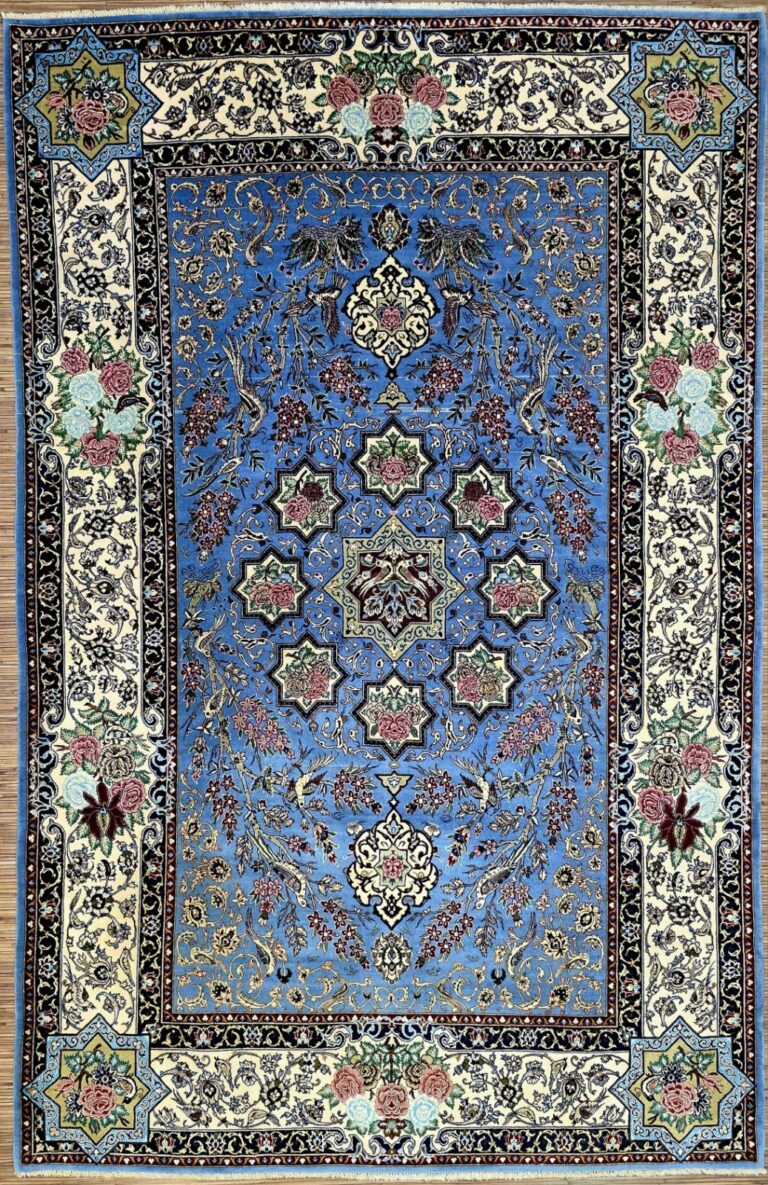
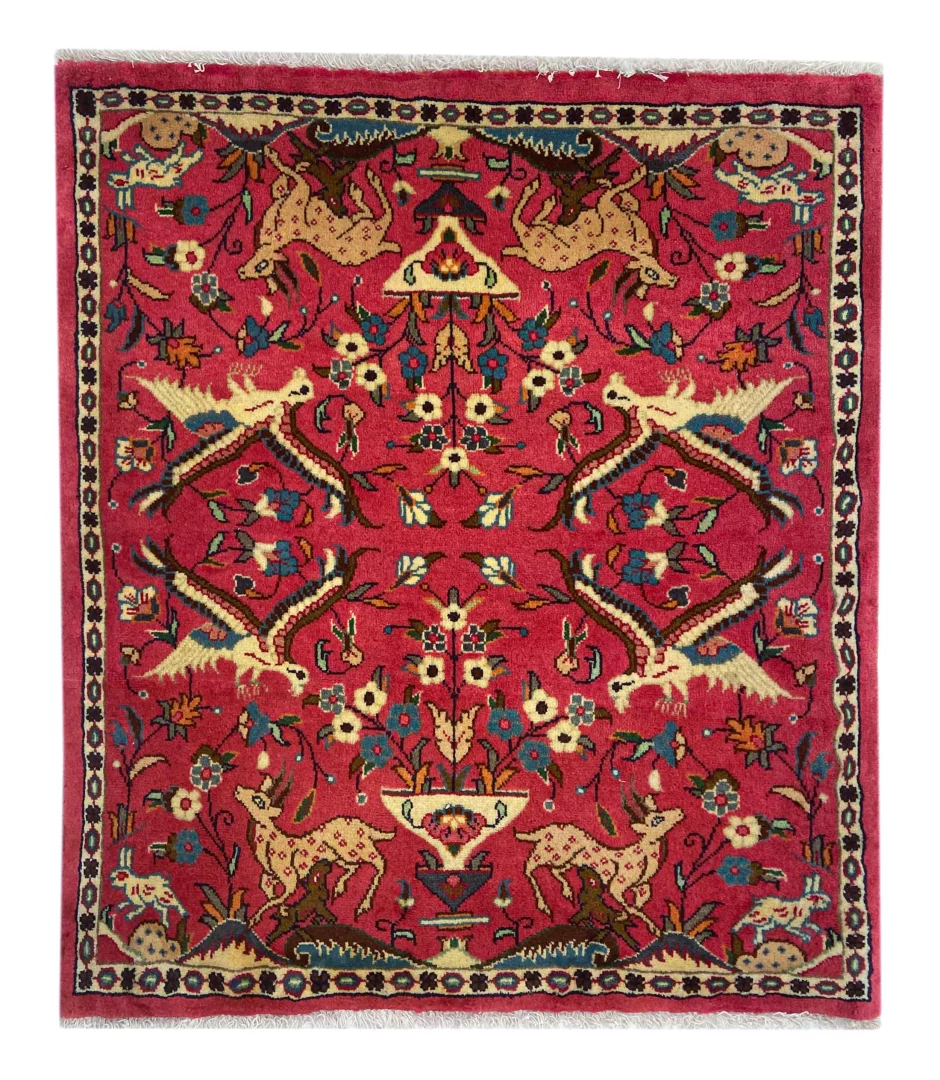
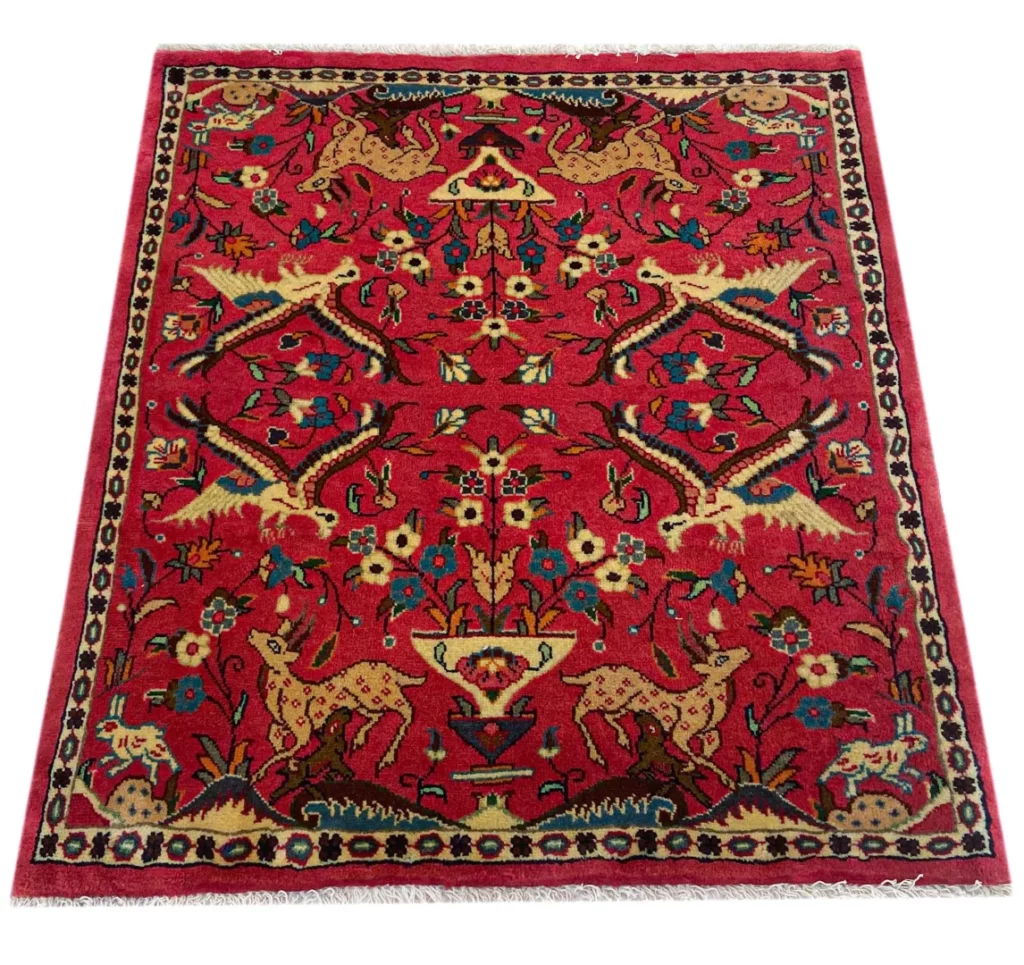
Hand-knotted Sarough Persian Rug | Knot density: 200,000 – 400,000 knots/m² | Material: pile high-quality wool | Size: 98 x 88 cm | Pattern: floral design in red and brown tones | Condition: Very good, sought after by collectors
This Sarough Persian Rug is hand-knotted and made of high-quality wool. Hand knotting is one of the defining features of Persian rugs: individual knots are inserted into the foundation, allowing the design to develop gradually across the textile. Unlike a machine-made rug, a hand-knotted piece reflects the particular execution of the person who made it while remaining rooted in an established regional tradition.
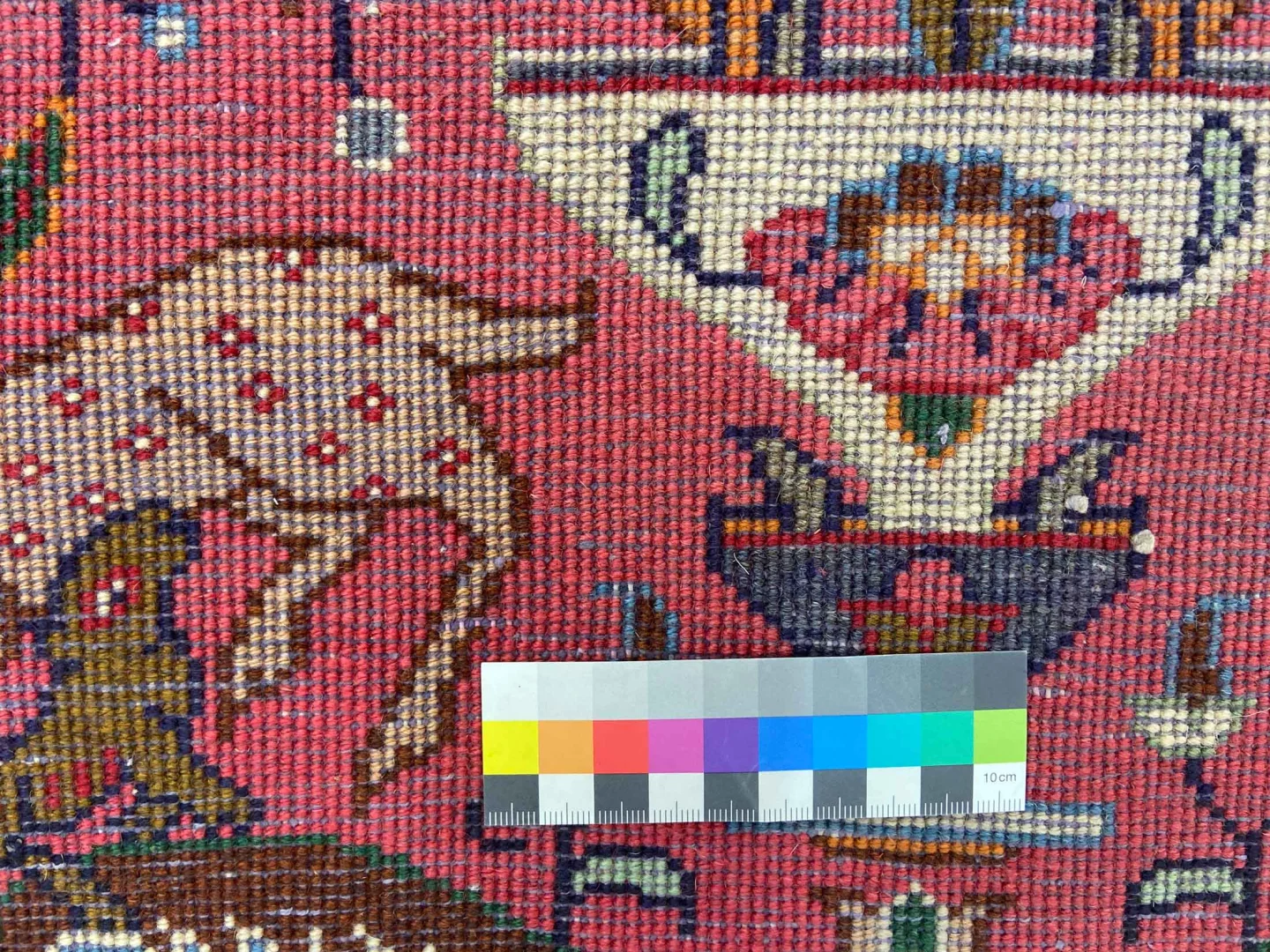
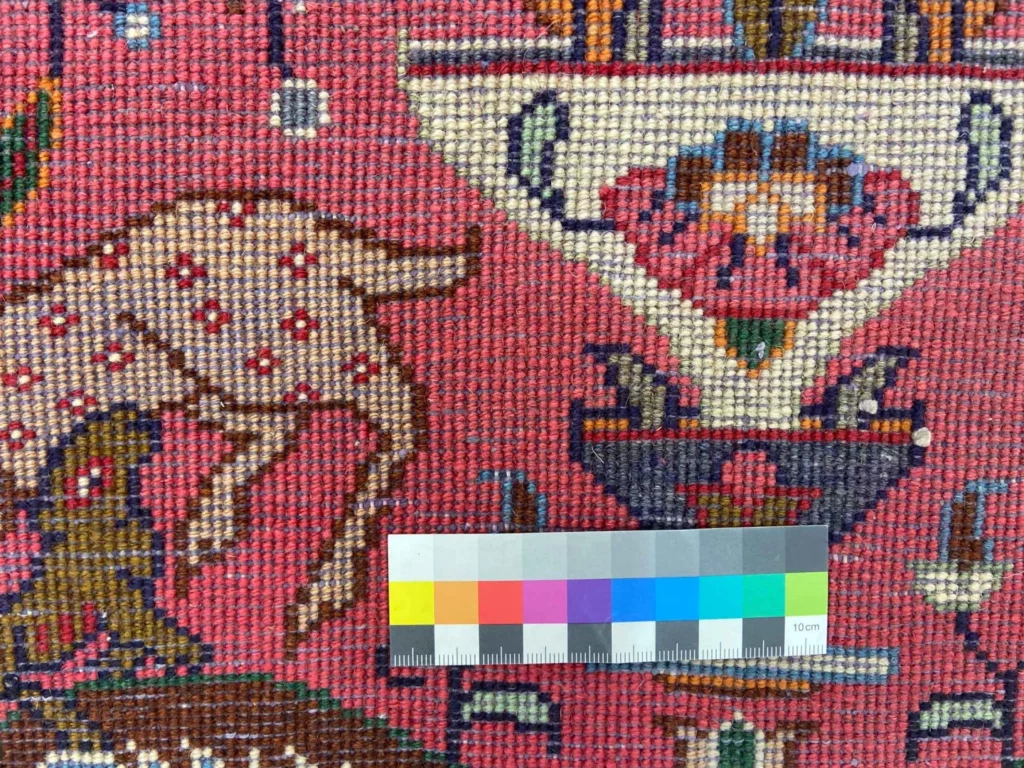
The knot density of this rug is between 200,000 and 400,000 knots per square metre. This density supports a finely worked surface and allows small floral details to be represented with clarity. The material specified for this individual rug is high-quality wool. Sarough rugs are also made with wool and, in some cases, silk; silk is not specified as a material for this particular piece.
Wool is widely used in Persian rug making because it is workable, resilient and pleasant to handle. It forms a substantial pile surface in which colour and ornament remain distinct. In a hand-knotted rug, the material and the knotting method are closely connected: the knots create the structure, while the wool provides the visible and tactile surface. This combination also means that rugs from the same region can show individual variations in detail.
Origin and Tradition
The rug comes from Sarough in northern Persia. Sarough is associated with a particular regional rug-making tradition rather than being merely a decorative label. Rugs from this area are known for hand-knotted construction, floral designs and intricate pattern work. The name Sarough therefore places this piece within the northern Persian tradition described for the region.
Persian rug making brings together practical textile skill and ornament passed down through generations. In a hand-knotted rug, the pattern is not printed onto a completed surface. It is created through the placement of coloured knots, so the composition has to be planned while the rug is being made. Outlines, repeated forms and colour relationships are built into the structure itself. This process gives the finished textile a surface in which the craft remains visible.
Sarough rugs are particularly connected with floral decoration and complex compositions. Nature-inspired forms can be arranged into a dense ornamental field, with flowers, leaves and winding stems forming relationships across the design. Repetition provides visual order, while variations in individual motifs keep the pattern from appearing mechanically uniform. The regional tradition is therefore recognizable through both its subject matter and its careful execution.
The northern Persian origin places this rug within an important area of Persian textile culture. Sarough rugs are described as being known for quality and distinctive designs. Their character comes from the interaction of regional weaving practice, detailed pattern planning and deliberate colour use. Rugs from the same origin may differ in composition while still sharing the visual language associated with Sarough.
Other Persian rug traditions mentioned alongside Sarough include Kerman, Tabriz and Isfahan. Kerman rugs are known for detailed designs and soft colours. Tabriz rugs are often associated with large medallions and complex floral motifs. Isfahan rugs combine traditional and modern elements and are known for their exquisite use of silk. These are separate regional traditions; they provide context for Persian rug culture but do not change this rug’s stated origin as Sarough.
Design and Pattern
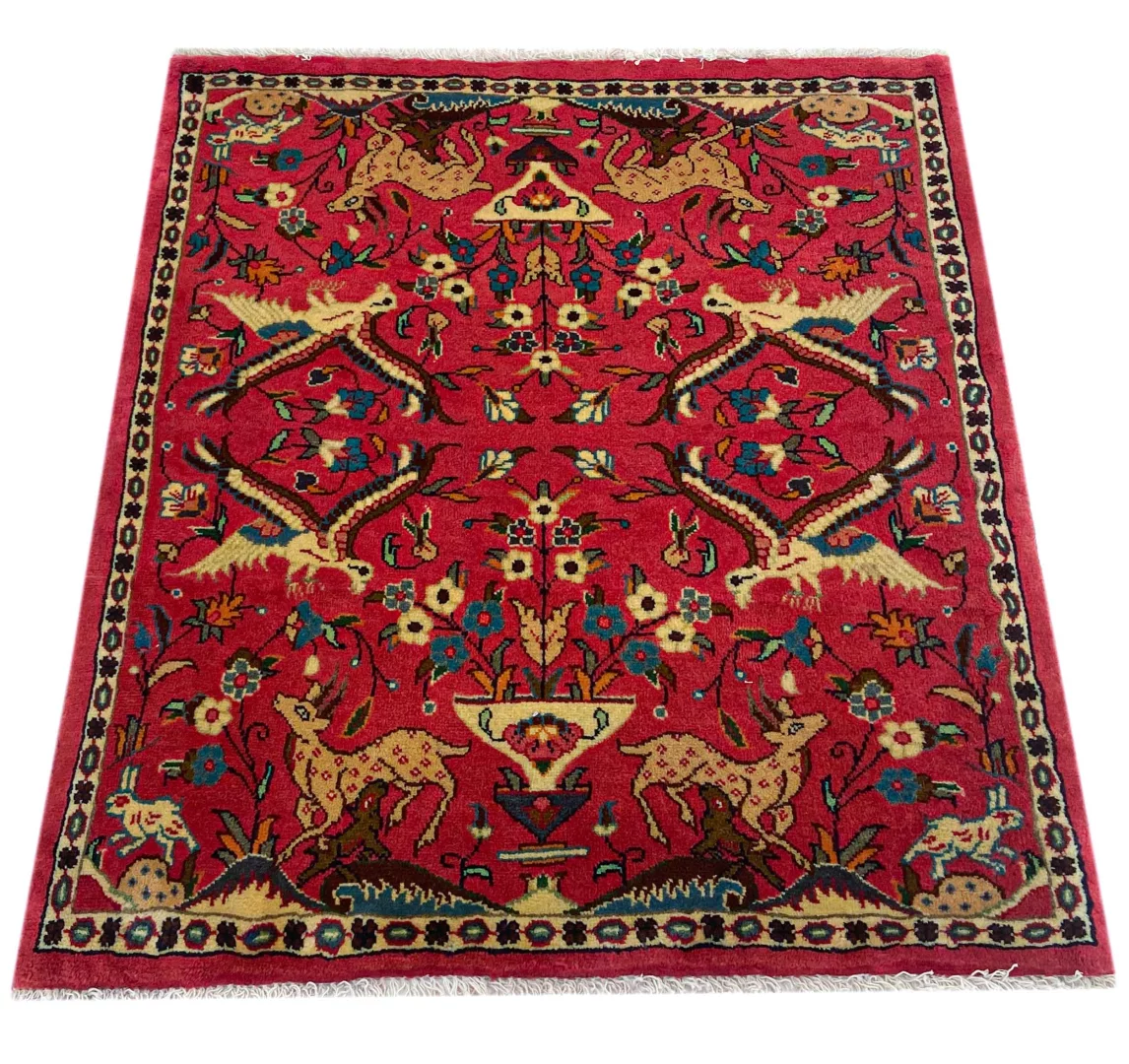
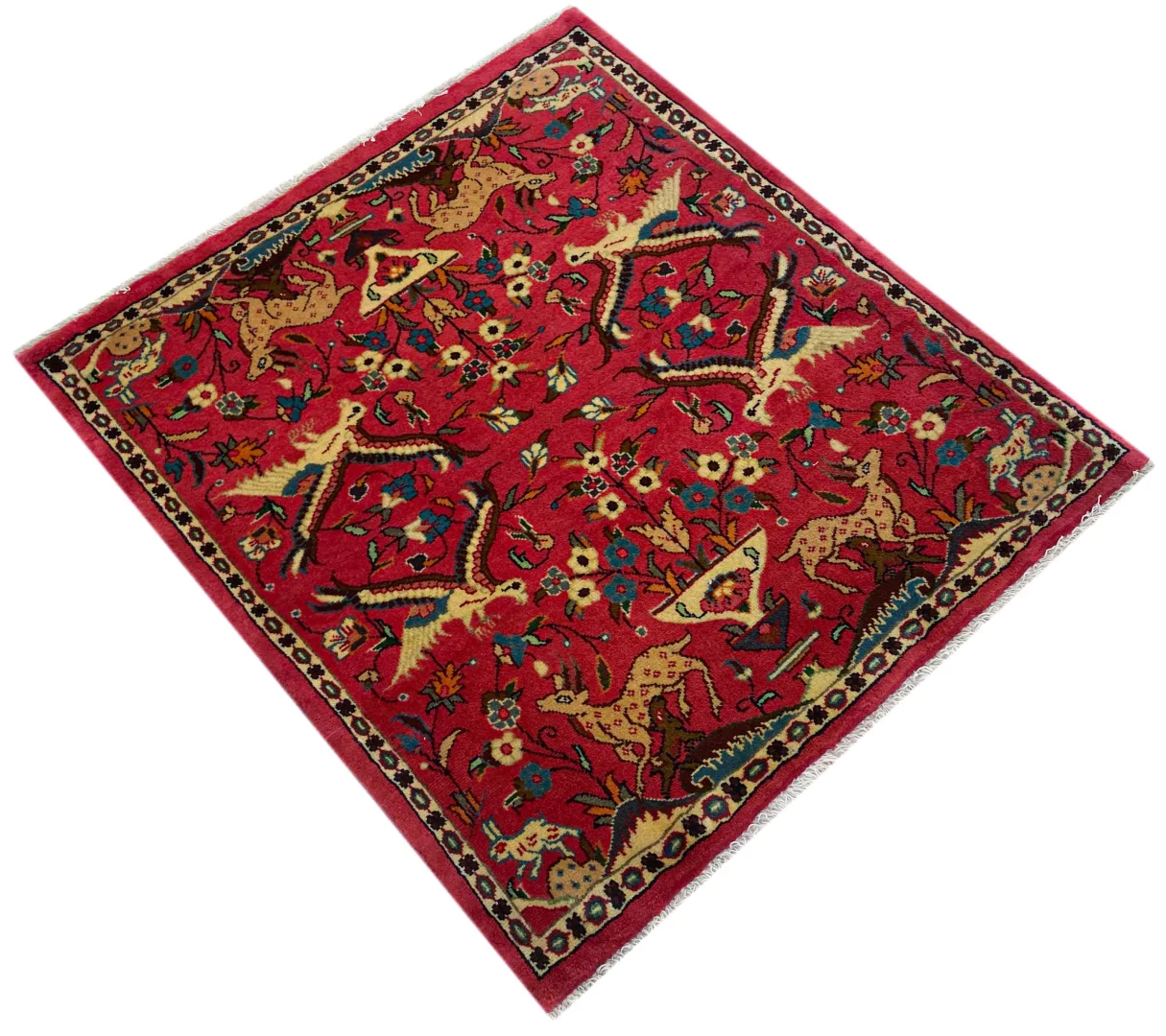
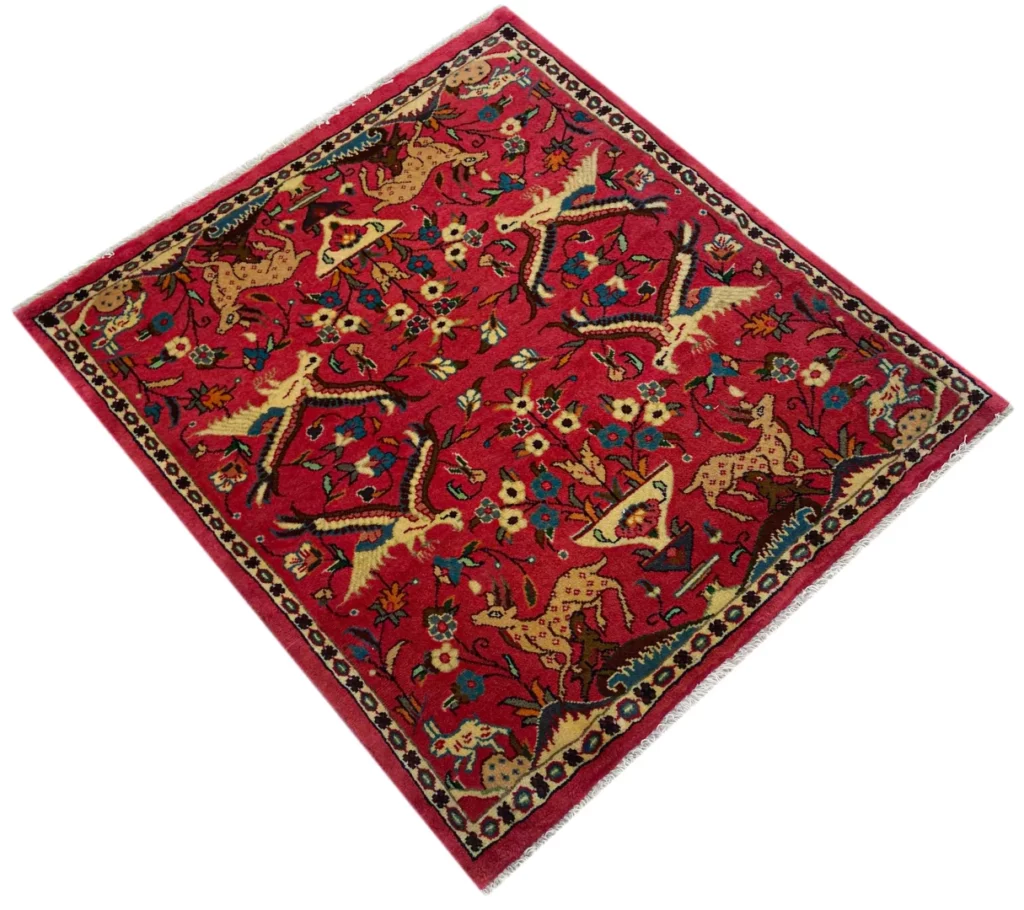
This individual rug has a floral design in red and brown tones. These colours establish the main visual character, while the floral subject places the piece within a pattern language strongly associated with Sarough. The design is specifically described as floral, rather than geometric or abstract, so the focus is on plant-inspired ornament and its arrangement across the surface.
Floral Sarough compositions may bring together flowers, leaves, vines and scrolling botanical forms. Within the regional tradition, such elements can be organized into a connected ornamental field. Repeated motifs create continuity between different areas of the design, while careful knotting allows outlines and smaller details to remain legible. The pattern is decorative, but it also records the planning and precision involved in making the rug by hand.
Red is frequently used as a significant colour family in Persian rug design, while brown introduces an earthy and more subdued counterpoint. For this rug, red and brown tones are the stated colours. Their combination gives the floral pattern a warm, grounded appearance. The colour description identifies the palette without implying a particular dye source or making a claim about a specific shade beyond the red and brown tones named for the piece.
The floral design also helps explain why Sarough rugs can work with both traditional and contemporary interiors. Botanical ornament carries a clear connection to Persian decorative practice, yet it can also provide a structured surface in a modern room. Sarough rugs are described as suitable for classic as well as contemporary living concepts, including living rooms, bedrooms and stylish offices. The setting may change, while the regional pattern vocabulary remains visible.
Hand knotting gives the floral design a textile depth that comes from the arrangement of the knots rather than from a printed image. The final appearance depends on the relationship between the specific colours, the individual motifs and the way the pattern was executed. This is why the Sarough tradition can remain recognizable without every rug from the area having an identical composition. The floral design in red and brown tones is the defining pattern information for this piece.
Special Features
This rug is in very good condition and is described as sought after by collectors. Its listed characteristics include an origin in Sarough in northern Persia, hand-knotted construction, high-quality wool, a high knot density and a floral design in red and brown tones. Together, these details identify the rug through its origin, workmanship, material and visual composition.
Sarough rugs are also described as durable and resistant. The combination of hand craftsmanship and wool is part of the rug’s stated character, while the floral colour scheme gives it a clearly defined decorative identity. It can be placed within either a classic or a contemporary interior concept. The collector interest and very good condition are specific details recorded for this individual rug.
FAQ
How should I care for my Sarough Persian Rug?
Regular vacuuming and occasional professional cleaning are recommended for a Sarough rug. Routine, careful vacuuming helps remove dust and everyday debris from the wool surface, while professional cleaning provides more thorough care when required. Direct sunlight should be avoided because it can cause the colours to fade. This is especially relevant to a rug with a floral design in red and brown tones, where the balance of the colours is an important part of its appearance.
What material is used for the Sarough Rug?
This Sarough is specified as being made of high-quality wool. Sarough rugs are primarily made from high-quality wool and are sometimes made with silk as well. Wool contributes to the tactile character and durability associated with a hand-knotted rug. For this particular piece, high-quality wool is the stated material; silk is part of the general description of Sarough rugs but is not specified for this rug.
Where can I buy an authentic Sarough Rug?
Authentic Sarough rugs can be found at specialist rug dealers or on online platforms that focus on handmade rugs from Persia. When choosing a piece, information about origin, knotting technique, material, knot density, pattern and condition is useful. For this rug, the key identifying details are Sarough in northern Persia, hand-knotted construction, high-quality wool, the floral design, and its very good condition.
To provide the best experiences, we use technologies like cookies to store and/or access device information. Consenting to these technologies will allow us to process data such as browsing behavior or unique IDs on this site. Not consenting or withdrawing consent, may adversely affect certain features and functions.
Functional Always active
The technical storage or access is strictly necessary for the legitimate purpose of enabling the use of a specific service explicitly requested by the subscriber or user, or for the sole purpose of carrying out the transmission of a communication over an electronic communications network.
Preferences
The technical storage or access is necessary for the legitimate purpose of storing preferences that are not requested by the subscriber or user.
Statistics
The technical storage or access that is used exclusively for statistical purposes.The technical storage or access that is used exclusively for anonymous statistical purposes. Without a subpoena, voluntary compliance on the part of your Internet Service Provider, or additional records from a third party, information stored or retrieved for this purpose alone cannot usually be used to identify you.
Marketing
The technical storage or access is required to create user profiles to send advertising, or to track the user on a website or across several websites for similar marketing purposes.

 SECURE PAYMENT
 SHIPPING PARTNERS