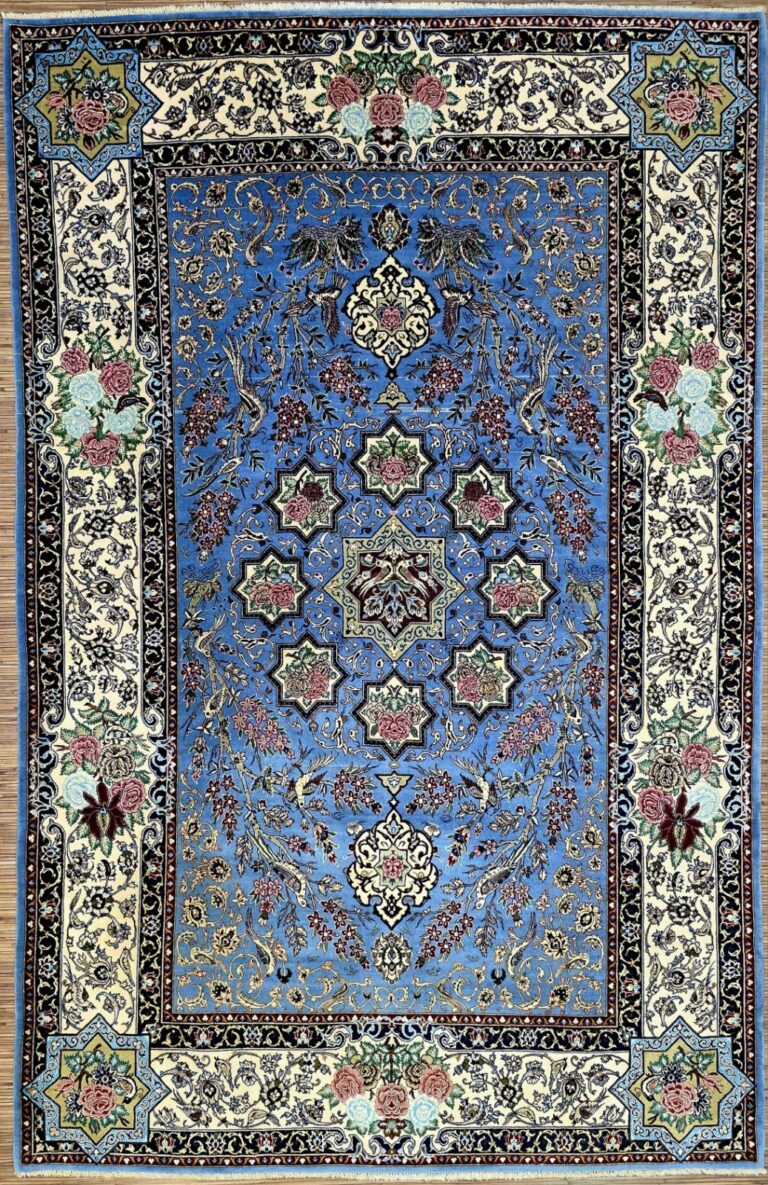
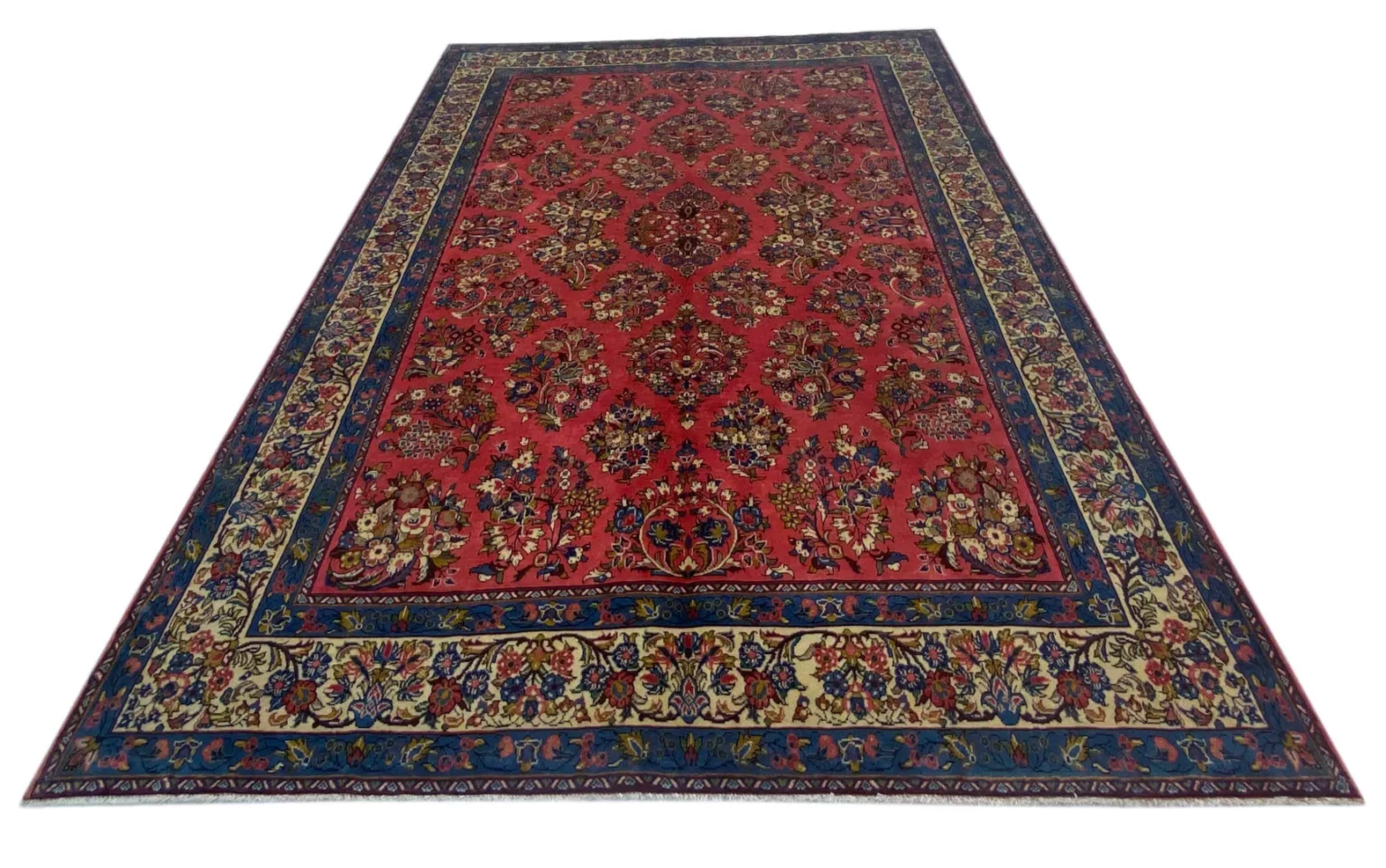
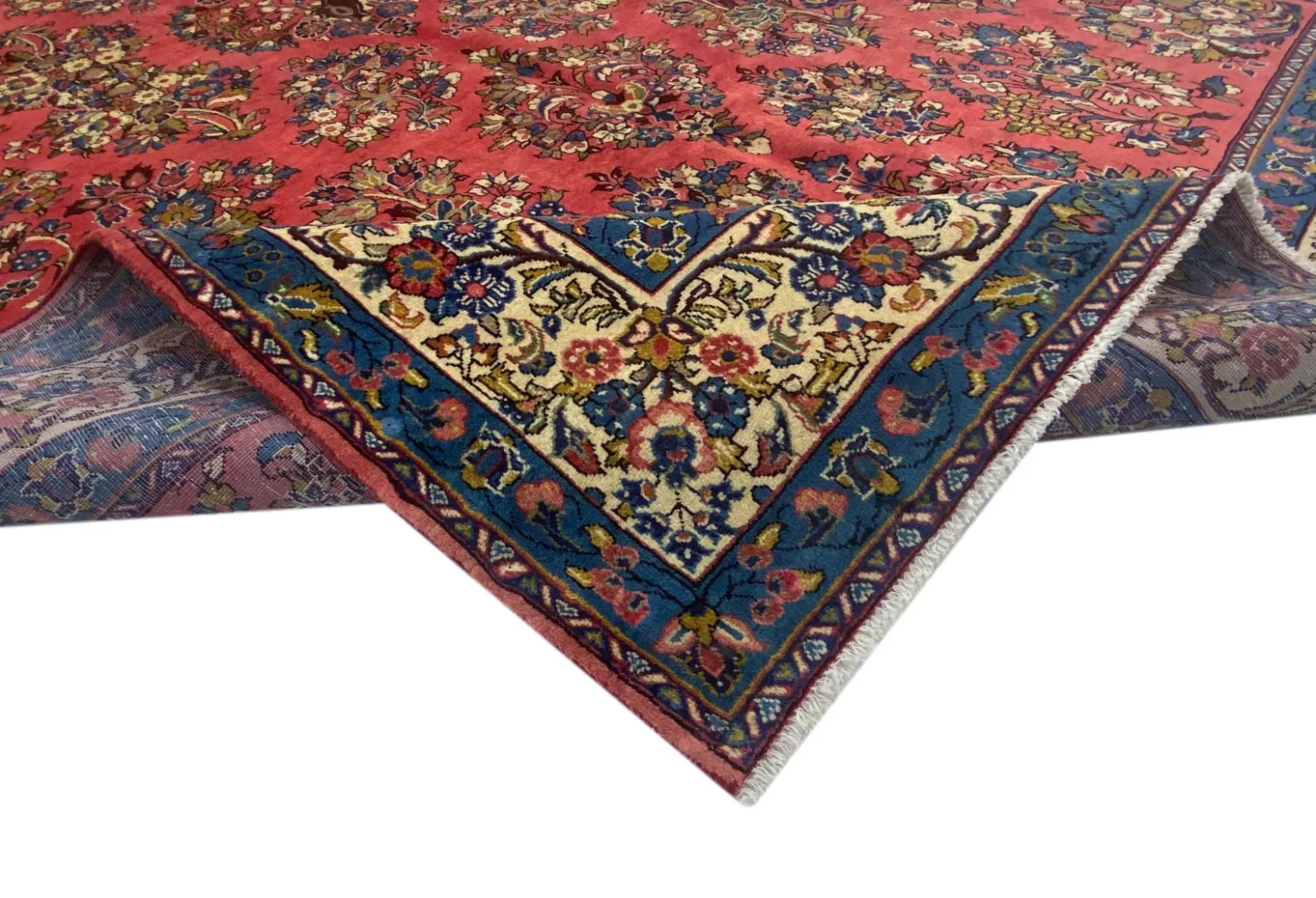
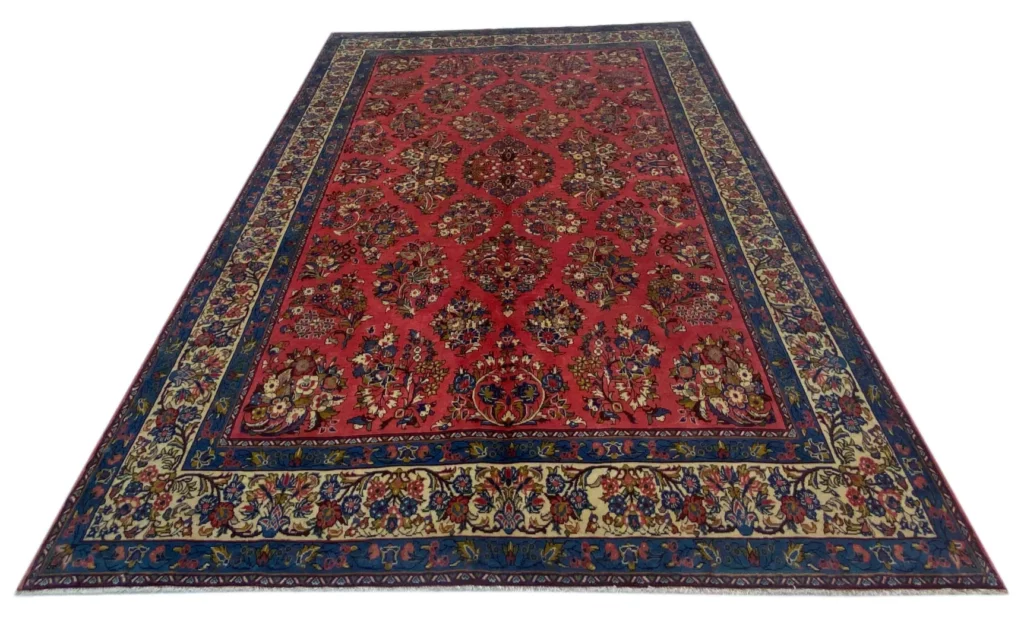
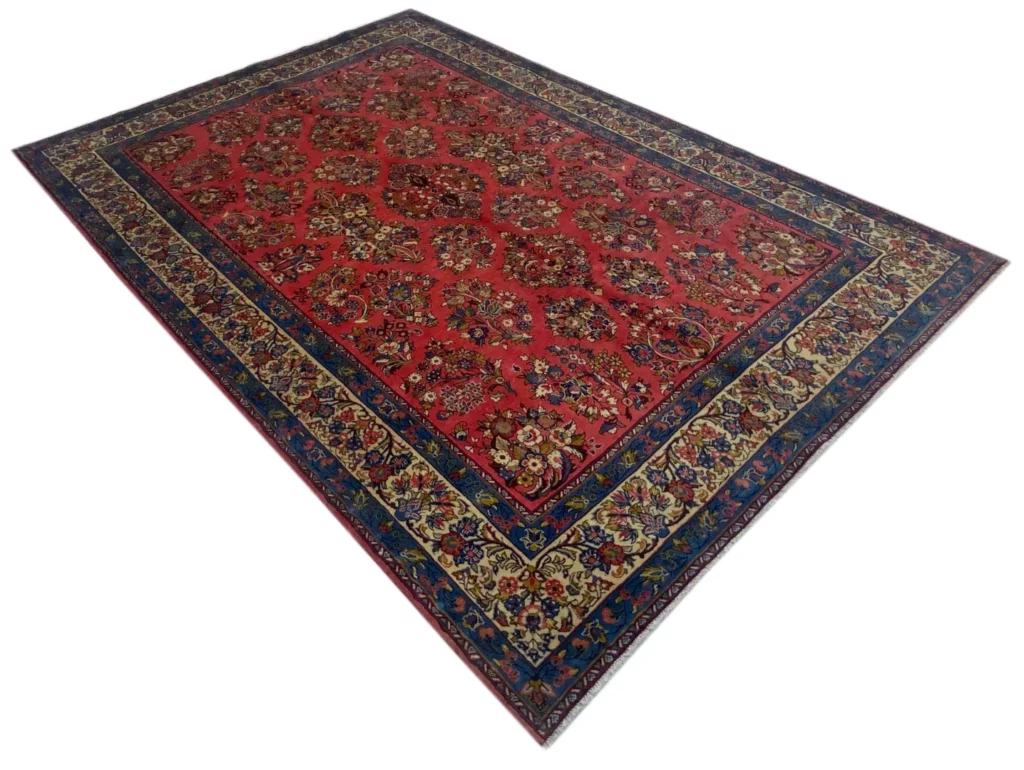
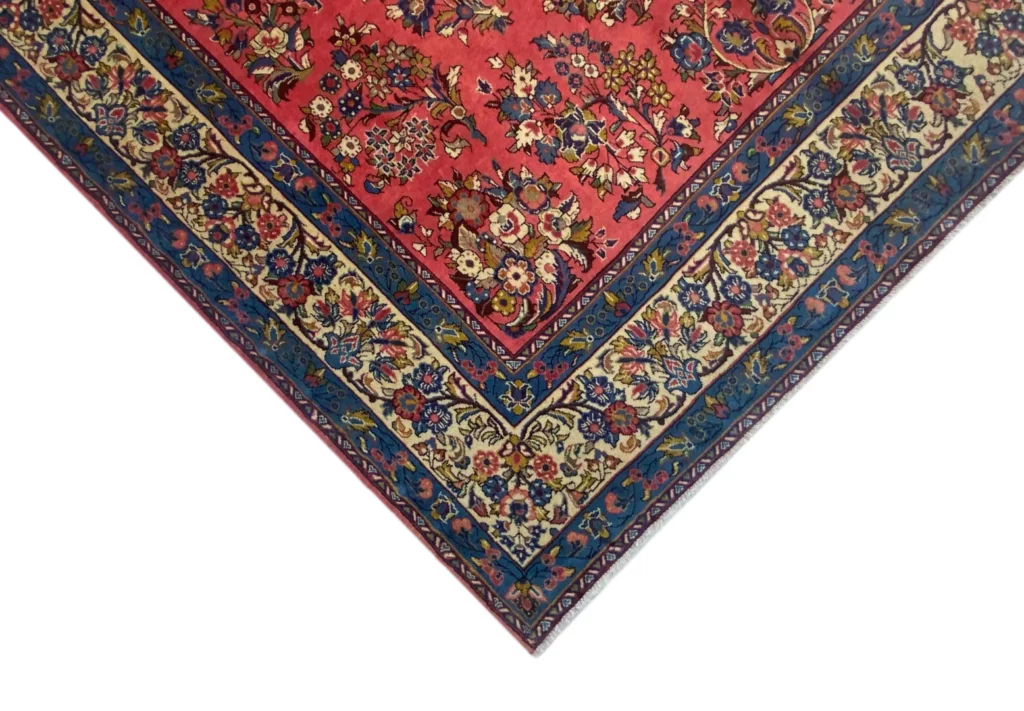
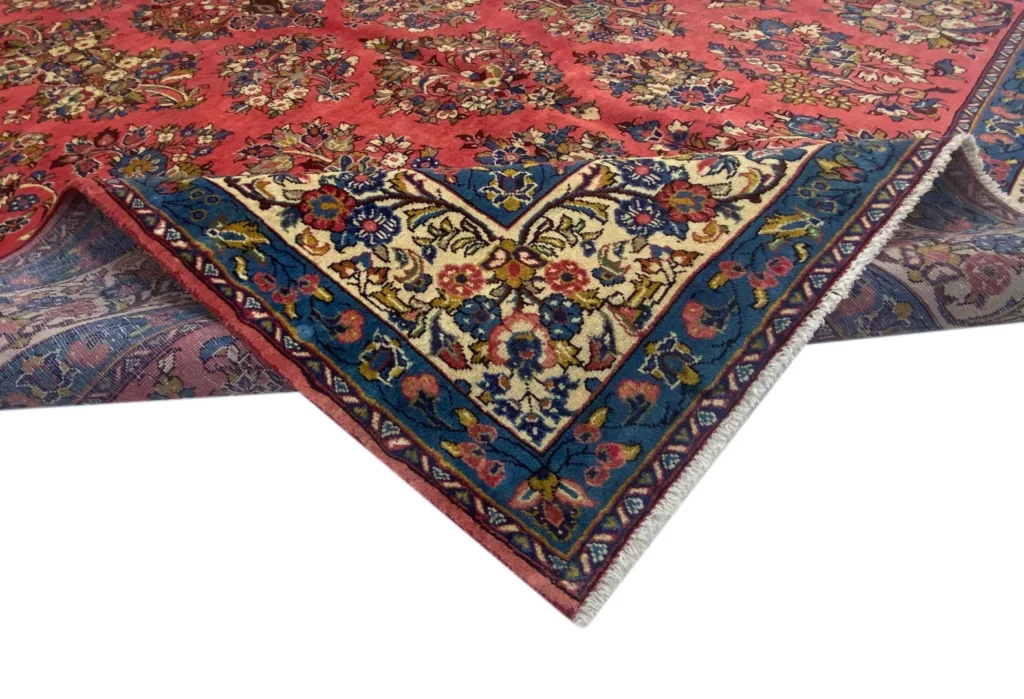
Hand-knotted Sarough Persian Rug | Knot density: 200,000 knots/m² | Material: pile wool | Size: 327 x 216 cm | Pattern: Floral design on red and brown ground tones | Condition: Very good
This Sarough Persian rug is hand-knotted and has a pile made from high-quality wool. The handmade construction links the material to a long-established method of Persian rug production. Each knot is placed by hand, row by row. The surface is therefore not a printed pattern applied to a finished textile, but a composition created through the actual arrangement of coloured knots.
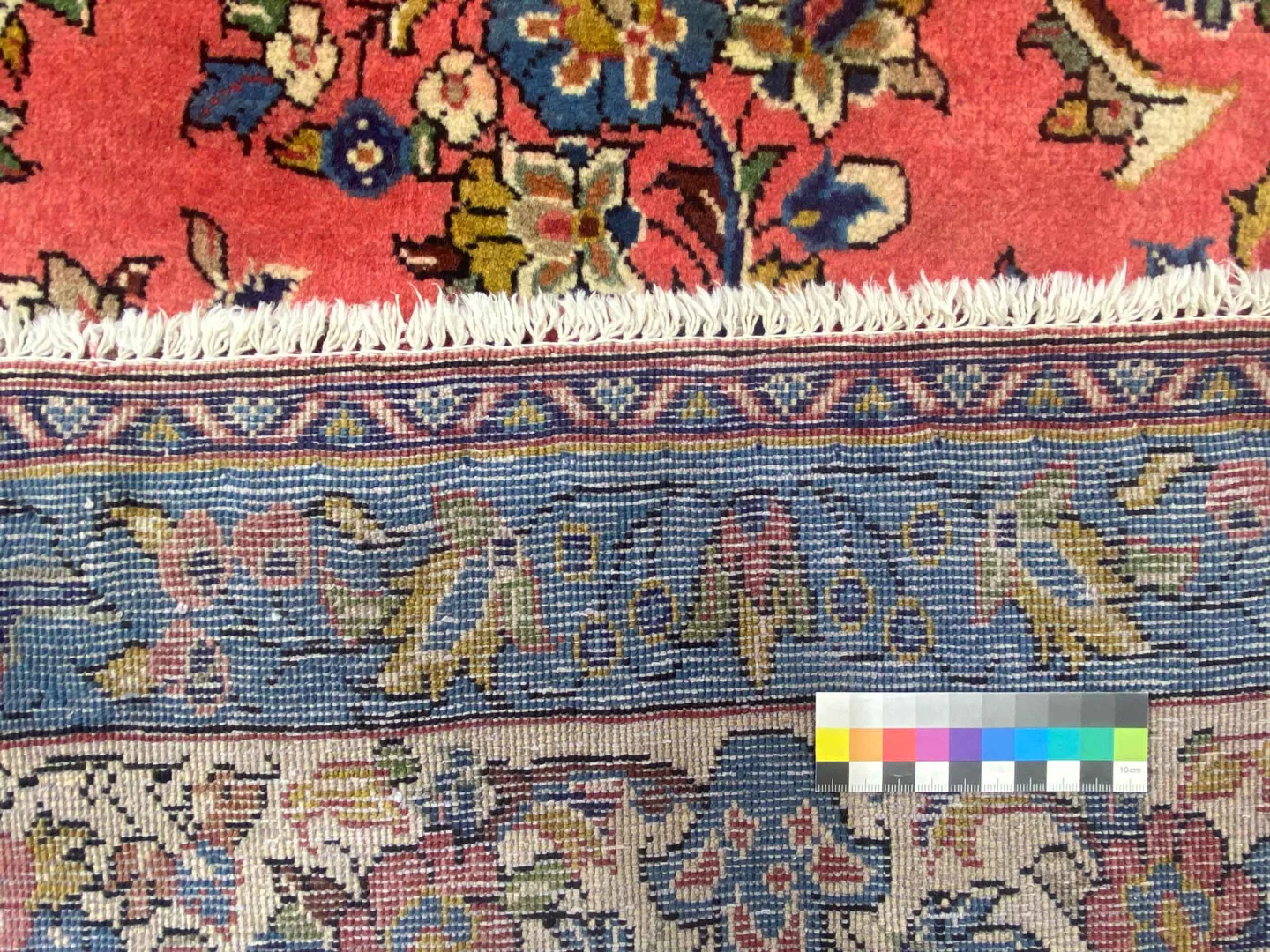
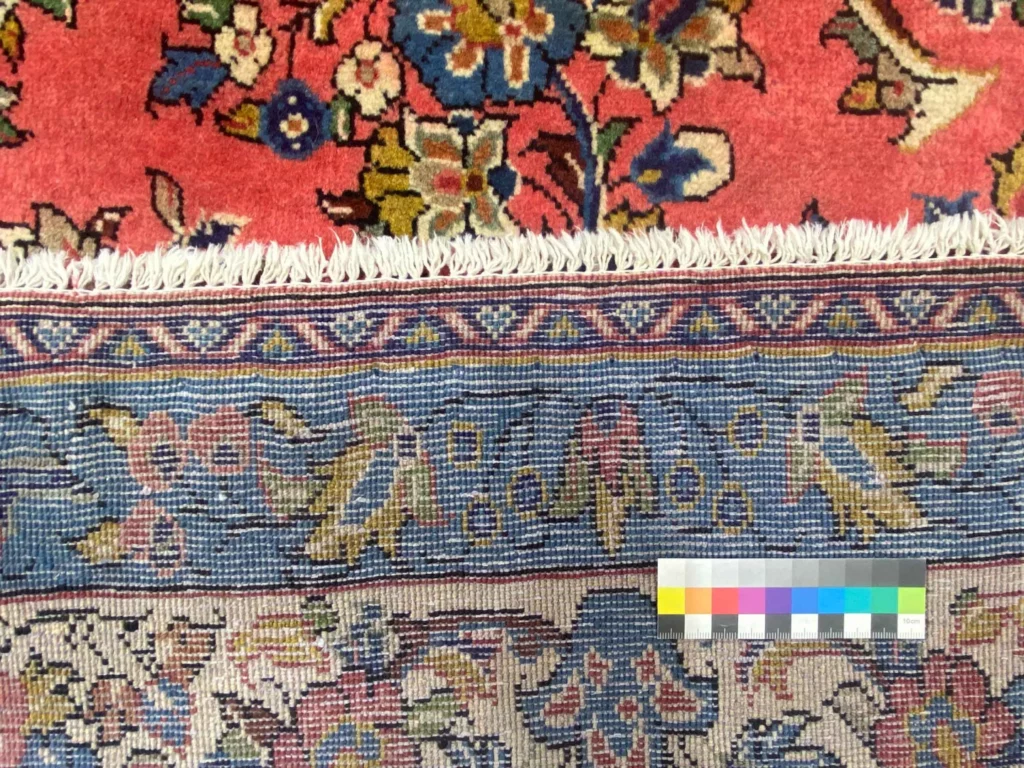
The rug has a knot density of 200,000 knots per square metre. This density supports the clear rendering of floral lines, leaves and other ornamental details. It also gives the textile a compact structure. Knot density is an important indication of technical construction, although it does not by itself determine the quality of a rug. Wool, knotting consistency and the care taken with the pattern are equally relevant to the finished result.
Wool is widely used for the pile of Persian rugs because it is durable and pleasant to the touch. It accepts dyes evenly and works well for patterns made from layered fields, outlines and subtle colour changes. In a hand-knotted rug, the character of the material remains connected to the construction: the design is built knot by knot, while the pile creates the tactile surface that can be seen and felt.
The condition of this rug is described as very good. That description adds information about the preservation of this particular piece to the details of its construction. Hand-knotting, a wool pile and the stated knot density together give a precise account of how it was made. A separate warp material is not stated and is therefore not specified here.
Origin and Tradition
Sarough is located in northern Persia and is associated with a distinctive tradition of Persian rug making. Sarough rugs are especially known for floral compositions set against warm red or brown grounds. This combination of regional identity and floral decoration is central to the classification of this piece. It is a Persian rug from Sarough, rather than simply a rug carrying a borrowed decorative name.
Persian rug production developed over many generations in different towns and regions. Each weaving area developed preferences for borders, medallions, field arrangements, colours and repeat motifs. In Sarough, floral decoration often takes a prominent role alongside the overall structure of the field. That does not mean that every Sarough rug looks alike. Regional ideas are interpreted through individual layouts, working methods and the decisions made during knotting.
A hand-knotted rug begins with a stretched foundation. Knots are inserted in successive rows and secured with weft threads. The pile is then trimmed so that the design can be read across the surface. This process gives hand-knotted rugs a textile depth that differs from machine-made production. It also explains why the precise character of a motif reflects the experience and working style of the person who made it.
The name Sarough points to a northern Persian weaving tradition, while the term Persian rug places the piece within Iranian rug culture. Sarough rugs are particularly appreciated on the European market. There, the warm palette, floral ornament and practical character of wool rugs have long formed part of the way this regional tradition is understood. Tradition is not a rigid template; it provides a framework for many individually executed rugs.
Other recognised Persian origins demonstrate the breadth of the country’s rug culture. Tabriz is associated with complex patterns and vivid colours, while Kashan has a long history of refined rugs in which silk may also play a role. These examples place Sarough within the wider Persian tradition and do not change the origin of this rug. The origin of this piece is Sarough in northern Persia.
Design and Pattern
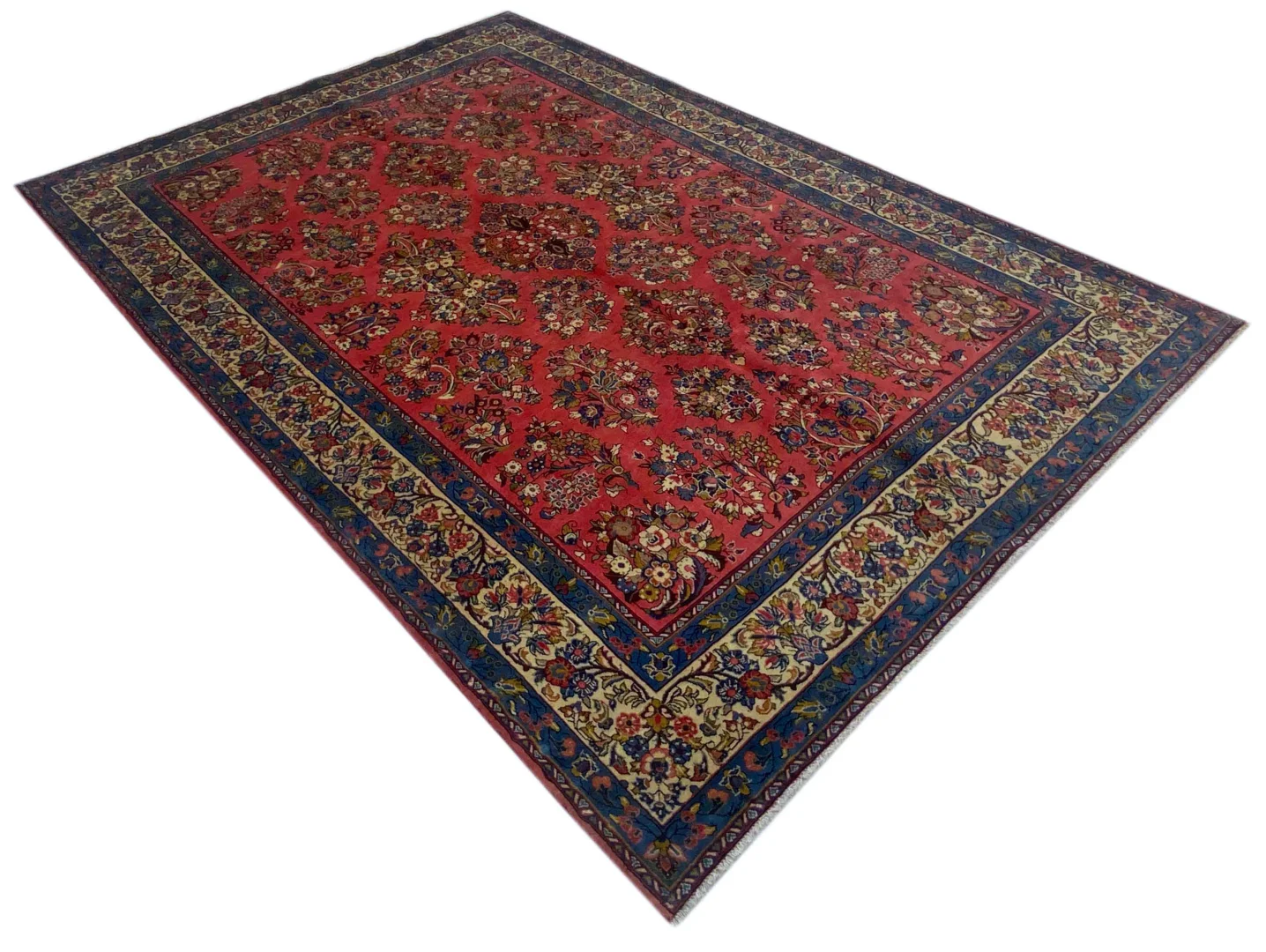
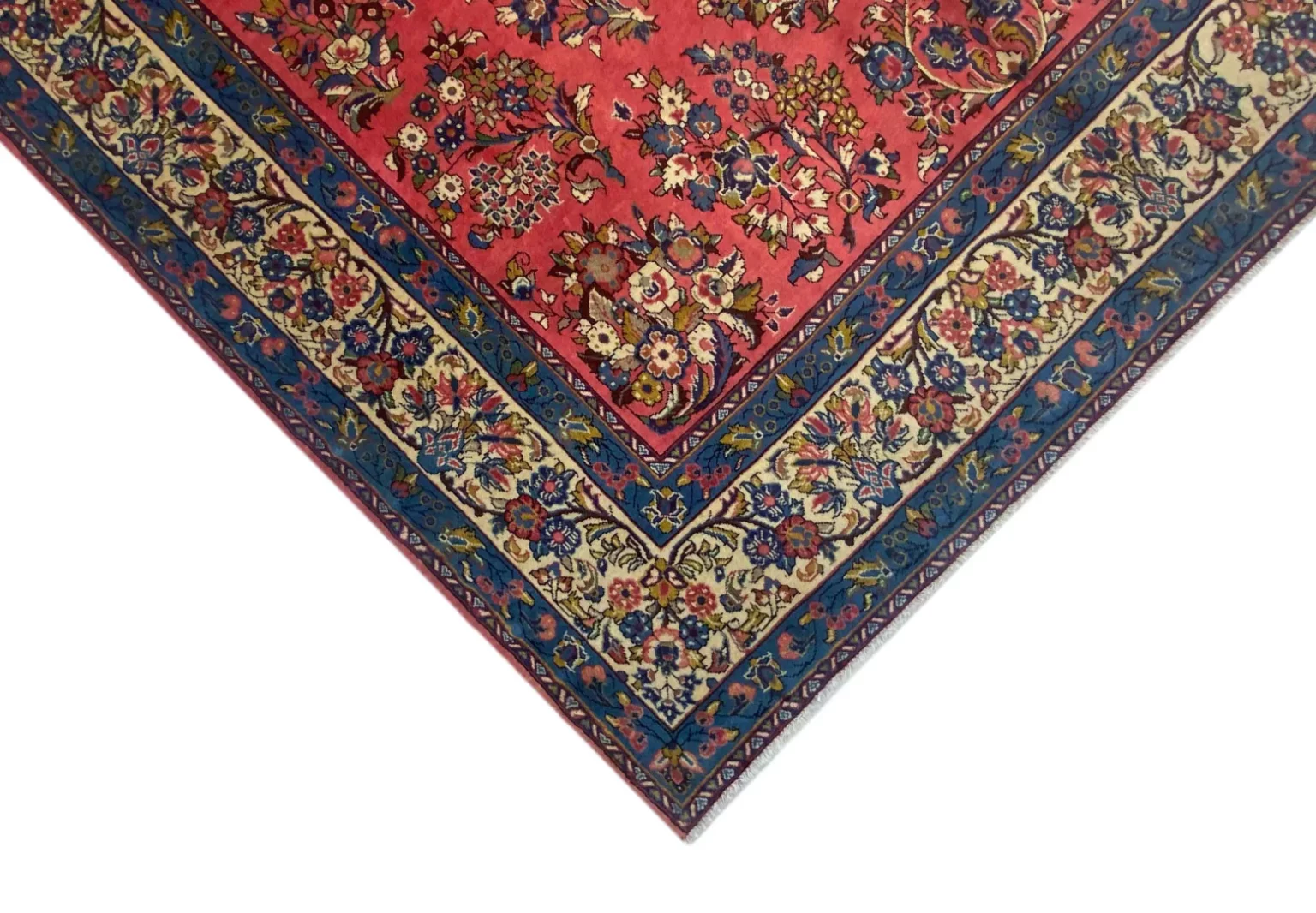
The pattern of this rug is described as a floral design on red and brown ground tones. Plant forms and a warm colour impression therefore define its visible character. Floral Persian designs may combine blossoms, leaves, vines and curved stems. Repetition and balance create a connected field that organises the surface without reducing it to a strictly geometric grid.
Curved lines give floral ornaments an organic quality. Blossoms may appear as separate accents or be incorporated into scrolling vines. Leaves fill spaces and create transitions between larger and smaller elements. Persian ornament frequently distributes such forms with symmetry or rhythm. The result is a coherent field in which many moving lines can still appear ordered.
Red grounds are among the recognisable colours of many Persian rugs. They can range from deep, dark tones to warmer and lighter variations. Brown adds an earthy and more restrained companion to this palette. Red and brown ground tones are specifically stated for this rug. No particular medallion, border, flower type or additional colour is specified, so no further individual design feature is assigned to the piece.
Floral decoration has a long history in Persian visual culture. Plant ornaments may suggest growth, order and a relationship with nature. In rug design they also perform a structural task: they distribute attention across the field and connect central areas with the surrounding zones. The same general principle can look very different depending on the region, the design and the individual execution.
The knot density of 200,000 knots per square metre supports the rendering of relatively fine contours. Small changes in the placement of knots can affect the course of a vine or the outline of a leaf. The design is therefore created not only by the chosen colours, but also by the precise placement of the wool. In a hand-knotted one-off, the relationship between the drawn idea and its physical execution remains part of the rug’s character.
Floral decoration in red and brown tones can, as a general design matter, work with both traditional and more contemporary interiors. This describes the visual effect of the colour family rather than a particular room. The defining information for this piece remains its floral design and its red and brown ground tones.
Special Features
The clearly stated characteristics are its origin in Sarough in northern Persia, its hand-knotted construction, its high-quality wool pile and its knot density of 200,000 knots per square metre. The floral design and the red and brown ground tones are further defining features. The rug is in very good condition. These details describe the particular piece without adding unsupported specifications.
Its identity comes from the combination of regional origin, dense handwork and floral decoration. Sarough provides the regional context, while wool forms the material basis of the pile. Because every hand-knotted rug is shaped by the person who executes the knots, the arrangement of details in an individual piece is not completely interchangeable with another rug. Silk accents or a particular warp material are not stated for this rug.
FAQ
How should I care for my Sarough Persian rug?
Vacuum the rug regularly to remove dirt and dust before they settle into the pile. If more thorough cleaning is needed, professional cleaning is recommended. This helps preserve the colours and the structure of the hand-knotted wool rug. Professional treatment is particularly appropriate when ordinary vacuuming is no longer sufficient for the required care.
Are Sarough rugs suitable for underfloor heating?
Yes. The wool used in Sarough rugs is suitable for rooms with underfloor heating. Wool stores warmth while remaining breathable. A wool rug can therefore also be used in a heated interior. This suitability relates to the wool pile, which is the material specified for this rug.
Can I use a Sarough rug outdoors?
Outdoor use is not recommended. Sarough rugs are not designed for extreme weather conditions. Moisture, intense sunlight and changing exposure can affect their colours and materials. To help preserve the very good condition described for this rug, it should be used indoors and protected from such stresses.
To provide the best experiences, we use technologies like cookies to store and/or access device information. Consenting to these technologies will allow us to process data such as browsing behavior or unique IDs on this site. Not consenting or withdrawing consent, may adversely affect certain features and functions.
Functional Always active
The technical storage or access is strictly necessary for the legitimate purpose of enabling the use of a specific service explicitly requested by the subscriber or user, or for the sole purpose of carrying out the transmission of a communication over an electronic communications network.
Preferences
The technical storage or access is necessary for the legitimate purpose of storing preferences that are not requested by the subscriber or user.
Statistics
The technical storage or access that is used exclusively for statistical purposes.The technical storage or access that is used exclusively for anonymous statistical purposes. Without a subpoena, voluntary compliance on the part of your Internet Service Provider, or additional records from a third party, information stored or retrieved for this purpose alone cannot usually be used to identify you.
Marketing
The technical storage or access is required to create user profiles to send advertising, or to track the user on a website or across several websites for similar marketing purposes.

 SECURE PAYMENT
 SHIPPING PARTNERS