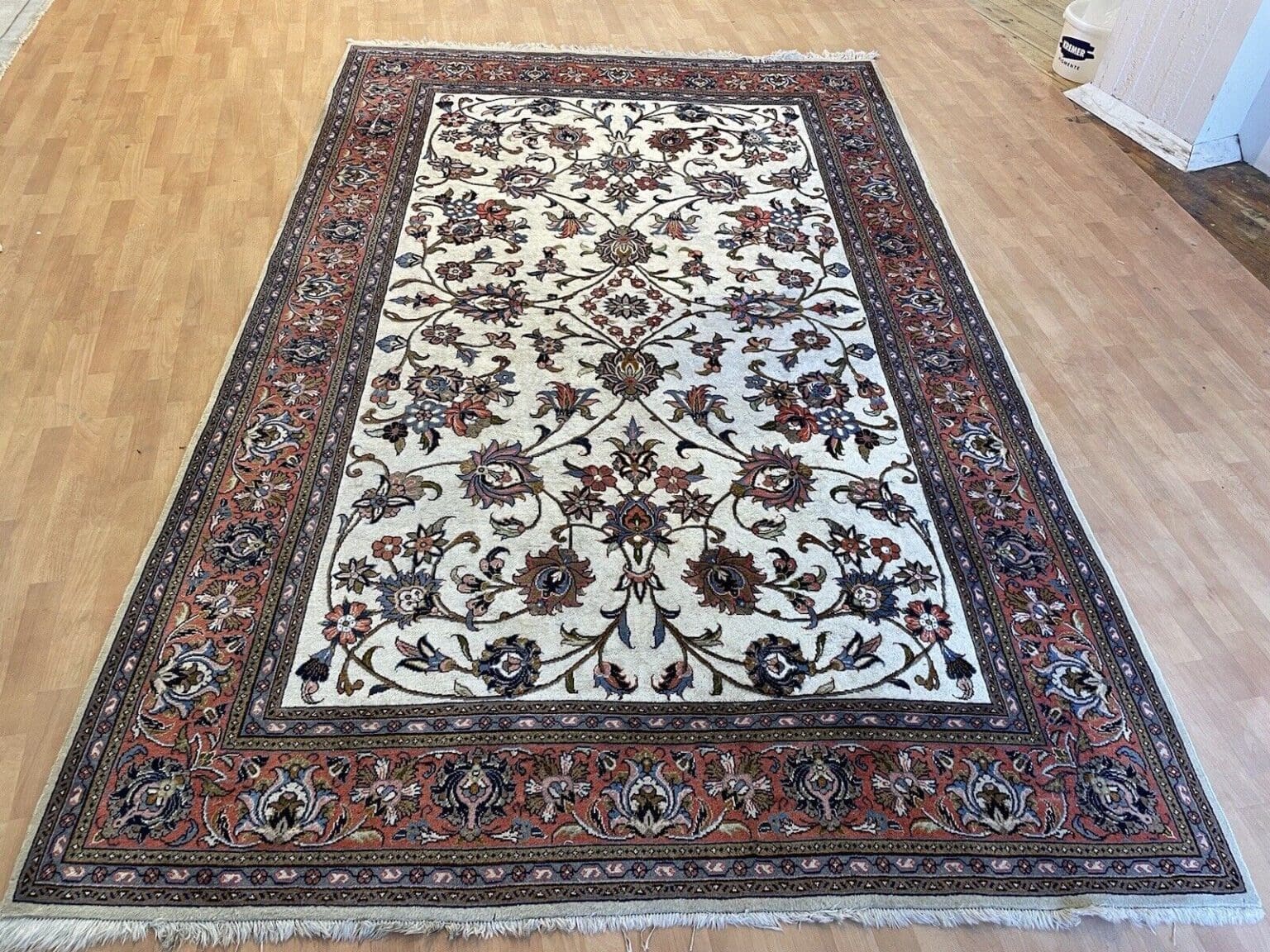
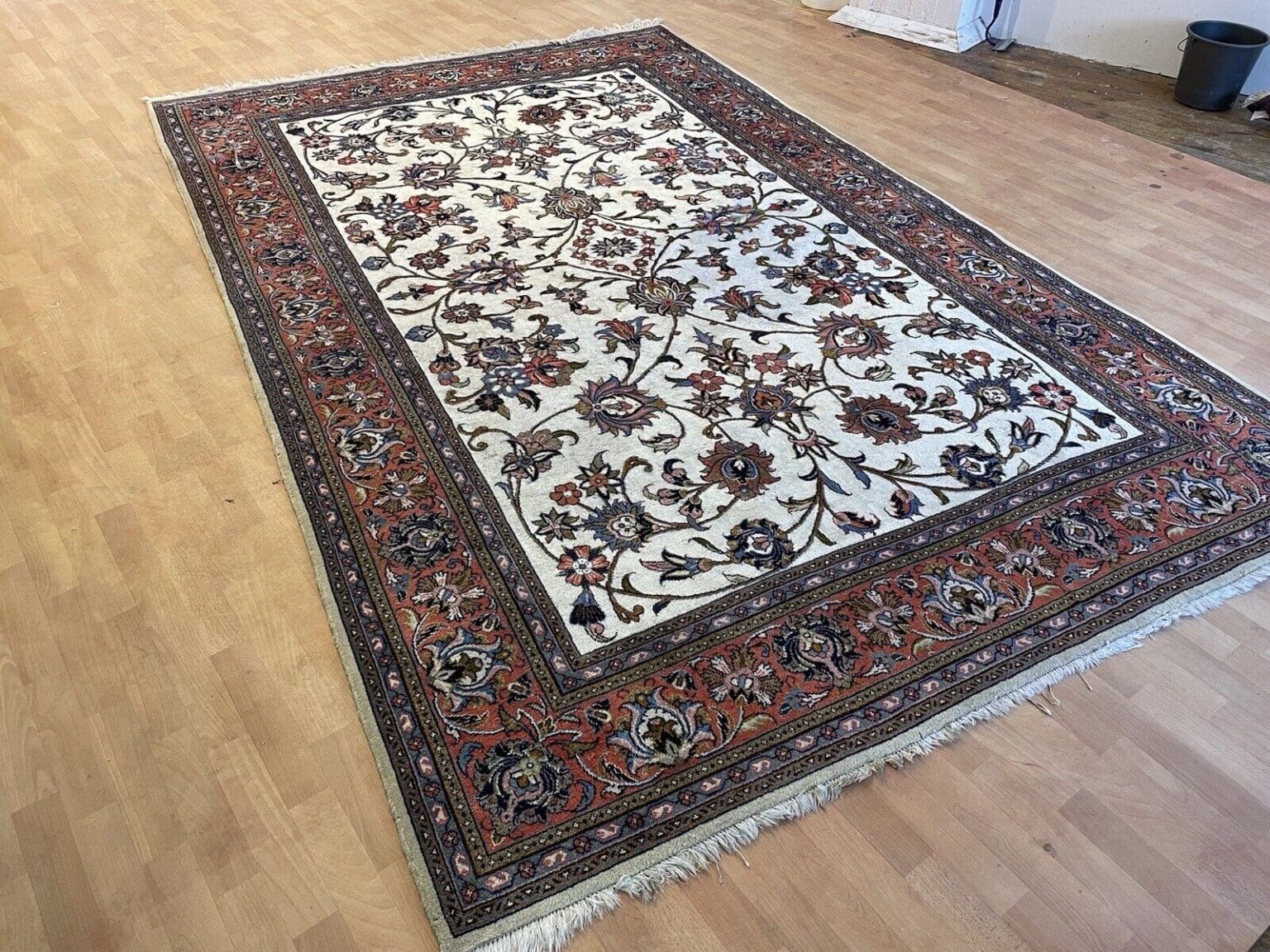
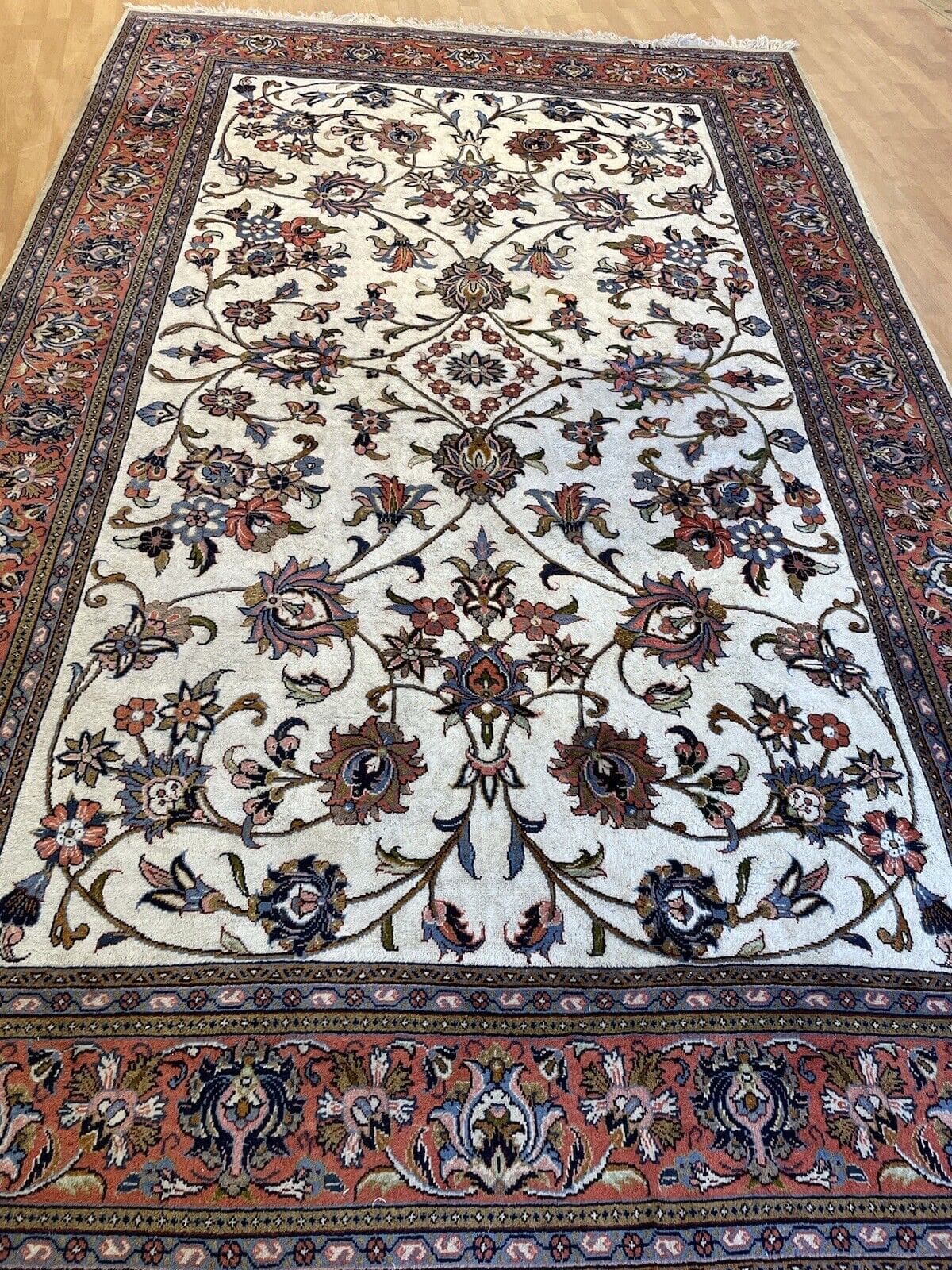
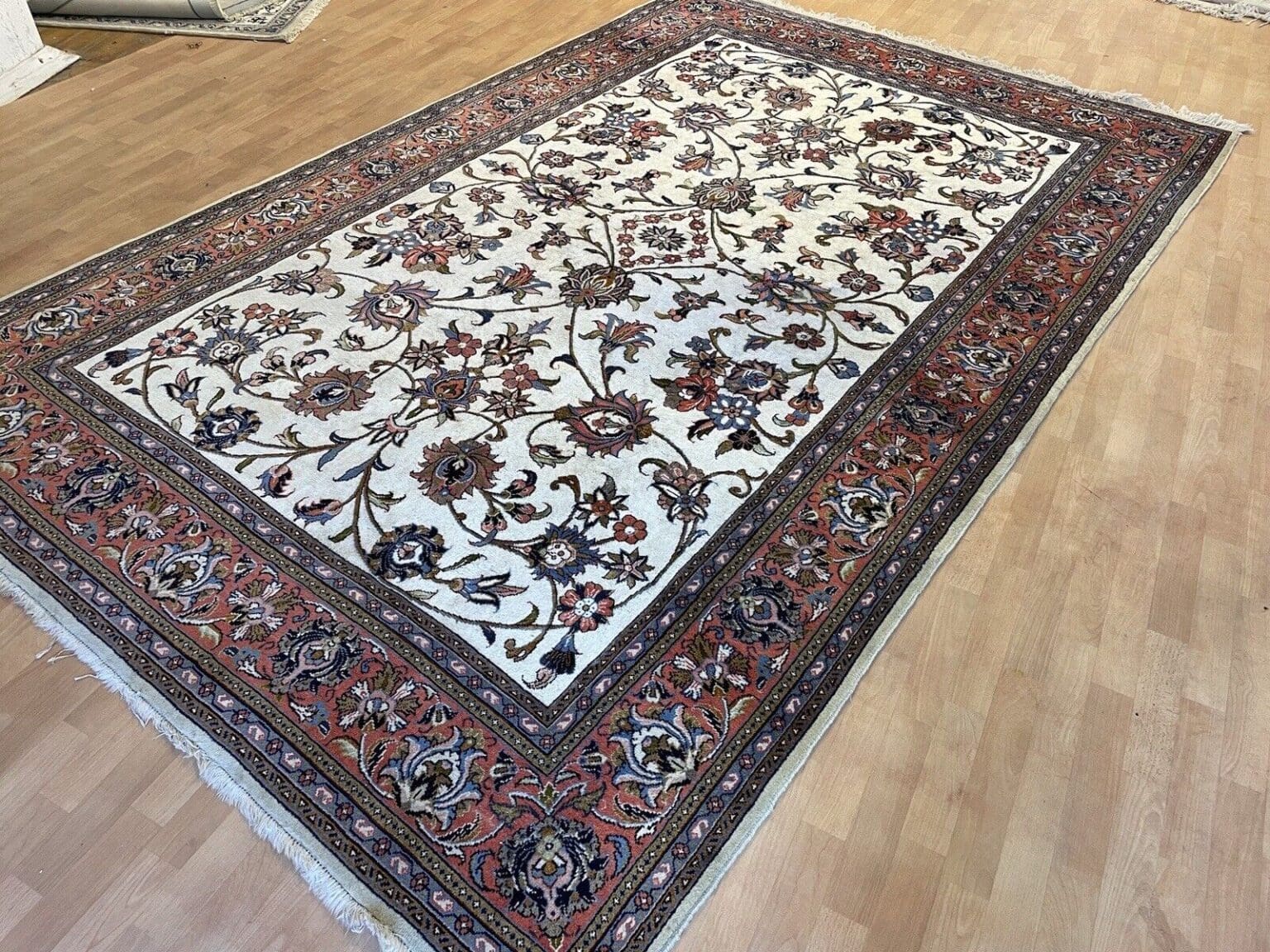
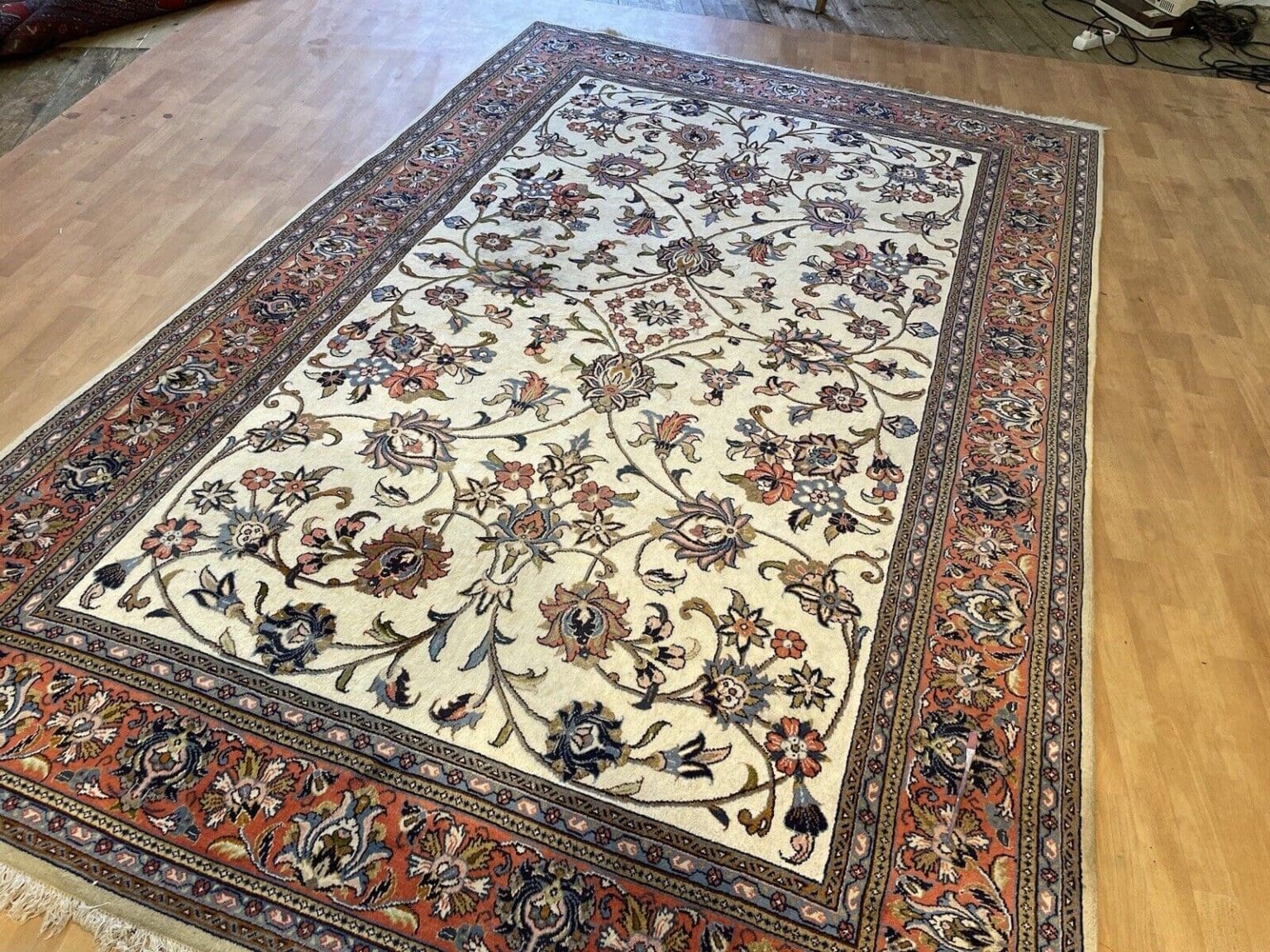
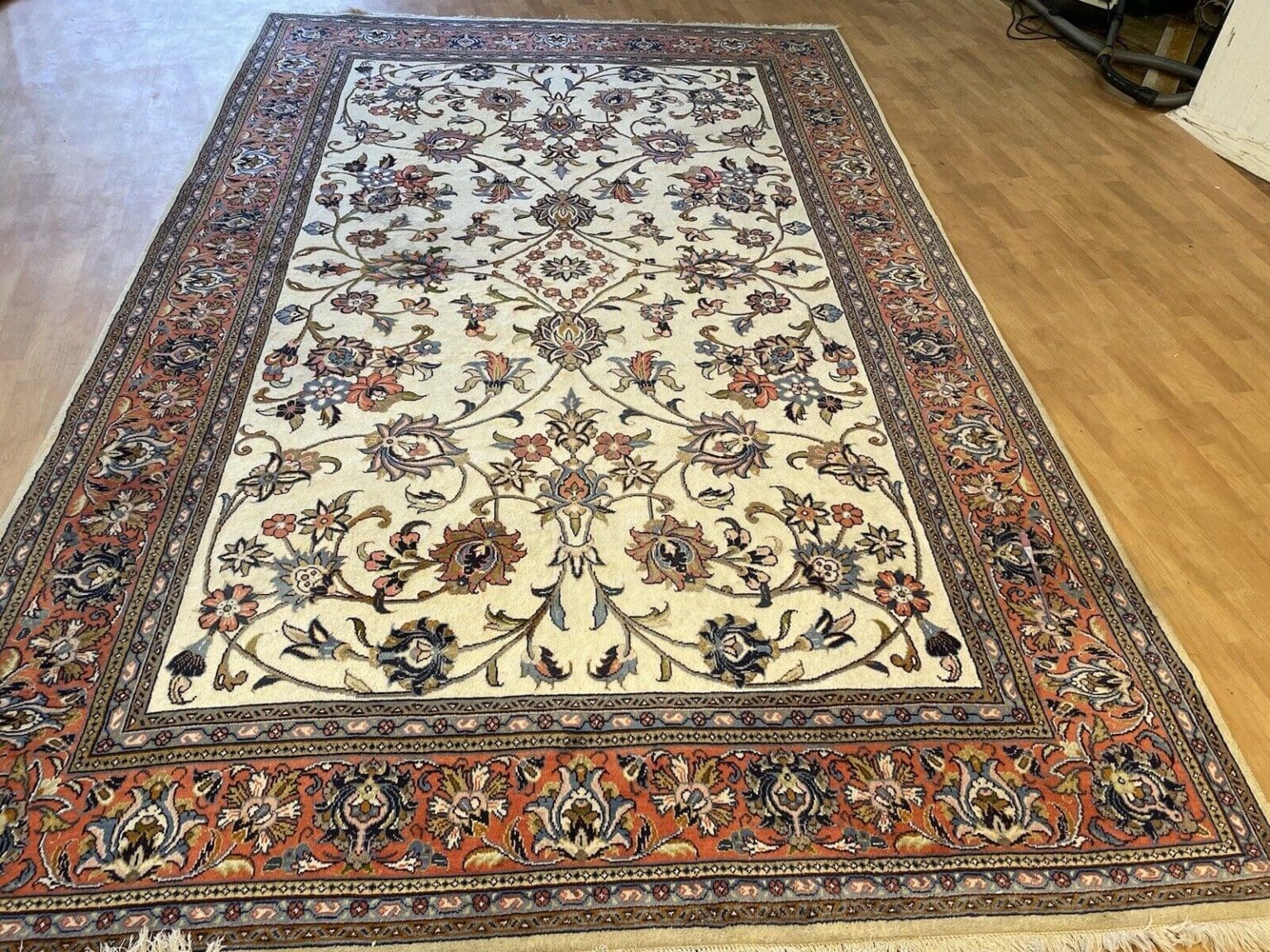
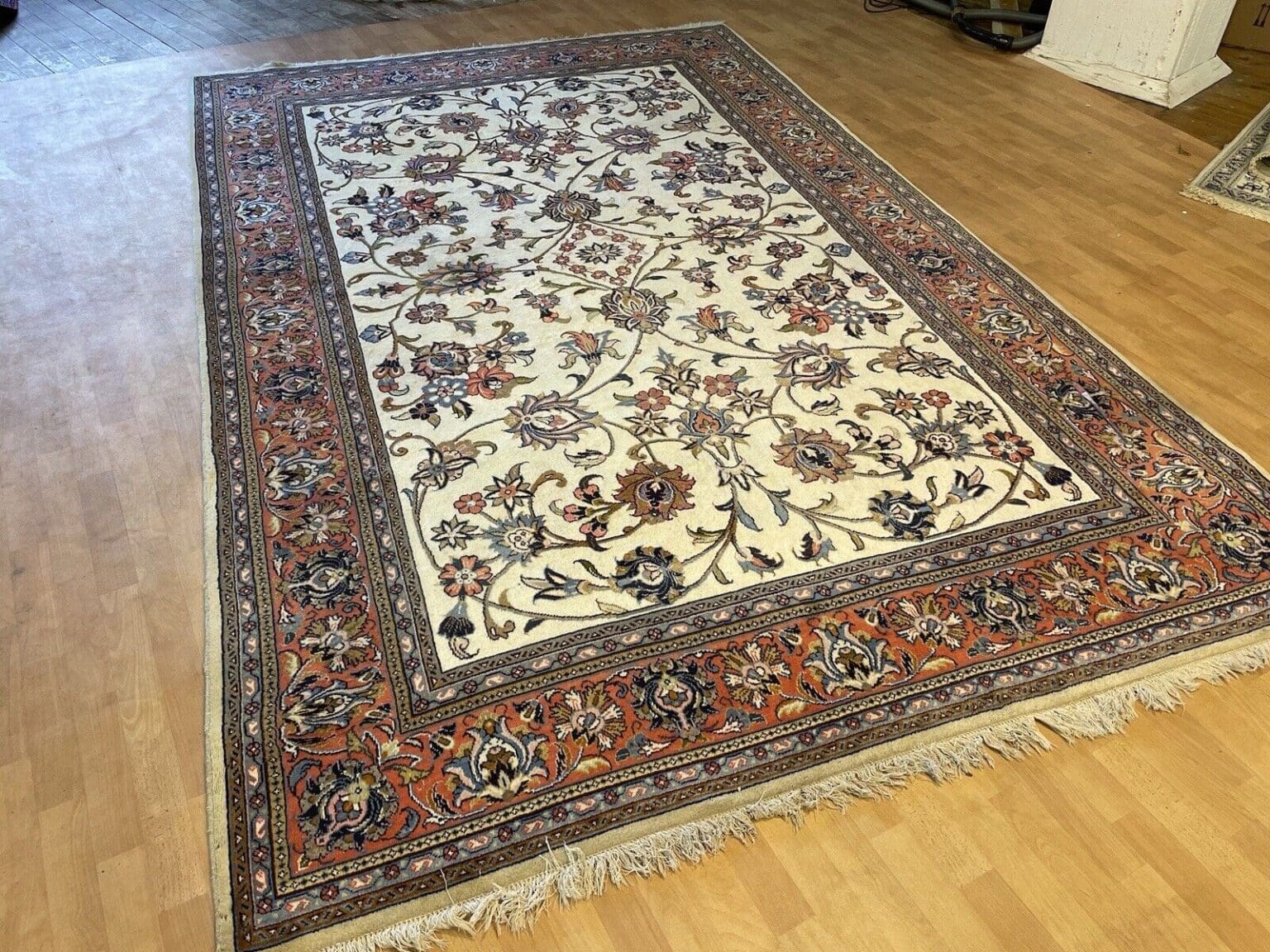
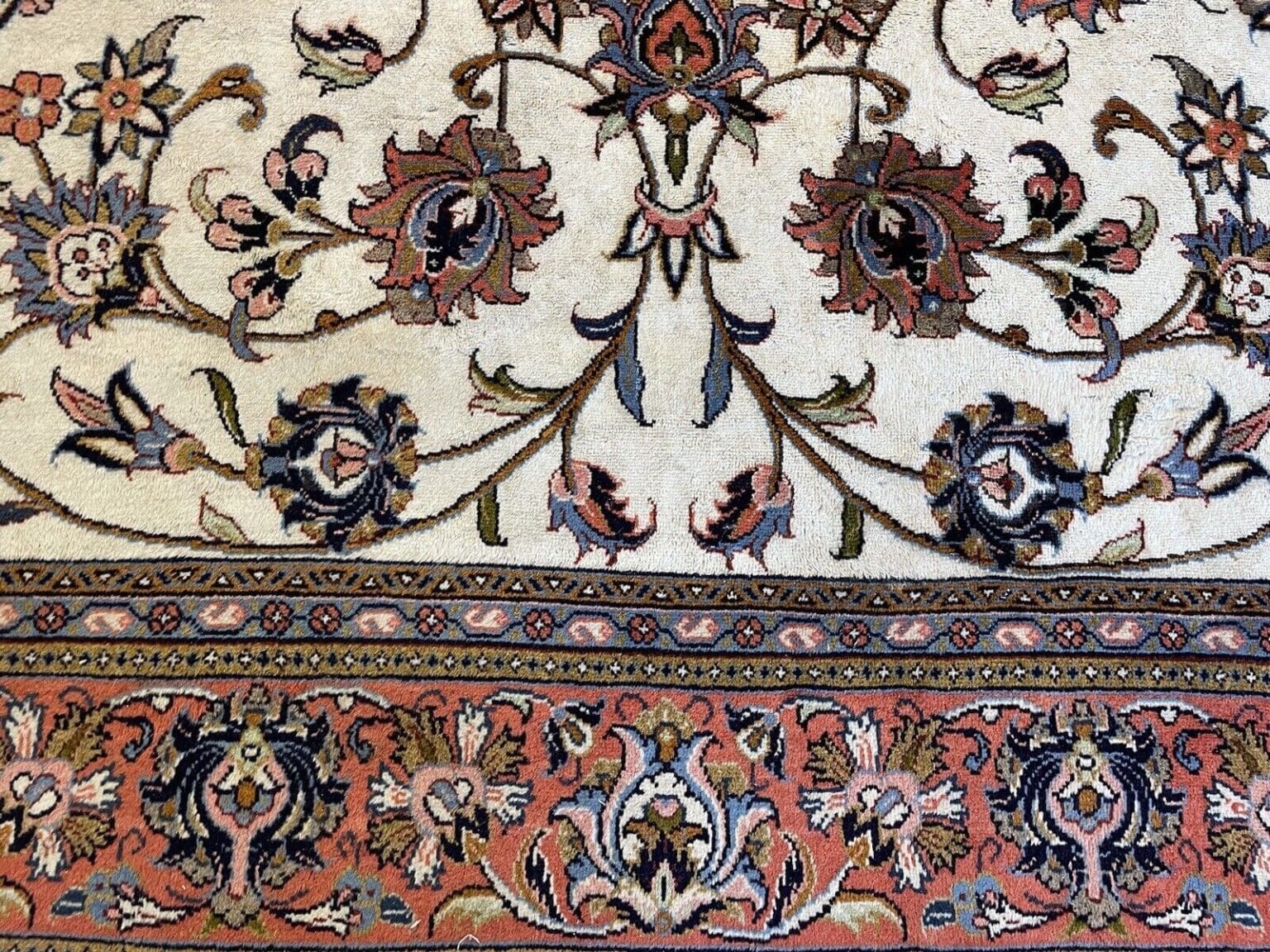
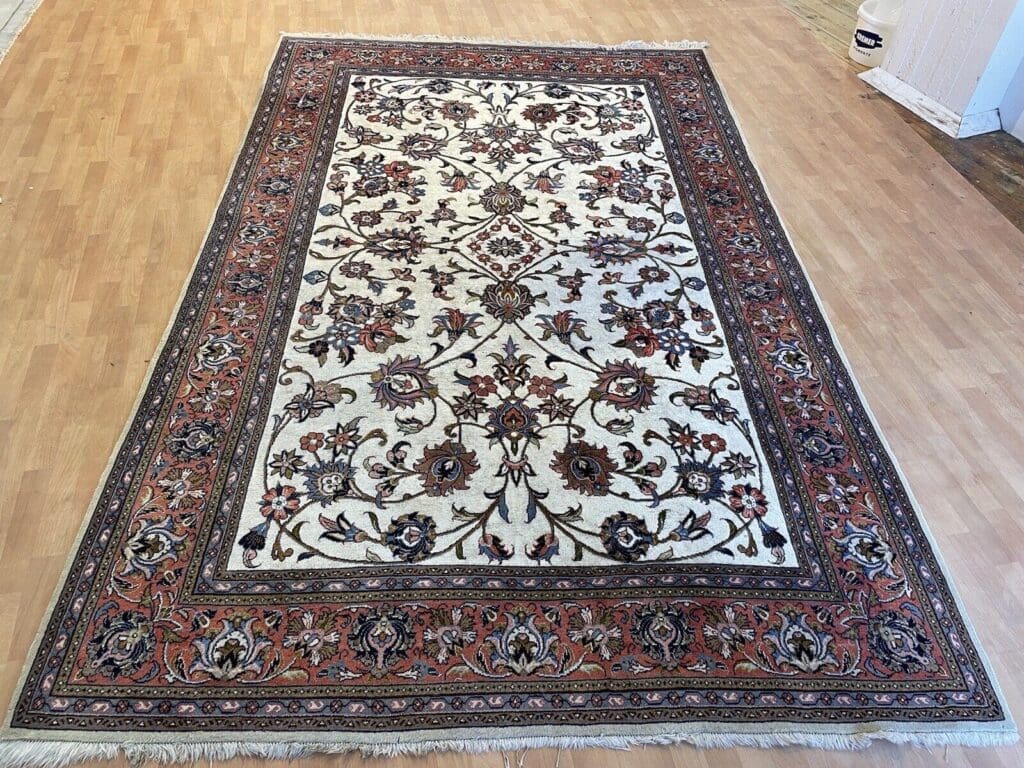
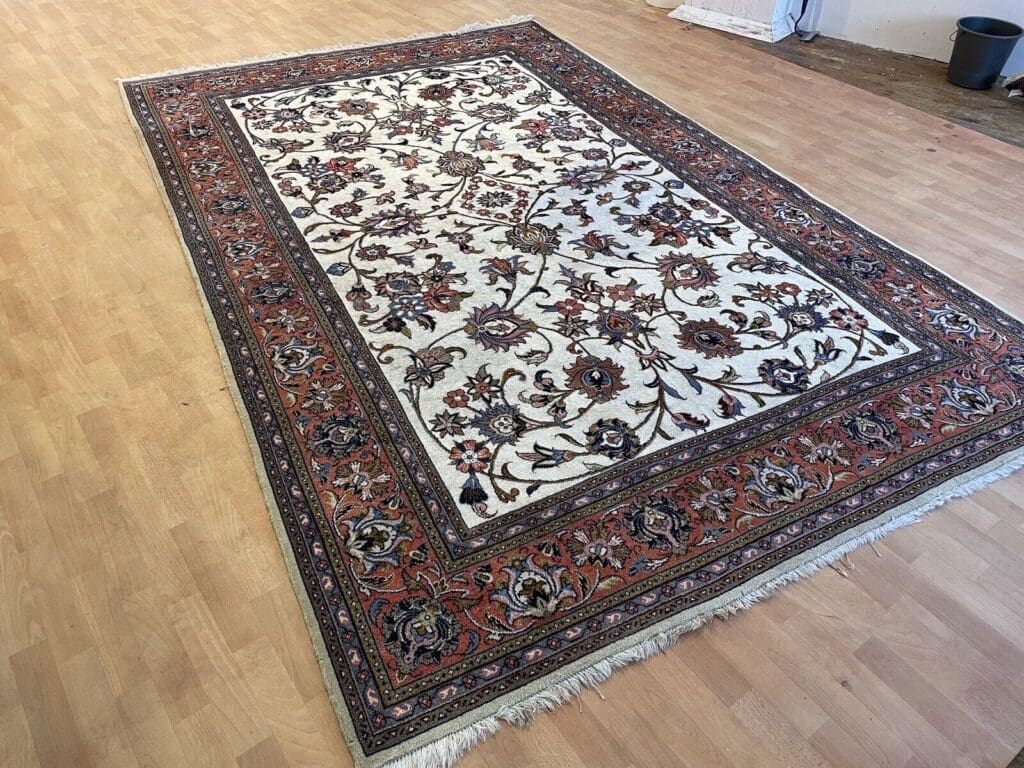
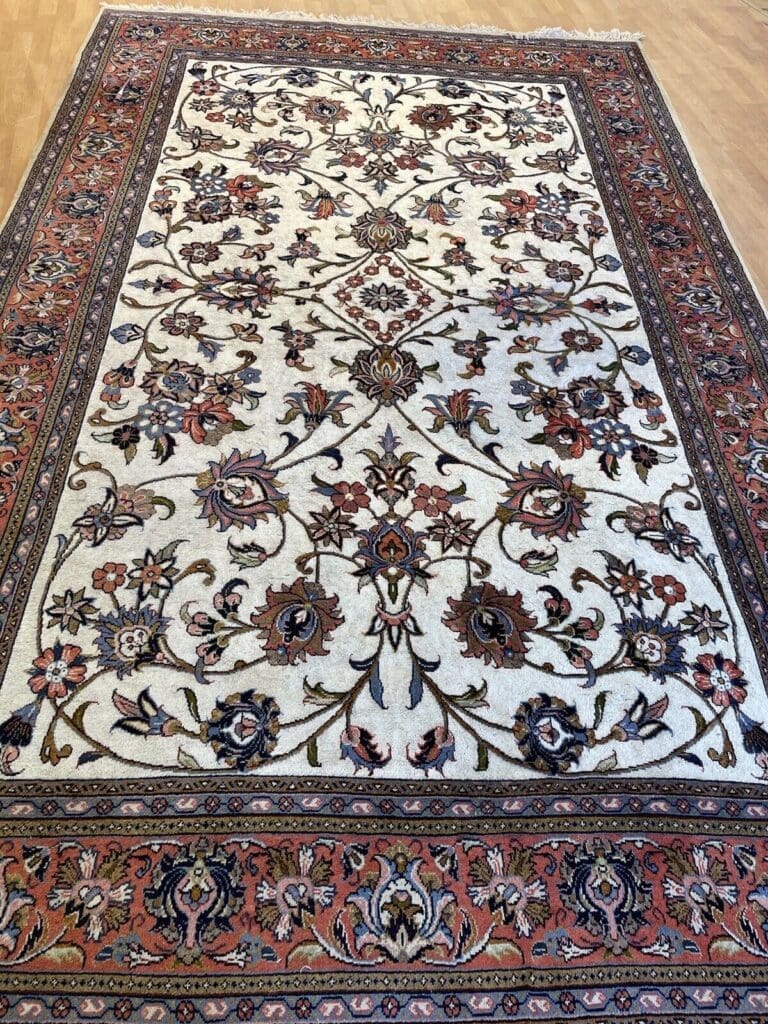
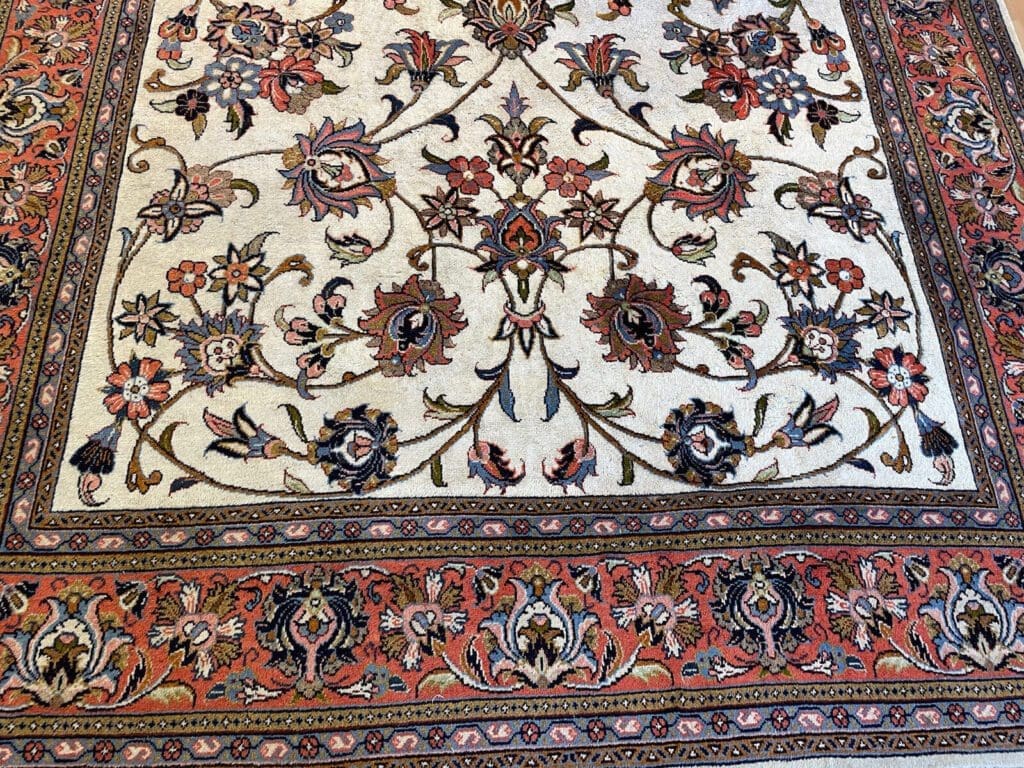
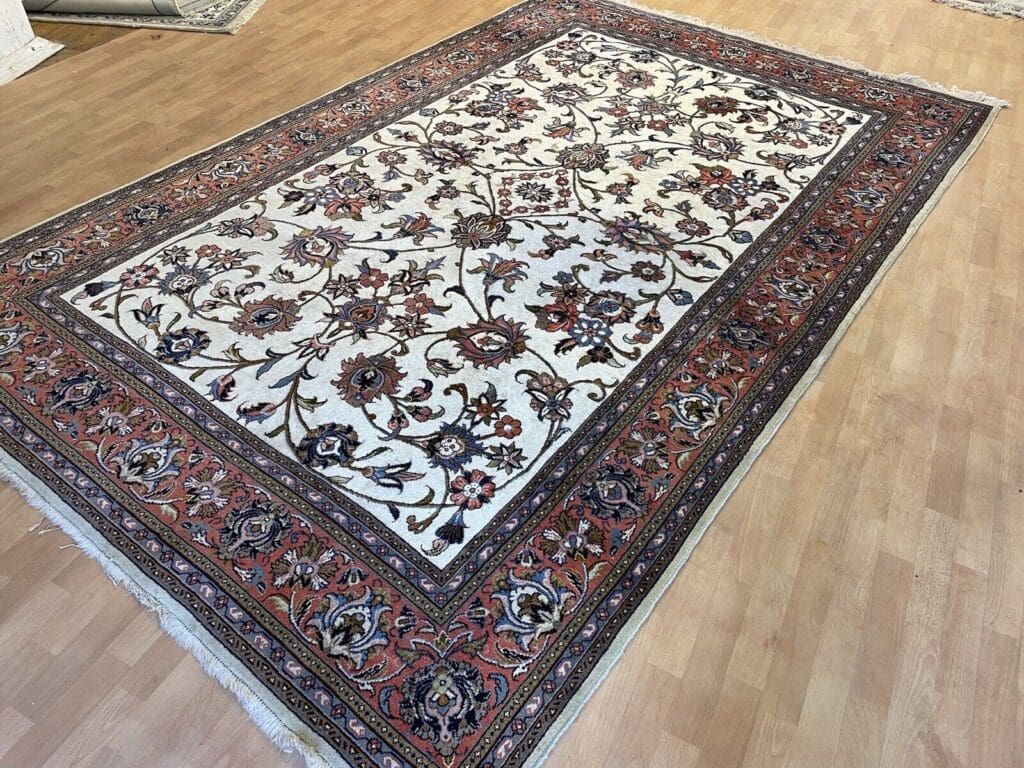
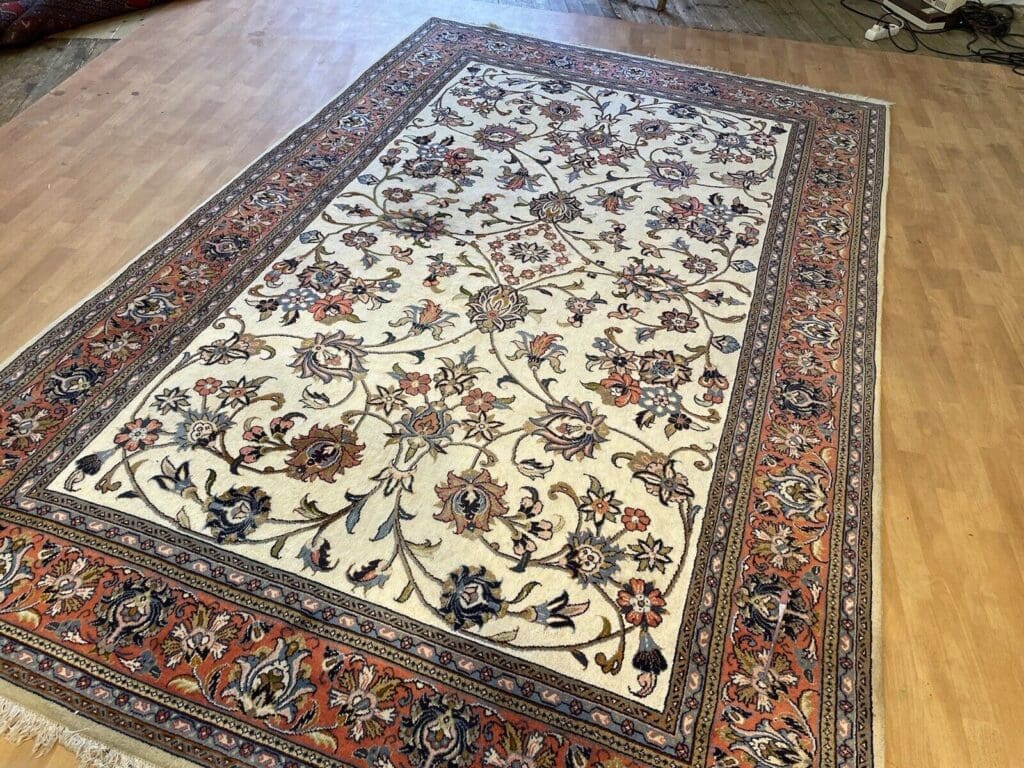
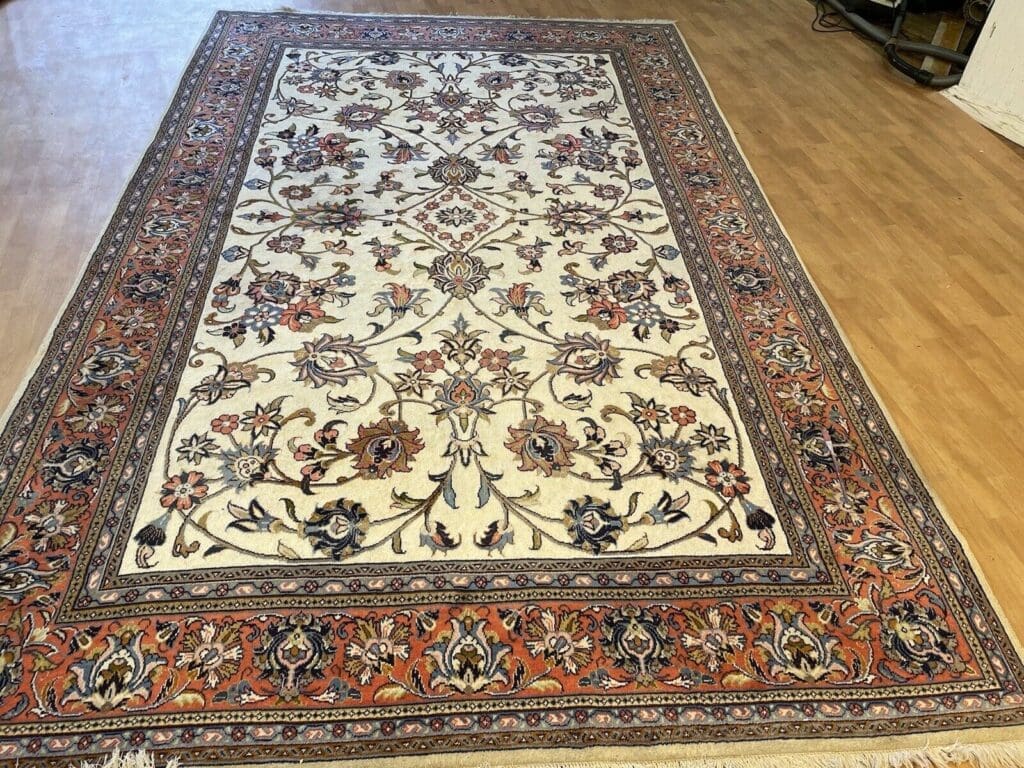
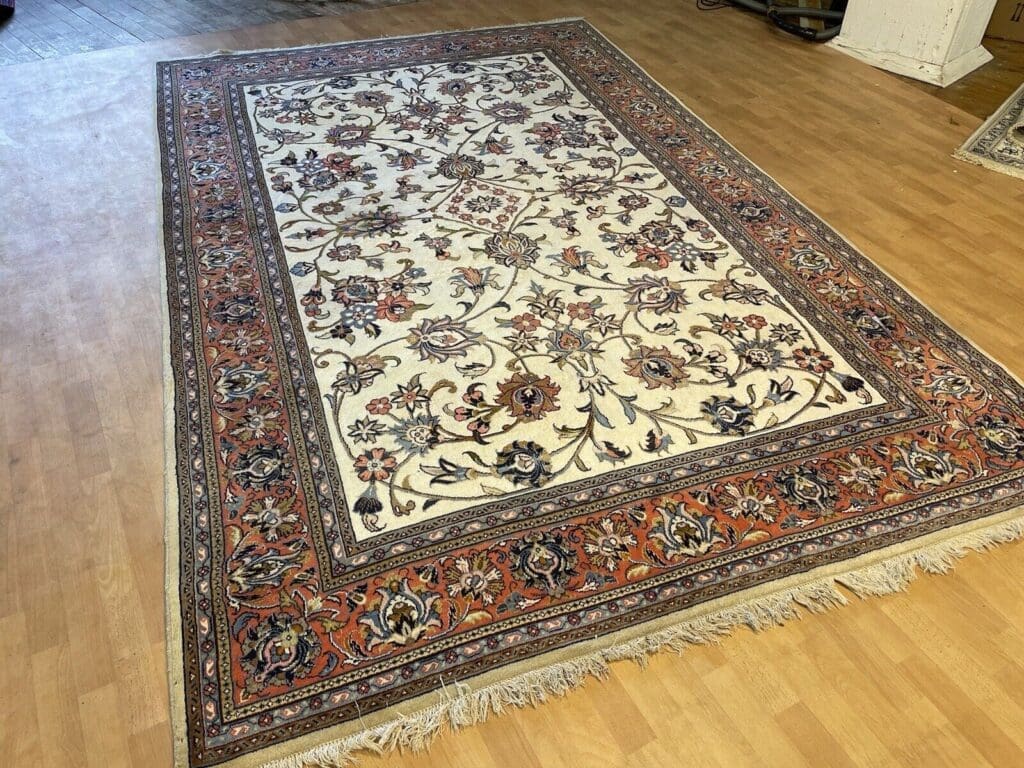
Hand-knotted Sarough Persian Rug | Knot density: high-grade virgin wool | Material: pile virgin wool, warp cotton | Size: 320×210 cm | Pattern: all-over curved floral elements on a light ground with a red border | Condition: new without label
This Sarough Persian rug has a pile made from high-grade virgin wool. The wool has been carefully worked, giving the surface the combination of softness and resilience associated with a well-prepared natural fibre. Cotton is specified for the warp. In a hand-knotted rug, the warp provides the vertical foundation into which the pile is tied, while the wool forms the visible and tactile part of the design.
Virgin wool comes from the first shearing of a sheep. Its fibres have a natural spring and can recover some of their shape after being pressed. This makes wool a long-established material for floor coverings. Wool can also take up and release a certain amount of moisture from the surrounding air, helping it remain comfortable in changing indoor conditions. Its natural crimp contributes both to its handle and to the resilience of the finished pile.
The rug is hand-knotted rather than produced by a mechanical printing or flat manufacturing process. Knots are tied individually around the warp, row by row, with weft passages helping to secure the structure. The surface is then finished so that the pile presents the intended direction and texture. This method allows a maker to build curved lines, floral forms and transitions in colour through many separate, controlled actions.
The description identifies the knot density as high-grade. In hand-knotting, the precision of the knots affects how clearly outlines and ornaments can be represented. A carefully executed structure supports the continuity of the pattern and gives the pile a stable foundation. The pile height is specified as 10 mm. That height creates a distinct textile surface while retaining the character of a traditionally made floor rug.
Wool is also valued in rug making for its practical qualities. It has a naturally robust fibre structure and is generally less prone to showing small changes in surface direction than many delicate fibres. It can be worked into both quiet backgrounds and clearly defined ornament. Here, the selected material is used for a floral, all-over design, while the cotton warp remains part of the underlying construction.
Origin and Tradition
The rug is identified as originating from the Sarough region in Iran. Sarough is known as a Persian rug-producing area with its own established design tradition. Its carpets are associated with carefully composed layouts, floral ornament and a considered use of colour. As with other Iranian weaving traditions, the making process brings together a prepared foundation, hand-tied pile, securing wefts and finishing work. The result depends on the coordination of these stages rather than on one isolated operation.
Iranian rug making has a long history. Rugs have served practical purposes as floor coverings, while also carrying decorative systems that communicate regional preferences and inherited visual ideas. Over generations, weaving areas developed recognisable approaches to borders, central fields, vines, flowers and geometric organisation. Sarough designs are often discussed in connection with floral compositions that fill the field rather than relying exclusively on one central medallion.
Traditional Persian rug patterns are commonly built from repeated units. A drawn design or remembered pattern establishes the relationship between vines, leaves and blossoms, and the knotter translates that plan into a textile surface one knot at a time. This requires attention to balance, spacing and the continuation of lines across the field. In an all-over composition, the pattern must maintain a coherent rhythm from one part of the interior to another, without depending on a single focal emblem.
Sarough design can combine organic imagery with an ordered structure. Curving stems and floral shapes suggest the forms of plants, while repetition and alignment give the field a measured arrangement. This relationship between natural motifs and geometric control is common in Persian carpet art. The plant forms are stylised rather than botanical illustrations; they are adapted to the demands of symmetry, weaving and repeated ornament.
The broader Iranian tradition also demonstrates how a border frames and organises a carpet. A border separates the main field from the outside edge and creates a visual transition between the interior pattern and the surrounding room. Its scale, colour and rhythm affect the balance of the entire composition. On a light field, a contrasting border can define the perimeter and keep the all-over ornament visually contained. These are general principles of Persian design that help explain the structure of this Sarough rug.
Persian carpets are often understood as decorative works as well as useful textiles. Motifs may refer in a general cultural sense to nature, growth and the beauty of the living world. Such associations are part of the background of floral ornament, although the individual rug is described here through its visible elements: a light ground, curved floral forms, an all-over arrangement and a red border. Its regional identity lies within the Sarough tradition of Iranian hand-knotting.
Design and Pattern
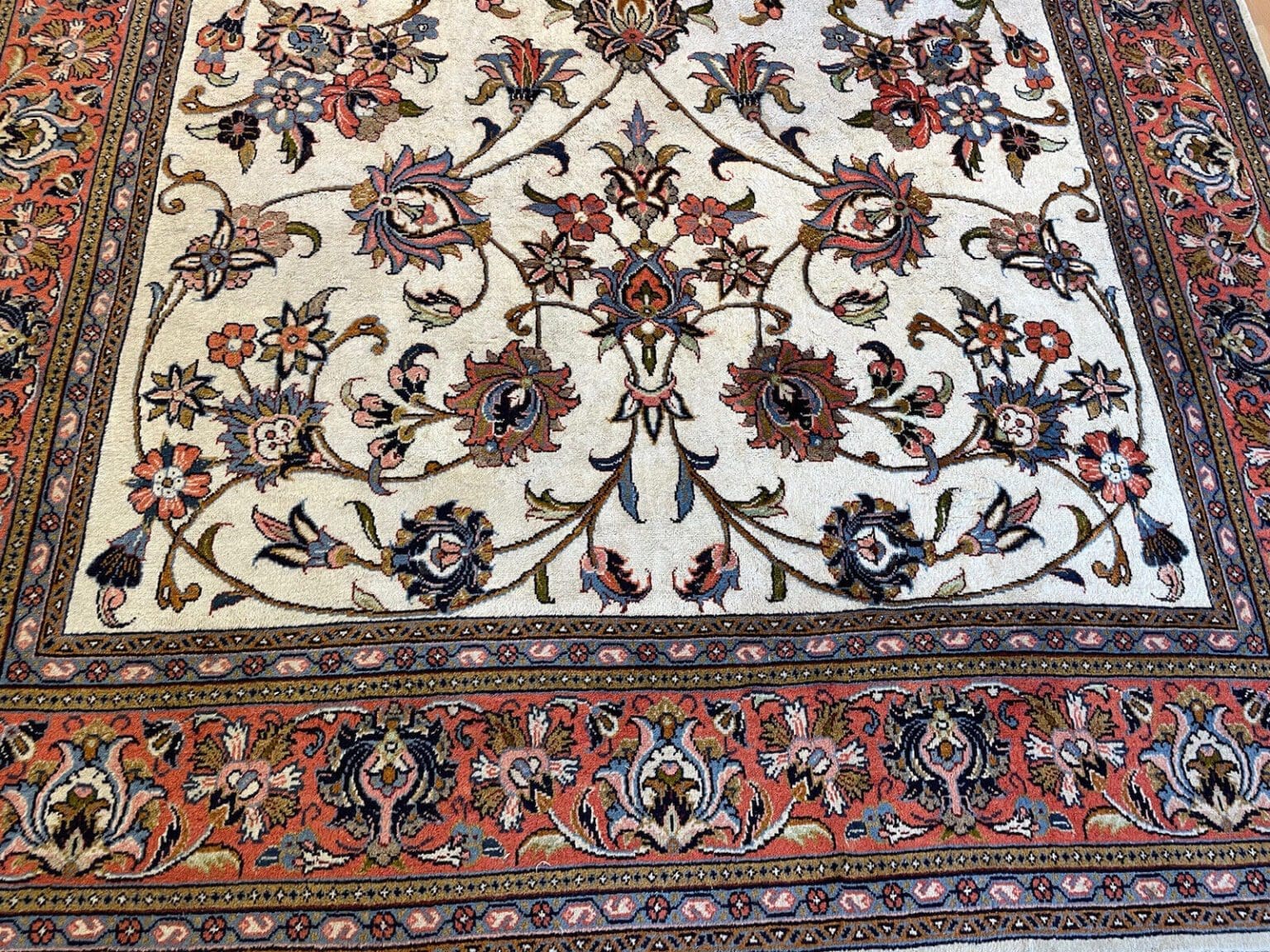
The design is all-over, with curved floral elements extending across the light ground. Instead of concentrating the decoration in one isolated centre, the composition gives the interior a continuous pattern. Curving stems, leaves and blossoms are among the established forms of Persian ornament. Through repetition and variation, such forms can fill a field while retaining a sense of order and allowing the eye to follow the movement of the lines.
The red border creates a firm frame around the patterned interior. Borders play an important role in rug design: they close the field, establish a transition to the edge and help define the proportions of the composition. Red is used here as a noticeable colour contrast against the light ground. It gives the outer zone its own visual weight while the curved floral drawing remains the main element within the field.
A light ground offers the ornament a clear setting. Pale backgrounds can make repeated motifs appear more open and allow the direction of a vine or petal to remain legible. The curved forms introduce movement, while their recurrence establishes visual continuity. The red perimeter then adds a more concentrated accent, bringing the field and the edge into a single design rather than leaving the border as an unrelated strip.
Floral motifs are widespread in Persian carpet art. They are usually stylised interpretations of blossoms, foliage and climbing vines, arranged according to the needs of a woven or knotted surface. In traditional decorative language, floral imagery is often associated with fertility, growth and the beauty of nature. Those meanings belong to the wider cultural context of the motif. They do not turn the pattern into a literal scene or establish a separate provenance for this particular rug.
The curved elements guide the eye through the field and help connect one ornament to the next. A repeating pattern can create rhythm without being mechanically identical in every detail. The border provides a stopping point for that movement and gives the composition a defined outer limit. This balance between continuous interior ornament and a clearly marked edge is a characteristic way to organise an all-over Persian rug design.
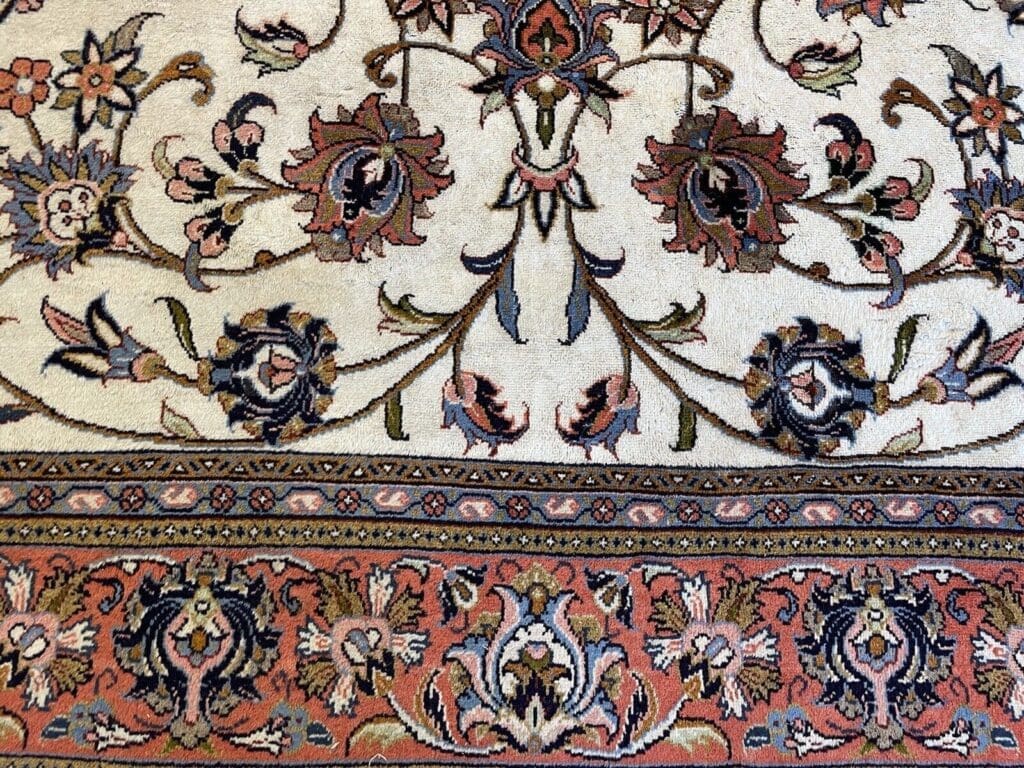
The overall visual language remains rooted in the Sarough tradition while using a restrained arrangement of light ground, floral drawing and red framing. The pattern can be examined at close range through its individual leaves and flowers, or from farther away through the relationship between light and dark areas. In both views, the design depends on line, repetition, contrast and the ordered distribution of ornament across the surface.
Special Features
The carefully worked virgin wool is identified as a special feature of this rug. It gives the surface a pleasant feel and supports the durability expected for regular use. The wool’s resilience also makes the rug suitable for areas of the home with heavier foot traffic. These practical characteristics accompany the hand-knotted construction rather than replacing it.
Every hand-knotted rug is formed through a large number of individual knots, so each piece has the character of a one-off object. In this rug, the knotting is combined with virgin wool in the pile and cotton in the warp. It is also suitable for use with underfloor heating. The condition is recorded as new without a label.
FAQ
How should I care for my Persian rug?
Vacuum the rug regularly to remove dust and loose dirt from the pile. If something is spilled, blot the spot promptly with a damp cloth rather than rubbing it. Rubbing can stress the fibres and work the substance further into the surface. For more extensive care, professional cleaning every few years is recommended. The exact interval depends on how intensively the rug is used and how much dirt it receives.
Is the rug suitable for underfloor heating?
Yes. This hand-knotted Persian rug is suitable for use with underfloor heating. Virgin wool has insulating properties and can help the surface feel pleasantly warm while allowing the heating system to contribute to the room’s overall comfort. The heating should be operated appropriately. The stated suitability applies to the hand-knotted construction and the wool pile described for this rug.
Can the rug be used in direct sunlight?
It is advisable to limit direct sunlight because strong, repeated exposure can cause a rug’s colours to fade over time. Curtains, blinds or another form of screening can reduce the amount of intense light reaching the surface. More even exposure is preferable to having one section illuminated strongly every day. Although wool is a durable natural material, protecting the rug from prolonged direct sun remains a sensible part of preserving its colours.
To provide the best experiences, we use technologies like cookies to store and/or access device information. Consenting to these technologies will allow us to process data such as browsing behavior or unique IDs on this site. Not consenting or withdrawing consent, may adversely affect certain features and functions.
Functional Always active
The technical storage or access is strictly necessary for the legitimate purpose of enabling the use of a specific service explicitly requested by the subscriber or user, or for the sole purpose of carrying out the transmission of a communication over an electronic communications network.
Preferences
The technical storage or access is necessary for the legitimate purpose of storing preferences that are not requested by the subscriber or user.
Statistics
The technical storage or access that is used exclusively for statistical purposes.The technical storage or access that is used exclusively for anonymous statistical purposes. Without a subpoena, voluntary compliance on the part of your Internet Service Provider, or additional records from a third party, information stored or retrieved for this purpose alone cannot usually be used to identify you.
Marketing
The technical storage or access is required to create user profiles to send advertising, or to track the user on a website or across several websites for similar marketing purposes.

 SECURE PAYMENT
 SHIPPING PARTNERS


