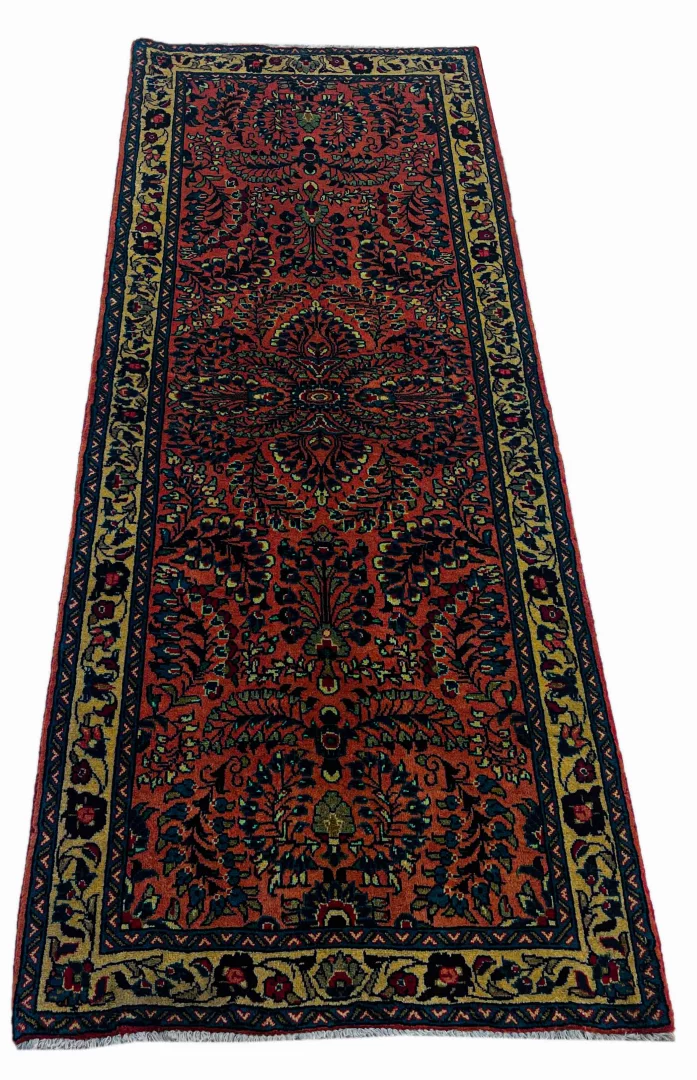
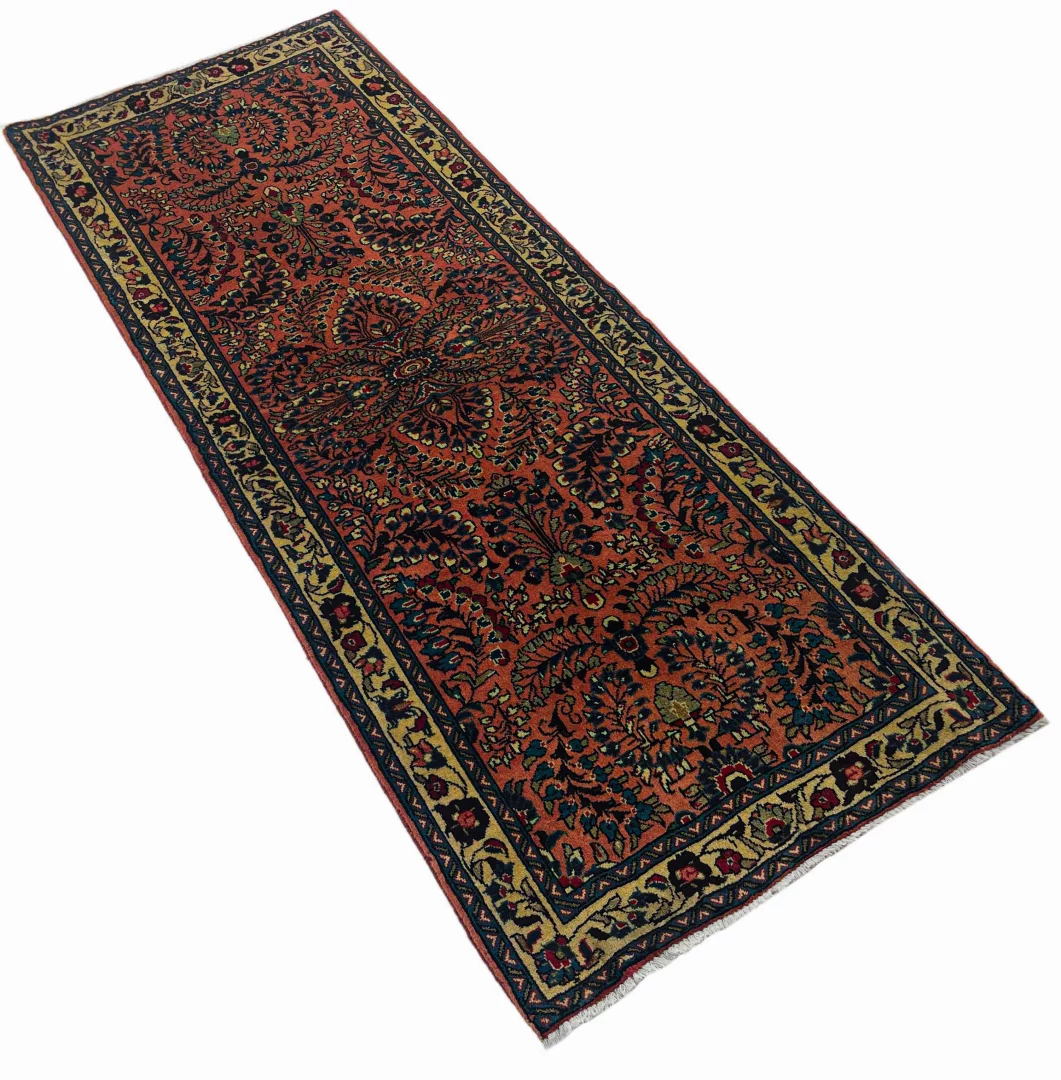
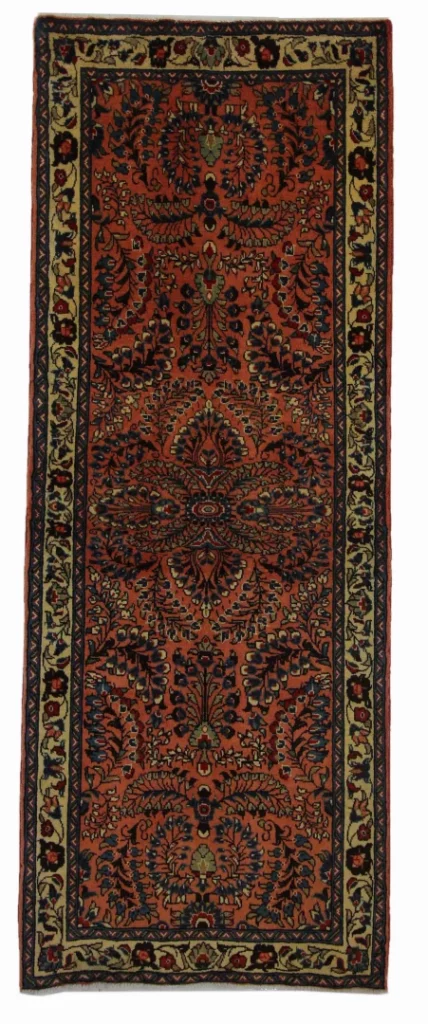
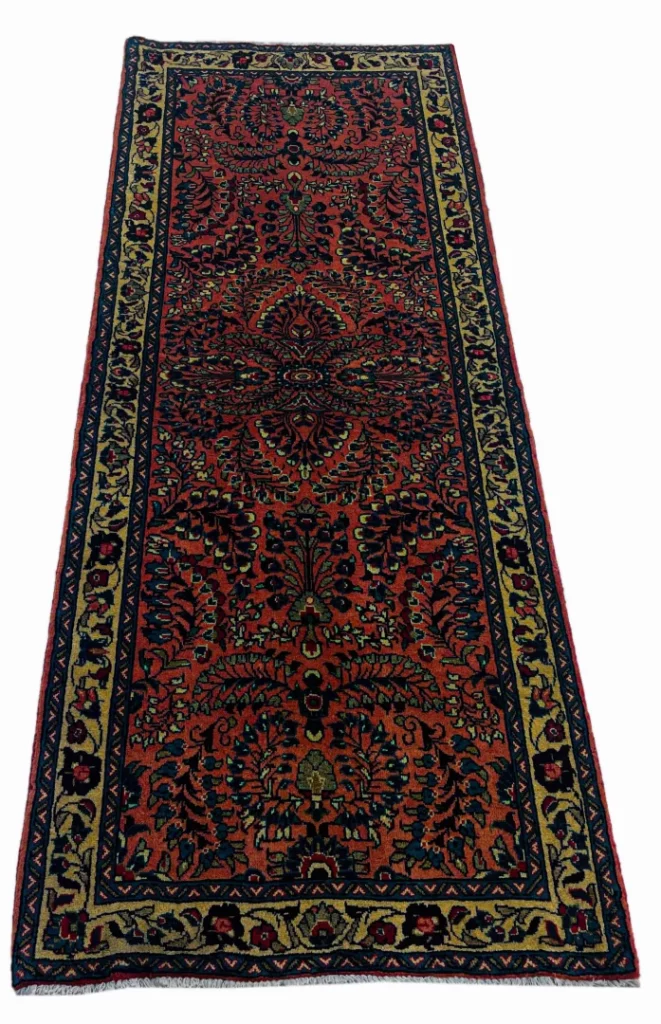
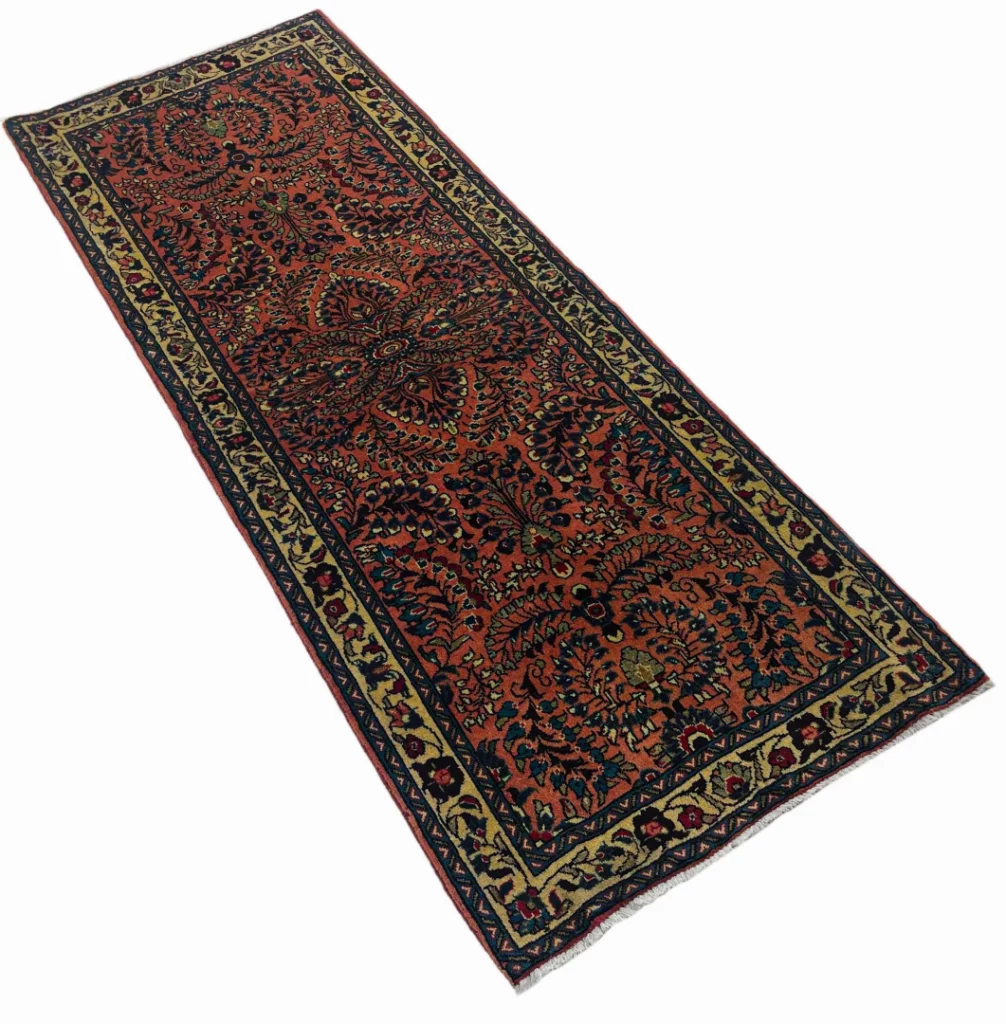
Hand-knotted Sarough Persian Rug | Knot density: 200,000 – 400,000 knots/m² | Size: 205 x 78 cm | Pattern: Floral design on a red and brown ground | Condition: Very good
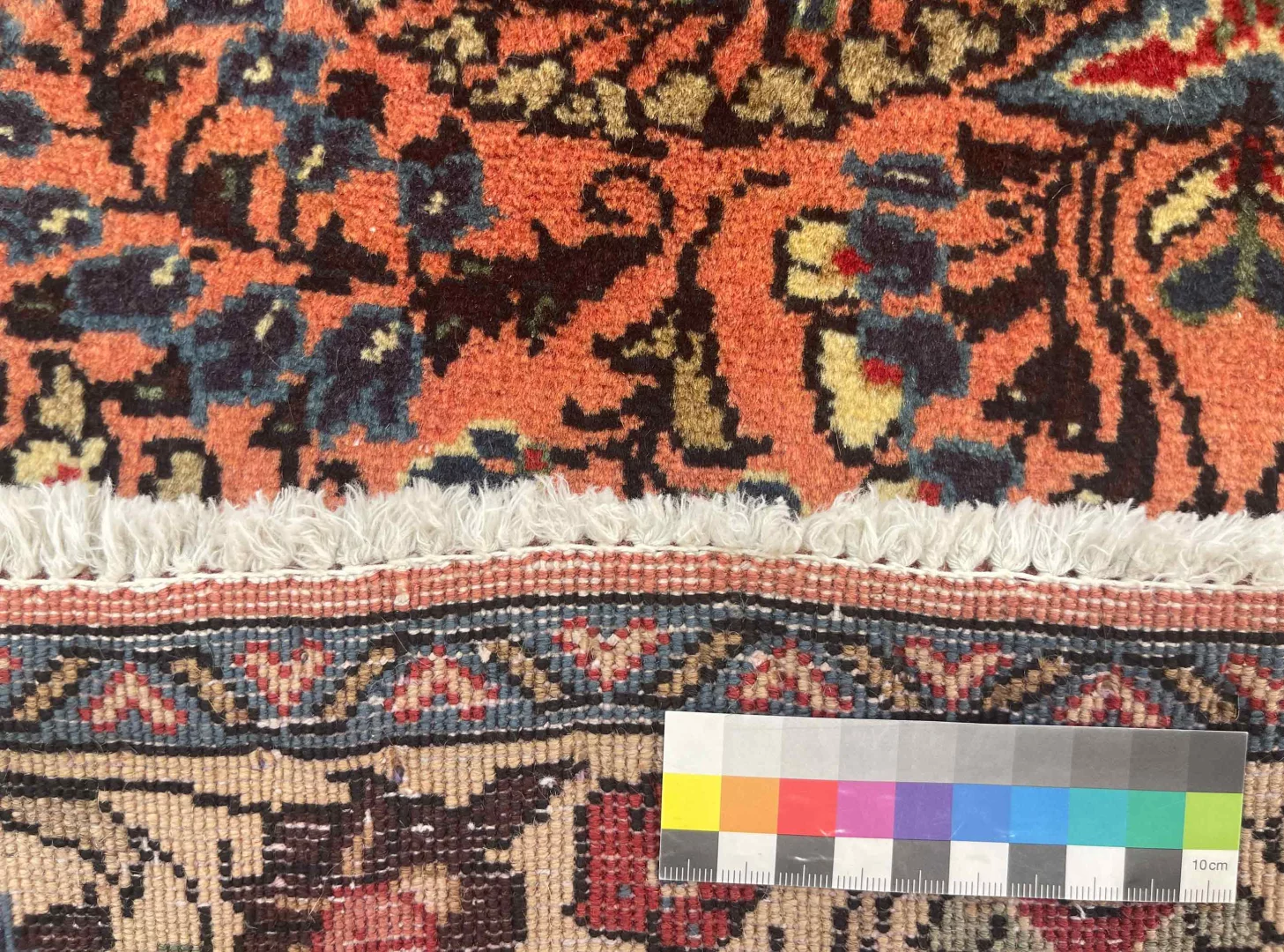
This Sarough is hand-knotted. A hand-knotted rug is made through a sequence of manual processes: individual knots are worked into the foundation, the pile is arranged, and the surface is finished so that the design can be read clearly. The pattern is created by the placement of the knots rather than by printing an image onto a finished textile. This gives the rug the structured surface and textile character associated with the hand-knotting technique.
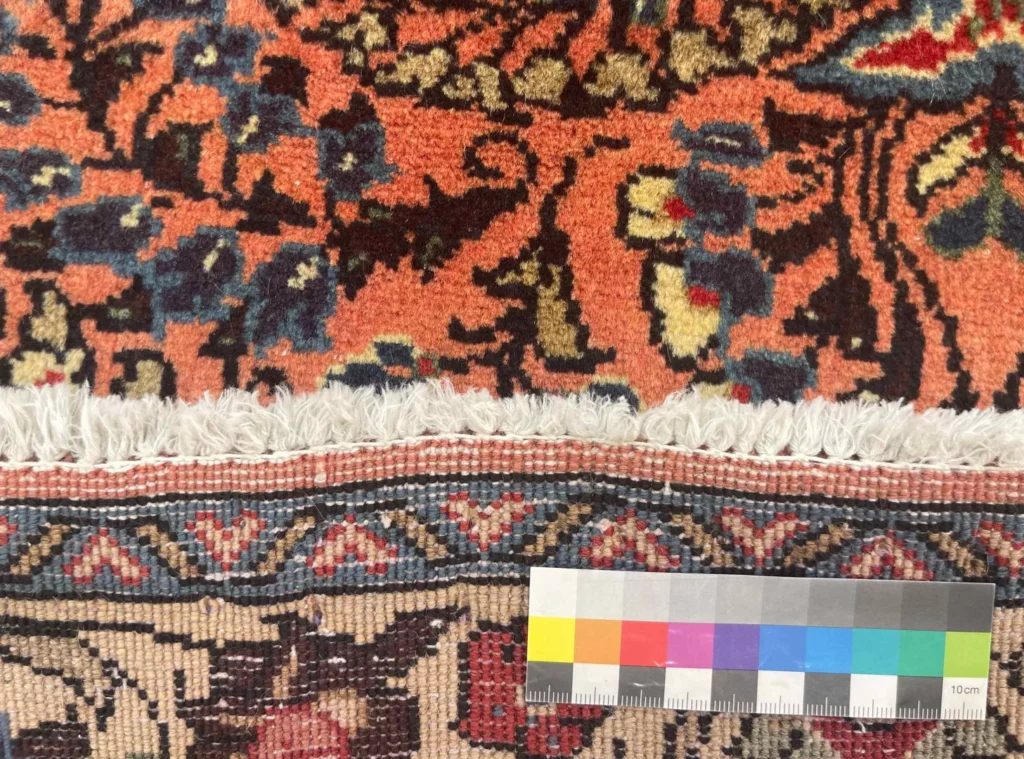
The knot density given for this rug is 200,000 to 400,000 knots per square metre. Knot density indicates how many knots are contained within a defined area and provides a technical way of describing the fineness of the construction. A carefully controlled knot sequence allows floral lines, leaves and other ornamental forms to be rendered with distinction. Knot density is one production feature among several; colour, design and the handling of the pile also contribute to the appearance of a hand-knotted rug.
Sarough rugs are often made with high-quality virgin wool and cotton. In Oriental rug production, virgin wool is traditionally valued for its pleasant handle and resistance, while cotton is frequently used in the foundation. The source does not give a separate pile-and-warp material specification for this individual rug. It does establish the hand-knotted technique, the stated knot density and the floral design, so those are the features presented here as specific to this piece.
Hand craftsmanship explains why a Sarough is described differently from a machine-made floor covering. Knot after knot, the maker follows the intended arrangement of the design and keeps the structure even across the field. Floral compositions require attention to outlines, repeated elements and colour areas as the work progresses. The craftsmanship recorded for this rug is combined with a condition described as very good.
Origin and Tradition
Sarough rugs come from northern Persia. Sarough is described as a picturesque village in that region and is associated with its own carpet-making tradition. The name therefore identifies a regional origin, not merely a colour combination or a general decorative category. This rug is presented as a Sarough Persian rug and belongs to the Iranian tradition of Oriental carpet weaving.
Persian carpet production developed in many towns and regions, each with preferences in colour, ornament and construction. Within this broad tradition, Sarough is associated with hand-knotted rugs and floral compositions that frequently appear on warm red or brown grounds. Carpet-making knowledge was passed through workshops and families over long periods. Skills such as preparing the foundation, placing the knots and translating a design into a woven surface could therefore continue from one generation to the next.
The Sarough weaving tradition is described as having lasted for centuries. Continuity does not mean that every Sarough has the same appearance. A regional tradition can contain different layouts, colour balances and sizes while retaining recognisable approaches to construction and ornament. Floral design is one of the recurring characteristics associated with Sarough. This rug expresses that direction through its floral pattern and its red and brown ground.
Many Sarough rugs were made for the American market in the past. This commercial history led to the term “American Sarough”, a designation used for a known group of Sarough rugs associated with that market. It does not create a separate geographic origin. Sarough remains the regional name from northern Persia. International demand helped make the name familiar outside Persia, and Sarough rugs are now noted by collectors in different countries.
Northern Persia contains a wide range of carpet traditions. Heriz and Tabriz are also mentioned in connection with the same broader region. Heriz rugs are known for geometric designs and strong colours, while Tabriz rugs are associated with complex designs and high knot density. Nain and Kashan are likewise recognised Persian carpet traditions, often connected with fine wool and silk combinations. These comparisons place Sarough within the wider landscape of Persian weaving without changing the origin of this individual rug.
Regional attribution is an important part of describing a Persian rug. It points to the accumulated relationship between local working methods, material choices, colours and pattern traditions. In Sarough, these elements meet in hand-knotted construction and in floral compositions that often use warm grounds. The rug offered here is identified with northern Persia and Sarough. No unrecorded age, signature or individual provenance is added to that regional description.
Tradition also provides a way to understand why a named weaving place matters. The place name connects the rug to a history of making rather than functioning as a decorative label. At the same time, an individual rug remains a single textile with its own pattern and condition. For this piece, the documented combination is Sarough origin, hand-knotted construction, a density of 200,000 to 400,000 knots per square metre, floral decoration and a red and brown ground.
Design and Pattern
The pattern of this Sarough is floral, set on a red and brown ground. These details identify both the motif category and the principal ground colours. Floral Persian designs commonly use stylised blossoms, leaves and scrolling stems arranged as ornament rather than as a literal depiction of one particular garden. Their purpose is to create an ordered visual language across the textile surface.
A floral composition depends on the relationship between the ground and the ornament. Red and brown create a continuous, warm foundation from which botanical forms can emerge. Depending on the design, flowers and vines may be repeated across the field, placed in a structured arrangement or connected through a rhythmic sequence. The source identifies the floral direction and the red and brown ground for this rug, but does not specify a central medallion, a particular border arrangement or individual floral species.
Red is one of the colour families frequently found in Persian carpet design. It can give a composition a strong, cohesive ground. Brown introduces an earthy shade and may visually connect the ornament with the field. For this rug, red and brown are specifically described as the ground colours. No further individual colours are stated, so the description remains with those documented tones rather than assigning additional shades.
Compared with a strictly geometric layout, a floral Sarough design is read through flowing lines and linked forms. Stems can guide the eye from one ornament to the next, while leaves and blossoms divide the surface into a repeated rhythm. This apparent movement is still based on careful order. Spacing, balance and the continuation of forms must be considered during the knotting process. Hand-knotting turns the planned design into a durable textile one knot at a time.
Persian carpet patterns are often understood as a relationship between field, border and internal ornament. The present description confirms a floral design on a red and brown ground, but it does not provide a detailed account of the border, field structure or a specific sequence of motifs. It would therefore be inaccurate to add a medallion, a Herati pattern or another named ornament. The reliable design statement is the concise one: a Sarough with floral decoration and a red and brown ground.
Other Persian traditions offer useful points of comparison. Heriz is associated with geometric patterns and strong colours; Tabriz is associated with complex designs and high knot density. Nain and Kashan are also known for distinctive Persian rugs, often made with fine wool and silk combinations. These examples show how varied Persian pattern traditions can be. They do not turn this rug into a Heriz, Tabriz, Nain or Kashan: its stated identity remains Sarough.
In a hand-knotted rug, a pattern is both decoration and working plan. The maker follows the intended placement so that lines, forms and colour areas remain coherent over the surface. The stated density of 200,000 to 400,000 knots per square metre adds technical context to the design description. It indicates the fineness of the knotting, while the floral designation explains the visual language used by the rug.
Special Features
The specific features of this rug are its Sarough identity, its origin in northern Persia, its hand-knotted construction and its knot density of 200,000 to 400,000 knots per square metre. It also has a floral design on a red and brown ground. Its condition is described as very good. These details define the offered piece without adding an undocumented signature, age or provenance.
Sarough rugs are valued for the connection between Persian hand craftsmanship, commonly selected quality materials and individual floral designs. Virgin wool and cotton are often mentioned for Sarough rugs, but the source does not separate the pile material from the warp for this specific example. The regional attribution, the hand-knotted technique and the documented pattern remain clear regardless of that material limitation.
Regular vacuuming is recommended as part of ordinary care for a hand-knotted Sarough. Occasional professional cleaning can help maintain the textile surface when it is needed. Direct sunlight should be avoided where possible because it may cause the colours to fade. Care should take the hand-knotted construction into account and should be adapted to the actual type of soiling and the floor beneath the rug.
FAQ
How should a Sarough rug be cared for?
Vacuum the rug regularly and arrange professional cleaning from time to time when appropriate. Avoid direct sunlight as much as possible to reduce the risk of fading. Because the rug is hand-knotted, care should be suitable for a textile surface and adapted to the specific soiling rather than treated as ordinary hard flooring.
What materials are used for Sarough rugs?
High-quality virgin wool and cotton are commonly used for Sarough rugs. Virgin wool is associated with a pleasant handle and resistance, while cotton is often used in the foundation. A separate pile-and-warp material breakdown is not given for this individual rug, so no more specific allocation is made here.
What makes Sarough rugs distinctive?
Sarough rugs combine Persian hand craftsmanship, commonly selected quality materials and individual floral designs. In this example, the distinctive documented features are the northern Persian origin, hand-knotted construction, knot density of 200,000 to 400,000 knots per square metre, floral pattern, red and brown ground and very good condition.
To provide the best experiences, we use technologies like cookies to store and/or access device information. Consenting to these technologies will allow us to process data such as browsing behavior or unique IDs on this site. Not consenting or withdrawing consent, may adversely affect certain features and functions.
Functional Always active
The technical storage or access is strictly necessary for the legitimate purpose of enabling the use of a specific service explicitly requested by the subscriber or user, or for the sole purpose of carrying out the transmission of a communication over an electronic communications network.
Preferences
The technical storage or access is necessary for the legitimate purpose of storing preferences that are not requested by the subscriber or user.
Statistics
The technical storage or access that is used exclusively for statistical purposes.The technical storage or access that is used exclusively for anonymous statistical purposes. Without a subpoena, voluntary compliance on the part of your Internet Service Provider, or additional records from a third party, information stored or retrieved for this purpose alone cannot usually be used to identify you.
Marketing
The technical storage or access is required to create user profiles to send advertising, or to track the user on a website or across several websites for similar marketing purposes.

 SECURE PAYMENT
 SHIPPING PARTNERS


