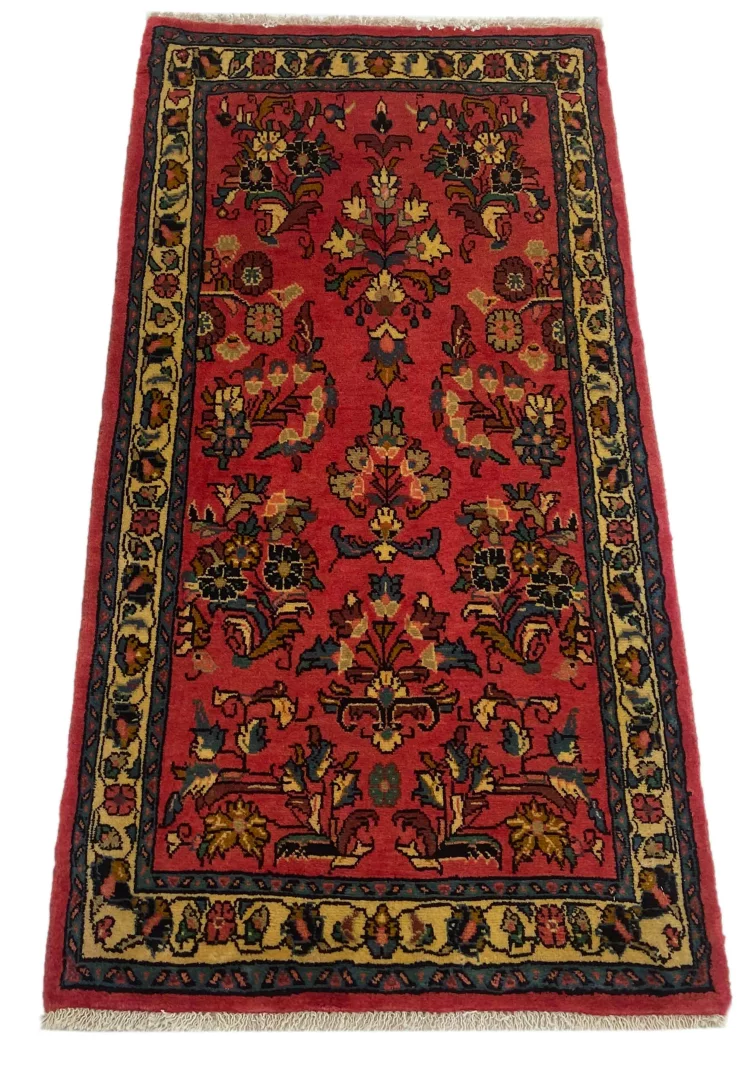
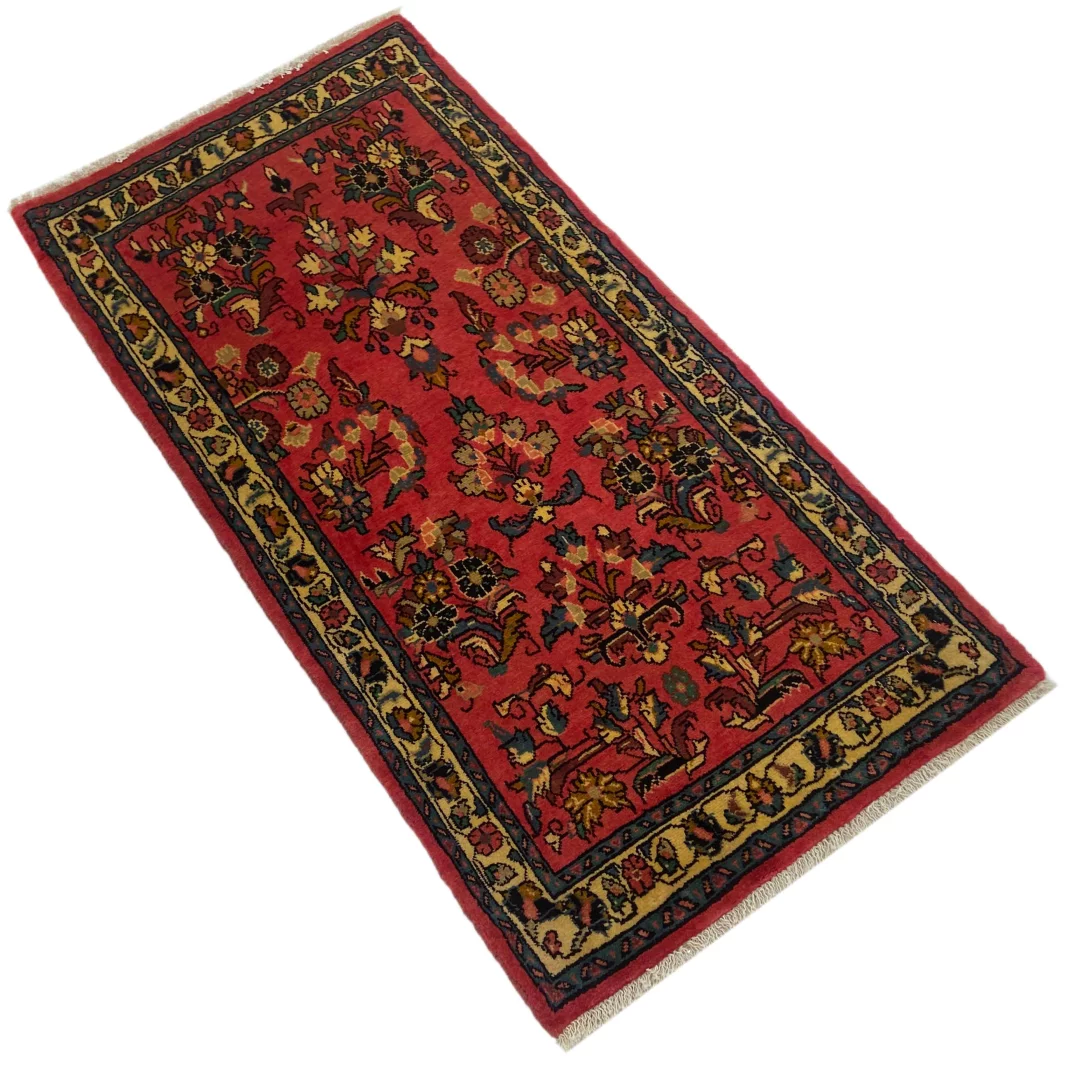
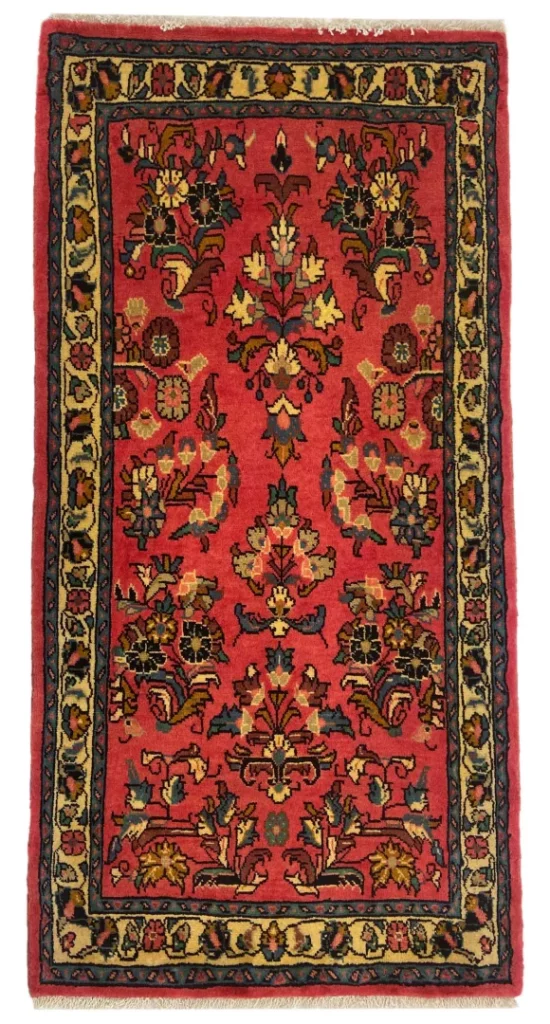
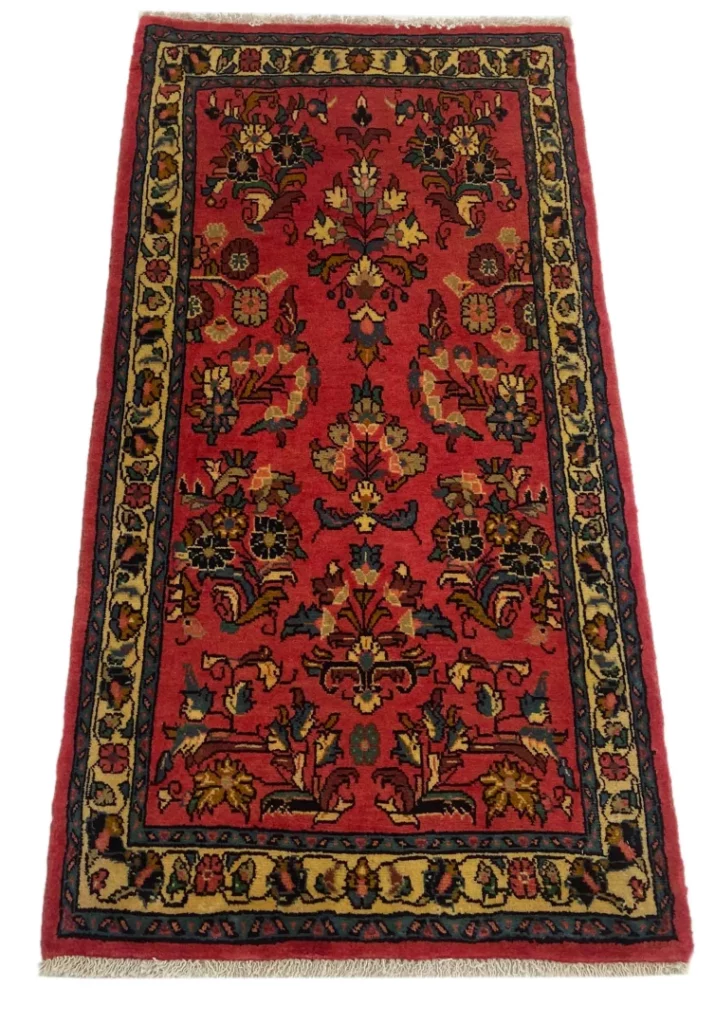
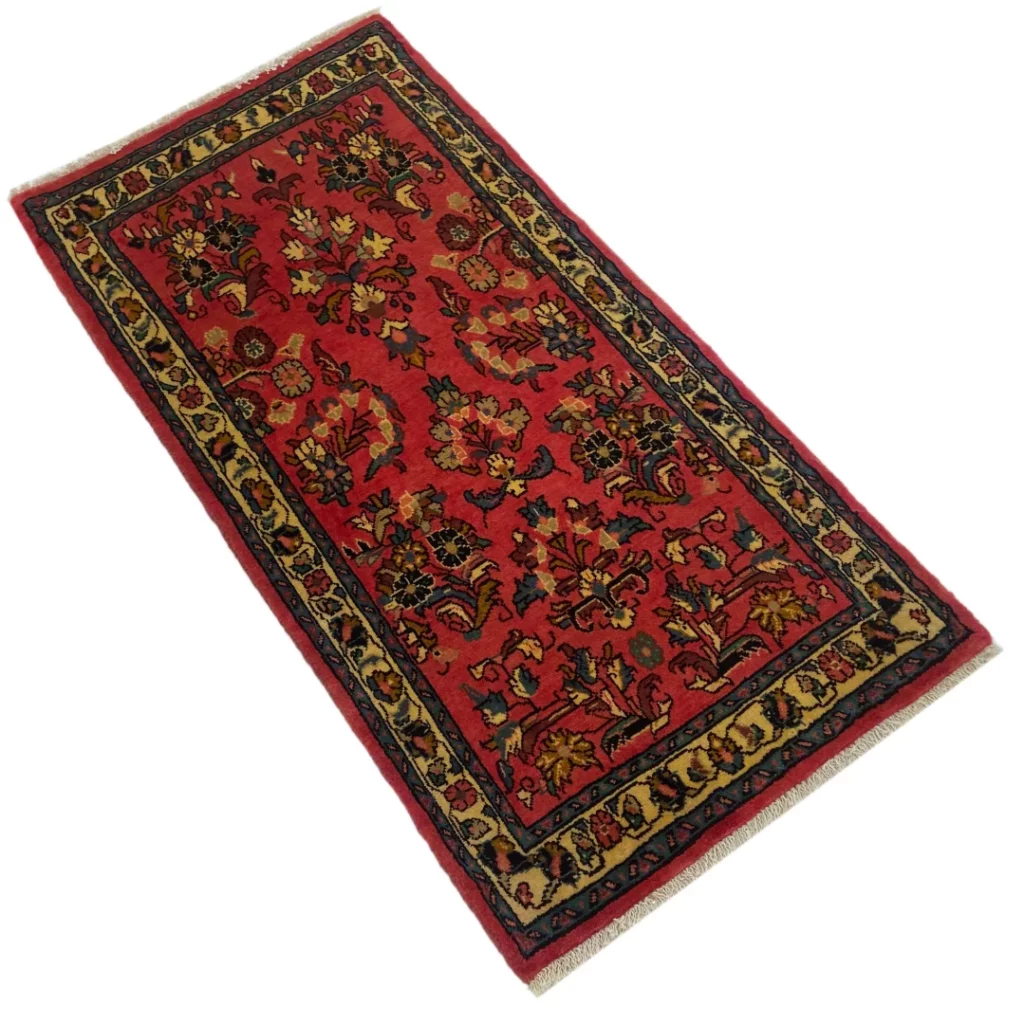
Hand-knotted Sarough Persian Rug | Knot density: 200.000 – 400.000 knots/m² | Size: 130 x 65 cm | Pattern: Floral design on a red/brown ground | Condition: Very good | Origin: Northern Persia
This Sarough is a hand-knotted Persian rug. Hand knotting builds the design one knot at a time on the rug’s foundation. The process calls for consistent knot placement, careful alignment of the pattern, and controlled density across the surface. Unlike a machine-made floor covering, a hand-knotted rug reflects the work of the individual weavers directly. Minor variations in execution are part of traditional textile production and belong to the character of the craft.
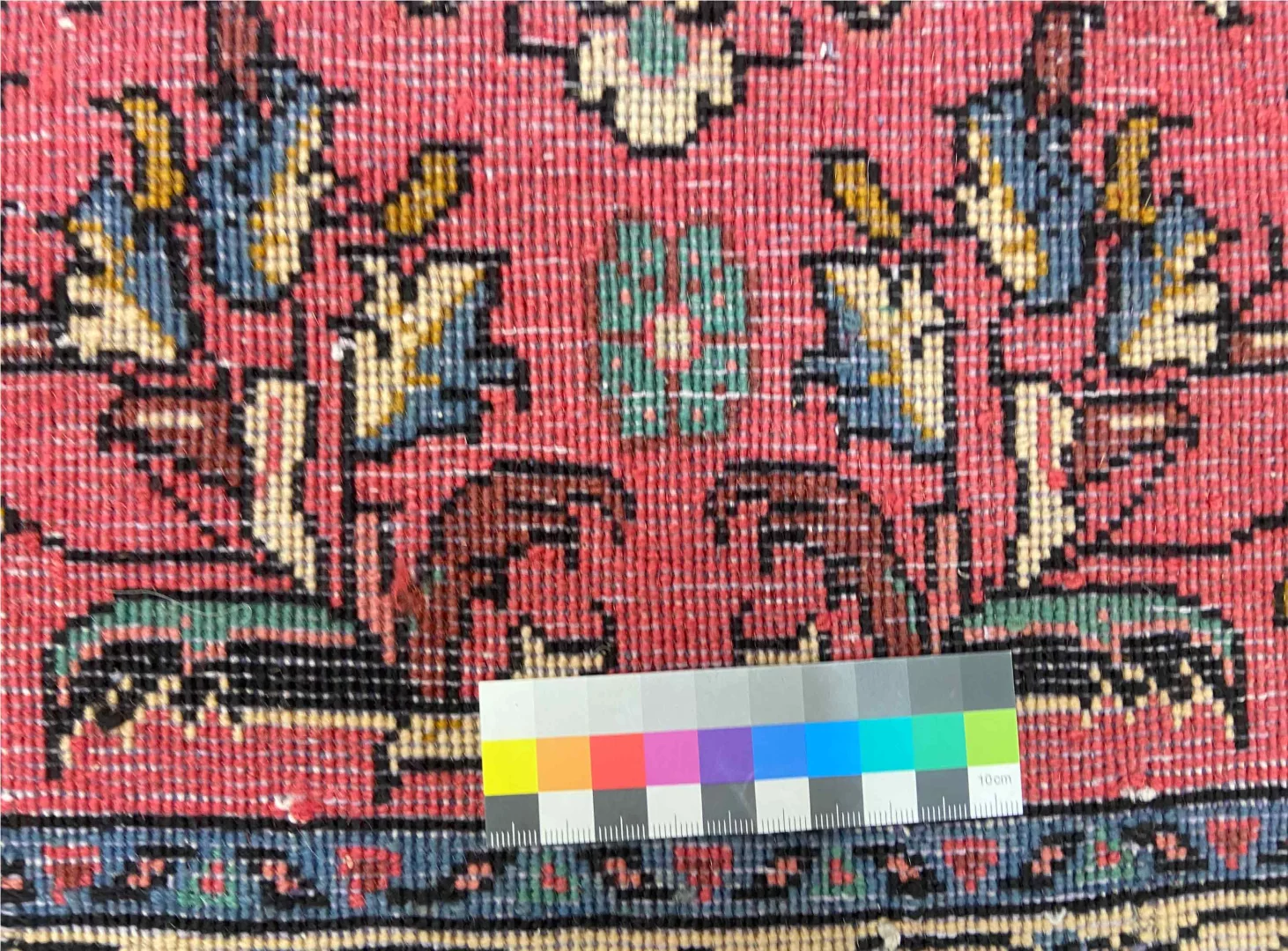
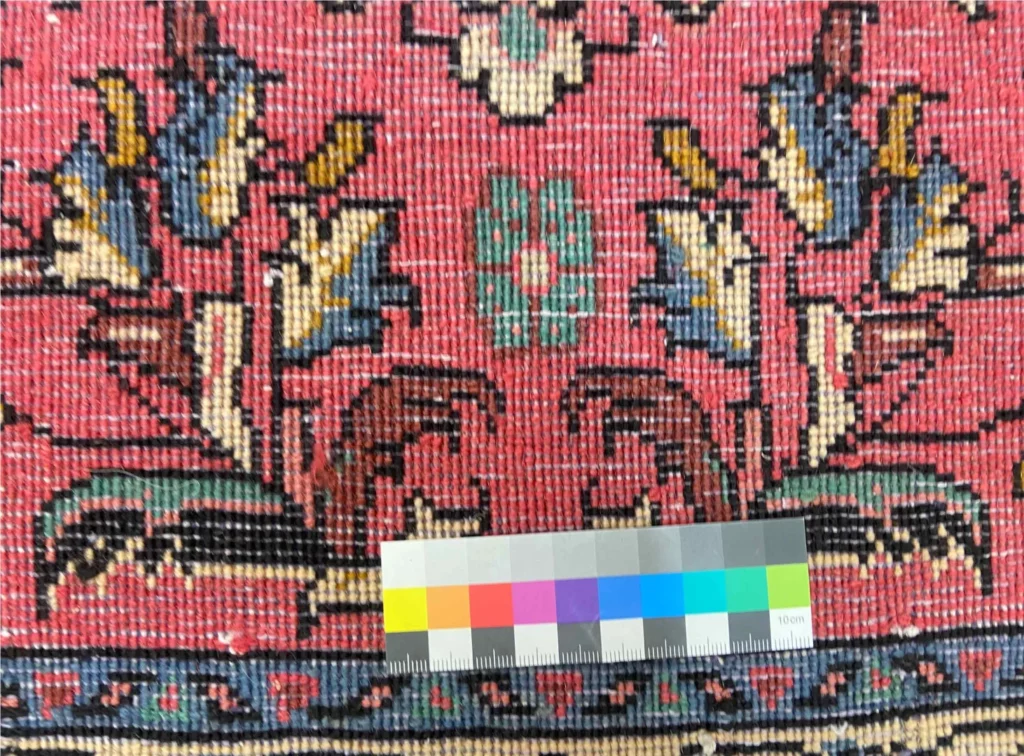
The listed knot density is 200.000 to 400.000 knots per square metre. A dense structure allows floral shapes, scrolling lines, and transitions within the ornament to be rendered with greater differentiation. Knot density describes the concentration of the knotting, but it is not the sole measure of a rug’s quality. The regularity of the knots, the clarity of the drawing, the definition of the outlines, and the relationship between colours also contribute to the finished appearance.
The description refers to high-quality materials without identifying particular fibres. No specific fibre is therefore assigned here. What is established is the combination of hand-knotting, a high stated knot density, and a floral design. These features place the piece within the traditional Persian rug craft and explain why Sarough rugs are associated with carefully worked surfaces and detailed ornament.
Origin and Tradition
Sarough belongs to the Persian rug tradition of Northern Persia. The name identifies a recognised rug type whose regional character is shaped by an established pattern language and by the transmission of weaving skills. A central concern is the balance between a clearly organised field and abundant floral ornament. Weavers work with inherited compositional principles while giving each individual rug its own execution.
Rug making in Northern Persia rests on a long history of craft knowledge. Techniques for knotting, colour coordination, pattern planning, and the use of drawn designs have been passed through generations. This tradition includes a sequence of practical tasks: preparing the foundation, tying rows of knots, securing the structure with weft, trimming the pile, and checking the edges and ends. The result is both a useful textile and a carefully constructed work of regional design.
Sarough rugs were often produced for international trade. The source description particularly discusses rugs originally made for the American market and later reimported from the United States to Europe. These pieces, sometimes called American Sarough, represent a distinct commercial route within the broader Sarough tradition. That route describes distribution rather than replacing the rug’s origin. This piece is described as a Sarough from Northern Persia.
Persian rug making contains many regional traditions, each with its own emphasis. Kerman rugs are associated with complex pattern structures and refined colour combinations. Tabriz is often linked with fine workmanship and precise detail. Isfahan is also recognised for accomplished craft and may feature artistic scenes from history. These comparisons place Sarough within the wider Persian tradition without confusing its Northern Persian identity with another place name.
Hand-knotted rugs from this tradition are practical textiles as well as expressions of regional design. Their patterns can develop over long periods while retaining the basic idea of a floral composition. In this way, inherited forms meet the particular decisions made during the production of one piece. Each hand-knotted rug is unique because its making is not repeated with industrial uniformity.
Design and Pattern
The pattern of this Sarough is described as a floral design on a red and brown ground. Floral Sarough compositions draw on forms from the plant world: blossoms, leaves, scrolling vines, and connected branches may be arranged into a repeating field or an organised overall layout. The floral language is not a literal image of one particular plant. It is a decorative system based on rhythm, repetition, connected movement, and balanced distribution across the surface.
Red and brown establish the colour setting for the design. Red can serve as a strong field colour in Persian rug composition, while brown introduces an earthy and more restrained counterpoint. Together, the two ground tones allow the floral ornament to read as a unified design. The description gives the ground colours but does not identify additional individual colours or the exact placement of particular blossoms. The account therefore remains with the stated floral character and the named red and brown tones.
In a floral rug, the relationship between the open ground and the ornament is fundamental. The design is arranged so that neither the empty field nor the decoration overwhelms the other. Repeating vines can guide the eye through the composition, while blossoms act as points of emphasis within it. A dense knot structure supports the rendering of such forms because outlines and smaller areas can be differentiated more carefully. This explains the connection between the stated knot density and the detailed nature of the design without adding unrecorded details about this rug.
Sarough designs are known for their floral imagery. Natural forms provide a vocabulary, but they are translated into a textile and ornamental order. Leaves can mark transitions, blossoms can create accents, and vines can connect separate areas of the field. This approach produces a harmonious decorative structure, while the precise drawing varies from one rug to another. The floral tradition is therefore a design framework, not a claim that every Sarough uses the same arrangement.
The floral composition makes Sarough rugs suitable for different interior settings. A red and brown ground can be placed alongside traditional furnishings or used with a quieter contemporary interior. This is a general feature of the design language, not a statement about a particular room. Sarough rugs have traditionally been used in different living spaces, where their floral ornament may function as a principal textile element or as a complementary pattern within the room.
Special Features
The recorded features of this piece are its hand-knotted construction, a knot density of 200.000 to 400.000 knots per square metre, a floral design on a red and brown ground, and very good condition. It is also identified as a Sarough from Northern Persia. The description mentions high-quality materials but does not provide a more specific material composition. These are the factual points on which the rug’s classification rests.
The combination of regional identity, traditional handwork, and floral decoration characterises the Sarough tradition. Knot density is the technical feature, while the colour ground and floral design define the visual aspect. The very good condition adds information about the preserved state of the offered rug. A particular fibre, production year, signature, or special provenance is not included in the description and is not assigned here.
FAQ
What makes this Sarough distinctive?
Its distinguishing features are the hand-knotted construction, the high stated knot density, and the floral design on a red and brown ground. The rug is also identified as a Sarough from Northern Persia and is described as being in very good condition. Floral ornament is one of the recognised characteristics of the Sarough tradition. A particular fibre or production year is not specified and is therefore not part of the description.
How should a hand-knotted Sarough be cared for?
Regular vacuuming and occasional beating are included among the recommended care measures for a hand-knotted Sarough. Spills should be treated promptly with a damp cloth so that they do not remain in the textile surface. Care should be carried out gently and without harsh handling. For a thorough cleaning or persistent marks, a professional service experienced with rugs should be consulted.
Where can Sarough rugs be purchased?
Sarough rugs are available from specialist rug dealers and through online retailers. When buying, it is useful to choose a trusted seller and to review the description carefully. Origin, technique, knot density, pattern, and condition should be stated as separate details. This makes it possible to distinguish a Sarough from Northern Persia from rugs made in other regions or from rugs that merely share a comparable floral design.
To provide the best experiences, we use technologies like cookies to store and/or access device information. Consenting to these technologies will allow us to process data such as browsing behavior or unique IDs on this site. Not consenting or withdrawing consent, may adversely affect certain features and functions.
Functional Always active
The technical storage or access is strictly necessary for the legitimate purpose of enabling the use of a specific service explicitly requested by the subscriber or user, or for the sole purpose of carrying out the transmission of a communication over an electronic communications network.
Preferences
The technical storage or access is necessary for the legitimate purpose of storing preferences that are not requested by the subscriber or user.
Statistics
The technical storage or access that is used exclusively for statistical purposes.The technical storage or access that is used exclusively for anonymous statistical purposes. Without a subpoena, voluntary compliance on the part of your Internet Service Provider, or additional records from a third party, information stored or retrieved for this purpose alone cannot usually be used to identify you.
Marketing
The technical storage or access is required to create user profiles to send advertising, or to track the user on a website or across several websites for similar marketing purposes.

 SECURE PAYMENT
 SHIPPING PARTNERS


