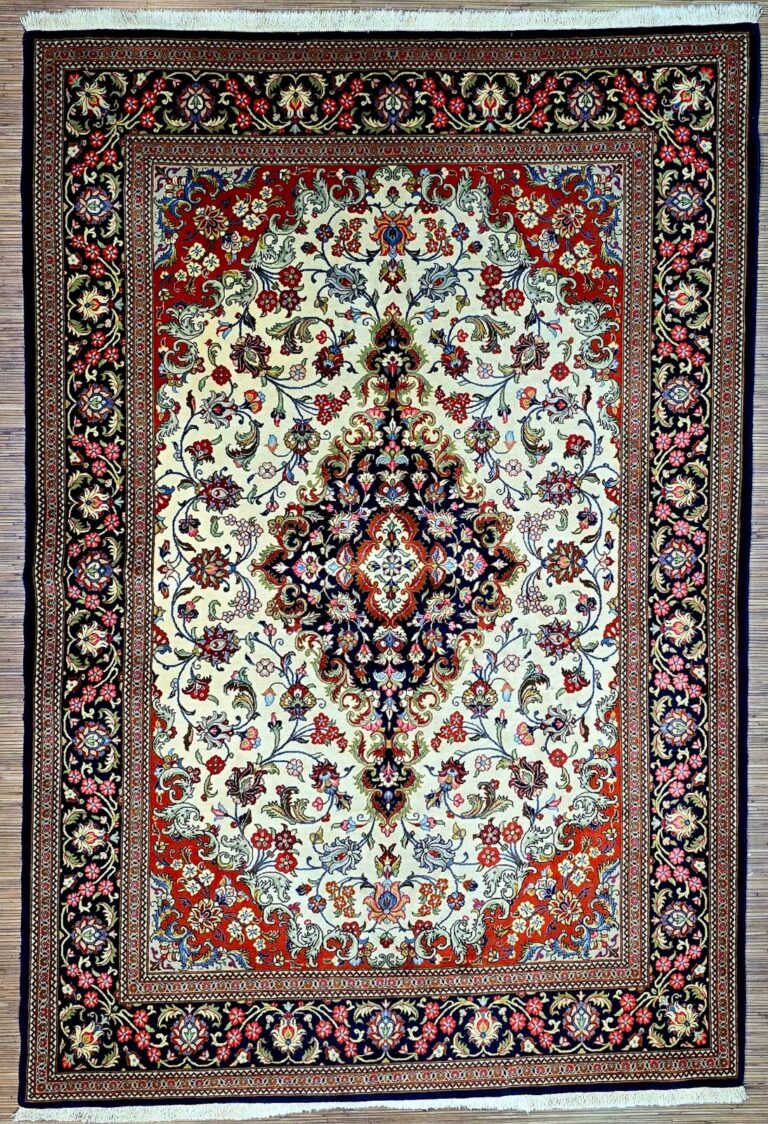
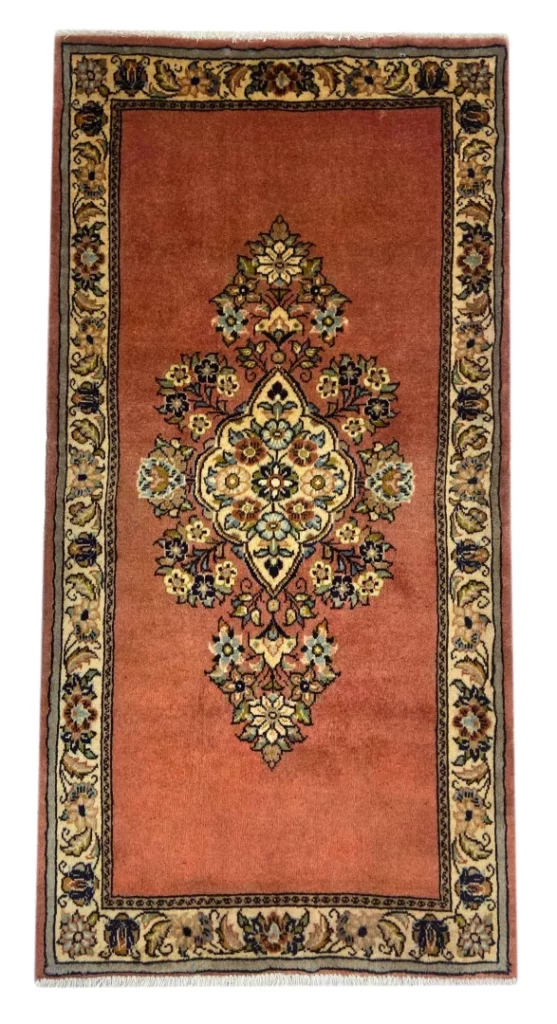
This Sarough Persian rug is hand-knotted and has a wool pile. Its construction begins with a firm foundation into which individual knots are inserted row by row. Unlike a machine-made floor covering, the surface is formed through a manual process in which the knot structure, the tension of the textile foundation and the placement of the colours must work together. Each stage requires close attention, because the drawn design has to be transferred into a coherent field of individually placed knots.
Wool has long been used for the pile of oriental rugs. It can be spun, dyed and worked into a resilient textile surface, while retaining a distinct natural texture. That texture allows the drawn motifs to remain legible within the pile. Wool is the material specified for the pile of this rug. A cotton foundation or any additional fibre is not stated for this particular piece and is therefore not added to its description.
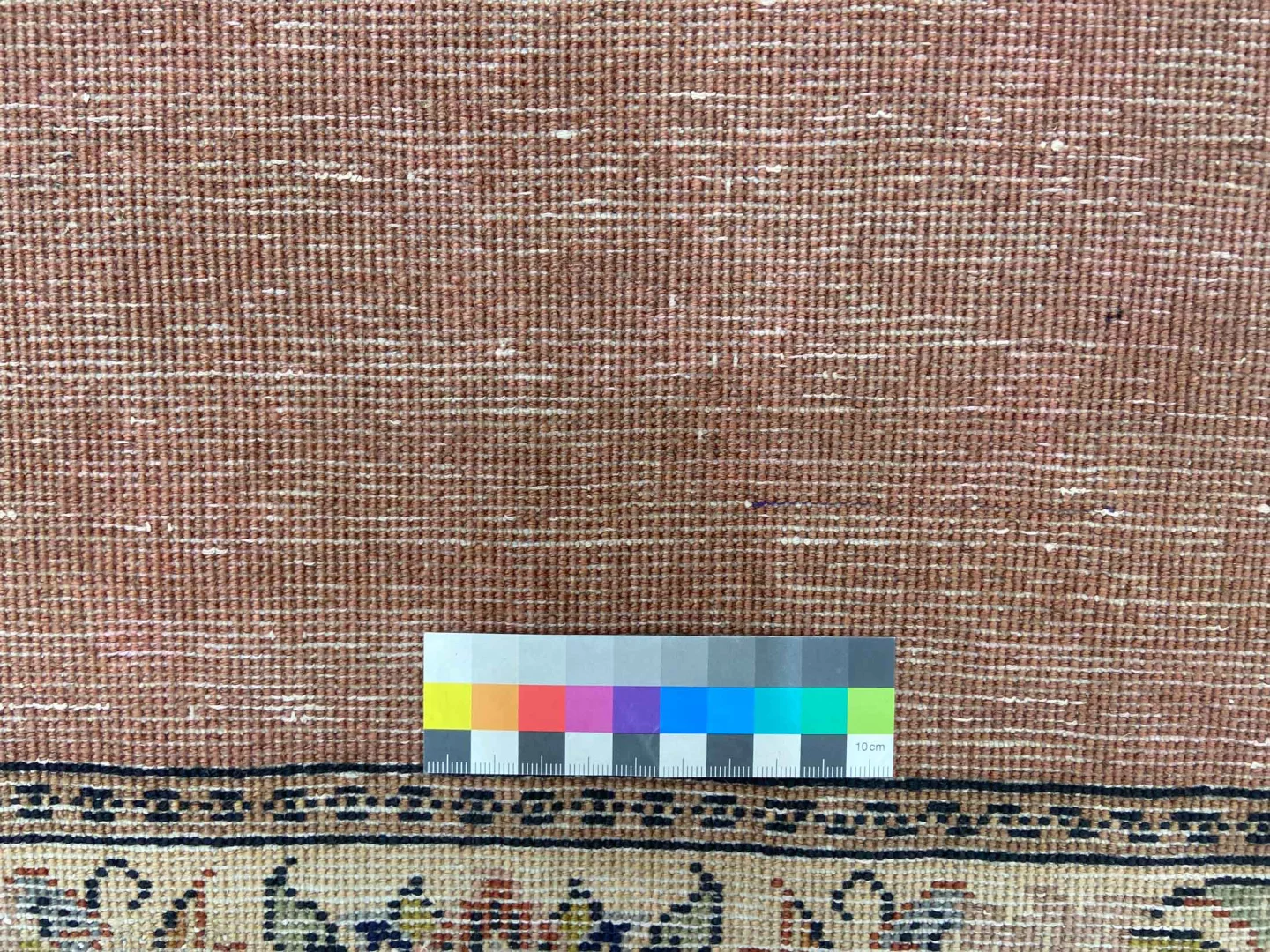
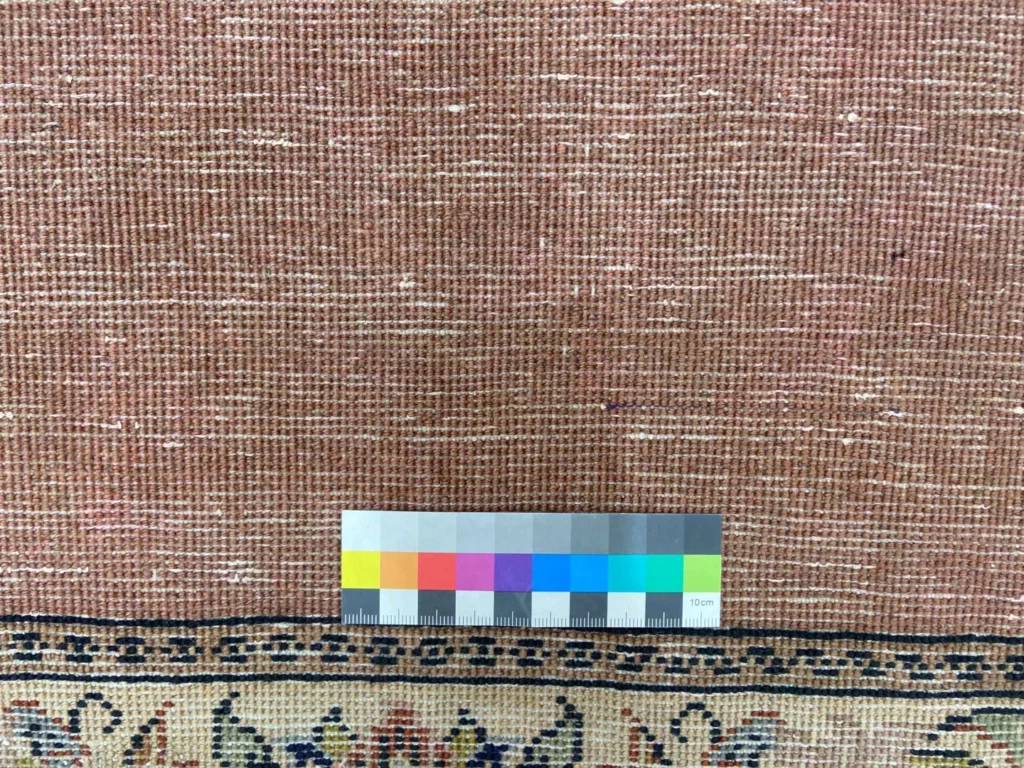
The recorded knot density is 200.000 to 400.000 knots per square metre. Knot density expresses how many hand-tied knots are placed within a defined area and gives an indication of the fine structure of the work. A construction at this level requires the design to be carefully divided into small colour fields and knot sequences. Floral details such as leaves, stems and blossoms can then be shaped through the arrangement of the knots rather than by applying a surface print.
Hand-knotting is one of the defining techniques of Persian rug making. It joins the choice of yarn with the preparation of the foundation, the repeated knotting process and the later finishing of the pile. Because the work is performed manually, the precise drawing and colour distribution belong to the individual piece. This rug is offered as a one-off item, so its particular execution is tied to this single Sarough rug.
Origin and Tradition
The rug comes from Sarough in northern Persia. Sarough is associated with a distinct regional tradition within Persian rug weaving. The name therefore refers to more than a decorative vocabulary: it identifies a place where design, materials and practical weaving knowledge developed together. Sarough rugs are commonly connected with carefully arranged floral compositions that draw on the established visual language of Persian carpets.
Across Persian weaving regions, knowledge of spinning, dyeing, knotting and finishing was passed from one generation to the next. A design had to be translated into a working process that could be followed at the loom. The sequence of knots, the order of colours and the limits of each ornament all depended on this practical knowledge. Sarough belongs to that wider Persian tradition while retaining its own regional identity and its association with floral patterning.
Northern Persia is an essential part of the rug’s classification. Persian rugs are not identified solely by a colour or by one isolated motif. Their regional origin, local design habits and method of construction all contribute to the classification. In Sarough weaving, these elements meet in compositions that use flowers, foliage and connecting ornament. The place name should consequently be understood as an origin statement, not as a simple synonym for a pattern.
The history of Persian rugs includes an exchange of forms, colours and technical ideas between weaving centres. Floral elements, medallions, borders and scrolling vines were repeatedly reorganised in different places and adapted to regional preferences. Sarough rugs form part of this continuing development, with floral details incorporated into an ordered overall composition. This individual rug represents a Sarough tradition without implying that every rug from the area has an identical layout.
Hand-knotted Persian rugs have traditionally been made for varied interiors and uses. Small pieces could serve as accent rugs or runners, while larger examples could cover more substantial areas. Size alone does not establish origin. For this rug, the relevant combination is the Sarough origin in northern Persia, the wool pile, the floral design and the hand-knotted technique.
Sarough weaving is also discussed in relation to rugs made for different trading markets. Commercial routes sometimes influenced formats, colour preferences and the selection of designs. Such circumstances do not automatically change a rug’s origin. This piece is identified as a Sarough Persian rug from northern Persia; no specific destination market or special export series is recorded for it.
Design and Pattern
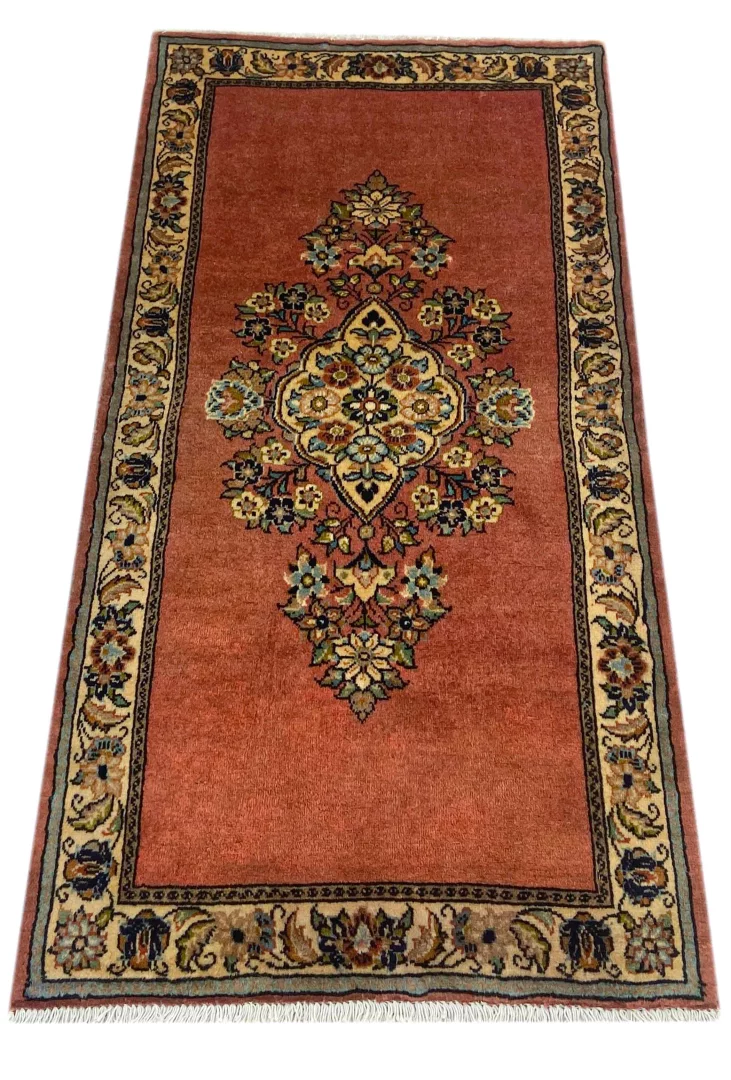
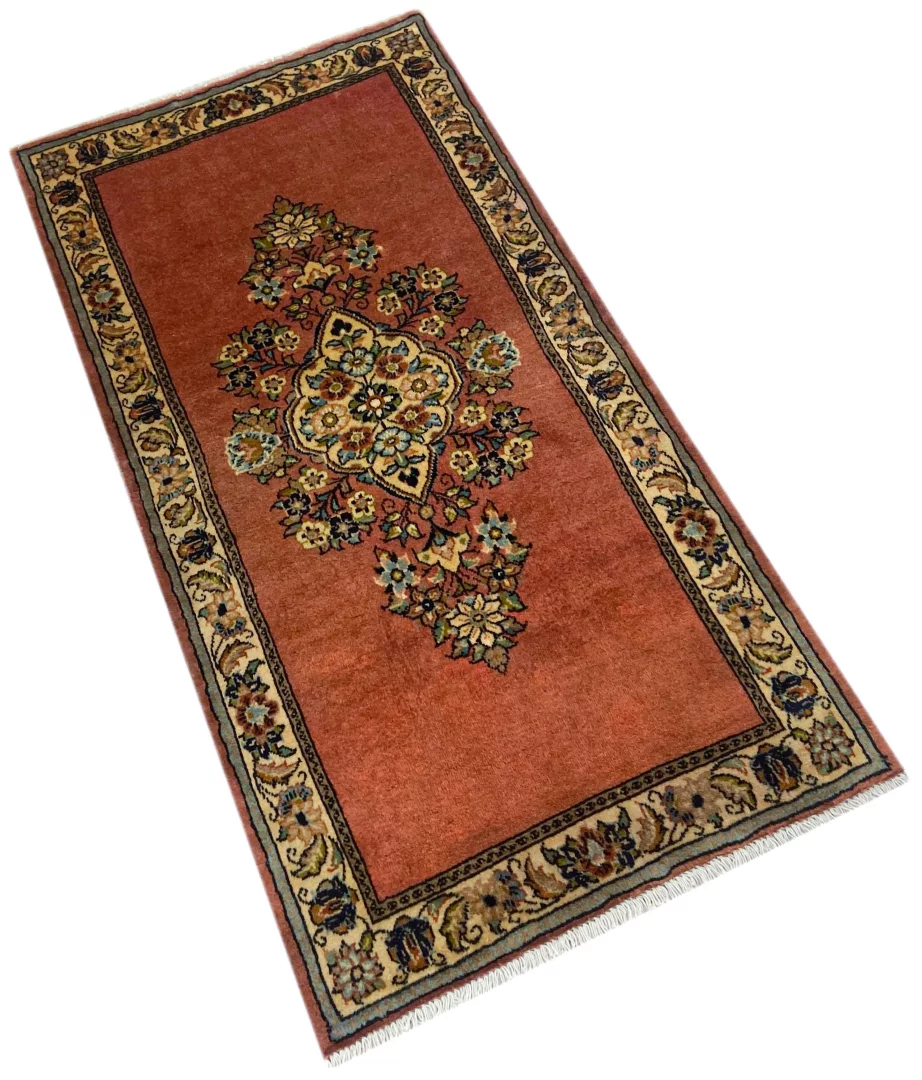
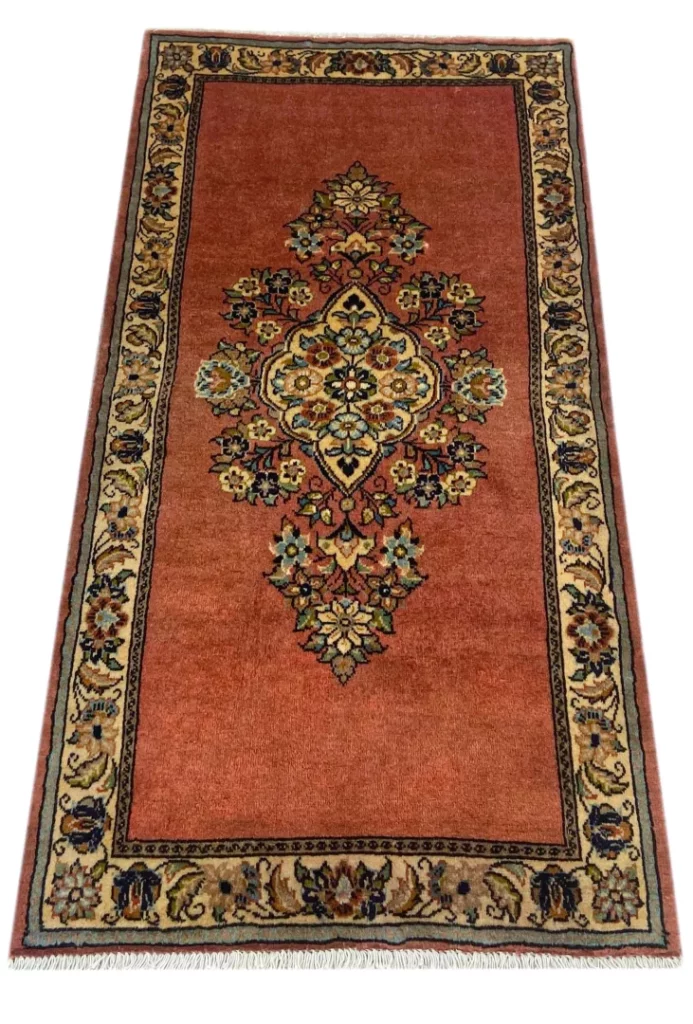
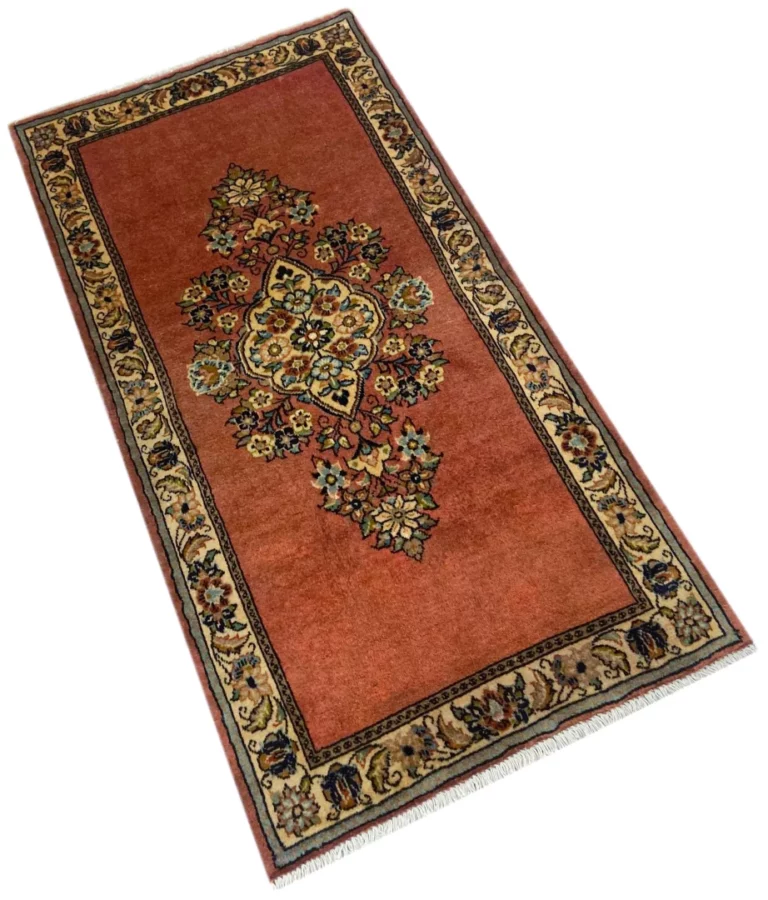
The pattern of this rug is described as floral. Floral Persian rug designs often draw on the forms of plants: blossoms, leaves, vines and stylised branches may be connected into a continuous ornamental rhythm. They are not necessarily botanical illustrations. Instead, natural forms are simplified, repeated and balanced within a woven composition. This transformation of plant shapes into ornament is one of the recurring methods of Persian decorative design.
Sarough compositions may arrange floral elements around a central structure, distribute them throughout the field or use scrolling vines as the main organising principle. The exact arrangement must be read from the individual rug. For this piece, the documented pattern description is floral design. No additional claim is made about a medallion, field layout, border structure or ground colour beyond that description.
A floral rug pattern is created in the knotting process through the deliberate placement of dyed wool yarns. The design is converted into separate colour areas and successive knot positions. This gives flowers and leaves their outlines, while changes in direction allow vines to link one ornament with another. The hand-knotted surface gives the transitions a textile presence while keeping the pattern within the ordered language of Persian ornament.
Floral compositions often depend on a balance between repetition and variation. Repeated blossoms establish a rhythm, while differences in scale, direction or connection keep the field from becoming mechanically uniform. In Persian ornament, repetition is normally governed by an underlying compositional plan. The eye can move between related motifs, across the field and toward the framing elements without requiring every detail to be identical.
Floral designs can be densely articulated or more restrained. Small leaves and blossoms create a finely divided drawing, while larger flowers provide clearer points of emphasis. Vines can act as a framework that connects separate motifs and controls the movement of the design. The specific density and colour distribution of this rug are not described beyond its floral designation. Its documented identity remains a Sarough pattern in the floral tradition.
Pattern names are sometimes associated with places or with particular ornaments. Such a name does not necessarily mean that a rug with that motif originated in the place named by the pattern. Here, Sarough identifies the origin, while floral design identifies the visual character. Keeping those two statements separate prevents a design description from being mistaken for an additional, unsupported provenance claim.
Special Features
This piece combines a Sarough origin with hand-knotted construction and a floral design. The wool pile and the recorded knot density describe its material and technical character. A density of 200.000 to 400.000 knots per square metre indicates finely structured manual work, but it does not by itself establish an age, a particular durability rating or a named workshop. Those details are not assigned to this rug.
The condition is described as very good. That assessment is a specific feature of the offered one-off item. No information is given about repairs, an original production date, a signature or a special provenance. The pile material is stated as wool; silk accents are not added as a feature of this particular rug, and no other pile material is claimed.
As a hand-knotted Sarough Persian rug, the piece brings together a clearly identified regional origin and a traditional technique. Its floral pattern establishes the design direction, while the wool pile and knot density describe the documented workmanship. These characteristics present the rug as an individual example of Sarough weaving without extending the description beyond the facts recorded for this one piece.
FAQ
How should I care for this Sarough Persian rug?
A hand-knotted wool rug benefits from regular, gentle cleaning so that dust and loose particles do not remain in the pile. Use a suitable vacuum cleaner without an aggressive setting or harsh treatment. If liquid is spilled, absorb it promptly and carefully rather than rubbing the pile strongly. For stains or a complete cleaning, professional rug cleaning is recommended. Strong direct sunlight should be avoided where possible so that the colours remain as even as they can. Since this rug is described as being in very good condition, restrained and careful maintenance is appropriate.
Where does the Sarough Persian rug come from?
This Persian rug comes from Sarough in northern Persia. Sarough identifies the place of origin, not merely the floral pattern. The area is connected with a Persian weaving tradition in which hand-knotted rugs with floral compositions are produced. Regional classification is complemented by the technique and the design, but it does not replace them. No maker, workshop, production date or signature is recorded for this particular rug, so none of those details is added.
What material is used in the rug?
The pile of this Sarough Persian rug is made of wool. Wool is a traditional natural material for the pile of oriental rugs and can be worked into a structured textile surface through hand-knotting. A cotton warp is not specified for this piece, and silk components are not identified as a feature of it. The material statement is therefore limited to wool in the pile. Together with the hand-knotted construction and the recorded knot density, it describes the documented workmanship of this individual rug.
To provide the best experiences, we use technologies like cookies to store and/or access device information. Consenting to these technologies will allow us to process data such as browsing behavior or unique IDs on this site. Not consenting or withdrawing consent, may adversely affect certain features and functions.
Functional Always active
The technical storage or access is strictly necessary for the legitimate purpose of enabling the use of a specific service explicitly requested by the subscriber or user, or for the sole purpose of carrying out the transmission of a communication over an electronic communications network.
Preferences
The technical storage or access is necessary for the legitimate purpose of storing preferences that are not requested by the subscriber or user.
Statistics
The technical storage or access that is used exclusively for statistical purposes.The technical storage or access that is used exclusively for anonymous statistical purposes. Without a subpoena, voluntary compliance on the part of your Internet Service Provider, or additional records from a third party, information stored or retrieved for this purpose alone cannot usually be used to identify you.
Marketing
The technical storage or access is required to create user profiles to send advertising, or to track the user on a website or across several websites for similar marketing purposes.

 SECURE PAYMENT
 SHIPPING PARTNERS