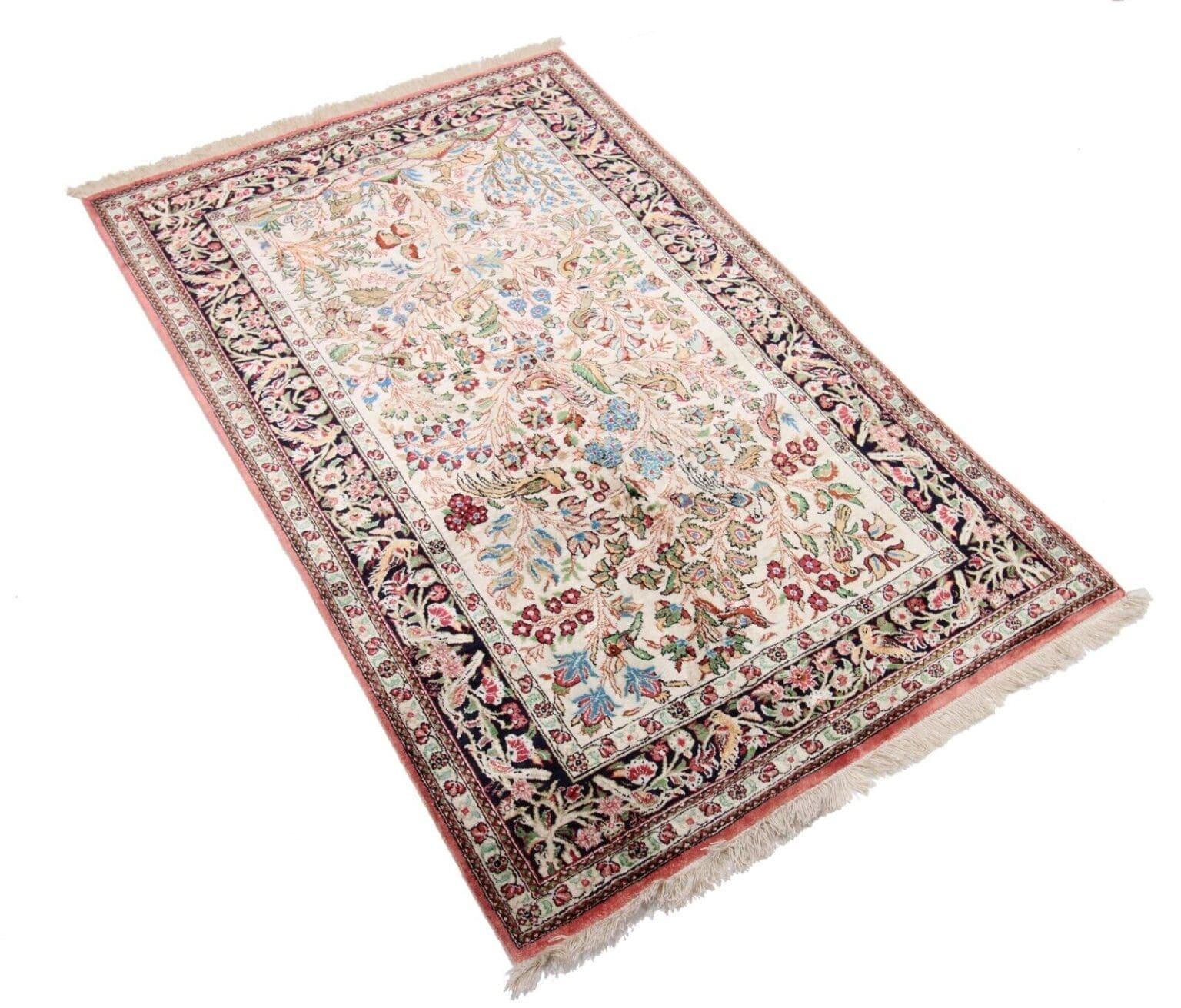
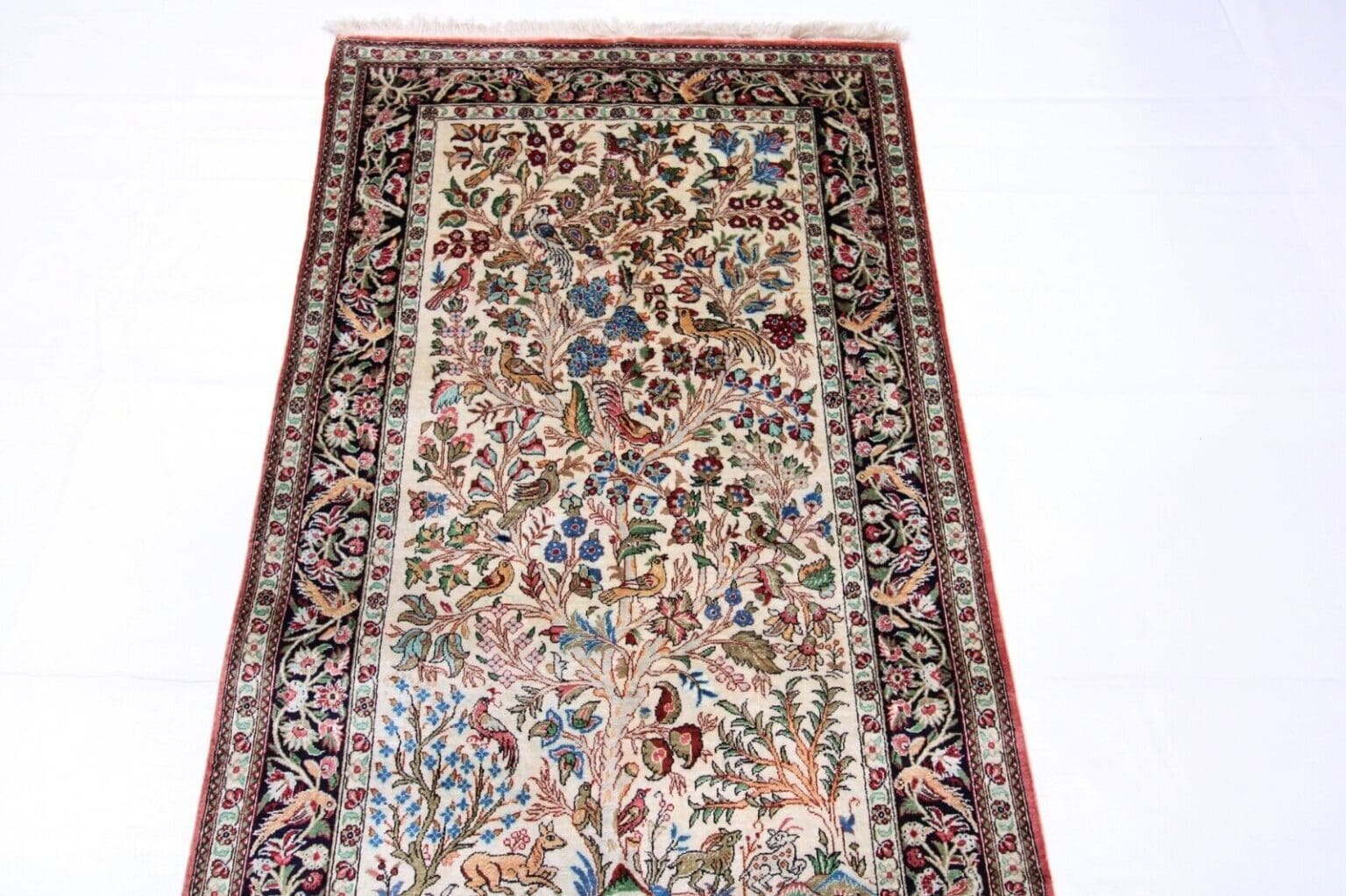
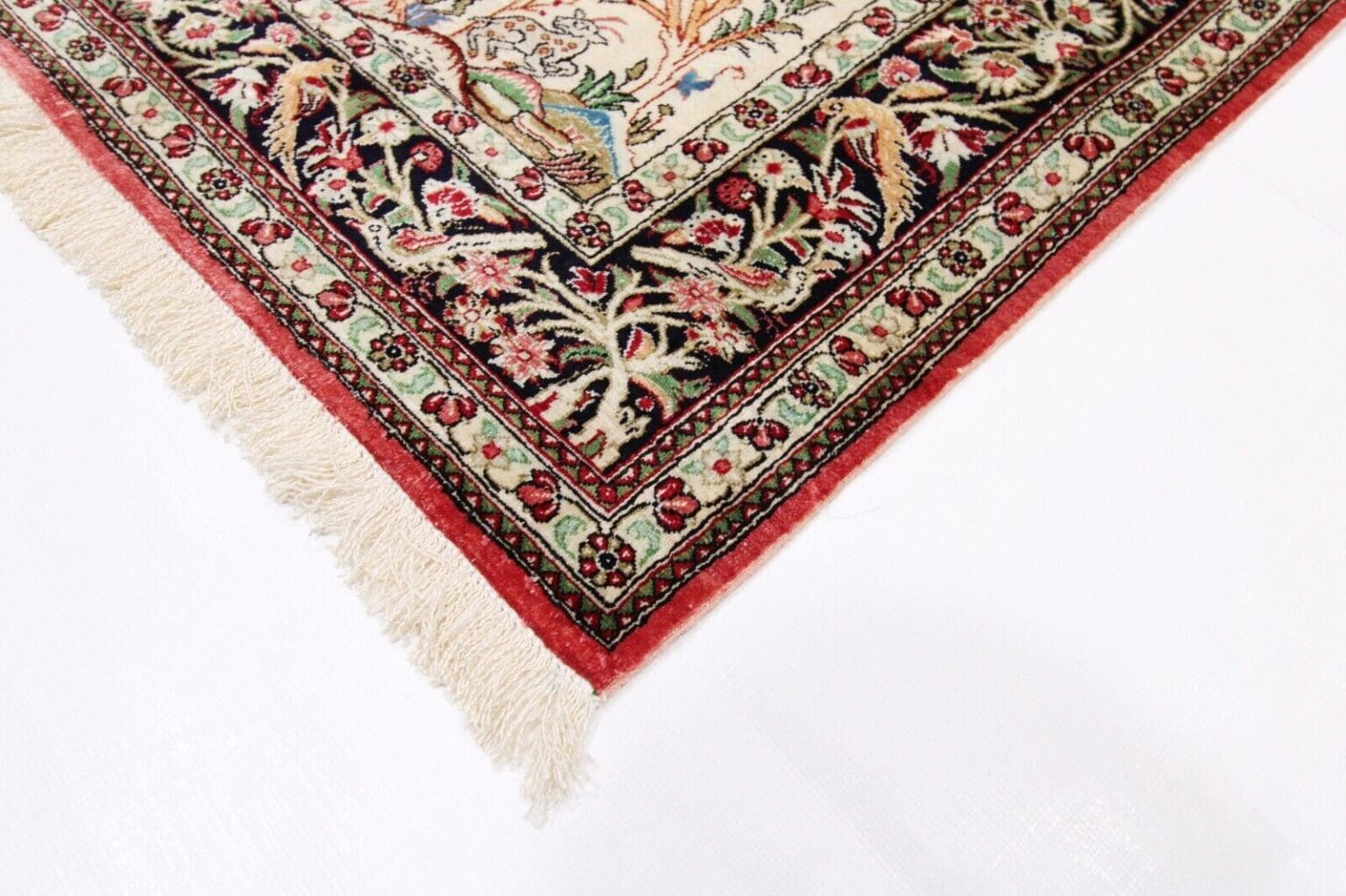
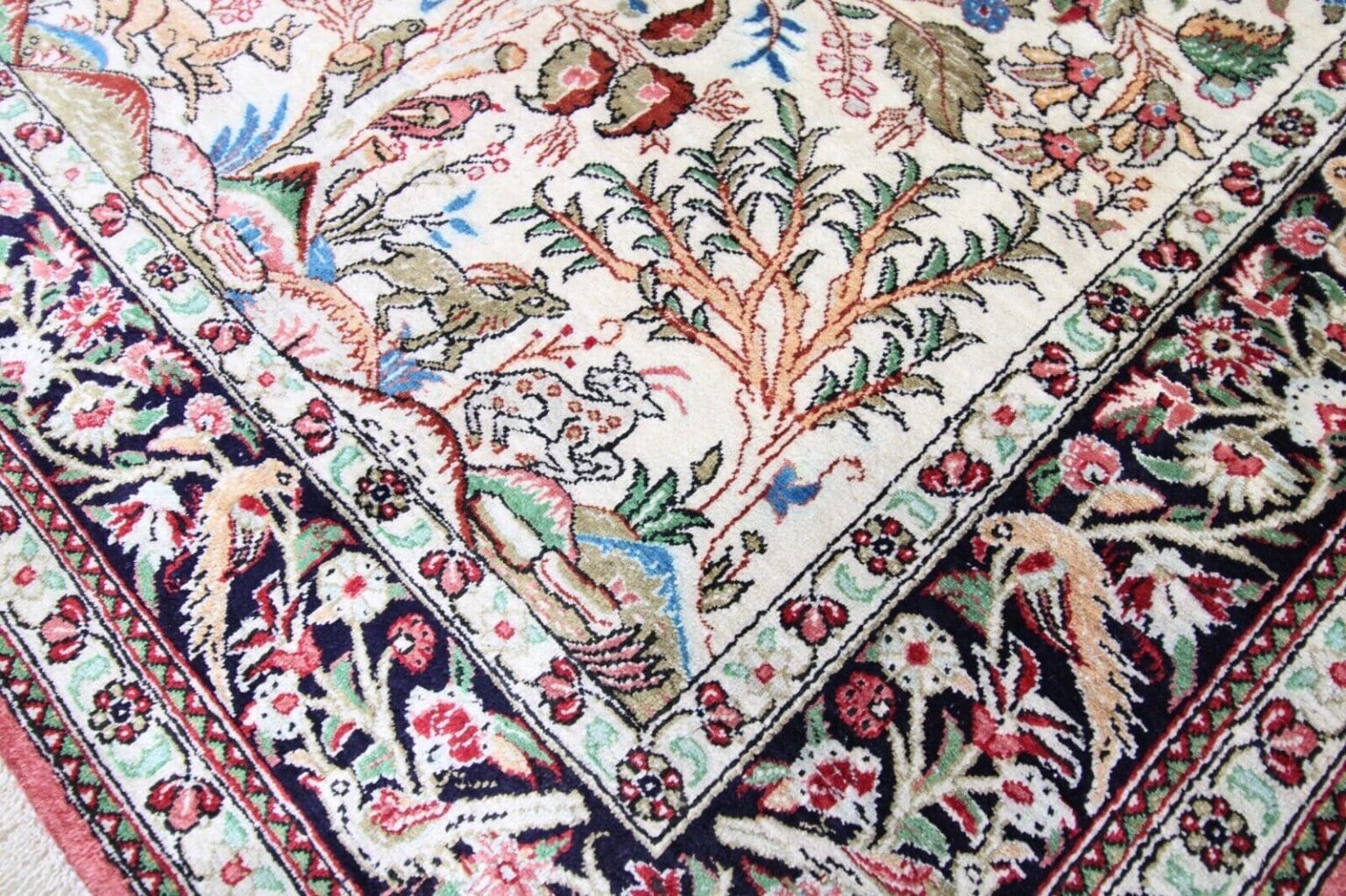
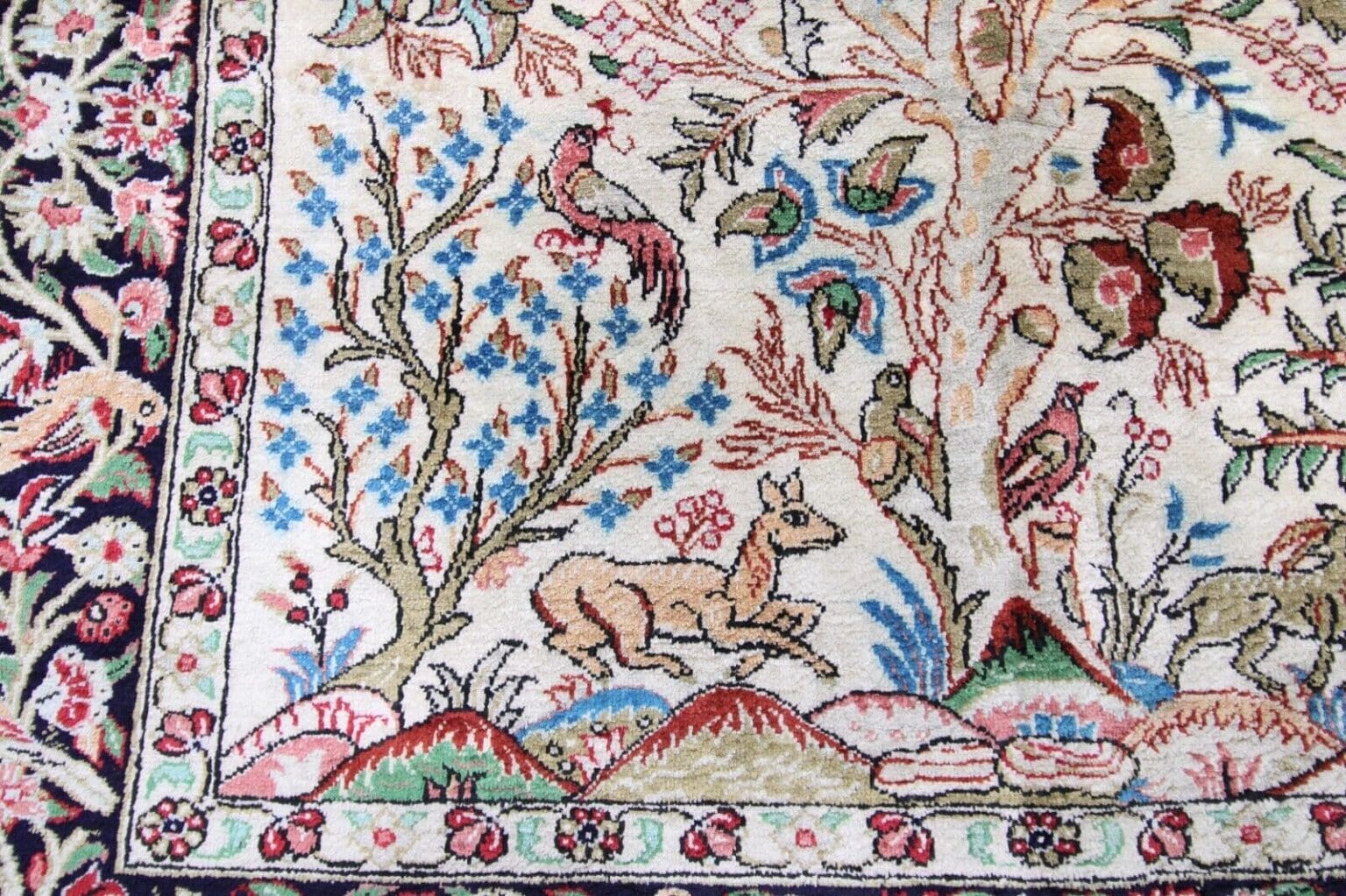
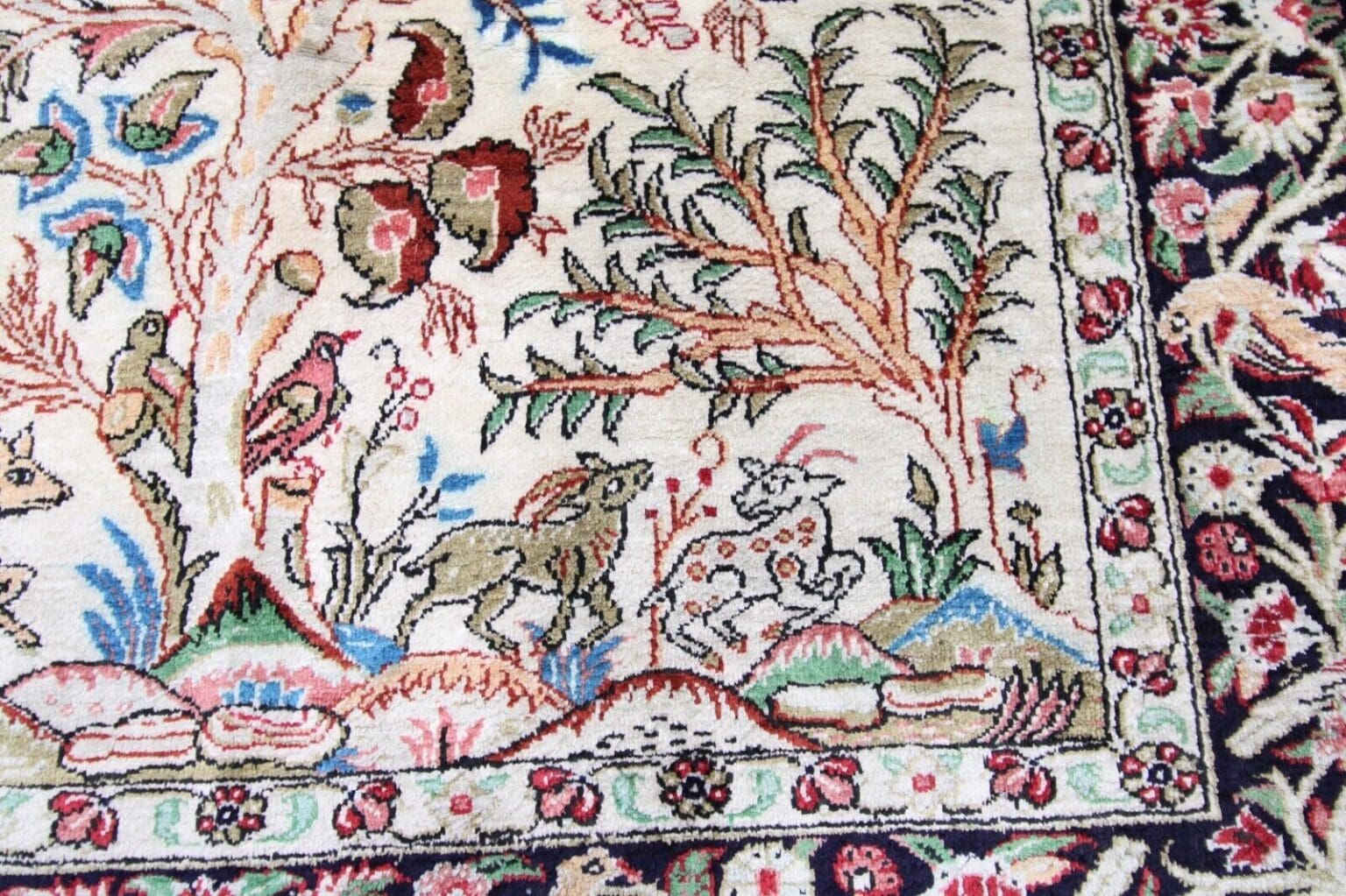
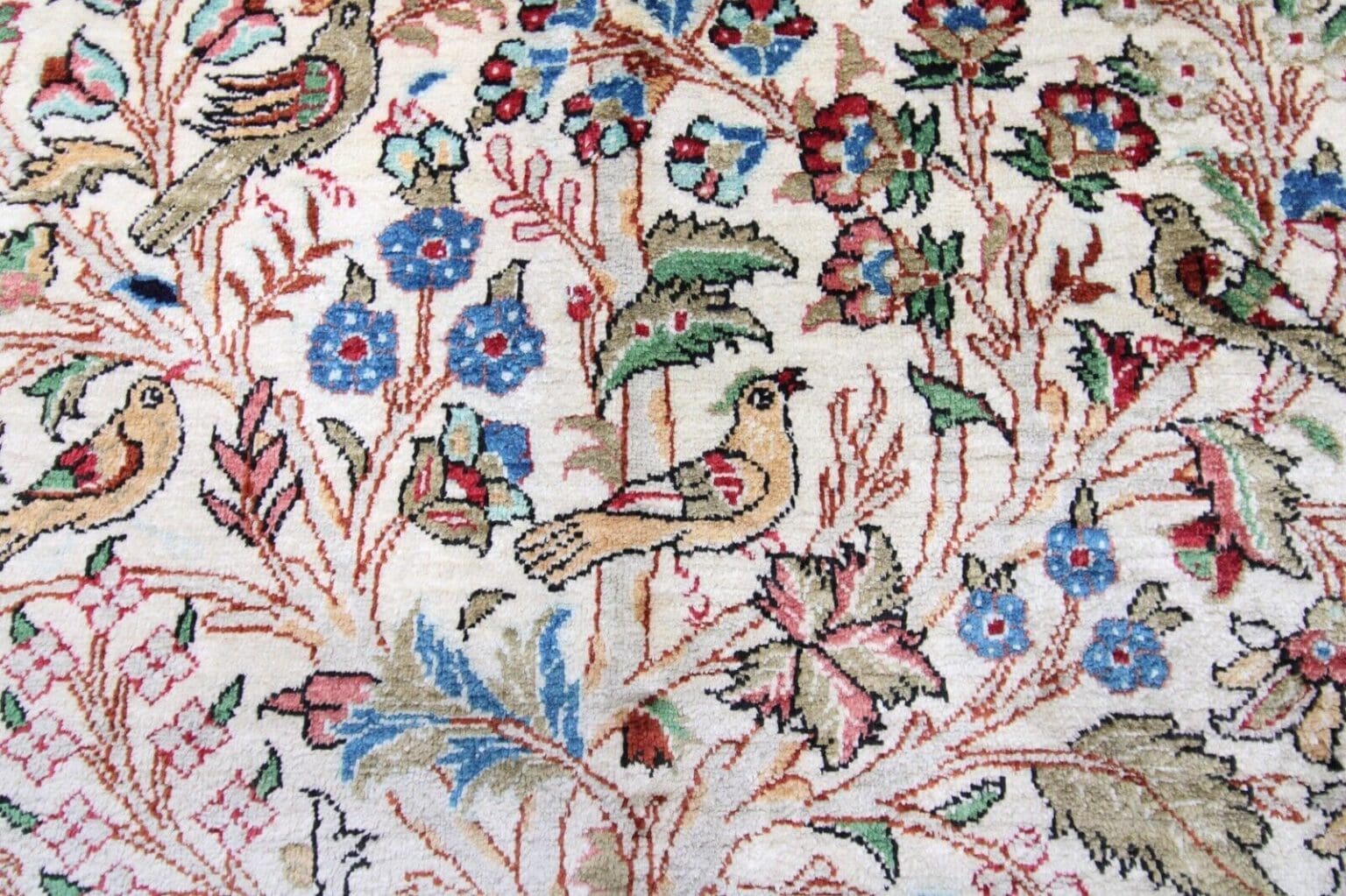
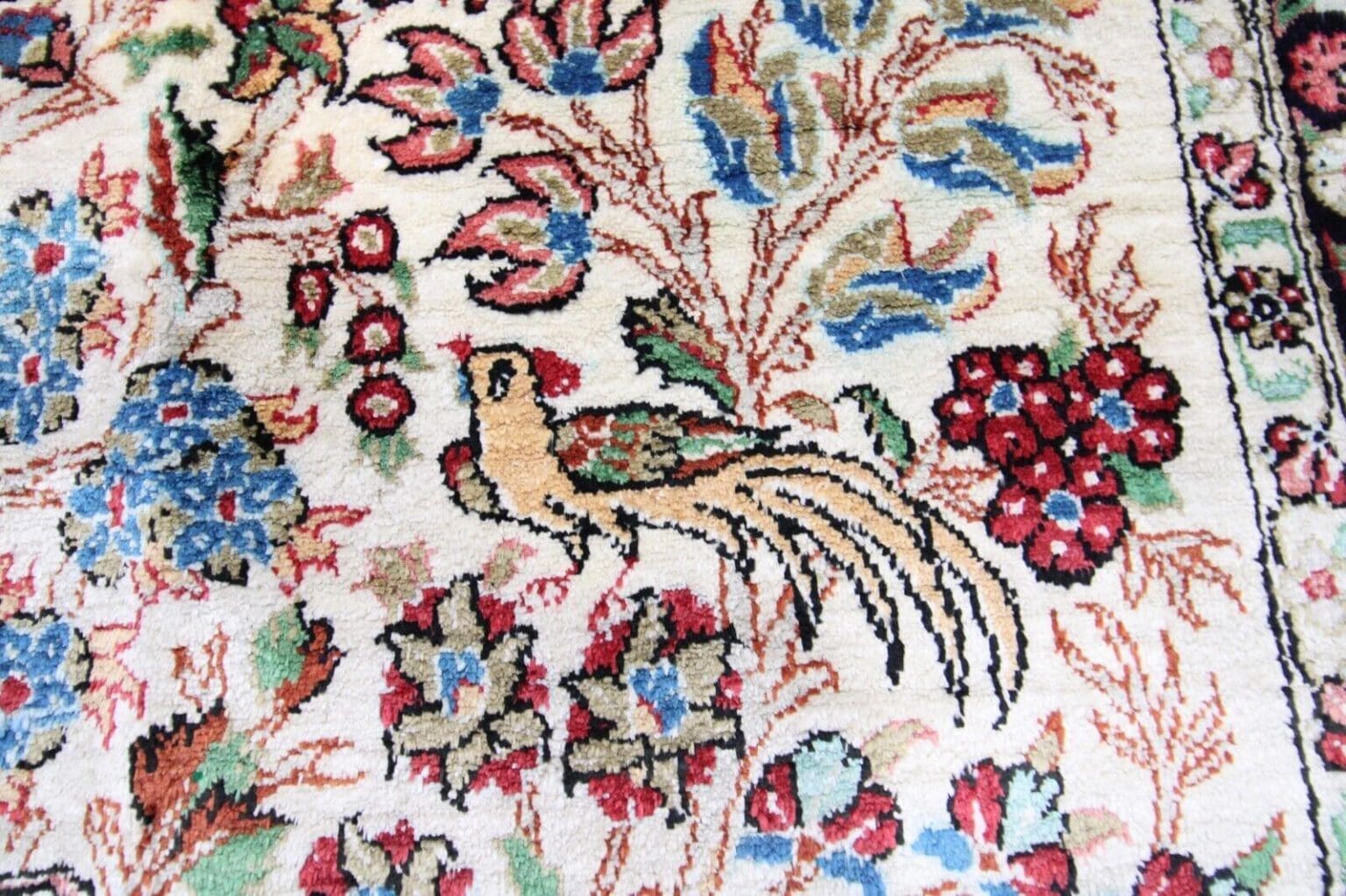
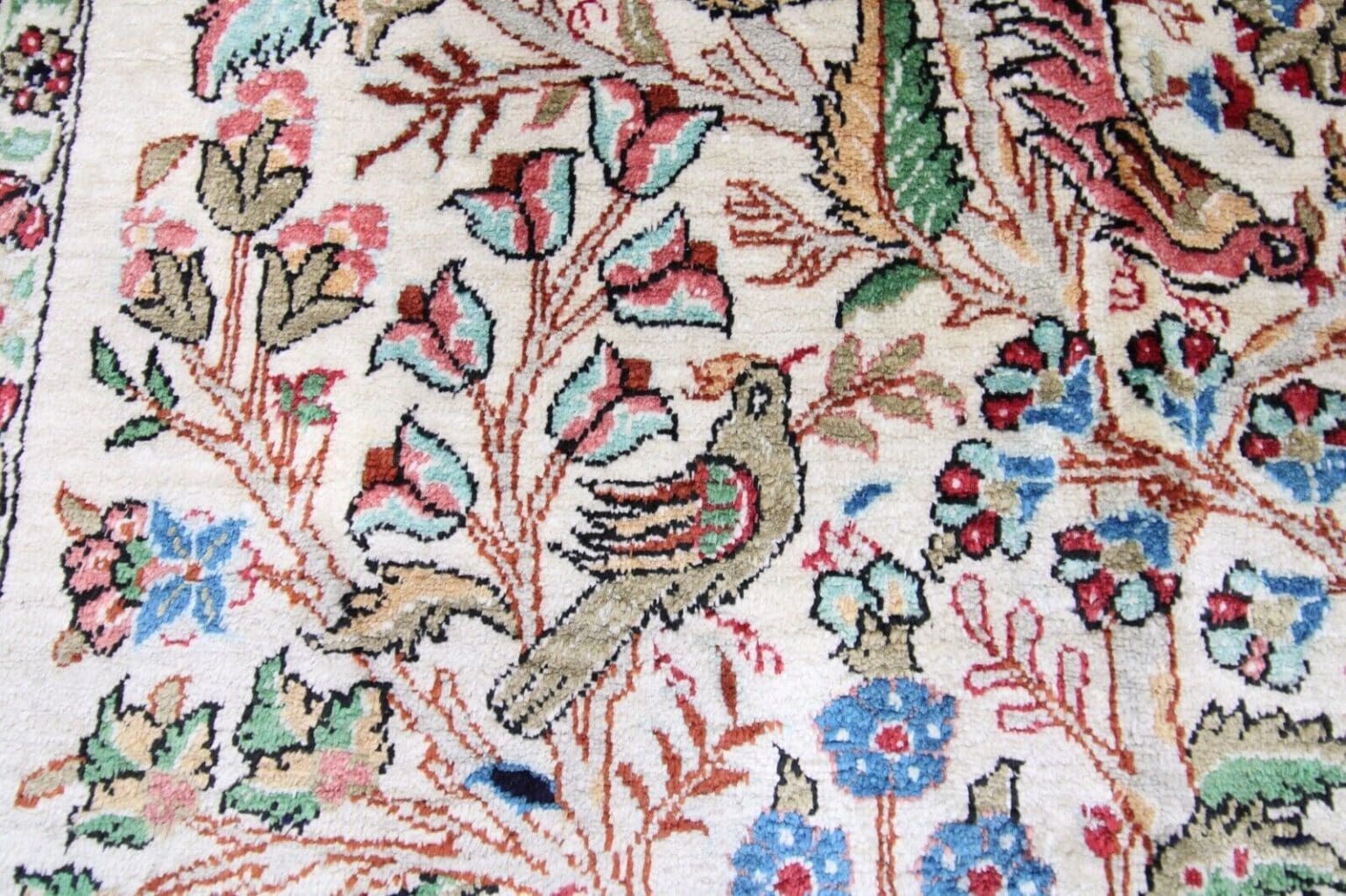
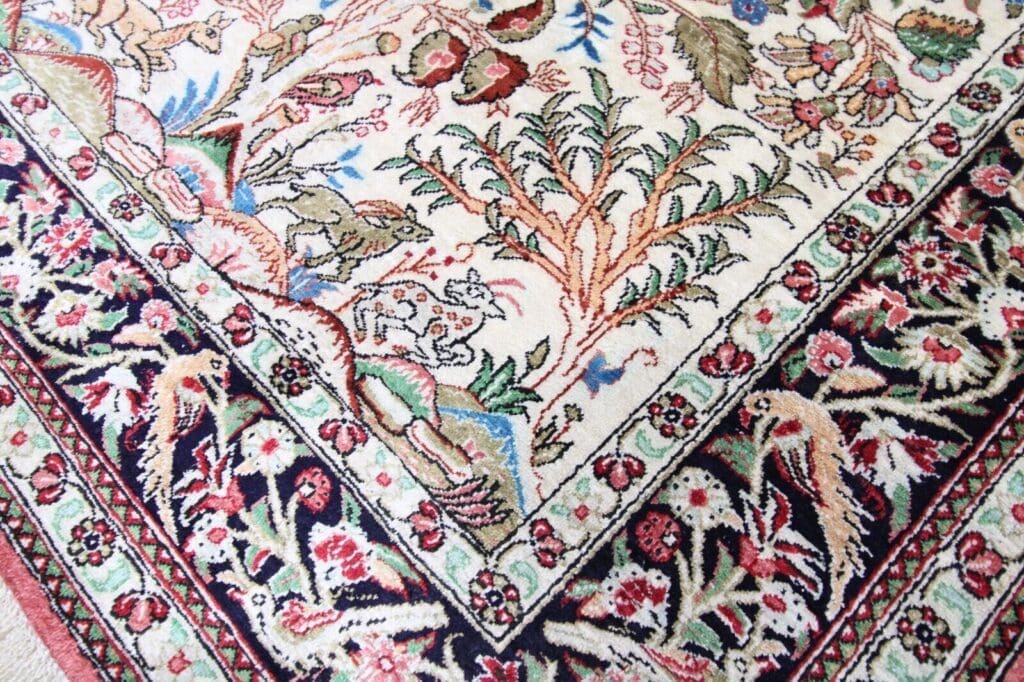
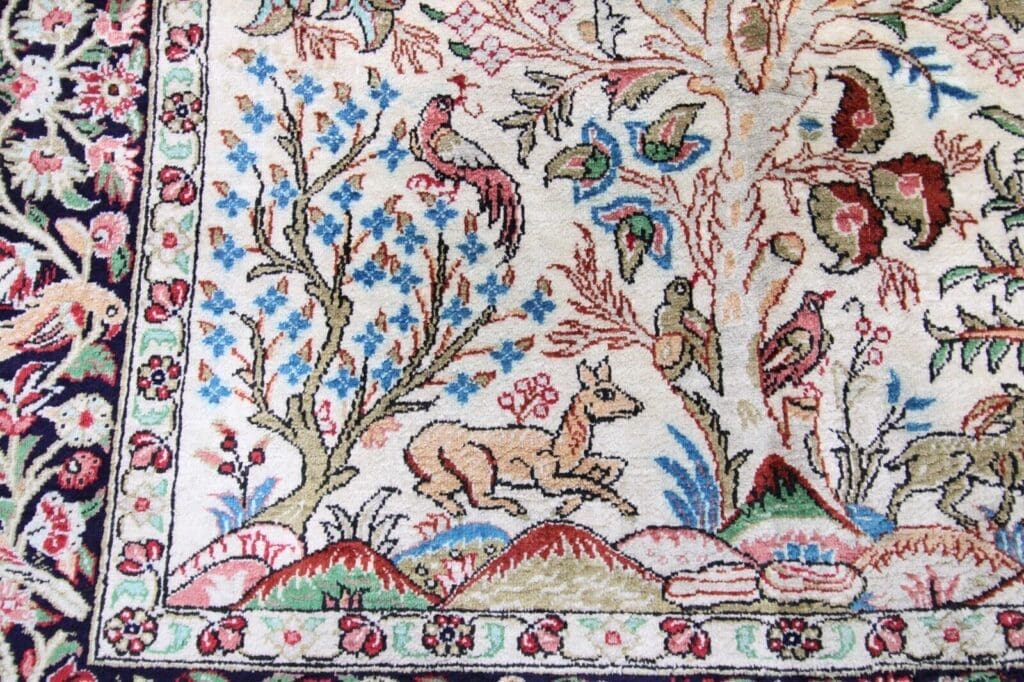
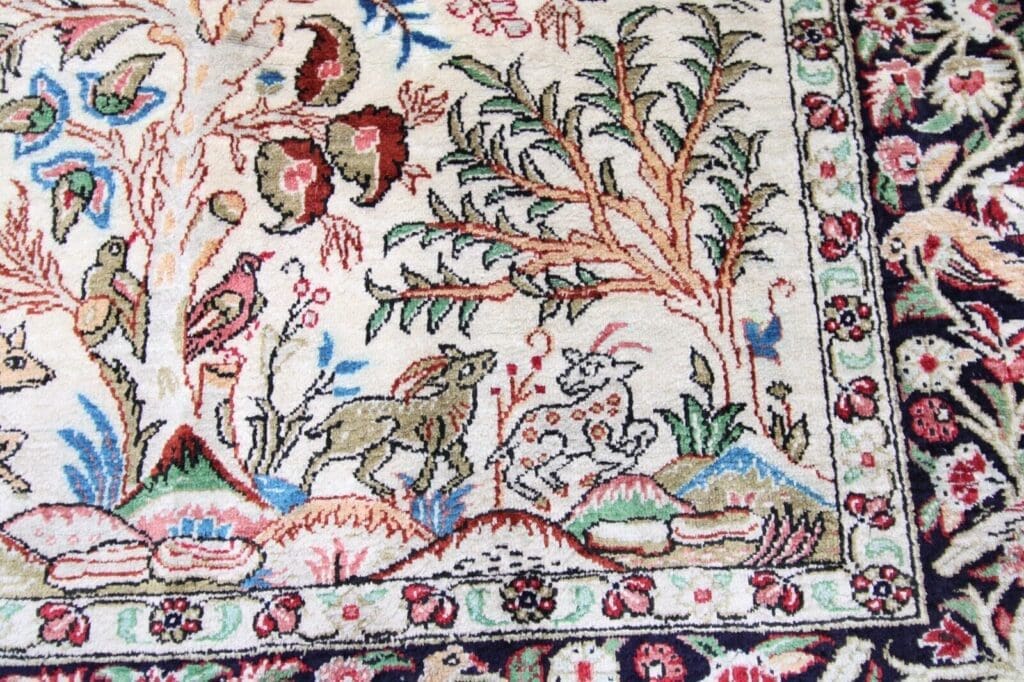
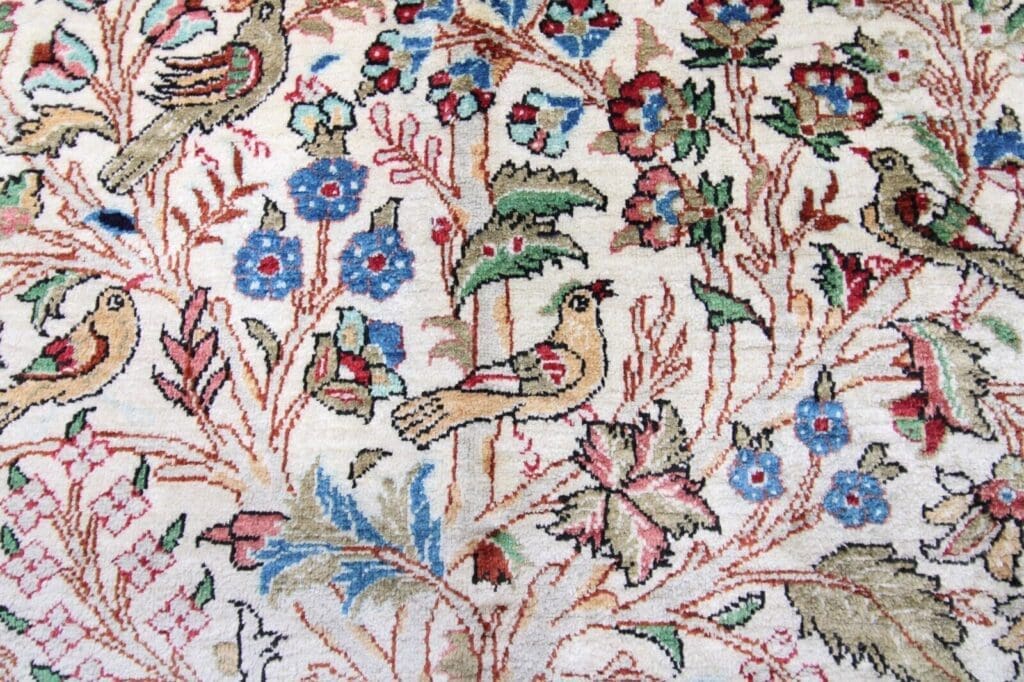
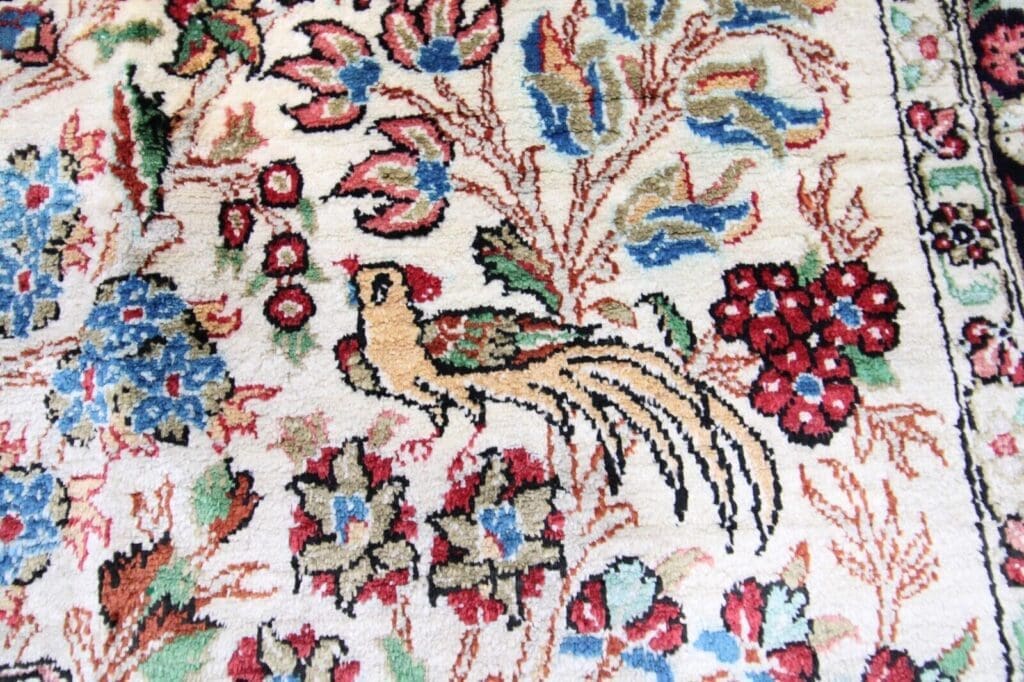
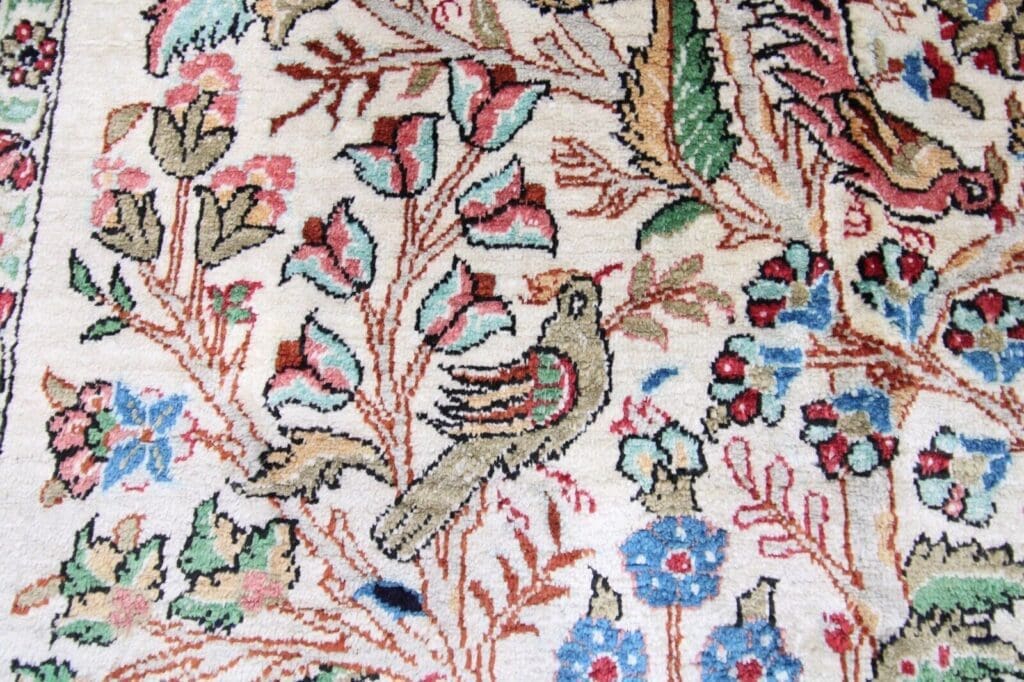
This Persian rug is hand-knotted and made with pure silk. Hand-knotting is a method in which individual knots are tied by hand around the warp, row by row, before the pile is trimmed and the surface is finished. The process allows a weaver to create precise contours, controlled colour changes and finely articulated details. It also means that the finished textile is the result of many separate manual decisions rather than a mechanically repeated surface.
Silk has a distinctive role in Persian rug making. Its smooth fibres can take colour clearly and reflect light across the pile, giving the surface a changing appearance as the viewing angle or illumination changes. Compared with wool, silk is finer and has a naturally polished feel. For this reason, silk is often used when a design calls for delicate lines, small-scale ornament or a particularly refined surface structure. The material is valued for its visual clarity as well as for its tactile character.
The combination of silk and hand-knotting connects the rug with a technically demanding branch of oriental textile production. A hand-knotted rug is not produced as a continuous industrial fabric. Its character develops through the interaction of the knot structure, the pile, the warp and the finishing work. In a silk rug, the fine fibre makes careful handling especially important during knotting, trimming and cleaning. The source identifies this piece as made from pure silk and as entirely hand-knotted.
Origin and Tradition
The rug is identified as a Persian rug from Ghom, also written Qom. Qom is one of the recognised centres of Persian carpet weaving and is particularly associated with finely executed workshop rugs. The city is located in central Iran and has developed a reputation for refined designs, detailed drawing and the use of fine materials. Qom carpets belong to the broader Persian tradition, while their workshop production has its own visual and technical identity.
Persian carpet weaving is a craft with a long history. In its traditional form, the design is transferred to the woven structure through a sequence of individually tied knots. Weavers work from an organised plan that establishes the main field, borders and ornamental elements. The process requires concentration and a consistent sense of proportion, because a small adjustment in one area can influence the balance of the complete composition. Finishing includes securing the ends, evening the pile and preparing the surface for use.
Qom became especially important for the production of finely knotted carpets during the modern development of Persian workshop weaving. Its carpets are often discussed alongside the work of other major Iranian centres such as Isfahan, Kashan, Nain and Tabriz. These places share the Persian knotting tradition but are not interchangeable names: each has developed characteristic approaches to drawing, colour and composition. Qom is commonly connected with precise floral ornament, medallion arrangements and detailed all-over designs, although individual carpets can vary considerably.
The Persian rug tradition also includes different levels of production, from village weaving and tribal work to organised urban workshops. Urban workshop rugs generally use planned compositions and carefully controlled drawing, while village and tribal examples may show more spontaneous geometry or a different approach to repeated motifs. This distinction is part of the wider history of Persian textiles. Qom is primarily known as a centre of workshop weaving, where the design is developed with attention to fine detail and the quality of the knotting.
Persian rugs have long served both practical and decorative purposes. They provide a textile covering for the floor, while their colours and patterns contribute to the character of an interior. Wool is common in many Persian rugs because of its resilience and warmth, while silk is chosen for its fineness and lustre. The material used in each piece affects how the design is perceived and how the surface should be handled. Here, the identified material is pure silk.
Design and Pattern
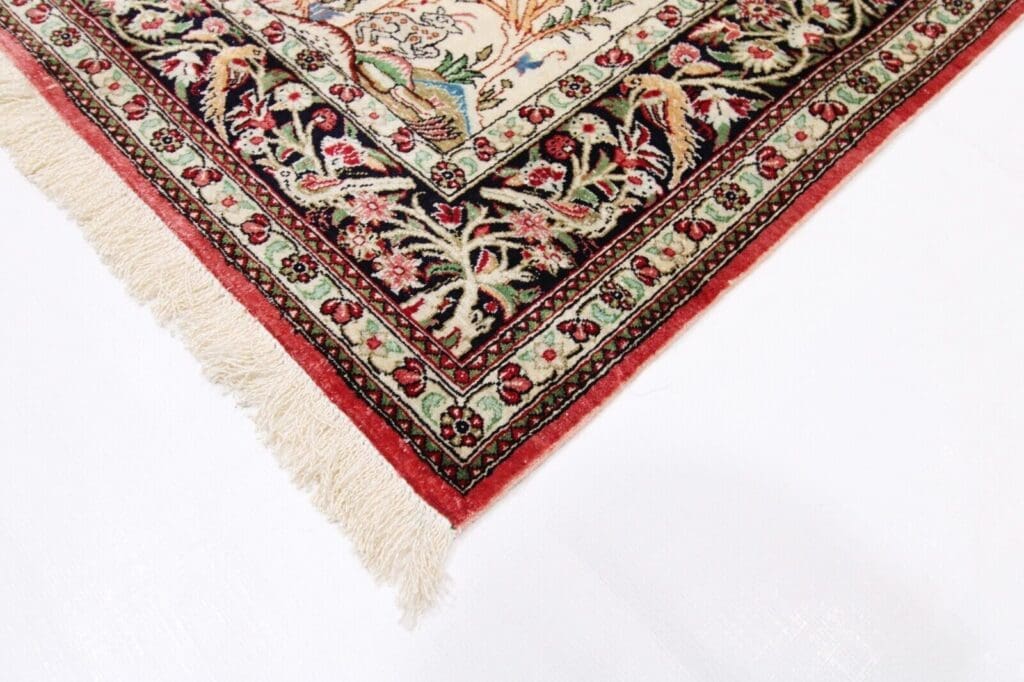
The specific pattern of this rug is not described in the source. Persian rugs as a group use a broad vocabulary of design, including floral compositions, geometric structures, arabesques, medallions, corner ornaments and repeating fields. These elements may appear separately or in combination. A central medallion can organise the design around a dominant focal form, while an all-over layout distributes ornament across the field. Border bands usually frame the inner composition and create a visual transition between the centre and the edge.
Floral ornament is an important part of Persian carpet design. Flowers, leaves, vines and palmettes may be rendered in a naturalistic or highly stylised manner. In a workshop drawing, these forms can be arranged with careful symmetry and repeated at different scales. The degree of detail depends on the intended composition and on the fineness of the weaving. Silk is particularly suited to fine ornamental drawing because its narrow, smooth fibres can support small visual distinctions and clear outlines.
Geometric designs follow a different principle. They rely on ordered lines, angular forms, repeated units and balanced intervals. Tribal and village rugs often demonstrate how geometric ornament can communicate structure without the flowing curves of a floral composition. Persian design traditions frequently combine both approaches: a field may contain curving vines while the border follows a more controlled sequence of repeated shapes. The pattern language is therefore varied, and the name of the weaving centre alone does not establish the precise design of an individual rug.
Colour is also central to the reading of a Persian carpet. Traditional palettes may include deep reds, blue tones, ivory, green, gold and brown, with the exact balance changing from one design to another. Colour can distinguish the field from the border, emphasise the main motif or create depth through contrast. Natural and synthetic dyes have both played roles in the history of Persian weaving, and colour practice has changed over time. Since the source does not specify the colours or motifs of this rug, no particular palette or pattern should be assigned to it.
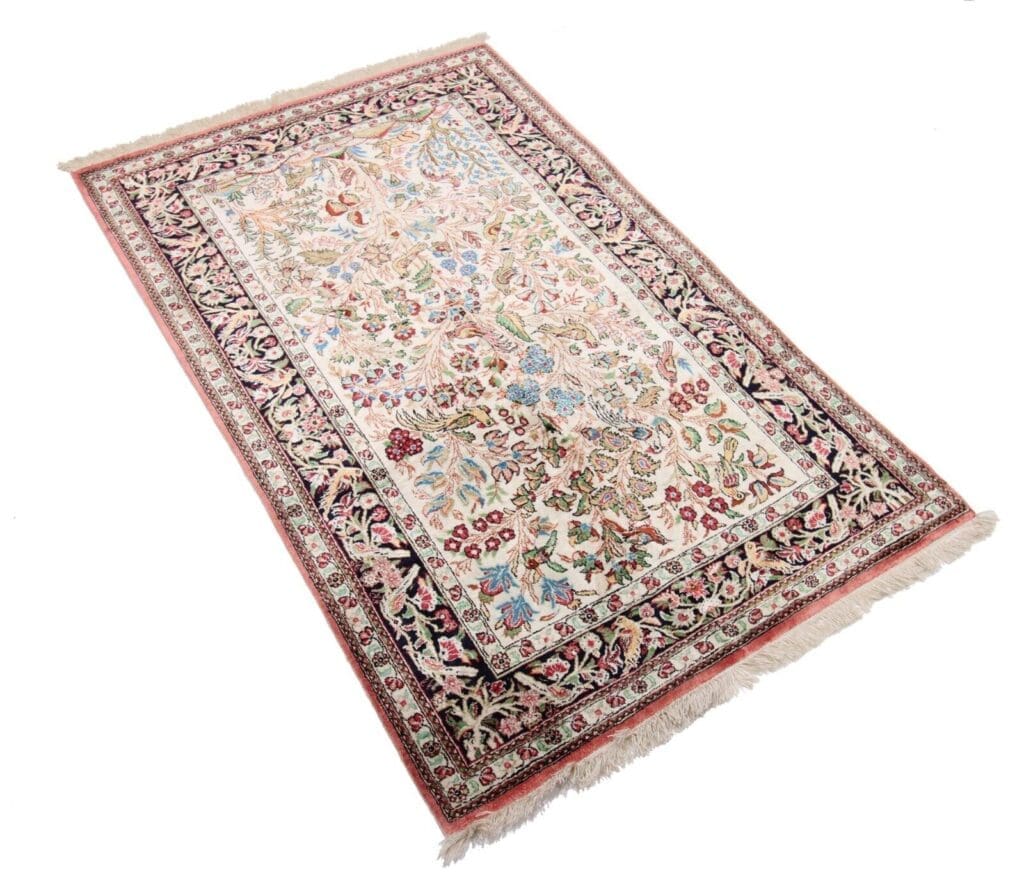
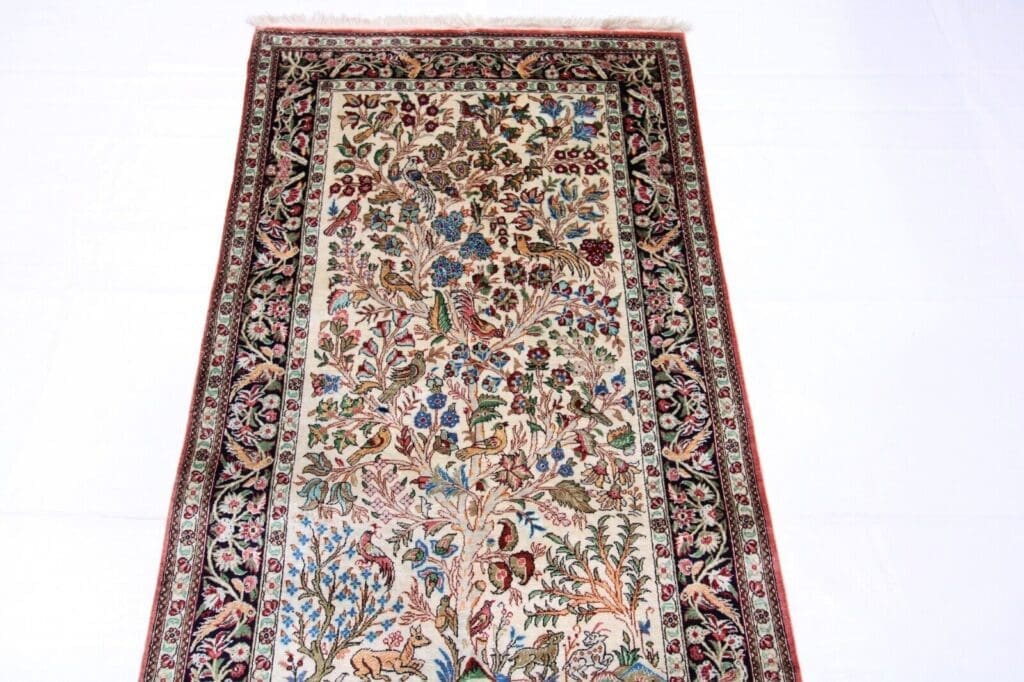
Qom designs are often associated with detailed floral compositions and carefully drawn ornamental schemes, but that association describes a regional design tradition rather than a confirmed description of this individual piece. The source establishes the Qom designation, the silk material and the hand-knotted construction. It does not name a medallion, a floral field, a particular border, a colour combination or a special motif. The absence of a stated pattern leaves the description accurate and open rather than attaching an unsupported design name to the rug.
Special Features
The defining features identified for this piece are its Qom origin, pure silk material and hand-knotted construction. These details place it within the Persian workshop tradition of finely made oriental rugs. Silk gives the pile a smooth, light-reflective character, while hand-knotting records the work of the weaver in the structure of the textile. Together, the material and technique distinguish the rug from flat-woven textiles such as Kilim and from pile rugs made with wool as their main material.
Care should take the silk pile into account. Regular, gentle vacuuming can help remove loose surface dust, but forceful brushing and aggressive cleaning products may be unsuitable for a delicate silk surface. Spills should be treated promptly without rubbing them deeply into the pile. For difficult marks or a thorough wash, specialist rug cleaning is the appropriate approach. Careful handling helps preserve the fibre, the knot structure and the appearance of the surface.
FAQ
How should a Persian silk rug be cared for?
Vacuum the rug gently and avoid harsh detergents or vigorous brushing. Silk has a fine, smooth surface that can be affected by inappropriate treatment. If a stain cannot be removed with careful, suitable handling, consult a professional rug cleaner. Specialist cleaning is preferable to experimenting with household chemicals, particularly when the pile is made from pure silk.
What sizes are available for Persian rugs?
Persian rugs are made in many formats, from narrow runners and compact pieces to larger rugs intended to define an area in a room. The suitable format depends on the available space, the furniture arrangement and the intended function of the rug. Every individual piece should be assessed by its own stated dimensions. This rug is listed with its specific size in the product information above.
What makes a hand-knotted Persian rug unique?
Hand-knotting means that the pile is formed through individually tied knots rather than through a uniform machine-made process. Small variations in drawing, colour placement and surface texture can result from this manual work. The use of pure silk adds another distinctive element through its fine handle and changing reflection of light. The combination of Qom identity, silk and hand-knotted craftsmanship gives the piece its particular place within the Persian rug tradition.
To provide the best experiences, we use technologies like cookies to store and/or access device information. Consenting to these technologies will allow us to process data such as browsing behavior or unique IDs on this site. Not consenting or withdrawing consent, may adversely affect certain features and functions.
Functional Always active
The technical storage or access is strictly necessary for the legitimate purpose of enabling the use of a specific service explicitly requested by the subscriber or user, or for the sole purpose of carrying out the transmission of a communication over an electronic communications network.
Preferences
The technical storage or access is necessary for the legitimate purpose of storing preferences that are not requested by the subscriber or user.
Statistics
The technical storage or access that is used exclusively for statistical purposes.The technical storage or access that is used exclusively for anonymous statistical purposes. Without a subpoena, voluntary compliance on the part of your Internet Service Provider, or additional records from a third party, information stored or retrieved for this purpose alone cannot usually be used to identify you.
Marketing
The technical storage or access is required to create user profiles to send advertising, or to track the user on a website or across several websites for similar marketing purposes.

 SECURE PAYMENT
 SHIPPING PARTNERS


