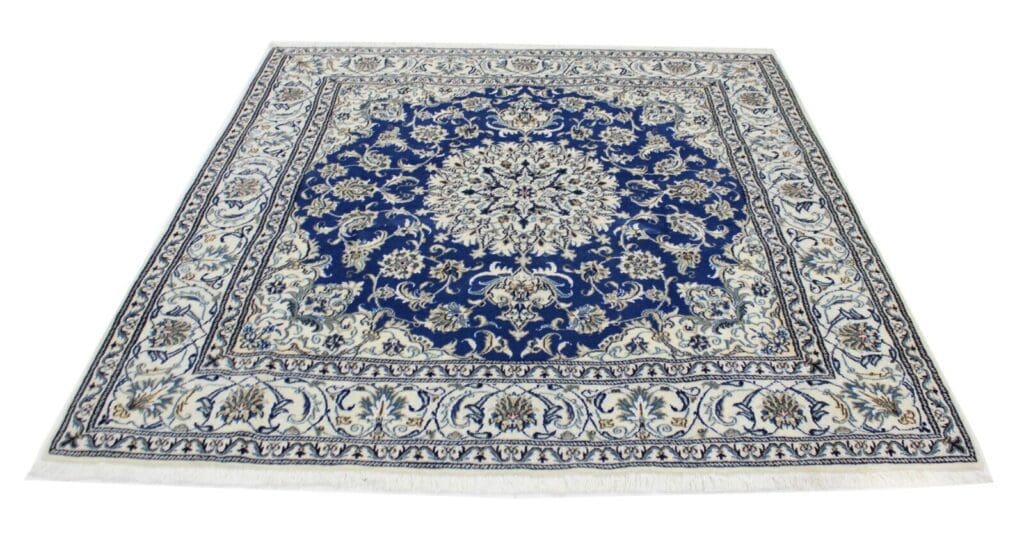
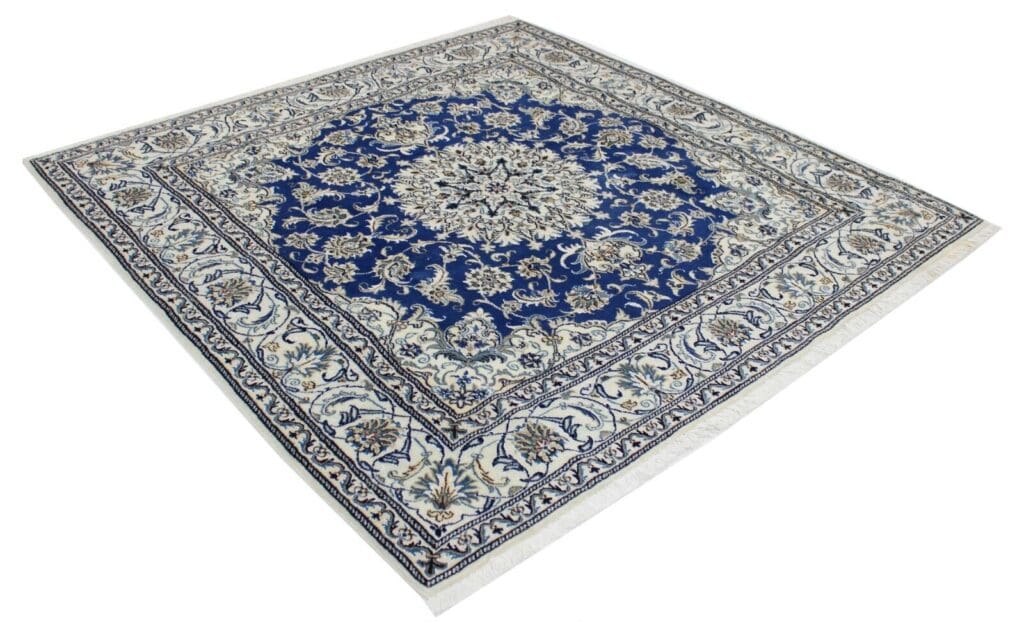
Persian Rug Nain Kashmir 200 x 192 cm Wool Hand-knotted
€ 1893
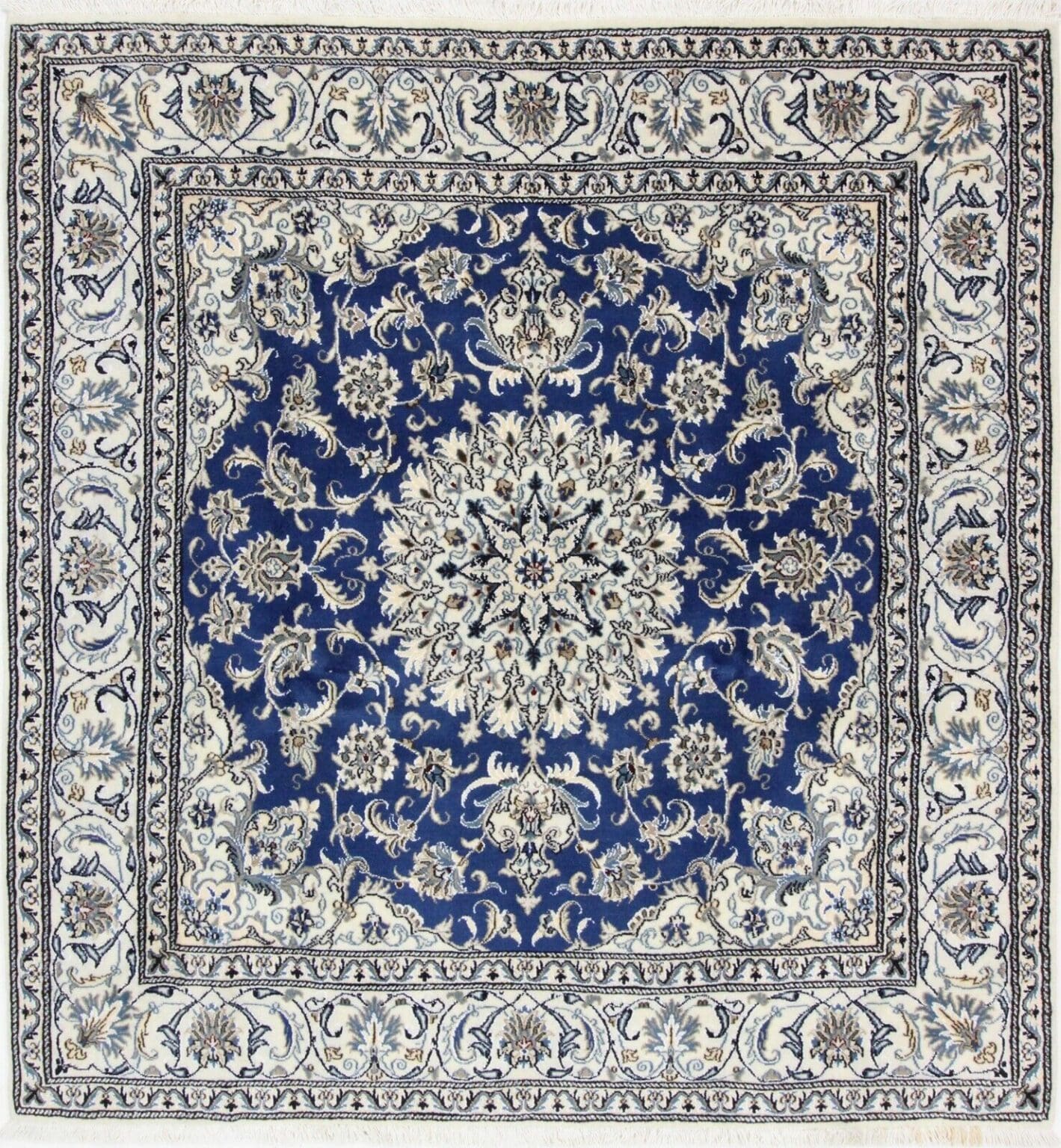
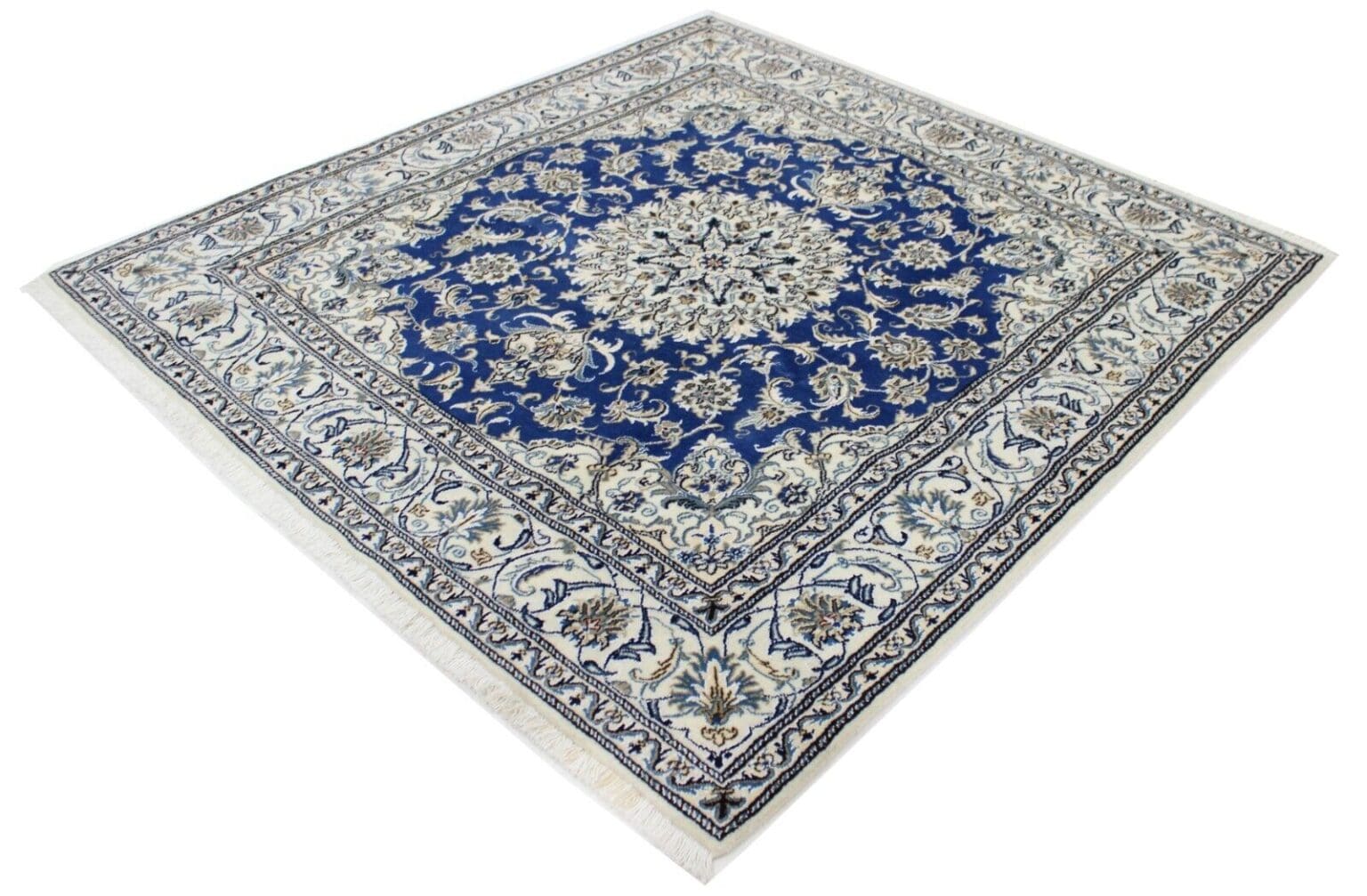
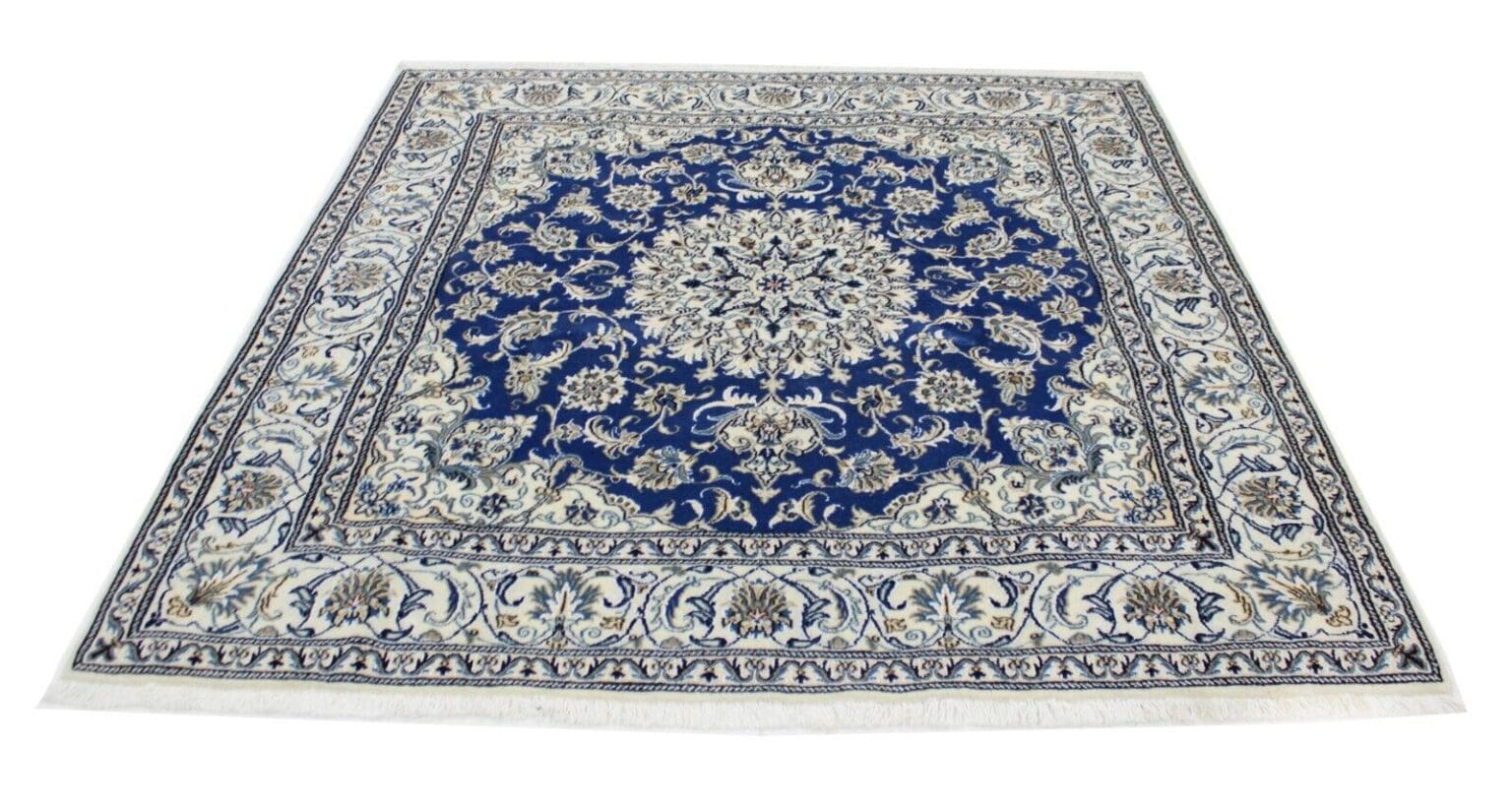
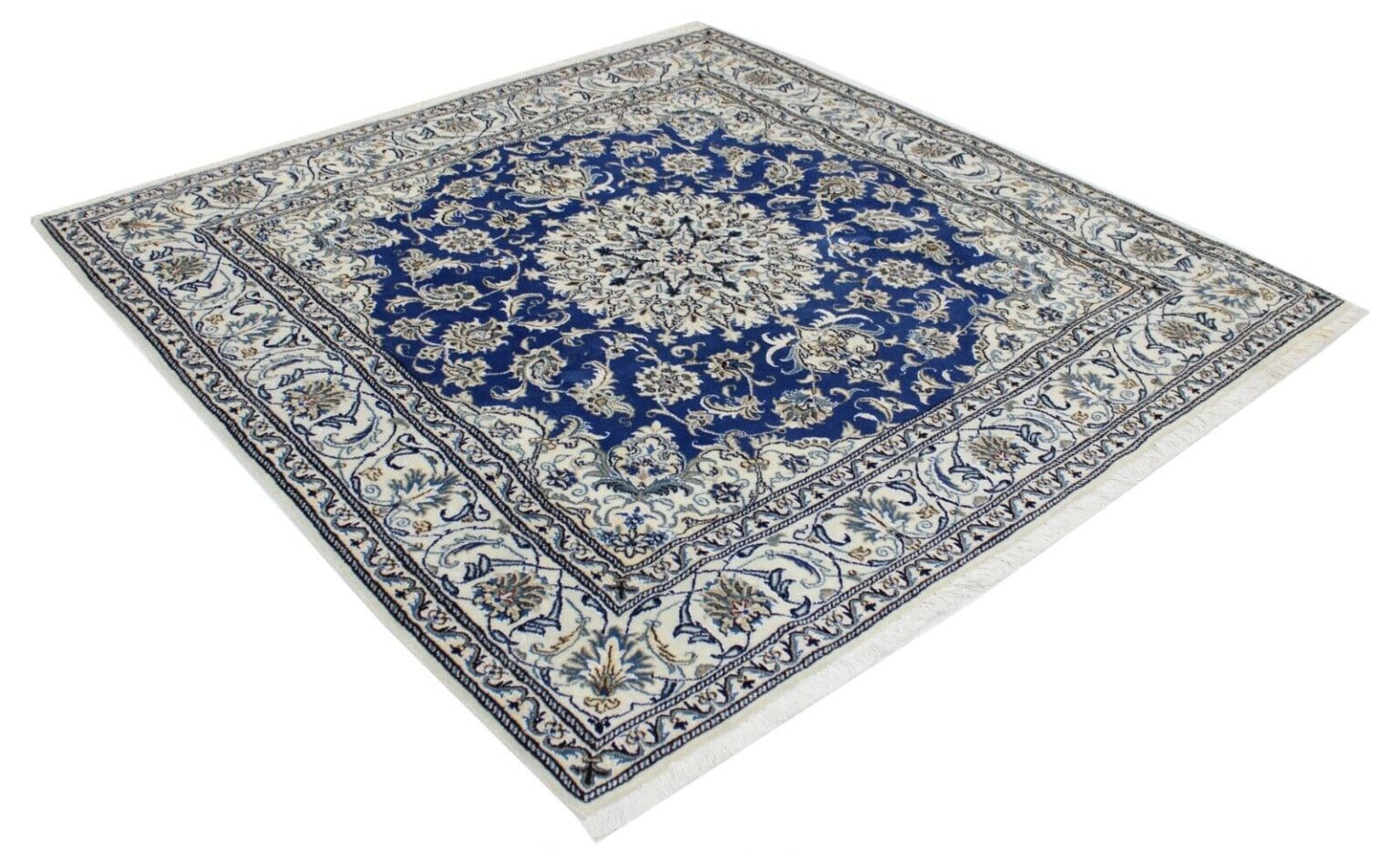
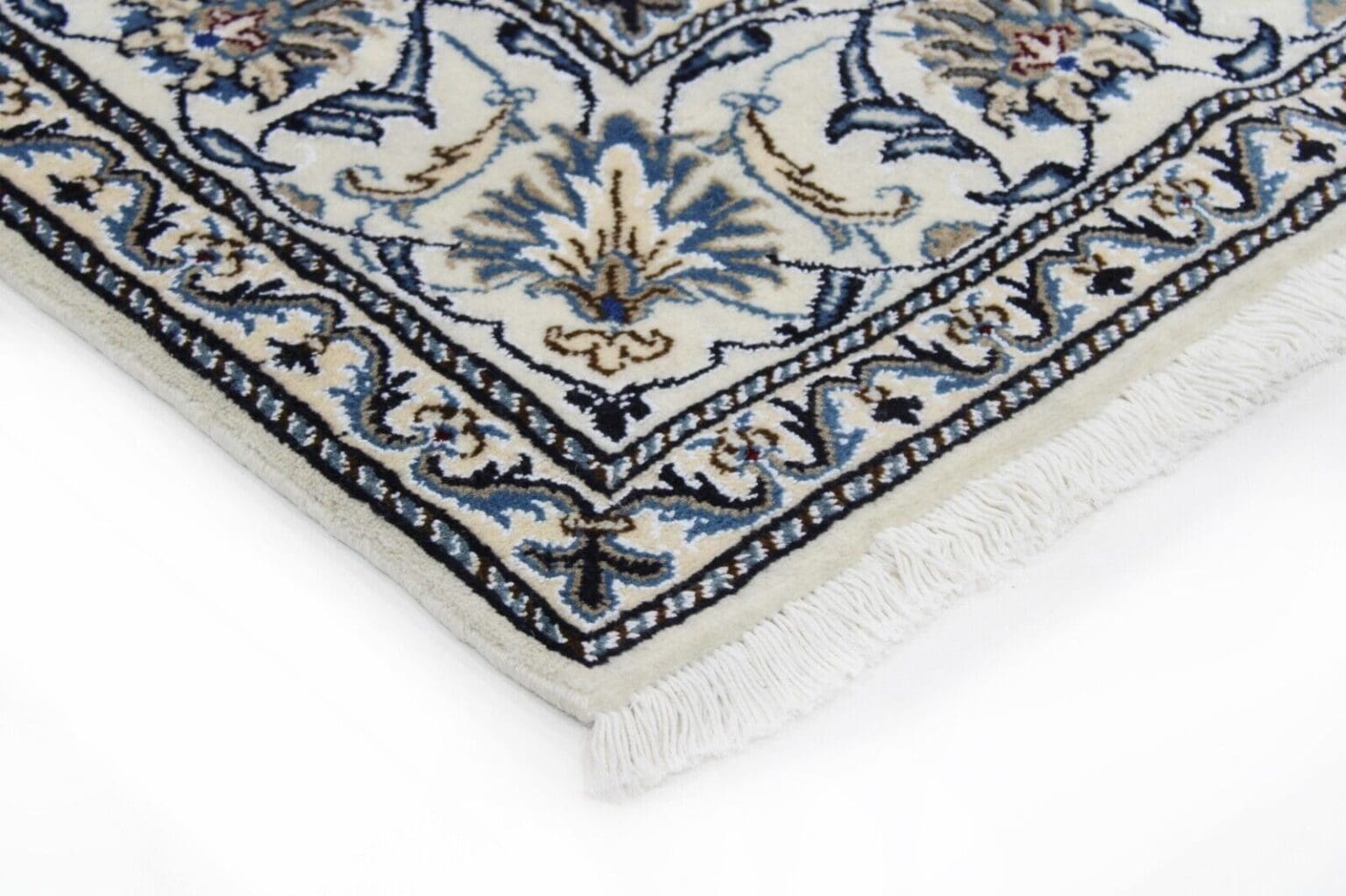
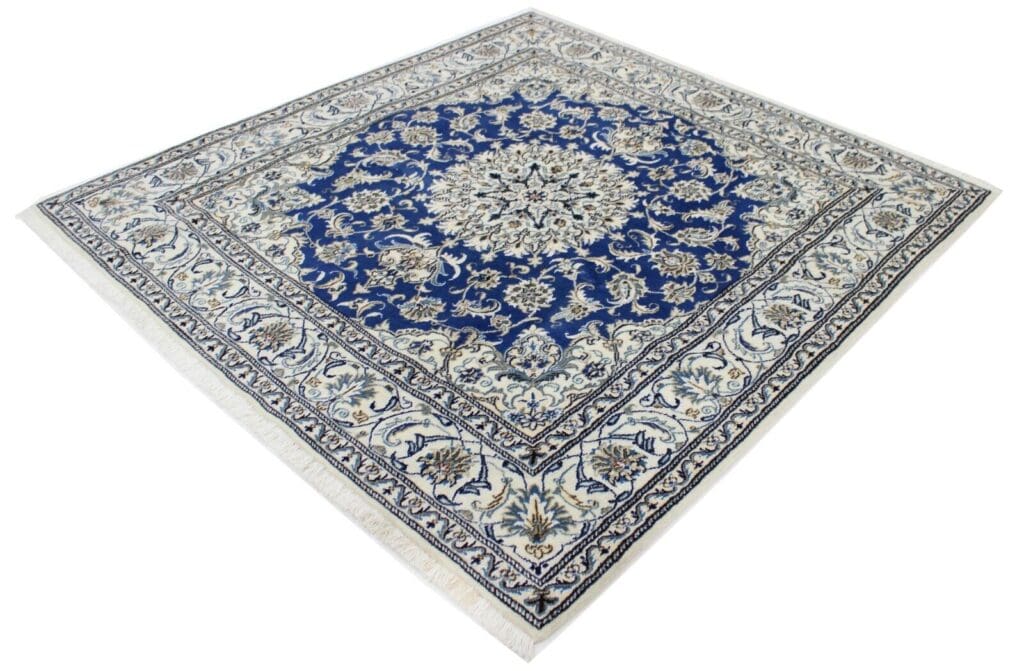
Hand-knotted Nain Kashmari Persian Rug | Knot density: hand-knotted | Material: wool and cotton | Size: 200 cm x 192 cm | Pattern: Oriental floral design | Condition: new without label, top condition
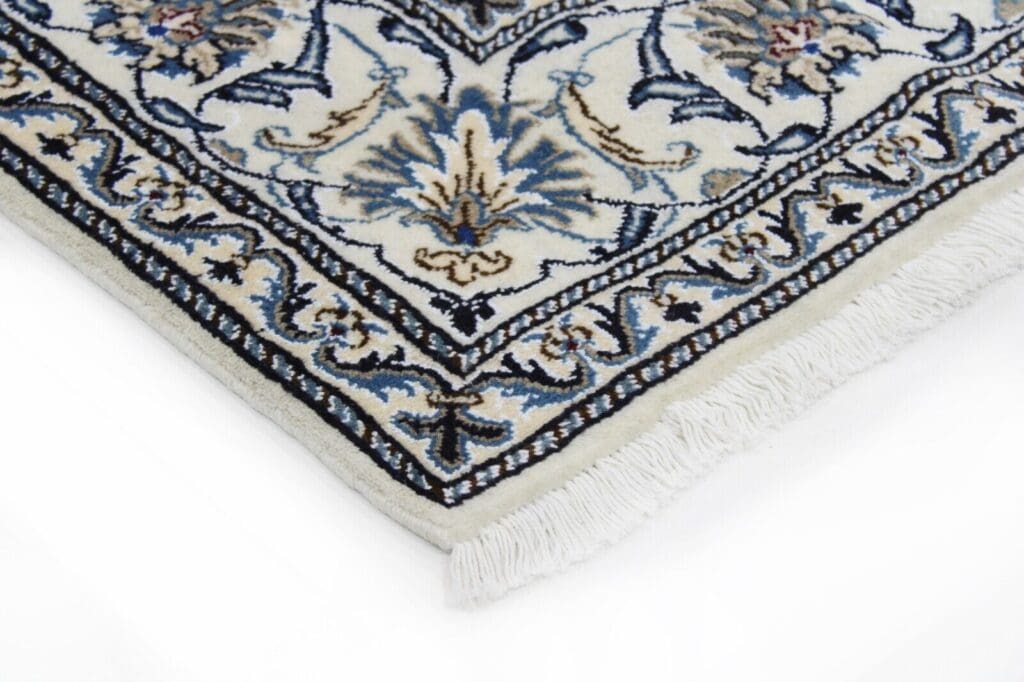
This Persian rug is hand-knotted and made from high-quality wool and cotton. The combination of these two materials belongs to the established vocabulary of Oriental rug making. Wool is traditionally used for the pile because it provides a resilient and tactile surface. Cotton is often used as a stable foundation in rug construction. For this individual rug, wool and cotton are listed as the materials; the source does not assign each material more specifically to pile or warp.
Hand-knotting is a textile process in which knots are inserted individually into the foundation rather than produced by a machine or printed onto a surface. Rows of knots are built up progressively, creating the rug’s structure and pile. The process requires consistent work and careful control of the design. In a floral composition, the weaver must keep colours and forms in sequence so that the ornament remains coherent across the entire field.
As a natural fibre, wool gives a pile a resilient handle and a degree of elasticity. It can absorb and release moisture from the surrounding air while retaining its characteristic textile feel. Cotton is widely valued in traditional rug construction as a dependable foundation material. Together, the two materials named for this rug reflect a classic material vocabulary for hand-knotted Persian rugs. The documented technique for this piece is hand-knotting.
The name Nain Kashmari appears in the product title. It is presented together with the designation Persian rug and does not describe a machine-made product. The hand-made technique is expressed through the pile structure and the detailed textile character associated with knotted rugs. No numerical knot count or specific knot density is supplied; the relevant product information identifies the rug as hand-knotted.
Origin and Tradition
The rug comes from Iran. Persian rugs belong to a centuries-old Iranian tradition in which regional workshops developed distinct approaches to design, colour and construction. Skills relating to fibres, dyeing, knotting and pattern planning were passed through generations of makers. The term Persian rug therefore covers a broad range of regional practices rather than one single visual formula. A rug’s name may point to a place, a style tradition or a trading designation, while the country of origin here is Iran.
Nain is associated with carefully drawn designs and balanced compositions. Traditional Nain carpets are often recognised for precise outlines, floral ornament and an orderly relationship between the central field and surrounding borders. Some designs use a medallion, while others create an all-over arrangement of interconnected motifs. These conventions form a regional design context; every individual rug still has its own drawing and execution.
The name Kashmari is included alongside Nain in the name of this piece. Both terms are retained as given in the product information. For its classification as a Persian rug, the stated origin is decisive: this rug is from Iran. Place names and style names can communicate different kinds of information in the rug trade. In this case, Nain Kashmari is the designation used for the rug, while Iran is the named country of origin.
Iranian rug making developed in a culture where carpets served practical, decorative and formal purposes. Workshop traditions brought together preparation of the foundation, selection of fibres, creation of colour, knotting and finishing. The work proceeds in stages: a foundation is prepared, knots are inserted row by row, the structure is compacted and the pile is finished. The design is therefore inseparable from the method used to build the textile surface.
Iranian rugs from different centres can vary in the balance between pile, foundation, outlines, borders and ornament. Nain is commonly linked with controlled drawing and detailed floral arrangements, while other Iranian traditions may favour larger geometric forms or more open compositions. Isfahan, Tabriz and Kashan are also widely known carpet centres, but they are not interchangeable with the designation used here. This rug is identified as Nain Kashmari and its origin is Iran.
Design and Pattern
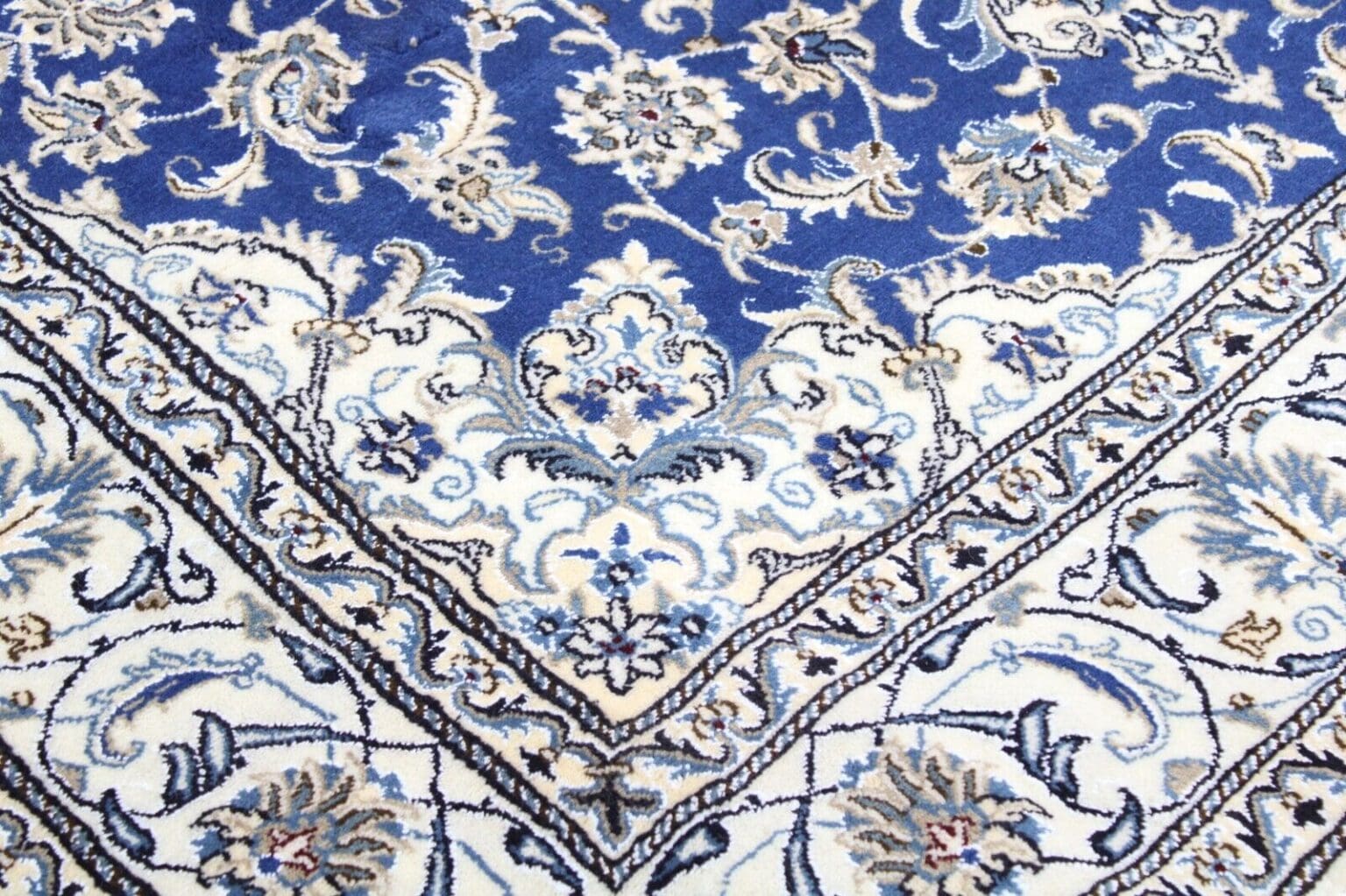
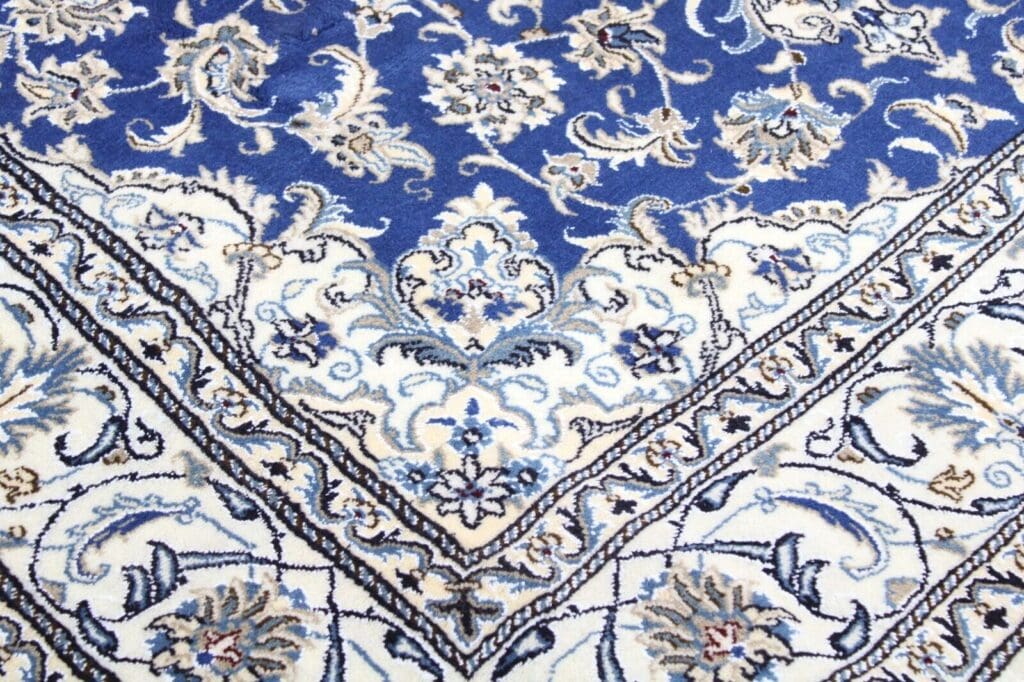
The pattern of this rug is described as Oriental with a floral motif. Floral ornament is one of the long-established design languages of Persian rugs. Flowers, leaves, vines and stylised branches may be joined into a continuous decorative system. Such motifs are usually not botanical illustrations. Instead, natural forms are simplified, mirrored and repeated so that they can be organised within a rectangular textile format.
A floral design may be arranged around a central field, framed by borders or distributed across the surface as a connected pattern. Small leaves and blossoms can link larger ornaments, while vines create visual transitions between separate elements. Borders often provide a formal edge around the field. The source does not specify whether this individual rug has a medallion, a particular border sequence or named flower types. It does specify an Oriental floral motif, and that is the basis of the pattern description.
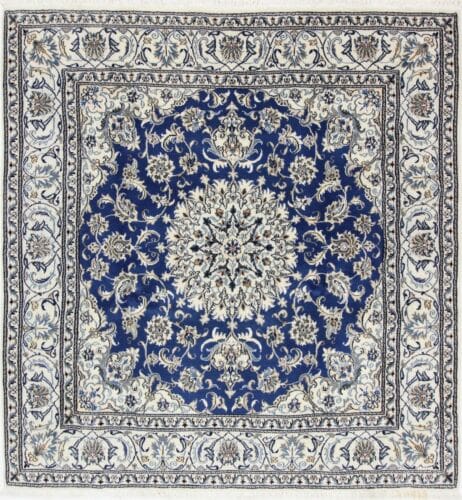
The stated colour is blue. In Persian rug design, blue may serve as a ground colour, a background tone or a detail within the ornament. Its effect depends on the relationship between the field, outlines and floral forms. A blue ground can make lighter blossoms and fine contours more legible, while blue accents can structure a lighter composition. Blue is the colour named for this rug; no additional colours are assigned to this specific piece.
Oriental floral patterns have traditionally used repetition and balance to create visual order. The flowers may be stylised rather than naturalistic, allowing the maker to repeat them with variations across the field. Symmetry can organise the composition, while small irregularities preserve the character of hand production. The drawing is translated into the textile one knot at a time, so the technical process directly supports the visual rhythm of the design.
The name Nain Kashmari places the design within the named regional and stylistic context, but it does not replace the concrete description of the visible pattern. For this rug, the documented design features are an Oriental floral motif and the colour blue. Claims about a particular medallion, a specific border arrangement or individual botanical species would go beyond the information supplied and are therefore not included. The description remains focused on the stated characteristics of this one piece.
Special Features
The listed special features of this individual rug are its hand-knotted construction, high-quality wool and cotton, blue colour and Oriental floral pattern. It is offered as a Nain Kashmari Persian rug from Iran. The piece is assigned to the Persian style of the twenty-first century. These details bring together its stated technique, materials, regional name, country of origin and visual character.
The condition is described as new without a label and as top condition. The rug is also stated to be suitable for underfloor heating. This suitability is a product characteristic given for the piece. When using any rug over underfloor heating, it remains sensible to follow the instructions for the heating system and to maintain suitable ventilation beneath the floor covering. The hand-knotted construction, the listed materials and the described condition form the principal special features of this offer.
FAQ
How should I care for this Persian rug?
Regular, gentle vacuuming is suitable for routine care. The pile should not be subjected to unnecessary aggressive brushing or friction. If deeper cleaning is required, professional rug cleaning is the appropriate choice because hand-knotted rugs made from wool and cotton should be treated by a specialist familiar with their construction. Strong, direct sunlight should be avoided so that the blue colour remains as even as possible. If liquid is spilled, it should be absorbed promptly and carefully rather than rubbed forcefully into the pile.
What makes this Persian rug distinctive?
Its distinctive features are the hand-knotted technique, the use of high-quality wool and cotton, and the combination of the Nain Kashmari designation, Iranian origin and Oriental floral motif. The blue colour defines the stated colour direction of the design. The rug is also described as new without a label and in top condition. It is suitable for underfloor heating and is assigned to the Persian style of the twenty-first century.
Where does this Persian rug come from?
This Persian rug comes from Iran. Nain Kashmari is the designation used in the product name, while Iran is the stated country of origin. Iranian rugs are made within different regional and workshop traditions, each of which has developed its own approaches to pattern and construction. Nain provides the named regional style context for this piece. The rug itself is described as hand-knotted and decorated with an Oriental floral motif.
To provide the best experiences, we use technologies like cookies to store and/or access device information. Consenting to these technologies will allow us to process data such as browsing behavior or unique IDs on this site. Not consenting or withdrawing consent, may adversely affect certain features and functions.
Functional Always active
The technical storage or access is strictly necessary for the legitimate purpose of enabling the use of a specific service explicitly requested by the subscriber or user, or for the sole purpose of carrying out the transmission of a communication over an electronic communications network.
Preferences
The technical storage or access is necessary for the legitimate purpose of storing preferences that are not requested by the subscriber or user.
Statistics
The technical storage or access that is used exclusively for statistical purposes.The technical storage or access that is used exclusively for anonymous statistical purposes. Without a subpoena, voluntary compliance on the part of your Internet Service Provider, or additional records from a third party, information stored or retrieved for this purpose alone cannot usually be used to identify you.
Marketing
The technical storage or access is required to create user profiles to send advertising, or to track the user on a website or across several websites for similar marketing purposes.

 SECURE PAYMENT
 SHIPPING PARTNERS


