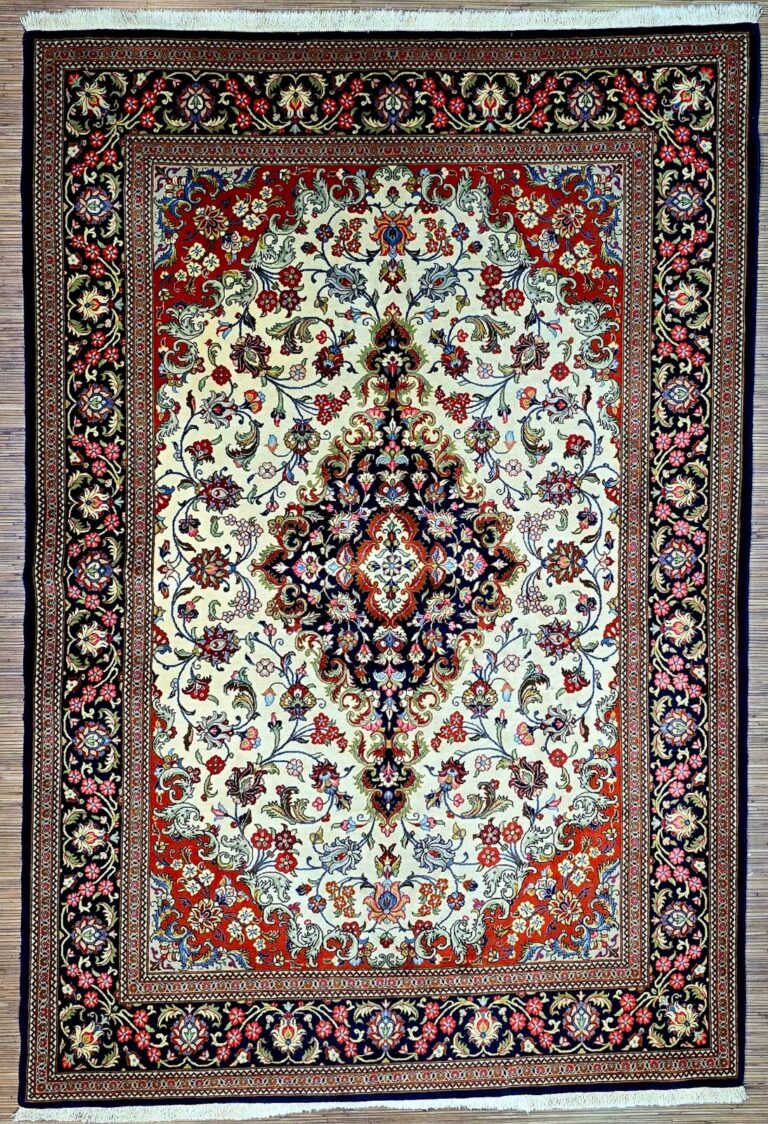
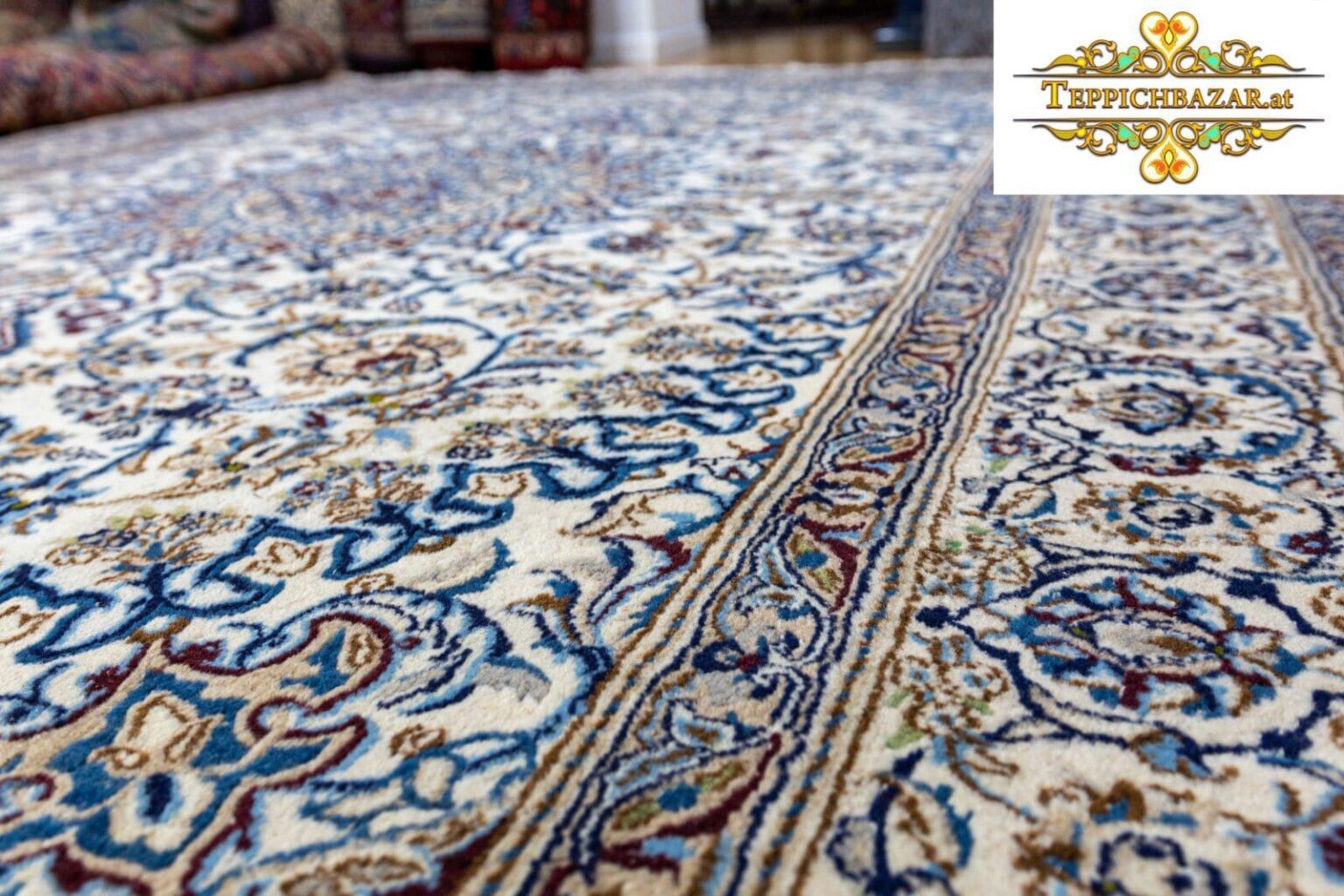
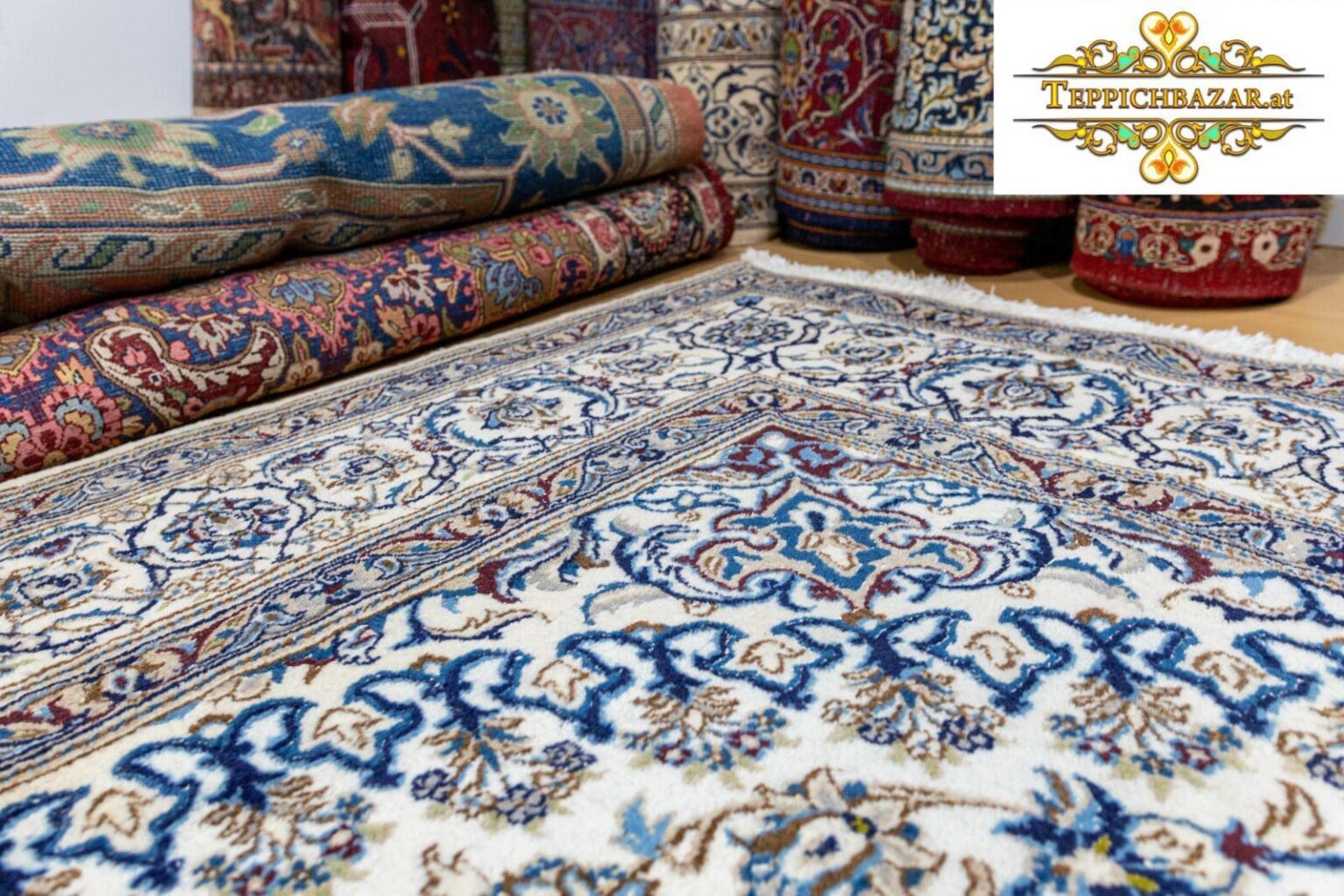
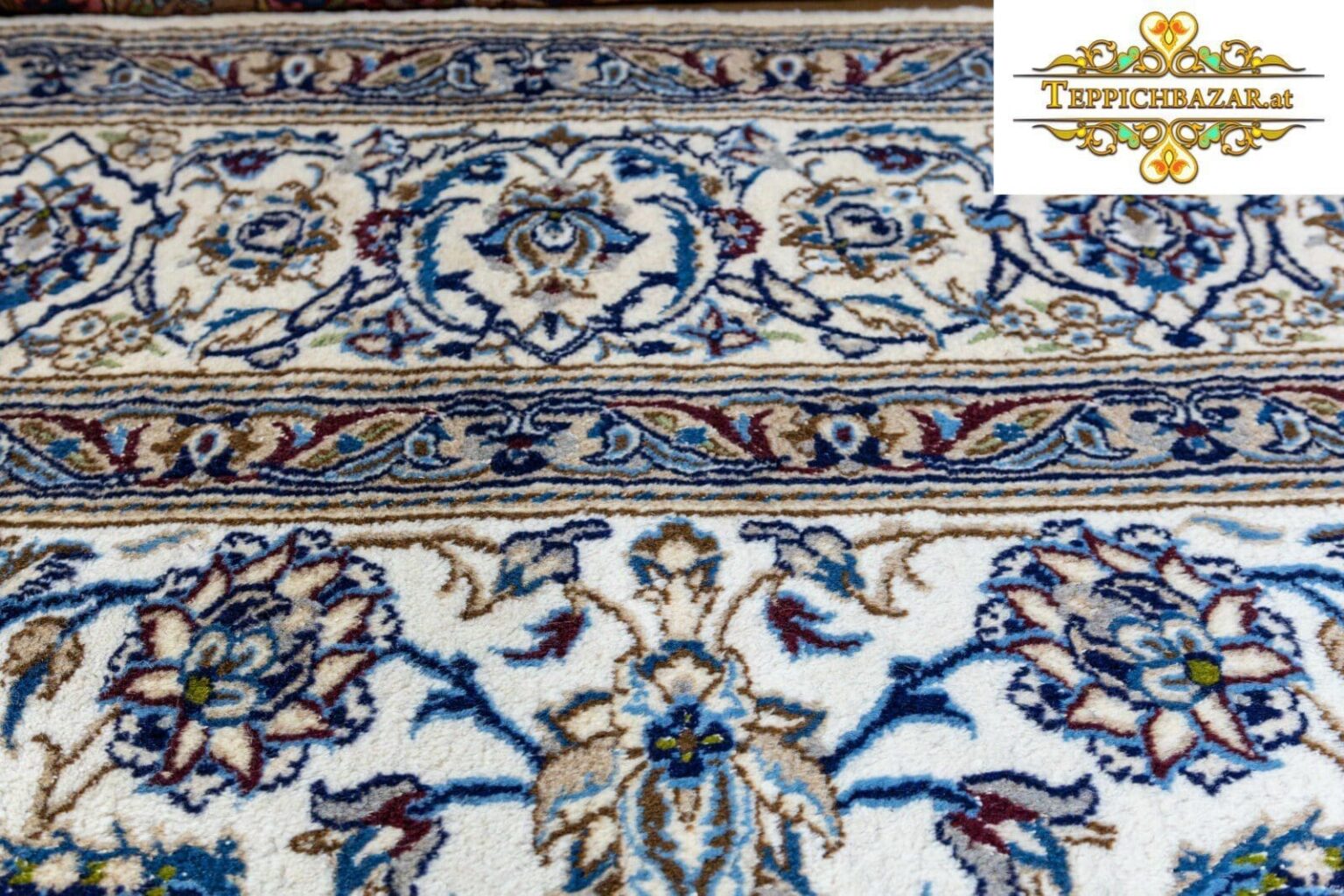
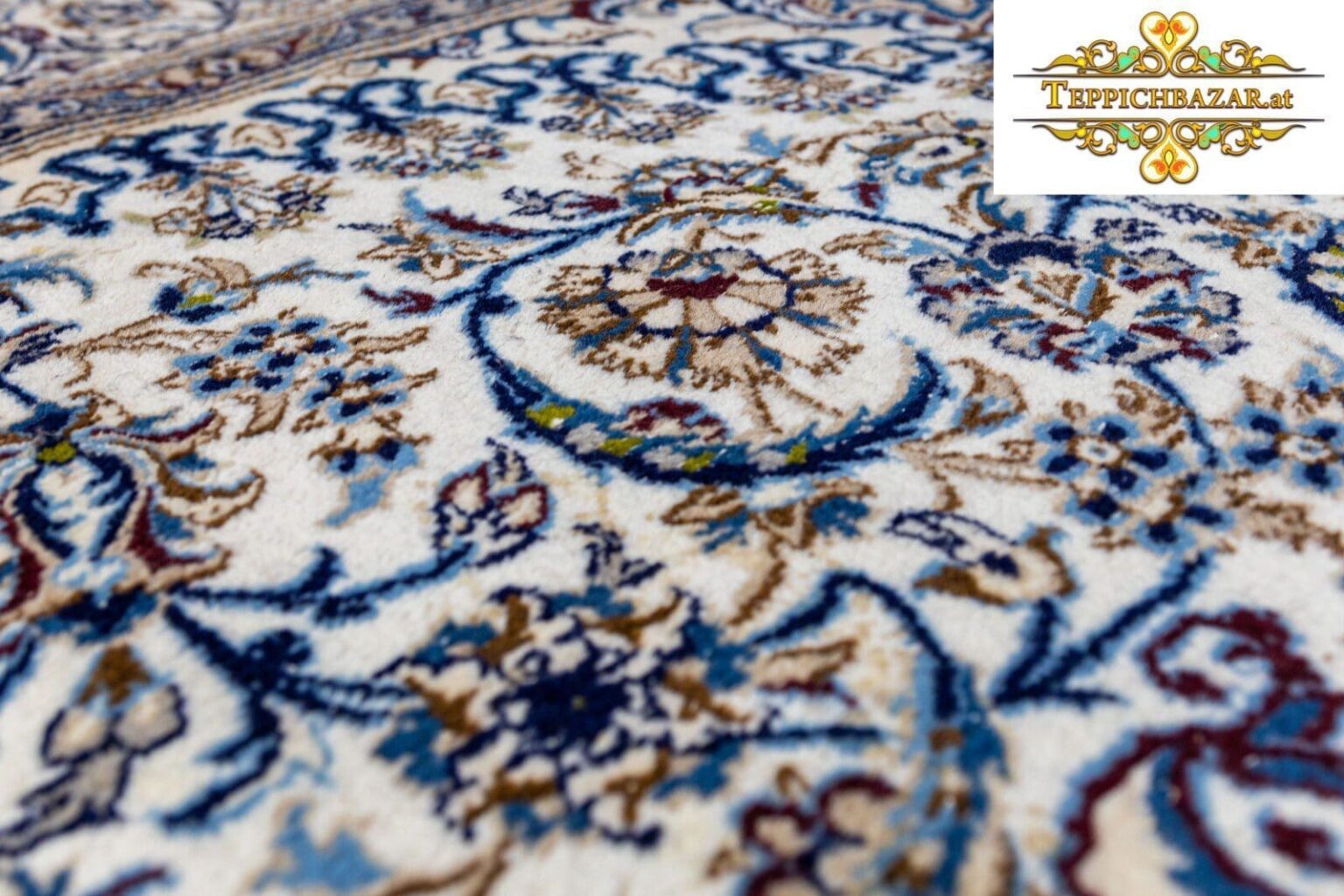
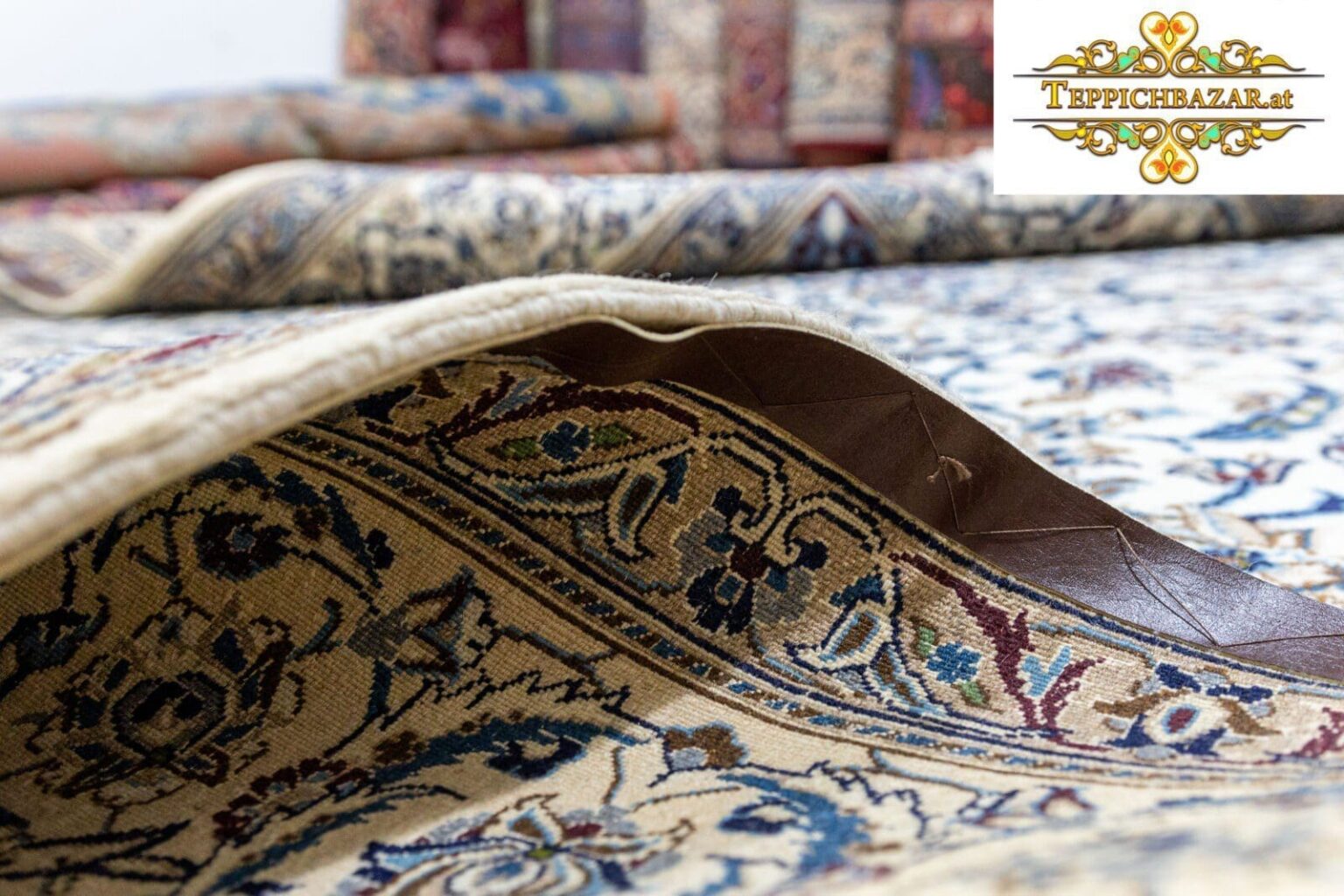
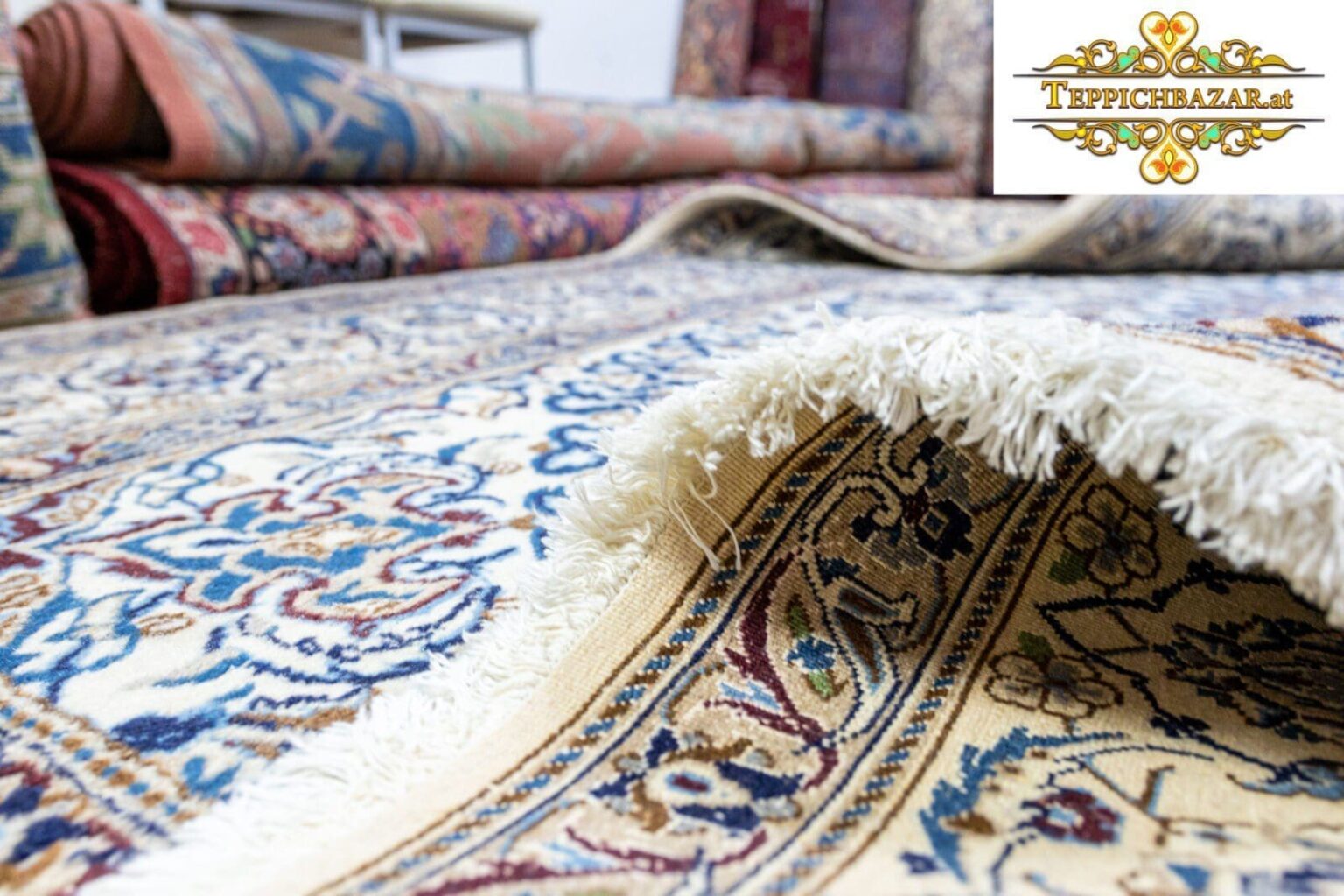
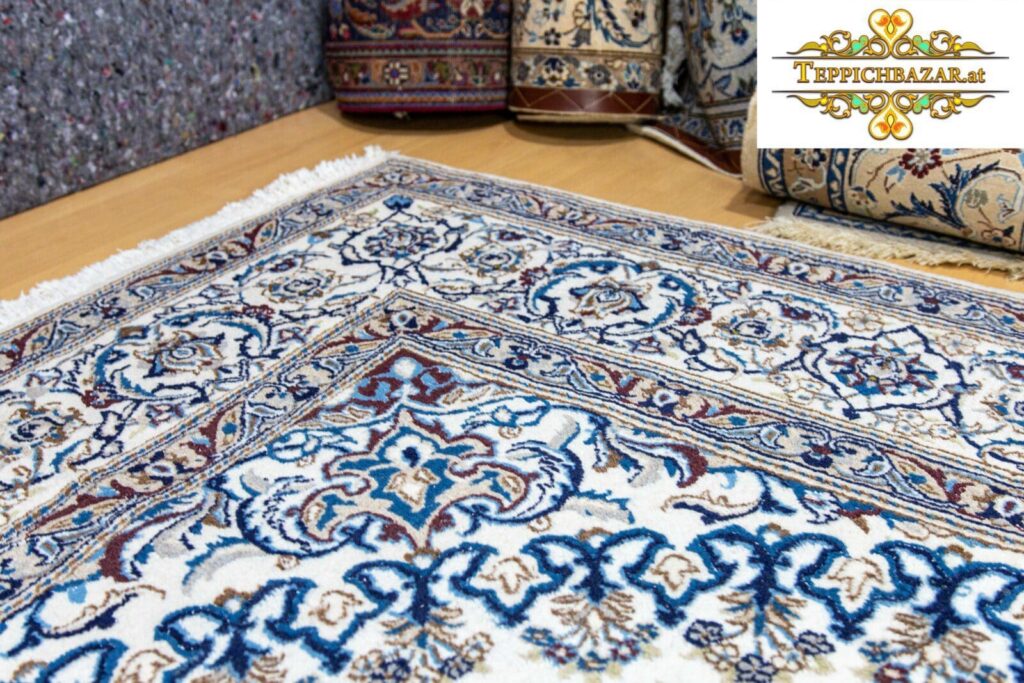
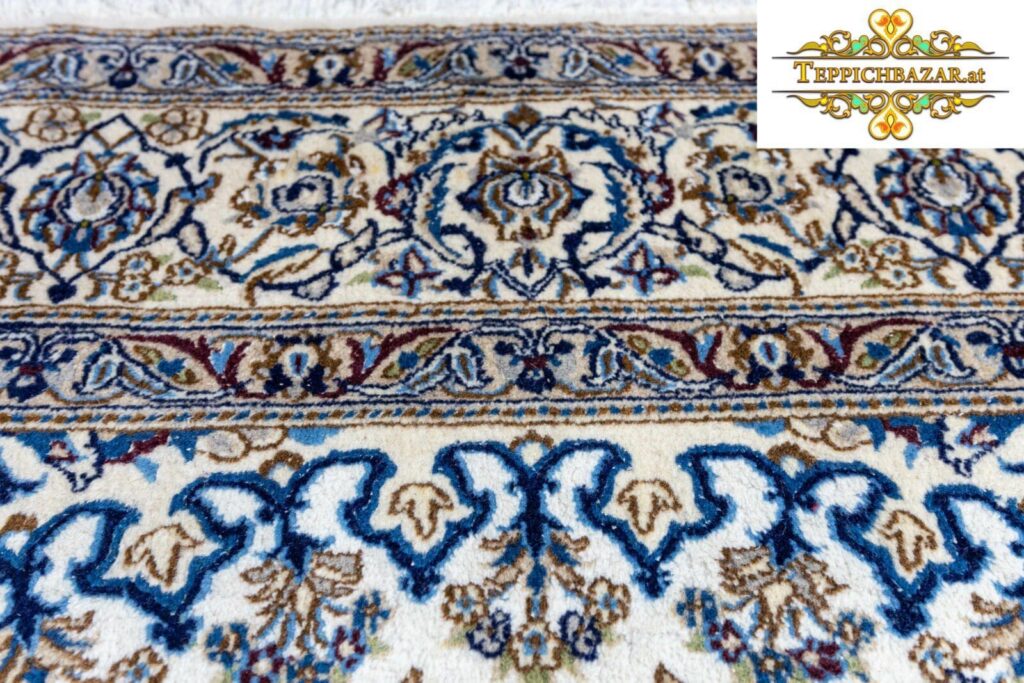
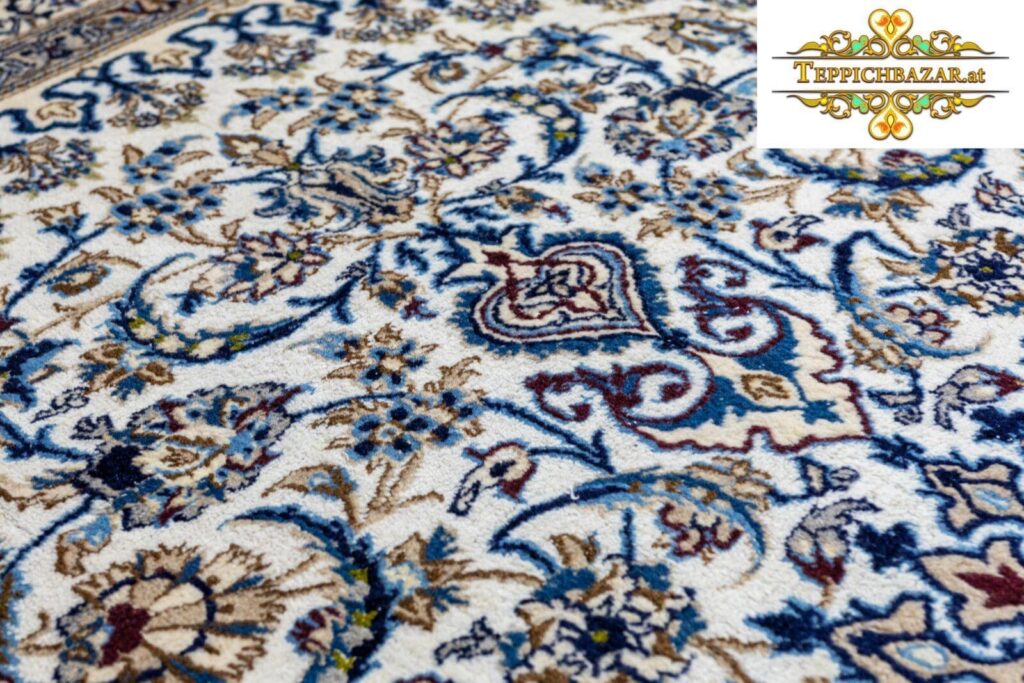
This Nain Persian rug is hand-knotted. Its pile is made of virgin wool and silk, while the warp is cotton. These materials are stated specifically for this piece. Wool gives the pile a textile presence and a softly structured surface. Silk adds a finer character and a gentle sheen. As the light moves across the surface, the two materials can affect the way individual colour areas and pattern sections are perceived.
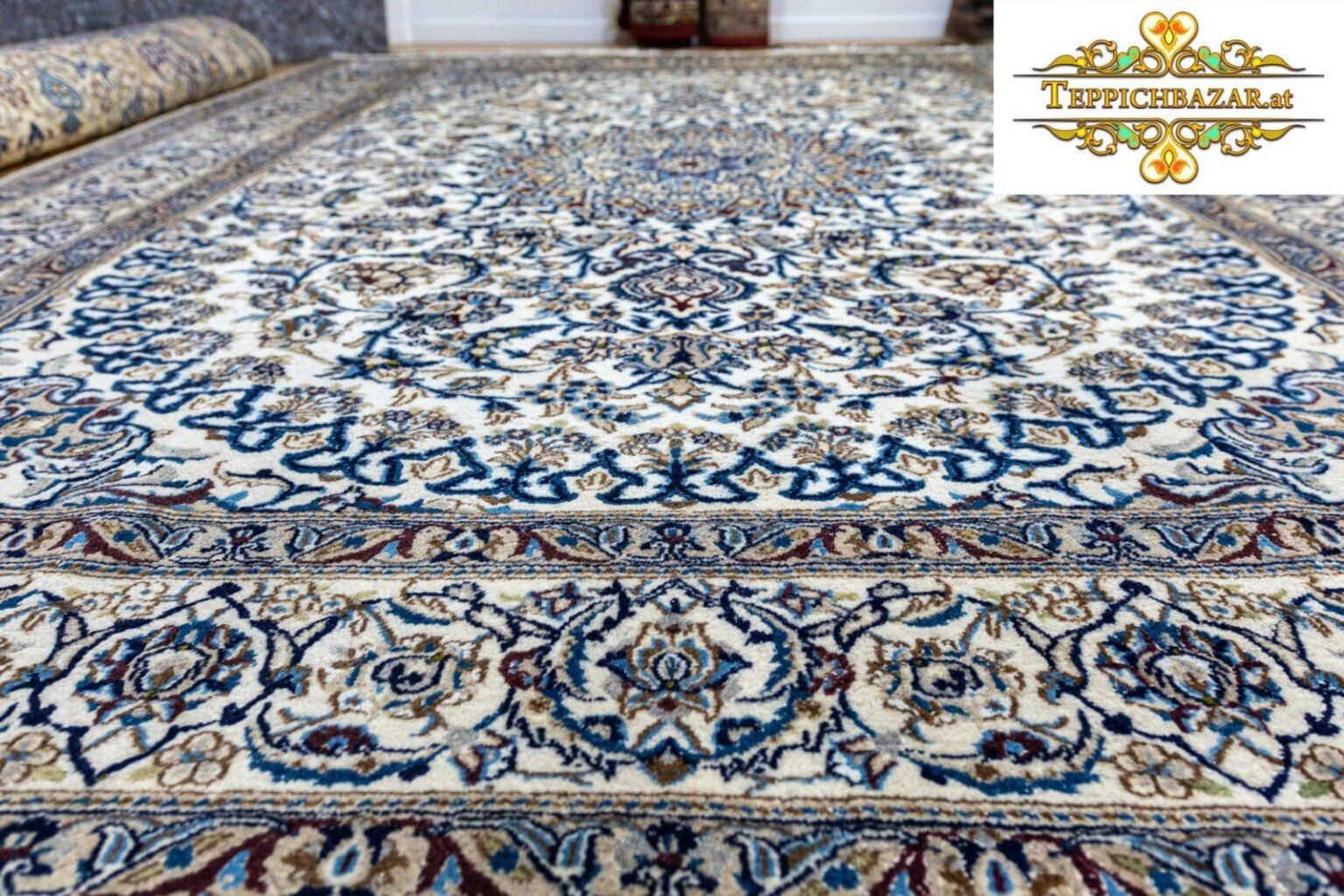
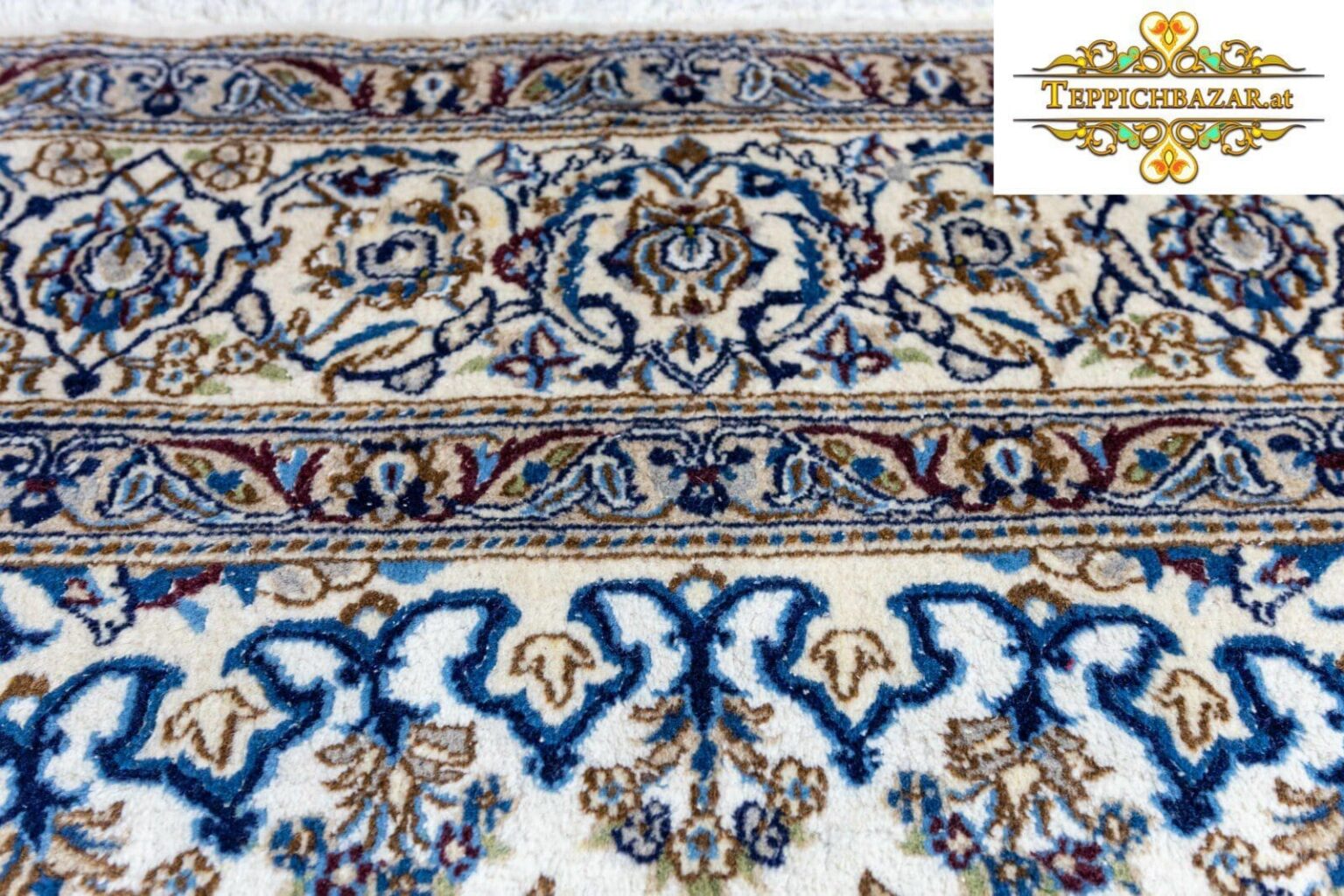
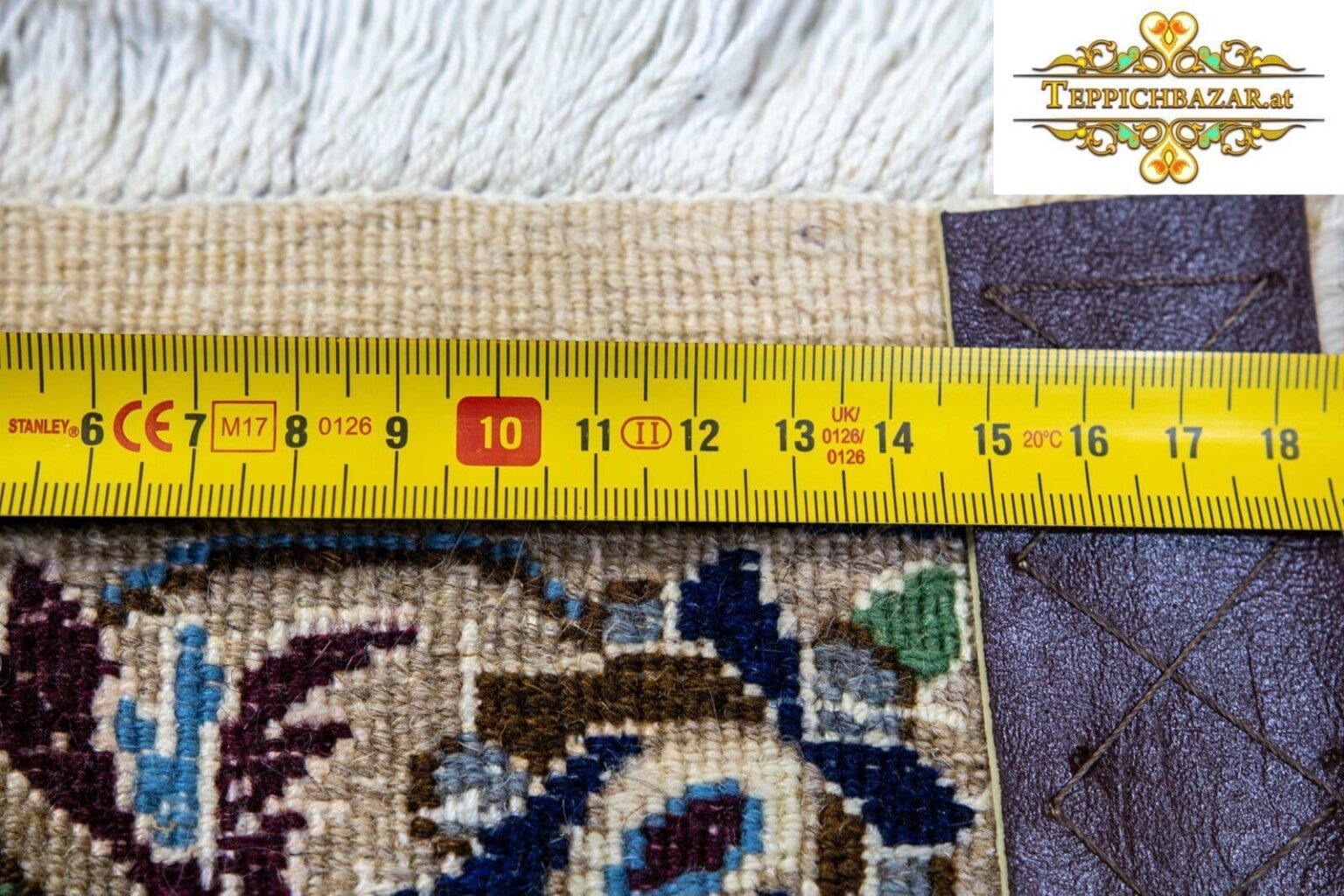
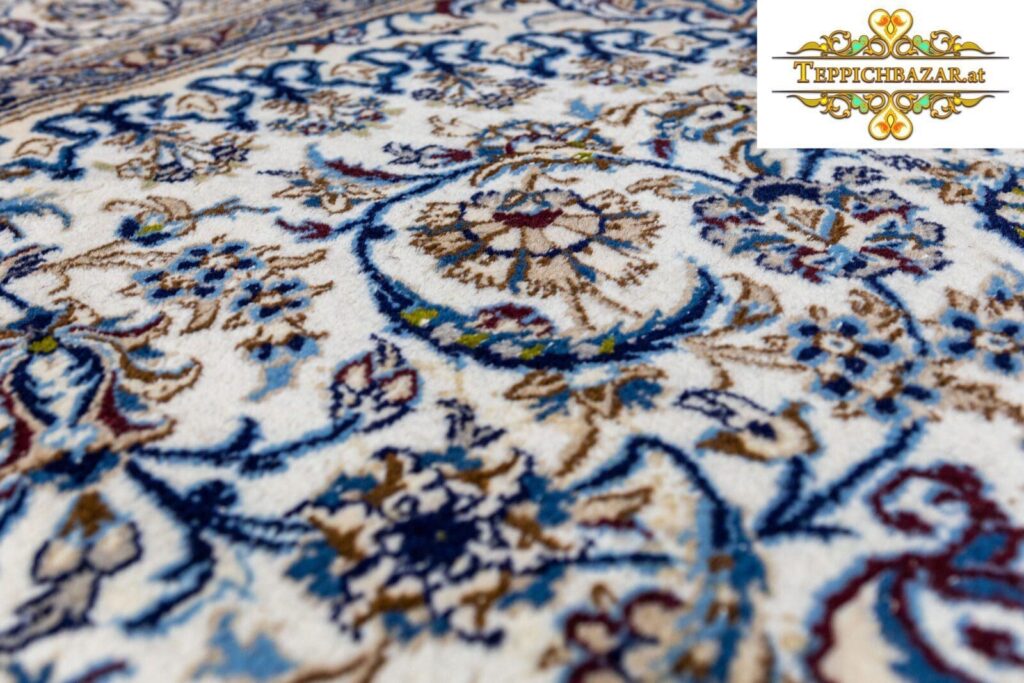
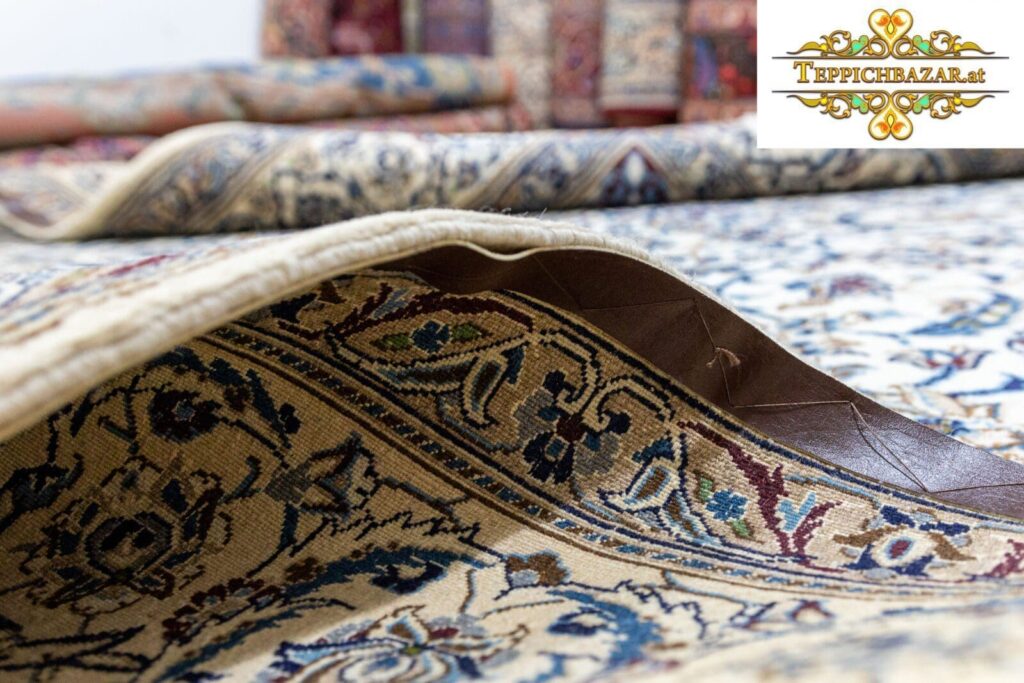
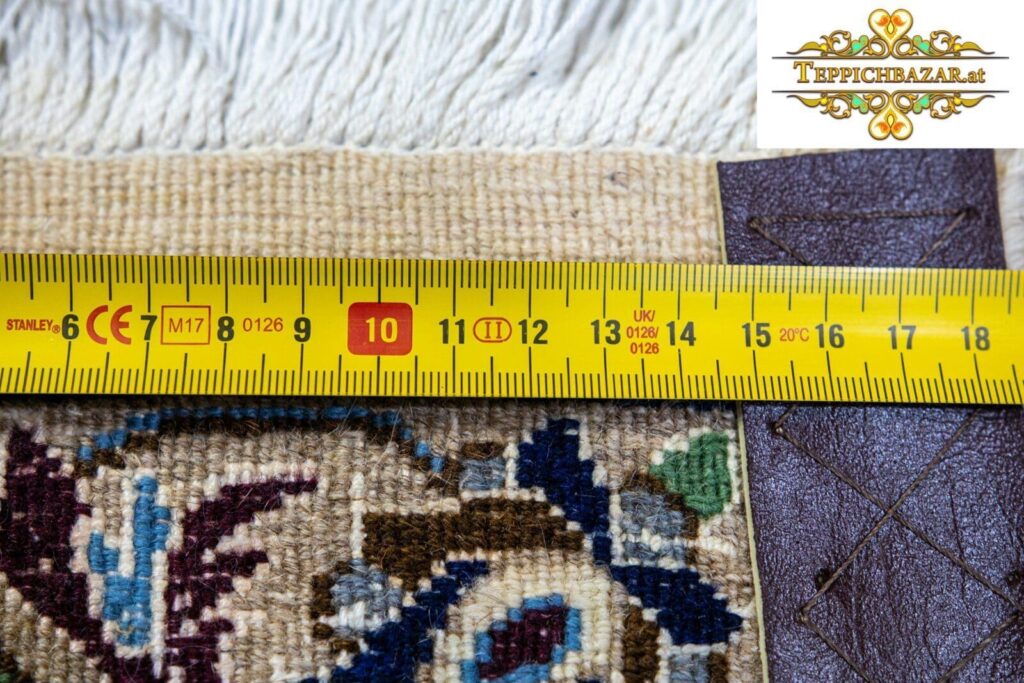
The listed knot density is 12la, meaning 12 yarn layers, with approximately 300,000 knots per square metre. Fine knotting supports the careful rendering of smaller forms and helps maintain the definition of a medallion composition. Each knot is made by hand, so production consists of a long sequence of individual working steps. The result is a single hand-knotted rug rather than an identical industrial series product.
The source describes the combination of virgin wool and silk as characteristic of Nain rugs. It brings together the textile body of wool and the lustre of silk, contributing to the colour brilliance associated with the design. The cotton warp forms the foundation for the knotting process. The stated materials and knot density therefore provide a clear description of the rug’s construction without requiring additional assumptions about properties that are not documented for this particular piece.
Origin and Tradition
The stated origin of this rug is the city of Nain in Persia, or Iran. Nain is known as a carpet city, and the source connects its weaving tradition with a history reaching back to the nineteenth century. The production of rugs in the city developed over time, creating a regional vocabulary of fine drawing and carefully organised ornament. The name Nain therefore identifies a place with its own weaving history, not merely a decorative label.
Nain rugs are traditionally made by experienced carpet weavers through an intensive and lengthy process. Hand knotting requires a continuous sequence of precise actions. The design has to be followed while the knots are placed across the textile foundation, and a fine structure demands sustained attention throughout the work. In this context, the stated knot density is associated with careful craftsmanship. It helps explain why Nain rugs are commonly linked with detailed designs and a refined surface.
The Nain tradition is described through fine patterns, historical references and floral motifs. These elements may be combined so that decorative drawing and geometric order support one another. Silk is often used in Nain weaving to give the rugs additional sheen and depth. Silk is expressly listed in the material description of this rug, so it is both a construction detail and a factor influencing the visual reading of its ornament.
The source also describes the region as shaped by a range of cultural influences. These influences can be reflected in colours and patterns that are often inspired by nature and by the history of the surrounding area. Such influences are a broad cultural background rather than a fixed formula. Individual rugs can bring together their own arrangements of ornament, colour and central structure while remaining within the wider Nain tradition.
Nain craftsmanship thus connects place, material and design. Fine drawing, floral forms, historical echoes and the use of silk are identified in the source as general features associated with Nain rugs. This individual rug is placed within that context by its stated origin in the city of Nain. The provenance statement should not be extended to another city or region, since no additional origin is given.
Design and Pattern
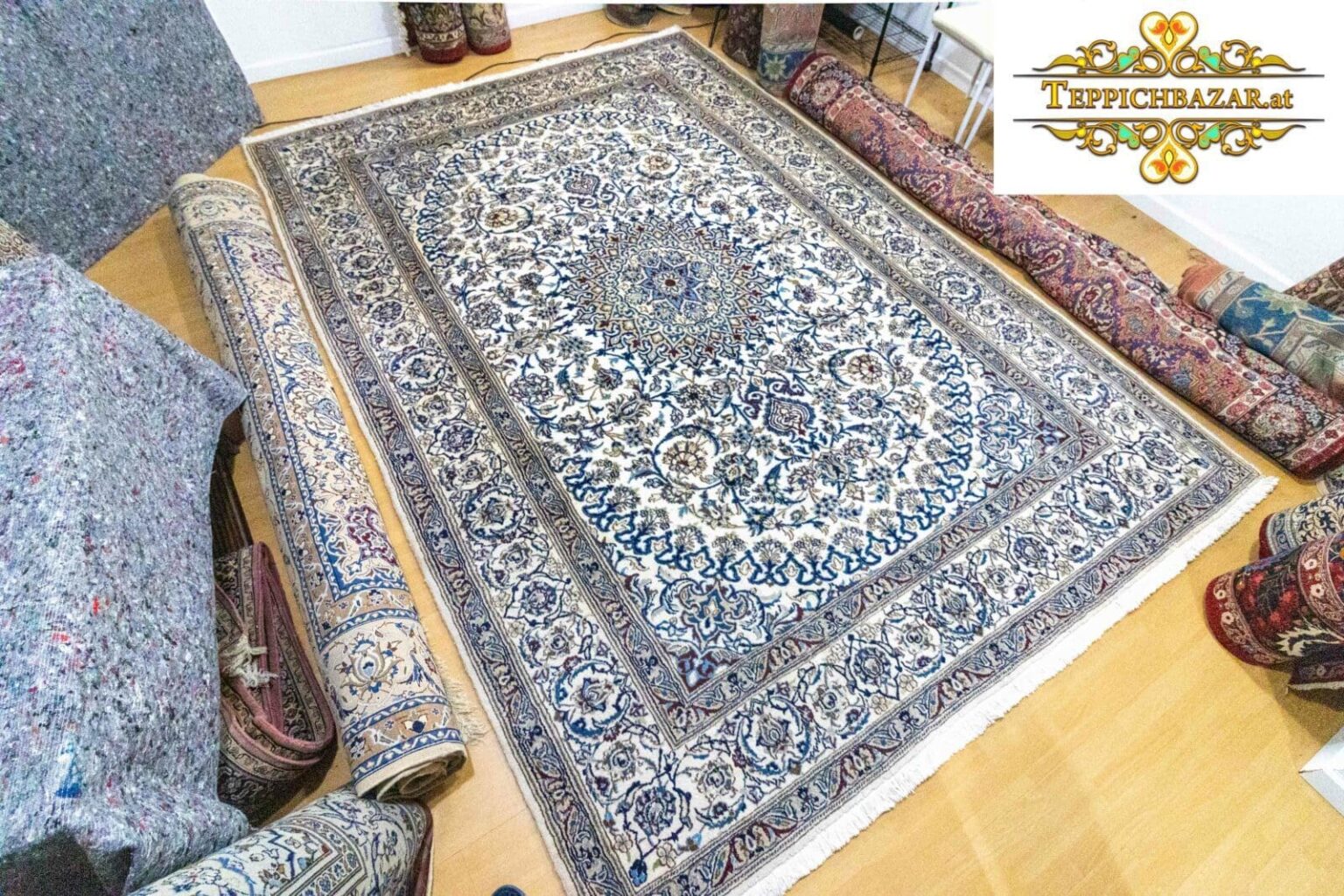
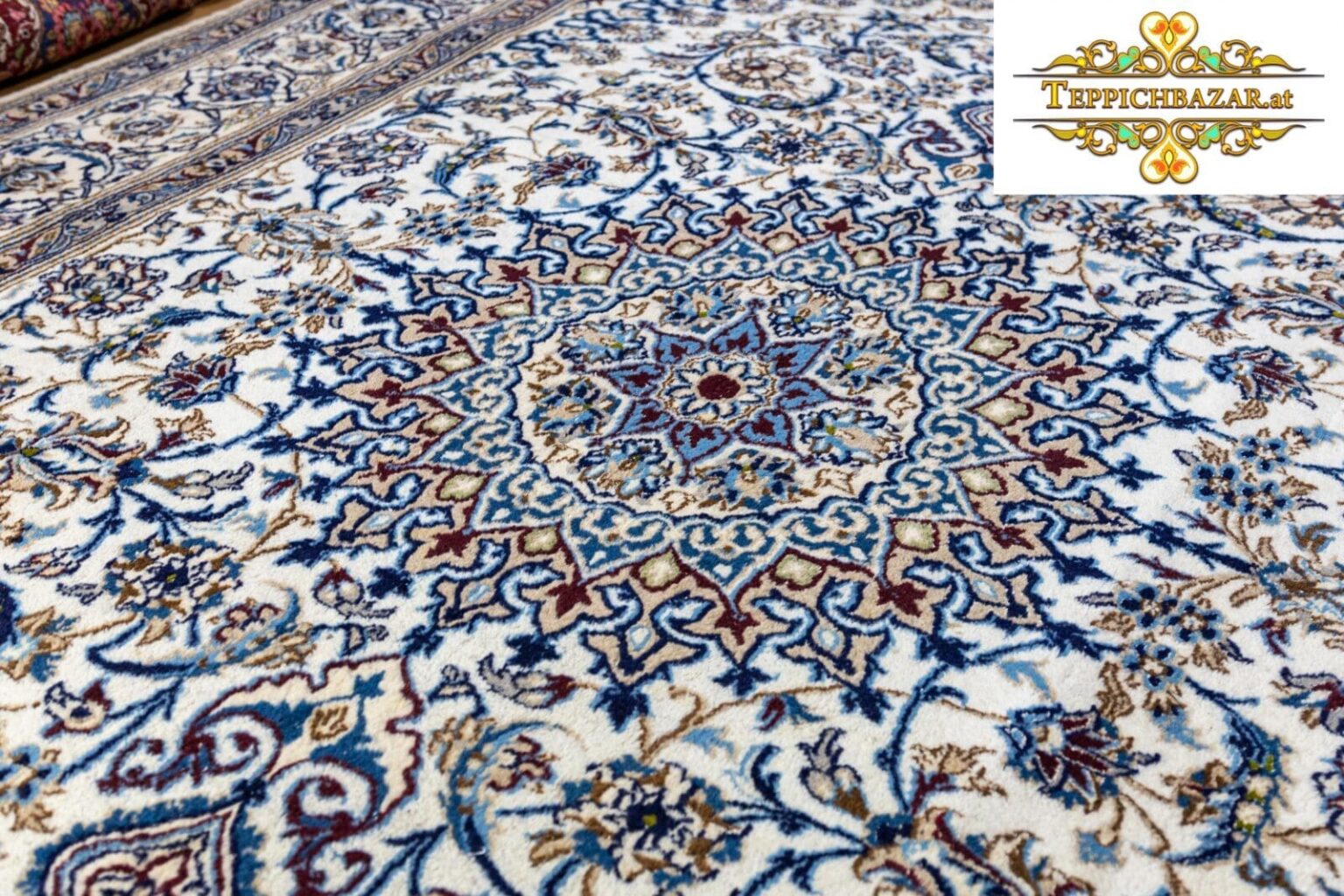
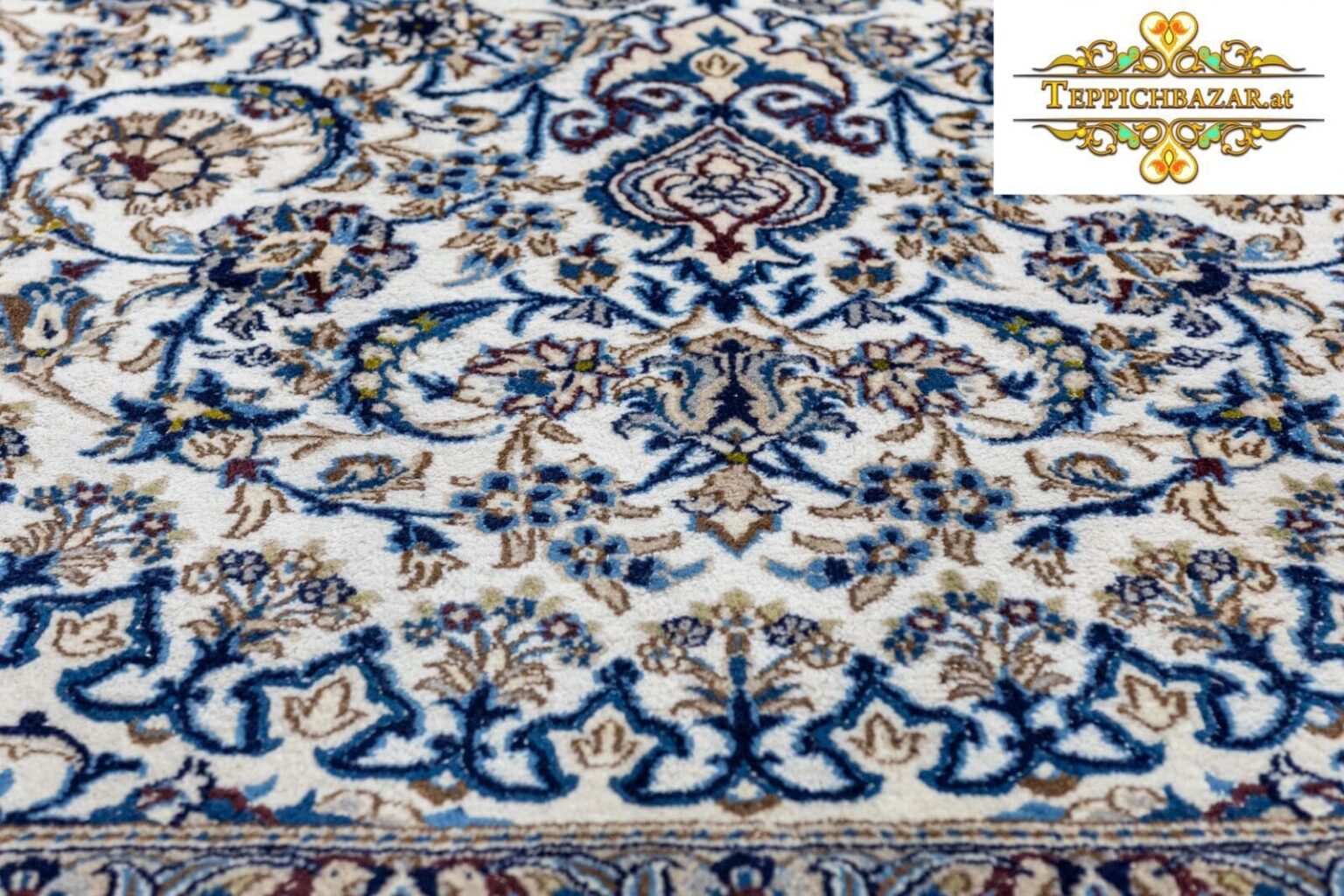
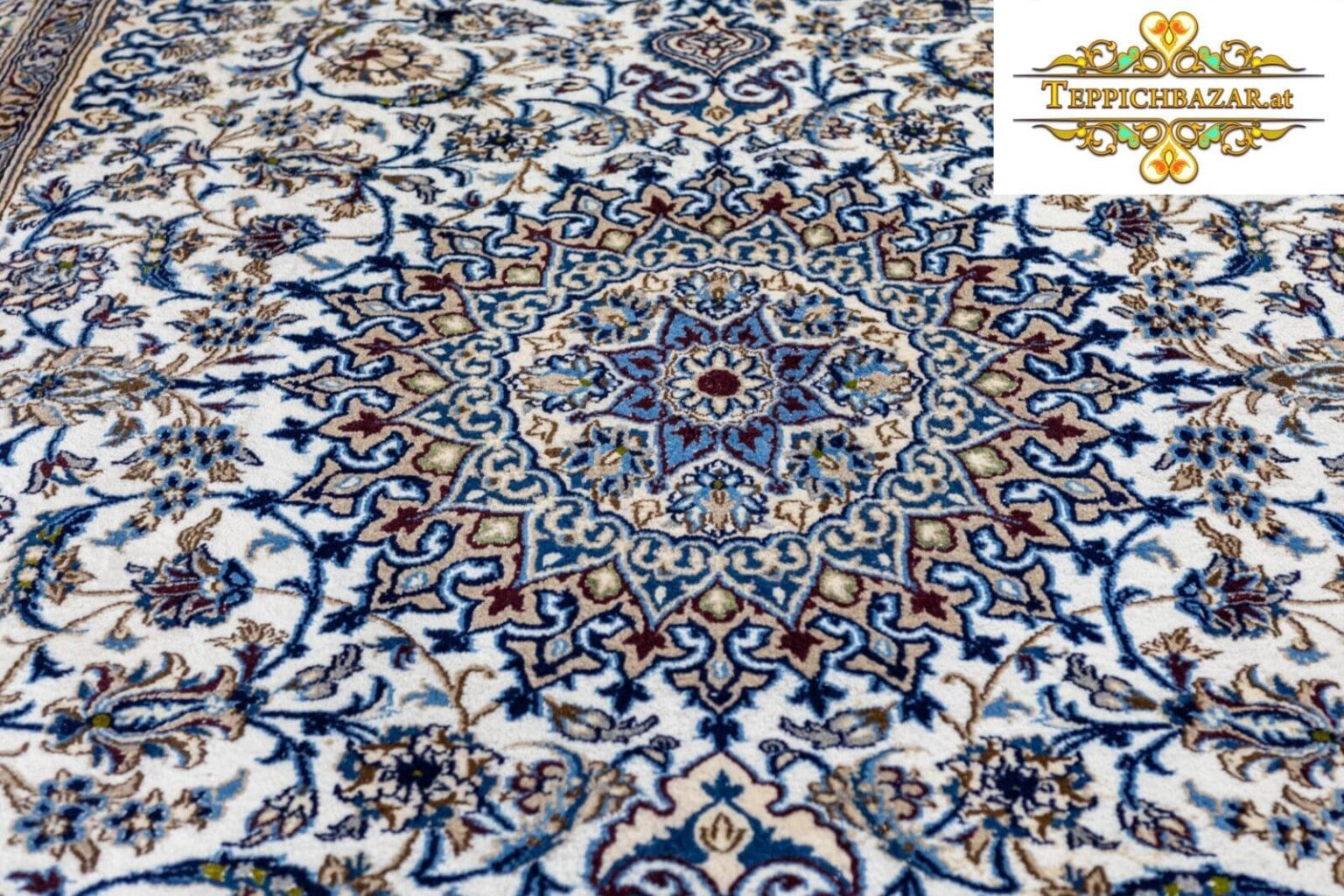
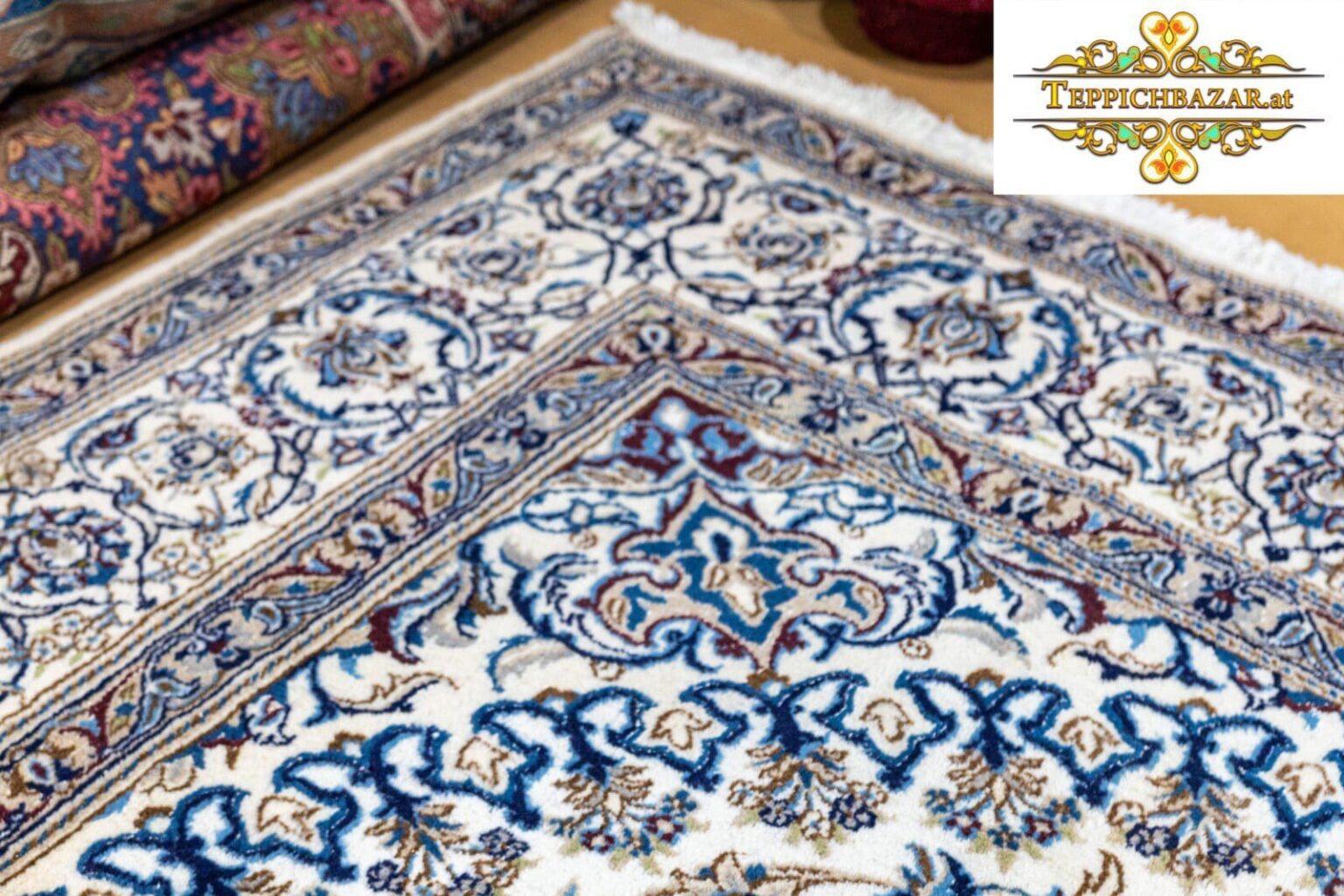
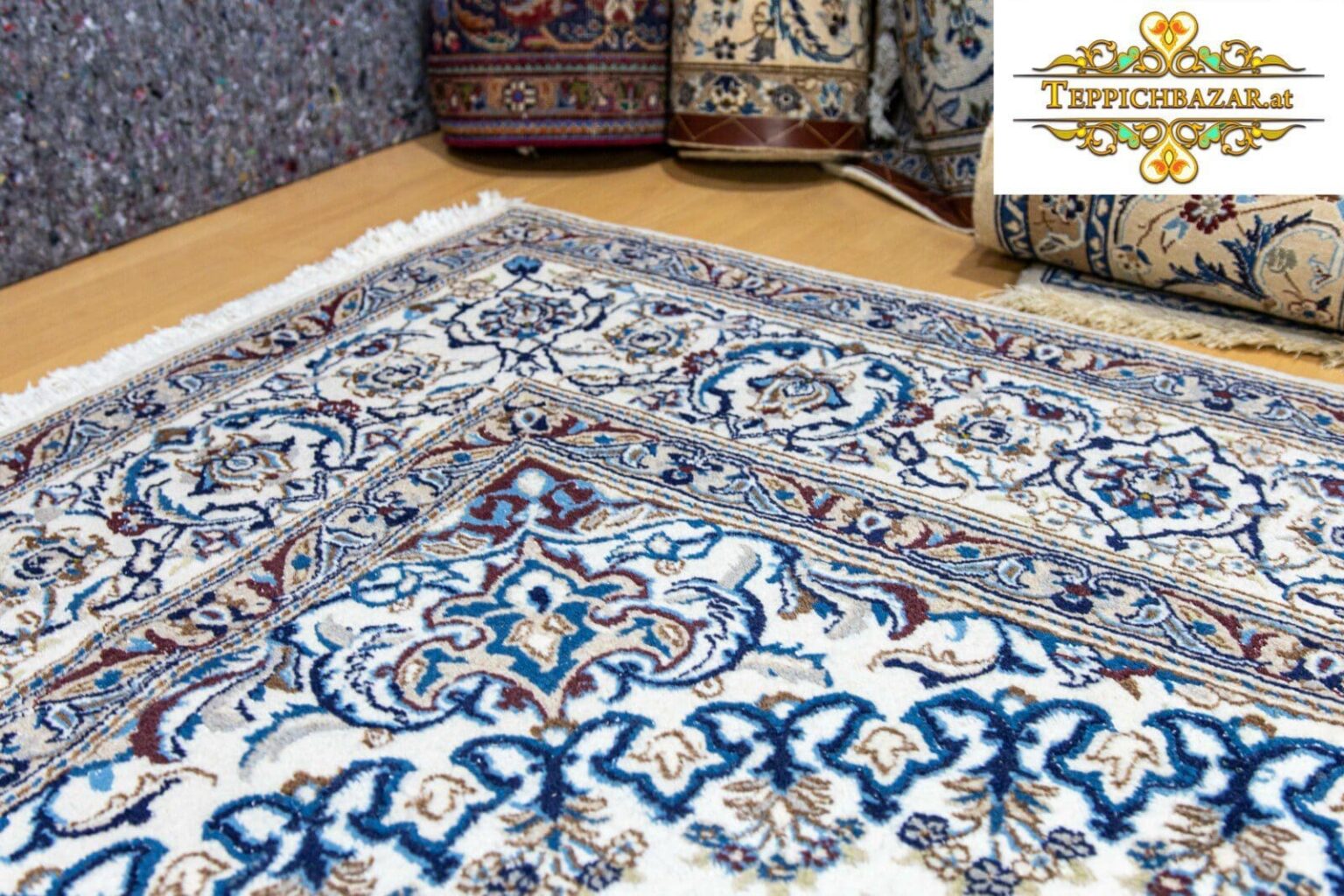
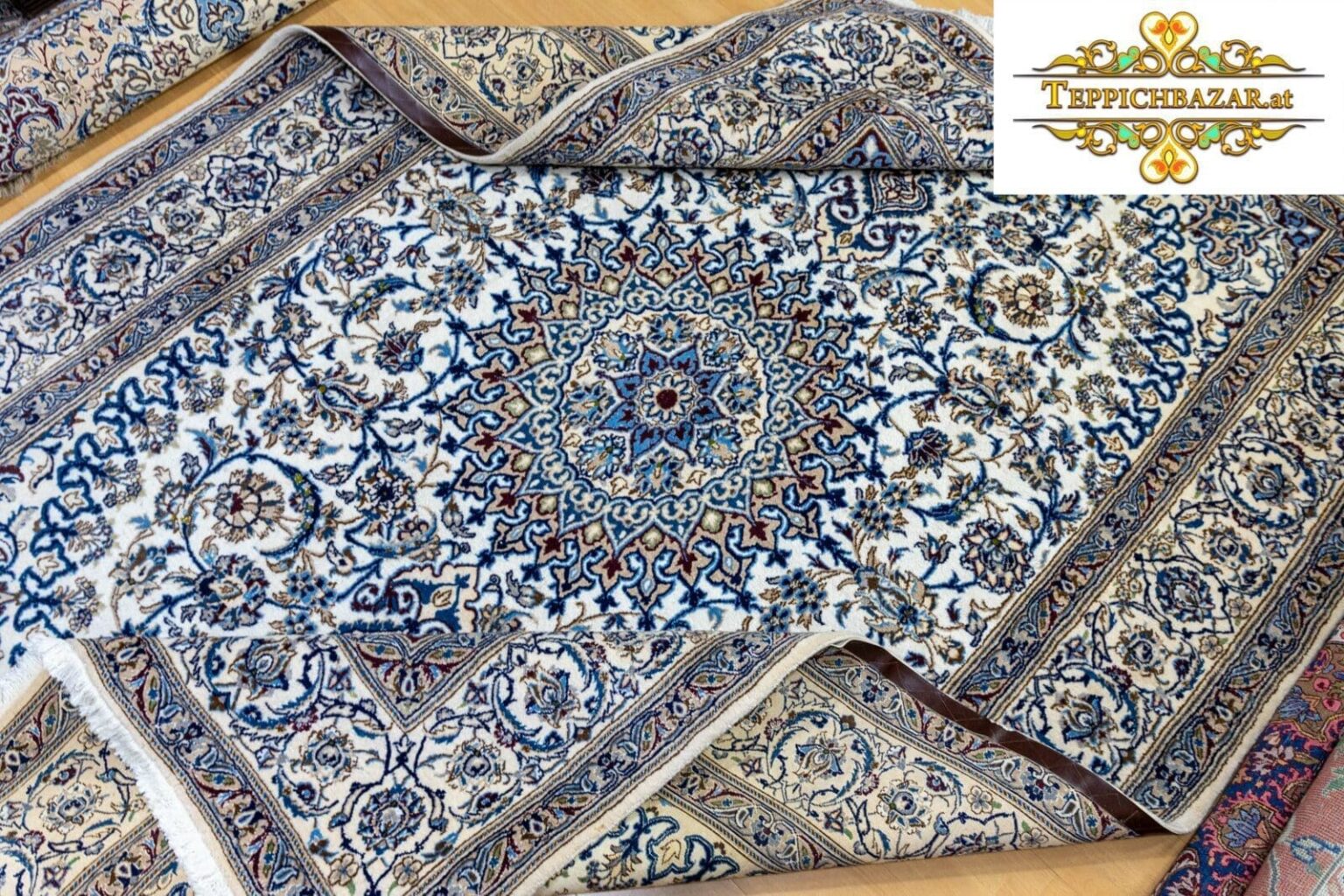
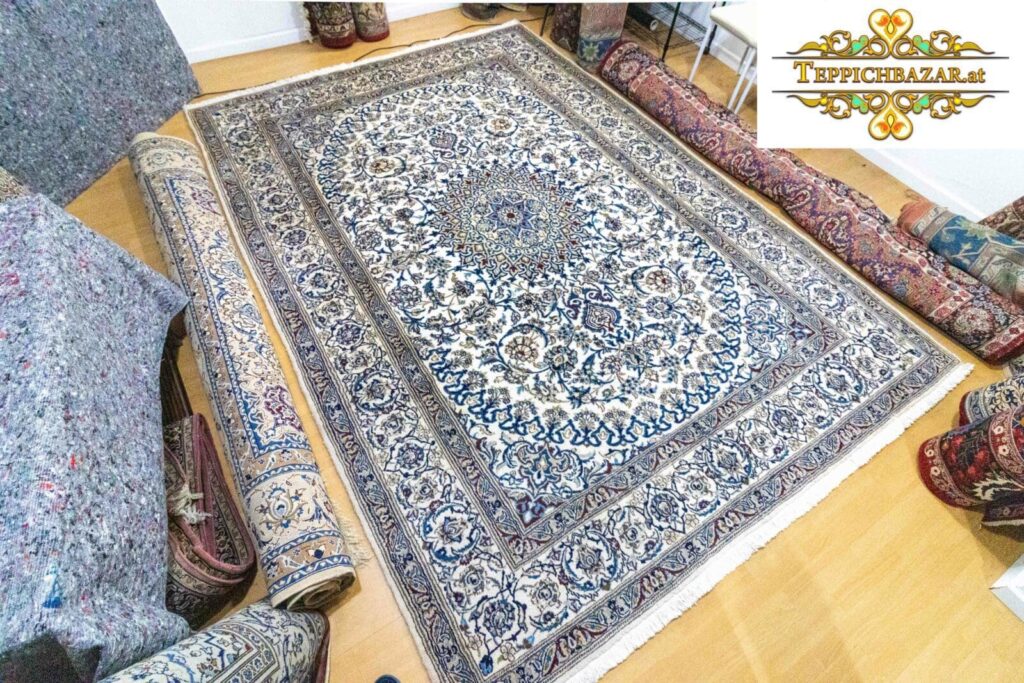
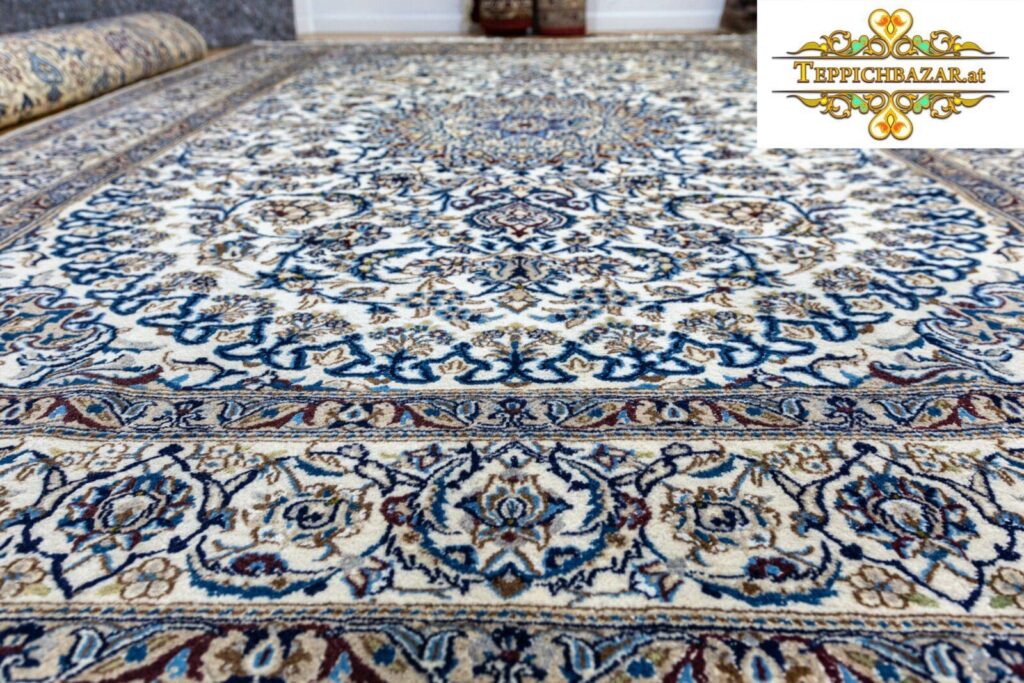
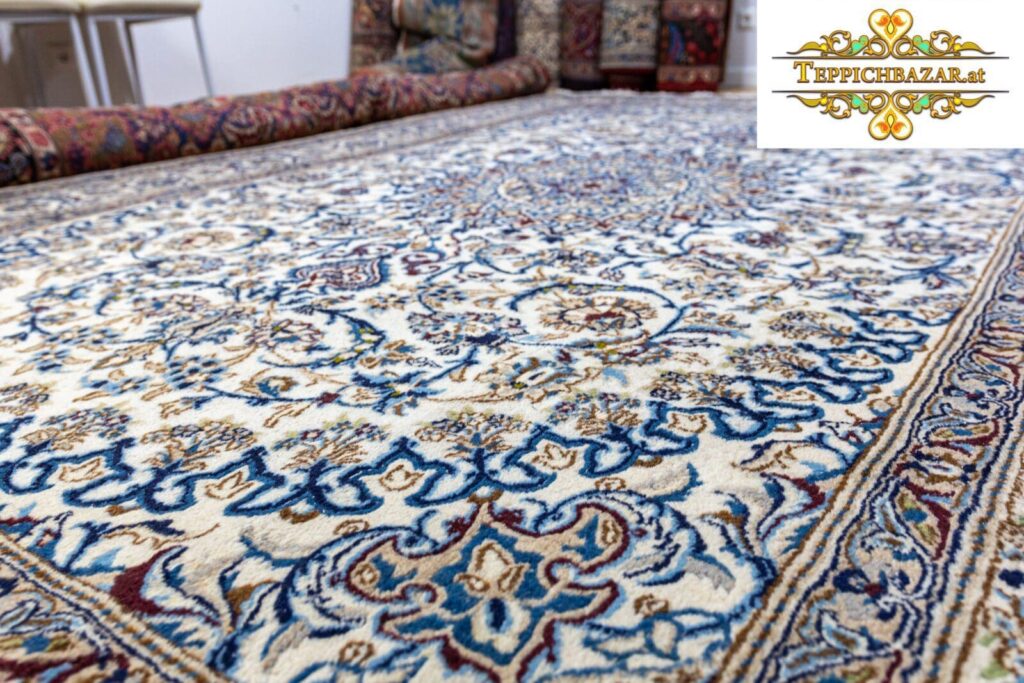
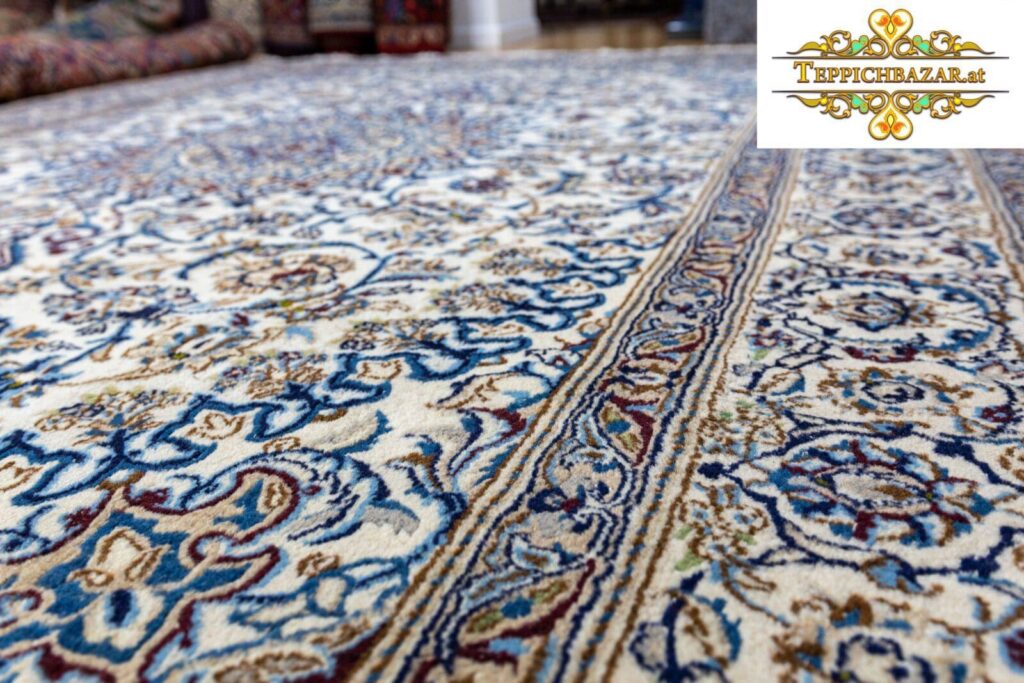
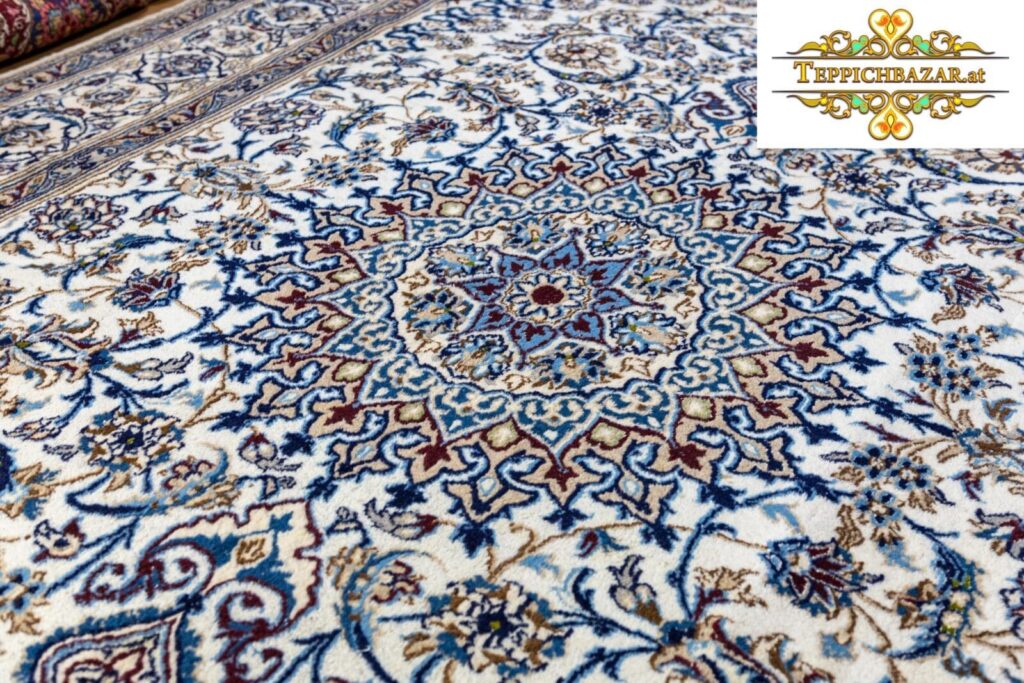
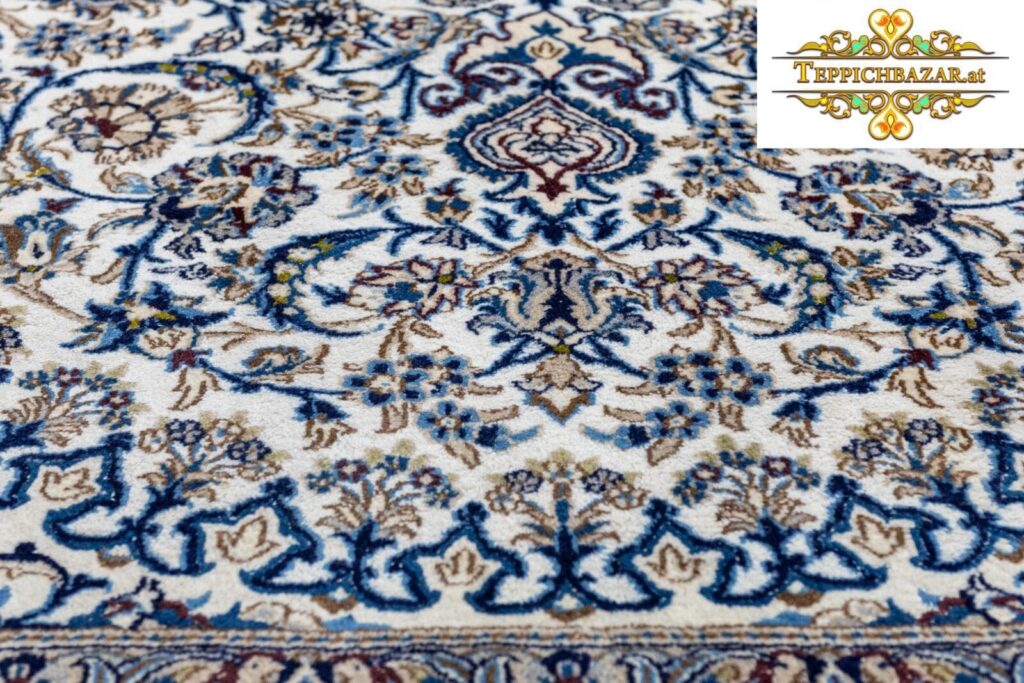
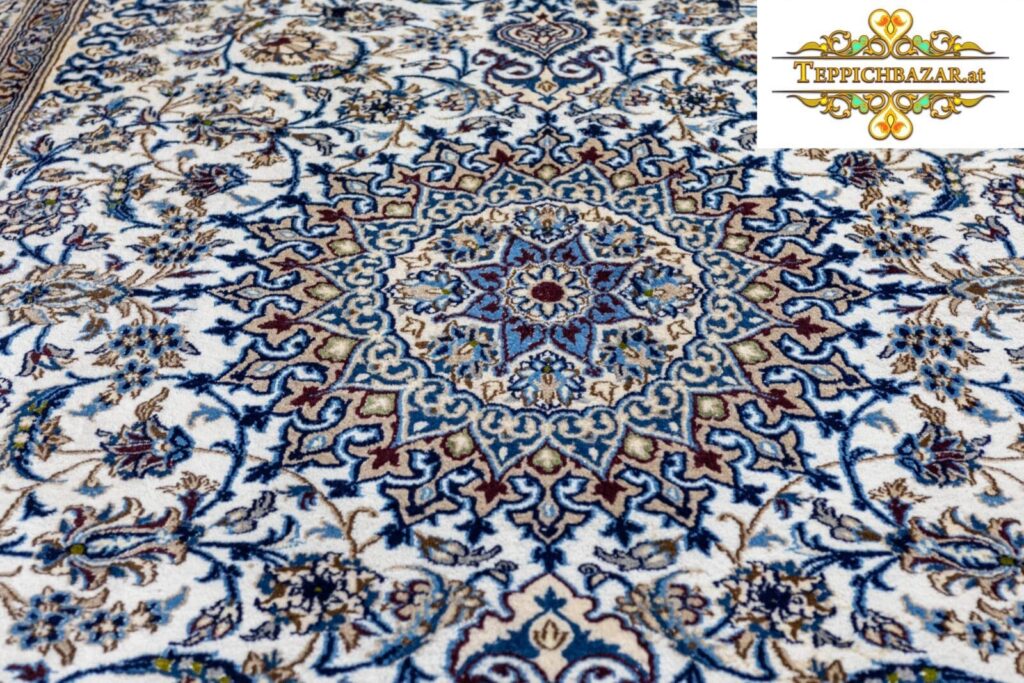
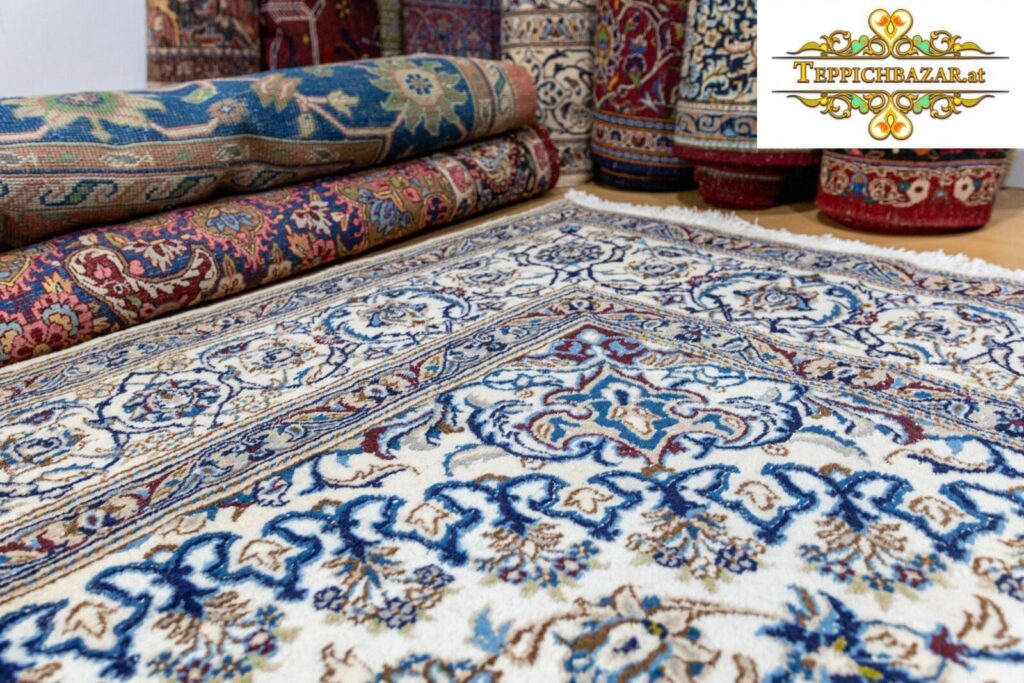
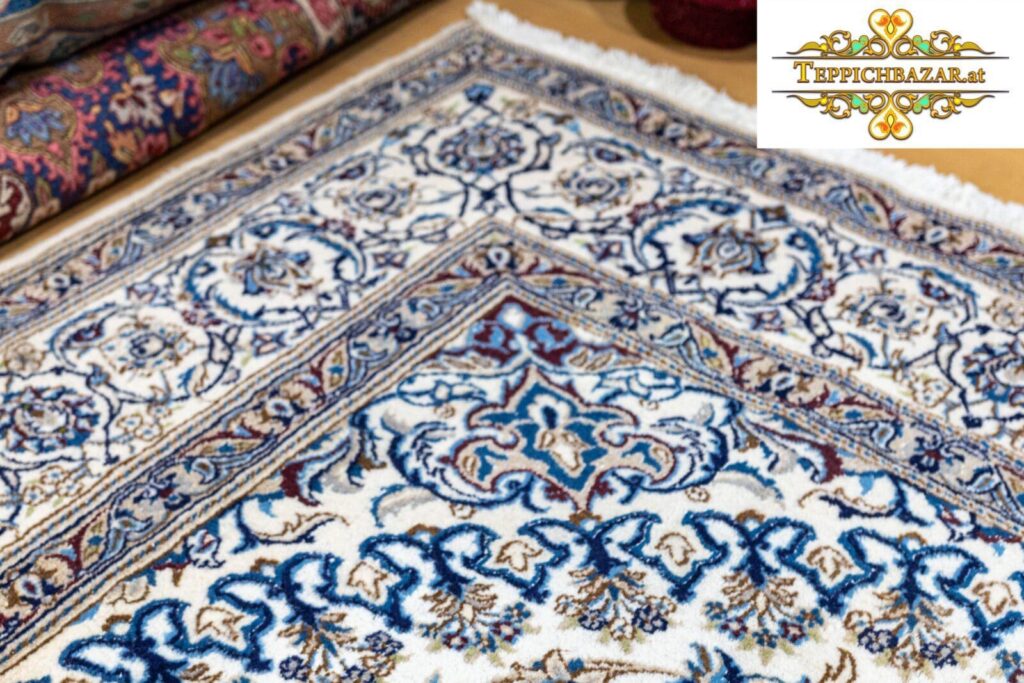
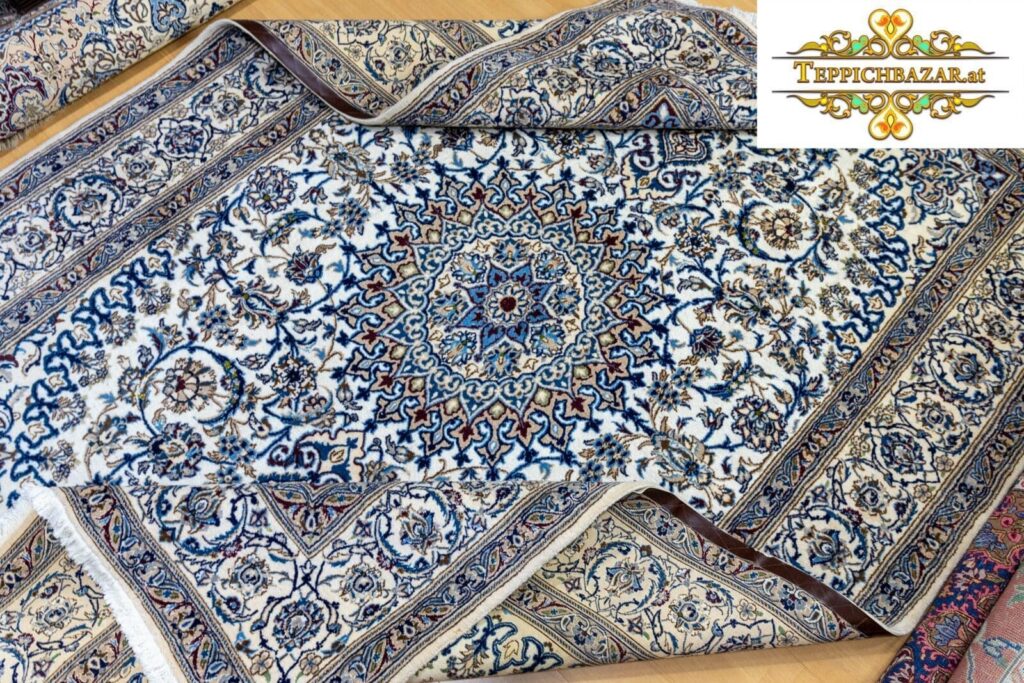
The listed pattern is Lachak-Toranj Nain medallion. The central medallion provides the main organising point of the composition. In carpet terminology, Toranj refers to a medallion form, while Lachak indicates the accompanying corner or spandrel elements. Together, the terms describe a design in which the centre and the surrounding corner areas are visually related. The addition of Nain identifies this medallion arrangement with the stated design tradition of Nain.
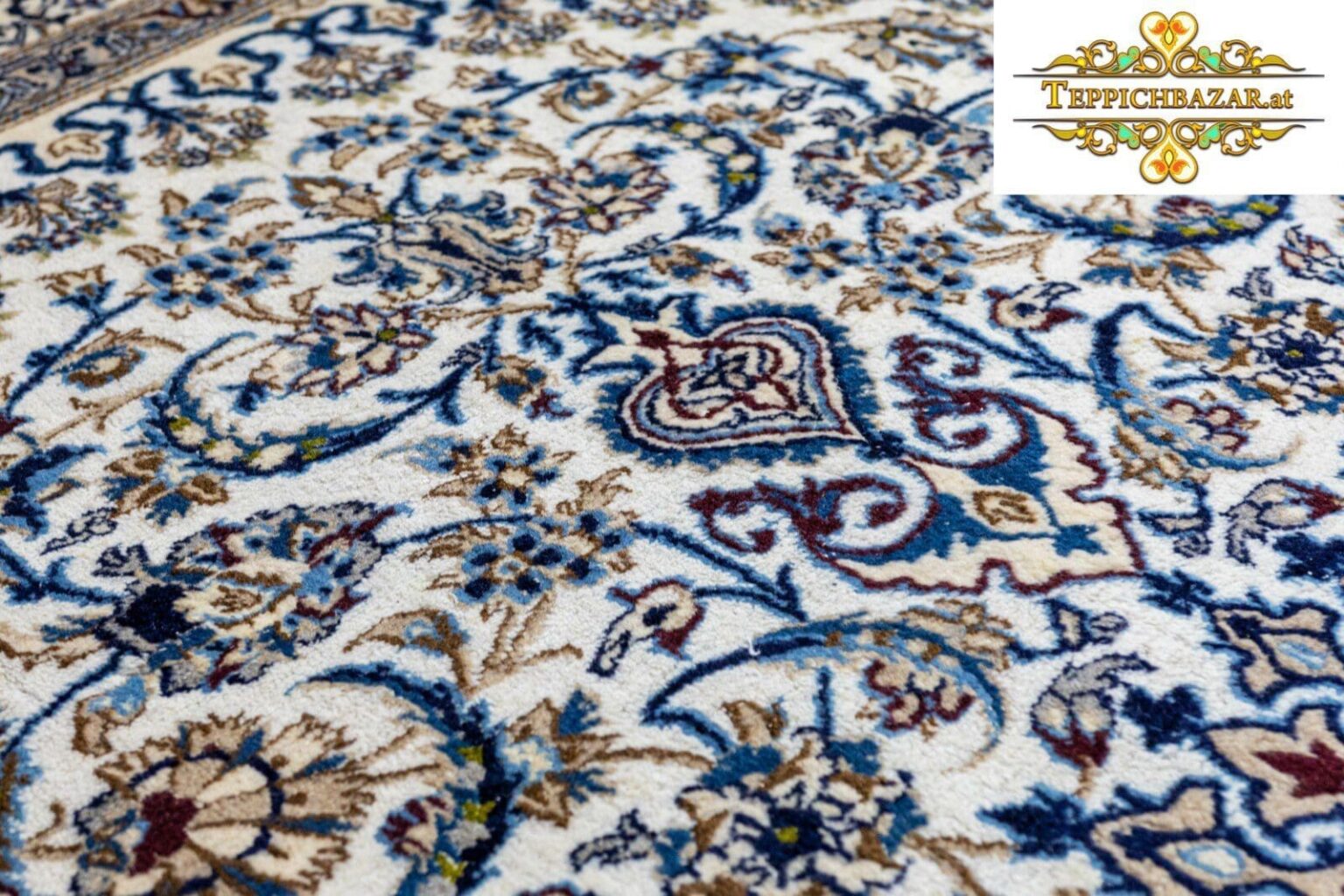
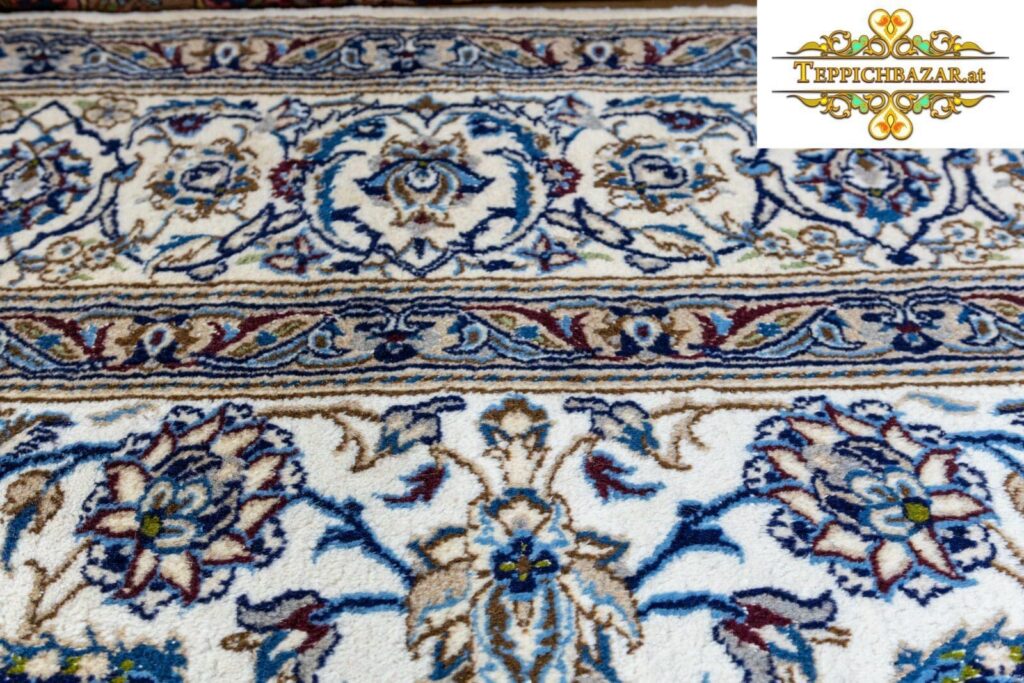
The source characterises Nain designs as finely drawn and mentions historical motifs together with floral patterns. Floral elements can be integrated into a geometric overall structure. This relationship is important in a medallion design: the central form establishes an axis, while flowers, foliage or related plant-based details give the surrounding areas variation. The precise pattern name Lachak-Toranj Nain medallion is recorded for this rug; no further individual motifs or exact colour values are supplied.
A Nain medallion composition is generally organised through the relationship between the centre, the corner areas, borders and recurring ornament. The medallion can draw the eye inward, while the surrounding forms create transitions and balance across the field. Corner solutions help connect the rectangular format with the central structure. When the knotting is fine, relationships between larger shapes and smaller ornaments can be rendered with greater differentiation.
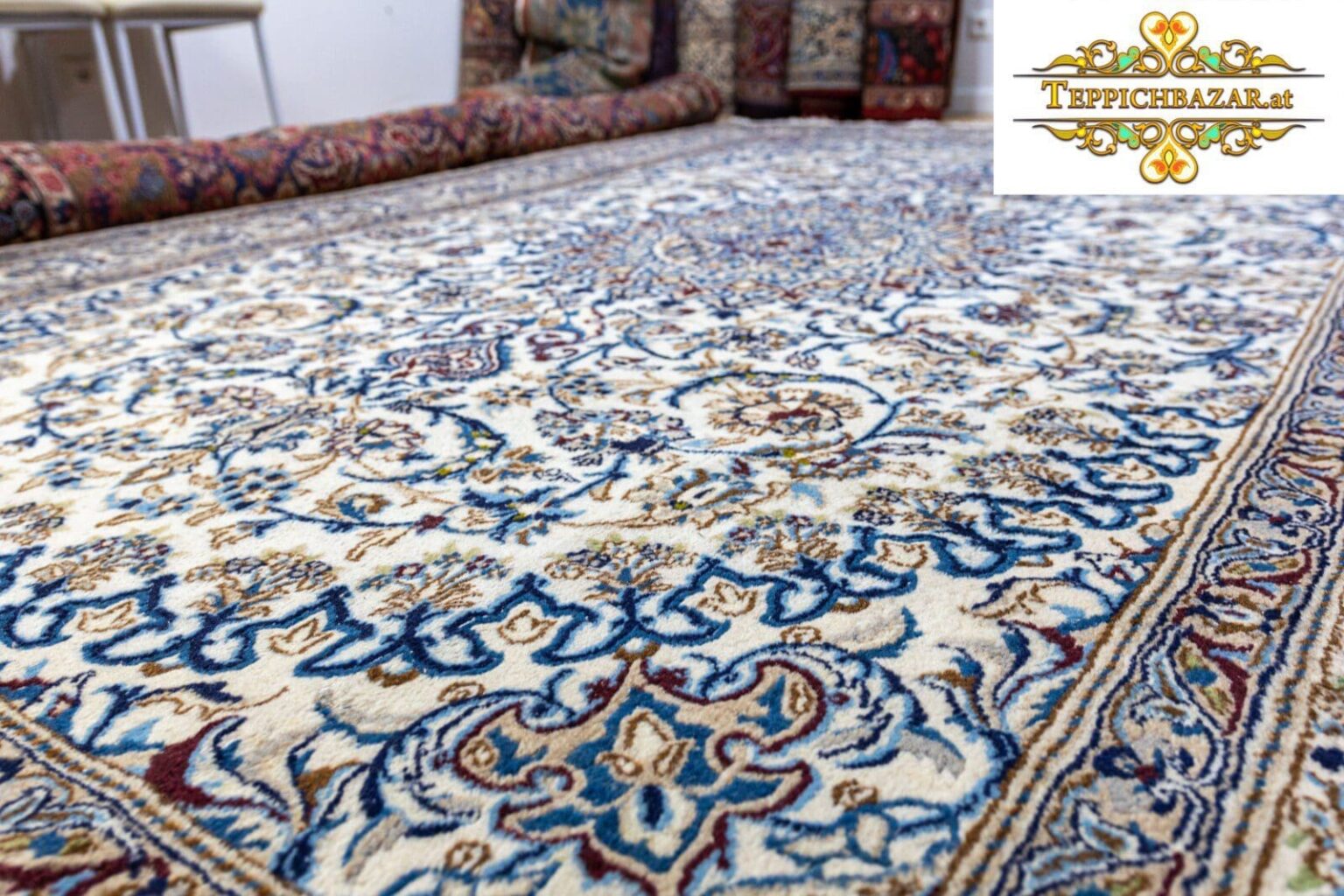
Materials also influence the appearance of a design. Wool gives the fields a textile density, while silk can make selected areas appear lighter or deeper as its gentle sheen responds to light. The source associates wool and silk with colour brilliance and additional depth. This is a general description of the material effect and not a colour inventory for the rug. The source does not specify the ground colour, border colours or a separate description of minor borders, so those details are omitted.
Historical and floral influences form part of the wider Nain design background. They can be arranged in a composed and balanced structure without reducing every rug to one repeated motif. The Nain medallion therefore represents a connection between central geometry and ornamental elaboration. The term Lachak-Toranj further indicates that the corner or spandrel forms participate in the organisation alongside the central medallion.
The design can consequently be classified as a traditional Nain composition centred on a medallion and accompanied by Lachak-Toranj forms. Fine drawing, the floral and historical background, and the interaction of wool and silk explain the balance between tradition and a contemporary visual setting described in the source. No signature, additional individual motif or specific colour chart is documented for this one-off rug, and no such details are added here.
Special Features
The explicitly stated features include the origin in Nain, hand knotting, a pile of virgin wool and silk, and a cotton warp. The listed knot density is 12la, and the design is a Lachak-Toranj Nain medallion. The condition is described as like new. These details identify the offered one-off piece without attributing an unstated signature, production date or additional certificate of origin.
The care guidance in the source recommends regular vacuuming without a brush. For spills or stains, professional carpet cleaning should be used so that the materials are not damaged. Occasional specialist cleaning is also mentioned as a way to help preserve the colours and appearance over time. Hand-knotted Persian rugs are generally described as compatible with underfloor heating, although the temperature should not be set too high in order to protect the materials.
The source names knot density and materials such as wool and silk as indicators that may help assess authenticity. Certificates or provenance documents can provide further information. A trustworthy dealer should make available the documentation that exists. No additional documents or examinations are stated for this rug.
FAQ
How should I care for the Nain Persian rug?
The supplied care advice recommends regular vacuuming without a brush. This cleans the surface while avoiding the additional stress that a rotating brush can place on textile materials. Stains should not be treated with unsuitable household products. Professional carpet cleaning is recommended instead, so that the virgin wool, silk and cotton warp are not damaged. Occasional cleaning by specialists is also mentioned as a way to help retain the colours and appearance of the hand-knotted rug. Care should therefore be gentle and should follow the material composition stated for this piece.
Is the rug suitable for underfloor heating?
According to the source, hand-knotted Persian rugs are generally compatible with underfloor heating. The temperature should nevertheless not be set too high. This precaution is intended to protect the materials used in the rug. Since its pile consists of virgin wool and silk and its warp is cotton, moderate and carefully controlled warmth is appropriate. General compatibility does not replace an assessment of the specific heating system or room conditions, but the supplied guidance gives the relevant basic precaution for use.
How can I tell whether the rug is authentic?
The source identifies knot density and the materials used, particularly wool and silk, as signs that can help with authenticity. Certificates or provenance documents may provide further support. For a Nain Persian rug, the stated origin in the city of Nain should be considered together with the other product information. A trustworthy dealer should provide the available details. For this one-off rug, the source records its hand-knotted construction, material composition, knot density and Nain origin; no further documentation or authentication procedure is specified.
To provide the best experiences, we use technologies like cookies to store and/or access device information. Consenting to these technologies will allow us to process data such as browsing behavior or unique IDs on this site. Not consenting or withdrawing consent, may adversely affect certain features and functions.
Functional Always active
The technical storage or access is strictly necessary for the legitimate purpose of enabling the use of a specific service explicitly requested by the subscriber or user, or for the sole purpose of carrying out the transmission of a communication over an electronic communications network.
Preferences
The technical storage or access is necessary for the legitimate purpose of storing preferences that are not requested by the subscriber or user.
Statistics
The technical storage or access that is used exclusively for statistical purposes.The technical storage or access that is used exclusively for anonymous statistical purposes. Without a subpoena, voluntary compliance on the part of your Internet Service Provider, or additional records from a third party, information stored or retrieved for this purpose alone cannot usually be used to identify you.
Marketing
The technical storage or access is required to create user profiles to send advertising, or to track the user on a website or across several websites for similar marketing purposes.

 SECURE PAYMENT
 SHIPPING PARTNERS