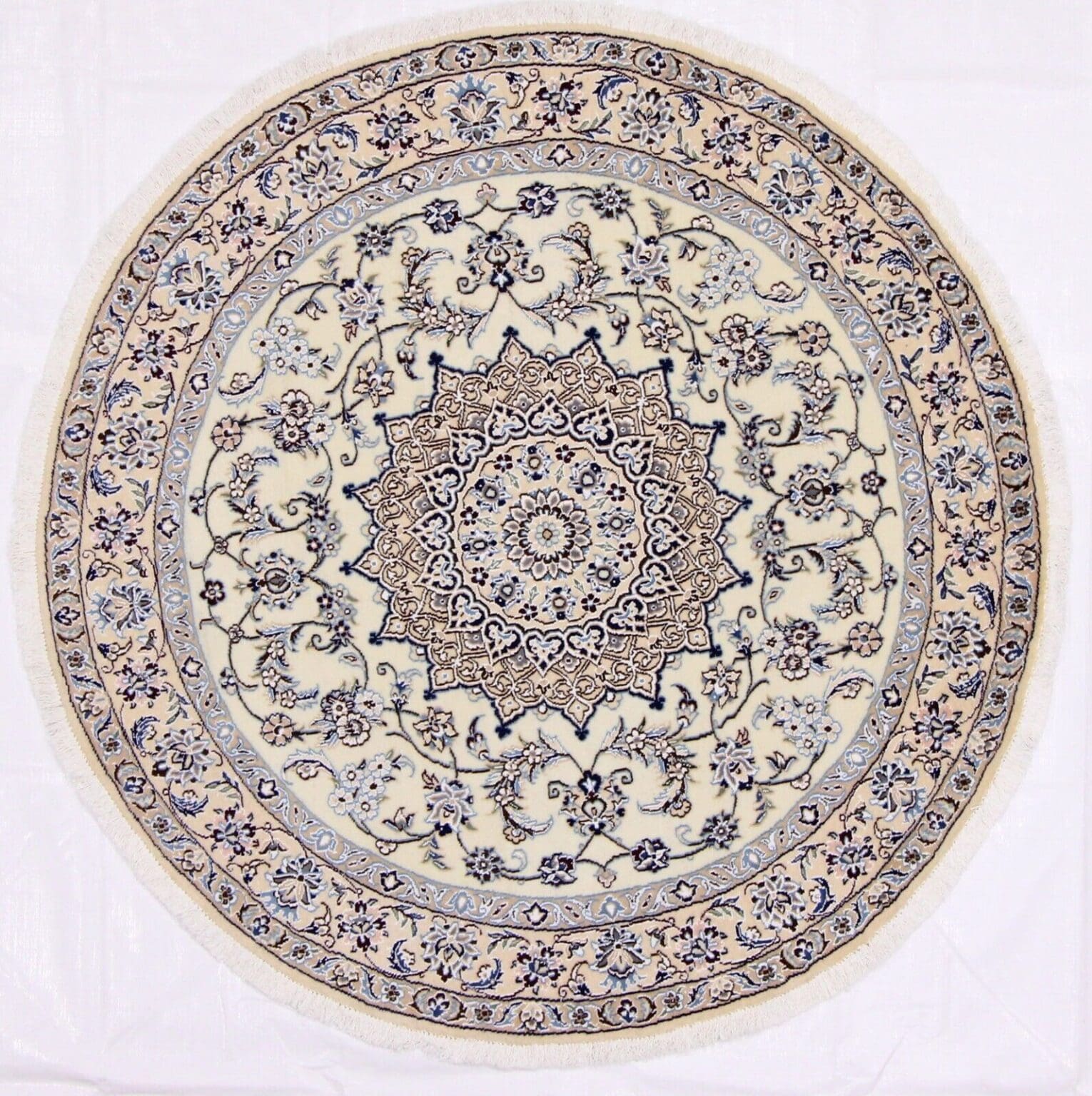
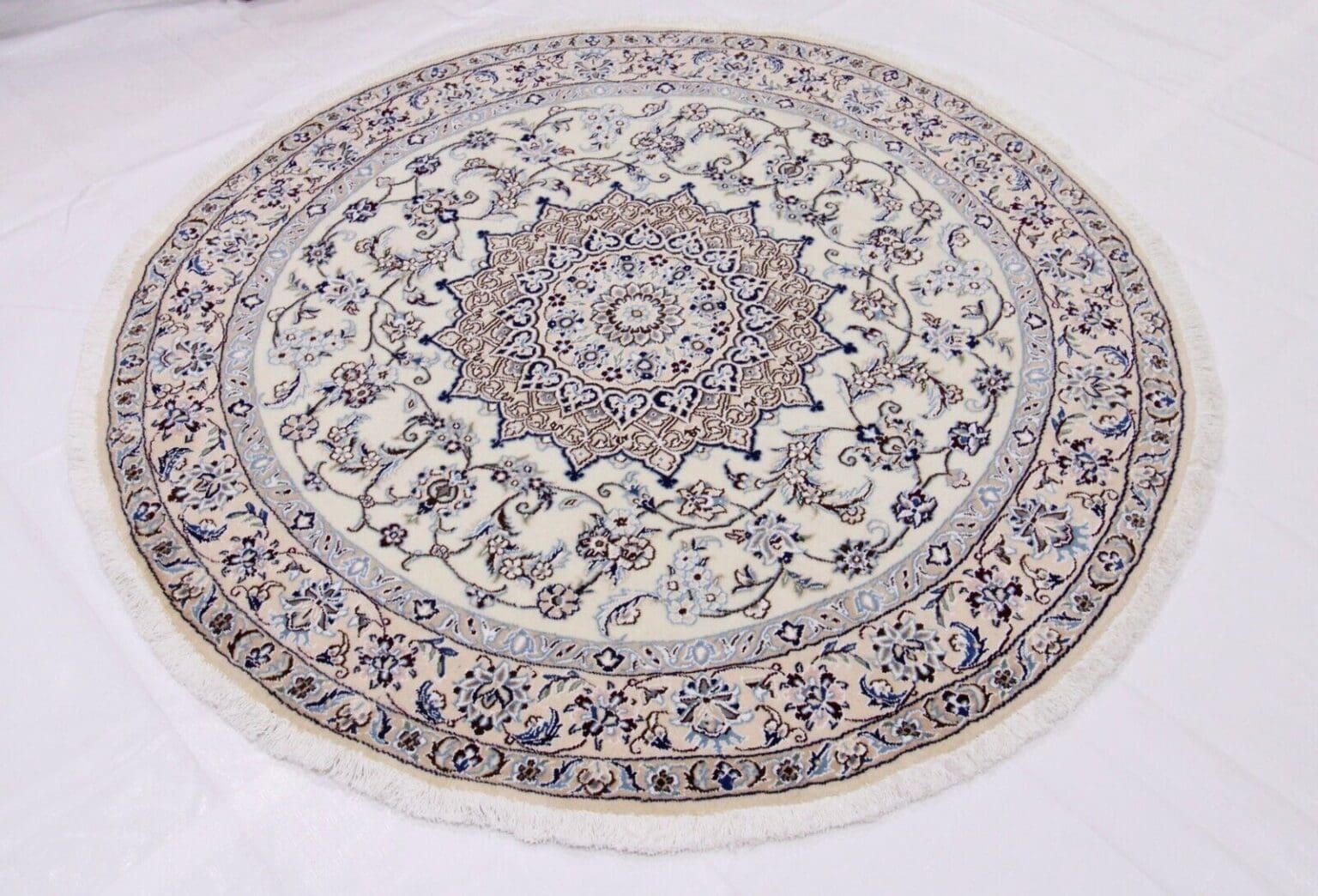
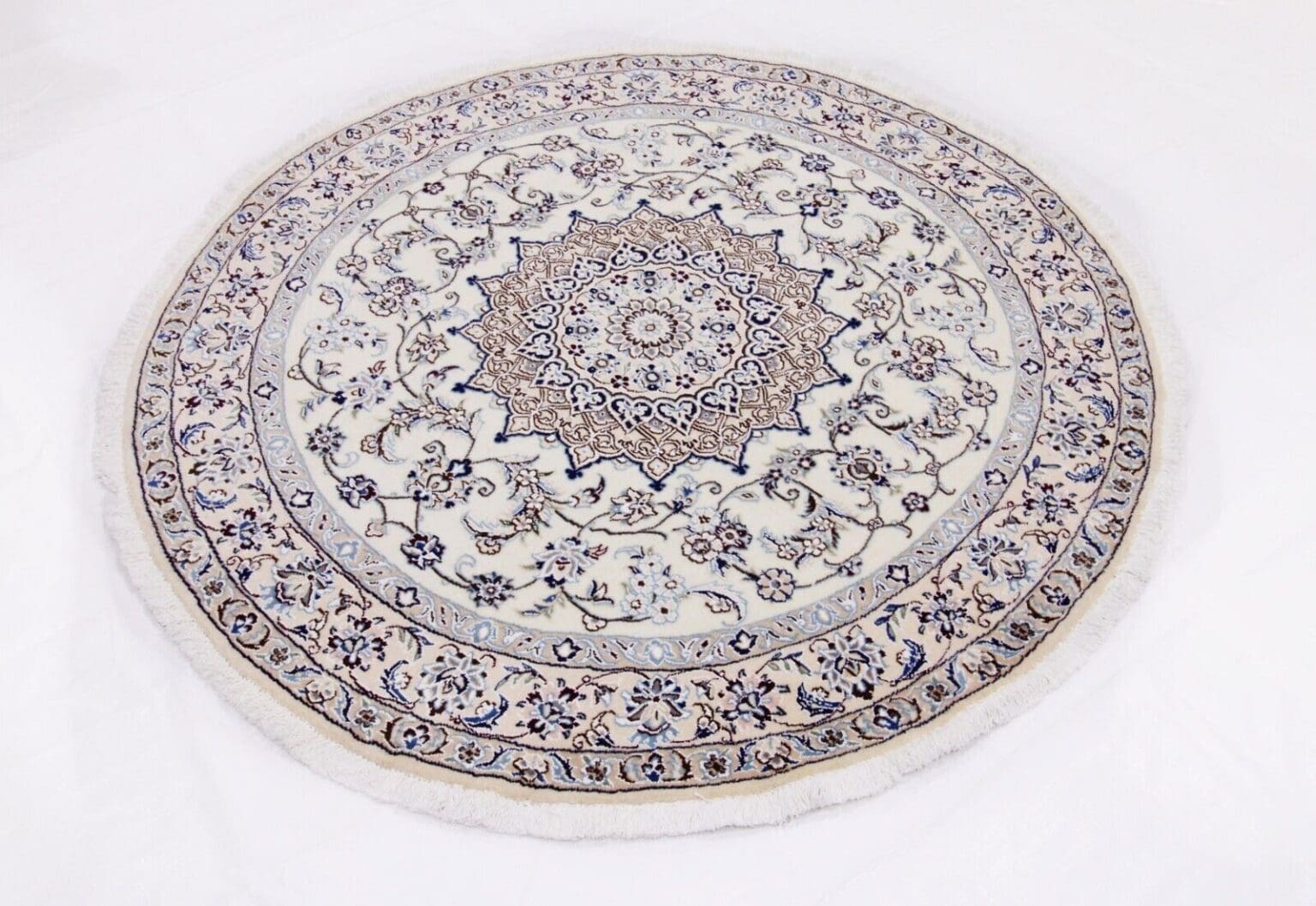
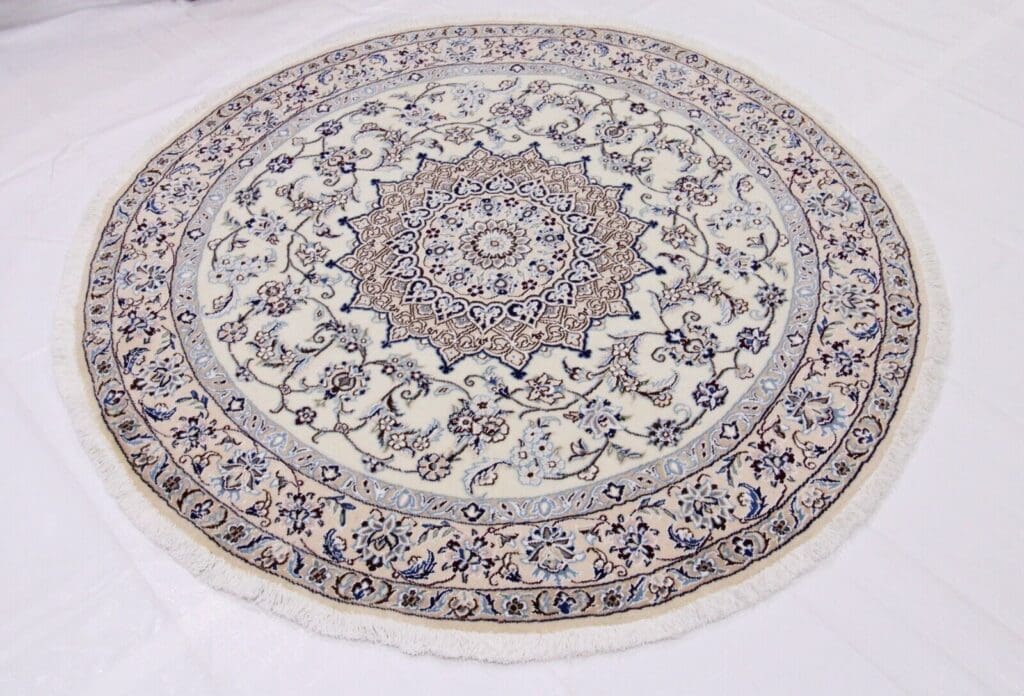
This Nain 9La is a hand-knotted Persian rug made with silk and wool. Silk gives the surface a distinctive sheen, while the contrast with robust wool creates a changing interplay of light and colour. Depending on how the light falls, the silk can appear brighter or more subdued, allowing the details of the weave and pattern to be read in different ways. The combination of these materials is part of the established craft tradition associated with Nain rugs.
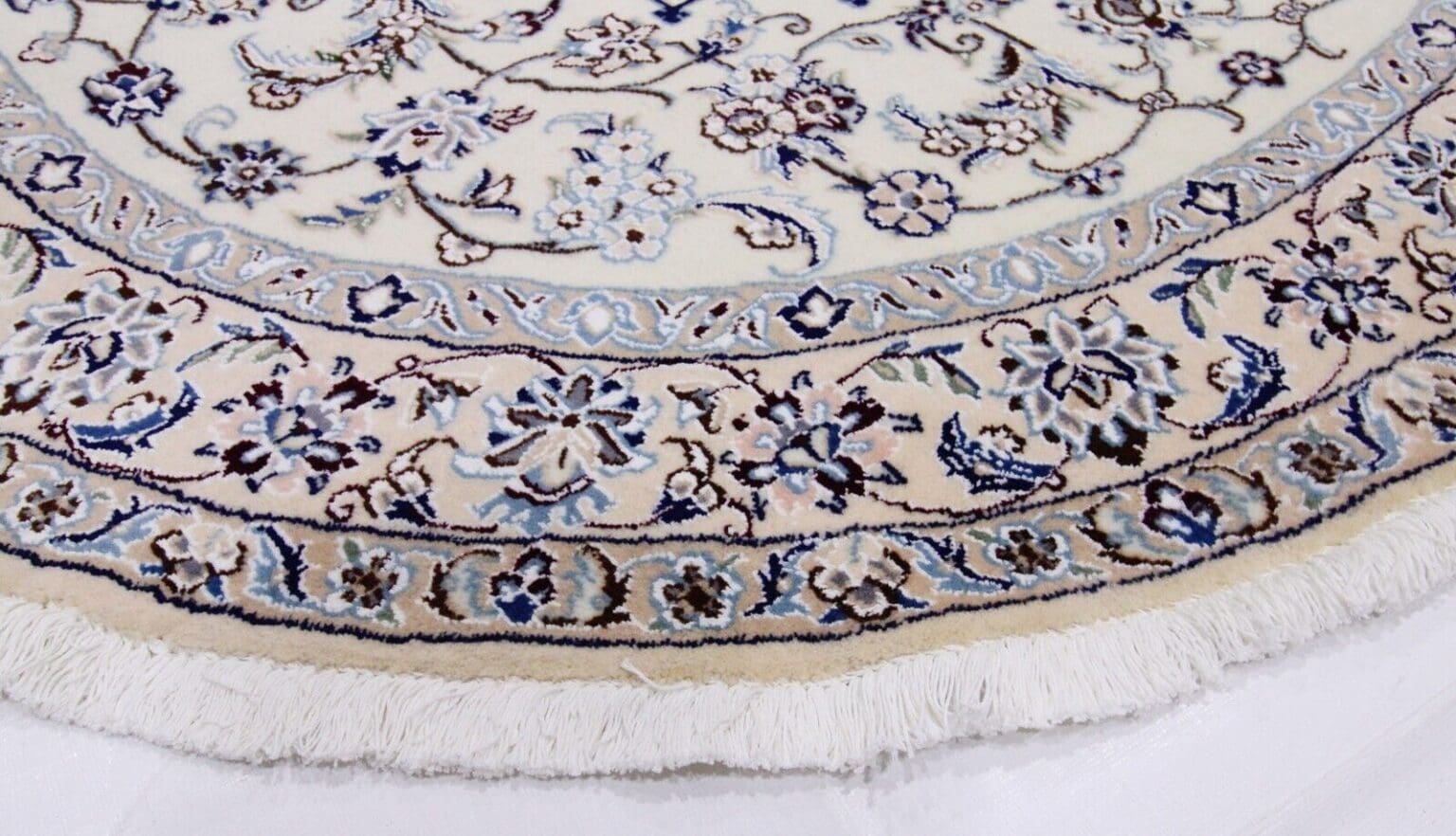
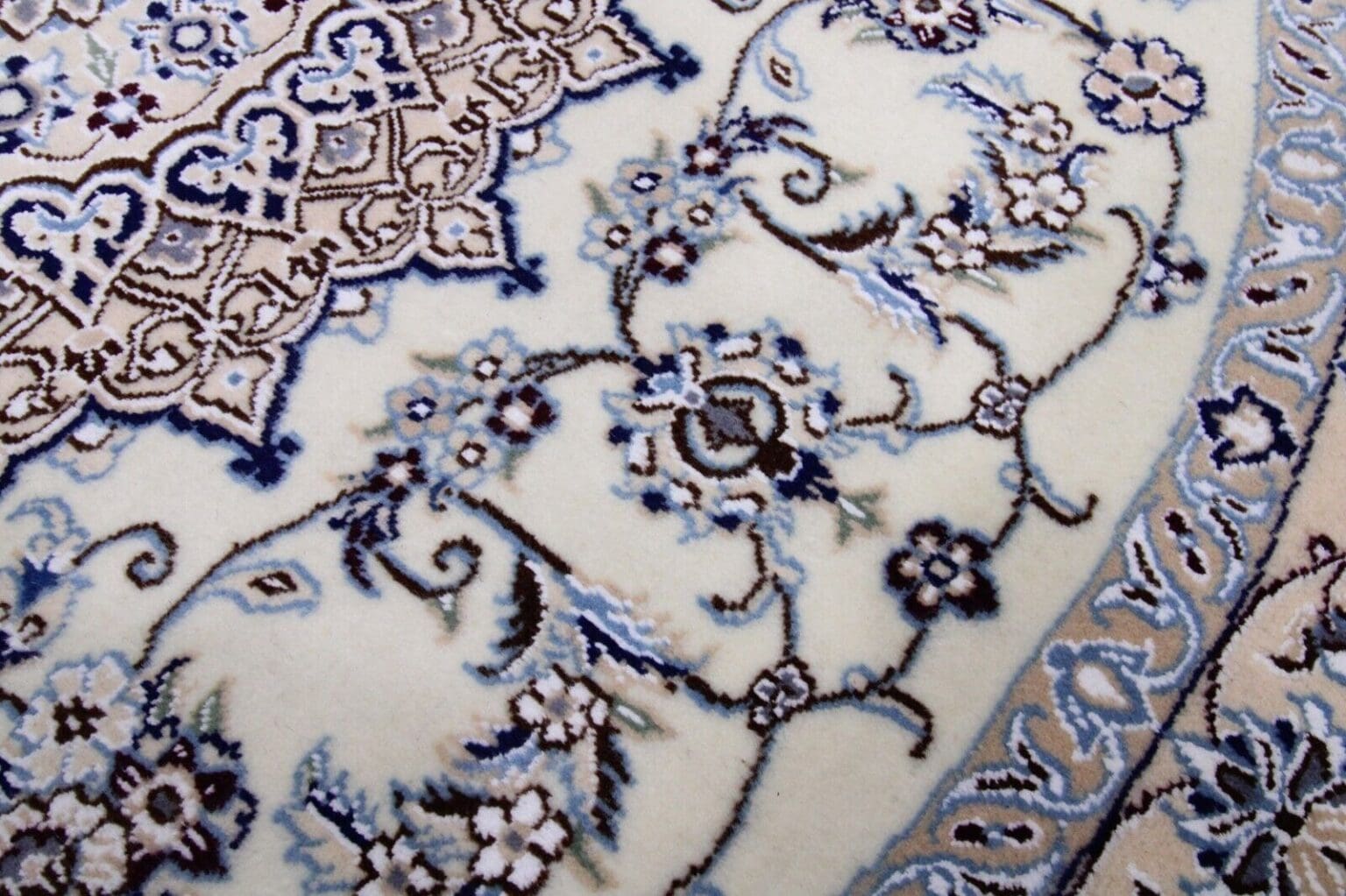
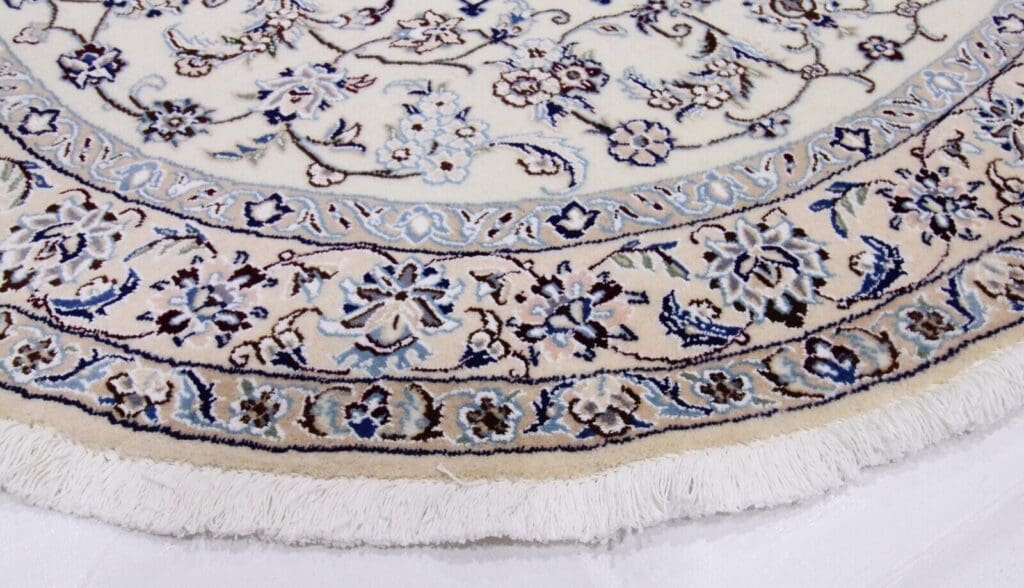
Hand knotting is a time-intensive process in which individual knots are tied by hand and arranged row by row. This method allows the weaver to build finely differentiated outlines, small ornamental elements and carefully controlled transitions. The rug’s high knot density is an indication of attentive workmanship. A dense knot structure generally supports a clearly defined pattern and is associated with the careful construction expected from finely made hand-knotted rugs.
The use of silk is also relevant to the character of the rug. In addition to its visual lustre, silk can make fine details particularly distinct because its surface responds clearly to light. Wool contributes a contrasting, more robust material presence. Together, the two fibres produce a surface in which texture, colour and pattern are closely connected. The hand-knotted technique remains visible in the precision of the design and in the way the ornamental composition is built across the rug.
Origin and Tradition
Nain rugs come from the city of Nain in Isfahan Province, an important centre of traditional Iranian carpet weaving. Nain has become known for rugs with fine workmanship, carefully developed patterns and selected materials. Its carpet tradition belongs to the wider history of Persian weaving, in which the design of a rug is shaped by local practice, the experience of the weaver and the disciplined repetition of established forms.
The city’s name is closely associated with a refined style of Persian rug production. Weaving in Nain developed within a culture where carpet making was treated as both a practical craft and an artistic discipline. The work requires knowledge of knotting, colour relationships, drawing and finishing. These skills are not separate stages in isolation: the choice of material affects the appearance of the pattern, while the density and regularity of the knots affect how precisely the design can be rendered.
Nain rugs are also associated with the use of natural dyes. Traditional dyeing methods produce colours with variation and depth rather than a completely uniform industrial appearance. The resulting palette can bring together pale, quiet tones with more defined accents, depending on the design. Colour is used not only to fill a field but also to separate motifs, clarify borders and establish a visual order throughout the composition.
The tradition of Nain weaving has been maintained through families and workshops in the region. Carpet knowledge can pass from one generation to the next through practical instruction, observation and repeated work at the loom. Older patterns and techniques continue to provide a foundation, while individual weavers contribute their own handling of line, colour and detail. This combination of inherited practice and personal execution is one reason hand-knotted rugs are treated as individual woven works rather than as identical manufactured products.
Iranian carpet history includes many regional approaches, and Nain occupies its own place within that broader landscape. Its reputation rests on the relationship between controlled drawing, fine construction and a restrained yet varied use of colour. The designation Nain 9La identifies the rug within the naming system used for this type of weaving, while the Persian origin connects it to the long-established carpet culture of Iran and Isfahan Province.
Design and Pattern
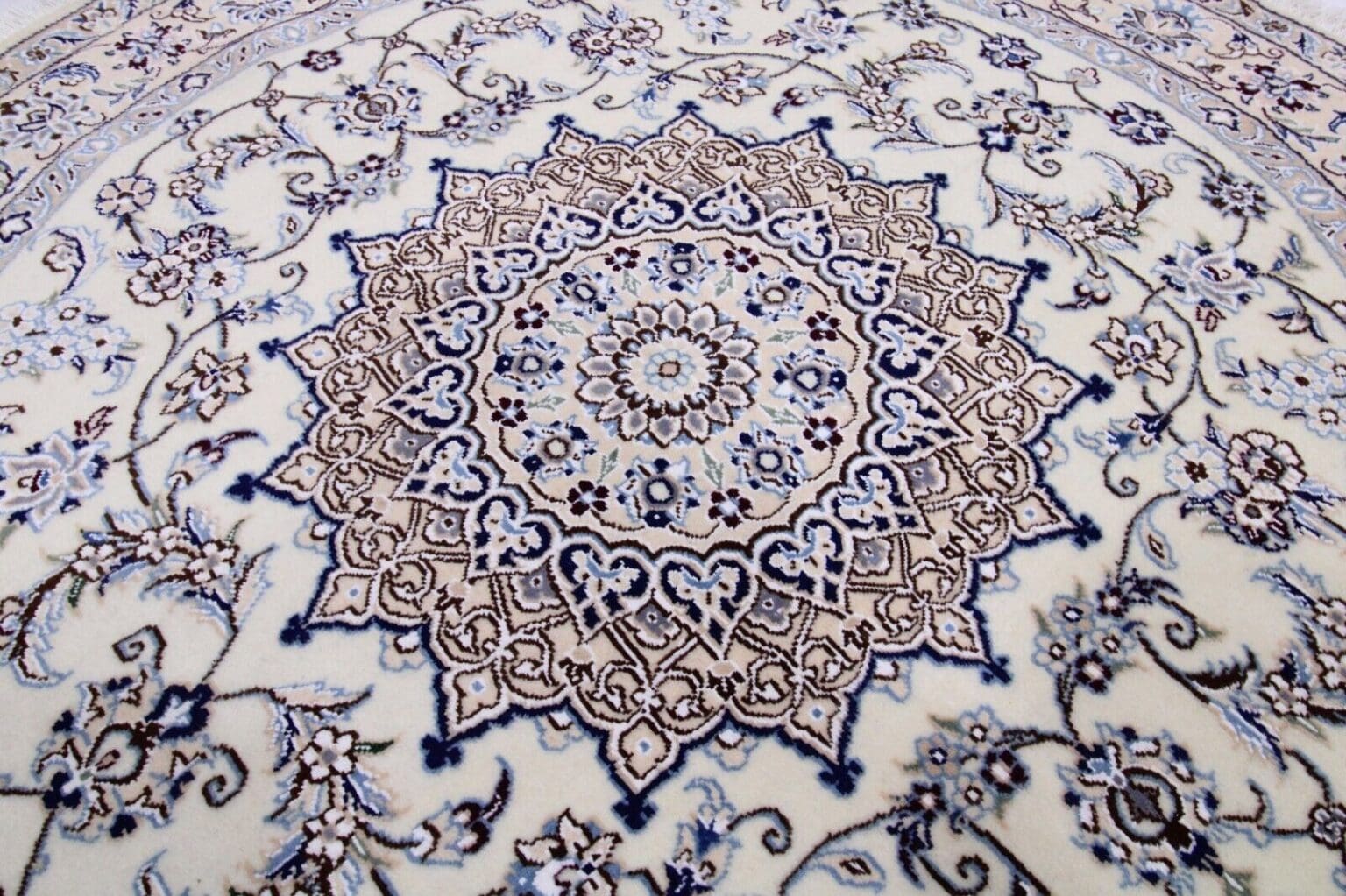
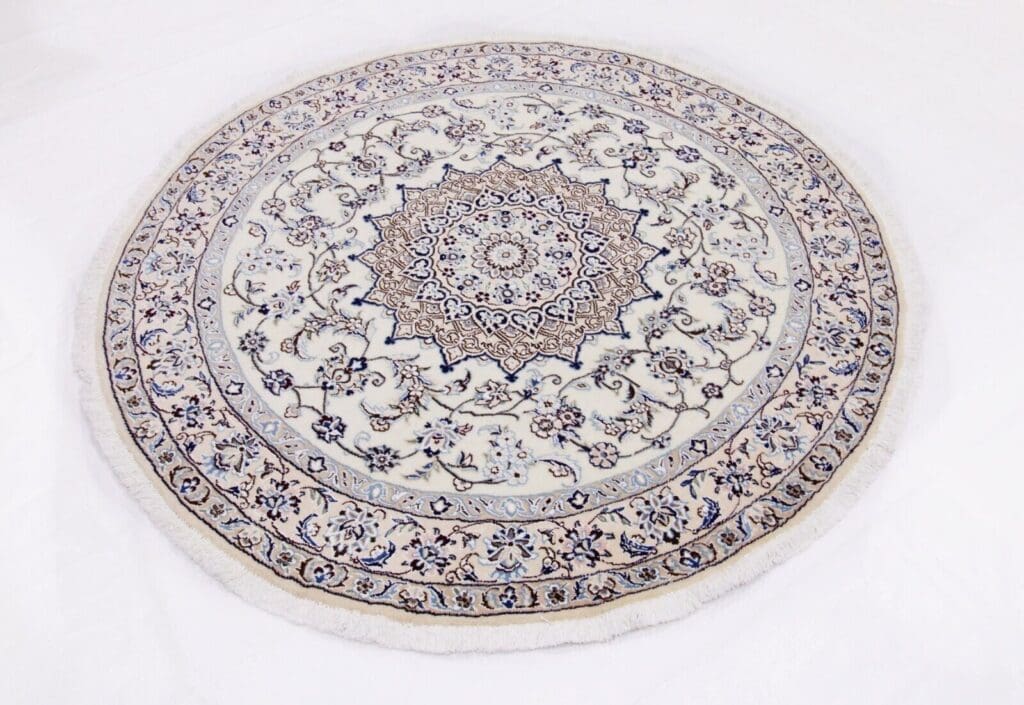
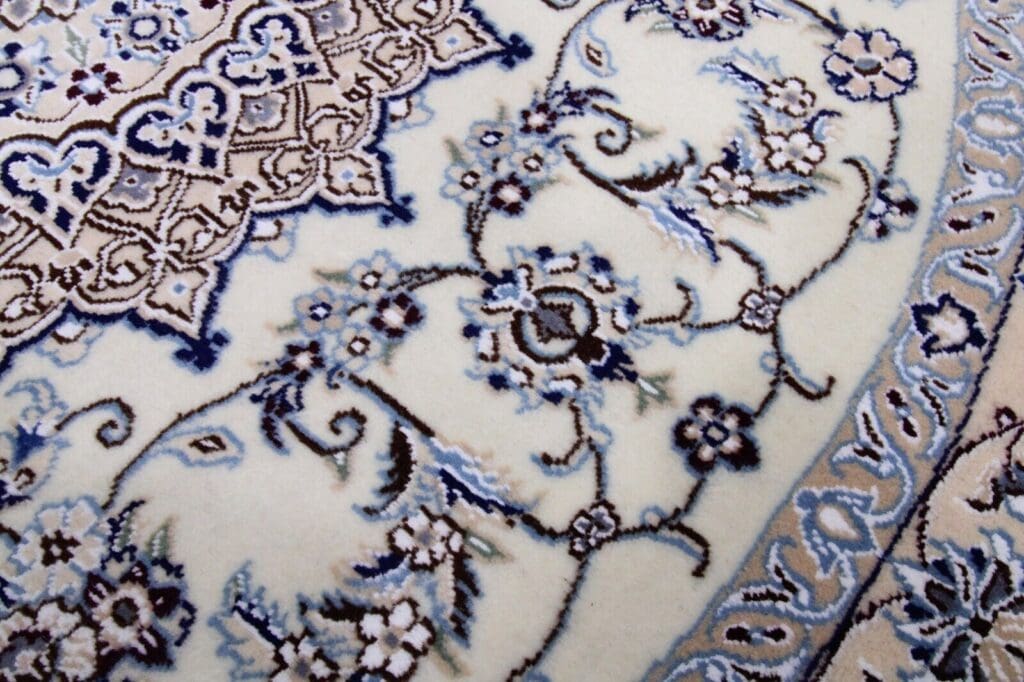
The design of Nain rugs, including the Nain 9La style, is often based on floral motifs and elegant ornaments. Such motifs draw on forms associated with nature, including leaves, blossoms and curling stems. They are translated into a carefully ordered carpet composition rather than copied as a naturalistic scene. The result is a pattern language in which repeated elements can be read as part of a larger, balanced structure.
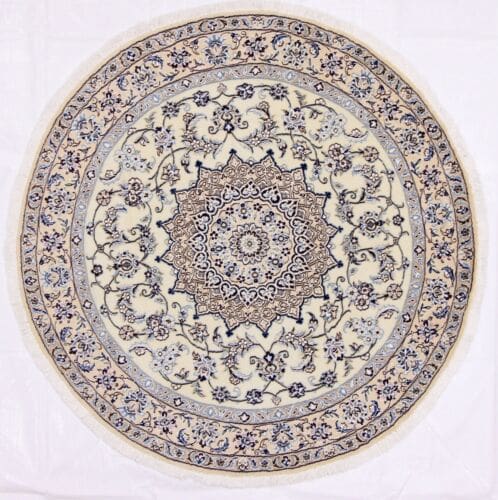
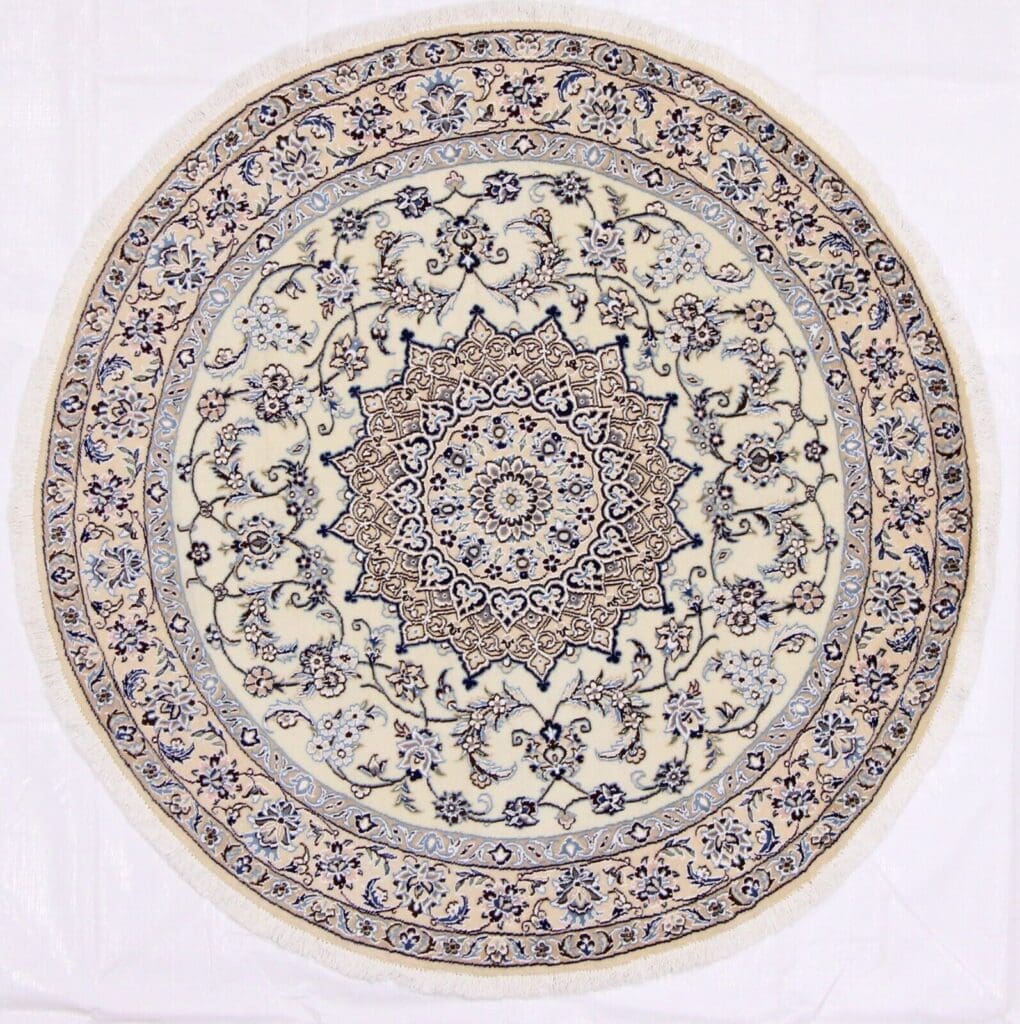
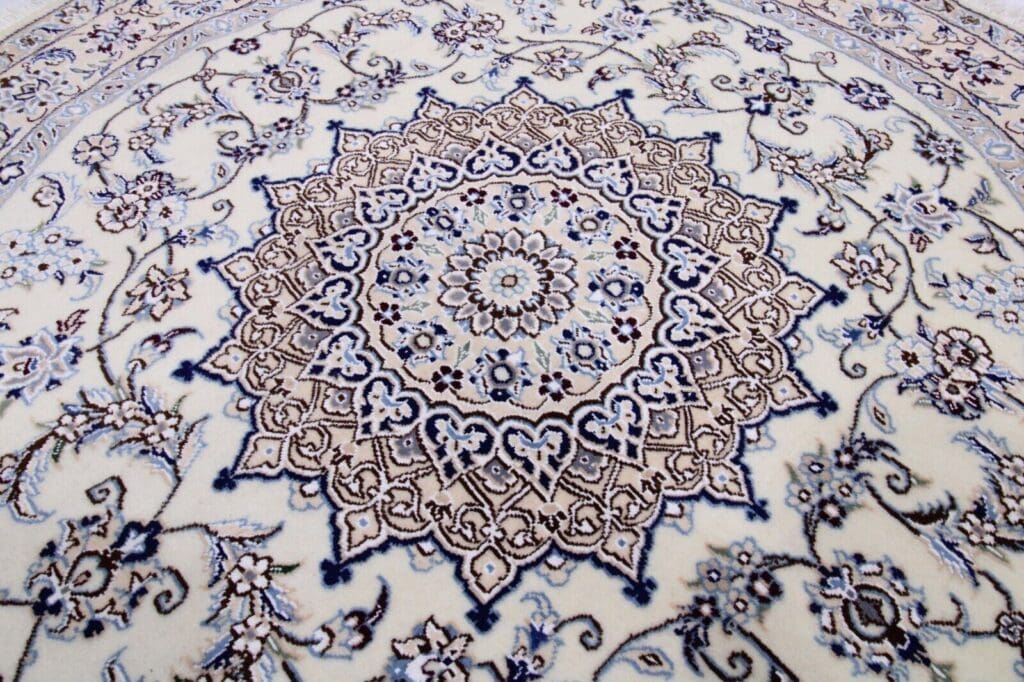
Nain designs frequently combine geometric organisation with organic lines. A central arrangement may be surrounded by a field of connected floral forms, while borders provide a framework that separates the inner design from the outer edge. Geometry gives the composition rhythm and stability; curved stems and floral details introduce movement. The interaction between these two qualities allows the pattern to remain structured without becoming visually rigid.
Ornament in Persian carpet design is often developed through repetition and variation. A motif may reappear across the field while changing slightly in scale, orientation or surrounding detail. This creates continuity without making every part of the pattern mechanically identical. Fine knotting is particularly useful for such work because small distinctions in outline and colour can be represented more clearly than in a coarser construction.
The Nain palette can include soft pastel shades as well as stronger red tones. These colours may be used in different proportions, with lighter fields allowing ornamental lines to stand out and deeper accents giving the composition definition. Natural dyes, as part of the regional tradition, are valued for the character they bring to the colour arrangement. The relationship between pale and stronger tones can make the design appear calm in one setting and more pronounced in another, depending on the surrounding furnishings and light.
Floral ornament does not mean that the design lacks a geometric foundation. Borders, axes, repeated units and measured spacing help organise the surface. At the same time, organic lines prevent the composition from appearing purely diagrammatic. This balance is characteristic of many Persian design traditions: the eye can follow a clear order while continuing to discover smaller details within it.
The pattern therefore functions on several levels. From a distance, the overall arrangement establishes colour, proportion and visual rhythm. Closer viewing reveals the drawing of individual ornaments and the precision made possible by hand knotting. Silk can accentuate this close reading by reflecting light from selected areas, while wool provides a contrasting ground within the material combination described for the rug. The pattern and the construction are consequently inseparable aspects of its appearance.
Special Features
A defining feature of the Nain 9La is its fine knotting. The detailed execution reflects the level of precision associated with experienced master weavers. Fine knotting makes it possible to render intricate ornaments and carefully controlled contours, giving the rug a character that belongs to hand craftsmanship rather than to a printed or mechanically reproduced surface.
The silk used in the rug adds a visible lustre. Its changing response to light can emphasise parts of the pattern and produce a subtle variation across the surface. The presence of wool creates a material contrast, so the rug combines the reflective quality of silk with the more robust character of wool. It can be used as a floor covering and, where suitable, also displayed as a textile work on the wall.
Nain rugs are valued within the culture of Iranian craftsmanship because they connect regional tradition, material knowledge and detailed drawing. The Nain 9La brings these elements together in a form intended for living spaces such as a sitting room or bedroom. Its decorative role comes from the pattern, while its cultural significance comes from the continued practice of hand knotting in the Nain and Isfahan region.
FAQ
How should I clean a Nain 9La Persian rug?
Regular cleaning can be carried out with a gentle vacuum cleaner without a brush attachment. Avoiding a rotating or stiff brush helps keep the surface from being treated too aggressively, which is particularly relevant when silk is part of the material combination. If a spill occurs, the mark should be addressed promptly with a damp cloth and a mild cleaning product. Work carefully rather than rubbing forcefully, and use only a small amount of moisture. For a more thorough cleaning, professional carpet cleaning is recommended. A specialist can assess the silk and wool construction and select a method appropriate to a hand-knotted Persian rug. Professional care is preferable to improvised intensive washing because the materials, dyes and knot structure require considered handling.
Can the rug be used in a room with underfloor heating?
Yes, the Nain 9La can be used in a room with underfloor heating. The heating should not be set too high, since excessive heat may damage or unnecessarily stress the materials. This applies especially when a rug contains silk alongside wool, as both the fibre combination and the hand-knotted construction should be treated with care. A moderate, even temperature is the appropriate approach. It is also sensible to keep the rug clean and to respond to spills promptly, since regular maintenance supports its continued use. Underfloor heating does not change the rug’s origin or construction, but the heat level should remain controlled so that the materials are not exposed to avoidable strain.
How can I recognise the quality of a Nain rug?
The quality of a Nain rug can be considered through several related features. Knot density is one important indication because a higher density generally allows a more detailed and precisely drawn pattern. The materials are also relevant: this Nain 9La uses silk and wool, whose different visual and practical qualities contribute to the character of the surface. Finally, inspect the detail of the motifs and the regularity of their execution. Fine outlines, carefully formed ornaments and a coherent relationship between field and border reflect the skill involved in the weaving. Quality should therefore not be judged by a single feature alone. Knotting, materials and detail accuracy work together, and the hand-knotted origin is central to understanding the rug’s construction and value.
To provide the best experiences, we use technologies like cookies to store and/or access device information. Consenting to these technologies will allow us to process data such as browsing behavior or unique IDs on this site. Not consenting or withdrawing consent, may adversely affect certain features and functions.
Functional Always active
The technical storage or access is strictly necessary for the legitimate purpose of enabling the use of a specific service explicitly requested by the subscriber or user, or for the sole purpose of carrying out the transmission of a communication over an electronic communications network.
Preferences
The technical storage or access is necessary for the legitimate purpose of storing preferences that are not requested by the subscriber or user.
Statistics
The technical storage or access that is used exclusively for statistical purposes.The technical storage or access that is used exclusively for anonymous statistical purposes. Without a subpoena, voluntary compliance on the part of your Internet Service Provider, or additional records from a third party, information stored or retrieved for this purpose alone cannot usually be used to identify you.
Marketing
The technical storage or access is required to create user profiles to send advertising, or to track the user on a website or across several websites for similar marketing purposes.
 SECURE PAYMENT
 SHIPPING PARTNERS


