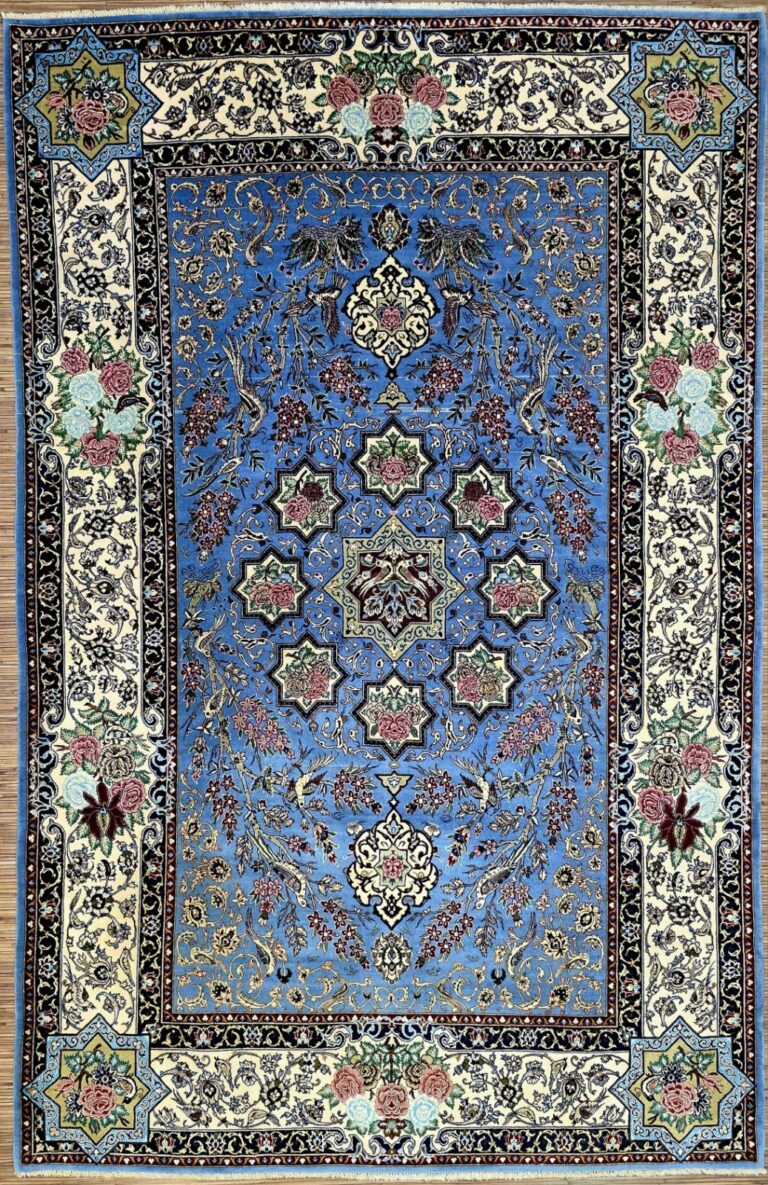
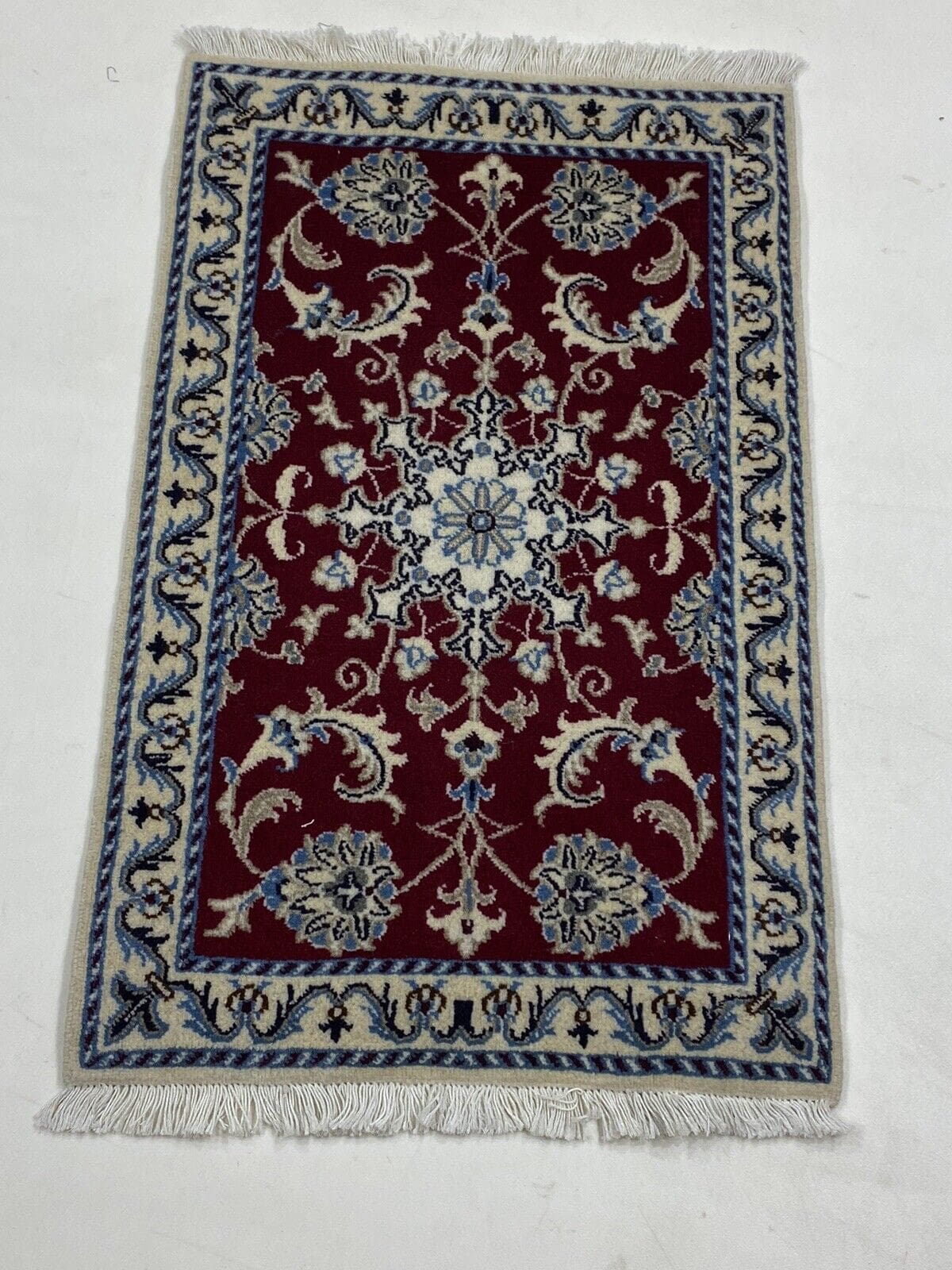
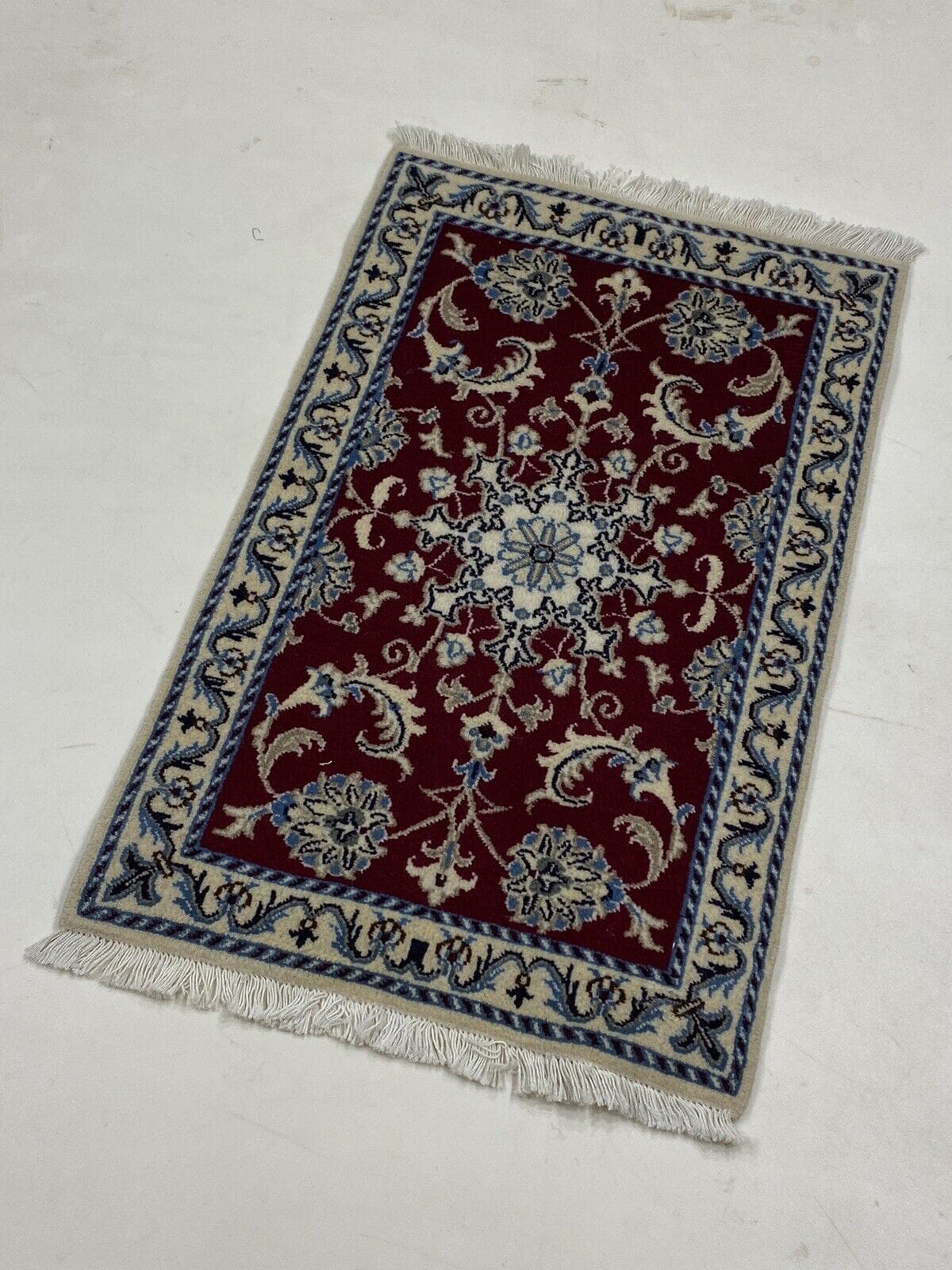
Hand-knotted Nain Persian Rug | Knot density: approx. 300,000 knots/m² | Material: 90% virgin wool, 10% silk | Size: 90 x 60 cm | Condition: New, described as very good in the long text
This Nain Persian rug is hand-knotted and made from virgin wool and silk. The pile composition is specified as 90% virgin wool and 10% silk. Wool is traditionally used in rugs for its resilience, natural warmth and familiar textile handle. It forms a durable foundation for the pile and can absorb a limited amount of moisture without immediately feeling wet. Silk contributes a smooth fibre structure and a subtle lustre. In a mixed pile, its reflective quality can make outlines, colour changes and small ornaments more visible. The material combination therefore brings together the practical character of wool and the distinctive light response of silk.
A hand-knotted rug is built knot by knot on a prepared foundation. The knots are inserted manually, row after row, and secured as the structure progresses. The person making the rug must follow the pattern, keep track of the colour sequence and maintain the intended density across the field. This differs from machine production, where the manufacturing sequence is mechanically predetermined. Manual work requires time, concentration and experience, because small variations can influence both the drawing and the surface. The stated technique is therefore a central part of the rug’s construction.
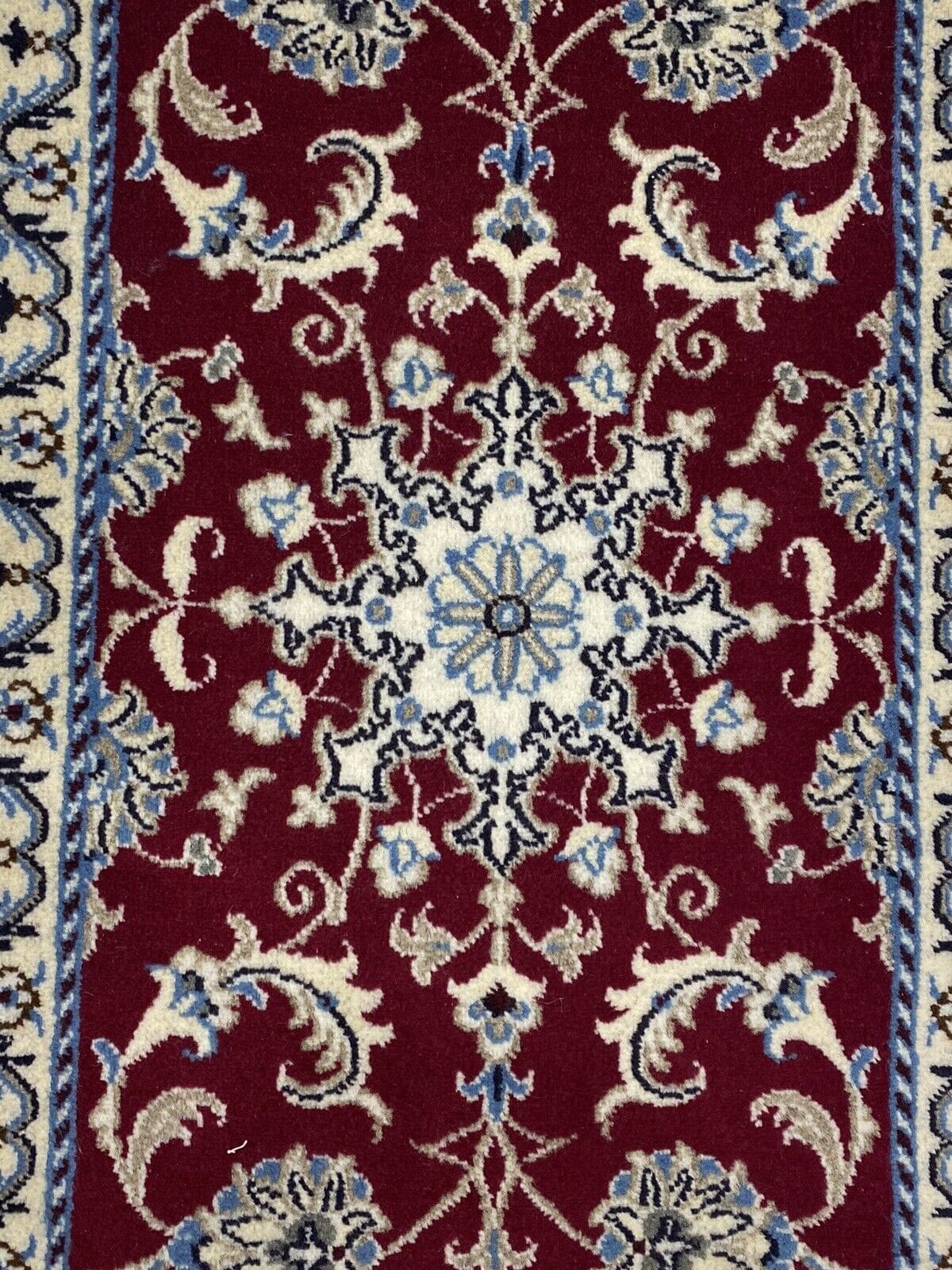
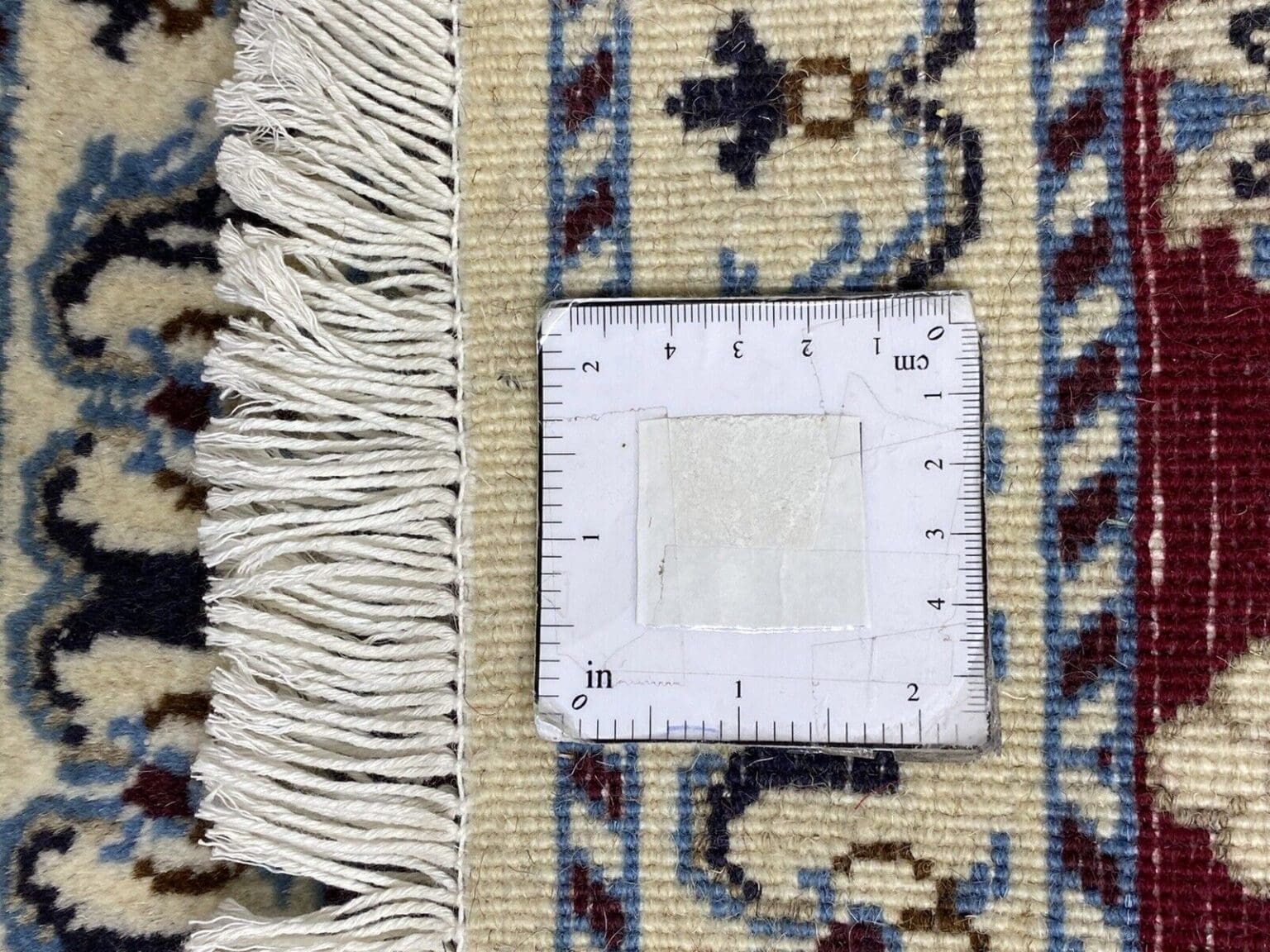
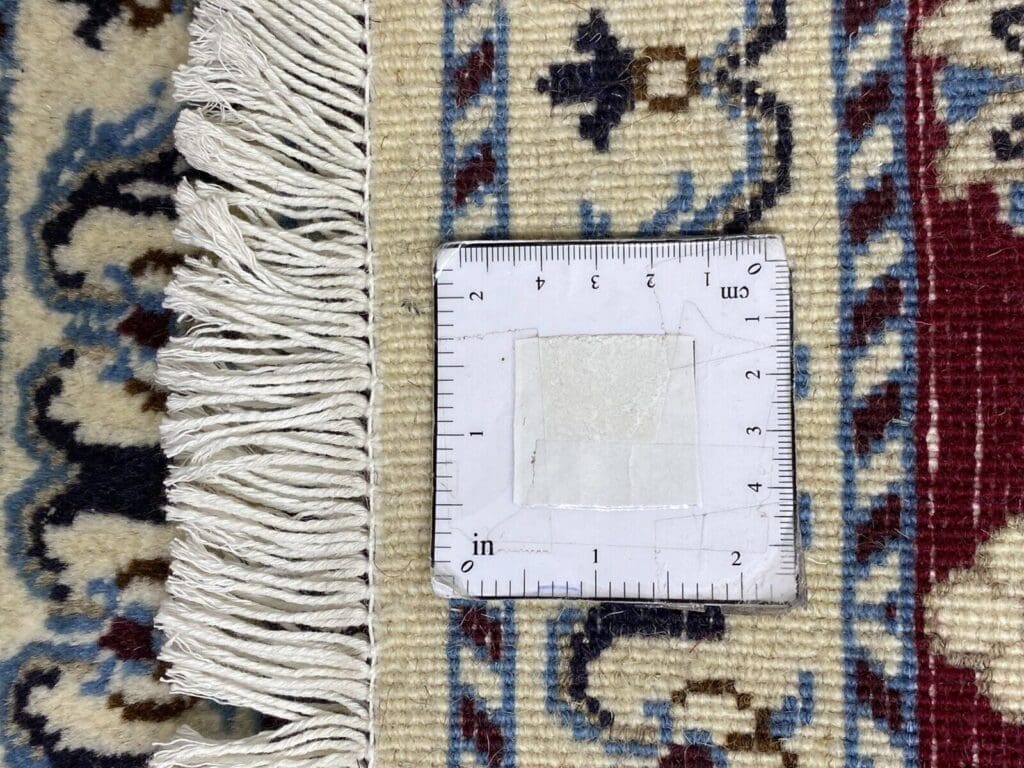
A knot density of approximately 300,000 knots per square metre is specified for this rug. High density creates the technical basis for a finely drawn design. Contours can be placed close together, floral details can be rendered on a smaller scale and transitions between neighbouring colour areas can be controlled with greater precision. Knot density alone does not describe every aspect of a rug. The preparation of the foundation, the evenness of the knots, the selection of fibres and the finishing of the pile also contribute to the workmanship. In a hand-knotted Nain, dense construction works together with the ordered character of the regional design tradition.
The material composition also affects how the pattern is seen. Wool has a more muted, tactile surface, whereas silk reflects more light. Depending on the angle of view and the lighting in the room, fine differences in the drawing may therefore become more or less apparent. This is a general material effect and is not a claim about a particular colour palette, which is not specified for this piece. The stated technical characteristics are the hand-knotted construction, the composition of 90% virgin wool and 10% silk, and the approximate knot density.
Origin and Tradition
The rug is identified as a Super Nain and comes from Persia. Nain is an important centre of Persian rug weaving. The town and its surrounding weaving tradition are especially associated with rugs featuring finely drawn decoration, controlled knotting and a carefully balanced relationship between field, border and surrounding elements. Nain belongs to the wider history of Persian textile production, in which rugs have been made both as useful household textiles and as decorative works carrying established cultural forms. Knowledge of patterns, fibres and working methods has traditionally been passed through workshops and families.
Persian rug history extends across many centuries. Different regions developed their own knotting practices, pattern structures and preferences in materials and colour. Nain became known in the international rug trade for finely worked pieces whose identity lies in the combination of technical precision and organised ornament. A regional attribution is not created by one isolated motif alone. The arrangement of the field, the treatment of the border, the character of the lines and the way the design is translated into knots are also important. These connected features explain why Nain is recognised as a distinct weaving tradition.
The production of a hand-knotted rug combines several kinds of practical knowledge. First, the foundation of warp and weft must be prepared. Knots are then inserted in rows, secured with weft and compacted as the work advances. Gradually, individual knots become a continuous patterned surface. When the knotting is complete, the pile is trimmed, the surface is cleaned and the drawing is checked. Each stage affects the result. A fine design requires close coordination between the person following the pattern and the person or people responsible for preparing, finishing and inspecting the textile.
In the rug trade, Super Nain is used as a designation for a fine expression within the Nain design tradition. It is a style and commercial term, not a substitute for the specific facts of material, technique or Persian origin. Nain workshops may interpret related principles in different ways. What they share is generally an emphasis on controlled ornament, careful detail and a balanced overall composition rather than one compulsory template. This allows individual designs to vary while remaining connected to the regional language of Nain rugs.
Persian weaving also demonstrates how technical skill and cultural transmission work together. A weaver does not reproduce a design as a printed image; the image is constructed progressively from coloured knots. The pattern must be anticipated over many rows, with attention to the position of small flowers, leaves, curves and geometric boundaries. Repeated forms have to remain coherent, while variations must be introduced at the intended points. This requires visual memory, coordination and practice. Such knowledge has been refined over generations and remains part of the living craft tradition associated with Persian rugs.
The Persian origin places this rug within a broad and varied regional culture of textile making. Nain represents a particular group of finely drawn Persian rugs, not a generic name for all Oriental rugs. The combination of wool and silk, close hand-knotting and structured ornament is part of the visual and technical identity associated with this type. The specific origin stated for this piece is Persia and Nain. No individual workshop, weaver or production year is provided, so no more precise attribution is added.
Design and Pattern
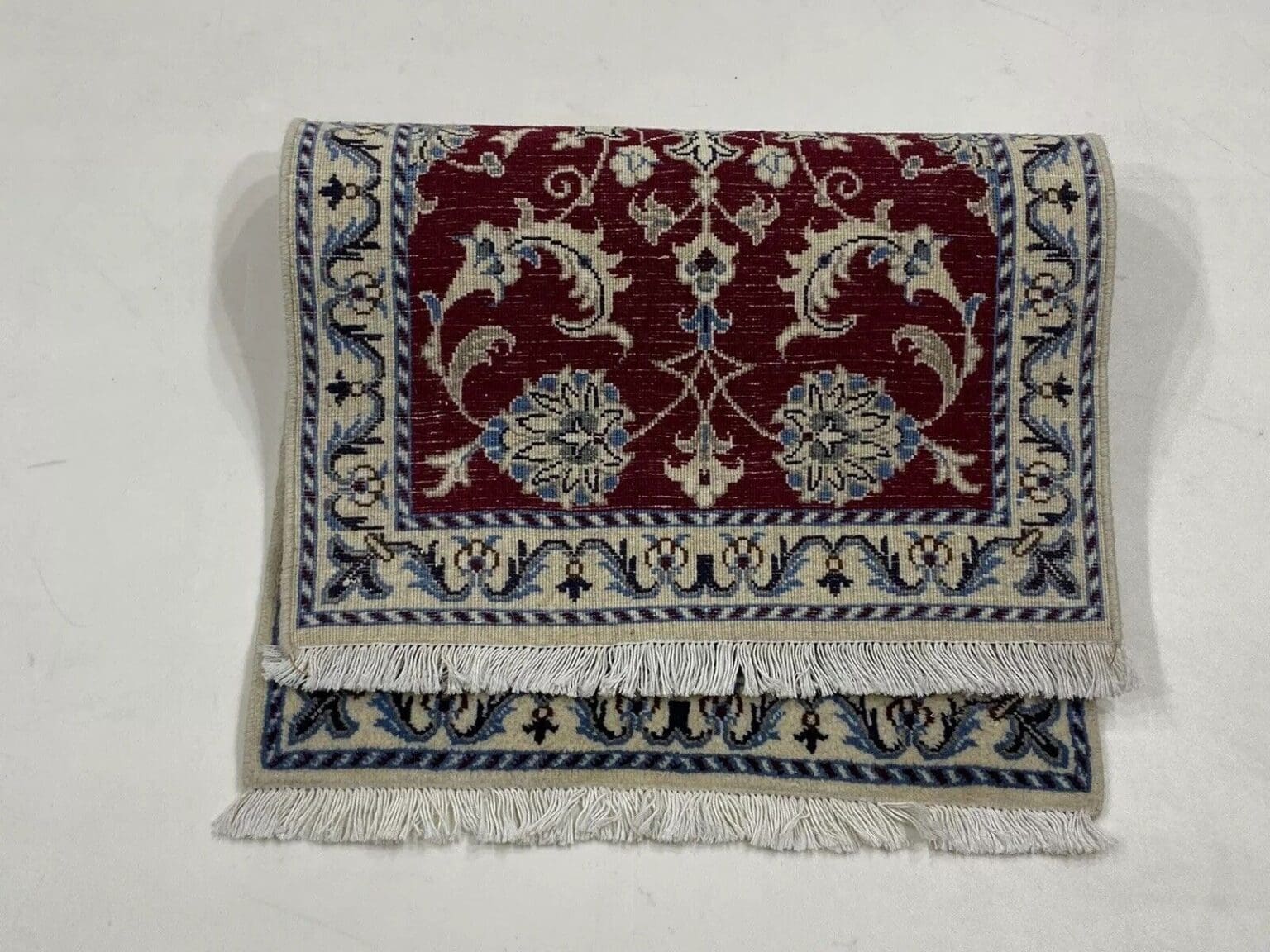
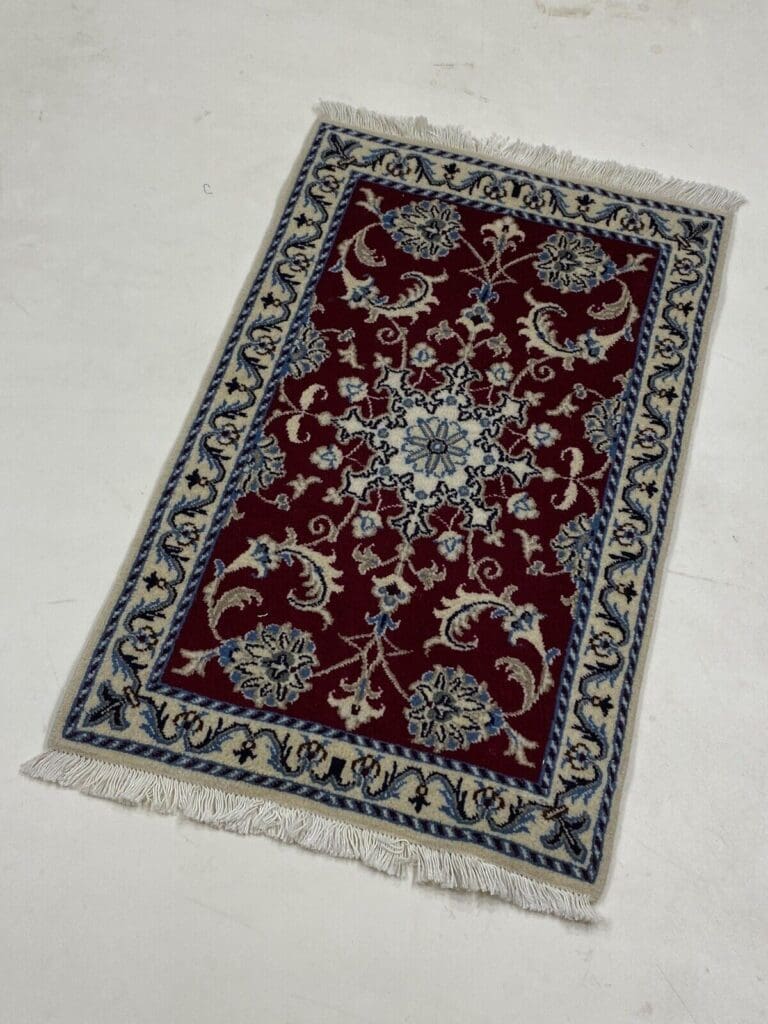
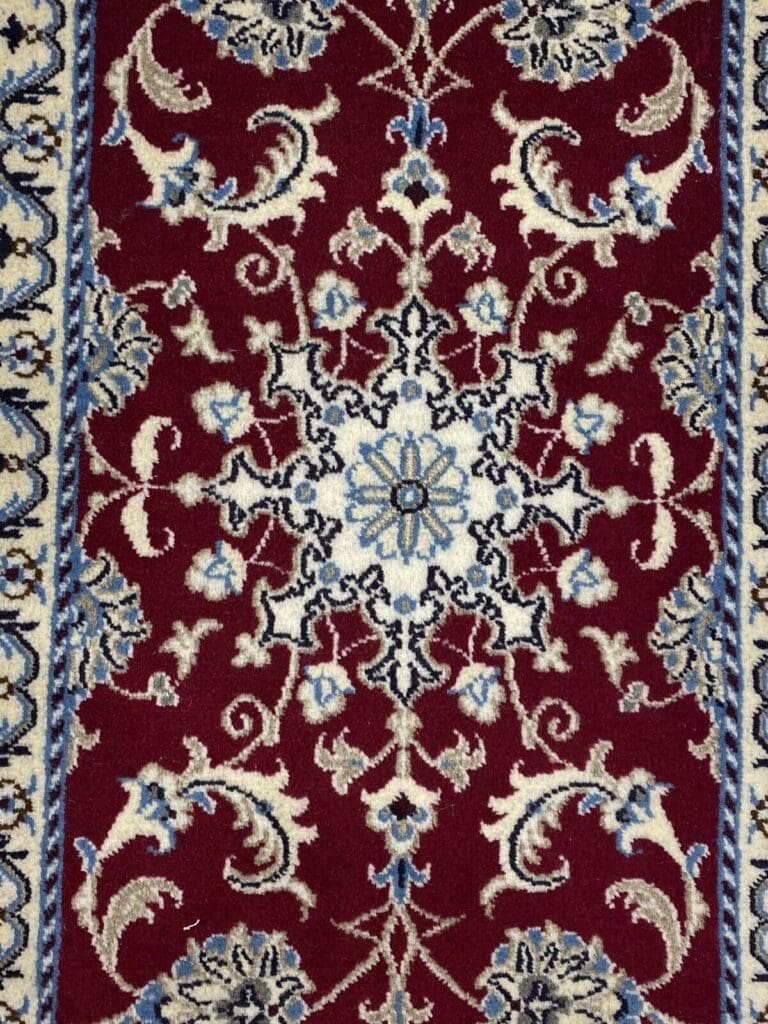
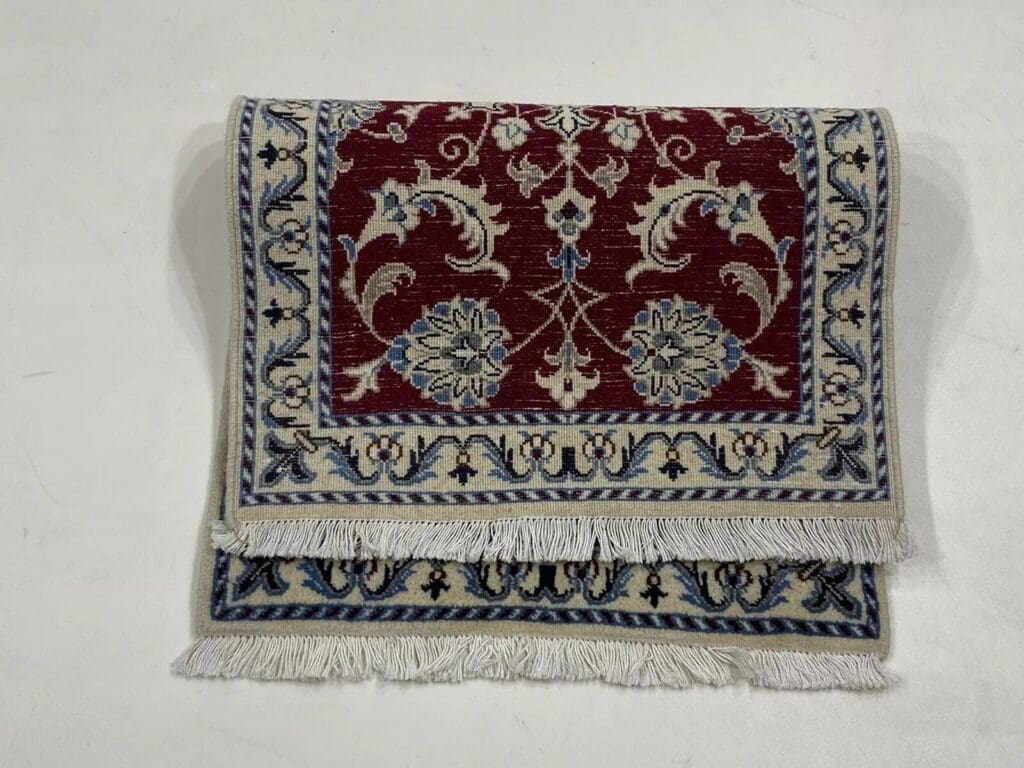
The extended description places this Super Nain within the decorative language associated with Nain. It names floral motifs, geometric forms and traditional Iranian design elements. These are the stated categories of design; no additional individual motif is assigned here. In Persian rug ornament, floral elements may appear as blossoms, leaves, branches or interlacing lines that connect different areas of the field. Geometric forms provide structure through symmetry, repetition, axes and clear divisions. The two approaches can operate together: geometry establishes order, while botanical details develop the interior drawing and give the surface a sense of movement.
Many Persian compositions are understood through the relationship between the central field and its border. The field may be organised around a medallion or covered by a continuous pattern in which branches and floral forms connect across the surface. A border frames the central area and provides a transition towards the edges. A medallion is one possible organising device, but it is not the only one. Nain design is better understood as a group of related solutions in which floral and geometric elements are arranged with control and balance.
The specified knot density of approximately 300,000 knots per square metre matters for the execution of such patterns. Dense knotting allows narrow contours and small details to be placed in close sequence. Curved lines can be handled with greater control, leaf forms can be separated more clearly and geometric borders can follow a more regular rhythm. Knot density is not a motif in itself, but it influences the resolution and legibility of the drawing. It makes it possible to translate a detailed design into a compact textile structure rather than relying on broad, simplified shapes.
Silk affects the visual response of the pile as well. Where silk fibres are present, they can reflect light more strongly than wool. Under changing illumination, some lines or areas may therefore appear with a different degree of emphasis. This describes a property of the material and does not establish a particular colour scheme, which is not stated for this rug. The description refers to a harmonious colour composition. Together with the sheen of silk, that quality can create subtle changes in appearance as the viewing angle changes, while the underlying organisation of the pattern remains stable.
Traditional Iranian design often depends on the repetition of basic forms. A branch may recur in altered positions, a border may echo a detail from the field, and geometric divisions may separate or frame floral passages. Repetition creates continuity; variation keeps the composition from becoming mechanically rigid. In a finely knotted Nain, these relationships are formed from coloured knots embedded in the structure of the rug. The pattern is not printed onto the surface. It is part of the textile itself, which is why the drawing and the construction are closely connected.
Nain therefore names a regional design tradition rather than one fixed pattern formula. Individual workshops can give more weight to floral drawing, geometric order, a central arrangement or an all-over field, while still working within related conventions. This rug is described as a Super Nain with the characteristic Nain design language. The specific design information is limited to the named floral motifs, geometric forms and traditional Iranian elements. No additional symbol, exact medallion or unmentioned colour is introduced.
Special Features
The listed features are hand-knotted construction, suitability for underfloor heating, suitability for homes with pets and children, and resistance to moths. The rug is listed as new in the short description, while the extended description calls its condition very good. Both statements come from the source and are presented together. A thickness of approximately 8 mm is also supplied in the source, but it is not repeated here because the long description must not contain measurements. The combination of virgin wool, silk, dense knotting and the Super Nain classification gives this one-off piece its stated technical and regional character.
FAQ
How should a Nain Persian rug be cared for?
Regular vacuuming on a gentle setting helps remove loose dust and everyday particles without treating the pile harshly. Fringes and exposed edges should be approached carefully so that the nozzle does not pull at them. Spills should be dealt with promptly using a damp cloth and a mild cleaning product. Vigorous rubbing, aggressive chemicals and excessive water can place stress on the fibres and may disturb the appearance of the pile. Professional cleaning every few years is recommended for long-term maintenance. A cleaner should be told that the pile contains both virgin wool and silk. An unfamiliar product can be tested first in an inconspicuous area, or a specialist can be consulted.
Why do hand-knotted rugs require so much craft?
In a hand-knotted rug, each knot is inserted into the foundation individually. The work proceeds row by row and requires a secure understanding of the design, consistent tension and experience with the fibres. At a high knot density, many individual knots must be positioned so that contours and colour areas remain coherent. The materials also affect the work: wool and silk differ in handle, lustre and behaviour during knotting and finishing. The craft involved therefore comes from the combination of time, technical practice, material knowledge and the ability to turn a complex drawing into a lasting textile surface.
Can this rug be used over underfloor heating?
Yes. The rug is expressly described as suitable for use with underfloor heating. Woollen Oriental rugs can absorb and release warmth, while wool remains a breathable natural fibre. The instructions for the particular heating system should still be followed, and normal care guidance for the rug remains applicable. Keeping the surrounding area reasonably clear can support air circulation, but no special installation claim beyond the stated suitability is made here. Compatibility with underfloor heating is one of the explicitly listed characteristics of this rug.
To provide the best experiences, we use technologies like cookies to store and/or access device information. Consenting to these technologies will allow us to process data such as browsing behavior or unique IDs on this site. Not consenting or withdrawing consent, may adversely affect certain features and functions.
Functional Always active
The technical storage or access is strictly necessary for the legitimate purpose of enabling the use of a specific service explicitly requested by the subscriber or user, or for the sole purpose of carrying out the transmission of a communication over an electronic communications network.
Preferences
The technical storage or access is necessary for the legitimate purpose of storing preferences that are not requested by the subscriber or user.
Statistics
The technical storage or access that is used exclusively for statistical purposes.The technical storage or access that is used exclusively for anonymous statistical purposes. Without a subpoena, voluntary compliance on the part of your Internet Service Provider, or additional records from a third party, information stored or retrieved for this purpose alone cannot usually be used to identify you.
Marketing
The technical storage or access is required to create user profiles to send advertising, or to track the user on a website or across several websites for similar marketing purposes.
 SECURE PAYMENT
 SHIPPING PARTNERS