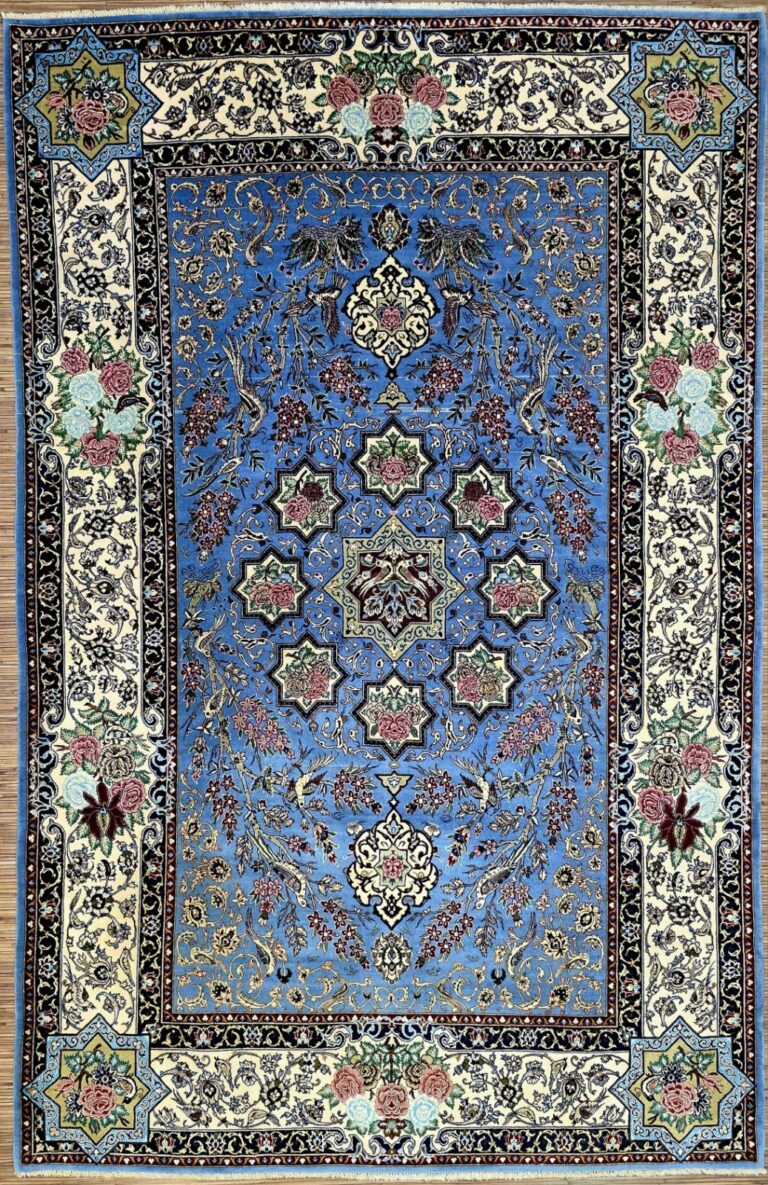
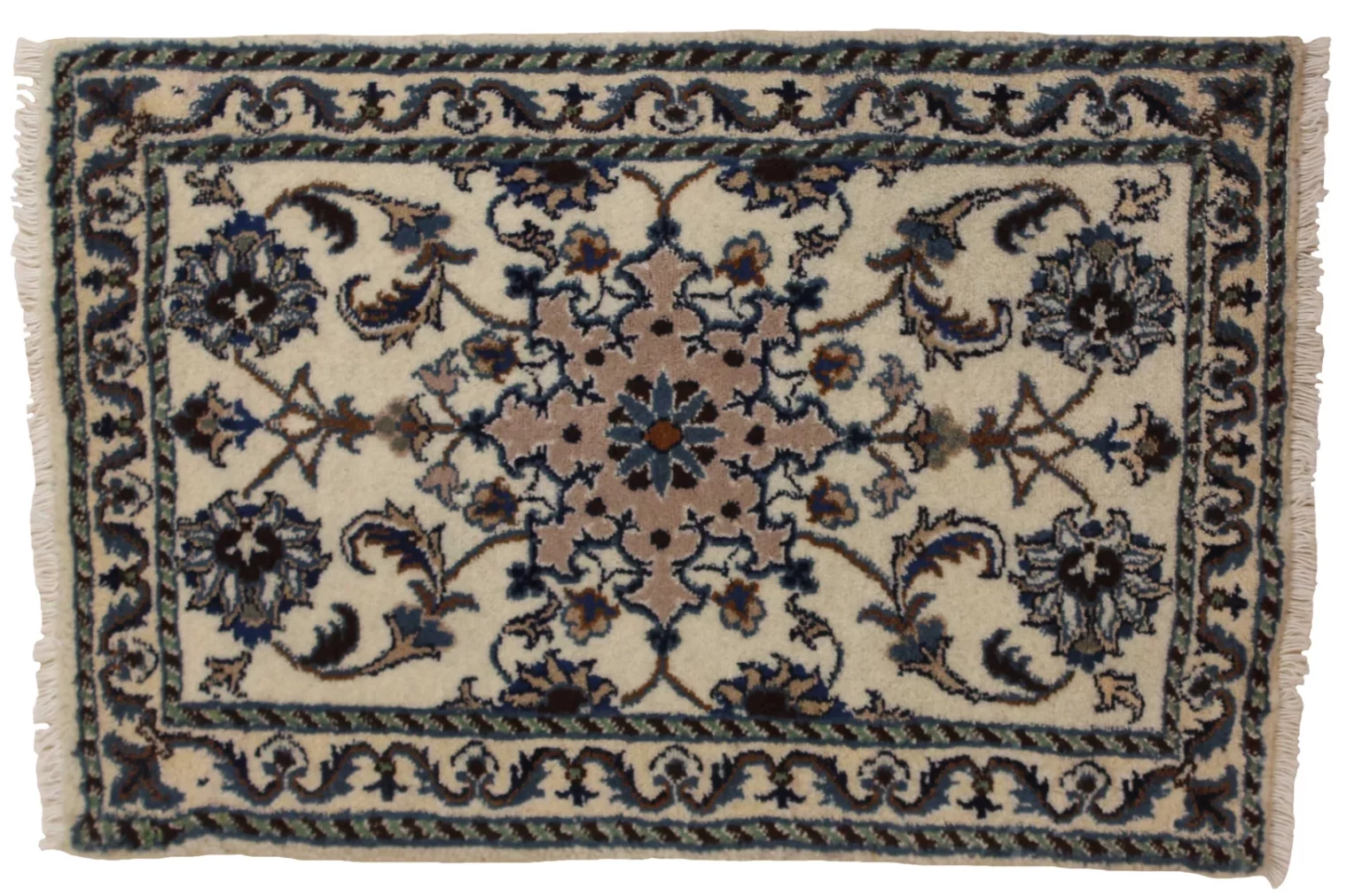
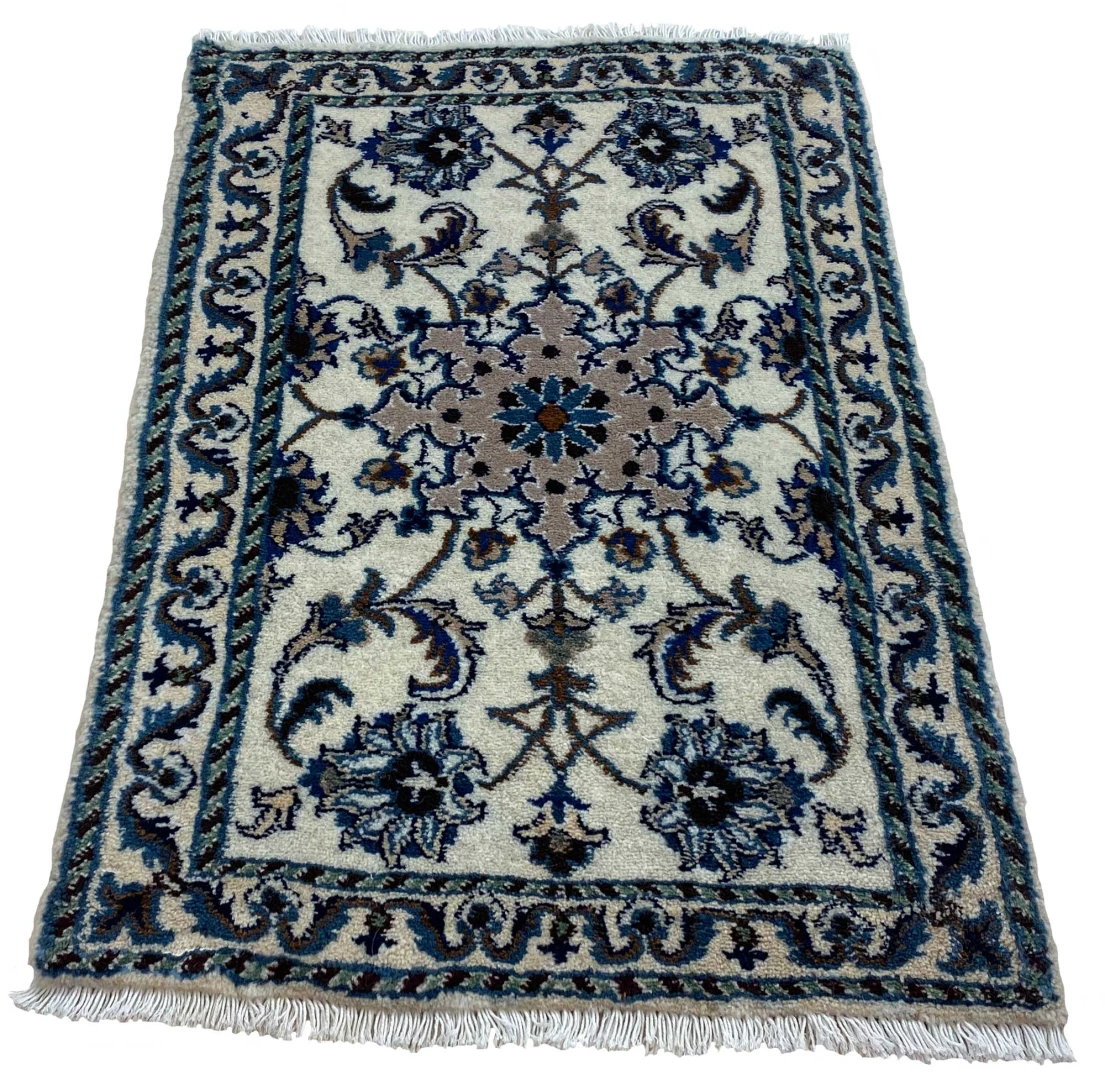
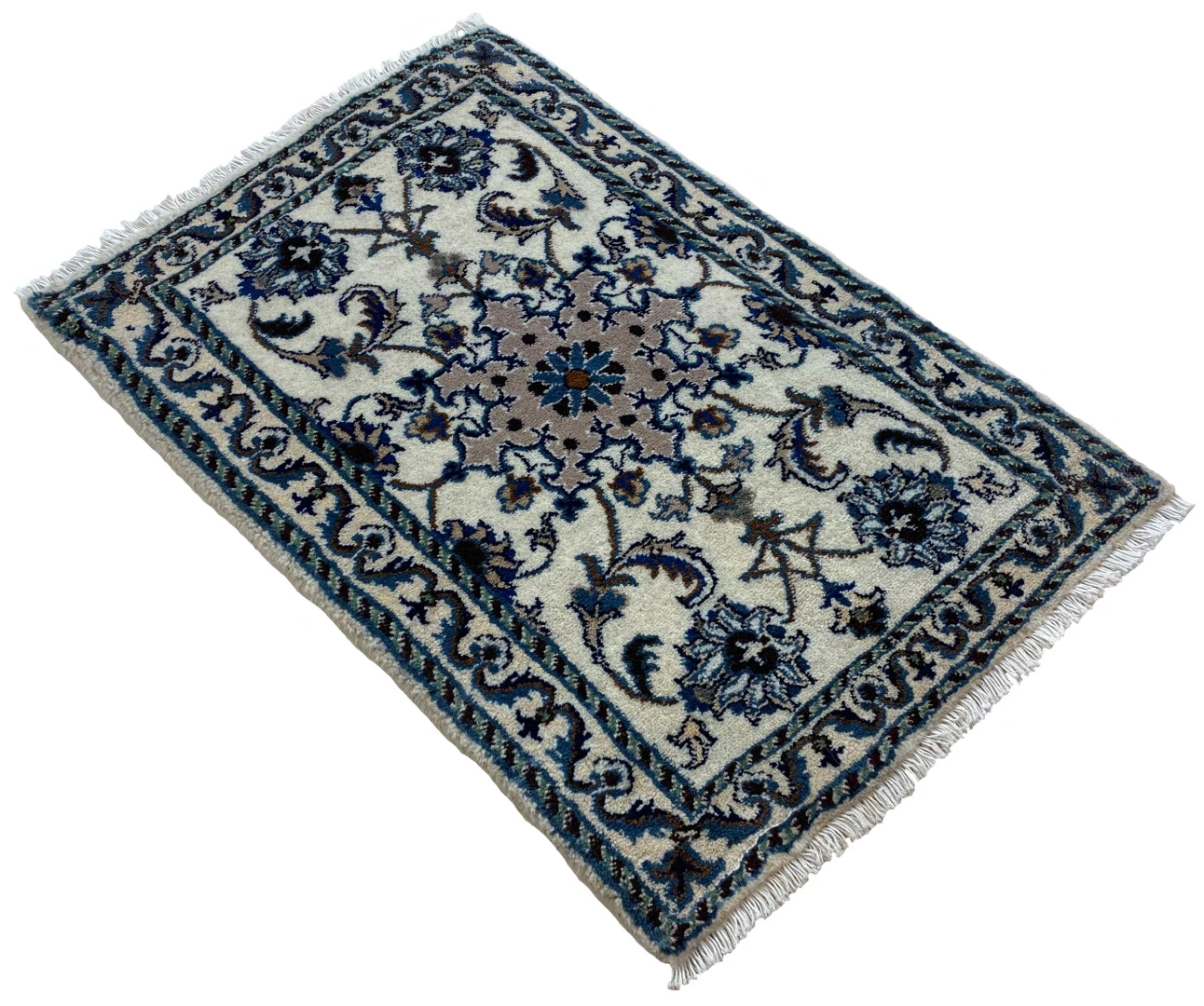
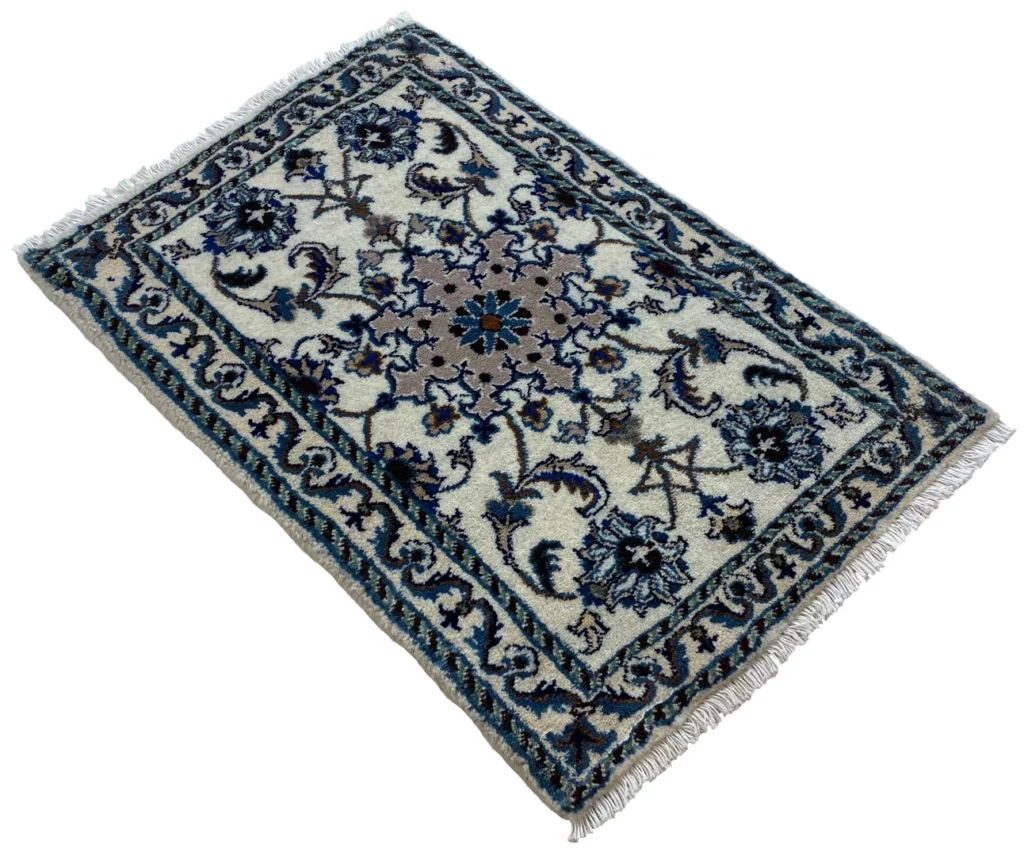
Hand-knotted Nain Persian Rug | Knot density: 12-Lah, approx. 250,000 knots/m² | Material: pile wool | Size: 90 x 60 cm | Pattern: classic floral motifs with central medallion | Condition: very good
This Nain Persian rug is hand-knotted and made with high-quality wool. The wool forms the pile and gives the surface its characteristic textile handle and structure. A hand-knotted rug is built through a sequence of individual operations rather than produced as one continuous industrial surface. Each knot is placed by hand into the prepared foundation, and the rows are secured as the pile develops. The resulting textile records the work of the maker in its density, drawing and overall construction.
The rug is classified as 12-Lah, a designation used for knot density in Nain rugs. Here, that classification corresponds to approximately 250,000 knots per square metre. It provides a way to describe the fineness of the construction and the level of detail possible in the design. The stated material remains wool pile, and the rug remains a hand-knotted piece from Nain. The density supports clearly defined outlines and small ornamental passages while retaining the tactile character associated with a wool surface.
In the traditional process, the warp is first arranged and tensioned on the loom. Pile knots are then tied along the foundation, with weft rows helping to hold the construction together. After each section has been compacted, the design gradually appears. This method requires consistency in the placement of knots, the handling of yarn and the progression of the pattern. Craftsmanship is therefore visible not only in the finished floral image, but also in the compact structure that supports it.
The material recorded for this particular rug is high-quality wool. Fine Nain rugs may, as part of the wider regional tradition, also use silk to accentuate delicate details or create a different surface effect. That general possibility should not be confused with the material of this piece: its pile is identified as wool. The relevant characteristics here are the wool pile, hand-knotting and 12-Lah classification.
Knotted density also affects the way a design can be drawn. A finer construction allows a weaver to reproduce narrow lines, small leaves and carefully controlled curves with greater definition. It does not replace the role of the design or the skill of the maker. The final appearance depends on the coordinated relationship between the drawn pattern, the yarn, the foundation and the regularity of the knots. This rug presents that relationship through a measured floral composition and a clearly defined central element.
Origin and Tradition
Nain is a city in Central Persia and is known for hand-knotted Persian rugs with carefully ordered designs. It lies near Isfahan, one of the important centres of Persian artistic and weaving culture. Nain developed a recognisable identity within this wider tradition, particularly through refined drawing, light colour effects and balanced compositions. The name therefore refers to a specific regional weaving tradition rather than simply to a decorative style.
Nain rugs are commonly discussed through several aspects of construction: the quality of the yarn, the knot density, the arrangement of the field and the precision of the ornament. Lah is used as a regional way of describing density, with 4-Lah, 6-Lah, 9-Lah and 12-Lah appearing as established quality classifications. These terms help distinguish different levels of fineness. They are part of the vocabulary used to explain Nain rugs and should be read alongside the actual material and workmanship of each individual piece.
The 12-Lah classification of this rug belongs to that regional system. In practical terms, Lah refers to the fineness and density of the knotting, which affects how closely small elements can be placed within the design. A more finely drawn pattern can contain additional contour changes and smaller botanical details. Yet density alone does not create a Nain rug. The regional identity also rests on the design tradition, the hand-knotted technique, the selection of materials and the knowledge needed to maintain an even structure throughout the work.
Many Nain rugs are associated with light, lively colours. Natural dyes are part of the traditional account of how such colour effects can be achieved, producing nuanced relationships between adjacent tones. Colour in a Persian rug is functional as well as decorative: it separates the central field from the surrounding ornament, clarifies the hierarchy of motifs and gives the eye a path through the composition. A pale ground can make a medallion and its surrounding foliage particularly legible.
Nain’s location near Isfahan places its weaving in a broader cultural landscape. Isfahan rugs are known for fine patterns and elaborate compositions. Tabriz rugs encompass a wide range of styles, from classical arrangements to more modern interpretations. Qom is particularly associated with luxurious silk rugs. These places represent other Persian weaving traditions and are useful points of comparison, but they are not the origin of this piece. This rug is from Nain in Central Persia.
The Nain tradition is sustained through the transmission of drawing methods, loom practice and knowledge of materials. A rug is planned as a complete textile composition, with the foundation, knotting sequence and colour plan working together. The apparent calm of many Nain designs should not be mistaken for simplicity. A balanced field can require careful calculation, especially when floral lines must remain symmetrical and fine details have to repeat consistently across the surface.
Regional tradition also explains why Nain rugs can be identified through a combination of features rather than through a single motif. Floral ornament, a central medallion, light colour relationships and fine hand-knotting often occur together in the Nain vocabulary. Individual rugs nevertheless vary in their drawing and colour balance. For this example, the documented identity is defined by Nain origin, wool pile, hand-knotting, 12-Lah density and a classic floral medallion design.
Design and Pattern
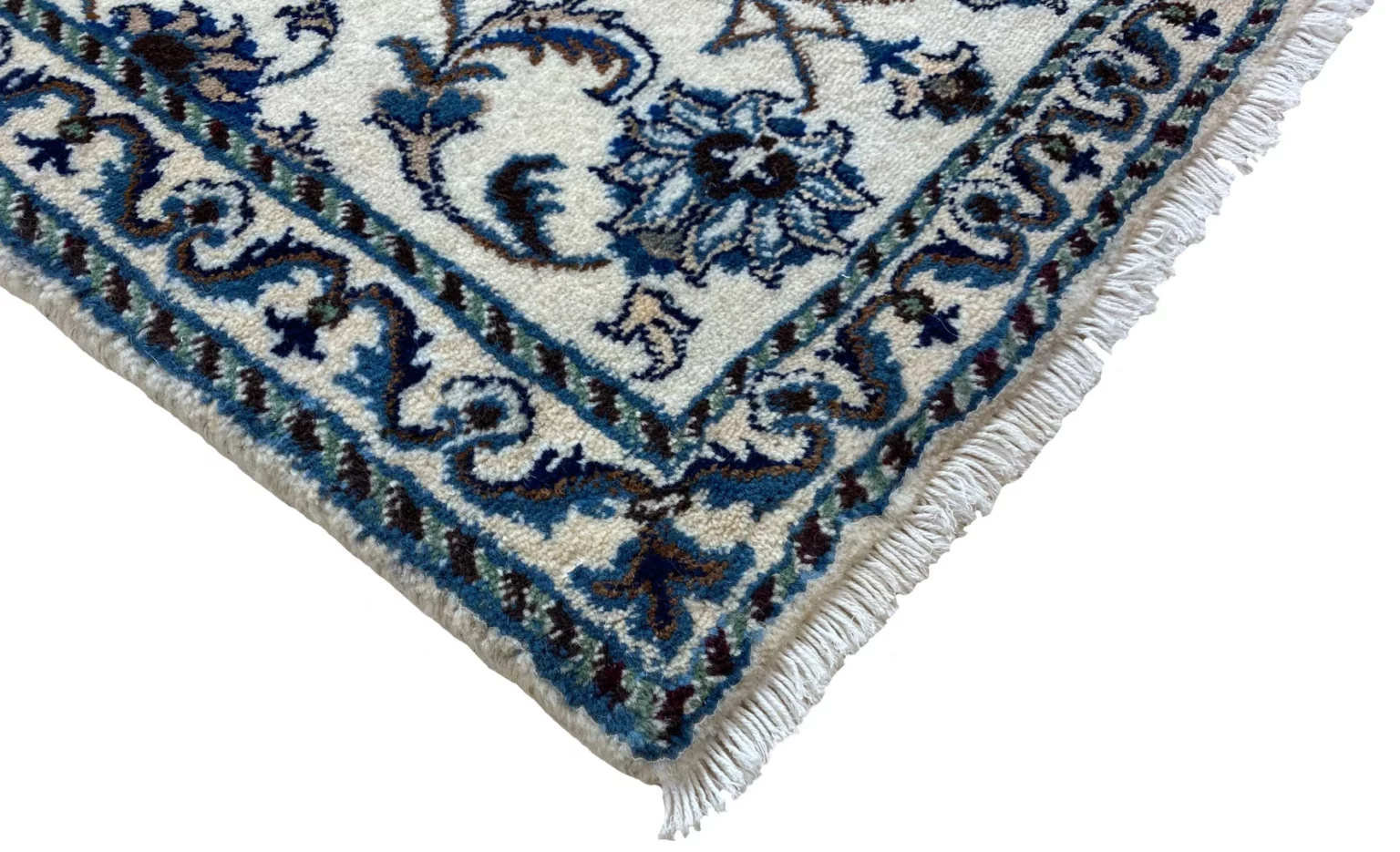
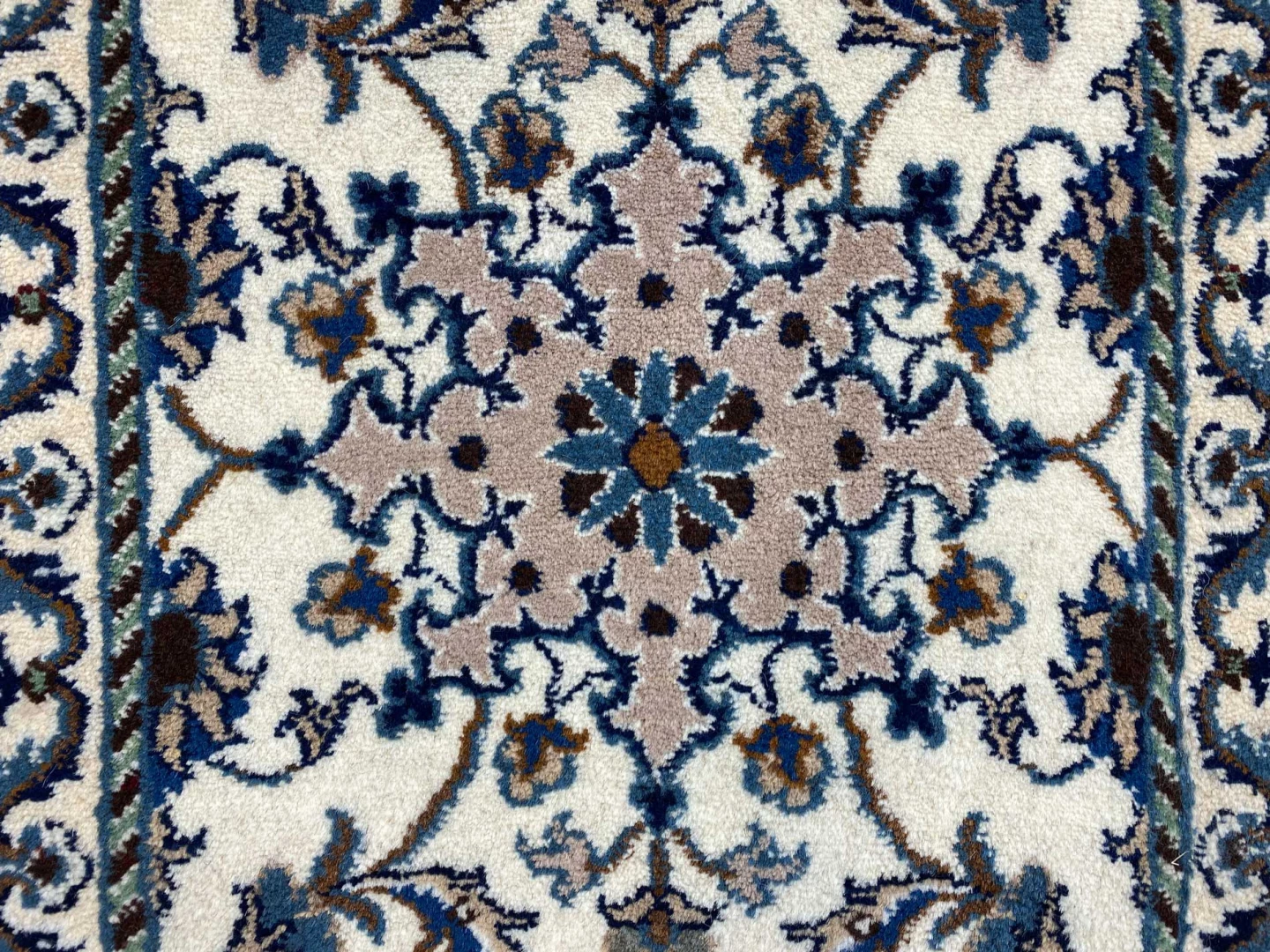
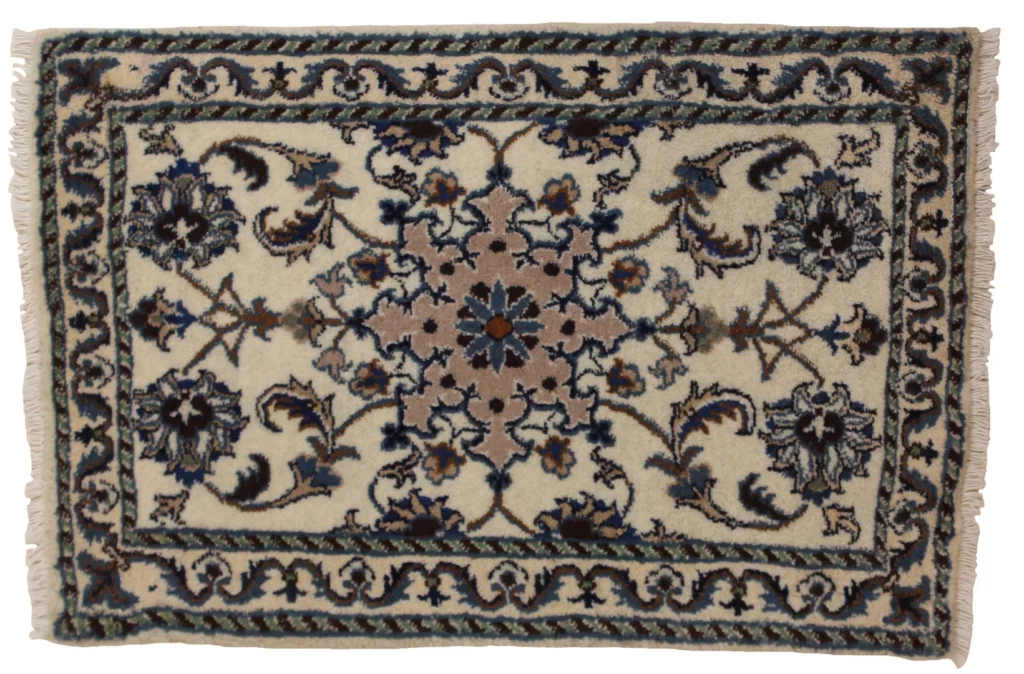
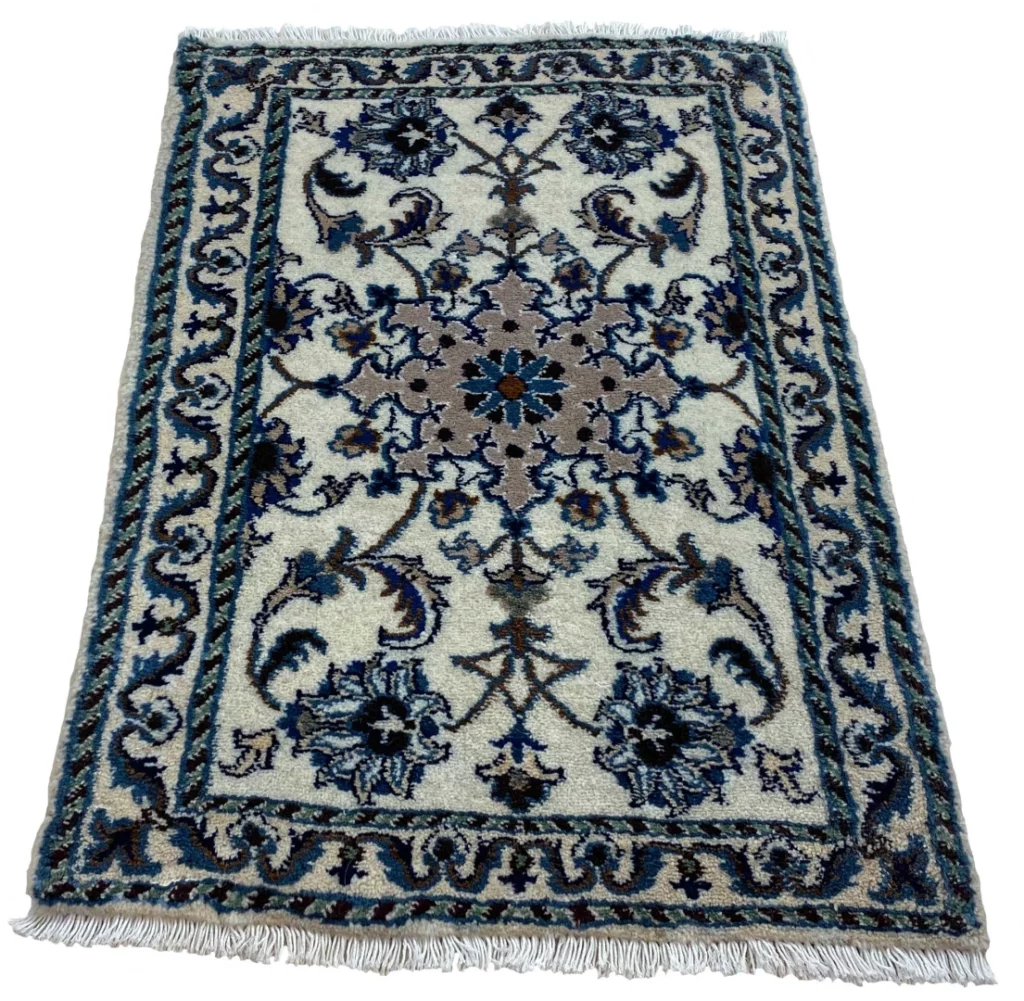
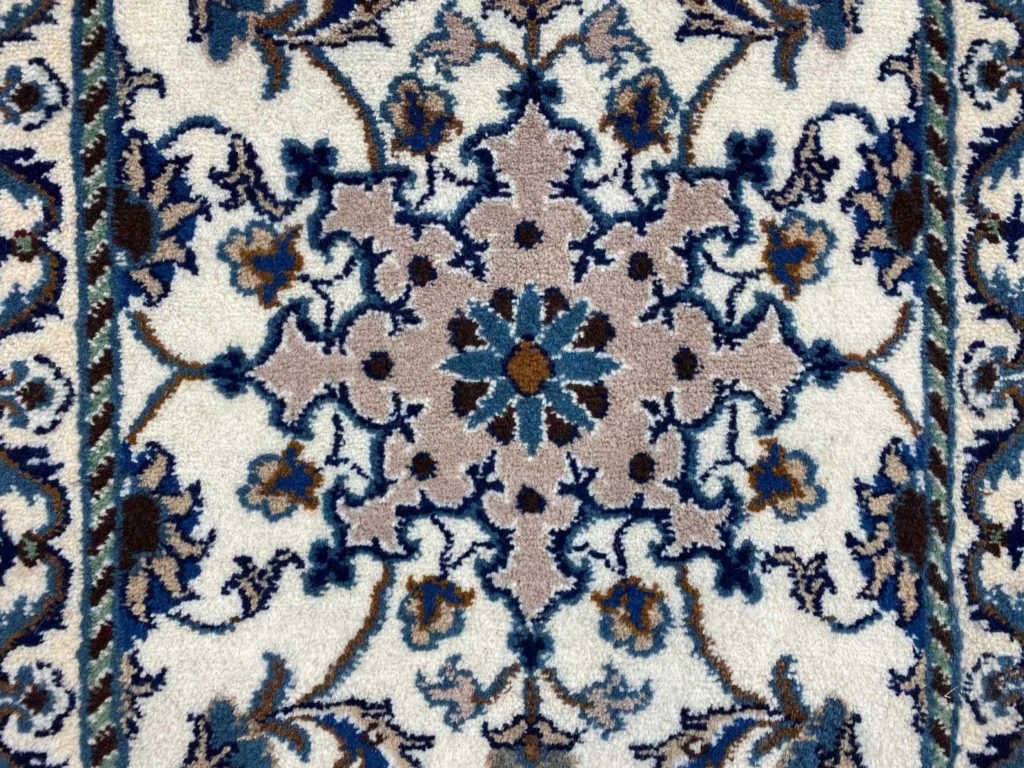
The pattern of this rug is classically floral with a central medallion. This arrangement gives the composition a visual centre and organises the surrounding field around it. The medallion acts as the principal point of reference, while floral motifs establish a connection between the centre and the outer areas. The result is a design that is decorative but also governed by a clear internal structure.
Floral ornament in Persian rugs is generally stylised rather than a literal depiction of one particular garden. Blossoms, leaves, stems and scrolling branches are adapted into repeatable forms that can be balanced across a field. Lines may be simplified, mirrored or extended so that they support the overall drawing. Individual motifs remain readable, but they are also parts of a larger ornamental language in which rhythm and proportion are important.
Symmetry is especially significant in a classical medallion design. It establishes a relationship between the central form and the motifs that surround it. Branches may extend outward from the medallion, or floral elements may be placed in corresponding positions on either side. Smaller leaves and blossoms can occupy the spaces between larger forms, preventing the field from appearing disconnected. The density of the knotting helps preserve the fine contours needed for this kind of controlled drawing.
The light and lively colour approach often associated with Nain supports the structure of a floral pattern. Natural dyes can create subtle variations within related colour groups, allowing the design to be differentiated without relying only on strong contrast. A restrained ground can set off the medallion, while the surrounding foliage adds movement and detail. The balance between these areas gives the composition its classical character.
A central medallion does not make the pattern static. The eye can move from the centre along the stems and branches, follow the repeated leaves and return to the main form. This circulation is one of the strengths of a well-organised floral composition. The pattern remains recognisable from a distance while revealing additional details when viewed more closely. Fine knotting contributes to that change in scale by allowing the drawing to retain definition.
Nain weaving includes a broader range of arrangements, including all-over floral fields and designs in which the border receives particular emphasis. Such possibilities describe the regional design vocabulary, not the documented pattern of this particular rug. Here, the relevant description is specific: the rug has classic floral motifs and a central medallion. The design should therefore be understood as a traditional medallion composition within the Nain context.
Pattern and technique are closely connected. The drawing must be translated into a sequence of coloured knots, and every curve or leaf depends on the placement of those knots. A denser construction can make narrow outlines and small ornamental changes more precise, but the visual result still depends on the skill of the weaver and the coherence of the original design. In this rug, the central medallion provides the framework and the floral motifs supply the repeated detail that fills it.
Special Features
The documented features of this rug are its Nain origin in Central Persia, hand-knotted construction, high-quality wool pile and 12-Lah classification at approximately 250,000 knots per square metre. Its pattern consists of classic floral motifs arranged around a central medallion. Together, these details identify the material, technique, regional tradition and visual structure of the individual piece.
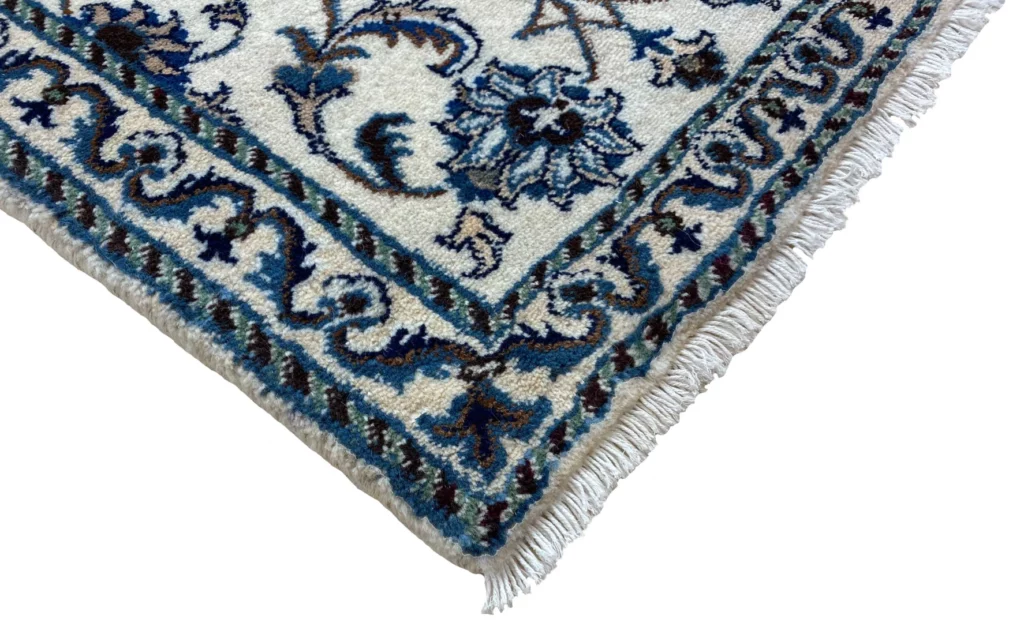
The condition is described as very good. This is a direct description of the state in which the rug is offered. No separate information is provided about its age, restoration history or previous use, so those aspects are not part of its description. The condition statement stands alongside the technical details and gives a concise account of its present preservation.
The compact format of this rug allows it to be considered for a range of interior settings. Nain rugs are used in living rooms, bedrooms, dining rooms and hallways, depending on the arrangement of the furniture and the role assigned to the textile. The central medallion gives the rug a defined focus, while the floral drawing creates an ordered decorative surface. Its effect in a room will depend on surrounding colours, lighting and the scale of the furnishings.
Its regional identity should remain distinct from that of other Persian weaving centres. Isfahan, Tabriz and Qom each have their own traditions and design histories. Comparisons can help explain the wider Persian context, but they do not alter this rug’s origin. The piece presented here is a Nain Persian rug with wool pile, hand-knotted workmanship, a 12-Lah classification, a very good condition and a classic floral medallion pattern.
FAQ
What makes a Nain Persian rug distinctive?
Nain Persian rugs are distinctive because they bring together a Central Persian weaving tradition, carefully organised ornament and fine hand-knotting. They are often associated with light, lively colours, natural dyes and floral compositions that may include a central medallion. The density classification is another important part of the Nain vocabulary, since it helps describe the fineness of the construction. On this rug, those regional characteristics are joined by a high-quality wool pile, hand-knotted workmanship and a 12-Lah classification. Its identity is therefore based on the combination of origin, material, technique, density and pattern rather than on one isolated feature.
How should I care for a Nain rug?
Regular, gentle vacuuming helps remove loose dust from the surface of a wool rug. The pile should not be subjected to unnecessarily aggressive treatment. Fresh spills are best addressed promptly by absorbing them with a damp cloth, taking care not to rub the area forcefully or saturate the textile. Strong cleaning agents should not be applied without checking that they are suitable for the fibres and dyes. Periodic professional cleaning can help preserve the structure and appearance of a hand-knotted rug. If a stain is extensive or its cause is unclear, a specialist cleaner is the appropriate choice.
Where can I use a Nain rug?
A Nain rug can be used in many rooms, including a living room, bedroom, dining room or hallway. Its classic floral design and central medallion provide a clear decorative focus, while the light colour character often associated with Nain can be coordinated with a variety of interiors. The most suitable placement depends on the furnishings, available light and amount of foot traffic in the room. This rug’s compact format can work as a defined textile accent in a smaller area, beneath selected furniture or in a passage where a patterned surface is desired.
To provide the best experiences, we use technologies like cookies to store and/or access device information. Consenting to these technologies will allow us to process data such as browsing behavior or unique IDs on this site. Not consenting or withdrawing consent, may adversely affect certain features and functions.
Functional Always active
The technical storage or access is strictly necessary for the legitimate purpose of enabling the use of a specific service explicitly requested by the subscriber or user, or for the sole purpose of carrying out the transmission of a communication over an electronic communications network.
Preferences
The technical storage or access is necessary for the legitimate purpose of storing preferences that are not requested by the subscriber or user.
Statistics
The technical storage or access that is used exclusively for statistical purposes.The technical storage or access that is used exclusively for anonymous statistical purposes. Without a subpoena, voluntary compliance on the part of your Internet Service Provider, or additional records from a third party, information stored or retrieved for this purpose alone cannot usually be used to identify you.
Marketing
The technical storage or access is required to create user profiles to send advertising, or to track the user on a website or across several websites for similar marketing purposes.
 SECURE PAYMENT
 SHIPPING PARTNERS