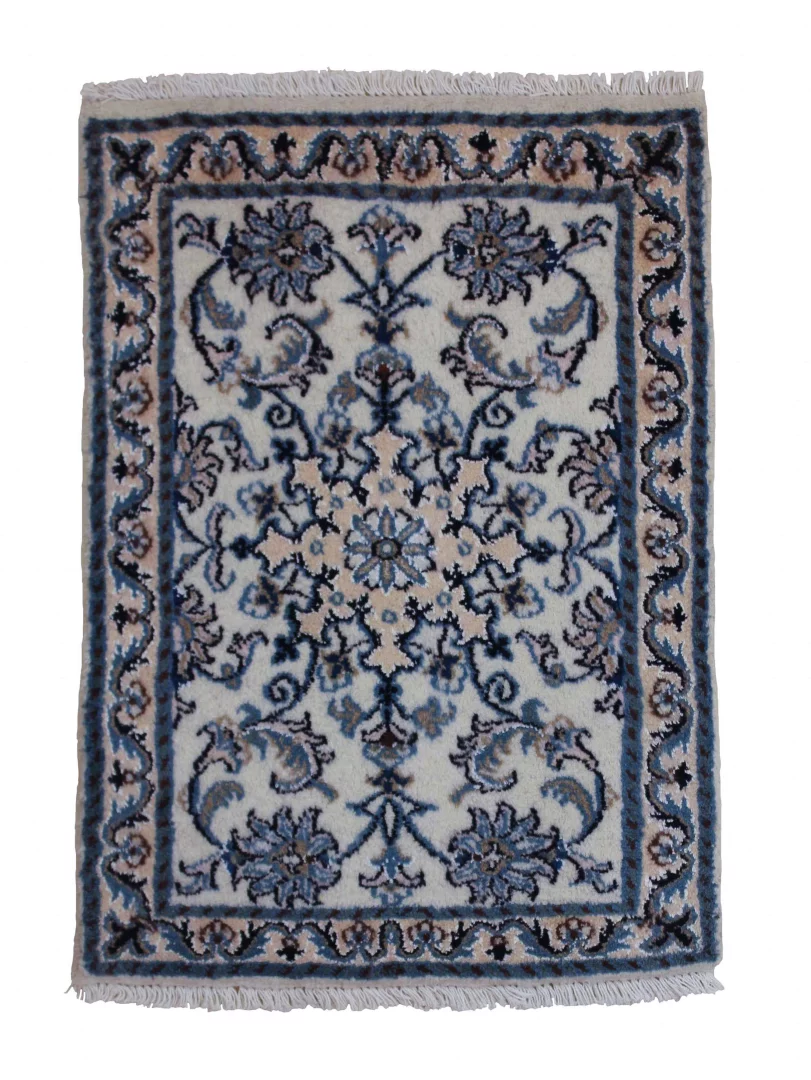
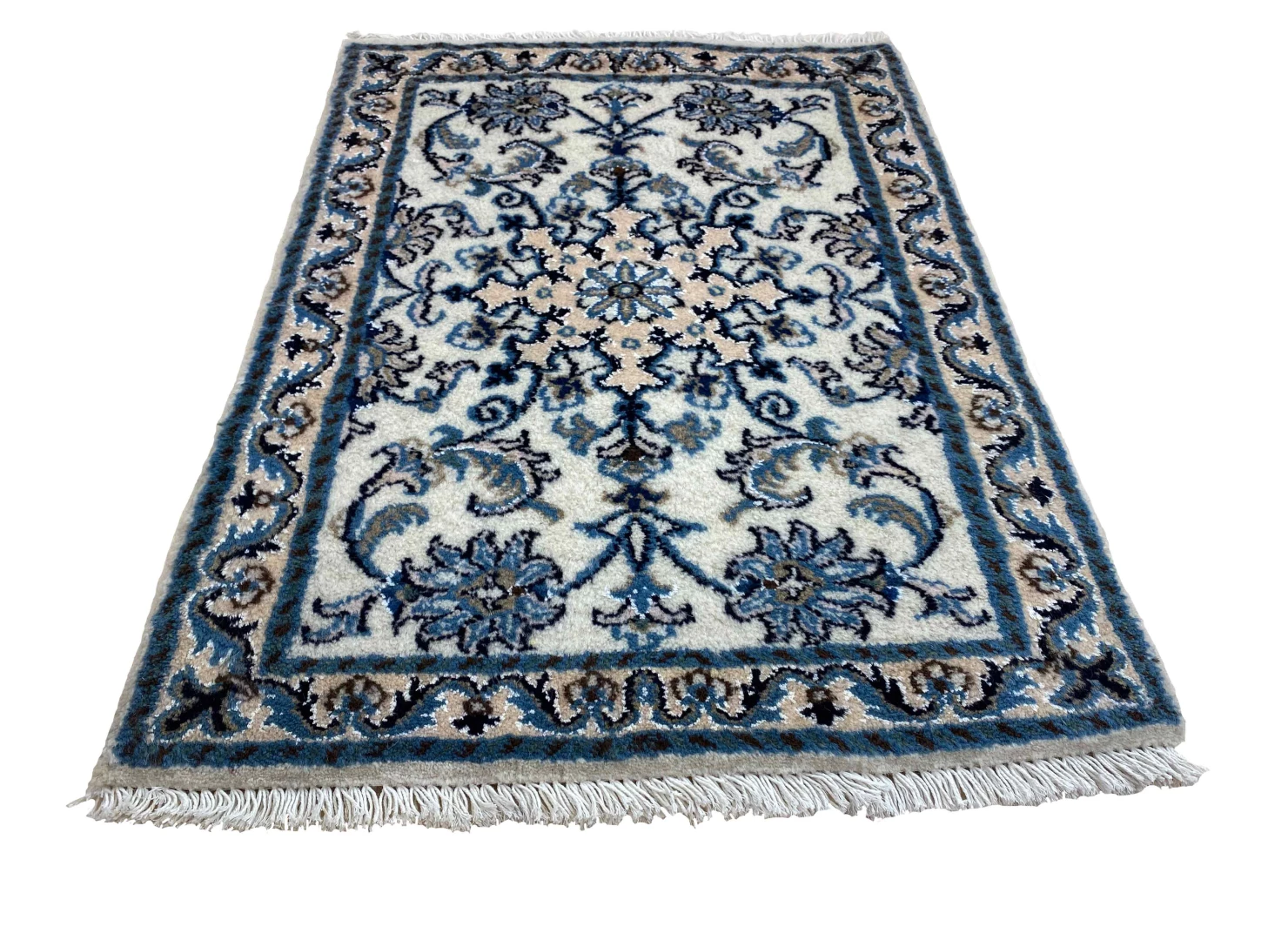
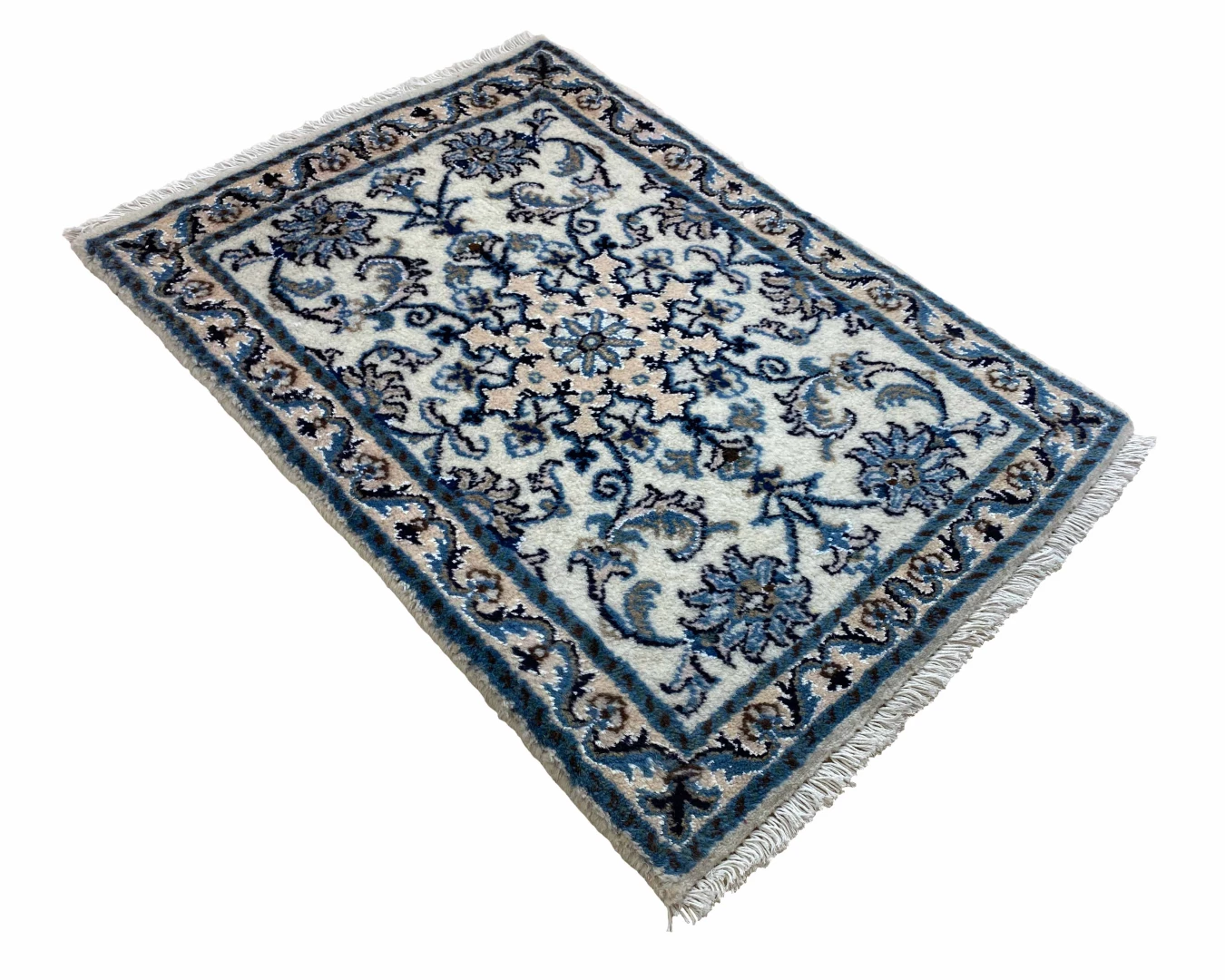
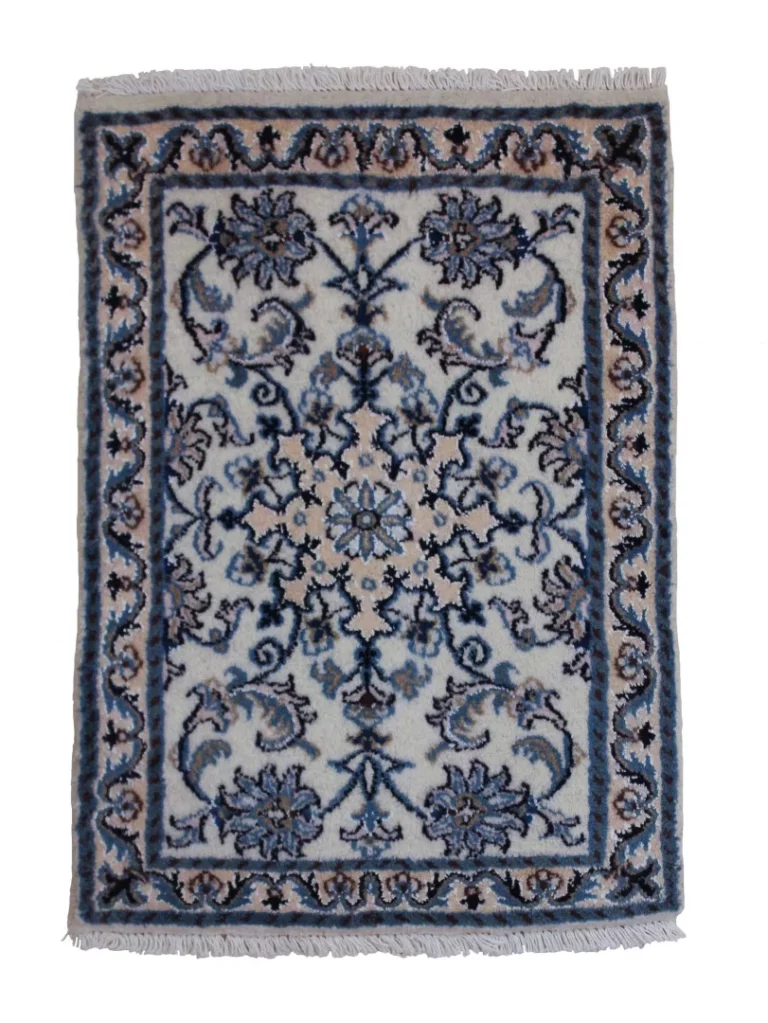
Hand-knotted Nain Persian Rug | Knot density: 12-Lah, approx. 250,000 knots/m² | Material: Wool pile with silk accents | Size: 90 x 60 cm | Pattern: Classical floral motifs with medallion | Condition: Like new
This Nain Persian rug is hand-knotted and has a pile made from high-quality wool with silk accents. That combination belongs to the established material language of Nain rugs: wool provides a resilient and comfortable surface, while silk accents can add finer definition and a subtle sheen to selected areas. For this particular rug, the recorded material is wool with silk accents. No further information about the warp or other structural components is provided.
The knot density is specified as 12-Lah, approximately 250,000 knots per square metre. In Nain weaving, Lah is used to distinguish quality levels associated with fineness and knot density. A denser knot structure permits especially detailed outlines and delicate transitions in a design. A 12-Lah quality is less finely divided than the most densely knotted Nain qualities, while remaining a carefully made and durable form of the tradition.
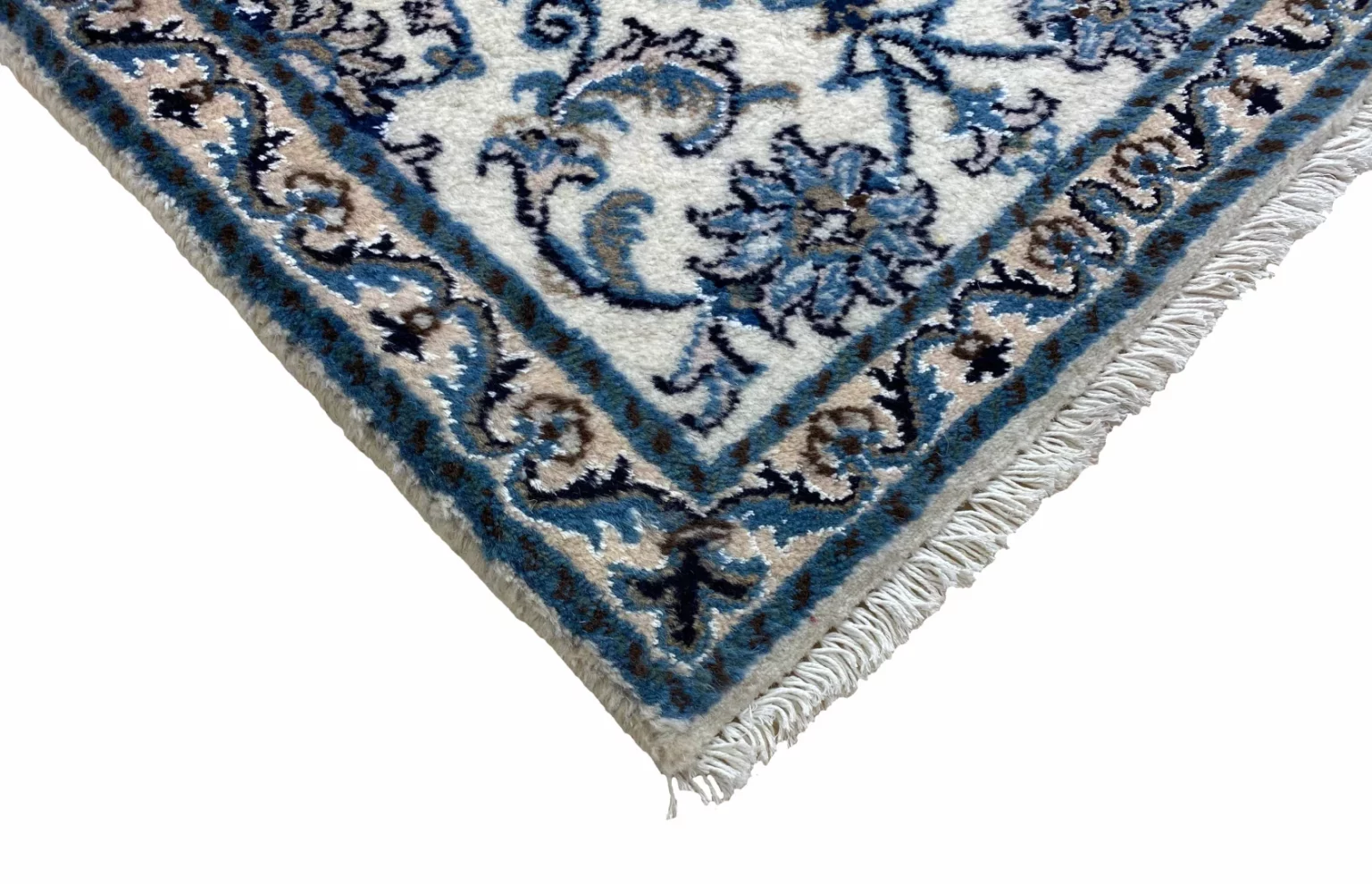
Hand-knotting means that the knots are inserted individually into the foundation. The pattern is therefore built through a sequence of hand-placed knots rather than applied as a printed surface. This technique is well suited to the floral language of Nain, where leaves, stems, blossoms and the contours of a medallion need to remain distinct. The result is a craft process in which patient manual work supports a precise and orderly composition.
Origin and Tradition
Nain is a city in Central Persia known for high-quality Persian rugs. The city and its surrounding region developed a recognizable weaving tradition, often associated with light colours, finely arranged floral drawing and a balanced overall structure. Nain rugs are identified not only by their place name, but also by the relationship between material, knot density and ornament. This rug is described as a Nain Persian rug and belongs to that Central Persian tradition.
The history of Nain weaving forms part of the broader Persian art of carpet making. Within this culture, a rug is more than a practical floor covering. Patterns, colour arrangements and technical knowledge are preserved through generations of makers. A Nain rug carries that heritage in a particularly ordered visual language: pale fields create clarity, floral ornaments organize the surface, and a medallion establishes a central point.
Lah classifications are used in Nain rugs to distinguish different levels of fineness. They show why knot density is an important element in describing a rug. Very fine qualities can accommodate highly detailed drawing, while less dense qualities often provide a balanced combination of legibility, resilience and practical use. The 12-Lah quality recorded for this rug forms part of that graded Nain tradition and is associated with approximately 250,000 knots per square metre.
Nain occupies an important place among the many Persian weaving centres. Isfahan rugs are also known for detailed floral and geometric designs and for the use of quality materials. Tabriz rugs often present larger and more complex compositions. These traditions differ in drawing and construction, yet together they demonstrate the range of Persian carpet culture. The Nain origin remains a distinct characteristic, linking this rug to the design vocabulary of Central Persia.
Creating a rug in this tradition requires a coordinated relationship between design, materials and knotting. A composition is divided into visual areas so that the medallion, floral elements and surrounding field can be read as a unified whole. The light colour direction associated with Nain supports this order. It allows the ornament to stand out without making the surface visually heavy. Nain weaving therefore combines restrained colour organization with carefully articulated pattern work.
Regional carpet traditions are shaped by local practice rather than by a single universal formula. Nain is recognized for its own balance of light grounds, floral ornament and refined structure. The classification system associated with Lah further demonstrates how technical distinctions are part of the identity of these rugs. In this way, origin and craftsmanship remain connected: the place name identifies a weaving tradition, while the knot density and material describe how that tradition is expressed in an individual piece.
Design and Pattern
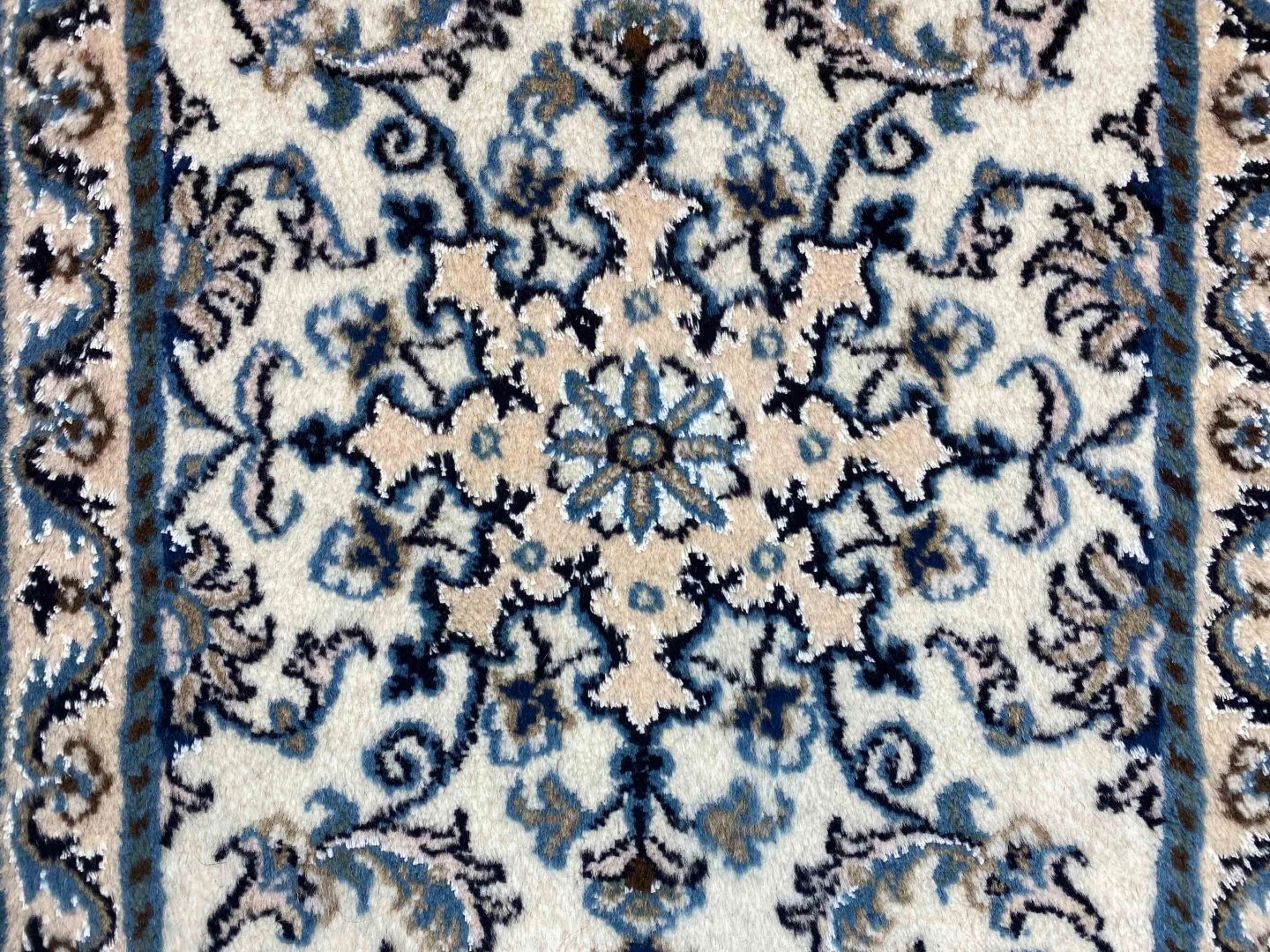
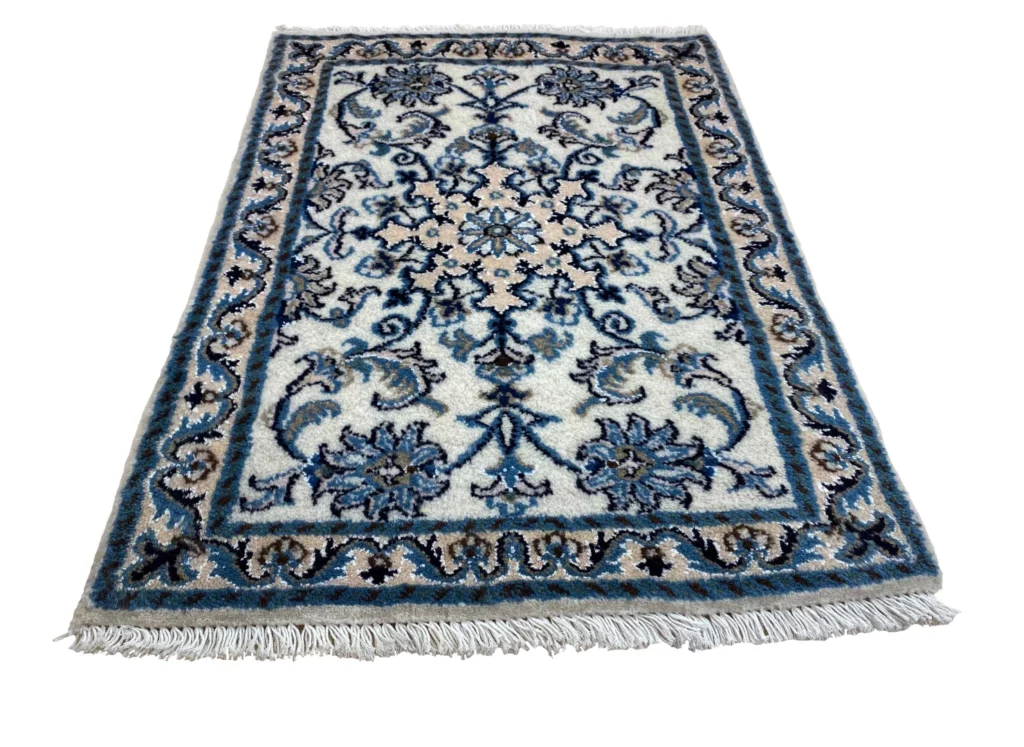
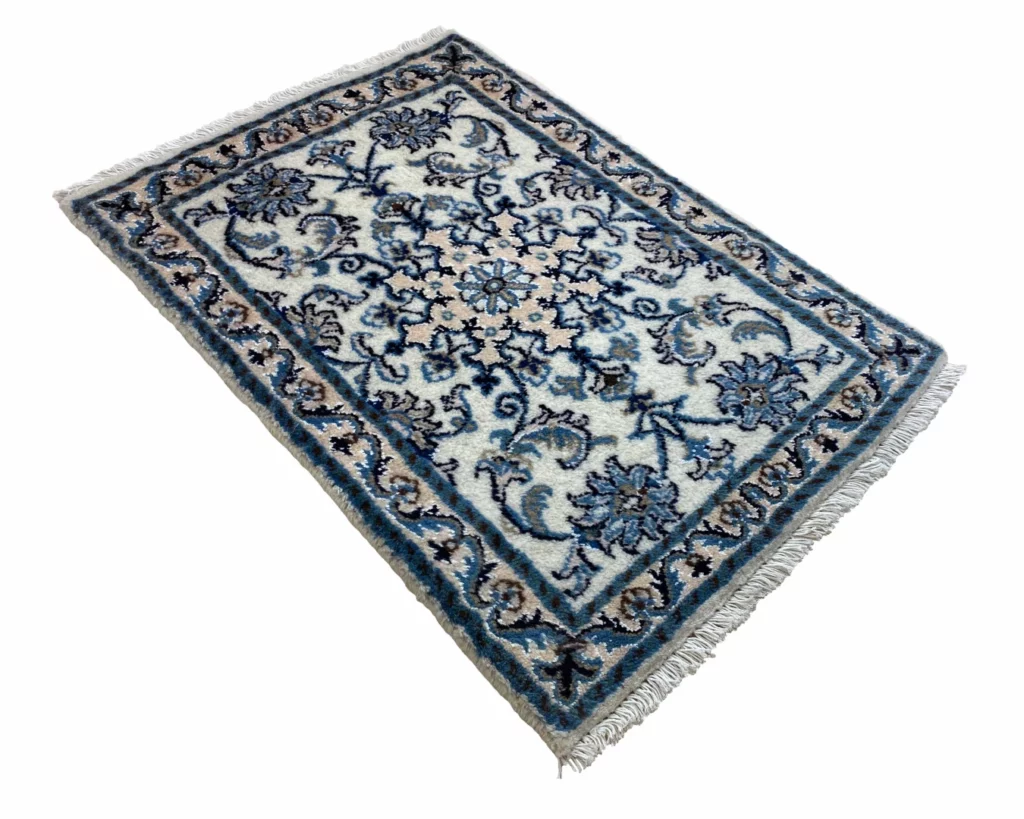
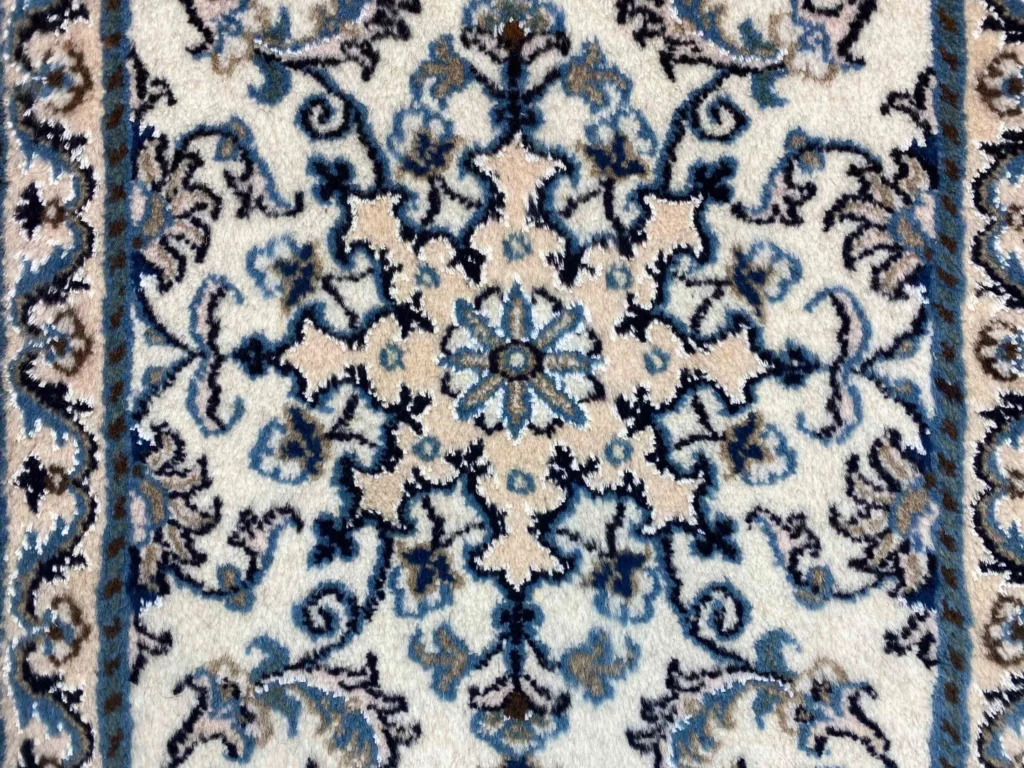
The design of this rug consists of classical floral motifs with a medallion. In Persian carpet design, a medallion acts as a central ornamental focus. It gathers the composition around a defined middle and can guide the relationship between the inner field, the surrounding ornaments and the border. In the Nain vocabulary, this central arrangement is often accompanied by fine stems, leaves and blossoms that create continuity around the medallion.
Floral motifs in Nain rugs are stylized rather than botanical illustrations. They are arranged rhythmically and adapted to the geometry of the woven field. Blossoms may recur at measured intervals, while stems and leaves connect separate areas of the design. Repetition gives the composition coherence. Variations in scale, contour and spacing then provide the detail needed to keep the pattern lively without disturbing its overall balance.
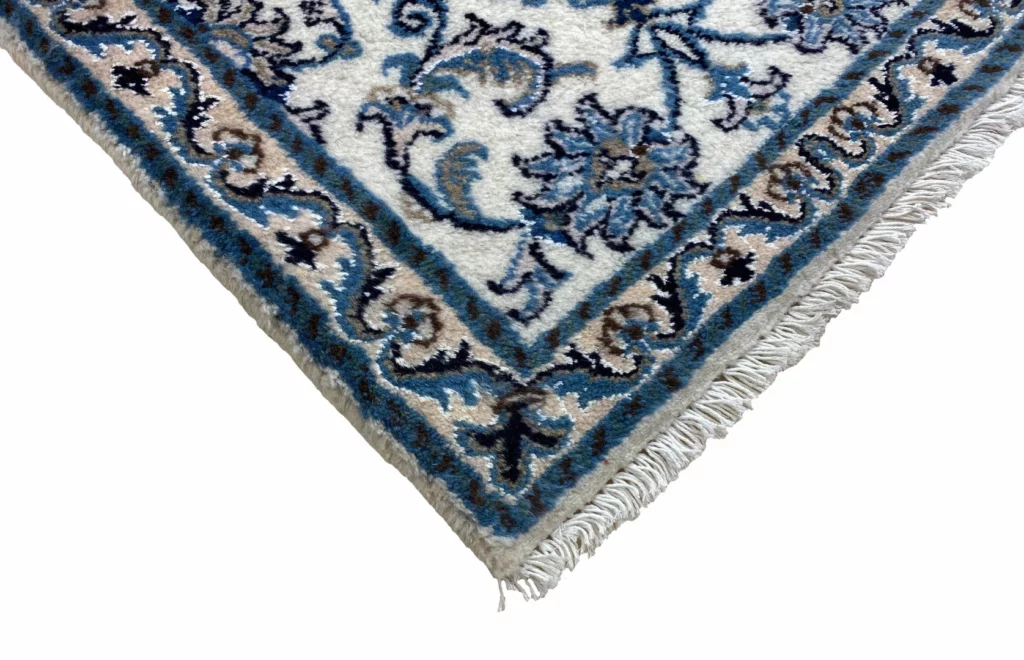
Light colour is an important part of the familiar Nain appearance. Sky blue, beige and cream are named as characteristic colour directions for Nain rugs. Such tones can create a calm ground and make floral drawing easier to read. The specific rug is described by its classical floral pattern with a medallion; no additional colour list for this individual piece is recorded. The reliable design statement is therefore the central medallion combined with traditional floral ornament.
A medallion composition gives the eye a clear centre while allowing the surrounding motifs to retain their own structure. Floral forms can mediate the transition between the centre and the outer field. Persian designs often use scrolling stems, leaf shapes and repeated smaller ornaments to create those transitions. The aim is balance between centre and surrounding space. This makes the design legible as a whole while preserving detail when viewed closely.
Knot density supports the way a Nain design is drawn. Individual knots can be used to build outlines and gradual changes in shape. In the 12-Lah quality recorded here, the floral composition is carried by a durable knot structure rather than by the finest possible division. That does not remove it from the Nain tradition. It represents a recognized quality level in which a clear ornamental design is combined with practical resilience.
Persian carpet motifs can carry cultural associations, although no single symbol has only one fixed interpretation. Plant forms may suggest growth, order or the connection between the centre and the surrounding world. For this rug, the secure description is its floral character and medallion layout. A more specific interpretation of individual flowers or leaves would go beyond the information available. The stated pattern already places the rug within the classical Nain design tradition.
The relationship between a central medallion and floral ornament also gives the rug a stable architectural rhythm. The centre provides orientation, while repeated botanical forms distribute attention across the field. This balance is one reason medallion designs have remained common in Persian weaving. In a Nain context, the light visual direction and fine organization of the motifs help maintain clarity. The design is therefore traditional in structure without requiring a literal reproduction of any one historic pattern.
Special Features
The specific features of this one-off piece are its hand-knotted construction, wool pile with silk accents, recorded 12-Lah knot density and classical floral design with a medallion. Its condition is described as like new. These details distinguish it from pre-owned Nain rugs, whose condition can vary considerably. The rug is identified as a Nain Persian rug from Central Persia.
The material description contributes two clearly stated qualities: wool forms the pile, and silk accents add a complementary element. Combined with the centred floral composition, this gives the rug a recognizable connection to Nain’s Persian design tradition. No information is provided about a signature, exact age or restoration history, so those details are not added here. The like-new condition remains one of the documented characteristics of this individual rug.
FAQ
What are the main characteristics of a Nain Persian rug?
Nain Persian rugs are known for light colour schemes, floral patterns and relatively high knot densities. A medallion is often placed at the centre of the composition. Wool, silk or a combination of the two may be used in their production. This rug has a wool pile with silk accents, is hand-knotted and features classical floral motifs with a medallion. Its stated quality is 12-Lah, with approximately 250,000 knots per square metre.
How should I care for my Nain Persian rug?
For routine care, vacuum the rug gently and dab spills or dirt promptly with a damp cloth. Vigorous rubbing can place unnecessary stress on the surface, particularly where silk accents are present. More extensive soiling should be handled by a professional rug cleaner. Any deeper cleaning should take account of the materials and the hand-knotted construction so that the pile and ornamental definition are treated appropriately.
What makes Nain rugs a good investment?
Nain rugs combine an established Persian weaving tradition with a clear design that can remain relevant across different interiors. Their floral patterns, light visual character and hand-knotted workmanship make them valued furnishings. Quality materials such as wool with silk accents and careful knotting can support long-term use. Nain rugs are also appreciated for their cultural importance and their role as examples of traditional craftsmanship, which can make them meaningful heirlooms. The like-new condition is a specific feature of this rug.
To provide the best experiences, we use technologies like cookies to store and/or access device information. Consenting to these technologies will allow us to process data such as browsing behavior or unique IDs on this site. Not consenting or withdrawing consent, may adversely affect certain features and functions.
Functional Always active
The technical storage or access is strictly necessary for the legitimate purpose of enabling the use of a specific service explicitly requested by the subscriber or user, or for the sole purpose of carrying out the transmission of a communication over an electronic communications network.
Preferences
The technical storage or access is necessary for the legitimate purpose of storing preferences that are not requested by the subscriber or user.
Statistics
The technical storage or access that is used exclusively for statistical purposes.The technical storage or access that is used exclusively for anonymous statistical purposes. Without a subpoena, voluntary compliance on the part of your Internet Service Provider, or additional records from a third party, information stored or retrieved for this purpose alone cannot usually be used to identify you.
Marketing
The technical storage or access is required to create user profiles to send advertising, or to track the user on a website or across several websites for similar marketing purposes.
 SECURE PAYMENT
 SHIPPING PARTNERS


