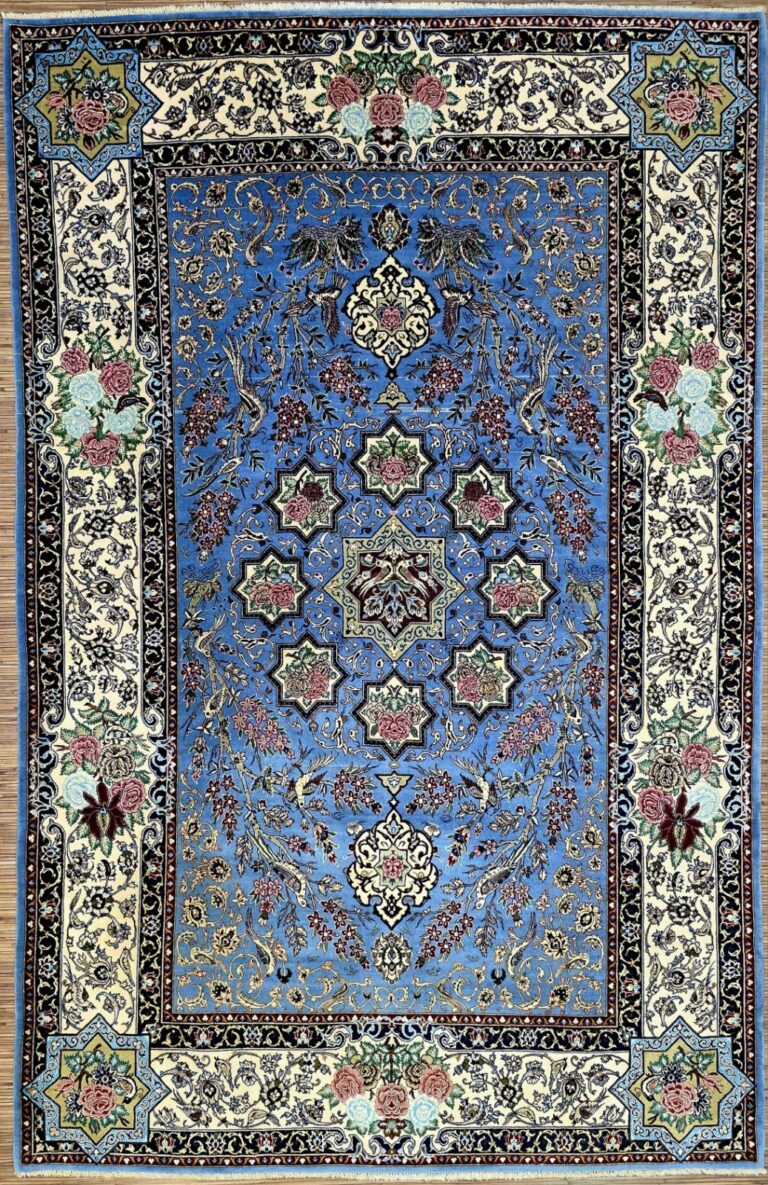
This Nain Persian rug is hand-knotted and has a pile made from 100% new wool. The warp and weft are made from 100% cotton. In a hand-knotted rug, the visible pile and the underlying foundation are created as connected parts of one textile structure. The wool forms the working surface, while the cotton warp and weft provide the framework into which the knots are secured. This construction makes the technique itself part of the rug’s character.
New wool is valued in rug making for its natural resilience, elasticity and pleasant handle. It can create a surface that feels soft while retaining a firm, tactile quality. The fibre is not simply applied to an already finished ground. Instead, it becomes part of the knotting process, so material, structure and pattern are developed together. This relationship is central to the way a hand-knotted oriental rug is made.
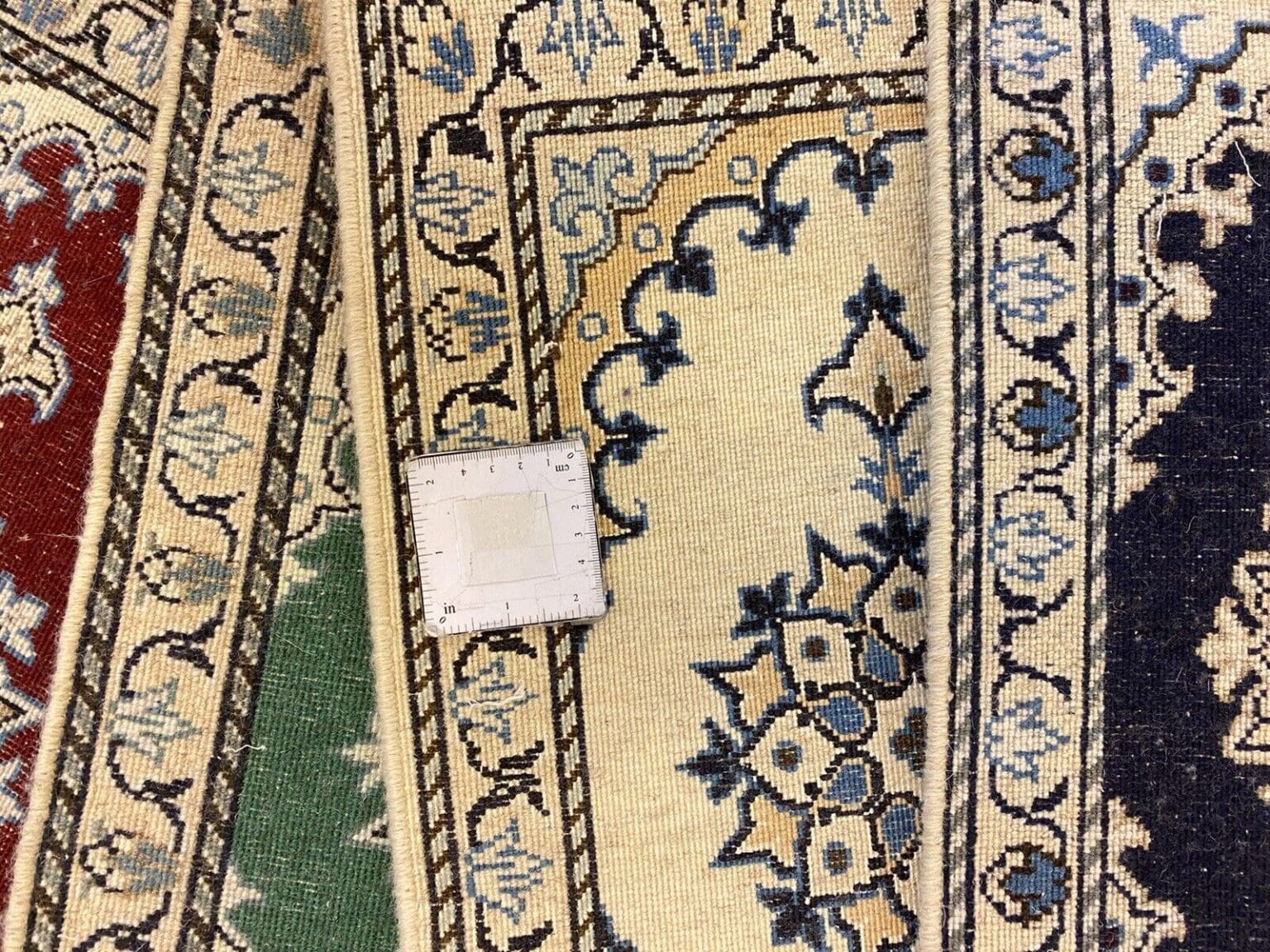
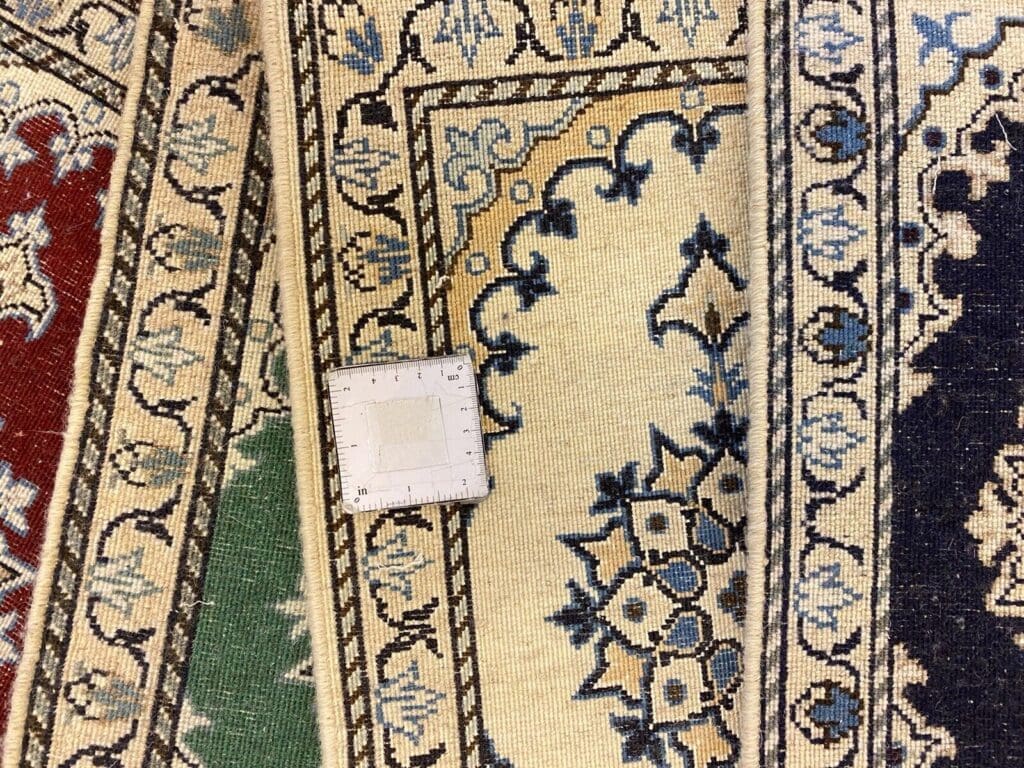
The knot density of this rug is given as approximately 300,000 knots per square metre. A dense knotting structure allows Nain designs to be rendered with fine outlines and small decorative passages. Leaves, floral details and transitions between motifs can be worked with greater definition when the design is built from closely arranged knots. Knot density is therefore both a technical measure and an element that affects the visual precision of the pile.
The cotton warp and weft form the supporting textile base. The warp runs lengthwise, while the weft passes across the structure and helps hold the rows together. Knots are inserted into this foundation one row at a time. During the work, the maker must coordinate the yarn, the tension and the planned pattern. The resulting surface is not printed after production; its decoration is formed directly through the construction of the rug.
Wool also has naturally insulating properties and can contribute to the comfortable feel of a textile in a room. It has a surface character that differs from smooth synthetic materials and responds to light with a natural depth. The combination of a wool pile and cotton foundation therefore brings together tactile material qualities and an ordered structure. The production of this particular rug is described as hand-knotted.
Origin and Tradition
Nain is a city in Iran known for fine Persian rugs. The region has a long rug-making tradition reaching back to the sixteenth century. In the context of Persian weaving, Nain is associated with careful execution, controlled drawing and a balanced relationship between open areas and ornament. Knowledge of the craft has been passed through generations, creating a regional tradition in which design and practical making are closely linked.
The name Nain consequently refers to more than a geographical place. It also describes a developed approach to designing and producing rugs. Regional compositions often organise a field, a border and supporting ornaments so that the parts form a coherent whole. Floral motifs may be combined with geometric boundaries, and fine secondary forms can be used to connect larger elements. The exact arrangement varies from one rug to another, but order and clarity remain important principles.
The history of Nain rugs is connected with the artistic development of Iran. Over the centuries, workshops in the region absorbed different influences while retaining an emphasis on precise drawing and meticulous knotting. A regional rug tradition is not static: new arrangements, colour relationships and interpretations of familiar motifs can be introduced over time. What remains recognisable is the relationship between disciplined composition, detailed workmanship and the visual language associated with Nain.
Preparing the yarn is an important part of the process. Wool intended for the pile must be suitable for knotting, while the warp and weft must provide a stable base. Colours and pattern placement are then considered in relation to one another. During knotting, the image is built directly from successive coloured knots rather than being added as a later surface decoration. The technical construction and the ornamental image therefore develop at the same time.
Natural dyes have traditionally been used by weavers in Nain. Dyeing affects the way the ground, outlines and decorative areas relate to each other. Depending on the fibre and the dyeing process, a colour may show different depths and subtle variations. Knowledge of colour preparation belongs to the wider craft tradition alongside setting up the foundation, maintaining tension and placing each knot accurately.
Regional Nain designs often bring floral motifs into a clearly structured composition. Blossoms, leaves and vines may be stylised and repeated at measured intervals. Geometric elements can frame organic lines and make the overall arrangement easier to read. This creates a dialogue between curved and straight forms. The specific appearance depends on the individual design, but the combination of precision and ornament is part of the background of the Nain tradition.
Persian rugs have historically served as useful textiles, decorative objects and carriers of inherited visual forms. Their patterns are transmitted and revised from one generation to the next. In Nain, this connection can be seen in the relationship between drawing, colour and knotting. A design is not separate from the craft that produces it: the choice of material, the density of knots and the treatment of the foundation all influence how the ornament appears.
The stated origin places this rug within the Iranian Nain tradition. The regional name does not mean that every Nain rug has an identical design or construction. It provides a shared cultural and craft context in which different colour arrangements, layouts and interpretations are possible. The individual rug remains a distinct piece while belonging to a long-established history of Persian weaving.
Design and Pattern
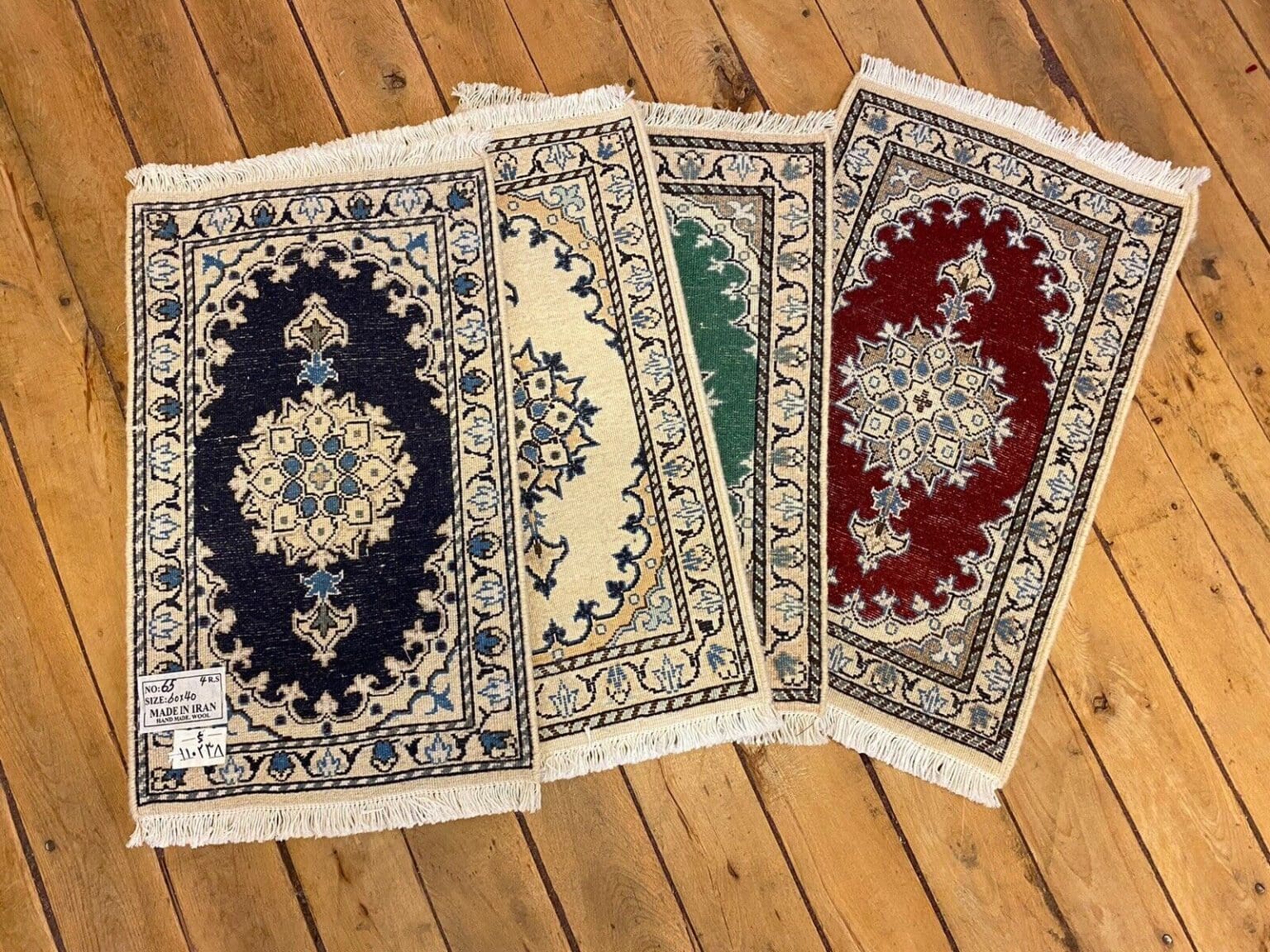
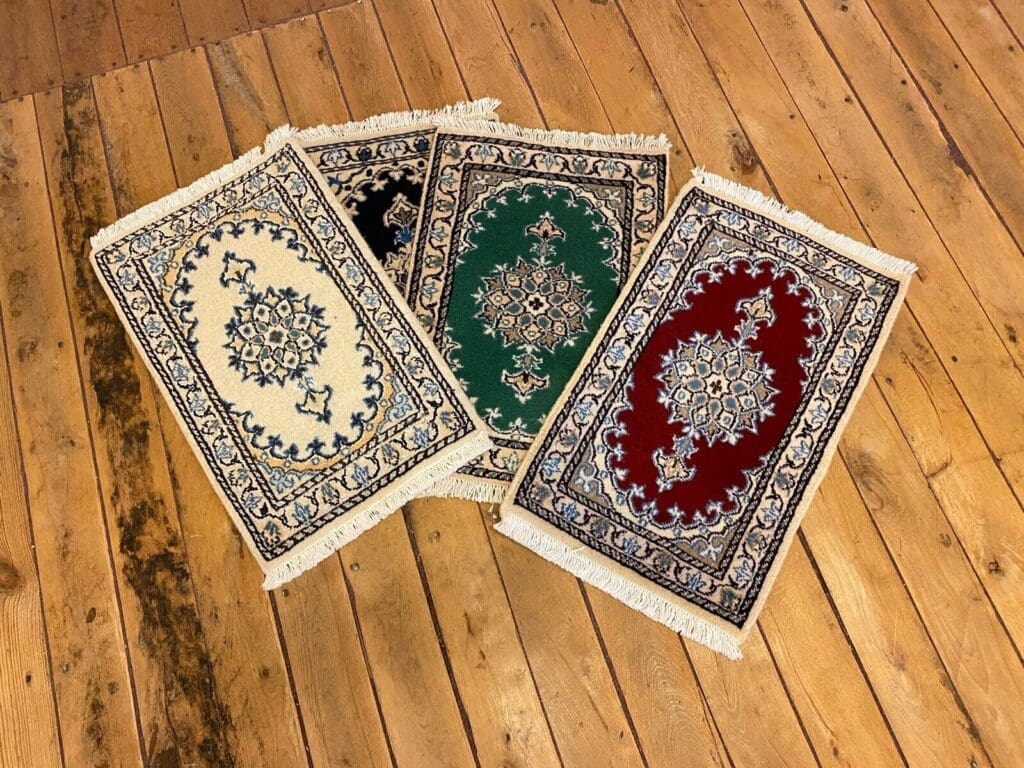
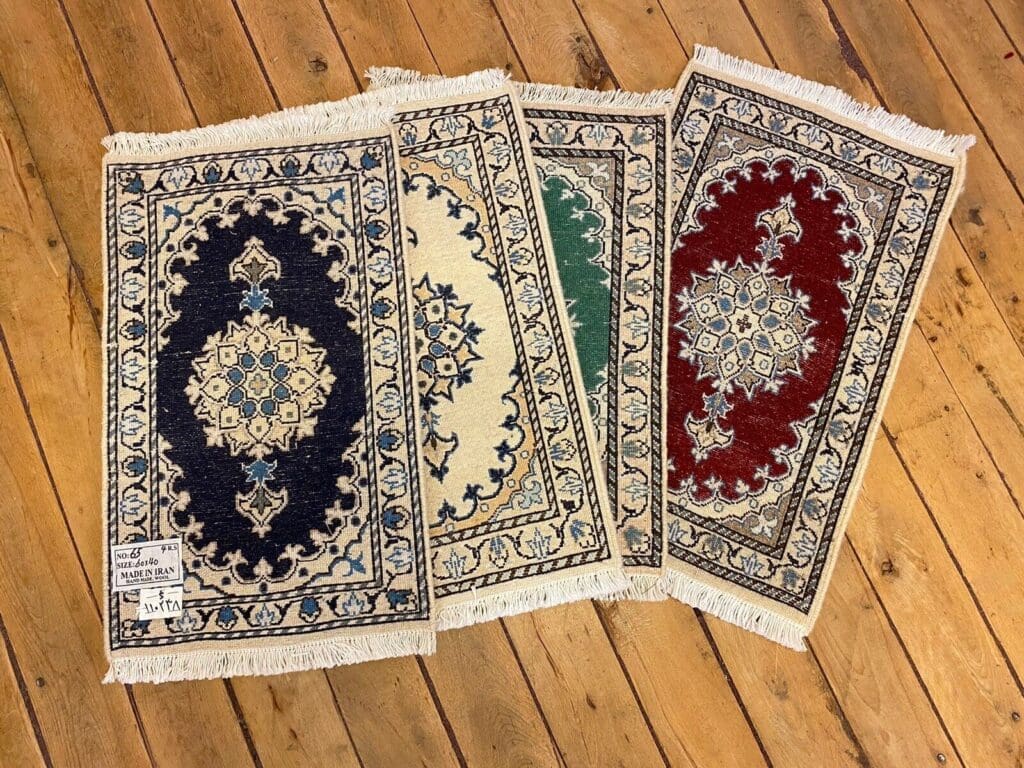
The design of this rug is described as unique and oriental in pattern. Nain rugs are known for elegant, clearly organised compositions and gentle shades. Floral motifs are frequently combined with stylised ornaments. Blossoms, leaves and vines may be repeated rhythmically, then arranged within borders or geometric divisions. The high knot density supports a differentiated rendering of these details and helps keep fine contours visible.
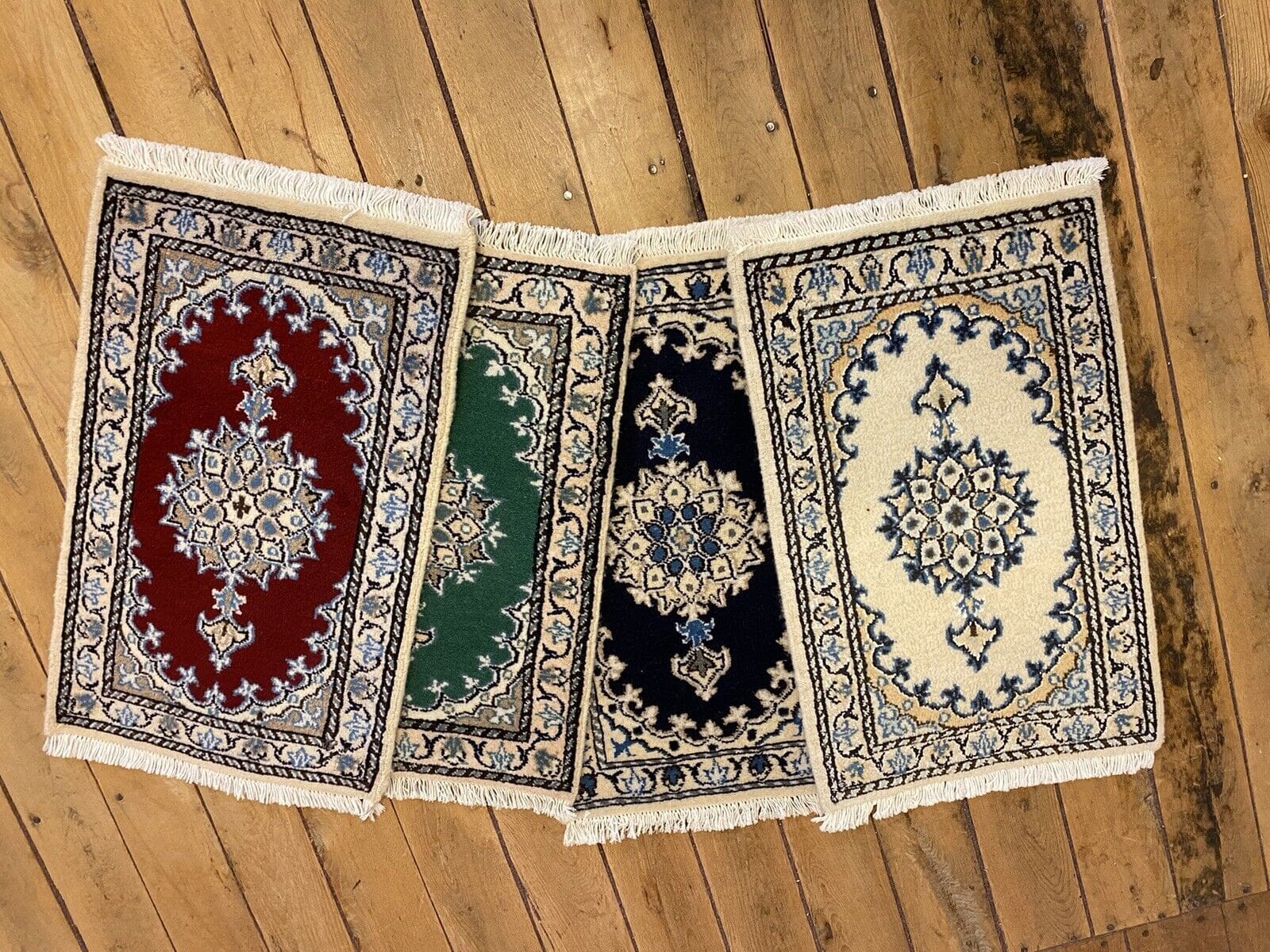
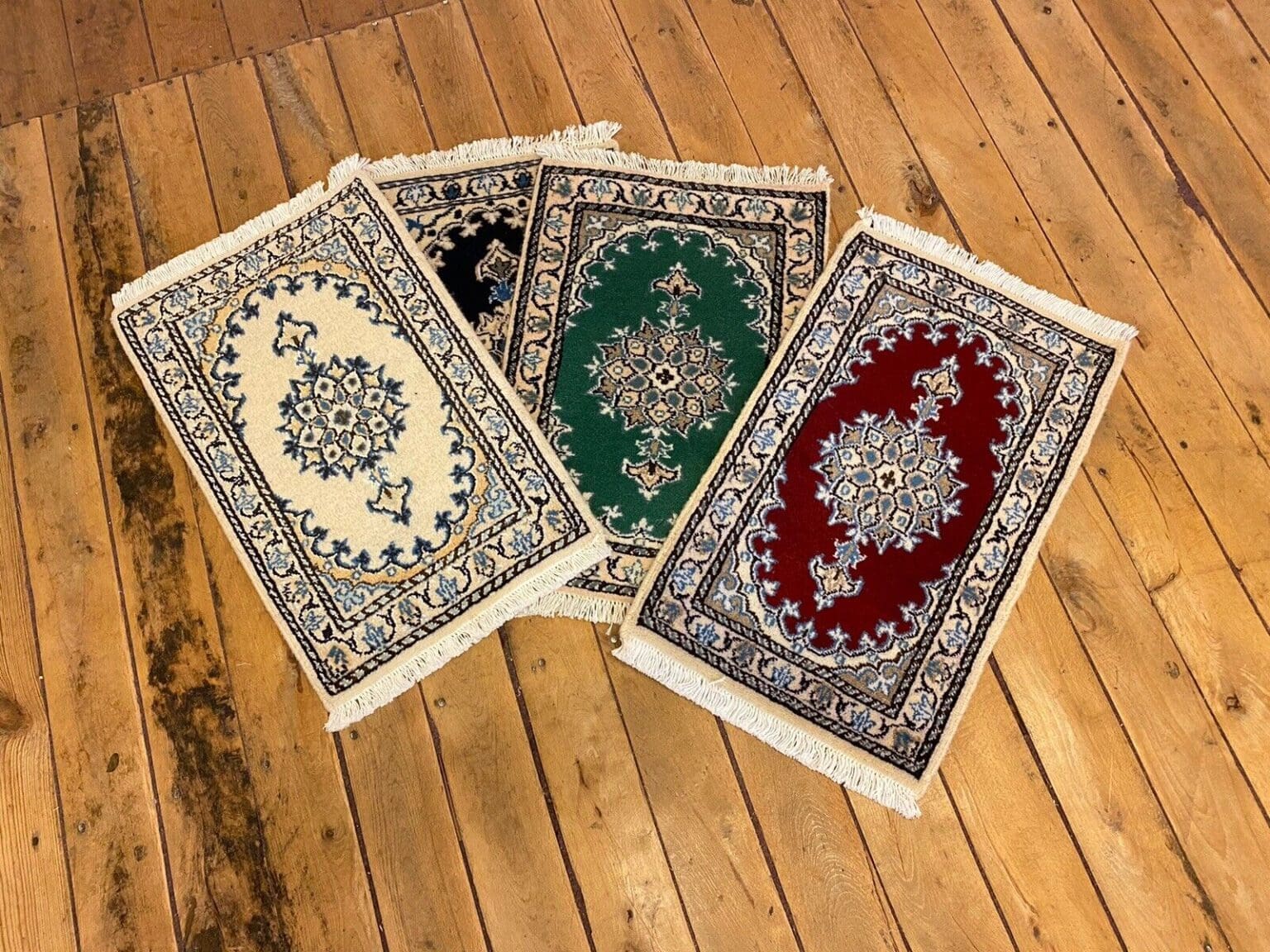
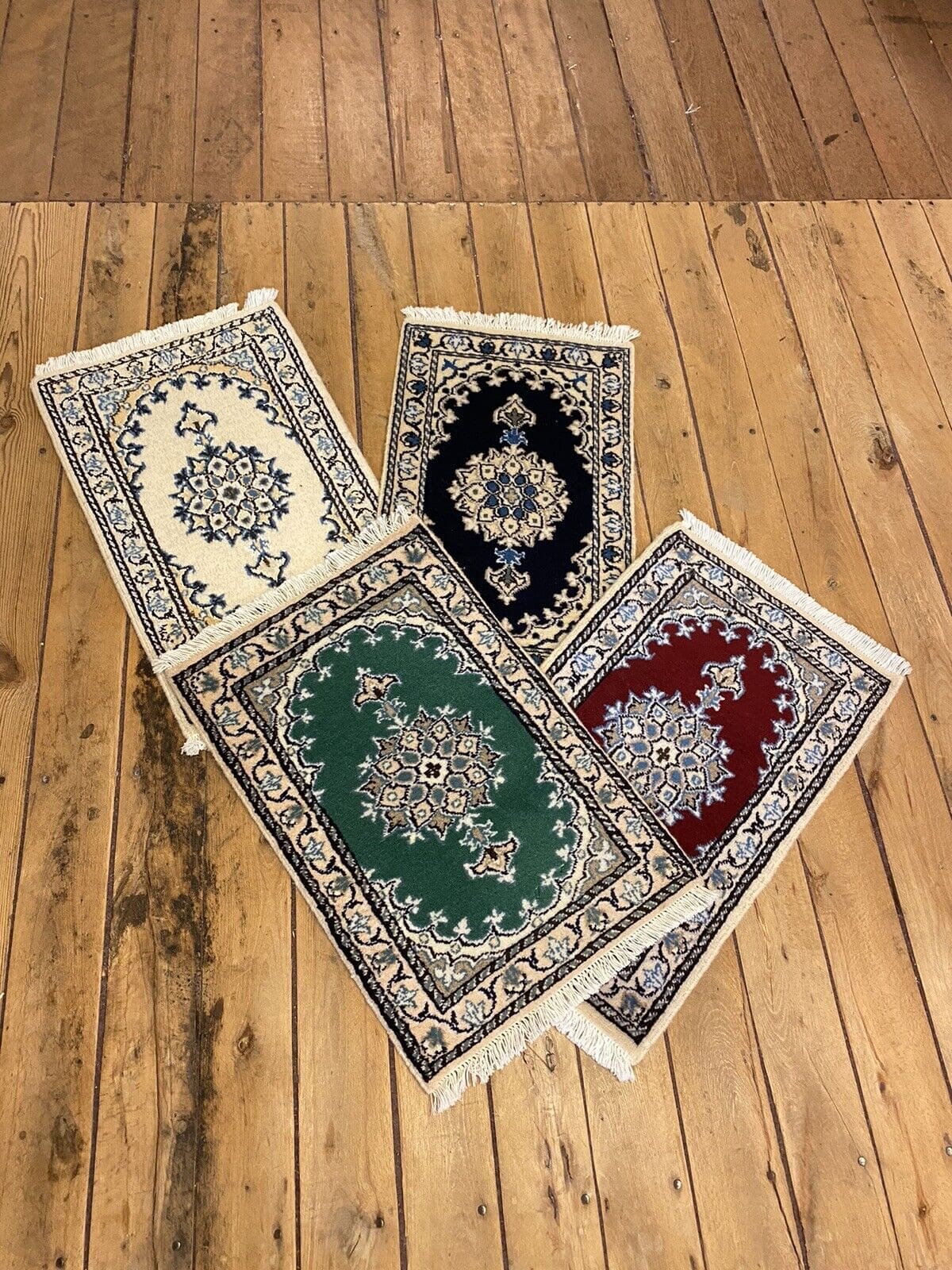
Colour ranges associated with the Nain tradition include soft cream and natural shades together with deeper blue and red. A light ground can allow the ornament to stand out clearly. Blue may define outlines, medallions or selected fields, while red can act as a controlled accent. The visual effect does not come from any one colour alone. It results from the relationship between the ground, the contour lines, repeated motifs and areas of emphasis.
Floral motifs in Persian rug art are generally stylised rather than copied directly from nature. A blossom may be simplified, mirrored or incorporated into a larger ornamental sequence. Leaves and vines can be placed so that they guide the eye through the field. Geometric structures provide a framework for organic forms, while curved lines prevent the composition from appearing rigid. Together, these elements create a decorative system rather than a literal botanical image.
A medallion, an all-over arrangement or a composition dominated by borders can change the way an oriental rug is read. In Nain designs, balance between the main field and finely worked details is often important. The layout may define the space of the rug clearly while still accommodating numerous smaller ornaments. The relationship between the central area, border, outlines and repeated forms determines how the pattern holds together as a whole.
Patterns and colours also have cultural associations in rug art. Certain forms and colour groups are linked with ideas of abundance, happiness and peace. These meanings belong to the wider symbolic background of Persian and oriental weaving. They should not be treated as a fixed translation of every single motif. Rather, they form part of an inherited visual language in which natural forms, order and colour are brought together.
The detail of a finely knotted rug is created through the close sequence of individual knots. A contour is not drawn in one continuous stroke; it is assembled from coloured knots placed in relation to one another. Small changes in the sequence can alter the course of a line or the shape of a leaf. Pattern therefore depends on both the design and its technical execution. In this rug, the oriental pattern is directly connected to the hand-knotted method.
Gentle shades and clearly arranged ornaments can work with a range of interior styles. In a traditional setting, they may sit beside classic furniture and other textiles. In a contemporary room, they can provide a hand-crafted contrast to simple forms and restrained surfaces. The Nain design is therefore not limited to one decorating period. Depending on its surroundings, the pattern may appear quiet, structured or used as a defined colour accent.
The design of a Nain rug combines regional recognisability with the individuality of each piece. Traditional motifs provide a vocabulary, but their exact placement, colour arrangement and execution create a separate composition. The oriental pattern of this rug belongs to that broader vocabulary while retaining its own character as a one-off hand-knotted textile.
Special Features
The rug is described as new and in very good condition. It is specified as suitable for use with underfloor heating. Its pile is made from 100% new wool, its warp and weft from 100% cotton, and its construction is hand-knotted. The knot density is given as approximately 300,000 knots per square metre. Its weight is stated as approximately 6 kg.
The piece is also described as having a unique design with an oriental pattern. It can be used in both classic and modern settings. For small marks, a damp cloth and cold water are recommended. More extensive cleaning should be handled by a professional rug cleaner so that the colours and structure are treated with care.
FAQ
How should I clean a Nain Persian rug?
Small spots can be treated carefully with a damp cloth and cold water. The area should not be worked more vigorously than necessary. Harsh cleaning products, forceful rubbing and soaking are unsuitable approaches for a hand-knotted rug with a new-wool pile, since they may affect the surface, colours or textile structure. For more extensive cleaning, professional rug cleaning is recommended. A specialist can take the wool pile, hand-knotted construction and colour arrangement into account. This provides a gentler way to maintain the appearance and structure of the rug.
How can I assess the quality of a Persian rug?
Quality is assessed through several features rather than through one isolated characteristic. Knot density, the materials used and the production technique are important points. In this rug, the pile is made from new wool, the warp and weft are cotton, and the construction is hand-knotted. A high knot density can support a finely detailed pattern. Clear, carefully executed motifs are also associated with precise workmanship. It is therefore useful to consider the pile, foundation, knotting method, density and pattern together when assessing a Persian rug.
Can a Nain Persian rug be used in a modern interior?
Yes, a Nain Persian rug can be used in a modern interior. The clear floral and geometric elements associated with the Nain tradition can be placed beside simple furniture and reduced contemporary room concepts. Soft cream and natural shades can provide a restrained base, while blue or red can introduce individual accents. The oriental pattern remains visible as a hand-crafted design feature without requiring a traditionally furnished room. A Nain rug can therefore be used in a classic setting or combined with contemporary pieces. Its final effect depends on the relationship between the rug’s colours and motifs and the surrounding furniture, floor and textiles.
To provide the best experiences, we use technologies like cookies to store and/or access device information. Consenting to these technologies will allow us to process data such as browsing behavior or unique IDs on this site. Not consenting or withdrawing consent, may adversely affect certain features and functions.
Functional Always active
The technical storage or access is strictly necessary for the legitimate purpose of enabling the use of a specific service explicitly requested by the subscriber or user, or for the sole purpose of carrying out the transmission of a communication over an electronic communications network.
Preferences
The technical storage or access is necessary for the legitimate purpose of storing preferences that are not requested by the subscriber or user.
Statistics
The technical storage or access that is used exclusively for statistical purposes.The technical storage or access that is used exclusively for anonymous statistical purposes. Without a subpoena, voluntary compliance on the part of your Internet Service Provider, or additional records from a third party, information stored or retrieved for this purpose alone cannot usually be used to identify you.
Marketing
The technical storage or access is required to create user profiles to send advertising, or to track the user on a website or across several websites for similar marketing purposes.
 SECURE PAYMENT
 SHIPPING PARTNERS