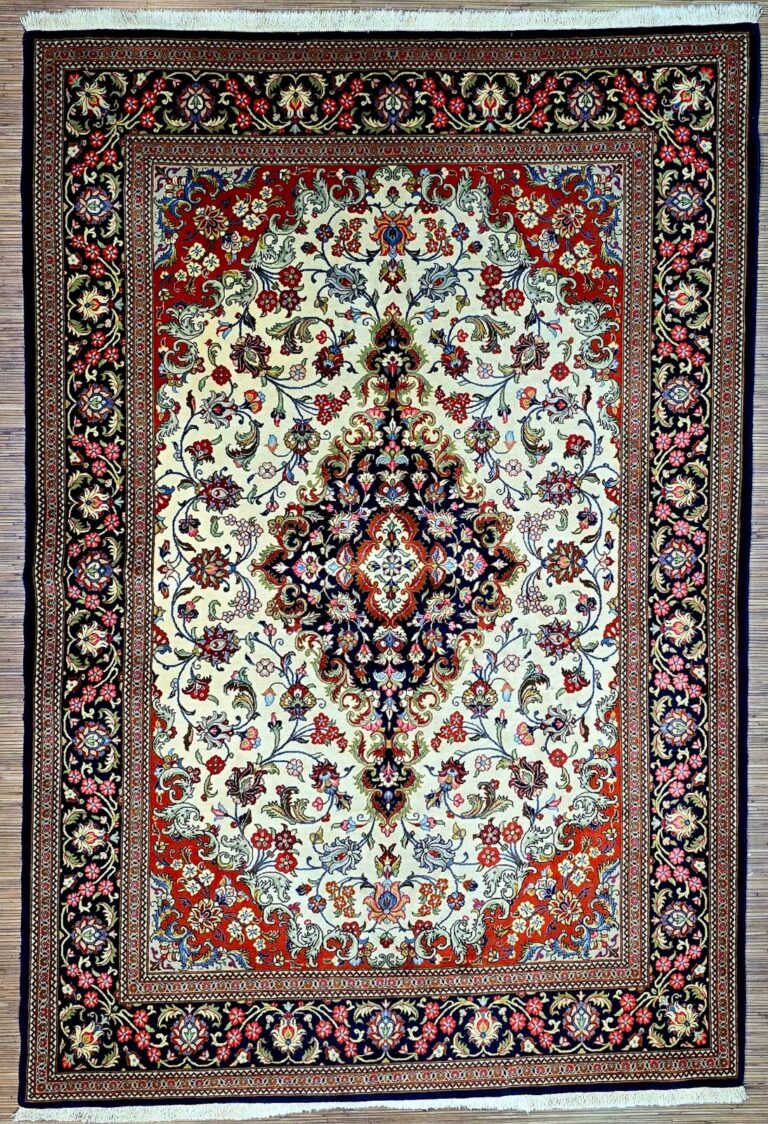
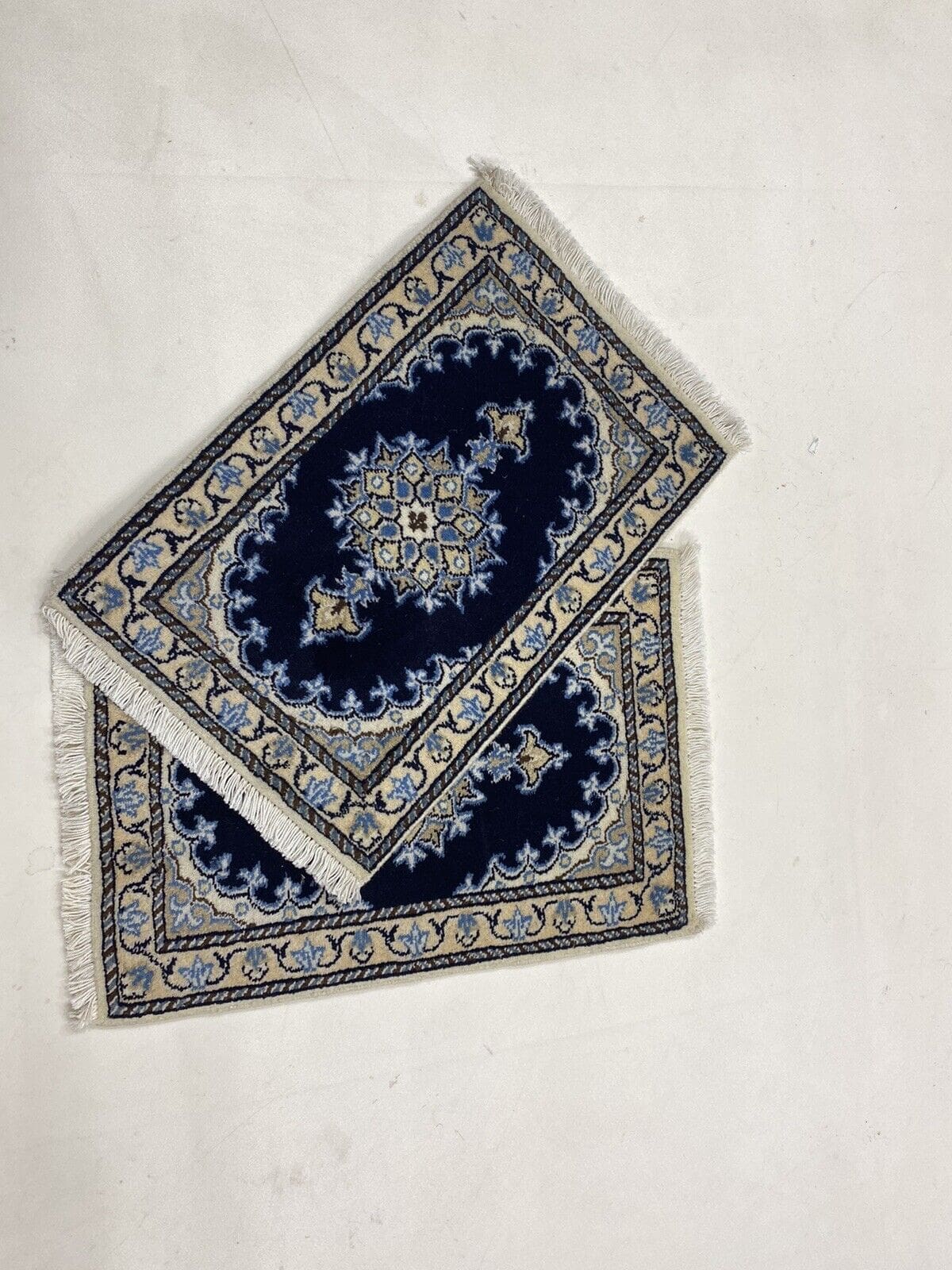
This Nain Persian rug is hand-knotted. Its pile consists of 95% virgin wool and 5% silk, while the warp and weft are made of 100% cotton. The construction therefore combines a predominantly wool pile with a silk component and a cotton foundation. Because the rug is made by hand, the pile is created knot by knot in successive rows rather than printed or mechanically applied. Each stage contributes to the finished textile surface.
Virgin wool has long been used in rug making because it provides a resilient surface together with a comfortable feel and insulating qualities. In this rug, wool is complemented by silk. The silk content can lend a restrained sheen to the surface and gives the pile a more refined visual character. Cotton in the warp and weft forms the underlying textile structure. These materials are the stated components of this particular Nain rug and define its construction.
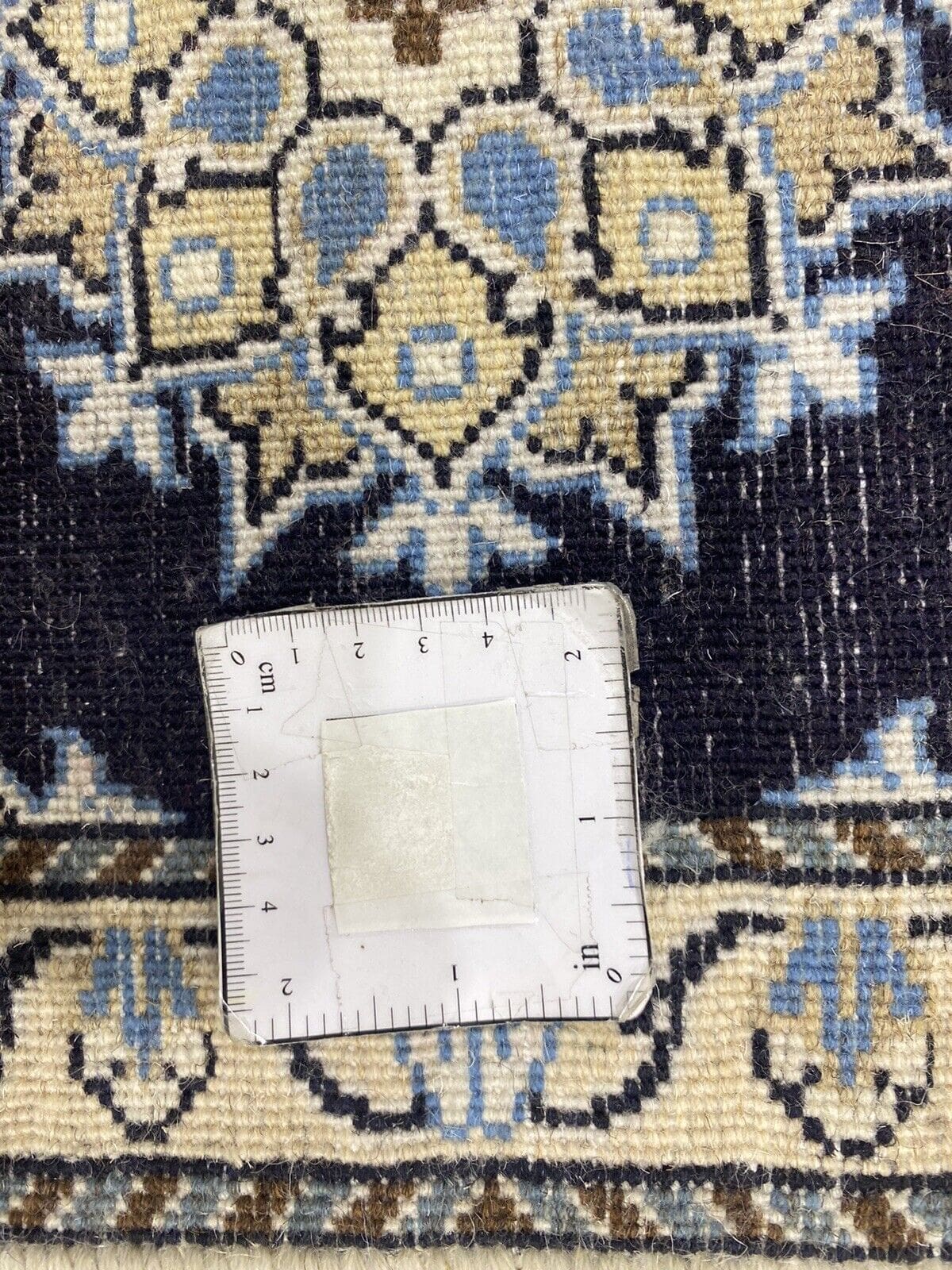
The knot density is approximately 300,000 knots per square metre. A dense knot structure allows small details, narrow outlines and subtle transitions to be rendered with precision. In a hand-knotted rug, the design is built into the pile through the arrangement of the individual knots. Material, colour and pattern are therefore part of the same making process. The density is also a visible indication of the degree of detail that can be achieved in the woven surface.
Origin and Tradition
The rug comes from Nain, a city in Iran known for its fine carpets. Nain is one of the recognised centres of Persian rug making and has developed a distinct regional language within Iranian textile culture. A Nain attribution identifies more than a place on a map: it points to a local tradition of careful knotting, controlled composition and finely drawn ornament. These features are associated with the town’s established carpet production.
Persian carpet making developed over centuries in many towns and regions, each with its own preferences in structure, colour, ornament and workmanship. Nain occupies a particular place in that history through rugs in which fine drawing and orderly layouts often work together. Production takes place on a vertical loom, with a design or pattern guide providing orientation while the maker places the knots by hand. The process requires concentration because the design must be maintained across many successive rows.
Hand-knotting is necessarily gradual. A row is completed, compacted and integrated with the foundation before the next row continues the surface. Trimming and further finishing bring the pile into a more even plane. The high knot density specified for this rug is consequently connected with a detailed form of workmanship rather than with a superficial printed decoration. It reflects the construction of the textile and the time required to form its pattern by hand.
Nain rugs belong to a broader Persian tradition in which practical household textiles also carry regional knowledge and decorative culture. Skills relating to fibre selection, knot placement, pattern reading and finishing have been transmitted through workshops and generations of makers. This rug’s origin in Nain places it within that Iranian craft context. Its Persian identity is therefore grounded in the named Iranian origin and in the hand-knotted technique.
Design and Pattern
The pattern of this rug is described as Oriental. Nain designs commonly draw on carefully ordered floral ornament, balanced layouts and small geometric details. A composition may bring together a central field, a surrounding border and connecting elements that guide the eye through the surface. Such features describe the wider design vocabulary of the region; they do not assign an unlisted specific motif to this individual rug.
Floral ornament is a long-standing form in Persian carpet design. Leaves, blossoms and vines may be stylised, repeated and arranged with a high degree of symmetry. Geometric lines can provide a framework for these organic forms, creating a relationship between movement and order. Across Persian weaving traditions, natural references are often transformed into an ornamental system rather than copied literally. This is why a floral pattern can appear both recognisable and highly structured.
A dense hand-knotted surface supports the careful rendering of such visual elements. Small contours can be separated more clearly, and neighbouring colour areas can be given measured transitions. The pattern is not added after the rug has been made; it emerges from the sequence of coloured knots that forms the pile. The craft technique therefore directly affects how the design is read, from the overall layout to the smallest visible detail.
The general description Oriental is the appropriate designation for this rug’s pattern. Nain provides the regional and historical framework, while the product information does not name a particular medallion, boteh, floral type or colour scheme. The design can therefore be understood as part of Persian ornamental practice without attributing symbols or meanings that are not specified for this piece.
Special Features
A defining feature is the knot density of approximately 300,000 knots per square metre. This is associated with finely executed knotting and with the ability to reproduce detailed designs. The pile uses a combination of virgin wool and silk rather than wool alone, and the cotton warp and weft complete the stated construction.
The condition is new and very good. The rug is offered as a one-off with a certificate of authenticity. These details describe this individual piece and its documented scope. Its hand-knotted production, Nain origin, stated materials and Oriental pattern form the central characteristics of the rug.
FAQ
How should I care for my hand-knotted Nain rug?
Regular vacuuming without a brush attachment is recommended for everyday care. This removes loose dust while avoiding unnecessary agitation of the pile. If a spill occurs, treat it promptly with a damp cloth and a mild cleaning product, working carefully rather than rubbing aggressively. Direct sunlight should be avoided because prolonged exposure can cause colours to fade. For a more comprehensive cleaning, a specialist familiar with hand-knotted rugs is the appropriate choice, particularly when the pile contains both virgin wool and silk. Care should always be gentle and proportionate to the material.
Where is the rug best placed?
This Nain Persian rug can be used in a living room or dining room, and it can also be placed in a hallway or bedroom. A stable, clean surface is important wherever it is laid. An even foundation helps the rug lie securely and can reduce unnecessary wear. In a dining area, spills should be dealt with quickly. In a hallway, the rug should be positioned so that it does not continually slide or catch against surrounding furniture. The most suitable room therefore depends on the existing layout, the floor surface and the intended use.
Is this Nain rug a good investment?
Hand-knotted rugs from Nain generally have a high value and may gain significance over time. Their individuality, traditional production and regional origin make them relevant to admirers of Persian rugs and to collectors. For this piece, the stated knot density, the virgin wool and silk pile, the new and very good condition and the certificate of authenticity are additional characteristics. No future price development can be determined from these features alone, since preservation, demand and market conditions also play a role. As a one-off, the rug can nevertheless hold a distinct place in a private collection.
To provide the best experiences, we use technologies like cookies to store and/or access device information. Consenting to these technologies will allow us to process data such as browsing behavior or unique IDs on this site. Not consenting or withdrawing consent, may adversely affect certain features and functions.
Functional Always active
The technical storage or access is strictly necessary for the legitimate purpose of enabling the use of a specific service explicitly requested by the subscriber or user, or for the sole purpose of carrying out the transmission of a communication over an electronic communications network.
Preferences
The technical storage or access is necessary for the legitimate purpose of storing preferences that are not requested by the subscriber or user.
Statistics
The technical storage or access that is used exclusively for statistical purposes.The technical storage or access that is used exclusively for anonymous statistical purposes. Without a subpoena, voluntary compliance on the part of your Internet Service Provider, or additional records from a third party, information stored or retrieved for this purpose alone cannot usually be used to identify you.
Marketing
The technical storage or access is required to create user profiles to send advertising, or to track the user on a website or across several websites for similar marketing purposes.
 SECURE PAYMENT
 SHIPPING PARTNERS