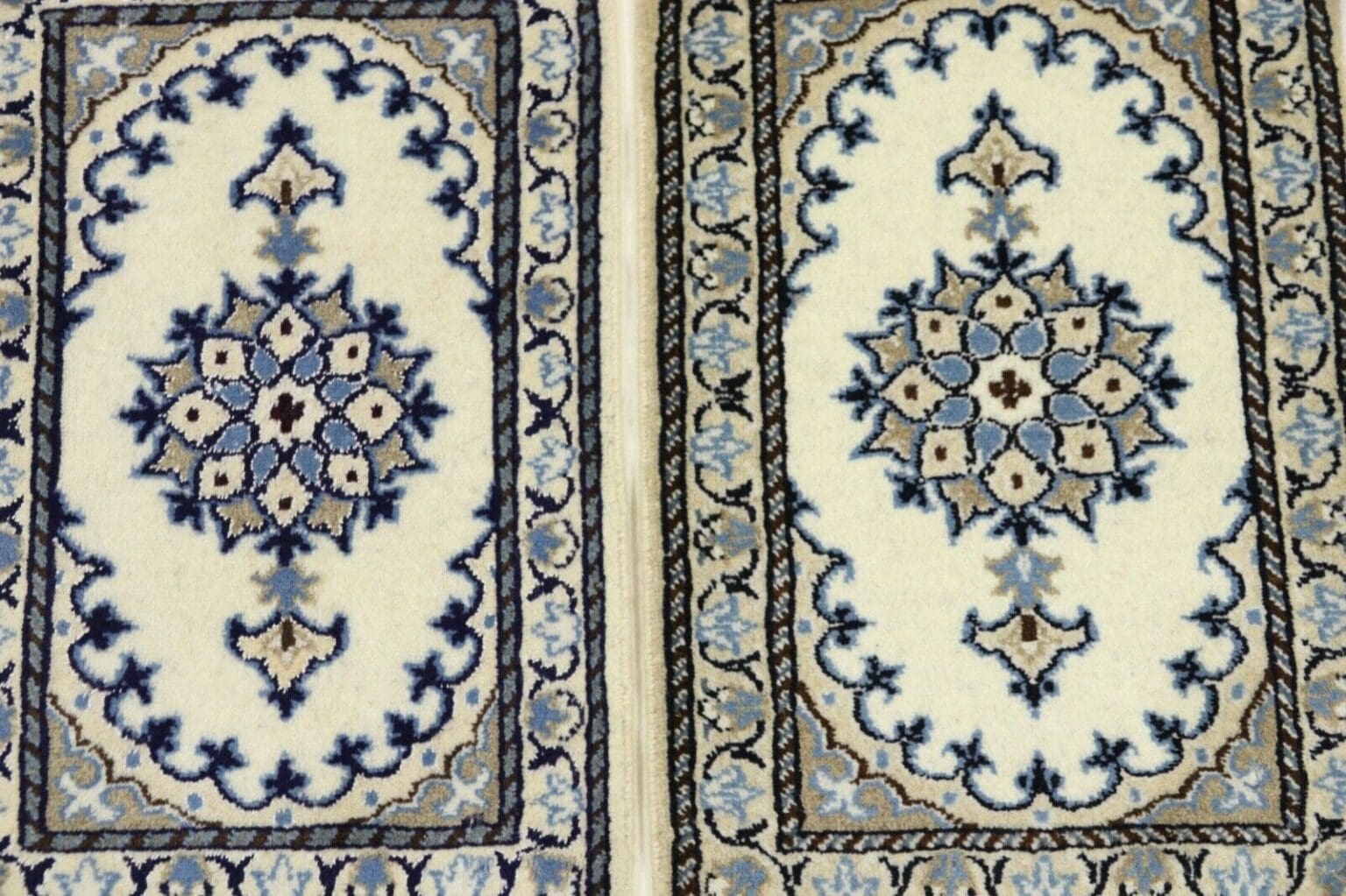
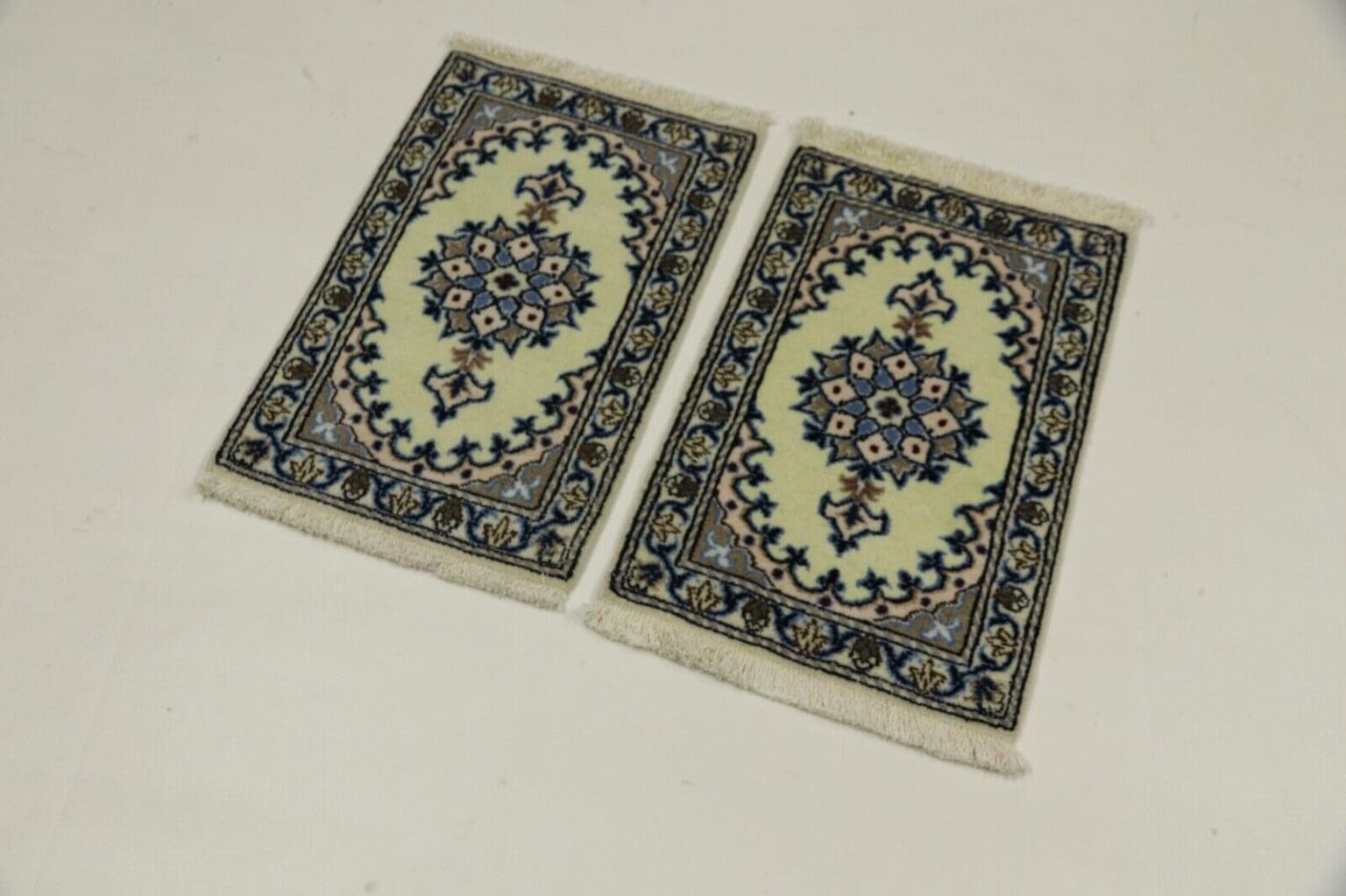
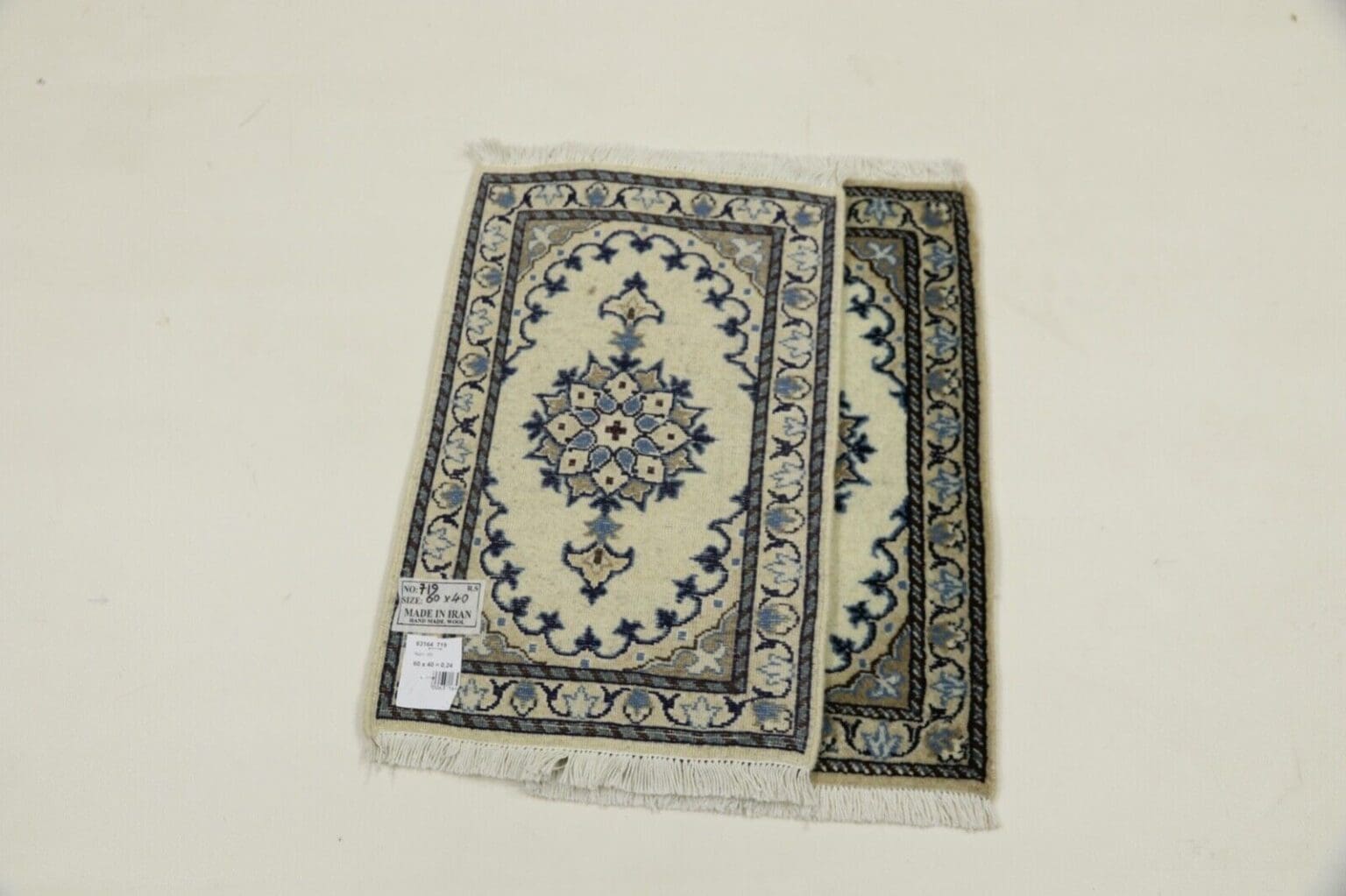
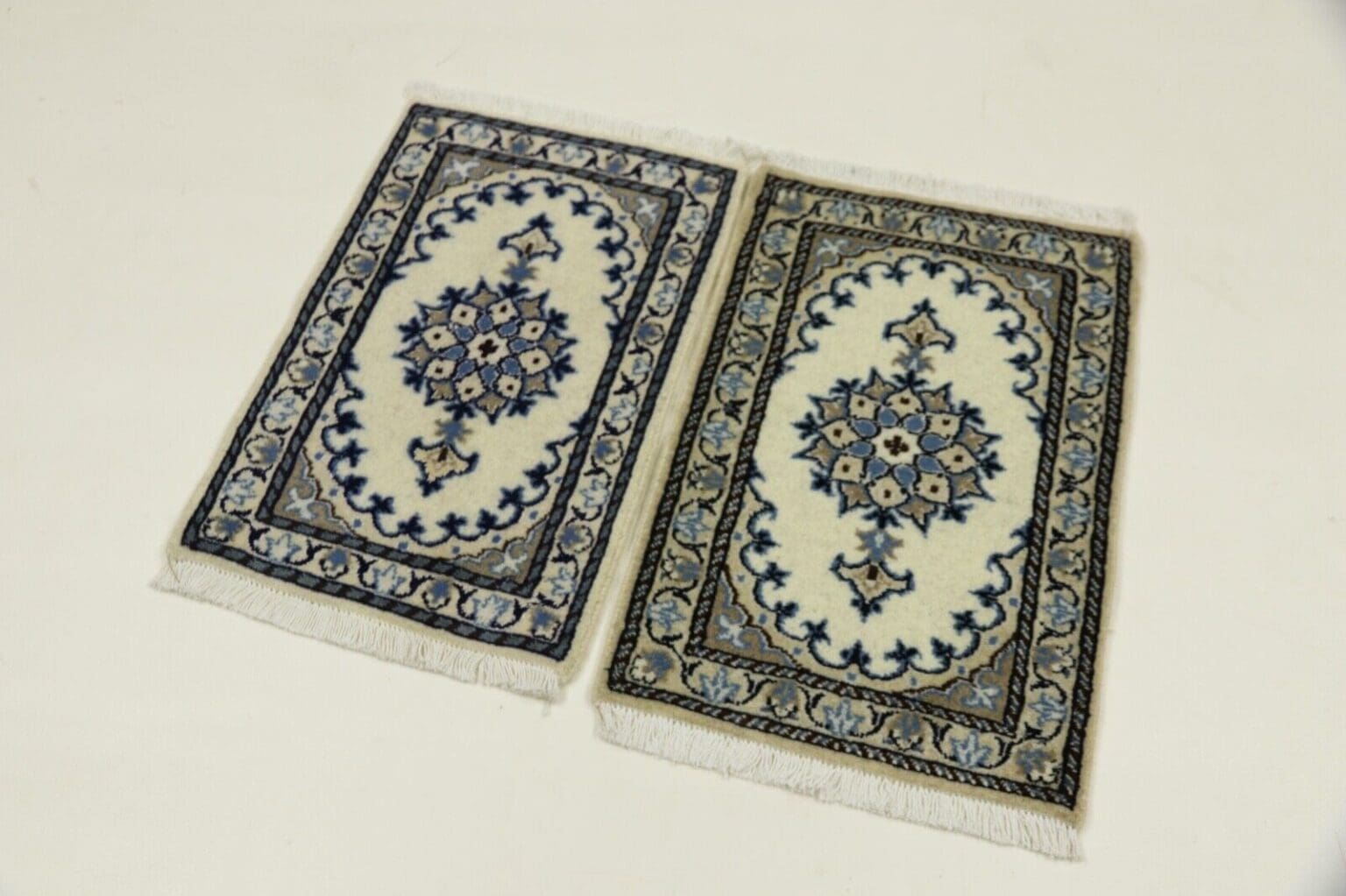
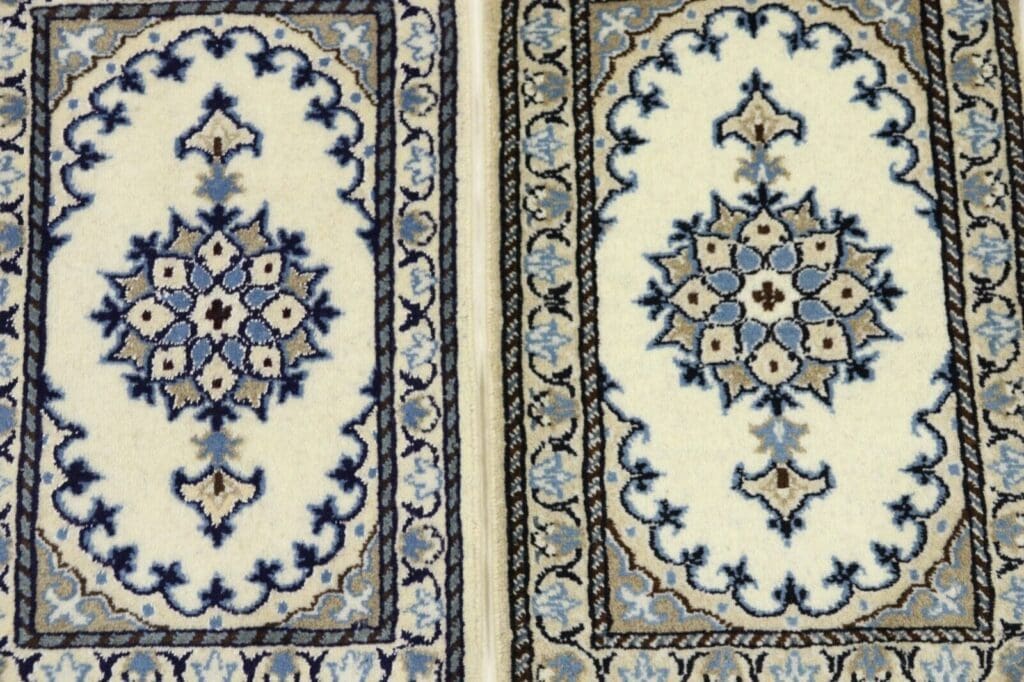
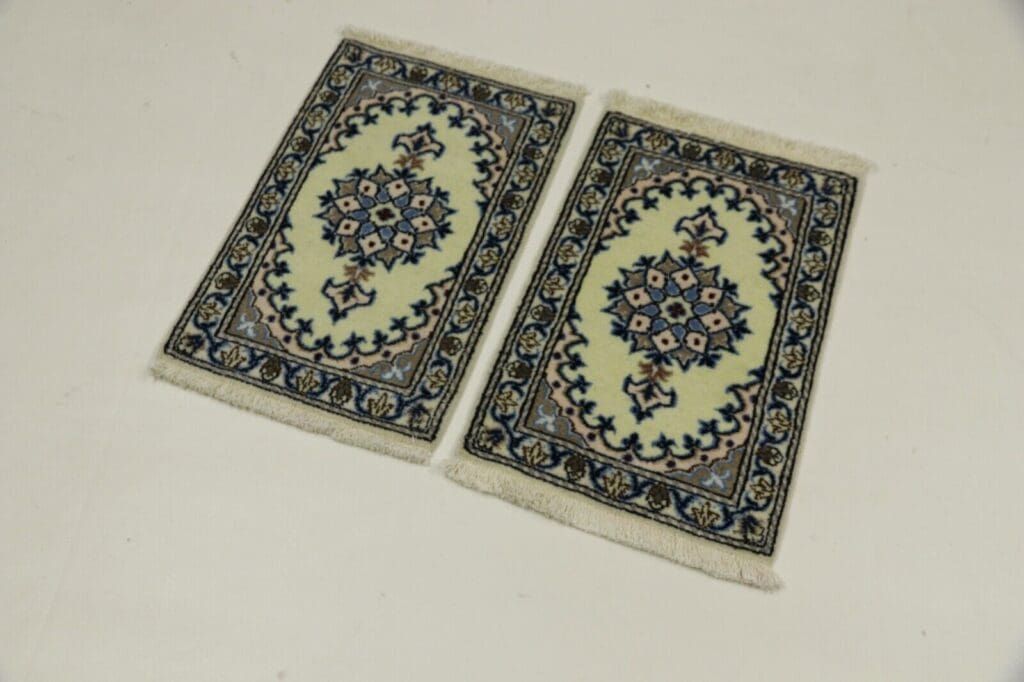
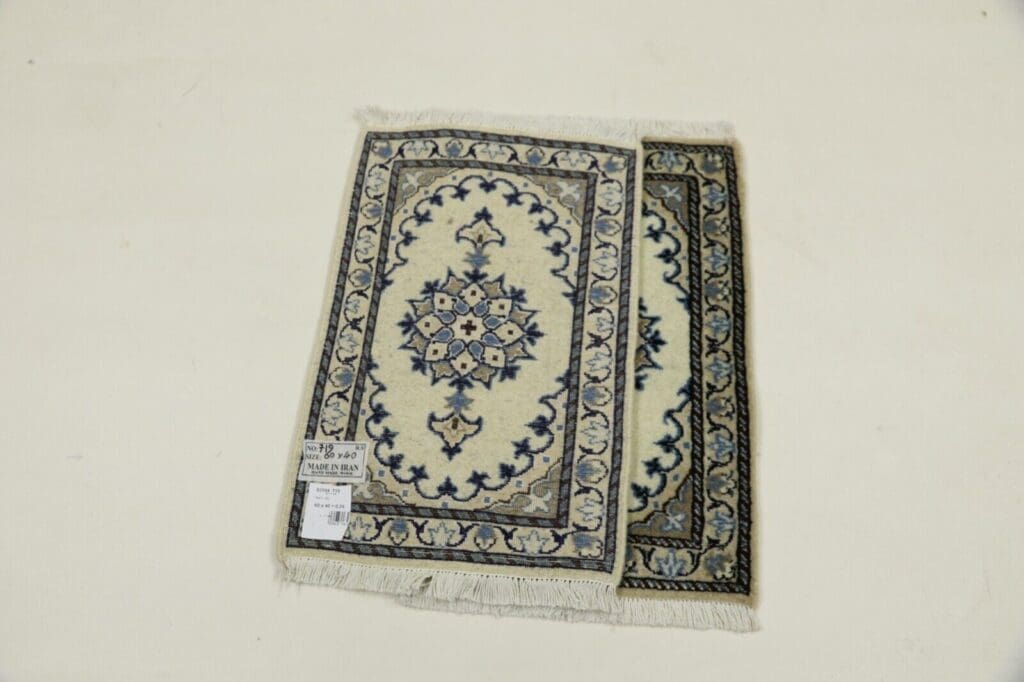
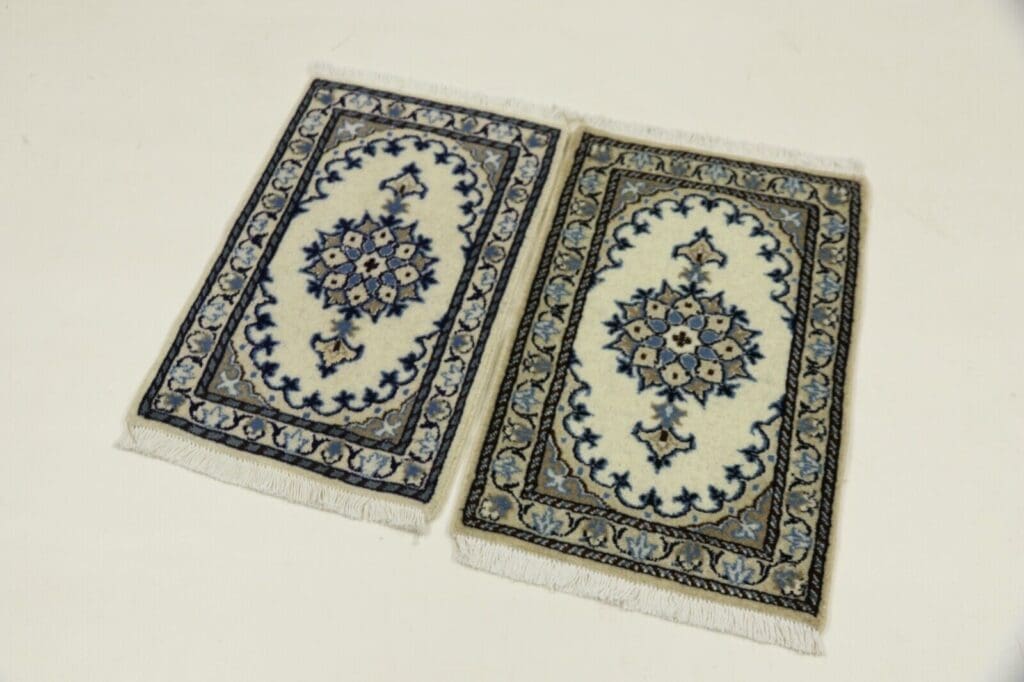
Hand-knotted Nain Persian Rug | Knot density: approx. 300,000 knots/m² | Material: pile 95% virgin wool, 5% silk, warp and weft 100% cotton | Size: 60 x 40 cm | Pattern: traditional Persian and Oriental | Condition: new, in very good condition
This Nain Persian rug is hand-knotted, with a pile made from 95% virgin wool and 5% silk. The warp and weft are specified as 100% cotton. Its textile structure therefore combines a predominantly woollen pile with a small silk content and a cotton foundation. Virgin wool is widely used in rug making for its resilient and flexible fibres. It gives the surface a soft handle while providing a practical basis for regular use. Silk contributes a finer fibre character and can add a restrained sheen where it catches the light.
Hand-knotting is a manual construction method rather than an industrially repeated process. Individual knots are tied into the prepared foundation and then compacted through the successive stages of weaving. The work requires patience, accurate tension and close attention to the relationship between pile, warp and weft. The listed density of approximately 300,000 knots per square metre indicates a finely worked construction capable of supporting detailed ornament. This rug is also described as a unique piece and comes with a certificate of authenticity.
Wool and silk perform different textile functions within the pile. Wool provides body, elasticity and a comfortable surface, while silk can refine the appearance of selected areas through its finer texture and different response to light. Cotton in the warp and weft forms the underlying framework on which the knots are secured. These material details distinguish the parts of the rug clearly: virgin wool and silk belong to the pile, while cotton is used for the foundation threads.
The manual process also affects the character of an individual rug. A hand-knotted surface is built gradually, row by row, instead of being produced as a uniform machine-made repeat. Minor variations are part of this form of craft and help explain why each hand-knotted rug is treated as an individual work. The technique combines a durable textile structure with the careful placement of decorative elements. It requires both practical knowledge of weaving and a trained understanding of pattern proportions.
The listed wool and silk composition is relevant not only to appearance but also to everyday handling. Wool can absorb and release moisture in a measured way and generally gives a rug a warm, soft textile presence. Silk is more delicate as a fibre and is therefore valued for fineness and visual refinement. The cotton foundation supports the pile from below. Together, these materials describe the construction of this particular rug without suggesting that every Nain rug has exactly the same composition.
Origin and Tradition
Nain is a city in Iran and the name of a recognised Persian rug tradition. It lies near Isfahan and is known for finely made hand-knotted rugs. The city stands in the dry landscape of central Iran, within a region shaped by long-established craft, trade and urban culture. Nain rugs are understood through this regional setting as well as through their technical construction. The name identifies a tradition connected with a place, not merely a decorative label applied to an unrelated rug.
The rug-making history of Nain is described as extending back to the nineteenth century. During that period, weaving and rug production gained renewed importance in many Iranian centres. Workshops refined their methods, colour arrangements and designs in response to local practice and wider trade. Nain participated in the broader Persian tradition while developing a recognisable regional language. That language is associated with controlled drawing, carefully organised ornament and finely executed handwork.
Its proximity to Isfahan places Nain within one of Iran’s important cultural landscapes. Isfahan has long been influential in Persian art, architecture and textile design. Knowledge moved between workshops through craftsmen, commercial connections, pattern traditions and the exchange of materials. Nain developed its own identity within that wider environment. The result is a regional tradition that remains connected to Persian design history while retaining its own approach to line, colour and composition.
Persian rugs are constructed on a foundation of longitudinal warp threads and transverse weft threads. Pile knots are tied around the foundation, and rows of weft help secure and compact the work as it progresses. The final appearance depends on the preparation of the foundation, the regularity of the knots, the quality of the fibres and the accuracy with which the design is followed. These technical principles provide useful context for understanding why hand-knotted Persian rugs require considerable time and concentration.
Regional rug traditions are passed on through workshop practice and the continued use of established design vocabularies. Motifs may be preserved, simplified or adapted, but they remain connected to a shared history of Persian ornament. City names can therefore indicate more than a production location: they can also refer to a family of technical and visual conventions. Nain belongs to this network of Iranian traditions. Its identity is rooted in the relationship between place, handwork, materials and pattern.
Persian rug making has served practical, decorative and cultural purposes at the same time. A rug can furnish a room, preserve a design tradition and demonstrate the skill of its makers. The balance between these roles has allowed regional styles to remain recognisable while changing with different periods and interiors. Nain is part of that continuing history. The traditional and Oriental character assigned to this rug places it within a broad Persian context, while the Nain designation gives that context a specific regional reference.
Design and Pattern
The rug is described as traditional Persian and Oriental in style. Nain rugs are often associated with floral and geometric ornament. Floral designs may include stylised blossoms, leaves, scrolling vines and arabesque forms. Geometric shapes provide structure by setting intervals, borders or repeated units. Persian ornament is not necessarily a literal depiction of nature. Motifs are commonly simplified, balanced and arranged into a coherent pattern system that can be read across the entire textile.
Nain design is frequently recognised for its ordered and finely articulated appearance. A composition may be organised around a central field, repeated vines or a relationship between field and border. These are general possibilities within the tradition and do not assert a specific layout for this individual rug. What defines the design language is the disciplined relationship between line, repetition and space. A fine knot construction can support small details and careful contours, allowing a pattern to be developed with considerable visual precision.
Soft, balanced colours are commonly connected with Nain rugs. Beige, blue and red are named as widespread tones in the source description. Beige can establish a quiet ground, blue can create cool definition, and red can provide a measured accent. The effect of a Persian rug does not depend on isolated colours alone. It also comes from the way shades are distributed, outlined and repeated. Light and dark areas work together to separate motifs and give the overall field a stable rhythm.
Floral ornament in Persian art often presents an idealised nature rather than a naturalistic scene. Gardens, flowers and vines become signs that can be repeated and arranged with mathematical order. On a rug, the garden idea may be suggested through a network of stems and blossoms rather than through a literal landscape. A geometric border can frame this inner field and create a clear transition toward the outer edge. Such combinations of organic and structured forms are part of the wider Persian design vocabulary.
The mixture of wool and silk may also affect how the design is perceived. Wool reflects light softly, whereas silk can appear brighter and more finely defined in areas where it catches illumination. As the viewing angle changes, parts of the surface may show subtle differences in lustre. This is a general textile effect of combining the two fibres. It explains why a finely knotted Nain rug can have a differentiated surface, while avoiding any unsupported claim about a particular motif or colour placement on this one-off piece.
Traditional Persian design can sit alongside both classic and contemporary furnishings because its structure is ordered rather than dependent on one historical interior. A carefully balanced field, border and colour relationship can function as a textile focal point without losing its regional identity. The term Oriental places the design within a broad cultural category; Nain identifies the Iranian tradition more precisely. Together, these descriptions place the rug within Persian decorative history and the wider world of Oriental weaving.
Special Features
This rug is described as new and in very good condition. It is identified as a unique piece and is supplied with a certificate of authenticity. Those are specific features of the offered rug. The combination of virgin wool and silk is associated in the description with a soft feel, an attractive surface and durability in use. Its hand-knotted construction, fine knot density and Nain tradition add technical and regional distinction to the material information.
Wool is generally considered a practical rug fibre when it is cared for appropriately. The care guidance provided for this rug recommends vacuuming regularly on a low setting, treating stains carefully with a damp cloth and mild cleaning product, and arranging professional cleaning every few years. To reduce exposure to ultraviolet light, the rug should not be placed in direct sun for long periods. Curtains or blinds can limit strong daylight. Turning the rug regularly helps distribute foot traffic and wear more evenly across the surface.
FAQ
What is the best way to clean my Nain Persian rug?
For routine care, vacuum the rug gently using a low setting. The surface should not be subjected to unnecessary force or aggressive brushing. If a stain occurs, a slightly damp cloth and a mild cleaning product are recommended in the supplied care guidance. Blotting carefully is preferable to vigorous rubbing, which can place additional stress on pile fibres and colour. Professional cleaning is recommended every few years. If the appropriate method is uncertain, a specialist should assess the fibres and test a discreet area before any extensive treatment is carried out.
How can I tell whether my rug is genuine?
Features associated with Nain rugs include a high knot density, characteristic patterns and a grey-blue selvedge or edge finish. Hand-knotted rugs may also carry a craftsman’s mark that supports their authenticity. This particular rug is additionally supplied with a certificate of authenticity. A sound assessment should consider several details together, including the stated origin, construction method, materials, pattern language and documentation. One feature by itself is not always enough to establish a rug’s origin or authenticity conclusively, especially when regional designs are reproduced elsewhere.
How can I protect the rug from light and wear?
To limit ultraviolet exposure, position the Nain Persian rug away from areas receiving prolonged direct sunlight. Curtains or blinds can be used to reduce strong daylight when needed. Rotating the rug at regular intervals helps spread walking pressure rather than concentrating it in the same areas. Gentle vacuuming and prompt, careful treatment of spills also support long-term care. Avoiding intense direct light, standing moisture and unnecessary friction helps preserve the surface qualities of wool and silk. These straightforward measures are particularly useful for maintaining a hand-knotted textile in very good condition.
To provide the best experiences, we use technologies like cookies to store and/or access device information. Consenting to these technologies will allow us to process data such as browsing behavior or unique IDs on this site. Not consenting or withdrawing consent, may adversely affect certain features and functions.
Functional Always active
The technical storage or access is strictly necessary for the legitimate purpose of enabling the use of a specific service explicitly requested by the subscriber or user, or for the sole purpose of carrying out the transmission of a communication over an electronic communications network.
Preferences
The technical storage or access is necessary for the legitimate purpose of storing preferences that are not requested by the subscriber or user.
Statistics
The technical storage or access that is used exclusively for statistical purposes.The technical storage or access that is used exclusively for anonymous statistical purposes. Without a subpoena, voluntary compliance on the part of your Internet Service Provider, or additional records from a third party, information stored or retrieved for this purpose alone cannot usually be used to identify you.
Marketing
The technical storage or access is required to create user profiles to send advertising, or to track the user on a website or across several websites for similar marketing purposes.

 SECURE PAYMENT
 SHIPPING PARTNERS


