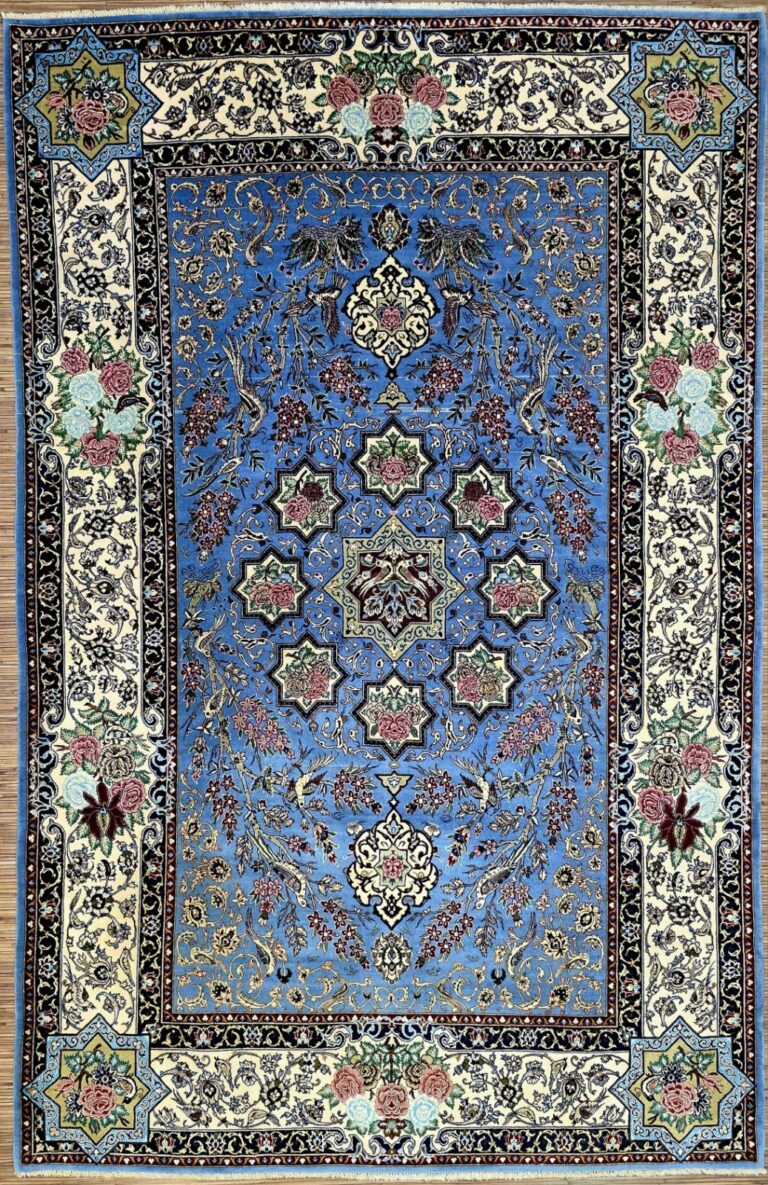
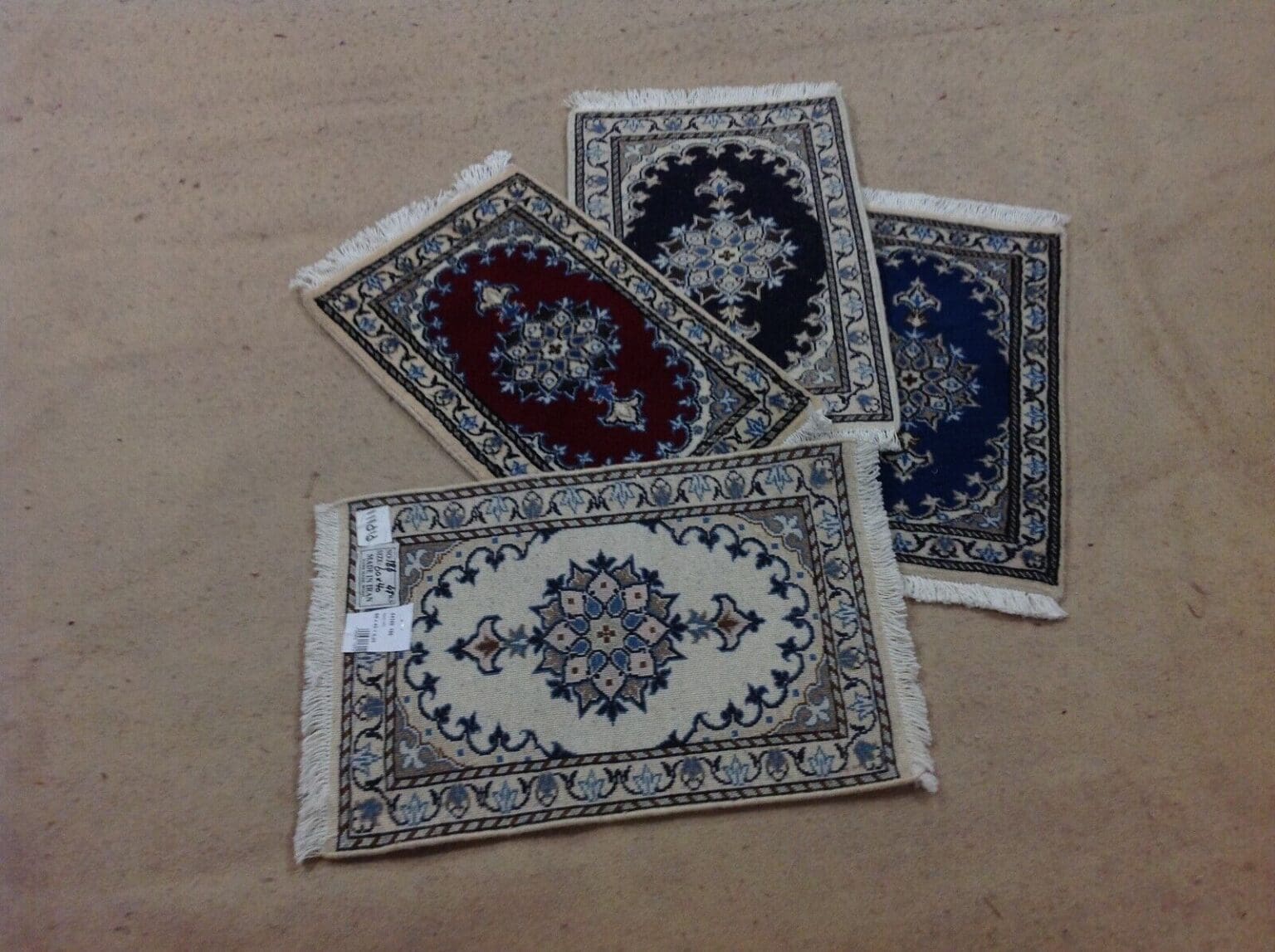
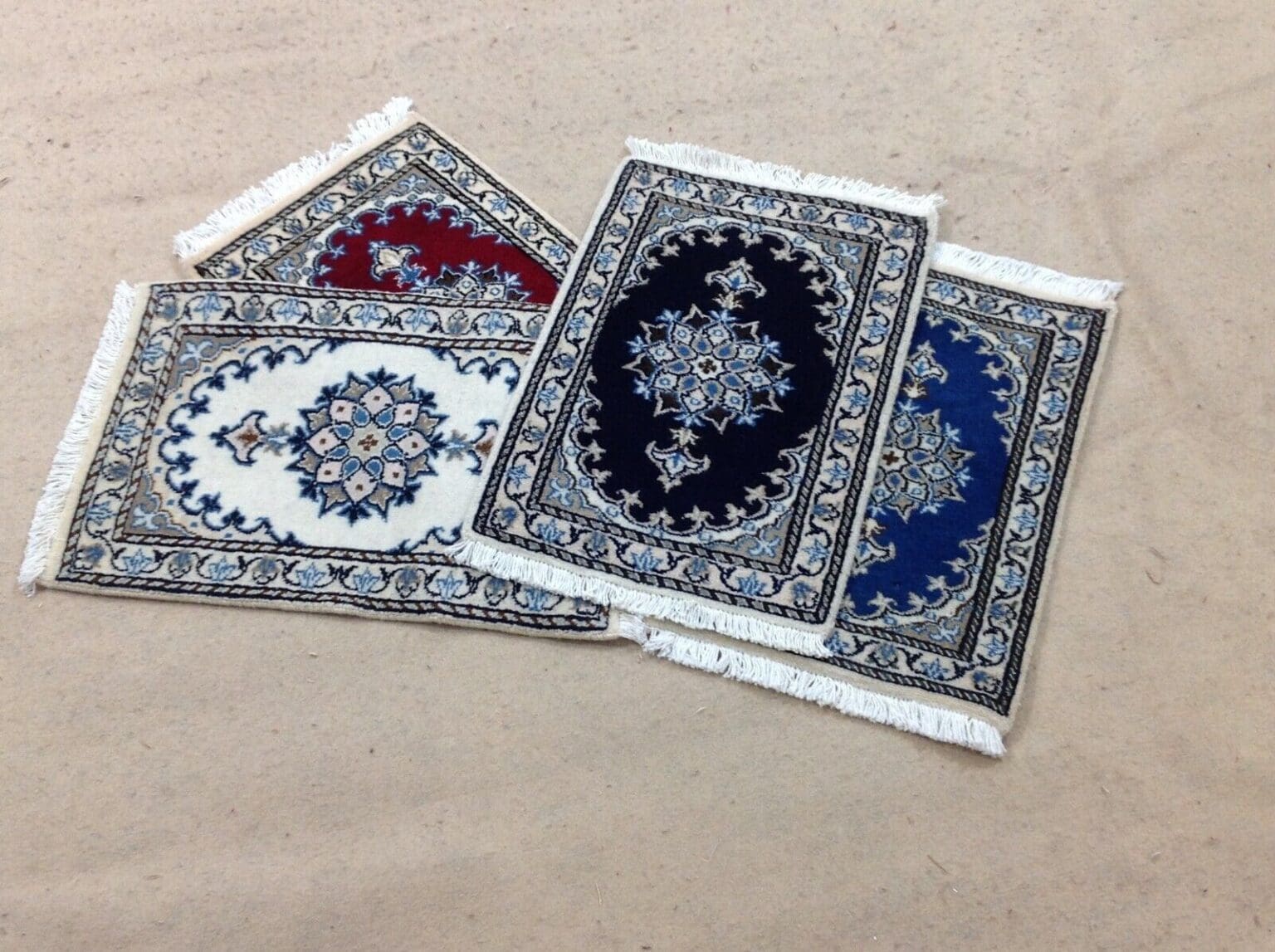
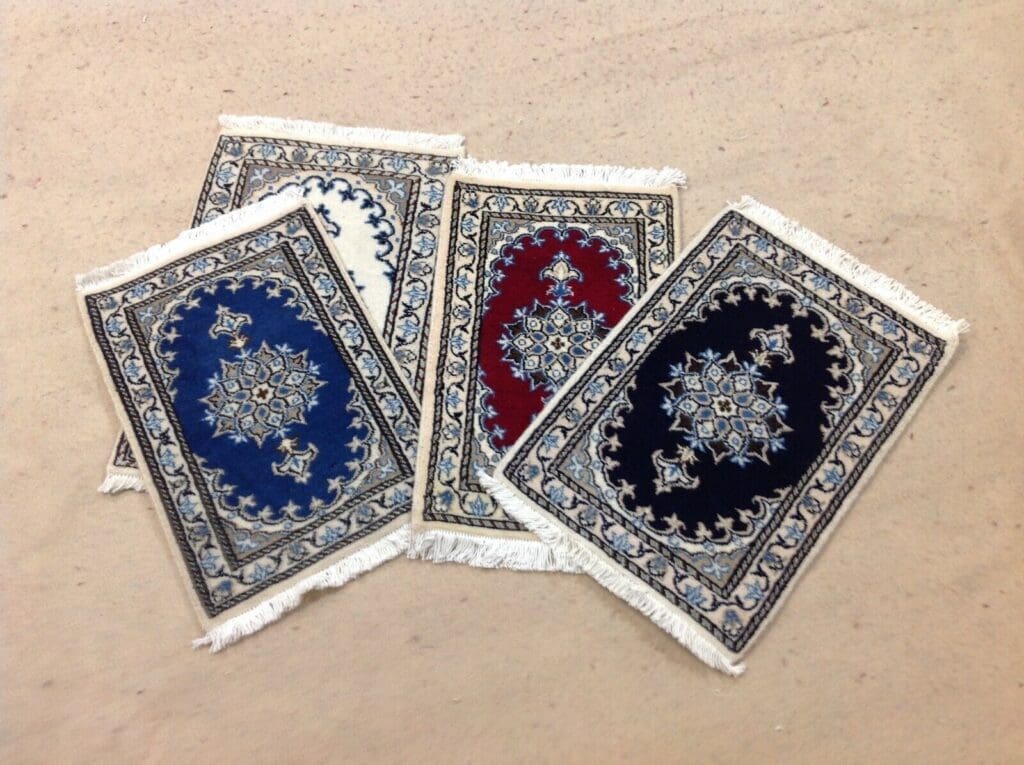
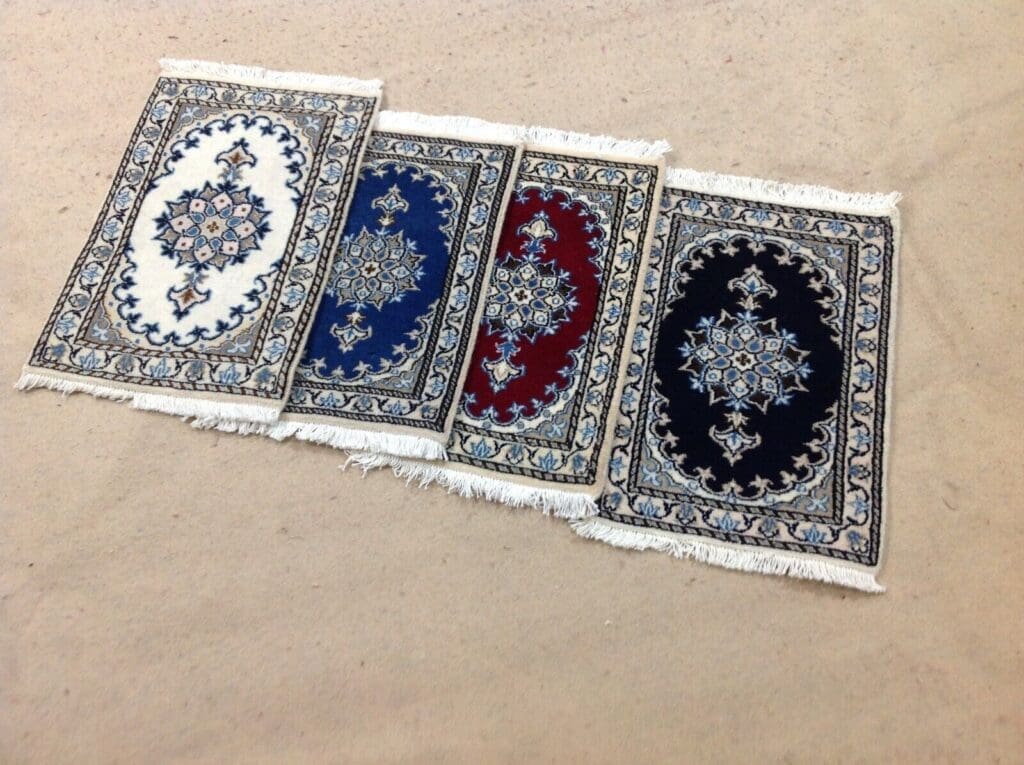
This Nain Persian rug is hand-knotted and made of 90% virgin wool and 10% silk. The two fibres define its material composition and its textile character. Virgin wool is widely used in rug making for its firm yet pleasantly soft feel. It can give a pile a naturally resilient structure and a tactile surface. In this rug, wool is the predominant material.
The silk content complements the wool with a finer sheen. Silk is used in rug design when small ornaments, outlines and subtle colour distinctions are intended to stand out clearly. Wool and silk therefore work together both as materials and as visual elements. The hand-knotted construction means that the knots are placed individually, making the woven structure part of the design rather than the result of a printed surface.
Hand knotting proceeds row by row, with each knot worked into the foundation before the next section is formed. The fine knotting specified for this rug is associated with detailed pattern work and careful execution. This piece is described as a unique one-off. Its craft character is consequently tied to this particular rug and cannot be understood as the output of a uniform industrial series.
The material mix also affects the way the surface receives light. Wool provides the visual and tactile body of the rug, while silk can create more delicate highlights in selected areas. The result is a combination of a soft textile presence and a finer reflective quality. The construction, materials and detailed knotting belong together: they explain how a traditional Nain design can be rendered with precise small-scale ornament.
Origin and Tradition
The rug comes from Nain, a city in Iran known for its rug production. Nain has a long tradition of carpet weaving, with a history reaching back to the fifteenth century. Over generations, local makers have passed on knowledge of knotting, structure, colour relationships and ornamental composition. This continuity is an important part of the identity attached to Nain rugs.
Nain rugs are associated with fine knotting and elegant designs. Their production belongs to an Iranian craft tradition in which technical accuracy and the balance of the complete composition are closely connected. A design has to be planned before it is knotted, with the field, borders and ornaments arranged in relation to one another. During the work, the weaver translates that plan into the fabric knot by knot.
Carpet weaving has cultural importance in Nain. Knowledge of established patterns and working methods is handed down from one generation to the next. The regional tradition combines exact workmanship with a clear and often restrained decorative language. A Nain rug therefore identifies not only a place of origin, but also a specific environment of skills, patterns and making practices developed over a long period.
Designs from the region often include motifs influenced by Islamic art. Flowers, scrolling foliage and geometric forms are recurring elements. They can be arranged in a balanced, symmetrical composition, with ornaments distributed through a central field and its surrounding borders. The individual details may be finely divided, yet they are intended to function as parts of a coherent overall pattern.
The origin of this rug refers to its Iranian provenance and to its place within the Nain weaving tradition. This should be distinguished from the motifs themselves: a floral or geometric ornament may occur in more than one weaving area, whereas Nain names the regional context of this piece. It is presented as a Persian rug from Nain and therefore belongs to the Iranian branch of Oriental rug making.
Design and Pattern
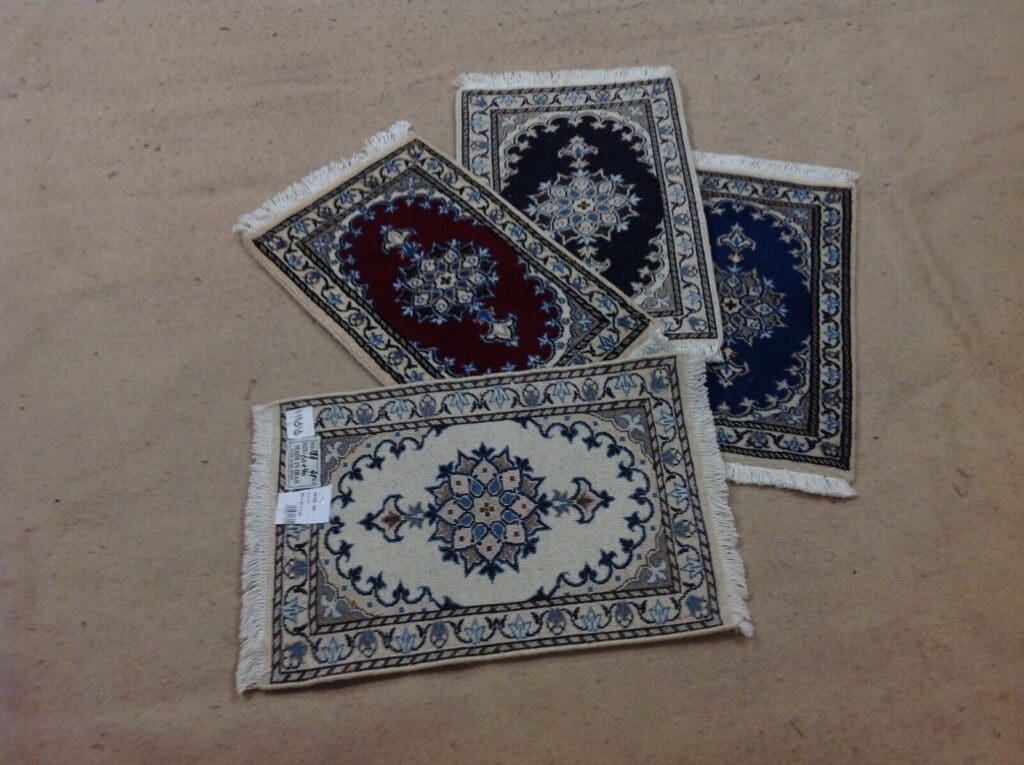
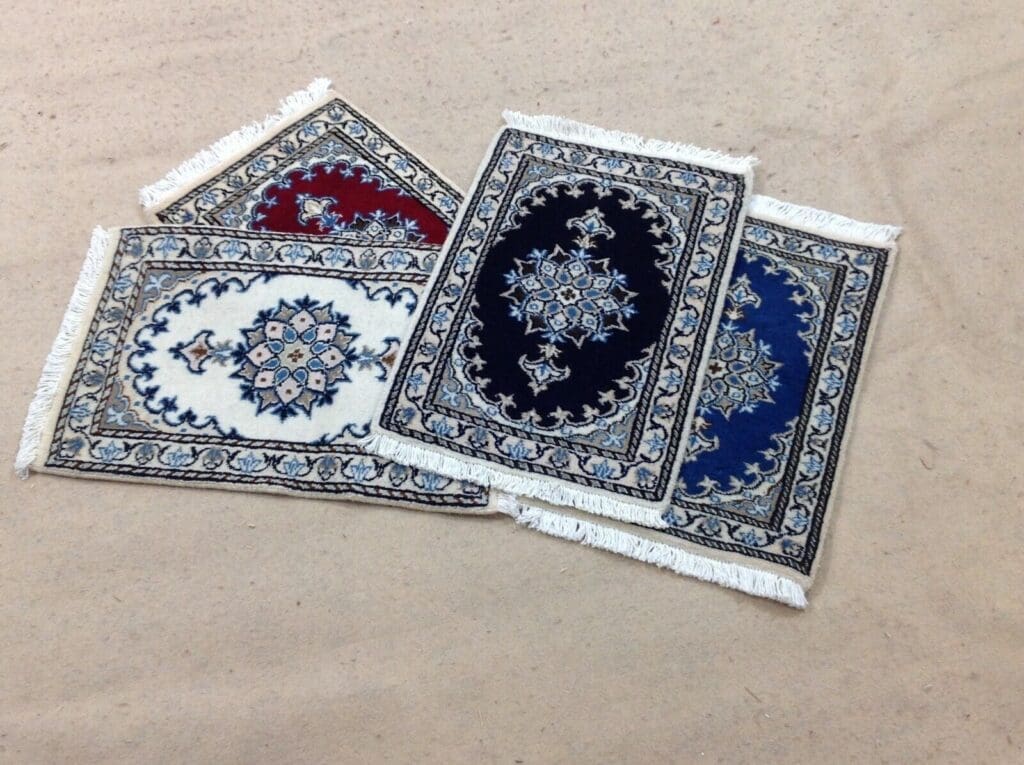
The pattern is described as traditional Oriental and reflects the elegant design language associated with Nain. Floral forms are often arranged symmetrically. Vines, blossoms and leaves may gather around a central ornament or continue across the field in a repeating rhythm. Geometric shapes can accompany the floral elements and introduce firm lines, measured intervals and recurring structures.
The design of such a rug depends on the relationship between open areas and fine detail. A central field provides the setting for the principal ornament, while border motifs can frame the composition. This division gives the eye a clear path through the design and creates a sense of order. In finely worked Nain patterns, small elements are coordinated closely so that lines, flowers and geometric details read as one connected image.
The colour impression is described as harmonious and based on gentle tones. Such colours can allow the different floral and geometric elements to relate calmly to one another. The silk content contributes to the differentiated light on the surface: certain areas may appear more luminous as the viewing angle changes. Wool gives the composition a textile depth, while silk can add a finer accent to selected parts of the pattern.
The character of the design is therefore created by the interaction of symmetry, ornament, colour and knotting. Fine knotting allows small shapes and transitions to be drawn with clarity. Islamic influences can be recognised in the use of floral and geometric motifs, but the design is not reduced to one single form. Its traditional character comes from the organised relationship among many individual elements.
The rug can be used in different interior settings. The product description identifies the living room, bedroom and hallway as possible locations. It also describes the design as compatible with both modern and classic interiors. This versatility is connected with the ordered ornament and harmonious colour effect. The rug can consequently be read as a traditional textile composition while remaining suitable for more than one type of room.
Special Features
This rug is identified as a unique one-off. An authenticity certificate is included. Its condition is stated as new and very good. Other specified features are the hand-knotted construction, the material combination of virgin wool and silk, the fine knotting and the traditional Oriental pattern. The description also characterises the rug as easy to care for and presents it both as a usable furnishing textile and as a piece of rug craftsmanship.
The fine knotting is described as an indication of the precision and workmanship invested in the pattern. Together with the Nain origin, the traditional design and the wool-and-silk composition, it gives the piece a clear identity. The authenticity certificate records the classification presented for the rug. Its one-off status further distinguishes this particular execution from a repeated, mass-produced design.
FAQ
How should I care for the Nain Persian rug?
Regular vacuuming is recommended for everyday care. The surface should be treated gently so that the pile and the textile structure are not placed under unnecessary strain. If a more thorough cleaning becomes necessary, professional rug cleaning is advisable. Direct sunlight should be avoided because it can cause colours to fade. These measures help preserve the surface, the wool-and-silk composition and the harmonious colour impression described for the rug.
Where can the Nain rug be used?
The rug can be used in several areas of the home. The living room, bedroom and hallway are named as possible settings. Its traditional Oriental design, with floral and geometric influences, can work with both modern and classic interiors. The appropriate placement depends on the room arrangement and on how the one-off is intended to be positioned. It can serve as a decorative textile surface as well as a hand-knotted furnishing element.
What makes this Nain rug distinctive?
Its distinctive features are its origin in Nain, Iran, its hand-knotted construction and its composition of 90% virgin wool and 10% silk. The fine knotting, traditional Oriental pattern and harmonious colour effect are additional characteristics. The rug is listed as a new, very good-condition one-off, and an authenticity certificate is included. These elements connect a regional weaving tradition with one particular execution. The description therefore presents it both as a functional furnishing item and as a work of rug craftsmanship.
To provide the best experiences, we use technologies like cookies to store and/or access device information. Consenting to these technologies will allow us to process data such as browsing behavior or unique IDs on this site. Not consenting or withdrawing consent, may adversely affect certain features and functions.
Functional Always active
The technical storage or access is strictly necessary for the legitimate purpose of enabling the use of a specific service explicitly requested by the subscriber or user, or for the sole purpose of carrying out the transmission of a communication over an electronic communications network.
Preferences
The technical storage or access is necessary for the legitimate purpose of storing preferences that are not requested by the subscriber or user.
Statistics
The technical storage or access that is used exclusively for statistical purposes.The technical storage or access that is used exclusively for anonymous statistical purposes. Without a subpoena, voluntary compliance on the part of your Internet Service Provider, or additional records from a third party, information stored or retrieved for this purpose alone cannot usually be used to identify you.
Marketing
The technical storage or access is required to create user profiles to send advertising, or to track the user on a website or across several websites for similar marketing purposes.
 SECURE PAYMENT
 SHIPPING PARTNERS