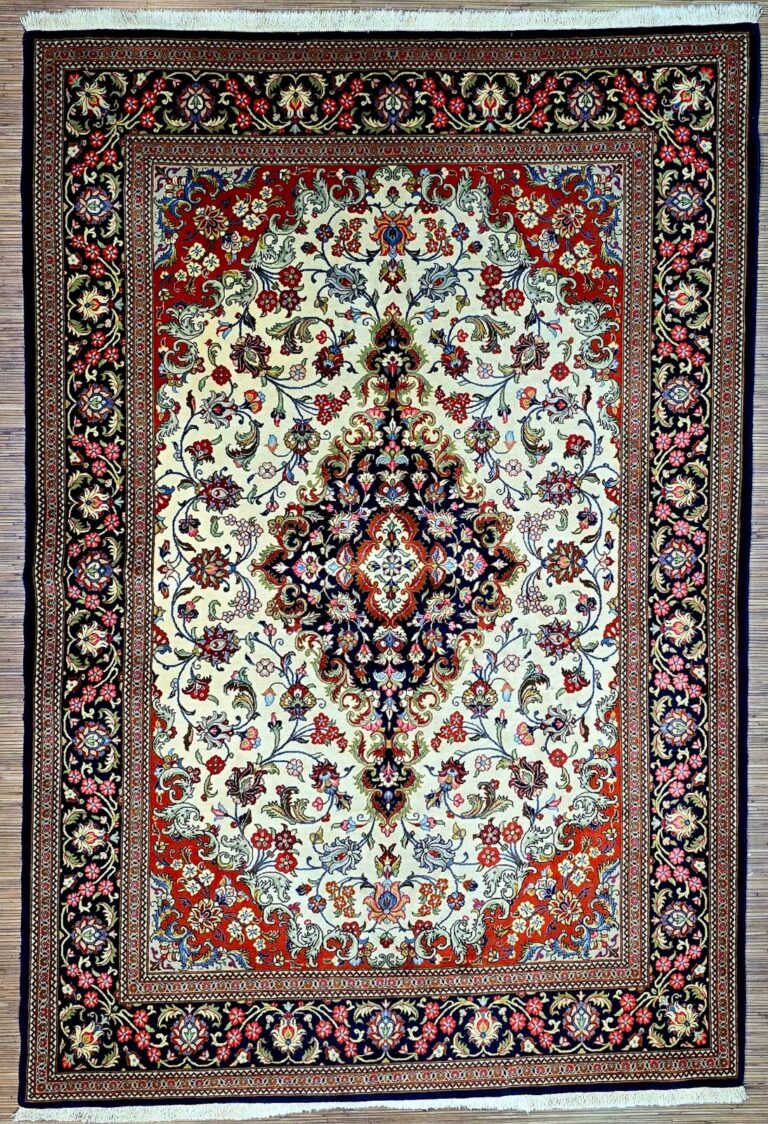
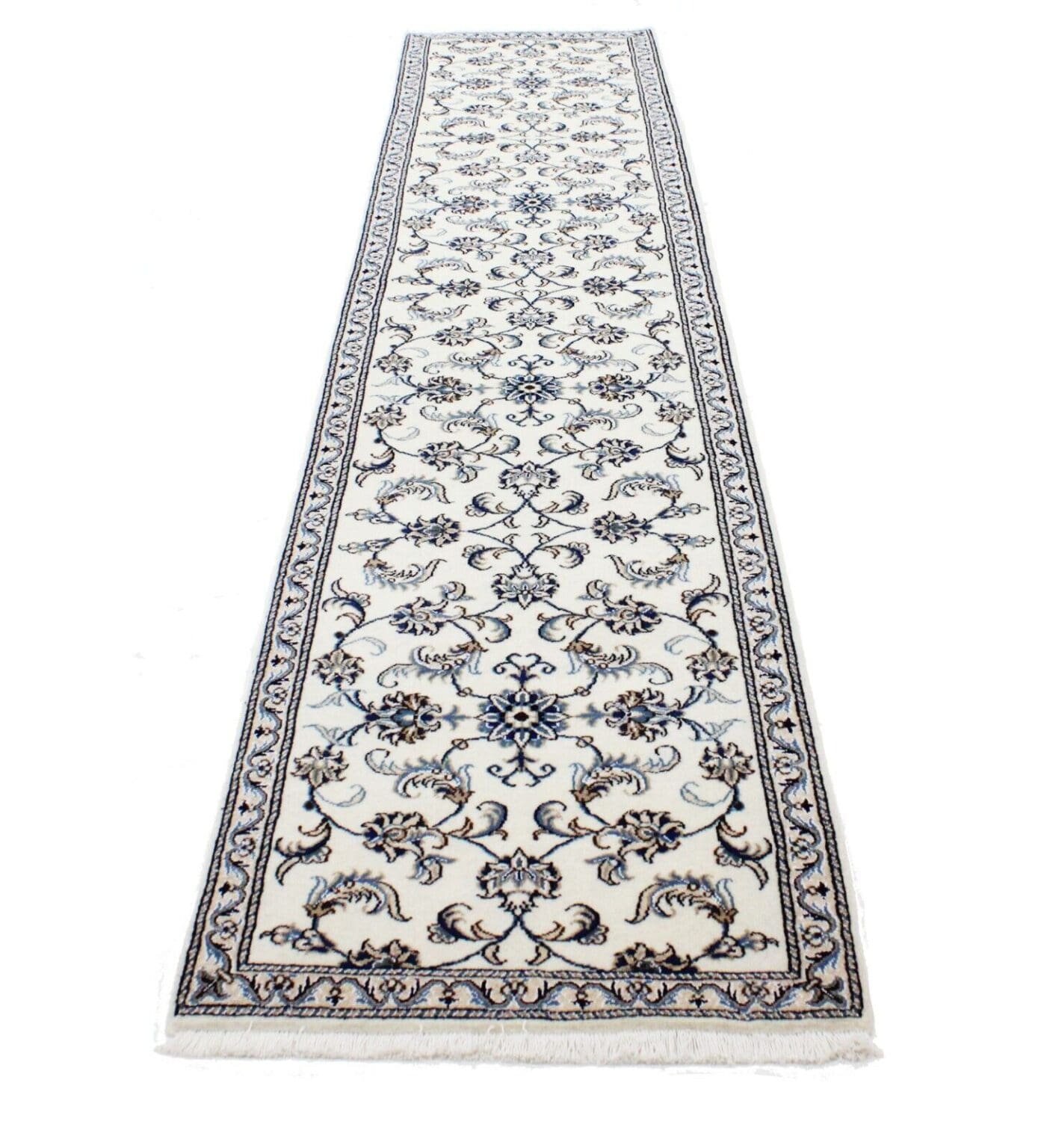
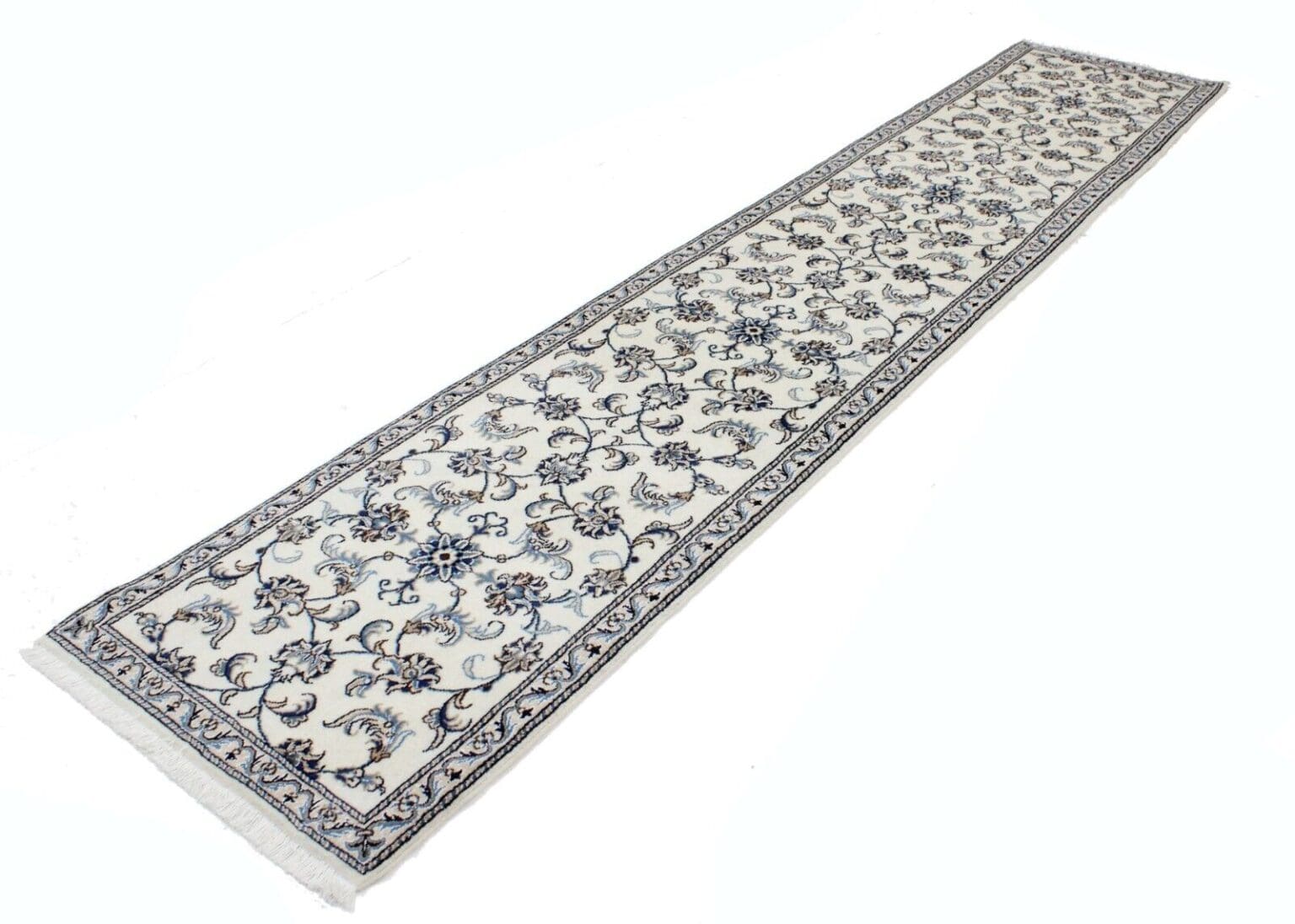
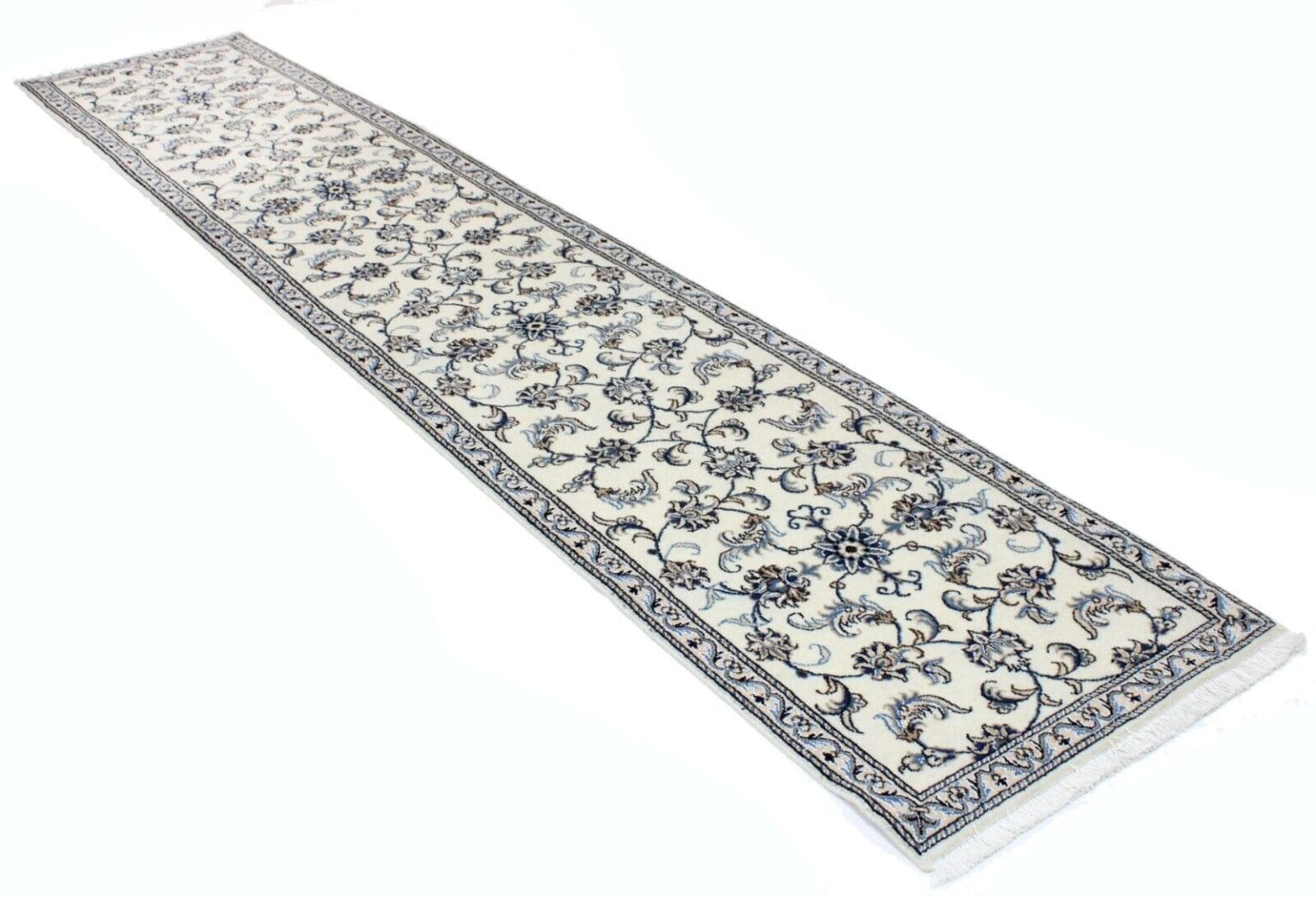
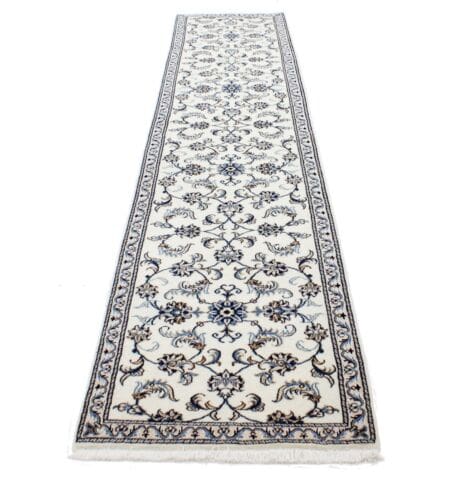
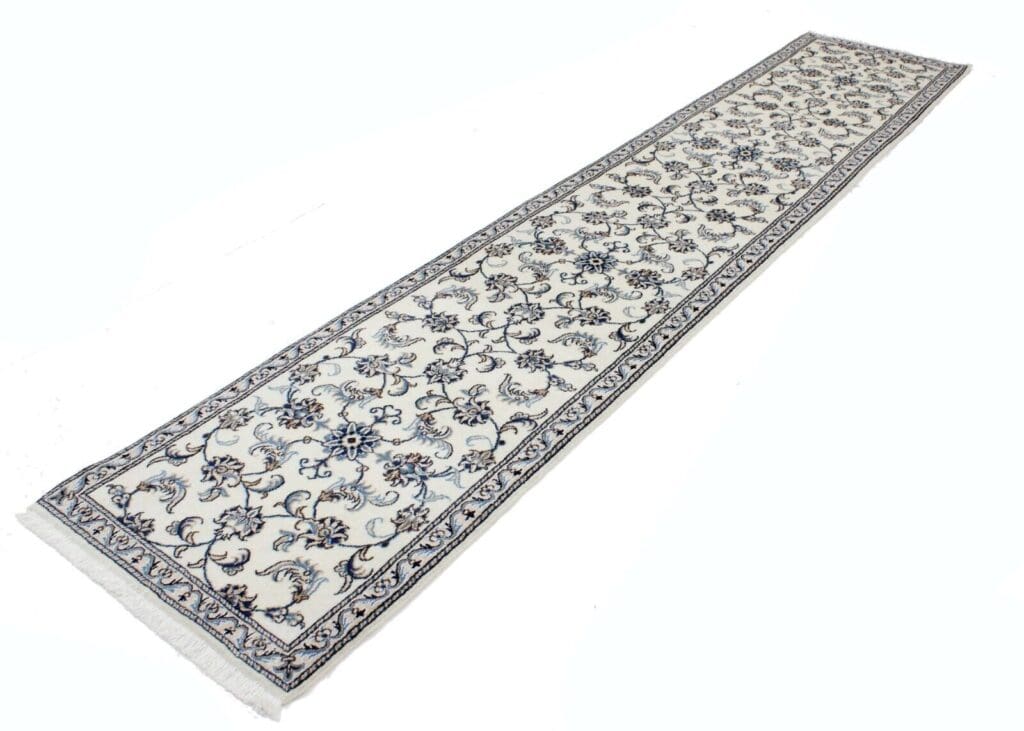
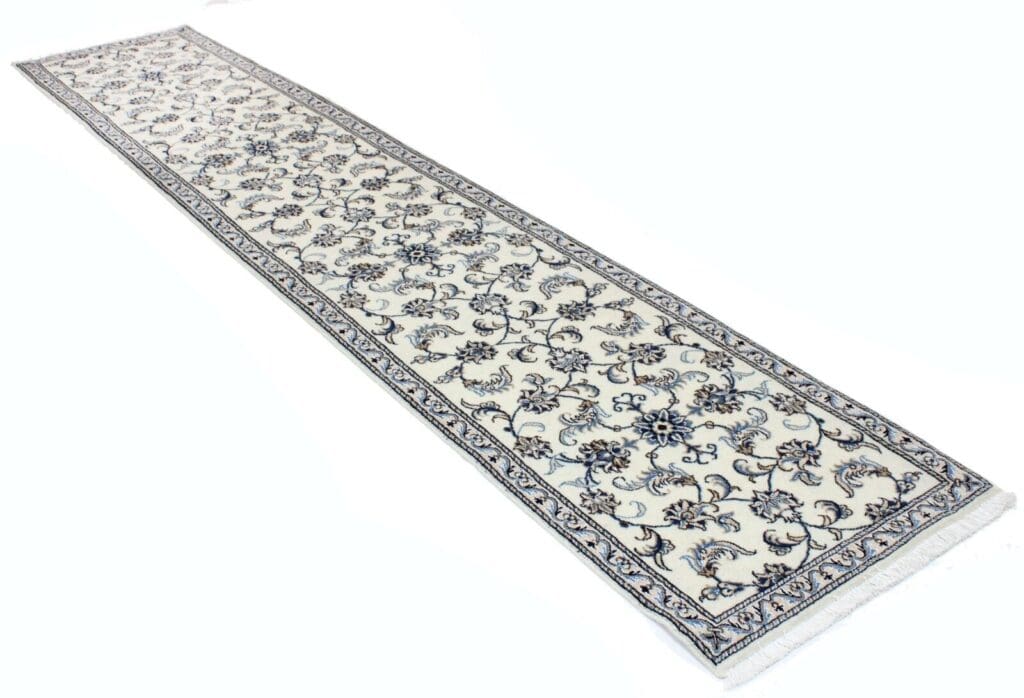
Hand-knotted Nain Persian rug | Knot density: hand-knotted | Material: wool and cotton | Size: 385 x 77 cm | Pattern: Oriental floral design | Condition: new without tag, top condition
This Nain Persian rug is hand-knotted and made from high-quality wool and cotton. Its construction is created one knot at a time. The design is therefore formed as part of the textile itself rather than being applied to an already finished surface. This method joins the visual pattern directly to the structure of the rug. The product information describes the knot density as hand-knotted; it does not provide a numerical knot count.
The long description identifies natural wool as the principal material. Wool has long been used in Persian rugs because it provides a resilient, tactile surface with a naturally warm feel underfoot. Its fibres can recover after ordinary pressure and give the pile a distinct textile character. Cotton is also listed among the materials. In hand-knotted rug construction, cotton is traditionally used in structural textile elements. The source does not specify which component of this particular rug contains which fibre, so the material statement remains limited to wool and cotton.
The rug is described as having a high pile. A higher pile changes both the feel and the appearance of a woven surface: the texture becomes more apparent when touched, while light is absorbed and reflected softly across the fibres. The stated combination of hand-knotting, natural wool and cotton defines the construction described for this piece. No additional treatment, impregnation, restoration or special finishing process is specified.
Hand-knotting requires the design to be followed continuously while the rug is being made. Individual knots are tied around the foundation, and rows of construction are secured as the surface develops. The result is a textile whose pattern and structure are inseparable. This is different from printing a design onto a completed floor covering. The technique is one of the defining methods associated with Persian rug making, while the precise working process, tools and workshop practice for this individual rug are not stated.
Origin and Tradition
The rug comes from Iran and is identified as a Nain Persian rug. Nain is therefore the named regional designation for this piece within the wider tradition of Iranian rug making. Persian rugs encompass many local styles, and their regional names can refer to established design languages, weaving traditions and workshop practices. The name Nain should here be understood as the designation supplied for this rug, not as a general name for every Oriental rug.
The source also mentions Isfahan, Kashan and Tabriz as well-known rug-producing regions. Each is associated in rug scholarship and trade with its own approaches to composition, colour and ornament. Regional distinctions may be visible in the arrangement of fields and borders, in the treatment of floral forms, and in the balance between fine detail and open space. Those broader comparisons provide context for Persian rug traditions, but they do not add another origin to this individual Nain rug.
Iranian rug making developed through the continuing transmission of textile knowledge. Designs are planned before and during the knotting process, and the weaver maintains the relationship between the intended drawing and the growing surface. A pattern may use repeated units, central organisation or a directional flow. The work demands attention to sequence and proportion because every section is built into the foundation. Hand-knotting consequently represents both a production method and a way of preserving regional visual traditions.
Nain is commonly treated as a distinct name within Persian rug classification. In a general historical and technical context, Nain rugs are associated with carefully organised compositions and an ordered ornamental language. Such background describes the type and its place in the broader tradition; it does not establish an unreported workshop, date or signature for this rug. For the individual piece, the stated facts are its Iranian origin and its Nain designation. No maker, workshop, production year or precise locality within Iran is given.
Persian rugs are used in a range of domestic settings, and their formats can help define circulation areas as well as larger furnishing zones. This rug is offered as a runner and is described as suitable for all rooms. It is also stated to be suitable for underfloor heating. These usage details connect the established Iranian craft tradition with present-day interiors. They do not imply a special room assignment beyond the information that the rug can be used throughout the home.
The traditional character of a Persian rug does not by itself establish an age classification. This piece is described as new without a tag and in top condition, not as antique or vintage. That distinction matters when discussing origin and tradition: a modern hand-knotted rug can belong to a long-established regional craft tradition without being an old historical object. The available description identifies the type, origin and making technique without assigning an age.
Design and Pattern
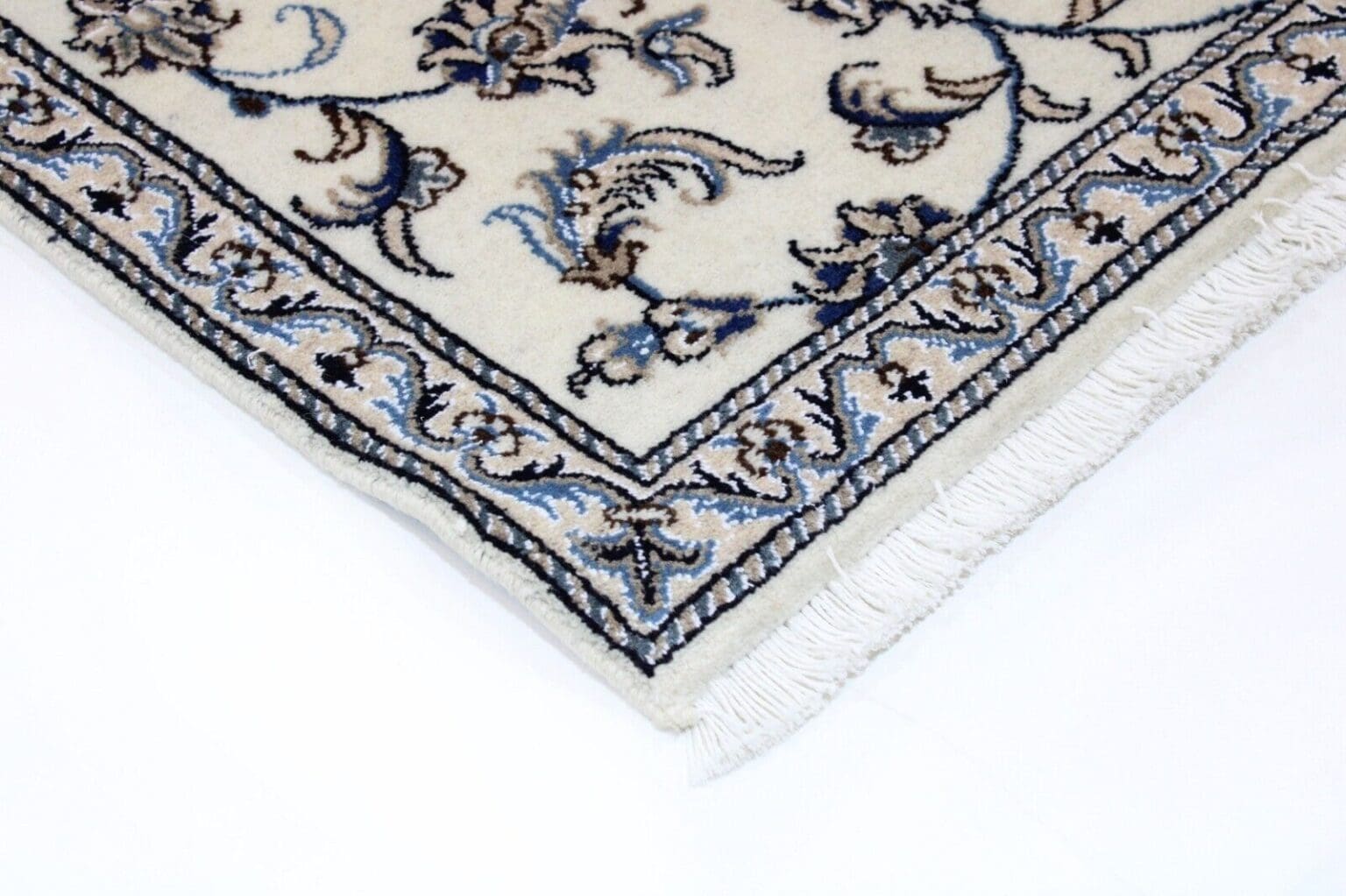
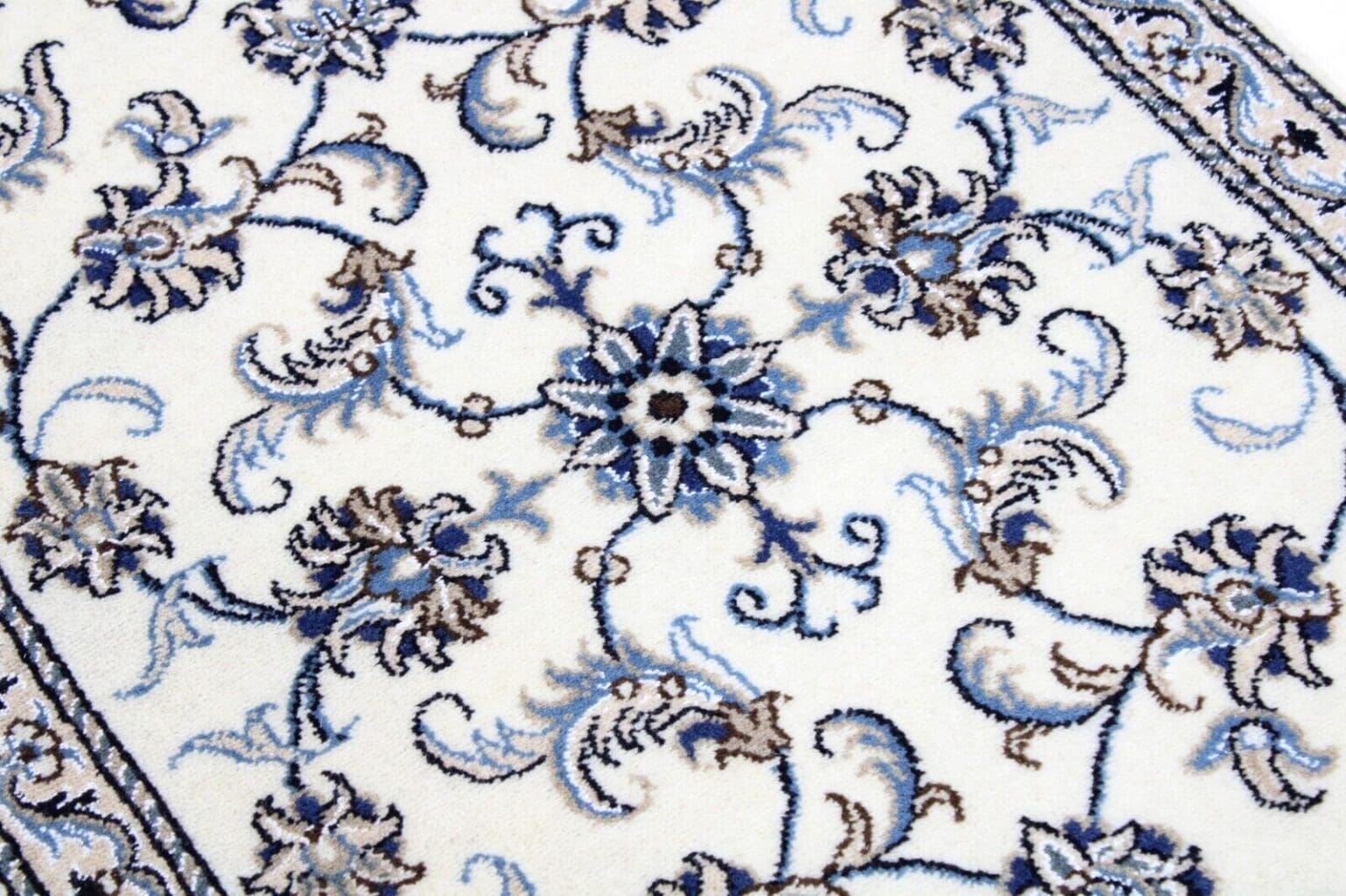
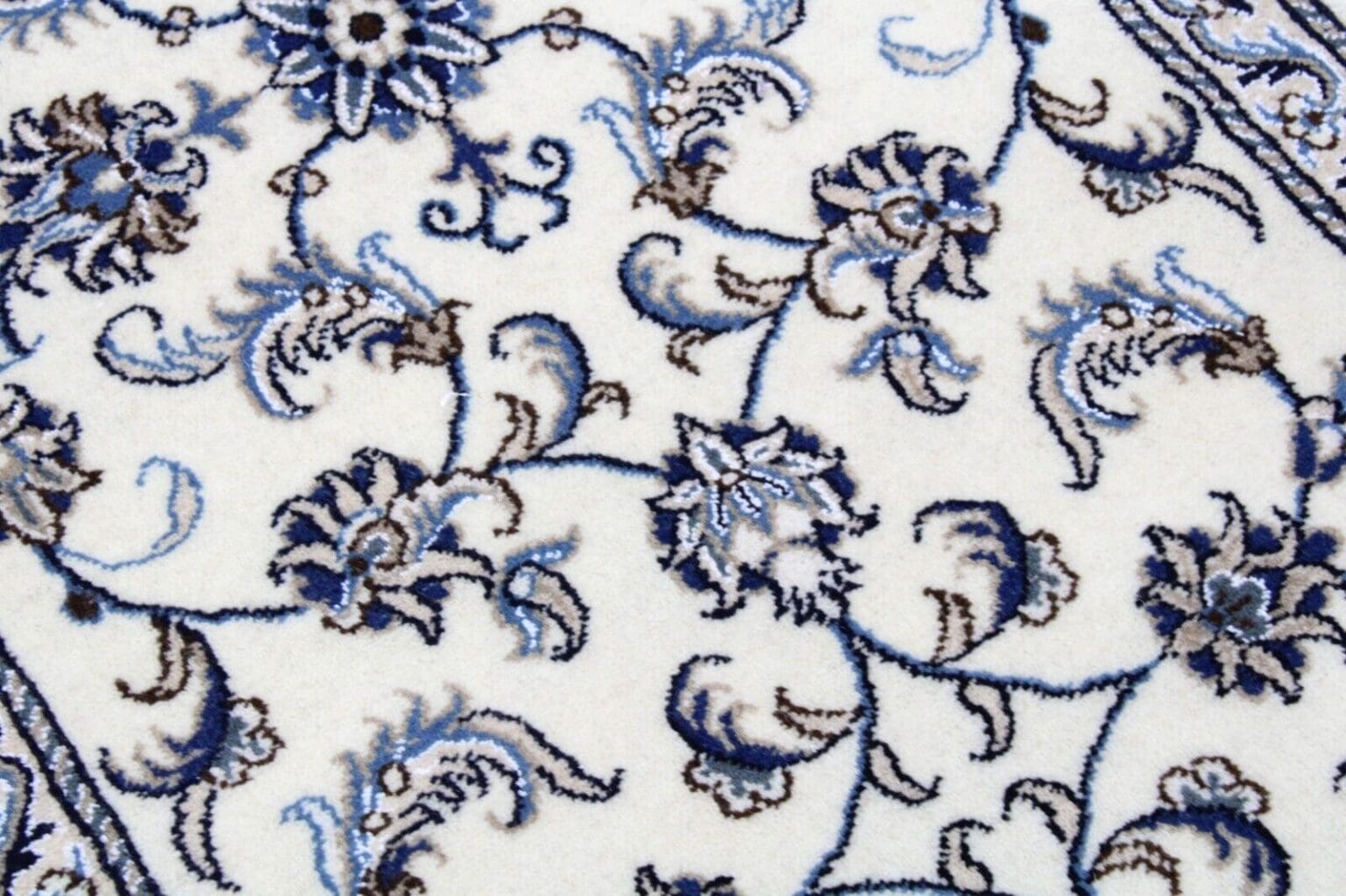
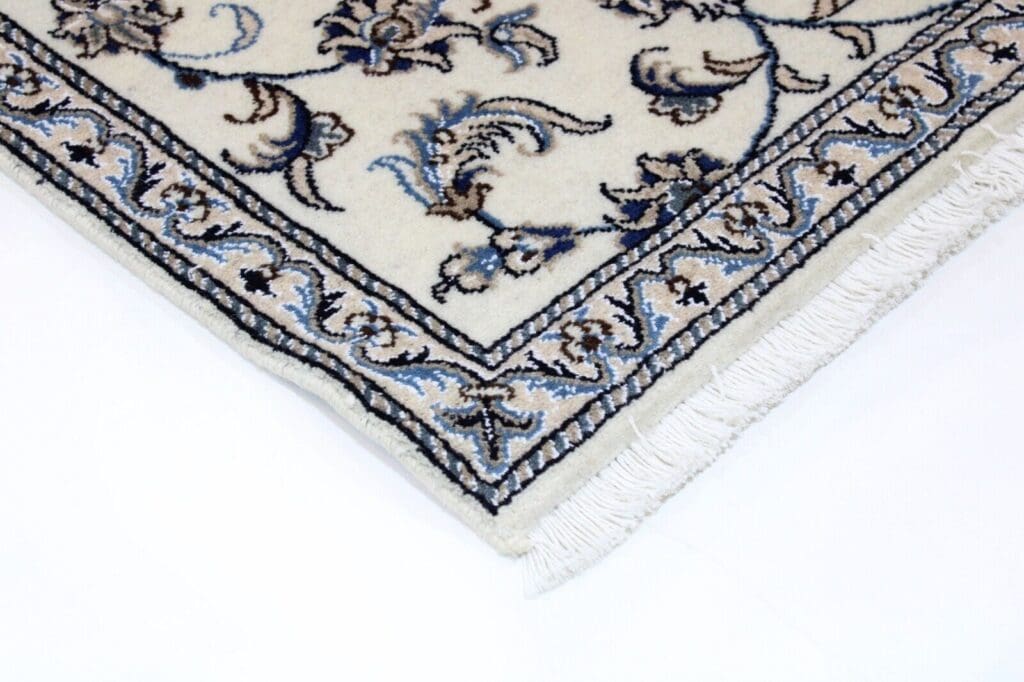
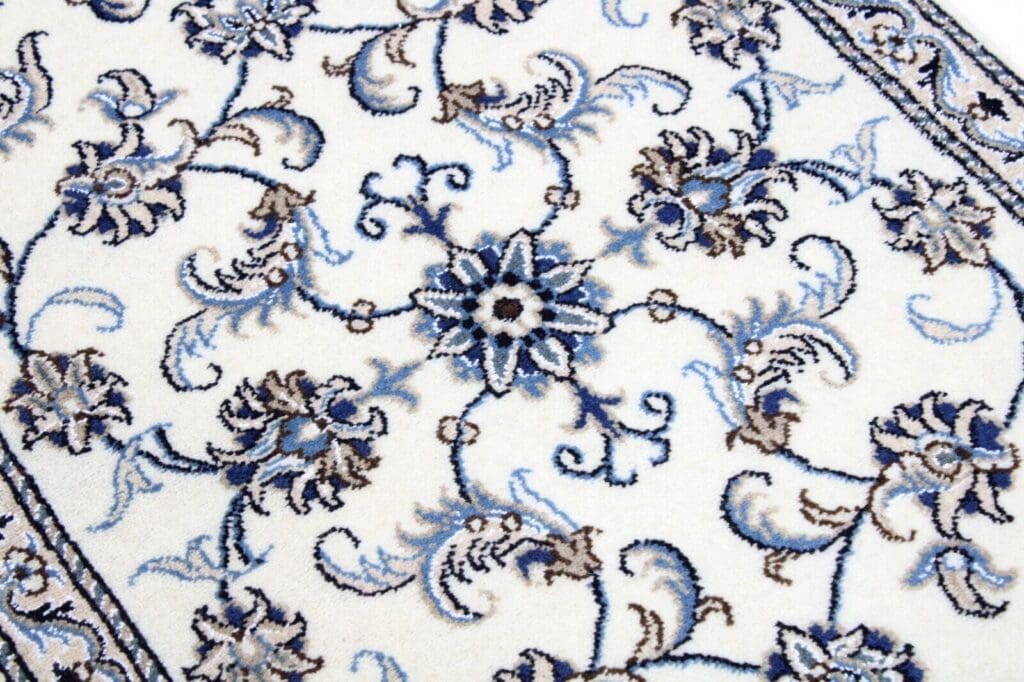
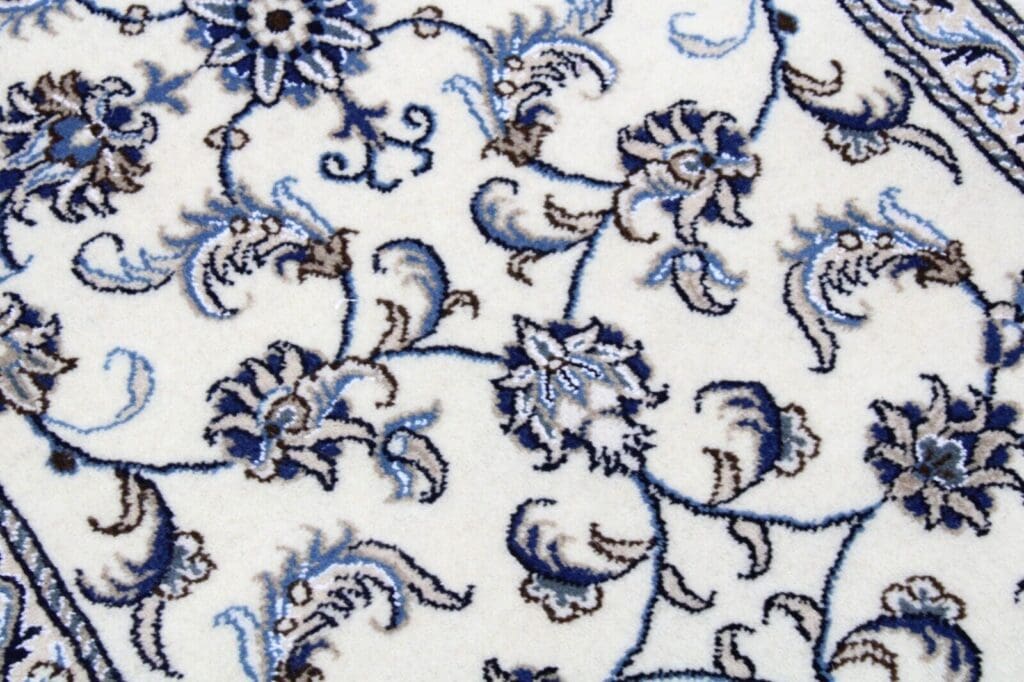
The design is described as Oriental with floral motifs. Flowers, leaves and related botanical forms are among the recurring elements of Persian rug design. They can be arranged as individual ornaments, connected through scrolling forms or repeated across a field. For this particular rug, the source confirms the broad floral character but does not name individual flowers, a border arrangement, a medallion or any secondary motif.
The stated colour is beige. In a rug design, beige can function as a calm ground or supporting tone, allowing floral forms to remain visible without a sharply contrasting effect. The precise colour arrangement, the number of shades and the position of the floral elements are not provided. The design can therefore be described factually as a beige Oriental pattern with floral motifs, without adding a more detailed palette or layout.
Floral ornament in Persian weaving often translates natural forms into a disciplined visual system. Repetition can create continuity across a long surface, while differences in scale can establish hierarchy between larger and smaller forms. Curving lines may guide the eye, and balanced spacing can keep a pattern legible. These are general principles of floral rug design. They explain how botanical ornament can provide both decoration and structure, but they do not identify unlisted details in this Nain rug.
The style is stated as traditional Persian and Oriental. Here, traditional refers to the design classification and its relationship to established Persian visual language. It does not mean that the rug has a historical age. No signature, designer, workshop or named pattern beyond the floral Oriental description is supplied. The design of this one-off rug should therefore be discussed through the confirmed designation Nain, the Iranian origin, the beige colour, the traditional style and the floral motifs.
As a runner, the rug presents its design along a lengthened field. A long format can accompany a passage, connect separate areas or provide a defined textile zone within a room. The high pile adds a tactile dimension to the pattern, because the surface is experienced through both sight and touch. The description states that the rug is suitable for all rooms and for underfloor heating. It does not assign the design to one particular room.
Persian and Oriental pattern terms are sometimes used broadly in retail language, so the named origin remains important. Floral ornament alone does not turn a rug into an Isfahan, Kashan or Tabriz rug. Those places appear in the source as examples of other recognised Iranian regions, whereas this individual rug is identified as Nain. The pattern statement remains accordingly precise: Oriental, floral, traditional Persian and beige.
Special Features
The rug is listed as new without a tag and in top condition. These are the condition details supplied for this piece. The description does not state whether it has previously been used, washed, repaired or stored in a particular way. No separate conservation report or inspection record is included in the source. The condition wording is therefore presented exactly as given rather than expanded with unsupported claims.
Other stated features are the Iranian origin, the Nain designation, hand-knotted construction, high pile, beige colour, floral Oriental pattern, suitability for all rooms and compatibility with underfloor heating. Together these details describe the rug offered as a one-off piece. A production date, signature, workshop name, numerical knot density and detailed fibre allocation are not provided.
The combination of a runner format and traditional Persian design gives the rug a clearly defined practical and visual role. The format can be used where a long textile surface is appropriate, while the floral pattern supplies the decorative language. The hand-knotted construction and high pile describe how the rug is made and felt. No claim is made here about a specific room, a specific historical period or a particular maker because those facts are not stated.
FAQ
Which materials are used in the rug?
The rug is described as being made from high-quality wool and cotton. The long description also refers to natural wool as the main material, giving the pile its warm, tactile character. Cotton is listed as part of the material combination. The source does not assign each fibre to a particular structural component, so it is not possible to state more precisely whether the cotton forms the warp or another part. The rug is hand-knotted and has a high pile.
How should the Nain Persian rug be cared for?
The supplied description does not contain a separate care instruction for this individual rug. In general, a hand-knotted rug should be cleaned regularly and treated without unnecessarily harsh methods. The suitable procedure depends on the fibres, pile and type of soiling. Because this rug is made from wool and cotton and is described as high-pile, professional advice is appropriate for thorough cleaning. The source does not state that this rug has already been washed, treated or professionally maintained.
Where do the rug’s patterns come from?
The rug comes from Iran and is identified as a Nain Persian rug with Oriental floral motifs. Persian rug traditions include regions such as Isfahan, Kashan and Tabriz, which are mentioned in the source as well-known examples. This individual piece, however, is designated Nain. No separate designer, workshop or named pattern source is given. The confirmed design information is therefore its traditional Persian and Oriental style, beige colour and floral motif.
To provide the best experiences, we use technologies like cookies to store and/or access device information. Consenting to these technologies will allow us to process data such as browsing behavior or unique IDs on this site. Not consenting or withdrawing consent, may adversely affect certain features and functions.
Functional Always active
The technical storage or access is strictly necessary for the legitimate purpose of enabling the use of a specific service explicitly requested by the subscriber or user, or for the sole purpose of carrying out the transmission of a communication over an electronic communications network.
Preferences
The technical storage or access is necessary for the legitimate purpose of storing preferences that are not requested by the subscriber or user.
Statistics
The technical storage or access that is used exclusively for statistical purposes.The technical storage or access that is used exclusively for anonymous statistical purposes. Without a subpoena, voluntary compliance on the part of your Internet Service Provider, or additional records from a third party, information stored or retrieved for this purpose alone cannot usually be used to identify you.
Marketing
The technical storage or access is required to create user profiles to send advertising, or to track the user on a website or across several websites for similar marketing purposes.

 SECURE PAYMENT
 SHIPPING PARTNERS