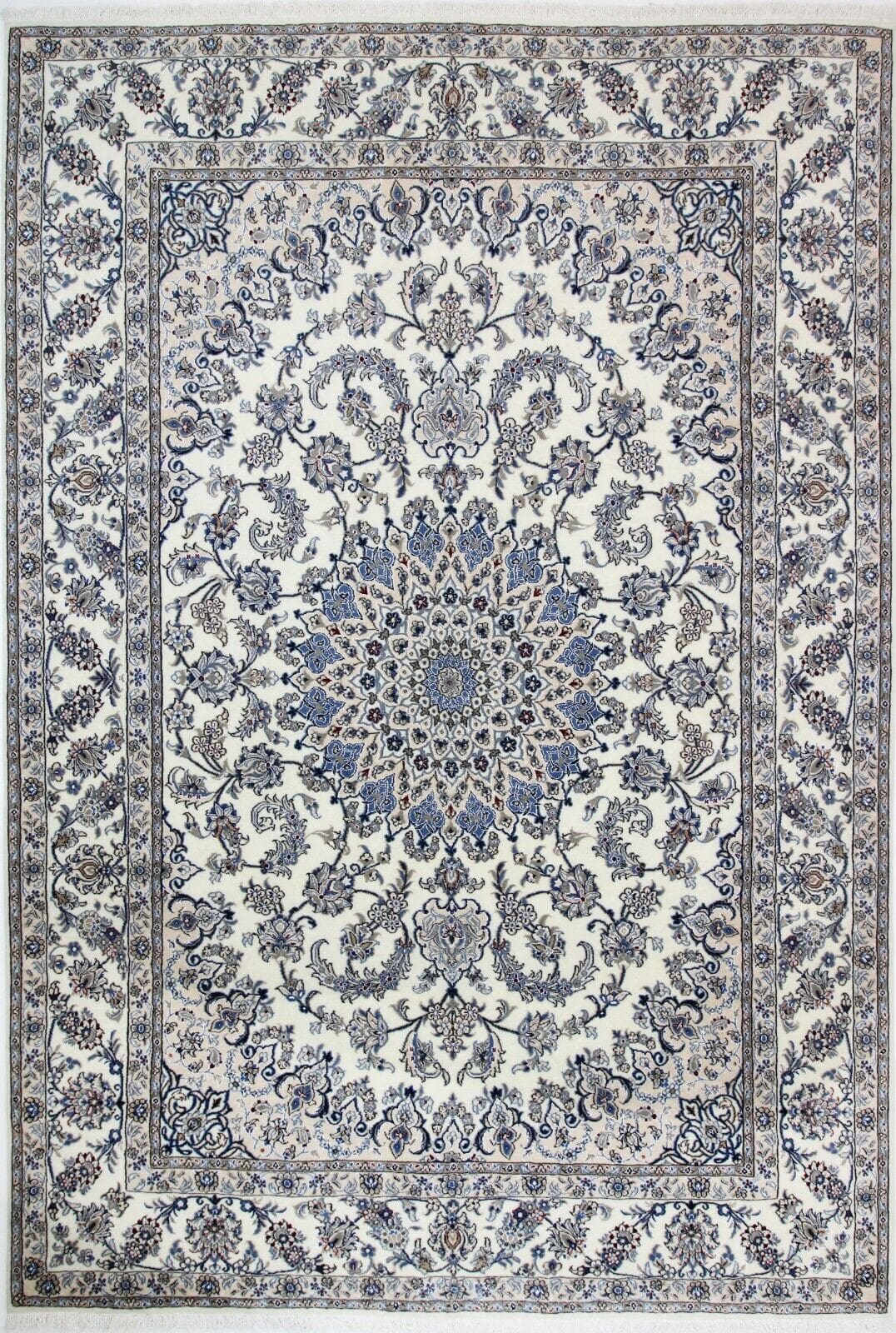
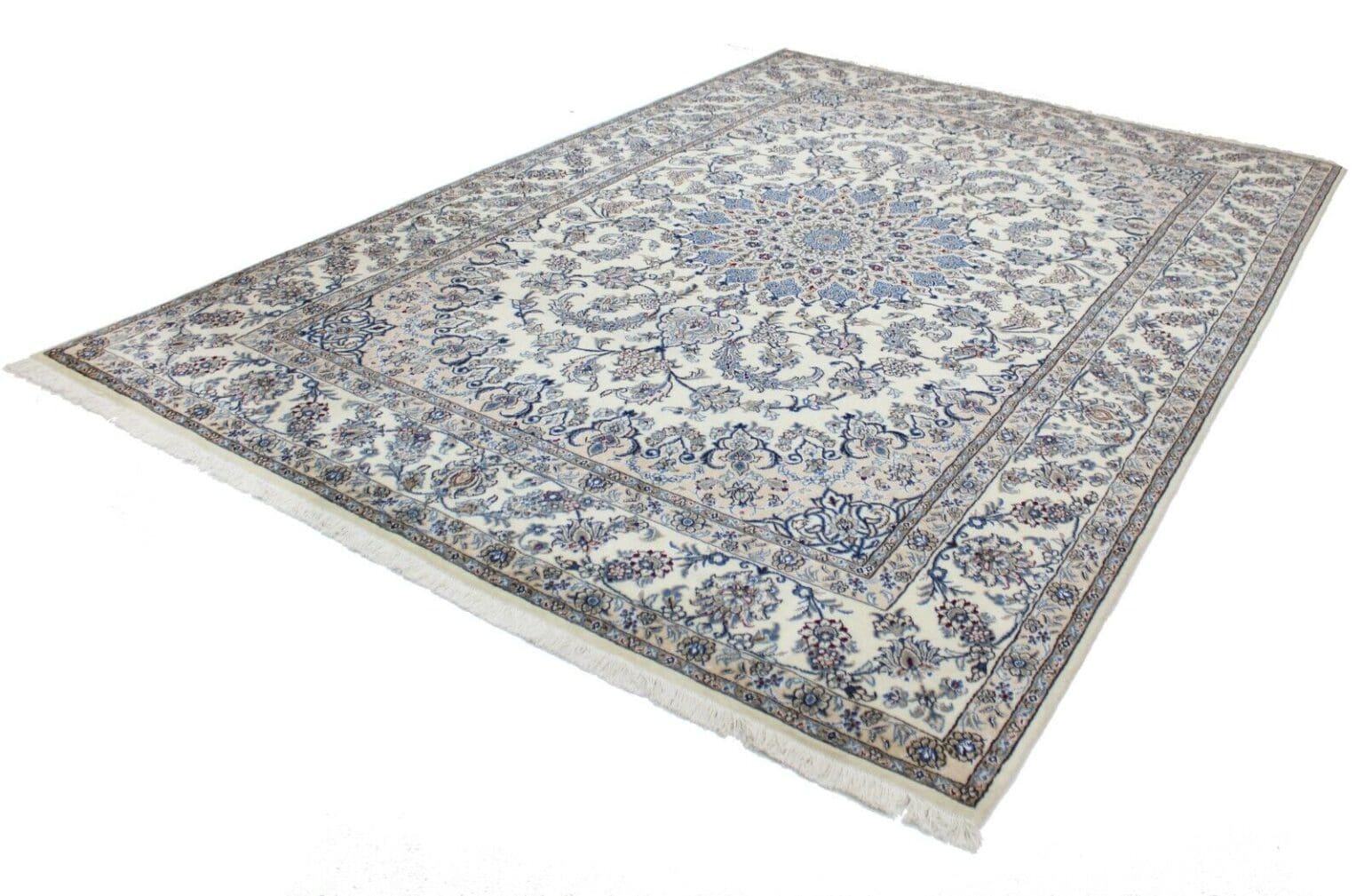
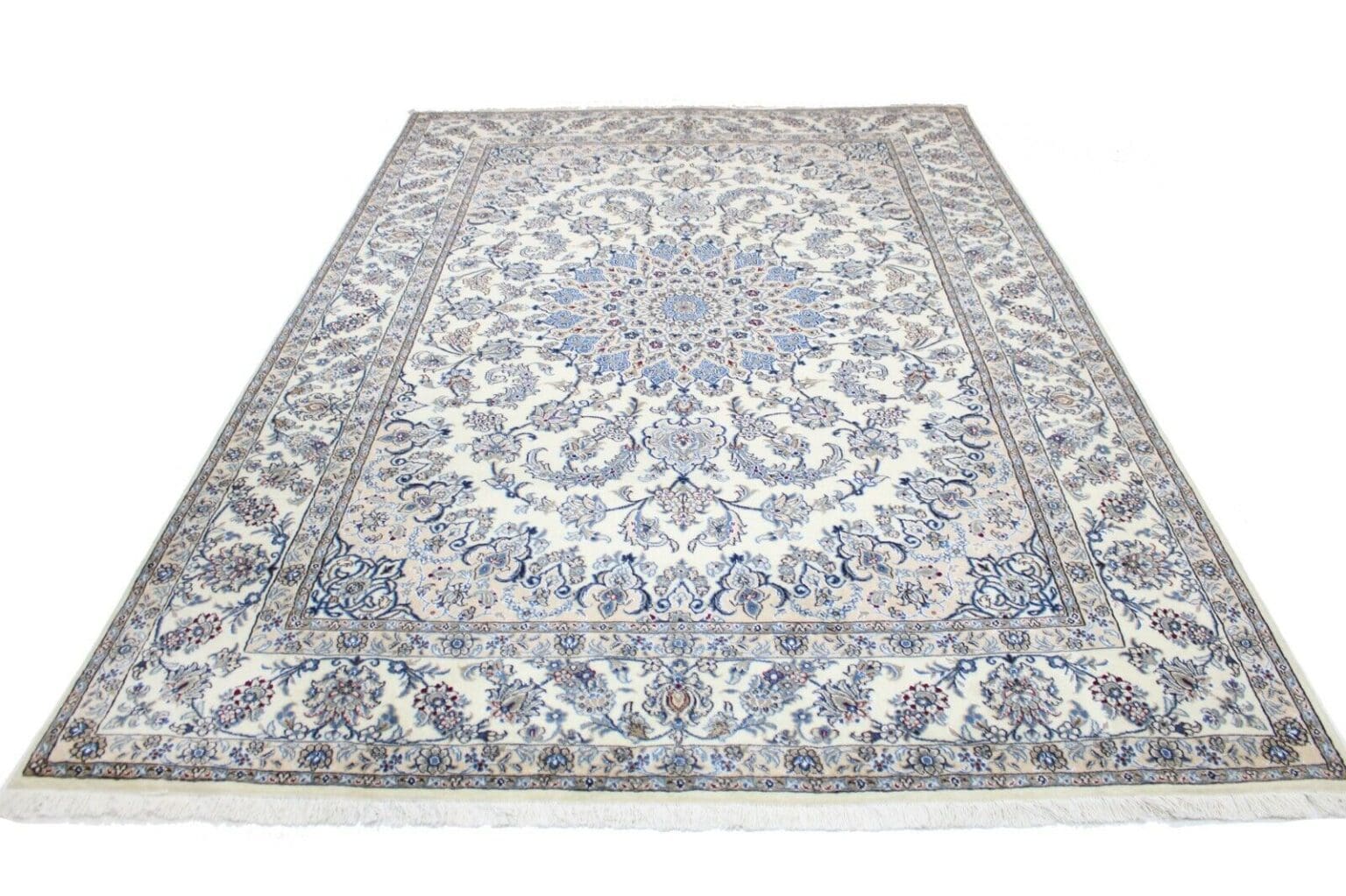
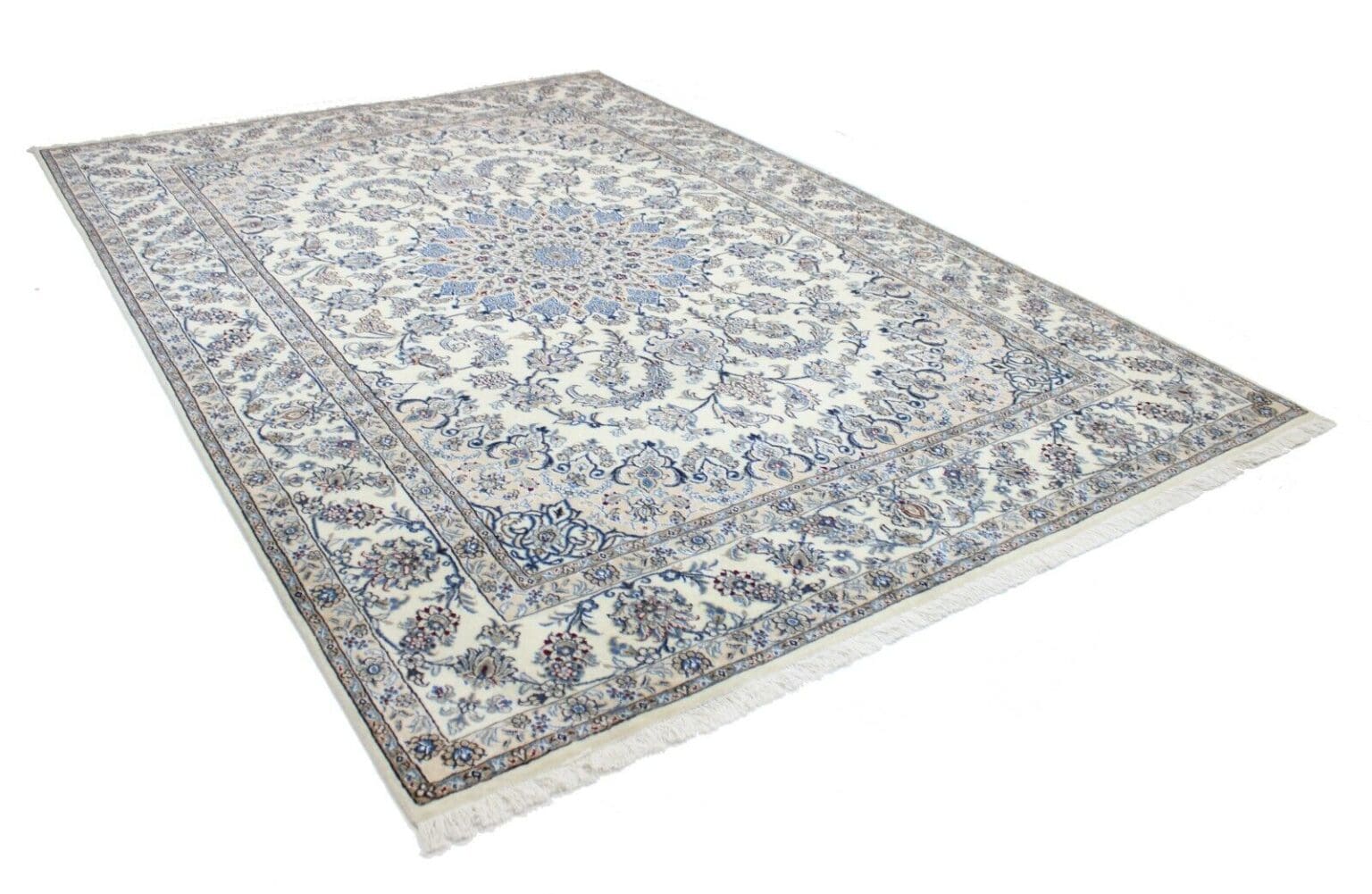
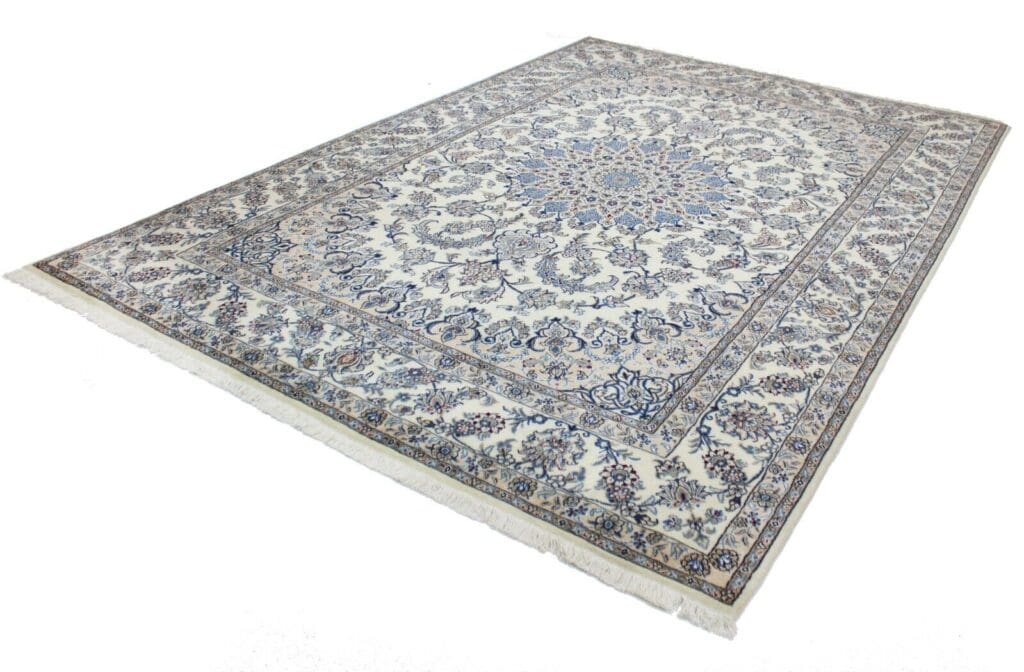
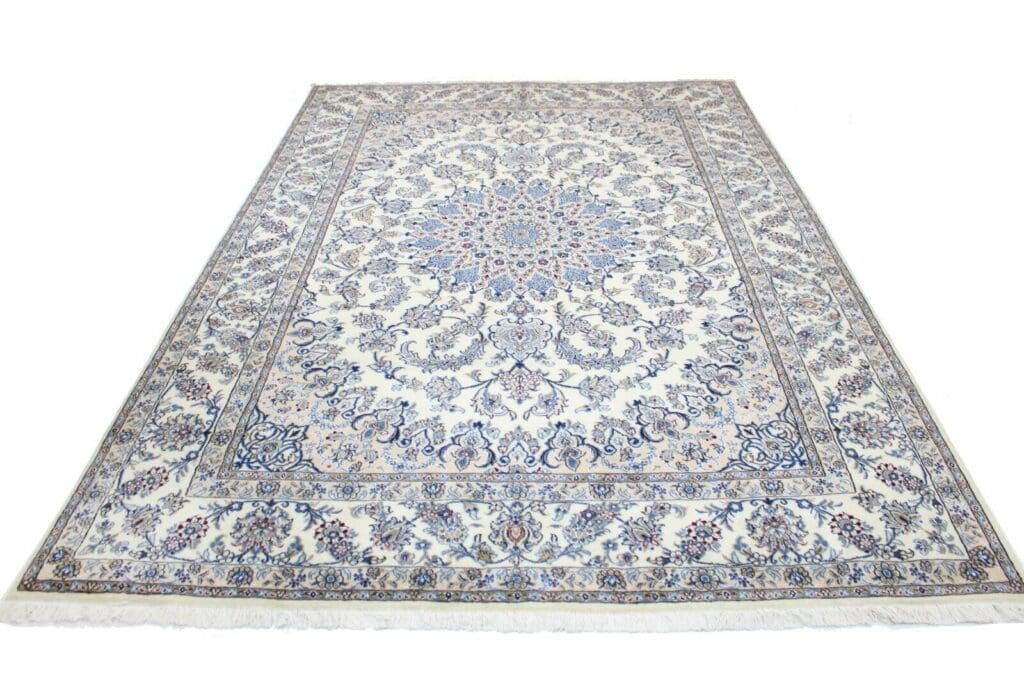
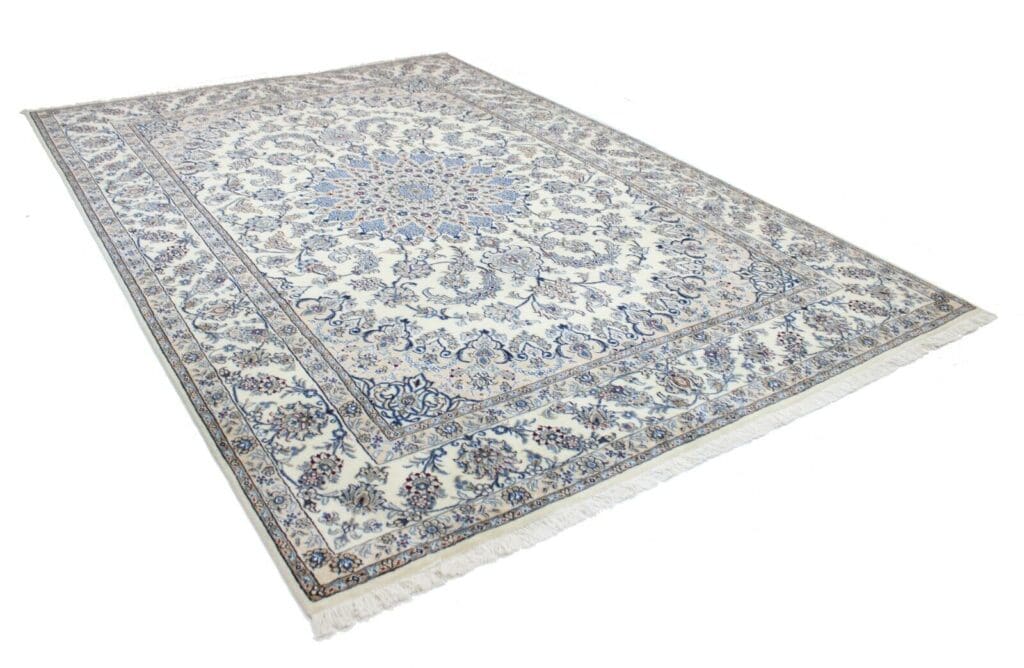
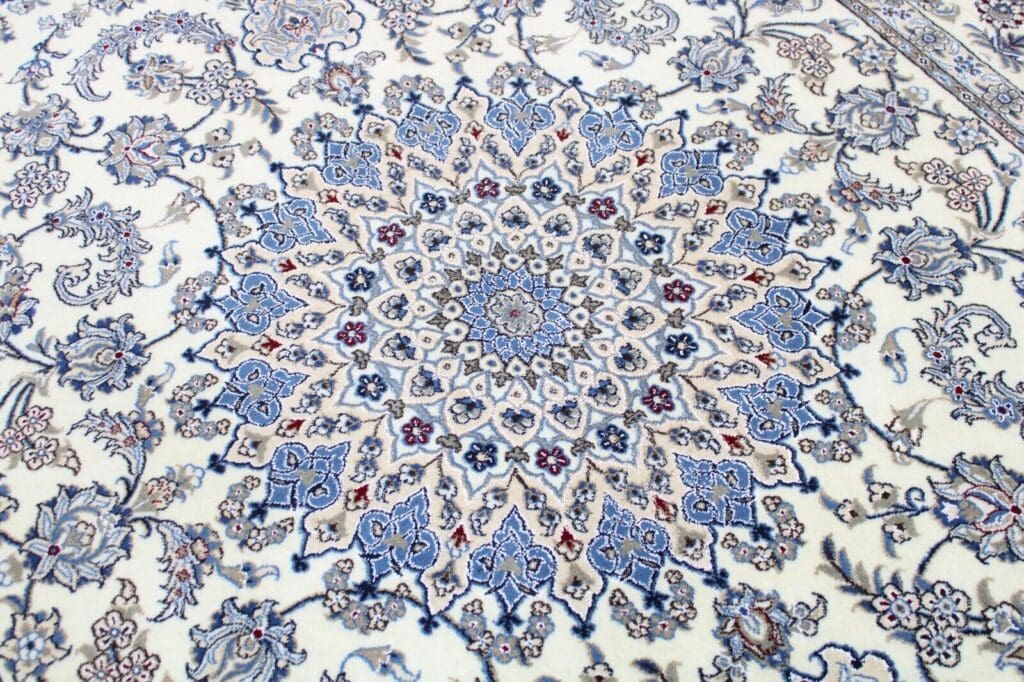
Hand-knotted Nain Persian Rug | Knot density: Hand-knotted | Material: Wool pile, cotton warp | Size: 360 x 245 cm | Pattern: Oriental floral design | Condition: New without tag
This Nain Persian rug is hand-knotted, with wool used for the pile and cotton forming the warp. These two materials are identified separately because they perform different roles in the construction of a rug. Wool creates the visible surface and gives the pile its textile character. Cotton provides the warp foundation into which the knots are tied. The rug is described as made from high-quality wool and cotton, with wool as the main pile material and cotton as the supporting warp.
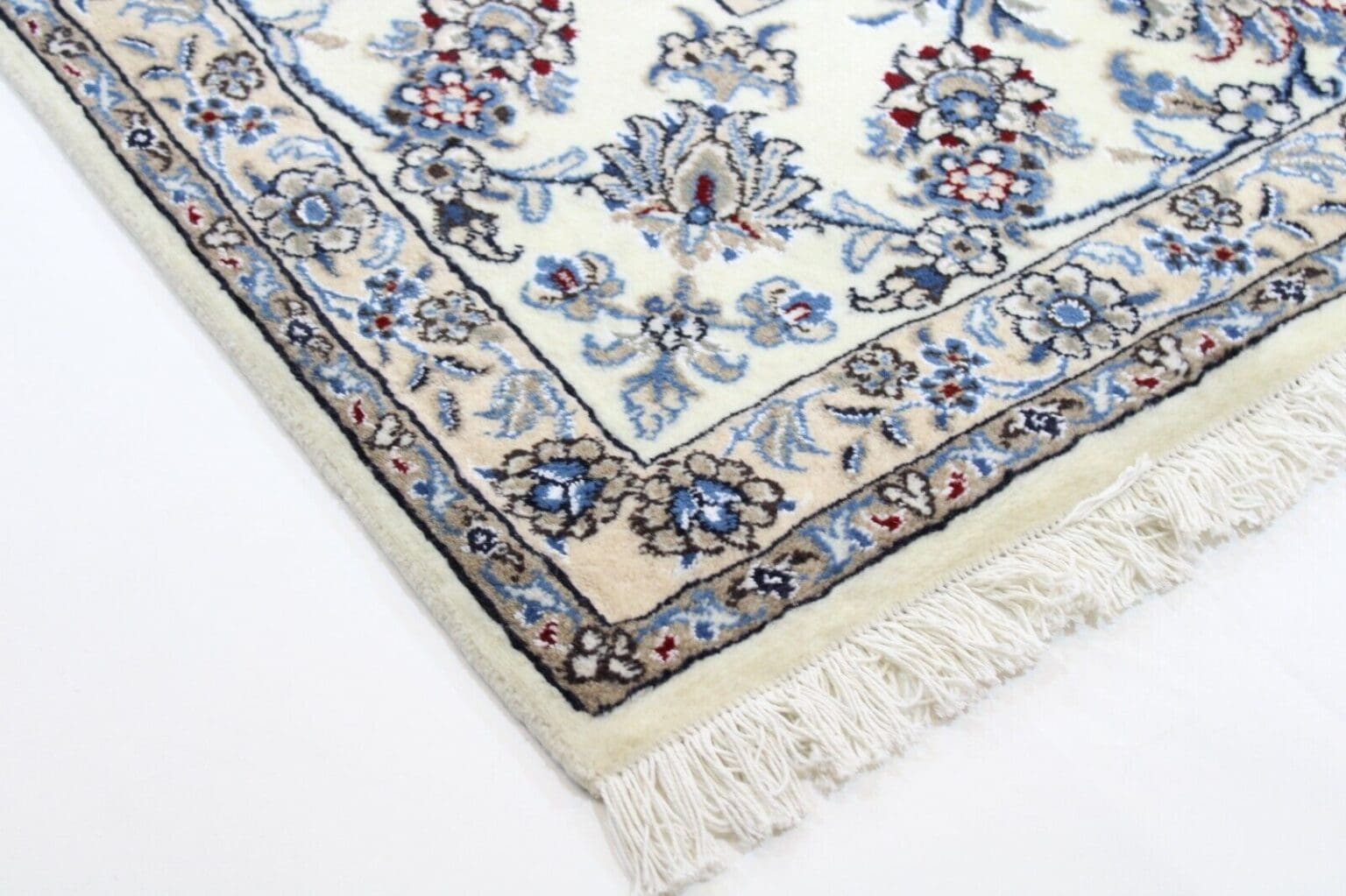
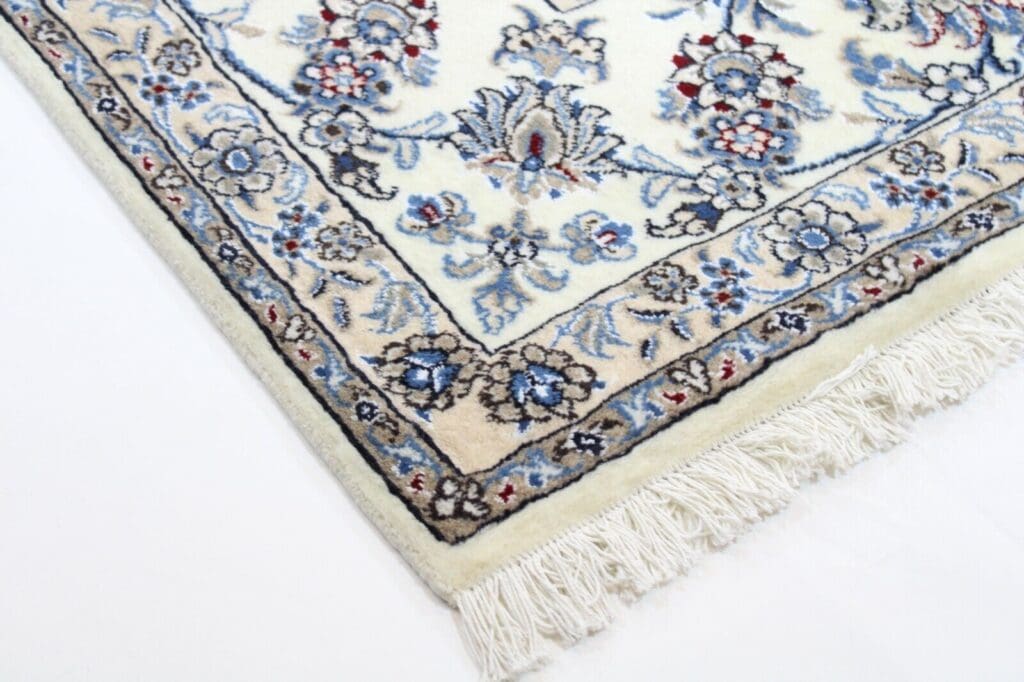
Hand-knotting is a traditional rug-making process rather than a printed or mechanically reproduced surface treatment. The warp is stretched on the loom, and individual knots are tied around its threads. Rows of knots are secured with weft threads and compacted as the work progresses. The pile is then trimmed and adjusted so that the pattern can be read across the finished surface. This rug has a high pile, giving it a clearly raised and tactile surface.
The combination of wool pile, cotton warp and hand-knotting describes the essential construction of this particular piece. Its workmanship is described as high quality. The condition is listed as new without a tag. It is also specified as suitable for use with underfloor heating. As with any rug placed over heated flooring, the requirements of the floor and heating system should be followed; suitability for underfloor heating is one of the stated features of this rug.
Origin and Tradition
This rug comes from Iran and is identified as a Nain Persian rug. Nain is one of the established rug centres of Iran. The city lies in central Iran and is associated with carefully executed knotting and ordered ornament. In the international vocabulary of rugs, Nain refers to a Persian regional tradition in which light grounds, controlled drawing and refined floral arrangements are frequent points of reference.
Persian rugs are made through a range of regional weaving practices, but hand-knotting follows a recognisable sequence. The warp is prepared first. Knots are then inserted row by row, with weft threads helping to hold the structure together. The weaver follows a design plan while building the image gradually through the placement of individual knots. Knot type, yarn, density and finishing methods may differ from one region or workshop to another. The result is a textile in which the pattern and the construction are created at the same time.
Nain developed its own place within this wider Iranian tradition. Many rugs associated with Nain use a balanced layout, precise lines and a restrained relationship between ground and ornament. Floral scrolls, leaves and blossoms may be arranged around a central field or distributed in a more continuous composition. Individual rugs differ in colour and drawing, yet a sense of order and careful pattern control remains an important part of the Nain association. Here, Nain identifies the regional rug tradition, while Iran identifies the country of origin.
The history of Persian rugs is connected with domestic life, regional craftsmanship and the transmission of visual ideas between generations. Designs were adapted by families and workshops, and established motifs could be redrawn in new arrangements. Rugs served practical purposes as floor coverings, but their woven surfaces also carried decorative conventions and local skills. The hand-knotted process allowed weavers to preserve familiar patterns while making each finished rug a distinct textile object.
Other well-known Iranian rug centres include Isfahan, Tabriz and Kashan. Each has its own history of drawing, colour relationships and technical practice. Nain is commonly associated with a fine, disciplined ornamental language. Isfahan and Kashan are also known for floral and medallion-based compositions, while Tabriz represents a broad range of Persian design traditions. These regional comparisons provide context for a Nain rug, but they do not change the origin of this piece. It remains a Nain rug from Iran.
Persian rug making developed through the use of locally available fibres, workshop knowledge and inherited design systems. Wool and cotton have long been important materials, while other Persian traditions may also use silk. Natural dyes have a significant place in the history of Persian textiles, and colour recipes were often shaped by regional resources and craft knowledge. The exact dye history of this rug is not specified. What can be identified is its place within the Iranian hand-knotted tradition, its wool pile, cotton warp and Nain designation.
Nain rugs are often discussed in relation to the relationship between line and field. Fine drawing can allow leaves, blossoms and scrolling stems to appear as a connected network rather than as isolated symbols. This does not mean that every Nain rug follows one fixed layout. Regional traditions contain many variations, and workshop interpretation is part of the history of the form. A rug is therefore best understood through the combination of origin, technique, materials and the actual pattern described for that piece.
Design and Pattern
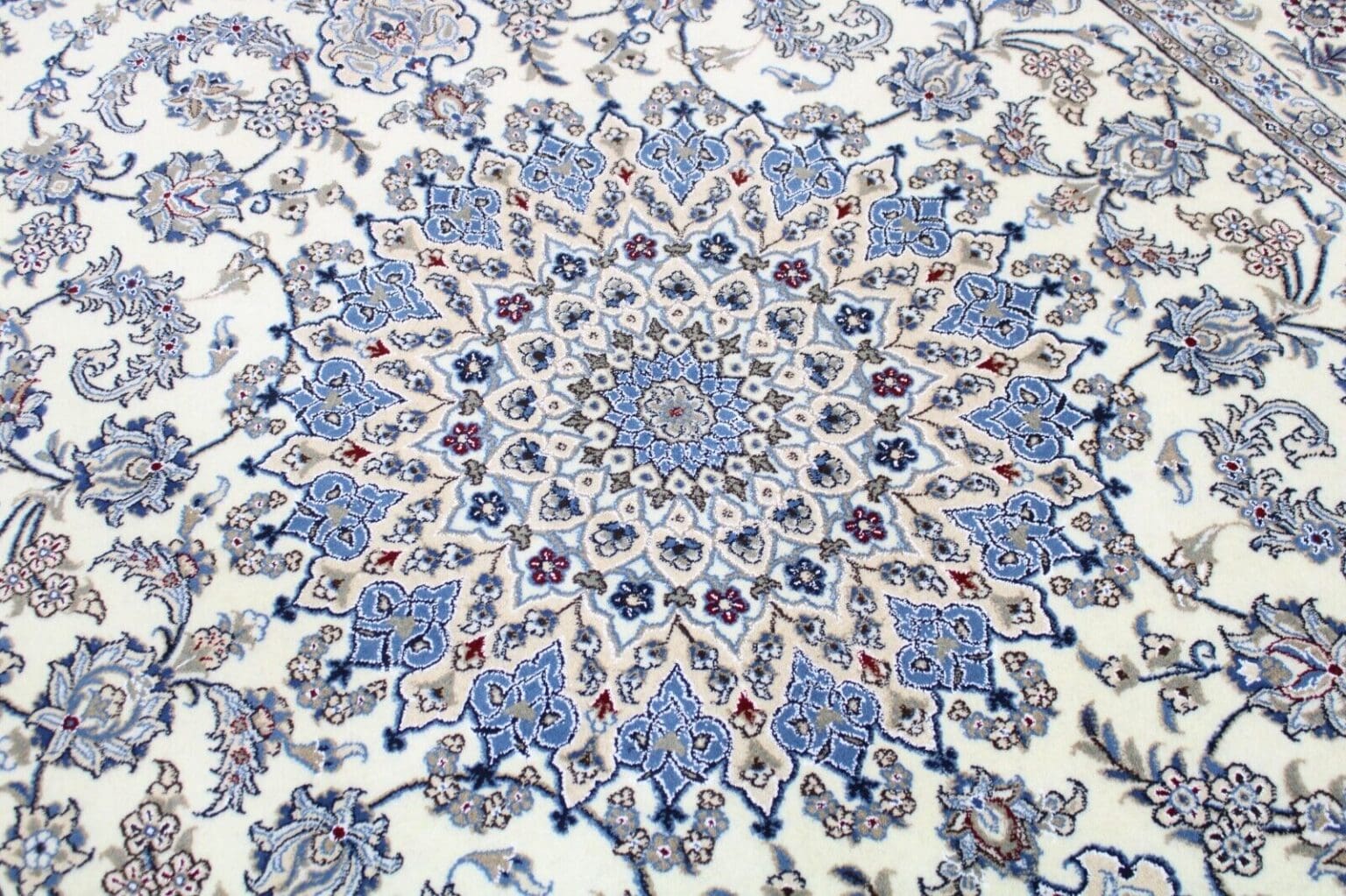
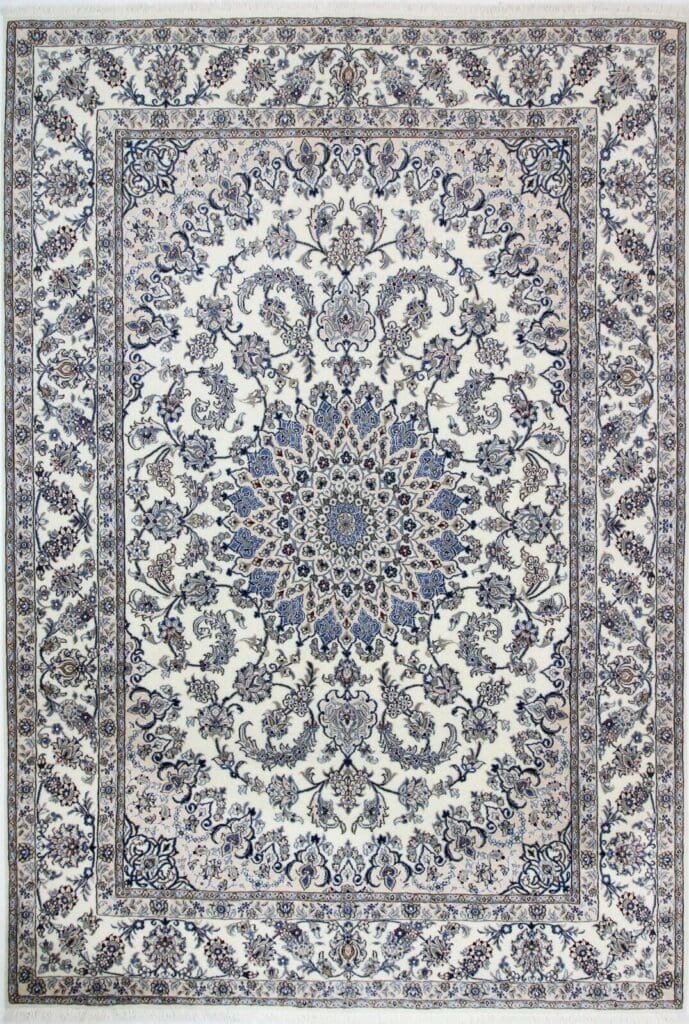
The pattern of this rug is described as oriental with floral motifs. Floral ornament is one of the central languages of Persian rug design. Flowers, leaves, stems and scrolling vines are stylised and arranged to create a textile composition rather than a literal botanical picture. A blossom may be repeated across a field, linked to a vine or placed as part of a larger balanced arrangement. The design is made legible through the relationship between the pile, the coloured yarns and the spacing of the motifs.
Floral motifs can organise different areas of a rug. They may fill a central field, connect the inner area to a border or create a repeated rhythm from one side to the other. Vines provide movement across the surface, while leaves and blossoms give the pattern distinct points of focus. In Nain traditions, this floral vocabulary is often combined with careful symmetry and controlled line work. The particular rug is identified only by its oriental floral pattern; an additional claim about a medallion, border layout or specific named design would not be appropriate.
Many oriental rugs are understood through the relationship between field, centre and border. A central medallion concentrates attention in the middle, while an all-over arrangement distributes ornament more evenly. A border frames the field and can repeat vines, flowers or other stylised forms. These are general principles of rug design, not additional specifications of this individual piece. For this rug, the confirmed design description is an oriental pattern with floral motifs.
Colour influences how a floral composition is perceived. This rug is listed in beige. Beige belongs to a light and subdued colour range and can provide a quiet ground for floral drawing. In Persian design, a pale ground may make scrolling stems and blossoms easy to distinguish, although the final impression also depends on the density of the pattern and the direction of the pile. The high pile gives the surface a tactile structure, so the appearance of the design changes slightly as the pile catches the light from different directions.
Persian floral ornament has a long history of transforming natural forms into repeatable textile elements. The purpose is not to reproduce a single garden exactly, but to create rhythm, balance and continuity within a woven field. Some compositions are strongly symmetrical; others allow vines and blossoms to move more freely. The same broad vocabulary can therefore produce very different rugs. A Nain rug is placed within this tradition by its Iranian origin and regional identity, while the individual arrangement belongs to the particular piece.
Hand-knotting has a direct effect on the way the design is formed. The motif is built one knot at a time, row after row, instead of being applied to a completed surface. The pattern plan guides the placement of colour and shape, while the final pile trimming brings the drawing into focus. Small variations are part of the relationship between handwork and finished design. In this rug, the floral pattern is therefore integrated into the pile itself.
Other regional rug forms demonstrate different approaches to design. Gabbeh rugs from southern Iran are known for simpler compositions and a strong connection with rustic and nomadic visual themes. Kilims are flat-woven and often use geometric forms created through weaving rather than pile knotting. Nain belongs to the hand-knotted Persian tradition, where floral drawing and a structured field can be developed through rows of individual knots. These comparisons explain the range of Iranian textile traditions without assigning another style or origin to this rug.
Special Features
The stated special features of this rug are its hand-knotted construction, wool pile, cotton warp and high pile. Its colour is beige, and its pattern is oriental with floral motifs. The rug is listed as new without a tag and is described as suitable for underfloor heating. Together, these details distinguish the physical construction, surface, design and listed condition of the individual piece.
The designation Nain connects the rug with an Iranian regional tradition, while the country of origin is Iran. The raised pile gives it a different surface character from a flat-woven Kilim. The hand-knotted structure means that the pile was formed by individual knots rather than printed onto the textile. These are the specific characteristics that can be stated for this rug; no additional age, signature or provenance is assigned.
FAQ
What defines a Nain Persian rug?
A Nain Persian rug belongs to the Iranian rug tradition associated with Nain. The classification refers to a regional identity as well as to a recognisable approach to orderly ornament and careful hand craftsmanship. This example is hand-knotted, has a wool pile and cotton warp, and features an oriental floral pattern. Nain rugs can vary in their composition, colour and level of detail because every design is built knot by knot. The name therefore provides regional context, while the individual rug must still be described through its own materials, pattern and condition.
How should I care for a hand-knotted wool rug?
Regular gentle vacuuming helps prevent loose dust from settling deeply into the pile. Direct and prolonged sunlight should be avoided where possible, since light can gradually affect textile colours. For a thorough cleaning, professional rug cleaning is the appropriate approach. Strong chemicals and unsuitable household cleaners may damage wool, cotton or the appearance of the colours and should not be used. Spills are best addressed promptly and without vigorous rubbing. When the rug is used over underfloor heating, the instructions for the flooring and heating system should also be observed.
Where can I buy an authentic Persian rug?
Authentic Persian rugs can be found through specialist rug dealers, art and rug fairs, and reputable online retailers. A careful purchase begins with a clear description of the individual rug, including its origin, materials, construction, pattern and condition. Because hand-knotted rugs are one-off pieces, the photographs and product details should refer to the same rug that is being offered. For a Nain rug, it is useful to distinguish between Nain as the regional designation, Iran as the country of origin and the floral description as the pattern information. A seller who provides a guarantee of authenticity and transparent product information offers a sound basis for evaluating the rug.
To provide the best experiences, we use technologies like cookies to store and/or access device information. Consenting to these technologies will allow us to process data such as browsing behavior or unique IDs on this site. Not consenting or withdrawing consent, may adversely affect certain features and functions.
Functional Always active
The technical storage or access is strictly necessary for the legitimate purpose of enabling the use of a specific service explicitly requested by the subscriber or user, or for the sole purpose of carrying out the transmission of a communication over an electronic communications network.
Preferences
The technical storage or access is necessary for the legitimate purpose of storing preferences that are not requested by the subscriber or user.
Statistics
The technical storage or access that is used exclusively for statistical purposes.The technical storage or access that is used exclusively for anonymous statistical purposes. Without a subpoena, voluntary compliance on the part of your Internet Service Provider, or additional records from a third party, information stored or retrieved for this purpose alone cannot usually be used to identify you.
Marketing
The technical storage or access is required to create user profiles to send advertising, or to track the user on a website or across several websites for similar marketing purposes.
 SECURE PAYMENT
 SHIPPING PARTNERS


