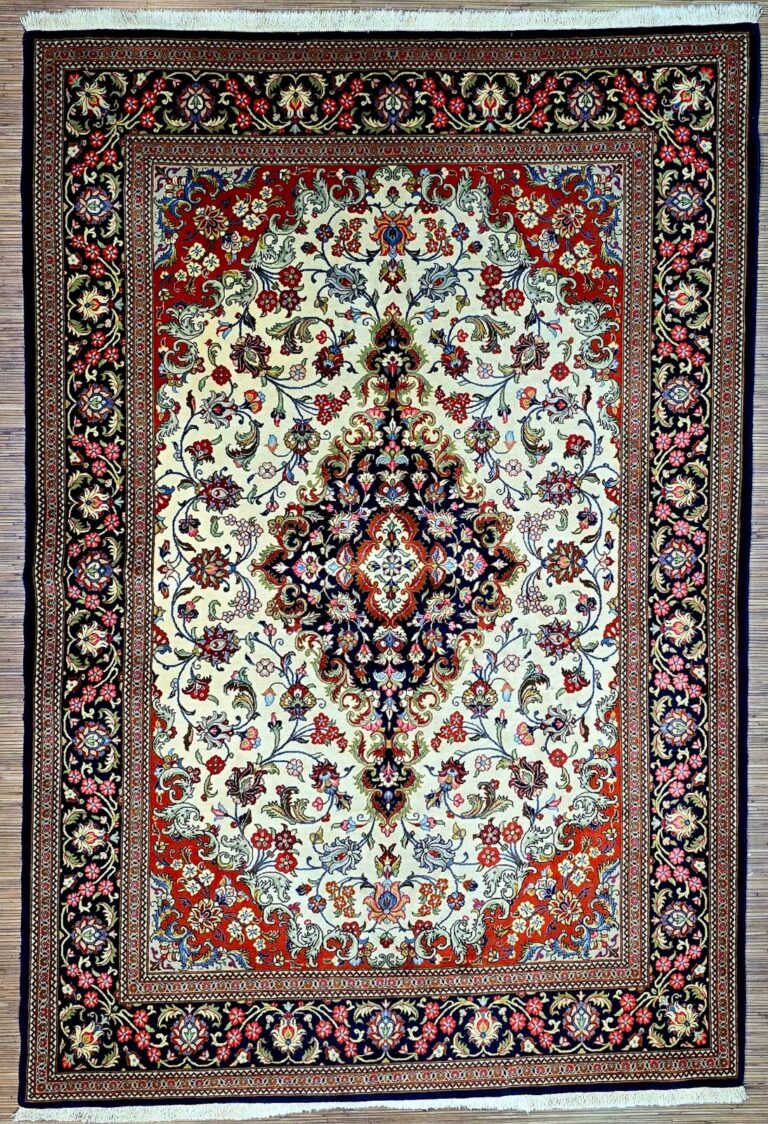
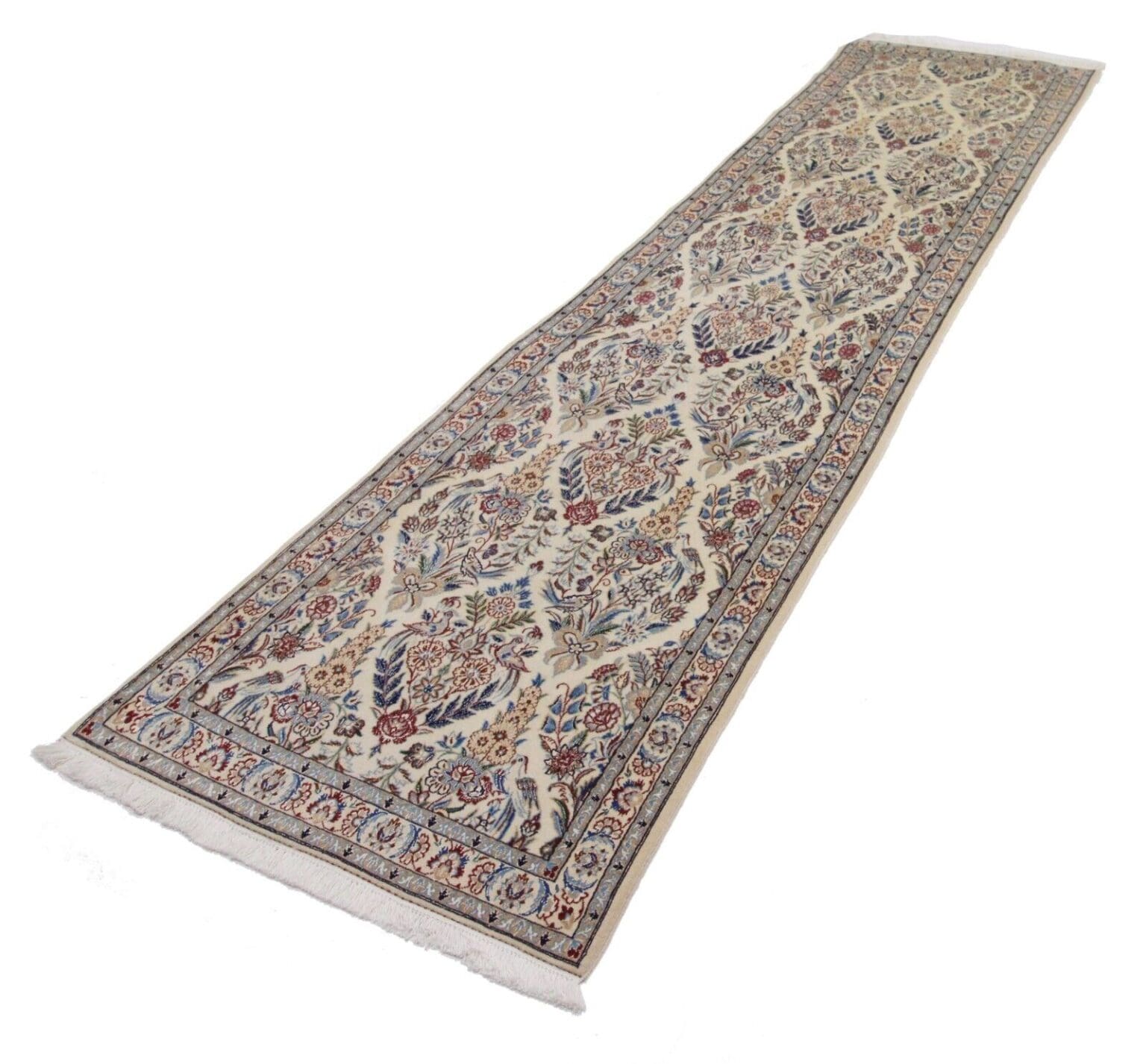
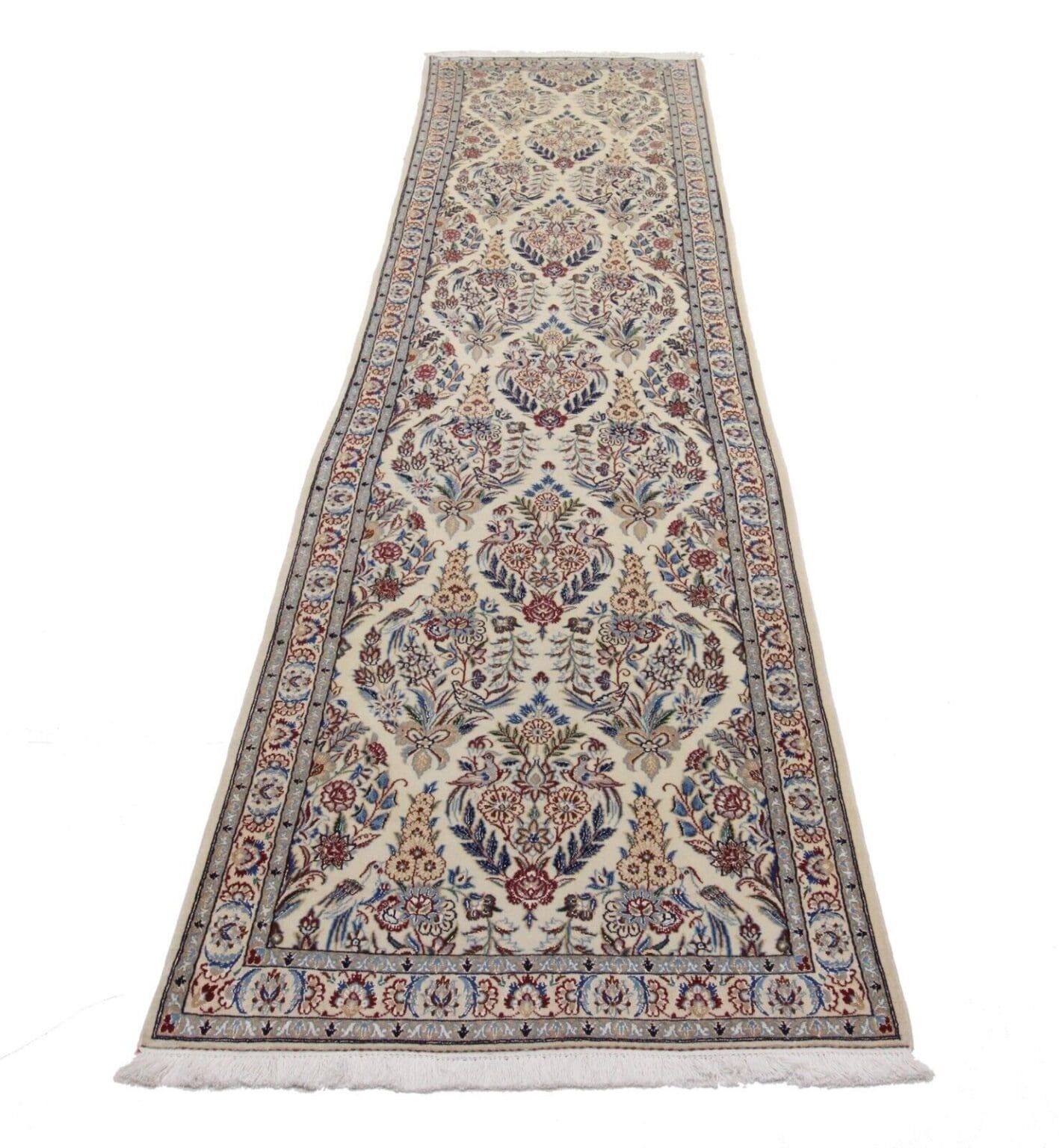
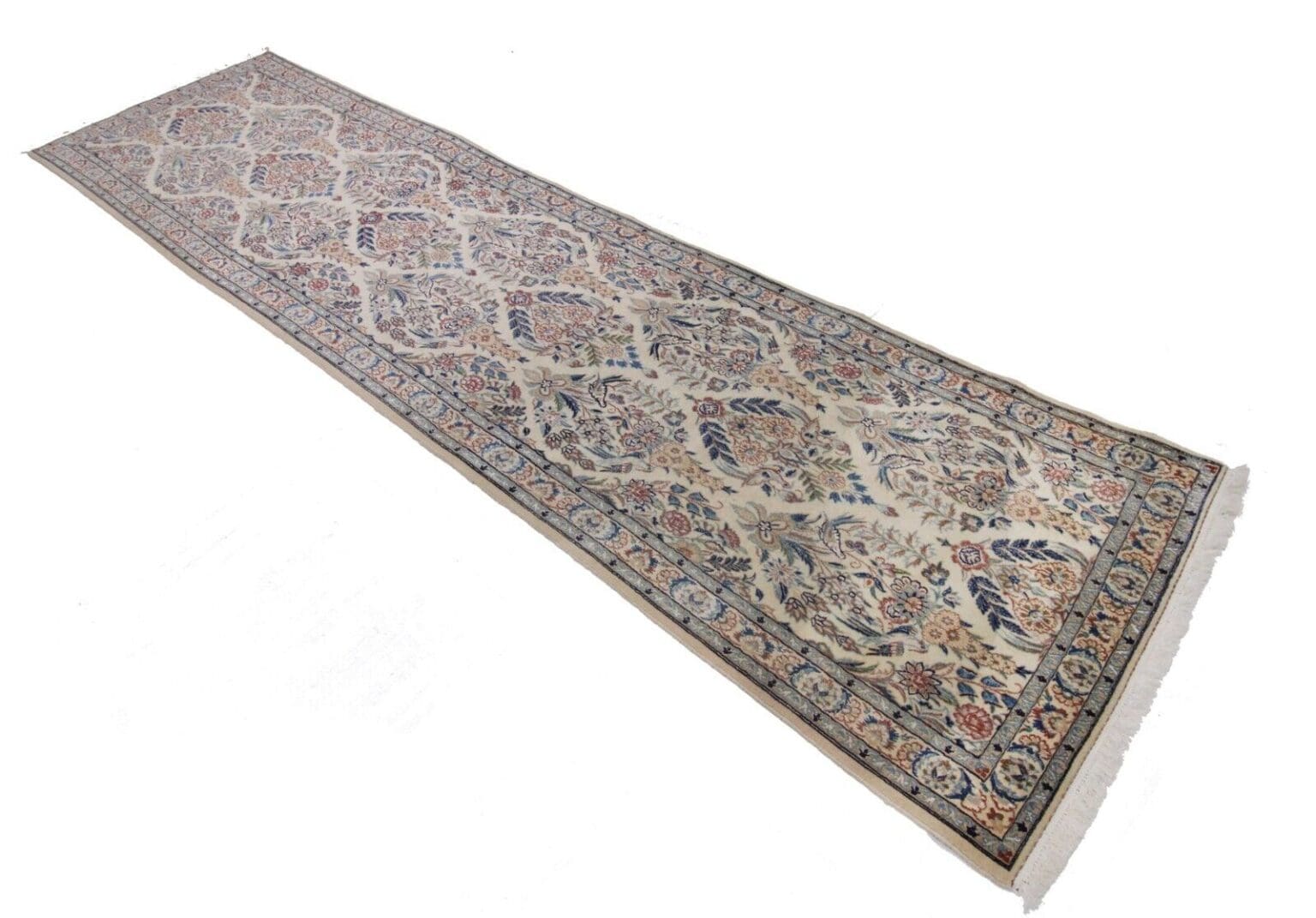
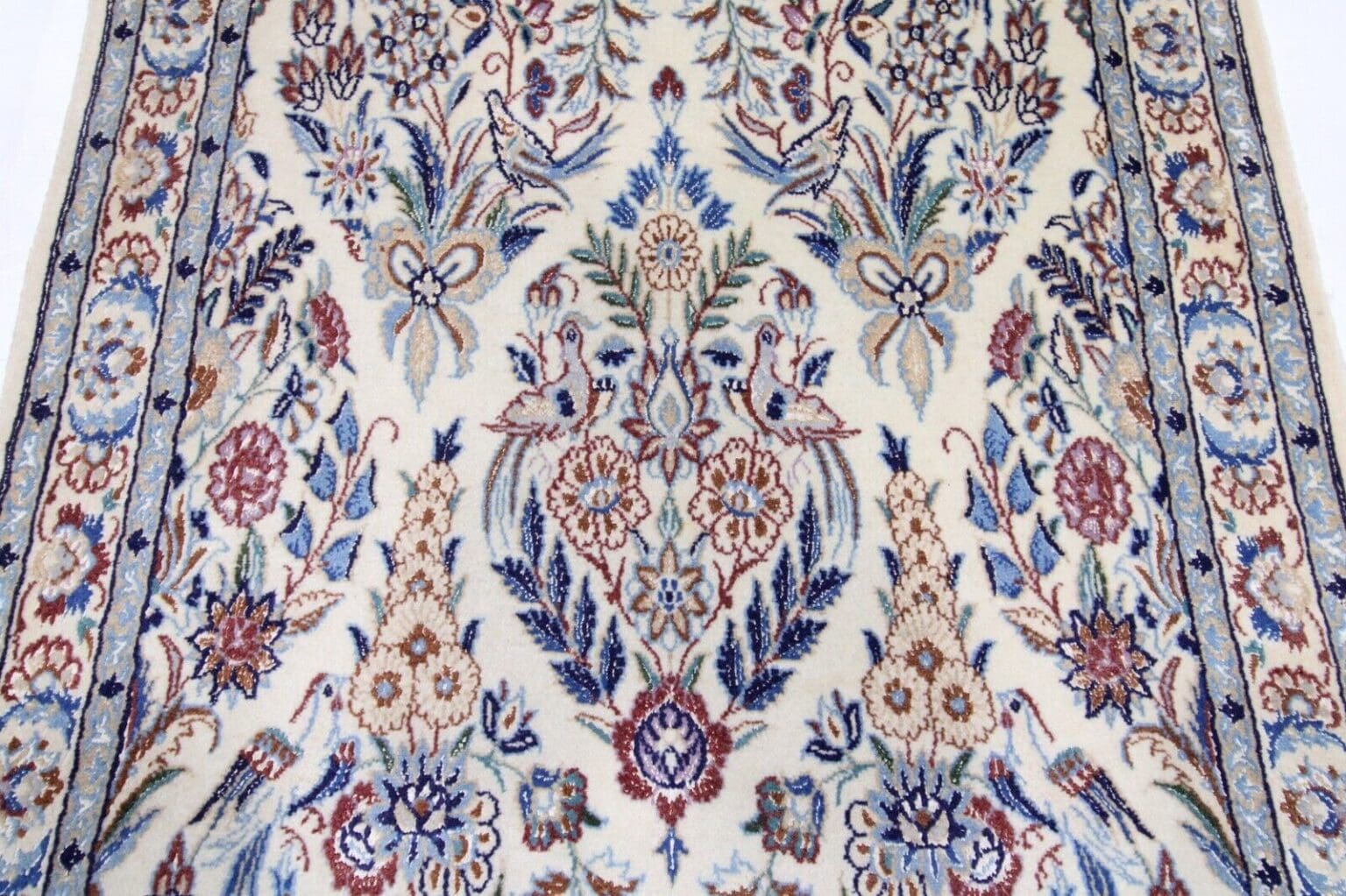
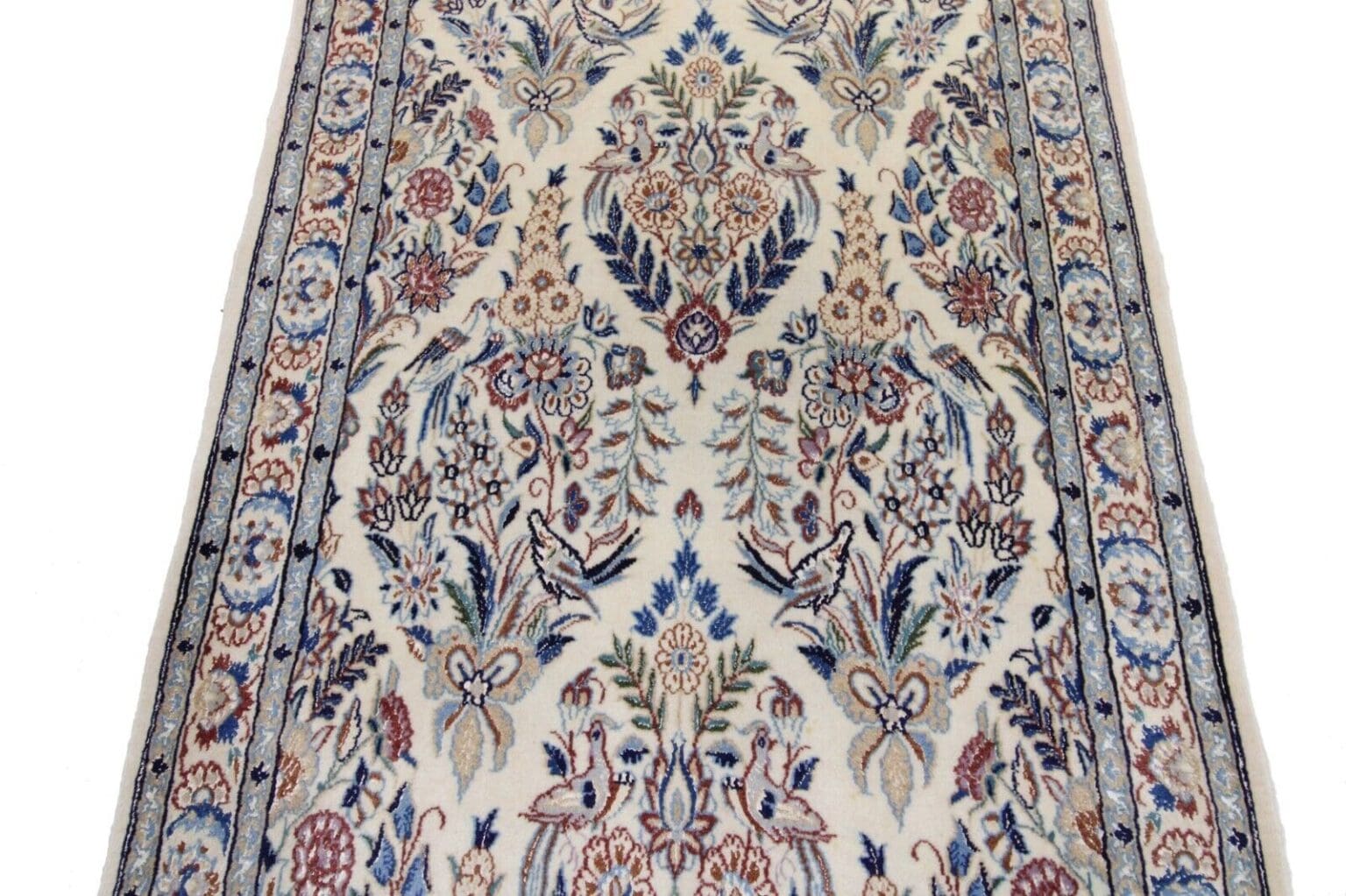
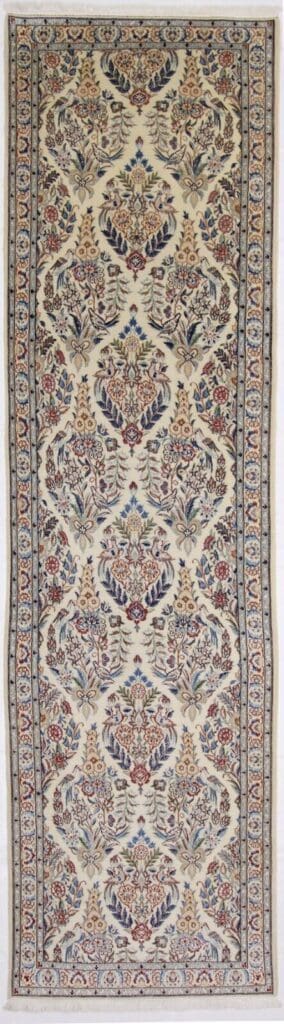
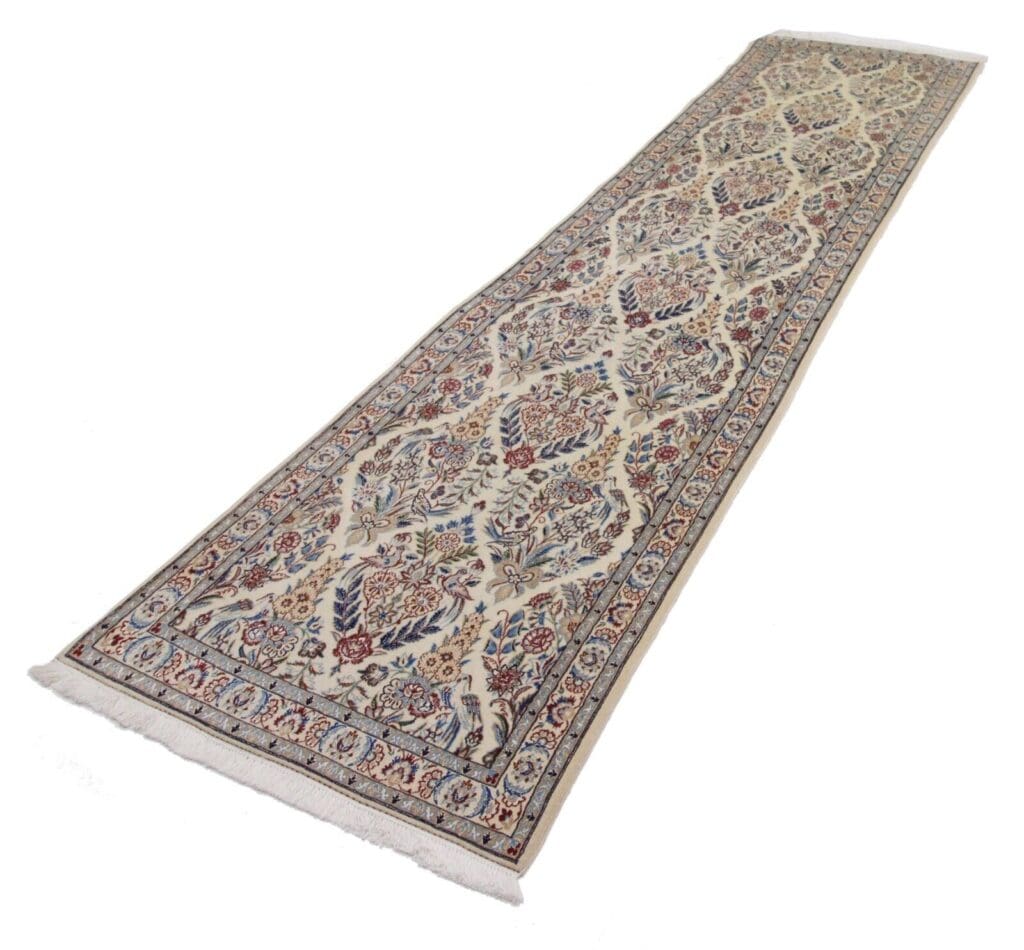
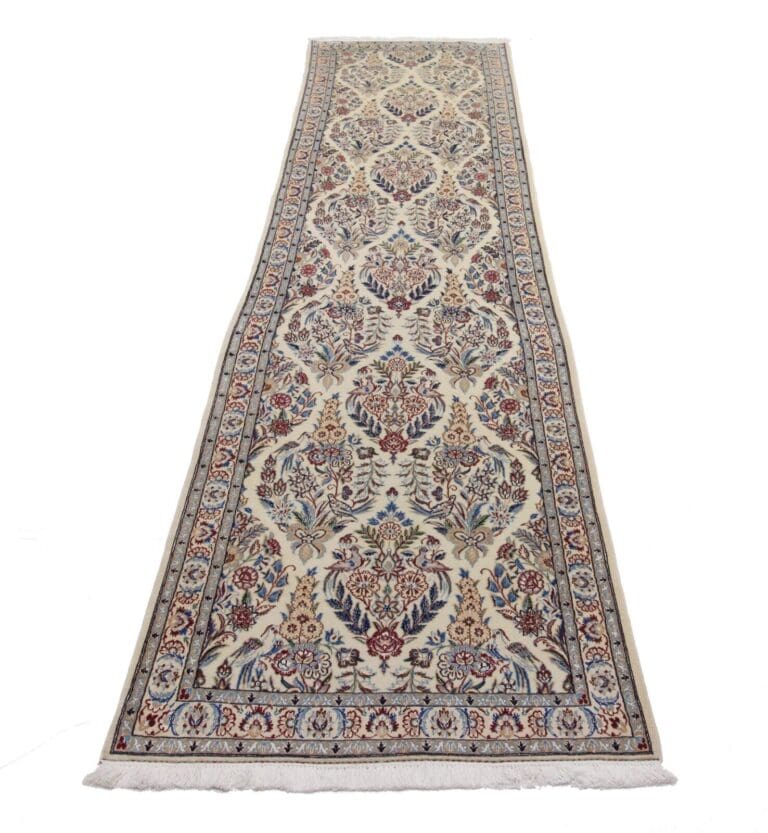
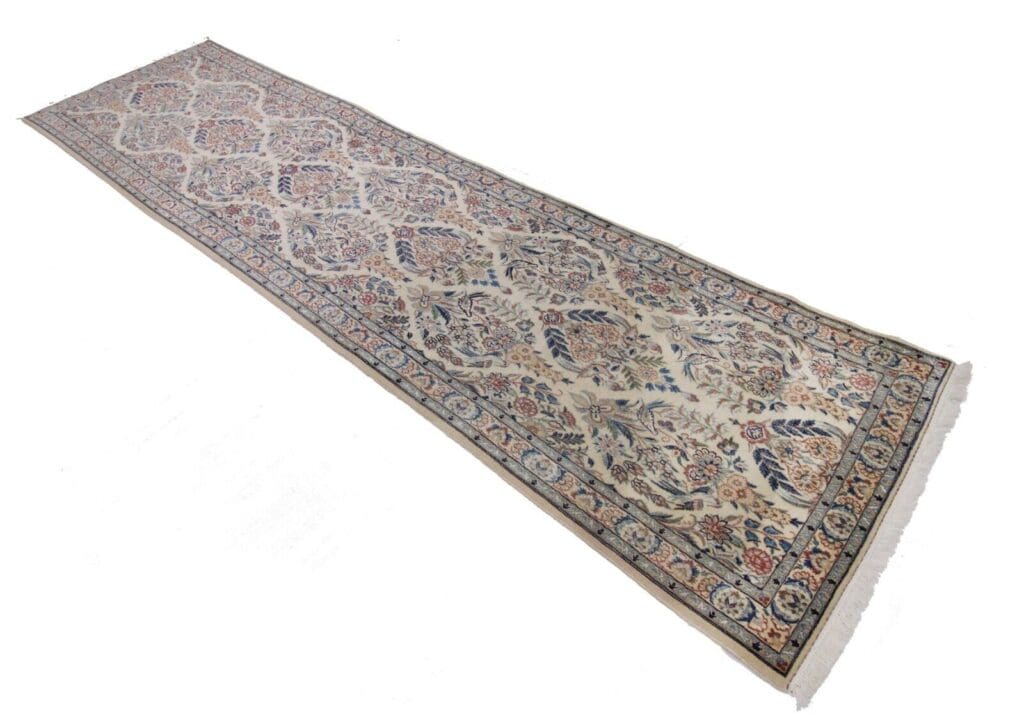
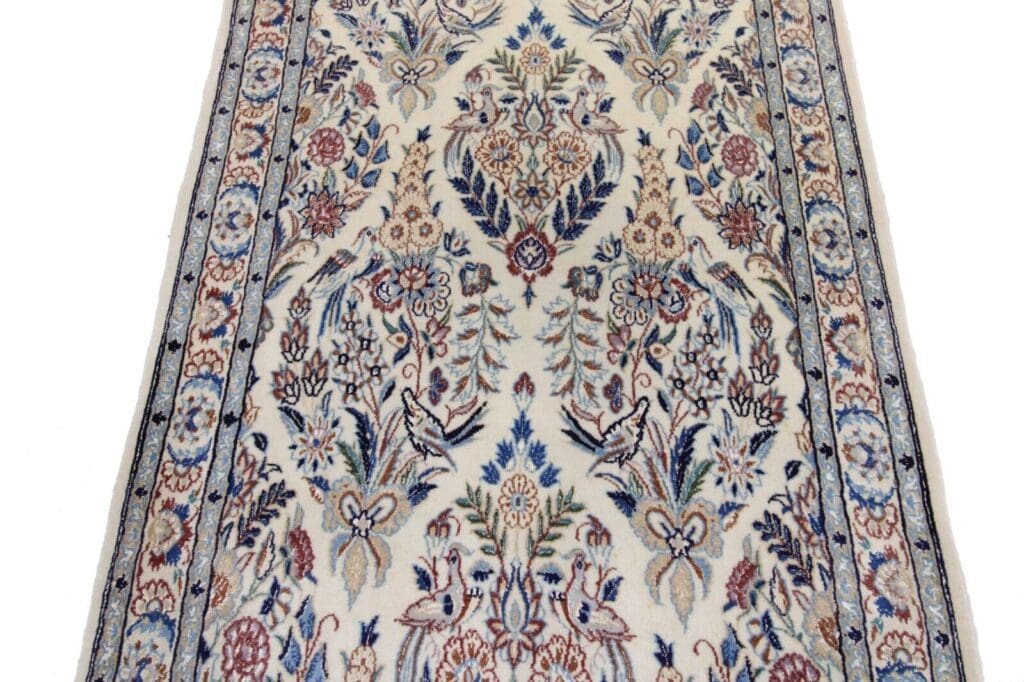
Hand-knotted Nain Persian rug | Knot density: Very fine | Material: Silk, cotton, wool | Size: 350 x 85 cm | Pattern: Oriental, beige | Condition: New without label, washed
This Nain Persian rug is hand-knotted. Cotton, silk, and wool are listed as its materials, and silk is also identified in the original title. Its knot density is described as very fine. In hand-knotting, each knot is inserted individually into the foundation. The work proceeds row by row, creating a textile surface in which the design is formed from the arrangement of many separate knots. Unlike a machine-made carpet, the construction follows the manual sequence of the weaver’s work.
The combination of cotton, silk, and wool brings together different textile qualities. In rug making, cotton is often used for a stable foundation, while wool and silk may be used in the visible pile depending on the construction. For this particular rug, the source names the materials but does not assign each one to a specific layer. The materials are therefore presented together rather than being divided into pile and foundation without evidence.
The rug is described as new without a label and washed. These statements form part of its recorded condition. The designation Nain 9La appears in the source title. It identifies a fine Nain format and accompanies the regional name. Hand-knotting and very fine knot density are separate descriptions: the first concerns the method of manufacture, while the second concerns the fineness of the knotting.
Origin and Tradition
This rug comes from Persia, Iran, and is identified as Nain. Nain is a city and an established rug-making centre in central Iran. During the twentieth century, its weaving developed into a distinctive branch of Persian carpet production. Nain rugs are commonly associated with fine materials, carefully organised drawing, and a light, restrained colour vocabulary. The name therefore indicates a regional weaving tradition rather than merely a decorative style.
Iranian carpet making draws on inherited knowledge of design, dyeing, knotting, and finishing. A pattern is usually prepared as a plan that establishes the relationship between the field, borders, and individual motifs. During weaving, this plan is transferred into successive rows of knots. The process requires consistent handling of the foundation and close attention to the design. In a fine rug, small areas of ornament can involve a large number of individual working steps.
Within this tradition, Nain is often associated with balanced compositions and a clear sense of symmetry. Many Nain designs draw on Persian garden imagery, scrolling vines, floral forms, and medallion arrangements. Light grounds and carefully drawn outlines are frequently used together. These are characteristic elements of the broader Nain tradition; they do not replace the specific description of this rug, which identifies its pattern as Oriental and its colour as beige.
Persian weaving centres developed different preferences for structure, colour, borders, and knotting. Nain, Isfahan, Kashan, Tabriz, and other places each have their own historical vocabulary of design. The Nain designation places this rug within the Nain tradition. It does not turn it into a rug from another named region. At the same time, the history of Persian carpet making shows how closely regional identity is linked to technical practice.
The Persian knot, also called the Senneh knot, is a widely used technique in Iranian rug making. It supports detailed drawing because the knots create the surface while also establishing the contours of the design. A finer structure can allow smaller design elements to be represented with greater definition. The description very fine refers to this rug’s knot density; it is not an exact knot count and should not be expanded into a numerical claim.
Design and Pattern
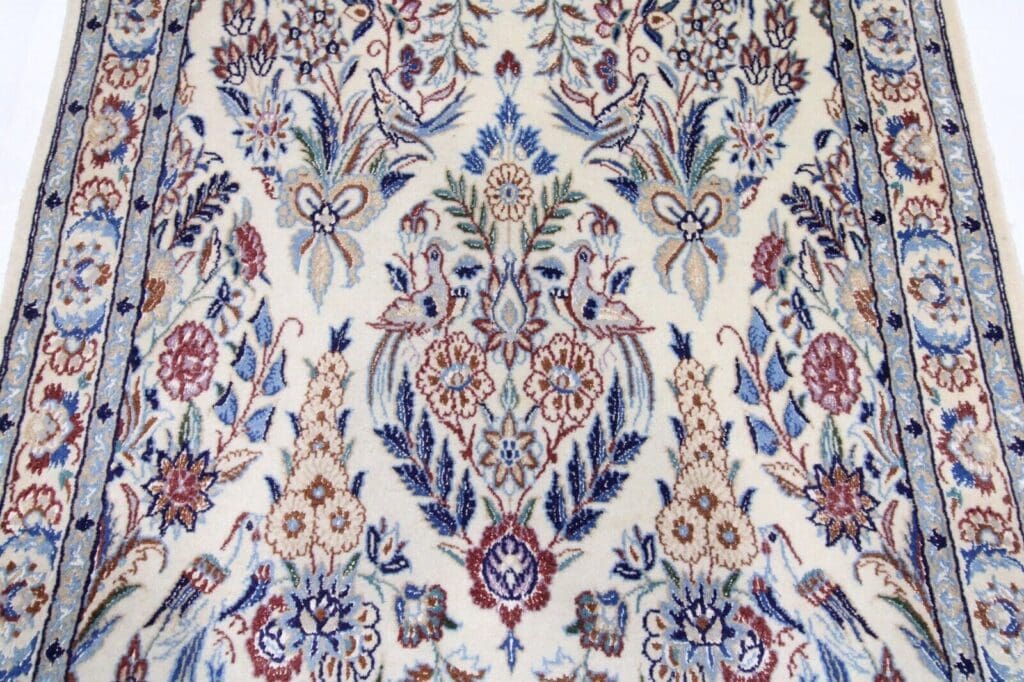
The pattern is described as Oriental and beige. Oriental gives the broad stylistic classification, while beige identifies the stated colour impression. Such a description can encompass a calm ground, delicate line work, and traditional ornament. The source does not name a particular medallion, border arrangement, or individual floral motif. Those details therefore remain unspecified.
Persian rug designs are often built from connected systems of order. A field may be framed by one or more borders. Scrolling vines join flowers, leaves, and palmettes, while axes and repetition create symmetry. In a medallion composition, the central motif provides the main focus; in an all-over design, ornament is distributed throughout the field. These terms explain established design structures without assigning an unnamed motif to this individual rug.
The Nain tradition is frequently recognised for finely drawn and carefully balanced ornament. Light grounds are often combined with measured contrasts so that the lines remain legible. Beige can act as a neutral link between larger colour areas and finer outlines. In Persian design, colours are considered in relation to the field, the border, and the contour rather than as isolated blocks. This relationship can make a pattern appear detailed at close range and unified from farther away.
Floral ornament has a long history in Persian carpet design. Flowers and vines may refer to idealised gardens, images of an ordered paradise garden, or decorative traditions connected with manuscript art. Geometric designs rely more strongly on repetition, axes, and measured intervals. Many Persian compositions bring both principles together: a regular structure carries flowers, leaves, or vines with a more natural appearance. The word Oriental leaves room for this wider tradition without defining an individual motif that has not been named.
A fine knot structure generally supports the accurate rendering of small lines and compact ornamental passages. It is therefore an important technical feature of the Nain tradition. The pattern of this rug is not identified by a specific name such as Mahi, Boteh, or Herati. Those pattern labels should not be added to the description of this piece. The secure design information consists of its Nain classification, its Oriental character, and its beige colour.
When viewing a hand-knotted rug, the composition is best understood as a relationship between field, borders, colour areas, and outlines. Together these parts create the visual order of the design. Manual transfer of a pattern into textile work can also leave small variations between areas. Such variations belong to the process of hand production. A more precise assessment of individual motifs would require a fuller pattern description or direct inspection and is not made here.
Special Features
The listed special features are allergy-friendly construction, an anti-slip property, antistatic properties, and suitability for use with underfloor heating. These points supplement the information about origin, materials, knotting, condition, and pattern. Allergy-friendly is the stated product characteristic. Anti-slip identifies the stated grip-related feature, while antistatic describes the corresponding property given for the rug.
The rug is also stated to be suitable for underfloor heating. Care and cleaning should be adapted to the textile composition. Professional rug cleaning is recommended for cleaning this piece. Regular vacuuming without using a brush attachment can help remove dust and loose dirt. Its condition is described as new without a label and washed.
FAQ
How should I clean the Nain Persian rug?
Professional rug cleaning is recommended for this piece. It can help protect the colours and the structure of the hand-knotted textile. For routine care, regular vacuuming without a brush attachment helps remove dust and loose dirt. A gentle approach is appropriate because silk, wool, and cotton have different textile characteristics.
How can the authenticity of a Persian rug be assessed?
A genuine Persian rug is often assessed through its dense knotting and the use of natural materials. This rug is described as having a very fine knot density and as being made with cotton, silk, and wool. A label and an expert appraisal can also assist with classification. This rug is described as new without a label, so a binding assessment of authenticity should be made by a qualified specialist.
Where can the rug be used?
Persian rugs can be used in living rooms, dining rooms, or offices. A runner format is generally suited to elongated areas such as hallways when the room and use are appropriate. This rug is also stated to be suitable for underfloor heating. Its anti-slip property and allergy-friendly designation are additional product features included in the description.
To provide the best experiences, we use technologies like cookies to store and/or access device information. Consenting to these technologies will allow us to process data such as browsing behavior or unique IDs on this site. Not consenting or withdrawing consent, may adversely affect certain features and functions.
Functional Always active
The technical storage or access is strictly necessary for the legitimate purpose of enabling the use of a specific service explicitly requested by the subscriber or user, or for the sole purpose of carrying out the transmission of a communication over an electronic communications network.
Preferences
The technical storage or access is necessary for the legitimate purpose of storing preferences that are not requested by the subscriber or user.
Statistics
The technical storage or access that is used exclusively for statistical purposes.The technical storage or access that is used exclusively for anonymous statistical purposes. Without a subpoena, voluntary compliance on the part of your Internet Service Provider, or additional records from a third party, information stored or retrieved for this purpose alone cannot usually be used to identify you.
Marketing
The technical storage or access is required to create user profiles to send advertising, or to track the user on a website or across several websites for similar marketing purposes.

 SECURE PAYMENT
 SHIPPING PARTNERS