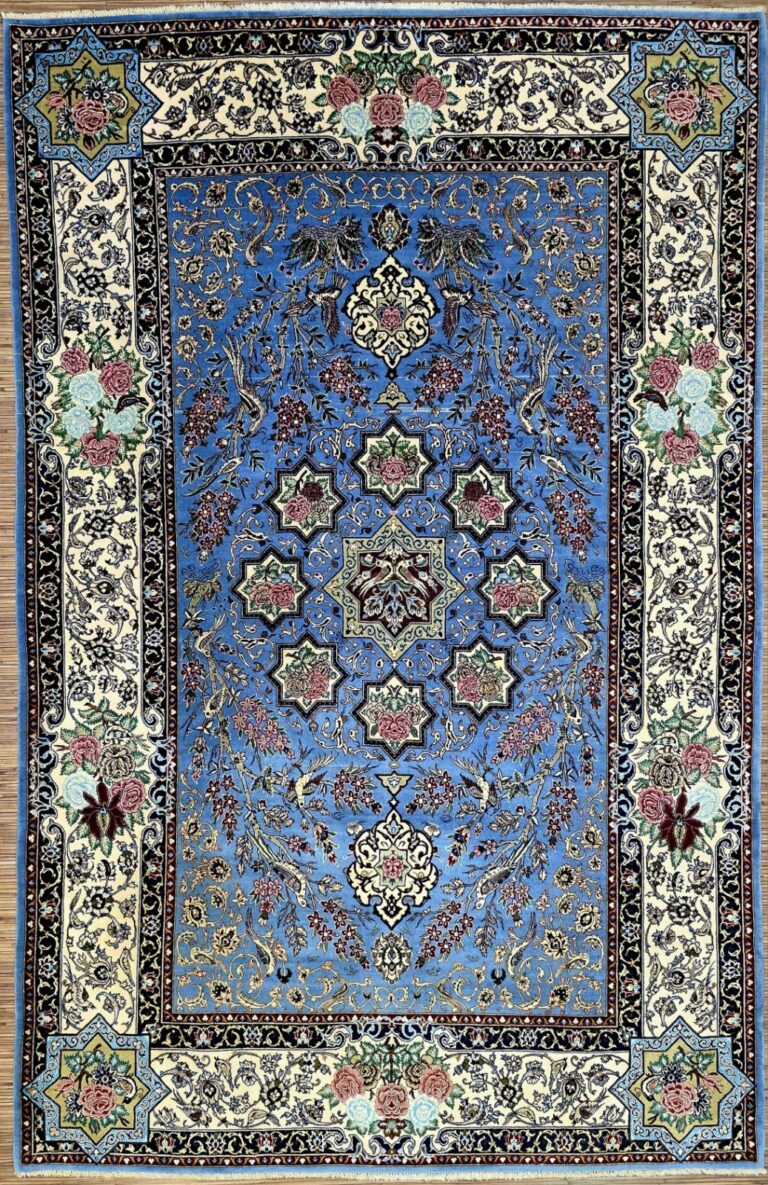
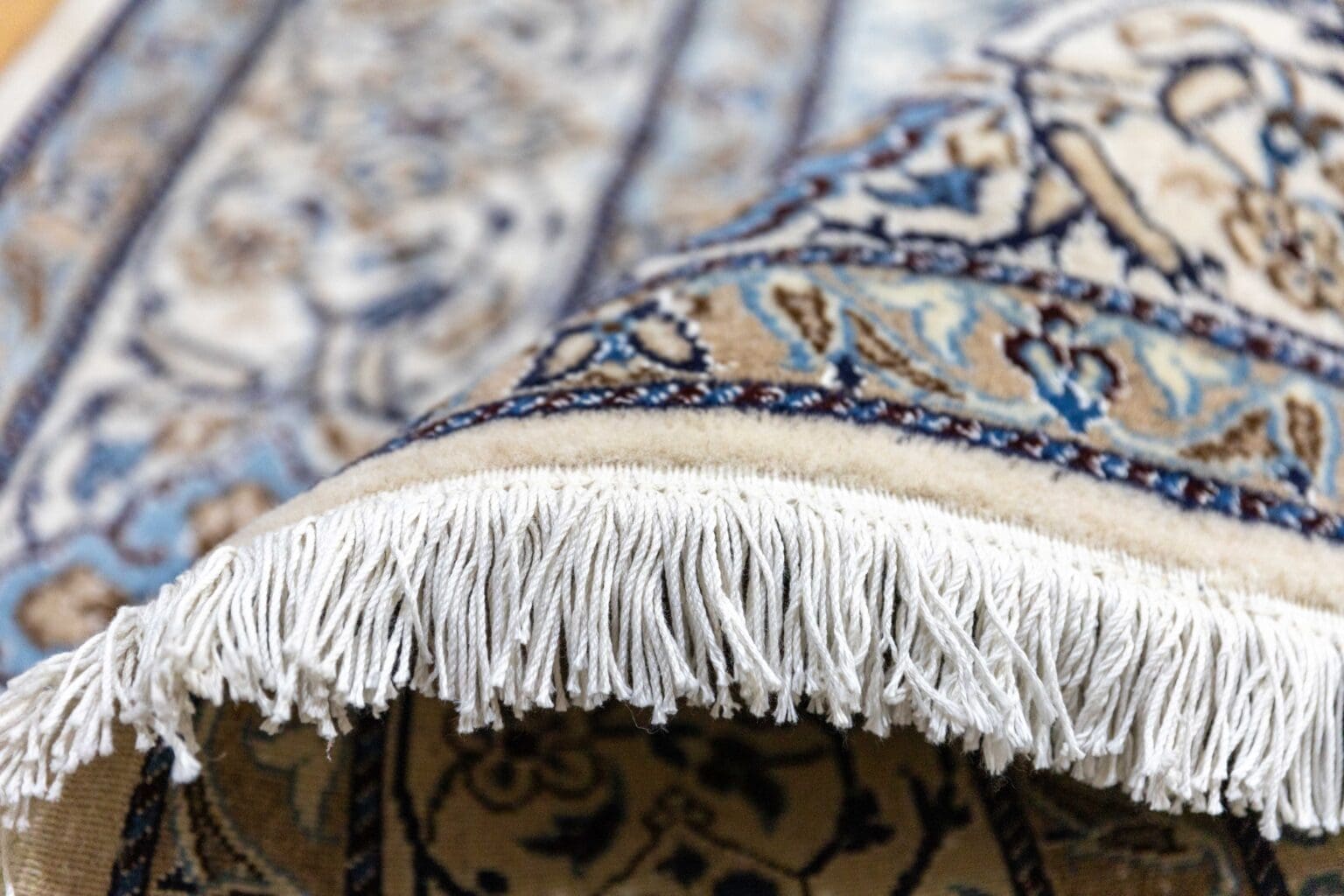
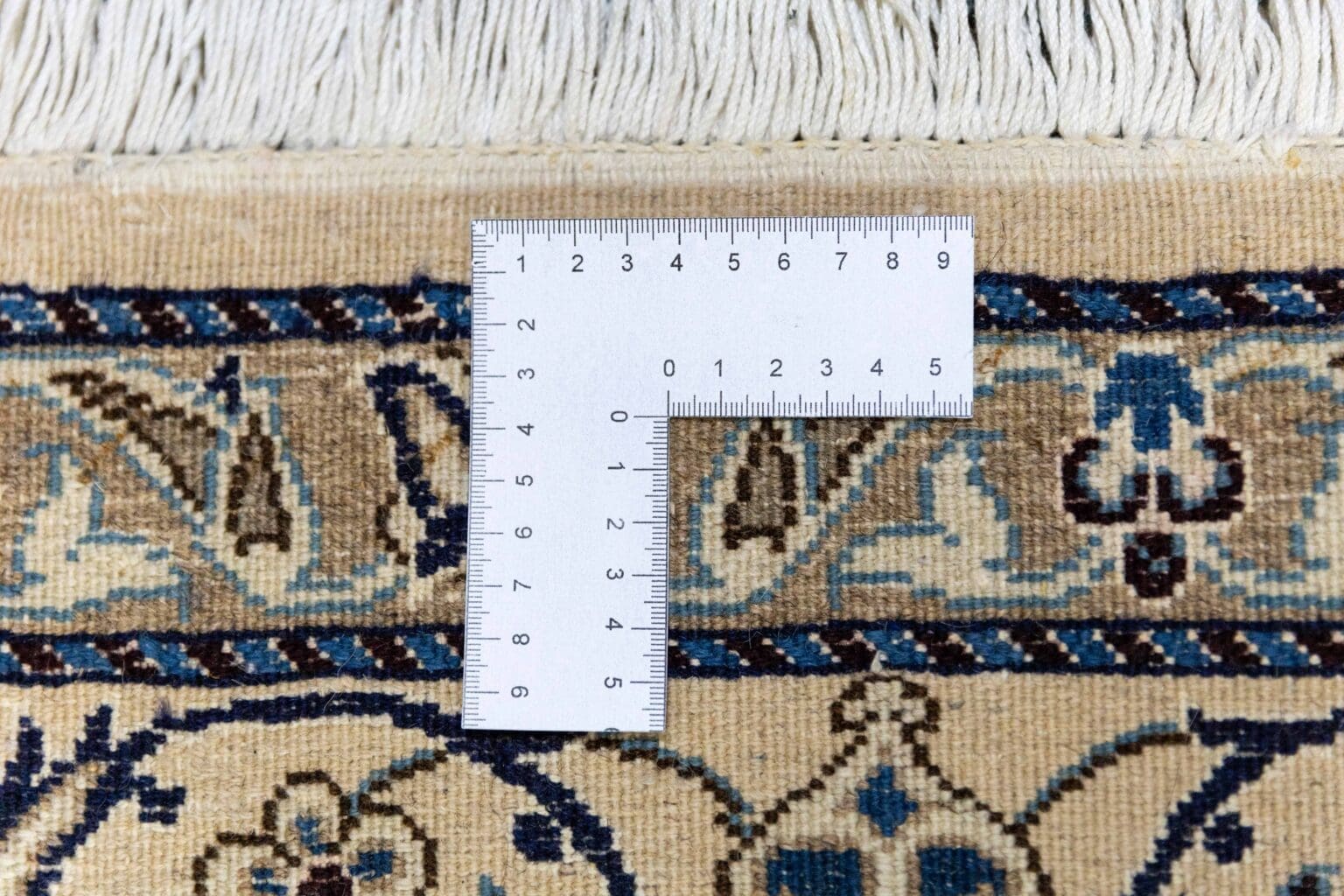
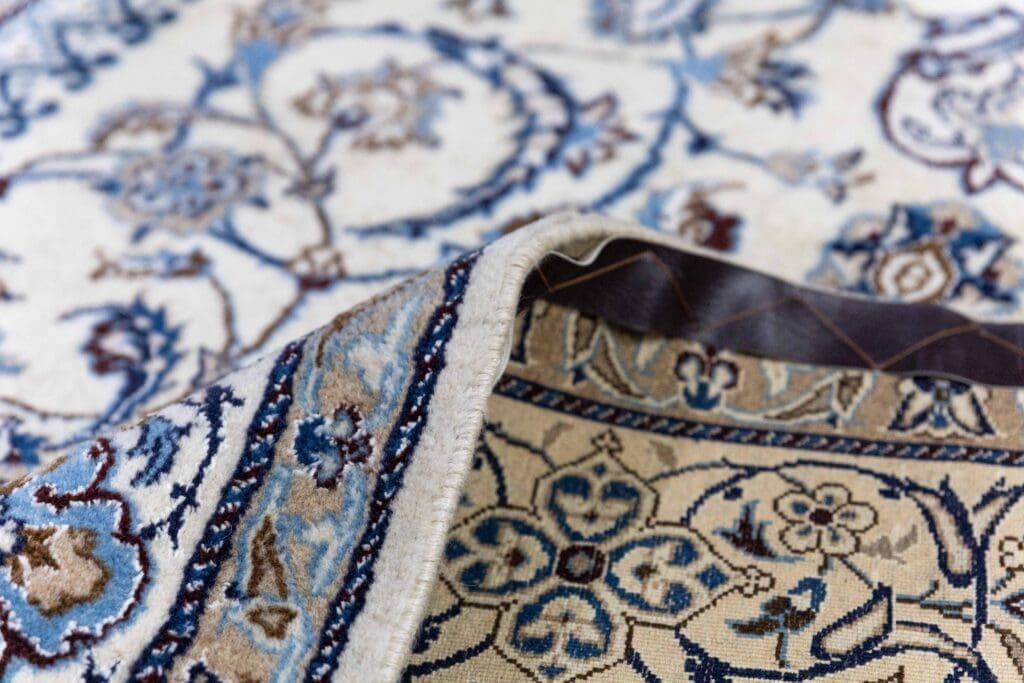
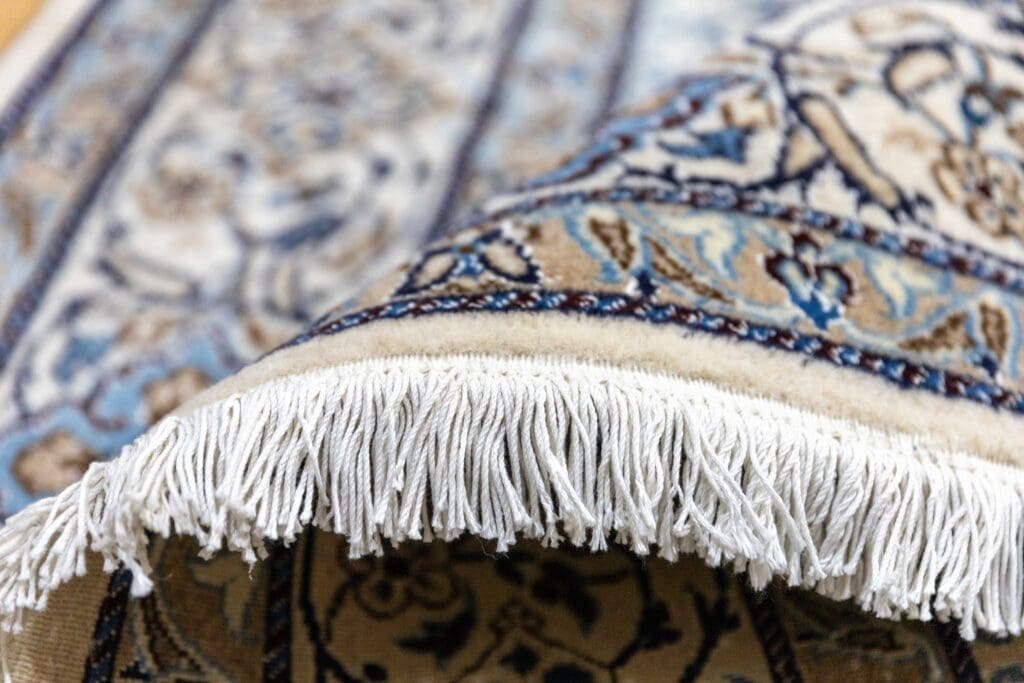
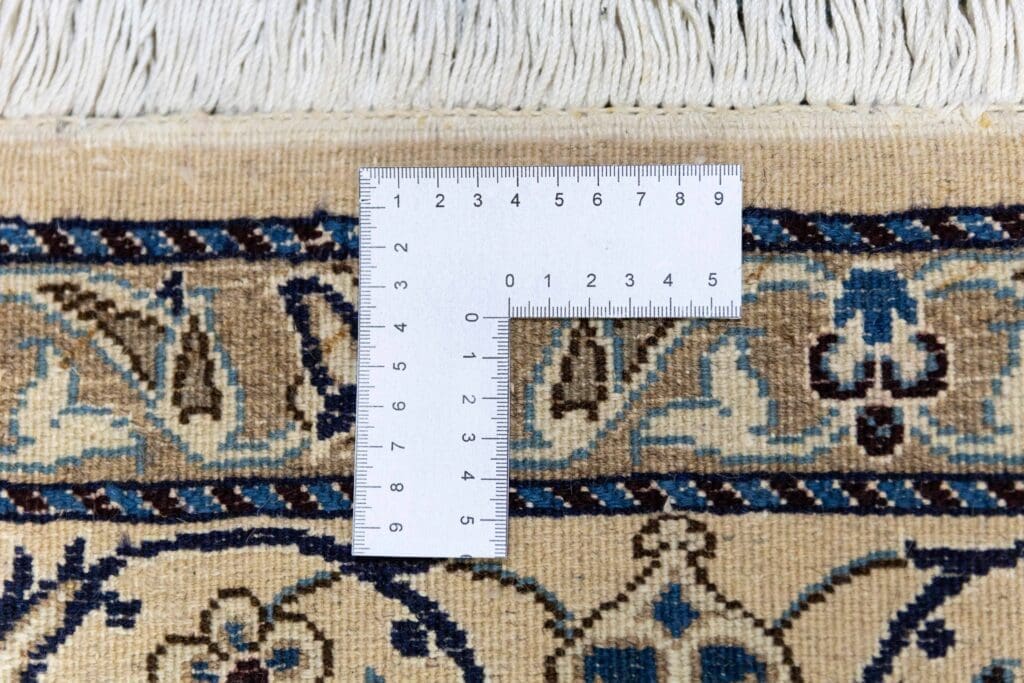
This Nain Persian rug is hand-knotted with a knot density of 12La and approximately 250,000 knots per square metre. In Nain weaving, the 12La designation identifies a fine knotting quality and points to the number of individual knots used to build the design. The pile is made of 100% wool with silk. The warp is made of 100% cotton. The material structure is therefore clearly defined: wool and silk form the visible pile, while cotton provides the foundation of the woven construction.
Wool has long been used for rug pile because its natural fibres can be spun into threads that are both workable and resilient. The surface accepts colour in a way that allows the pattern to remain legible, while the fibre structure gives the pile a distinct tactile character. Silk adds a finer fibre to the wool pile and reflects light differently. In this rug, the two pile materials are used together rather than treated as separate decorative details. Cotton in the warp provides the regular framework to which the knots are attached.
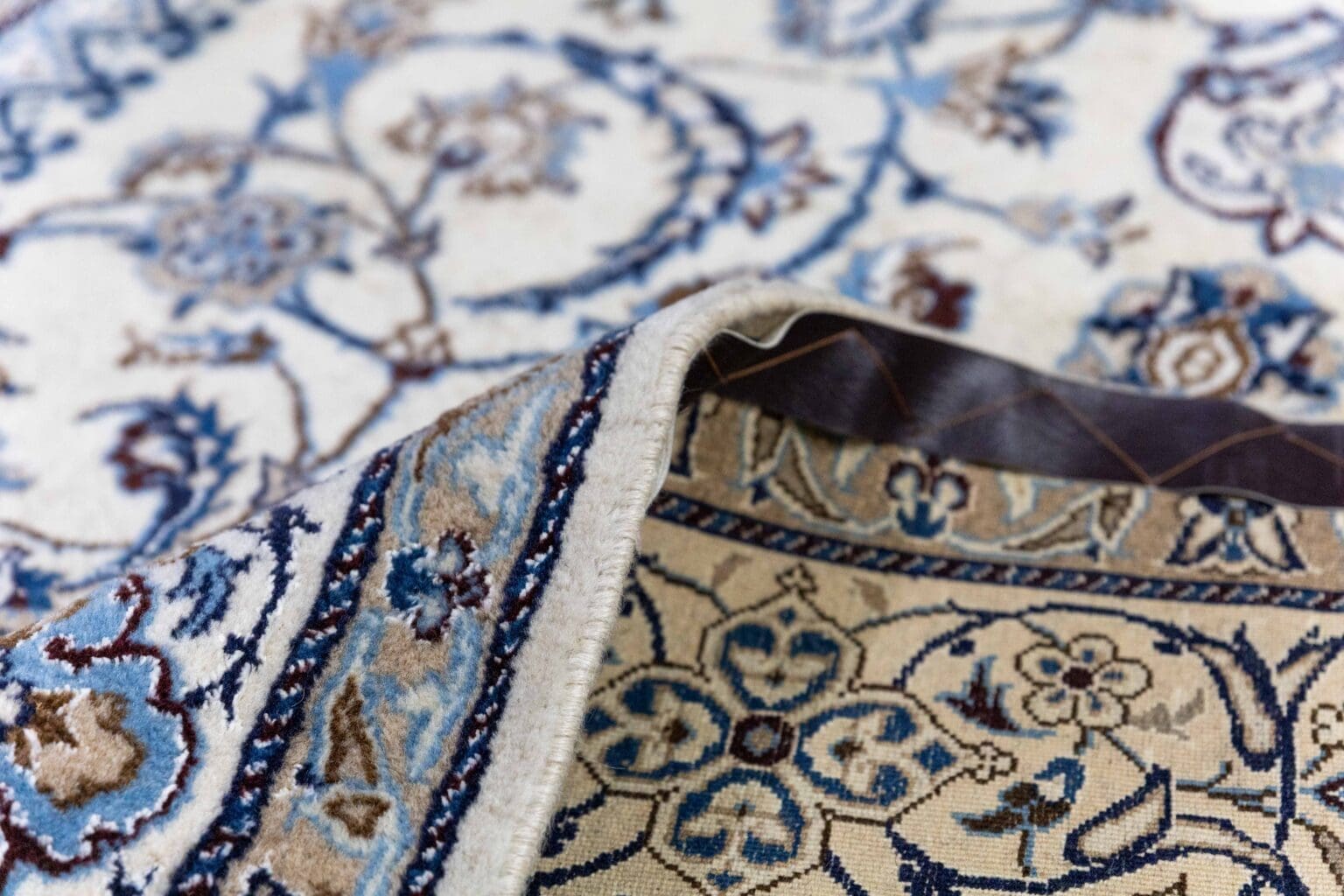
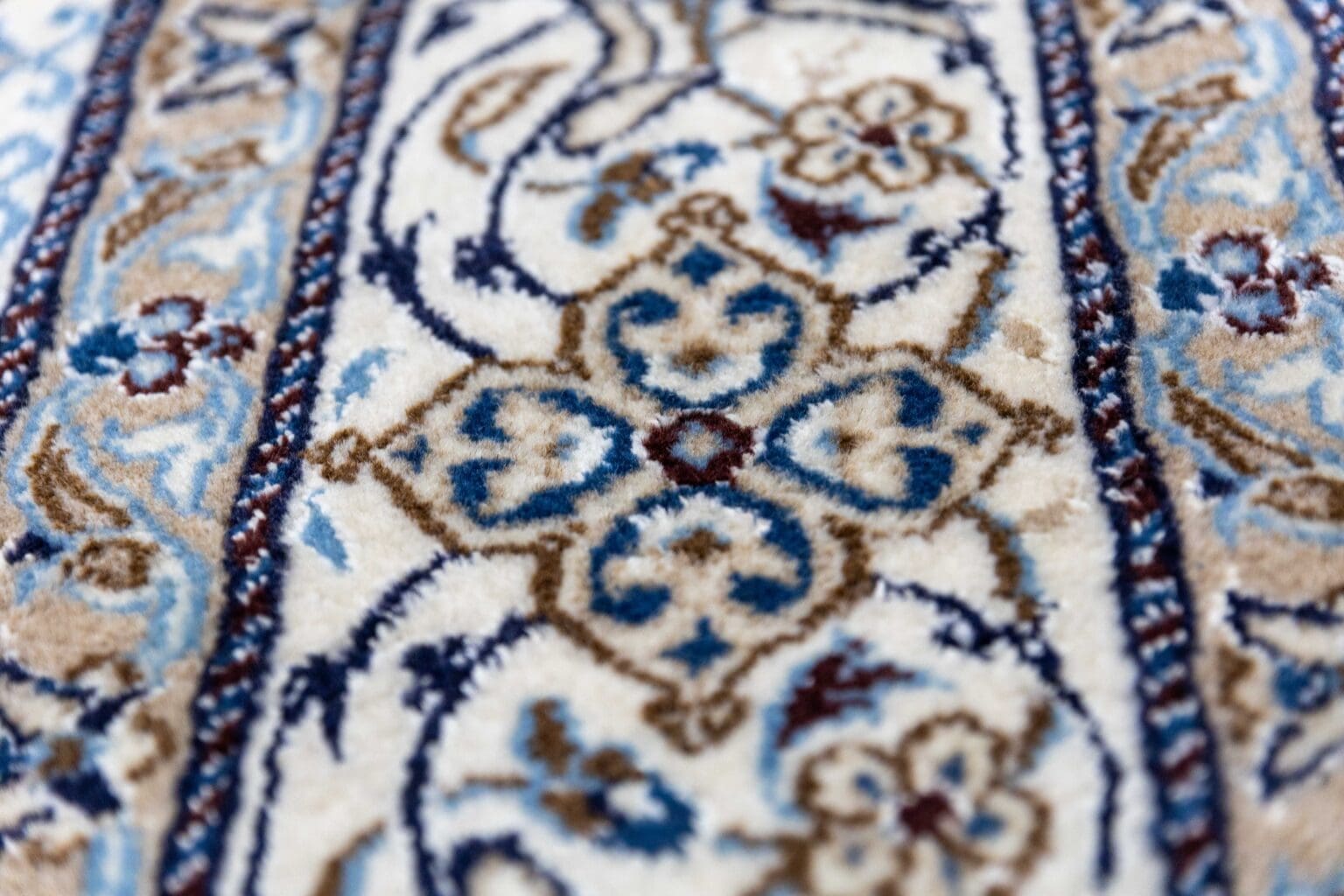
Hand-knotting builds the pile one knot at a time across the warp. Each row is created manually and then compacted as the work progresses. A 12La construction allows contours, curved lines and small ornamental units to be drawn with considerable definition. It also helps create a coherent surface in which the central medallion and surrounding floral forms remain connected. The cotton warp is part of this process, holding the structure in place while the wool and silk pile is formed.
The combination of wool, silk and cotton belongs to the established material vocabulary associated with fine Nain rugs. It places a woollen pile with silk within a cotton foundation and gives the finished textile a differentiated fibre structure. This individual rug is not described as machine-made; it is specifically hand-knotted. The inventory designation W1(#396) identifies the piece within the collection and distinguishes it from other one-off rugs.
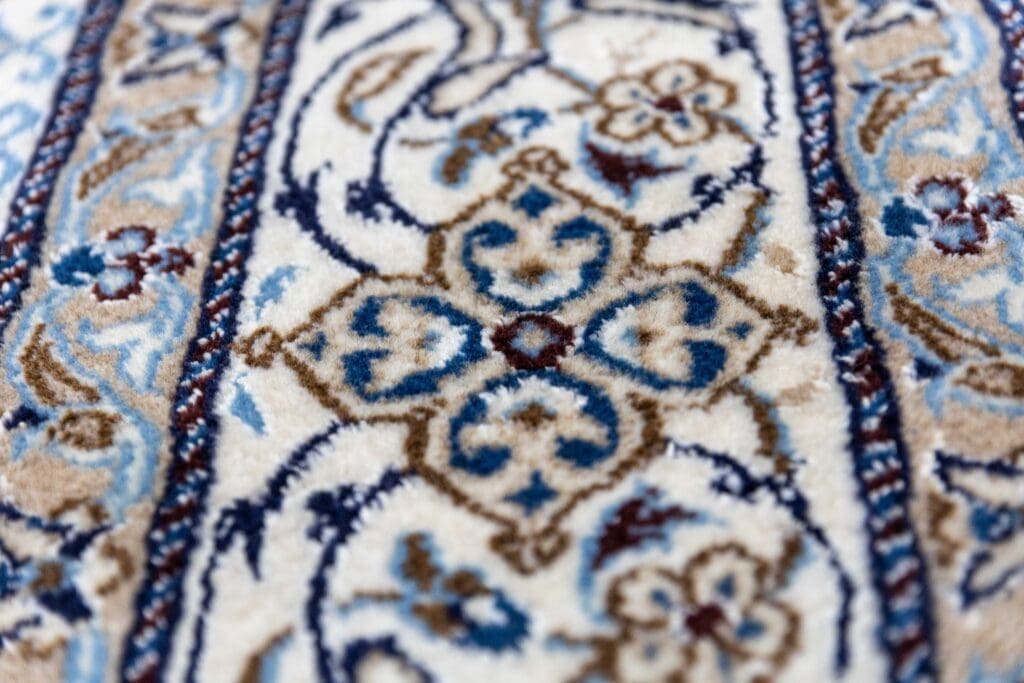
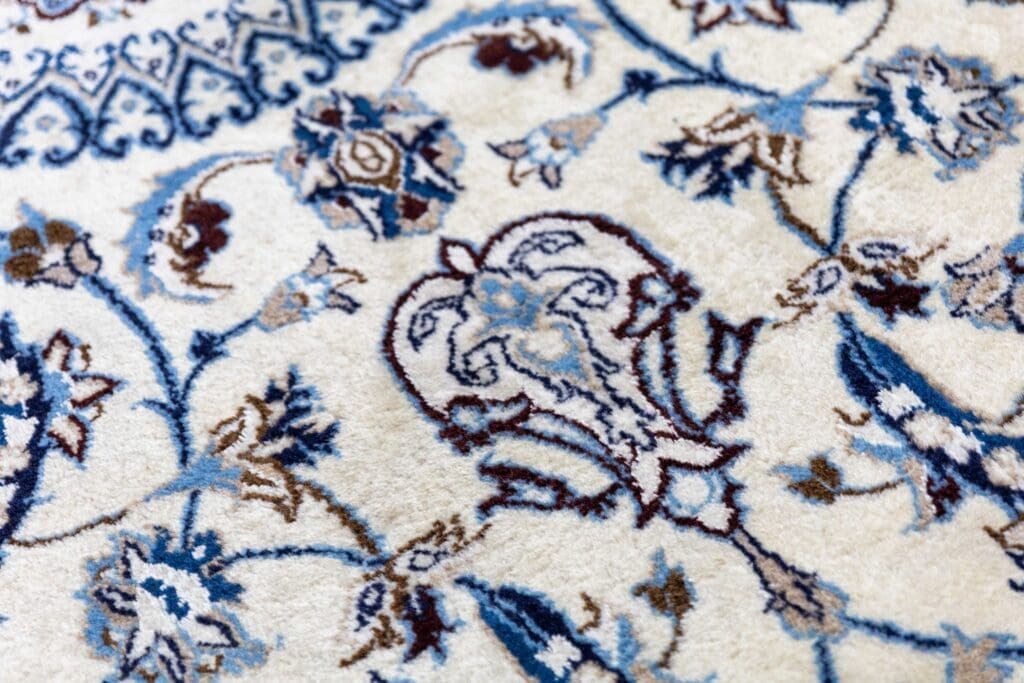
The stated construction also explains why the design can be read on more than one level. From a distance, colour fields and the medallion form a balanced whole. At closer range, the pile reveals the individual work of the knotter and the contrast between wool and silk. The knot density, material composition and hand-knotted technique are factual characteristics of this rug, while the wider tradition of Nain provides the technical context in which they are understood.
Origin and Tradition
The rug comes from the city of Nain in Persia. Nain is located in Isfahan Province in central Iran and is known as a distinct centre of Persian rug production. The city lies in an arid landscape within a historic cultural region that connected important centres of craft, trade and artistic exchange. Within this setting, textile production developed as a skilled form of work, and Nain became associated with carefully drawn designs and fine hand-knotting.
Persian rug making has a long history. The tradition connected with Nain reaches back through the history of Persian textile arts to the Safavid period. The Safavids supported court arts, textiles and ornamental design, helping establish a visual language in which carpets could combine structure, colour and symbolism. Later workshops continued to reinterpret this heritage. Nain weaving belongs to that wider history while retaining its own regional identity through its fine drawing, balanced layouts and use of refined materials.
Nain is an origin designation rather than the name of one single pattern. Rugs from the city may use medallions, floral arrangements, scrolling vines and framed fields in different combinations. What links many of them is the disciplined organisation of the design and the attention given to knotting and material preparation. A pattern is not printed onto the surface. It is created through the placement of coloured knots, so the quality of the drawing depends directly on the regularity of the construction.
For this reason, the name Nain must be kept separate from the pattern term Lachak-Toranj. Lachak-Toranj describes the medallion arrangement used here; it does not change the rug’s origin. Persian design terminology often travels between cities and workshops, and motifs may be adapted in more than one regional tradition. The origin of this particular rug remains Nain, in Isfahan Province, while its central design belongs to the broader vocabulary of Persian medallion carpets.
Isfahan Province has an important place in Persian art and craft history. Its workshops are associated with complex compositions in which a centre, corner elements, borders and botanical ornament are brought into a carefully measured relationship. Nain developed within this cultural environment and became recognised for a precise style of drawing. The regional tradition is therefore expressed not only through a place name, but also through the technical process of planning a field, preparing the warp and reproducing a detailed design knot by knot.
Knowledge in rug making is transmitted through a chain of practical skills. Fibres must be selected and prepared, yarns spun, colours applied, the loom arranged and the knotting carried out in sequence. Finishing then includes securing the structure and working the pile surface. In a fine rug, small variations at any stage can affect the clarity of a line or the balance of a motif. The tradition of Nain is consequently both visual and technical: its designs belong to a Persian artistic heritage, and its appearance depends on the precision of handwork.
The central medallion tradition itself has deep roots in Persian carpet design. A medallion creates a visual centre and allows the rest of the field to be organised around it. Corner pieces and borders can echo its contours, producing a relationship between the centre and the rectangular outline. This principle is not limited to one city, but Nain workshops have used it within their own finely detailed language. The present rug brings that established structure together with the Lachak-Toranj designation and the regional Nain identity.
Design and Pattern
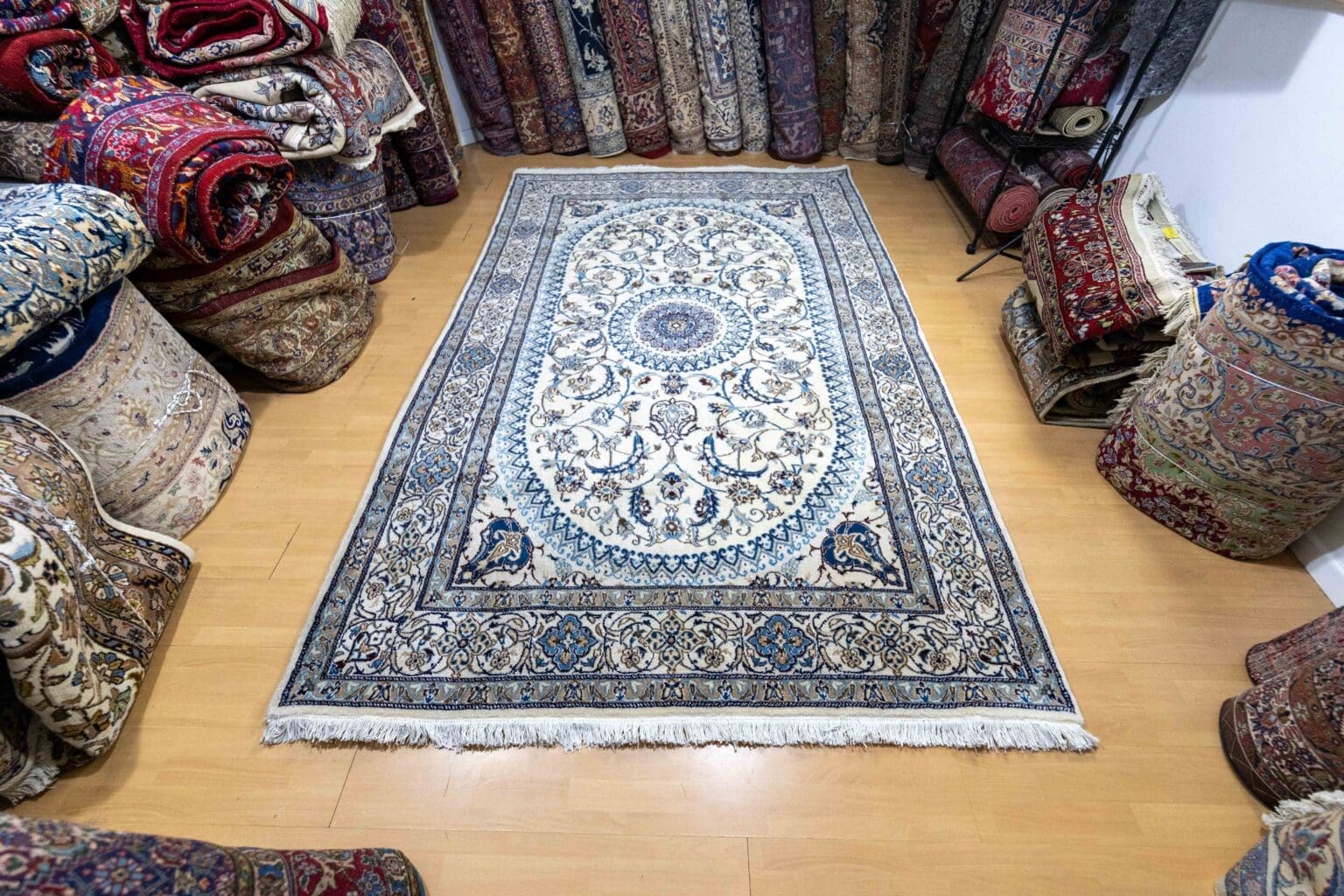
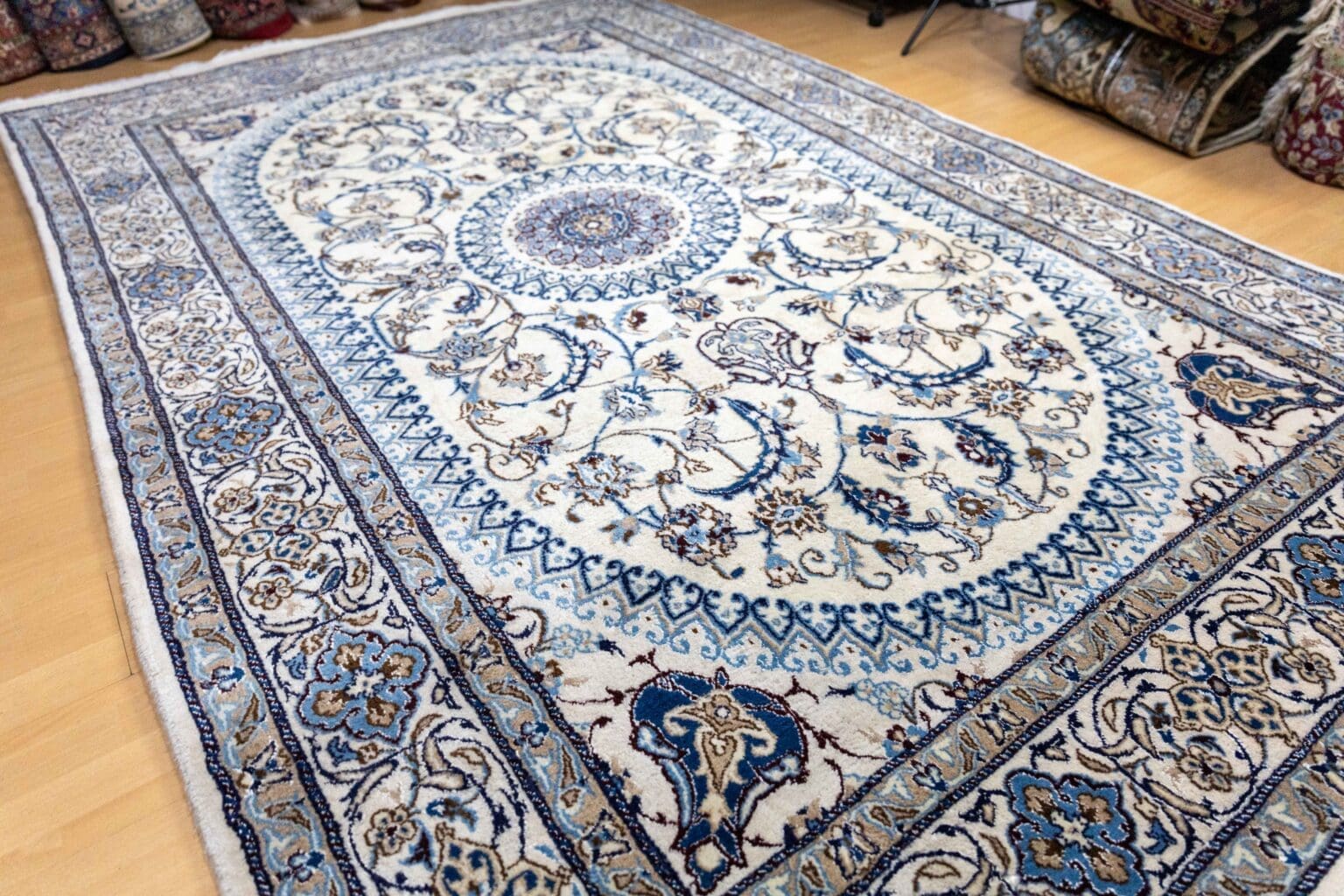
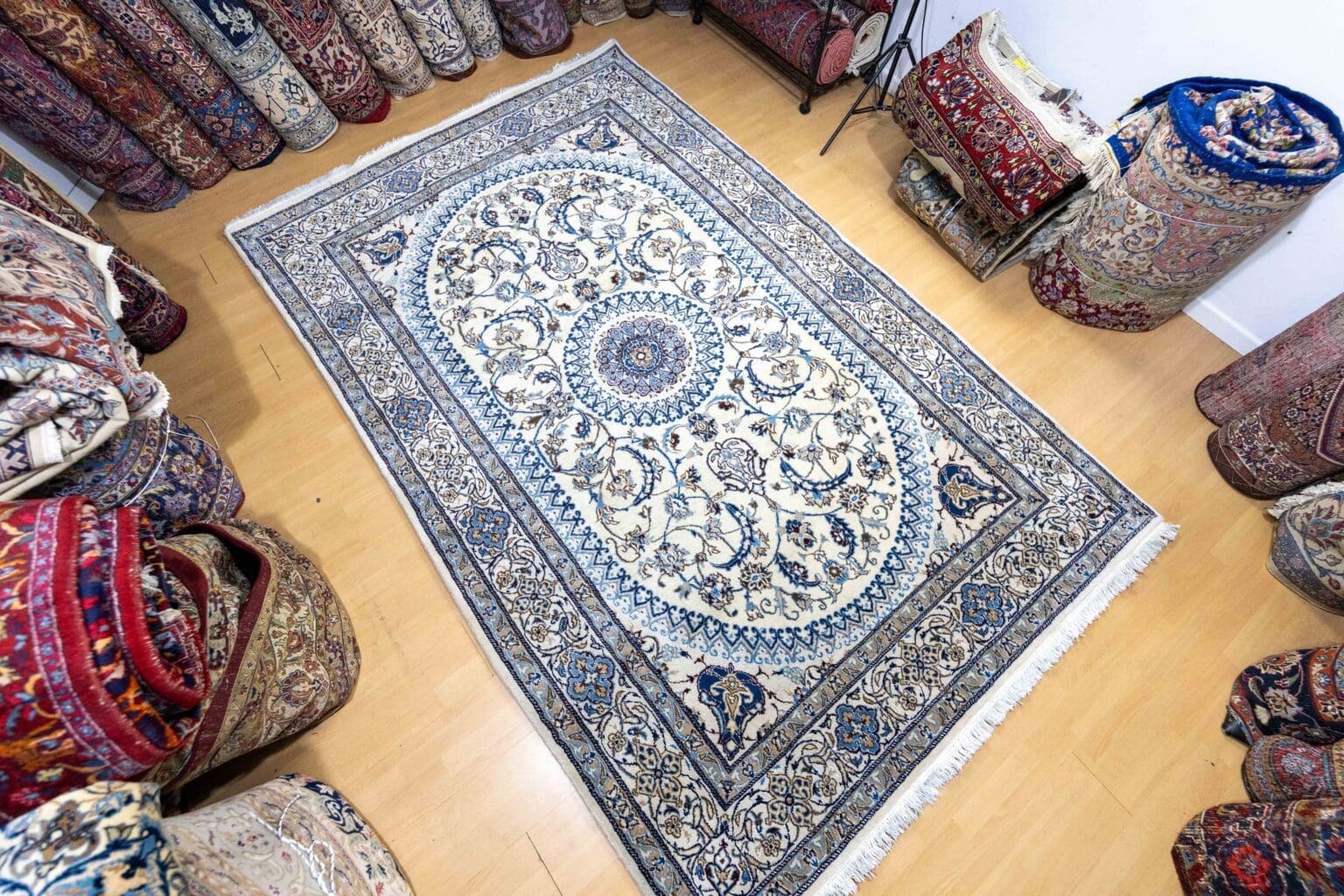
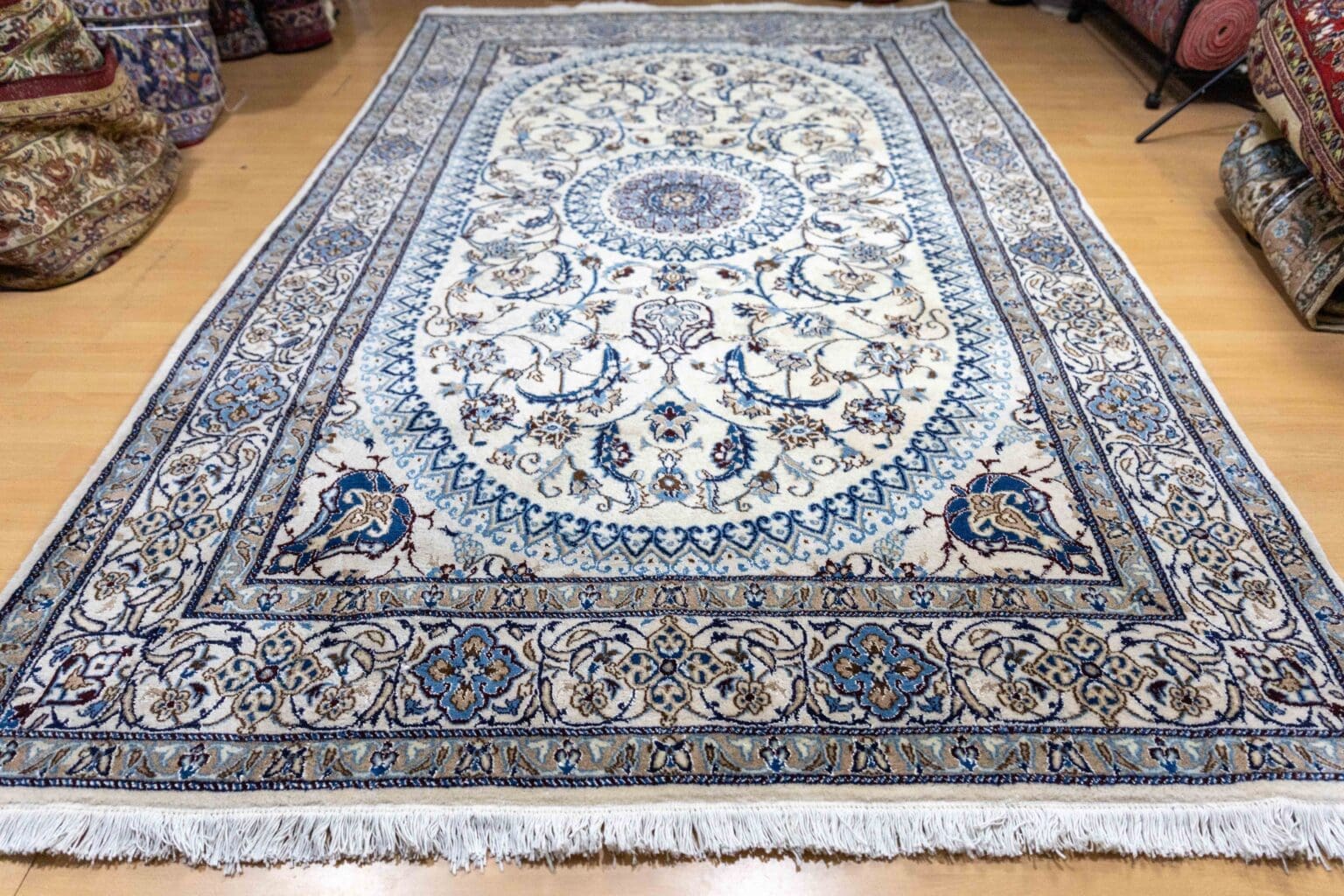
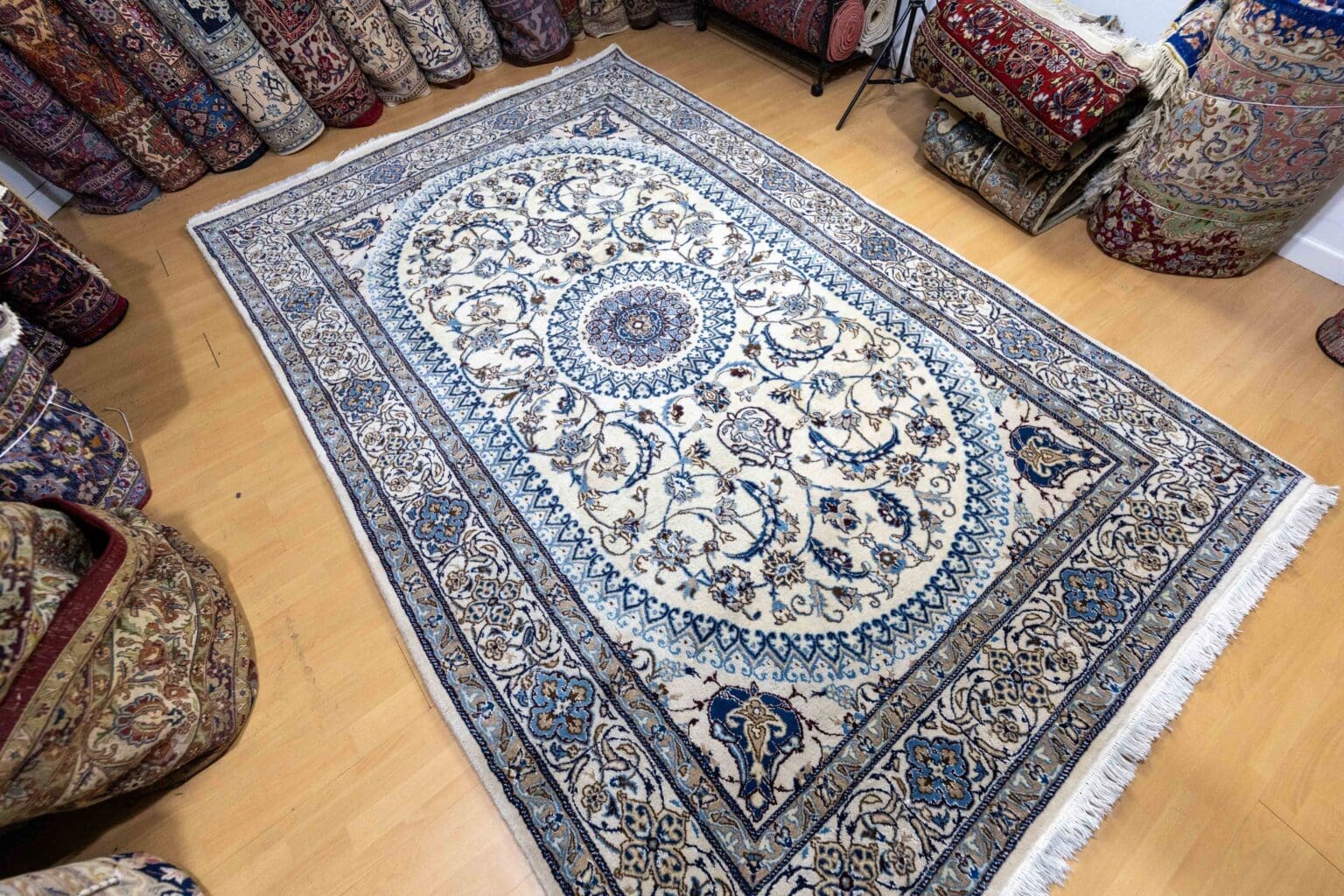
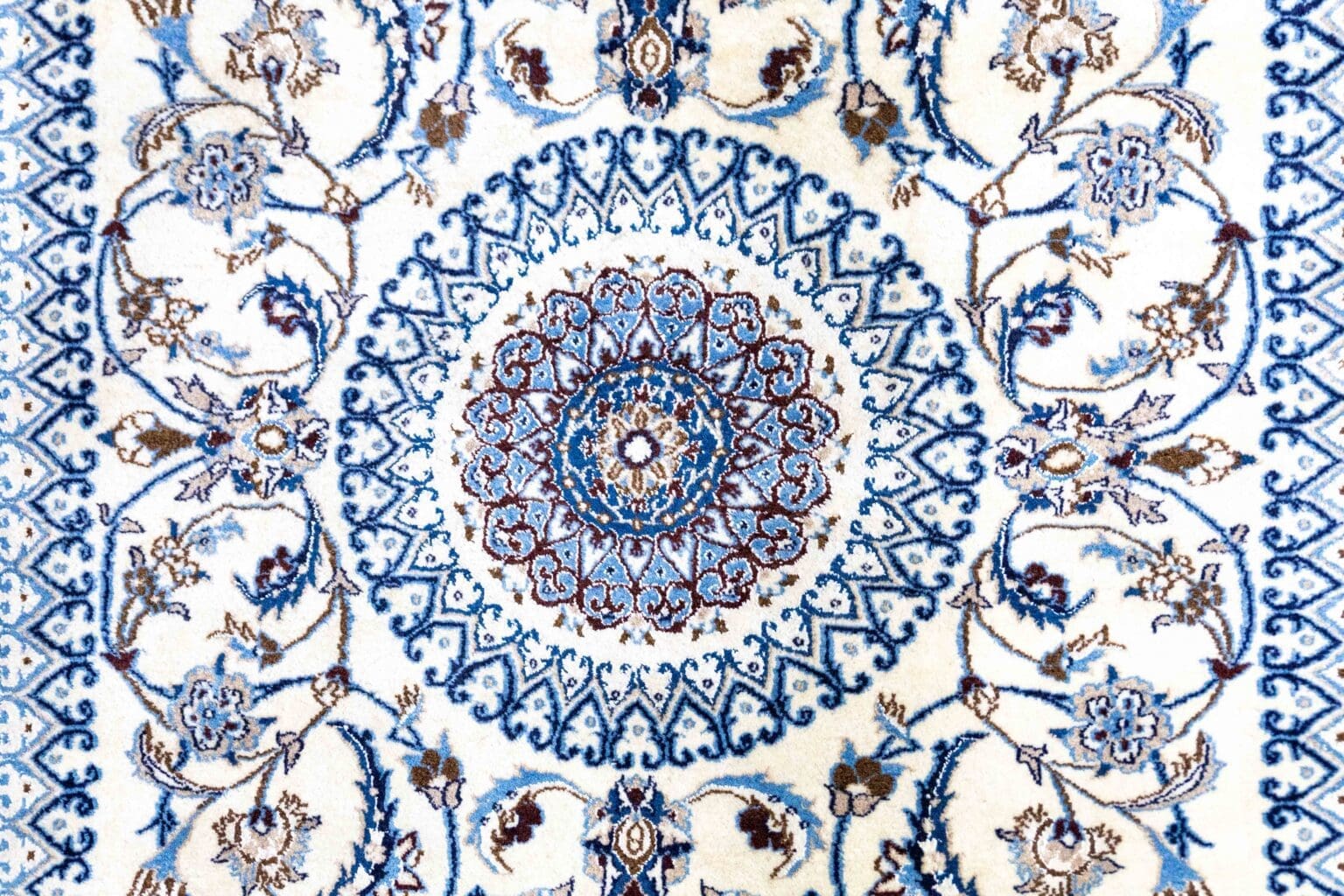
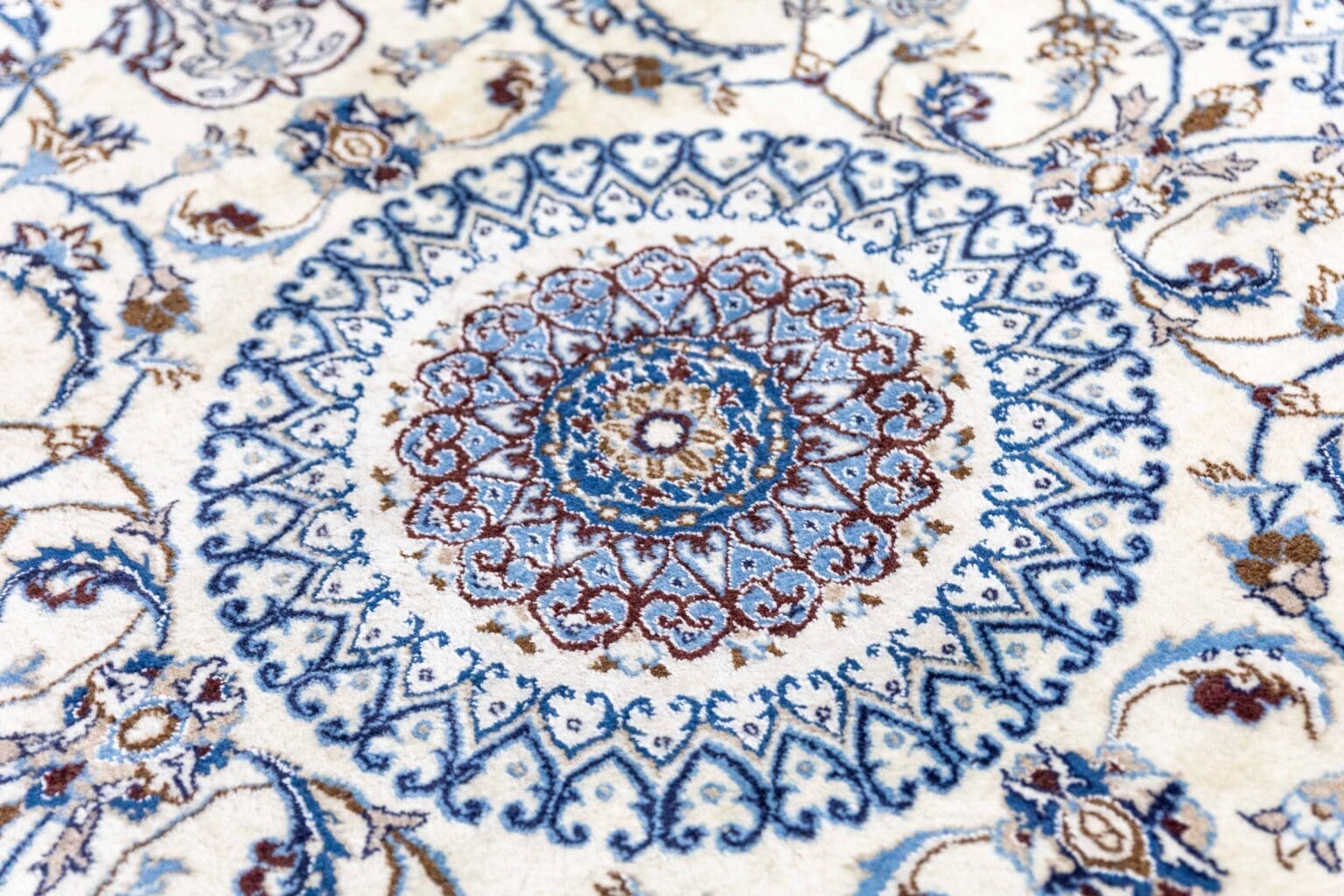
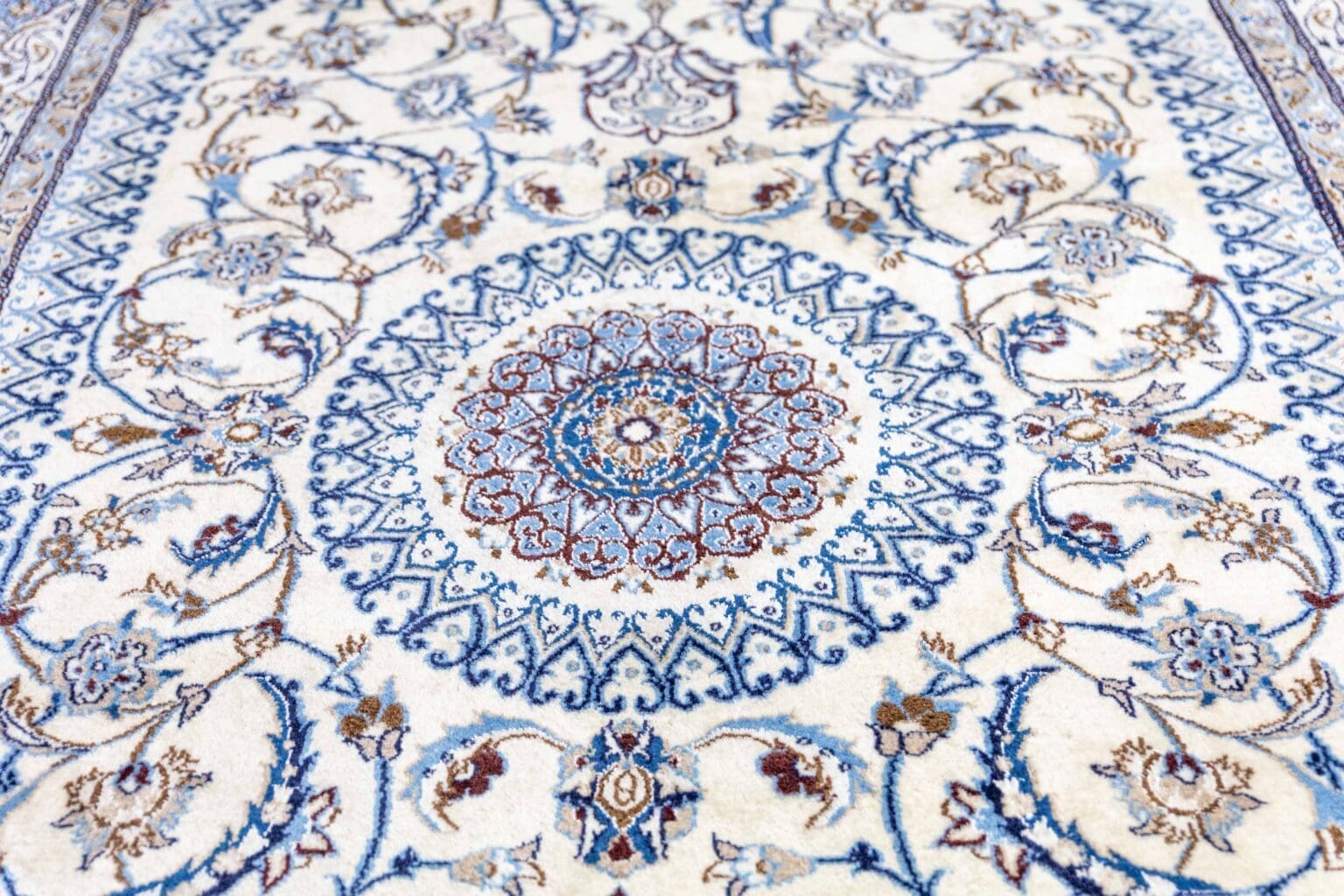
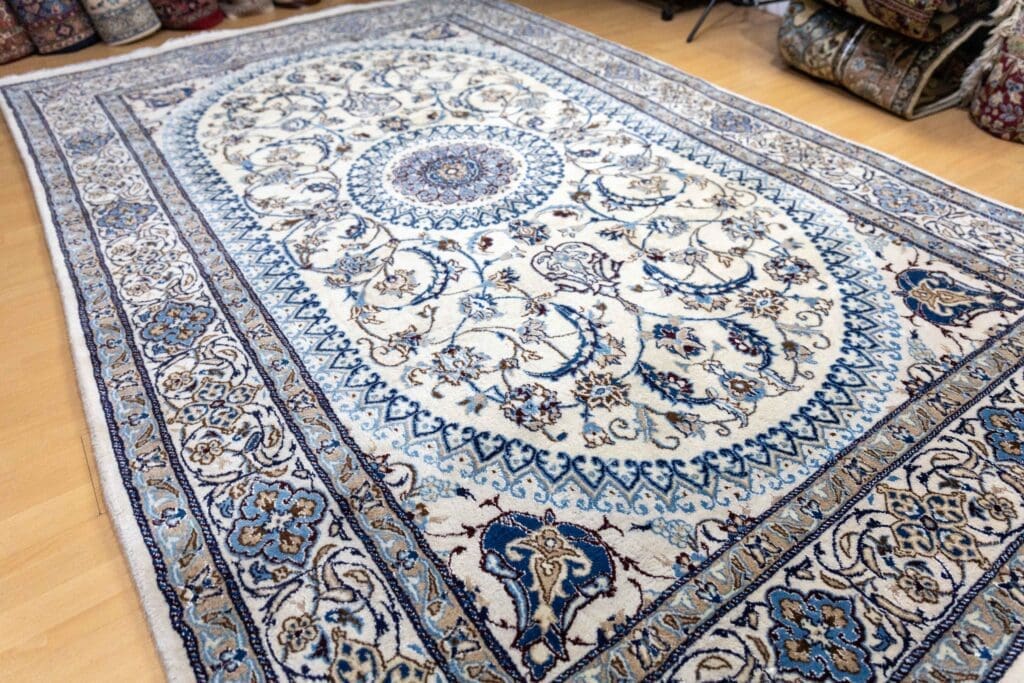
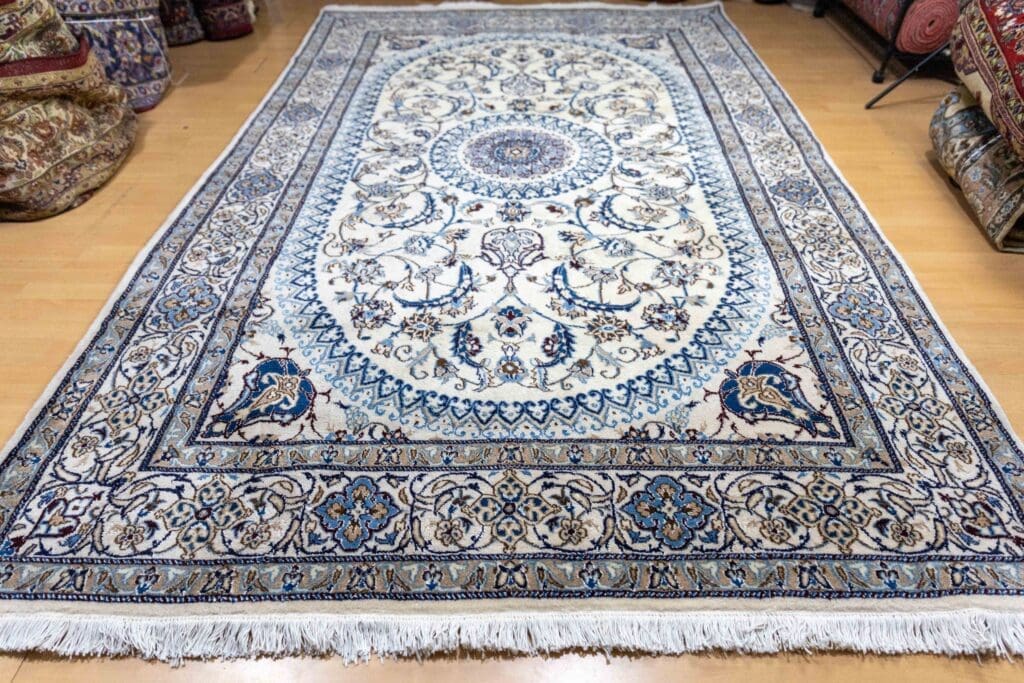
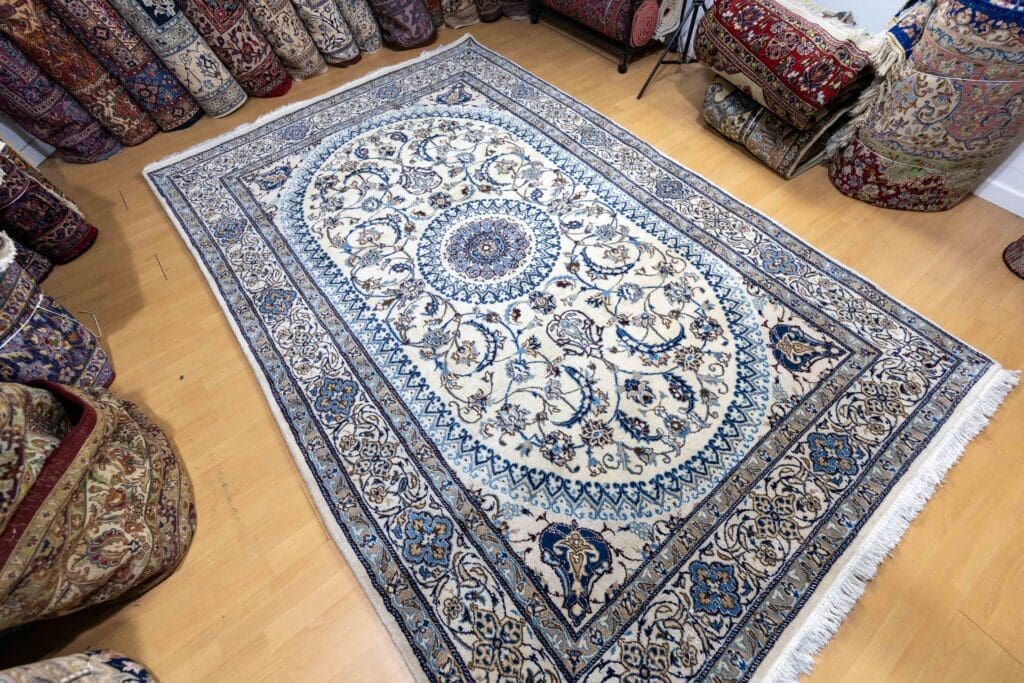
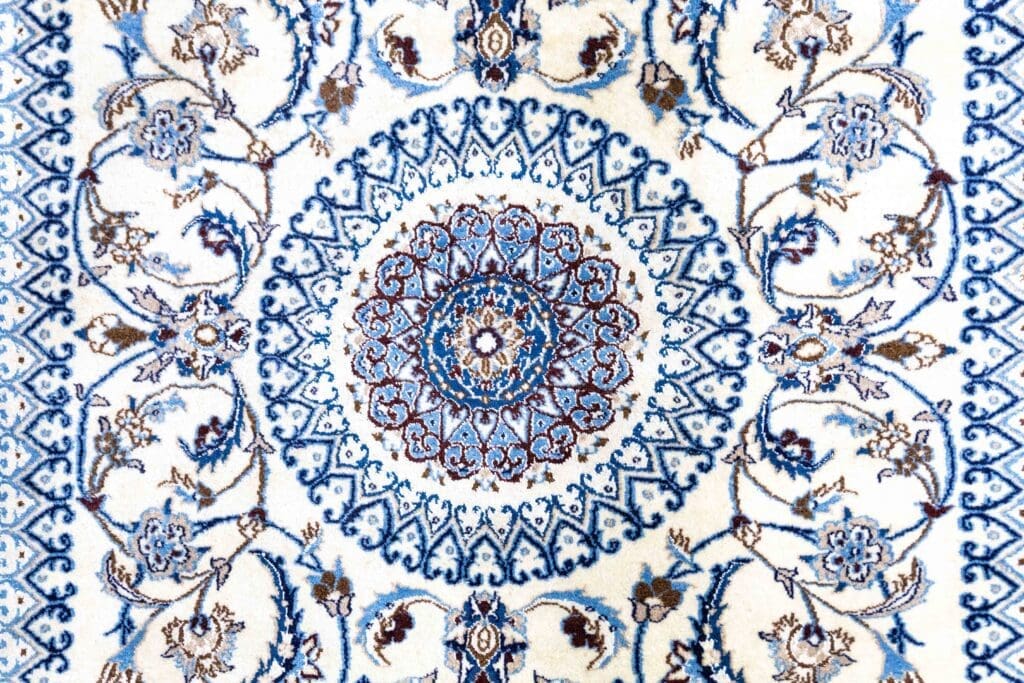
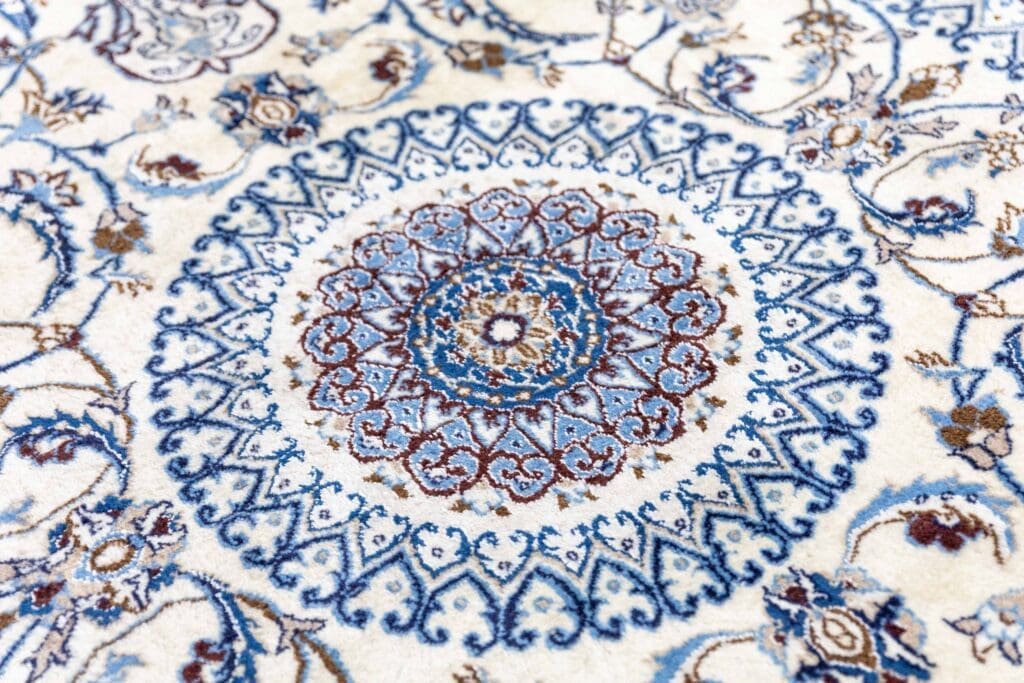
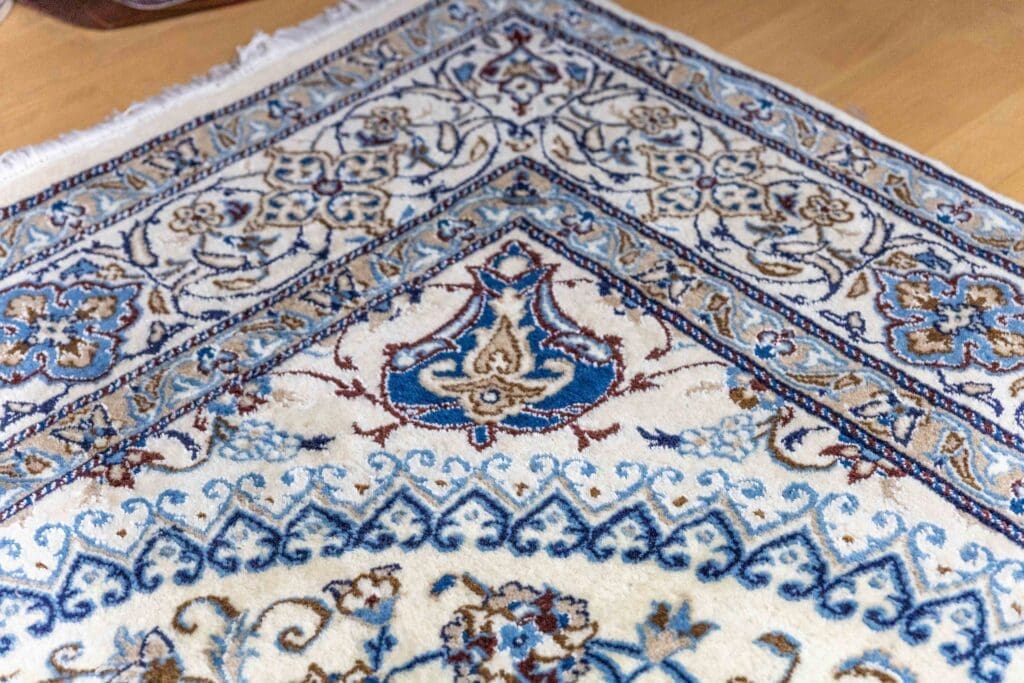
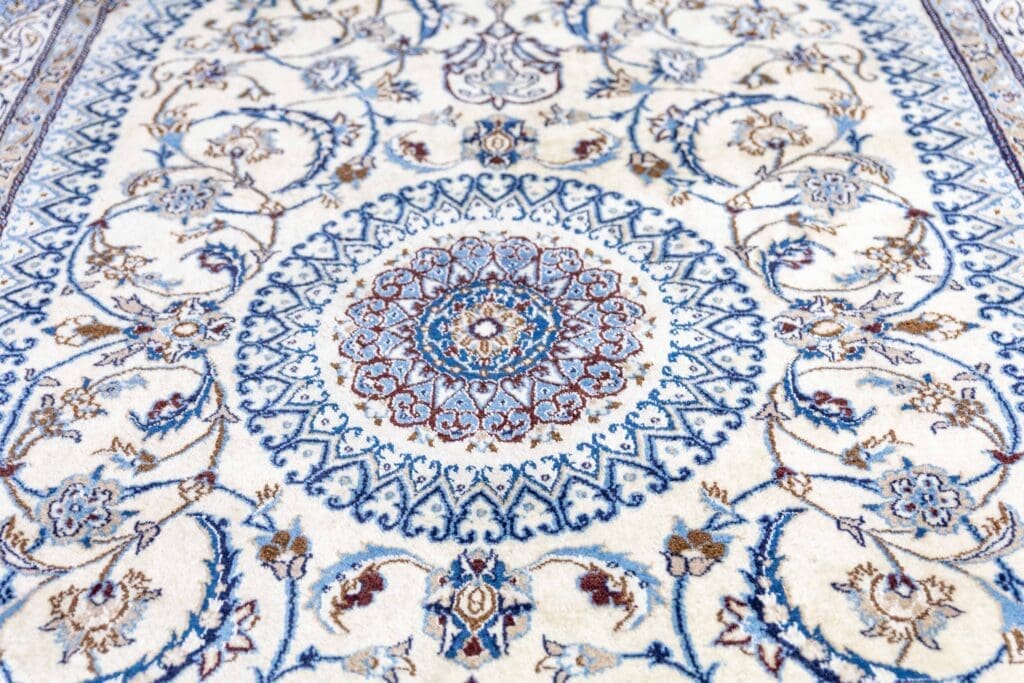
The main design element is a Lachak-Toranj medallion. In Persian pattern terminology, toranj refers to a central medallion, often shaped as an elongated almond or a rounded lozenge. Lachak refers to the quarter-medallion forms associated with the corners. Together, these terms describe a composition in which the middle of the rug and the corner areas are designed as related parts. The structure gives the field a clear centre without separating it from the surrounding ornament.
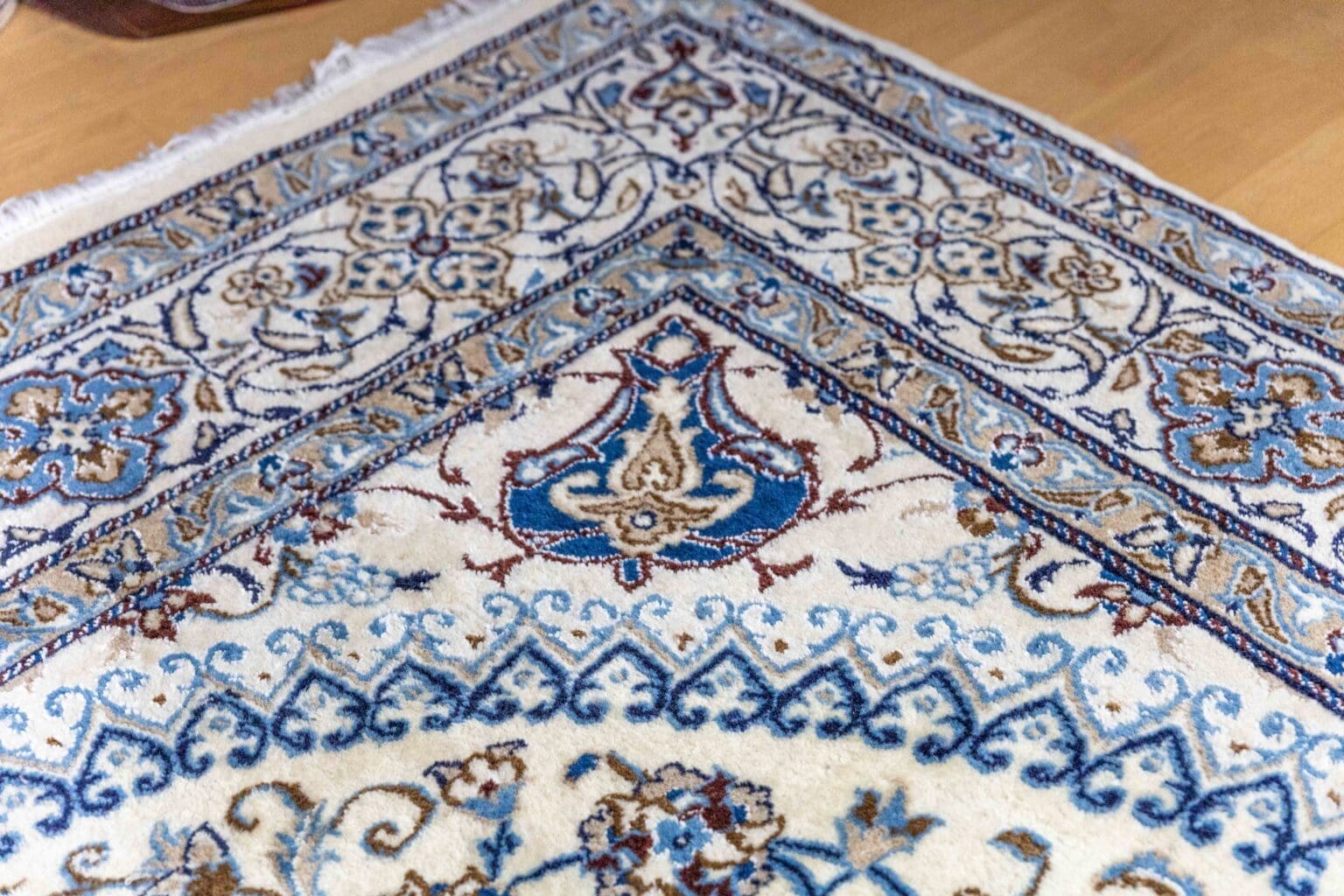
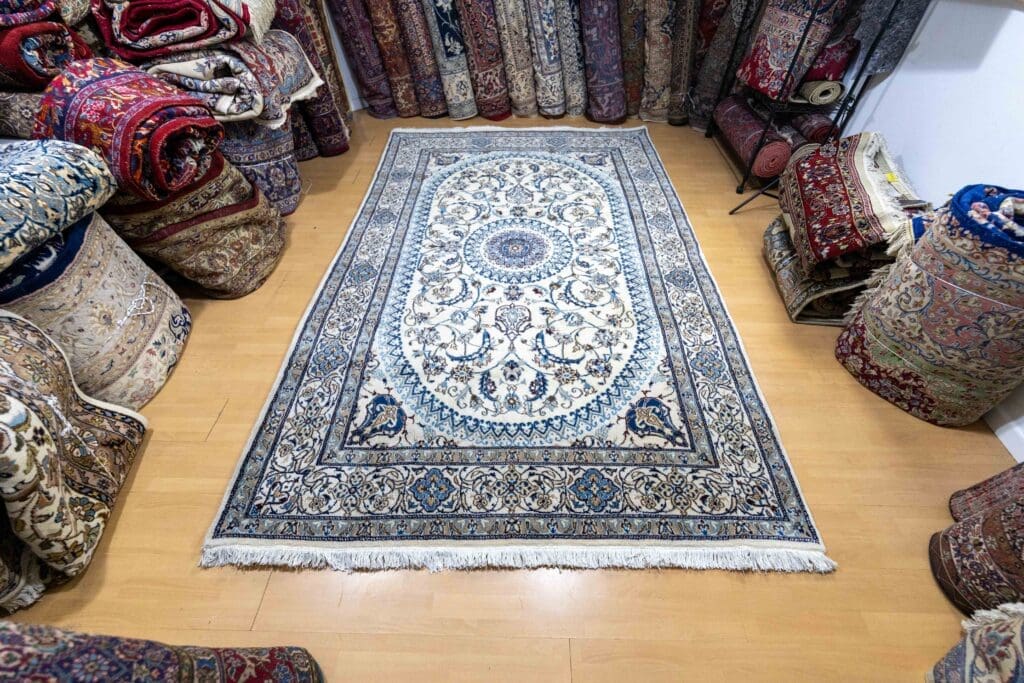
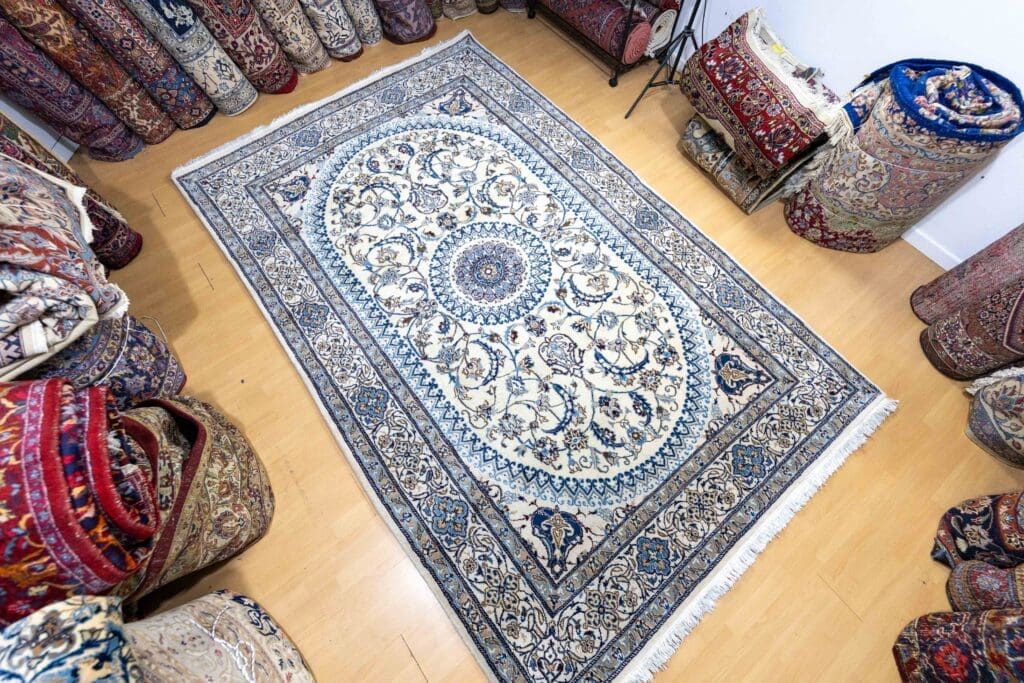
The Nain medallion is positioned in the centre of the field. Its placement establishes the primary axis of the composition and guides the eye through the internal drawing toward the surrounding floral details. Floral borders frame the main field and mark the transition from the central area to the outer edge. In Persian rugs, a border is more than a finish around the perimeter. It controls the scale of the design, contains the field and creates a visual interval between the ornament and the room around it.
The colours described for this rug include soft beige tones, warm reds and deep blue. These colours create different levels of contrast within the composition. Beige can provide a quiet ground or transitional area, while red introduces warmth and blue gives the design darker points of emphasis. The final appearance also depends on the direction of the pile and on the way wool and silk reflect light. Silk fibres can catch light differently from wool, making selected details appear finer or more luminous without changing the underlying pattern.
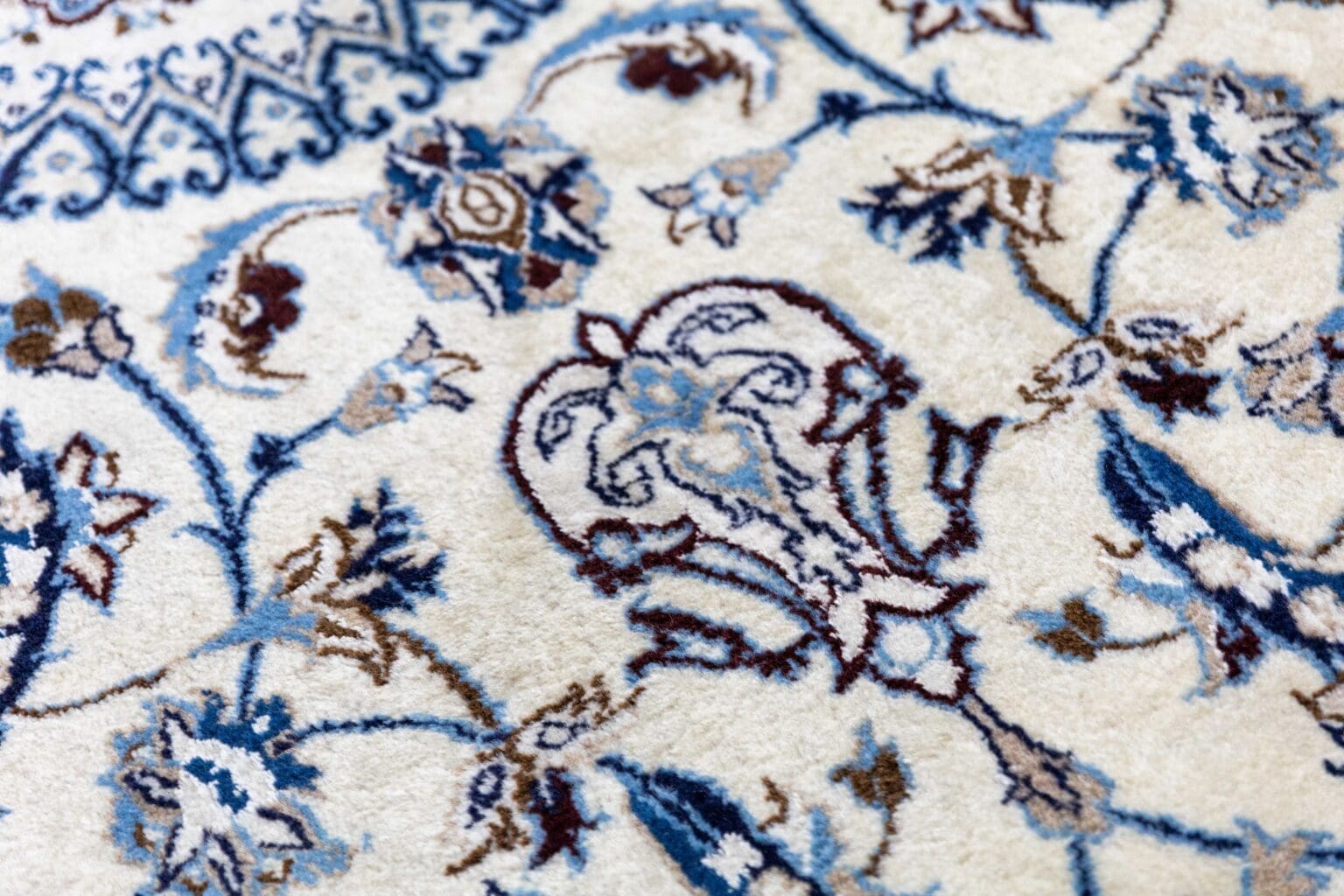
Floral ornament is a central part of Persian carpet design. Leaves, blossoms, stems and scrolling vines can be arranged symmetrically, repeated rhythmically or used to connect separate parts of a field. Such motifs fill space while preserving intervals between the individual elements. In a medallion composition, floral forms often surround the centre, extend toward the borders and help connect the corner pieces to the main design. Their function is decorative, but they also provide rhythm and continuity across the rectangular surface.
The fine knotting supports the drawing of the Lachak-Toranj pattern. Curves can be kept distinct, outlines can be placed closely together and smaller floral units can be differentiated from one another. Each coloured knot contributes to the image. Viewed from a distance, these small units merge into an ordered pattern; viewed close up, the hand-made construction remains visible. This changing scale is an important characteristic of finely knotted Oriental rugs, because the design and the technical structure remain present at the same time.
A medallion composition does not mean that the rug consists only of one isolated symbol. The medallion establishes a focus, while borders, corners and floral details provide balance. The Lachak-Toranj structure links the central form with complementary elements at the edges. Repetition, symmetry and proportion determine how the eye moves from the centre outward and back again. These principles belong to the long Persian design tradition and are applied here within a Nain setting.
The pattern terminology should be read together with the origin designation. Lachak-Toranj identifies the design language, and Nain identifies the city of origin. The use of a Persian motif name does not imply that the rug was made in another province. Its documented composition remains a Nain medallion with floral borders, rendered in soft beige, warm red and deep blue tones and worked with a wool-and-silk pile.
Symbolic interpretations of Persian motifs vary according to period, region and workshop. A medallion may be read as a device for harmony and cohesion because it organises the surrounding field around a centre. Floral forms may suggest the ordered relationship between nature and geometry that appears throughout Persian art. These are general features of the tradition; the specific, verifiable design features of this rug are its Lachak-Toranj Nain medallion, floral borders and described colour range.
Special Features
This rug is described as new and in TOP condition. The product information states that it has never been used and has no signs of wear or damage. That condition is one of the defining features of this individual piece. It also carries the designation W1(#396). Alongside the condition, the 12La knotting, the wool pile with silk, the cotton warp and the Lachak-Toranj medallion identify the rug’s documented construction and appearance.
Silk is part of the pile material and is not merely a name for an ornamental effect. The rug therefore combines a woollen pile with silk fibres on a cotton warp. Its hand-knotted construction means that the design is formed through individual knots rather than through a printed surface. Taken together, the stated materials, technique, pattern and new condition describe the particular character of this Nain. No separate provenance or additional condition claim is needed beyond these documented features.
FAQ
What is the best way to care for a hand-knotted Nain rug?
Vacuuming regularly at a low setting helps remove dust and loose dirt while placing less strain on the pile. The vacuum head should be moved in a controlled manner, and rotating brushes should be used cautiously on a fine surface. Because this rug combines wool with silk, strong household chemicals should not be applied to stains without checking their suitability. Specialised rug cleaners or professional cleaning services are appropriate when deeper cleaning is required. A professional process can take account of the different behaviour of wool and silk and help preserve the pile structure and colour appearance.
Can the rug be used over underfloor heating?
Yes, the W1(#396) Nain can be used over underfloor heating. The temperature should not be set too high, so that the fibres are not subjected to unnecessary heat. Moderate, even warmth is preferable to intense or rapidly changing temperatures. Regular airing is advisable to prevent moisture from accumulating beneath or within the rug. A clean and dry floor supports the preservation of its new condition. When placing it over heated flooring, the room’s heat distribution and the stability of the surface should both be taken into account.
Where is the best place to position the rug?
The Nain is suitable for a living room, bedroom or foyer as a refined furnishing element. It should rest on a stable, level surface so that the hand-knotted structure lies evenly. Direct sunlight should be avoided because prolonged exposure can cause colours to fade. This is especially relevant to the carefully balanced beige, red and blue palette. A suitable position will keep the central Lachak-Toranj medallion and floral borders visible while reducing unnecessary stress from sharp furniture edges or exceptionally heavy traffic.
To provide the best experiences, we use technologies like cookies to store and/or access device information. Consenting to these technologies will allow us to process data such as browsing behavior or unique IDs on this site. Not consenting or withdrawing consent, may adversely affect certain features and functions.
Functional Always active
The technical storage or access is strictly necessary for the legitimate purpose of enabling the use of a specific service explicitly requested by the subscriber or user, or for the sole purpose of carrying out the transmission of a communication over an electronic communications network.
Preferences
The technical storage or access is necessary for the legitimate purpose of storing preferences that are not requested by the subscriber or user.
Statistics
The technical storage or access that is used exclusively for statistical purposes.The technical storage or access that is used exclusively for anonymous statistical purposes. Without a subpoena, voluntary compliance on the part of your Internet Service Provider, or additional records from a third party, information stored or retrieved for this purpose alone cannot usually be used to identify you.
Marketing
The technical storage or access is required to create user profiles to send advertising, or to track the user on a website or across several websites for similar marketing purposes.

 SECURE PAYMENT
 SHIPPING PARTNERS