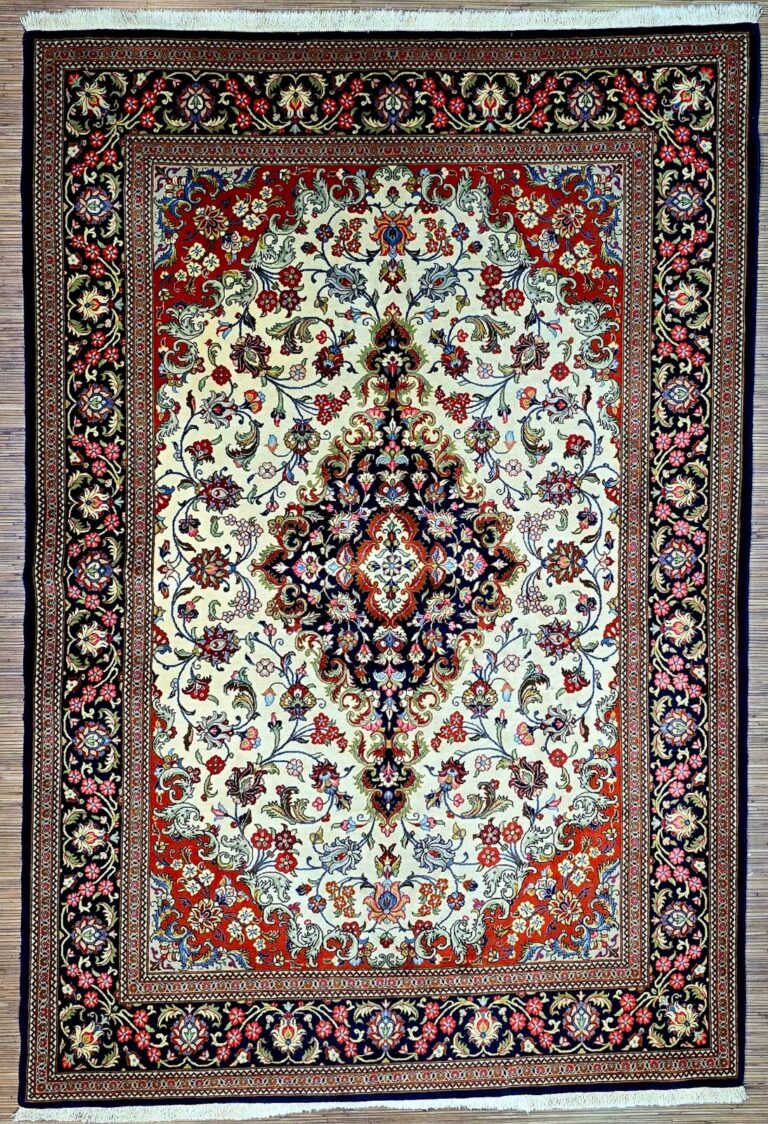
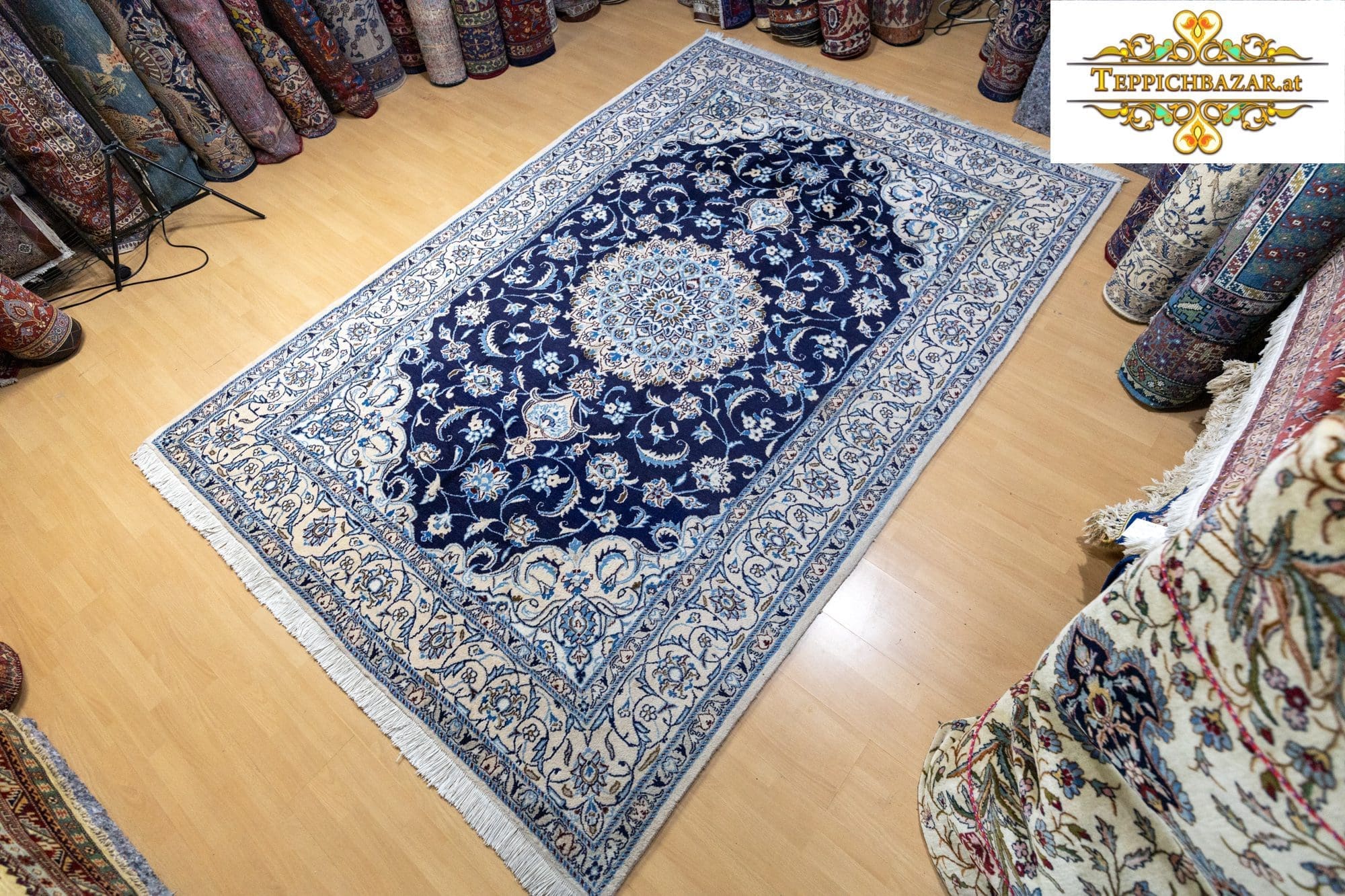
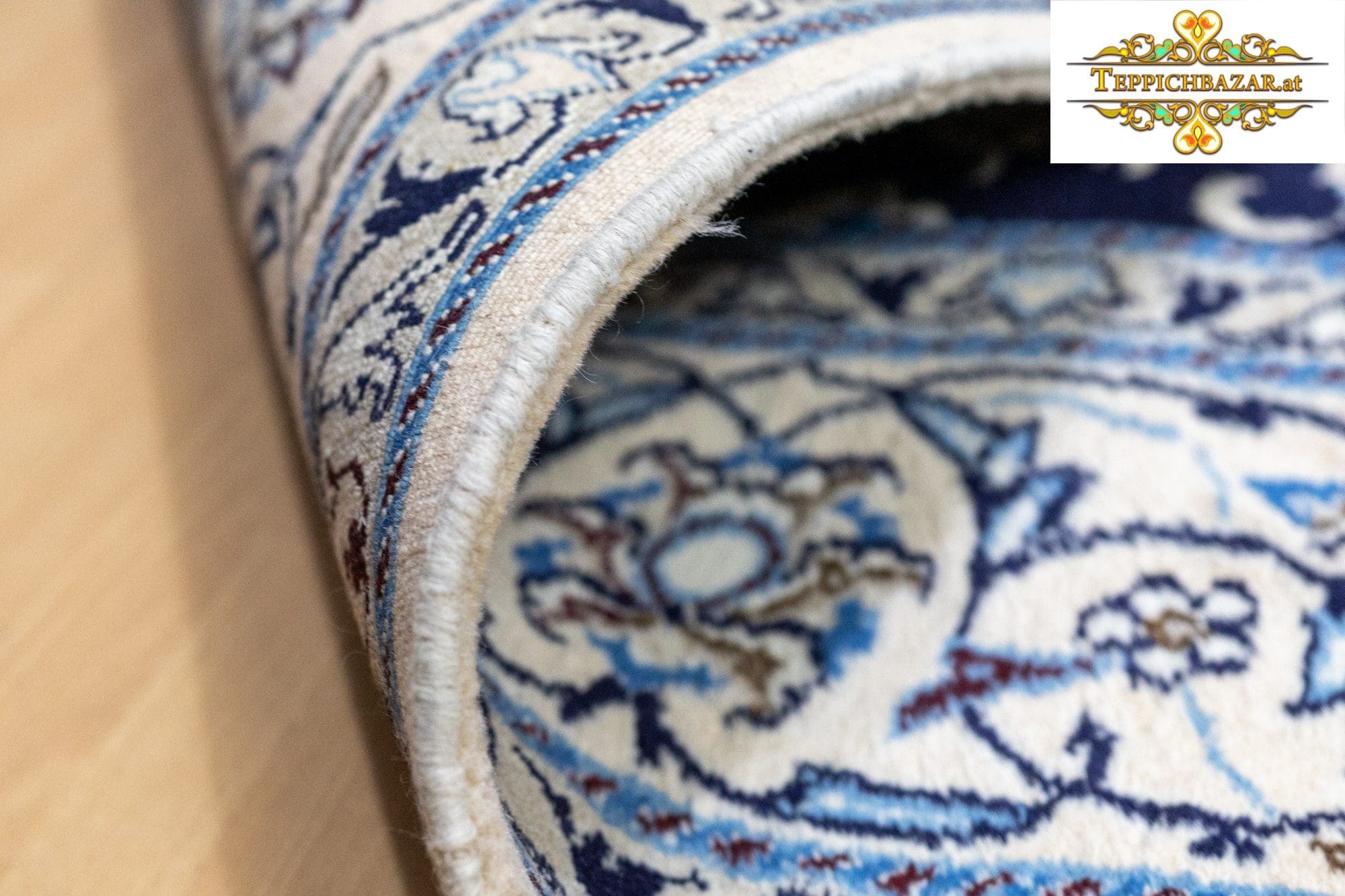
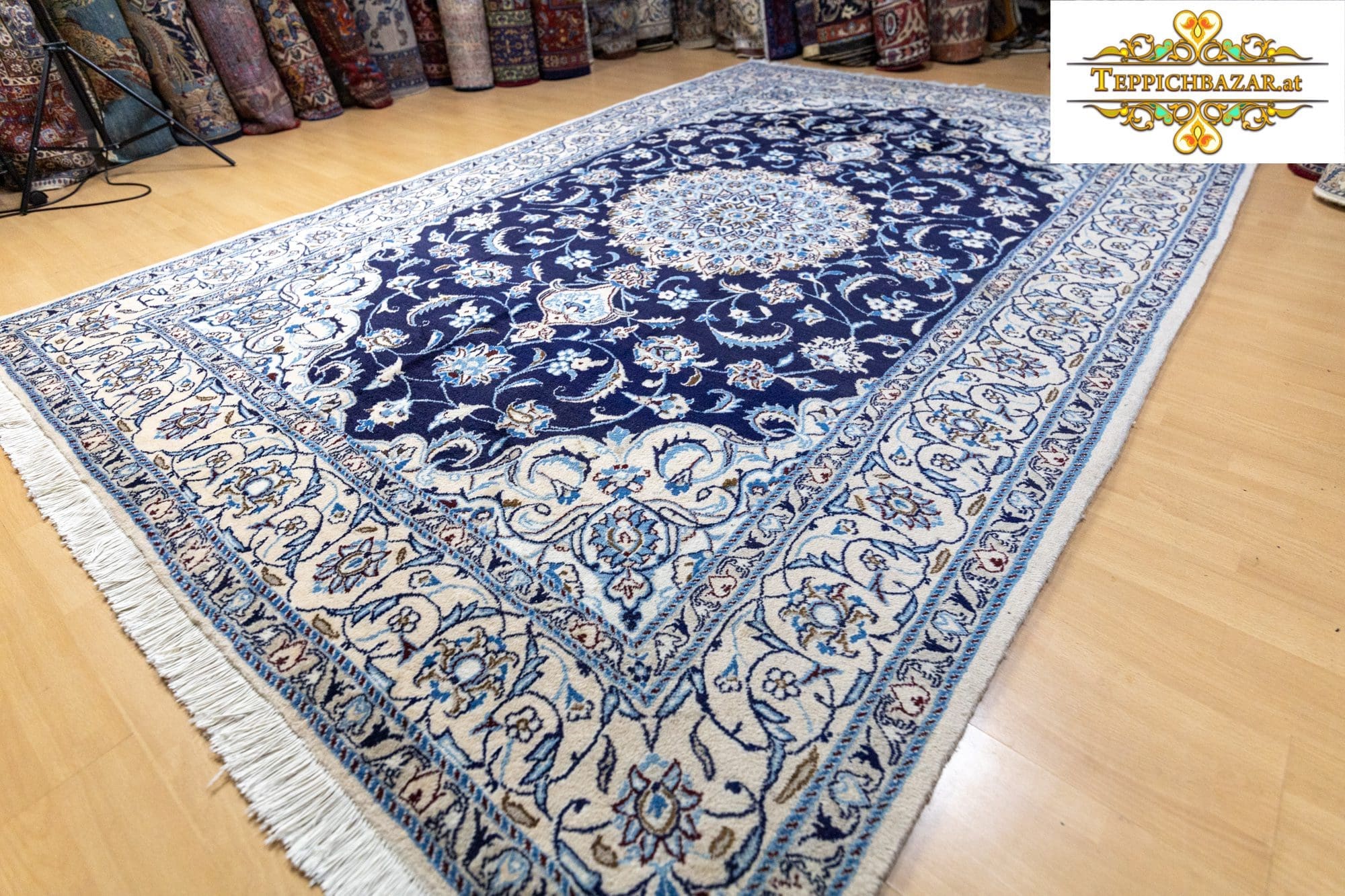
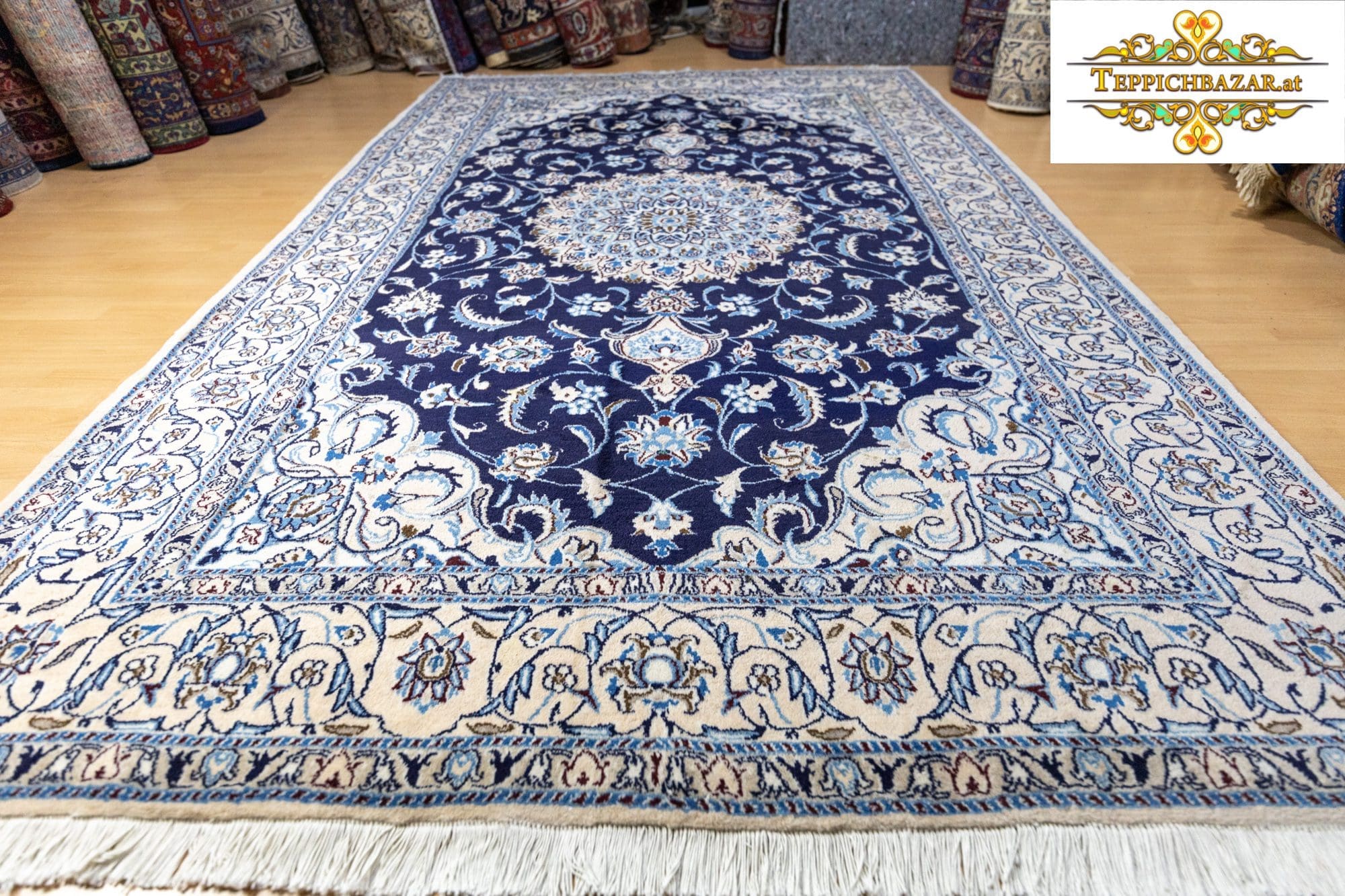
This Nain Persian rug is hand-knotted. Its pile is made from pure wool, while the borders are decorated with silk. Wool is a traditional material for Persian pile rugs because it can be spun, dyed and worked into a resilient surface with a clearly defined texture. In a hand-knotted rug, the pile is built knot by knot on the foundation. Each knot is placed by hand and then secured within the structure of the rug, allowing the design to develop gradually across the field and borders.
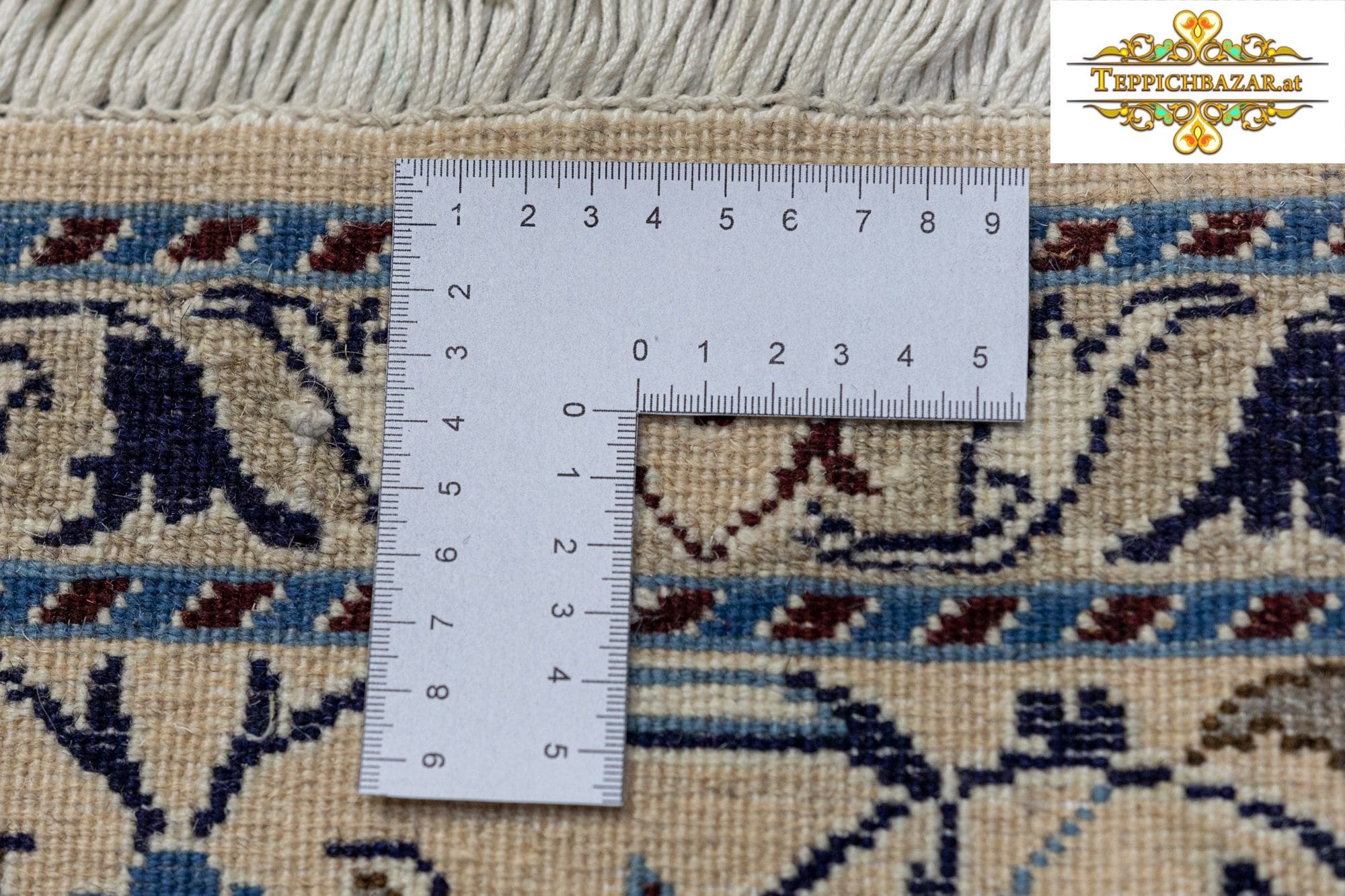
The classification recorded for this rug is 12La. In Nain terminology, the La designation refers to the yarn structure of the warp. Nain rugs are divided into several quality classifications, including four La, six La, nine La and twelve La. The classification is connected with the fineness and density of the construction. It is therefore part of the traditional vocabulary used to describe Nain weaving and should be considered together with the materials, the drawing of the design and the skill of the weaver.
The wool pile and silk-decorated borders give the rug a material contrast between the main surface and its framing elements. The pile provides the field in which the floral medallion is formed, while the silk in the borders adds a different fibre and a more finely accentuated edge. No cotton warp is stated for this piece, so the construction is described here only through the wool pile, the silk border decoration and its 12La classification.
The condition is very good, and the rug has been professionally washed. Professional washing is a recognised part of rug care in which the textile is cleaned with attention to its fibres, colours and construction. It does not change the fact that this is a hand-knotted rug; it describes the cleaning treatment recorded for the piece. The result is a rug whose present condition and material details can be considered alongside its Persian origin and Nain design vocabulary.
Origin and Tradition
The rug is identified as a Nain Persian rug from the city of Nain in Persia. Nain is a small town in central Persia, situated east of Isfahan. Its weaving tradition became known for carefully drawn Persian designs, fine construction and a restrained organisation of field, medallion and border. The name Nain therefore refers both to a recognised Persian weaving tradition and to the city associated with that tradition.
Nain developed its own identity within the broader history of Persian carpet weaving. Persian weaving regions are not uniform: each area has developed characteristic ways of arranging motifs, balancing colour and constructing the foundation. Nain is especially associated with orderly compositions in which a central medallion is set into a field of flowers and arabesques. The design language can be read as distinctly Persian while retaining the refined, structured appearance associated with Nain carpets.
The traditional classification of Nain rugs is based on knot density and the structure of the warp. The terms four La, six La, nine La and twelve La are used to distinguish the principal levels. The La term refers to a layer or grouping of yarn in the warp, and the number is traditionally related to the individual yarns forming that warp. In general, a lower La designation indicates a finer construction and a more complex execution, while a higher La designation indicates a different level within the Nain classification. The classification is not a substitute for examining the whole rug, but it provides an established framework for discussing Nain quality.
Among Persian rugs, Nain is often considered together with Isfahan because both traditions are associated with fine drawing and formal floral compositions. This does not make the two traditions identical. Nain has its own vocabulary of medallions, arabesques, borders and colour relationships. The weaving of a Nain rug requires the weaver to maintain the proportions of the composition while repeating small botanical and curving details throughout the field. The regularity of the overall arrangement is balanced by the human process of hand knotting.
Nain patterns have also been woven in Kashmar, a city in the Khorasan region of northeastern Persia. This is part of the wider circulation of Persian design traditions, in which established regional patterns can be interpreted by weavers in other centres. A Kashmar-made rug with a Nain pattern belongs to that design relationship, whereas the present rug is identified as originating from Nain. The distinction between a weaving origin and a named pattern is important when describing Persian carpets accurately.
The wider Persian carpet tradition includes many provinces and towns, each with its own approaches to materials, knotting, colour and composition. Nain belongs to this extensive network of regional production. Its identity is connected to the city, to the La classification and to the floral medallion style rather than to a single isolated motif. The rug therefore represents a specific Nain design tradition within Persian weaving, while its hand-knotted construction links it to the broader craft of oriental carpet making.
Hand weaving also explains why regional traditions remain recognisable without being mechanically identical. A weaver follows the planned structure of the composition but executes the individual knots and details by hand. Small variations in spacing, line and ornament can occur naturally in handmade work. These variations are part of the construction method and distinguish a hand-knotted rug from a machine-made textile, where the design is produced by an automated process.
Design and Pattern
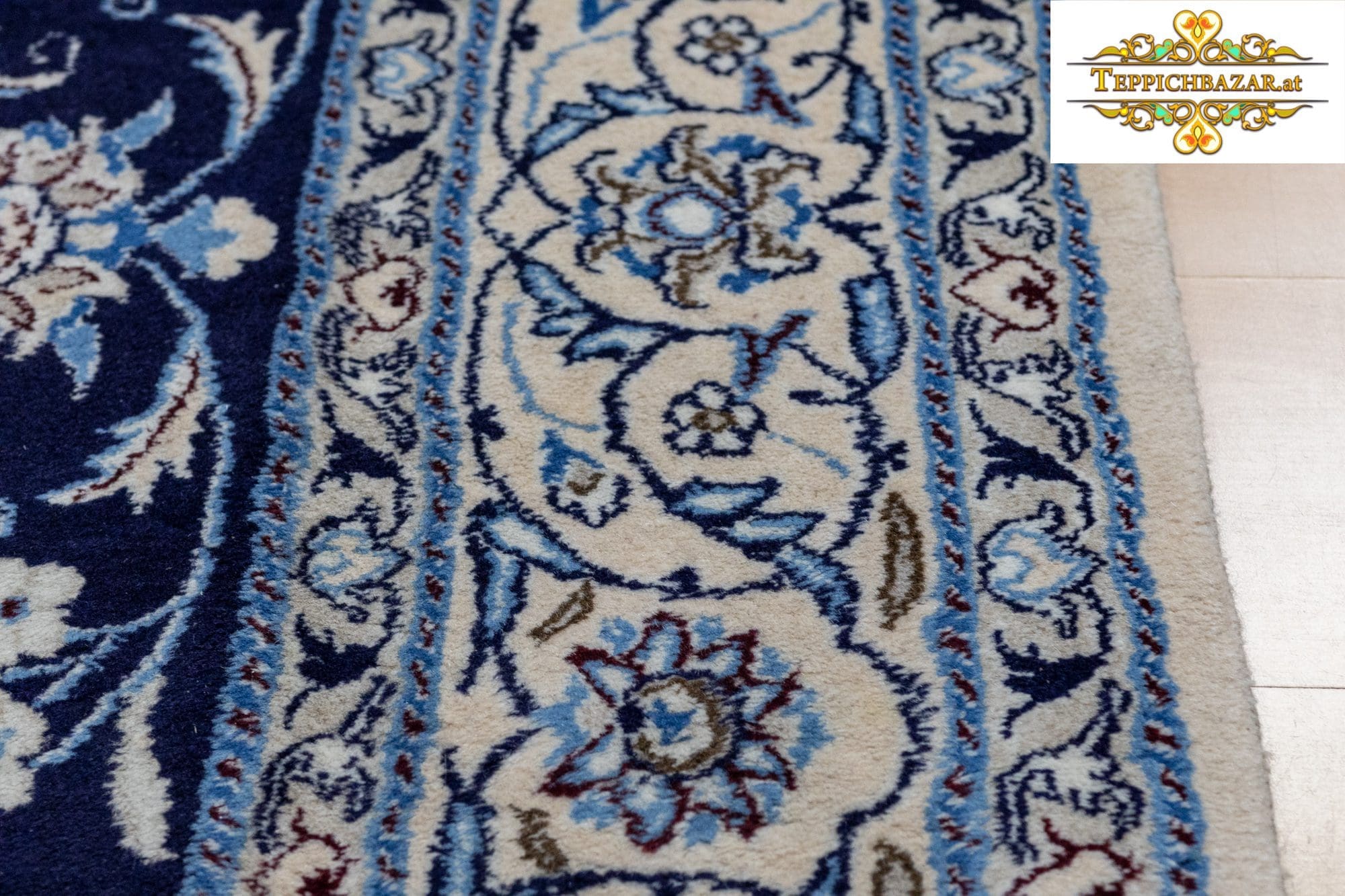
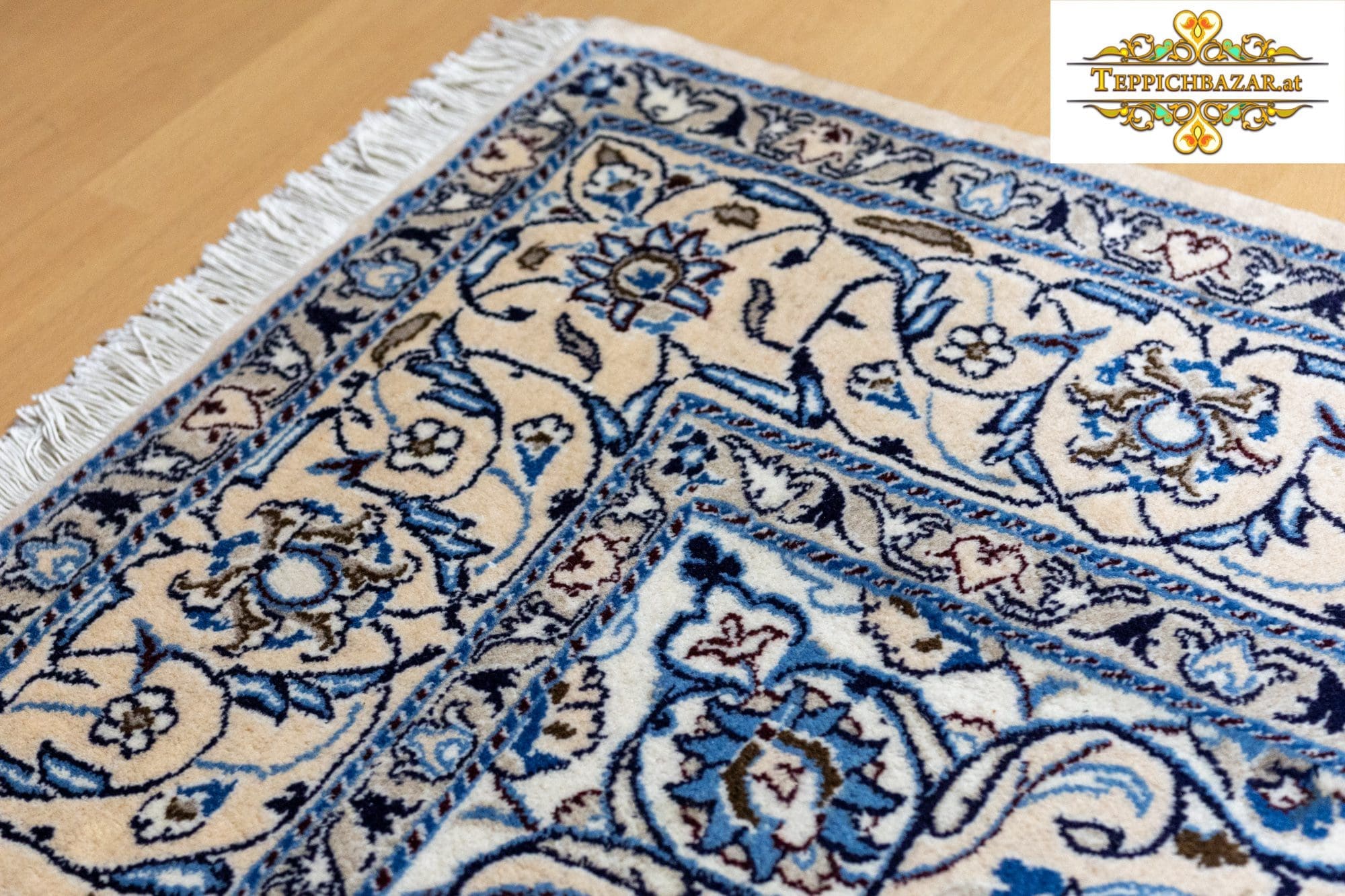
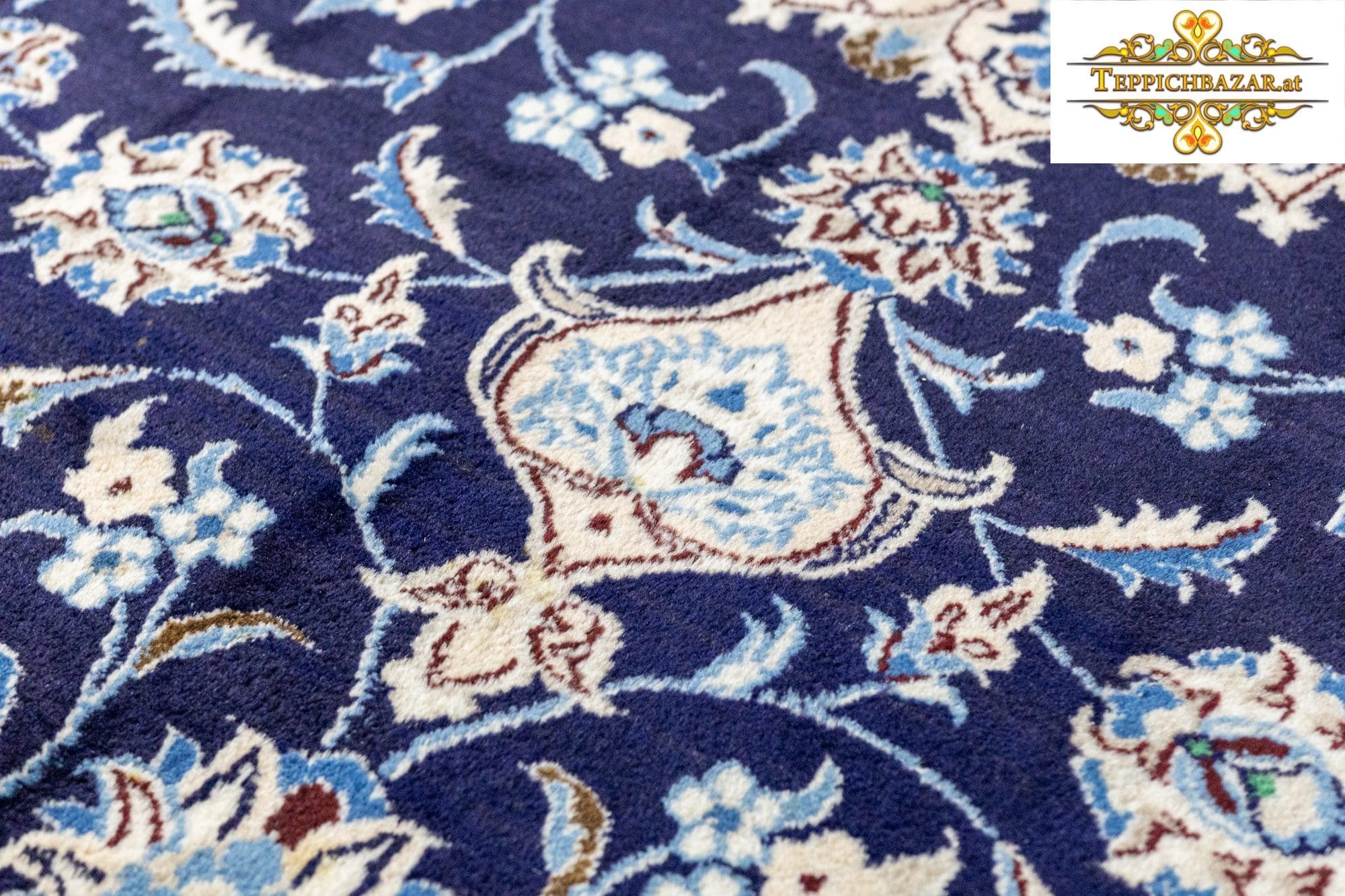
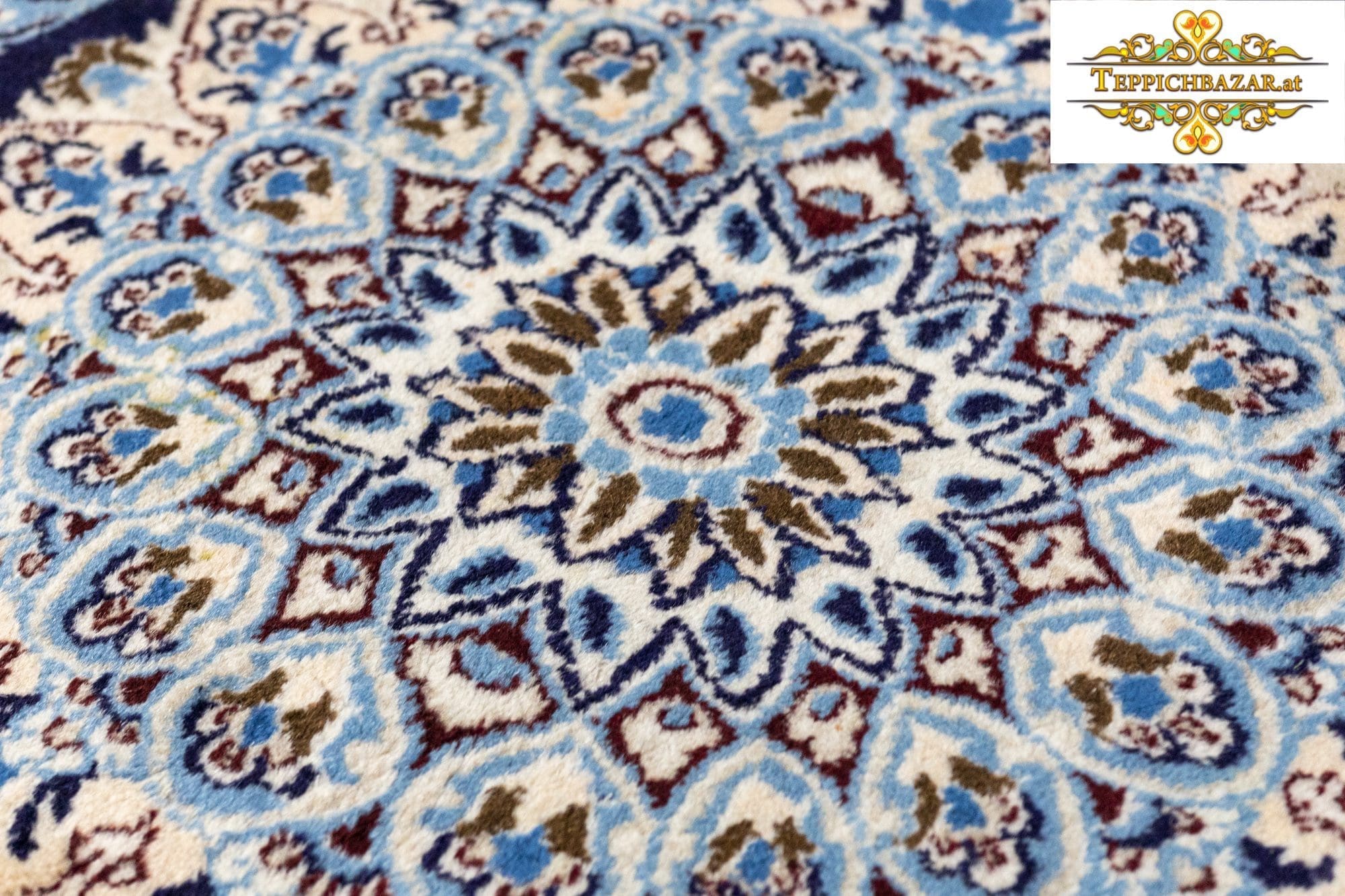
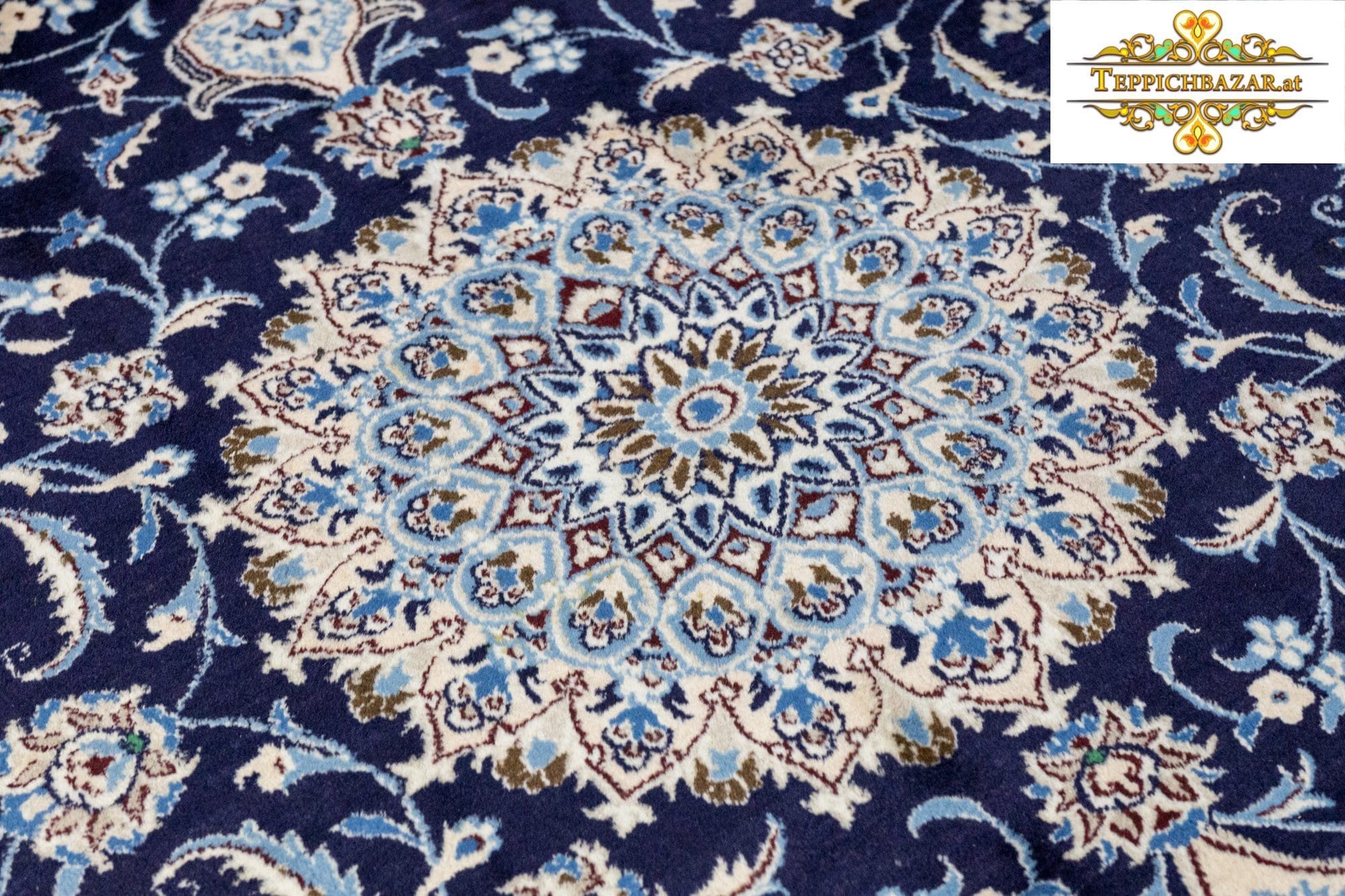
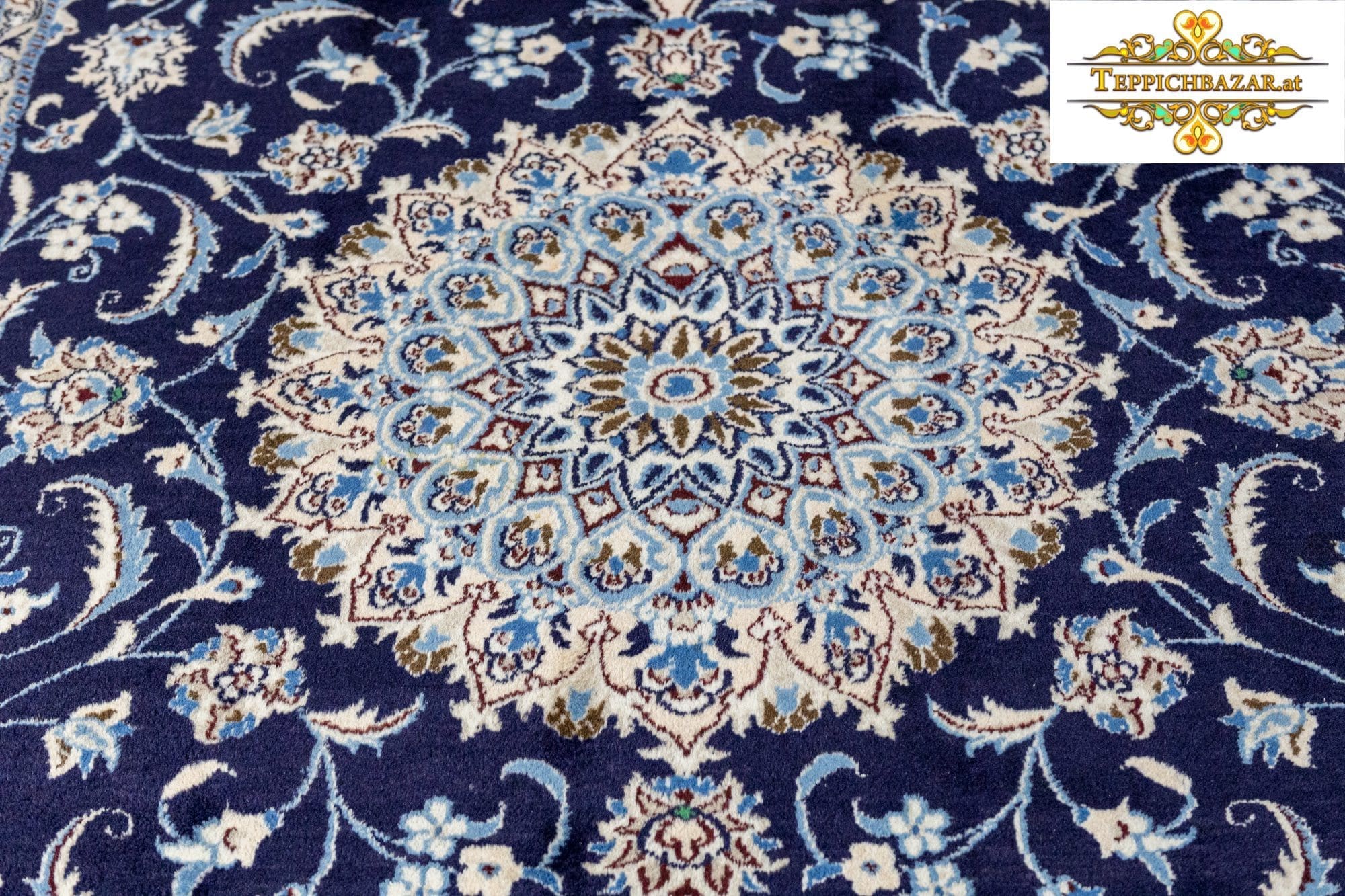
The pattern is identified as a Nain floral medallion. Its central organising element is a medallion, surrounded and accompanied by flowers and arabesques. A medallion gives the field a clear centre and establishes a visual hierarchy: the eye first reads the central form, then follows the floral ornament and the surrounding scrolling lines toward the borders.
Floral decoration is one of the enduring languages of Persian carpet design. Flowers may be arranged symmetrically around a central axis, repeated as smaller ornaments or connected by curving stems and arabesque lines. In a Nain composition, these elements are typically coordinated rather than scattered at random. The result is a design in which the field, medallion and border operate as related parts of one pattern.
Arabesques are flowing, curvilinear forms that guide the movement of the design. They can connect blossoms, leaves and secondary ornaments while preventing the field from appearing divided into isolated sections. In a floral medallion composition, arabesque lines also help transition from the central motif to the surrounding field. Their repeated curves give the pattern continuity and make the ornament readable across the hand-knotted surface.
The medallion format has a long history in Persian weaving. It allows the weaver to combine a focused centre with a carefully organised surrounding field. The central element may be enclosed by floral details, while the corners, field and borders are adjusted to support its proportions. This relationship between a dominant centre and supporting ornament is a defining feature of medallion-based carpet design, including the Nain floral medallion named for this rug.
In a hand-knotted rug, the pattern is not printed onto a finished surface. It is built into the pile as the knots are tied and the rows are advanced. Fine drawing depends on the weaver’s ability to translate a design plan into individual knot placements. Curves, leaves and small blossoms are therefore formed through the accumulation of many separate decisions. This method gives the pattern its textile character and makes the design part of the structure rather than a superficial treatment.
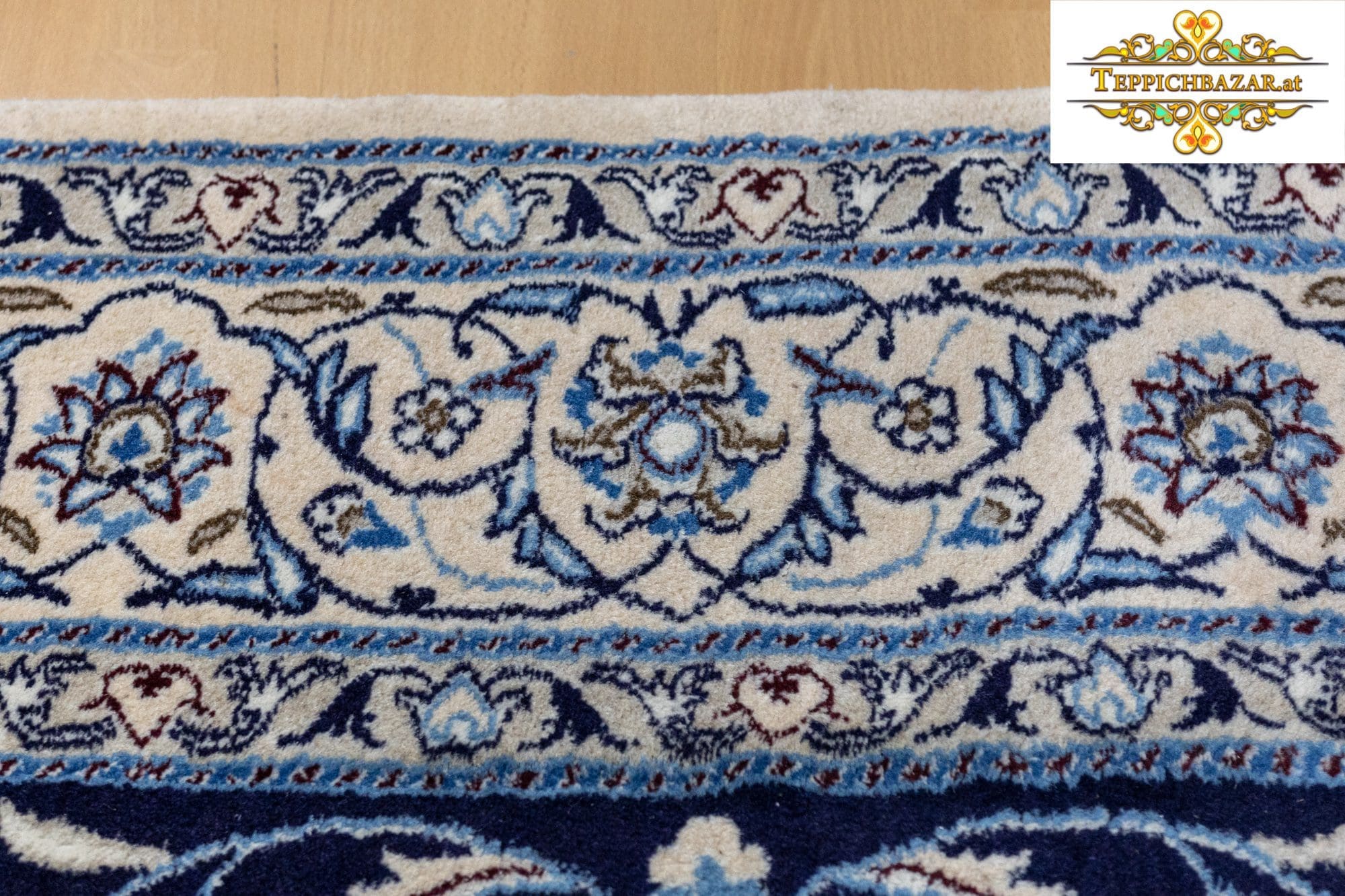
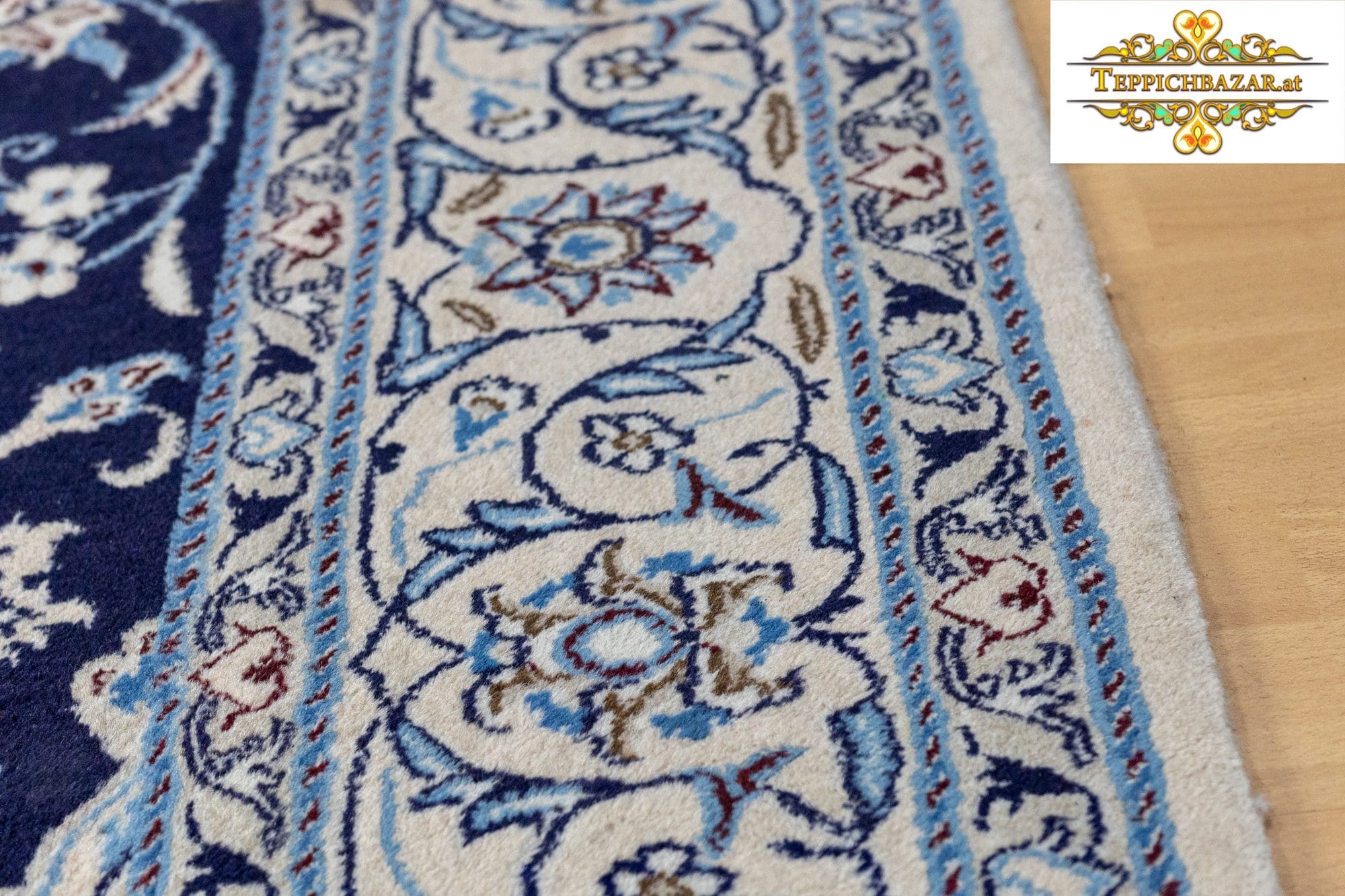
The borders serve both a practical and a design function. They frame the central field, establish a transition between the rug and its surroundings, and repeat or complement elements from the interior composition. On this rug, the borders are decorated with silk. That material detail is relevant to the visual reading of the edge because the border is not only a boundary; it is also an ornamented component of the overall Nain design.
Nain designs are often described as distinctly oriental because they combine a central medallion with floral ornament, arabesques and formal borders. The term describes the design vocabulary rather than suggesting a separate origin. Here, the pattern name remains Nain floral medallion and the origin remains the city of Nain in Persia. Keeping those two aspects distinct gives a precise description of both the rug’s provenance and its visual language.
The composition can also be understood through repetition and balance. Flowers and arabesques create rhythm, while the medallion gives the eye a point of orientation. The border contains the movement of the field and provides a finishing frame. Together, these elements form a traditional Persian arrangement that depends on proportion, line control and the consistent repetition of ornamental forms.
Special Features
The rug combines a Nain floral medallion design with a 12La classification, a pure wool pile and silk-decorated borders. These details describe different aspects of the piece: the pattern identifies its design tradition, the La designation describes its place within the Nain classification, and the materials distinguish the pile from the border decoration.
It is hand-knotted rather than machine-made. The present condition is very good, and the rug has been professionally washed. Its origin is given as the city of Nain in Persia. These are the specific characteristics recorded for this one-off rug and should be considered together rather than separated into isolated claims.
The combination of a central floral composition, arabesque ornament, wool pile and silk border decoration reflects the structured approach associated with Nain carpets. The hand-knotted method means that the design is integrated into the textile through manual work, while the professional washing documents the care already carried out on this piece.
FAQ
How is the value of a Persian rug determined?
The value of a Persian rug is considered through several factors rather than through one characteristic alone. Origin is important because Persian provinces and towns have their own established weaving traditions and design languages. Knot density and the classification of the construction also contribute to the assessment, as do the type and fineness of the materials, the complexity of the pattern, the quality of the workmanship, the colours, the age and the condition. Originality, style, aesthetic character, creativity and rarity may also influence the market. Supply and demand are relevant as well. For this Nain rug, the recorded points of reference include its Persian origin, its 12La classification, its pure wool pile, silk-decorated borders, floral medallion design, very good condition and professional washing.
How can a hand-knotted rug be recognised?
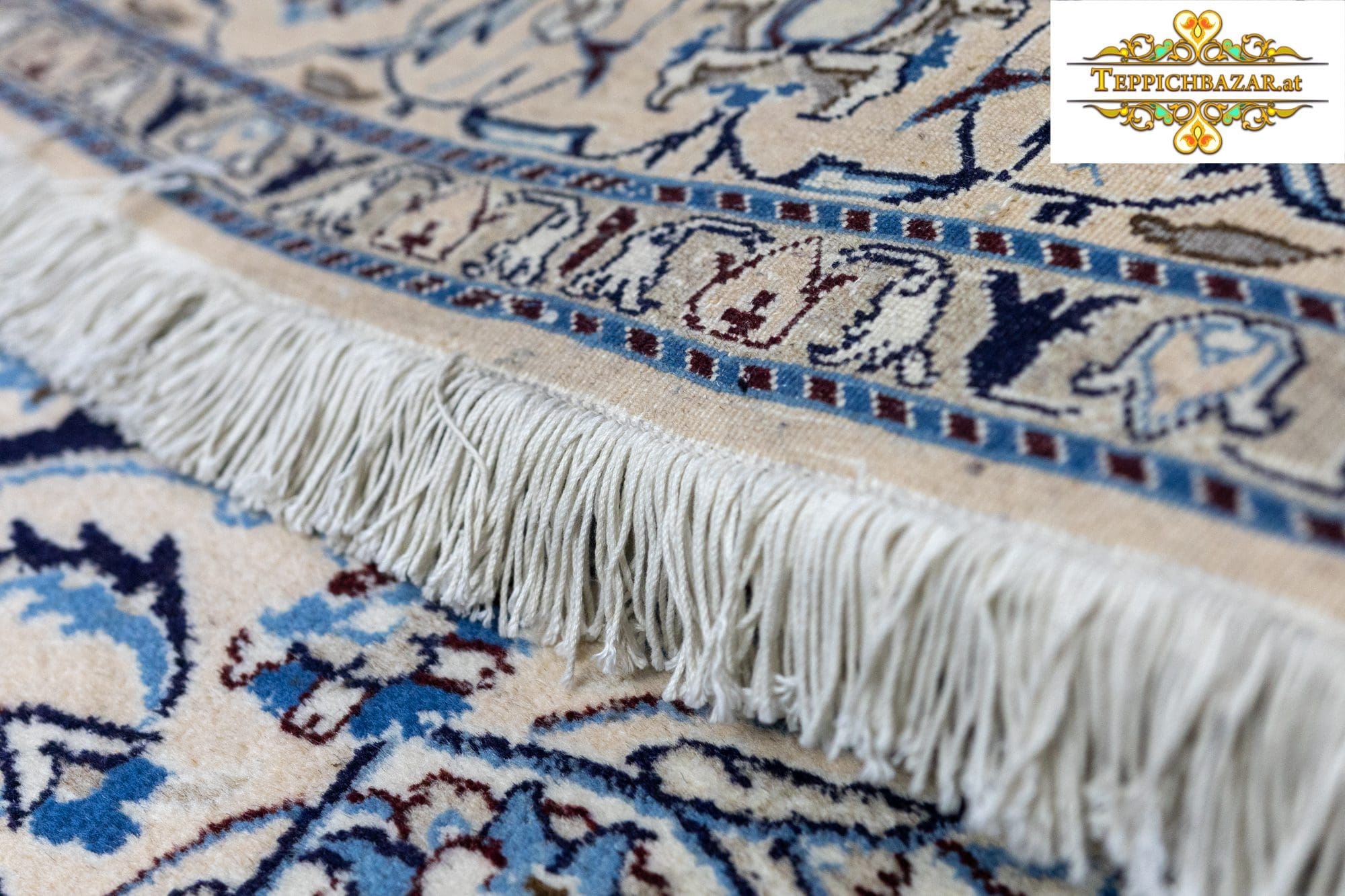
A hand-knotted rug is made on a loom and formed knot by knot by hand, whereas a machine-made rug is produced on an automated loom. The fringes of a hand-knotted rug are normally extensions of the warp rather than separate elements sewn onto the rug afterwards. The side edges are also useful: hand-finished edges may be sewn by hand and can show slight irregularity, while machine-made edges are often very even and precise. The back provides another point of inspection because the knot structure can be seen there. A hand-made pattern may also contain small variations or a charming asymmetry, while an automated design is commonly more uniform and mirrored. These are general identifying features of hand-knotted rugs; this piece is specifically identified as hand-knotted.
What determines the quality of a Persian rug?
Quality is commonly assessed by looking at the construction, the materials and the design together. Knot density per square metre is one factor, while the fineness and type of wool or silk are also relevant. The complexity and precision of the pattern show how demanding the weaving process is, and the weaver’s skill affects the clarity of the finished drawing. Condition and care are part of the assessment as well. In Nain weaving, the La classification provides an additional traditional way to discuss construction and fineness. It is not the only criterion, but it helps place a rug within the recognised Nain system. The rug described here has a 12La classification, a pure wool pile, silk decoration on the borders, a Nain floral medallion design and very good professionally washed condition.
To provide the best experiences, we use technologies like cookies to store and/or access device information. Consenting to these technologies will allow us to process data such as browsing behavior or unique IDs on this site. Not consenting or withdrawing consent, may adversely affect certain features and functions.
Functional Always active
The technical storage or access is strictly necessary for the legitimate purpose of enabling the use of a specific service explicitly requested by the subscriber or user, or for the sole purpose of carrying out the transmission of a communication over an electronic communications network.
Preferences
The technical storage or access is necessary for the legitimate purpose of storing preferences that are not requested by the subscriber or user.
Statistics
The technical storage or access that is used exclusively for statistical purposes.The technical storage or access that is used exclusively for anonymous statistical purposes. Without a subpoena, voluntary compliance on the part of your Internet Service Provider, or additional records from a third party, information stored or retrieved for this purpose alone cannot usually be used to identify you.
Marketing
The technical storage or access is required to create user profiles to send advertising, or to track the user on a website or across several websites for similar marketing purposes.

 SECURE PAYMENT
 SHIPPING PARTNERS