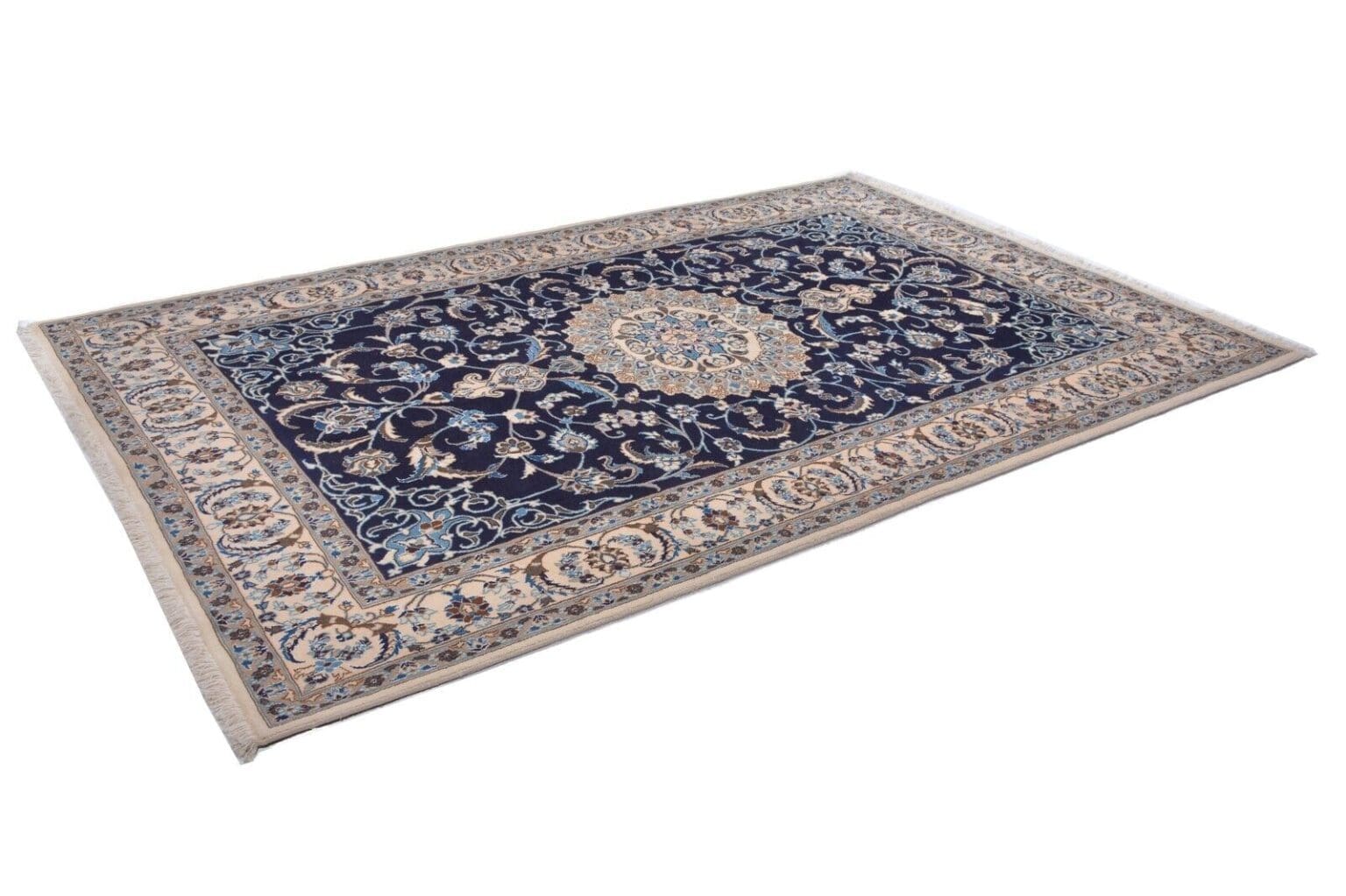
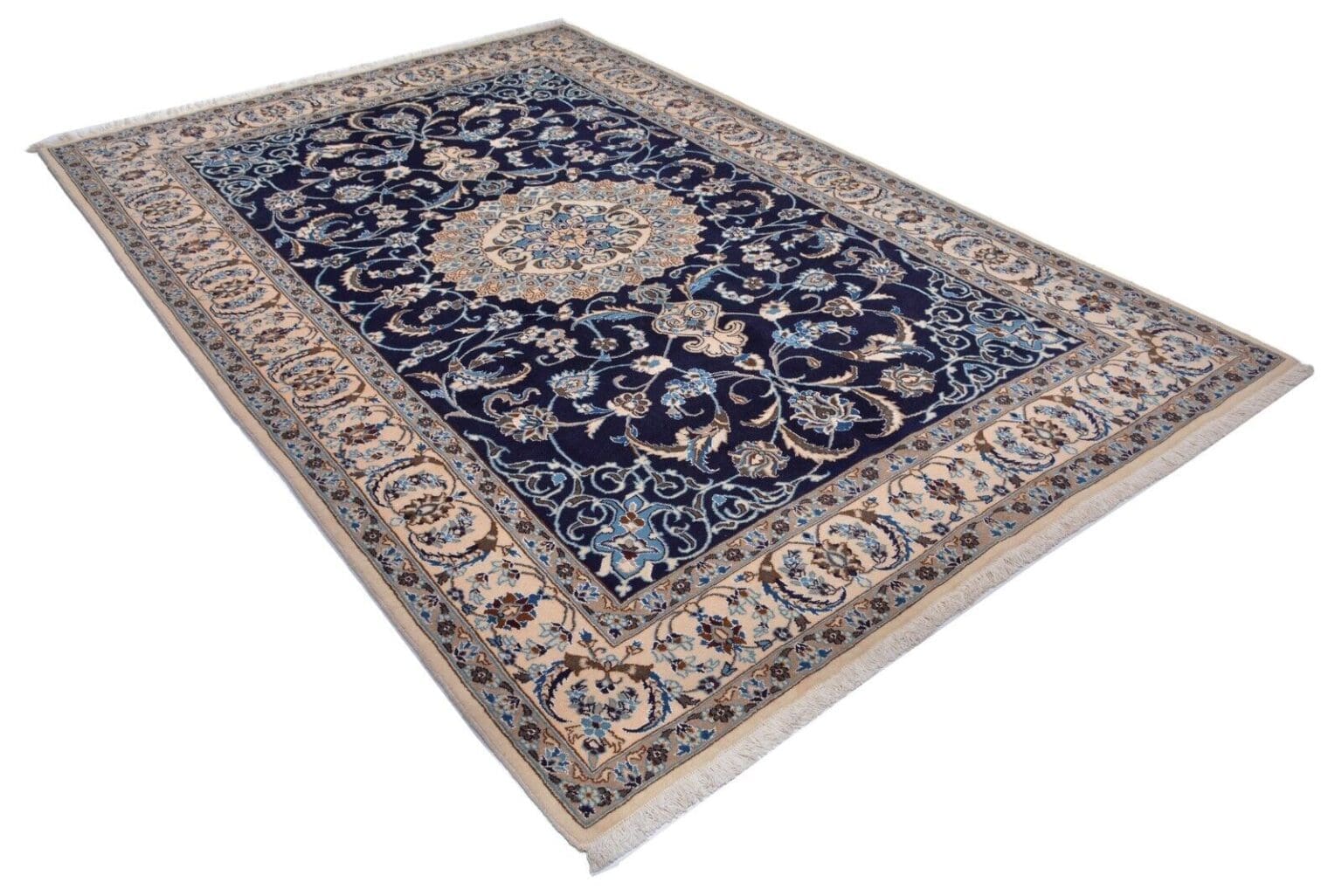
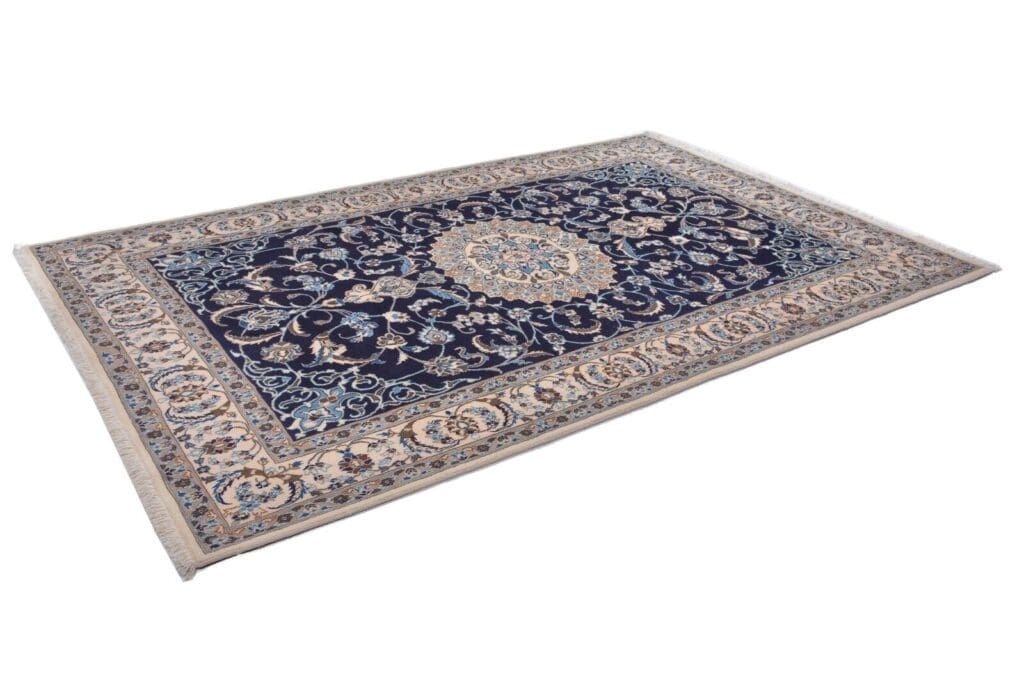
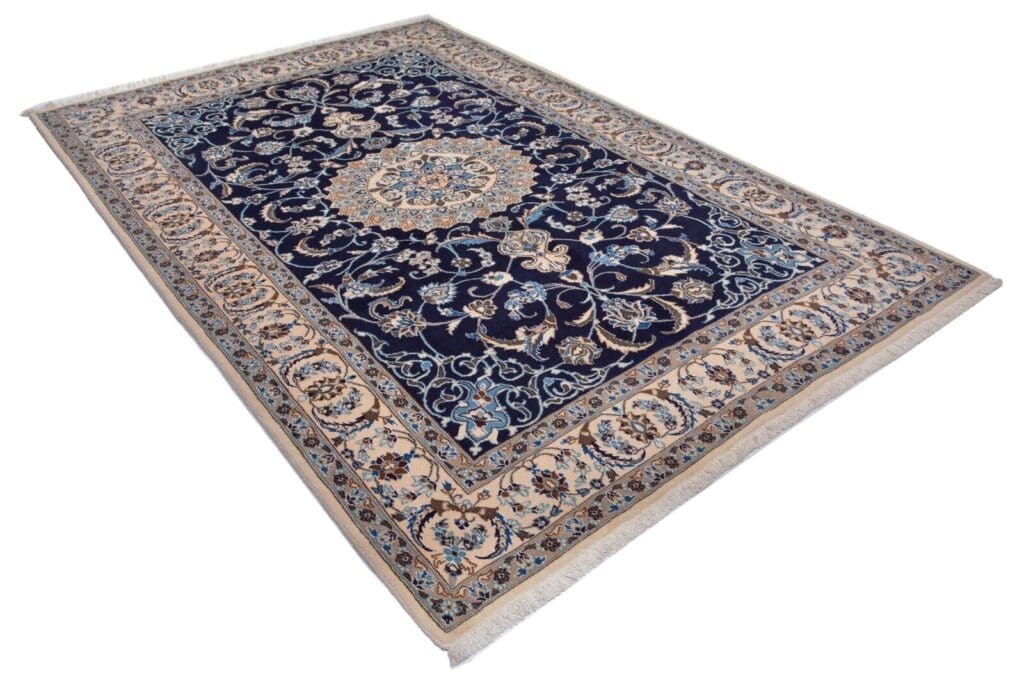
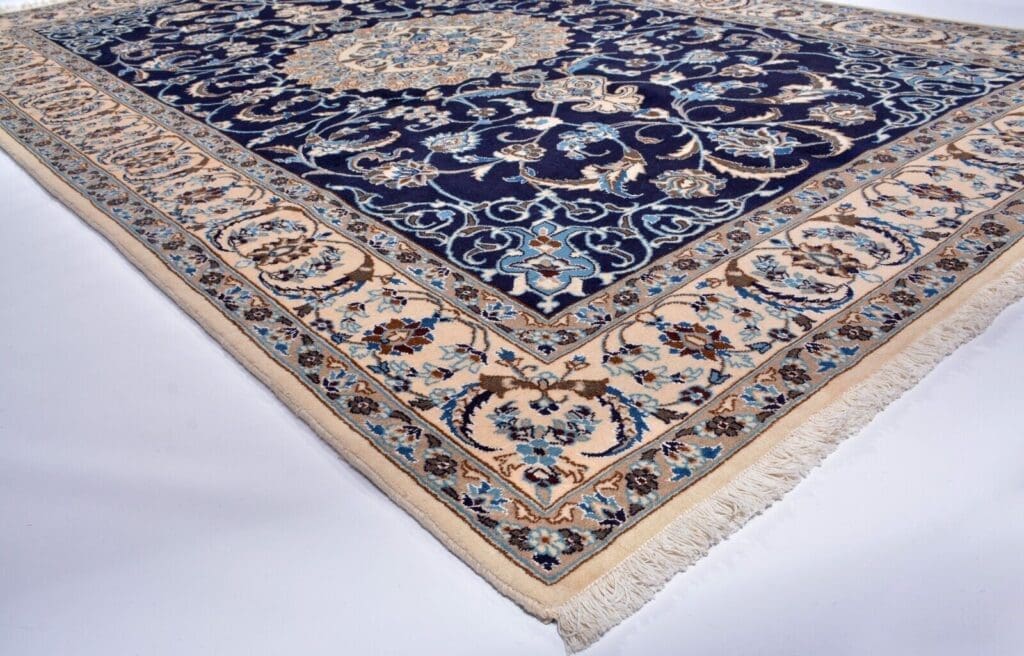
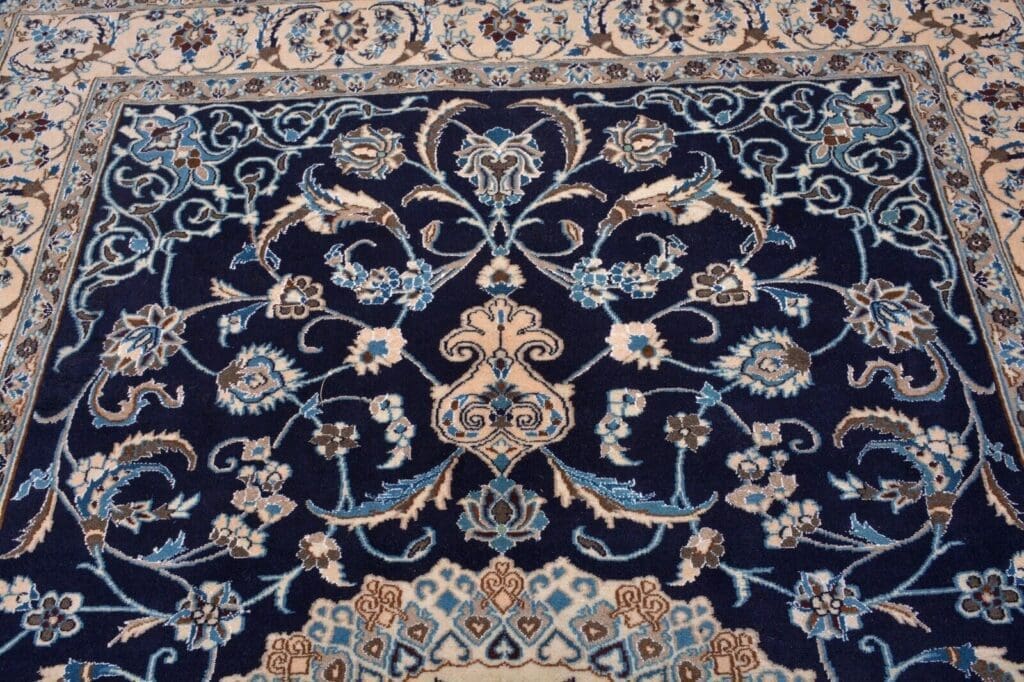
Hand-knotted Nain Persian rug | Knot density: 300,000 knots/m² | Material: wool pile | Size: 302 x 196 cm | Pattern: blue floral medallion design | Condition: New and perfect
This Persian rug from Nain is hand-knotted with a pile made from 100% virgin wool. The wool is fine, soft and pleasant to the touch, while also being hard-wearing enough for regular use. Its natural lanolin content has a dirt-repellent effect, which makes everyday care more straightforward. The material therefore combines a comfortable surface with qualities suited to a durable household rug.
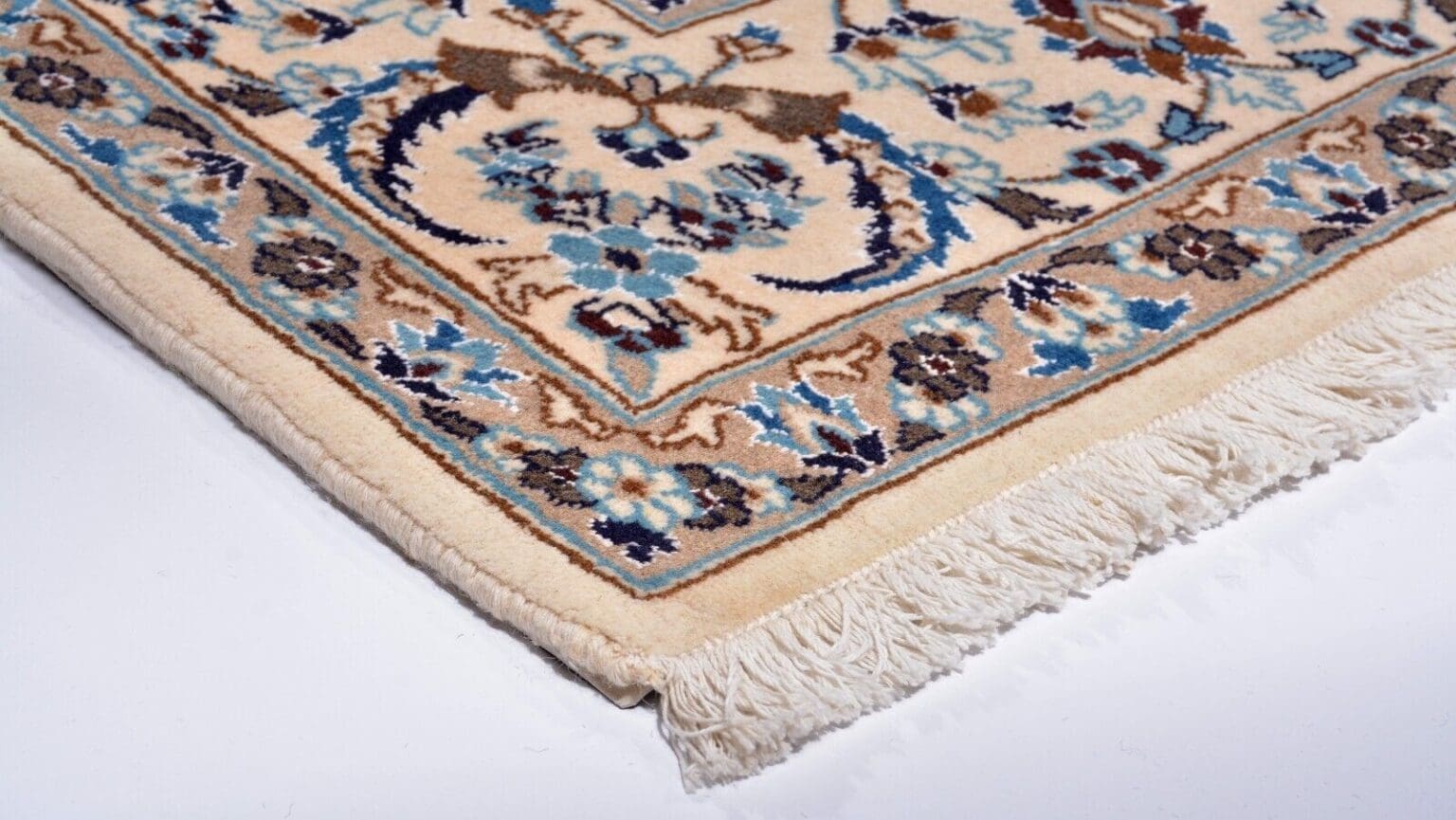
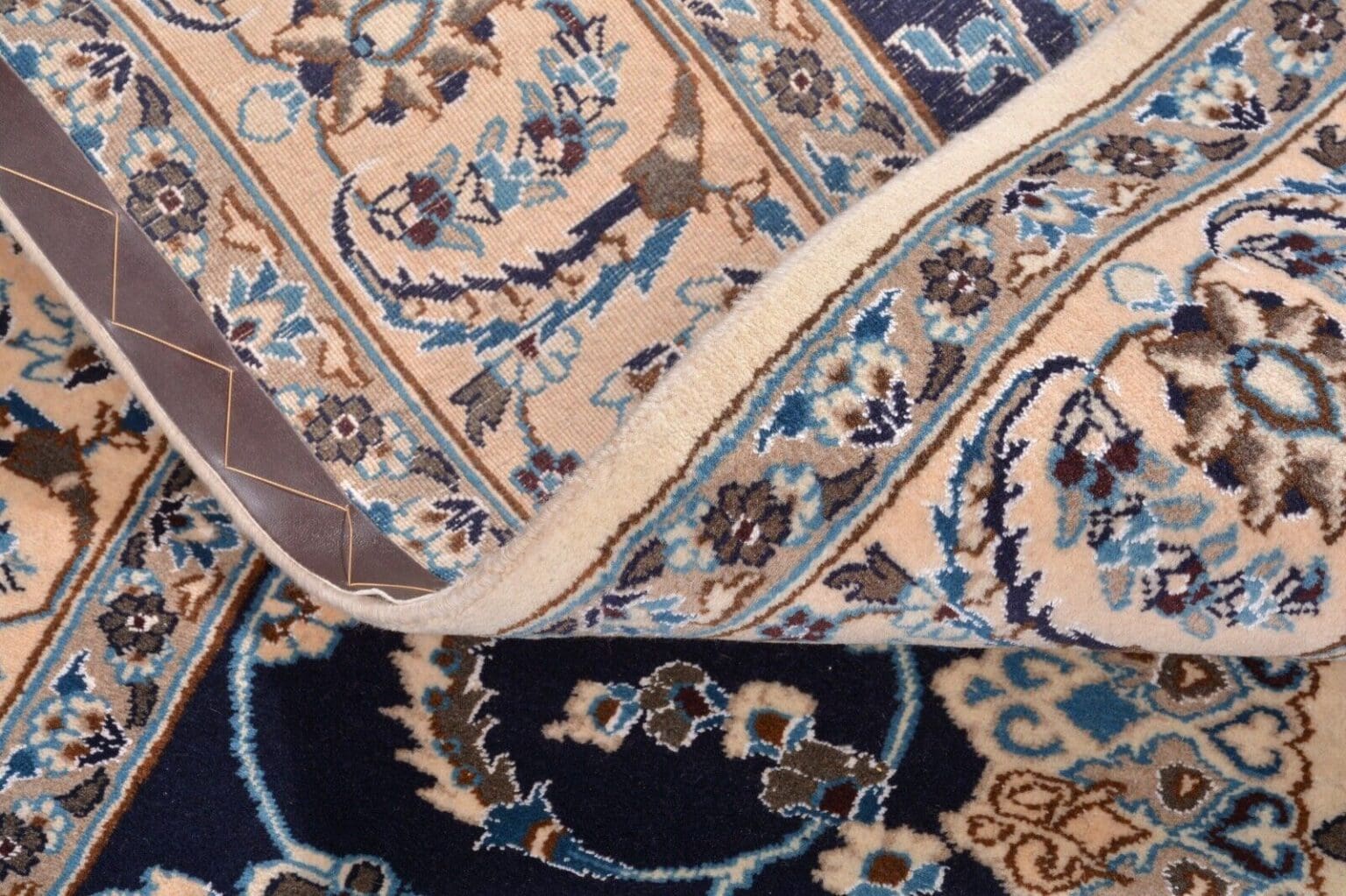
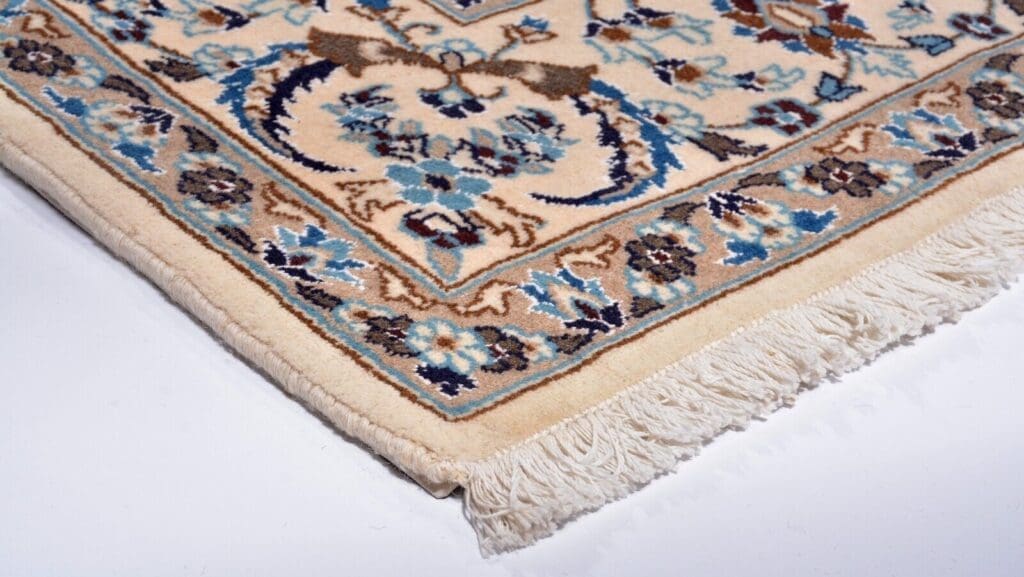
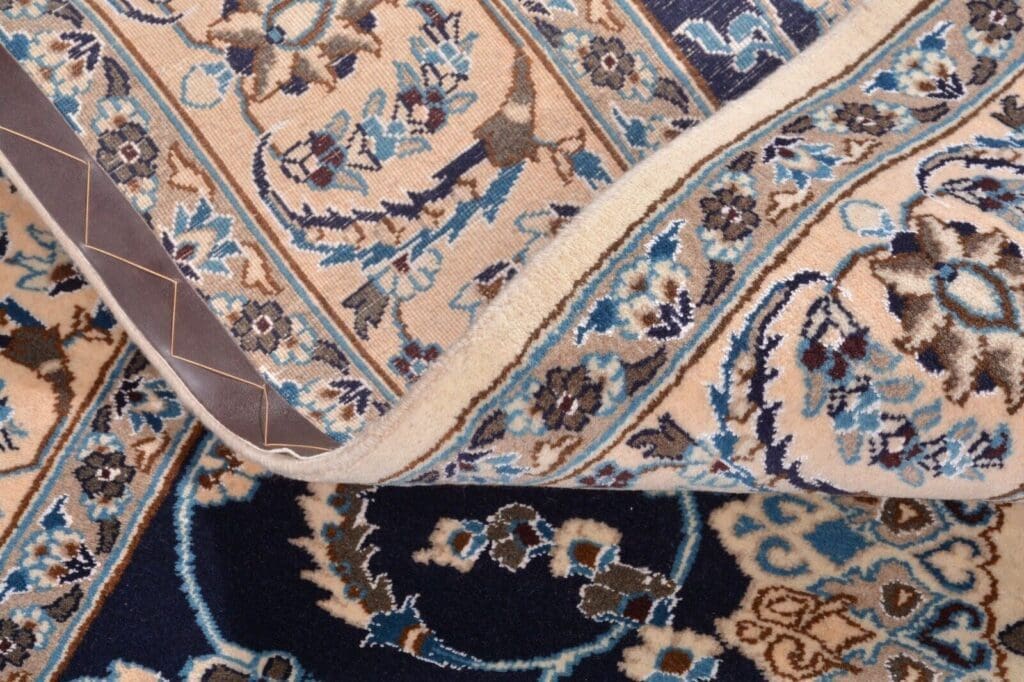
Hand-knotting gives the rug a firm, carefully formed structure. Each knot is worked into the foundation individually, and the process requires time, consistency and the experience of the knotter. This Nain rug has a knot density of 300,000 knots per square metre. That density allows outlines and smaller ornamental sections to be rendered with precision. It also makes the manual work invested in the rug visible in the character of its surface.
Virgin wool is valued for the combination of comfort and resilience it provides. It feels soft but remains robust, helping the pile resist premature wear. The relationship between wool and hand-knotting determines the handle and appearance of the finished surface. The rug is suitable for underfloor heating and is described as pet-friendly. It also has high colour fastness.
The natural oil in wool is a material characteristic that can be useful in everyday living. It does not prevent every mark, but it supports the pile’s dirt-repellent quality. Regular, gentle care helps maintain the structure and colour impression. In this way, the traditional method of hand-knotting is combined with a material commonly chosen for long-lasting rugs.
Origin and Tradition
Nain is a city in central Iran with an established tradition of Persian rug weaving. Nain rugs are associated with careful knotting, fine execution and quality materials. The name Nain consequently refers not only to a geographical origin but also to a regional language of design and a body of craft knowledge developed over time. The city’s weaving tradition reaches back to the Safavid period, an important era in the history of Persian carpet art.
The central Iranian setting and its climate, which is suitable for sheep raising, provide the background for the use of virgin wool. Raw material has a direct influence on the character of a hand-knotted rug, since wool affects both the feel and the durability of the pile. In Nain, wool is shaped through precise knotting and established workshop practices. This produces the relationship between a fine structure and clearly readable ornament associated with the region.
Persian rugs are closely connected with Iran’s long textile and decorative-art history. Designs have been transmitted across generations, adapted by workshops and interpreted by individual makers. Nain rugs draw on this inherited visual vocabulary. Floral ornament, organised fields and a central medallion may be combined into a balanced composition. The weaver does not merely reproduce a standard industrial surface; the traditional arrangement is realised through many manual decisions in each individual piece.
The Safavid period is considered formative for Persian carpet design. During that era, rugs developed as an independent art form and were often given complex ornamental systems. Regional traditions preserved and refined these principles in later generations. Nain is known within this history for a fine and detail-oriented approach. Persian origin and hand-knotting place the rug within the broader history of Iranian weaving and distinguish its provenance from a pattern name used in another country.
A Nain rug can therefore be understood both as a household textile and as an expression of regional craft culture. Its production depends on knowledge of wool, a sequence of repeated working steps and the practical experience of the knotter. Origin explains why Nain is treated as a distinct Persian provenance rather than simply as a label for a decorative motif. The regional name describes a tradition of making as well as a place.
In this weaving tradition, material and pattern are closely related. A fine pile allows ornamental lines to remain legible, while the colour arrangement supports the order of the composition. Technical precision and inherited visual ideas are therefore developed together. Even where the underlying design principles are recognisable across Nain rugs, hand production gives each piece its own particular expression.
Design and Pattern
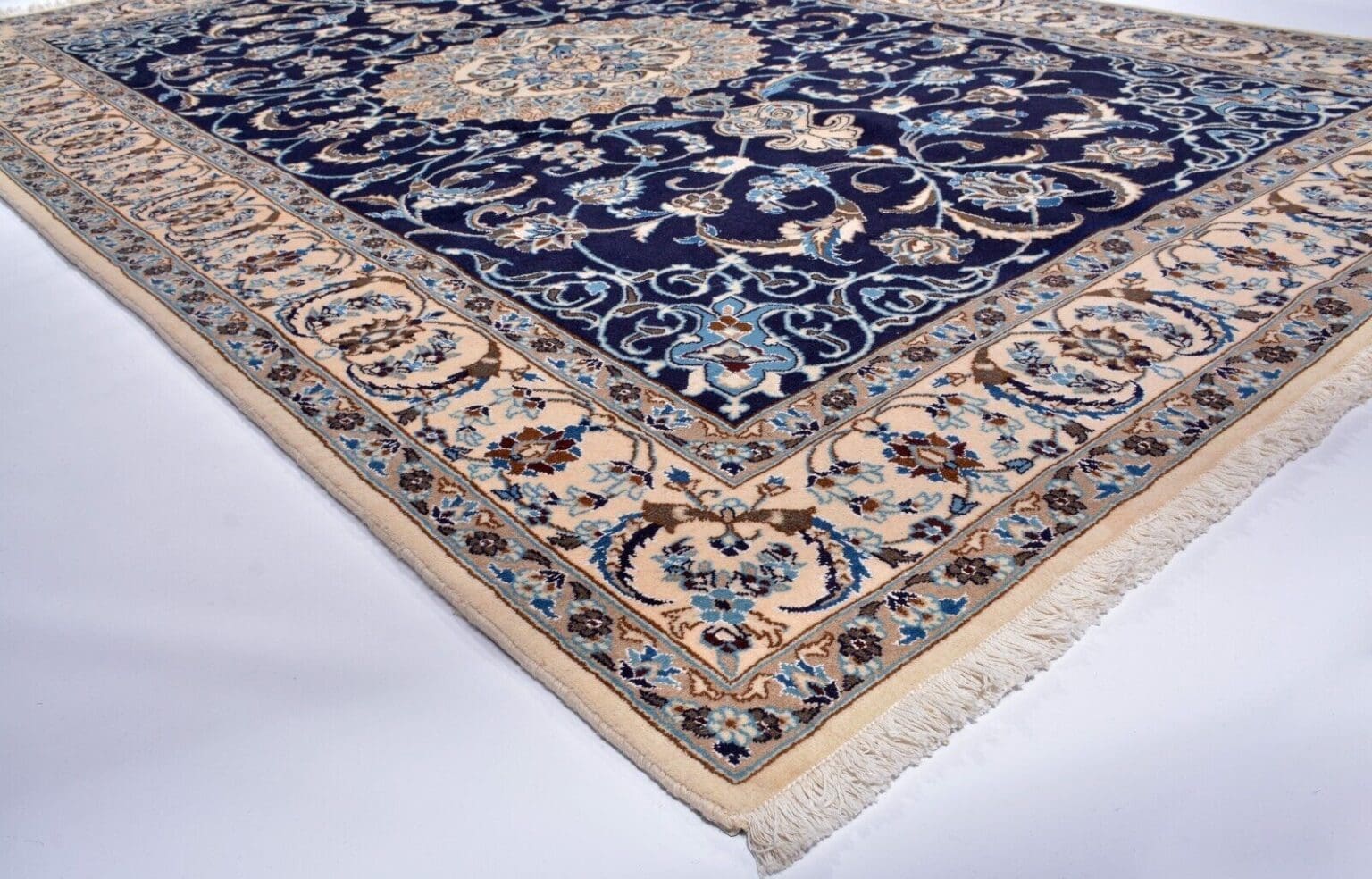
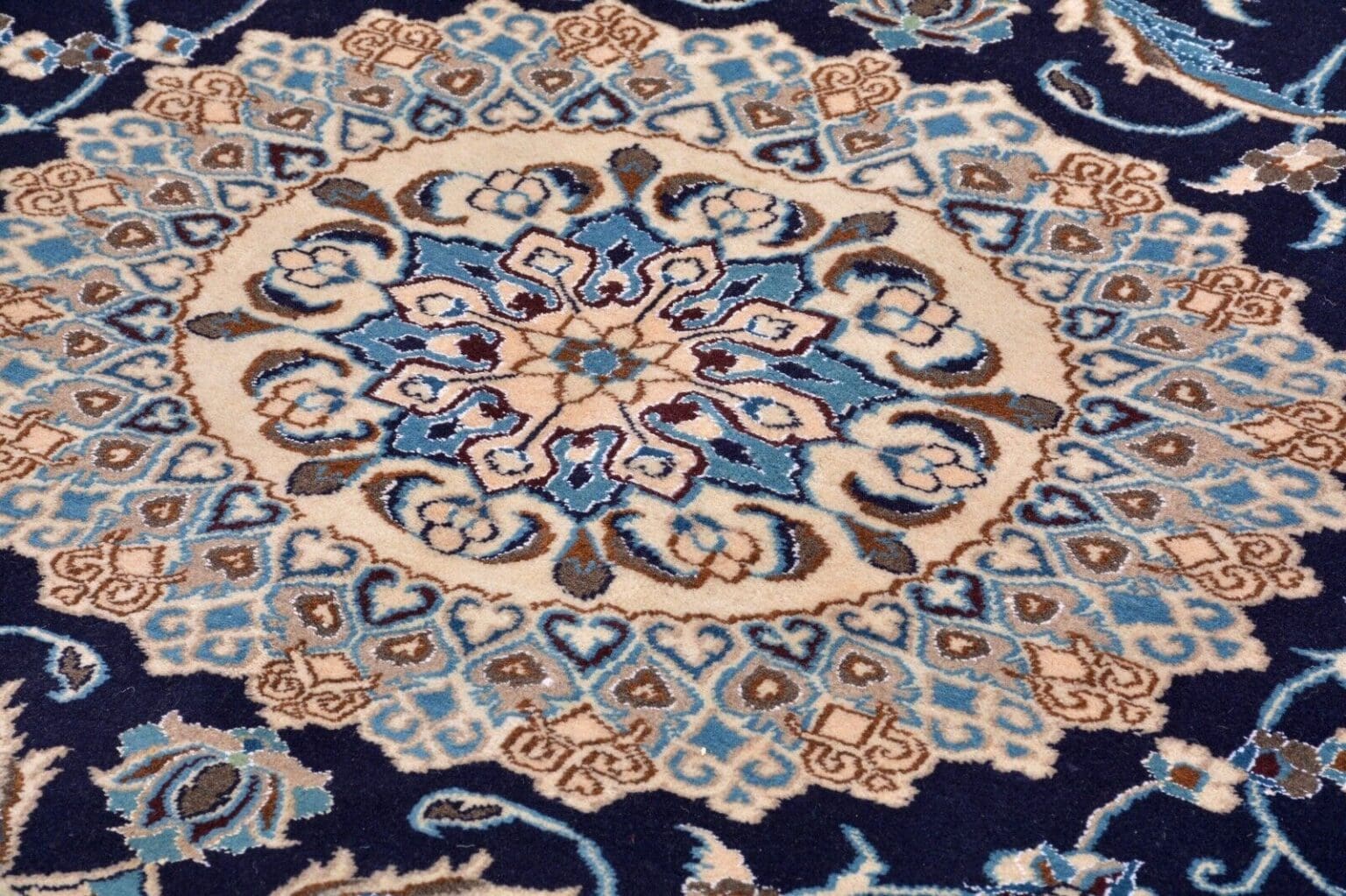
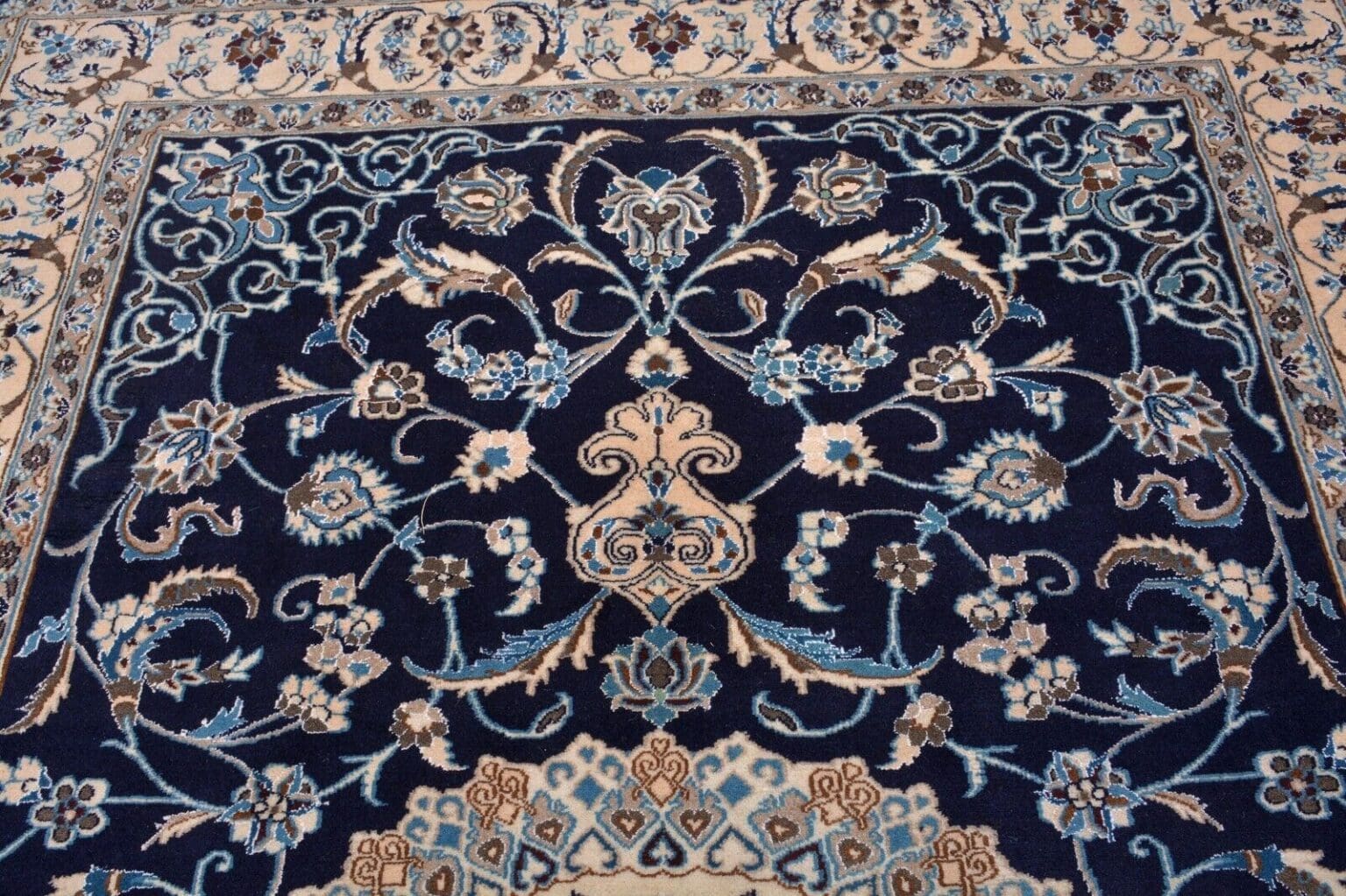
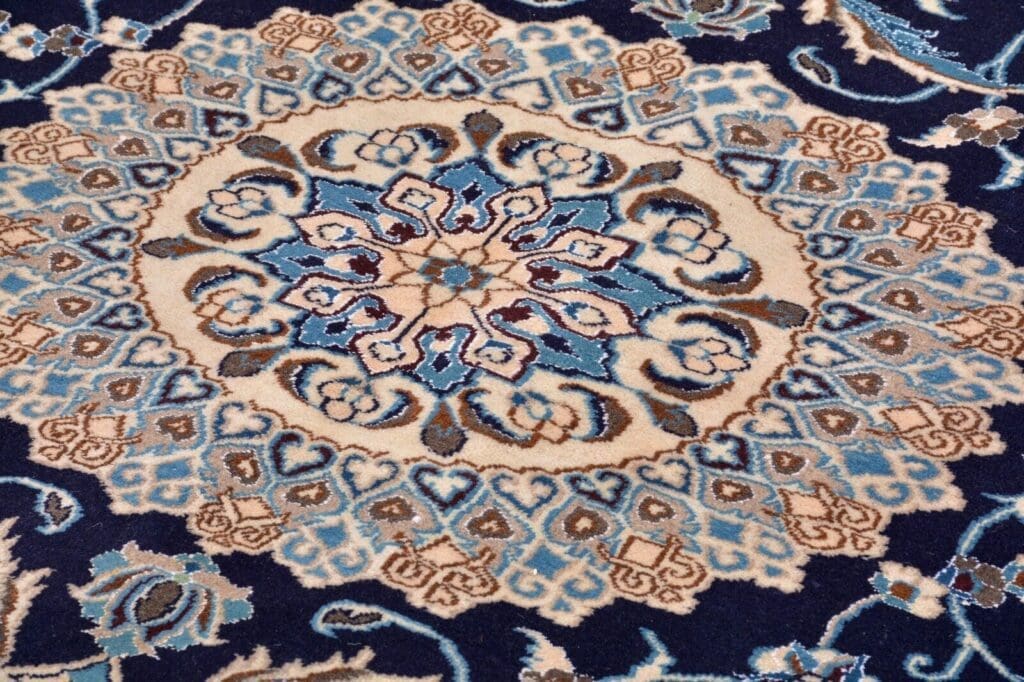
The design of this rug is defined by its blue colour and a floral pattern with a medallion. The medallion establishes the central point of the composition. Floral forms extend around it and guide the eye across the surrounding field. The result is a clearly organised arrangement in which the central structure and the ornamental detail support one another.
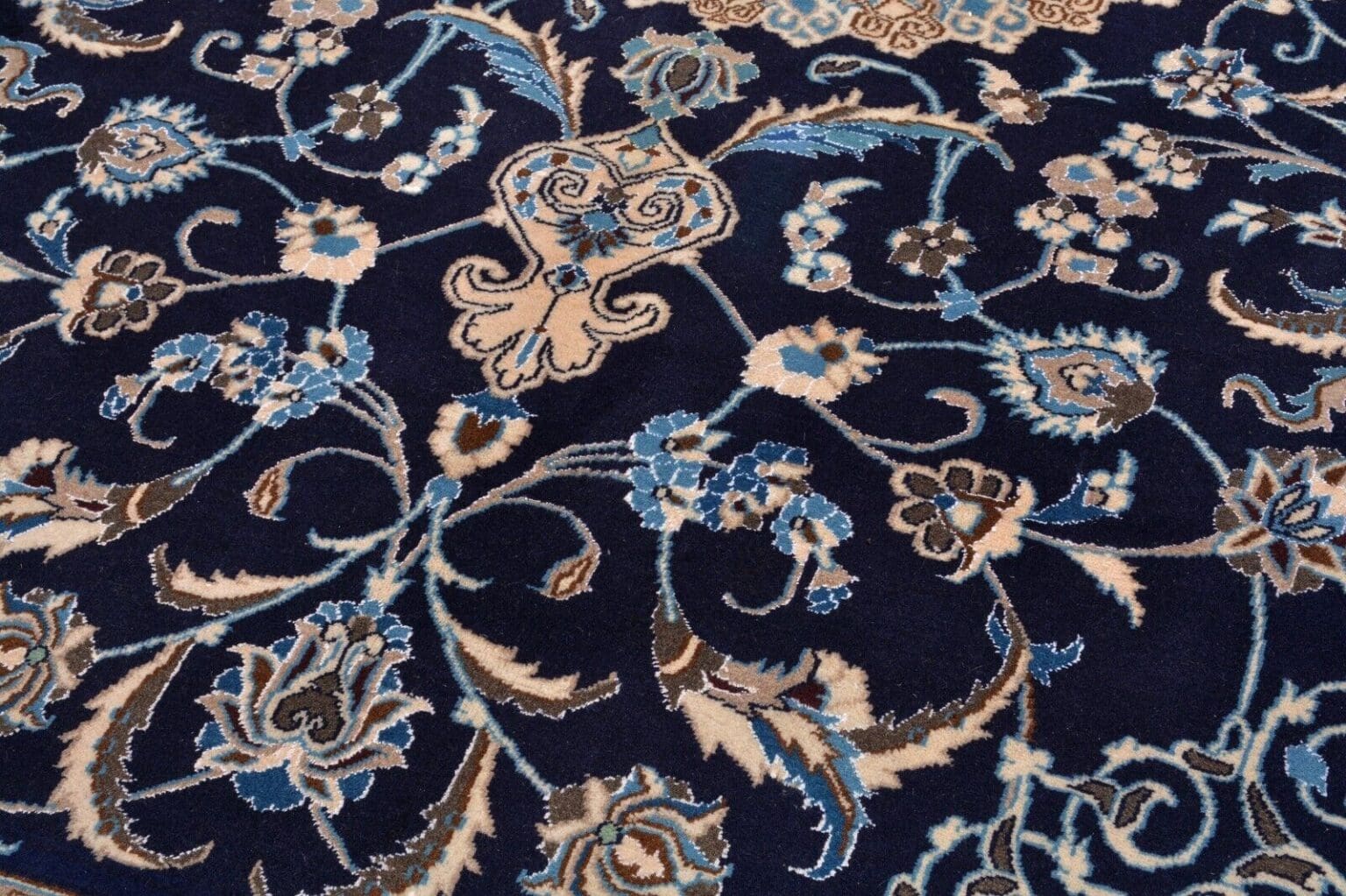
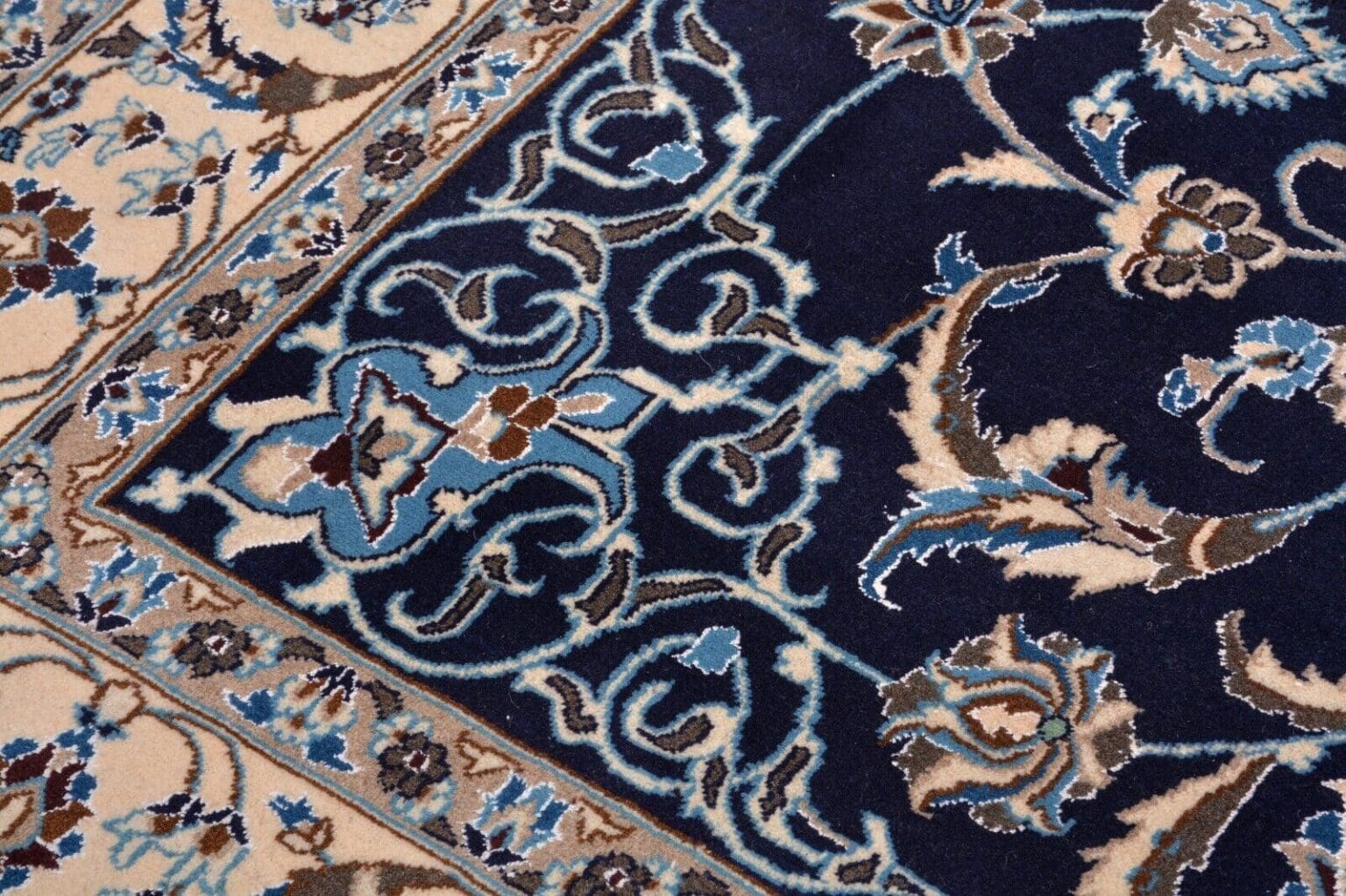
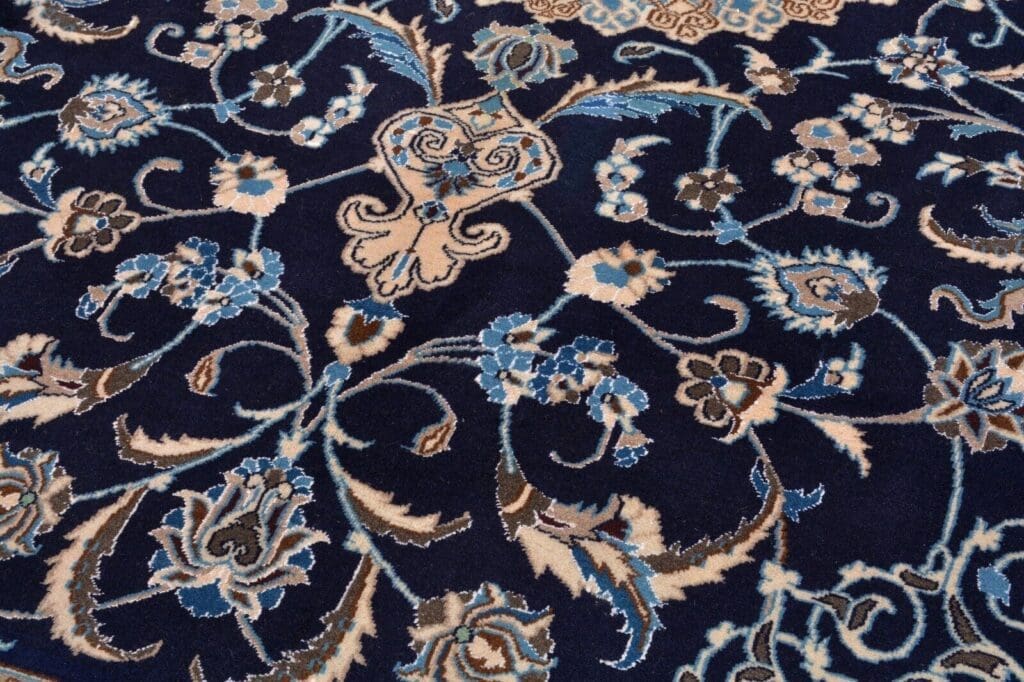
Floral ornament is a familiar element of Persian rug design. Leaves, blossoms and curling vines can be arranged in repeated sequences and connected through flowing lines. Nain designs often bring these forms together with geometrically ordered structures. The floral and geometric elements are not necessarily separate systems; measured spacing can give natural forms clarity, while floral detail keeps the composition connected to the visual language of gardens and vegetation.
Blue is the dominant colour of this piece and strongly shapes its appearance. In Persian visual culture, blue is often associated with freedom of spirit and harmony. These associations belong to the cultural background of the colour and do not reduce the specific composition to a single meaning. Here, the blue colouring supports the floral medallion design and links a traditional Persian arrangement with a distinct colour impression.
A medallion composition organises the field from the centre outward. It gives the viewer a point of orientation and places the surrounding motifs in relation to the central ornament. Floral details may soften the order of the layout, while repeated lines and shapes maintain continuity. This combination of centre, repetition and fine ornament is an important principle in many classical Persian rug designs.
The motifs can carry meaning in addition to their decorative role. In Persian culture, floral forms are often connected with nature and fertility, while blue may suggest harmony and an open spirit. These interpretations belong to the history of the design language rather than functioning as a literal message. The definite features of this rug are its blue colouring and its floral medallion pattern.
Hand-knotting gives the design an individual appearance. The knotting method and changing light conditions can make colour nuances and pattern transitions appear differently across the pile. A traditional Nain design is therefore not an entirely uniform industrial repeat. Each rug bears the working character of its knotter and combines an established regional pattern language with a particular handmade execution.
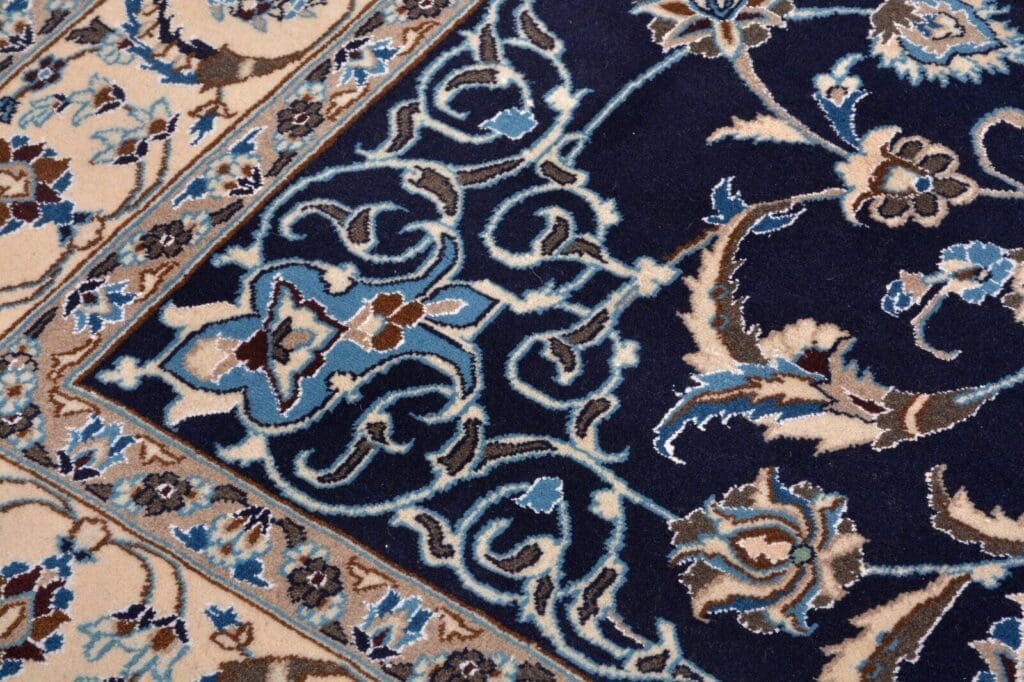
The medallion creates a visual centre, while floral vines and smaller motifs connect the surrounding areas. In classical designs, borders, fields and internal ornaments may further divide and balance the composition. The important principle is the interaction of repetition and variation: recurring forms provide coherence, while handmade execution keeps the lines and colour transitions individual rather than mechanically identical.
Special Features
A defining feature is the knot density of 300,000 knots per square metre. It indicates the considerable manual work involved and supports the detailed rendering of the floral composition. The dense knotting also contributes to the rug’s robust structure. Because it is hand-knotted, the rug is a one-off with the individual signature of its knotter expressed through the execution.
The rug is new and perfect. It is suitable for underfloor heating and is described as pet-friendly. It also offers high colour fastness. The natural lanolin in the virgin wool has a dirt-repellent effect, which supports practical day-to-day care. With appropriate handling, a hand-knotted Persian rug can be used for a long time and passed from one generation to the next.
Variations in colour and pattern can occur in a handmade one-off because of the individual knotting technique and changing light conditions. These variations belong to the way the rug is made. They distinguish it from a standardised series product and preserve the character of a textile produced by hand in the Nain tradition.
FAQ
How should I care for my Persian rug?
Regular vacuuming and occasional beating are recommended for caring for the rug. These measures remove loose dirt from the pile and support normal household use. Stains should be treated as soon as possible. A specialist carpet cleaner or a mild cleaning agent can be used for this purpose. The product should be applied carefully and in accordance with its intended use. The natural lanolin in virgin wool has a dirt-repellent effect and helps simplify everyday maintenance. Gentle treatment protects the surface and helps preserve the long service life of the hand-knotted construction.
Where do the rug’s materials come from?
The pile consists of 100% virgin wool. The wool comes from the area around Nain in Iran. This region is known for sheep raising and therefore provides the basis for obtaining the wool used in the rug. Virgin wool combines a soft, pleasant handle with durability, while its natural lanolin can have a dirt-repellent effect. In the finished rug, the material is formed into a resilient pile through traditional hand-knotting. The combination of regional wool and Nain weaving practice defines the material character and craft identity of the rug.
What makes this rug a unique work of art?
The rug is hand-knotted throughout and is therefore a one-off. Every knot represents an individual part of the maker’s work. The knotting technique influences the rendering of colours and motifs, while light conditions can make different colour nuances visible across the pile. A traditional floral medallion design may consequently show its own particular expression in each handmade piece. The rug carries the hand of its knotter rather than repeating an entirely identical factory surface. Its uniqueness comes from the combination of Nain tradition, virgin wool, dense knotting and individual manual execution.
To provide the best experiences, we use technologies like cookies to store and/or access device information. Consenting to these technologies will allow us to process data such as browsing behavior or unique IDs on this site. Not consenting or withdrawing consent, may adversely affect certain features and functions.
Functional Always active
The technical storage or access is strictly necessary for the legitimate purpose of enabling the use of a specific service explicitly requested by the subscriber or user, or for the sole purpose of carrying out the transmission of a communication over an electronic communications network.
Preferences
The technical storage or access is necessary for the legitimate purpose of storing preferences that are not requested by the subscriber or user.
Statistics
The technical storage or access that is used exclusively for statistical purposes.The technical storage or access that is used exclusively for anonymous statistical purposes. Without a subpoena, voluntary compliance on the part of your Internet Service Provider, or additional records from a third party, information stored or retrieved for this purpose alone cannot usually be used to identify you.
Marketing
The technical storage or access is required to create user profiles to send advertising, or to track the user on a website or across several websites for similar marketing purposes.

 SECURE PAYMENT
 SHIPPING PARTNERS


