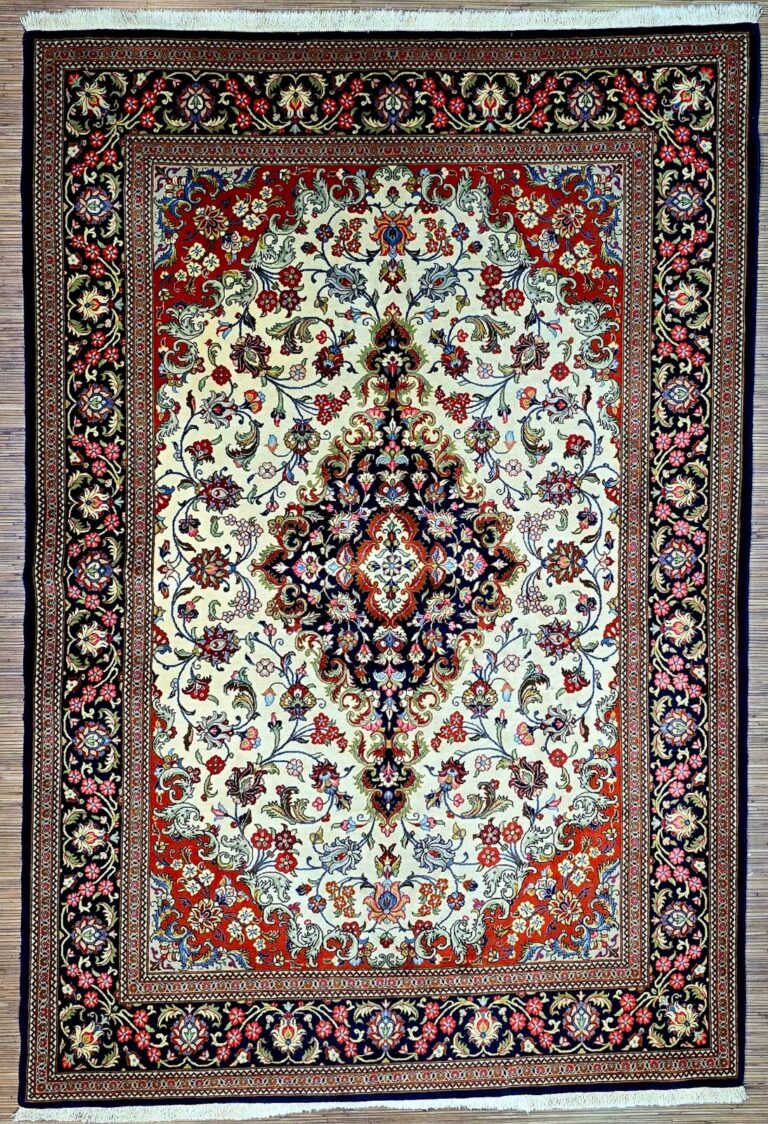
This Nain Persian rug is hand-knotted and has a pile made from 100% wool. Silk is also specified as part of the material description and belongs to the established material vocabulary of fine Nain weaving. In Nain carpets, silk may be used to define delicate outlines, small accents, or selected details within the design. Its smooth surface can catch the light differently from wool, creating a restrained variation in texture and appearance. The wool pile provides the principal textile surface, while the silk element adds another material quality to the composition.
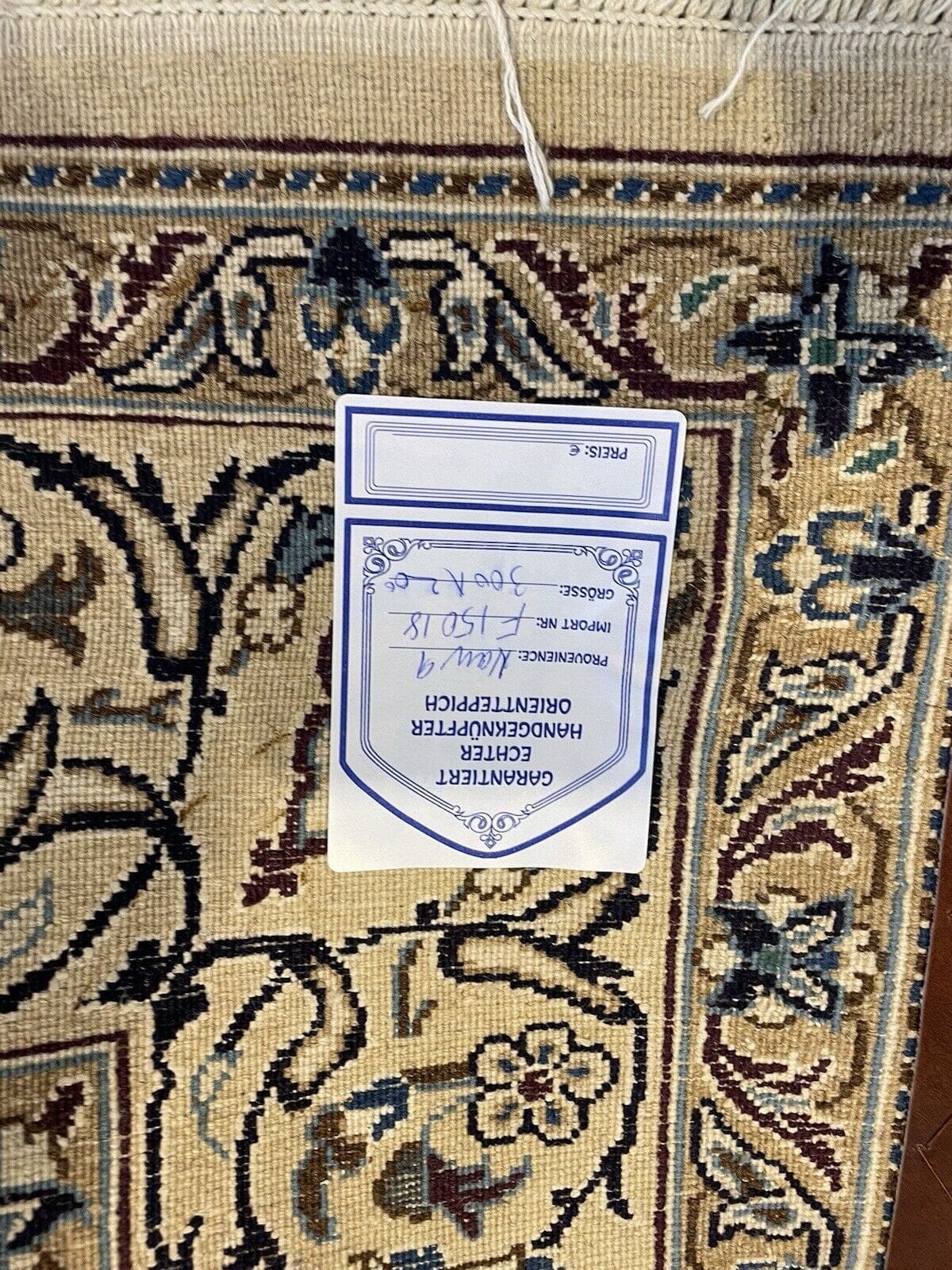
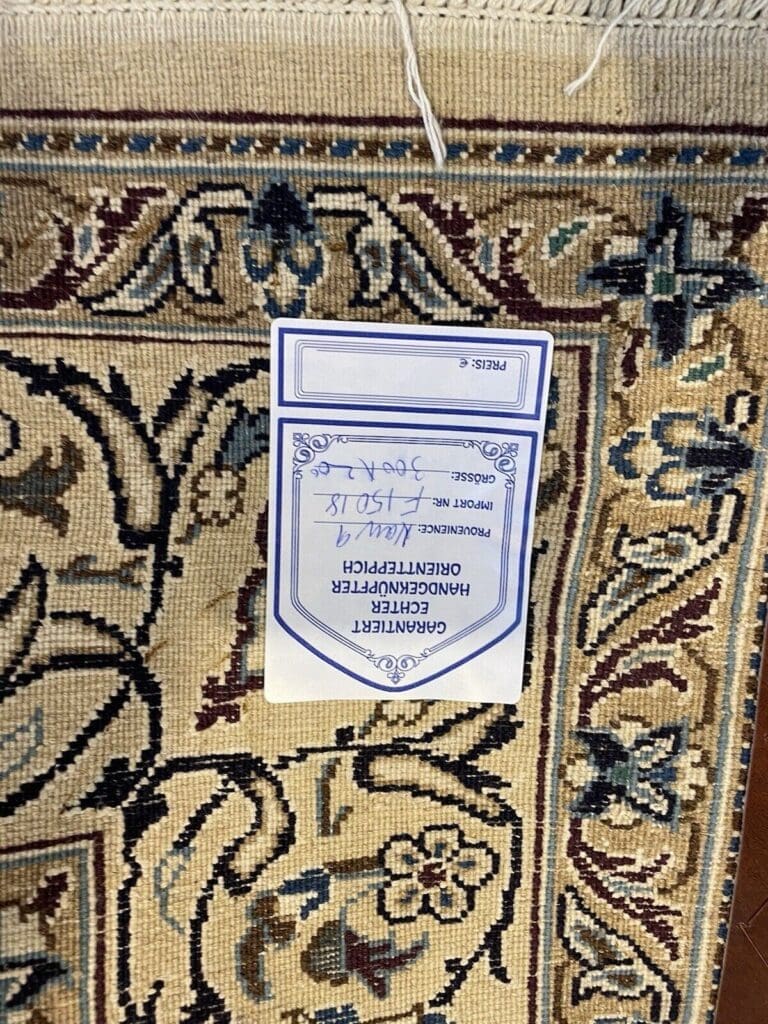
Hand-knotting means that the individual knots are placed by hand into the foundation rather than being produced by a printed or mechanically tufted process. The stated density of approximately 300,000 knots per square metre corresponds to a finely worked construction in which small lines and ornaments can be drawn with considerable precision. In a hand-knotted rug, the pattern is built gradually row by row. The back therefore reveals the structure created by the knots and allows the design to be seen as part of the woven construction.
Wool has long been used in rug making because its fibres can be worked into a resilient pile with a pleasant tactile surface. It also accepts colour in a way that gives the finished textile depth and softness. Silk is used in Persian weaving when a smoother fibre and a subtle reflective effect are required. The material information for this rug identifies 100% wool in the pile together with silk. The rug is new with a label, so its listed condition is not that of a previously used or restored piece.
The work of a hand-knotter involves repeated, precise movements and close attention to the planned drawing. Every section of a medallion, border, and floral detail has to be translated into the sequence of knots. This makes the density, regularity, and clarity of the knotting relevant to the visual result. The construction described here combines a wool pile, silk as an additional material, and the traditional hand-knotted method associated with Persian rugs.
Origin and Tradition
Nain is an important rug centre in Iran. The town is located in central Iran and is known for Persian rugs with carefully ordered compositions, fine drawing, and a restrained approach to ornament. Nain weaving became an especially recognisable branch of Persian carpet production during the twentieth century. Its designs are associated with a balance between a clearly structured field and detailed floral or arabesque work. The regional name therefore indicates both an Iranian origin and a distinctive design tradition.
The Nain tradition belongs to the wider history of Iranian carpet making, in which weaving and knotting have been practised in workshops and households for generations. A rug is created through the interaction of a drawn design, a selected palette, a foundation, and the gradual formation of the pile. The maker does not simply apply a picture to a finished surface. Instead, the image develops through the placement of coloured knots, making the pattern and the textile structure inseparable.
Many Nain compositions are planned around symmetry. A central field, surrounding ornaments, and one or more borders are arranged so that the eye can follow a consistent order across the rug. This organisation is often combined with fine lines, scrolling branches, blossoms, leaves, and small secondary motifs. The result is a design language that can be intricate without losing its overall clarity. Fine materials such as silk can support this approach by making narrow contours and small transitions more distinct.
Nain rugs are part of a diverse Persian weaving landscape. Isfahan rugs are widely associated with elaborate workshop designs, finely drawn floral arrangements, and complex colour relationships. Tabriz rugs are known for varied compositions, precise drawing, and a broad range of traditional layouts. Other Iranian centres have their own structures, palettes, and weaving habits. Nain is distinguished by its controlled ornament, balanced medallion and field designs, and the fine workmanship traditionally associated with the region.
The history of Persian rugs includes domestic pieces, workshop production, ceremonial textiles, and rugs made for interior use. Designs have been transmitted, adapted, and refined over time. Floral motifs may refer to idealised gardens, while geometry provides order and proportion. A Nain rug carries this broader cultural background through its construction and ornament, but each hand-knotted piece remains a separately made textile. Its identity comes from the regional tradition together with the specific arrangement of materials, colours, and knots.
The Iranian origin of Nain is distinct from a motif name. A pattern can be used in several weaving regions, but the designation Nain identifies the regional tradition described here. This rug is classified as a Persian rug from Iran and combines that origin with a medallion layout, a petrol-blue colour tone, wool pile, silk, and hand-knotting. These elements place the piece within the established vocabulary of Nain weaving while retaining the individual character of its own textile construction.
Design and Pattern
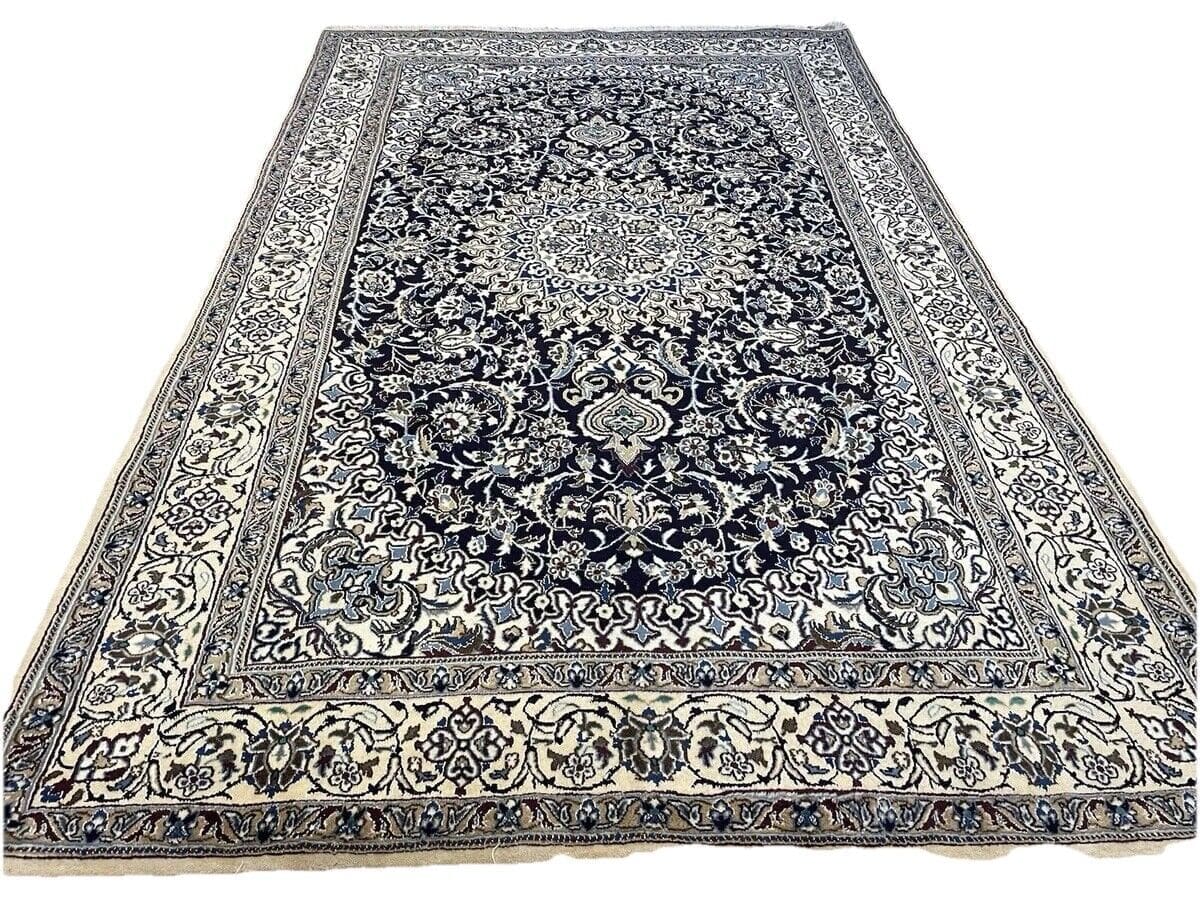
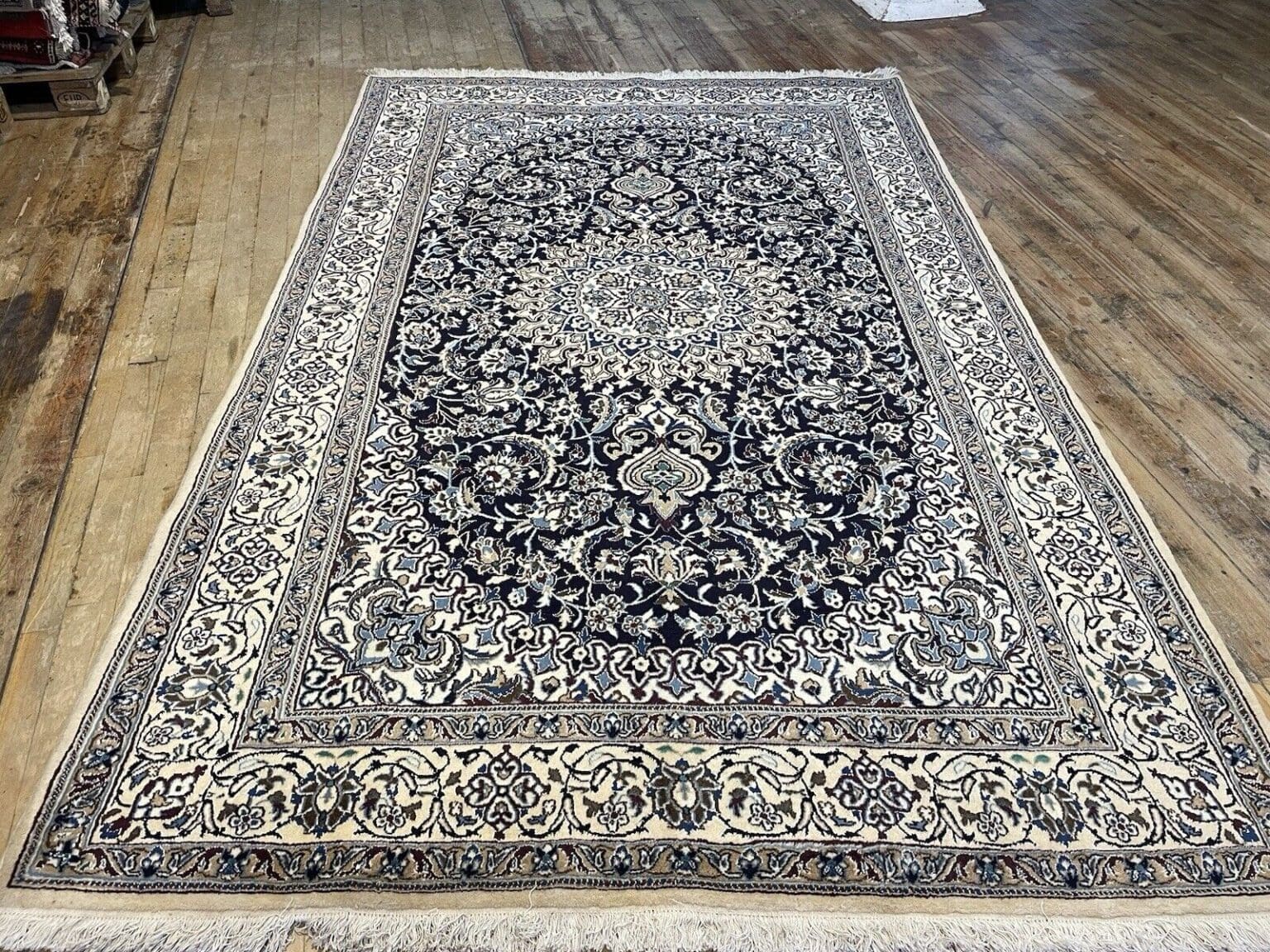
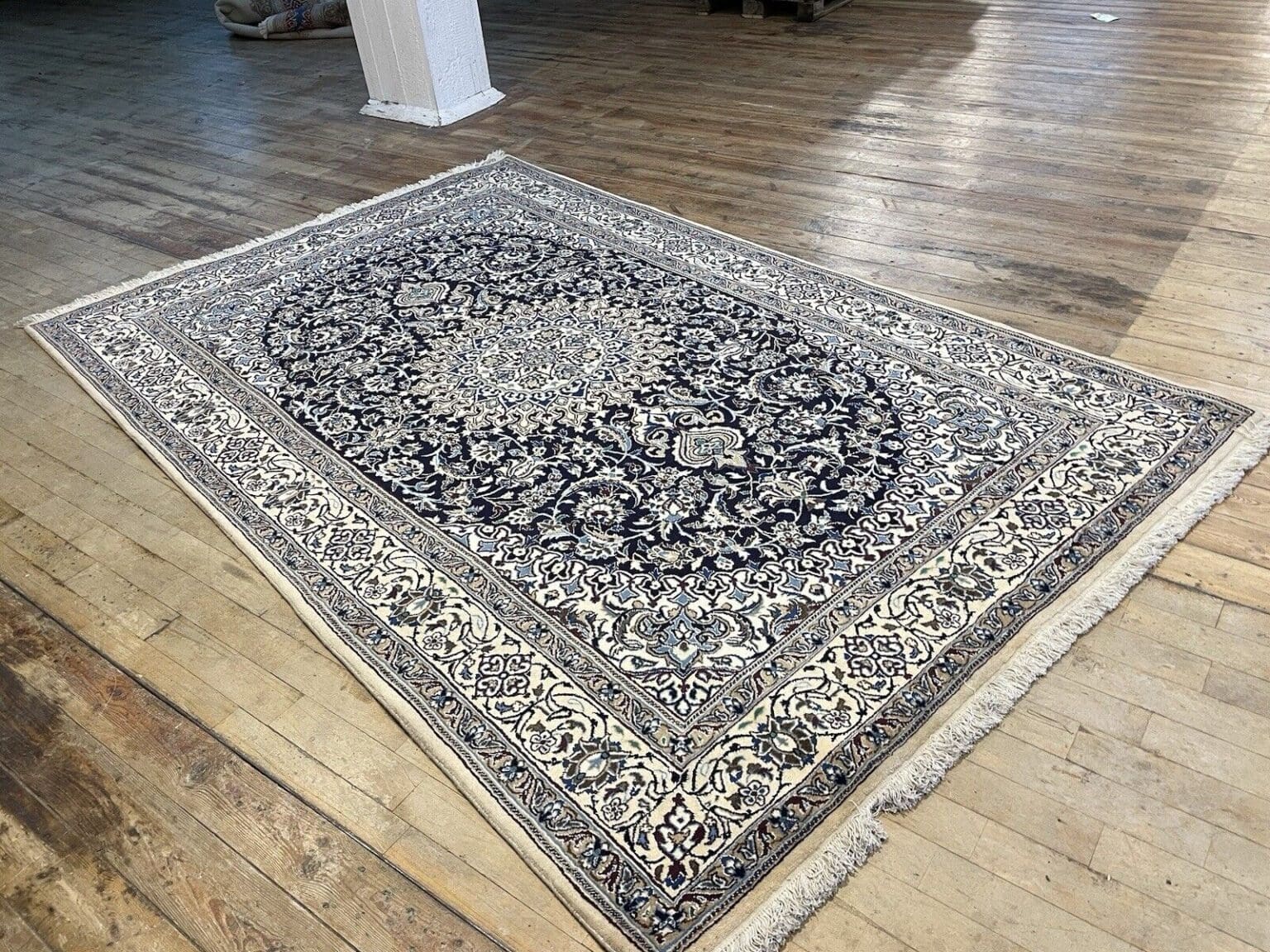
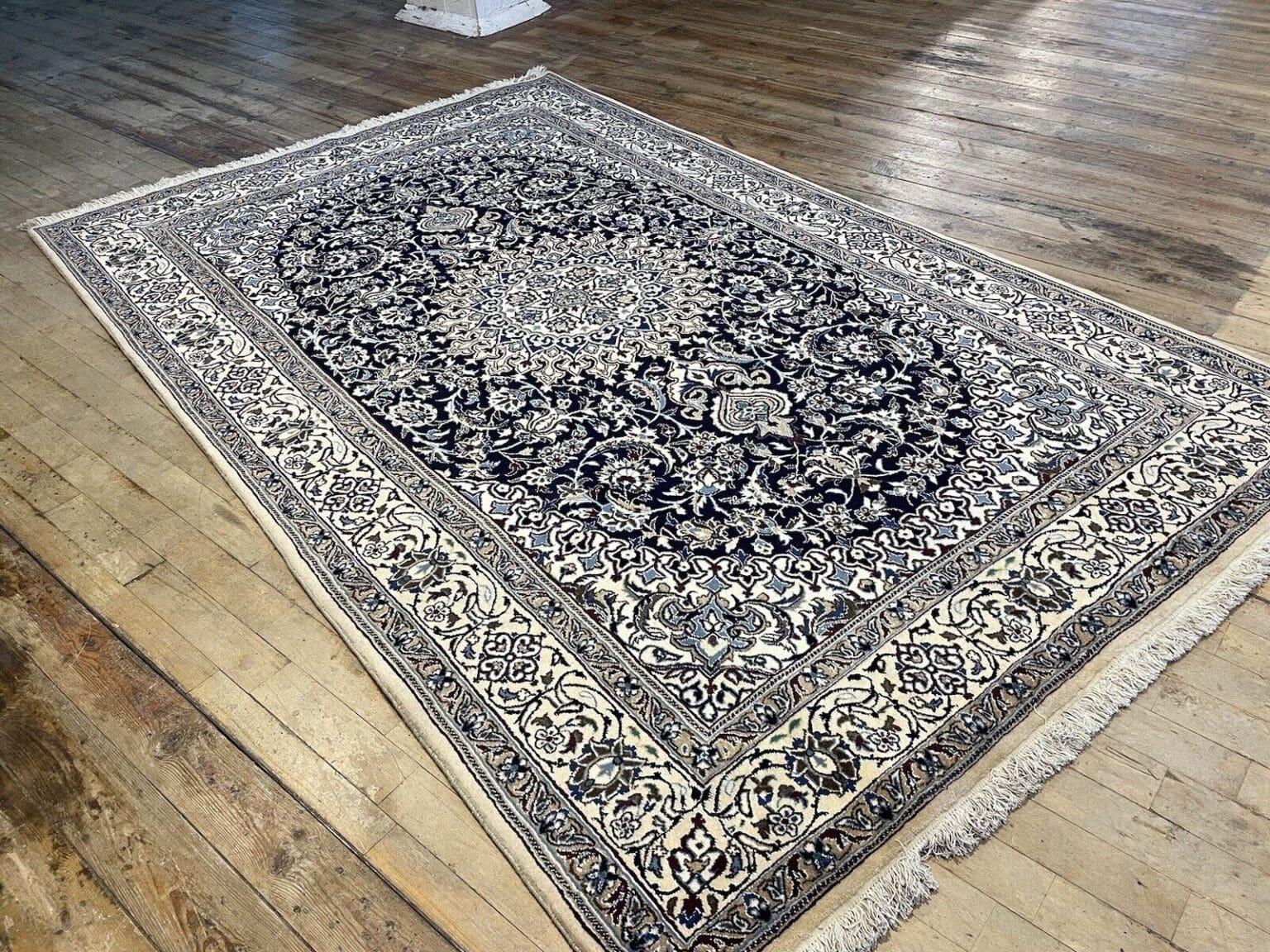
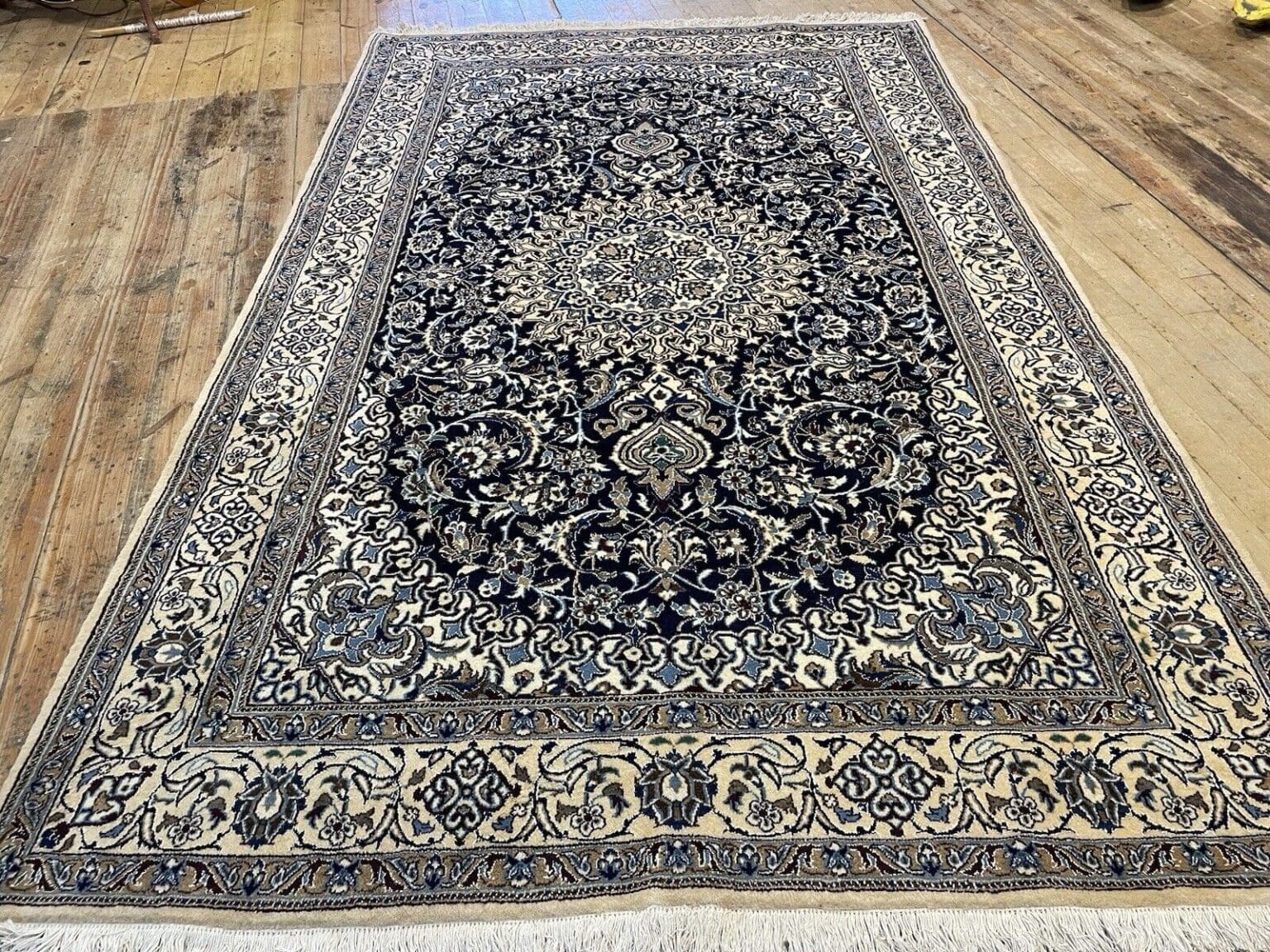
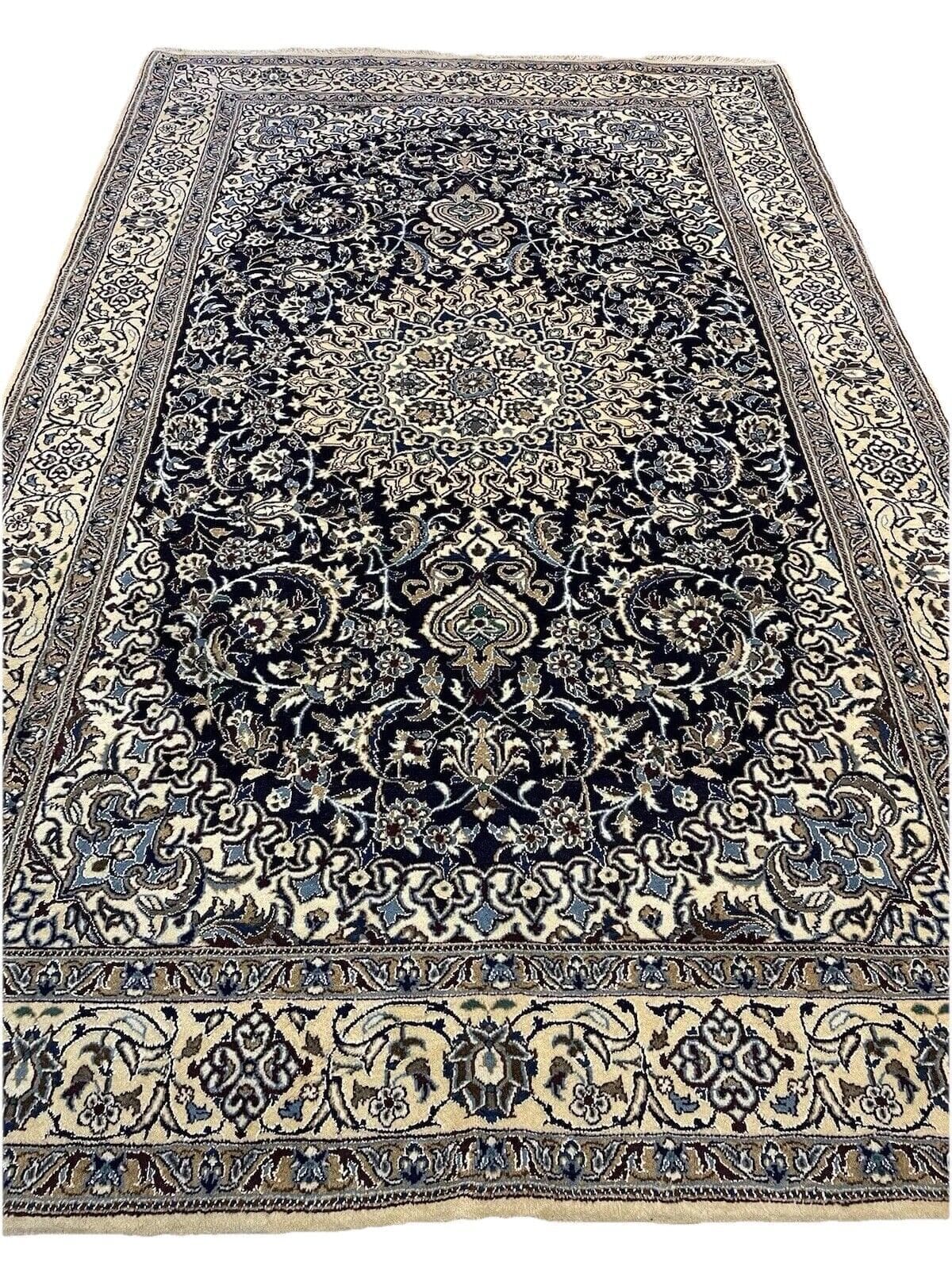
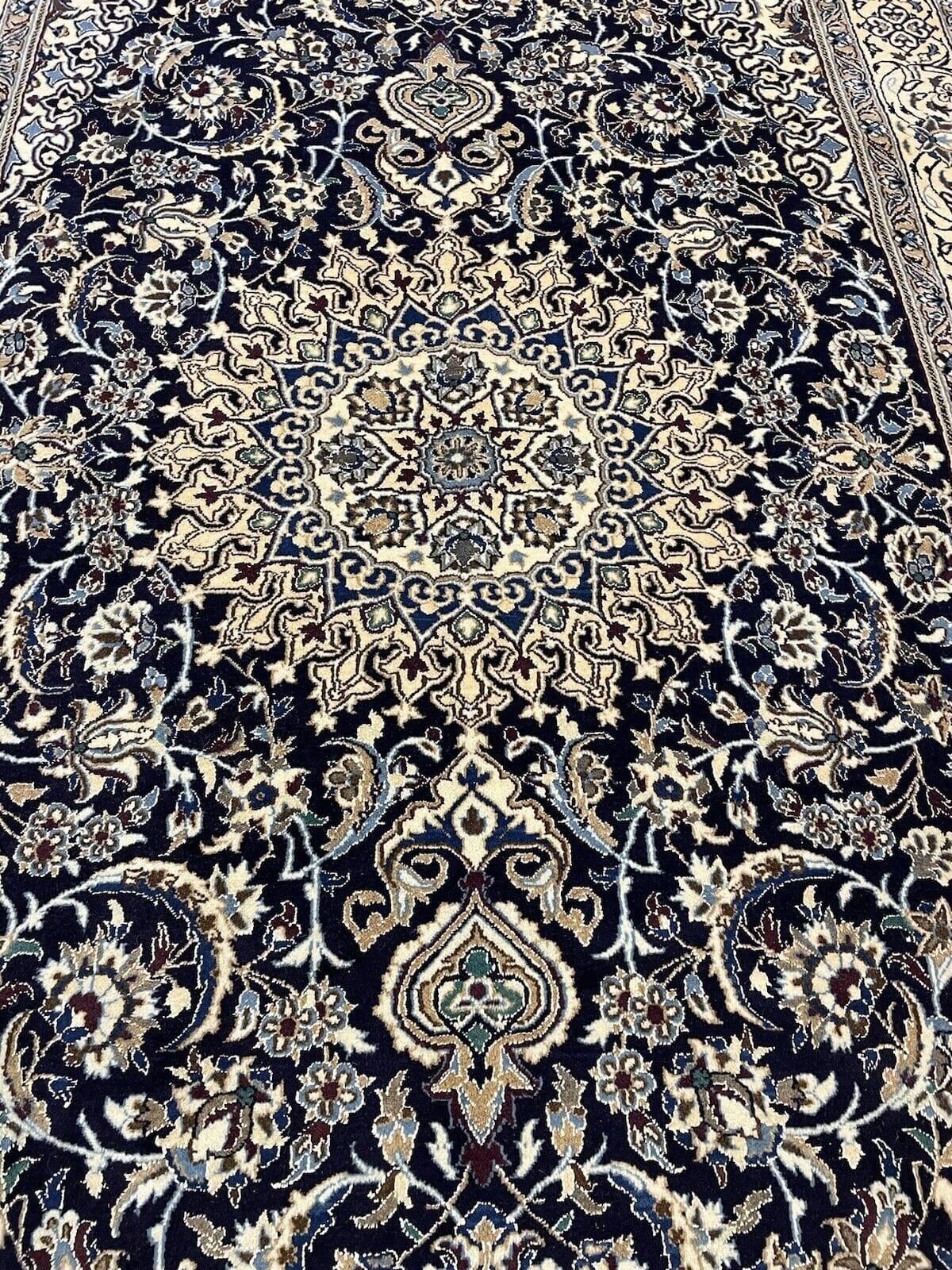
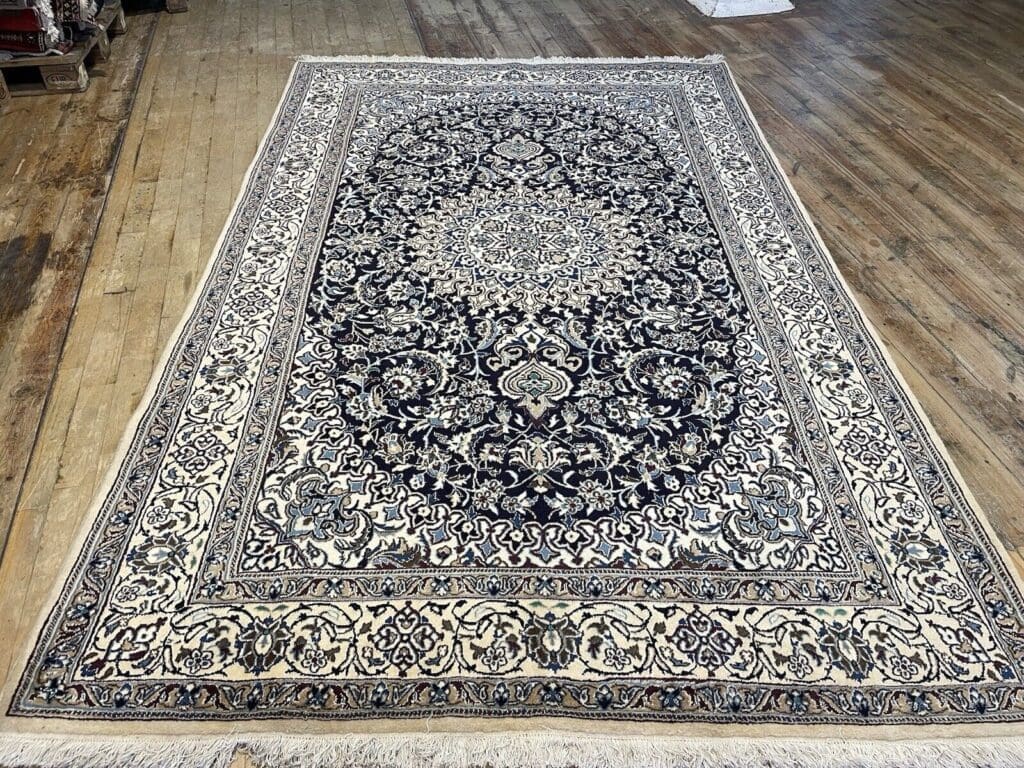
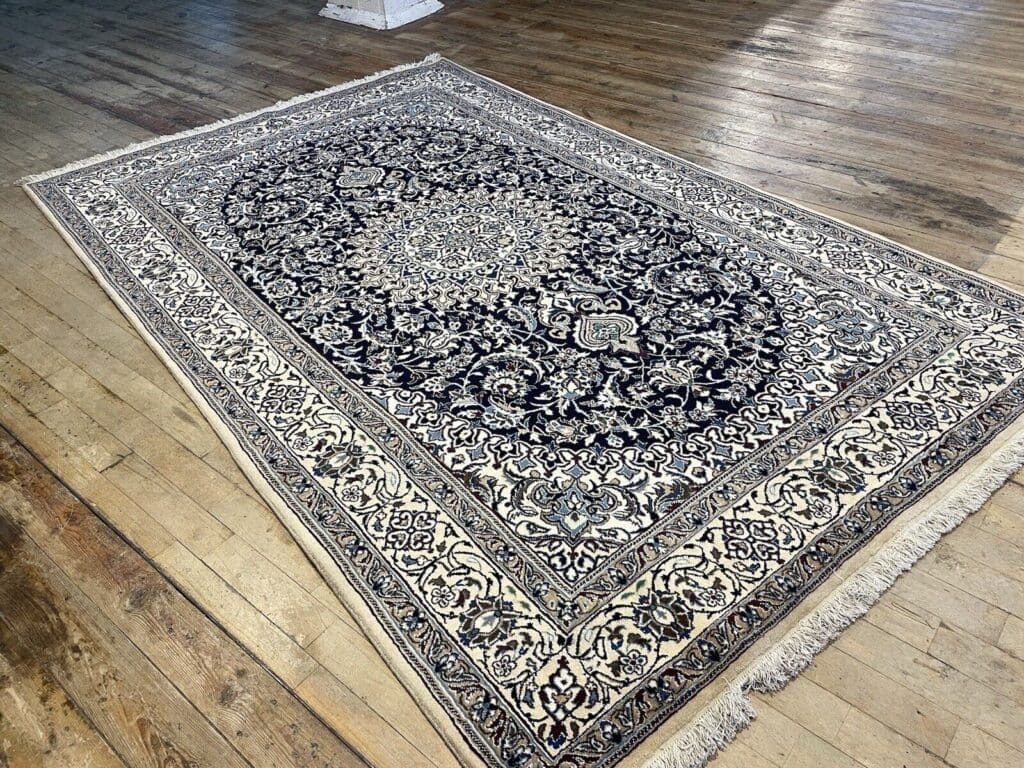
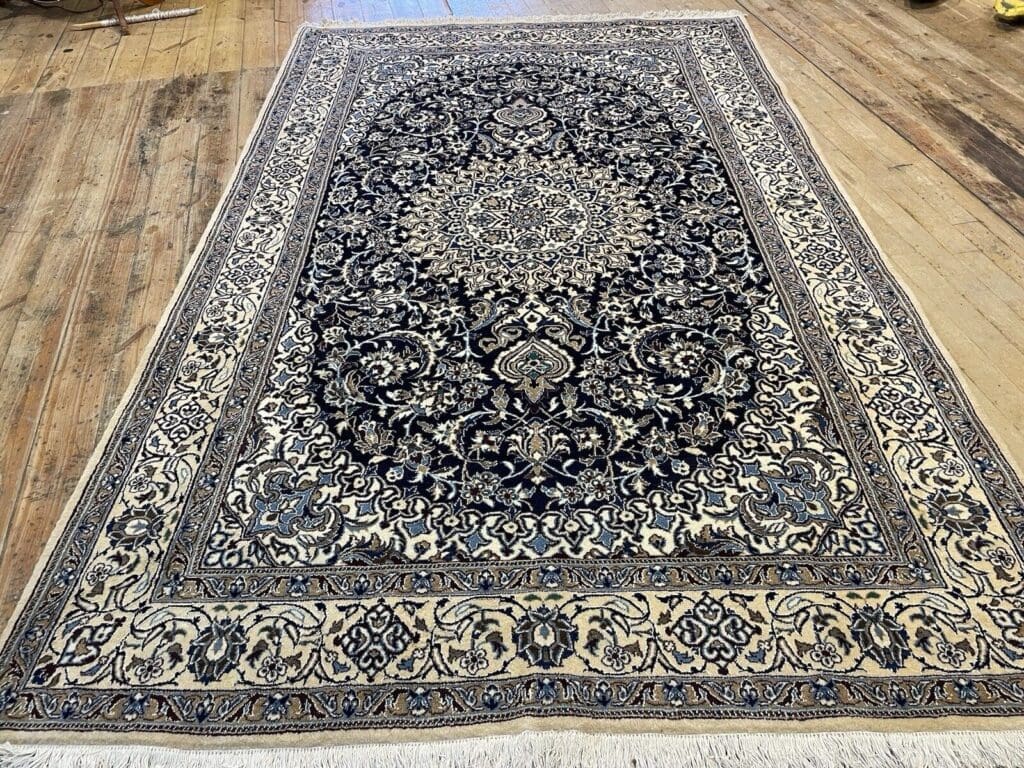
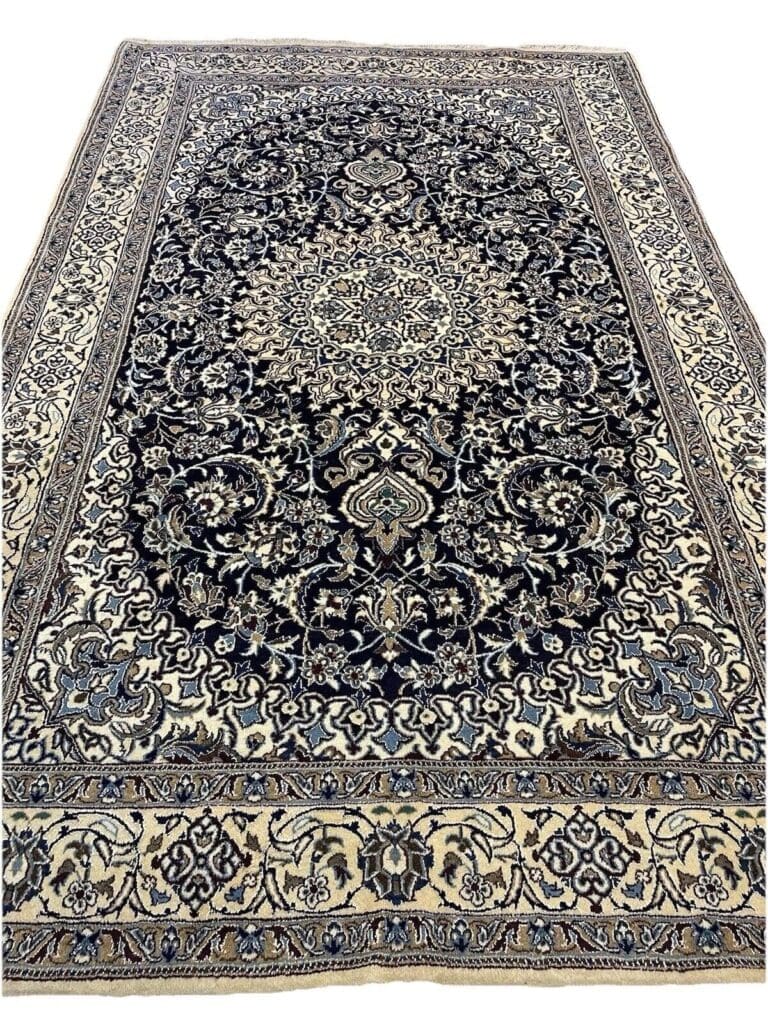
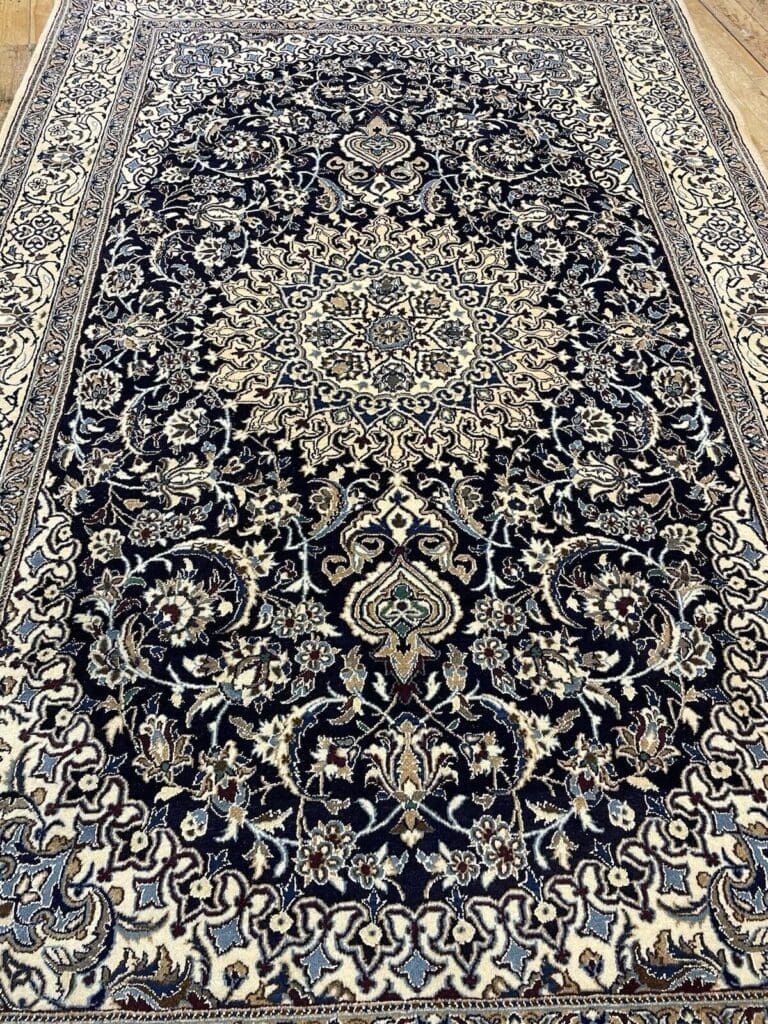
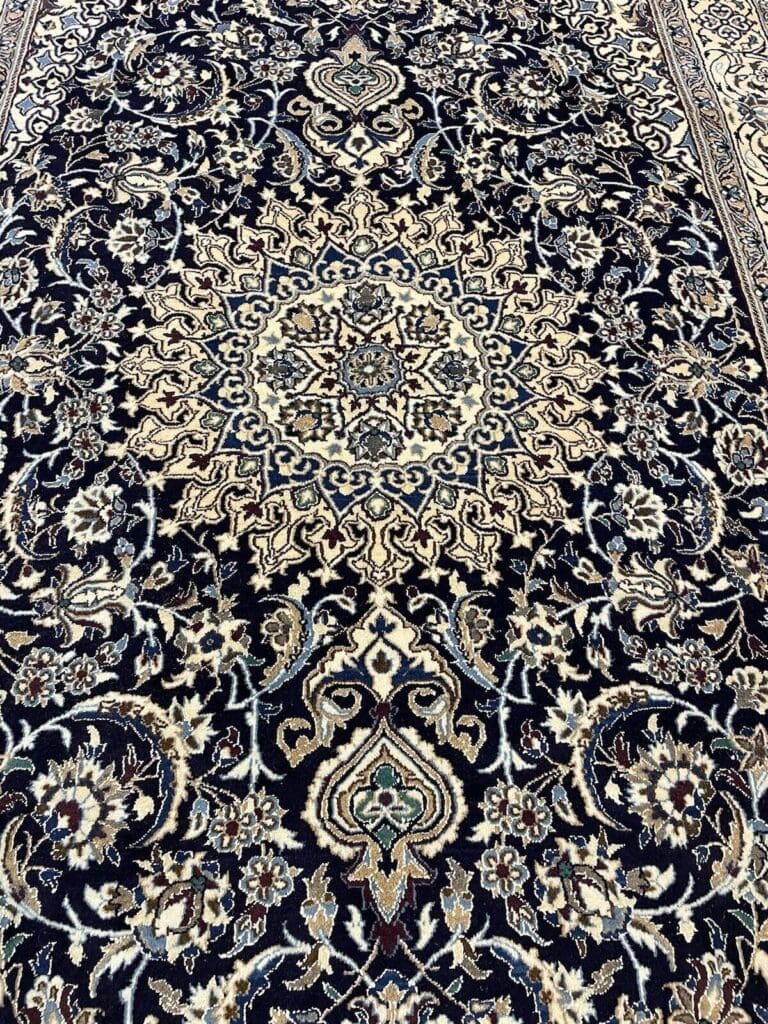
The pattern of this rug is a medallion. In Persian carpet design, a medallion acts as the visual centre of the composition. It may be circular, oval, polygonal, or formed from interlocking contours. The surrounding field is organised in relation to that centre, with ornaments extending outward or filling the spaces around it. This arrangement gives the rug a defined focal point and creates a clear distinction between the central field and the enclosing border system.
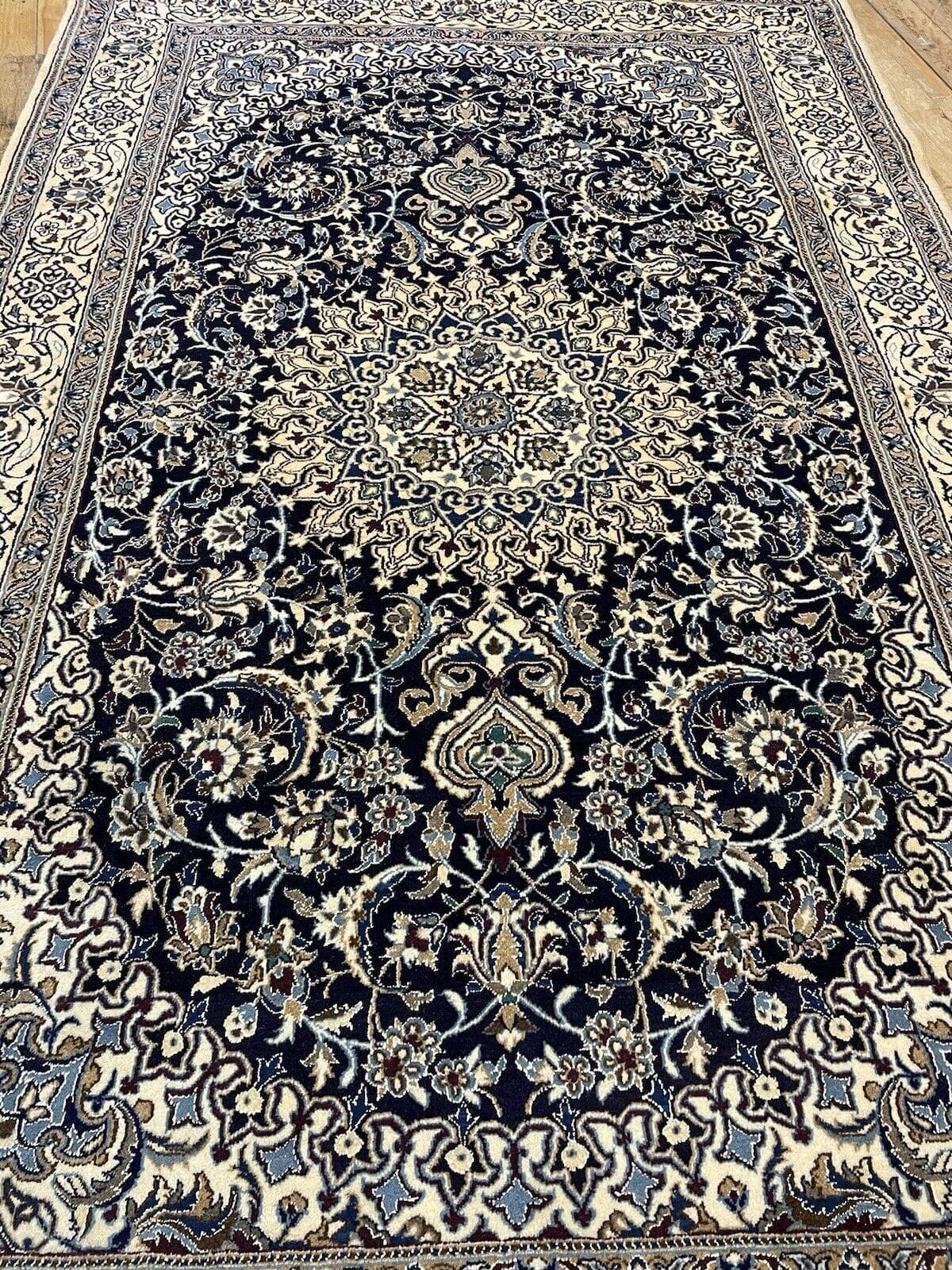
Nain medallions are often accompanied by delicate floral elements, scrolling branches, leaves, and arabesque forms. These motifs can be arranged symmetrically so that corresponding parts appear on opposite sides of the central axis. Geometric lines may frame the floral drawing or mark the transition between different sections. The combination of measured structure and finely drawn botanical forms is characteristic of the way Nain designs balance order with detail.
The colour tone is specified as petrol blue. Petrol blue occupies a position between blue and green and can serve as a unifying ground colour or as a controlled accent within a Persian composition. Wool gives the colour a soft, textile presence, while silk can reflect light more distinctly and make selected details appear subtly differentiated. The exact visual balance depends on how the colour is distributed through the medallion, field, floral motifs, and borders.
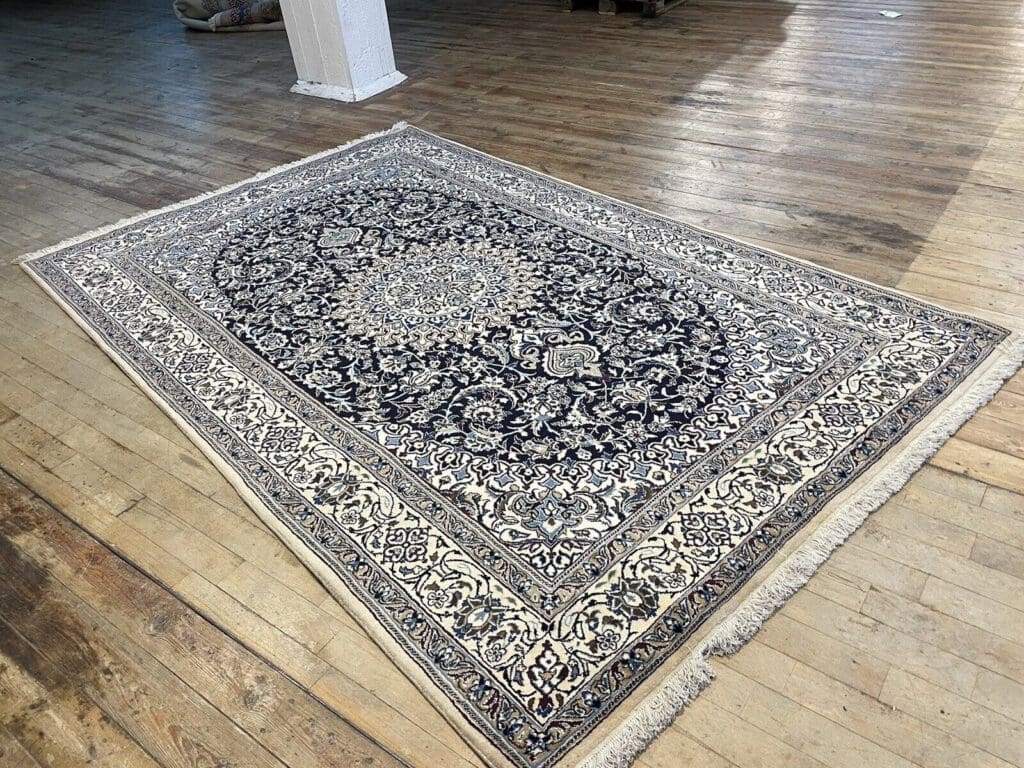
Traditional Persian pattern systems use borders to frame the central field and to establish a transition between the rug and its outer edge. A principal border may carry repeating flowers, vines, or geometric units, while narrower guard borders create visual separation. In a medallion design, these bands also help stabilise the central arrangement. The eye can move from the middle to the surrounding field and then to the border without losing the overall rhythm of the pattern.
The fine drawing of a Nain rug is closely connected to its knotting. Small changes in colour and outline are represented by individual knots, so a denser construction allows more room for precise pattern development. This does not make the medallion an isolated ornament; it becomes part of a complete system in which centre, field, border, and secondary details support one another. The hand-knotted structure gives the design a direct relationship to the textile surface.
The style is described as traditionally Oriental and Persian. These terms refer to a design vocabulary rooted in Iranian carpet culture, including symmetrical layouts, medallions, floral ornament, and carefully coordinated borders. The rectangular form is the conventional format for many knotted rugs and allows the medallion composition to be read along a clear central axis. A traditional design can be placed beside classic furniture or within a simpler interior because its structure remains legible even when the surrounding setting changes.
Special Features
This rug is identified as a Nain Persian rug from Iran. It has a medallion pattern, a petrol-blue colour tone, a pile of 100% wool, and silk as an additional material. The rug is hand-knotted and is listed as new with a label. It is suitable for use over underfloor heating. Its rectangular form follows the established format of many Persian rugs and supports conventional placement in a living area, dining space, or bedroom.
The combination of a fine knot density, wool pile, silk, and a centrally organised design brings together several recognised Nain characteristics. The information about origin, colour, condition, material, and construction describes one new Persian textile with a traditional regional identity. Because it is hand-knotted, the visible surface is created through a sequence of individual knots rather than through a printed pattern. That method links the design directly to the making of the rug.
FAQ
How should I care for a Nain Persian rug?
Regular vacuuming on a low setting is suitable for routine care. The surface should not be treated with unnecessary force, particularly where silk details are present. Occasional professional cleaning is recommended for a thorough treatment of the wool pile and the other fibres. Direct sunlight should be avoided because prolonged exposure can cause colours to fade. Strong household cleaners and vigorous spot treatment are not appropriate for a hand-knotted Persian rug; more substantial soiling should be handled by a specialist rug cleaner.
How can I tell whether a Nain Persian rug is genuine?
A genuine Persian rug from Nain is hand-knotted and has a knot structure that can be inspected from the back. A high knot density may indicate finely executed work, but density alone is not a complete authentication method. The back should show a recognisable version of the front pattern because the design is formed by the knots themselves rather than printed onto the pile. Origin, materials, construction, pattern clarity, and the visible quality of the knotting should be considered together when assessing a rug.
What sizes are available for Nain Persian rugs?
Nain Persian rugs are produced in a range of formats. The selection may include narrow runners as well as larger rugs intended to define a living area or another interior zone. The appropriate format depends on the room plan, furniture arrangement, walkways, and the amount of floor that should remain visible. A runner can organise a passage, while a larger rectangular rug can connect a seating or dining arrangement. Doors and clearances should be checked before choosing a format.
To provide the best experiences, we use technologies like cookies to store and/or access device information. Consenting to these technologies will allow us to process data such as browsing behavior or unique IDs on this site. Not consenting or withdrawing consent, may adversely affect certain features and functions.
Functional Always active
The technical storage or access is strictly necessary for the legitimate purpose of enabling the use of a specific service explicitly requested by the subscriber or user, or for the sole purpose of carrying out the transmission of a communication over an electronic communications network.
Preferences
The technical storage or access is necessary for the legitimate purpose of storing preferences that are not requested by the subscriber or user.
Statistics
The technical storage or access that is used exclusively for statistical purposes.The technical storage or access that is used exclusively for anonymous statistical purposes. Without a subpoena, voluntary compliance on the part of your Internet Service Provider, or additional records from a third party, information stored or retrieved for this purpose alone cannot usually be used to identify you.
Marketing
The technical storage or access is required to create user profiles to send advertising, or to track the user on a website or across several websites for similar marketing purposes.
 SECURE PAYMENT
 SHIPPING PARTNERS