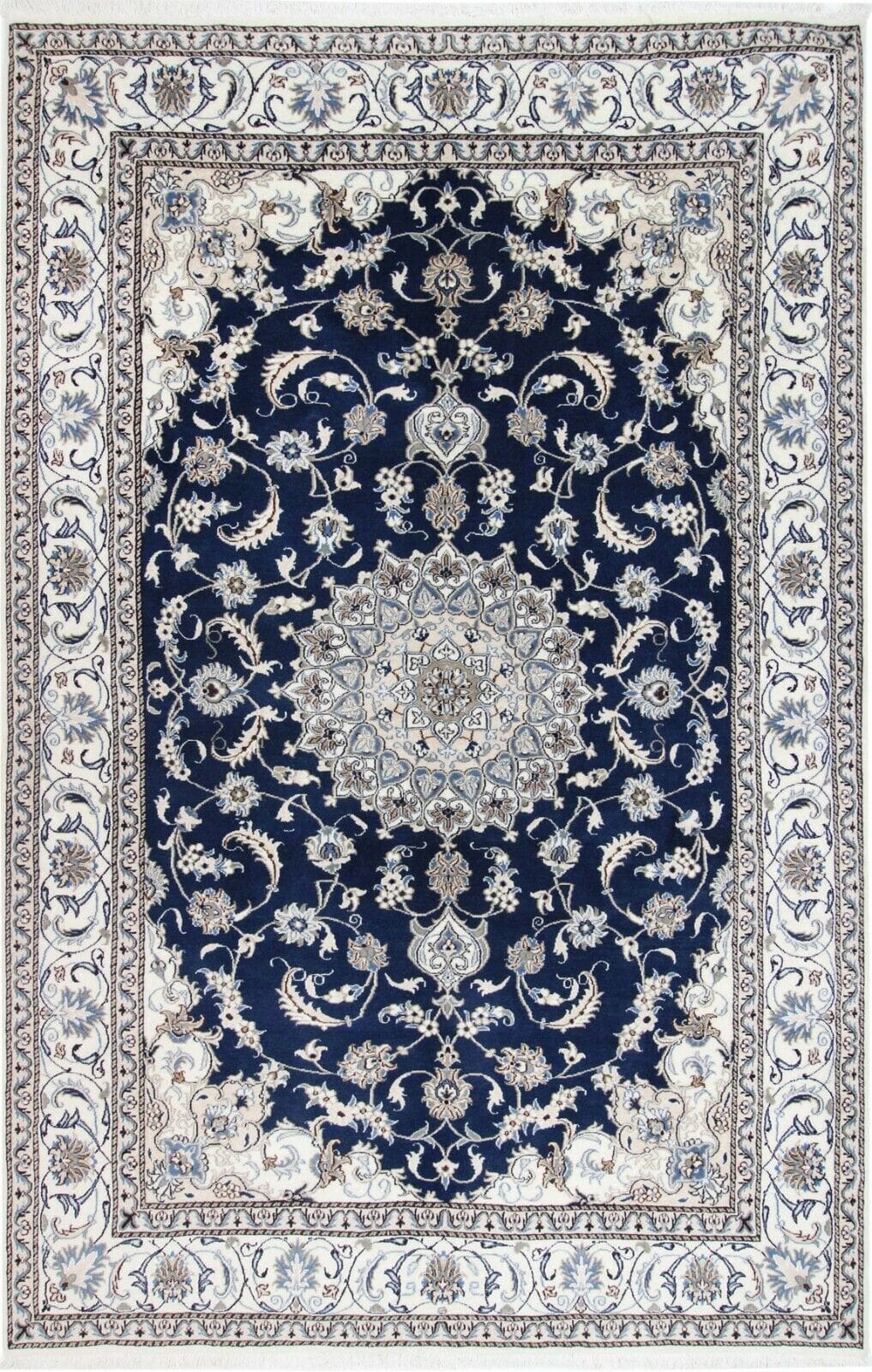
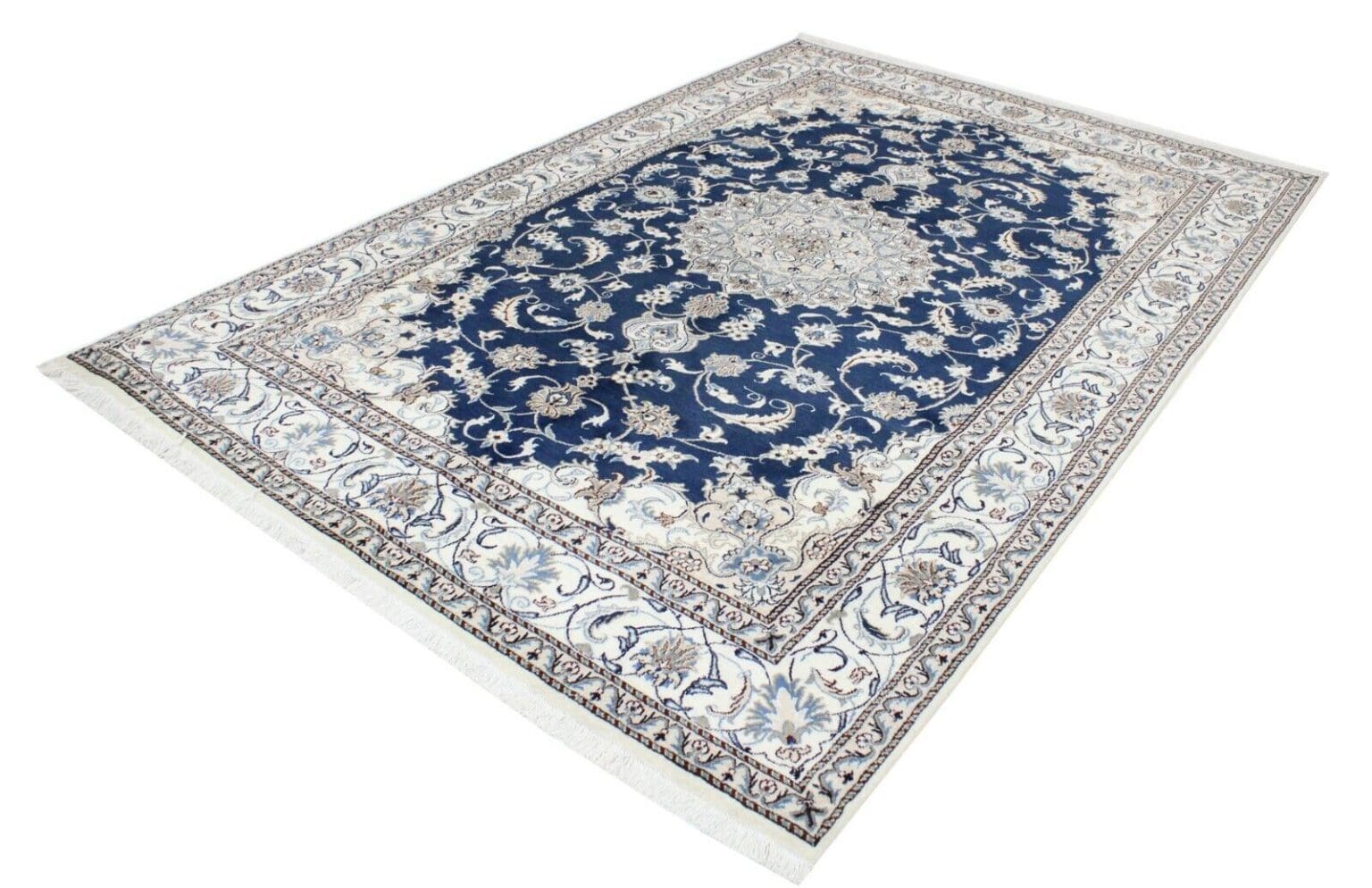
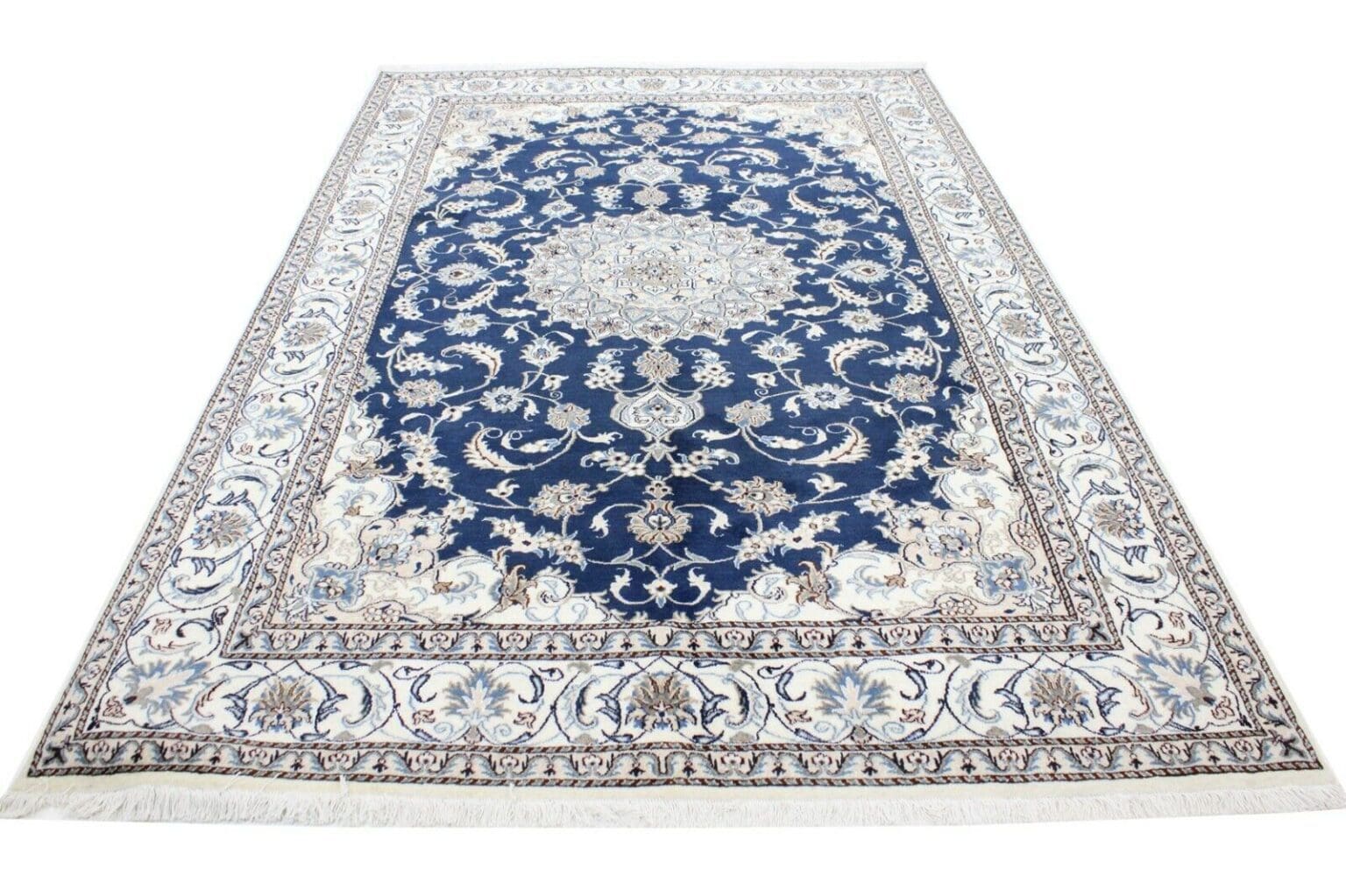
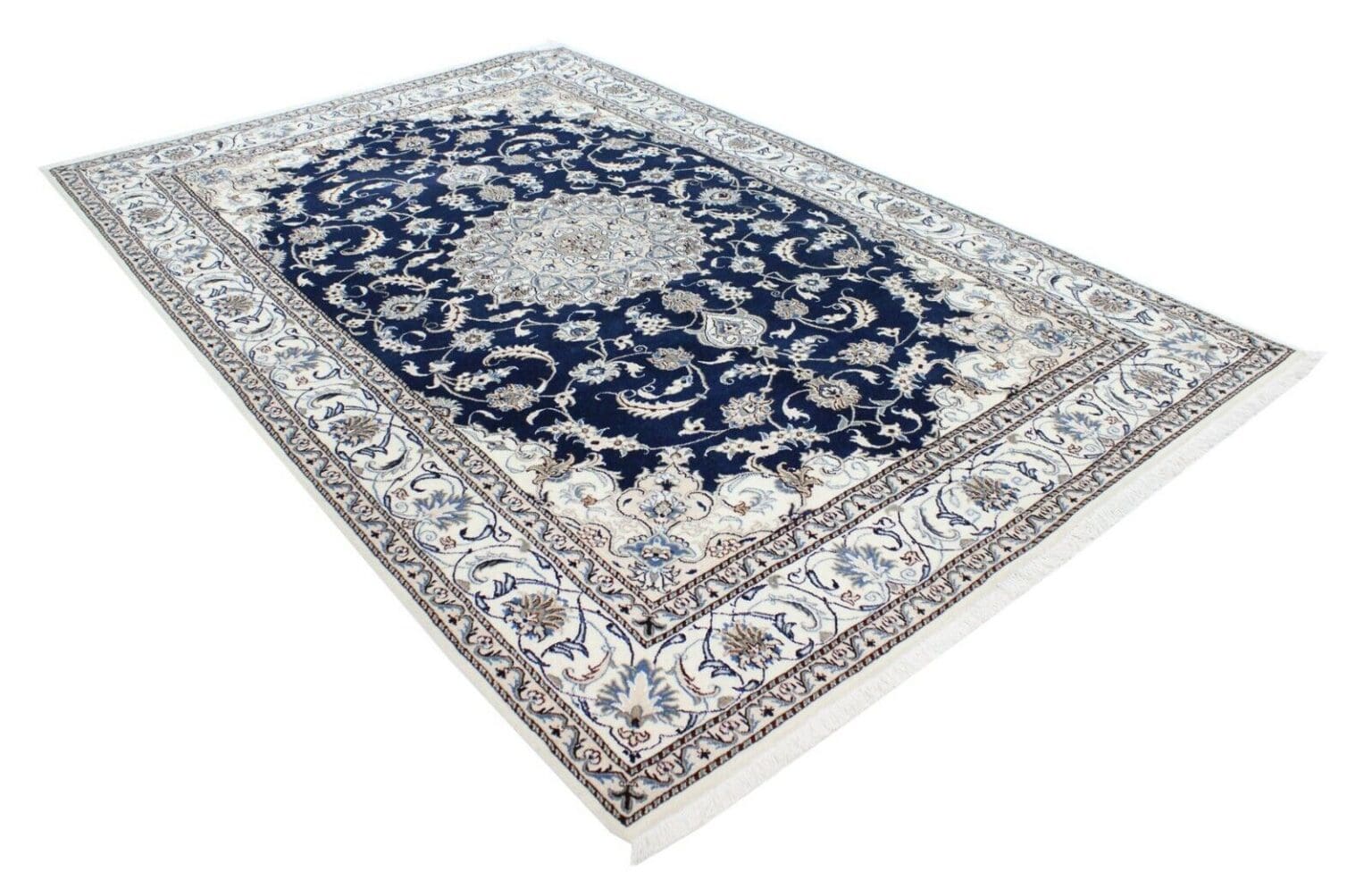
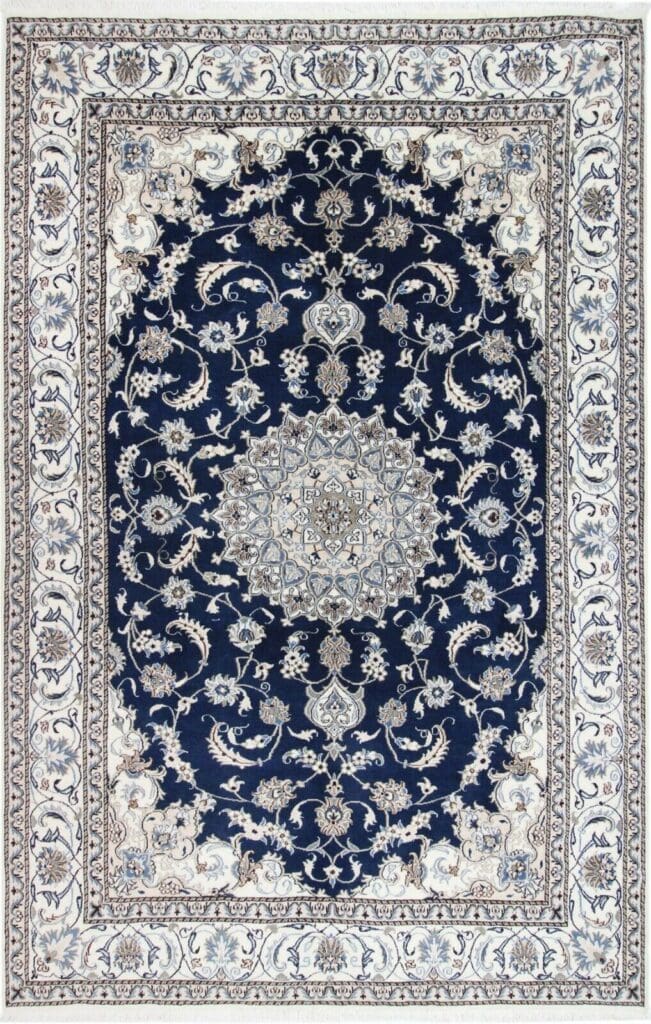
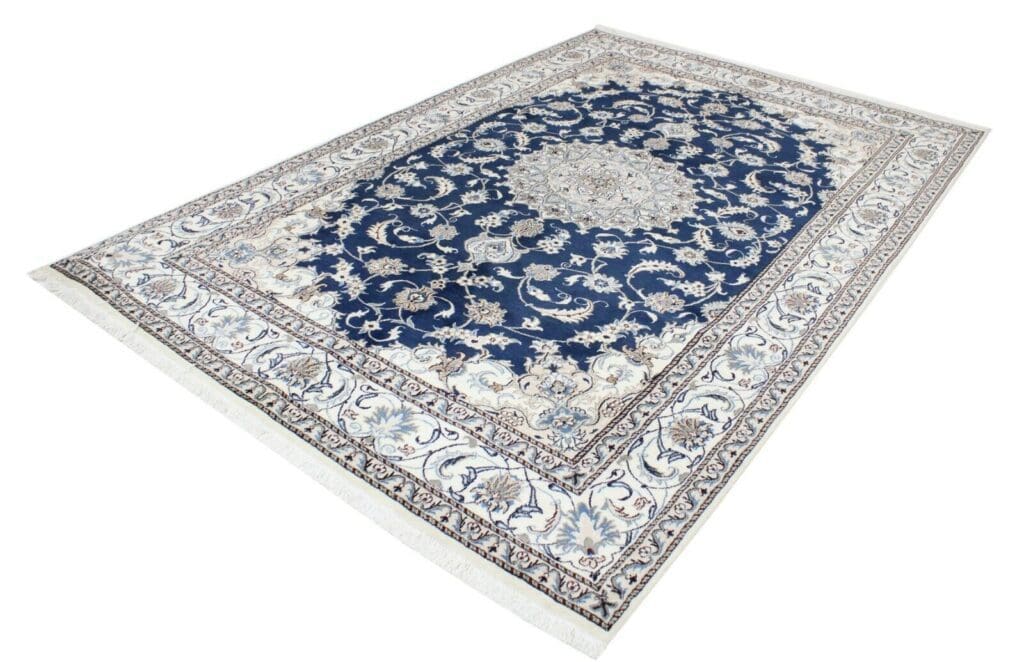
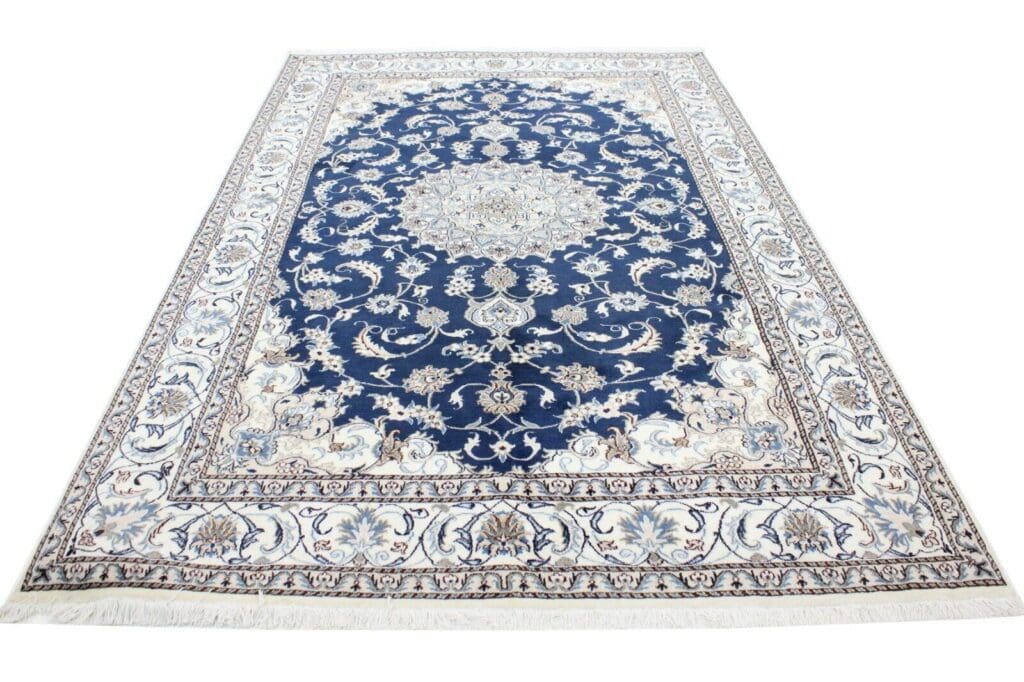
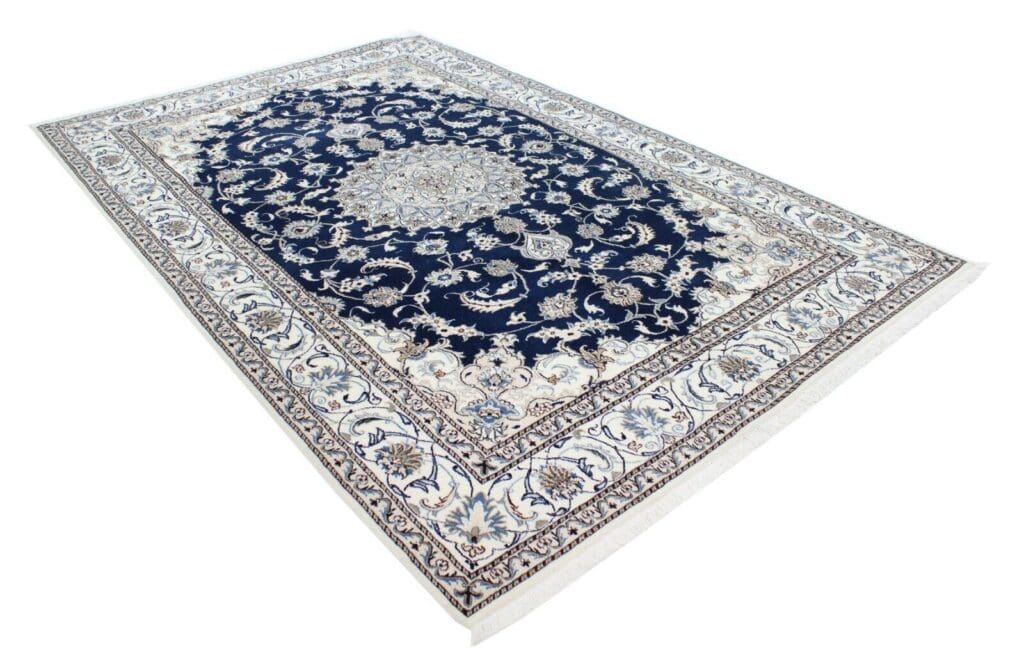
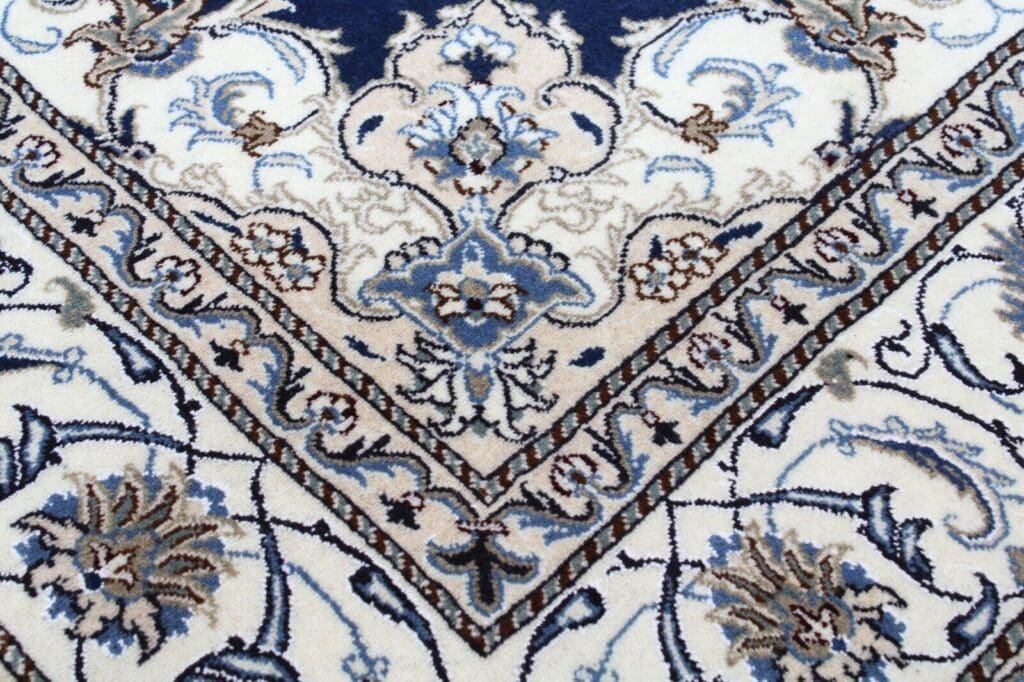
Hand-knotted Nain Persian Rug | Knot density: Hand-knotted | Material: Wool and cotton | Size: 300 x 200 cm | Pattern: Oriental with floral motifs | Condition: New without label, top condition
This Nain Persian rug is hand-knotted and made from high-quality wool and cotton. Both materials belong to the established tradition of Persian carpet making. Wool is valued for its resilient, tactile character and is commonly used for the pile, while cotton can provide a regular and stable foundation within the construction. Together, these materials support a textile surface that combines practical use with the visible character of manual craftsmanship. The materials specified for this rug are high-quality wool and cotton; no other material components are stated for the piece.
Hand-knotting is a gradual process. Individual knots are tied around the foundation, rows are secured with weft threads, and the structure is compacted as the work progresses. The pile is repeatedly aligned and later finished to create a coherent surface. This method differs from the industrial production of a ready-made floor covering because the rug is built through many separate manual actions. Variations in tension, row rhythm, and small details are natural consequences of handwork. Every hand-knotted rug is therefore an individual object rather than a mass-produced duplicate.
The preparation of the wool affects the feel and working properties of the pile. Fibres are selected, spun, and prepared before they are used in the knotting process. The cotton foundation establishes the lengthwise framework, while the knots, wefts, and edge finishing hold the woven structure together. Careful execution helps preserve the clarity of outlines and the continuity of the surface. For this rug, high-quality wool and cotton and hand-knotted construction are specified. The description does not identify any further fibre or material.
Origin and Tradition
The rug comes from Iran and is identified as a Nain Persian rug. Nain is an established place name within Iranian carpet culture. The city and its surrounding area are located in central Iran, where urban workshops, trade connections, and textile skills developed alongside one another over many generations. Nain is particularly associated with orderly compositions, carefully articulated ornament, and floral designs arranged with a clear sense of balance. The name therefore refers both to a geographical origin and to a developed design tradition.
Persian carpet making has a long history in which useful household textiles, artistic expression, and regional identity overlap. Knowledge of warps, wefts, knots, borders, pile, and colour arrangement has traditionally been passed through workshops and families. Numerous local traditions emerged from this continuity. They differ in knotting methods, proportions, drawing, colour relationships, and the way a field is connected to its surrounding borders. The wide range of Iranian rugs reflects the different landscapes, communities, markets, and working methods found across the country.
Nain belongs to the urban side of this tradition, where a planned design often guides the work. A pattern may be arranged before knotting begins so that the main motifs, secondary elements, and borders have a defined position. This approach supports symmetry, repetition, and a measured distribution of detail. It also explains why Nain designs are commonly associated with a composed appearance and finely organised floral ornament. The plan provides structure, but the final object still depends on the hands and judgement of the people who execute it.
Iranian rugs from different places should not be treated as interchangeable. Gabbeh, Kashan, and Tabriz are also names from the Persian rug tradition, but each has its own history and visual conventions. Gabbeh is often linked with simpler, more open compositions and strong colour areas. Kashan is widely associated with detailed floral arrangements, while Tabriz encompasses several refined and carefully structured design traditions. Nain represents a separate Iranian origin and should be understood on its own terms, even where certain floral or geometric elements overlap with designs from other regions.
The history of Persian rugs is also a history of technical adaptation. Materials, dyes, looms, patterns, and workshop organisation changed over time, while the basic principle of constructing a durable textile by hand remained important. Urban production could rely on established pattern systems and specialised skills, whereas village and nomadic traditions often developed different proportions and drawing methods. This diversity is why “Persian rug” describes a broad family rather than one uniform appearance. A Nain Persian rug belongs to that family while retaining the regional identity indicated by its name.
Design and Pattern
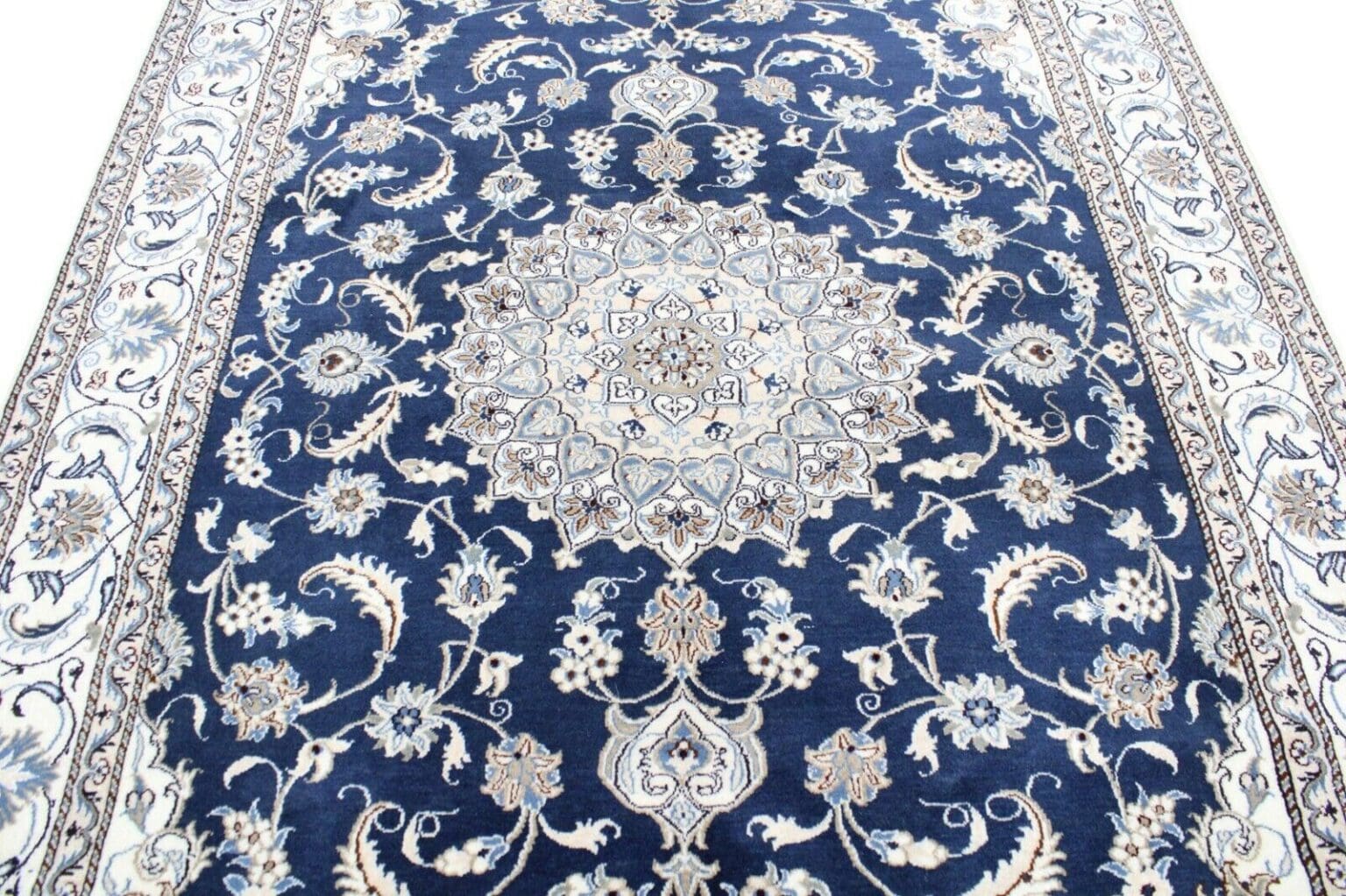
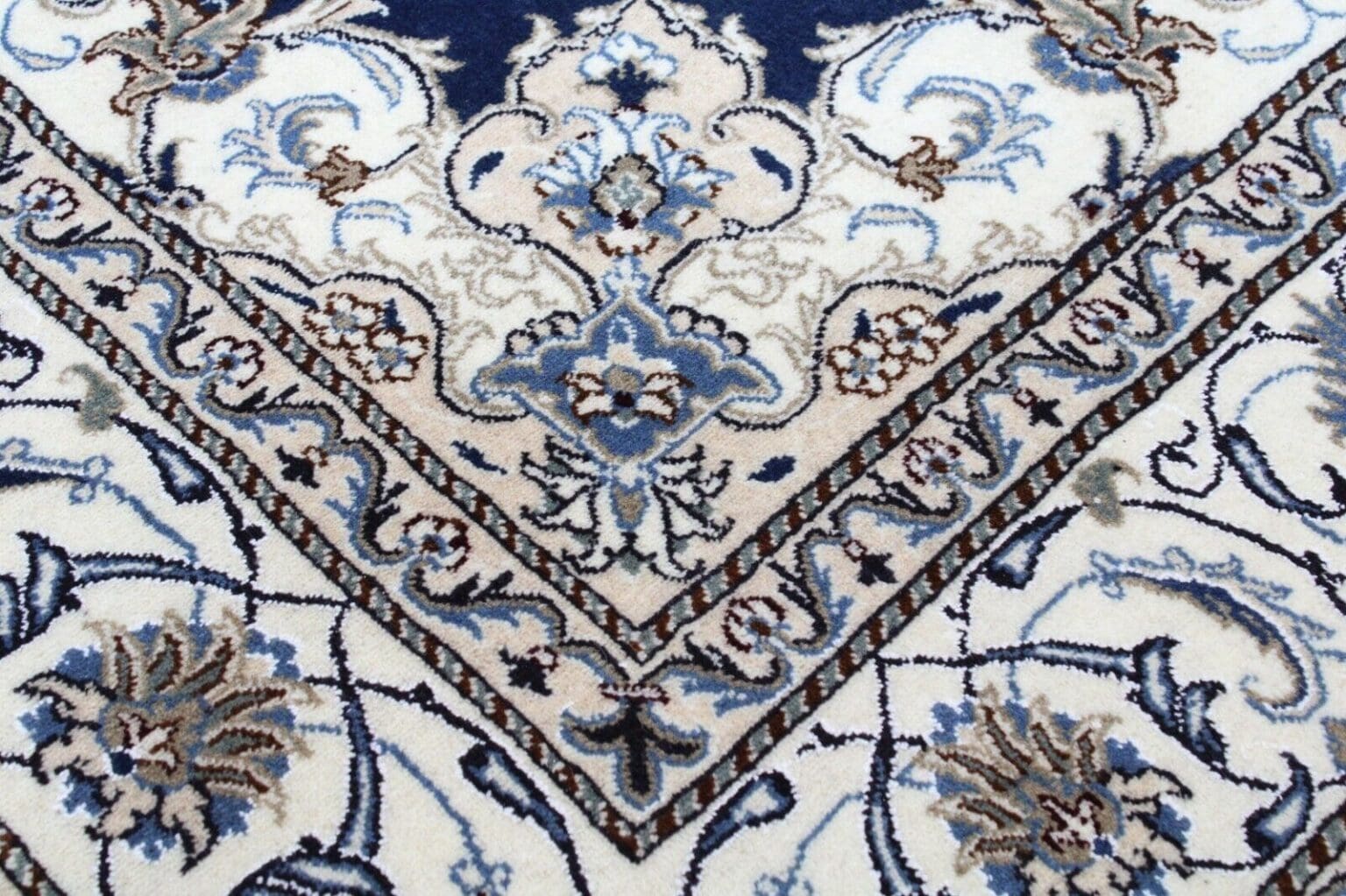
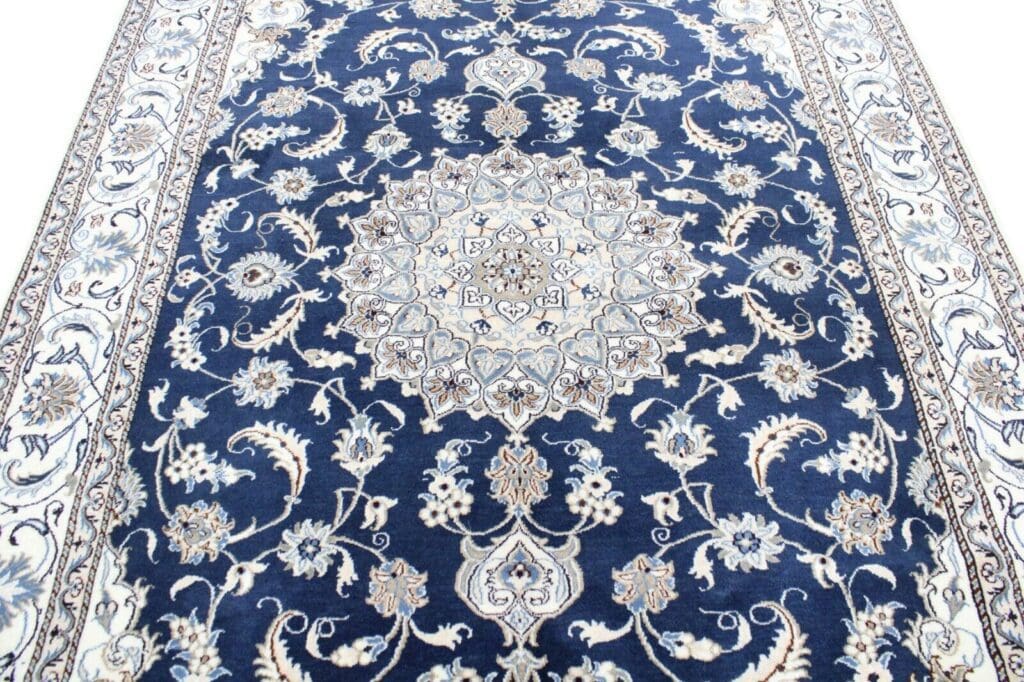
The pattern of this rug is described as Oriental with floral motifs. Floral ornament is one of the central languages of Persian carpet design. Flowers, leaves, vines, and stylised botanical shapes may be based on natural forms but are usually transformed into a decorative system. Repetition gives the motifs rhythm, while their placement can connect separate areas of the field. The result is a pattern in which plant forms are not isolated illustrations but elements of a planned surface. This relationship between botanical detail and formal order is especially relevant to the traditional design context associated with Nain.
Geometric structure often supports floral ornament in Persian rugs. Lines may establish a border, mark a central axis, frame a field, or create mirrored relationships. Repeated shapes can fill spaces between larger motifs and help maintain visual balance. Geometry does not have to dominate the pattern; it may remain an underlying framework that organises the more organic appearance of flowers and vines. Many classical Oriental carpets depend on this combination of measured structure and flowing ornament. For this particular rug, the named pattern features are its Oriental character and floral motifs.
Traditional compositions are often divided into a central field and one or more surrounding borders. The field carries the principal drawing, while the borders enclose it and create a transition toward the outer edge. Narrower secondary borders may add additional bands of ornament. Depending on the regional design, a composition can be based on a central medallion, an uninterrupted vine, or a repeating all-over pattern. The source for this piece specifies Oriental floral motifs but does not identify each structural component. General Nain design practice provides the historical context for an ordered floral appearance without adding an unrecorded feature to the rug.
Colour, line, and density determine how easily a pattern can be read. In Persian design, colours are often balanced so that flowers, vines, borders, and ground areas remain distinguishable. The visual effect depends not only on individual shades but also on the relationship between large and small motifs, open and filled areas, and stronger and quieter outlines. In a hand-knotted rug, every part of the design is built through a sequence of knots. The precision of the final drawing is therefore connected to both the planned design and the care of its execution.
Here, “Oriental” describes the cultural and decorative direction of the pattern. It does not change the stated origin from Iran and does not turn the rug into one from another region. Similar flowers, leaves, and geometric details can appear in several Persian traditions because they belong to a shared ornamental vocabulary. The relevant identifying information remains the stated Iranian origin and the name Nain. The design can therefore be placed within the wider history of Oriental ornament while remaining associated with its specified Nain tradition.
Special Features
The rug is new without a label and is described as being in top condition. It is suitable for immediate use or decorative presentation. Its hand-knotted construction combines traditional craftsmanship with an Oriental pattern featuring floral motifs. The rug is suitable for underfloor heating. Persian rugs can be used in living rooms, dining rooms, or offices, and their textile surface can contribute to warmth insulation and sound absorption in an interior. This rug is also described as hypoallergenic, which makes it relevant for people with allergies. Recommended care includes regular vacuuming without a beater brush and occasional professional cleaning. Direct sunlight should be avoided to help prevent the colours from fading.
FAQ
How should I care for my Persian rug?
Regular vacuuming without a beater brush removes loose dirt while placing less stress on the pile. Occasional professional cleaning supports the long-term preservation of the rug. Direct sunlight should be avoided because it can contribute to colour fading. When heavier soiling occurs, professional rug cleaning is the appropriate approach. The textile surface should also be treated without unnecessary moisture or harsh mechanical action, so that the pile and woven construction are not put under avoidable strain.
Where do the patterns on Persian rugs come from?
Persian rug patterns are inspired by the rich culture and history of Persia. Floral designs, geometric shapes, and traditional regional motifs are often arranged together within a planned composition. This rug is described as having an Oriental pattern with floral motifs. The name Nain places it within the Iranian Persian rug tradition. Individual flowers or geometric details may occur in more than one Iranian region, so a floral ornament alone does not make a rug a Kashan or Tabriz rug.
How can I assess the quality of a Persian rug?
Common points of reference include the number of knots per square metre, the materials used, and the precision of the pattern details. High-quality rugs are often hand-knotted and may have a high knot density. For this piece, high-quality wool and cotton and hand-knotted construction are specified. The regularity of the workmanship, the clarity of the outlines, and the careful treatment of floral details are also general aspects to consider when examining a Persian rug. The description of this individual piece as new without a label and in top condition addresses its stated condition as well.
To provide the best experiences, we use technologies like cookies to store and/or access device information. Consenting to these technologies will allow us to process data such as browsing behavior or unique IDs on this site. Not consenting or withdrawing consent, may adversely affect certain features and functions.
Functional Always active
The technical storage or access is strictly necessary for the legitimate purpose of enabling the use of a specific service explicitly requested by the subscriber or user, or for the sole purpose of carrying out the transmission of a communication over an electronic communications network.
Preferences
The technical storage or access is necessary for the legitimate purpose of storing preferences that are not requested by the subscriber or user.
Statistics
The technical storage or access that is used exclusively for statistical purposes.The technical storage or access that is used exclusively for anonymous statistical purposes. Without a subpoena, voluntary compliance on the part of your Internet Service Provider, or additional records from a third party, information stored or retrieved for this purpose alone cannot usually be used to identify you.
Marketing
The technical storage or access is required to create user profiles to send advertising, or to track the user on a website or across several websites for similar marketing purposes.
 SECURE PAYMENT
 SHIPPING PARTNERS


