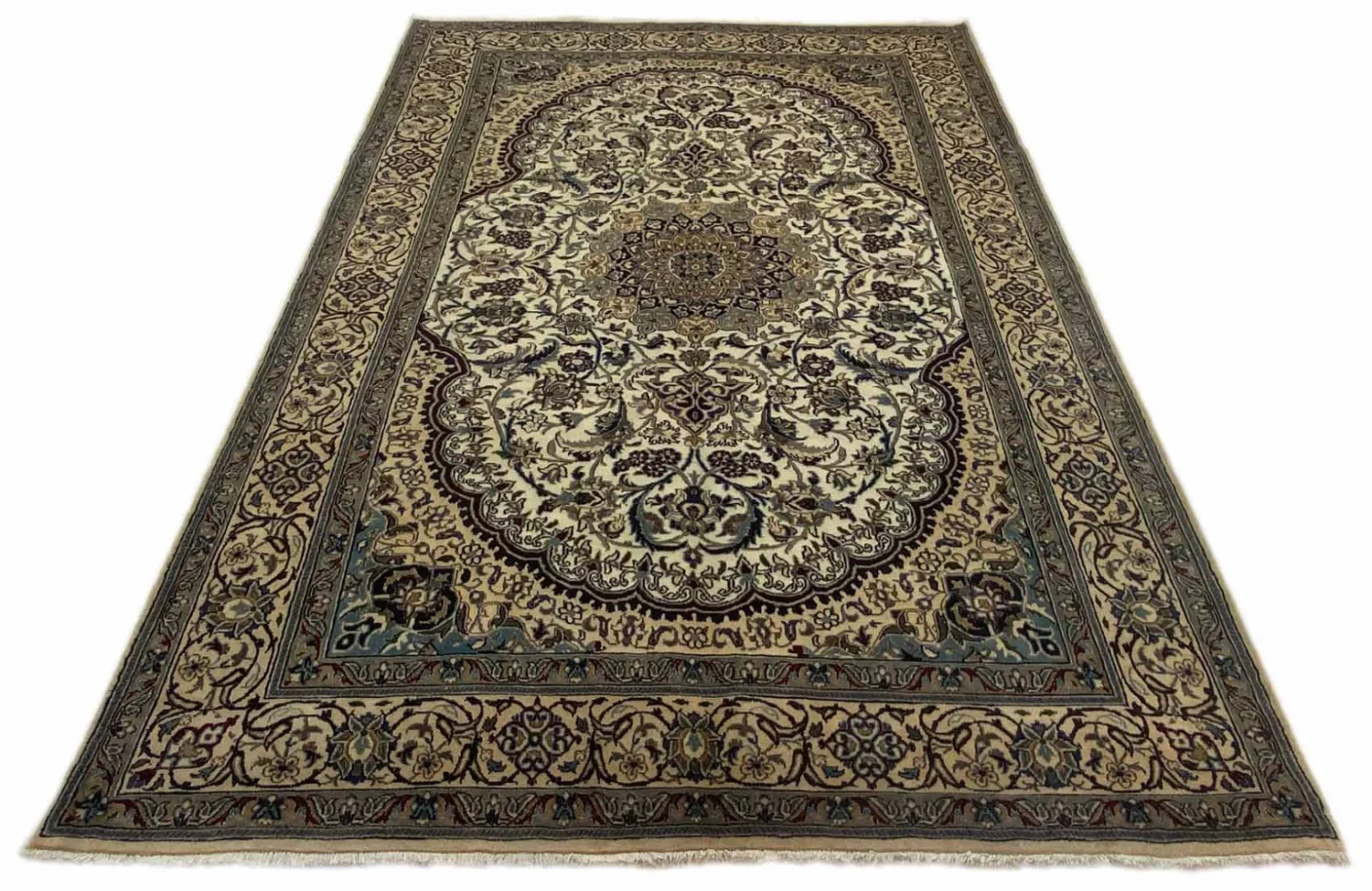
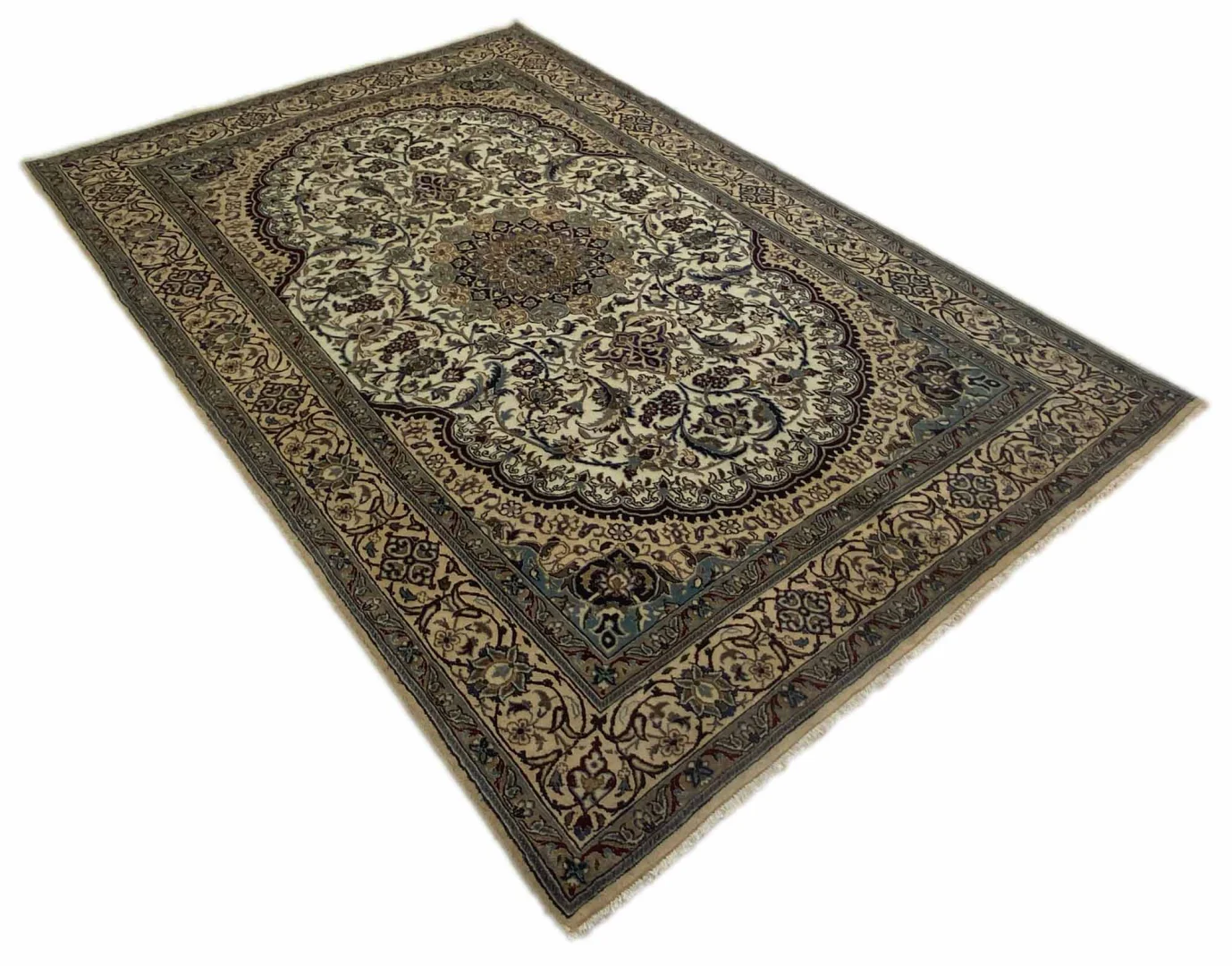
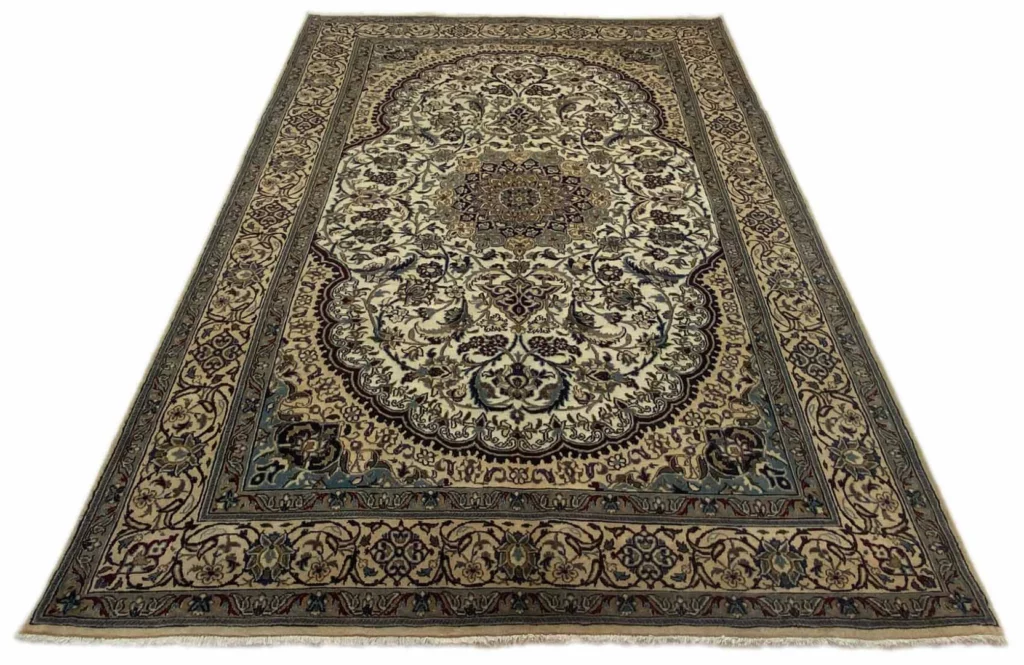
Hand-knotted Nain Persian rug | Knot density: 12-La 200,000 knots/m² | Material: Wool pile with silk accents | Size: 297 x 200 cm | Pattern: Classical floral motifs with medallion | Condition: Very well preserved
This Persian rug from Nain is hand-knotted and has a pile made from high-quality wool with silk accents. The combination of wool and silk is associated with finely made Nain rugs. Wool provides the main textile body of the pile, while silk accents can give selected areas a smoother surface and a distinct play of light. The result is a material character that remains clearly wool-based while incorporating the more finely reflective quality of silk.
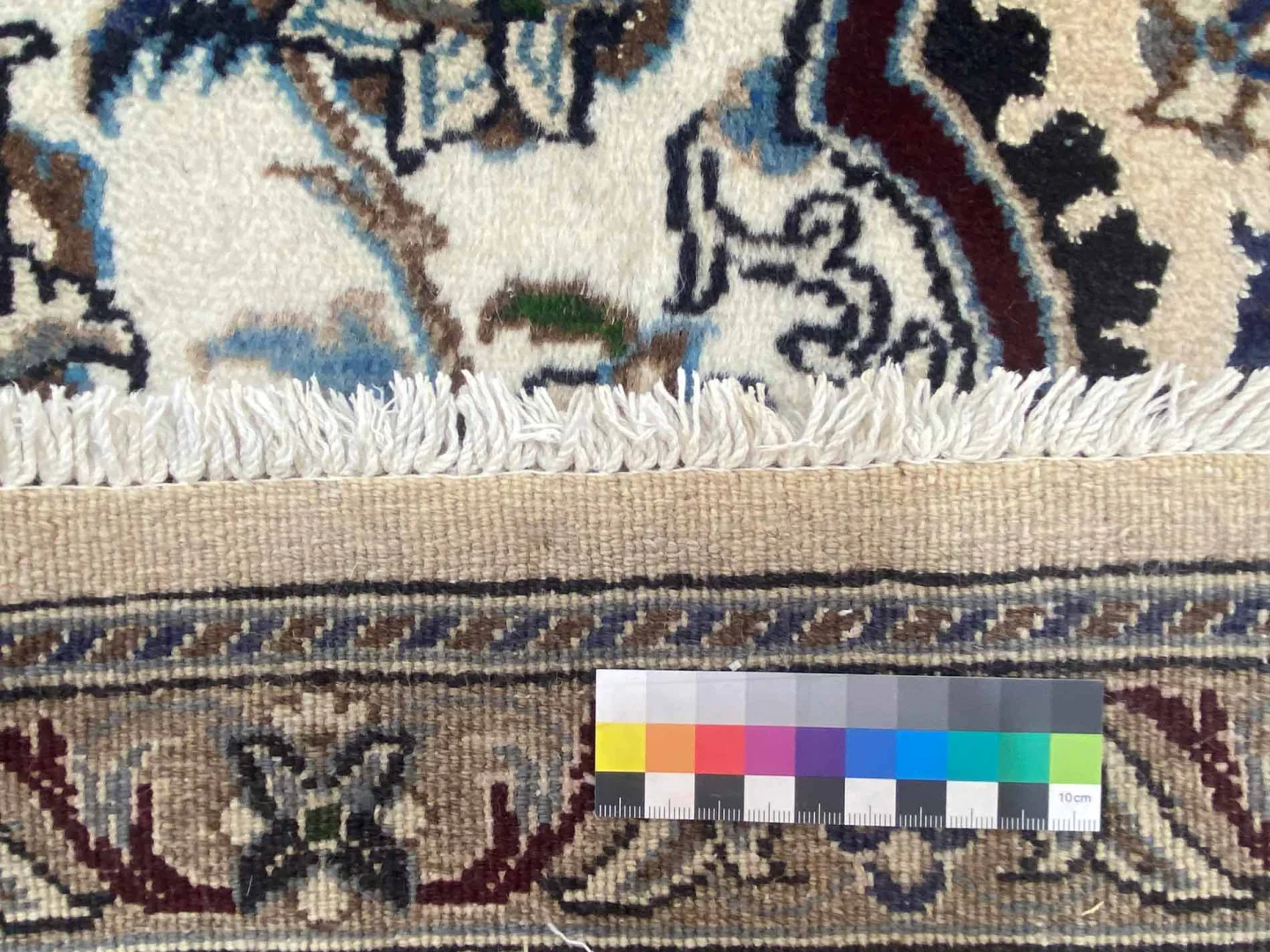
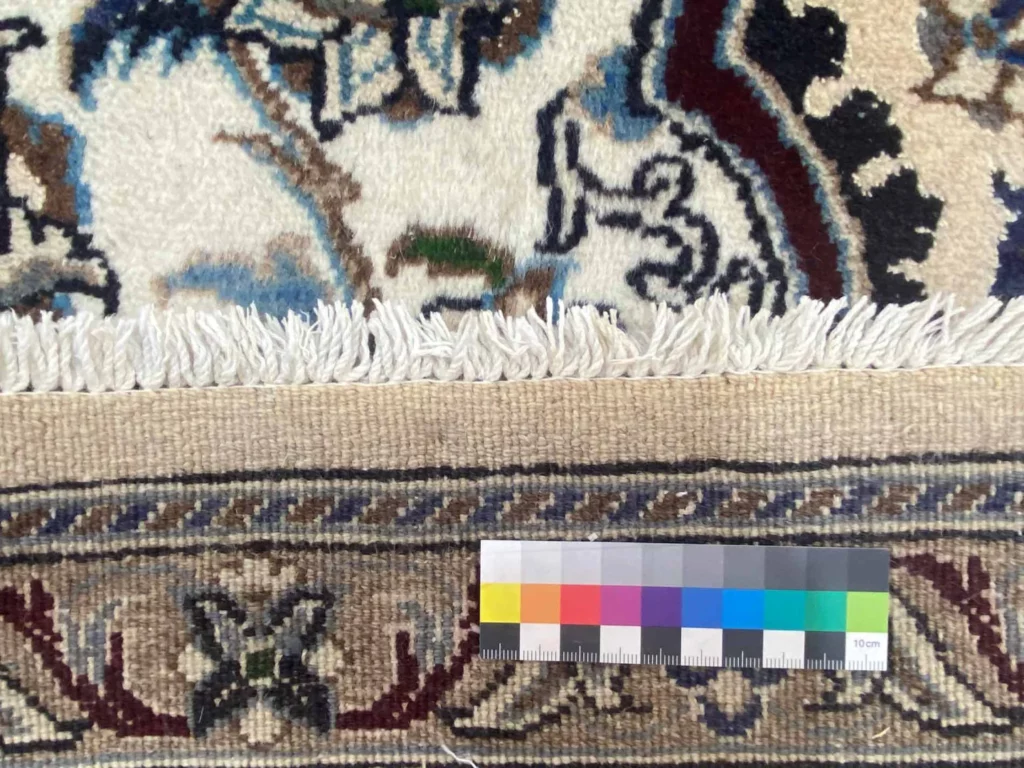
The knot density is given as 12-La and 200,000 knots per square metre. Lah, also written La, is used in descriptions of Nain rugs to indicate a level of fineness and knotting quality. The designation places the density within the terminology of the Nain tradition. A detailed weave allows small floral lines, leaves and medallion contours to be rendered in a controlled way rather than as broad, simplified shapes.
Hand-knotting means that individual knots are tied into the prepared textile structure one by one. Rows are built up gradually until the pile and design form a complete surface. This is a manual process, distinct from the production of a machine-made floor covering. Here, the hand-knotted construction, the stated density, the wool pile and the silk accents describe the rug’s specific workmanship and textile composition.
Origin and Tradition
The rug comes from Nain in Central Persia, a city near Isfahan. Nain is known for a distinctive rug-making tradition associated with pale colour schemes, finely controlled drawing and detailed hand-knotting. The city belongs to a region where Persian weaving knowledge has been passed down through generations. In this context, Nain identifies not only a place but also a regional workshop culture with recognisable approaches to composition, materials and execution.
Nain rugs are often linked with a calm, light overall appearance. Compared with some other Persian weaving traditions, lighter ground and secondary colours are more prominent in Nain designs. This gives the drawing room to remain legible while delicate floral details and narrow lines define the surface. The balance between a restrained colour impression and a finely worked pattern is one of the features commonly associated with Nain.
Its proximity to Isfahan places Nain within an important cultural area of Persian art, but the two origins should not be confused. Isfahan rugs and Nain rugs represent different regional design traditions. Nain is particularly associated with lighter colours and fine floral compositions, while Isfahan rugs often use richer colour relationships and more elaborate drawing. Kashan also has its own Persian rug tradition. This particular rug is a Nain from Central Persia.
The Lah classification is a familiar part of the specialist vocabulary used when discussing the fineness of Nain rugs. It makes different levels of knotting easier to distinguish and connects technical construction with regional terminology. In a finer weave, ornaments can be placed more closely and transitions can be drawn with greater precision. The work nevertheless remains manual, relying on the weaver’s experience, consistent tension and command of the design.
Persian rug making combines practical use with inherited visual language. A rug is made as a functional textile, but it also carries the characteristics of a region and its workshops. In Nain weaving, this relationship appears in the measured placement of medallions, vines and floral forms. Tradition does not consist only of repeating one pattern. It also involves maintaining proportions, materials and techniques while allowing designs to be interpreted across different individual rugs.
Design and Pattern
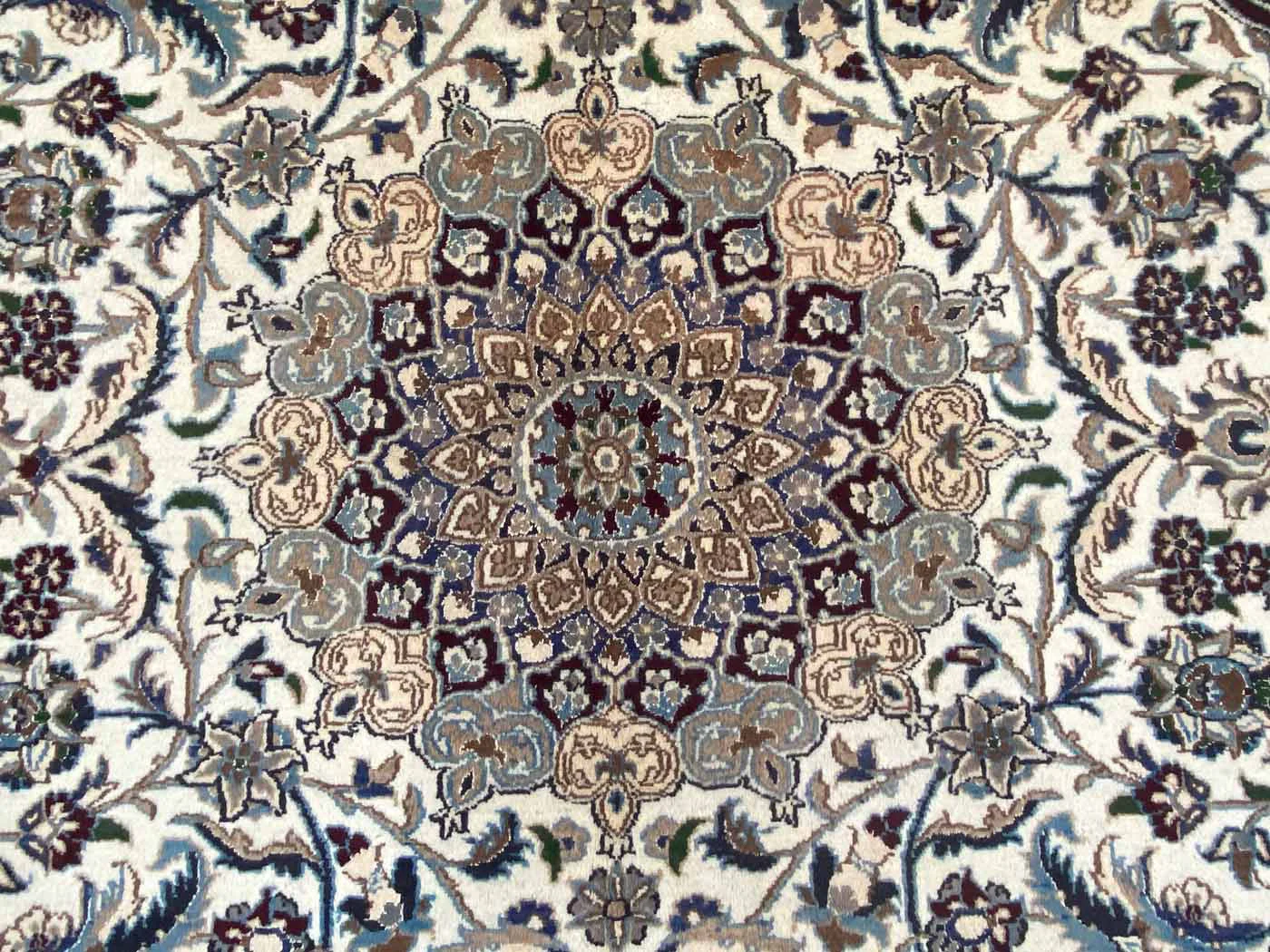
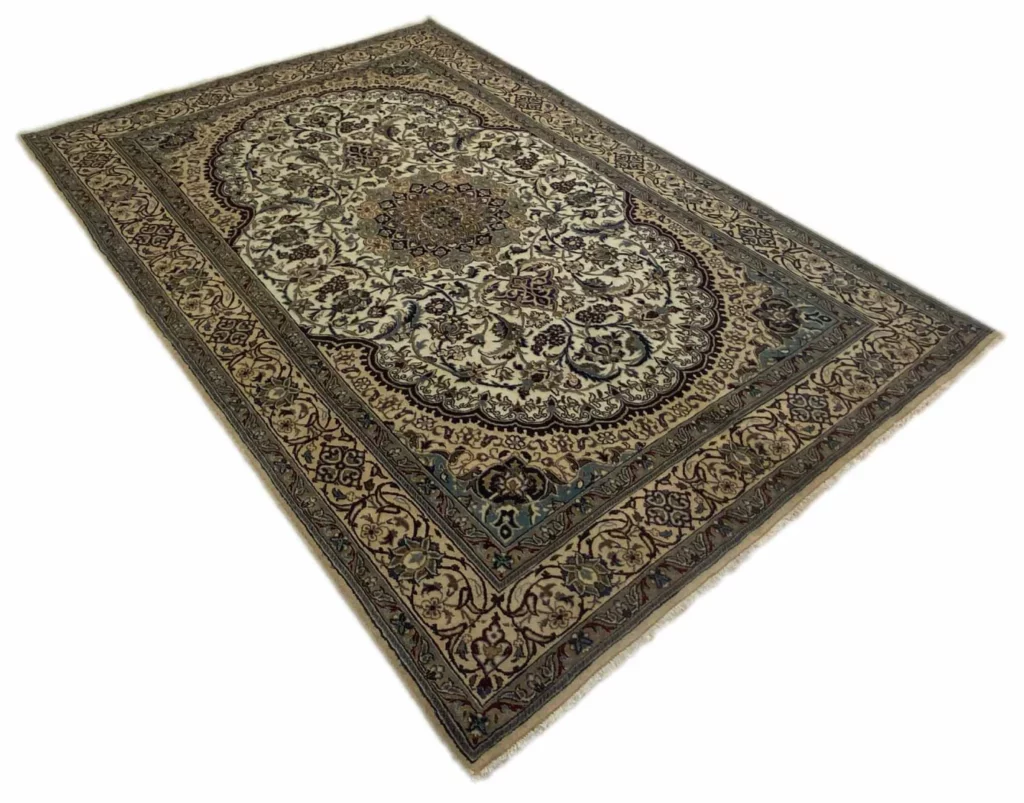
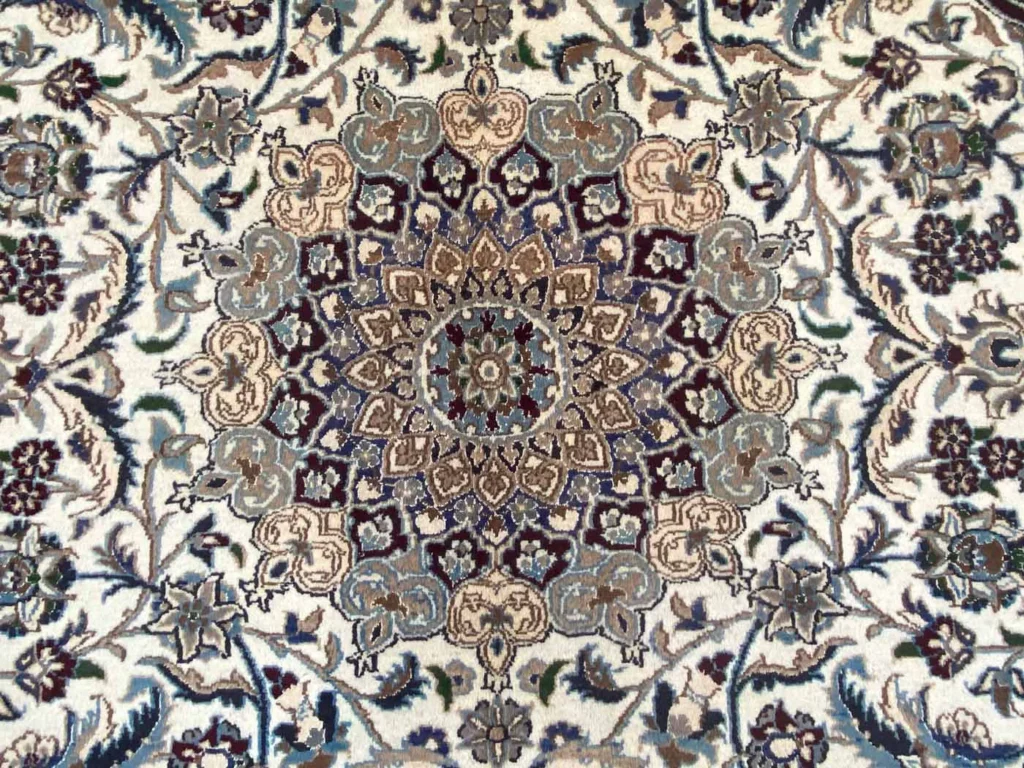
The pattern of this Nain rug is described as classical floral with a medallion. The composition therefore has a central medallion accompanied by floral forms. A medallion creates a visual centre and divides the field into an ordered arrangement. Vines, blossoms and leaves may relate back to this centre and lead the eye towards the surrounding areas. The structure is formal, while the botanical details provide movement across the surface.
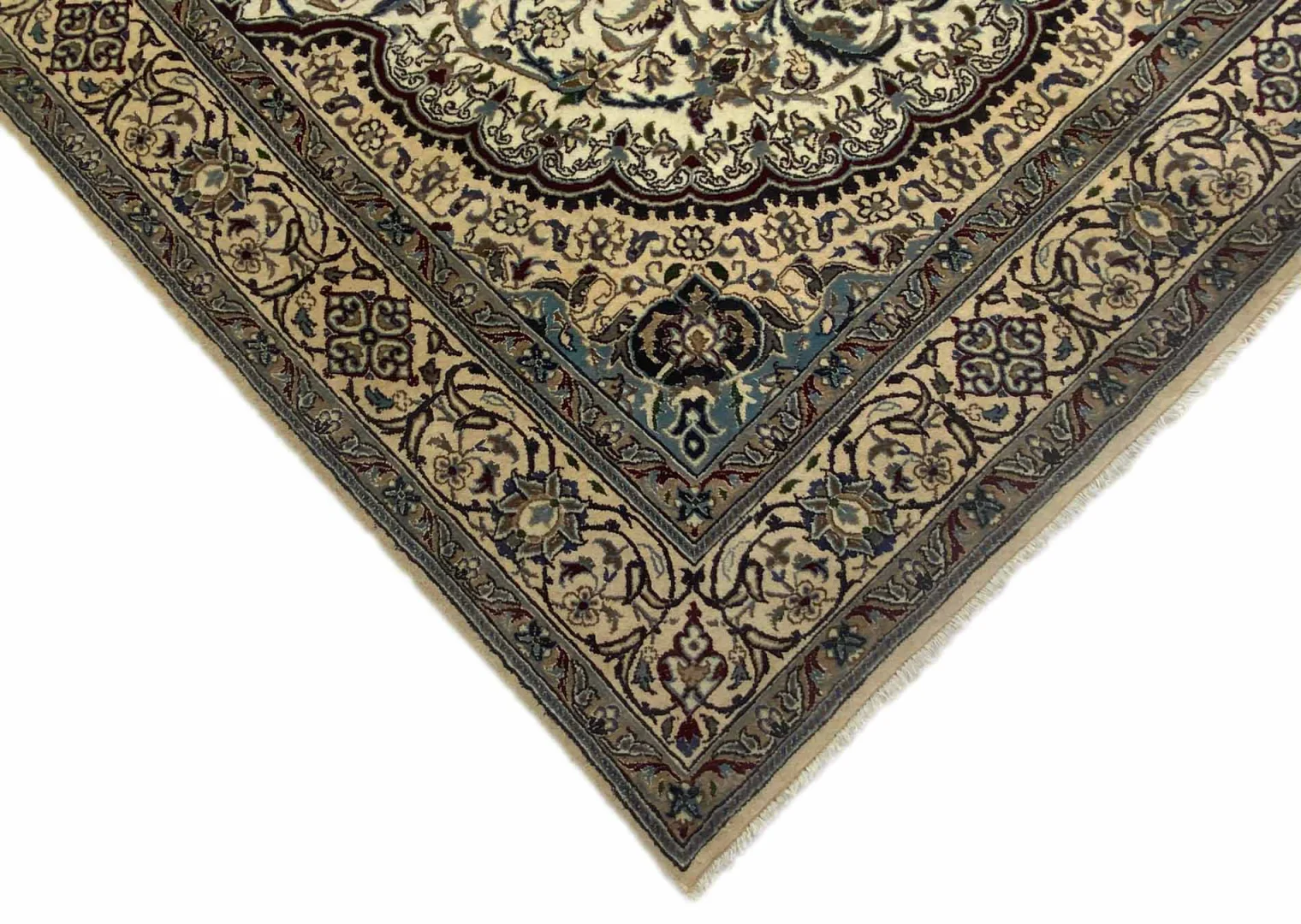
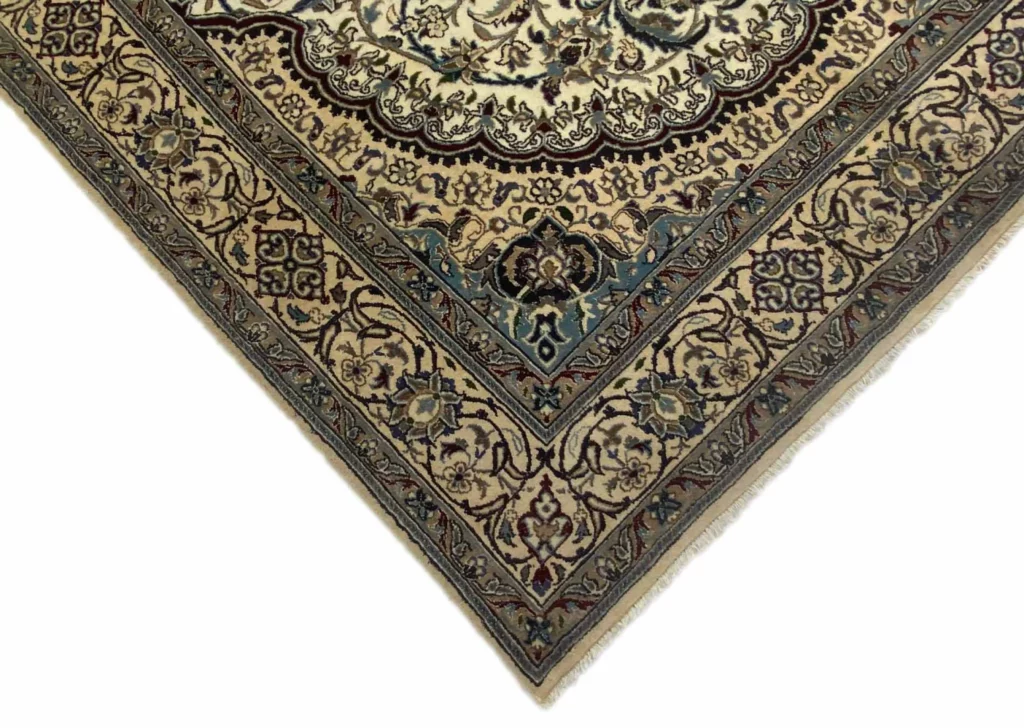
Floral imagery is one of the enduring subjects of Persian rug design. Plant forms may be observed in nature, but in a woven design they are normally stylised, repeated and arranged according to a plan. Vines connect blossoms, leaves occupy the spaces between larger elements and recurring motifs establish rhythm. The clarity of these details is closely related to knot density, since a more finely resolved textile surface can support narrower contours and smaller ornaments.
A classical medallion composition is generally organised around a central form and a surrounding framework. Side elements may echo the central design or connect it to the field through scrolling vines and flowers. The relationship between centre, lateral areas and border is important to the overall balance. Even when individual motifs are small, repetition brings them together into a unified decorative system.
Nain rugs are traditionally recognised for light colours and delicate floral drawing. Pale tones can make fine outlines and ornamental details easy to read, giving the pattern an open appearance. Silk accents can introduce subtle differences in surface and reflection within this type of composition. They do not change the wool-based character of the pile; instead, they distinguish selected details or pattern areas through their finer texture.
The design therefore brings together several levels of organisation: the central focus of the medallion, the movement of floral motifs, the precision made possible by fine knotting and the light visual language associated with Nain. Geometric order and botanical forms work together rather than competing. The medallion and repeated divisions provide structure, while blossoms, vines and leaves animate the field. This balance is a characteristic feature of the classical Nain aesthetic.
Special Features
The specific features of this one-off rug are its origin in Nain, Central Persia, its hand-knotted construction, its stated 12-La quality with 200,000 knots per square metre, and its pile of high-quality wool with silk accents. The design contains classical floral motifs with a medallion. The rug is very well preserved. These details identify the material, workmanship, pattern and condition of this particular piece.
The 12-La designation places the rug within the established terminology of Nain weaving, while the stated knot density gives a precise technical description of its construction. Together with the medallion and floral motifs, it presents a direct connection between regional origin and classical design. The wool pile and silk accents add a differentiated textile surface to the finely drawn composition.
FAQ
How should I care for my Nain rug?
Vacuum the rug regularly to remove dust and loose dirt from the pile. If a spill occurs, treat it promptly with a damp cloth and a mild cleaning product. Avoid vigorous rubbing, as this can affect the fibres and the finely drawn pattern areas. Direct sunlight should also be avoided because prolonged exposure can cause colours to fade. For a complete cleaning, specialist rug care is the appropriate choice.
Where do the materials for Nain rugs come from?
The materials used for Nain rugs come predominantly from the Persian region. They include wool from sheep raised in highland areas and high-quality silk produced in the region. Wool is valued for its durable textile qualities, while silk is used for its fine surface and characteristic lustre. In this rug, the pile is made from high-quality wool and incorporates silk accents.
What is the main difference between Nain and Isfahan rugs?
Nain rugs are typically distinguished by lighter colours and floral patterns. Isfahan rugs often present richer colours and more complex designs. Isfahan rugs are generally somewhat thicker and heavier, whereas Nain rugs are known for their fineness. These are differences between the regional traditions; this particular rug is a Nain by origin and has a classical floral medallion design.
To provide the best experiences, we use technologies like cookies to store and/or access device information. Consenting to these technologies will allow us to process data such as browsing behavior or unique IDs on this site. Not consenting or withdrawing consent, may adversely affect certain features and functions.
Functional Always active
The technical storage or access is strictly necessary for the legitimate purpose of enabling the use of a specific service explicitly requested by the subscriber or user, or for the sole purpose of carrying out the transmission of a communication over an electronic communications network.
Preferences
The technical storage or access is necessary for the legitimate purpose of storing preferences that are not requested by the subscriber or user.
Statistics
The technical storage or access that is used exclusively for statistical purposes.The technical storage or access that is used exclusively for anonymous statistical purposes. Without a subpoena, voluntary compliance on the part of your Internet Service Provider, or additional records from a third party, information stored or retrieved for this purpose alone cannot usually be used to identify you.
Marketing
The technical storage or access is required to create user profiles to send advertising, or to track the user on a website or across several websites for similar marketing purposes.

 SECURE PAYMENT
 SHIPPING PARTNERS


