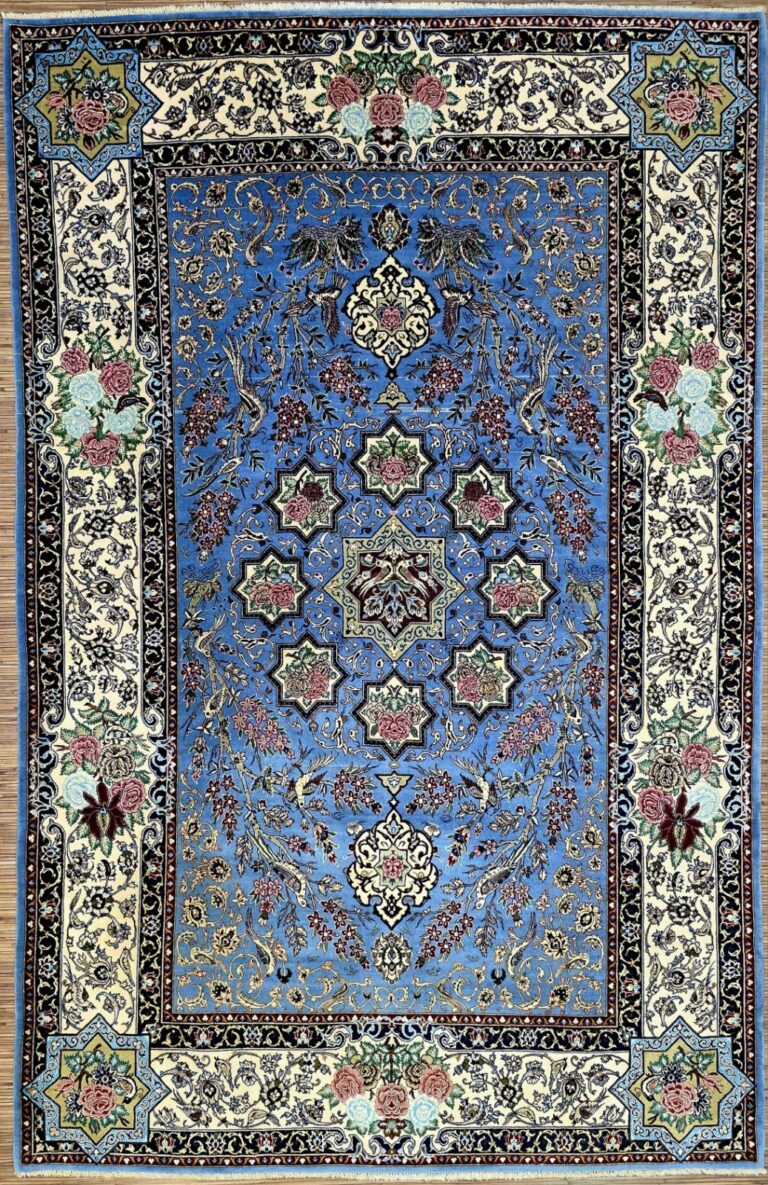
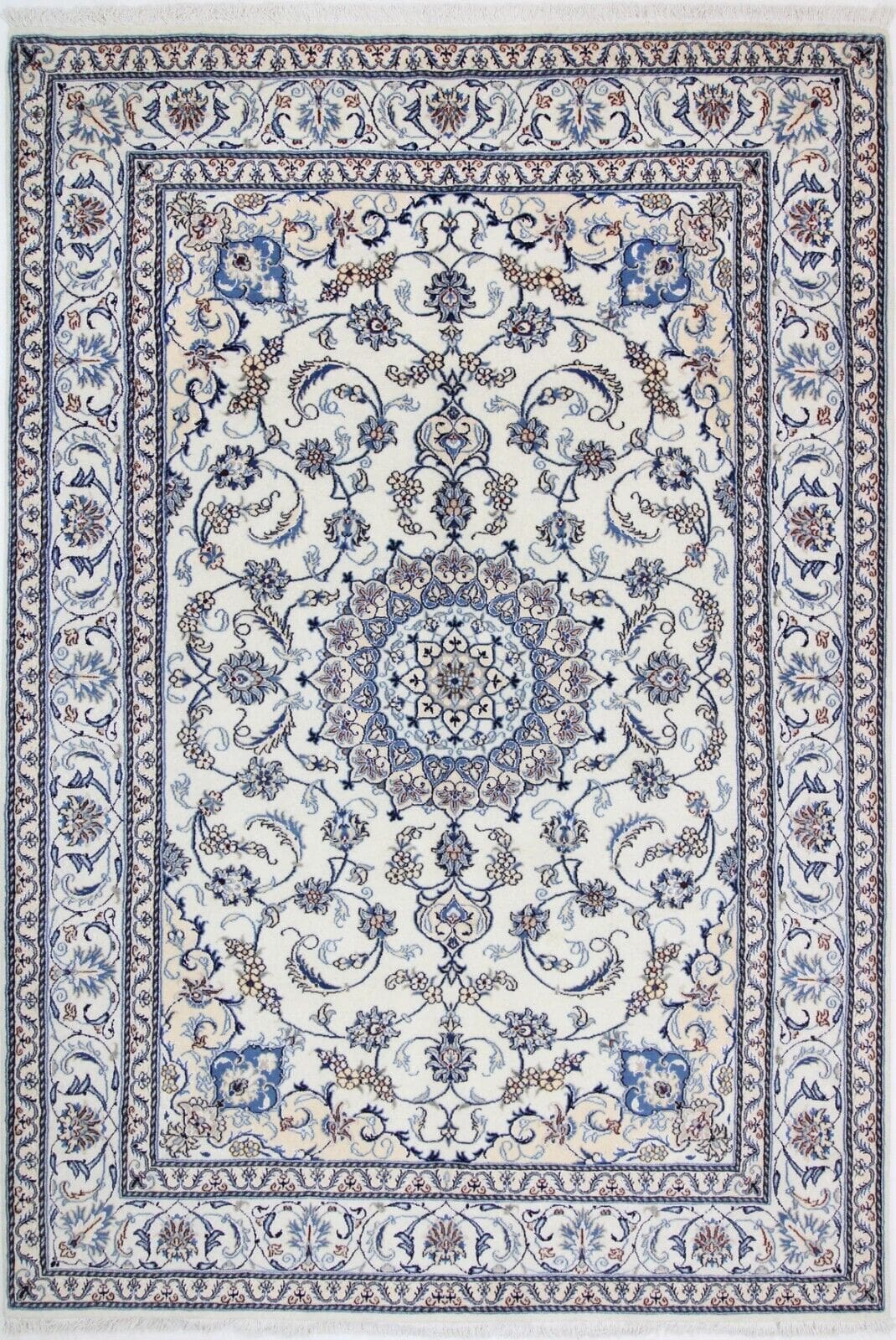
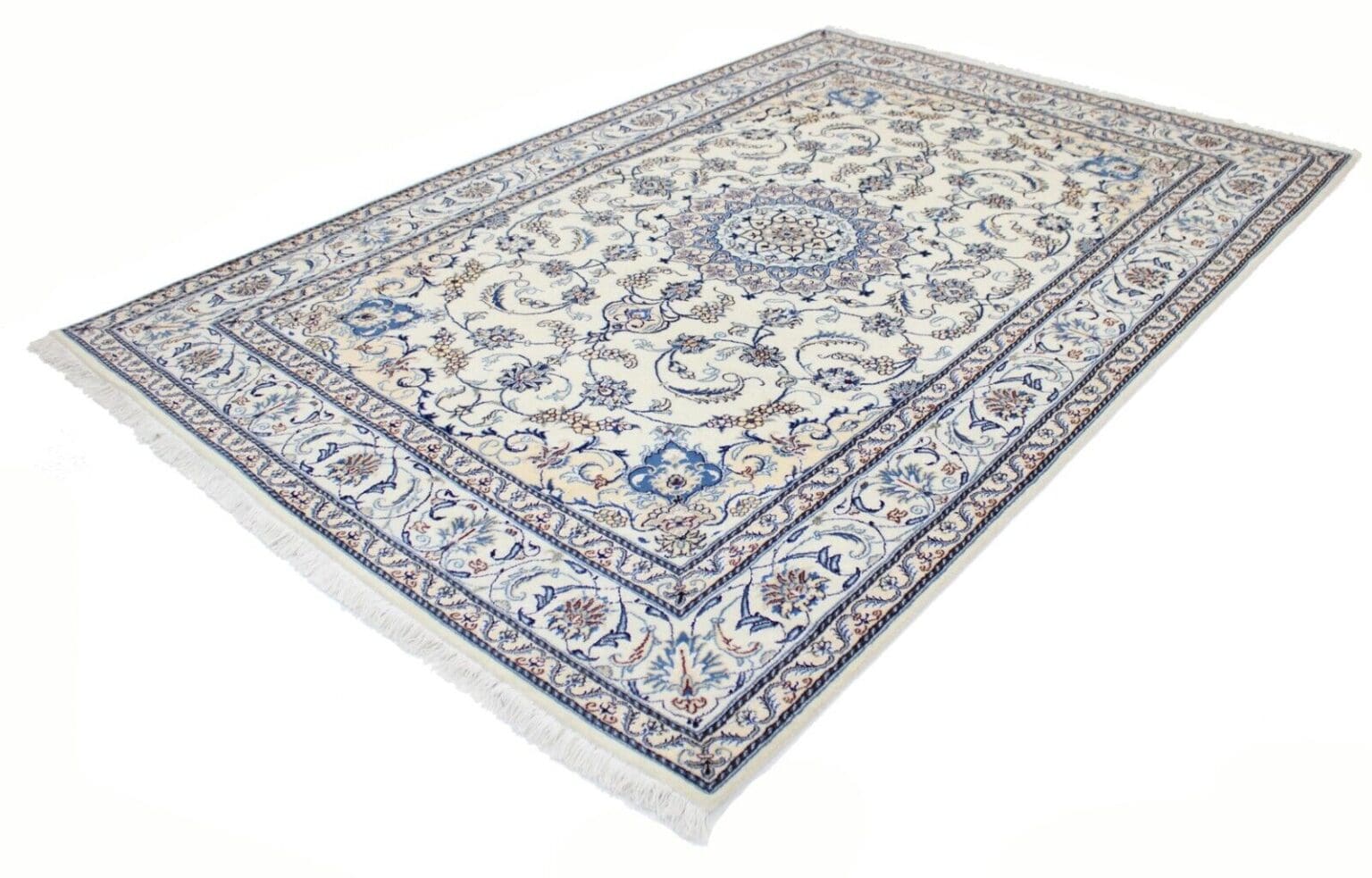
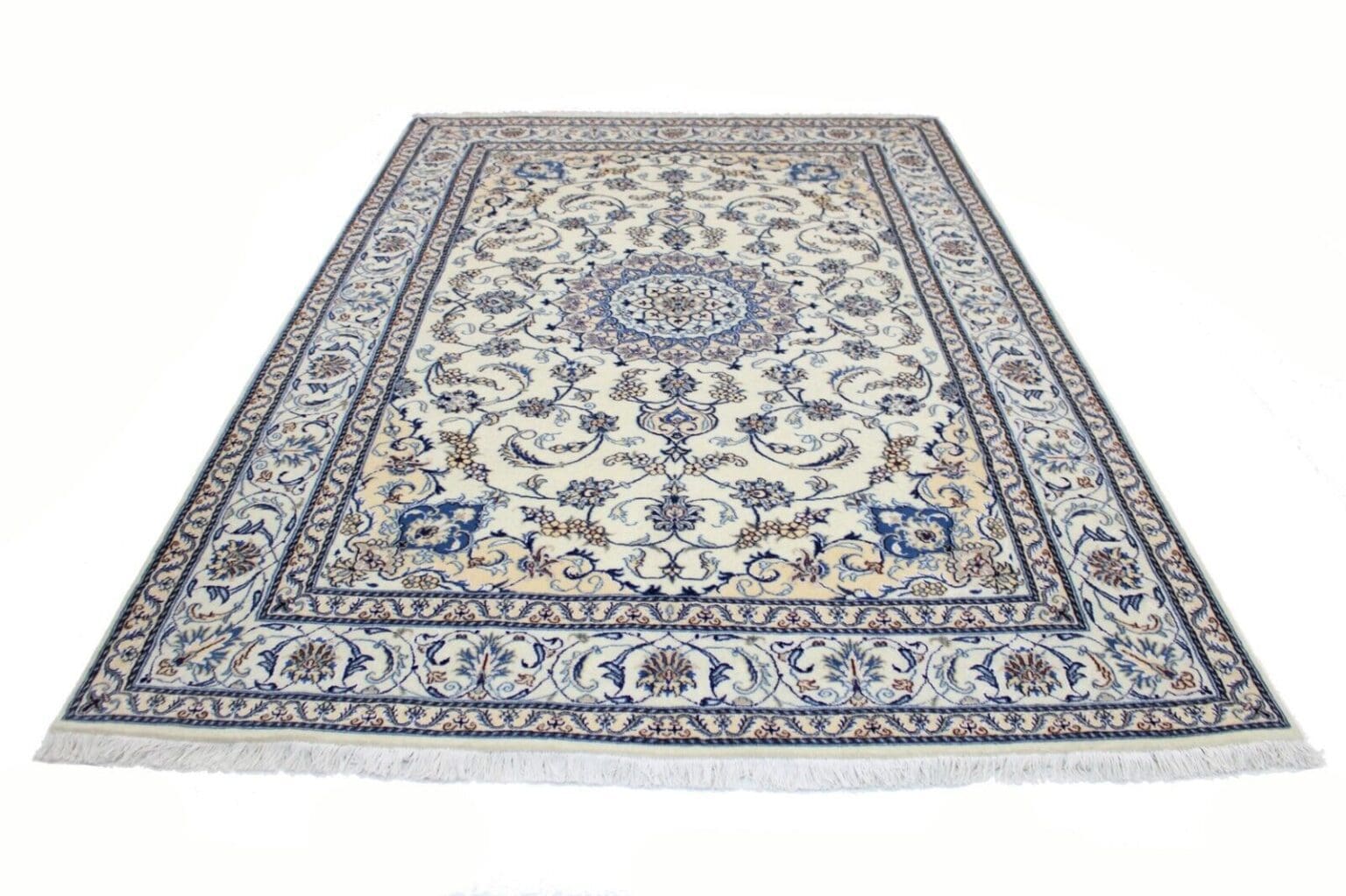
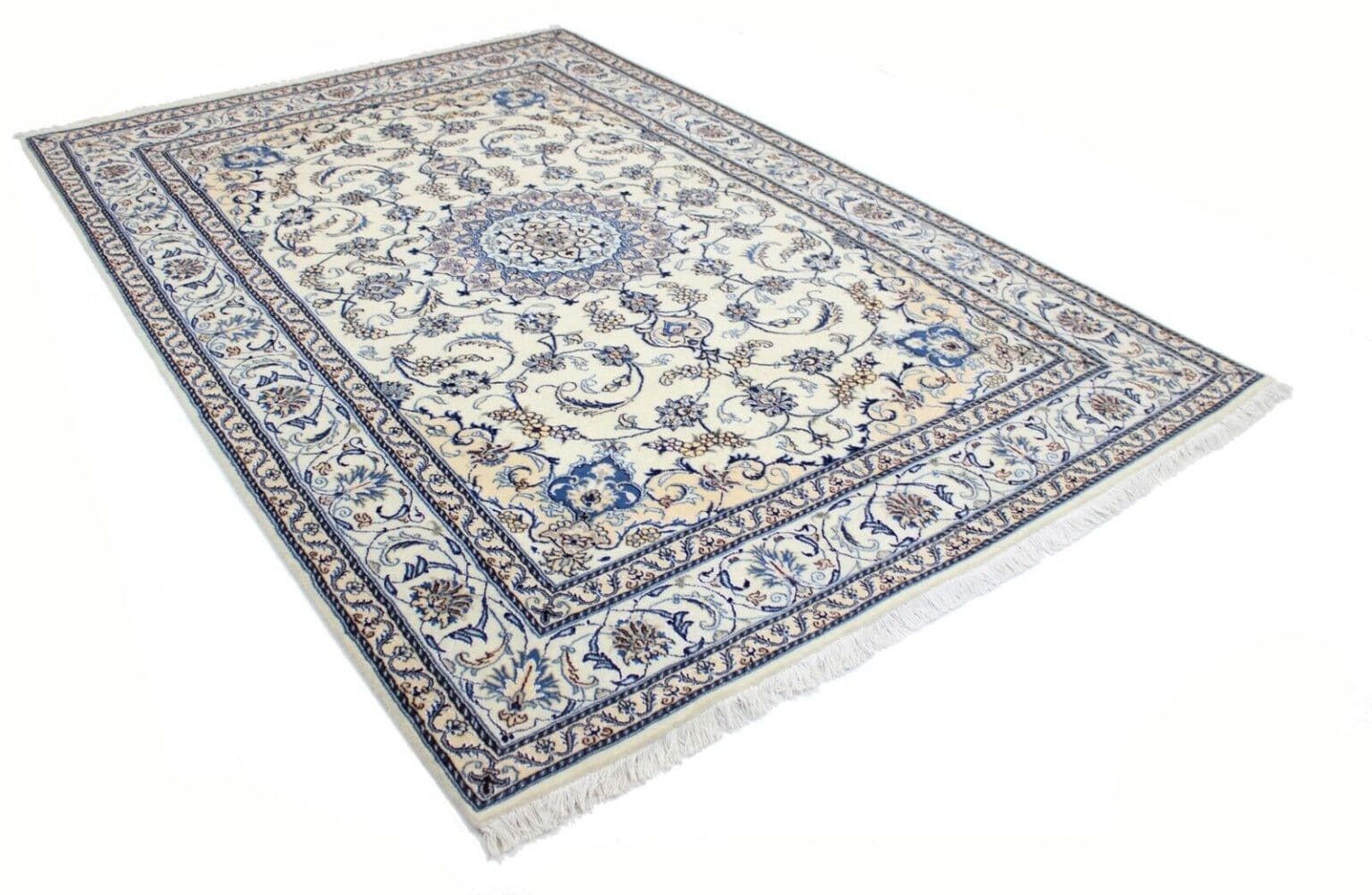
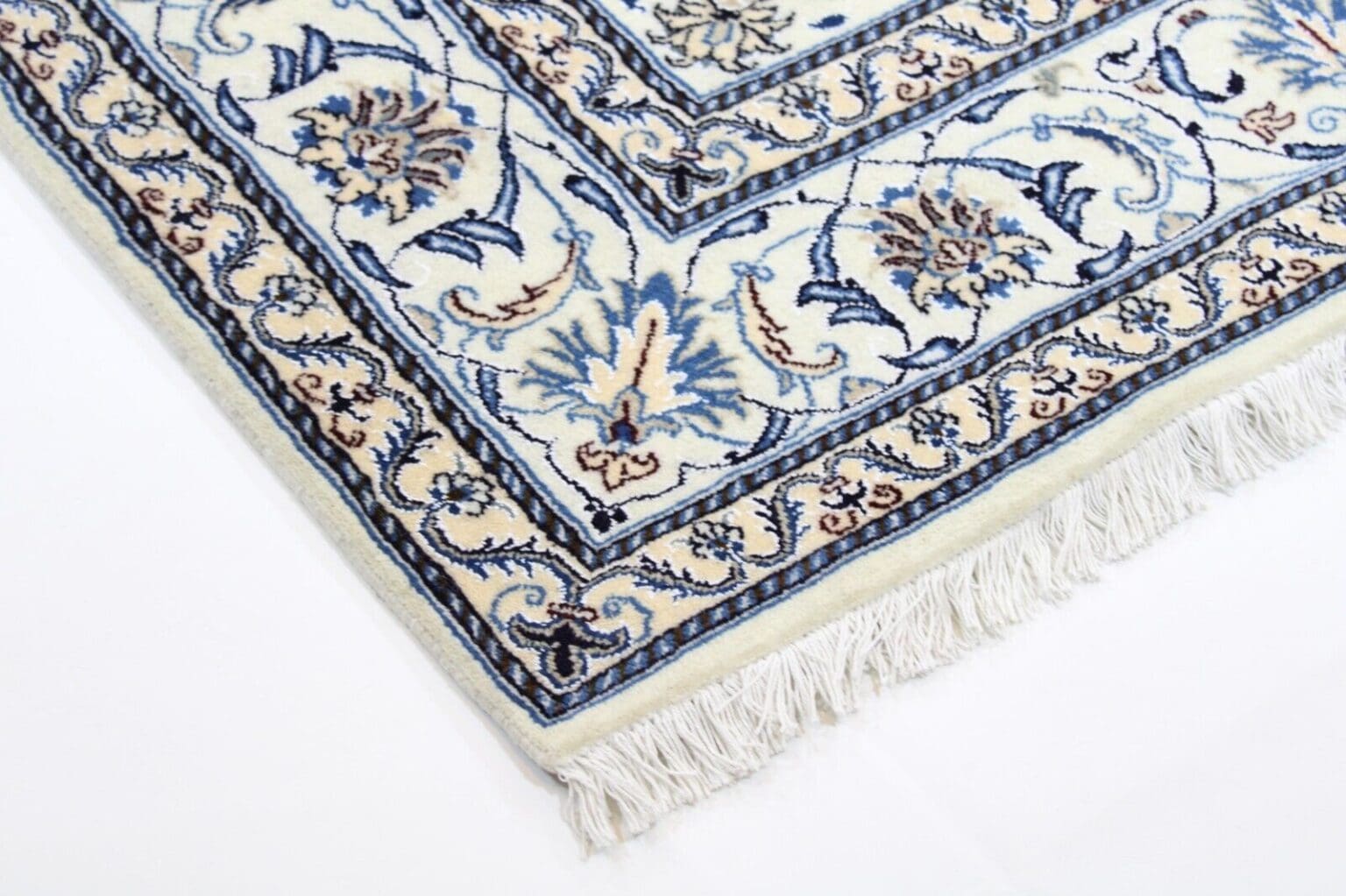
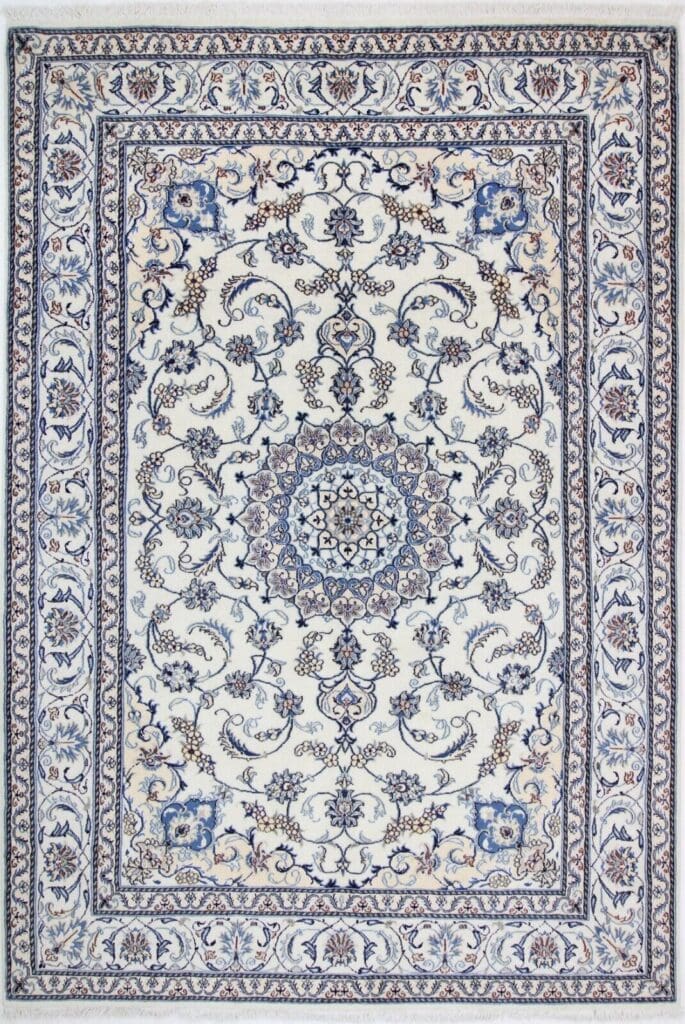
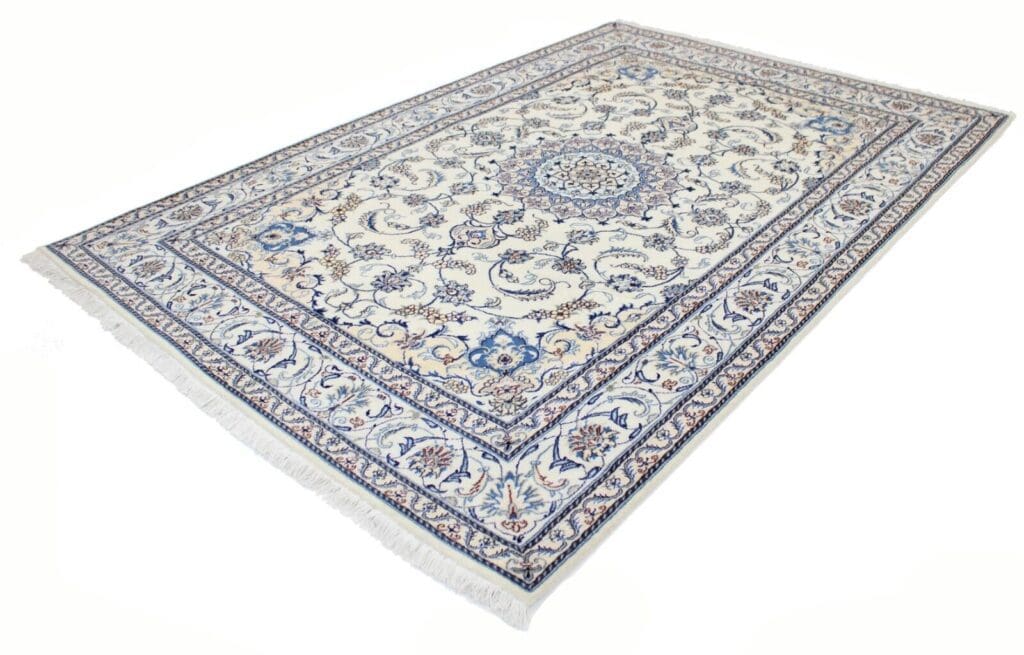
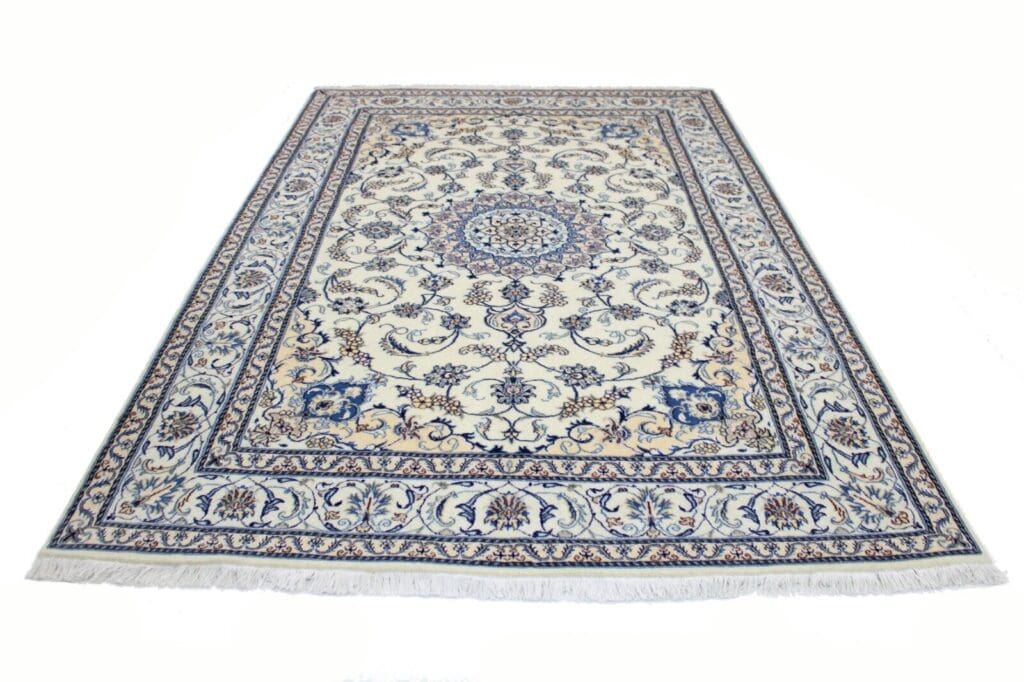
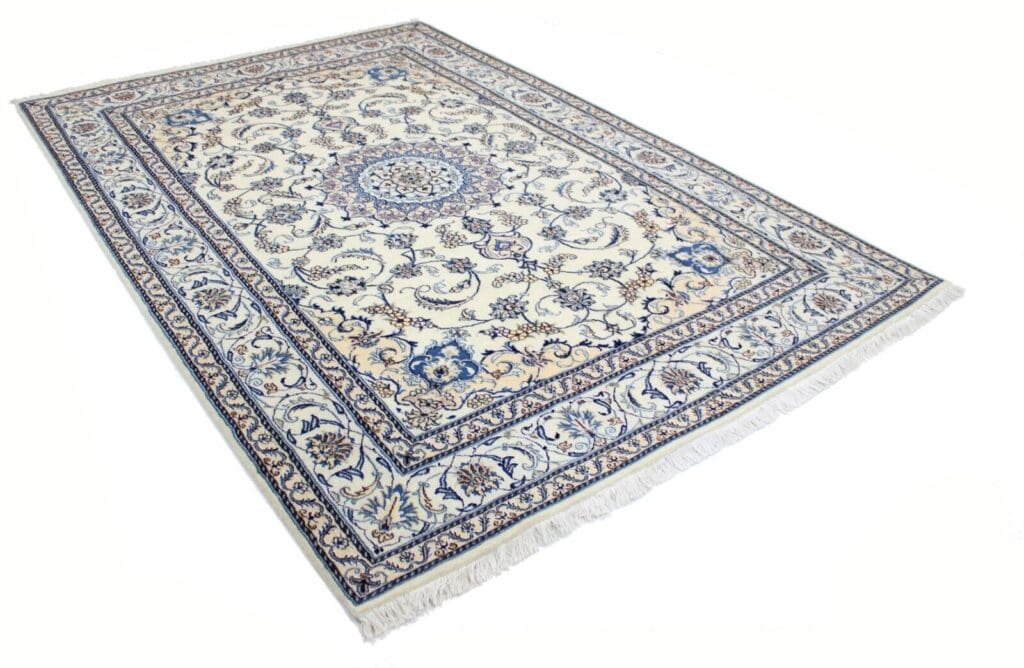
Hand-knotted Nain Persian rug | Knot density: Hand-knotted | Material: Wool and cotton | Size: 297 x 200 cm | Pattern: Oriental with floral motifs | Condition: New without tag, top condition
This Nain Persian rug is hand-knotted and made from high-quality wool and cotton. Both materials are expressly named for this piece. In traditional rug making, wool is valued as a practical fibre for a tactile pile, while cotton is also widely used as a stable textile material in the construction of hand-made rugs. The material description here states wool and cotton without assigning a separate percentage or specifying a particular structural position for either fibre.
Hand-knotting builds the surface through individual knots rather than through a printed design or a continuous machine-made process. A prepared foundation is worked row by row, with the design developing as the knots are placed and compacted. The pile is then treated so that the surface has an even textile character. This method requires sustained manual attention because the pattern is created through many separate operations rather than applied in a single step.
The rug is described as high-pile. A higher pile creates a clearly tactile surface and affects the way the rug feels underfoot and receives light. Wool can provide a resilient and softly textured pile when handled appropriately. Routine care should therefore be gentle: loose dust can be removed with careful vacuuming, while harsh brushing and unnecessary friction should be avoided. The hand-knotted technique and high pile are the specific construction features stated for this rug.
Its condition is listed as new without a tag and in top condition. This identifies the condition in which the rug is offered; it does not establish a production date or an age. The separate details remain distinct: the rug is hand-knotted, contains wool and cotton, and has a high pile. No additional claim about a workshop, maker or historical use is added to those facts.
Origin and Tradition
The rug comes from Iran and is identified as a Nain Persian rug. Nain is one of the recognised carpet-making centres of Iran and has a distinct regional weaving tradition. The town is located in central Iran, an area where textile skills have been maintained through generations. Nain rugs are commonly associated with orderly compositions, carefully controlled drawing and a restrained visual balance. Those are features of the regional tradition and do not replace the specific description of this individual rug.
The Nain tradition belongs to the wider history of Persian carpet making. In Iranian workshops, the planned design, the distribution of colour and the knotting process are closely connected. A pattern is prepared and then translated into textile form step by step. Weavers work from established layouts or design models, arranging the field, borders and smaller ornaments so that the completed surface has a coherent structure. Hand-knotting turns that plan into a fabric through repeated manual actions.
Iranian carpet regions are distinguished by their preferred proportions, ornament, colours and working practices. Nain should not be confused with Isfahan, Tabriz or Kashan, even though all of these places form part of the broader history of Persian weaving. Nain is often recognised for a composed, finely organised visual language in which floral drawing can be integrated into a balanced field. This regional context explains the name Nain; it does not imply that every rug from the area has an identical design or material specification.
Knowledge of Persian rug making has traditionally been passed on through practical instruction. Such knowledge includes preparing fibres, arranging the foundation, selecting colours, following a design and keeping rows consistent during knotting. The process demands patience and close attention to proportion. A hand-knotted rug is consequently both a textile and the result of a sequence of manual decisions. Its regional identity is connected to the design tradition and the place of production, while its actual materials and condition must be read from the individual description.
Because Iran is named as the origin, this rug is correctly described as a Persian rug. The term refers to Iranian provenance and Persian weaving tradition, not merely to the appearance of the pattern. Floral oriental motifs can occur in rugs from many countries, but the origin stated for this piece is Iran and its regional designation is Nain. No claim is made here about a particular Iranian workshop, a signature or a precise date of manufacture.
Design and Pattern
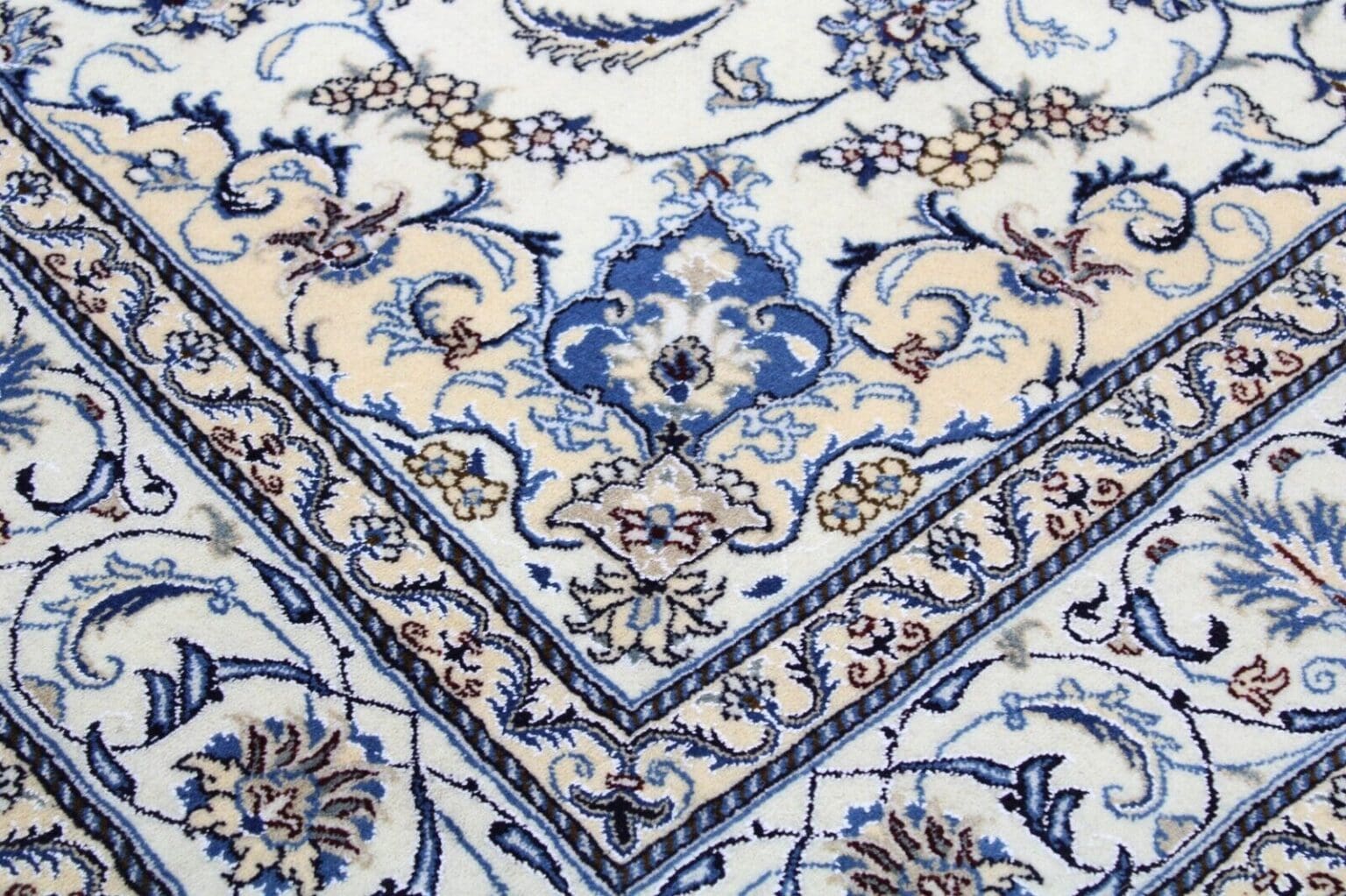
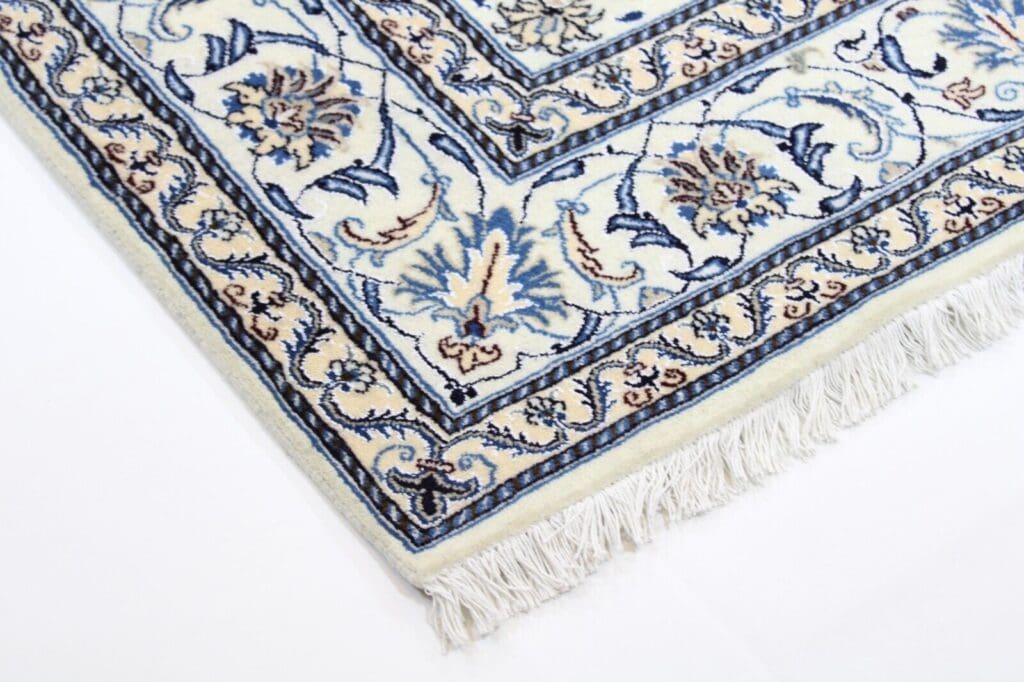
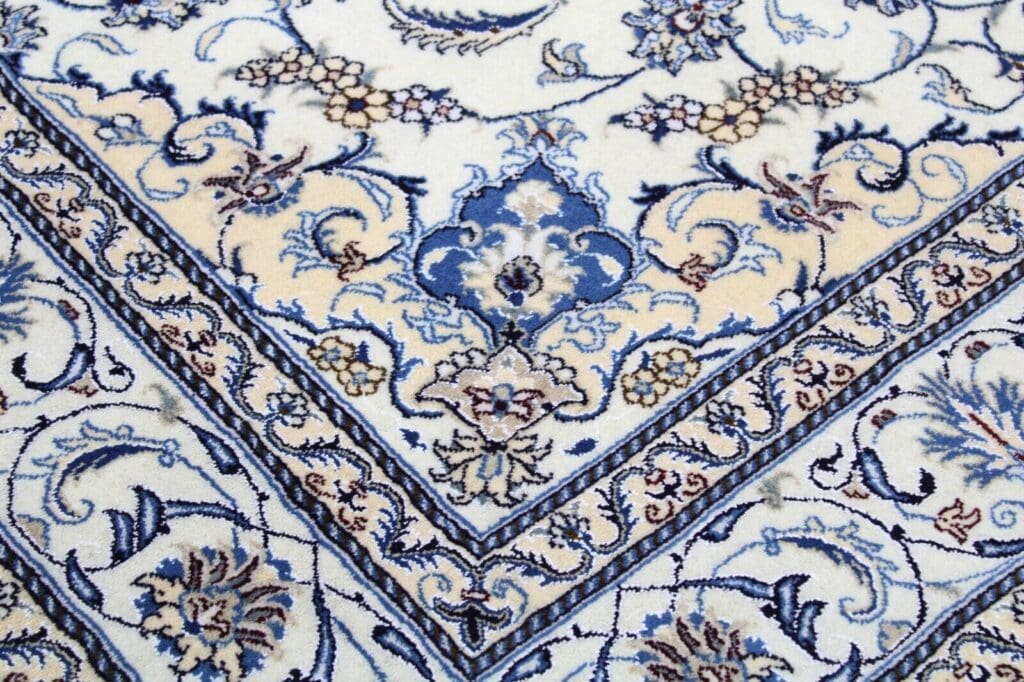
The pattern is described as oriental with floral motifs. Floral ornament is a long-standing element of Persian carpet design. Flowers, leaves, stems and vines may be simplified into repeatable forms that work within a woven or knotted surface. They are not necessarily botanical illustrations; instead, natural shapes are converted into a visual vocabulary of lines, curves and repeated details. This allows the pattern to remain legible while being built knot by knot.
A floral composition gains its structure from the relationship between main forms, secondary details and the areas around them. Borders may frame a field, while smaller leaves or blossoms can connect separate parts of the drawing. The description of this rug does not specify a medallion, a particular border arrangement or any named floral pattern. Those elements are therefore not added as facts. The established description is limited to oriental floral motifs and the stated beige colour.
Nain designs are often discussed in connection with disciplined organisation and fine visual articulation. Floral forms may be repeated symmetrically or arranged along controlled axes, making it easier to maintain a balanced composition during the knotting process. Individual hand work can still create subtle variations between sections. The underlying principle is a measured relationship between repetition, spacing and ornament rather than an exact claim about a detail not identified for this rug.
Beige is the stated colour. In a floral design, beige can serve as a quiet ground or supporting tone against which outlines and plant forms are read. One colour entry does not establish a complete palette, so no other colours are assigned to the rug. Similarly, the description does not state that it has a central medallion, a specific border, or geometric companion motifs. The confirmed visual information is the beige colour together with an oriental design featuring flowers.
Traditional Persian motifs are more than surface decoration. Their forms have been preserved, adapted and repeated in weaving communities over many generations. A floral ornament may suggest an ordered representation of nature, but it would be inaccurate to impose one fixed symbolic meaning on every flower or vine. For this rug, the design can be described precisely through its Nain designation, its oriental floral character and its beige colour, without extending the description beyond the supplied facts.
Special Features
The stated special features are its hand-knotted construction, high pile, wool and cotton materials, and beige colour. The condition is given as new without a tag and top condition. This condition statement describes the offered piece and is not accompanied by an age, date of manufacture or provenance history. No signature or workshop attribution is included.
The rug is suitable for use with underfloor heating. Heat should be distributed evenly, and the textile surface should still be cared for in a way appropriate to a high-pile hand-knotted rug. Gentle vacuuming can remove loose dust. For more extensive cleaning, professional treatment is appropriate so that the wool, cotton, colours and pile are handled with care.
As an Iranian Nain Persian rug, this piece brings together a named regional origin and a traditional hand-knotted method. Its confirmed features are Iran as the country of origin, Nain as the regional designation, wool and cotton as materials, a high pile, a beige colour, oriental floral motifs, suitability for underfloor heating and the stated new condition without a tag. These details define the rug without requiring unsupported claims about its age or workshop.
FAQ
What characterises a Nain Persian rug?
A Nain Persian rug is a rug from Iran associated with the regional tradition of Nain. The name points to origin and weaving culture rather than automatically specifying an age, knot density, colour range or material composition. Nain designs are often discussed as orderly and finely organised, with floral ornament appearing frequently in the broader tradition, but individual rugs can differ. For this piece, the confirmed details are hand-knotting, wool and cotton, a high pile, a beige colour and an oriental floral pattern. Its condition is described as new without a tag and in top condition.
How should a hand-knotted wool rug be cared for?
Loose dust should be removed regularly with careful vacuuming, using a setting that does not pull aggressively at the pile. A high-pile surface should not be scrubbed with hard brushes or exposed to unnecessary friction. If liquid is spilled, it should be absorbed promptly rather than rubbed deep into the fibres. Professional cleaning is advisable when a thorough wash is needed, since wool, cotton, colour and hand-knotted construction all require suitable treatment. The rug may be used over underfloor heating, but it should remain dry and should not be subjected to concentrated, repeated pressure.
Where does this Persian rug come from?
This Persian rug comes from Iran and is identified as a Nain rug. Nain is an established centre of Iranian carpet making with its own regional design tradition. It should not be relabelled as an Isfahan, Tabriz or Kashan rug simply because those places also belong to Persian carpet history. The specific origin stated here is Iran, with Nain as the regional designation. No information is provided about an individual workshop, weaver, signature, previous owner or year of manufacture, so none of those details can be assigned to this piece.
To provide the best experiences, we use technologies like cookies to store and/or access device information. Consenting to these technologies will allow us to process data such as browsing behavior or unique IDs on this site. Not consenting or withdrawing consent, may adversely affect certain features and functions.
Functional Always active
The technical storage or access is strictly necessary for the legitimate purpose of enabling the use of a specific service explicitly requested by the subscriber or user, or for the sole purpose of carrying out the transmission of a communication over an electronic communications network.
Preferences
The technical storage or access is necessary for the legitimate purpose of storing preferences that are not requested by the subscriber or user.
Statistics
The technical storage or access that is used exclusively for statistical purposes.The technical storage or access that is used exclusively for anonymous statistical purposes. Without a subpoena, voluntary compliance on the part of your Internet Service Provider, or additional records from a third party, information stored or retrieved for this purpose alone cannot usually be used to identify you.
Marketing
The technical storage or access is required to create user profiles to send advertising, or to track the user on a website or across several websites for similar marketing purposes.
 SECURE PAYMENT
 SHIPPING PARTNERS