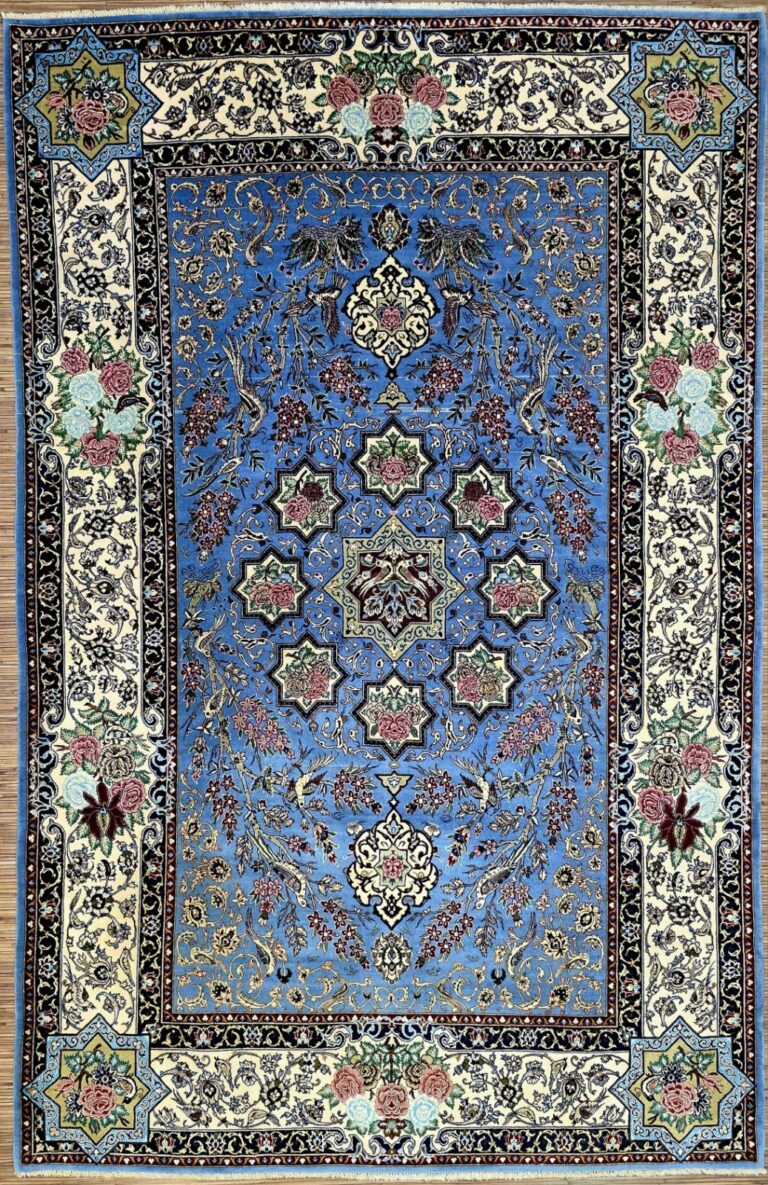
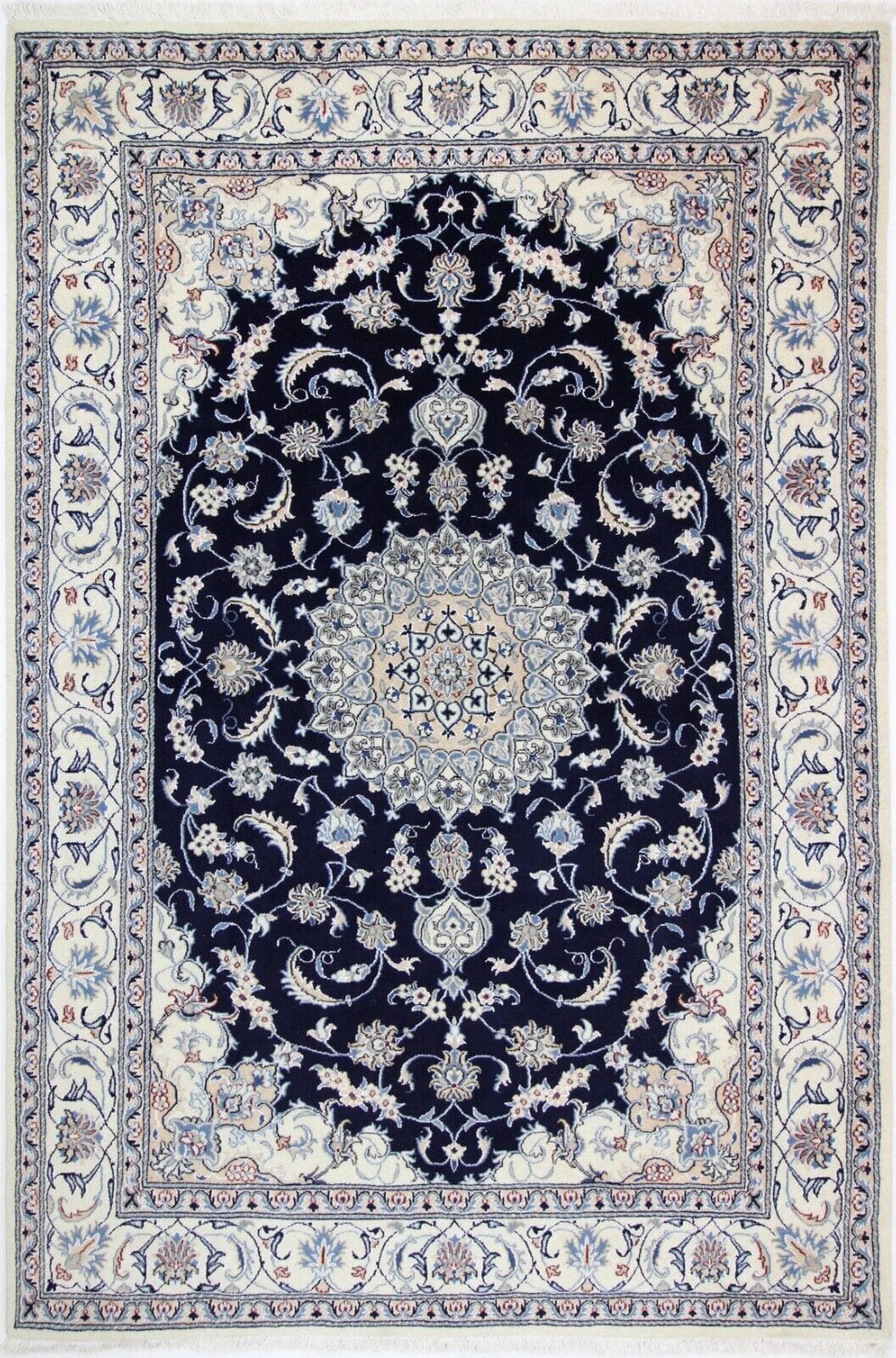
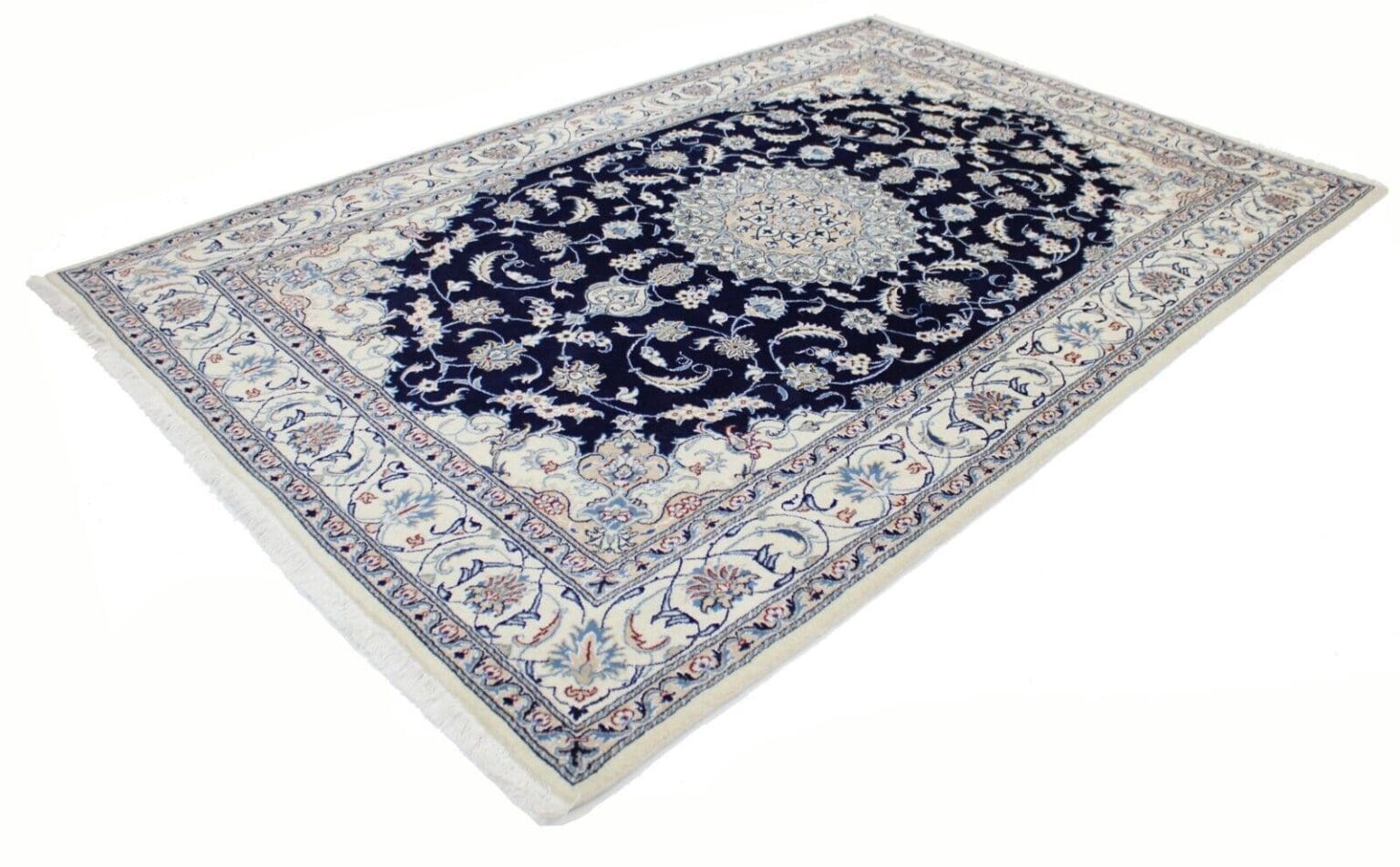
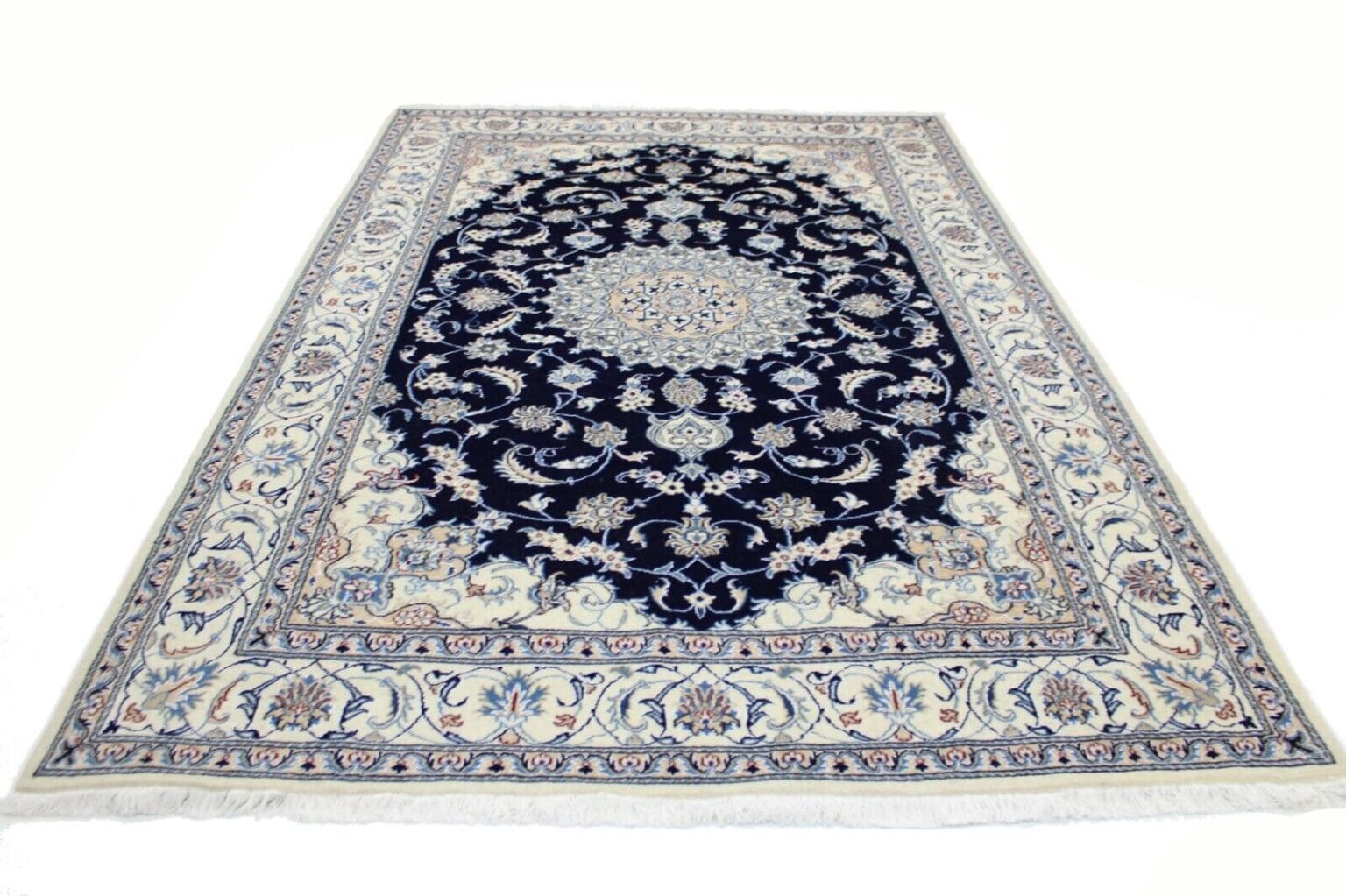
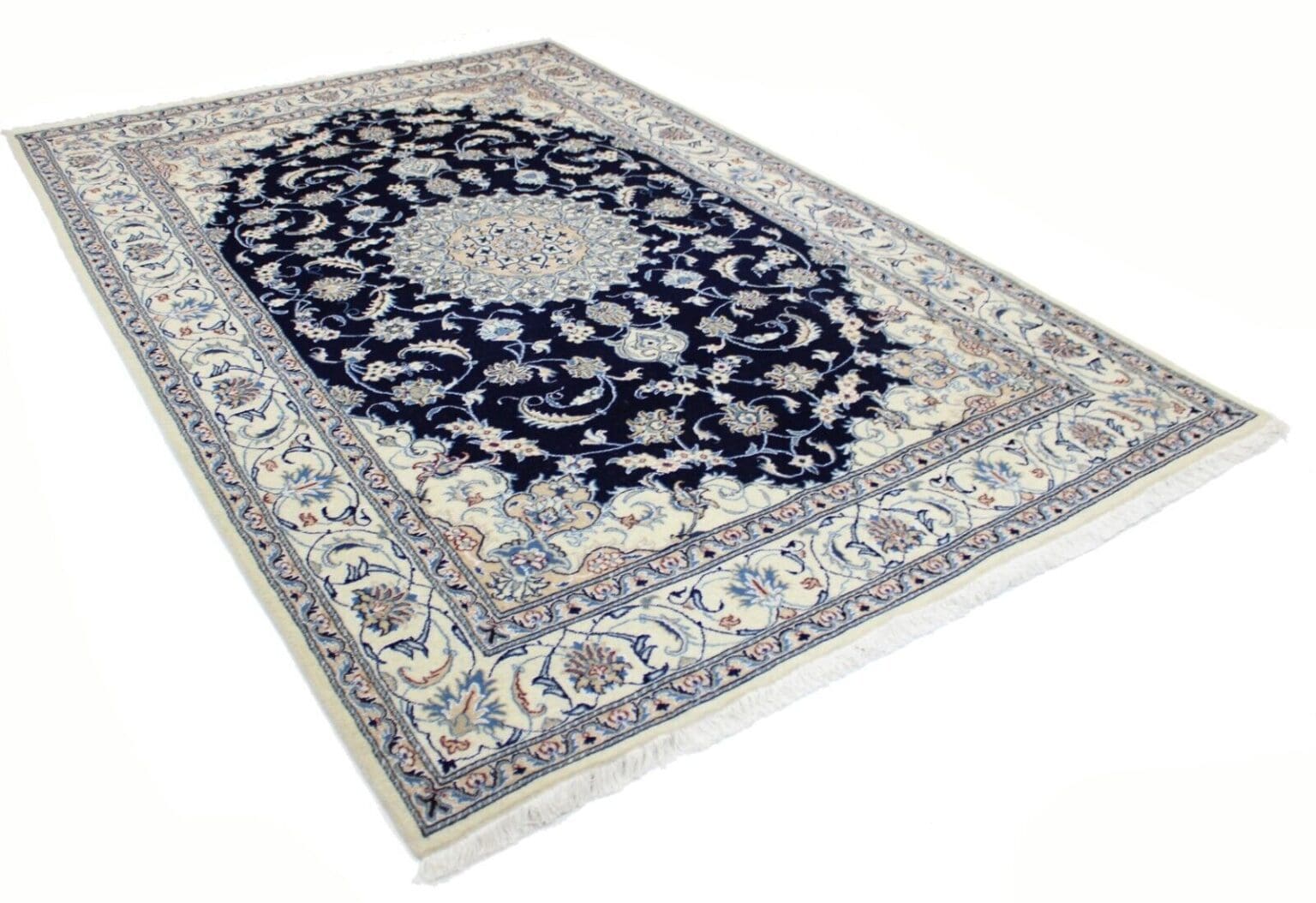
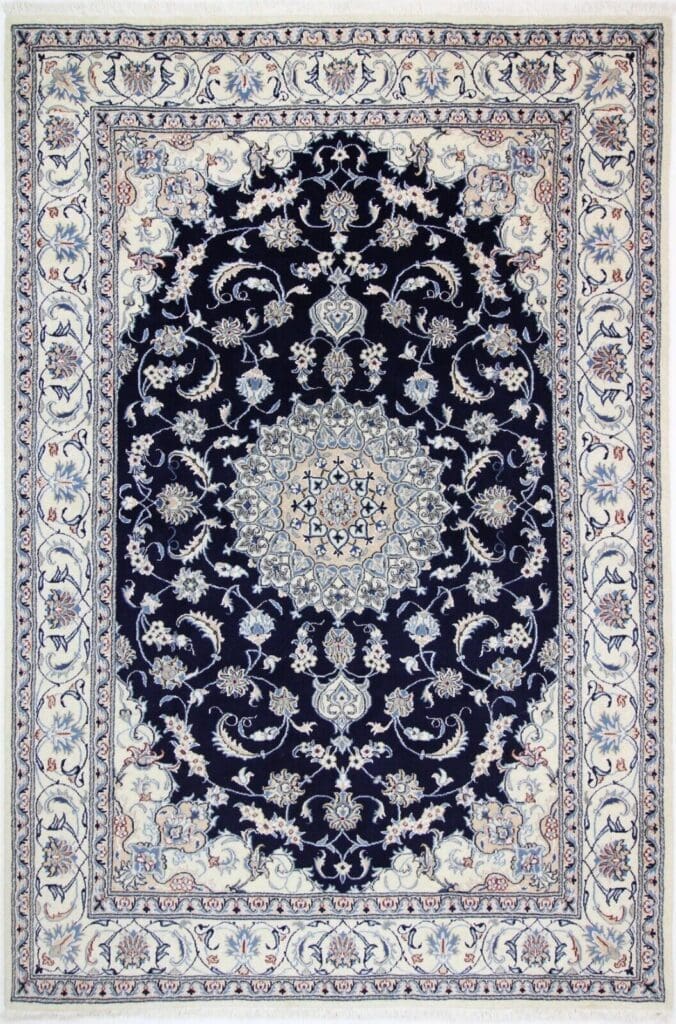
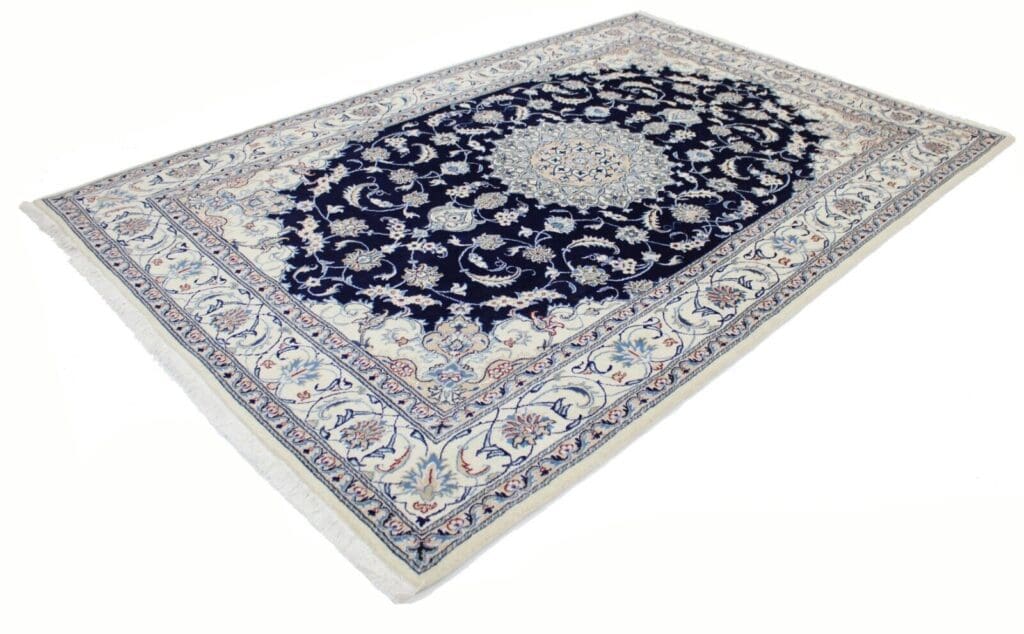
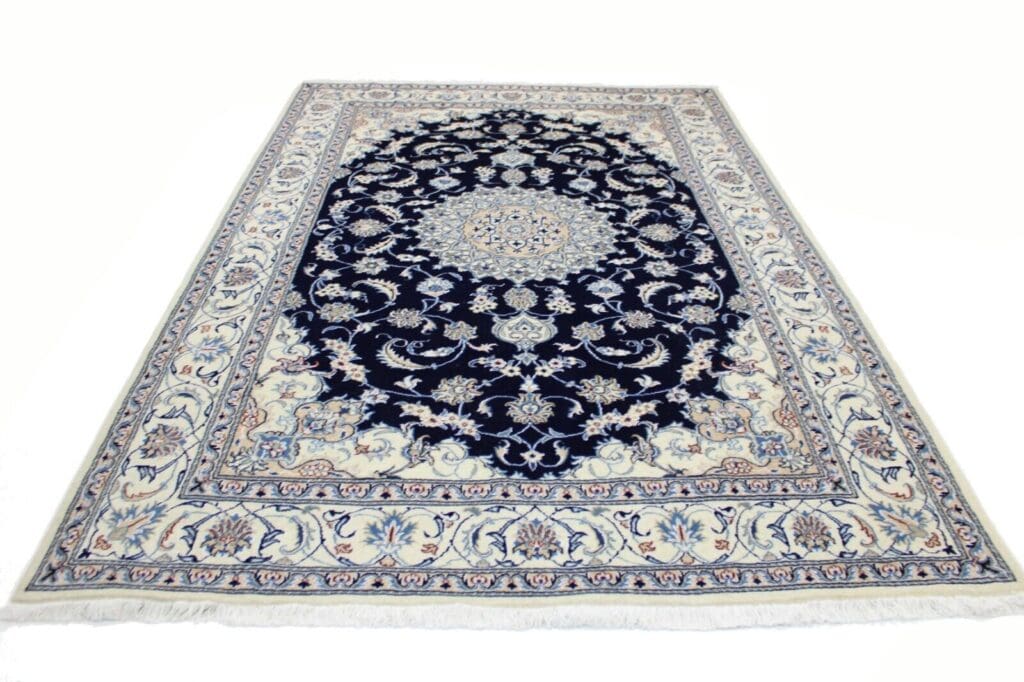
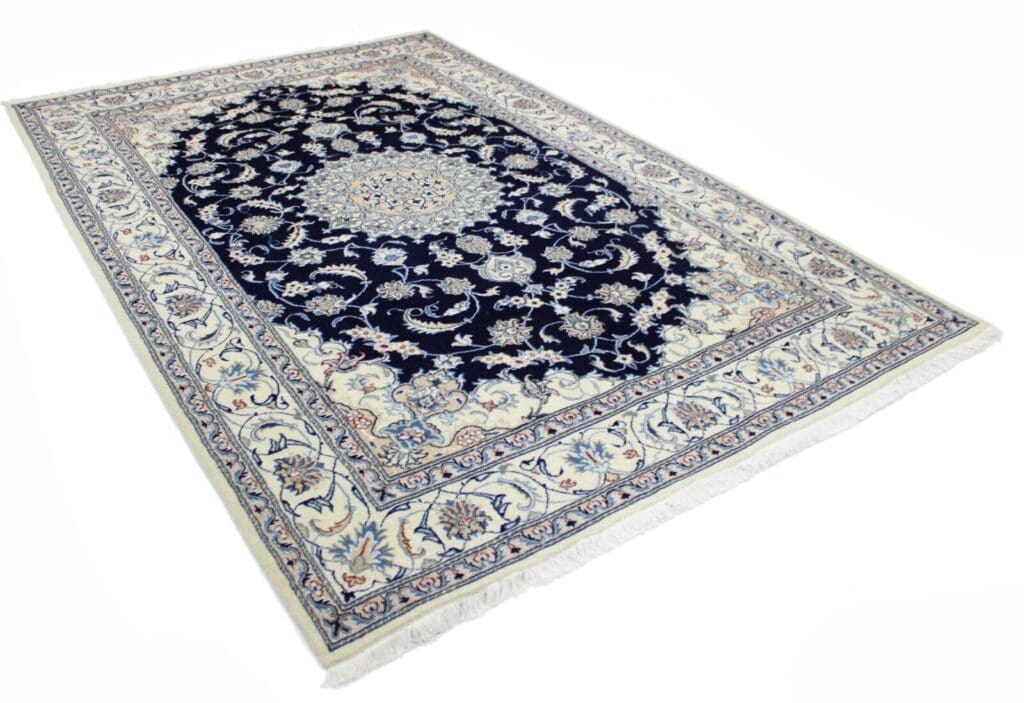
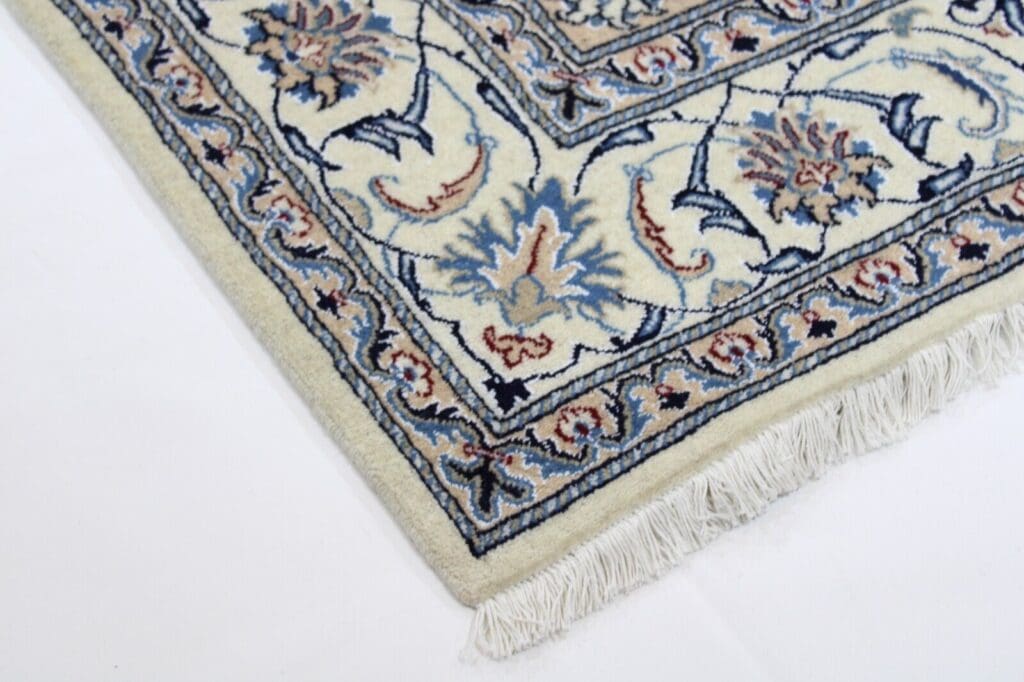
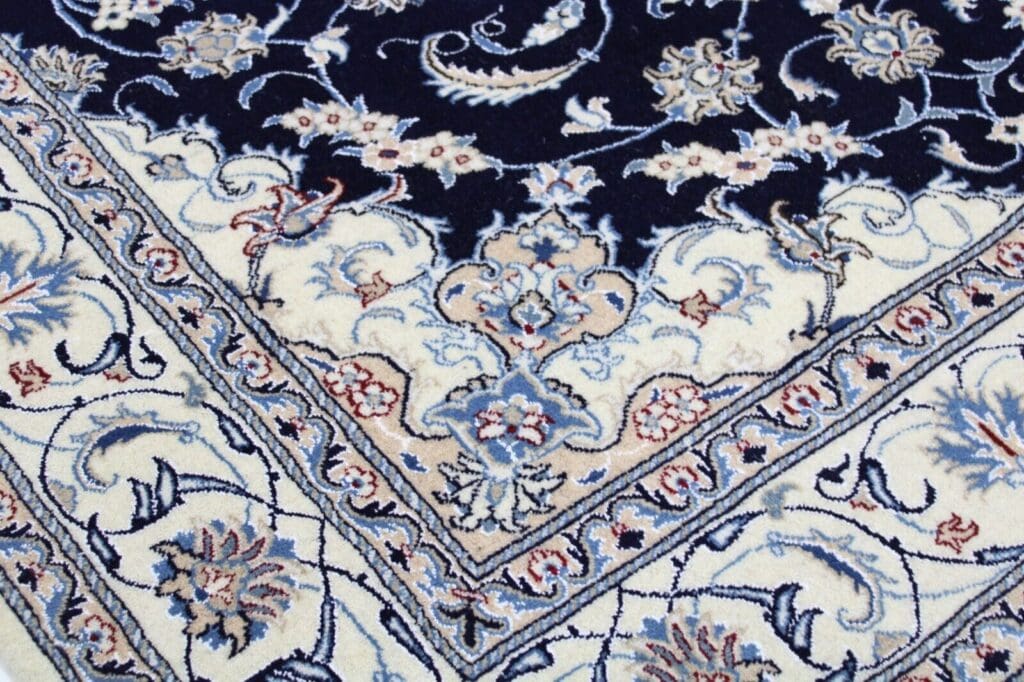
Hand-knotted Nain Persian Rug | Material: Wool and cotton | Size: 297 x 200 cm | Pattern: Oriental with floral motifs | Condition: New without label, top condition
This Nain Persian rug is hand-knotted and made from high-quality wool and cotton. Both materials have a long-established place in the making of oriental rugs. Wool is valued for its durable structure, natural resilience and comfortable textile feel. Cotton can be used within rug construction to create a regular and stable foundation. The product description identifies high-quality wool and cotton as the materials of this rug. It does not give a separate allocation of the materials to pile or warp, so no more specific construction claim is made.
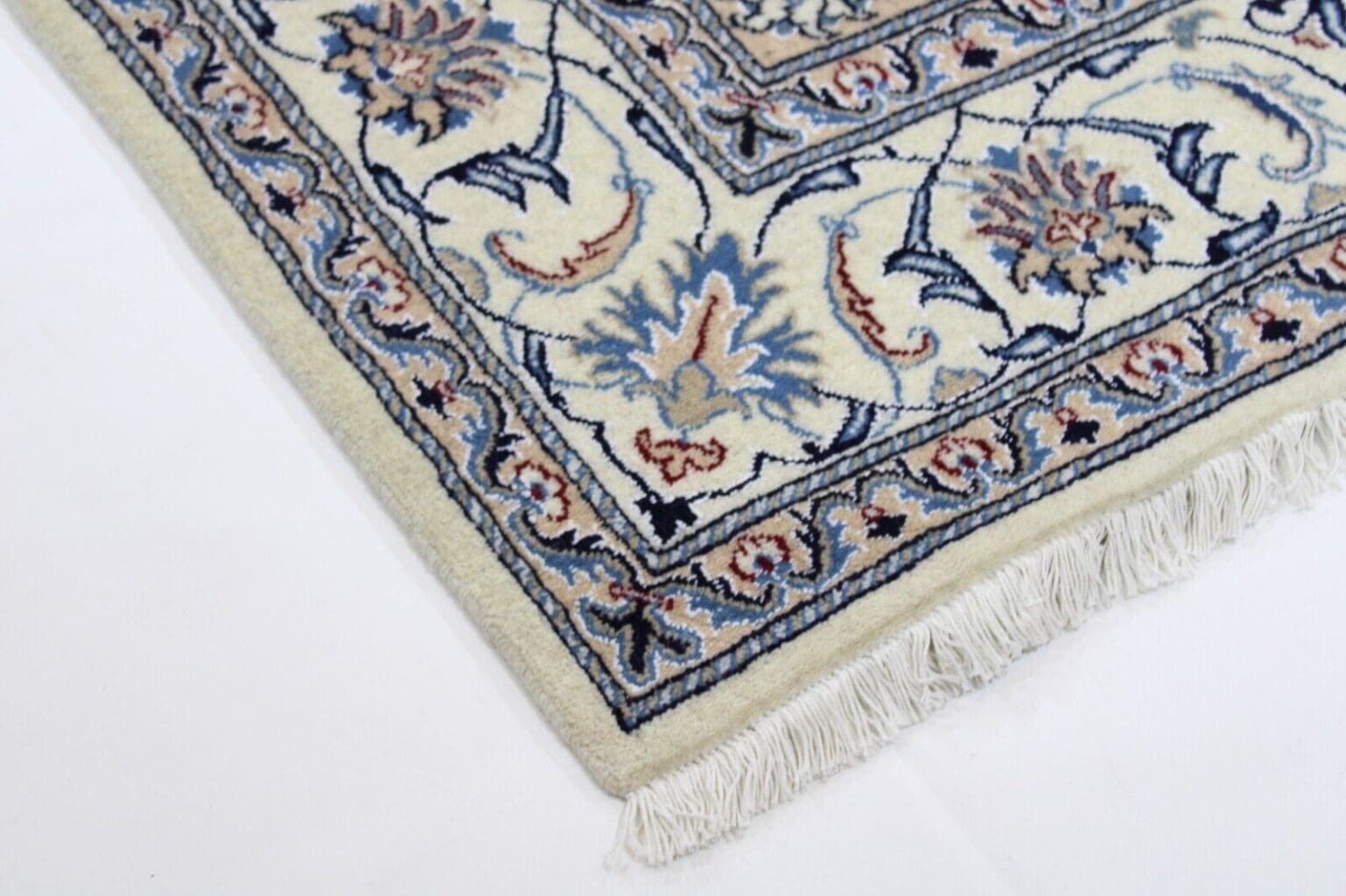
Hand-knotting is carried out by placing individual knots into a prepared structure by hand. The rug develops gradually, row by row, rather than being produced in one continuous machine process. Once the knots have been completed, the surface can be finished so that the pile and pattern become clearly defined. This method requires time, attention and practical experience. Small variations in knot tension, execution and ornament are part of handmade production and make each hand-knotted rug an individual piece.
Wool forms the visible pile in many oriental rugs and gives the surface its characteristic tactile quality. Cotton is traditionally often used in the warp or weft because it can provide a consistent foundation for the knots. For this particular rug, the source only confirms the use of wool and cotton; it does not provide a separate statement about pile and warp. No additional fibres, percentages or construction details are therefore added.
The hand-knotted technique allows floral and geometric forms to be built from many individual knots. The more carefully the knots are placed and the rows maintained, the more clearly a detailed pattern can be developed. This rug is described as hand-knotted and made from high-quality materials. An exact knot density for this individual piece is not given.
Origin and Tradition
This rug comes from Nain in Iran. Nain is located in Isfahan Province and is known as a distinct centre of Iranian rug making. The name Nain therefore refers both to a specific place of origin and to a regional knotting tradition. As a Persian rug, this piece belongs to the wider heritage of Iranian textile art, in which individual centres developed their own technical practices and visual languages.
Nain lies on the edge of Iran’s central desert region and is closely connected with the cultural environment of Isfahan. Textile crafts developed in this setting over a long period. Nain rugs are generally associated with careful drawing, fine ornament and controlled execution. Their regional tradition brings together knowledge of spinning, dyeing, preparing the warp, knotting and finishing the completed rug.
Iranian rug making is based on knowledge transmitted through practice. Patterns may be developed from designs, pattern collections or regional forms learned by the makers. A weaver must understand not only how to make individual knots, but also how colours and ornaments follow one another. The design takes shape through many small decisions during the work. Technical precision and visual order therefore become part of the same textile process.
The history of Iranian rugs extends across many centuries. Rugs have been made in different regions for private interiors, formal settings and everyday use. Over time, local characteristics developed through materials, working methods and inherited designs. Nain is traditionally associated with finely organised compositions, floral drawing and an ordered use of symmetry. These are general features of the regional tradition and are not additional specifications of this individual rug.
The relationship with Isfahan is important when placing Nain in its cultural context, since Isfahan has been a significant centre of Iranian art and craft for centuries. Experiences from architecture, ornament, manuscript art and textile design have influenced the broader visual culture of the province. Rug patterns can reflect forms familiar from other crafts, including flowers, vines, rosettes and geometric framing devices. Such connections help explain the structured character often associated with Nain designs.
The craft was traditionally passed on through families, workshops and local communities. Practical skills were taught alongside an understanding of proportion, repeat, rhythm and colour relationships. Making a rug can take a considerable amount of time because the design is built entirely by hand. This combination of labour, experience and regional design knowledge accounts for the place of hand-knotted Nain rugs within Iranian rug making.
Nain is therefore more than a generic style label. It identifies an Iranian origin and the tradition associated with that region. This piece is described as an original Nain Persian rug from Nain, Iran. The source does not identify a particular workshop, individual weaver, production year or signature. None of those details are added here.
Design and Pattern
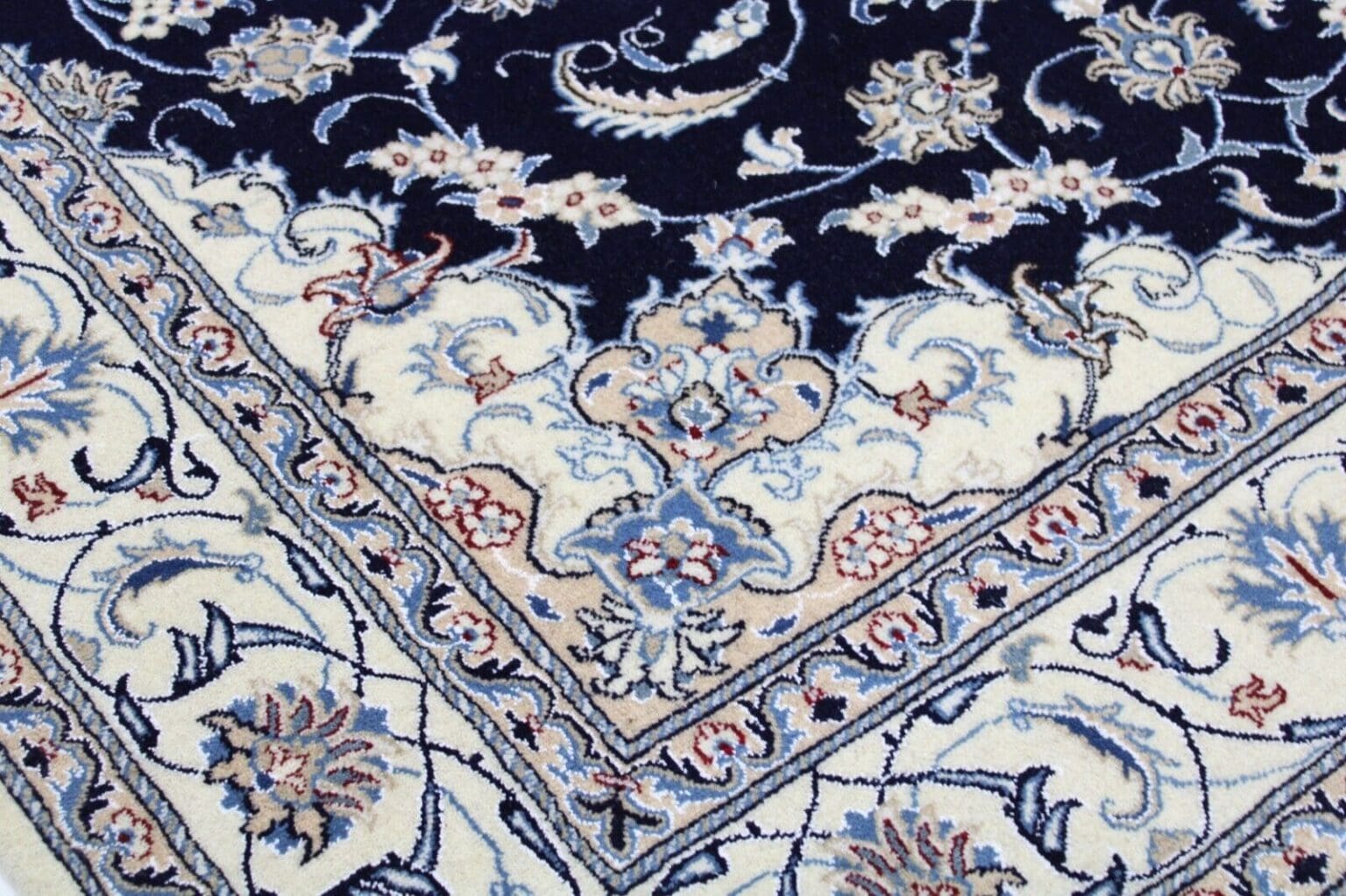
The pattern of this rug is described as oriental with floral motifs. Floral ornament is a major element of Persian rug design. Blossoms, leaves and winding branches can be joined into repeating units and distributed across a field. Repetition creates rhythm, while changes in size and shape prevent the composition from appearing mechanically uniform. For this rug, floral motifs are identified as the defining pattern feature.
Within the Nain tradition, floral forms are often placed within a clearly ordered composition. A central field may be structured by a medallion or by a continuing pattern of vines. Borders contain the inner field and create a transition towards the edge. These elements belong to the general vocabulary of Persian rug design. The exact arrangement of this rug, including its border, any medallion and its precise colours, is not specified in the source.
Geometric order and organic forms frequently work together in oriental rugs. Lines, axes and symmetrical arrangements can organise flowers and vines. Geometry does not have to appear only as angular shapes. It can also be present in repeated blossoms, mirrored branches or the regular division of the field. In this way, a rug can combine decorative detail with an overall structure that guides the eye across the surface.
Persian patterns are traditionally arranged according to an underlying order rather than scattered randomly. Designs and regional pattern knowledge help determine the proportions and sequence of ornaments. Smaller details may accompany larger forms, while the border provides a visual framework for the central composition. During hand-knotting, this arrangement is translated into the textile one knot at a time. The result is an integrated pattern rather than a decoration applied after manufacture.
Floral motifs in Persian art can be naturalistic, stylised or highly ornamental. The purpose is often not to reproduce one particular plant exactly, but to create a balanced relationship between blossom, leaf and vine. This stylised treatment of nature is a central part of oriental ornament. Nain rugs are generally associated with fine, controlled designs in which small floral details can be incorporated into a coherent composition.
The traditional Persian and oriental classification of this rug describes its cultural and formal setting. It indicates that the design belongs to the Iranian pattern tradition. It does not provide information that is absent from the product description, such as an exact colour palette or a specific border scheme. The recorded design information for this piece is an oriental pattern with floral motifs. Further claims about individual decorative elements would go beyond the source.
The visual character of floral rugs often comes from the relationship between ornamented areas and clearly organised borders. Repeated shapes can lead the eye across the surface, while symmetrical references create balance. Hand-knotting makes it possible to build such patterns gradually and with detailed control. The regional Nain tradition is generally associated with a precise and finely structured design language within Iranian rug art.
Special Features
The rug is described as new without a label and in top condition. It is hand-knotted and suitable for use over underfloor heating. This suitability is an expressly stated product feature. When the rug is used with underfloor heating, the temperature should not be set too high in order to protect the material.
Nain rugs are generally associated with a high knot density. A range of 300,000 to 1,000,000 knots per square metre is given for Nain rugs in the source text. The exact knot density of this individual rug is not stated in the product information. Dense knotting can support the rendering of fine ornament and can contribute to resistance against wear. The general range must not be read as a measured value for this particular piece.
Hand-knotted rugs also have textile insulating properties. They can help retain warmth in winter and provide a pleasantly balancing floor surface in summer. The stated suitability for underfloor heating is an additional feature of this rug. Nain rugs can develop a patinated surface over time, changing the visible character of the wool as the rug is used. This is general background about the rug type and is not a condition statement about the piece offered here.
FAQ
How should I care for a Nain Persian rug?
Regular vacuuming helps remove loose dust and everyday debris from the pile. A setting suitable for rugs should be used so that the surface is not placed under unnecessary stress. Occasional professional cleaning is recommended for a deeper clean. A specialist can take the material, knotting and type of soiling into account before choosing a suitable method. Strong direct sunlight should be avoided because it may cause colours to fade over time. Spilled liquids should be absorbed as quickly as possible rather than rubbed into the pile. Care should remain gentle so that the hand-knotted structure and surface are preserved. Professional cleaning is particularly useful when ordinary vacuuming is no longer enough.
Why do hand-knotted rugs cost more than machine-made rugs?
Hand-knotted rugs require substantially more time and craft skill than machine-made rugs. Each knot is made by hand, and the design develops gradually through many separate stages of work. This makes production labour-intensive. Every hand-knotted rug is also an individual piece because its execution, knot tension and small details cannot be made completely identical by a machine. The price therefore reflects more than the materials alone; it also reflects the time and knowledge required. In a Nain rug, the long Iranian tradition of knotting forms part of this craft context. Higher production costs result from the combination of manual labour, materials and knowledge passed down through the technique.
Can I use a Persian rug over underfloor heating?
Yes, this Persian rug is suitable for use over underfloor heating. Hand-knotted rugs can provide insulation while remaining a textile floor covering. To protect the material, the heating should not be set to an excessively high temperature. Moderate, even warmth is preferable to strong heat or rapid temperature changes. If an underlay is used, it should be suitable for heated floors, should not unnecessarily block the heat and should help the rug remain securely in place. The product description expressly states that this rug is suitable for underfloor heating. For unusual heating systems or different technical instructions, the guidance supplied with the heating installation should also be followed.
To provide the best experiences, we use technologies like cookies to store and/or access device information. Consenting to these technologies will allow us to process data such as browsing behavior or unique IDs on this site. Not consenting or withdrawing consent, may adversely affect certain features and functions.
Functional Always active
The technical storage or access is strictly necessary for the legitimate purpose of enabling the use of a specific service explicitly requested by the subscriber or user, or for the sole purpose of carrying out the transmission of a communication over an electronic communications network.
Preferences
The technical storage or access is necessary for the legitimate purpose of storing preferences that are not requested by the subscriber or user.
Statistics
The technical storage or access that is used exclusively for statistical purposes.The technical storage or access that is used exclusively for anonymous statistical purposes. Without a subpoena, voluntary compliance on the part of your Internet Service Provider, or additional records from a third party, information stored or retrieved for this purpose alone cannot usually be used to identify you.
Marketing
The technical storage or access is required to create user profiles to send advertising, or to track the user on a website or across several websites for similar marketing purposes.
 SECURE PAYMENT
 SHIPPING PARTNERS