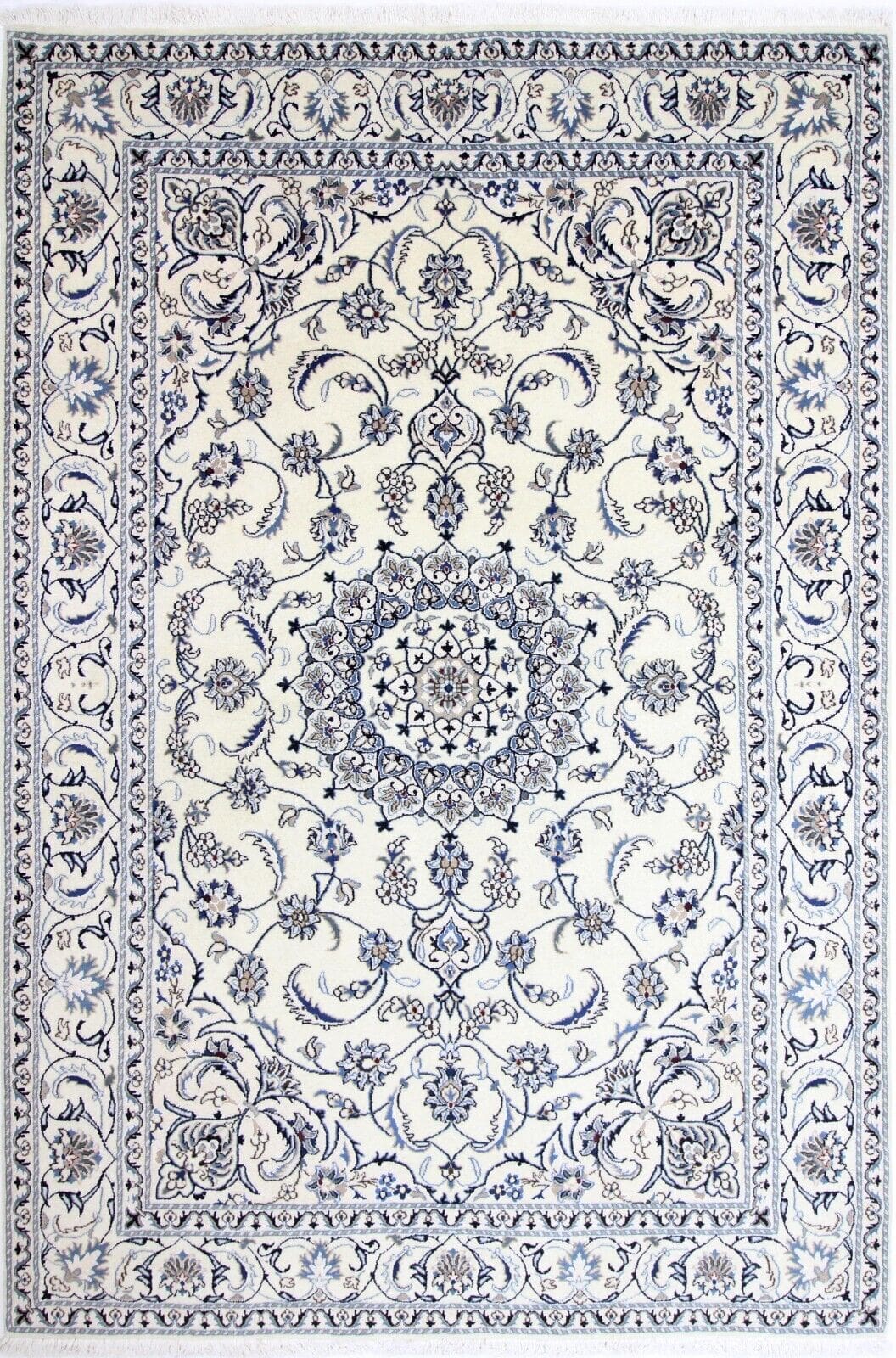
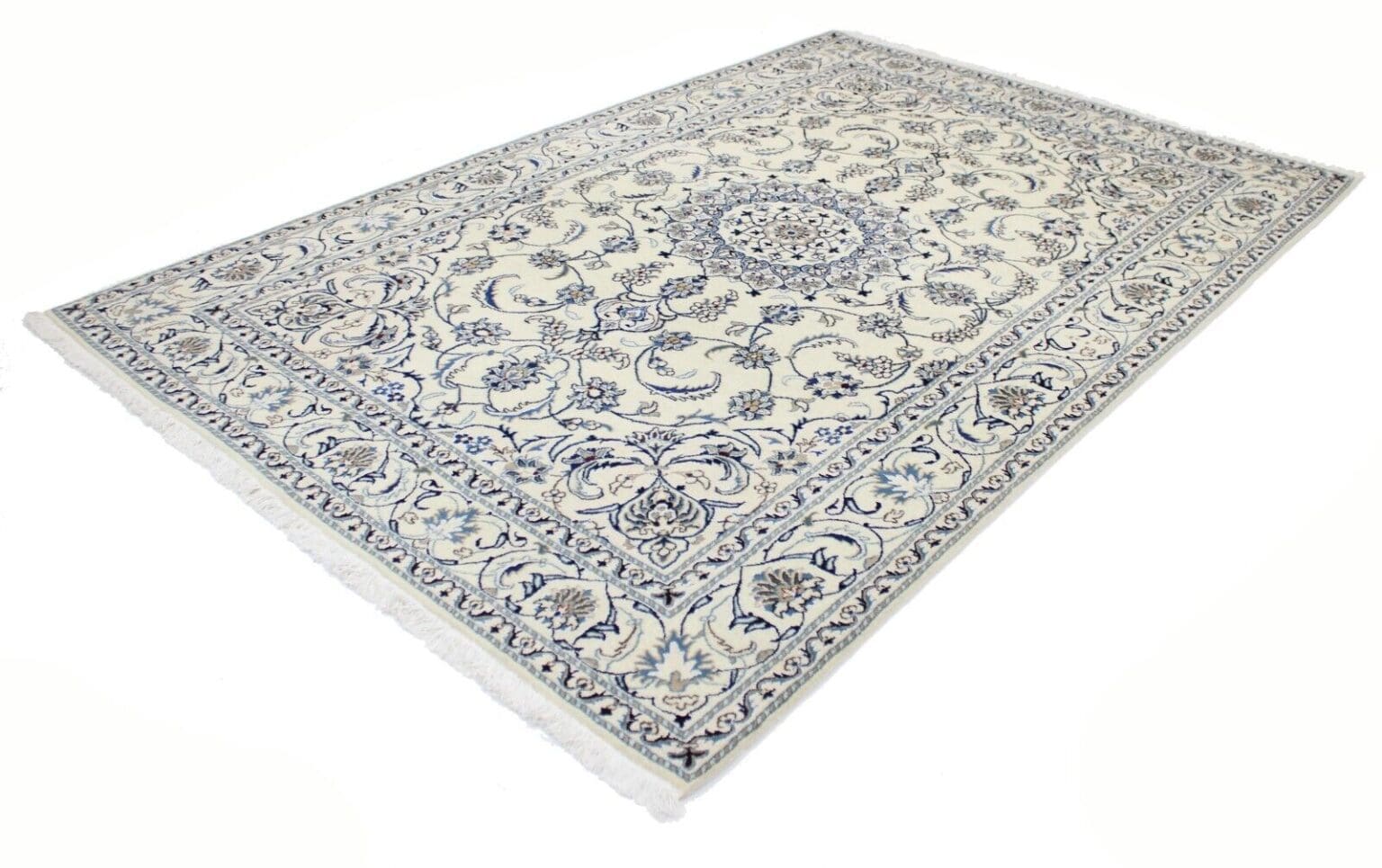
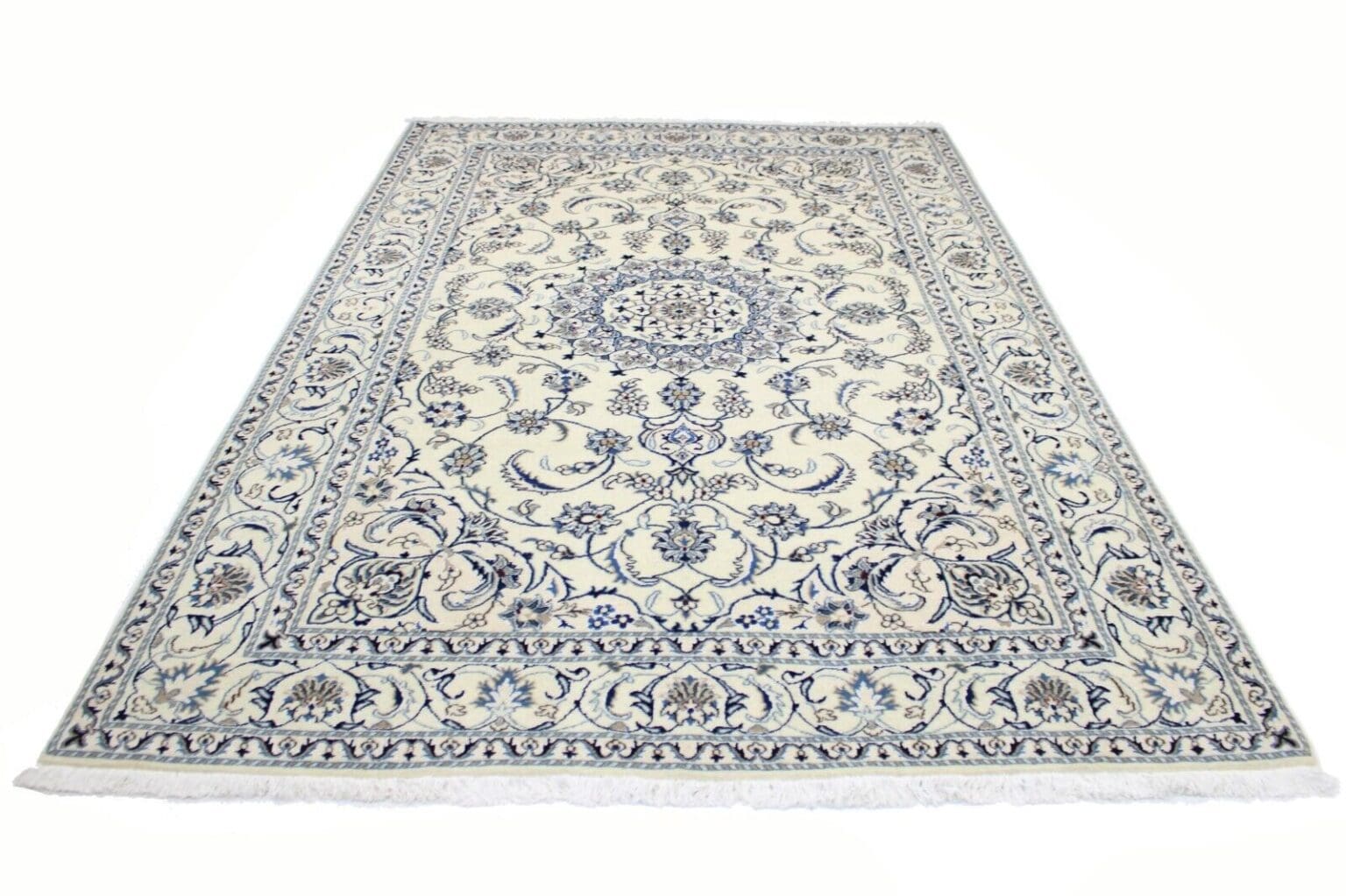
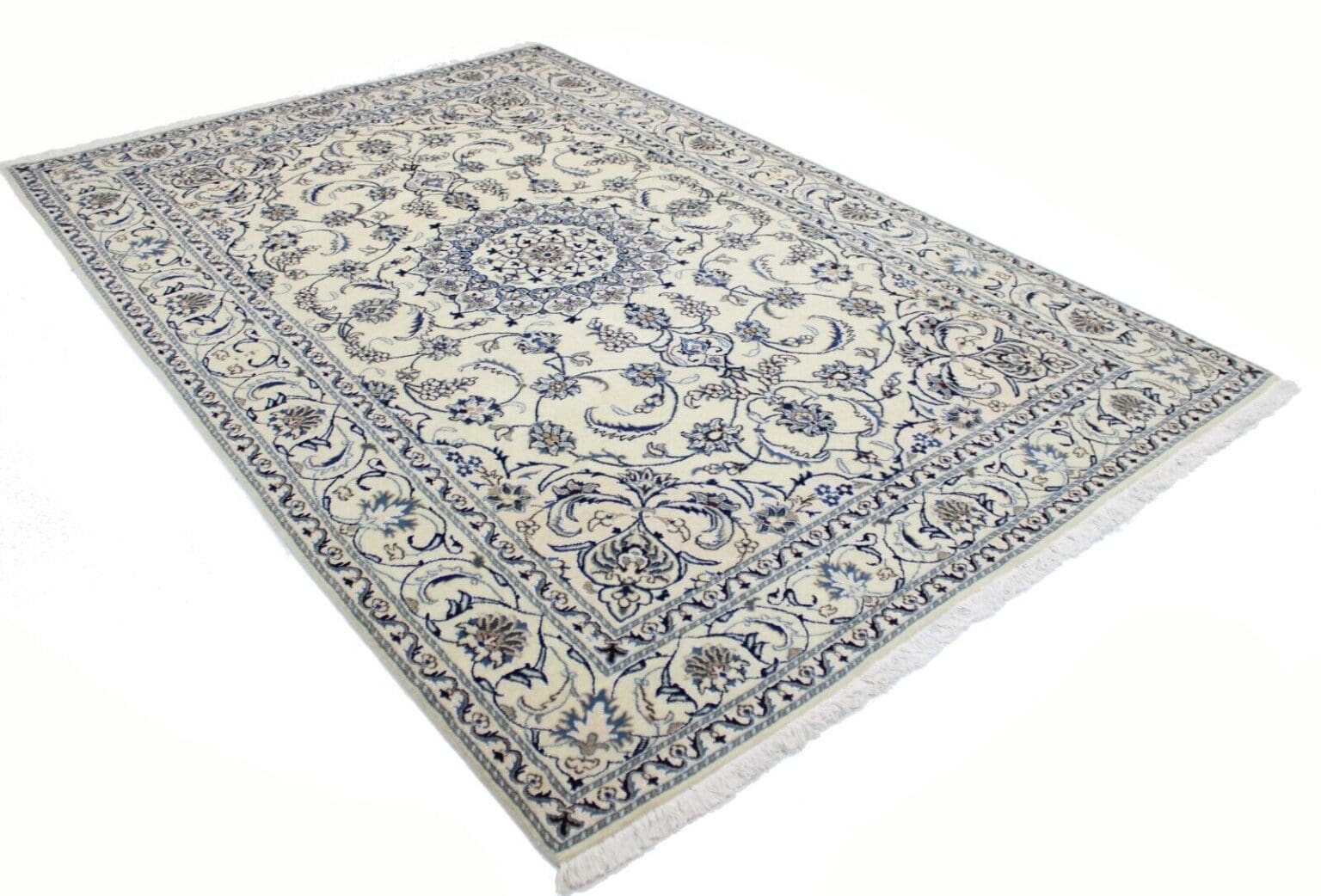
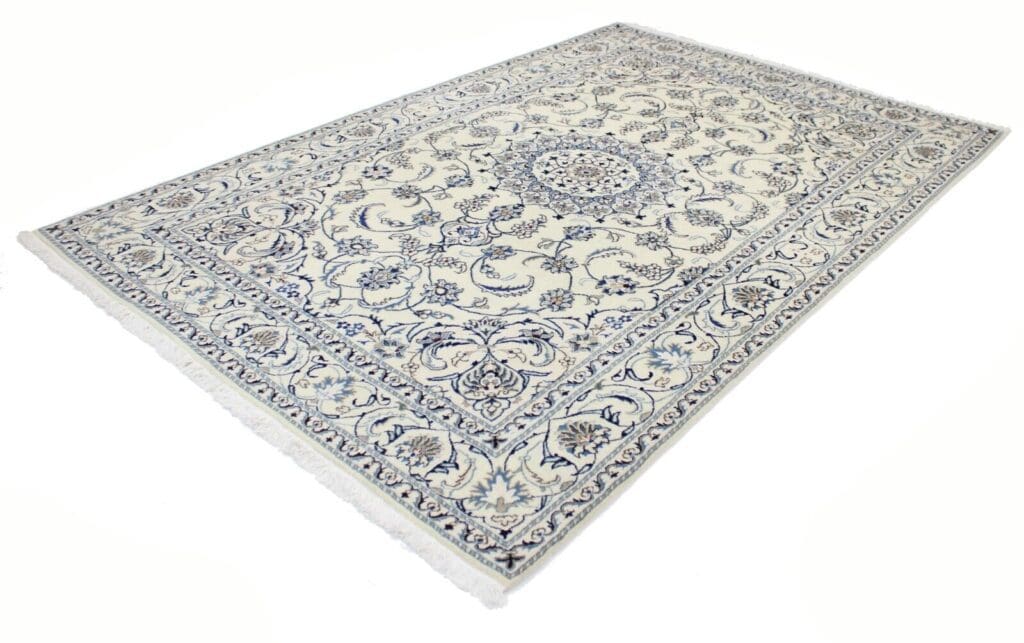
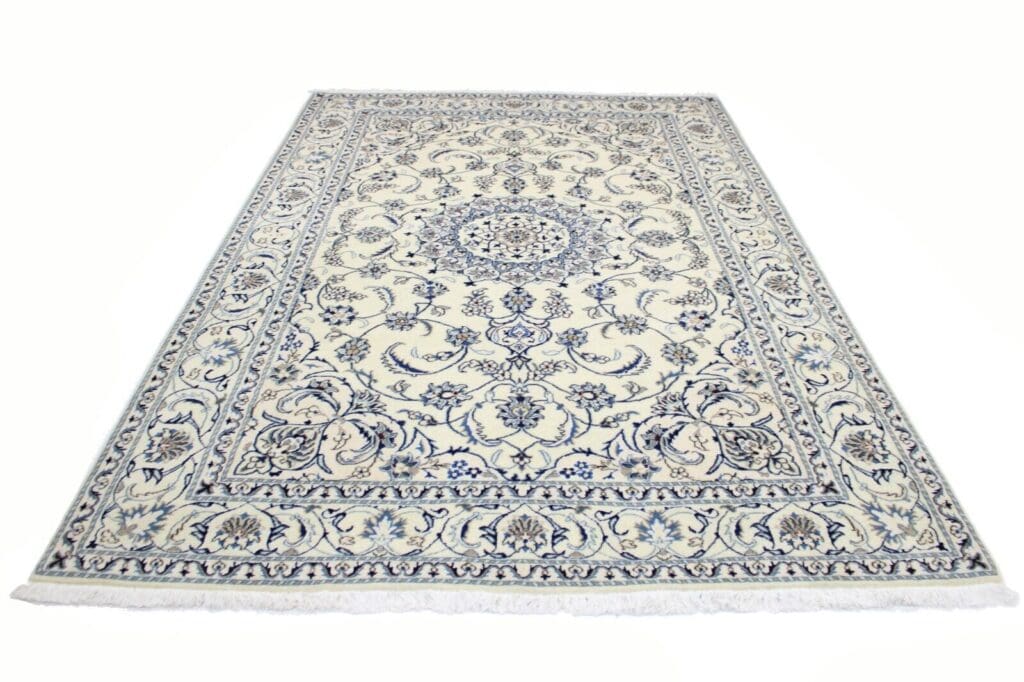
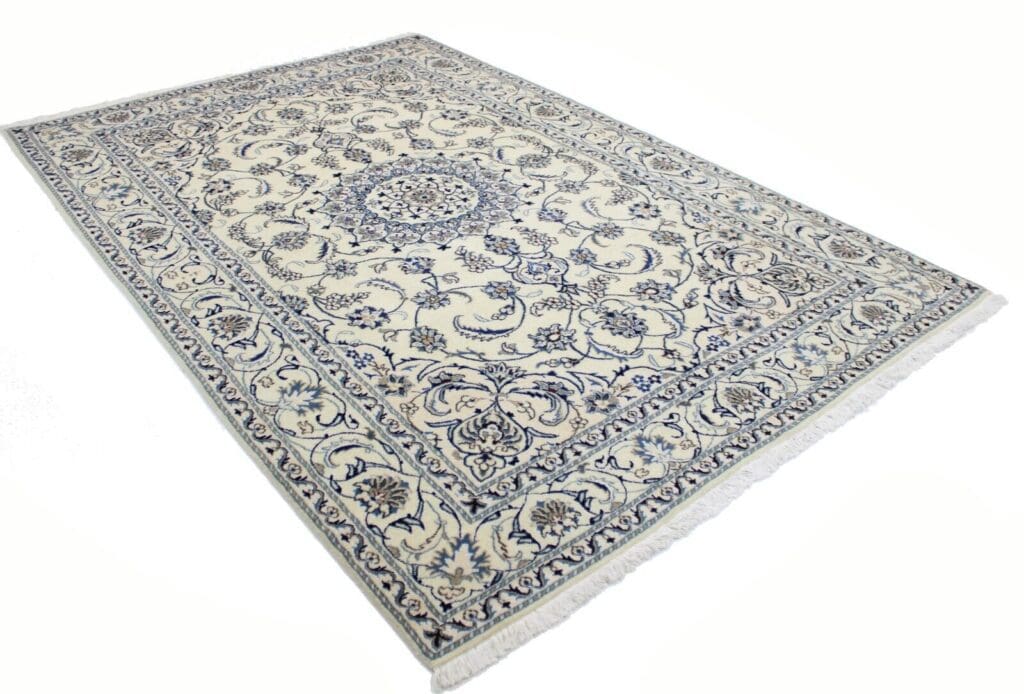
Hand-knotted Nain Persian rug | Knot density: Hand-knotted | Material: Wool and cotton | Size: 297 x 198 cm | Pattern: Oriental, floral | Condition: New without label, top condition
This Nain Persian rug is hand-knotted. Its construction is formed by hand, with the visible textile surface built up knot by knot rather than produced through a flat weaving process. The listed materials are high-quality wool and cotton. Both materials are expressly identified for this rug, while their precise allocation to individual structural parts is not specified. Wool has a long-established role in oriental rug making, and cotton is likewise a traditional textile material used in Persian production.
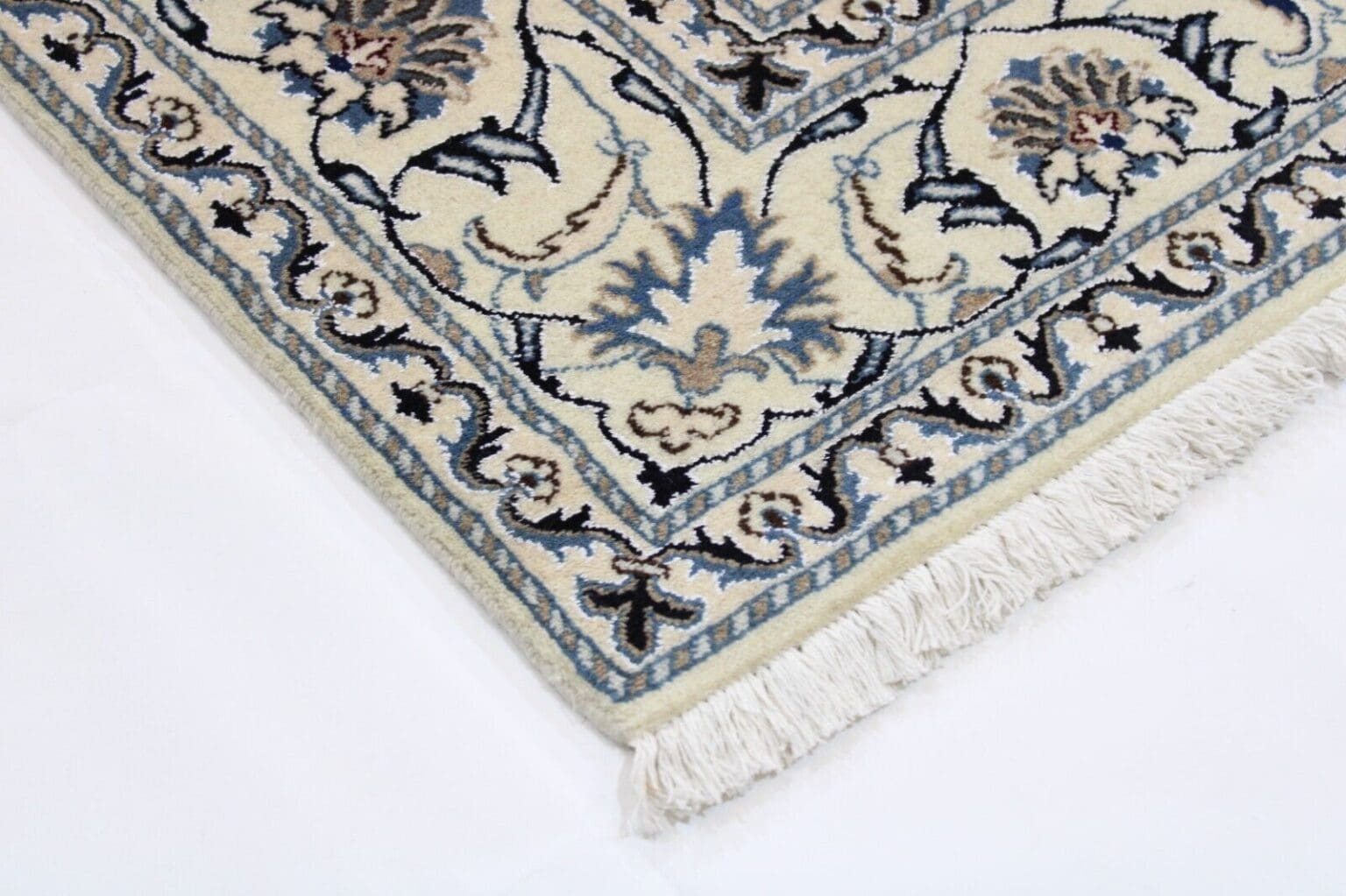
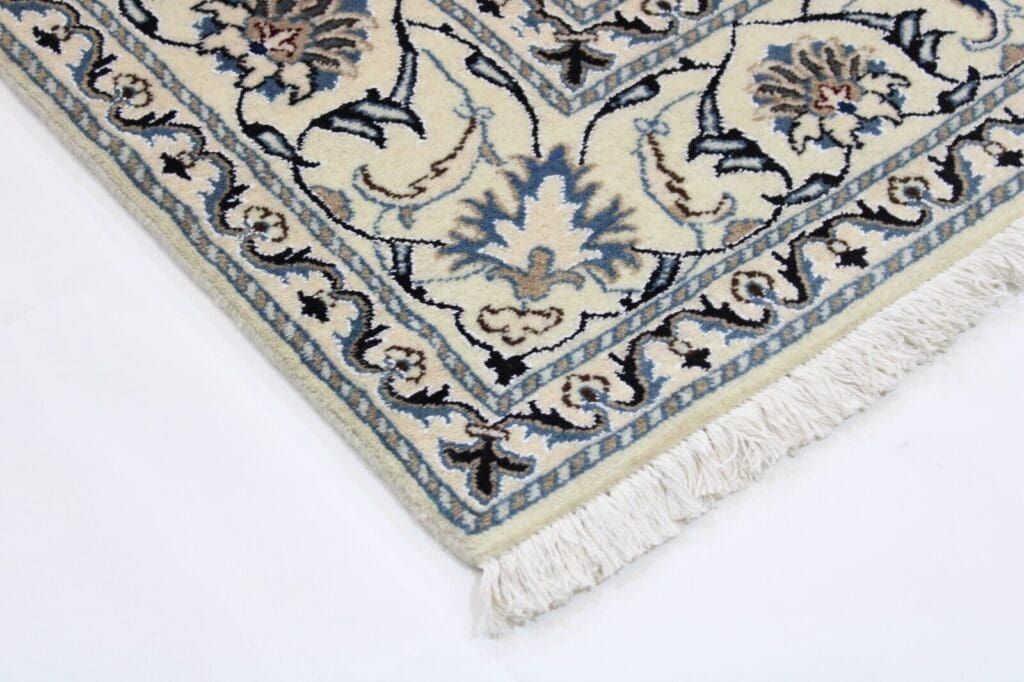
The rug is described as having a high pile. Pile height affects the feel and texture of the surface, giving it a noticeable textile relief. In a hand-knotted rug, the pile is created through the placement of individual knots and then brought into an even surface during finishing. The process requires careful control of yarn, tension, rows and pattern placement. Hand-knotting therefore describes both the production method and the manual basis of this one-off piece.
High-quality wool is widely used in rug making because it can be spun into a resilient yarn and accepts colour well. It also provides a distinct natural handle. Cotton has also been part of the technical vocabulary of Persian rug production for generations. In this case, the source identifies high-quality wool and cotton without assigning either material to a particular layer. No silk or other material is added to the description.
The specified pile is high pile, but no numerical pile height is provided. The source also gives the knot density as hand-knotted rather than supplying a numerical knot count. For that reason, no density figure is introduced. The craftsmanship can be described precisely through the facts that the rug is hand-knotted, made with high-quality wool and cotton, and finished with a high pile. These details explain its construction without adding measurements that are not stated.
Origin and Tradition
This is a Nain Persian rug from Iran. Nain is one of the recognised rug-making centres of Iran, with a regional tradition shaped by urban workshop production and long-standing textile skills. The place name identifies the origin given for this rug. It is not merely a reference to a decorative style. Nain belongs to the wider Persian weaving culture in which design, yarn preparation, knotting and finishing are connected within a complete craft process.
Persian rug making developed through the interaction of urban workshops, village production and nomadic traditions. Each setting contributed different approaches to materials, structure and ornament. In a workshop environment, a design may be organised carefully before it is transferred into the rug. The weaver then builds the composition row by row, combining knots with weft and warp elements. This gradual construction is why a hand-knotted rug has a textile character that cannot be reduced to a printed image.
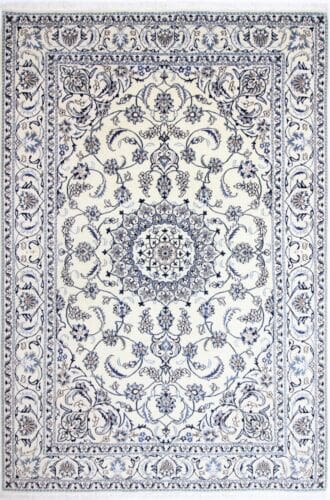
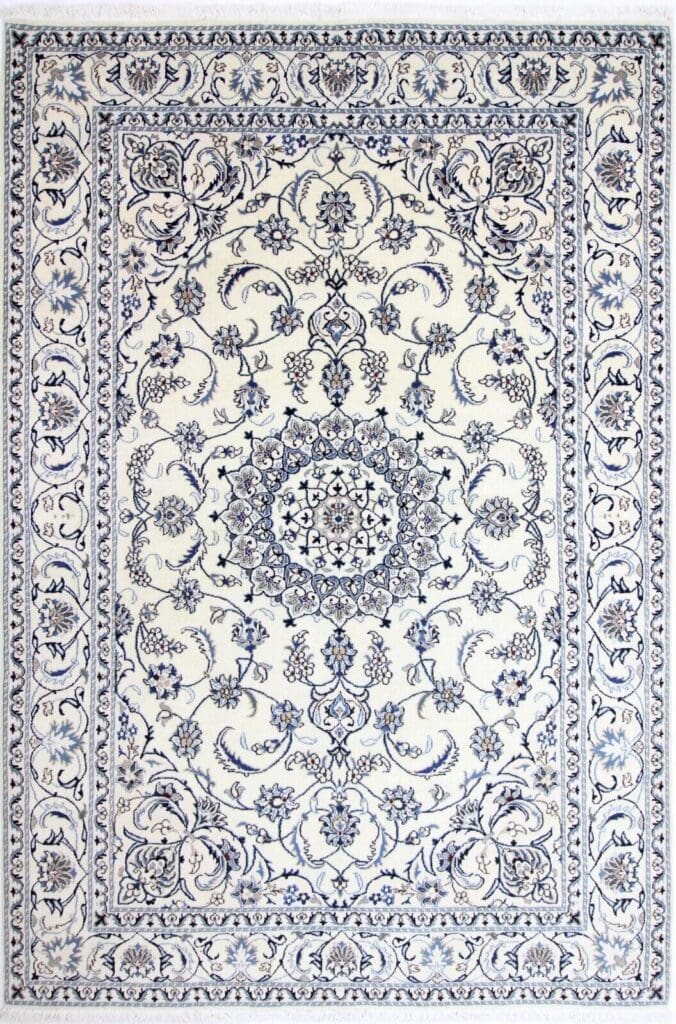
Nain rugs are commonly associated with an orderly and refined visual language. Regional examples often use a carefully structured field, surrounding borders and floral ornament. A central organisation can provide direction, while smaller botanical elements connect the field and the frame. Individual rugs vary, however, because a hand-knotted piece is made as a separate work rather than as one identical unit in a series. The regional tradition provides a vocabulary; the finished arrangement remains specific to the individual rug.
The designation Persian rug reflects the Iranian origin stated for this piece. Persian weaving is known for combining a planned ornamental structure with intensive manual work. Traditional forms may be preserved, rearranged or adapted within the conventions of a particular region. Flowers, leaves, scrolling vines, medallion structures and borders can therefore appear in many different relationships. Nain is one regional identity within this larger Iranian tradition, alongside other centres such as Isfahan, Tabriz and Kashan.
Producing a hand-knotted rug requires patience and a consistent reading of the design. Knots are placed in rows and secured by the surrounding textile structure. The pattern gradually emerges as the field is built. The work depends on practical knowledge of yarn, tension, colour placement and repeated ornament. Such knowledge is traditionally transmitted through experience and instruction over generations. The result is not simply a decorative surface; it is a textile whose appearance is inseparable from the method used to make it.
Nain’s place in Persian rug history is connected with this urban and design-conscious approach. The regional name in this product identifies Nain and should not be confused with a motif named after another location. The rug is from Iran, and its listed origin is Nain. Other famous Persian centres have their own traditions, but they are not substituted for the origin of this piece. Keeping the place designation clear preserves the distinction between where a rug was made and the broader family of patterns in which it may participate.
Design and Pattern
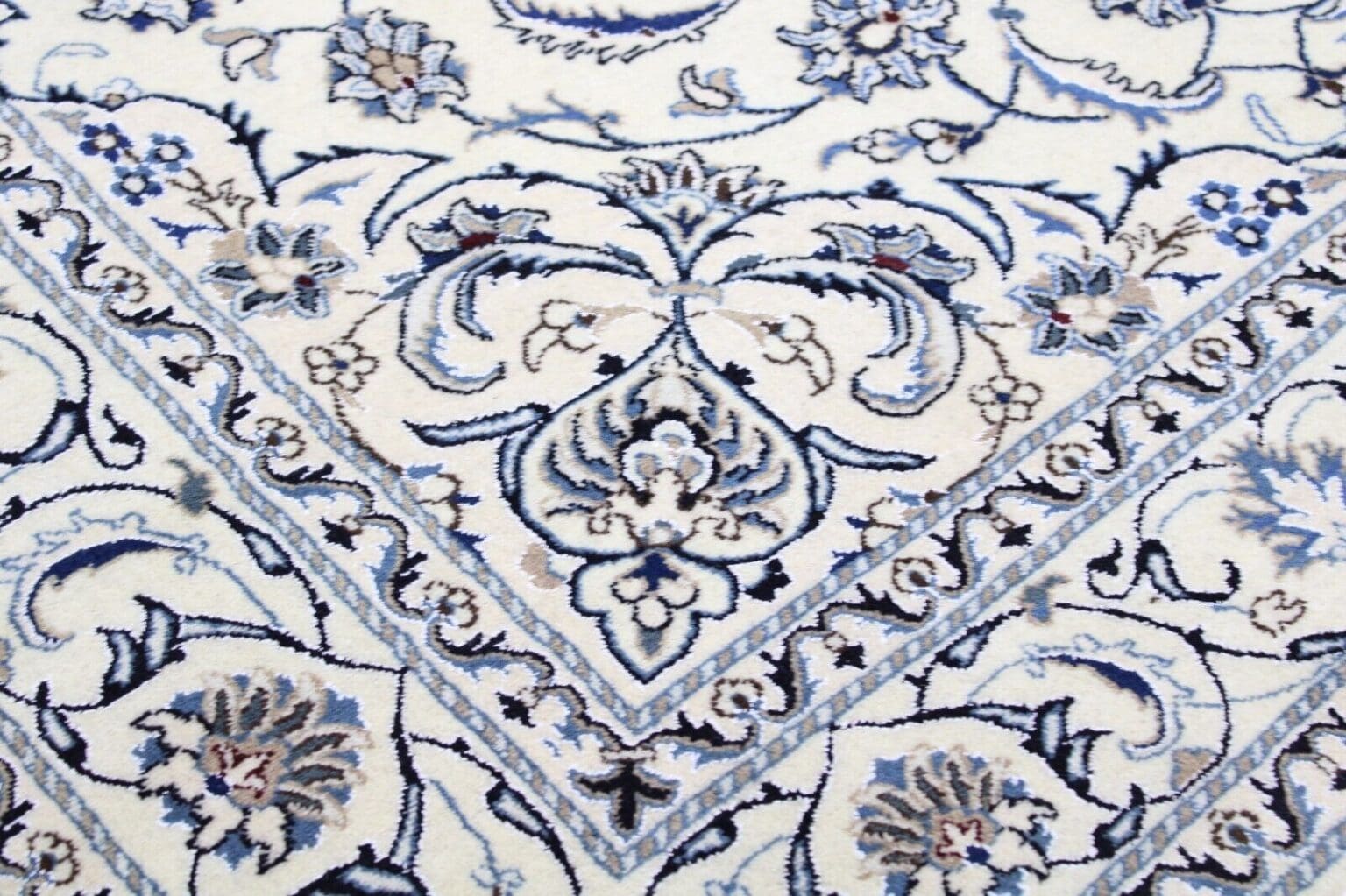
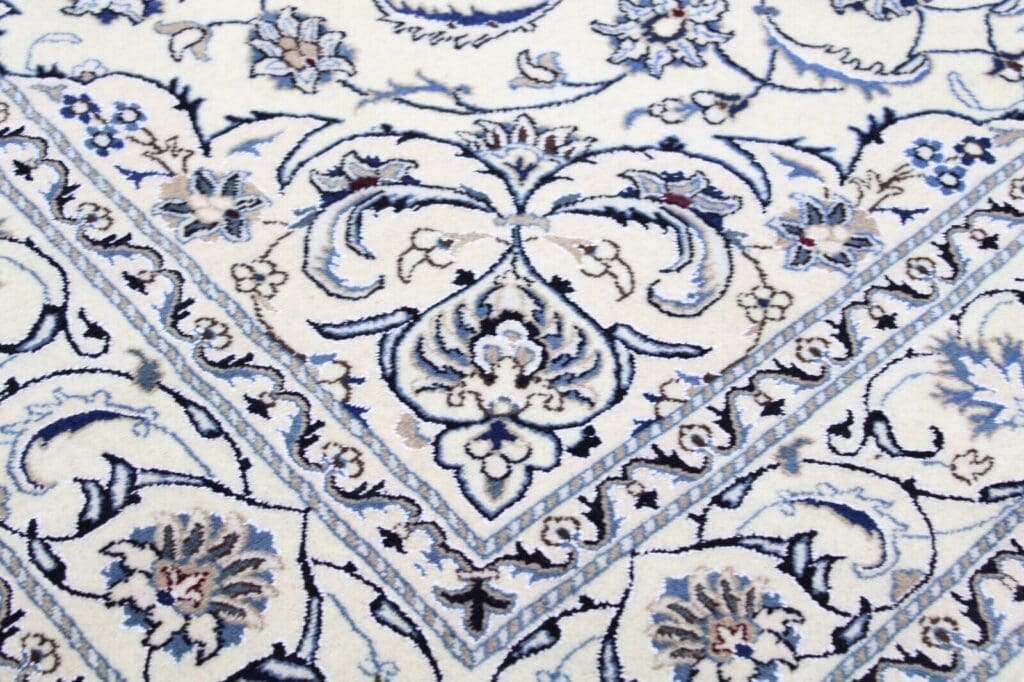
The pattern of this rug is described as oriental and floral. Flowers are therefore the explicitly stated decorative focus. Floral ornament is one of the most enduring forms in Persian rug design. It may appear through individual blossoms, leaves, curling stems, repeated botanical units or connected arrangements. In a hand-knotted rug, these shapes are not printed onto the surface. They are created by the placement of coloured knots, so the design is built into the textile itself.
Oriental compositions often rely on repetition, balance and framing. A border can surround the field and create a visual transition between the central area and the outer edge. Floral elements may be evenly distributed, arranged in scrolling movement or repeated at measured intervals. The word oriental describes the cultural and decorative character stated for the pattern. It does not, by itself, establish a specific colour scheme, medallion type or exact layout. Those details are not supplied for this rug and are not added here.
Persian ornament frequently transforms natural forms into an organised visual language. A flower may be simplified, mirrored or repeated until it functions as a motif rather than as a botanical illustration. Leaves and vines can link separate elements and create a continuous rhythm. This process turns references to nature into a pattern suited to a woven or knotted surface. In Nain-related design traditions, that ordered approach is often associated with clear drawing and balanced distribution, while individual compositions still differ.
The effect of a floral pattern depends on how motifs are spaced and how the field relates to the borders. Repetition can guide the eye across the rug, while a framed structure can give the composition a defined beginning and end. Some designs are dense and intricate; others allow more open ground between the ornaments. The available description establishes an oriental floral pattern, but it does not state the exact arrangement, colours or named motif. The description therefore remains with the confirmed design characteristics.
Craftsmanship and design are closely connected. The weaver has to translate a drawn or memorised arrangement into a sequence of individual knots. Every flower, stem and repeated shape is assembled from many small textile decisions. Minor variations are a normal part of manual production and help distinguish a hand-knotted one-off from a mechanically repeated floor covering. The pattern is consequently not separate from the construction: it is made visible through the knotting process and preserved in the pile.
Floral Persian designs can sit within traditional interiors as well as more contemporary settings because their underlying principles are based on line, rhythm and proportion. Their appearance depends on the relationship between ornament and open space, between field and border, and between colour areas. For this rug, the stated style is traditional Persian and oriental, while the named pattern is oriental and floral. These terms describe its documented character without assigning an unlisted design school or a different regional origin.
Special Features
The special features listed for this rug are its Iranian origin, its Nain designation, hand-knotted construction and high pile. The materials are described as high-quality wool and cotton. Its condition is given as new without a label and top condition. This condition statement describes the offered state of the rug. No production year or age is supplied, so neither is added to the description.
The rug is suitable for use with underfloor heating. This is a specific stated use characteristic. In practical care, normal attention remains appropriate: suitable air circulation, a compatible underlay and compliance with the instructions for the heating system support proper use. The underfloor-heating suitability does not change the rug’s hand-knotted construction or its high-pile surface.
A hand-knotted rug is a one-off because its surface is built manually rather than reproduced as an identical industrial unit. That description does not establish a signature, a date or a special provenance. None of those details is provided for this Nain rug. Its special features therefore remain limited to the documented facts: Iranian origin, Nain designation, hand-knotting, high-quality wool and cotton, high pile, new condition without a label, top condition and suitability for underfloor heating.
FAQ
How should I care for this Persian rug?
Regular vacuuming without a brush attachment is recommended. It removes loose dust while placing less mechanical stress on the high-pile surface. If a stain appears, treat it promptly with a damp cloth and a mild cleaning product. Rubbing firmly, soaking the rug or using harsh chemicals can put unnecessary strain on fibres and colours, so gentle handling is appropriate for a hand-knotted rug. Professional cleaning every few years helps maintain its condition. The cleaning service should be told that the rug is hand-knotted and made with wool and cotton, and that it has a high pile. Because the rug is suitable for underfloor heating, it should also be allowed to dry fully and should not be placed where moisture is trapped beneath it. These measures follow the stated care guidance while respecting the rug’s construction.
Where do the patterns on Nain Persian rugs come from?
Persian rug patterns are connected with the history and culture of the region where they are made. In Nain traditions, organised floral ornament and a clearly structured composition form part of the regional design vocabulary. Flowers, leaves and vines can be reduced to lines and repeated shapes that work well on a knotted textile surface. Such motifs may reflect nature, inherited workshop designs and the ornament of Islamic art. The pattern of this rug is identified as oriental and floral. No specific drawing, colour palette or symbolic interpretation is stated, so those details should not be assigned to this individual piece. What can be said is that its floral design belongs to the broader Persian tradition and is rendered through hand-knotting.
What makes this Persian rug distinctive?
Its distinctive combination of stated features includes Iranian origin, the Nain designation and hand-knotted construction. The rug is made with high-quality wool and cotton and has a high pile. It is described as new without a label and in top condition. The oriental floral pattern gives it a clearly stated connection to Persian decorative tradition. It is also suitable for underfloor heating, which provides a defined practical characteristic. These points describe its origin, materials, construction, pattern, condition and use. No claim is made about a specific age, signature, investment value or exceptional provenance because none of those facts is provided.
To provide the best experiences, we use technologies like cookies to store and/or access device information. Consenting to these technologies will allow us to process data such as browsing behavior or unique IDs on this site. Not consenting or withdrawing consent, may adversely affect certain features and functions.
Functional Always active
The technical storage or access is strictly necessary for the legitimate purpose of enabling the use of a specific service explicitly requested by the subscriber or user, or for the sole purpose of carrying out the transmission of a communication over an electronic communications network.
Preferences
The technical storage or access is necessary for the legitimate purpose of storing preferences that are not requested by the subscriber or user.
Statistics
The technical storage or access that is used exclusively for statistical purposes.The technical storage or access that is used exclusively for anonymous statistical purposes. Without a subpoena, voluntary compliance on the part of your Internet Service Provider, or additional records from a third party, information stored or retrieved for this purpose alone cannot usually be used to identify you.
Marketing
The technical storage or access is required to create user profiles to send advertising, or to track the user on a website or across several websites for similar marketing purposes.
 SECURE PAYMENT
 SHIPPING PARTNERS


