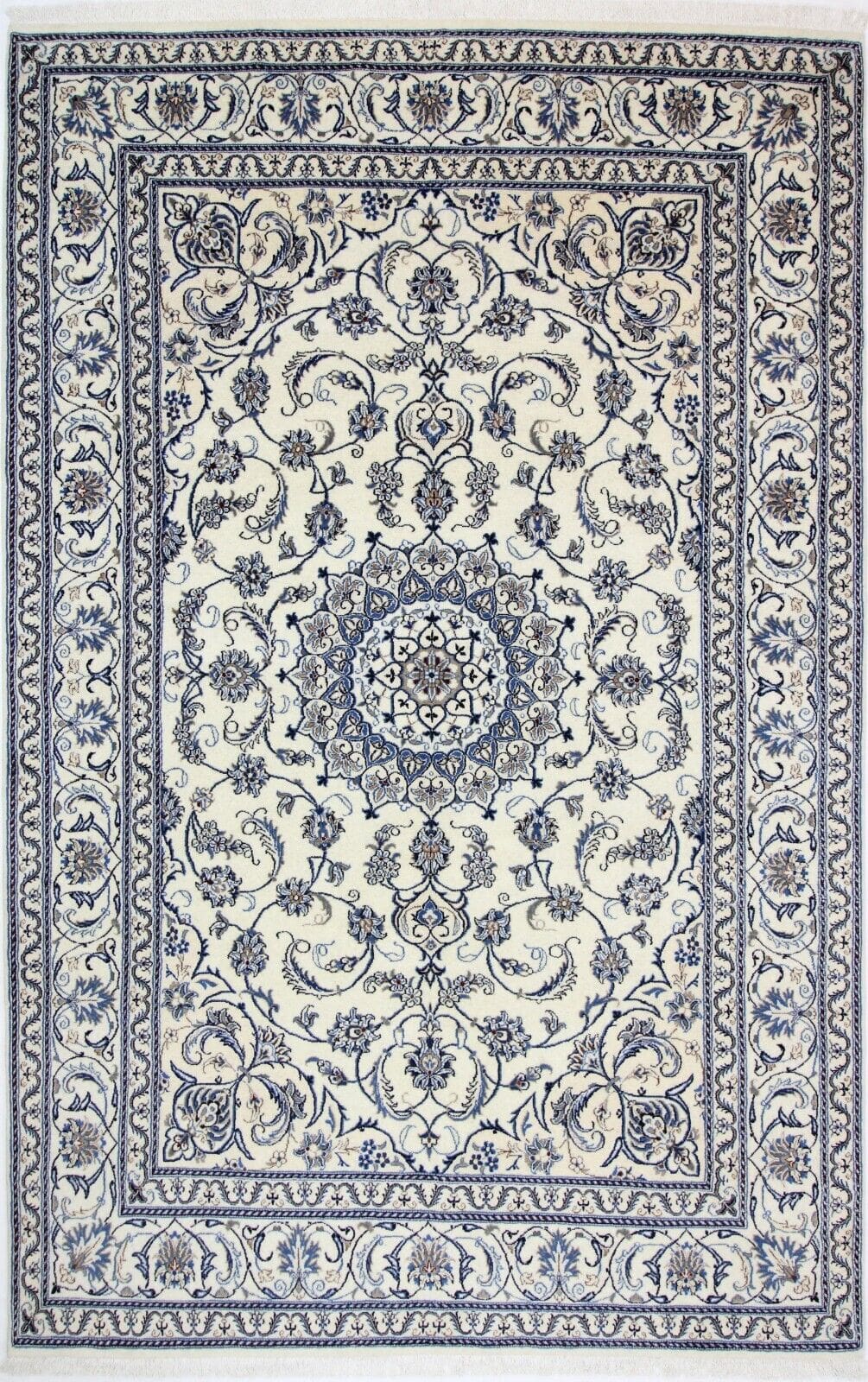
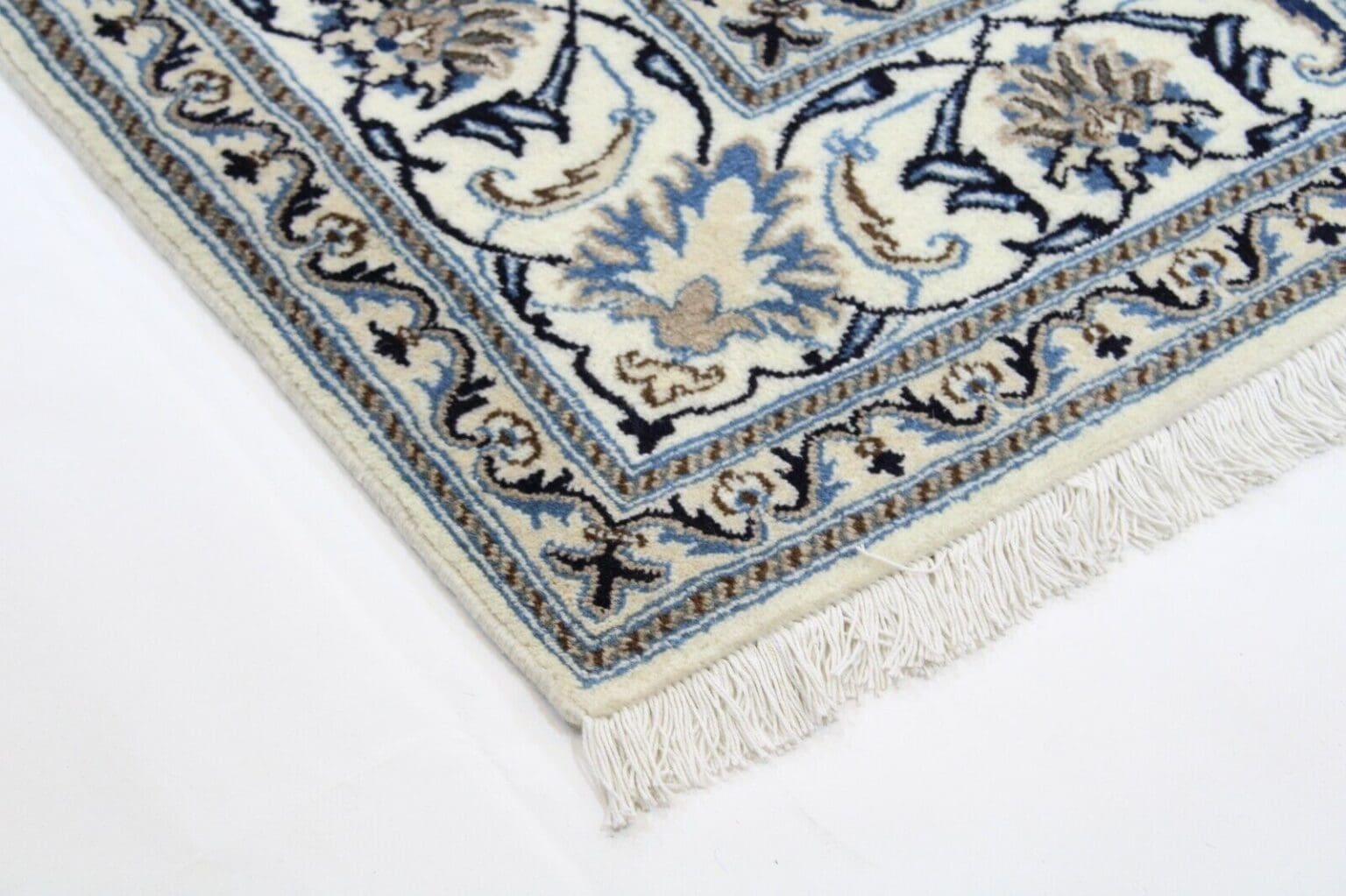
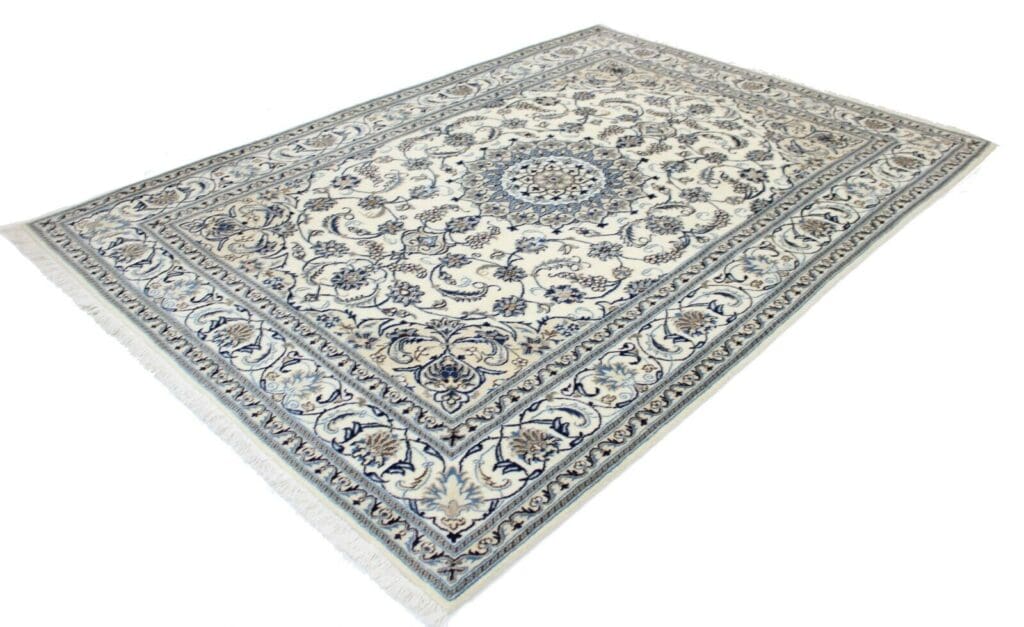
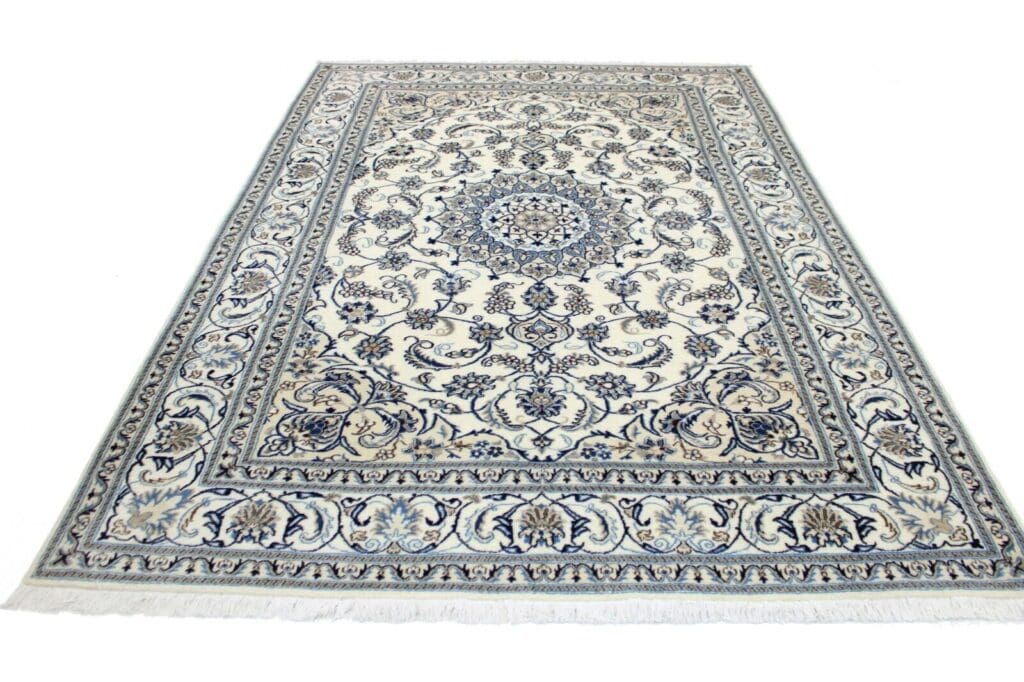
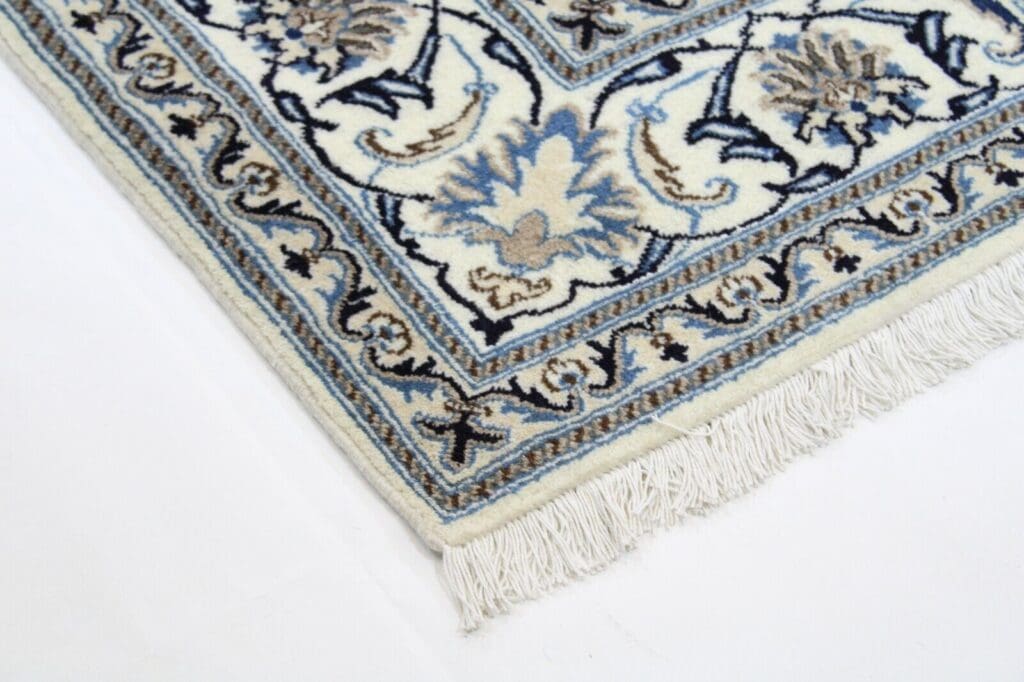
This original Persian rug from Nain is hand-knotted. The listed materials are high-quality wool and cotton. Wool forms the pile, while cotton is used for the warp. These two materials therefore have distinct roles in the rug’s construction. The pile is the visible, tactile surface, while the warp provides the foundation into which the individual knots are worked together with the weft.
Hand-knotting builds the rug one knot at a time on a prepared foundation. Each row is formed by hand and then compacted as the work progresses. This method is fundamentally different from the uniform structure of a machine-made floor covering. The craft requires continuous coordination between the warp, weft, pile and design. Floral outlines, leaves and blossoms must be placed in sequence so that they develop into connected forms across the surface.
Wool has long been used in oriental rugs because of its comfortable feel and suitability for everyday interiors. Cotton creates a firm structural base. The combination of a wool pile and cotton warp is a classic construction found in hand-knotted Persian rugs. Here, the description of high-quality wool and cotton refers to the materials specified for this rug and does not add any other fibre or material that has not been named.
The hand-knotted construction can also be studied from the back. Individual knots and the arrangement of the rows are visible there, unlike the mechanically repeated appearance of a machine-produced textile. Handwork creates a distinct fabric structure as the knots are placed and the design advances. Gentle care is appropriate for this type of surface: regular vacuuming removes loose dust, while vigorous rubbing may put unnecessary stress on the pile.
The technical work begins by preparing the foundation. Warp threads establish the direction of the rows, while the weft helps secure the worked sections. The pile is created through individual knots, which are held in place as the construction advances. In a floral design, the weaver must keep both the structure and the drawing in view. Large motifs, narrow lines and small filling elements are developed in a planned sequence.
Wool in the pile provides the traditional textile surface associated with many oriental rugs. Cotton in the warp belongs mainly to the inner construction and supports the shape of the woven foundation. These statements concern only the materials named for this piece. No silk, viscose or other fibre is added because none is specified. The division between wool pile and cotton warp gives a precise account of the stated material structure.
Hand-knotting also explains why a rug can carry a detailed design without using a printed surface. Coloured knots are placed during manufacture, and the image grows together with the textile. Small areas, outlines and larger flowers all depend on the order of the knotting process. The pattern is therefore part of the rug’s construction, not a separate finish applied afterwards.
Origin and Tradition
The rug comes from Iran, specifically from the Nain region. Nain is one of the recognised Iranian rug regions and represents a distinct tradition within Persian weaving. Persian rugs are made in many parts of the country, with local approaches to drawing, colour relationships, proportions and the combination of floral or geometric forms. The origin Nain places this rug within the Iranian tradition of that region rather than treating it as an undifferentiated oriental product.
The history of Persian rugs reaches back through a long textile tradition. Rugs have served as practical floor coverings, furnishings and decorative objects in different settings. Over time, weaving centres developed their own families of designs and working habits. Isfahan, Kerman, Tabriz and Shiraz are often named among the important Persian rug regions. Nain is another specific regional designation within this broader Iranian culture. Its name therefore identifies a place and a tradition, not merely a generic floral style.
Regional rug traditions grow from several connected influences. Available fibres, established working methods, workshop organisation and the teaching of weaving skills all play a role. Designs may be preserved within families and workshops while also being adapted over time. This allows a region to retain a recognisable vocabulary without making every individual rug identical. The name of a weaving centre consequently refers to a broader craft tradition rather than to one single fixed template.
Nain weaving is commonly associated with carefully organised compositions and finely divided ornament. The regional tradition illustrates how closely drawing and craftsmanship are connected. A design is not applied to a finished surface after the fact. It is assembled row by row from individual knots. The central field, border areas and smaller decorative elements must be kept in relation as the work moves across the rug.
Persian rug history includes both ceremonial pieces and rugs intended for everyday use. Their roles could range from providing warmth underfoot to shaping the appearance of a room. Sizes traditionally varied from narrow runners to large room rugs. Whatever the format, hand-knotting remains a defining method of Persian production. In this Nain rug, the Iranian origin, the regional name and the traditional technique create a clear classification within that history.
The term Persian rug points to the Iranian cultural and geographic context. It is not interchangeable with every oriental rug, since oriental rugs may come from many different countries and weaving regions. Nain, Kerman, Isfahan and Tabriz each refer to particular traditions within the Persian field. The Nain origin is consequently a concrete part of the rug’s description, while the floral pattern describes its visual language.
Weaving knowledge is traditionally passed on through practice, familiarity with patterns and control of the working sequence. A weaver must follow the order of knots, keep the rows coherent and carry the drawing through the entire composition. Floral designs demand particular attention at the transitions between blossoms, leaves and connecting lines. Many small manual decisions thus combine into one continuous textile structure, which is characteristic of hand-knotted rug production.
Persian rugs are therefore both regional products and textile picture surfaces. Their classification takes account of the place of production, the technique and the design tradition. Nain is a geographic designation with its own role in this history. The stated origin Iran, Nain region identifies the rug’s regional context, while hand-knotting and the wool-and-cotton construction describe how it was made.
Design and Pattern
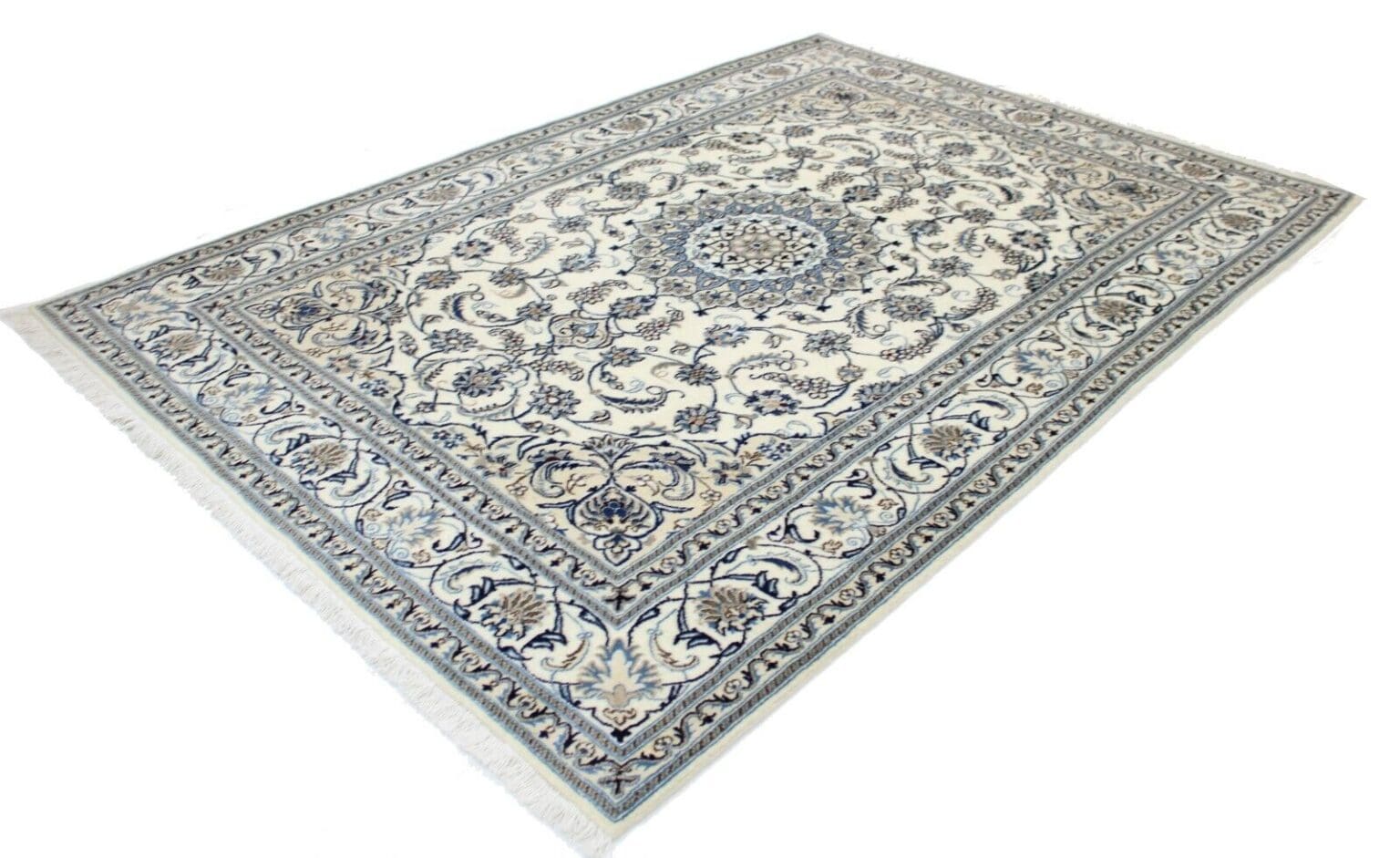
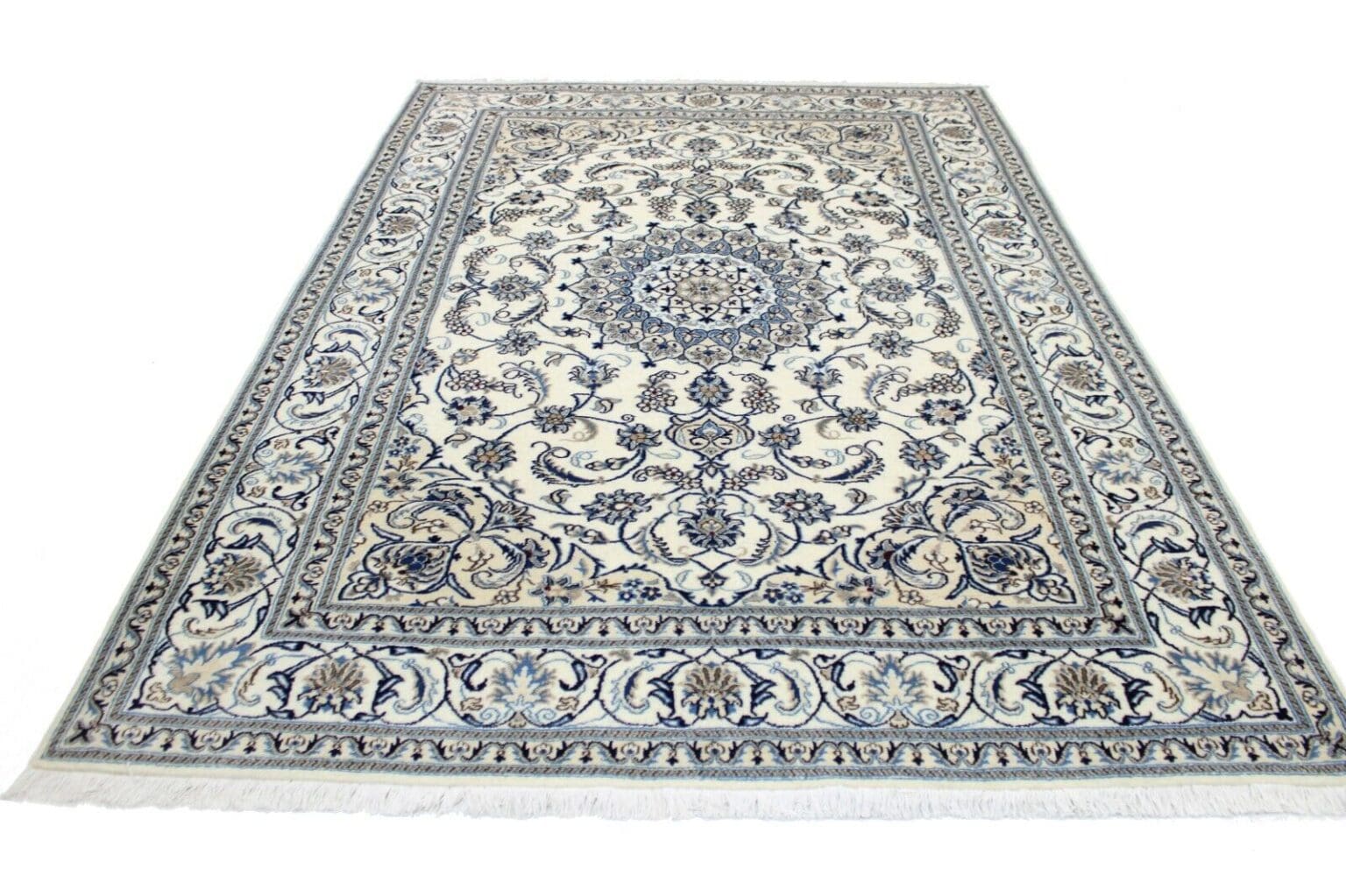
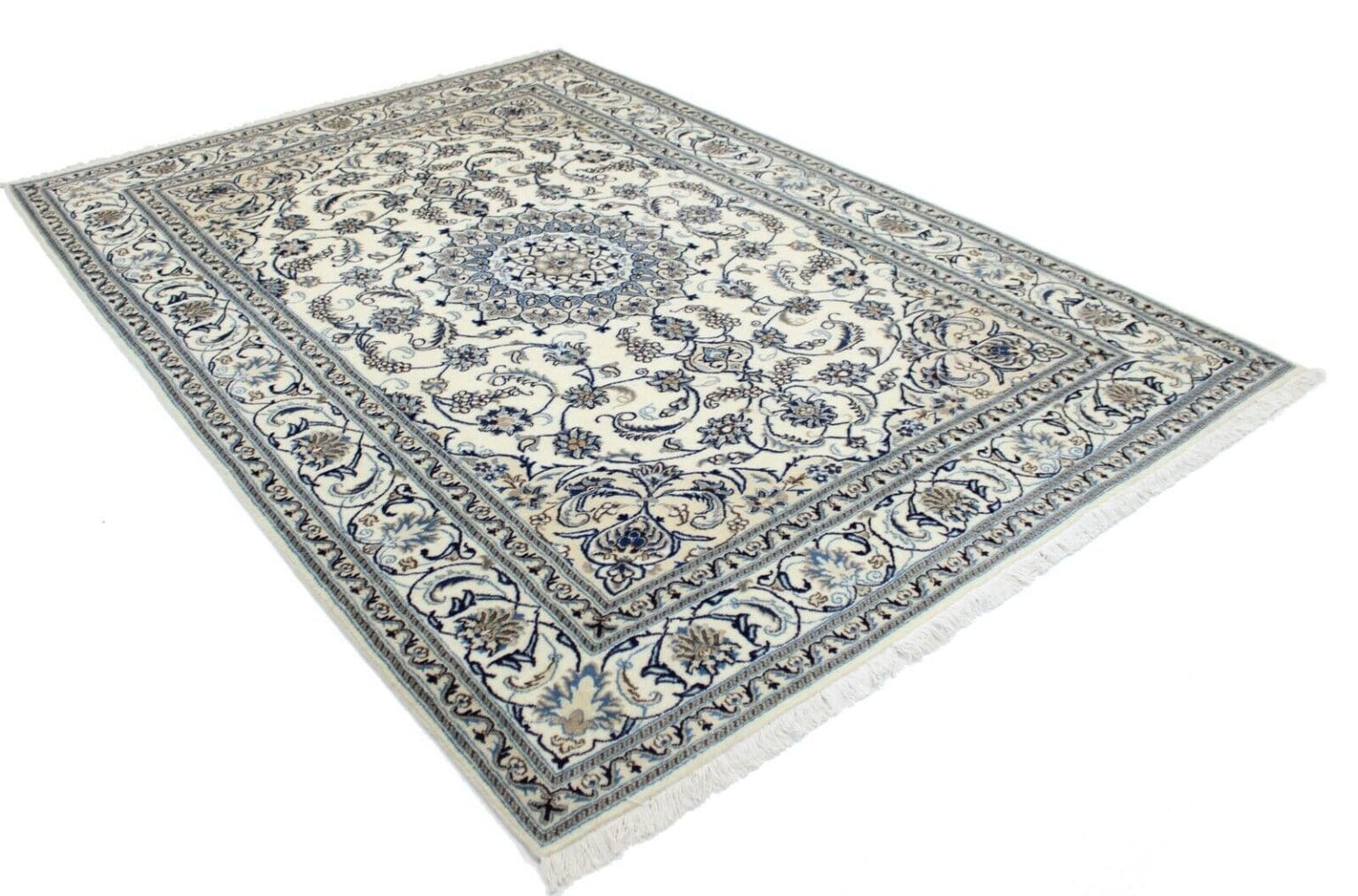
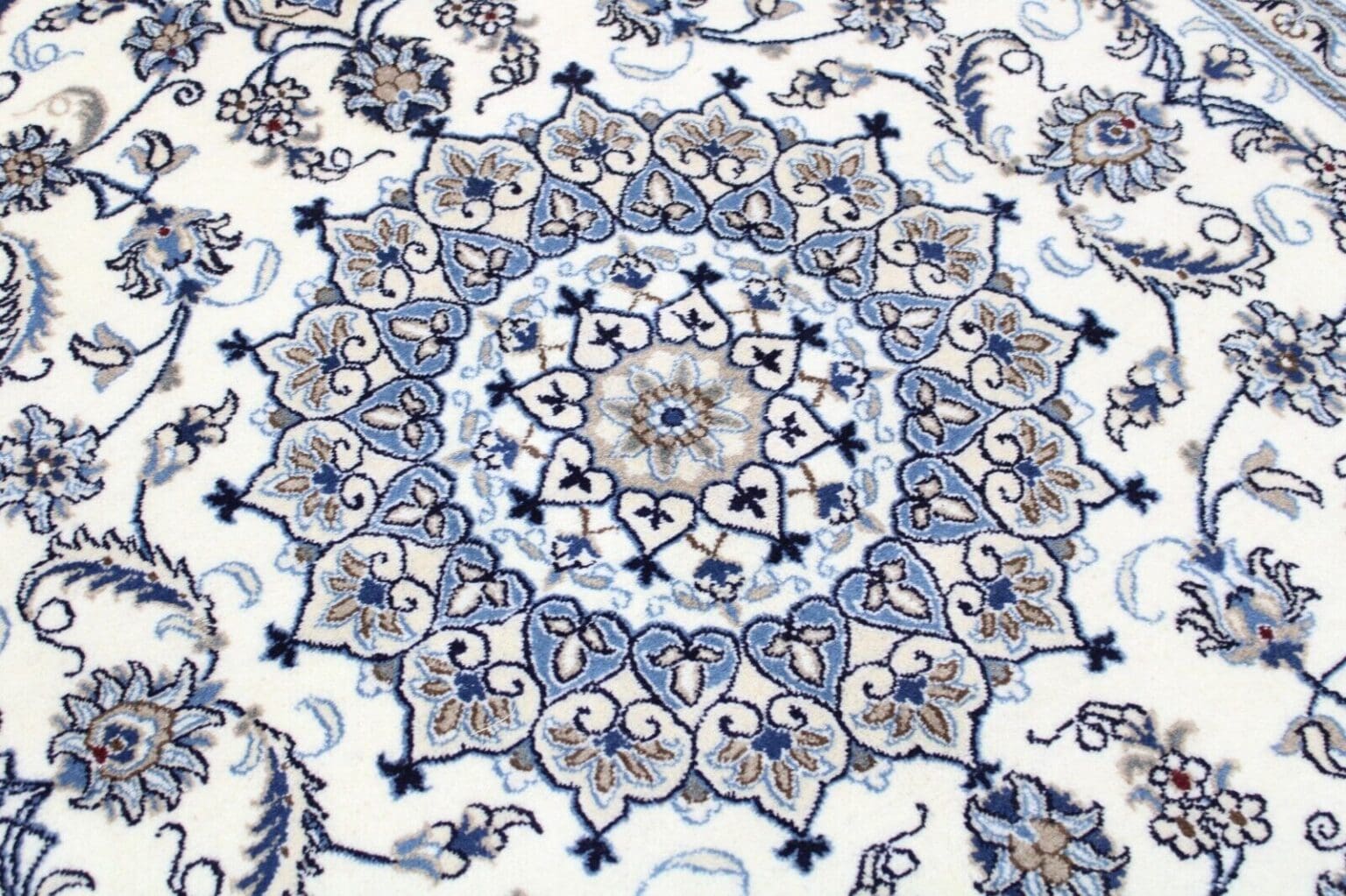
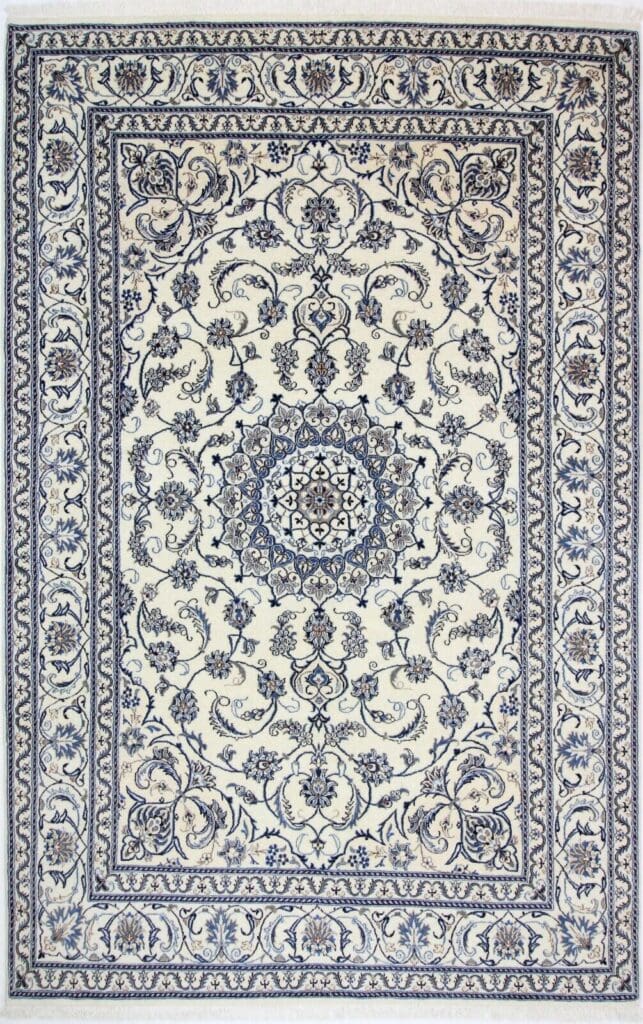
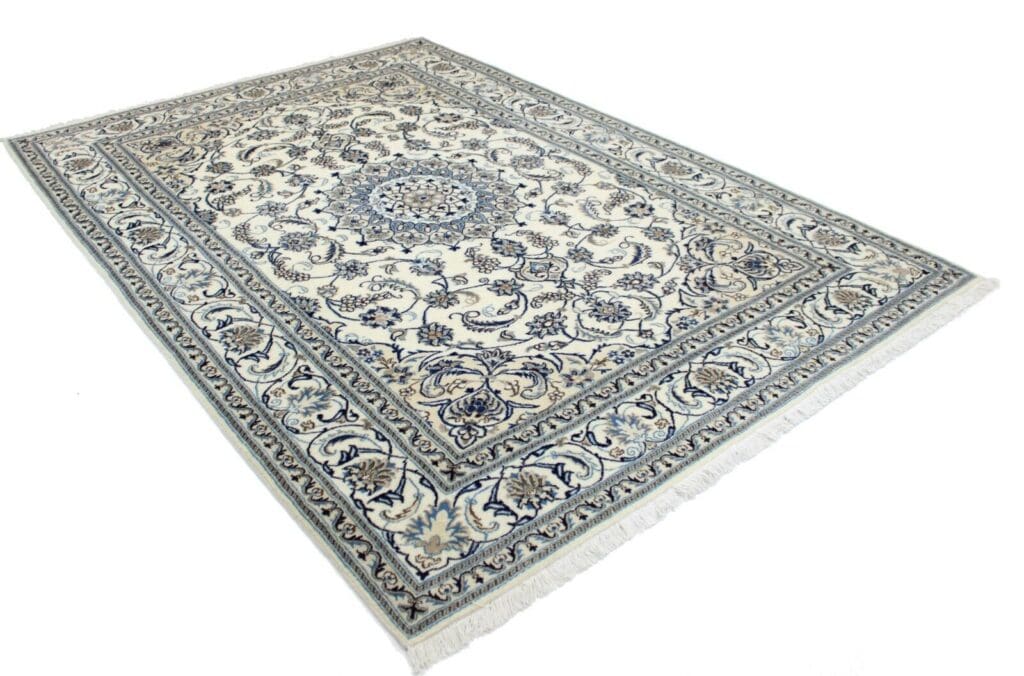
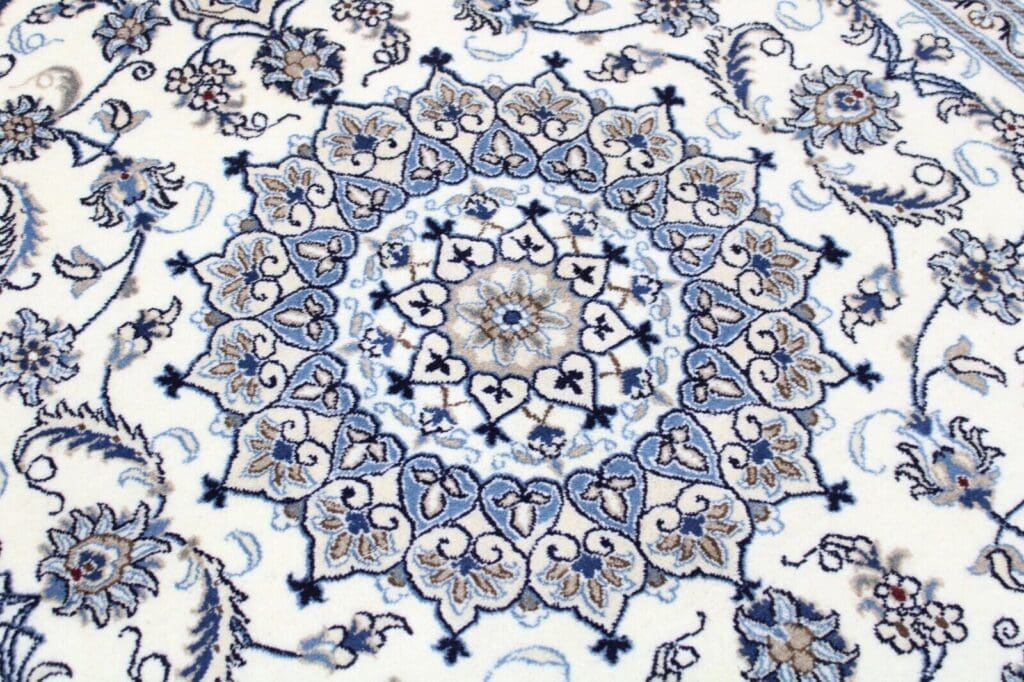
The pattern is described as oriental with floral motifs. Floral ornament is therefore the main visual feature named for this rug. In Persian rug design, flowers may appear as individual emblems, repeated blossoms, scrolling vines or elements of a more formally arranged composition. In each case, the forms are created as part of the knotting rather than printed onto the pile after manufacture.
A floral Persian design can bring together blossoms, leaves, vines and smaller filler elements. These components divide open areas and lead the eye through the composition. Some designs are organised around a clear central field, while others rely on a repeated rhythm across the surface. The precise arrangement of the flowers on this individual rug is not expanded beyond the description oriental with floral motifs, so no additional claim about a medallion, border layout or colour palette is made here.
Traditional Persian pattern language includes both floral and geometric structures. Floral forms do not necessarily reproduce nature literally. They can be stylised, mirrored, repeated or arranged according to a clear rhythm. Once translated into textile symbols, blossoms and leaves become part of a decorative system that remains legible across the rug. Hand-knotting allows those elements to be built gradually, with each knot contributing to an outline, a field or a transition.
Many Persian compositions use several visual zones, such as an inner field and surrounding borders. This is a general feature of Persian design and is not presented as an additional specification of this particular rug. It helps explain why floral patterns often appear ordered rather than random. Borders can frame the inner design, while smaller ornaments connect larger shapes and prevent the composition from losing its visual continuity.
Floral motifs can perform several functions in Persian ornament. A blossom may stand alone as a clearly defined sign or form part of a scrolling vine. Leaves may establish direction, fill spaces and connect larger shapes. Repetition creates rhythm, while variations in scale establish relationships between major and minor forms. These are general principles of floral rug design and do not add unlisted details to the drawing of this individual piece.
The classification traditional Persian or oriental describes the stylistic context supplied for the rug. It refers to a design tradition developed over generations and interpreted differently in individual Iranian regions. Nain represents one regional expression within Persian rug culture. Floral motifs belong to this wider vocabulary because flowers, leaves and scrolling forms are recurring elements in oriental textile design.
In an interior, a floral rug can be read in different ways. It may complement traditionally furnished surroundings or provide a patterned textile counterpoint in a more restrained setting. Those are general possibilities of floral rug design, not a promise about a particular room. The specific description remains decisive: this is a hand-knotted Nain Persian rug from Iran with an oriental floral pattern.
Developing a pattern during knotting requires close attention to the planned sequence. Small variations are part of the nature of work carried out by hand and do not change the rug’s basic classification. They distinguish a hand-made textile from a mechanically printed surface, where the image is applied in a separate industrial step. Here, the pattern belongs directly to the construction of the rug.
In Persian design, ornament and construction work together. The sequence of knots influences how a narrow line is formed and how clearly a motif stands apart from the surrounding field. Small contours require a different progression from broad areas. The design is therefore not separate from the manufacturing process but grows out of it. The floral description identifies the visible language without adding unlisted information about colours or individual ornaments.
Special Features
The rug is described as new without a label and in top condition. This condition statement applies to the individual item. No age or production year is given, so no historical date is assigned. No signature, certificate number or additional provenance document is specified. The description identifies it as an original Persian rug and gives Iran, Nain region as its origin.
Its listed practical feature is suitability for underfloor heating. The rug is therefore intended for use on a floor equipped with that type of heating. The surface should be clean and level, and the usual care for a textile floor covering remains advisable. Regular removal of dust and avoidance of strong direct sunlight support even wear and help protect the appearance of the wool pile.
For routine care, gentle vacuuming is recommended. Fresh stains should be treated promptly with a damp cloth and a mild cleaning agent. Rubbing aggressively can affect the pile and should be avoided. Larger or persistent stains are best handled by a professional rug cleaner who can take the hand-knotted construction and the listed materials into account. These care points complement, but do not expand, the stated suitability for underfloor heating.
The special features named for this offer are therefore the combination of several explicit details: it is an original Persian rug from the Nain region of Iran, a hand-knotted piece made with wool and cotton, a rug with an oriental floral pattern, and an item described as new without a label and in top condition. No further individual characteristics are added. Suitability for underfloor heating is also part of the stated practical information.
FAQ
How should I care for my Nain Persian rug?
Vacuum the rug regularly and gently so that dust and loose dirt do not remain in the wool pile. It is best to avoid direct sunlight for long periods, as strong light can affect textile colours unevenly. Treat fresh stains promptly with a damp cloth and a mild cleaning product, without rubbing forcefully. For heavier soiling, professional rug cleaning is the appropriate option. A specialist can take the hand-knotted construction, wool pile and cotton warp into account during the cleaning process.
How can I identify a genuine hand-knotted Persian rug?
Look at the workmanship, the detail of the design and the materials used. The back of a hand-knotted rug provides useful visual information: individual knots can be seen, and their arrangement is not perfectly uniform in the way a machine-made product often is. The design is created through the knotting itself rather than applied as a printed surface. For this rug, the stated hand-knotted construction, wool and cotton materials, and origin in the Nain region of Iran are part of its product description.
Is this rug suitable for underfloor heating?
Yes. The product description states that it is suitable for underfloor heating. For use, the floor should be clean, level and dry, and the instructions for the particular heating system should be followed. Avoiding prolonged, intense direct sunlight is also sensible for textile floor coverings. The hand-knotted wool pile with cotton warp should be maintained gently and vacuumed regularly so that the surface and floral design remain in good condition.
To provide the best experiences, we use technologies like cookies to store and/or access device information. Consenting to these technologies will allow us to process data such as browsing behavior or unique IDs on this site. Not consenting or withdrawing consent, may adversely affect certain features and functions.
Functional Always active
The technical storage or access is strictly necessary for the legitimate purpose of enabling the use of a specific service explicitly requested by the subscriber or user, or for the sole purpose of carrying out the transmission of a communication over an electronic communications network.
Preferences
The technical storage or access is necessary for the legitimate purpose of storing preferences that are not requested by the subscriber or user.
Statistics
The technical storage or access that is used exclusively for statistical purposes.The technical storage or access that is used exclusively for anonymous statistical purposes. Without a subpoena, voluntary compliance on the part of your Internet Service Provider, or additional records from a third party, information stored or retrieved for this purpose alone cannot usually be used to identify you.
Marketing
The technical storage or access is required to create user profiles to send advertising, or to track the user on a website or across several websites for similar marketing purposes.
 SECURE PAYMENT
 SHIPPING PARTNERS


