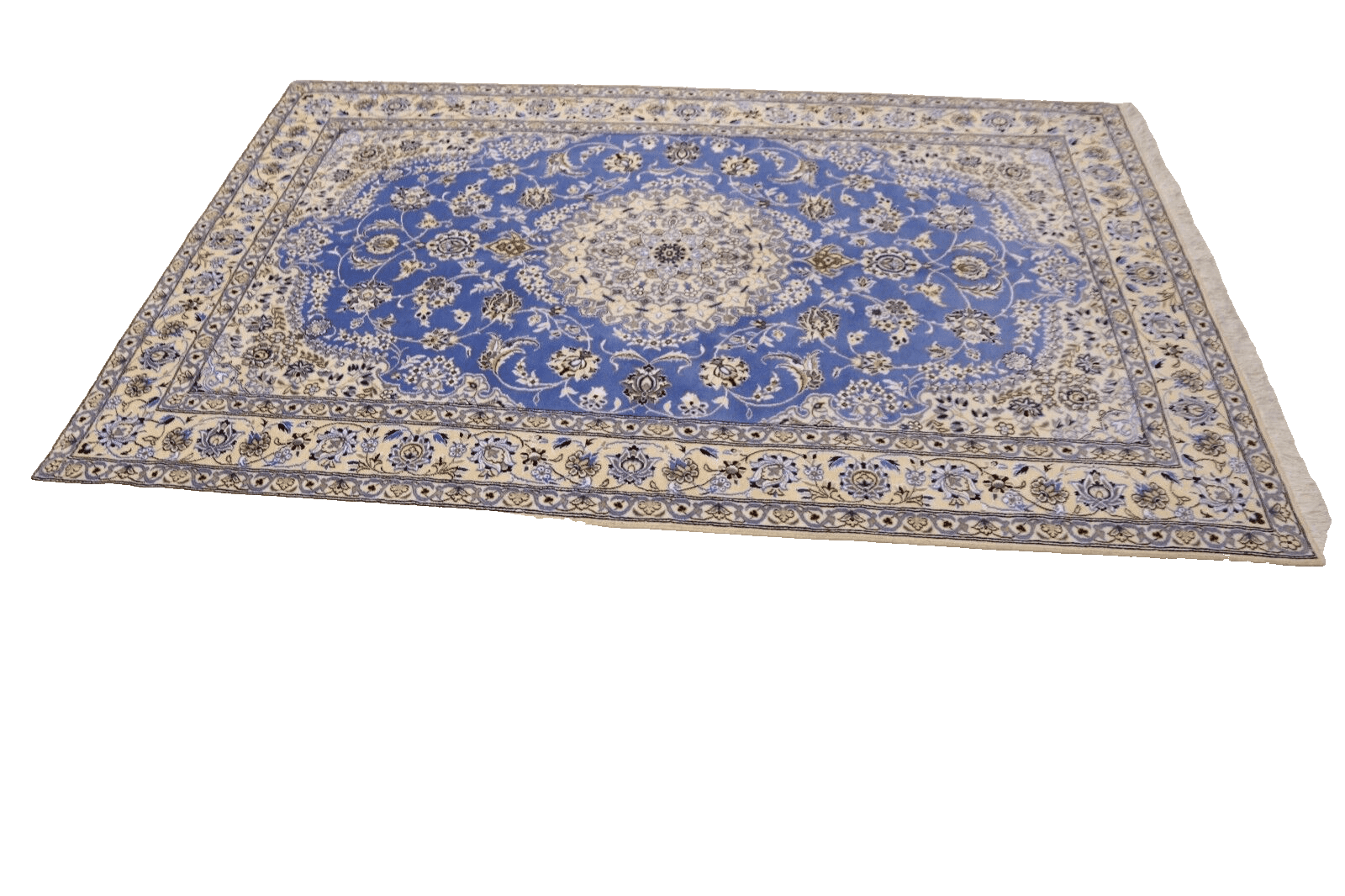
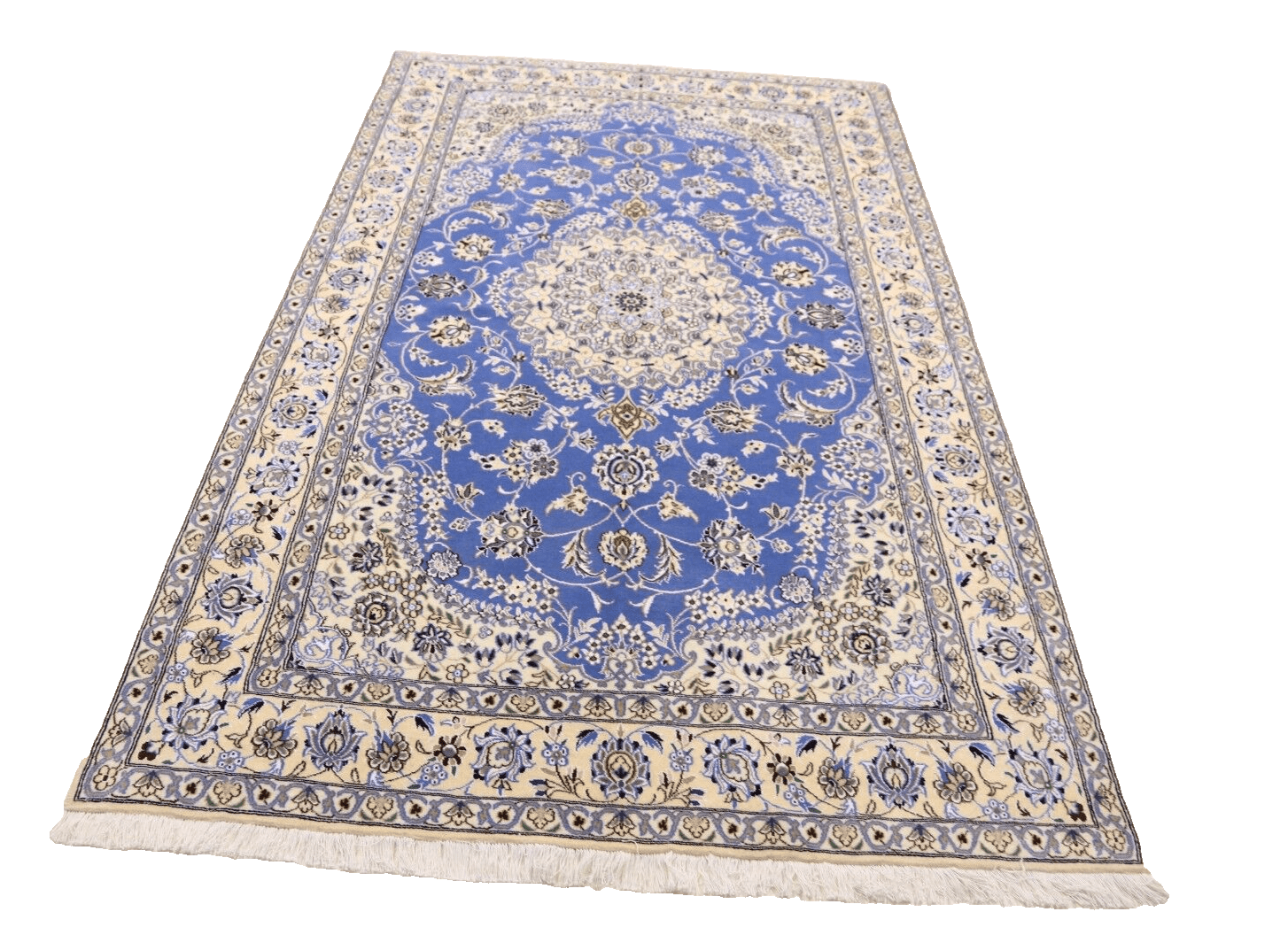
This Nain Persian rug is made from 90% virgin wool and 10% silk. The combination brings together the practical qualities of wool with the refined character of silk. Virgin wool is known for its ability to retain warmth and for its soft, resilient structure. In this rug, it forms the principal pile material and gives the surface a pleasant handle. Silk contributes a subtle sheen and a smoother accent to the composition, adding visual variation without changing the traditional character of the rug.
The rug was produced using traditional hand-knotting methods. Hand-knotting is a method in which individual knots are tied by hand around the warp, row by row, before the pile is trimmed and finished. This process allows the weaver to render fine contours, small ornamental details and carefully balanced transitions in the pattern. It also means that the completed piece is made as a one-off rather than as a mechanically repeated floor covering.
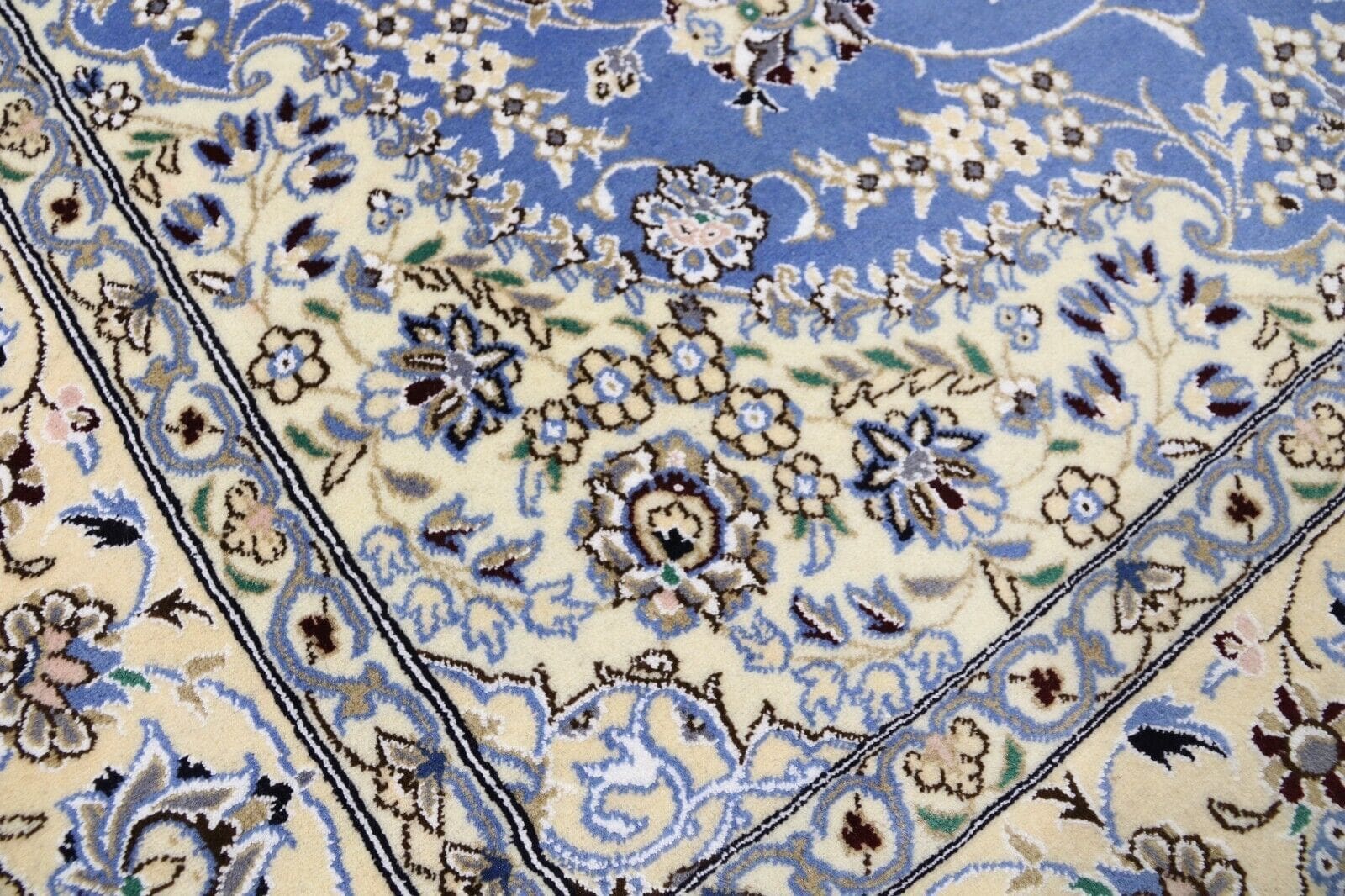
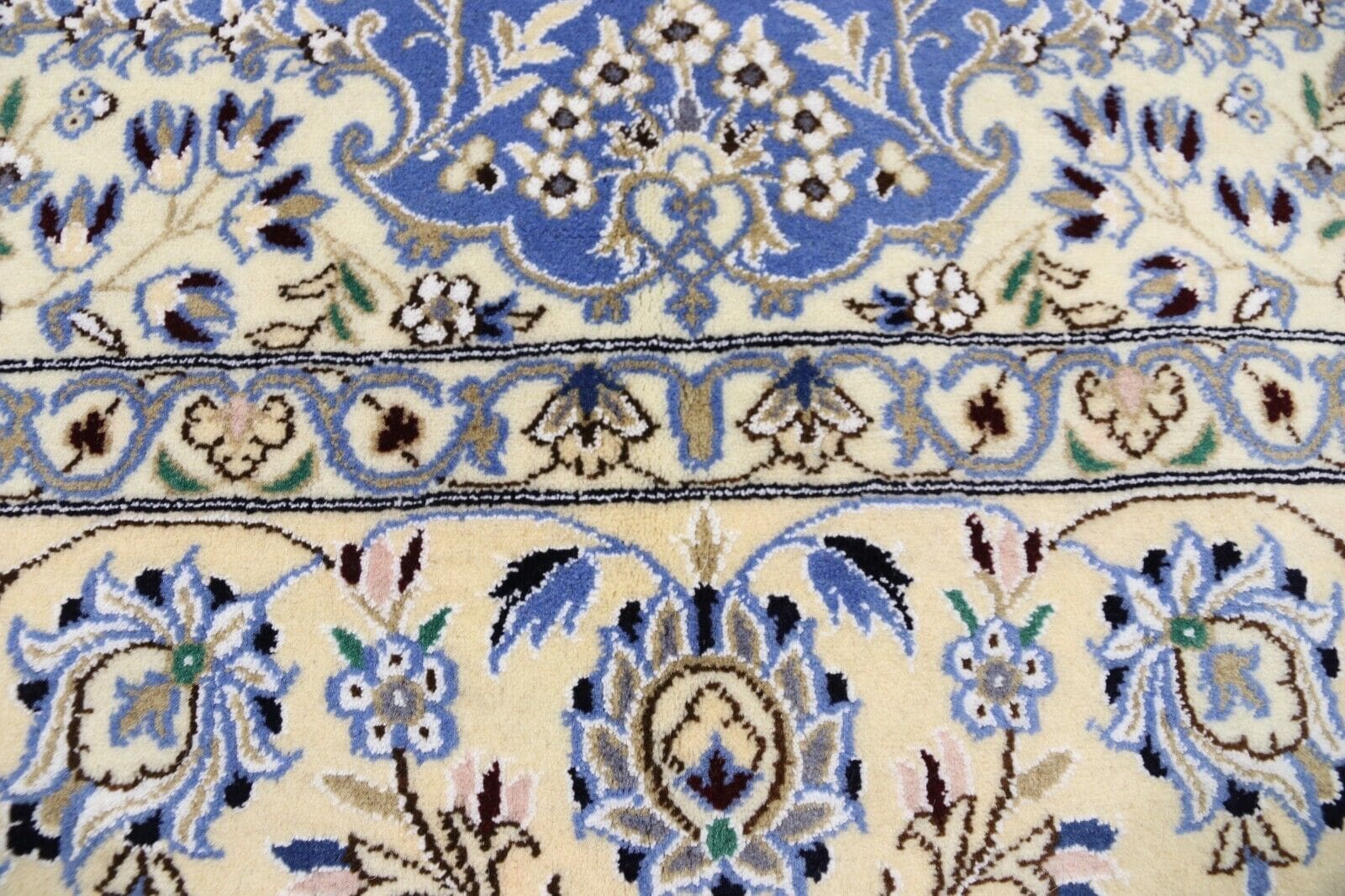
Its knot density is approximately 500,000 knots per square metre. A fine knot structure supports the precise execution of detailed motifs and helps create a clearly defined surface. It is one of the characteristics associated with finely knotted Nain rugs. The combination of a detailed construction, virgin wool and silk gives the rug a balance of softness, warmth, surface sheen and durable everyday structure.
The rug is described as new. Its traditional construction and carefully selected materials are presented together as the defining elements of the piece. Wool and silk also respond differently to light, so the pile can show restrained changes in surface appearance as the direction of the fibres shifts. This is a normal visual effect of the materials and of hand-finished pile.
Origin and Tradition
This rug comes from Nain, a city in Iran known for its carpet production. Nain has an established place in the tradition of Persian weaving, with a reputation for finely worked carpets and carefully controlled ornament. The region’s weaving culture is connected to the broader history of Iranian textile craftsmanship, in which carpets serve both practical and decorative purposes. Designs are developed through knowledge passed between generations, while the hand-knotting process preserves the direct involvement of the weaver in every stage of construction.
Nain rugs are associated with fine materials, precise workmanship and patterns in which the elements are arranged with a strong sense of order. Their appearance often depends on the relationship between a central composition, a surrounding field and a border system. Rather than relying on irregular placement, many traditional Nain designs use measured repeats, balanced axes and clear ornamental outlines. This structure makes the design legible across the entire field and allows small details to remain part of the overall composition.
The history of Nain weaving belongs within the long development of Persian carpet art in Iran. Iranian carpets are created in many different regional traditions, each with its own approach to colour, drawing, knotting and proportion. Nain is recognised as one of the places where delicate materials and detailed designs are brought together. Local expertise is expressed not only in the choice of motifs but also in the control of tension, knot placement, pile finishing and the relationship between the field and the border.
Traditional Nain carpets are often connected with calm, harmonious colour arrangements and fine ornamental drawing. The source description places this rug within that Nain tradition and identifies it as an authentic product from Iran, specifically from the city of Nain. The designation is therefore a statement of origin, while the decorative vocabulary reflects the wider heritage of Persian carpet design. Natural dyes are frequently discussed in connection with traditional Iranian weaving, where colour is selected to support the balance of the pattern and the character of the finished textile.
Hand-knotting also gives the regional tradition a material dimension. The design is not simply printed or applied to a finished base; it is built through the repeated placement of coloured yarns. Every section of the drawing must be interpreted during the weaving process. This explains why the tradition places such importance on precision, patience and knowledge of established pattern structures. The result is a textile that records both a regional design language and the physical work of its maker.
Design and Pattern
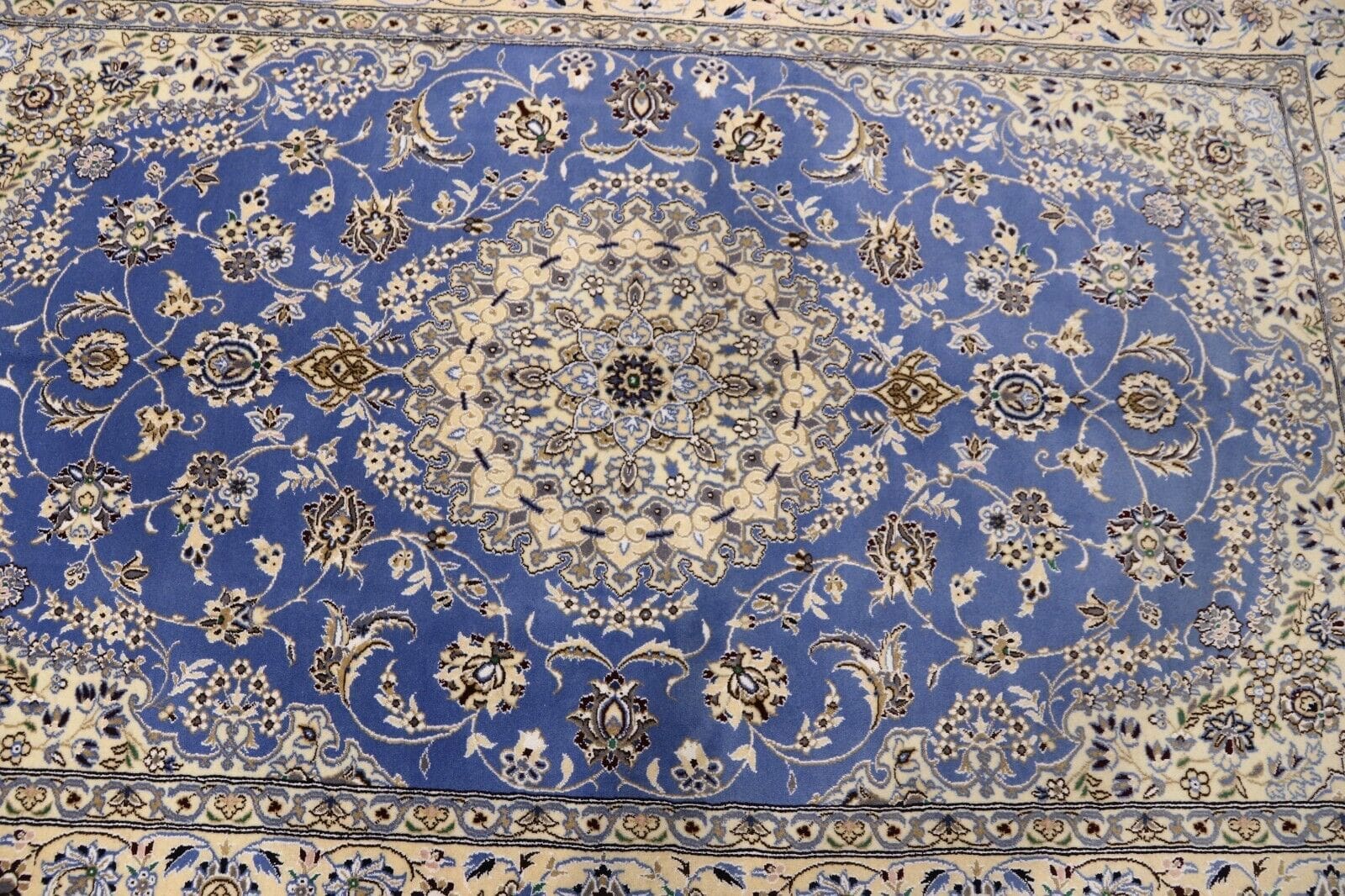
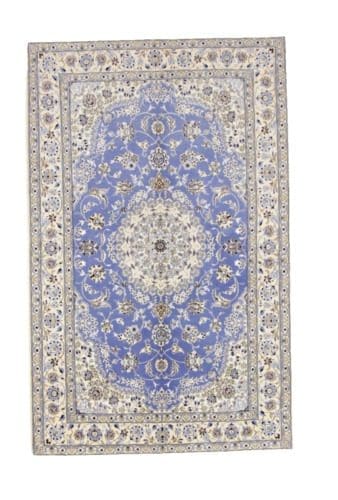
The rug has an elegant pattern inspired by nature and by traditional ornamental elements of Persian culture. Floral references and geometric forms are identified as part of this design vocabulary. These two groups of motifs can work together in a Persian composition: floral elements provide flowing lines and organic movement, while geometric details establish rhythm, balance and visual structure. The resulting pattern belongs to a tradition in which natural forms are interpreted rather than copied literally.
Floral ornament has a long history in Persian carpet design. Leaves, blossoms, stems and scrolling branches may be arranged symmetrically, repeated across a field or integrated into a larger medallion and border system. Such motifs are not merely isolated decorations. Their scale, direction and spacing help guide the eye through the composition. In finely drawn rugs, the outlines and internal details of the flowers are especially important because they give the surface its distinctive degree of definition.
Geometric forms provide another layer of organisation. Repeated shapes, balanced compartments and regular borders can frame the more organic floral elements and create a clear relationship between the centre and the edges. Geometry in Persian carpets does not necessarily mean a stark or purely angular appearance. It can appear through symmetry, measured repetition and the controlled spacing of ornament. This allows the design to remain orderly while retaining the softness associated with floral drawing.
The colour arrangement is described as harmonious and the overall pattern as timeless. A harmonious palette supports the separation of the motifs without making the design feel fragmented. It also allows the detailed construction of the pile to remain visible. The pattern is intended to create a calm and appealing atmosphere, while its traditional references connect the rug with Iranian cultural history. The design therefore combines decorative function with the symbolic dimension commonly associated with Persian ornament.
Nature-inspired motifs and traditional geometric elements are often used to express ideas of continuity, balance and connection between the built environment and the natural world. In Persian decorative culture, ornament can carry meanings that go beyond surface decoration, reflecting cultural values and inherited artistic forms. This rug is described in those terms: its floral and geometric language brings a sense of tradition into the living space while maintaining an orderly, adaptable appearance.
The pattern can be read as a carefully structured composition rather than as a random arrangement of individual details. The fine knotting supports the drawing by allowing smaller elements and controlled contours to be represented with clarity. At the same time, the combination of wool and silk can create slight differences in texture and reflection across the ornamental surface. These material effects contribute to the way the pattern is perceived as the light changes.
Special Features
The defining features of this rug are its Nain origin, traditional hand-knotted construction, fine knot density, and combination of virgin wool with silk. The rug is new and is described as an authentic Persian rug from Iran, specifically from Nain. Its detailed design, elegant appearance and balanced ornamental language allow it to be used in both modern and classical interiors.
The materials also give the piece a combination of comfort and visual refinement. Wool provides warmth and a soft surface, while silk introduces a subtle sheen. The hand-knotted structure makes the rug a durable textile that can remain part of an interior over an extended period when it is cared for appropriately. The source description presents a Nain Persian rug not only as a furnishing element but also as a piece of Persian carpet craftsmanship that may be passed on through generations.
For care, regular vacuuming without a brush attachment is recommended. Spills should be addressed immediately with a soft, damp cloth rather than being allowed to remain in the pile. Professional cleaning is recommended when a more thorough cleaning is needed, since a specialist can handle the wool and silk construction with suitable methods. The rug can also be used over underfloor heating; its materials and thickness are described as suitable for conducting warmth without impairing its function.
FAQ
How should I care for this Persian rug?
Vacuum the rug regularly without using a brush attachment, so the pile is cleaned without unnecessary mechanical action. If a stain or spill occurs, remove it promptly with a soft, damp cloth. For a complete or particularly careful cleaning, professional rug cleaning is recommended. Specialist treatment is appropriate for a hand-knotted construction made from virgin wool and silk and helps preserve the appearance and serviceability of the rug.
Is this an authentic Persian rug?
Yes. This is described as an authentic Persian rug from Iran, specifically from the city of Nain. It was made using traditional hand-knotting methods. The Nain origin, the Iranian production and the hand-knotted construction place the piece within the established tradition of Persian carpet craftsmanship. Its fine knot structure, wool and silk materials, and traditional ornamental design are consistent with the character attributed to Nain rugs.
Can the rug be used over underfloor heating?
Yes, the rug can be used over underfloor heating. Its materials and thickness are described as suitable for conducting warmth, so its use does not present a functional concern in this respect. As with any hand-knotted rug, the surrounding floor and the heating system should be used in their normal intended manner, while the rug itself can remain in place above the heated floor.
To provide the best experiences, we use technologies like cookies to store and/or access device information. Consenting to these technologies will allow us to process data such as browsing behavior or unique IDs on this site. Not consenting or withdrawing consent, may adversely affect certain features and functions.
Functional Always active
The technical storage or access is strictly necessary for the legitimate purpose of enabling the use of a specific service explicitly requested by the subscriber or user, or for the sole purpose of carrying out the transmission of a communication over an electronic communications network.
Preferences
The technical storage or access is necessary for the legitimate purpose of storing preferences that are not requested by the subscriber or user.
Statistics
The technical storage or access that is used exclusively for statistical purposes.The technical storage or access that is used exclusively for anonymous statistical purposes. Without a subpoena, voluntary compliance on the part of your Internet Service Provider, or additional records from a third party, information stored or retrieved for this purpose alone cannot usually be used to identify you.
Marketing
The technical storage or access is required to create user profiles to send advertising, or to track the user on a website or across several websites for similar marketing purposes.

 SECURE PAYMENT
 SHIPPING PARTNERS


