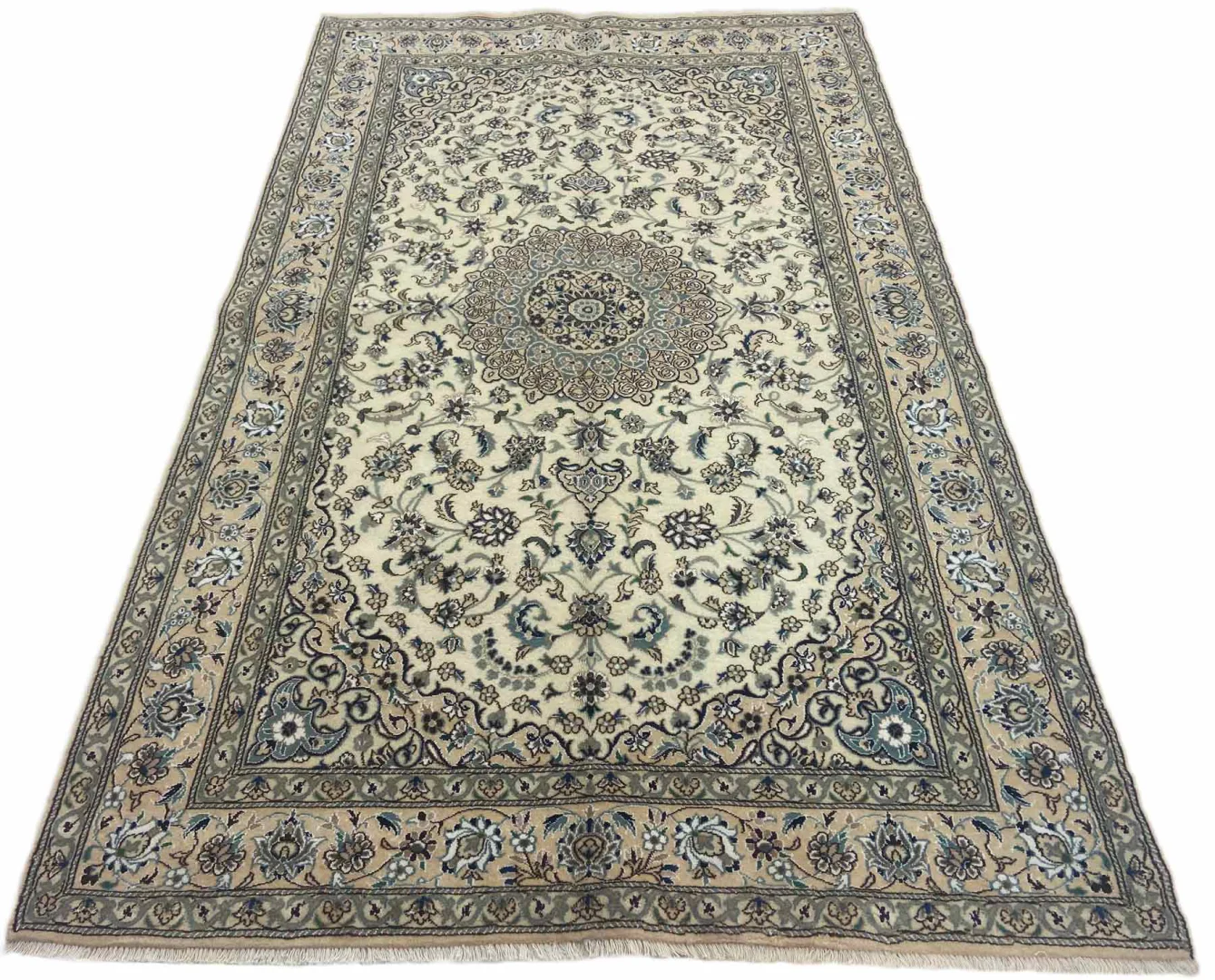
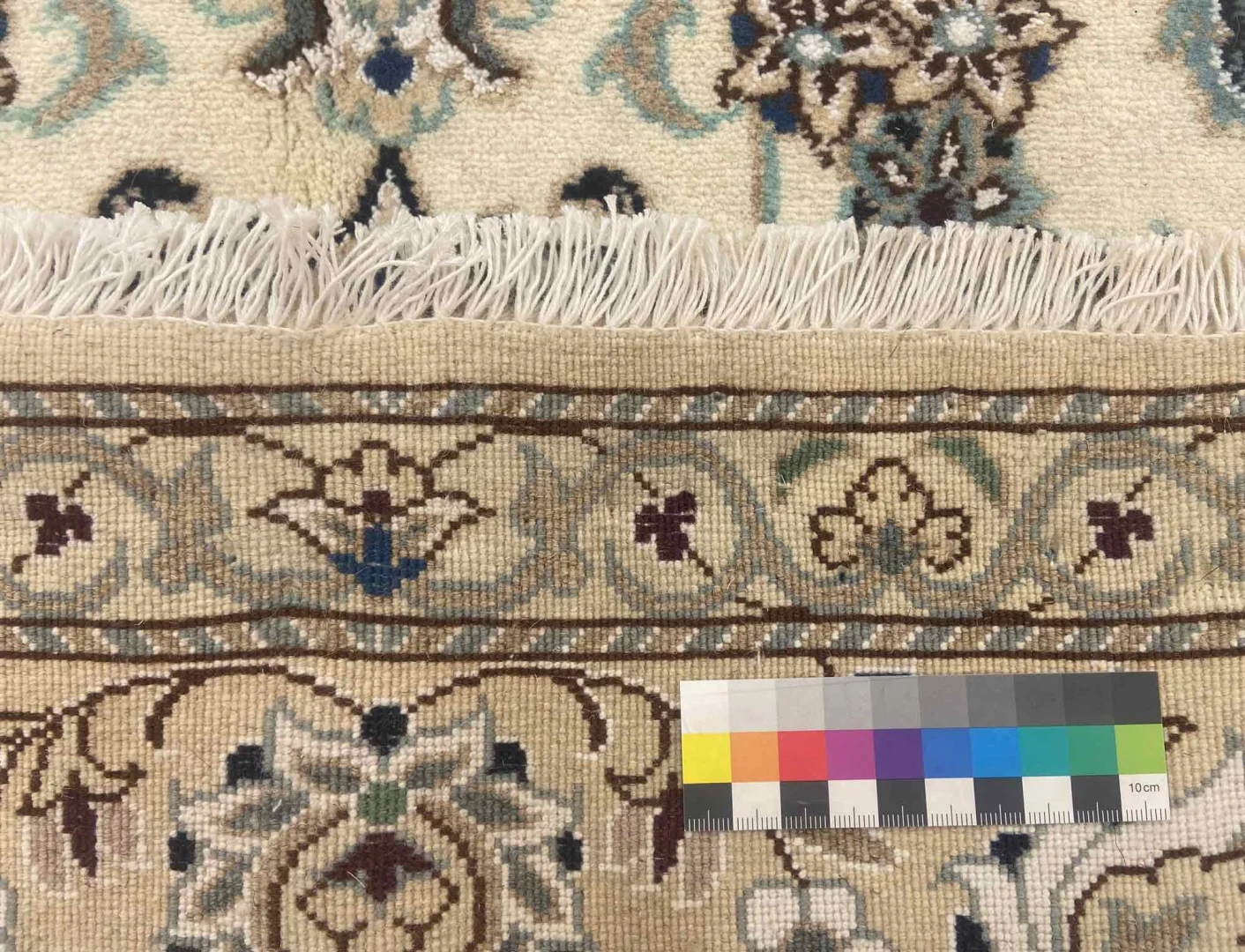
This Nain Persian rug is hand-knotted. Its pile is described as high-quality wool with silk accents. The combination belongs to the established material tradition of finely made Nain rugs. Wool provides the main textile body of the pile, while silk accents can give selected areas a finer surface and a restrained change in sheen. In a floral composition with a medallion, these contrasting materials can help distinguish outlines, small ornaments, and the central arrangement.
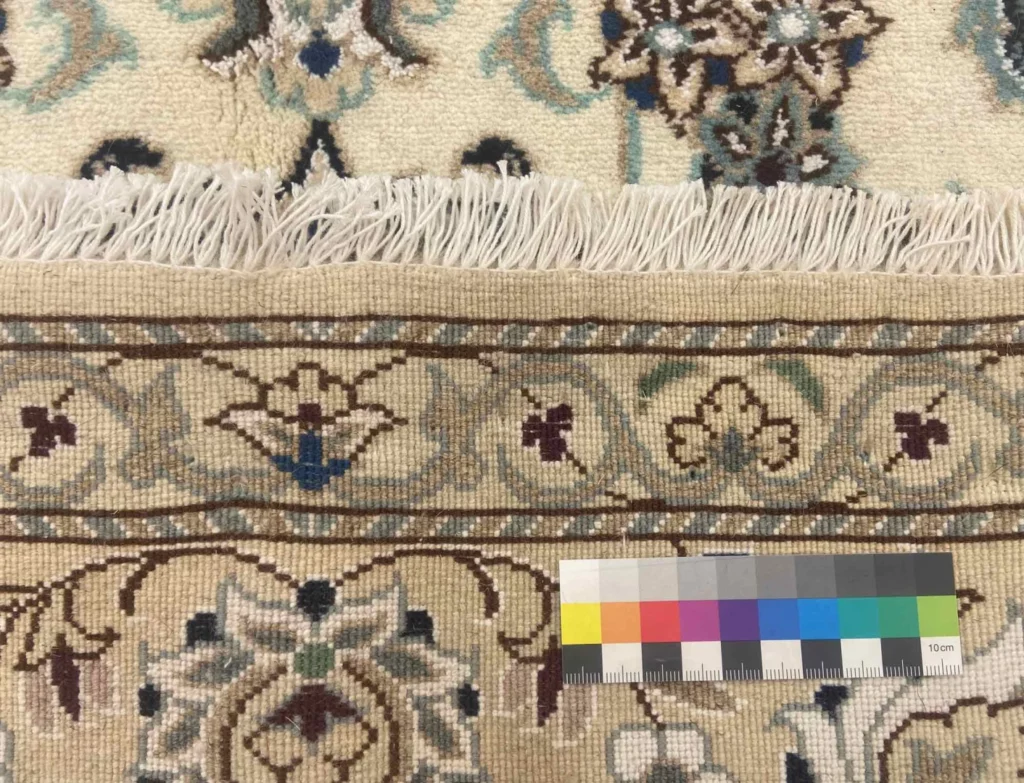
The designation 9La identifies a quality classification used in the Nain tradition. Nain qualities are associated with knot density and with the level of detail that can be achieved in the drawing. A dense construction makes it possible to articulate flowers, scrolling foliage, and the contours of a medallion with greater definition. Hand-knotting builds the design knot by knot on a loom. The pattern is therefore formed within the structure of the rug rather than printed onto a finished surface.
Wool has long been used in Persian rugs because of its resilient character and its ability to take colour clearly. Silk is often introduced in finer examples as an additional material. It can create a different response to light from that of wool, particularly when used for small highlights or delicate ornament. For this rug, the documented material is high-quality wool with silk accents. No further information about the warp or the precise construction of the foundation is provided.
Origin and Tradition
The rug comes from Nain in central Persia. Nain is a historic city within the Persian carpet landscape and is associated with a distinct weaving tradition. It lies in the wider cultural area of Isfahan, another important centre of Persian carpet production. The origin stated for this rug therefore connects it with central Persia and the Isfahan region without changing its specific Nain attribution.
Nain rugs developed as a recognizable branch of Persian weaving. They are commonly associated with light, lively colour schemes and finely organized floral compositions. Many designs arrange their decoration around a central medallion. Their character comes from the relationship between the field, the medallion, the border system, and the lines that connect the floral elements. This ordered structure distinguishes the Nain tradition from more freely arranged tribal designs.
The craft tradition of Nain depends on the controlled translation of a drawing into individual knots and colour areas. A design is built gradually as the weaver follows the planned arrangement across the loom. The more intricate the drawing, the more important a regular knot structure and precise contour work become. Lah is used in Nain to classify qualities and is linked with the fineness and density of the construction. Different Lah classifications allow different degrees of detail and visual delicacy in the finished pattern.
Isfahan is relevant to the regional setting, but it does not replace the stated origin of this piece. Isfahan has its own carpet tradition, including elaborate floral compositions and geometric organization. Nain, by contrast, is particularly associated with pale overall impressions, delicate floral lines, and medallion-based layouts. These traditions share the wider heritage of Persian weaving while remaining identifiable as separate regional approaches.
Persian carpet production involves a sequence of skilled operations. Yarns are prepared, the loom is set up, knots are tied, weft is inserted, and the surface is finished after the main weaving is complete. In a hand-knotted rug, the image emerges continuously during the knotting process. The reference to Nain consequently indicates both a place and a body of inherited knowledge about composition, materials, and construction.
Design and Pattern
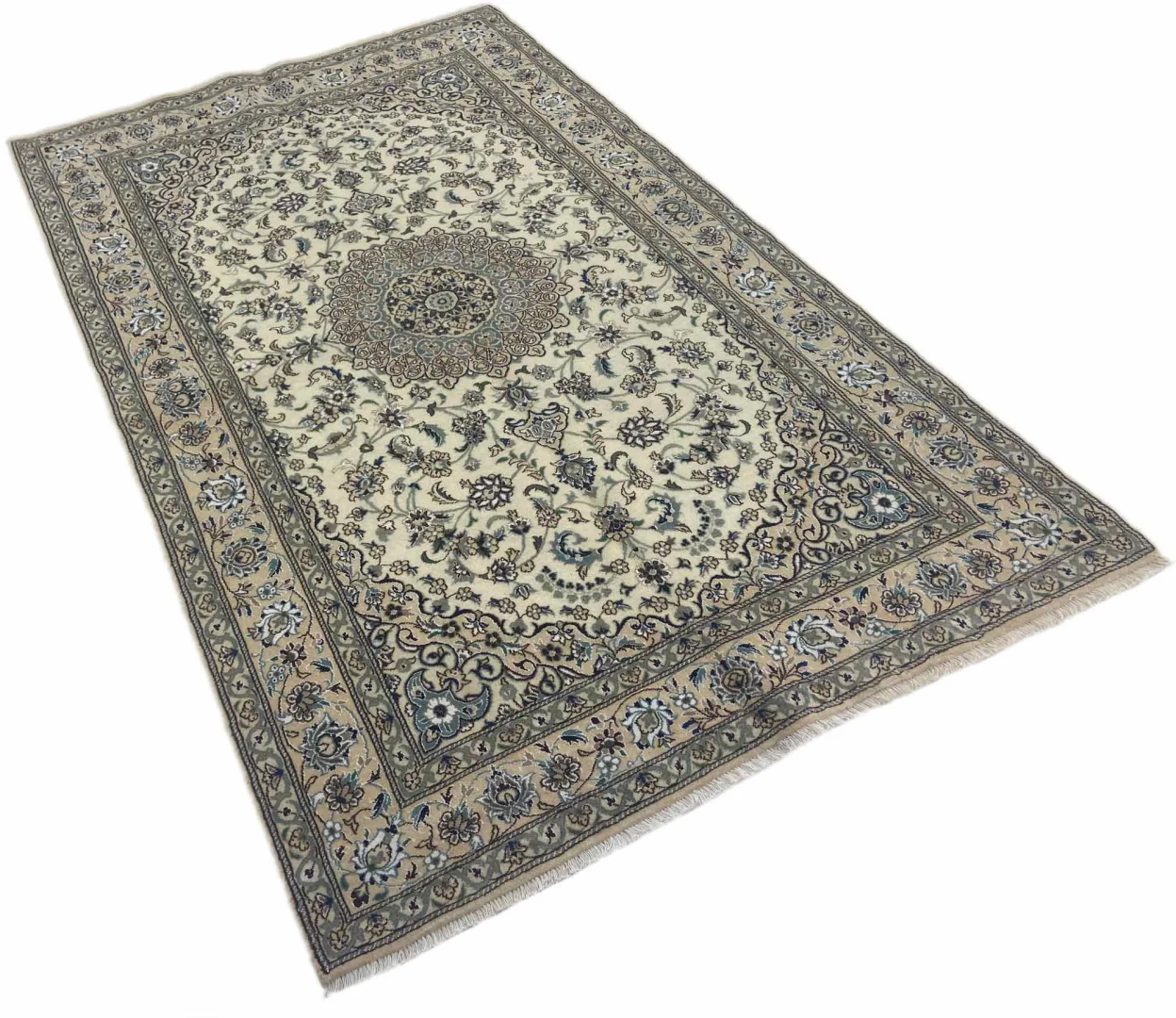
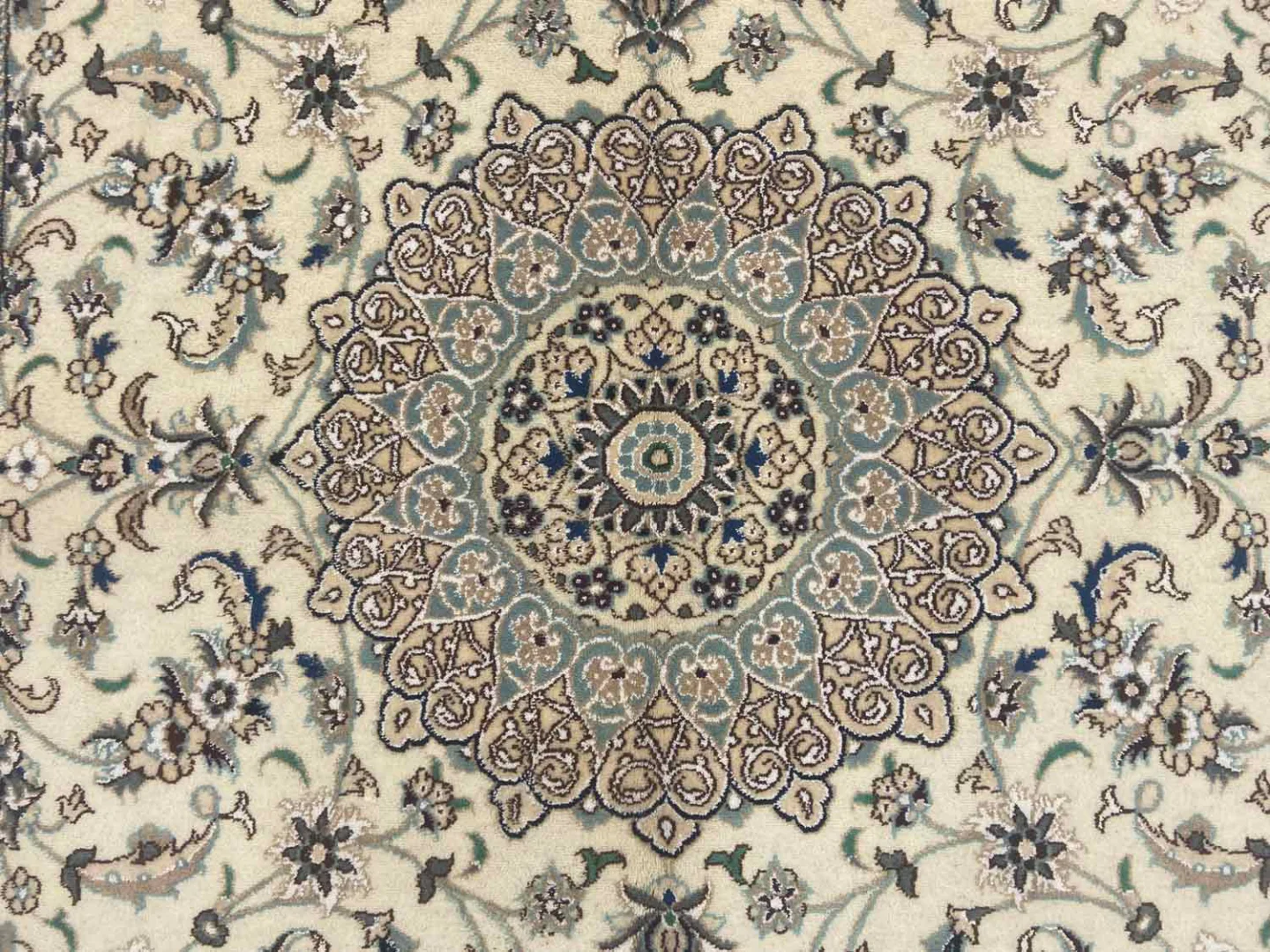
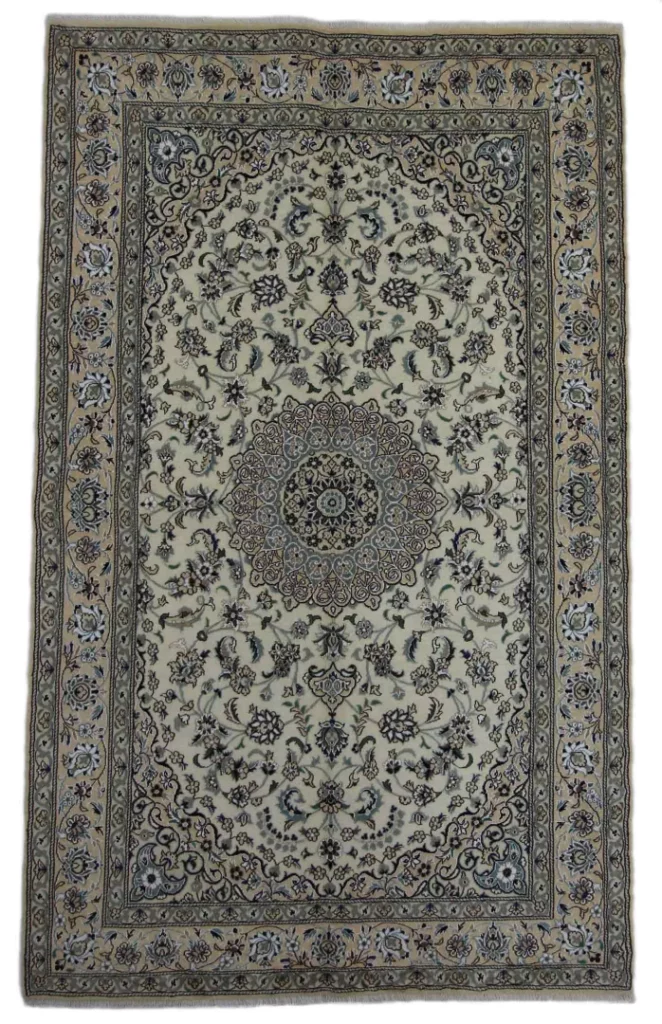
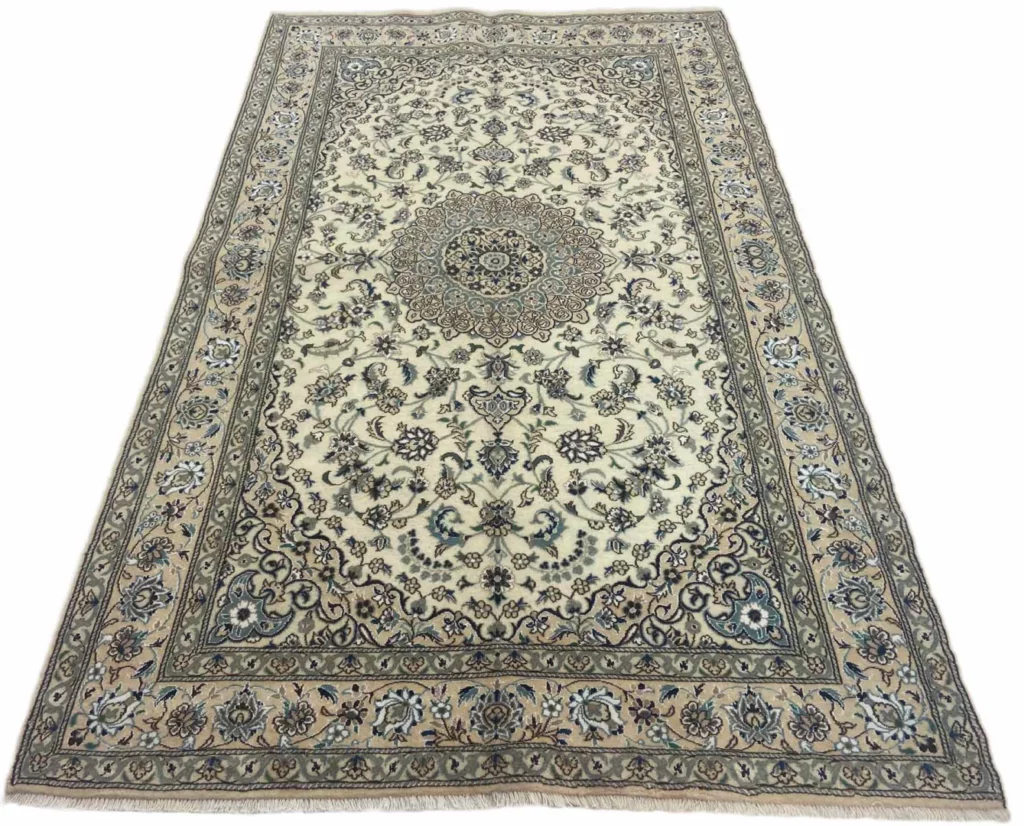
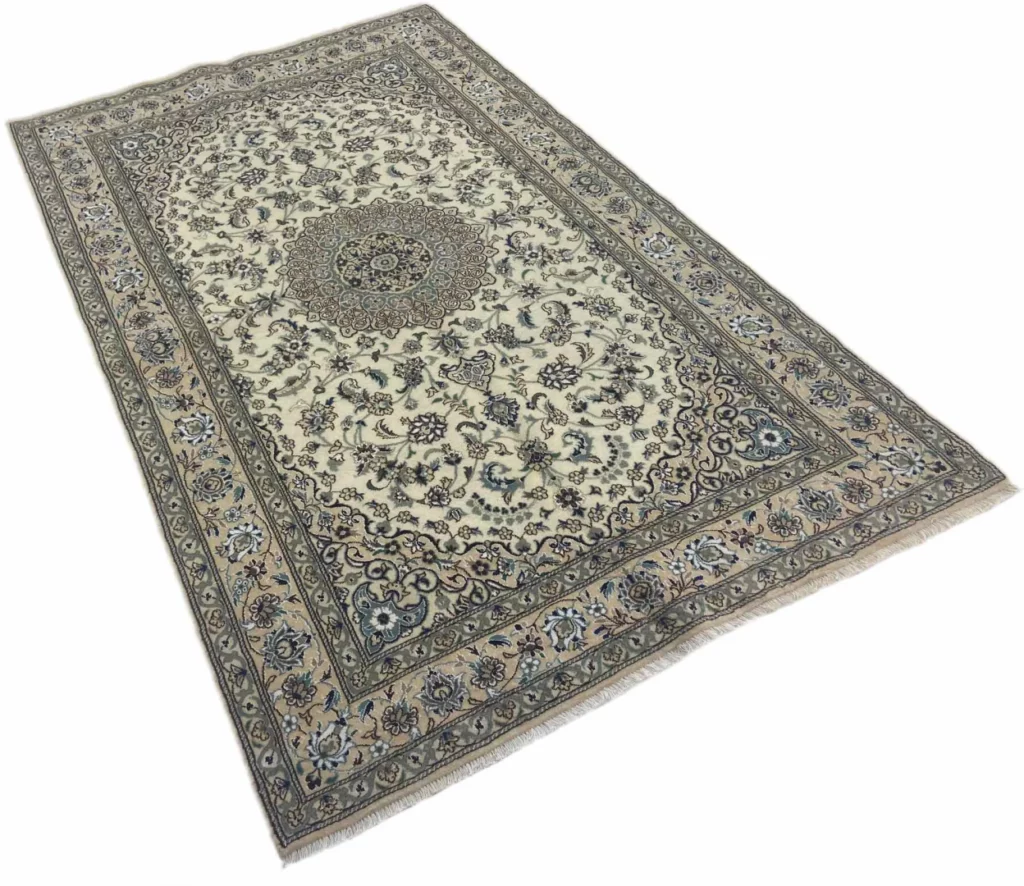
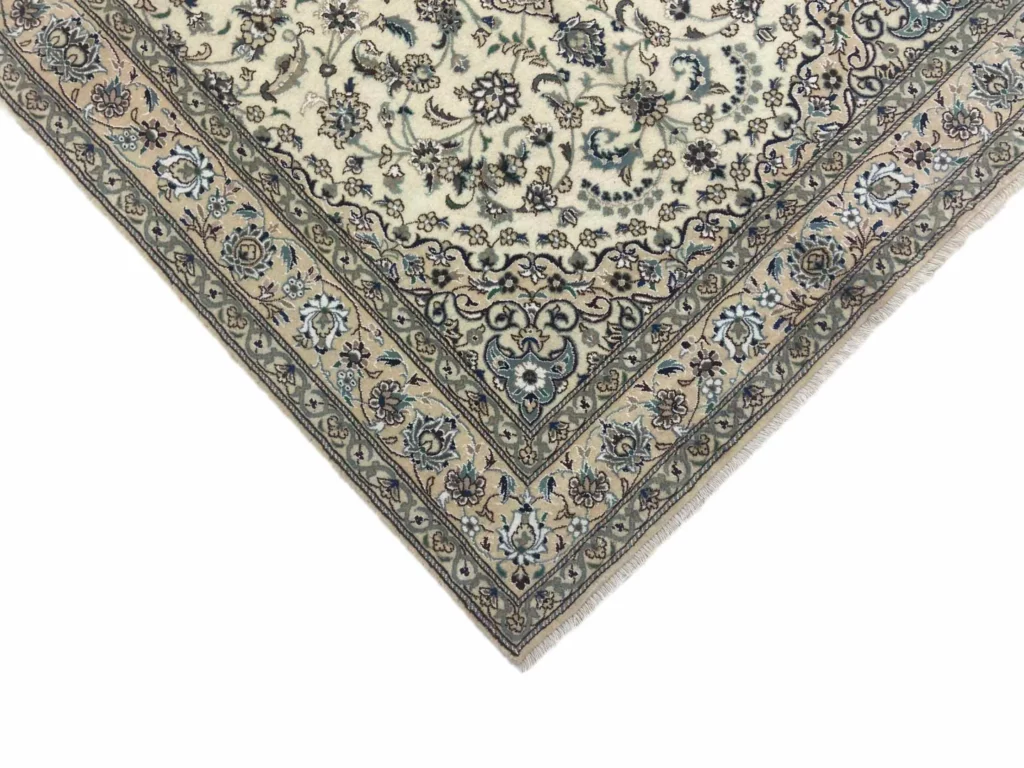
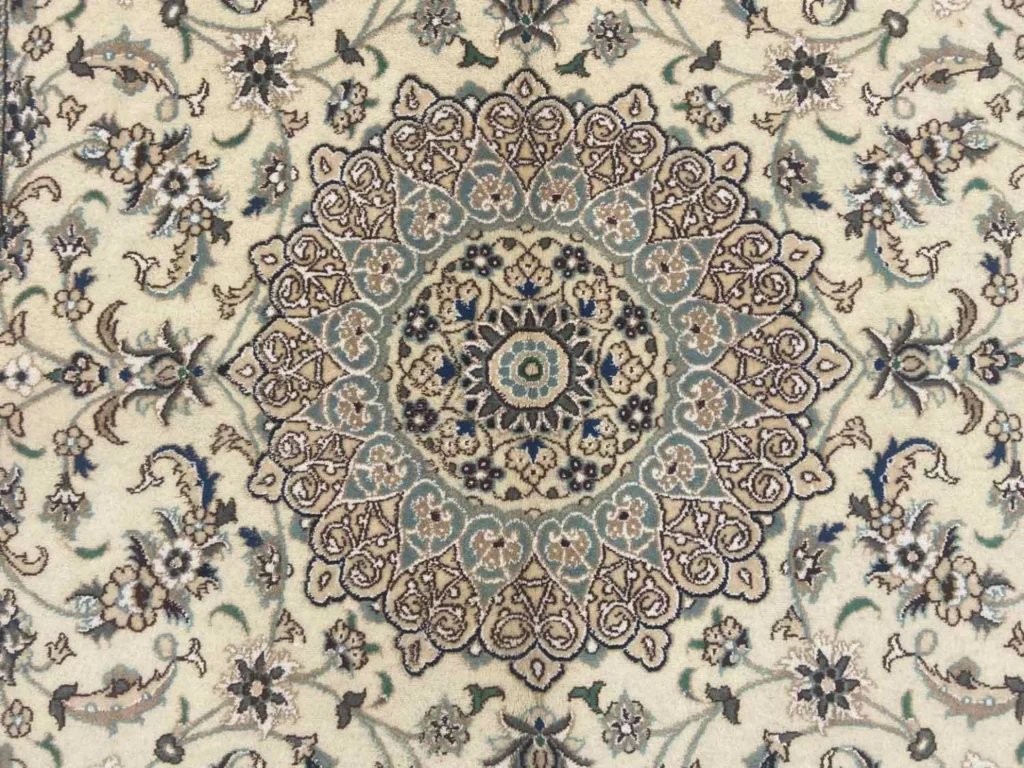
The pattern of this rug is described as a classic floral design with a medallion. The medallion provides the central organizing element. Floral forms, scrolling lines, and related ornaments are arranged around it. In this context, classic refers to a composition based on balance, repetition, and a considered relationship between the centre and its surrounding borders.
A medallion may be circular, oval, lobed, or shaped through flowing contours. In Nain compositions, it is often accompanied by floral detail so that the centre remains connected to the rest of the field. Scrolling stems can guide the eye outward, while flowers and leaves are separated by fine lines. Hand-knotting allows such shapes to be built through small changes in contour and repeated ornamental units.
Floral design is one of the principal languages of Persian carpet art. It can include stylized flowers, leaves, arabesques, and scrolling vines. These elements are not necessarily a literal depiction of one particular garden. Instead, they form an ornamental vocabulary in which shapes are repeated, reflected, and organized along axes. The resulting order gives the composition its traditional sense of structure.
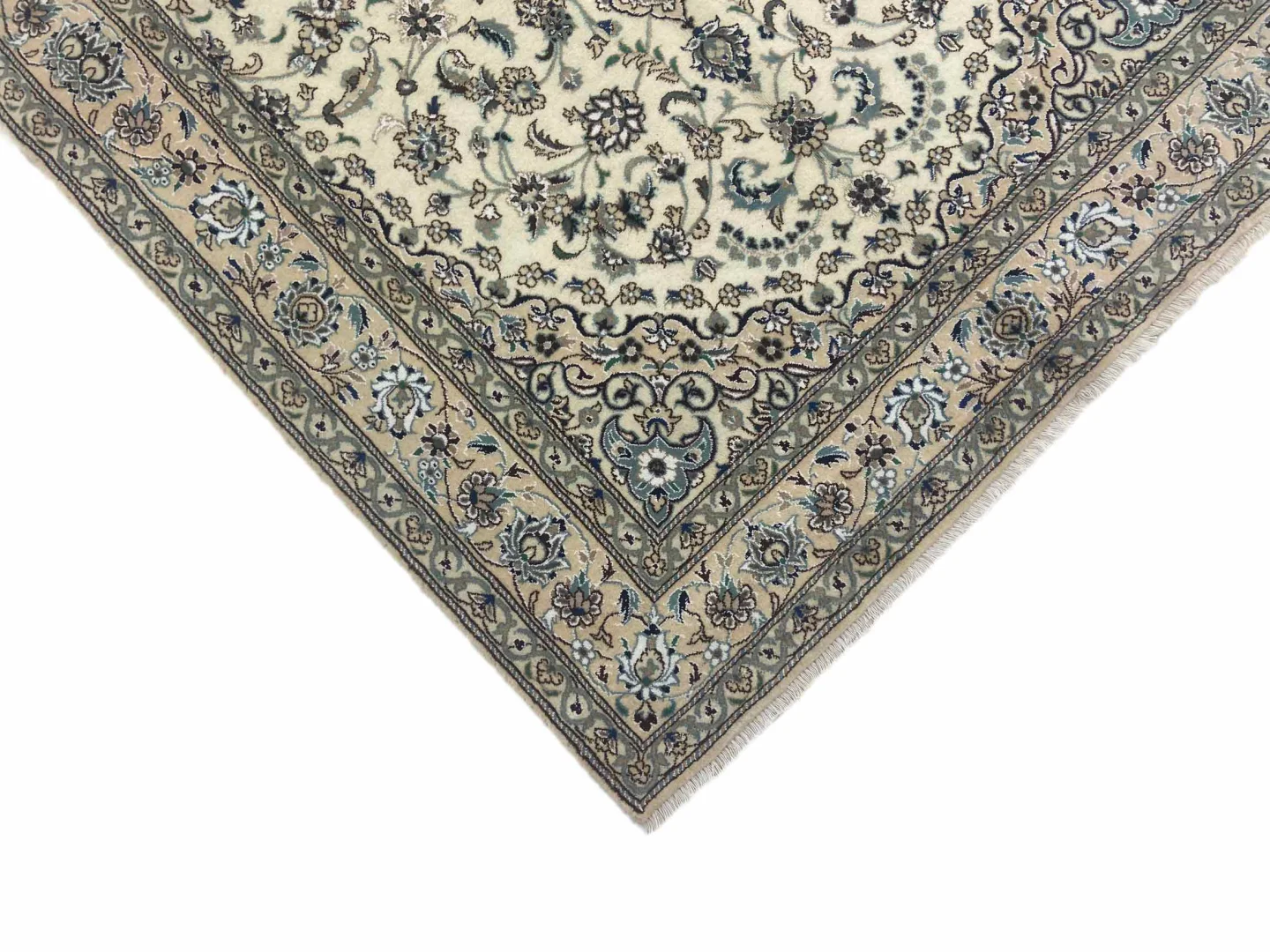
Borders play an important role in a medallion rug. They frame the field and provide a transition between the central design and the outer edge. Narrower secondary borders may accompany a broader main border. In floral designs, the vines and blossoms of the border often echo forms from the field, creating visual continuity. The documented design of this rug is floral with a medallion; details beyond that description should not be inferred as specific features of the individual piece.
The Nain tradition is often connected with bright, pale colour impressions and finely articulated drawing. Such a palette can allow a medallion and floral details to remain legible across the field. The visual result also depends on knot density, finishing, and the interaction between wool and silk areas. For this rug, the stated design characteristics are its Nain origin, its classic floral composition, its medallion, and its wool pile with silk accents.
Related floral approaches appear in other Persian weaving centres as well. Isfahan is known for complex designs and the use of high-quality materials. Kashan is often associated with deeper colours and dense pile. Tabriz and Kerman also have distinctive design traditions. These comparisons place Nain within the variety of Persian carpet art, but they do not turn this rug into an Isfahan, Kashan, Tabriz, or Kerman rug. Its stated origin is Nain in central Persia.
Special Features
The specific features recorded for this one-off rug are its Nain origin, the 9La classification, hand-knotted construction, high-quality wool pile with silk accents, and classic floral design with a medallion. The piece is offered as a unique rug. Its condition is described as excellent. These points identify the individual article and add concrete product information to the broader Nain tradition.
The combination of fine construction, a floral centre, and the named materials provides a clear stylistic and technical classification. Wool is the principal pile material, while silk accents contribute additional textile variation within the design. No statement is made about the exact colours, the warp, the age, or a signature, so those details are not part of the description.
FAQ
How should a Nain Persian rug be cared for?
A Nain Persian rug should be cleaned regularly to remove dust and loose dirt. Routine care should be gentle so that the pile, wool, and silk accents are not subjected to unnecessary stress. Professional cleaning is recommended because a specialist can take the different material qualities and the colour surface into account. Strong, direct sunlight should be avoided because prolonged exposure can cause fading. If a spill occurs, vigorous rubbing is not advisable. A professional treatment is the safer approach for protecting the surface and the fine pattern work.
How can the quality of a Nain rug be assessed?
Knot density is an important criterion, and Nain rugs use Lah classifications in connection with the fineness of their construction. A finer, denser structure can support more detailed drawing. Materials are another consideration. High-quality wool provides the main pile, while silk in selected areas can create a finer visual effect and a distinct sheen. Evenness of knotting, clarity of the outlines, and the care given to the medallion are also relevant when assessing a rug. This piece is identified as 9La and is described as hand-knotted with high-quality wool and silk accents.
Where can an authentic Nain rug be purchased?
Authentic Nain rugs can be found at specialist carpet dealers and through trustworthy online retailers. The origin, materials, knotting method, and condition should be documented clearly before purchase. Certificates may provide additional information about origin and authenticity, although they do not replace a careful assessment by a specialist dealer. It is also important not to confuse a Nain-inspired floral motif with a Nain origin: a pattern may follow regional models while the actual place of manufacture is different. This piece is described as a hand-knotted Nain Persian rug from central Persia.
To provide the best experiences, we use technologies like cookies to store and/or access device information. Consenting to these technologies will allow us to process data such as browsing behavior or unique IDs on this site. Not consenting or withdrawing consent, may adversely affect certain features and functions.
Functional Always active
The technical storage or access is strictly necessary for the legitimate purpose of enabling the use of a specific service explicitly requested by the subscriber or user, or for the sole purpose of carrying out the transmission of a communication over an electronic communications network.
Preferences
The technical storage or access is necessary for the legitimate purpose of storing preferences that are not requested by the subscriber or user.
Statistics
The technical storage or access that is used exclusively for statistical purposes.The technical storage or access that is used exclusively for anonymous statistical purposes. Without a subpoena, voluntary compliance on the part of your Internet Service Provider, or additional records from a third party, information stored or retrieved for this purpose alone cannot usually be used to identify you.
Marketing
The technical storage or access is required to create user profiles to send advertising, or to track the user on a website or across several websites for similar marketing purposes.

 SECURE PAYMENT
 SHIPPING PARTNERS


