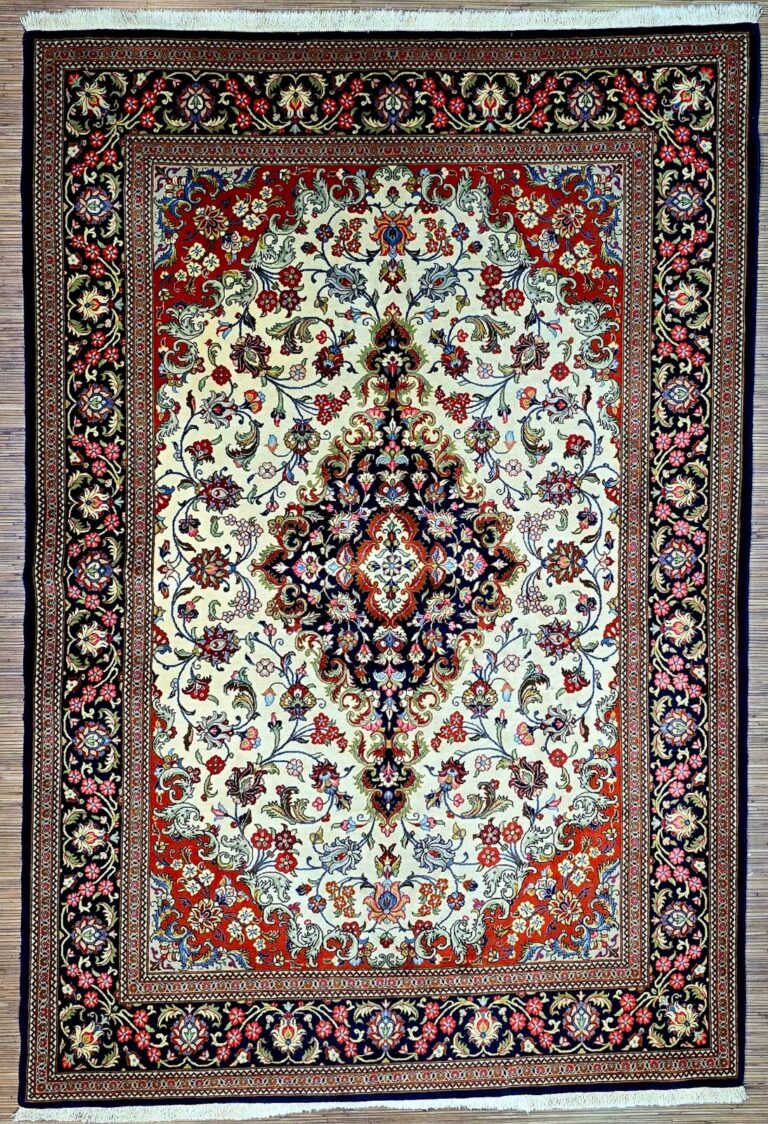
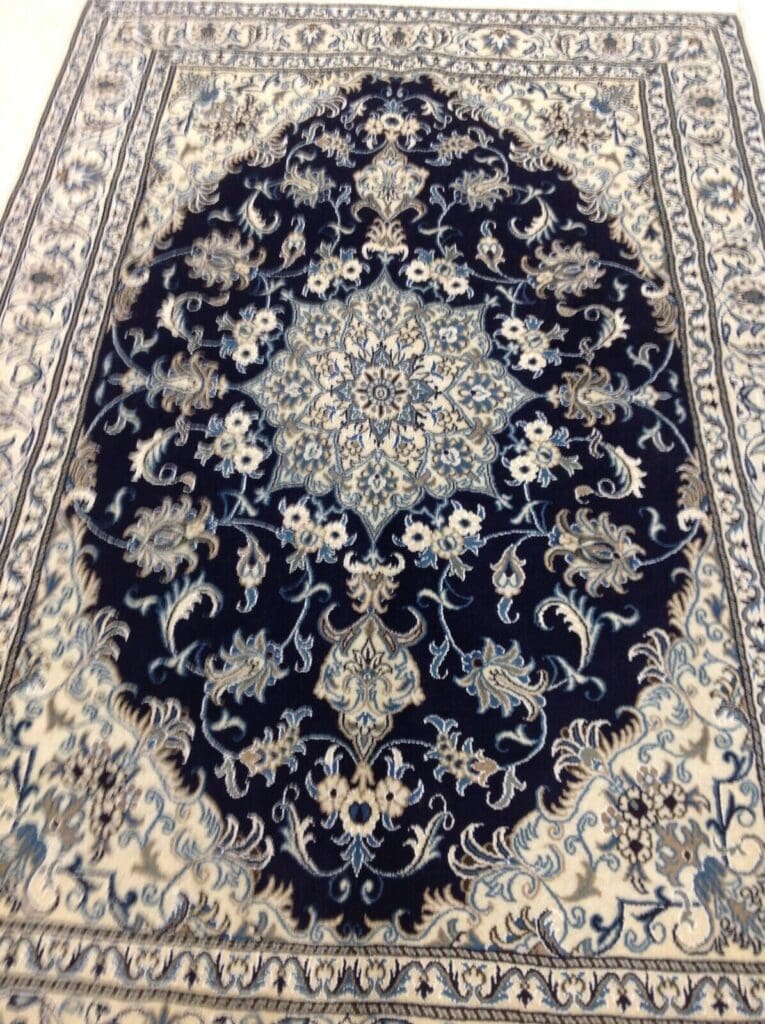
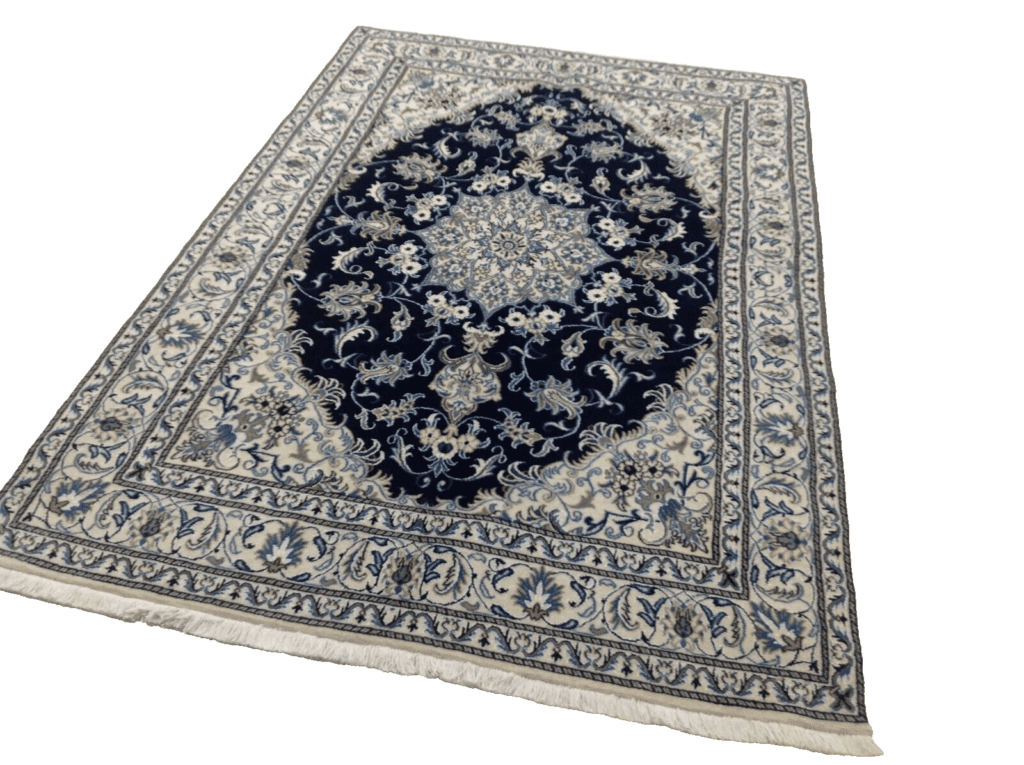
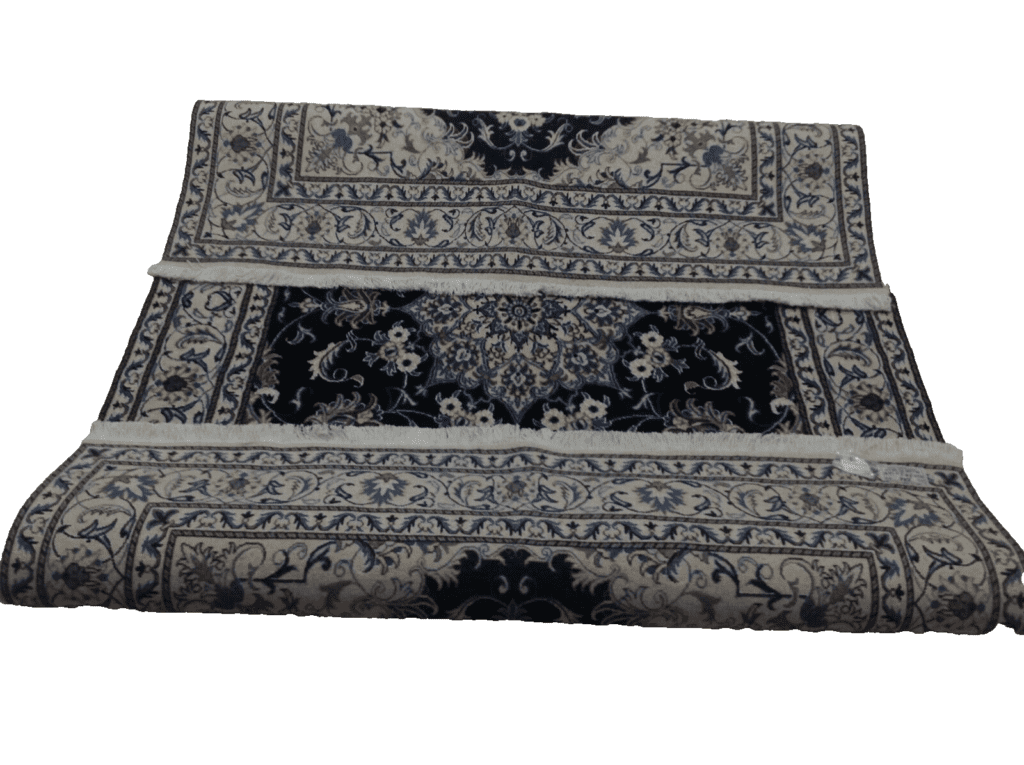
Hand-knotted Nain Persian Rug | Knot density: approx. 300,000 knots/m² | Material: 90% virgin wool, 10% silk | Size: 245 x 164 cm | Pattern: floral motifs, geometric forms and central medallion | Condition: New, very good
This Nain Persian rug is hand-knotted and made from 90% virgin wool and 10% silk. Virgin wool forms the larger part of the composition and is known for its resilient character. As a natural fibre, wool has been used in rug making for centuries because it can combine a durable surface with a comfortable sense of warmth. Silk adds a smooth handle, a fine lustre and a distinctive response to colour. Together, the two materials create a balance between strength, softness and visual definition.
Hand-knotting is one of the most demanding methods used in rug production. Every knot is inserted by hand into the foundation, so the surface develops through many separate stages of work. This rug has a knot density of approximately 300,000 knots per square metre. A dense knot structure makes it possible to reproduce narrow lines, small floral details and carefully controlled transitions within the design.
Unlike a machine-made rug, a hand-knotted piece is not created through a fully automated process. The work calls for experience, patience and consistent control of the knotting technique. Knots are placed in accordance with the planned design and gradually form the textile field. Nain rugs are often associated with fine, clearly drawn compositions, and wool combined with silk supports this type of visual treatment. In this rug, the stated fibre composition is joined to manual craftsmanship.
Wool can give the surface stability and warmth, while silk contributes additional softness and a restrained sheen. The material description for this rug is 90% virgin wool and 10% silk. Together with the high knot density, this composition supports the rendering of detailed ornament in the knotted field. The technical character of a hand-knotted rug comes from the interaction of material, knotting work and pattern structure.
Origin and Tradition
The rug comes from Nain in Iran. Nain is known for its rugs and has a long-established carpet-making tradition. The history of this regional craft reaches back to the sixteenth century. Within this tradition, Persian rugs are not viewed only as household objects. They are also textile expressions in which fibre, colour, drawing and manual execution are considered as parts of one design.
Nain is a place where rug-making knowledge has been passed from one generation to the next. This knowledge includes selecting suitable fibres, preparing the structure, working with colour and transferring a design into a knotted surface. At the loom, planning and manual execution must remain closely connected. A pattern is not printed onto a finished textile; it develops knot by knot as the rug itself is made.
The Nain tradition is associated with clear, lively colours and finely drawn designs. Floral motifs and established Persian elements are recurring parts of this regional vocabulary. The combination of wool and silk represents a material choice that places a resilient fibre alongside finer, lustrous accents. This pairing can support the precise drawing and differentiated surface effect associated with Nain rugs.
The history of Persian rug making includes many regional schools and distinct craft languages. Nain developed its own identity within this wider context. Its approach combines precise line work with floral ornament and an orderly overall composition. Regional origin therefore refers not only to a location, but also to knowledge of fibres, proportions, colours and the technical process of translating a design into a finished rug.
Traditional patterns exist alongside more contemporary designs in Nain rug production. The craft remains connected to inherited forms without being limited to one unchanging image. New designs can retain Persian elements while arranging them in a clearer or more restrained structure. The centuries of history provide the cultural setting for hand-knotted Nain rugs made in the present.
Knot density is closely related to the technical possibilities of this type of rug. The more closely the knots are placed, the more precisely contours, blossoms, scrolling forms and geometric details can be represented. Such work demands concentration and even execution across the entire surface. The process remains manual, and the skill of the knotters is essential to transferring the intended design into the textile.
The material combination also has a place within this regional tradition. Wool can form a stable and warm field, while silk can make selected passages appear smoother and more reflective. The fibres are used together not only for practical reasons, but also to support the appearance of fine drawing. Construction, handle and ornament are therefore treated as connected aspects of Nain rug making.
Design and Pattern
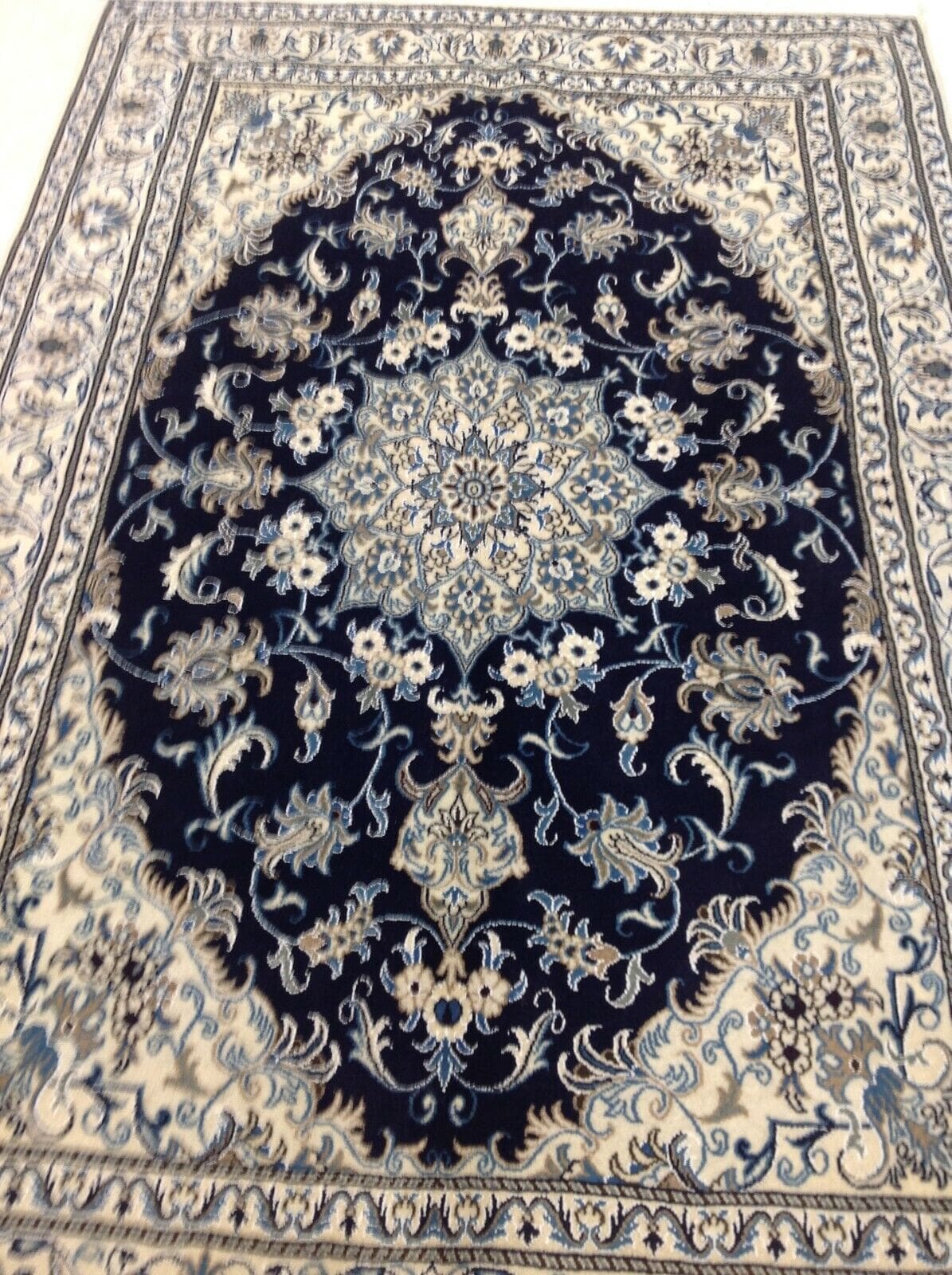
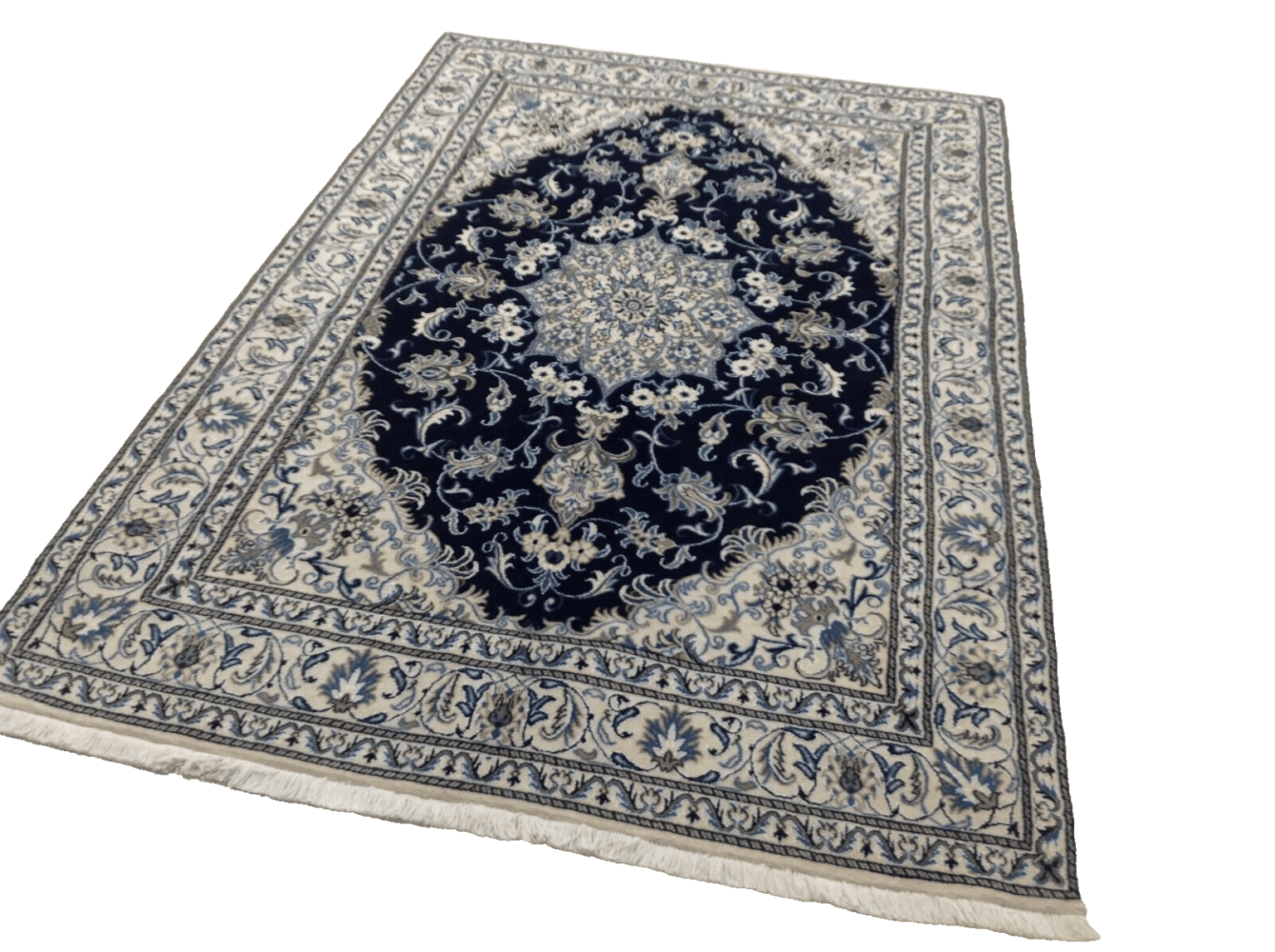
The design of this rug combines fine floral motifs with geometric forms. These are important elements within Persian rug design. Blossoms, vines and other plant forms create an organic rhythm across the field, while geometric lines and ordered shapes provide structure. The two visual languages can be balanced within one composition, allowing a pattern to remain detailed while retaining a clear overall organisation.
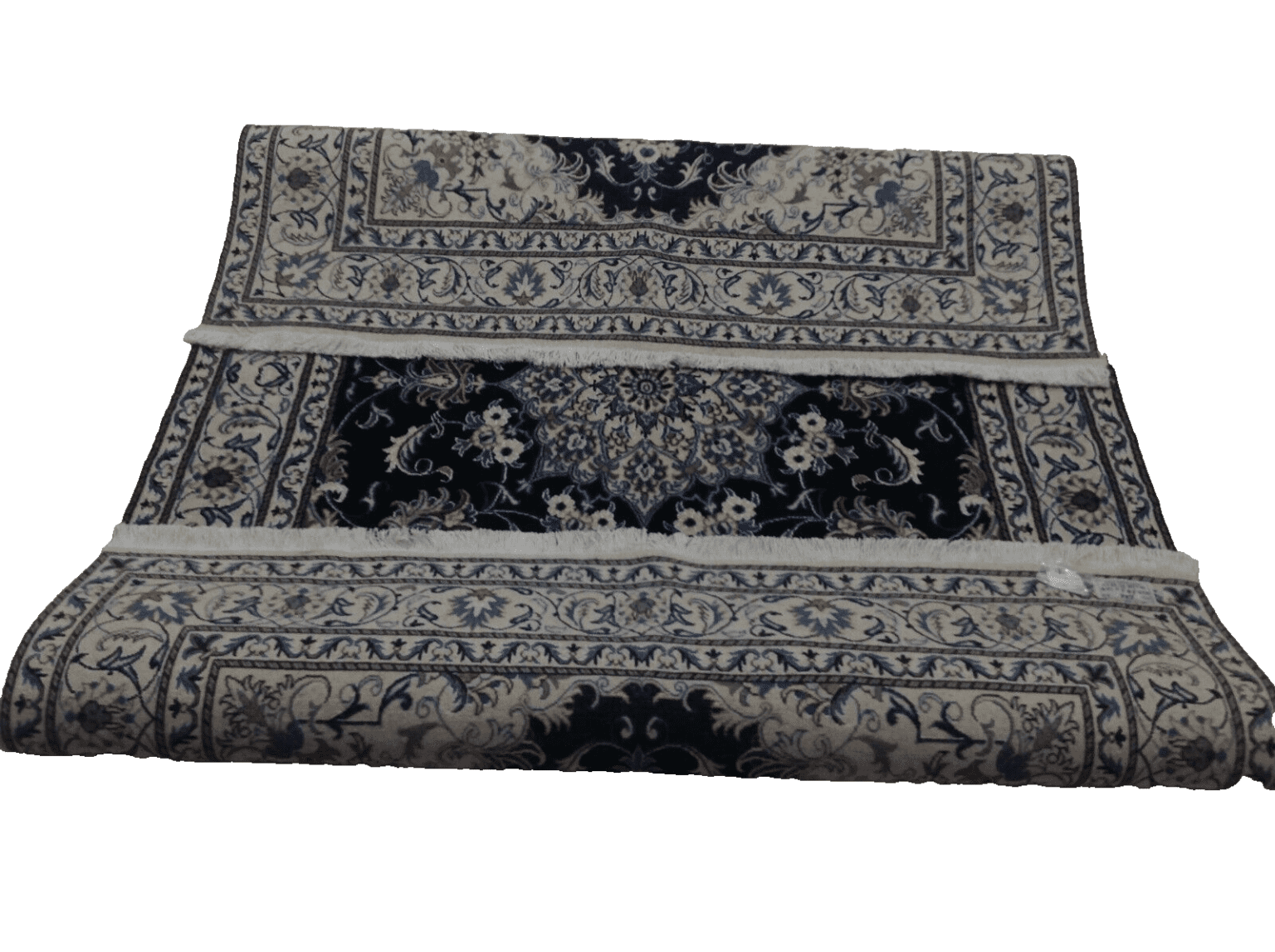
Large central medallions are particularly characteristic of Nain designs and can organise the middle of the composition. They create a visual centre and are often accompanied or surrounded by floral ornament. Secondary motifs and borders lead from the centre towards the outside and establish the relationship between the main field and its surrounding areas. The design elements described for this rug include floral motifs, geometric forms and a central medallion.
The colour scheme is based on blue, red and beige. Blue can provide a cool, concentrated foundation in Persian ornament, while red introduces a distinct accent. Beige connects the different parts of the composition and creates light transitions. Together, these colours support the readability of the drawing and allow fine details to remain visible as part of the overall pattern.
Persian patterns are often more than simple decorative arrangements. Floral forms may refer to the natural world, while geometric order can suggest balance and structure. A medallion gathers the design around its centre. These devices have been used in Persian visual culture for a long time and give a rug an internal order, although each individual motif does not have to carry exactly the same symbolic meaning.
The fine execution of a Nain rug is closely connected to its design. Small, closely placed knots allow curved lines, leaves and narrow transitions to be reproduced with precision. High knot density supports this level of detail, while silk can make selected passages appear smoother and more reflective. Wool helps unite those details into a coherent field. The materials and the pattern therefore work together rather than acting as separate decorative features.
Traditional Persian elements and a clear, lively palette allow Nain designs to be used in different interior settings. The composition can be read as a classic Persian rug pattern while its orderly line work also suits a contemporary room. The medallion, floral drawing, geometric structure and the use of blue, red and beige together establish the visual identity described for this one-of-a-kind rug.
Special Features
This rug is a one-off and is supplied with a certificate of authenticity. Its condition is new, very good. The specifically stated features of this individual piece also include hand-knotting, a knot density of approximately 300,000 knots per square metre and a composition of 90% virgin wool and 10% silk. Because its surface is formed from many individual knots, a hand-knotted rug is a distinct textile work rather than a repeated machine-made product.
The materials combine practical and decorative qualities. Virgin wool is associated with durability and warmth, while silk contributes lustre and additional softness. Alongside its fine design, the rug can therefore be used as a floor covering and understood as part of Iran’s textile and cultural history. Nain rugs can be placed in living rooms, dining rooms, bedrooms and studies. The description also presents a rug of this kind as a possible collector’s item and a potential heirloom for future generations.
A hand-knotted Persian rug can remain in use for a long time when treated carefully. Such rugs may also increase in value over the years, although no increase can be guaranteed for every individual piece. The particular features named here are its origin, hand craftsmanship, material composition, pattern, new condition, one-off character and certificate of authenticity. These qualities describe it both as a practical furnishing textile and as an individually made object connected with Persian rug tradition.
FAQ
How should I care for my Nain Persian rug?
Gentle care helps protect the wool, silk and hand-knotted structure. Regular vacuuming without a brush attachment removes dust and loose dirt while avoiding unnecessary stress on the surface. If a stain occurs, the affected area should be dabbed immediately with a damp cloth. It should not be rubbed, since rubbing can strain the fibres and affect the appearance of the colours. Professional cleaning is recommended every few years. The cleaning process should take the combination of virgin wool and silk into account.
Where can I use the rug?
The Nain rug is suitable for living rooms, dining rooms and bedrooms. A study can also be an appropriate setting. Its floral motifs, geometric forms and organised composition with a central medallion can be combined with different interior styles. Blue, red and beige give the design a distinct visual presence without restricting the rug to one particular room type. As a hand-knotted textile, it also adds warmth, comfort and a carefully worked surface to the chosen living area.
Is a Persian rug a worthwhile investment?
Persian rugs are often regarded as value-retaining and may increase in value over time. Whether this happens depends on factors such as origin, workmanship, materials, preservation and demand. This rug comes from Nain, is hand-knotted, has a knot density of approximately 300,000 knots per square metre and is made from virgin wool and silk. It is offered as a one-off with a certificate of authenticity. Besides possible long-term value development, it serves a practical function as a floor covering and, because of its cultural and handcrafted character, can also be kept as an heirloom for future generations.
To provide the best experiences, we use technologies like cookies to store and/or access device information. Consenting to these technologies will allow us to process data such as browsing behavior or unique IDs on this site. Not consenting or withdrawing consent, may adversely affect certain features and functions.
Functional Always active
The technical storage or access is strictly necessary for the legitimate purpose of enabling the use of a specific service explicitly requested by the subscriber or user, or for the sole purpose of carrying out the transmission of a communication over an electronic communications network.
Preferences
The technical storage or access is necessary for the legitimate purpose of storing preferences that are not requested by the subscriber or user.
Statistics
The technical storage or access that is used exclusively for statistical purposes.The technical storage or access that is used exclusively for anonymous statistical purposes. Without a subpoena, voluntary compliance on the part of your Internet Service Provider, or additional records from a third party, information stored or retrieved for this purpose alone cannot usually be used to identify you.
Marketing
The technical storage or access is required to create user profiles to send advertising, or to track the user on a website or across several websites for similar marketing purposes.

 SECURE PAYMENT
 SHIPPING PARTNERS