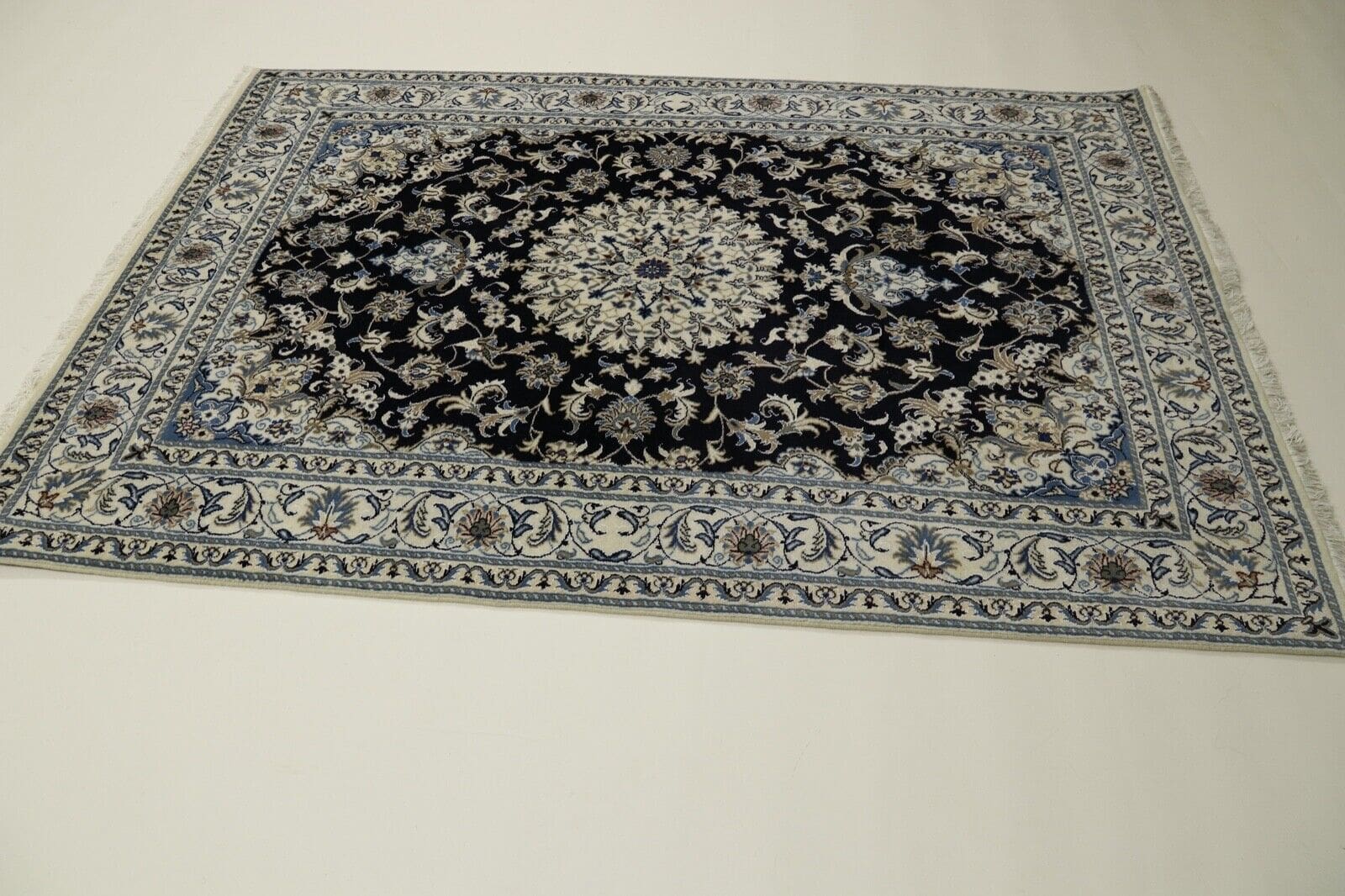
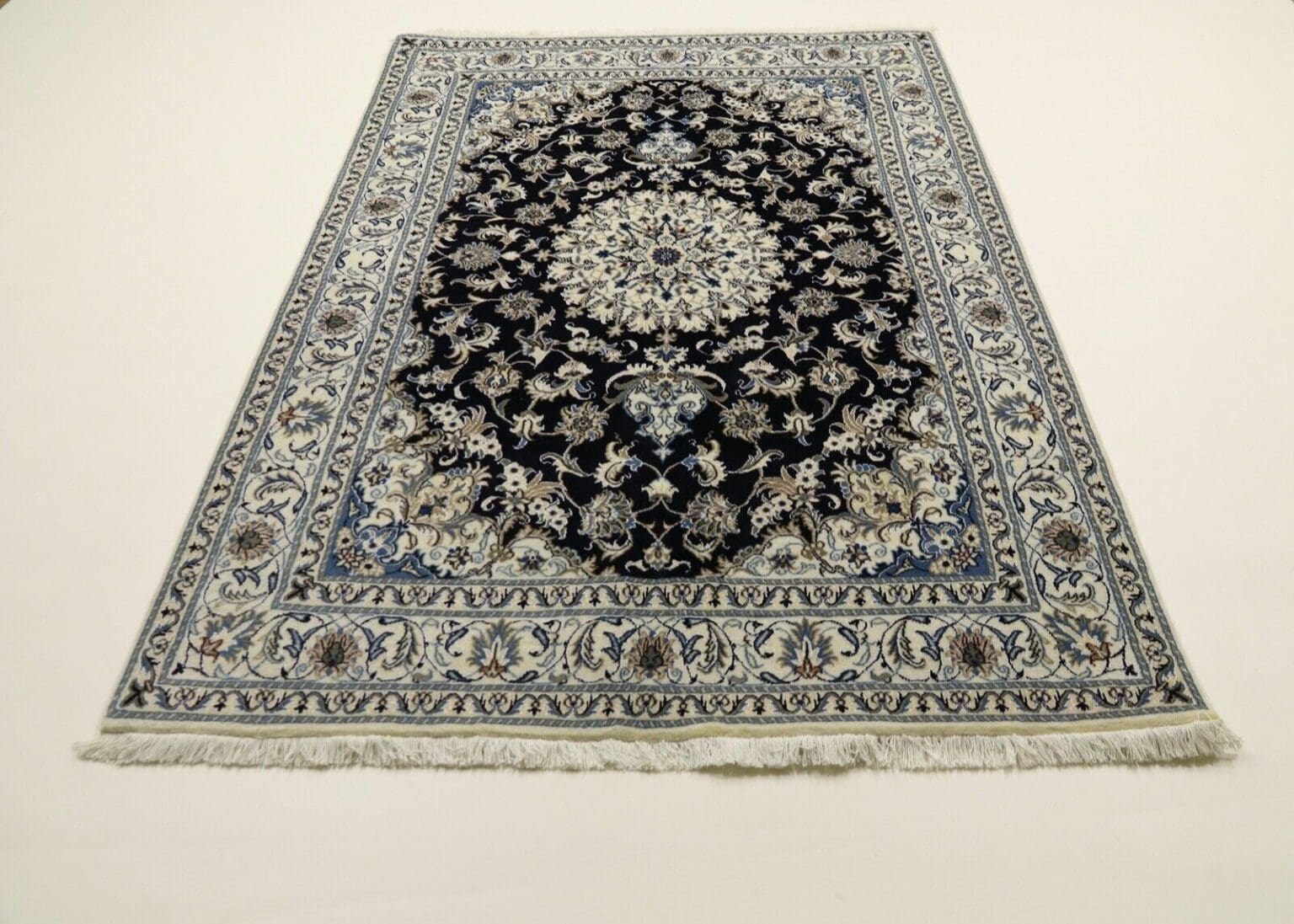
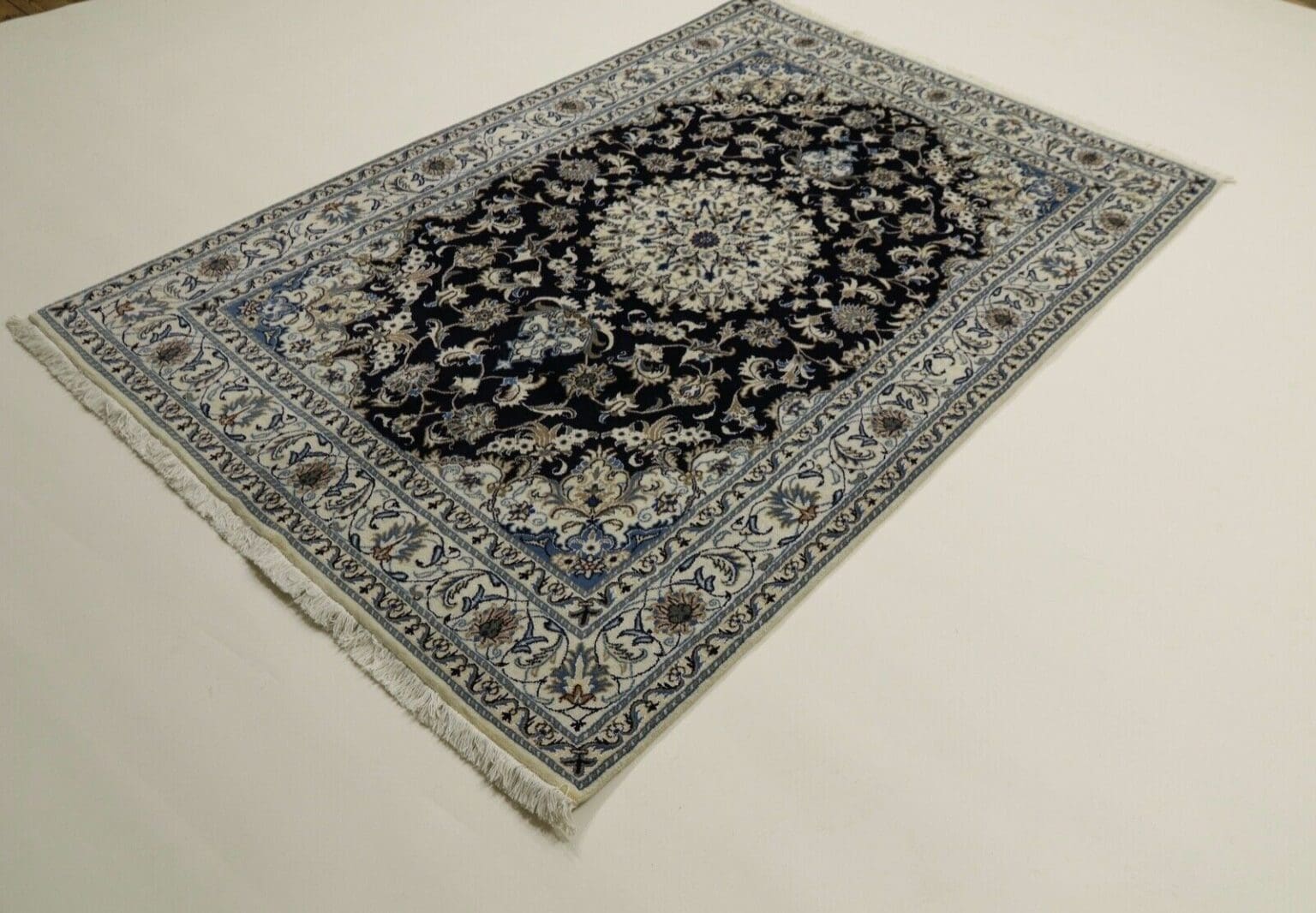
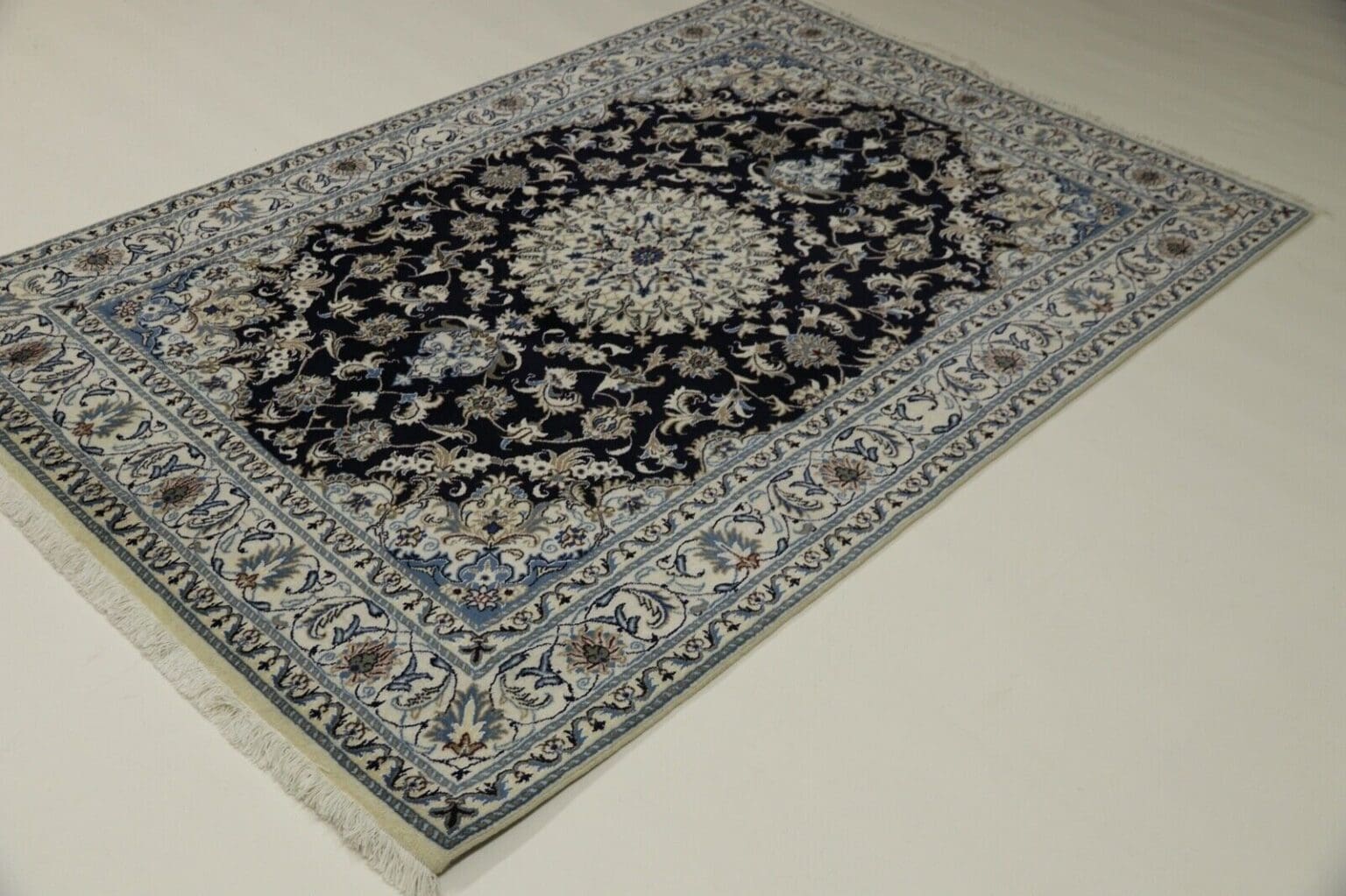
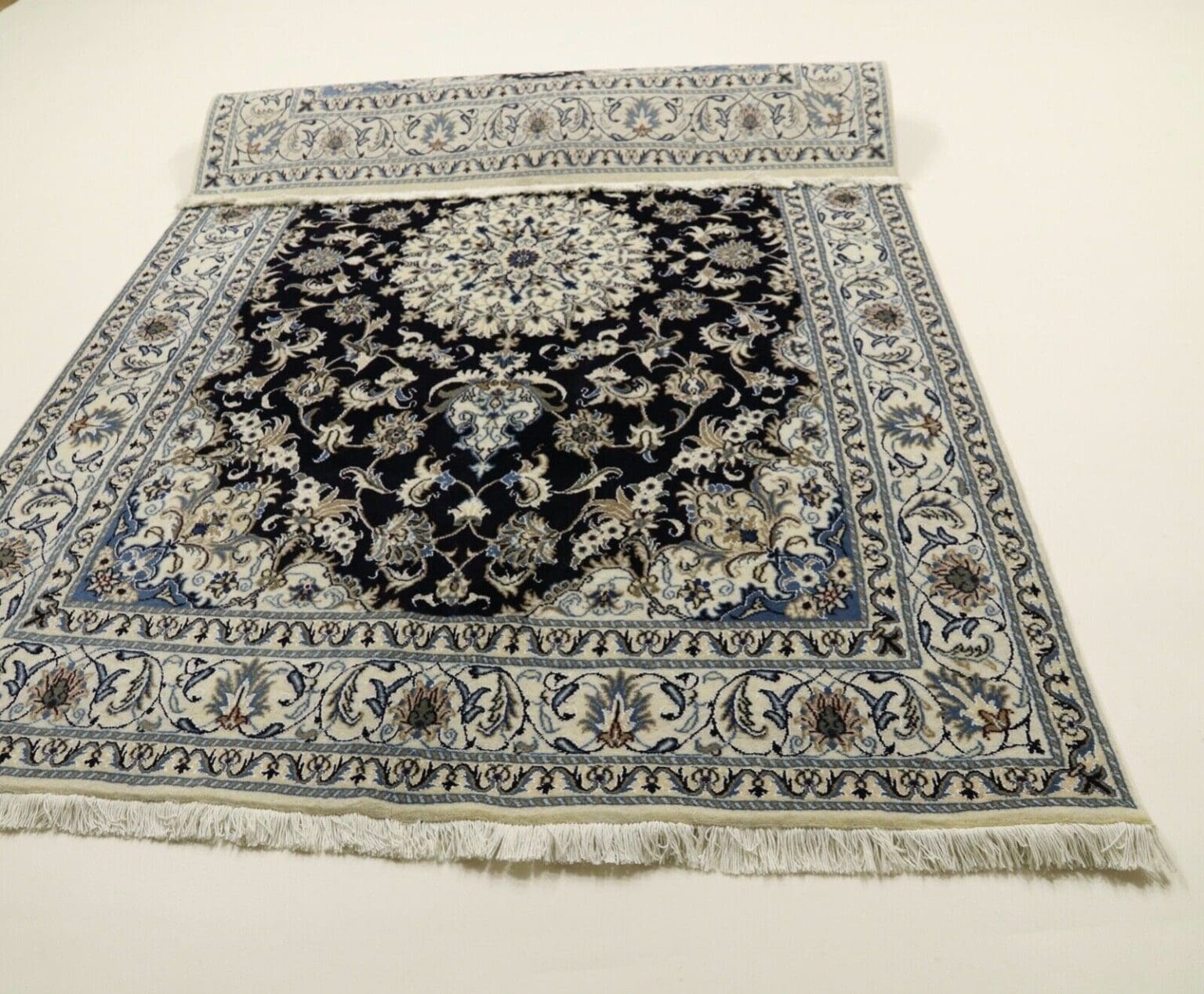
This Nain Persian rug is hand-knotted and made from 90% virgin wool and 10% silk. Virgin wool provides the greater part of the material and is known for its strength, insulating qualities, and ability to regulate moisture. It offers a pleasant tactile surface and has long been used for rugs intended for living spaces. Its natural resilience makes it suitable for a textile that combines practical use with detailed decoration.
The silk content adds a fine sheen to the wool. Depending on the light, it can make selected contours and ornaments appear more distinct and gives the surface a varied visual character. Wool and silk therefore contribute different qualities: wool supplies a fuller, more substantial feel, while silk reflects light more noticeably. Their combination creates a textile surface in which colour, texture, and illumination interact.
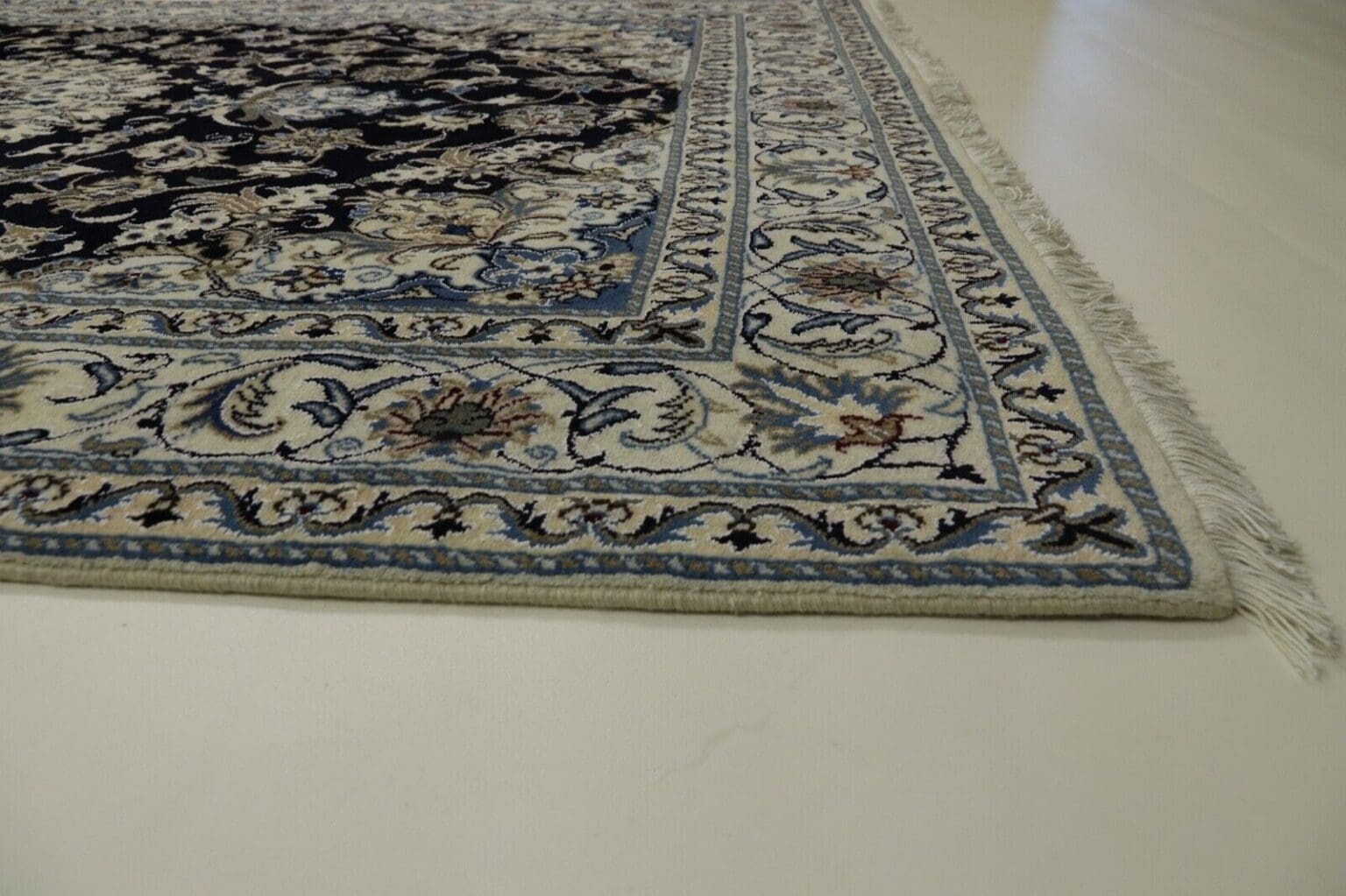
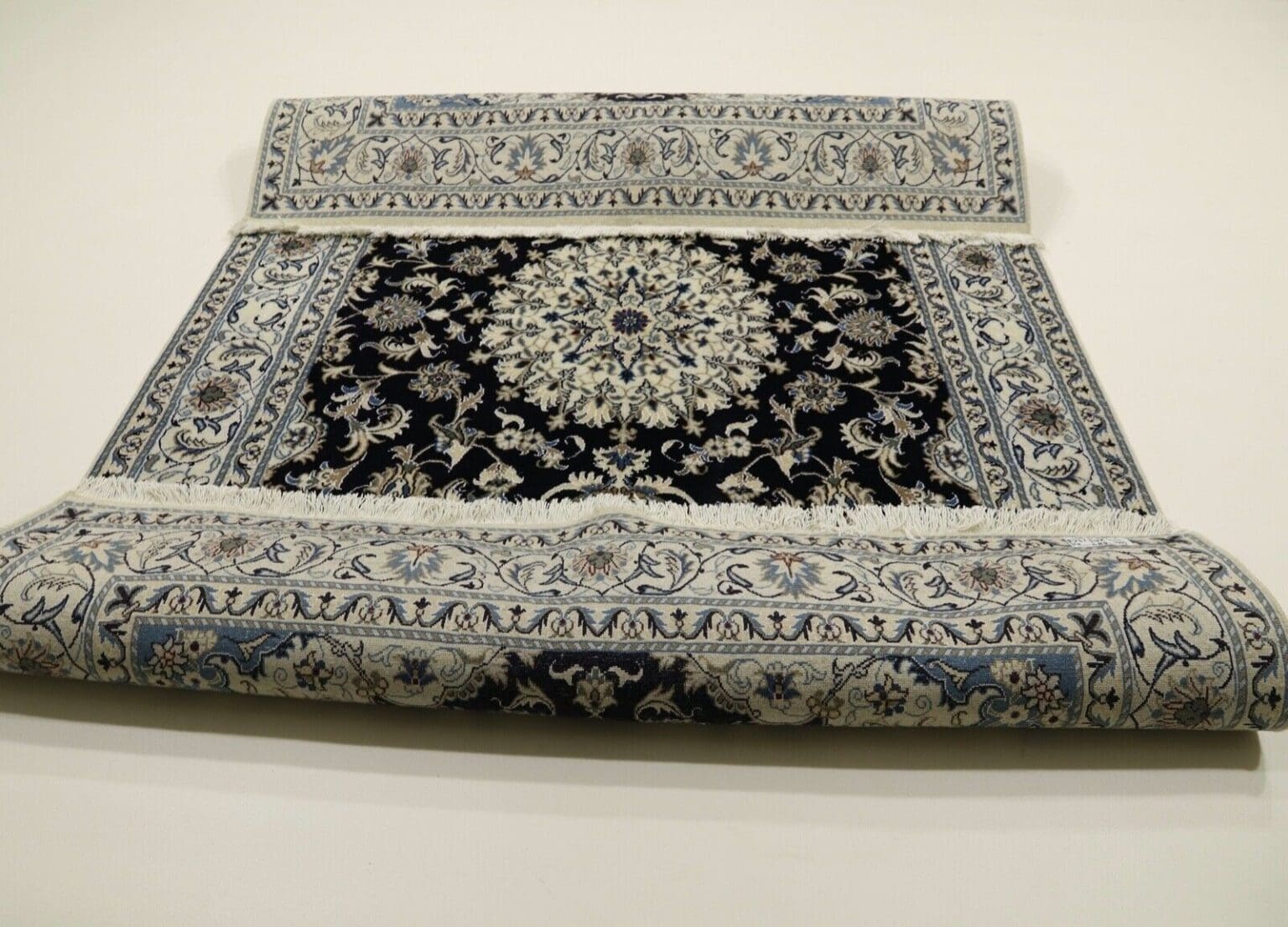
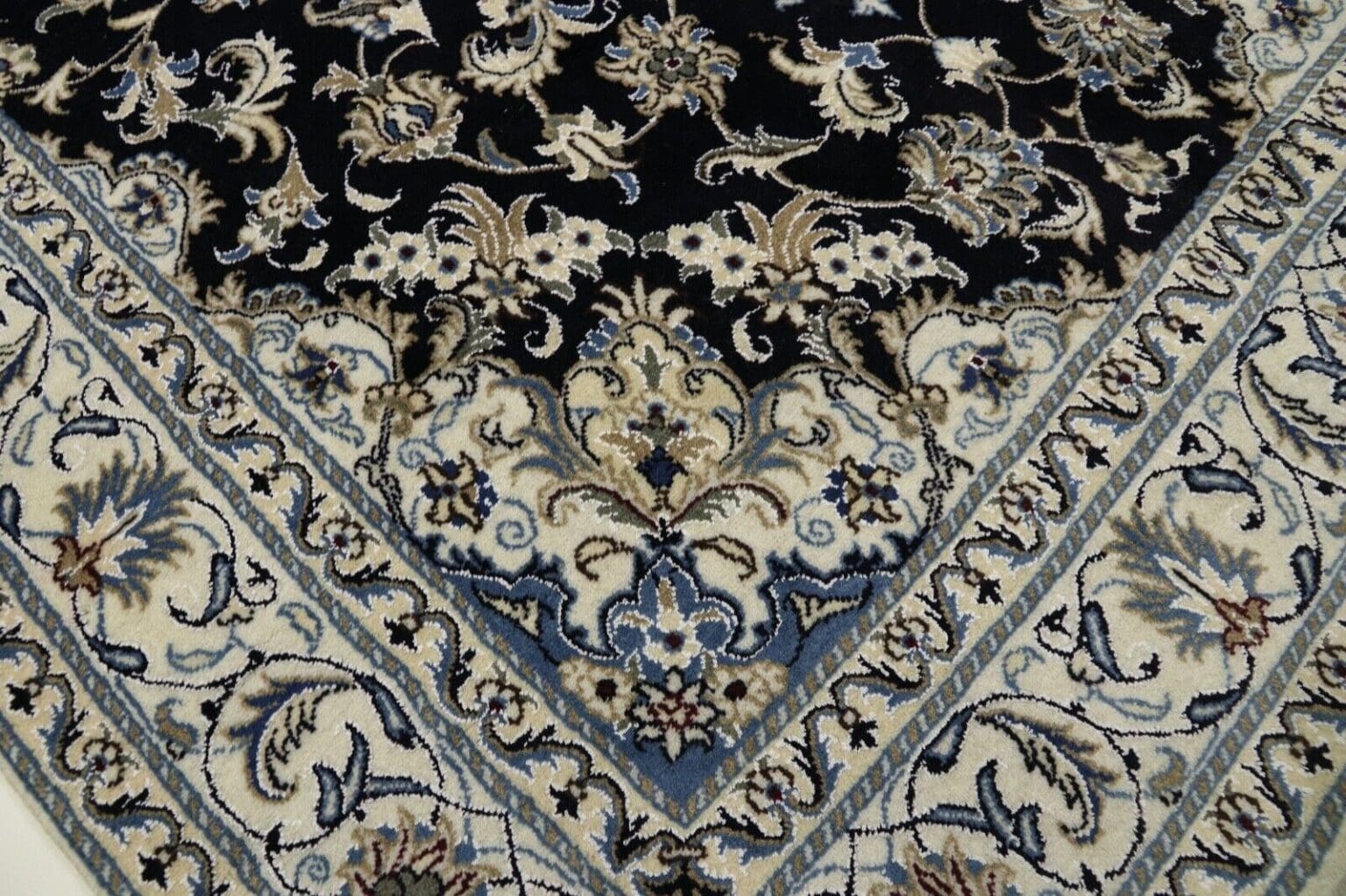
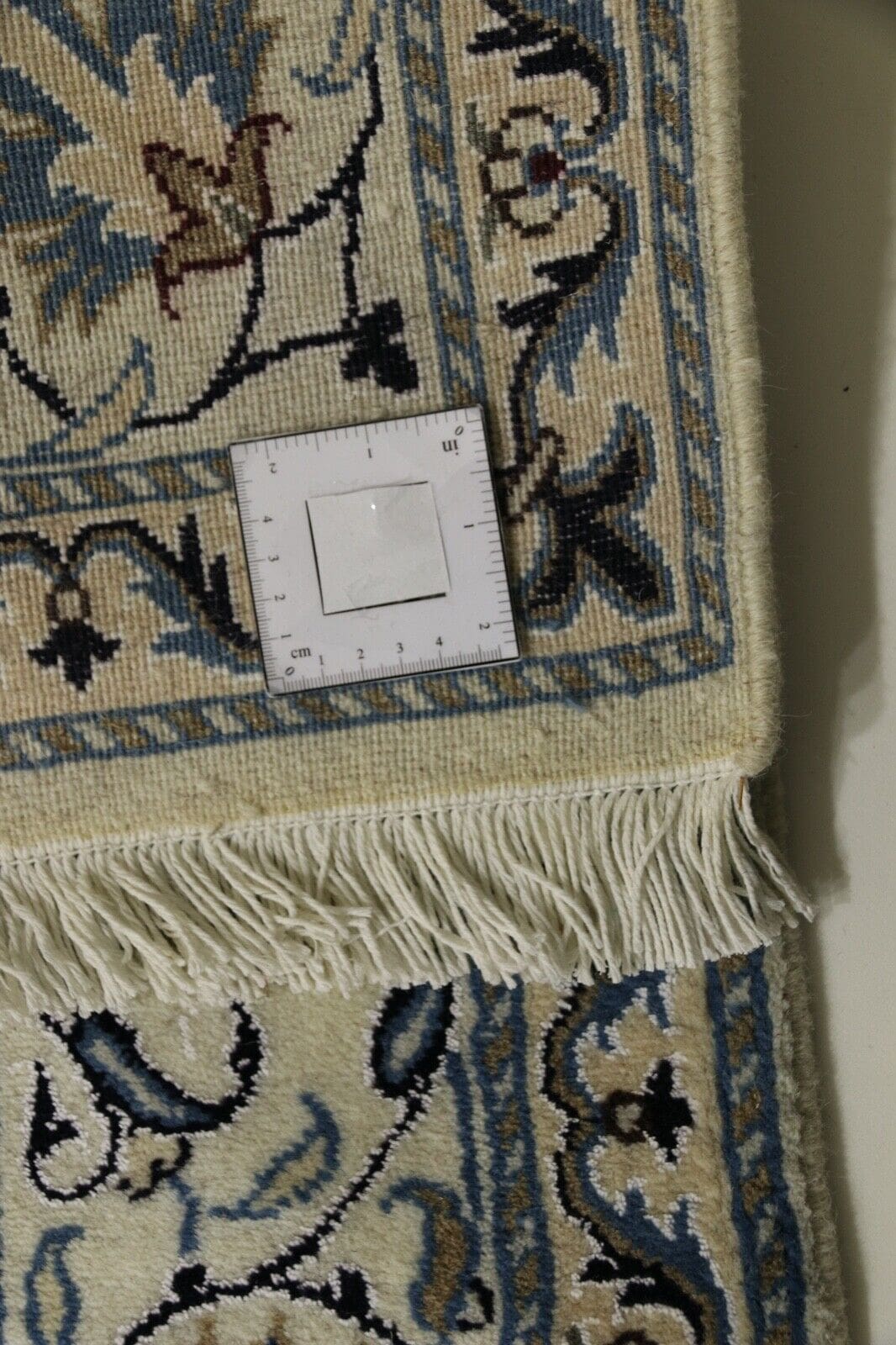
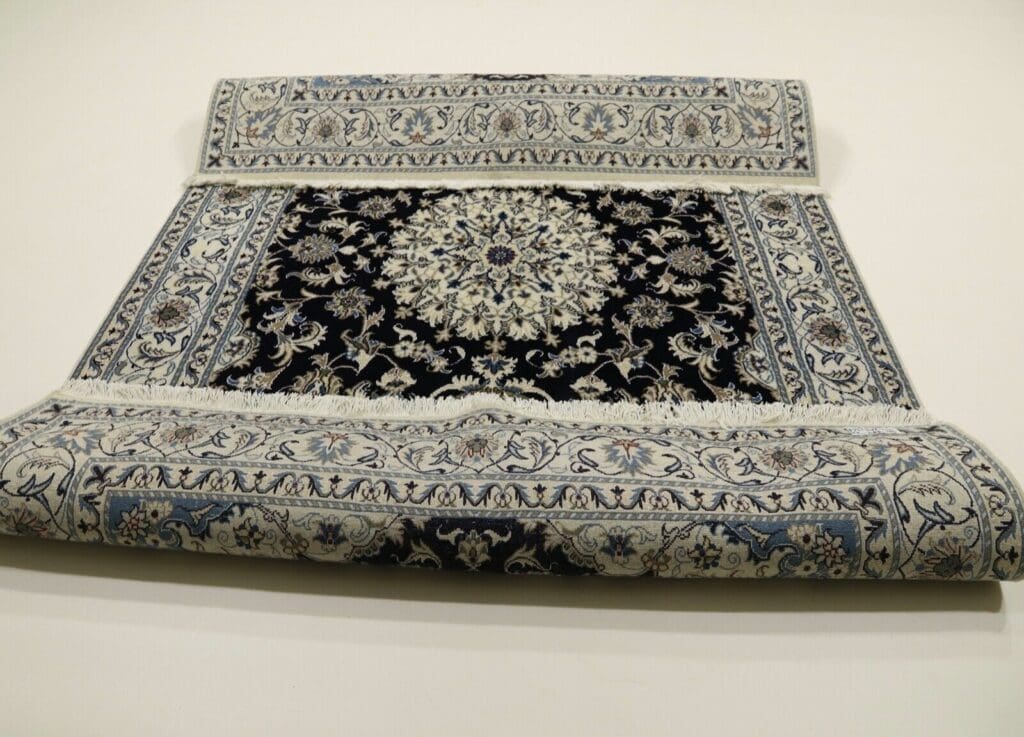
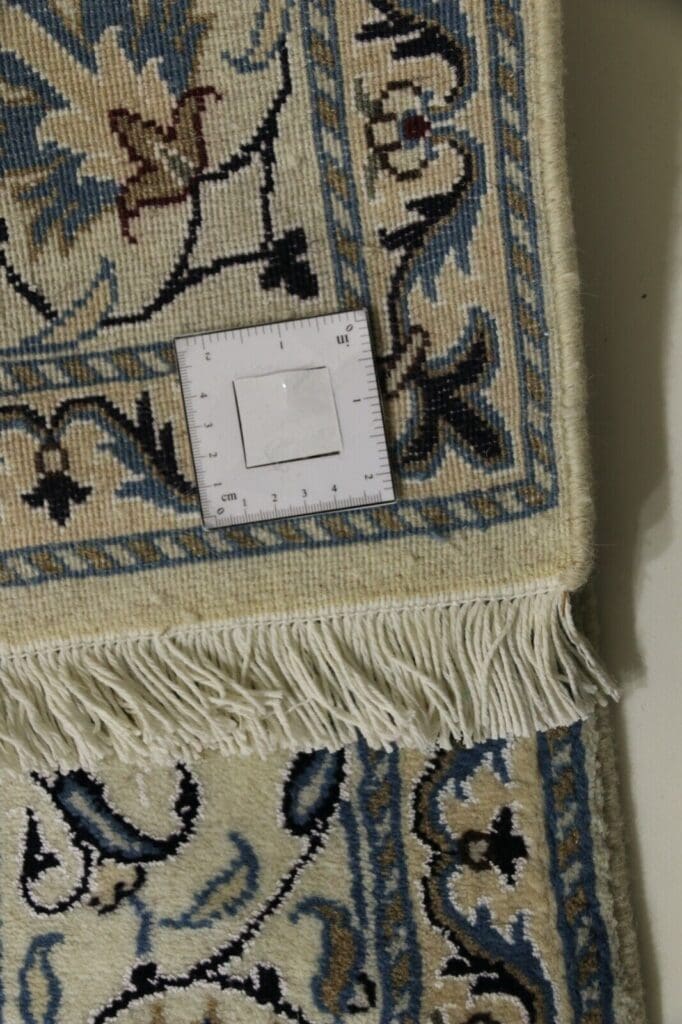
Hand-knotting means that the knots are made individually and incorporated into the foundation before the surface is finished. This method allows the weaver to follow a detailed design with careful control over lines, ornaments, and floral elements. The rug has a knot density of approximately 300,000 knots per square metre, a feature that supports the fine rendering of the pattern. Hand production also makes each rug an individual piece rather than a mechanically repeated floor covering.
The workmanship thus brings together virgin wool, silk, and a traditional knotting process. The rug is new and in very good condition. It has not been used and retains the original state associated with a newly made piece. An authenticity certificate is included. Its hand-knotted construction, mixed fibres, certificate, and status as a unique one-off are part of its stated specification.
Origin and Tradition
Nain is a city in Iran and the name of an established Persian rug tradition. It lies in central Iran, in a region whose cultural history has been shaped by trade, craftsmanship, and the design of textiles. Nain rugs gained recognition through their carefully ordered compositions and finely worked surfaces. The tradition is often associated with light colour schemes, floral drawing, and an emphasis on precise ornament.
The development of Nain weaving belongs to the wider history of Persian textile production. In specialist workshops, knowledge of preparing materials, planning a design, arranging colours, and tying knots is passed from one generation to the next. The work involves more than the knotting itself. The weaver must keep the intended structure of the composition in view while building the surface step by step. This combination of planning and manual skill gives Nain rugs their controlled appearance.
Nain designs are commonly recognised for their fine organisation and restrained elegance. Light grounds, floral forms, connected vine work, and balanced borders are recurring elements of the regional vocabulary. They are not applied identically to every rug. The arrangement of the field, the treatment of the border, the colour balance, and the density of the detail can differ from one hand-knotted piece to another. Regional tradition provides a framework, while the finished rug remains an individual interpretation.
Persian rug making has traditionally joined practical use with visual structure. A rug covers a floor, but it also carries information about the place where it was made, the skills of its makers, and the decorative language of its culture. In Nain weaving, this relationship is expressed through disciplined spacing, repeated motifs, and carefully controlled contours. A detailed knotting process permits the design to be transferred into the textile with a high degree of definition.
The region is also associated with the use of fine materials and with compositions in which the surface is treated as a carefully planned whole. Silk may be introduced to sharpen a contour, add light to a motif, or give selected areas a more reflective appearance. Wool supplies the main textile body and a different tactile quality. The combination of wool and silk fits the broader Nain tradition of using material contrast to support the reading of the design.
This rug is described as a Persian rug from Nain, with its origin given as Persia or Iran. The place name refers to Nain as the source of the regional tradition, while the Persian classification identifies its Iranian origin. Its hand-knotted construction places it within the long history of Oriental rug making, where individual workmanship, inherited patterns, and carefully selected materials are closely connected.
Design and Pattern
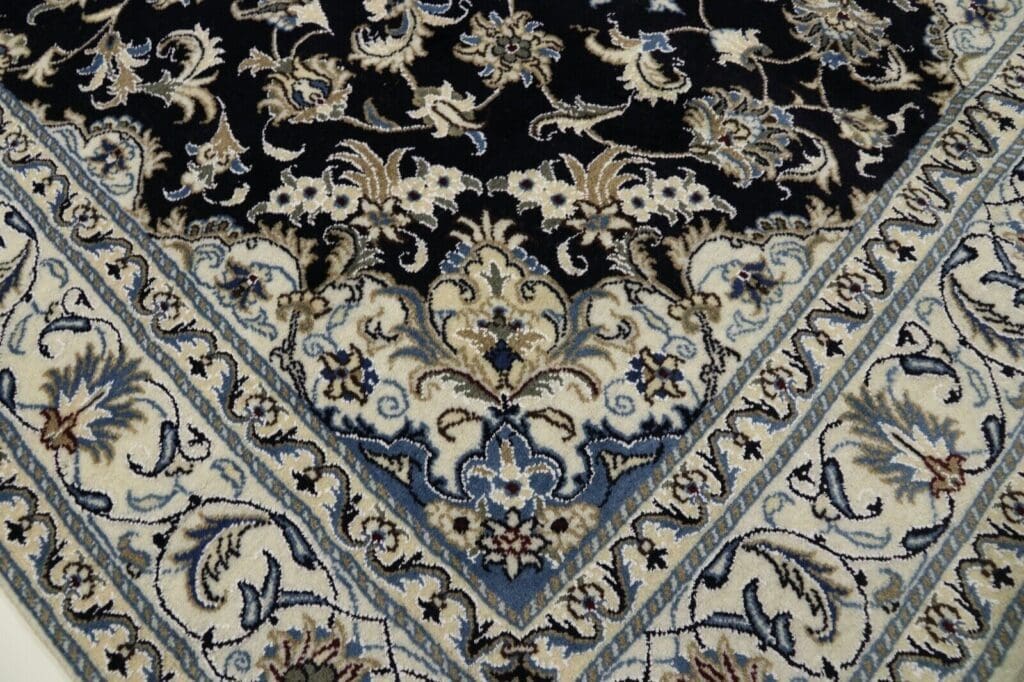
The pattern of this rug is described as Oriental. Nain rugs are often associated with floral and ornamental compositions. Vines, blossoms, leaves, and stylised arabesques can connect different areas of the design and lead the eye across the field. These forms belong to a long Persian tradition in which elements from nature are simplified, repeated, and arranged into a balanced decorative system.
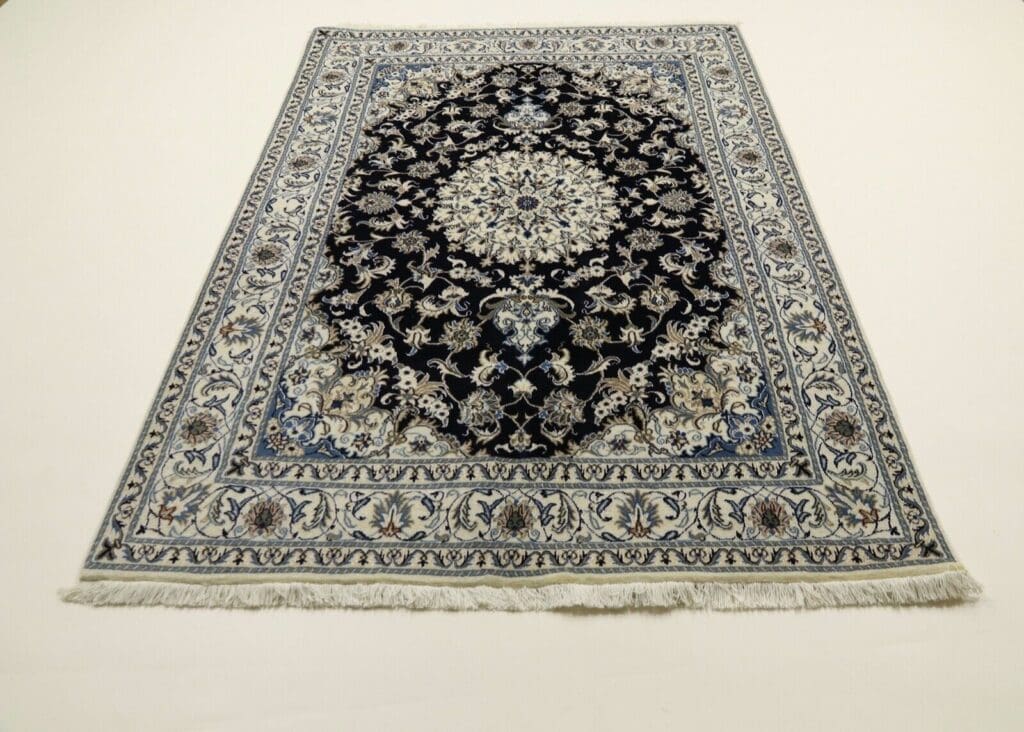
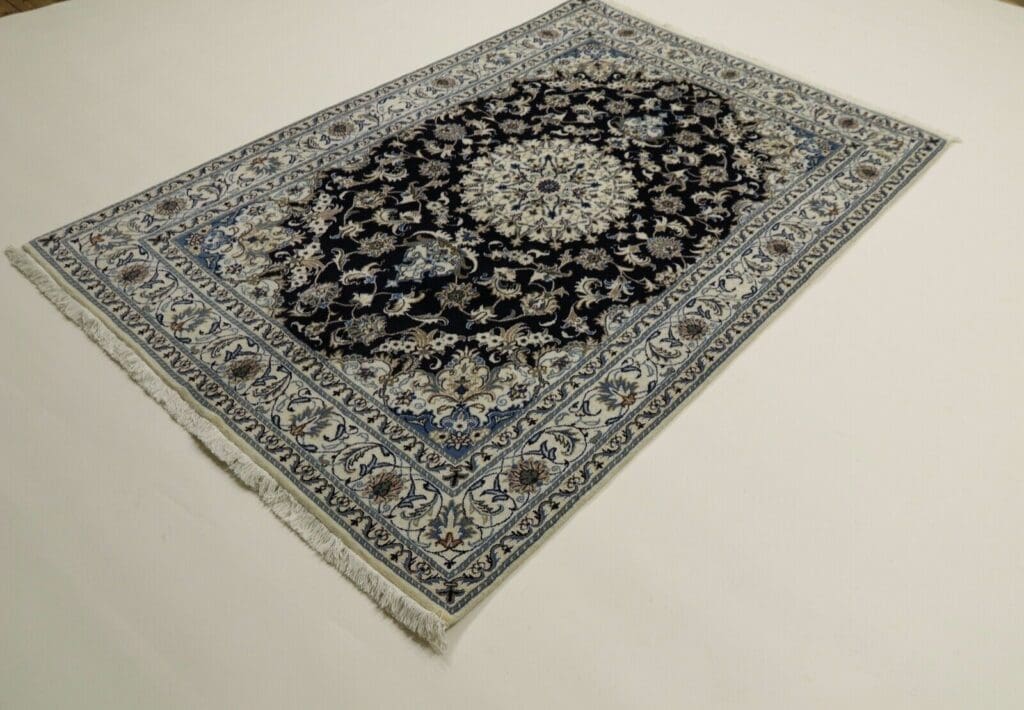
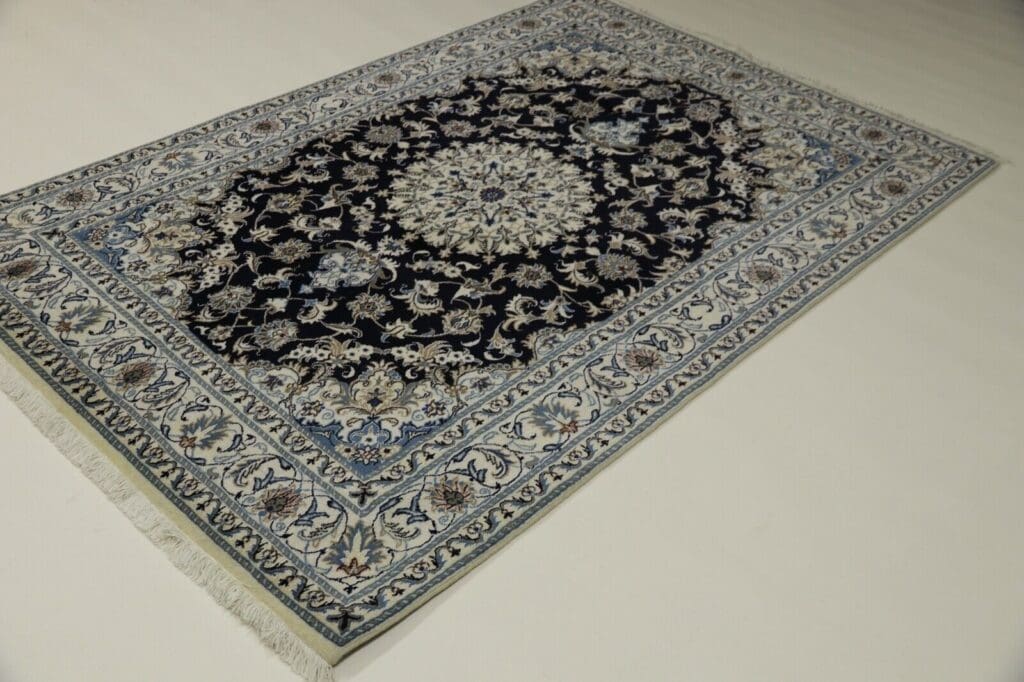
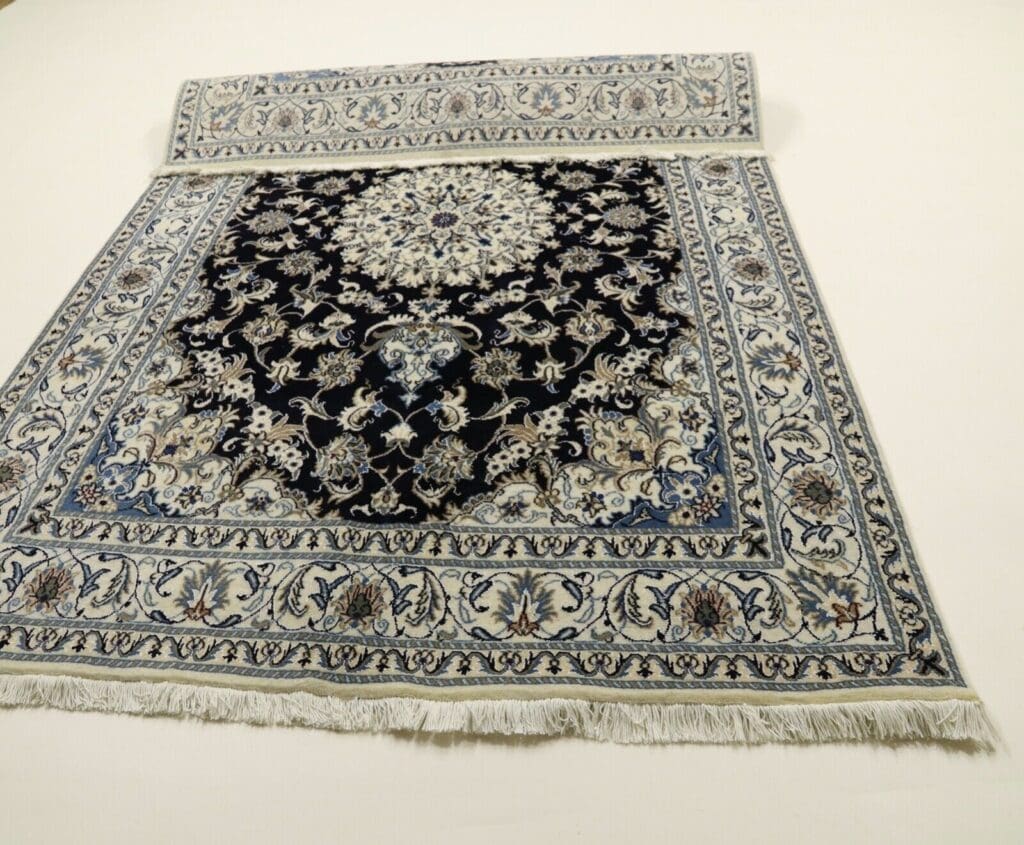
The stated colours are white and dark blue. White can provide a light ground or a clear background against which the drawing is read, while dark blue can define borders, outlines, vines, and ornament. The contrast creates a distinct pattern without requiring a large palette. The silk can add a further change in appearance as the light moves across the surface, particularly where the design contains fine lines or closely worked details.
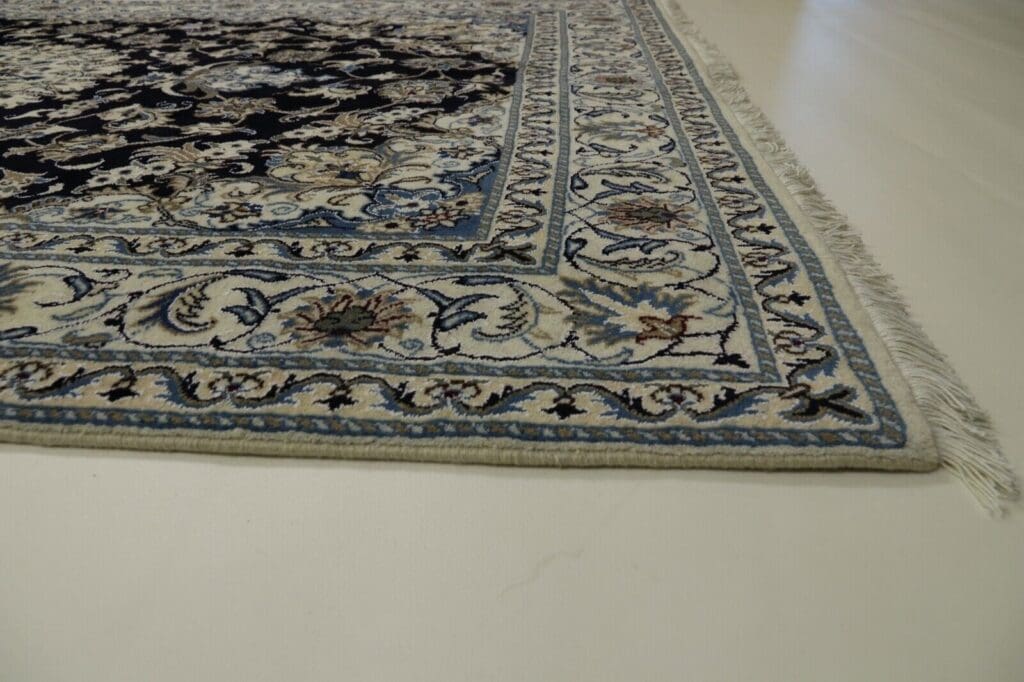
Oriental rug patterns are often organised as connected compositions rather than as isolated images. A central field may be surrounded by scrolling vegetation, smaller ornaments, or a border that frames the whole. Repetition and symmetry provide visual order in Persian design, while the character of handwork remains visible in the precise execution of individual areas. Knotting allows transitions between larger shapes and smaller details to be developed gradually.
Floral motifs in Persian rugs are not necessarily intended as literal botanical images. Flowers and leaves are stylised, rhythmically repeated, and adapted to the geometry of the woven surface. Within the cultural language of ornament, they may suggest nature, beauty, prosperity, or harmony. The meaning of a particular symbol depends on the design in which it appears; its significance is best understood through the relationship between the motifs and the overall composition.
The combination of white and dark blue gives the described design a clear and composed direction. Darker lines can bring structure to lighter areas, while the pale ground allows floral and ornamental details to remain legible. The interplay of wool and silk adds another layer to the pattern because the two materials receive and reflect light differently. As a result, the same motif can appear more subdued or more defined as the viewing angle changes.
Nain design traditionally depends on proportion and continuity. Borders enclose the field, repeated vines connect separate sections, and smaller motifs fill transitional spaces. This creates a unified arrangement rather than a collection of unrelated decorations. At the same time, every hand-knotted rug is an individual piece because the final expression depends on the particular execution of the design, the material, and the work of the weaver.
This rug therefore combines the Nain regional vocabulary with an Oriental floral and ornamental pattern. White and dark blue determine its stated colour effect, while the wool-and-silk construction contributes both texture and reflected light. The high knot density supports the detailed rendering of the design. Its visual language is rooted in Persian ornament, yet its specific execution belongs to this one unique, hand-knotted piece.
Special Features
A defining feature is the knot density of approximately 300,000 knots per square metre. A dense knot structure can support the precise rendering of small pattern elements and clear definition in contours. Here it is combined with hand-knotting and an Oriental design. The density is therefore both a technical specification and an indication of the work involved in producing the detailed surface.
The rug is new and in very good condition. It is a unique one-off and comes with an authenticity certificate. Its white and dark blue colour scheme, its combination of virgin wool and silk, and its Nain origin are further stated features. As a hand-knotted Persian rug from Persia or Iran, it brings together regional tradition and individual craftsmanship. The stated thickness is approximately 9 mm.
FAQ
How should I clean a Nain Persian rug?
Careful, regular vacuuming is suitable for removing dust and loose dirt from the surface. Cleaning should be carried out gently so that the hand-knotted structure and the materials are not unnecessarily stressed. For a deeper clean, a professional rug cleaner is recommended. This is particularly appropriate because the rug combines virgin wool with silk, and the two materials should be treated according to their textile properties.
Where is the best place to position my Nain Persian rug?
A location with relatively little foot traffic is recommended. A living room or an elegant dining area can provide a suitable setting in which the white and dark blue design remains visible while the rug is not exposed to constant heavy use. Such placement also helps protect the hand-knotted surface and its fine details over time.
How can I assess the quality of a Persian rug?
Several features are relevant: knot density, the materials used, the precision of the design, and the quality of the workmanship. A high number of knots per square metre can support finely rendered details. In this Nain Persian rug, the hand-knotted technique, the combination of virgin wool and silk, and the stated knot density are all part of the quality description. Its new, very good condition and authenticity certificate are additional stated characteristics.
To provide the best experiences, we use technologies like cookies to store and/or access device information. Consenting to these technologies will allow us to process data such as browsing behavior or unique IDs on this site. Not consenting or withdrawing consent, may adversely affect certain features and functions.
Functional Always active
The technical storage or access is strictly necessary for the legitimate purpose of enabling the use of a specific service explicitly requested by the subscriber or user, or for the sole purpose of carrying out the transmission of a communication over an electronic communications network.
Preferences
The technical storage or access is necessary for the legitimate purpose of storing preferences that are not requested by the subscriber or user.
Statistics
The technical storage or access that is used exclusively for statistical purposes.The technical storage or access that is used exclusively for anonymous statistical purposes. Without a subpoena, voluntary compliance on the part of your Internet Service Provider, or additional records from a third party, information stored or retrieved for this purpose alone cannot usually be used to identify you.
Marketing
The technical storage or access is required to create user profiles to send advertising, or to track the user on a website or across several websites for similar marketing purposes.
 SECURE PAYMENT
 SHIPPING PARTNERS


