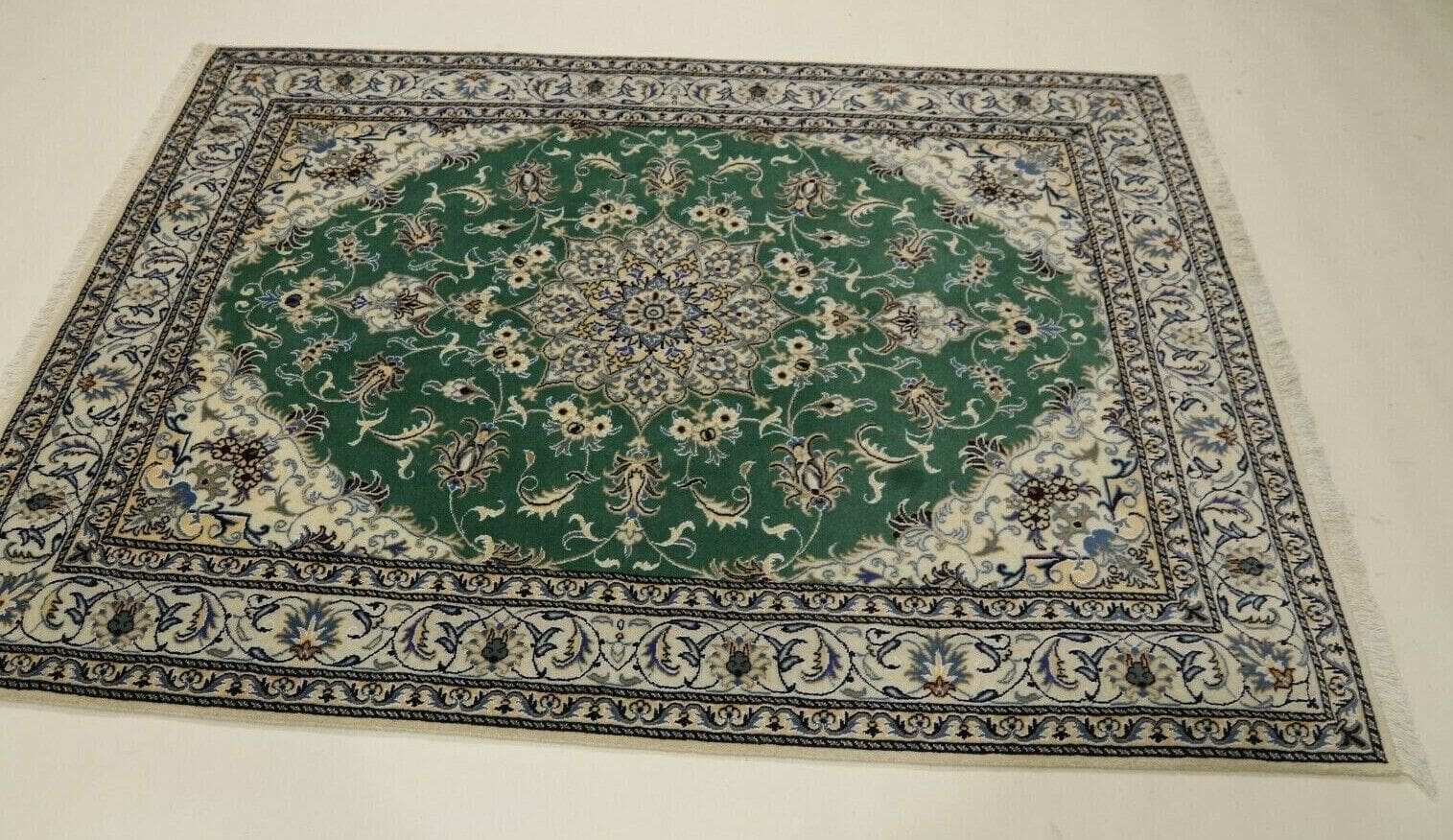
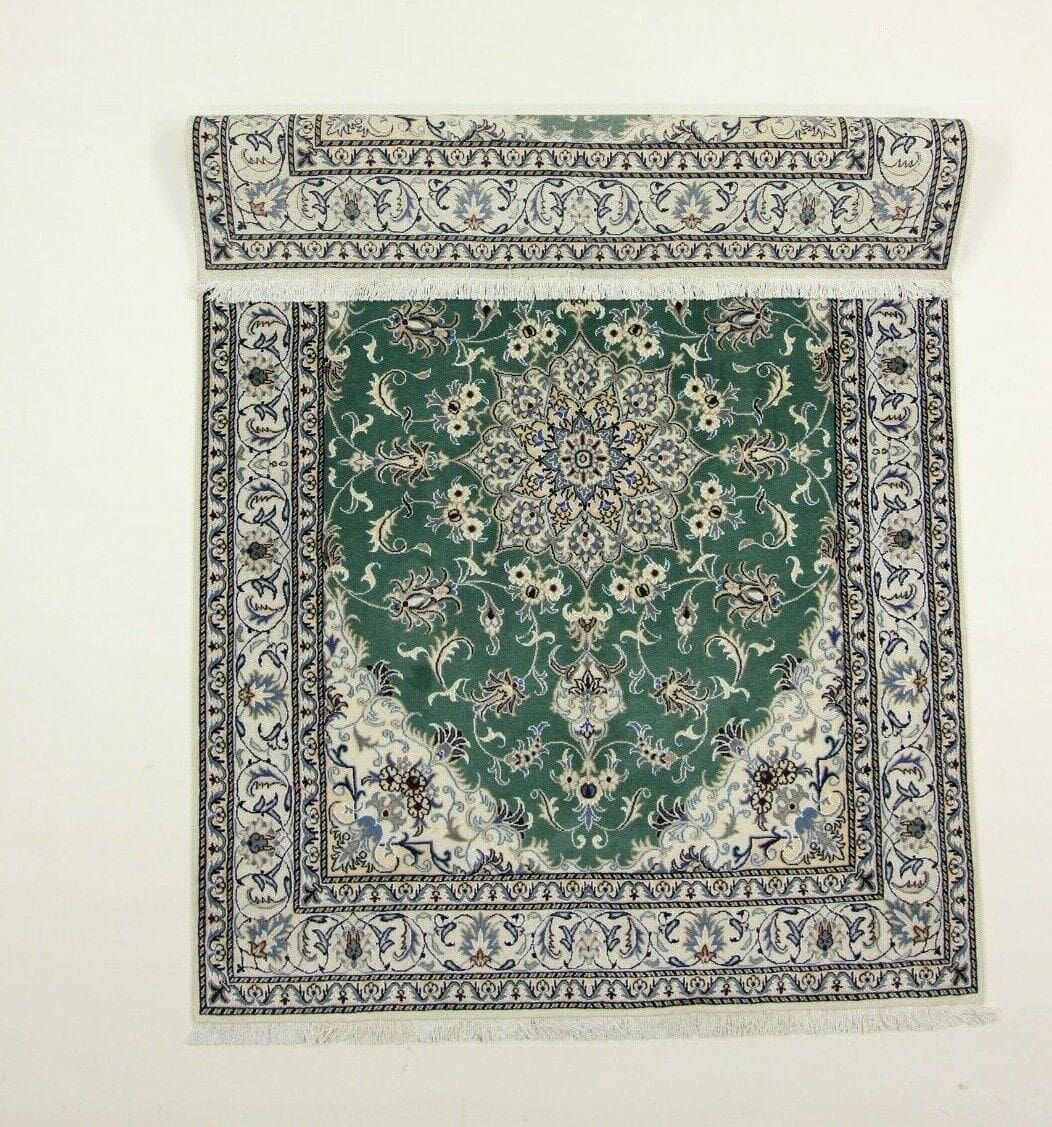
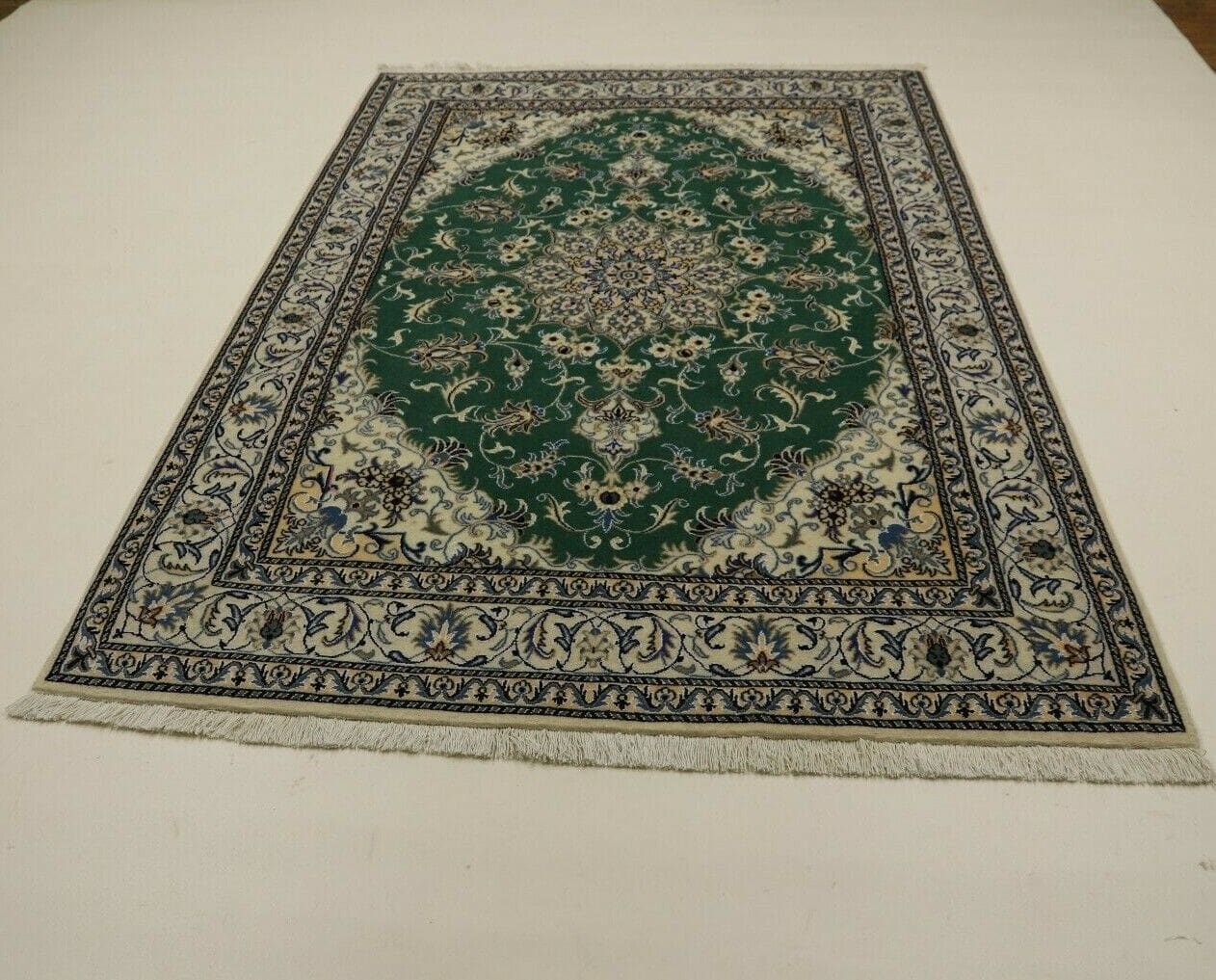
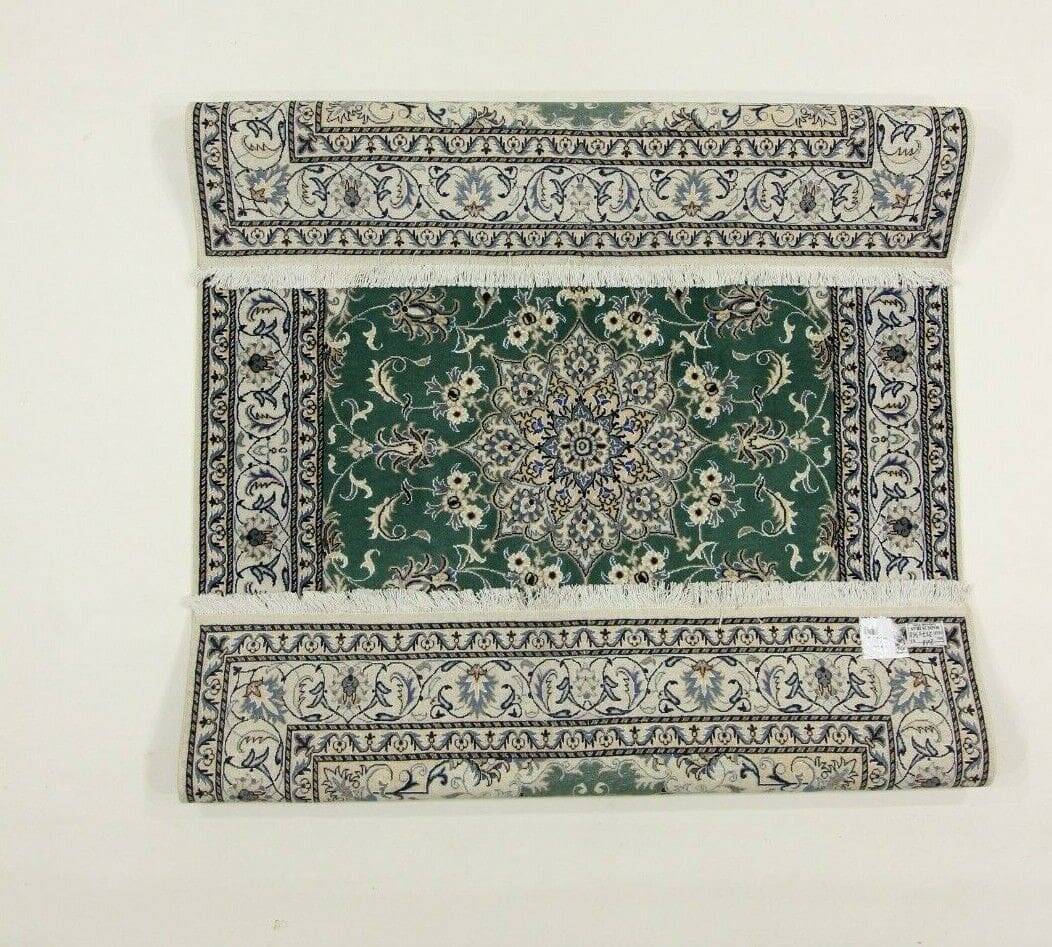
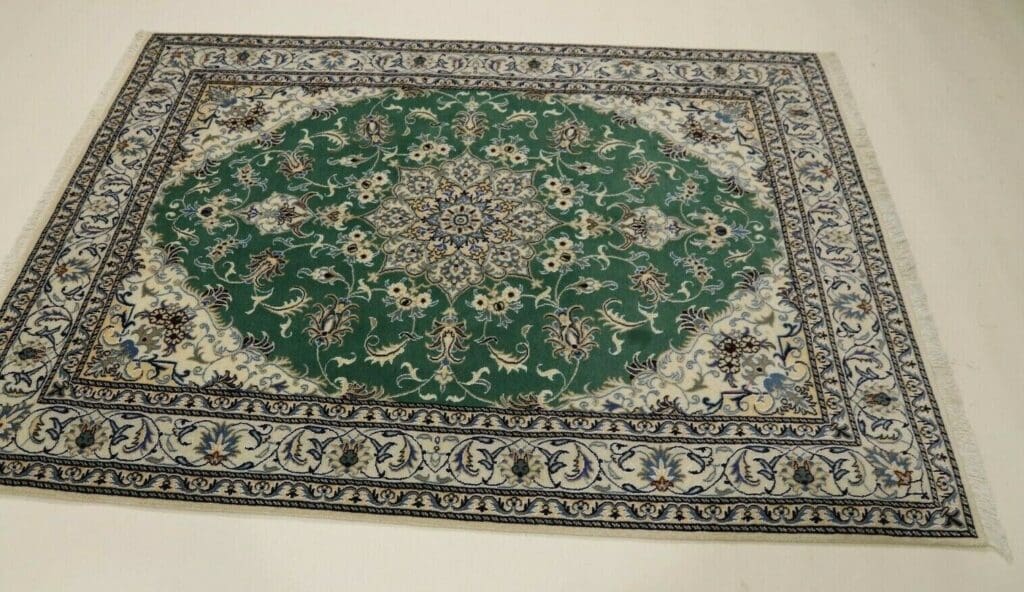
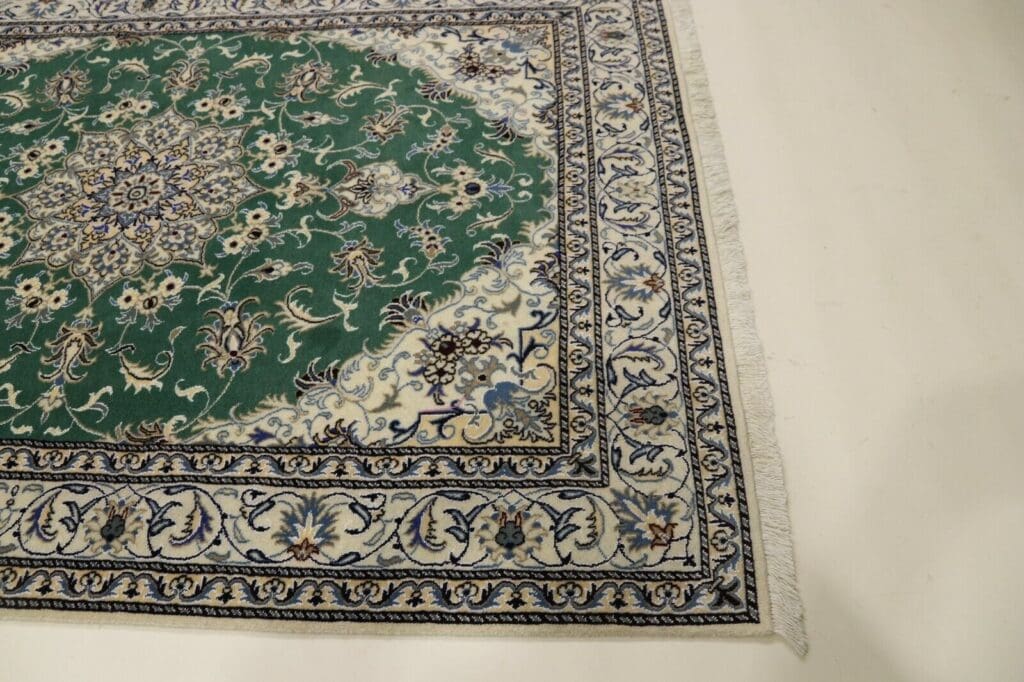
This Nain Persian rug is hand-knotted, with a pile made from 90% virgin wool and 10% silk. The two fibres bring different qualities to the same textile surface. Virgin wool is a traditional rug material with a resilient structure and a naturally comfortable handle. Wool can absorb warmth and contribute to a balanced room climate, while its natural structure gives the pile resistance in everyday use. Silk adds a finer touch and a restrained sheen. Depending on the light, the contrast between the wool and silk can make changes in texture and colour perception visible across the pile. Combining these materials in a hand-knotted rug requires careful coordination of the fibre, knot and foundation. Each knot is placed individually into the woven structure. The pattern is therefore built through a large number of separate manual operations rather than through a printed or mechanically applied surface. The rug has a knot density of approximately 300,000 knots per square metre. Such a density allows fine contours, floral details and small ornaments to be rendered with precision. The handwork brings together the fuller appearance of wool and the light-reflecting quality of silk. The pile is approximately 8 mm high. The rug is new and in perfect condition. It has a rectangular shape and is suitable for use over underfloor heating. These details describe both its construction and its intended practical setting. The material composition is also relevant to care: wool and silk should be cleaned gently, protected from unnecessarily intense sunlight and treated with suitable products. A hand-knotted rug is the result of patient manual work, and its surface should be maintained in a way that respects the fibres and the structure beneath them.
Origin and Tradition
Nain is a city in Iran and an established centre of Persian rug weaving. It lies approximately 150 kilometres north-west of Isfahan. Nain rugs are traditionally associated with fine knotting, controlled drawing and carefully balanced compositions. The city has developed a recognisable weaving tradition in which Persian ornament, material selection and precision of execution work together. Persian rugs are part of a broader textile culture in which the design is planned before it is translated into knots. A drawing determines the relationship between the field, borders and ornamental details. The weaver then transfers that plan into the foundation through many individual knots. Fine knotting supports the reproduction of narrow lines and small motifs, although density alone does not define a rug. Fibre, colour, drawing and construction all contribute to the character of a Nain piece. Nain belongs to the cultural landscape of central Iran, while remaining distinct from Isfahan as a place of origin and as a rug designation. Its proximity to Isfahan helps explain its place within the Persian artistic tradition, but a Nain rug is not automatically an Isfahan rug. Nain is its own origin with its own conventions of drawing and workmanship. Traditional Nain designs often use an ordered central field, floral ornament and finely divided arabesque forms. Borders are generally arranged in a clear relationship with the interior field, giving the design a coherent framework. These principles are connected with the long transmission of patterns, technical knowledge and workshop practice. In a hand-knotted rug, the link between a prepared design and manual execution remains visible in the way repeated shapes are built row by row. The term Super Nain places this rug within the fine Nain design tradition, while its stated origin is Persia. That origin identifies the rug as Persian rather than as a product of another weaving country. The Iranian background is therefore part of the object’s classification, and the Nain name points to the regional tradition associated with its design and construction. The rug belongs to the history of Oriental carpet making in which local practice, Persian ornament and patient handwork are combined. Its construction expresses that tradition through the individual knot, while its pattern refers to the ordered floral language commonly associated with Nain weaving.
Design and Pattern
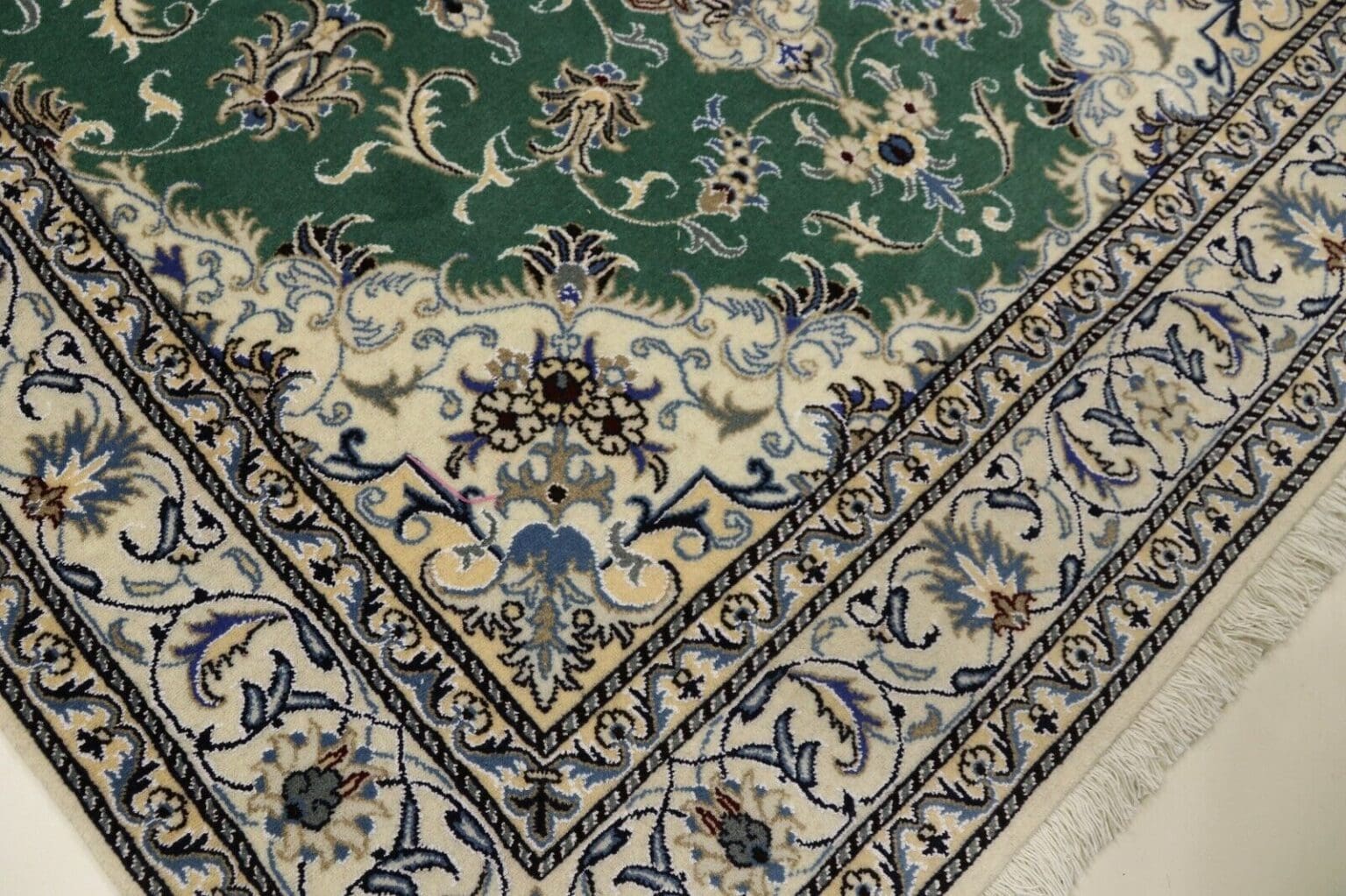
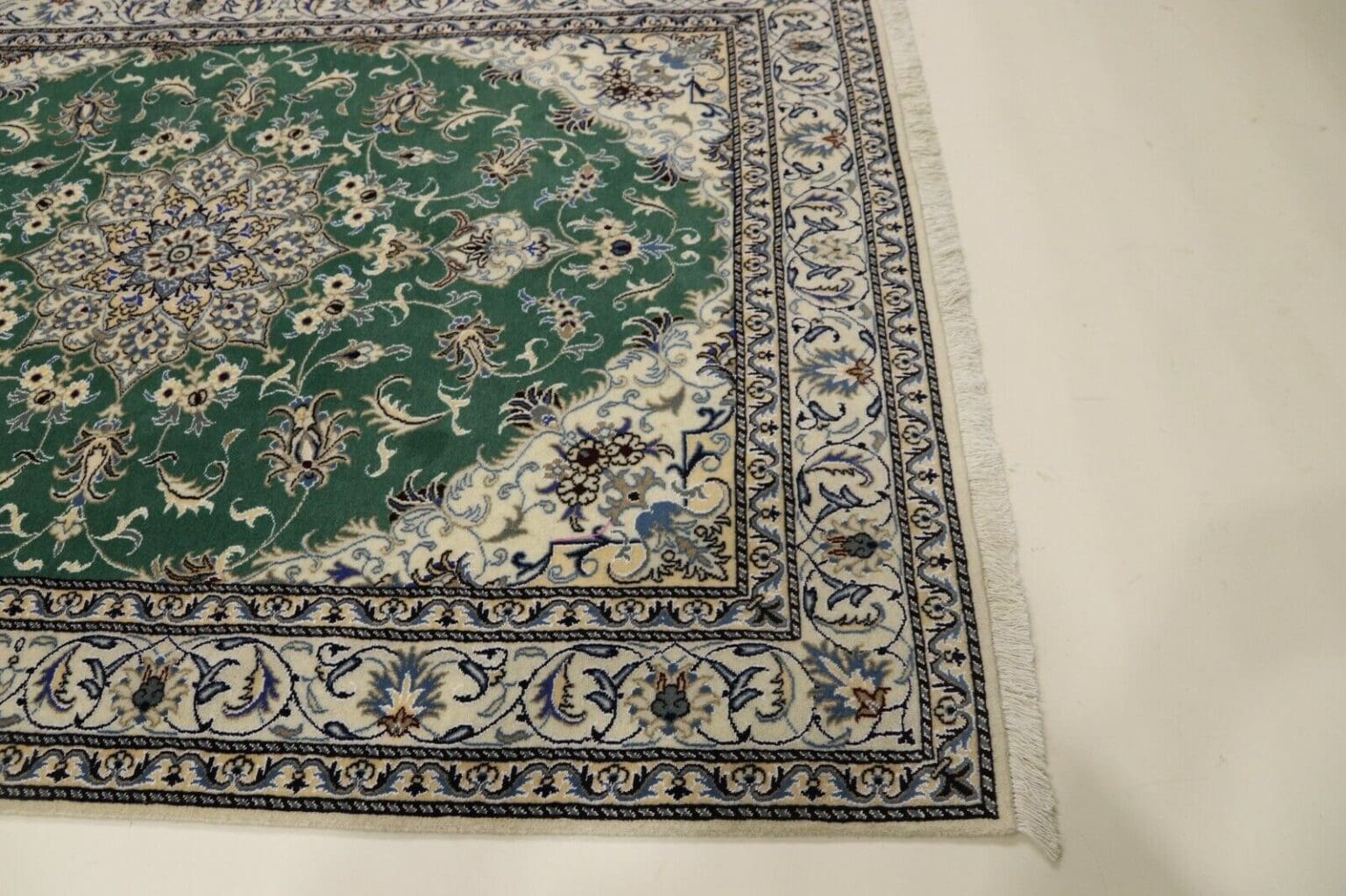
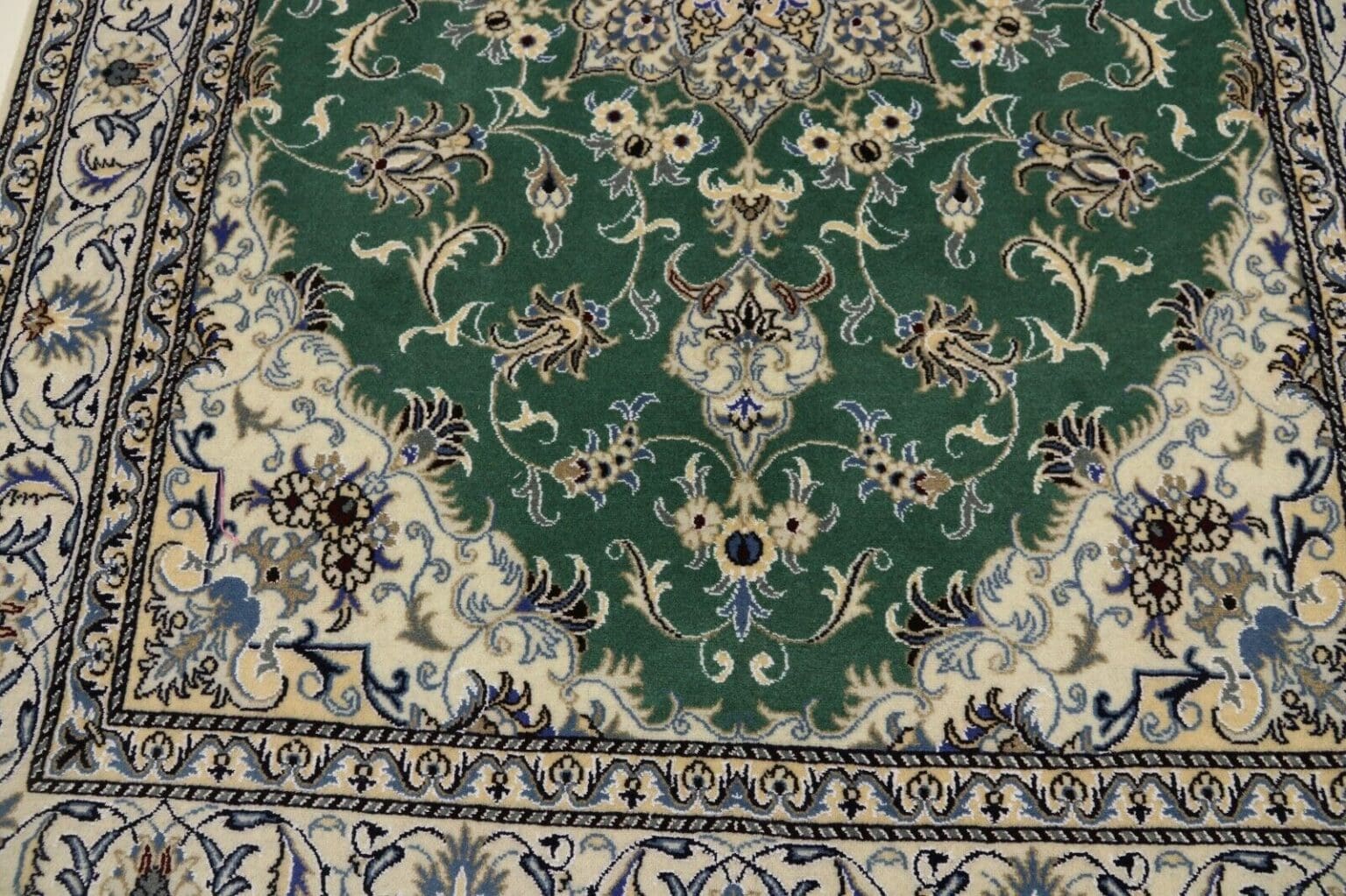
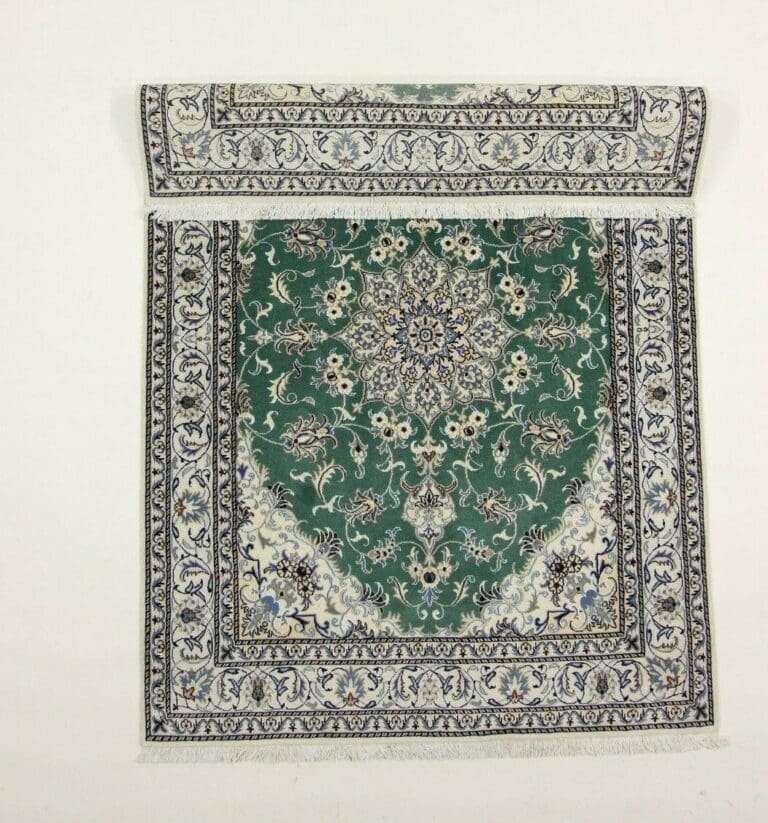
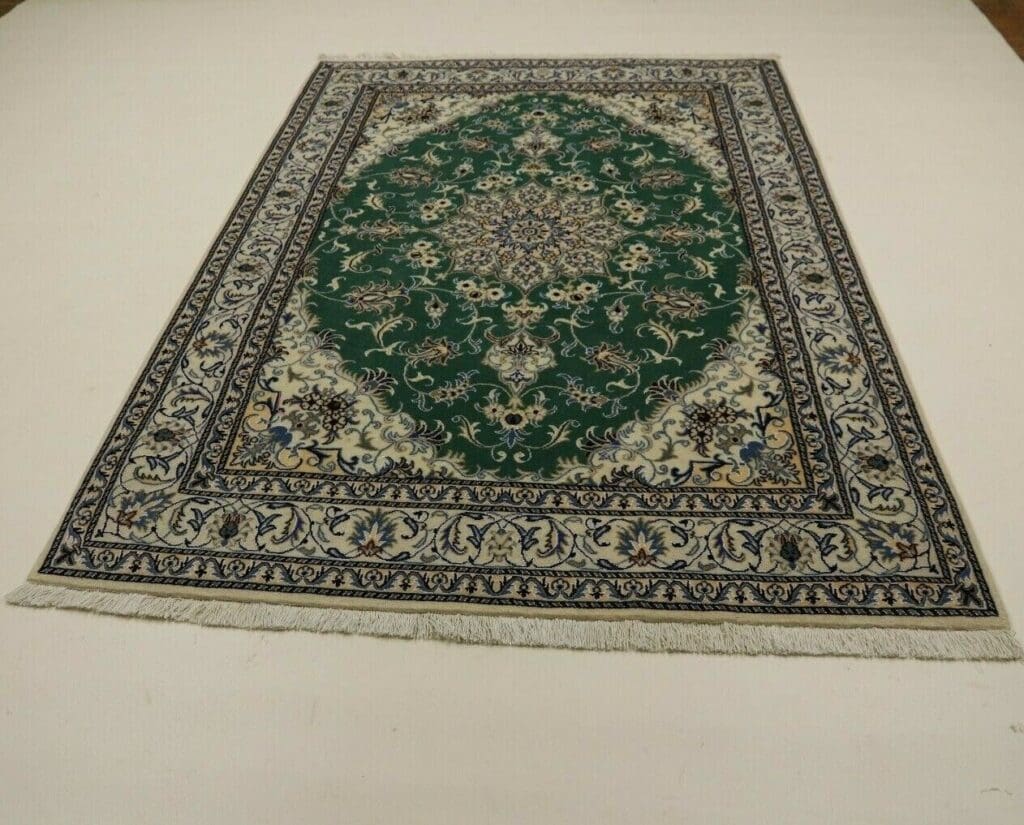
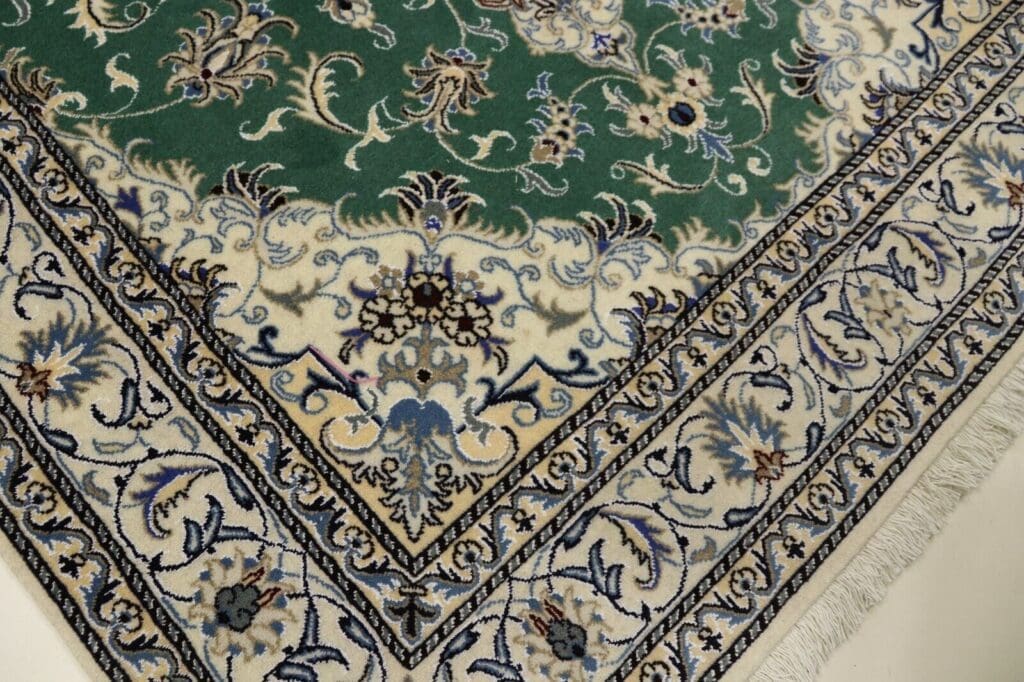
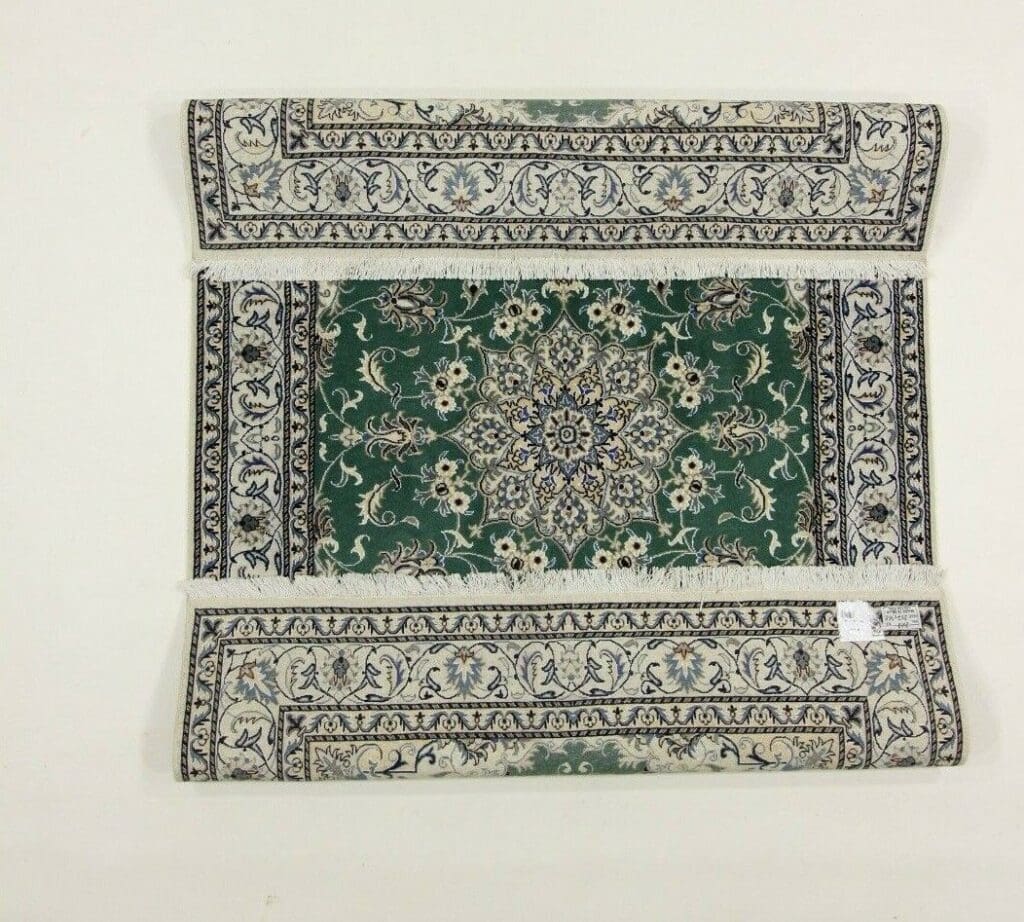
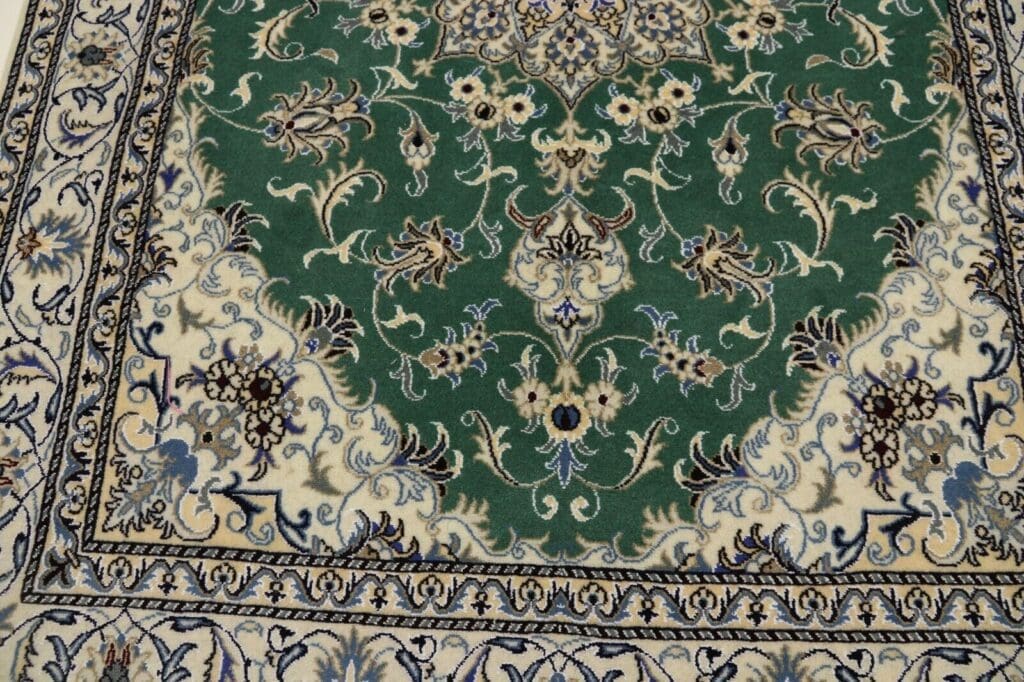
The pattern of this Oriental rug is described as Oriental and traditionally Persian. Its design uses floral motifs rooted in Persian ornament and in the visual language of nature and gardens. Flowers, leaves, vines and arabesques are traditionally arranged as parts of a coherent composition rather than scattered without structure. A design of this kind may be organised around an interior field, surrounding borders and smaller transitional ornaments. Fine knotting allows the contours and repetitions to be drawn with clarity while preserving the continuous textile character of the rug. The Super Nain designation connects this piece with a design tradition known for ordered decoration and detailed floral drawing. This rug is coloured white and green. Light areas make the ornament easy to read, while green elements provide the principal colour contrast and structure within the composition. Nain designs in general may also use cream, gold and blue, with those tones appearing differently as the light changes and as they are placed beside one another. The colours specified for this rug are white and green. Its pattern is not abstract in the modern sense; it follows an Oriental and traditionally Persian vocabulary based on repetition, balance and floral order. The relationship between fibre and design also affects its appearance. Silk can catch the light in selected areas, while virgin wool usually gives the surrounding surface a softer and more subdued presence. As a result, some lines or ornaments may appear more or less pronounced under different lighting conditions. The rectangular format supports a classic arrangement of a central field and longitudinal border areas. Traditional Oriental patterns can be read through their symmetry, rhythm and relationship between filled and open sections. Here, the contrast of white and green gives the floral drawing a clear visual framework, while the fine hand-knotting supports the execution of small details. The design therefore combines an established Persian pattern language with a restrained colour statement. It can be placed alongside traditional furnishings or within a more contemporary room without losing its connection to Persian ornament. The important elements are the floral character, the ordered composition, the white and green palette and the visible effect created by the combination of wool and silk. Together they define the rug’s stated Oriental and traditional Persian style.
Special Features
The knot density of approximately 300,000 knots per square metre is a notable technical feature. It allows the floral drawing to be worked with fine detail and reflects the precise construction associated with this Super Nain rug. The pile combines 90% virgin wool with 10% silk, bringing a natural wool fibre together with a finer fibre that contributes a subtle sheen. The rug is hand-knotted, rectangular, new and in perfect condition. It is suitable for underfloor heating. When it is used over heated flooring, the temperature should not be set unnecessarily high so that the fibres and hand-knotted construction are treated carefully. Regular vacuuming at low suction helps remove dust and loose dirt. Strong direct sunlight should be avoided to help keep the colours even. Fresh marks can be treated carefully with a damp cloth and mild detergent. A professional rug-cleaning service is appropriate for a deeper cleaning.
FAQ
How should I care for this Nain Persian rug?
Vacuum the rug regularly using low suction to remove dust and loose dirt without placing unnecessary stress on the pile. Avoid strong direct sunlight, since prolonged exposure can affect the even appearance of the colours. Fresh stains should be treated promptly and gently with a damp cloth and mild detergent. Do not rub aggressively, use harsh chemicals or saturate the rug with water. For a thorough or deep cleaning, use a professional rug-cleaning service familiar with hand-knotted rugs. Wool and silk require appropriate handling, and professional cleaning helps protect both the fibres and the structure beneath the pile.
How can I tell whether an Oriental rug is authentic?
Several features should be considered when assessing a hand-knotted Oriental rug. Knot density, material quality and the execution of the pattern all provide useful information. Hand-knotted rugs may show small irregularities or slight variations between individual knots. These are normal signs of manual production and are not automatically defects. The relationship between the pile, foundation and design can also assist with classification. The stated origin should be supported by suitable documentation, a certificate or confirmation from a knowledgeable dealer. No single characteristic is sufficient for a reliable assessment. A qualified evaluation considers construction, materials, pattern and origin together.
Is this rug suitable for underfloor heating?
Yes. This Nain Persian rug is suitable for use over underfloor heating. Its material composition of virgin wool and silk can be used on a heated floor, while wool has insulating properties that affect the way warmth is distributed. The heating should not be set unnecessarily high, so the fibres and the hand-knotted construction are not exposed to avoidable stress. Even heating and attention to the flooring manufacturer’s recommendations are sensible. If the floor construction or heating system raises a specific question, a qualified specialist can provide additional guidance.
To provide the best experiences, we use technologies like cookies to store and/or access device information. Consenting to these technologies will allow us to process data such as browsing behavior or unique IDs on this site. Not consenting or withdrawing consent, may adversely affect certain features and functions.
Functional Always active
The technical storage or access is strictly necessary for the legitimate purpose of enabling the use of a specific service explicitly requested by the subscriber or user, or for the sole purpose of carrying out the transmission of a communication over an electronic communications network.
Preferences
The technical storage or access is necessary for the legitimate purpose of storing preferences that are not requested by the subscriber or user.
Statistics
The technical storage or access that is used exclusively for statistical purposes.The technical storage or access that is used exclusively for anonymous statistical purposes. Without a subpoena, voluntary compliance on the part of your Internet Service Provider, or additional records from a third party, information stored or retrieved for this purpose alone cannot usually be used to identify you.
Marketing
The technical storage or access is required to create user profiles to send advertising, or to track the user on a website or across several websites for similar marketing purposes.

 SECURE PAYMENT
 SHIPPING PARTNERS


