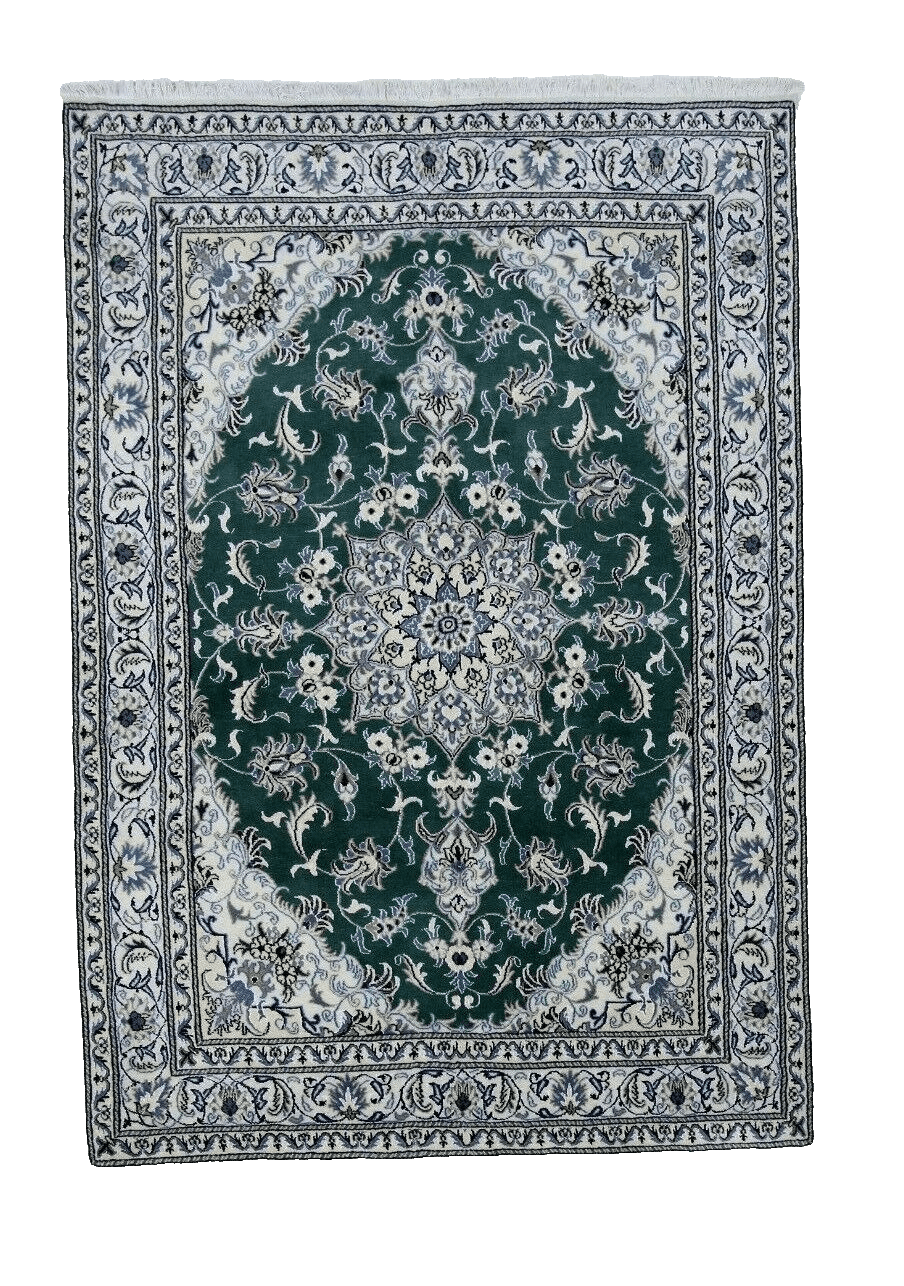
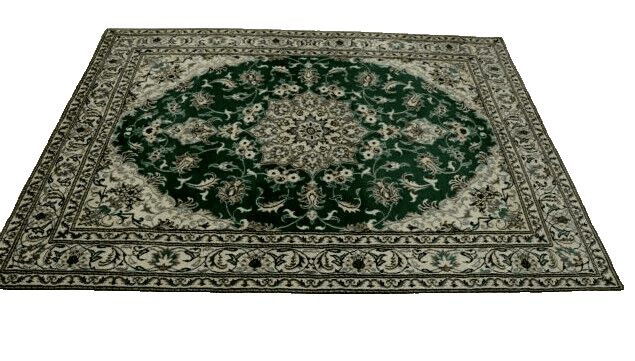
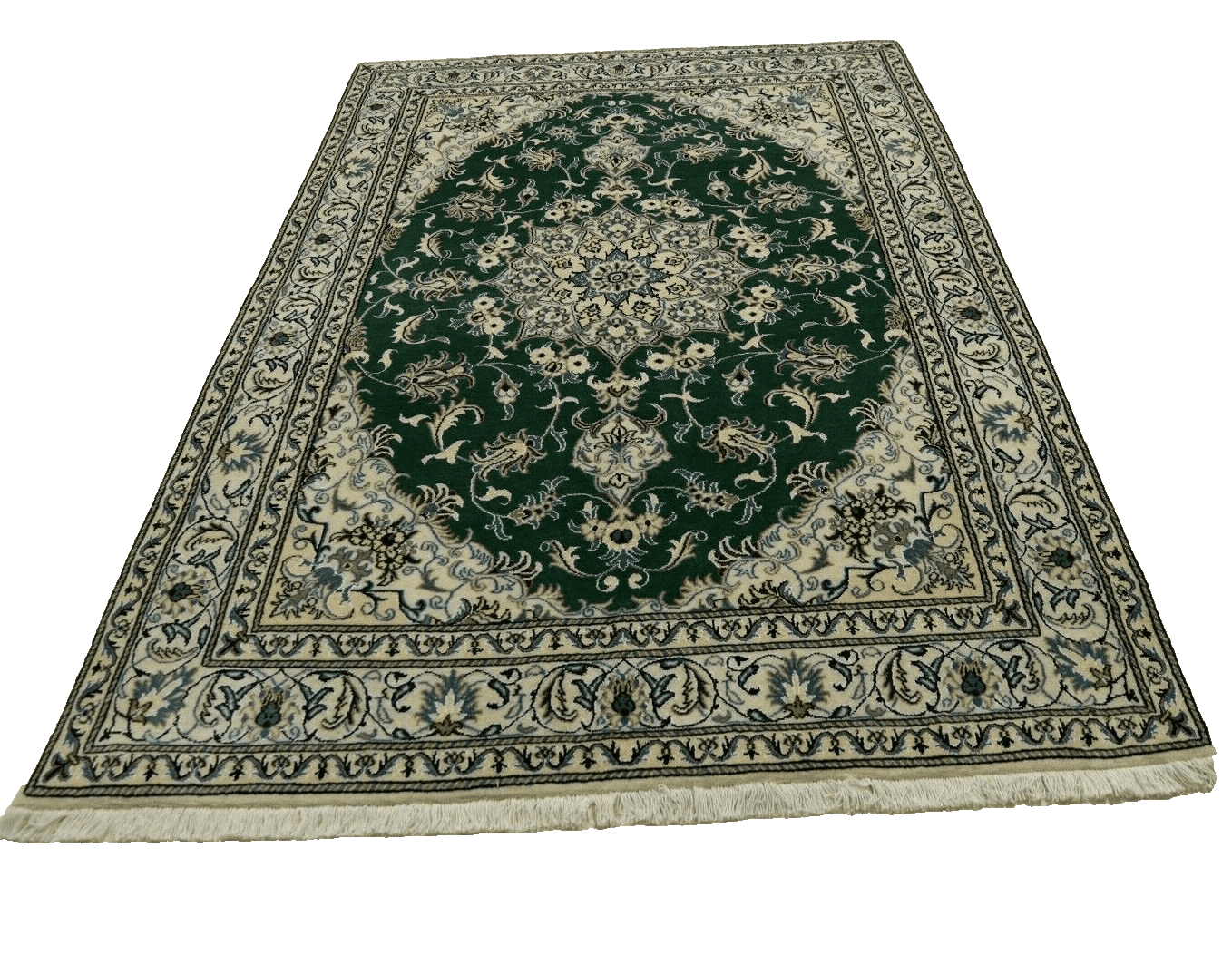
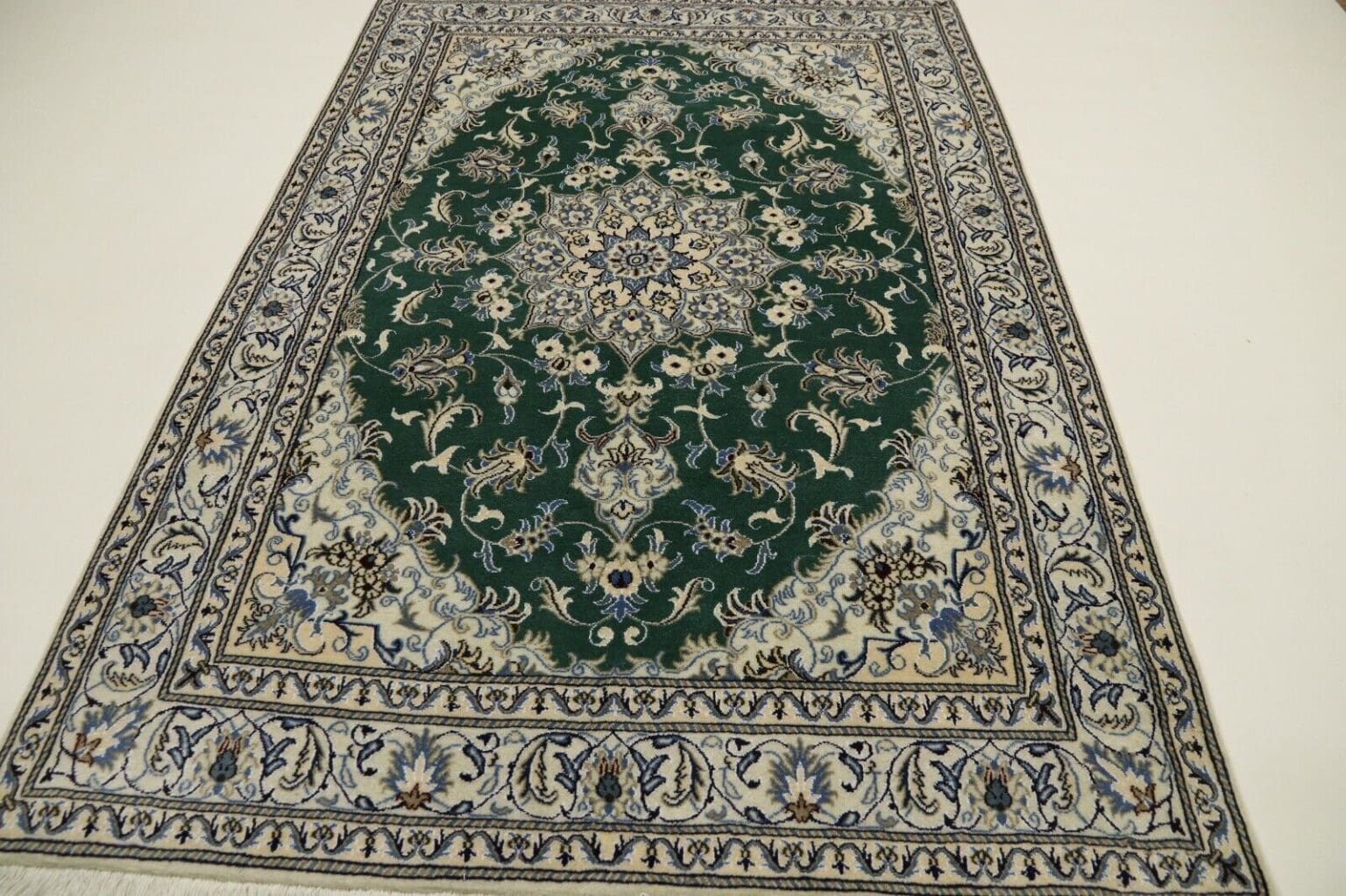
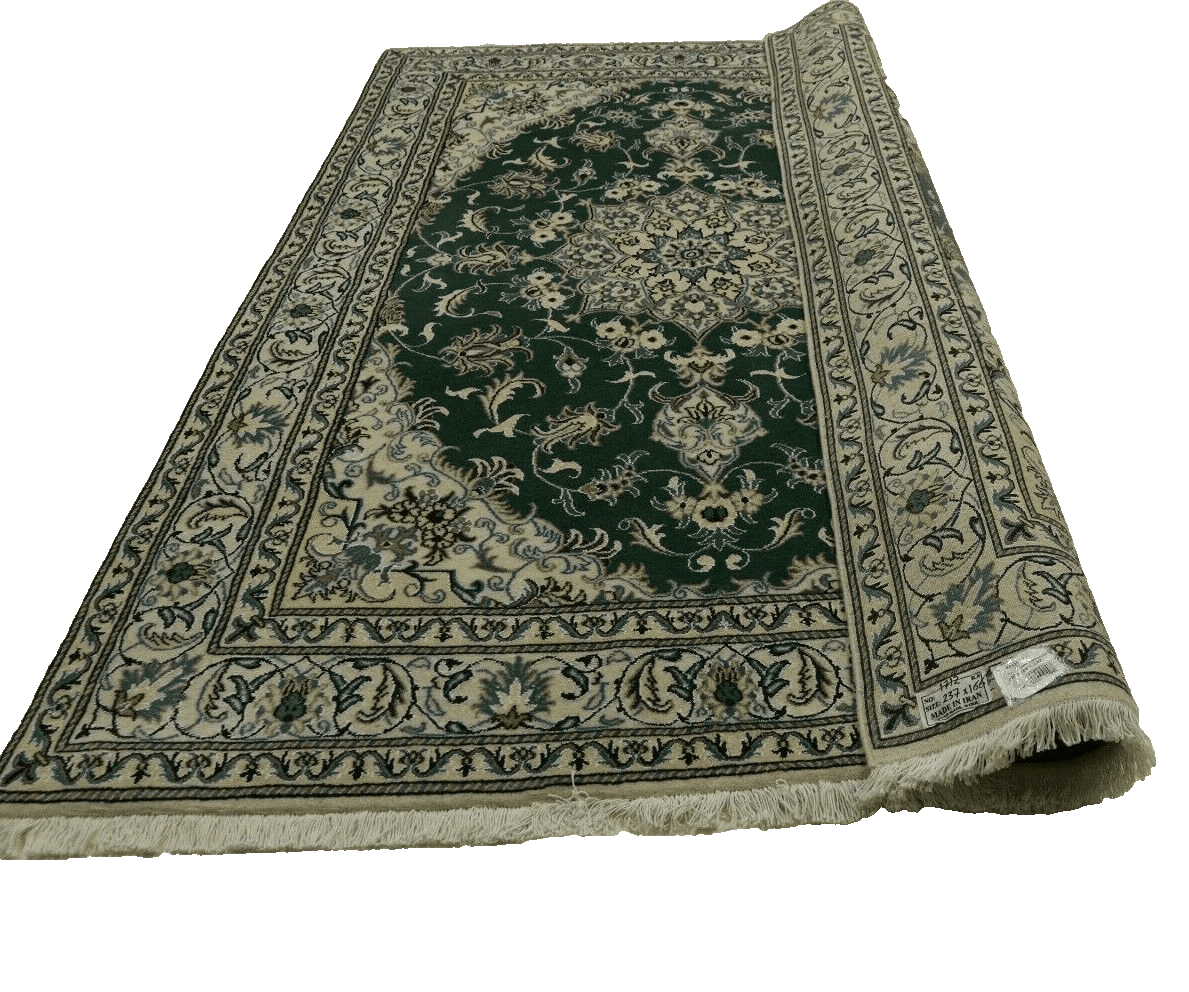
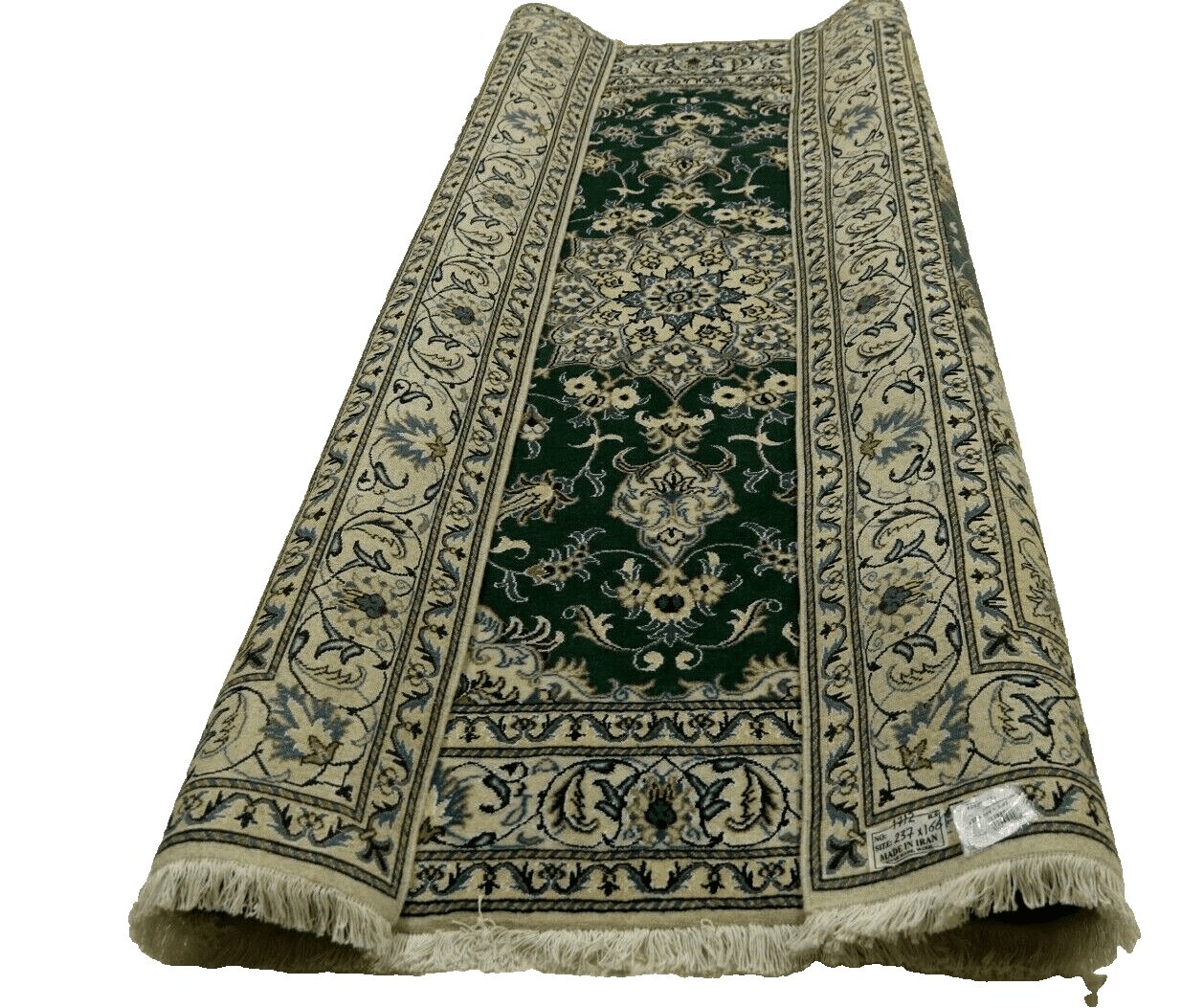
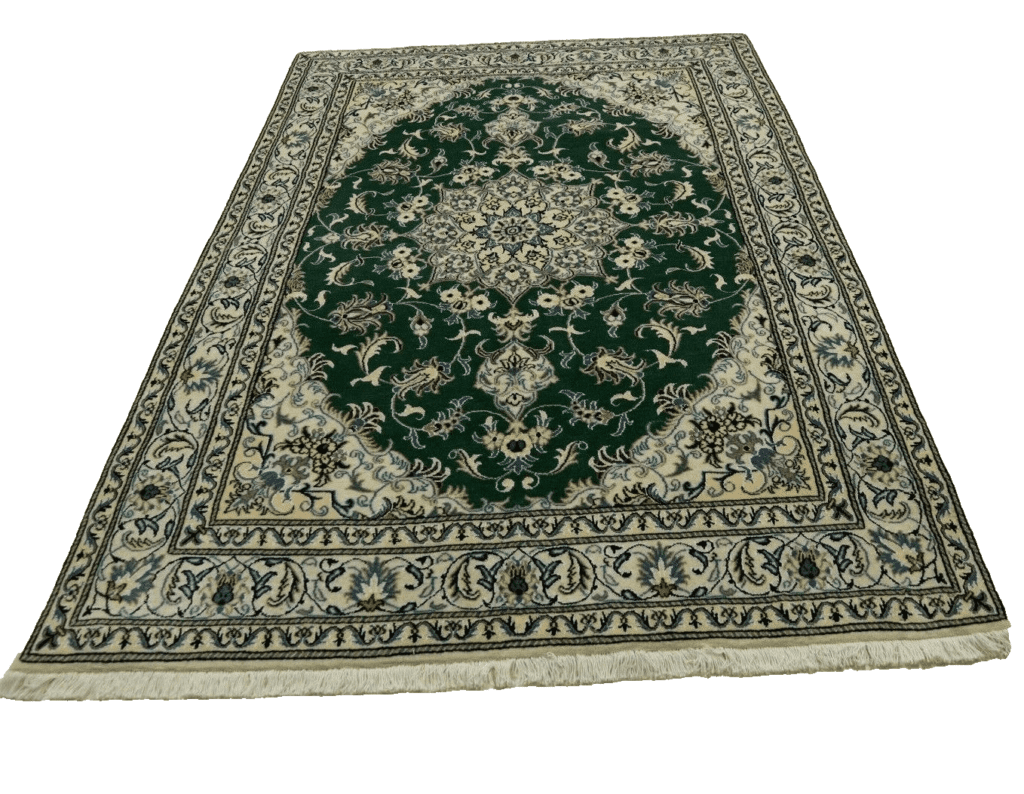
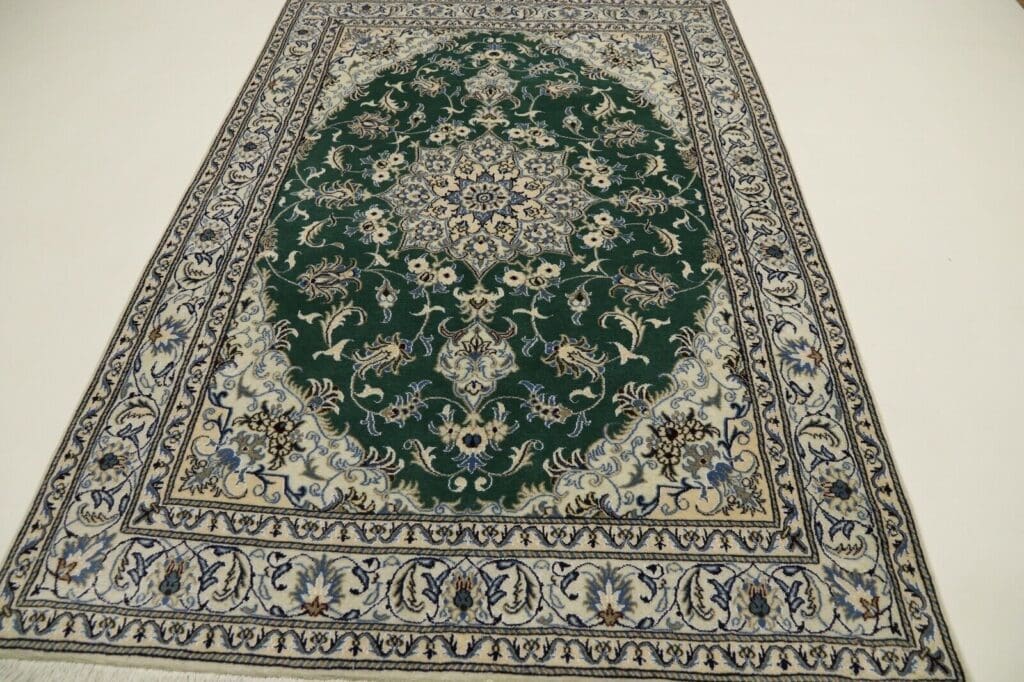
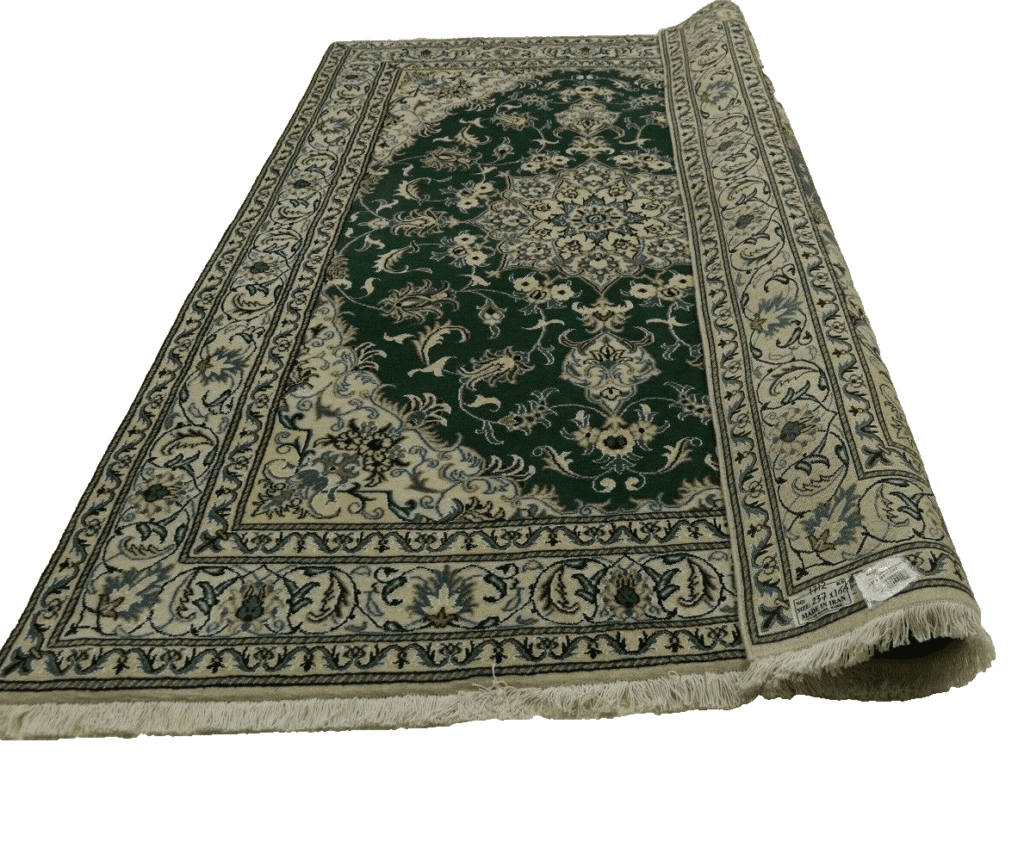
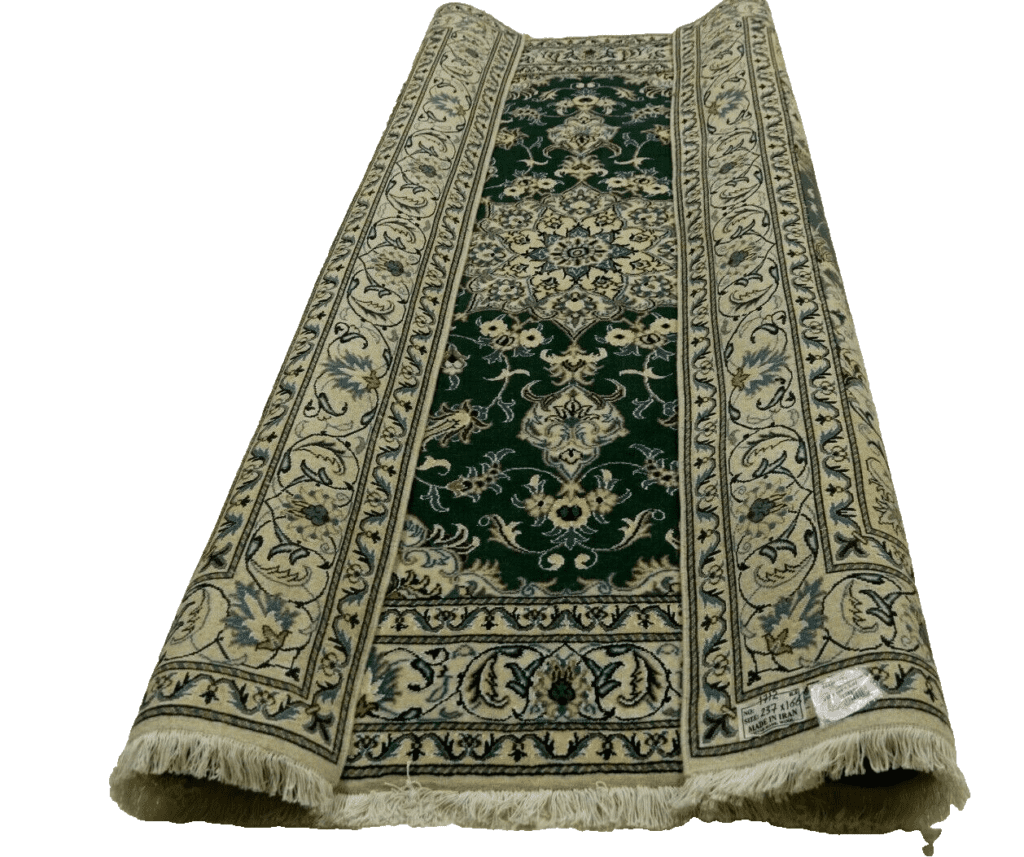
Hand-knotted Nain Persian Rug | Knot density: approx. 300,000 knots/m² | Material: pile wool and silk | Size: 237 x 166 cm | Pattern: Traditional Oriental/Persian | Condition: New
This Nain Persian rug is hand-knotted from virgin wool and silk. The two fibres contribute different qualities to the surface: wool provides a hard-wearing foundation, while silk adds a smooth feel and a restrained sheen. The source description also characterises virgin wool as naturally resistant to dirt and capable of helping regulate temperature. That combination makes the material suitable in principle for living spaces where a rug is used regularly. Because silk reflects light differently from wool, it can bring additional definition to fine lines and subtle changes across an ornamental design.
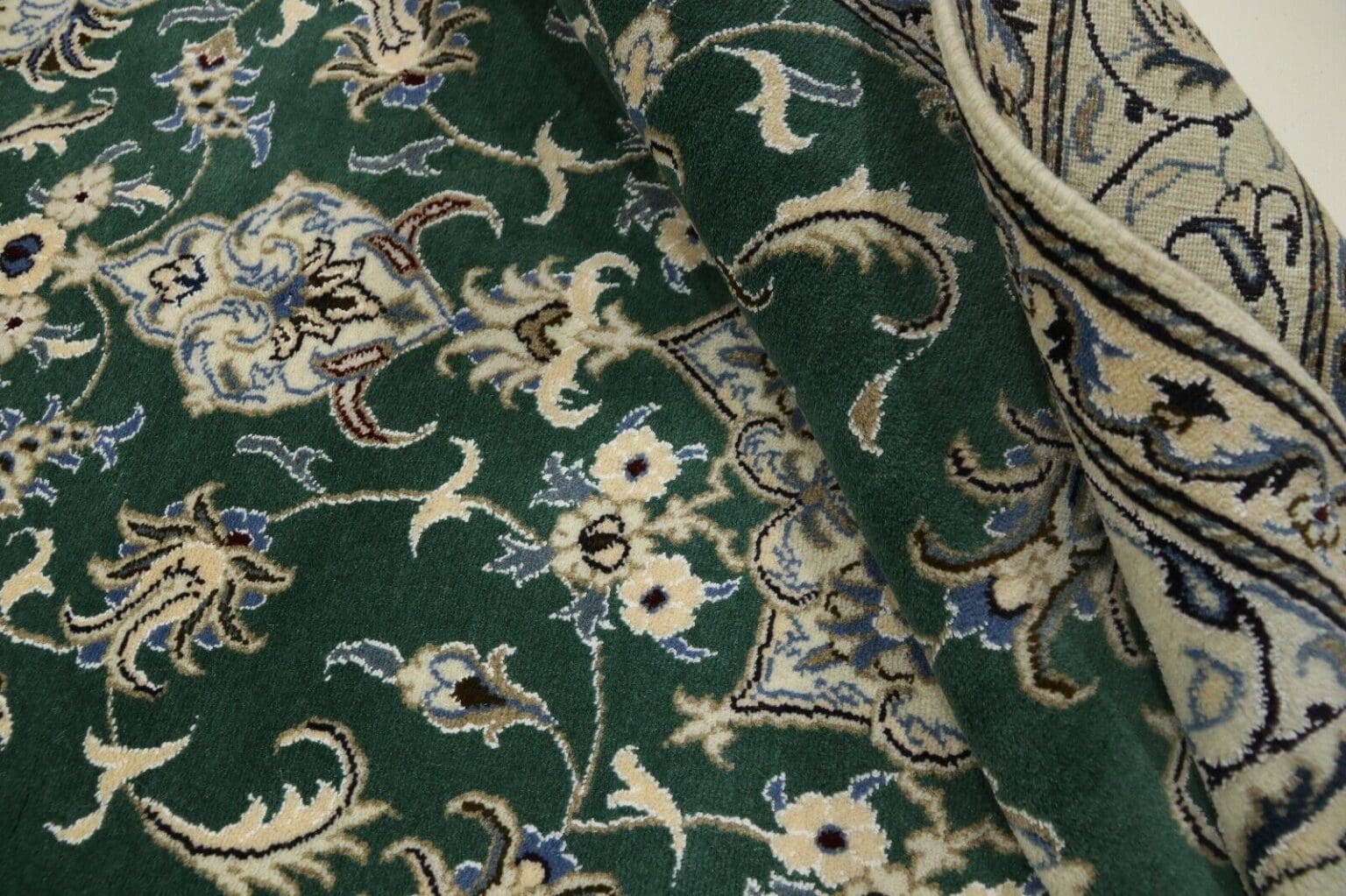
Hand-knotting is a traditional construction method in which each knot is placed by hand. Unlike a machine-made floor covering, the rug is built step by step through the repeated work of the knotter. The individual process makes this piece a one-off and an individual item. Minor variations arising from hand production are part of the way such a rug is made. The listed knot density of approximately 300,000 knots per square metre indicates a finely executed construction and provides a basis for rendering small details with clarity.
The rug is described as new, and an authenticity certificate is present. These details concern the condition and documentation of this particular item. Its hand-knotted construction, the combination of virgin wool and silk, and its high knot density together define the technical character of the Nain Persian rug offered here.
Origin and Tradition
Nain rugs originate in Nain, Iran. The city is situated in the arid landscape of central Iran and has become recognised as a distinct centre of Persian rug making. In this setting, textile skills, wool working and the transmission of designs across generations became closely connected. Nain therefore names not only a place of origin but also a particular branch of Persian weaving and knotting culture.
The rug-making tradition of Nain is traced back to the sixteenth century. Over the course of that history, local artisans developed and refined a range of compositions and ornamental structures. Religious and cultural symbols could appear alongside floral decoration and carefully ordered geometric forms. The regional tradition is associated with controlled drawing and precise placement of motifs. Artisans work from a design, organise its elements into a coherent repeat or field, and build the image knot by knot so that outlines and colour areas remain distinct.
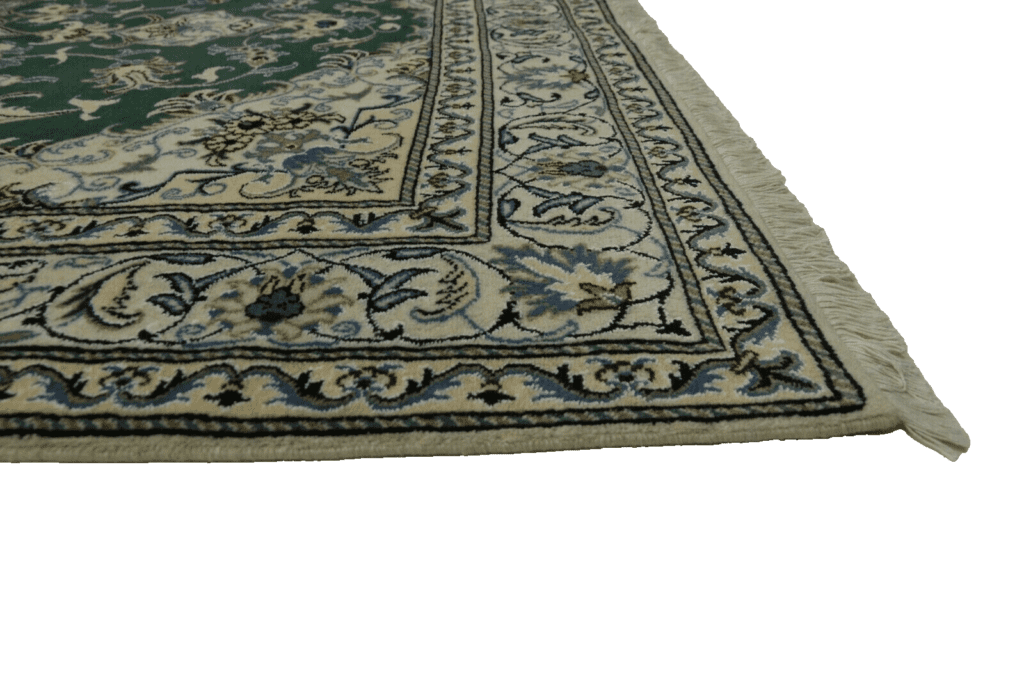
A notable feature of Nain craftsmanship is the relationship between delicate motifs and restrained colour transitions. Fineness is not only a matter of knot count; it also involves balancing the drawing, the ground and the borders. In Persian rug design, borders provide structure by enclosing the central field, creating a transition toward the edge and giving the composition a visible frame. The central field may be organised around a symmetrical axis or defined by a medallion, depending on the design chosen by the weaver.
Nain Persian rugs are known internationally for careful handwork and an elegant, finely drawn visual language. Their place within Persian rug culture comes from the combination of regional origin, inherited design practice and manual workmanship. The name Nain refers to an Iranian tradition rather than merely to a broad Oriental style. In rug terminology, regional names help describe characteristic methods, design families and the history of important weaving centres.
Making a hand-knotted rug involves a sequence of skilled tasks. A design is prepared, the foundation is arranged, and knots are then tied row by row with the intervening weft work. Drawing a flower, vine, border or geometric panel requires concentration because the final image is assembled from many individual placements. After the knotting is complete, the pile and surface are finished so that the design can be read clearly. Nain tradition thus brings together knowledge of materials, control of structure and continuity of ornamental practice.
The cultural background of Nain also illustrates how regional rug identities develop. A place becomes recognised through recurring approaches to drawing, colour, construction and finishing, while individual workshops and weavers continue to make their own decisions. The result is not a mechanically identical series but a body of work with shared characteristics. Hand production keeps the relationship between the established Nain vocabulary and each individual rug visible.
Design and Pattern
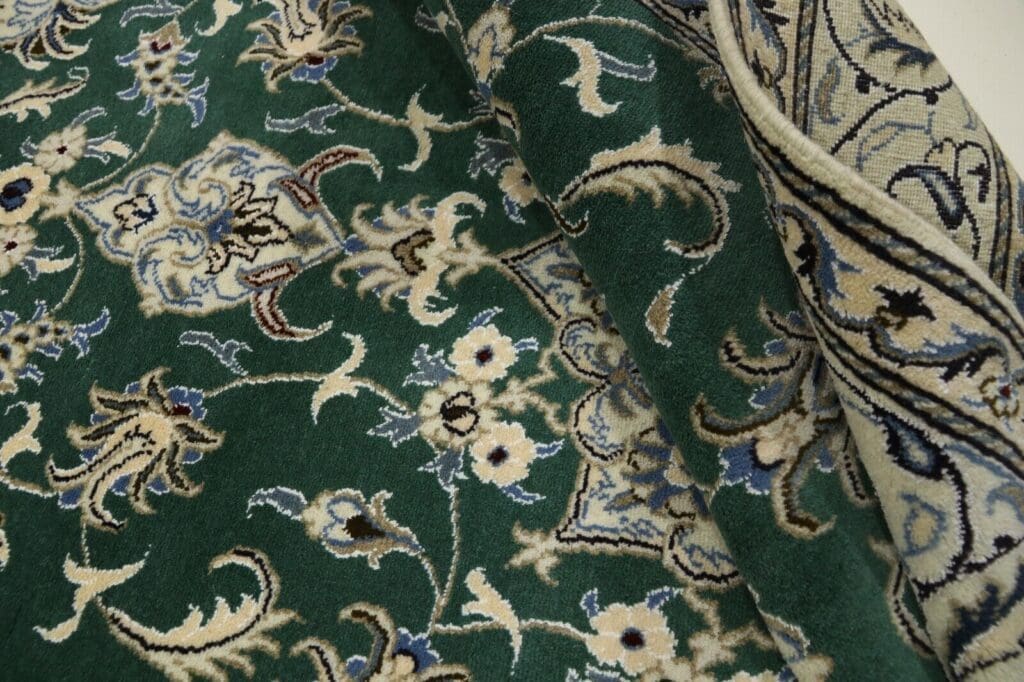
The style of this rug is given as Traditional Oriental and Persian. Nain designs are often balanced compositions in which floral ornament is combined with a clearly ordered geometric framework. Floral elements may include blossoms, leaves, vines and stylised plant forms. Geometric devices can appear as axes of symmetry, repeated ornaments and carefully structured borders. These components are placed in relation to one another, creating a hierarchy between the centre, the surrounding field and the enclosing bands.
In a classical Persian rug, the central field usually has an important role in organising the image. A medallion may gather attention at the centre, with floral elements extending into the surrounding areas. Another approach is an all-over design, where repeated ornament fills the field without one dominant central emblem. Both structures belong to the wider Persian design tradition. In Nain work, fine drawing and proportion are important because the separate motifs are intended to read as a coherent surface rather than as unrelated details.
The colour range associated with Nain rugs often runs from soft beige and blue tones to stronger red and gold accents. Colour helps distinguish the ground from the ornament and the main field from its borders. Pale areas can give a composition an open appearance, while deeper lines clarify the contours. Red and gold may be used as accents within floral details or along the framing elements. Individual designs vary in their colour balance, but these tonal relationships form part of the recognised Nain design environment.
Persian rug ornaments are more than purely decorative devices. Floral shapes are frequently associated with life in nature, growth and renewal. Geometric patterns are traditionally linked with harmony, proportion and balance. Such interpretations belong to the cultural reading of the motifs and should not be treated as a single fixed translation for every individual sign. Meaning is created through the relationship of repeated forms, placement, colour and the overall structure of the composition.
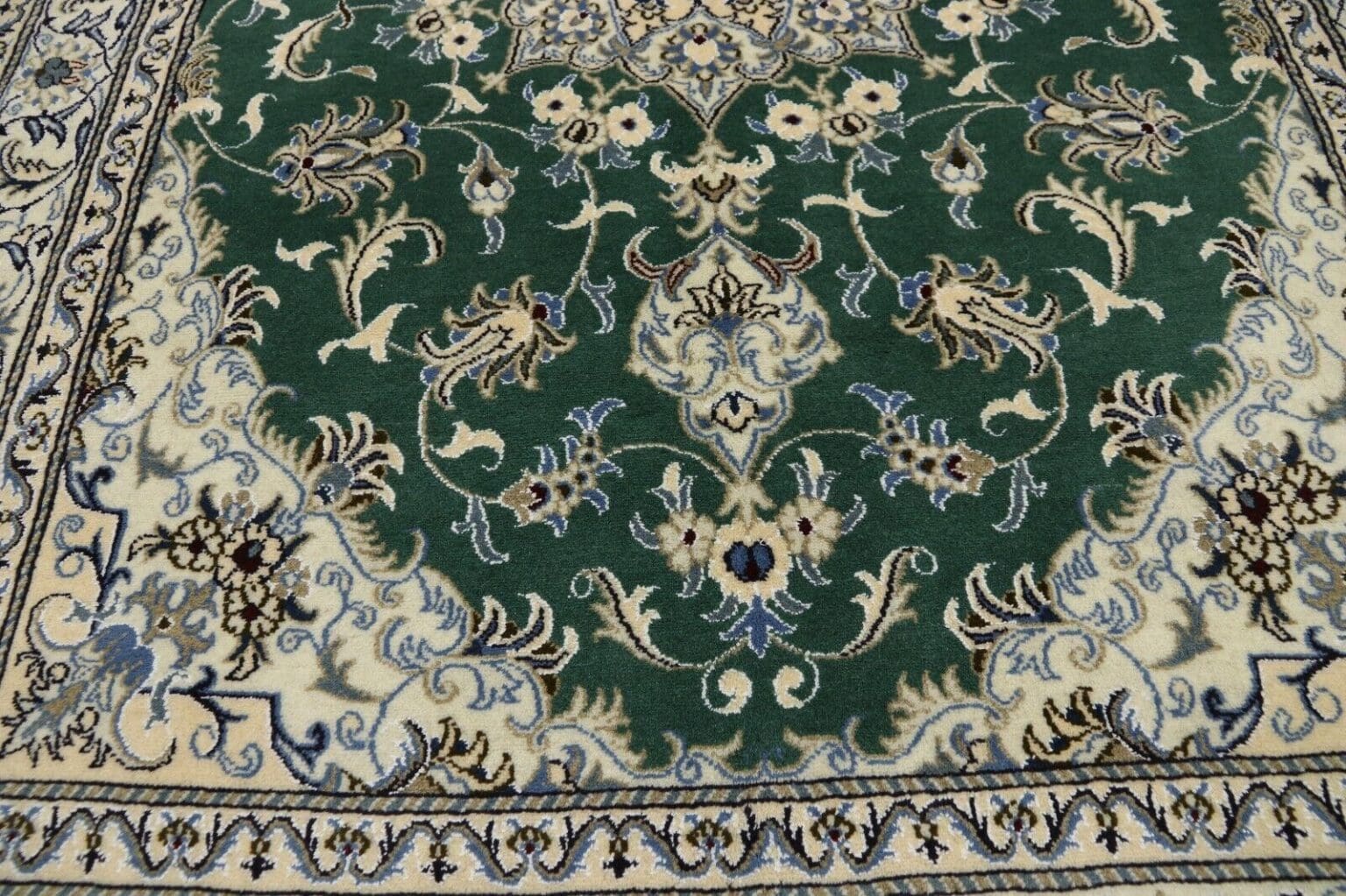
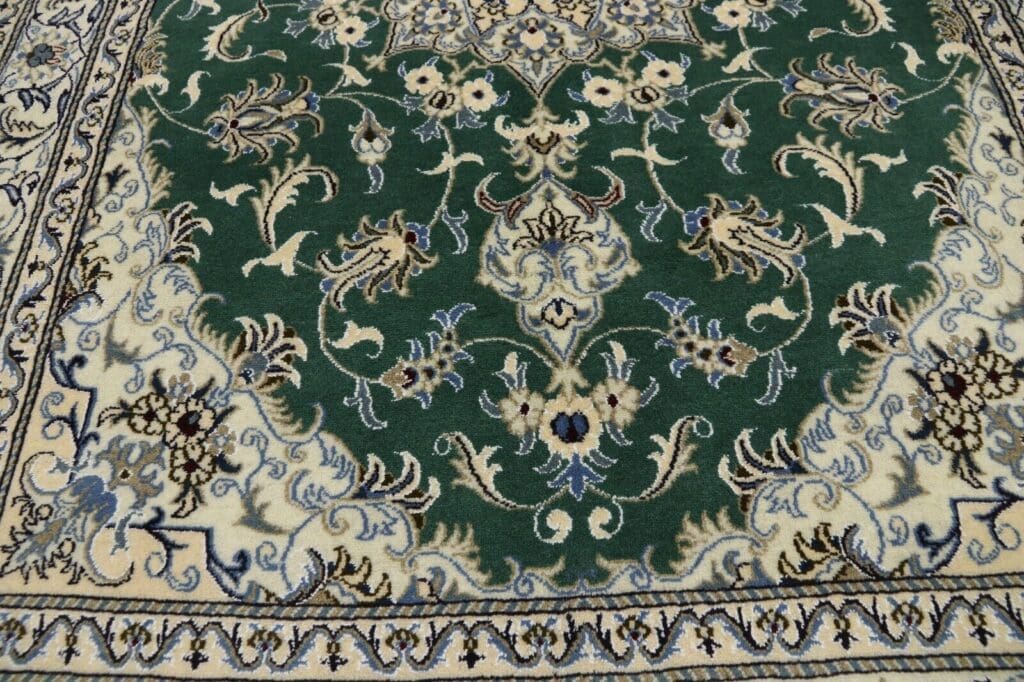
A fine knot structure supports the depiction of small elements. Narrow outlines, compact petals and closely repeated details can be drawn with greater precision when the knots are set densely. Silk, with its smoother surface and gentle reflection, may visually accentuate selected parts of a design. Wool supplies the durable character of the pile, while silk introduces additional variations in the way light falls across the ornament. This produces the familiar dialogue between crisp drawing, nuanced surface and Persian floral or geometric vocabulary.
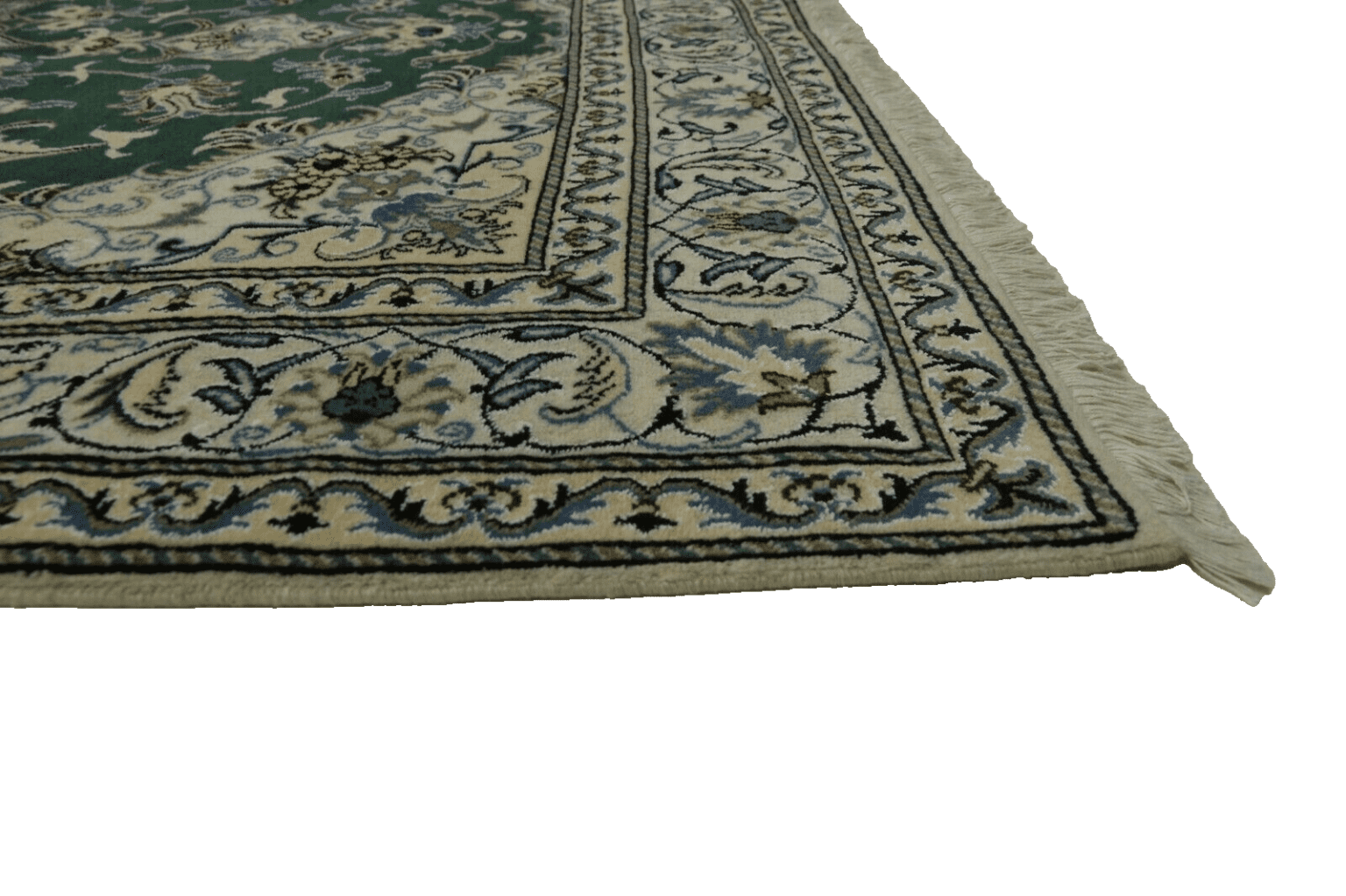
The balance of a rug also depends on the relationship between field and border. An inner border can settle the transition around the principal design, while outer bands provide a formal conclusion at the edge. Repetition creates rhythm, although the hand-made execution does not require every side to appear mechanically identical. The design follows a traditional plan, yet it is realised knot by knot as a distinct individual object. That connection between inherited pattern and manual interpretation is central to the character of hand-knotted Nain rugs.
Special Features
The specific features recorded for this rug are its hand-knotted construction, a knot density of approximately 300,000 knots per square metre, and its combination of virgin wool and silk. The rug is also described as new, as a one-off or individual piece, and as being accompanied by an authenticity certificate. Together, these points document both the construction and the status of the item offered here.
The blend of wool and silk determines much of the surface impression. Virgin wool contributes the robust, naturally dirt-resistant and temperature-regulating properties stated in the description. Silk adds a soft sheen. The high knot density is a technical characteristic that supports detailed pattern work. The new condition indicates that the rug is offered as new, while the certificate provides accompanying documentation for the piece.
FAQ
What is the best way to clean my Persian rug?
Regular vacuuming is suitable for routine care. For more thorough cleaning, professional rug cleaning is recommended. Excessive water and harsh cleaning products should be avoided so that the wool and silk are not unnecessarily stressed or damaged. Professional treatment can take the different properties of the two fibres into account and help preserve the surface and the appearance of the pattern.
Can I use a Persian rug in the living room?
Yes. A Persian rug can be used in a living room and can introduce a traditional Oriental or Persian character to the space. The virgin wool described for this rug is robust and is suitable in principle for areas that receive frequent use. Its dirt-resistant properties may make ordinary care easier. Regular vacuuming and professional cleaning when needed remain advisable in order to protect the materials.
What makes a Nain rug special?
A Nain rug is distinguished by its Iranian origin, inherited craftsmanship, fine pattern drawing and carefully selected materials. In this piece, those qualities are accompanied by hand-knotting, a high knot density, virgin wool and silk. Floral or geometric ornament, restrained colour transitions and a balanced composition belong to the traditional Nain context. The available authenticity certificate and the designation as a one-off add documented information about this particular rug.
To provide the best experiences, we use technologies like cookies to store and/or access device information. Consenting to these technologies will allow us to process data such as browsing behavior or unique IDs on this site. Not consenting or withdrawing consent, may adversely affect certain features and functions.
Functional Always active
The technical storage or access is strictly necessary for the legitimate purpose of enabling the use of a specific service explicitly requested by the subscriber or user, or for the sole purpose of carrying out the transmission of a communication over an electronic communications network.
Preferences
The technical storage or access is necessary for the legitimate purpose of storing preferences that are not requested by the subscriber or user.
Statistics
The technical storage or access that is used exclusively for statistical purposes.The technical storage or access that is used exclusively for anonymous statistical purposes. Without a subpoena, voluntary compliance on the part of your Internet Service Provider, or additional records from a third party, information stored or retrieved for this purpose alone cannot usually be used to identify you.
Marketing
The technical storage or access is required to create user profiles to send advertising, or to track the user on a website or across several websites for similar marketing purposes.
 SECURE PAYMENT
 SHIPPING PARTNERS


