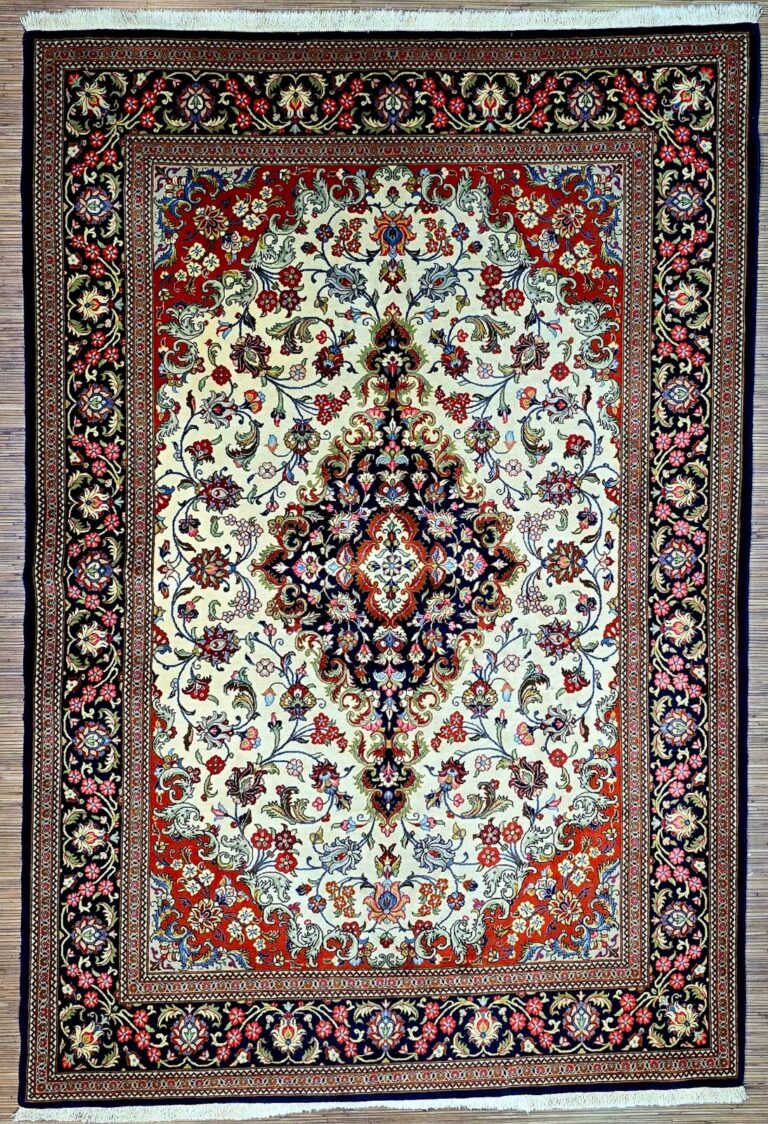
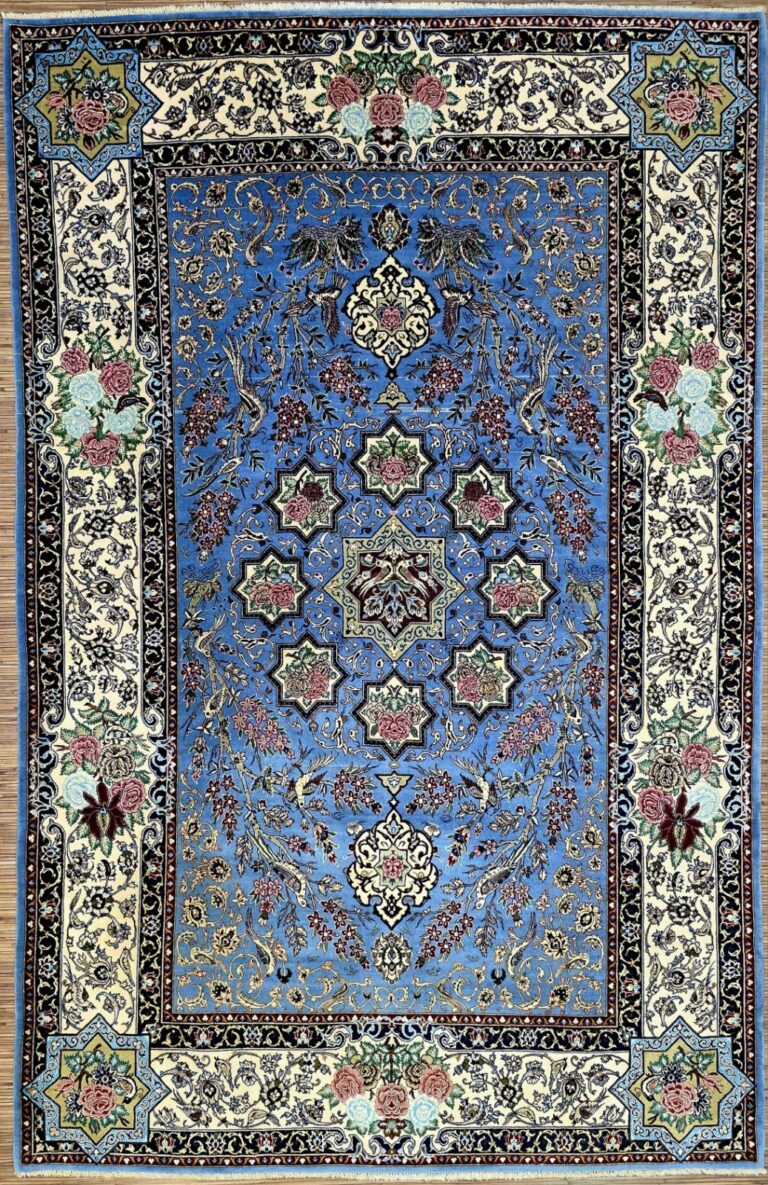
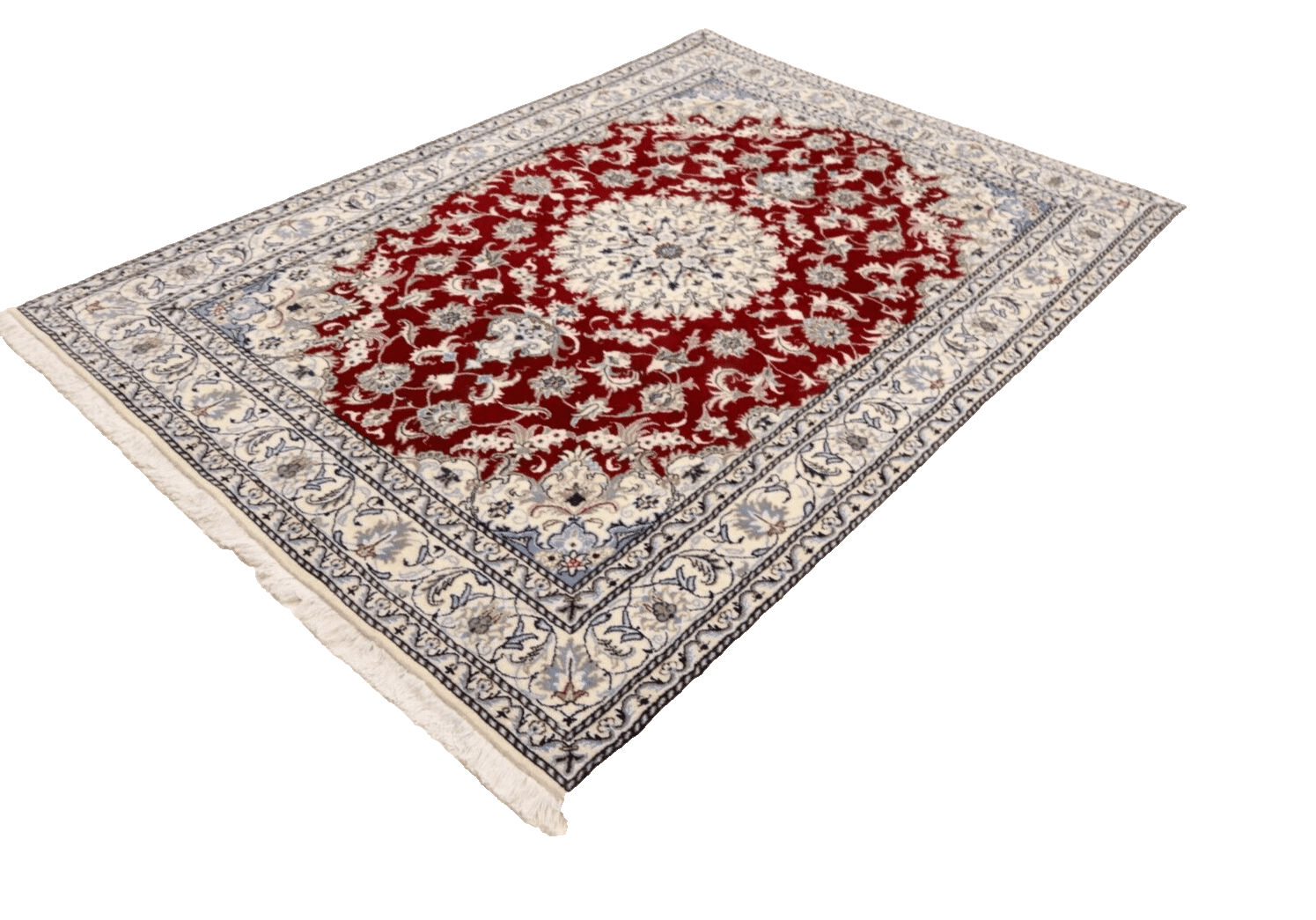
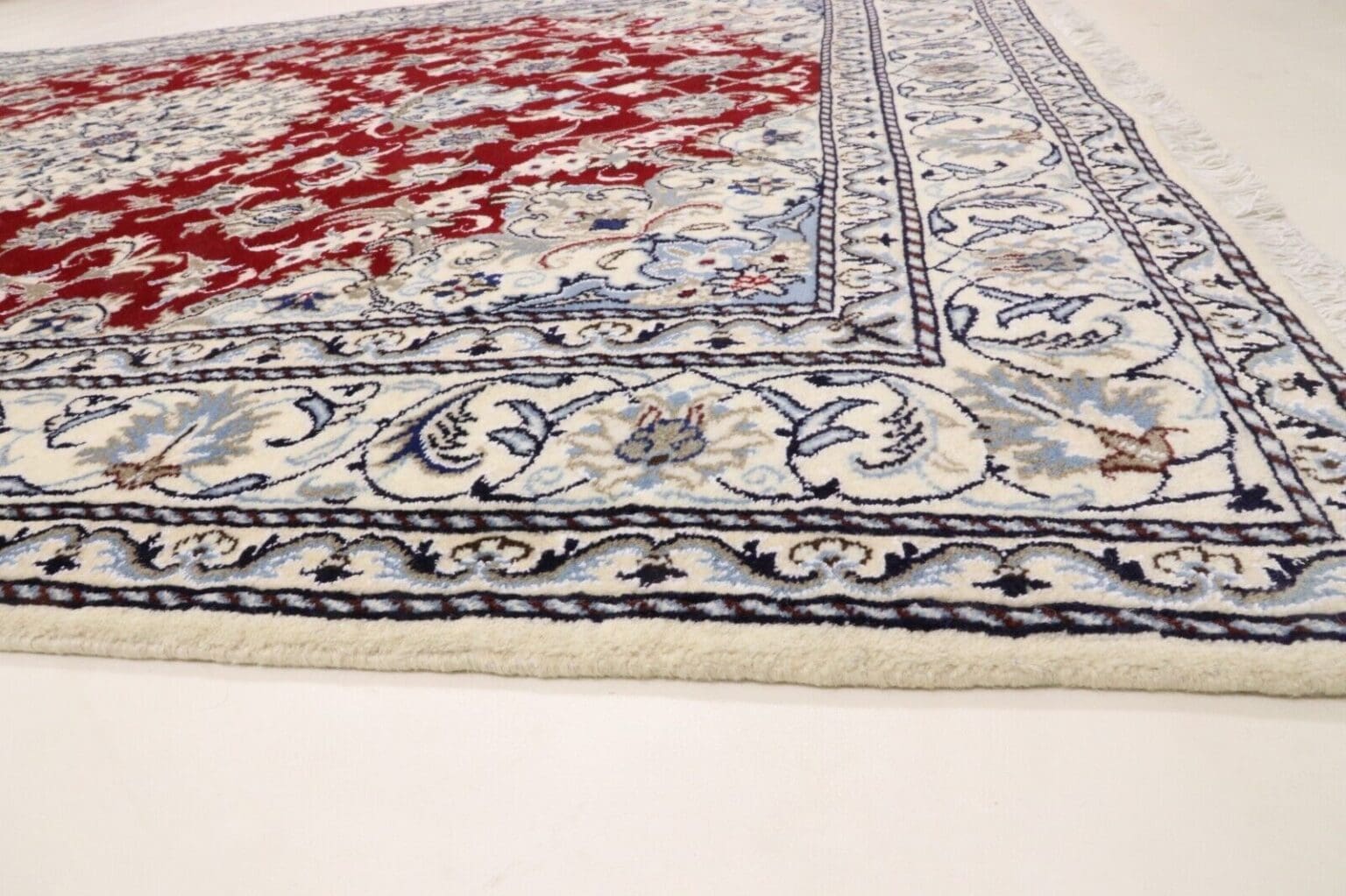
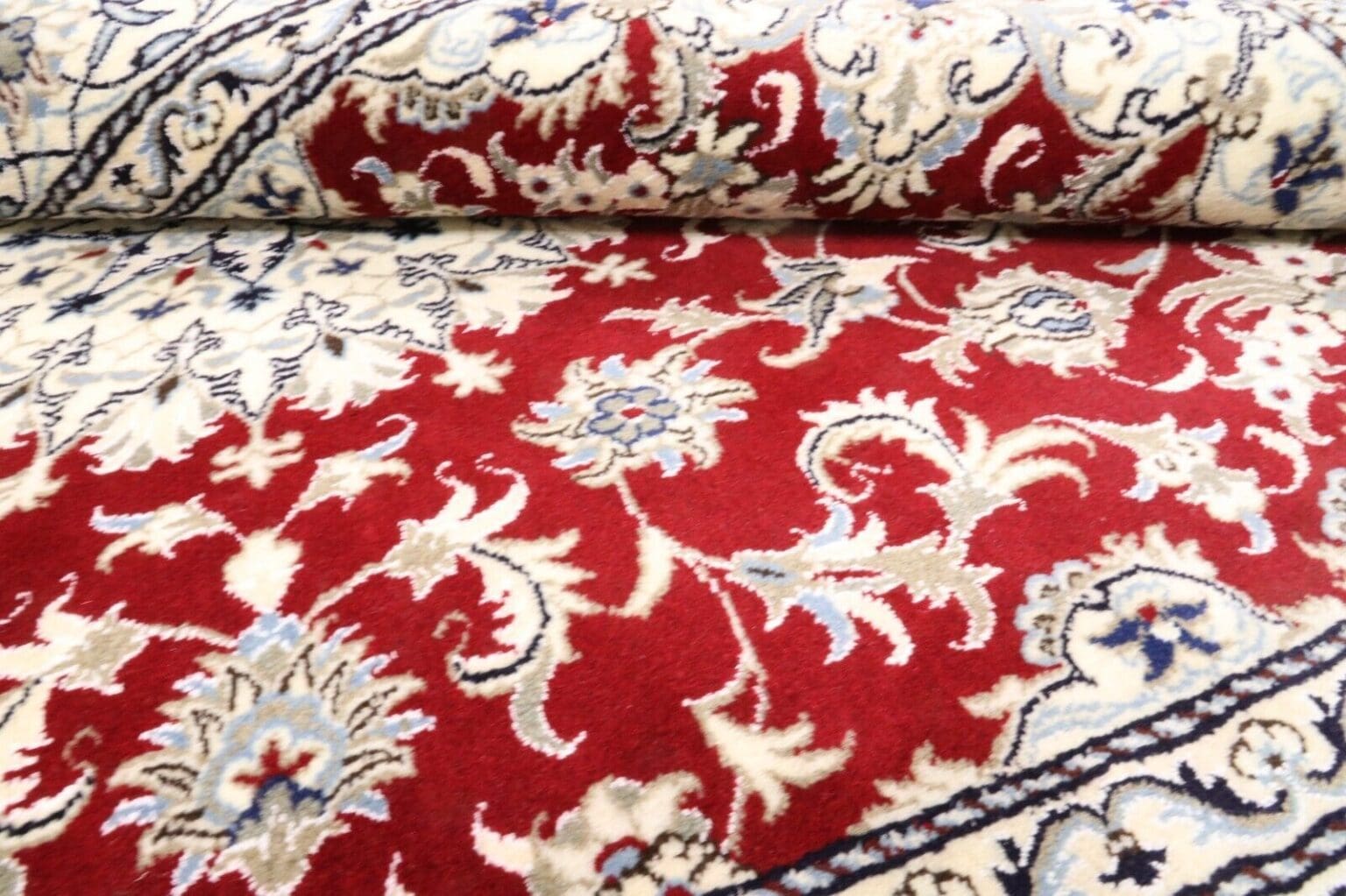
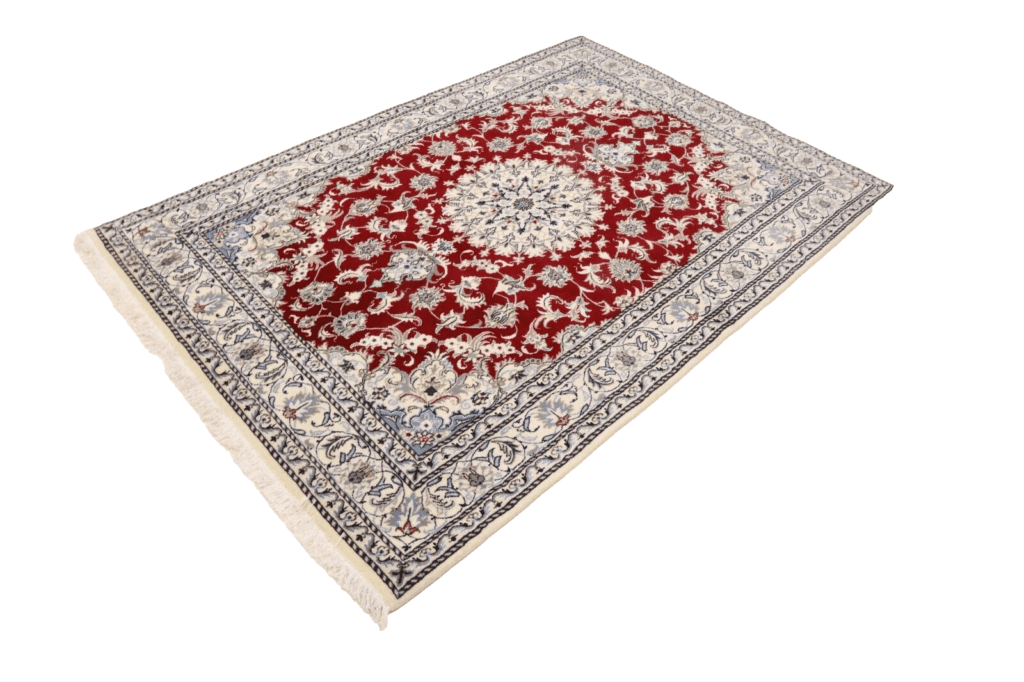
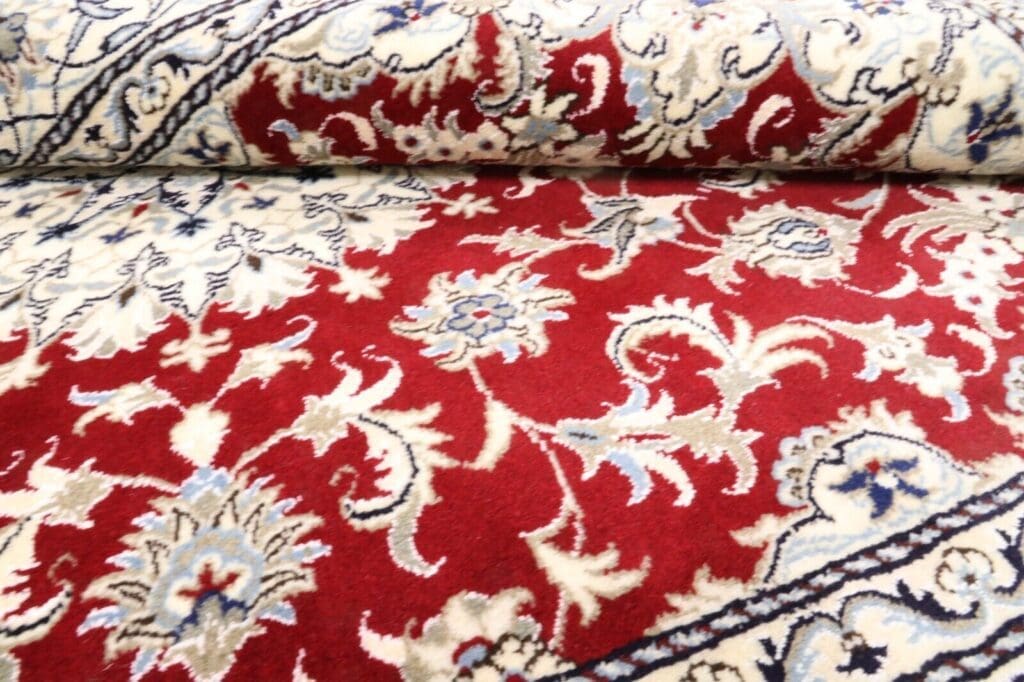
This Nain Persian rug is hand-knotted and has a pile made from virgin wool and silk. Virgin wool accounts for the greater part of the material and gives the surface a resilient, tactile character. Silk adds a smoother texture and a restrained play of light. The two fibres are combined in the pile while the character of wool remains clearly present.
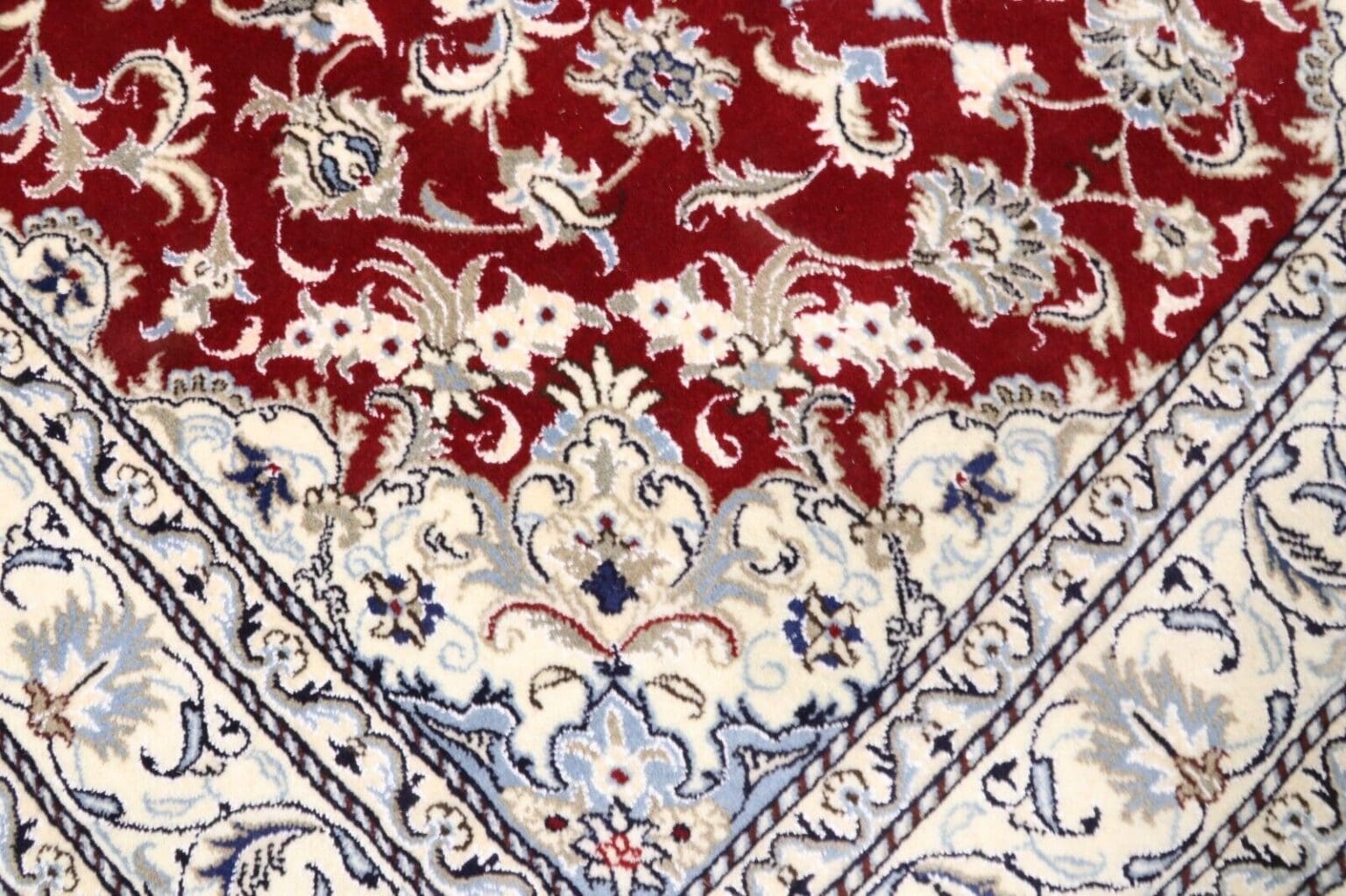
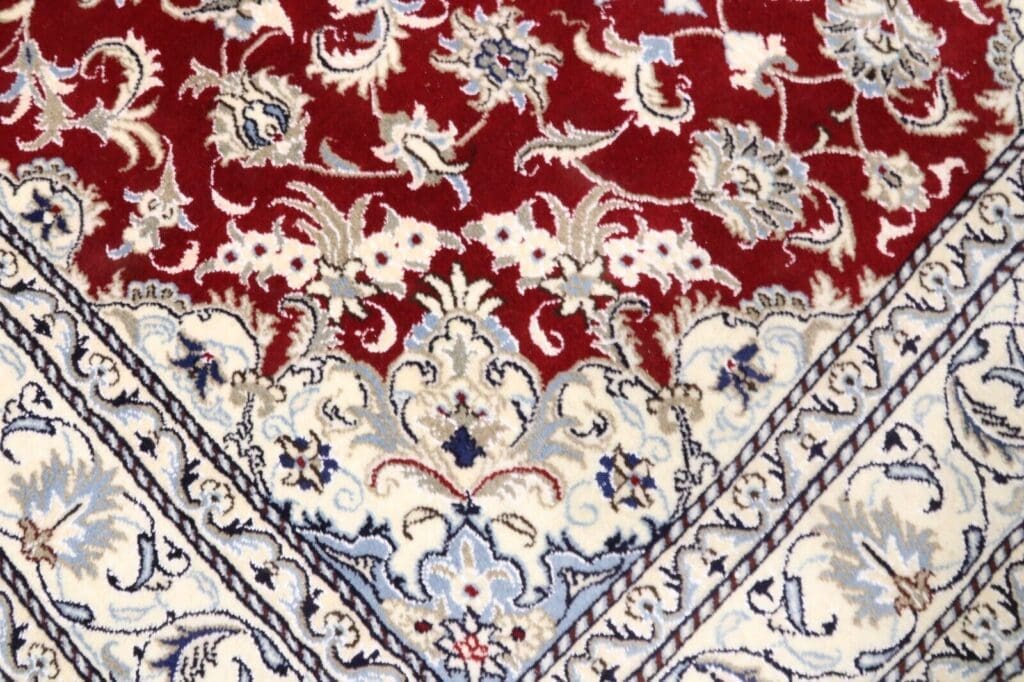
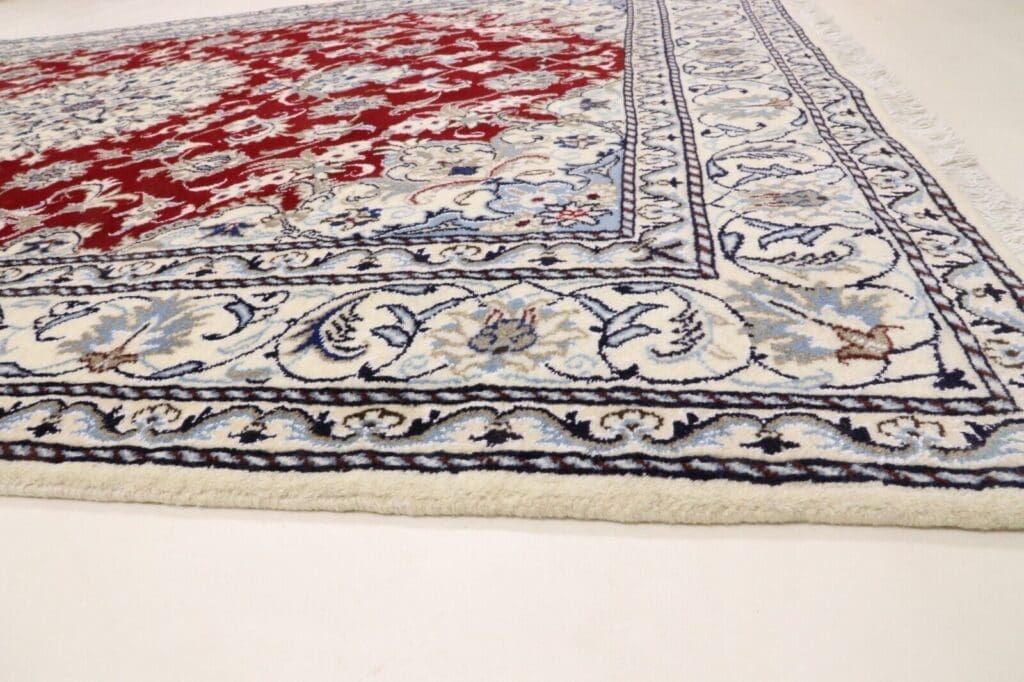
In hand-knotting, each knot is inserted individually into the structure of the rug. The surface therefore reflects a form of textile work in which the construction develops knot by knot. The listed density is approximately 300,000 knots per square metre. Knot density indicates how finely the rug has been knotted and how closely the individual knots are placed.
The rug is new and in very good condition. Its pile consists of 90 percent virgin wool and 10 percent silk. This combination brings together the practical resilience associated with wool and the smooth handle and subtle sheen associated with silk. The material choice complements the hand-knotted construction and remains part of the rug’s clearly stated character.
Origin and Tradition
The rug comes from Persia and is identified as a Nain. Nain is one of the recognised carpet centres of Iran. Its weaving tradition is associated with careful execution, finely drawn designs and a controlled approach to colour. In workshops, the preparation of the foundation, the placement of knots, the shaping of the edges and the finishing work are coordinated as connected stages. Accuracy and an orderly overall composition are central to this regional tradition.
Nain rugs emerged from a relatively modern yet distinctive Iranian weaving tradition. Their designs often draw on established Persian systems of proportion and ornament. A clearly defined field, a surrounding main border and narrower guard borders are common structural devices. Depending on the design and workshop, medallions, vines, floral forms, palmettes or more geometric details may be arranged together. These are features of the regional vocabulary and do not automatically describe every individual rug.
Nain weaving also demonstrates a deliberate relationship between open ground and ornament. Light grounds and finely drawn lines occur frequently in the broader Nain tradition, as do balanced borders and carefully distributed details. Designs are generally organised around an axis or a repeating order rather than scattered without structure. This allows small ornaments to be read as part of a unified composition. It is the discipline of the arrangement, as much as any single motif, that contributes to the recognisable Nain language.
Persian rugs have traditionally served as both useful textiles and forms of visual expression. Knowledge of knotting, colour, proportion and pattern is passed through workshops and families. In a Nain, that heritage is often visible in precise drawing and in the relationship between classical ornament and an ordered field. This rug is identified as a Nain Persian rug from Persia. No further information about a particular workshop or signature is provided.
Design and Pattern
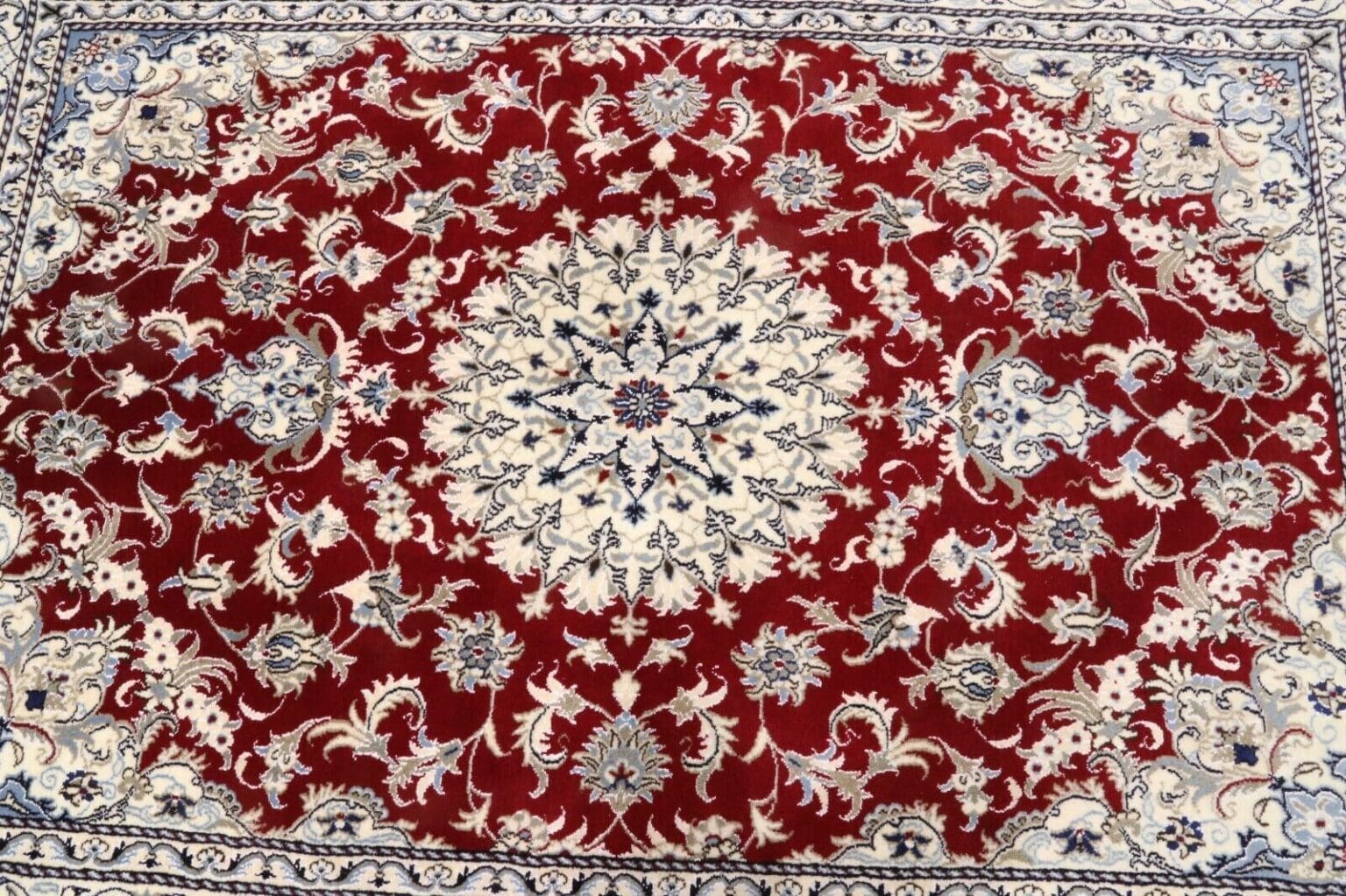
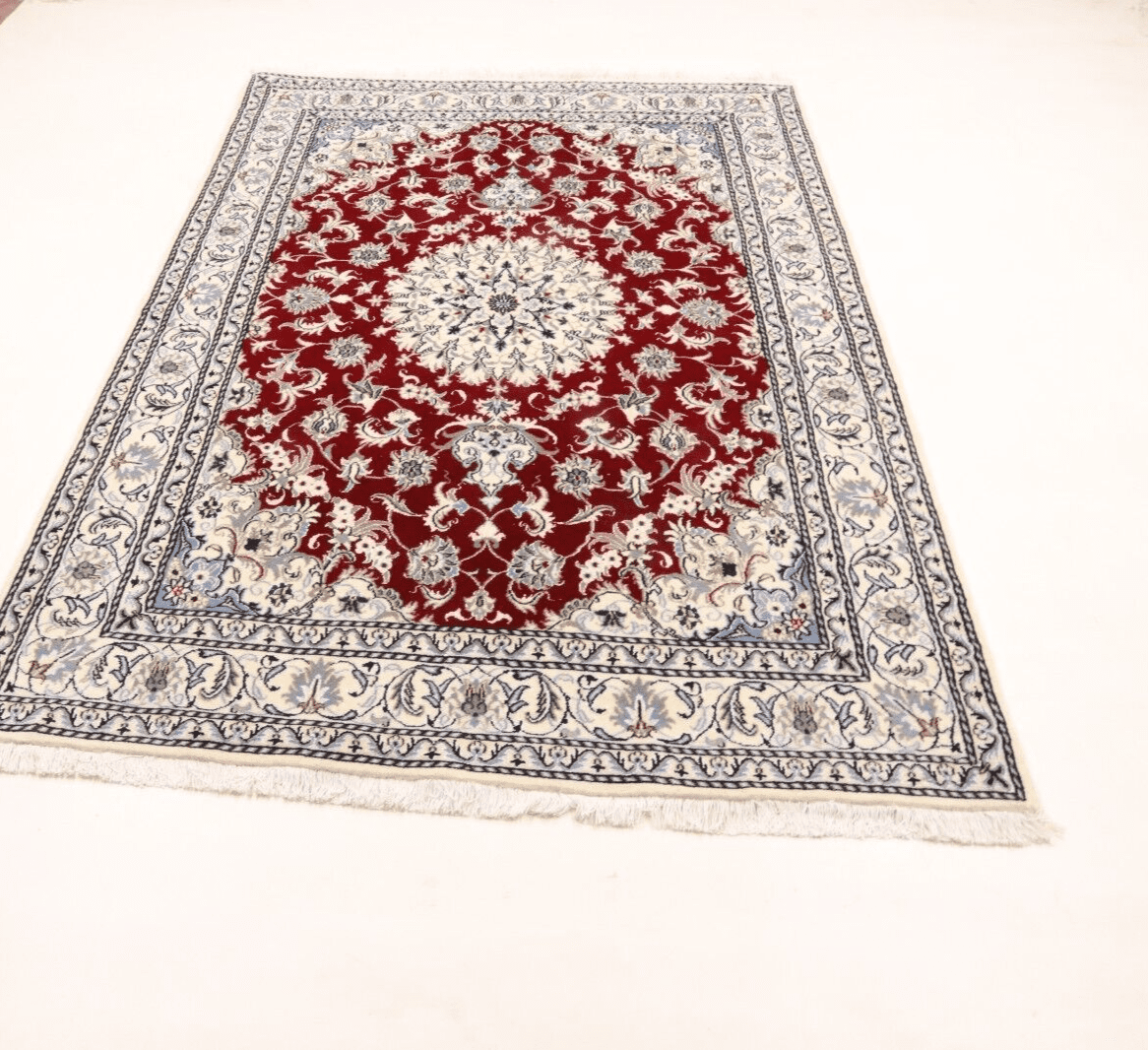
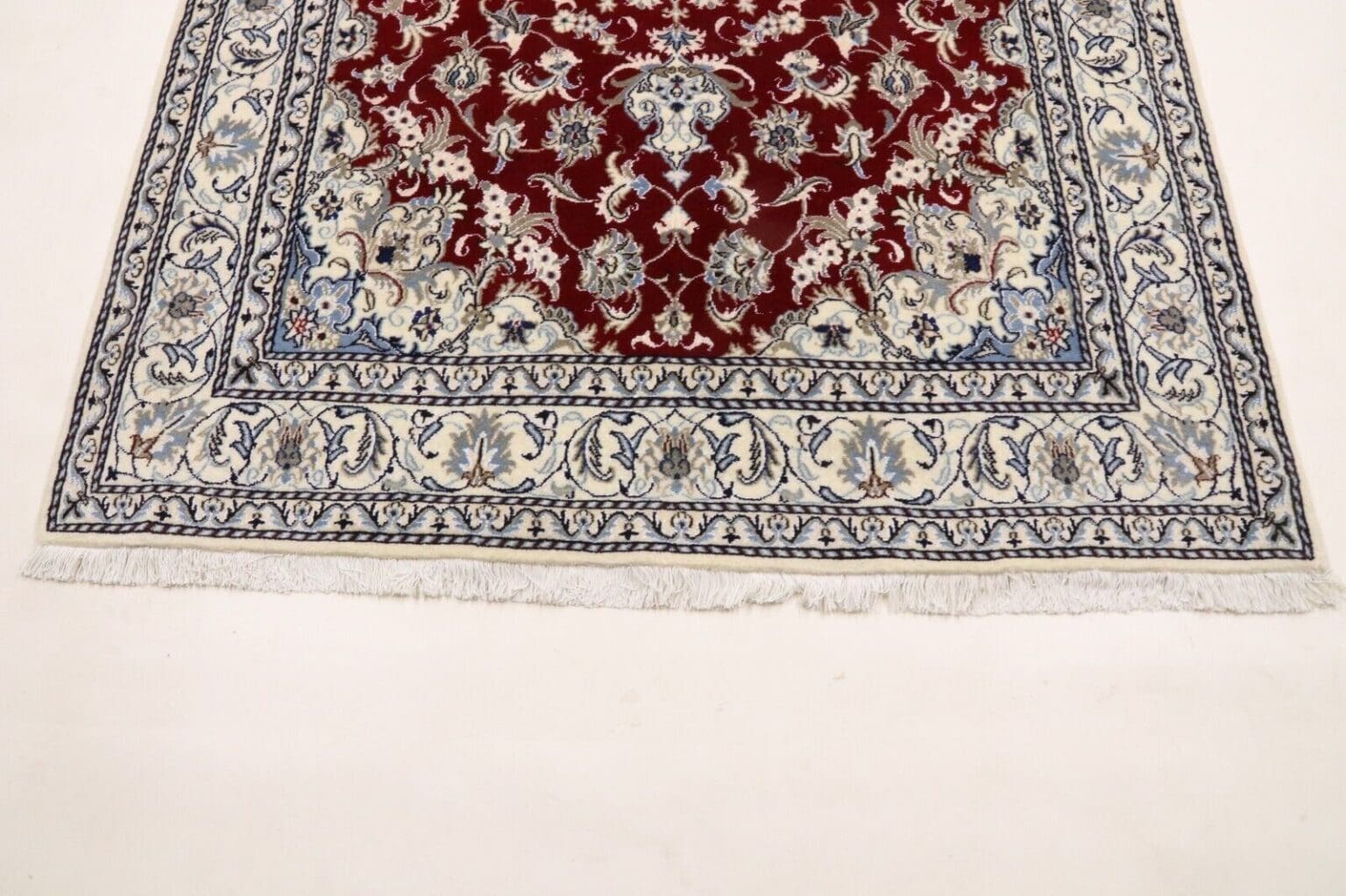
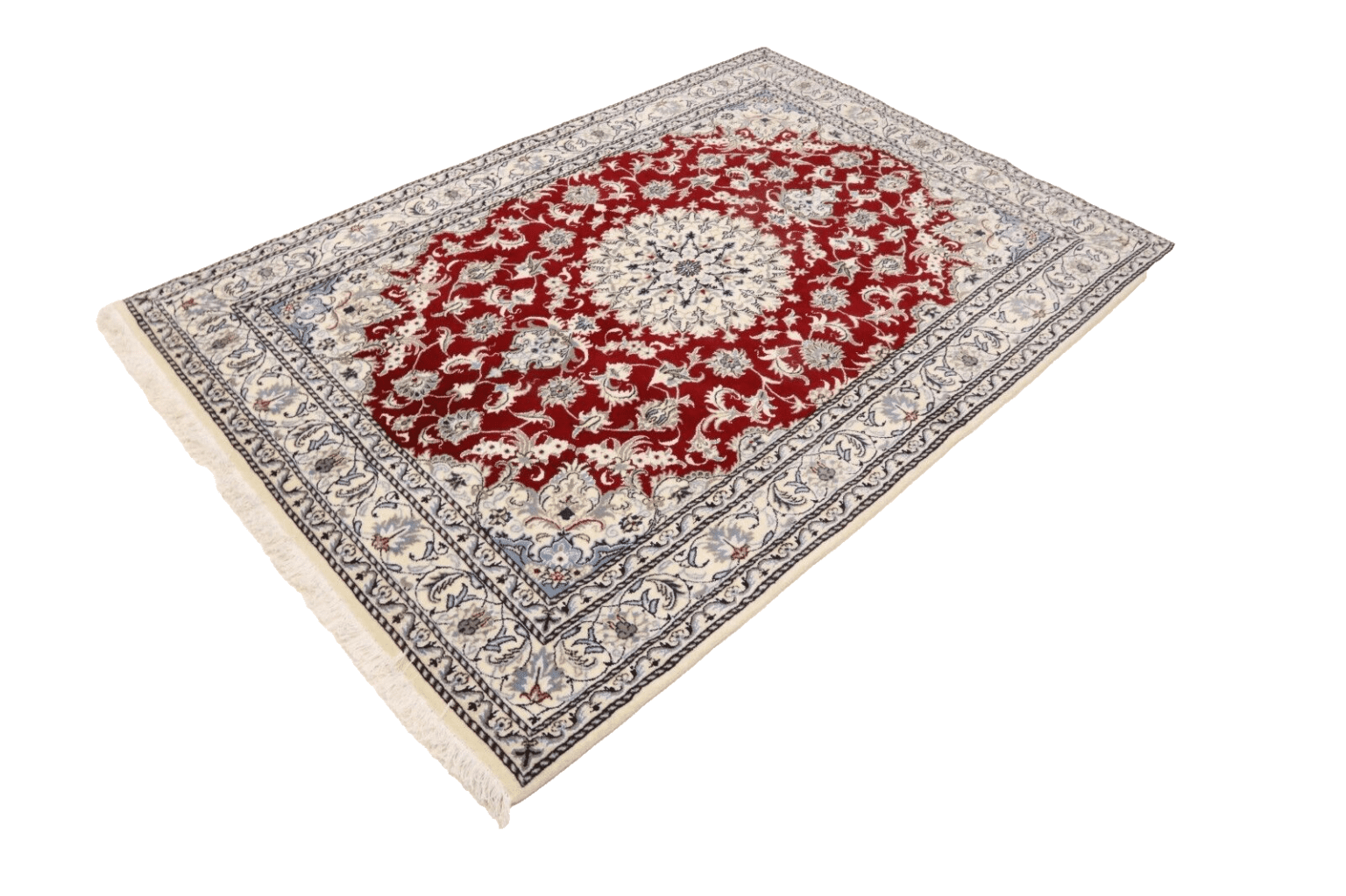
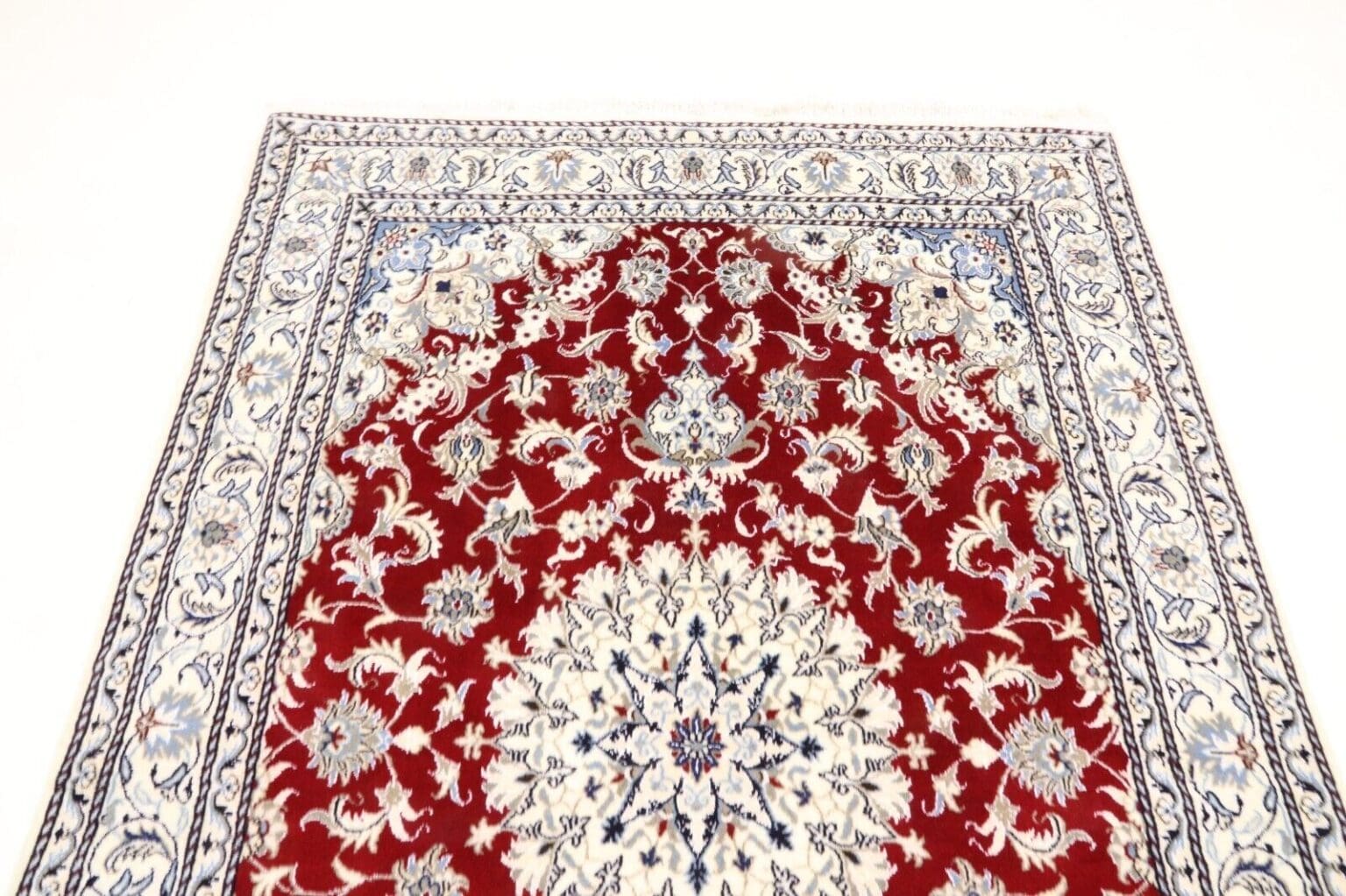
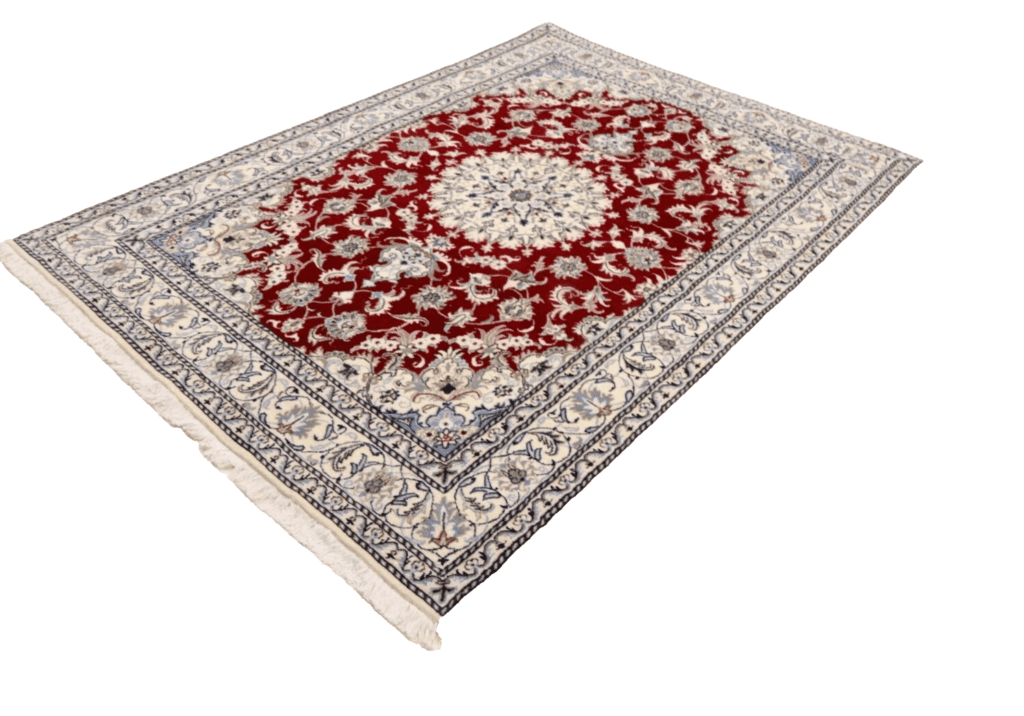
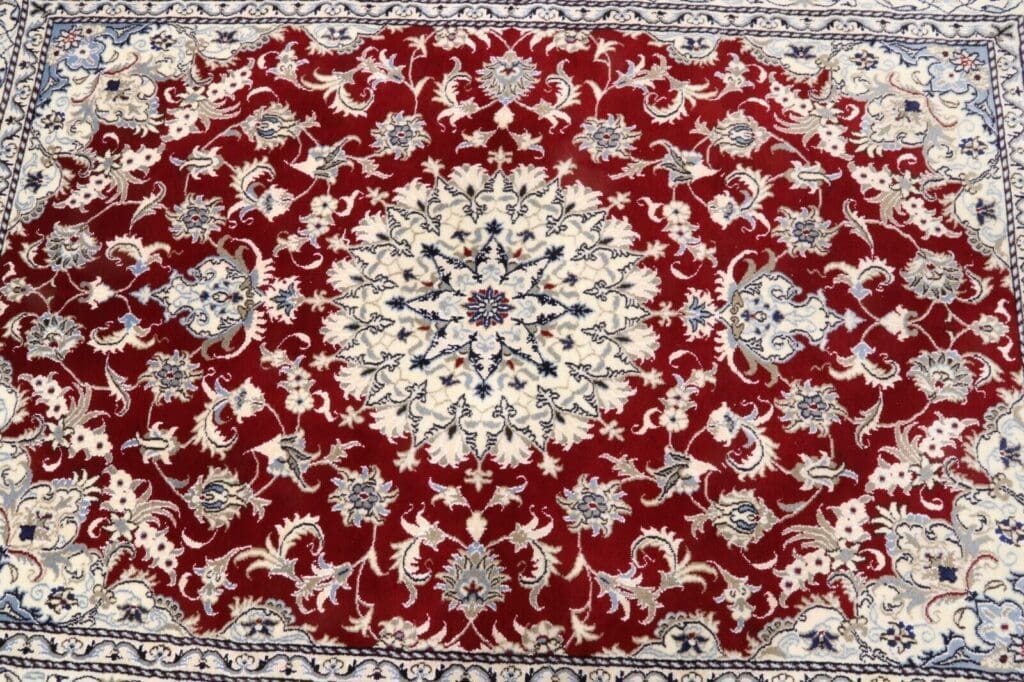
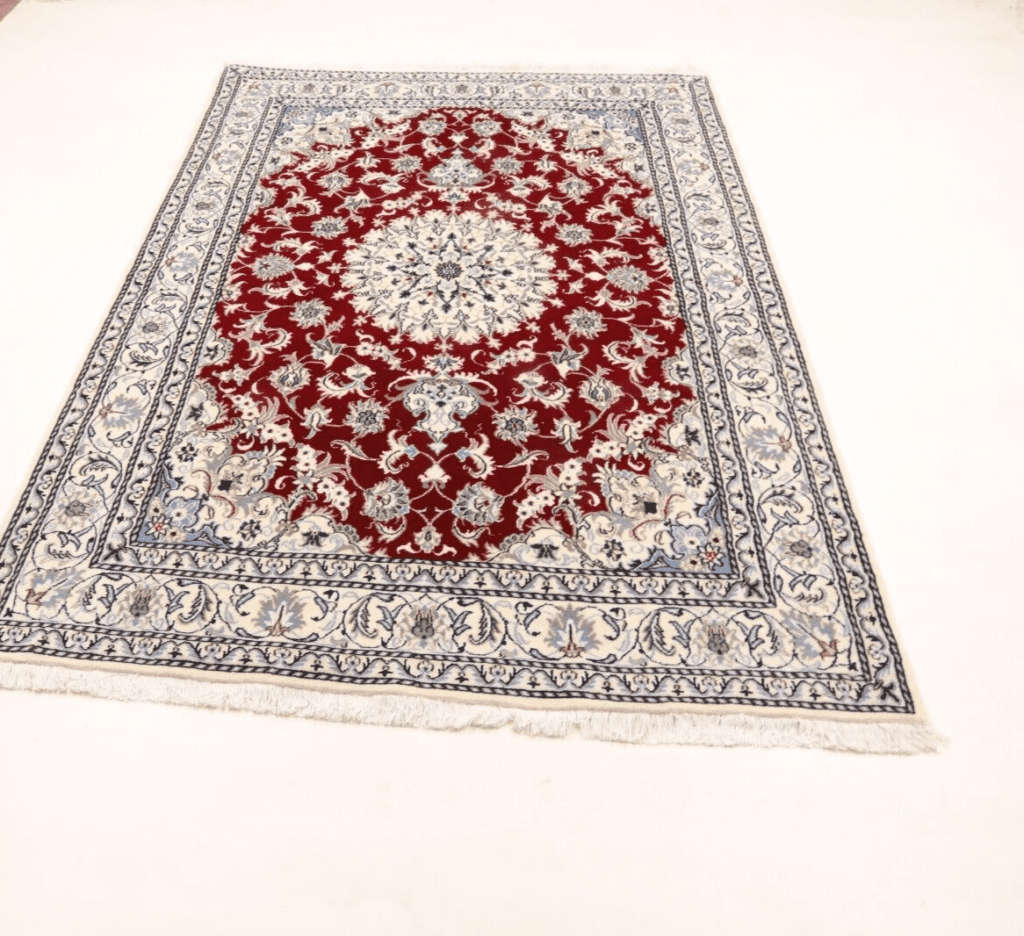
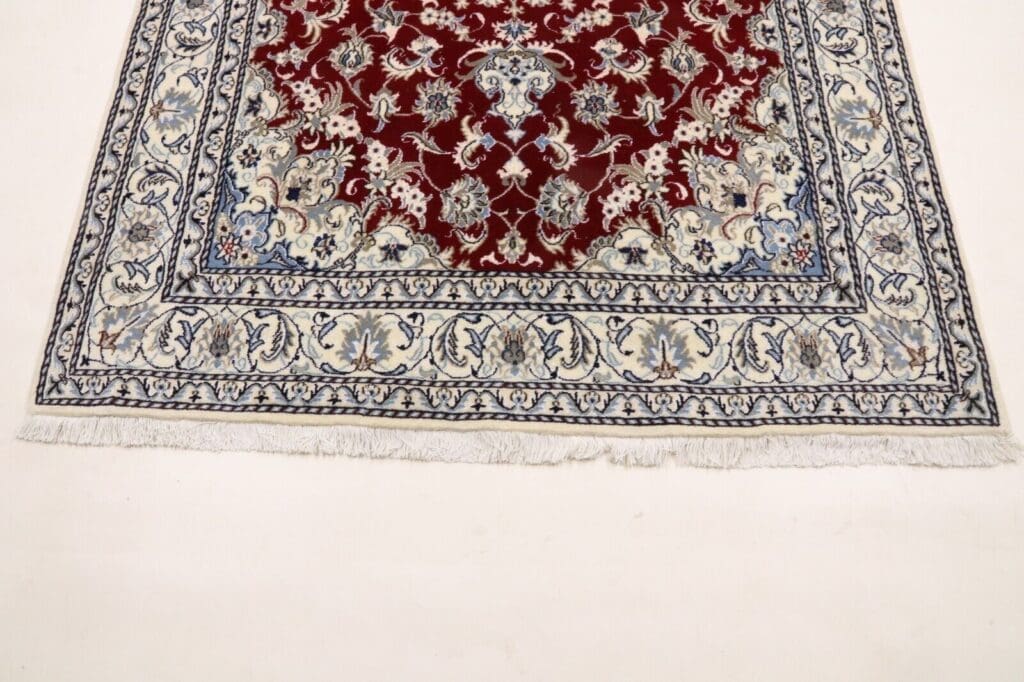
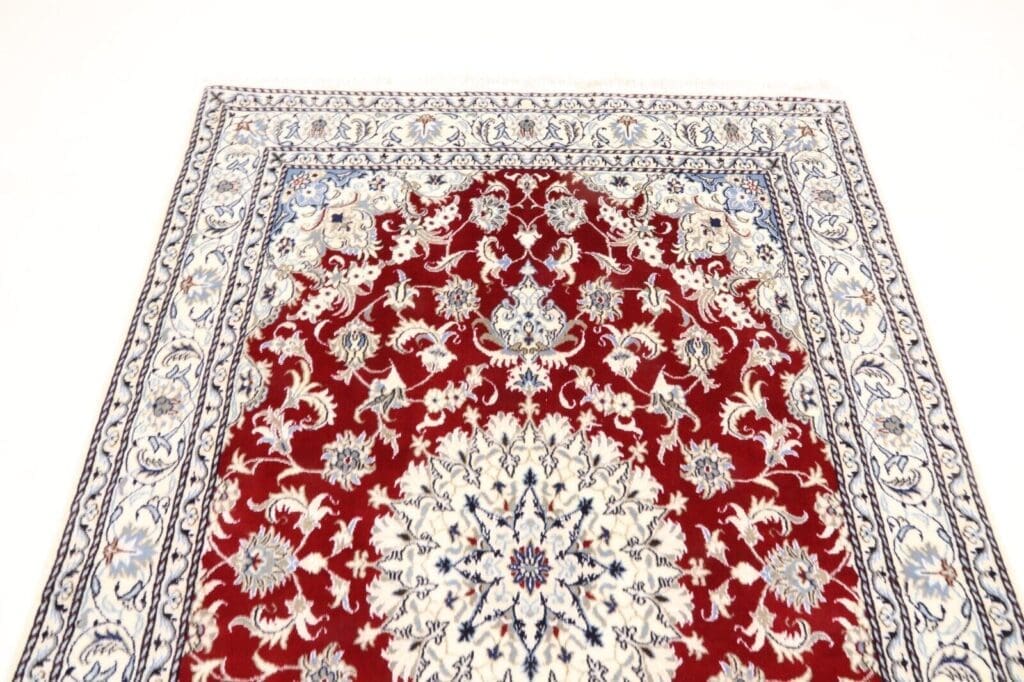
The pattern of this rug is described as Oriental, and its colour is red. These are the specific design details provided for the piece, without assigning additional motifs to it. In Persian carpet design, red may serve as a principal ground colour or as an accent. Depending on its shade, it can appear warm, deep or restrained and can influence how the ornaments set against it are read.
The wider Nain design tradition often uses a structured centre and a framing border. A medallion may organise the middle, while floral vines, blossoms and palmettes connect the surrounding field. Other compositions distribute ornament more continuously or combine flowing floral lines with geometric precision. The important relationship is the one between the field, the main border and the guard borders. This background explains the Nain design tradition without turning general motifs into a claim about this particular rug.
Fine knotting makes it possible to draw narrow lines and small transitions within an ornament. When virgin wool is combined with silk, light can rest differently on the smoother silk areas than on the wool. Within a red ground, this may create a changing relationship between texture and sheen. That is a general effect associated with the materials and is not presented as an additional pattern detail for this rug.
Oriental pattern traditions frequently rely on repetition, symmetry and a hierarchy of motifs. A border band frames the central field, while smaller bands help organise the transitions. In Persian designs, flowers and vines can create a flowing movement, while geometric lines give the composition structure. Nain brings these principles together in a controlled and finely articulated visual language. The specific rug is described by the supplied details: an Oriental pattern and the colour red.
Special Features
The distinctive stated features of this rug are its hand-knotted construction, its combination of virgin wool and silk, and its density of approximately 300,000 knots per square metre. It is new and described as being in very good condition. The material combination gives the pile a predominantly woollen character together with the different tactile and visual qualities associated with its silk content.
The rug is suitable for use over underfloor heating. It is also described as pet-friendly and child-friendly. These details relate to its intended use in a living environment. Gentle, regular care remains useful for preserving the surface: dust can be removed with a vacuum on a low setting, while spills should be treated carefully with a damp cloth. Professional cleaning is recommended when a deeper clean is needed.
FAQ
How should I clean this Nain Persian rug?
For routine care, vacuum gently on a low setting. Spills should be treated promptly with a damp cloth. Direct sunlight should be avoided so that the colours do not fade unnecessarily. For a thorough cleaning, professional assistance is appropriate, particularly because the pile contains both virgin wool and silk.
How can I assess the quality of an Oriental rug?
Knot density, materials and craftsmanship are important points of reference. This rug is described as having approximately 300,000 knots per square metre, a pile of virgin wool and silk, and hand-knotted construction. Condition is also relevant: this piece is new and listed as being in very good condition.
What should I consider when buying a Persian rug?
Clear information about origin, materials, technique, condition and pattern is important when choosing a rug. This piece is identified as a Nain Persian rug from Persia and has a pile made from virgin wool and silk. Buyers should also look for a precise description of the construction and, when necessary, ask a reputable dealer about origin and workmanship.
To provide the best experiences, we use technologies like cookies to store and/or access device information. Consenting to these technologies will allow us to process data such as browsing behavior or unique IDs on this site. Not consenting or withdrawing consent, may adversely affect certain features and functions.
Functional Always active
The technical storage or access is strictly necessary for the legitimate purpose of enabling the use of a specific service explicitly requested by the subscriber or user, or for the sole purpose of carrying out the transmission of a communication over an electronic communications network.
Preferences
The technical storage or access is necessary for the legitimate purpose of storing preferences that are not requested by the subscriber or user.
Statistics
The technical storage or access that is used exclusively for statistical purposes.The technical storage or access that is used exclusively for anonymous statistical purposes. Without a subpoena, voluntary compliance on the part of your Internet Service Provider, or additional records from a third party, information stored or retrieved for this purpose alone cannot usually be used to identify you.
Marketing
The technical storage or access is required to create user profiles to send advertising, or to track the user on a website or across several websites for similar marketing purposes.

 SECURE PAYMENT
 SHIPPING PARTNERS