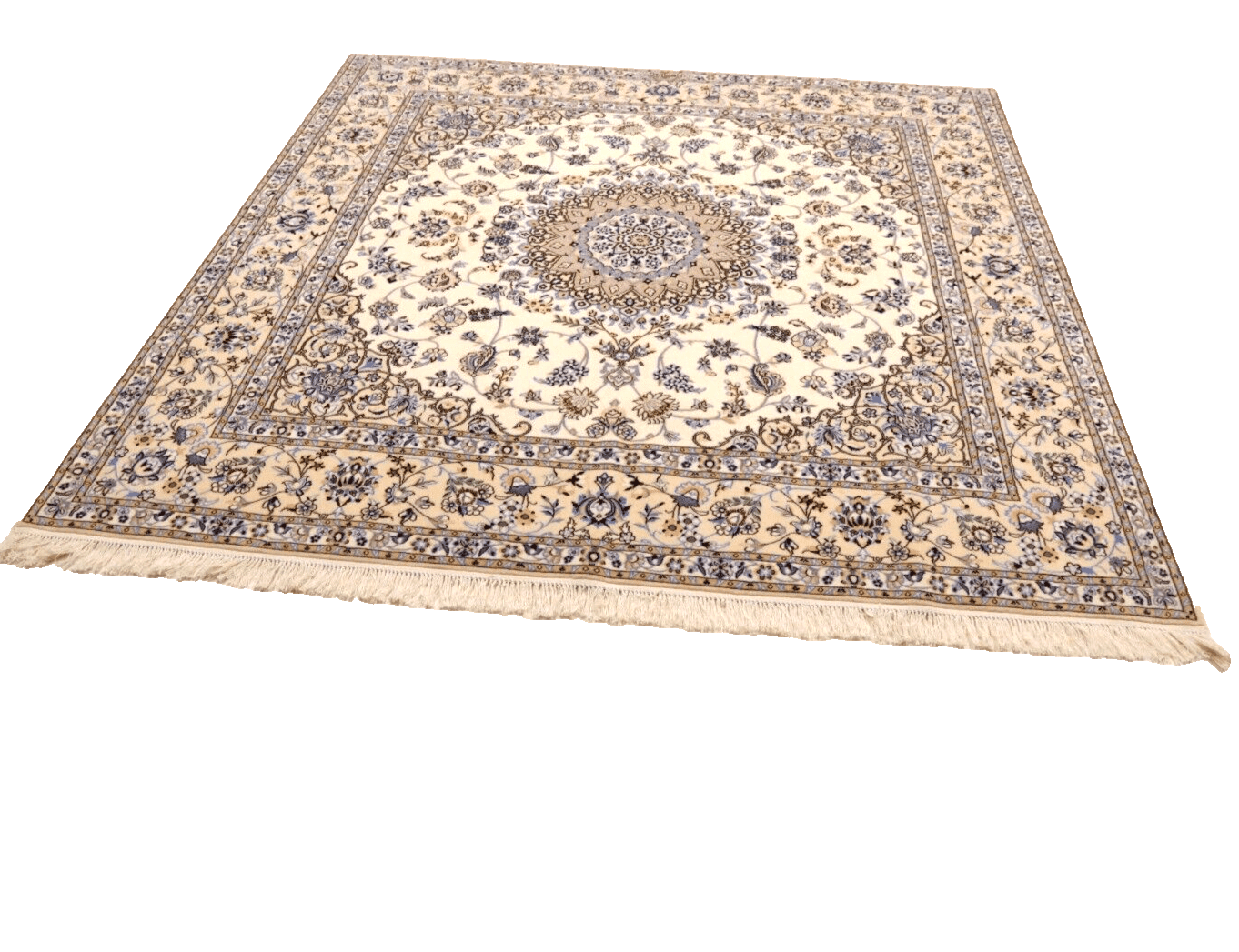
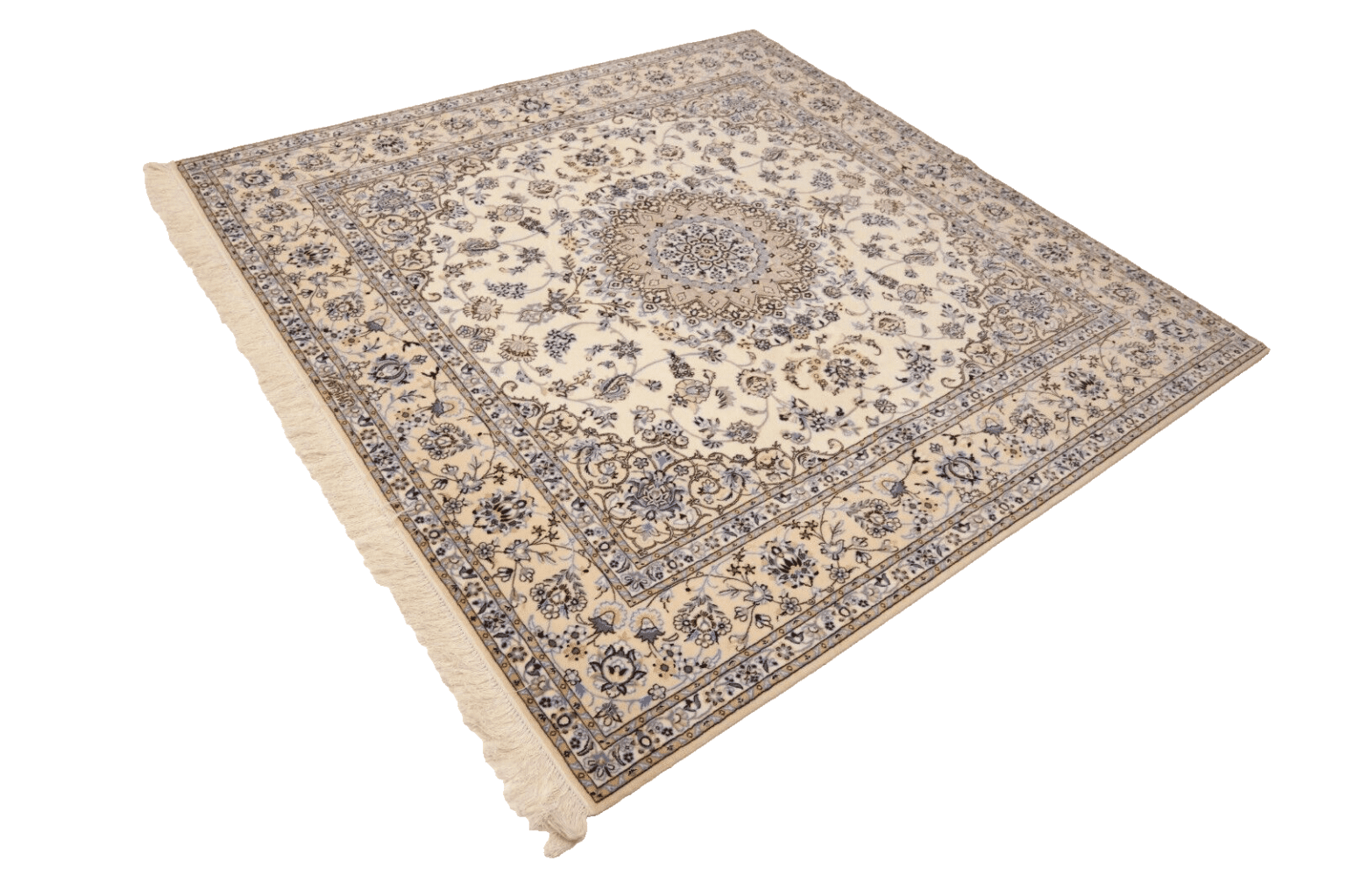
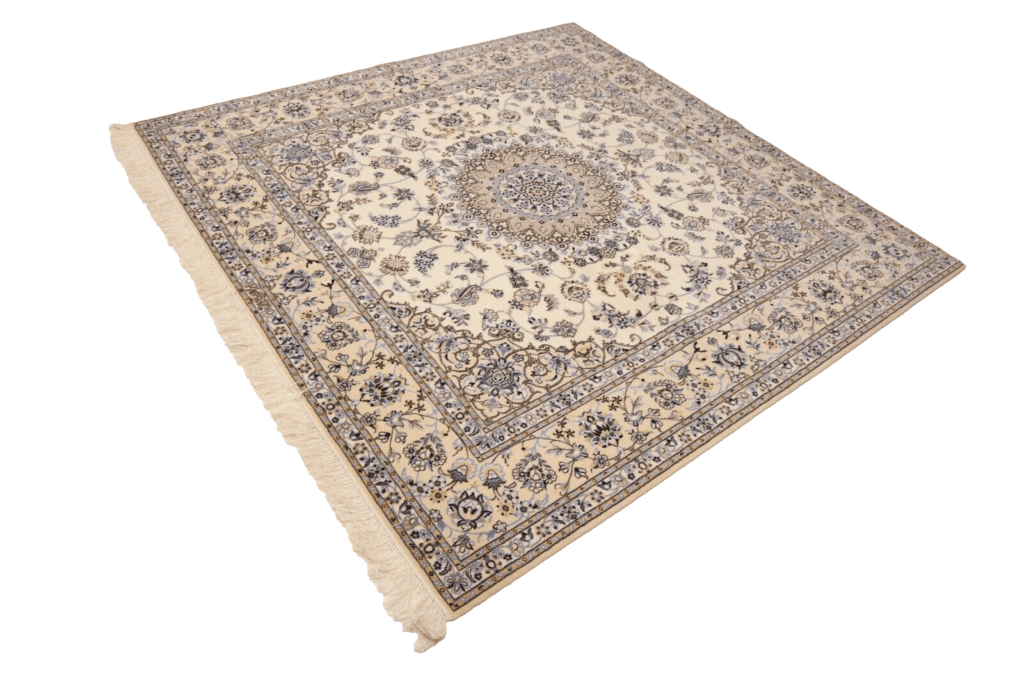
This Nain Persian rug is hand-knotted and made from cork wool and natural silk. Its pile consists of 80% cork wool and 20% natural silk. The two materials contribute different qualities to the surface. Cork wool provides the main body of the pile and is associated with a robust, easy-care character. Natural silk adds a soft sheen and reflects light with a fine, varied effect.
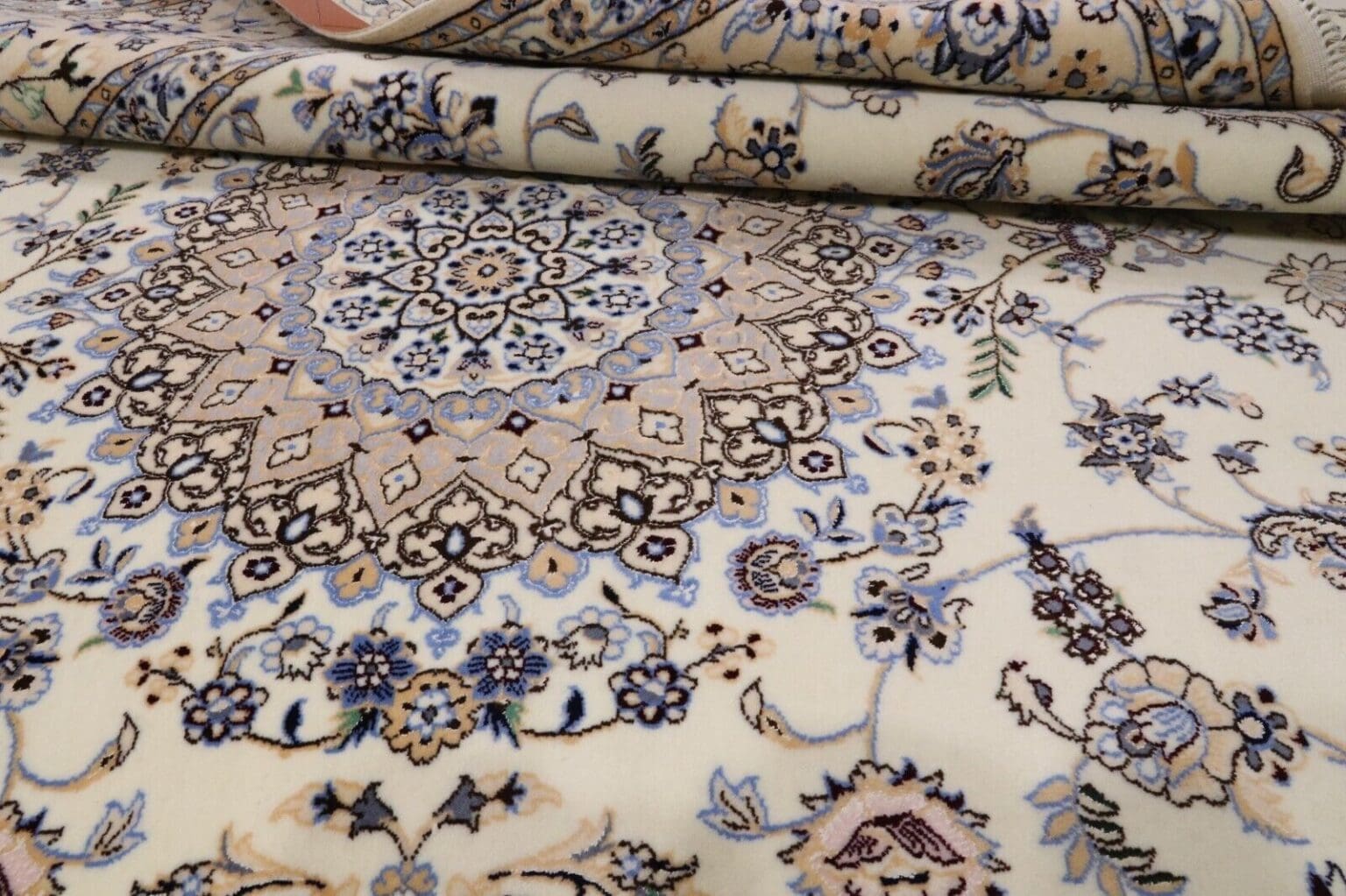
In a hand-knotted rug, each knot is inserted individually into the foundation. The process requires controlled handling of the yarn, close attention to the pattern and experience with the materials. This rug’s high knot density supports particularly detailed work. Fine lines, small ornaments and carefully separated areas of colour can be rendered with clarity when the knots are arranged densely and consistently.
The combination of cork wool and natural silk also shapes the way the pile looks. Cork wool gives the surface a comparatively calm and compact appearance, while silk catches light differently as the viewing angle changes. Selected parts of the pattern can therefore appear more prominent or more subdued depending on the surrounding light. Because the rug is hand-knotted, it is a one-off piece rather than an identical industrial repeat.
Handwork in Oriental rug making is more than a production method. It includes knowledge passed from one generation to the next: preparing the loom, choosing and handling the yarns, following the design and securing the finished work. This Nain rug brings together that established craft tradition, a carefully defined material composition and a pattern language intended for fine detail.
Origin and Tradition
The rug comes from Persia and follows the tradition of Nain rugs. Nain is known for its carpet weaving and belongs to Isfahan Province in Iran. The town and its surrounding area developed a distinctive weaving identity associated with finely executed rugs. Careful material selection, dense knotting and controlled ornament are important parts of that regional tradition.
The Isfahan region has a long history of carpet production. In its workshops, designs, colours and working methods have been handed down and refined over time. Within this wider tradition, Nain rugs are recognised for a restrained and detailed visual language. Their character is created less by heavy contrast than by the relationship between delicate outlines, balanced fields and precisely placed motifs.
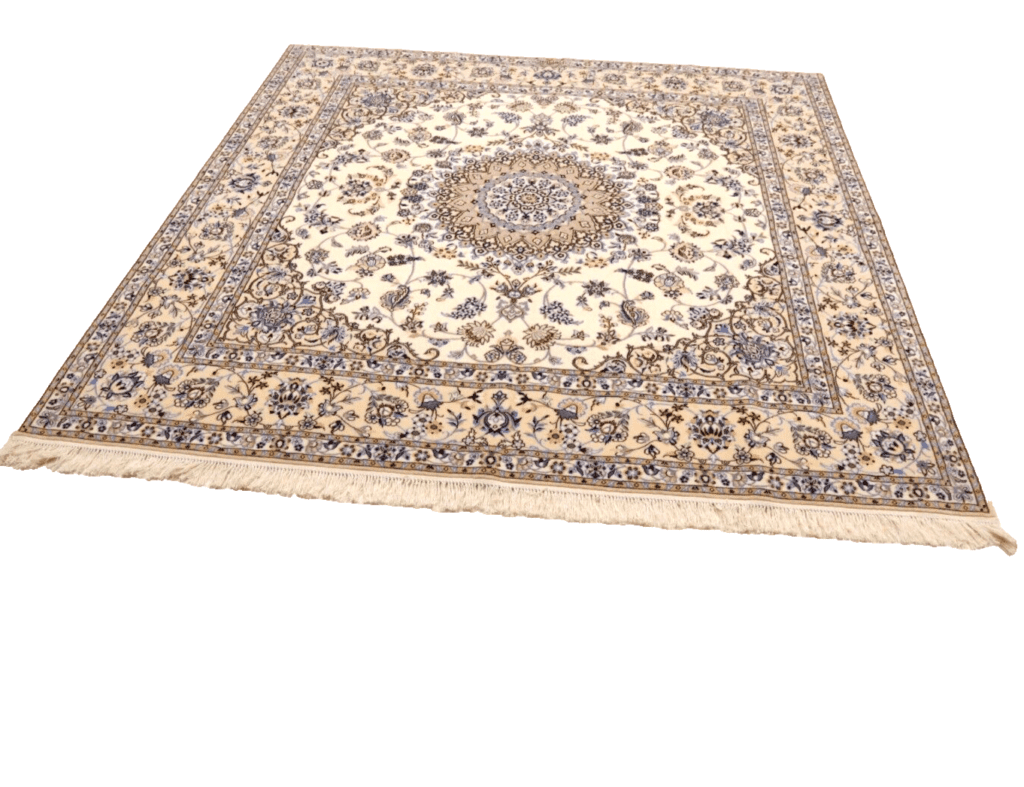
Nain weaving is often associated with light, subtle colour schemes and ornament that remains clearly legible. Floral forms may be combined with geometric structure. Centrally organised compositions, scrolling vines and finely drawn borders are among the design approaches frequently found in the Nain tradition. These general characteristics explain the stylistic classification of this rug as Super Nain 6 La without adding an unsupported description of individual motifs.
The designation Super Nain 6 La is connected with a fine Nain quality. In the Nain tradition, such quality descriptions are commonly associated with the fineness and density of the knotting. The result depends on the interaction of knots, pile, foundation and design. Dense knotting creates the conditions for precise drawing, while the yarn selection influences how the pile lies and how it responds to light.
Nain rugs form part of Persian carpet culture, in which the transmission of patterns and technical knowledge has an important place. Their designs are not dependent on short-lived fashions, but draw on established forms of Persian ornament. This allows Nain rugs to work in traditional interiors as well as in contemporary rooms. Their regional identity remains visible through the combination of material, hand-knotting and inherited design practice.
Design and Pattern
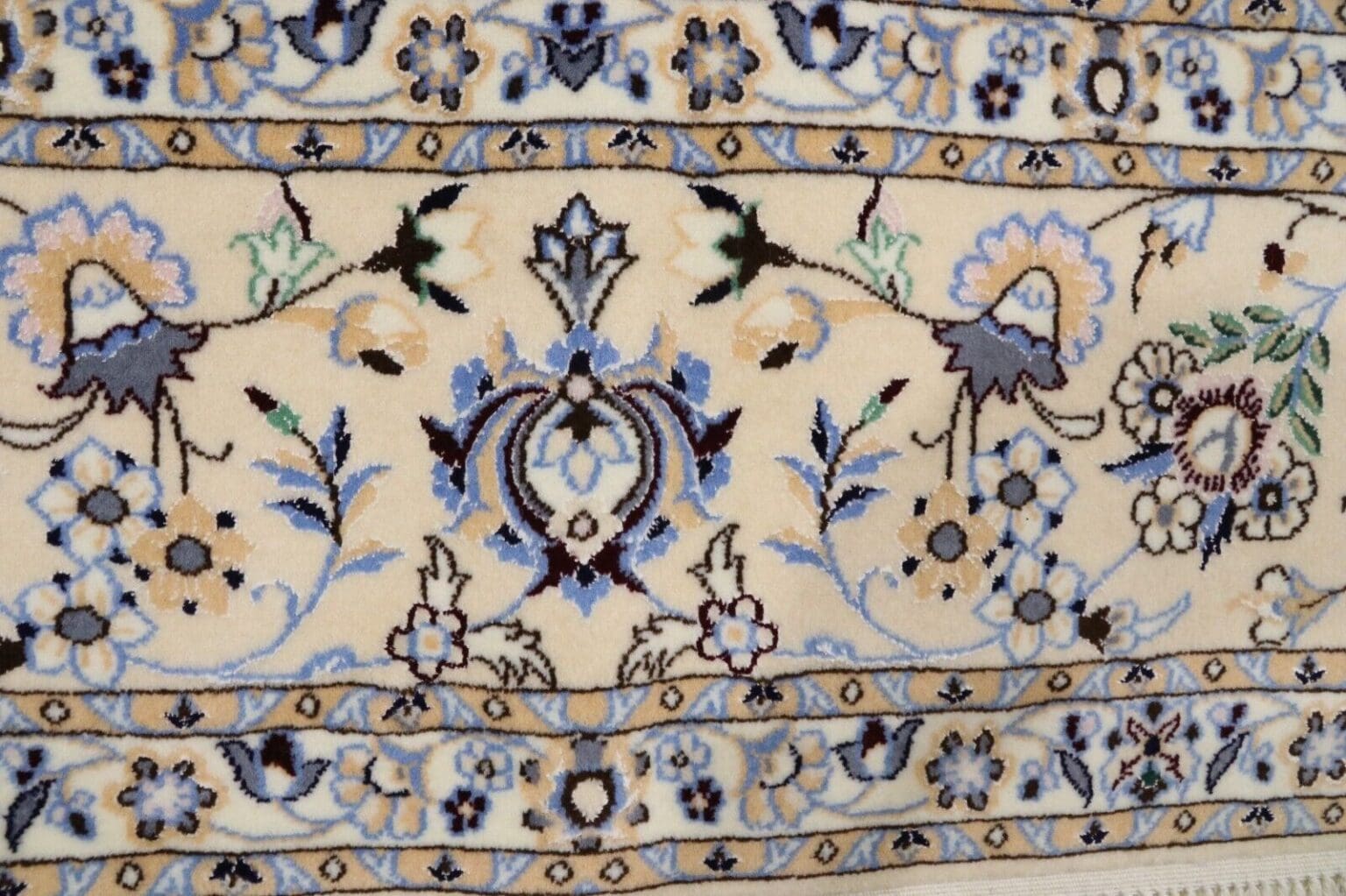
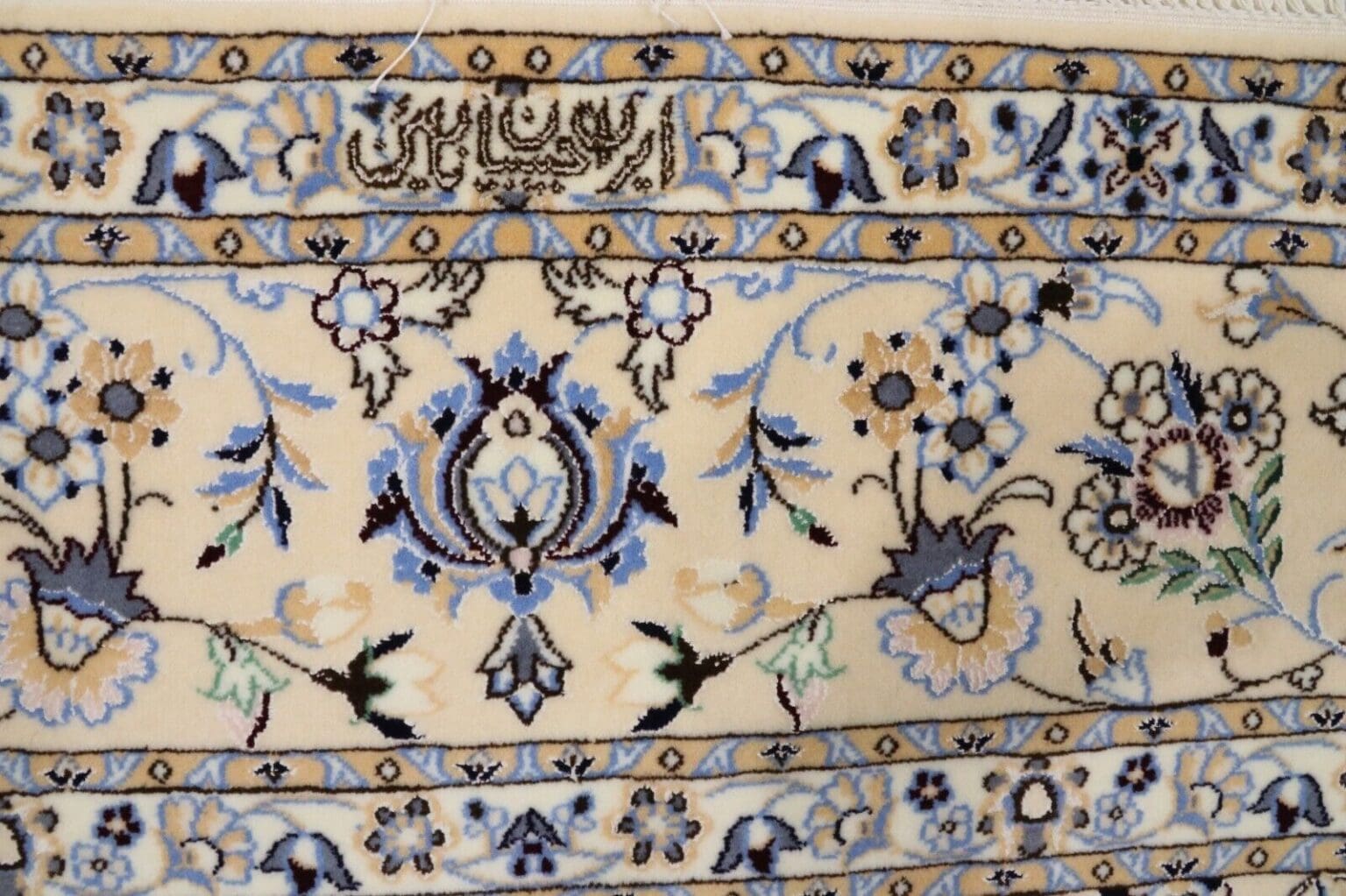
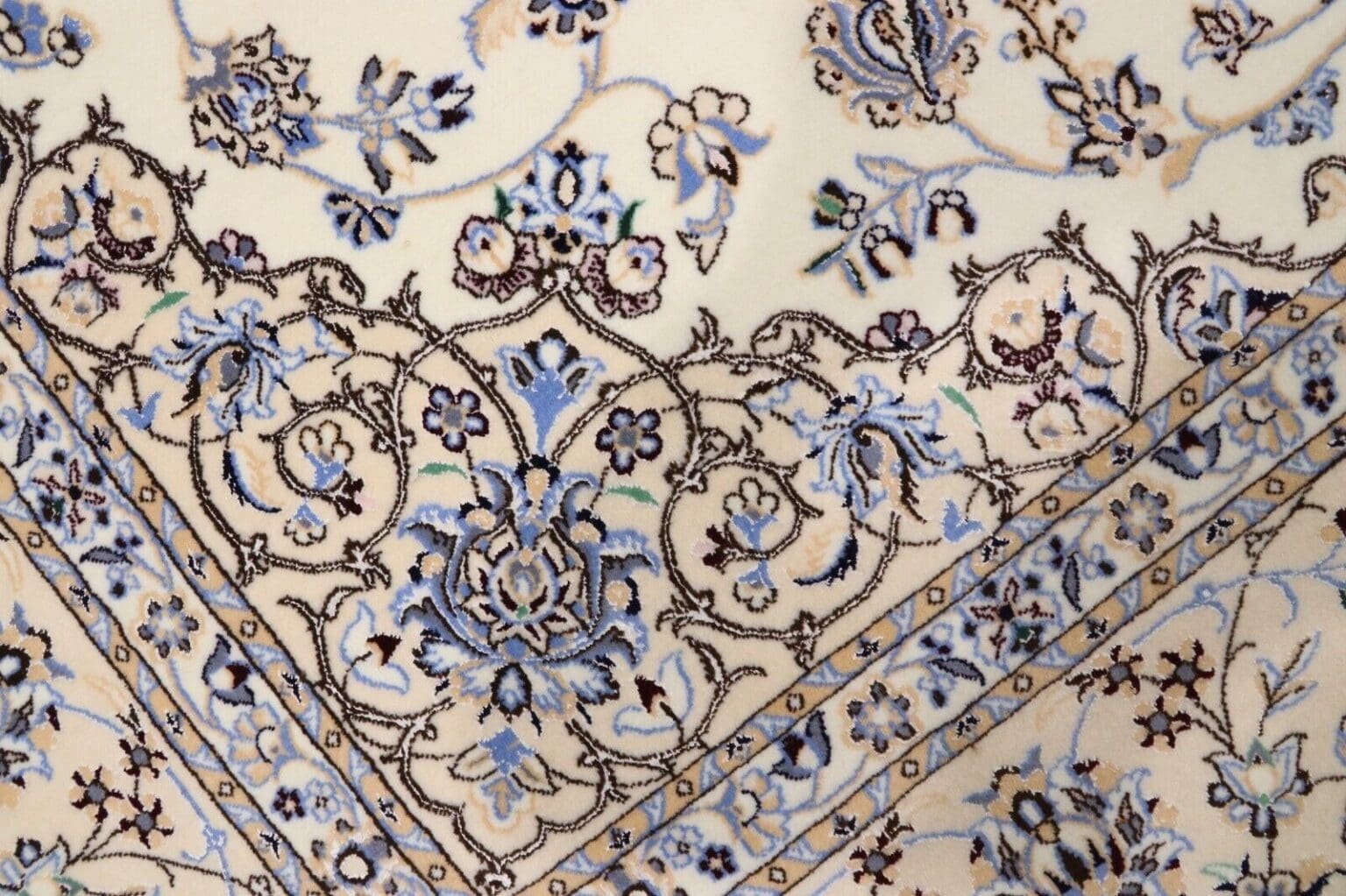
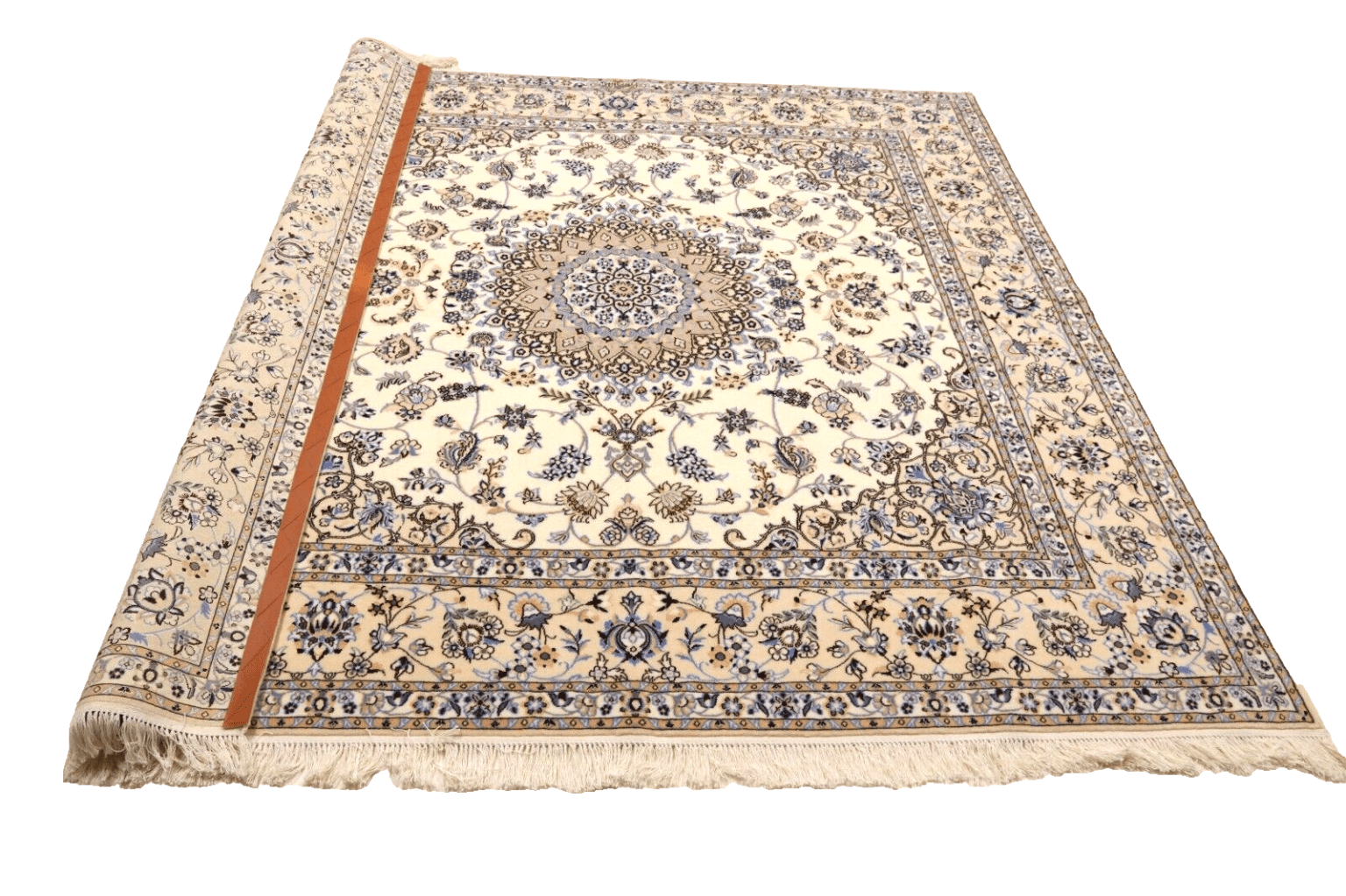
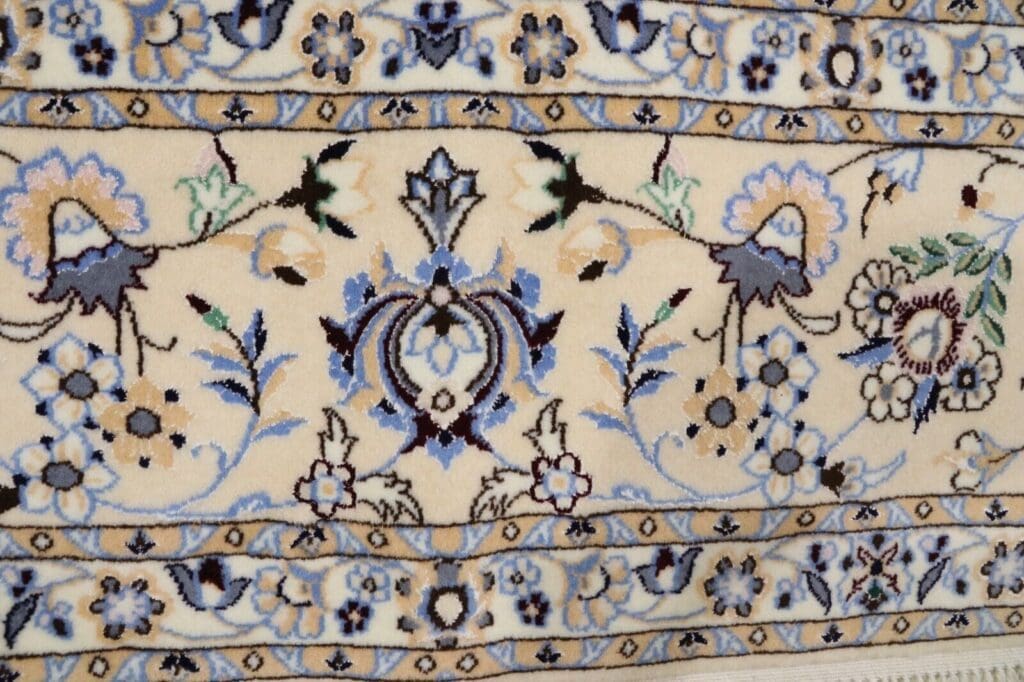
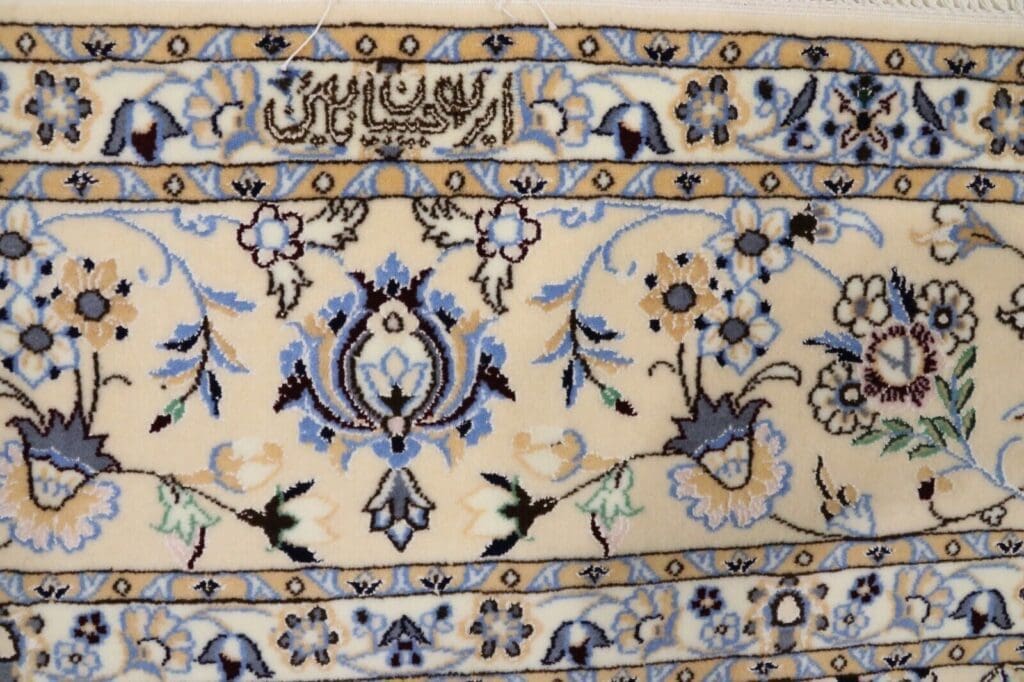
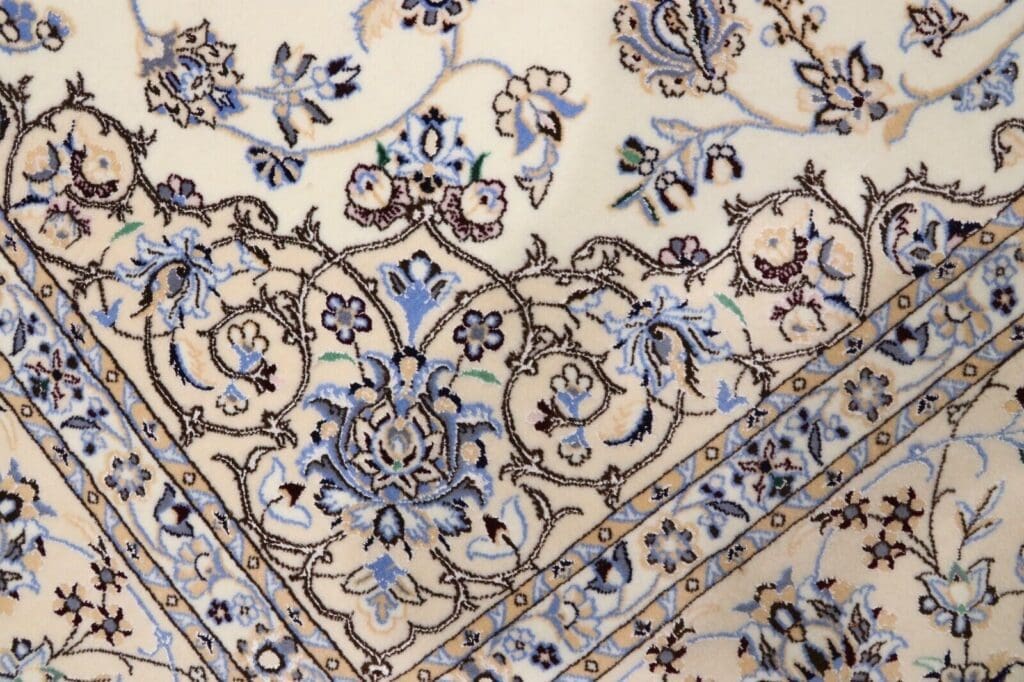
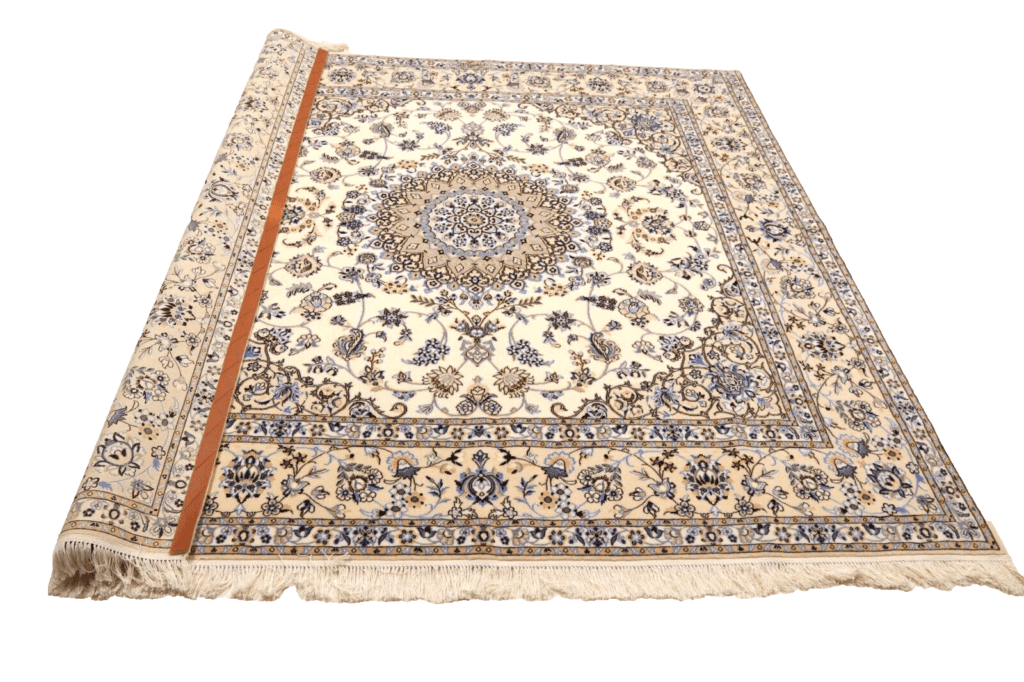
The Super Nain 6 La is defined by a delicate colour palette and intricate patterns. This is consistent with the characteristic appearance of Nain rugs, where fine detail and an ordered composition are central. Floral and geometric elements may be combined to create a balanced overall design. Fine outlines give the ornaments a clear definition, while the lighter colour effect contributes to an even and restrained impression.
Floral ornament is one of the important forms of expression in Persian carpet design. Vines, blossoms, leaves and palmettes can connect separate areas and guide the eye through the field. In a Nain composition, such forms are often drawn finely and arranged in a controlled rhythm. Geometric elements provide additional structure. They may frame a design, establish an axis or appear as repeated details within a floral arrangement.
The relationship between floral and geometric decoration is not merely a surface choice. Persian ornament uses recurring forms across generations because they create a recognisable visual vocabulary. Lotus and palmette motifs are often associated with joy in life, growth and abundance. These interpretations belong to the general symbolism of Persian patterns and do not add a separate provenance or material claim to this particular rug.
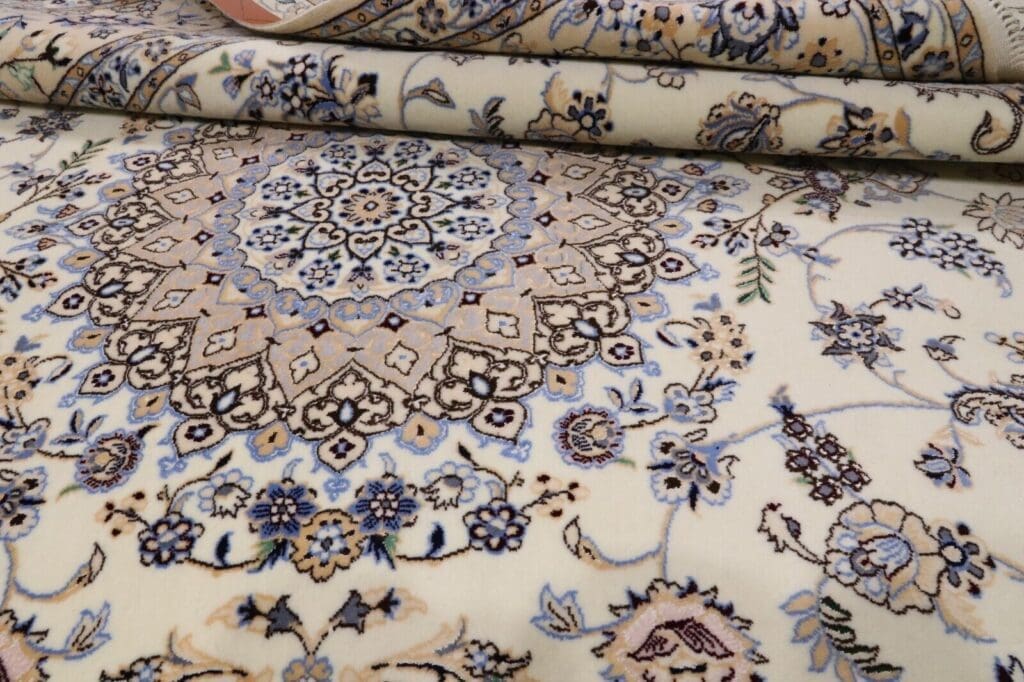
Fine knotting supports the clarity of complex ornament because small colour changes and narrow contours can be placed close together. In a hand-knotted Nain rug, the design is built knot by knot rather than printed onto the finished surface. Each section results from a sequence of manual decisions and controlled work. The very high density of this rug therefore has a direct relationship to the fine, detailed appearance described for its pattern.
The traditional Oriental and Persian style can be used with different interior schemes. In a classical room, the floral ornament can echo established furniture shapes and decorative elements. In a modern setting, it can provide a deliberate cultural and handcrafted accent. This adaptability comes from the balanced character of the Nain tradition and from the measured appearance of its detailed patterns.
Natural silk in the pile contributes another layer to the perception of the design. Light behaves differently on fine silk fibres than on cork wool, so certain areas can appear brighter or quieter as the viewer moves around the room. The dense hand-knotted construction keeps the pattern readable while the material combination adds subtle variation to its surface. Traditional Persian ornament and a refined textile effect are therefore present together.
Special Features
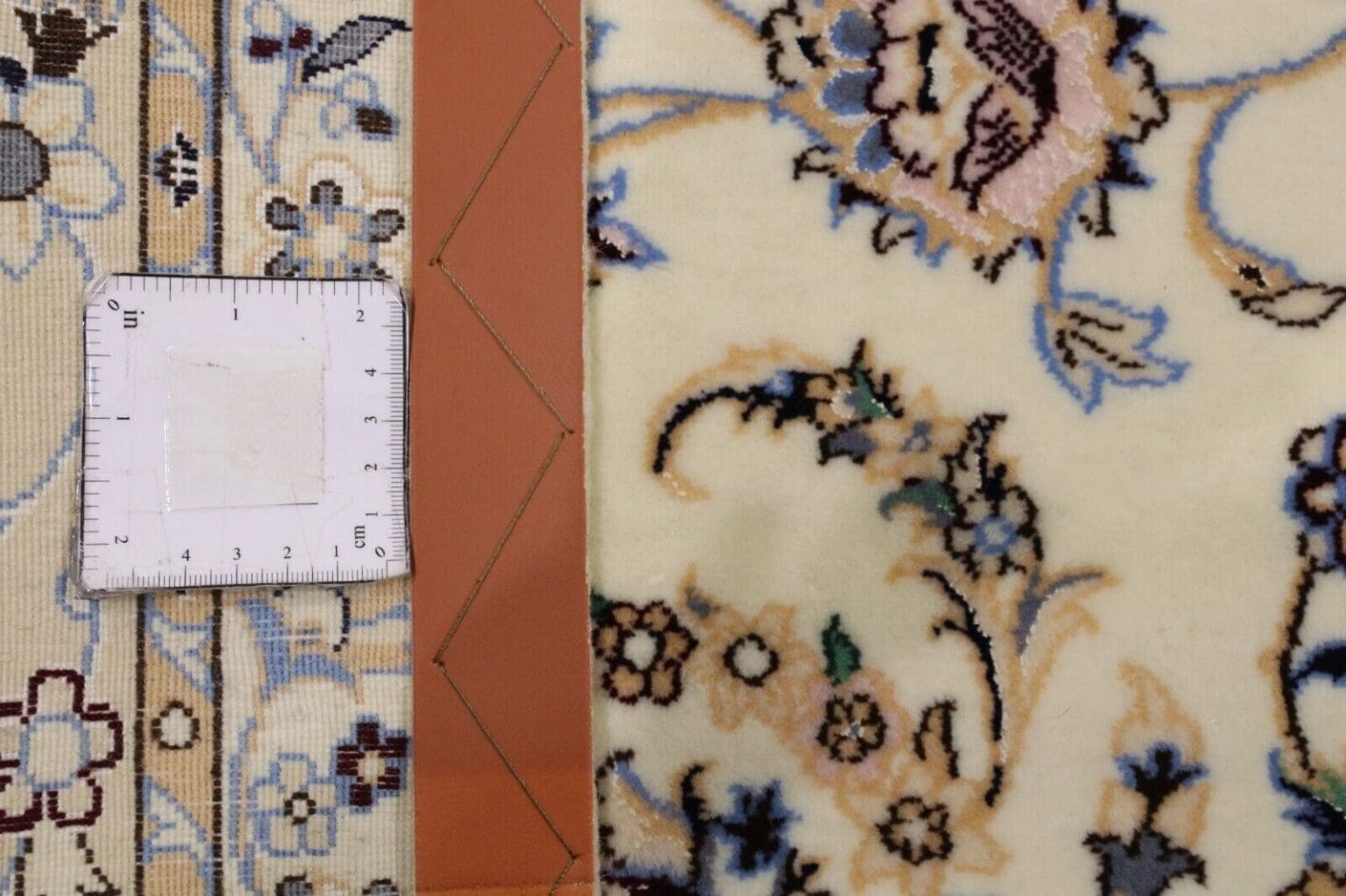
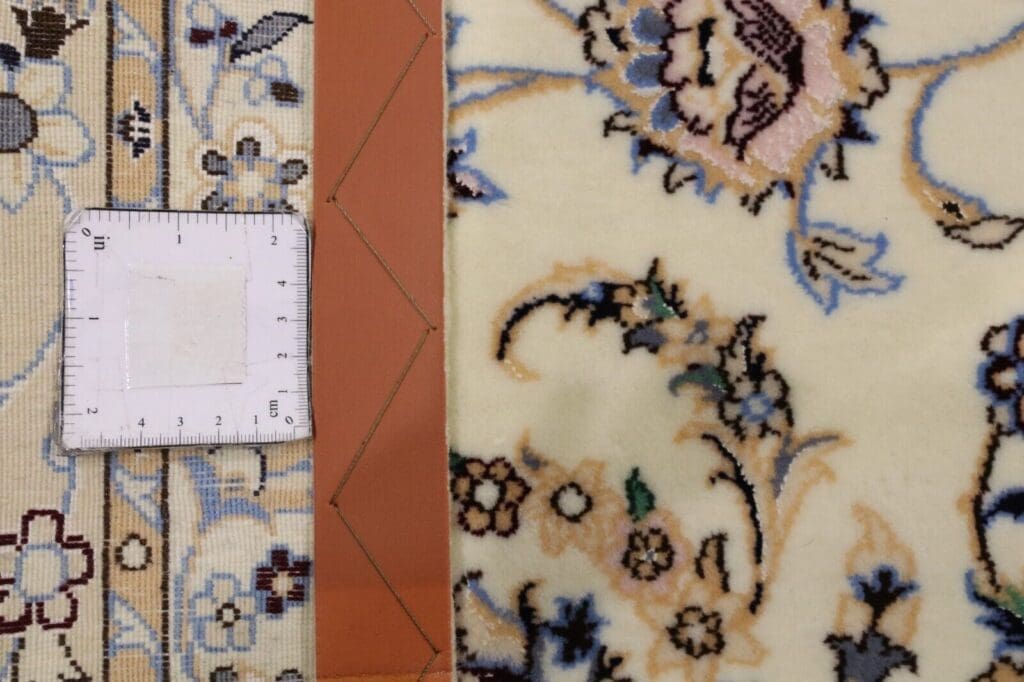
A defining feature of this rug is its very high knot density of approximately 1,000,000 knots per square metre. It allows fine and complex pattern work and is one of the characteristics associated with the Super Nain 6 La execution. The dense knotting is closely connected with the detailed design and contributes to the quality and durability described for the rug.
The rug is new and in perfect condition. It is hand-knotted and unique. Its combination of cork wool and natural silk, its fine Nain styling and its Persian classification make it suitable for living areas as well as representative rooms. The traditional design can be placed in interiors ranging from classical to modern.
The rug can be used in living rooms and bedrooms, and it is also suitable for offices or reception areas. Its delicate, intricate appearance can be integrated into different furnishings while retaining its handcrafted origin. The cork wool base combined with the sheen of natural silk and the dense hand-knotted construction are central to the particular character of this one-off piece.
FAQ
How should I care for this Persian rug?
For routine care, vacuum the rug gently on a low setting. The surface should not be subjected to unnecessary force. Treat stains promptly with a damp cloth. Professional cleaning every few years is recommended to help protect the fibres. A careful approach is appropriate for a pile made from cork wool and natural silk because the two materials have different surface properties and respond differently to handling and light.
Why are hand-knotted Persian rugs laborious to make?
Making a hand-knotted Persian rug involves many separate stages and can require hundreds of hours of manual work. Every knot is inserted individually, the pattern is checked as the work progresses and the construction has to remain consistent across the entire surface. High-quality materials such as cork wool and natural silk, together with a very high knot density, add to the technical effort. The handwork also makes each rug a unique piece that embodies craft, culture and tradition.
Where can the Super Nain 6 La be used?
The rug is suitable for living rooms and bedrooms and can also be placed in offices or reception rooms. Its elegant, finely drawn design works with both classical and modern interiors. The combination of cork wool and natural silk, along with the dense hand-knotted construction, makes it appropriate for spaces where a traditional Persian accent and carefully executed textile craftsmanship are intended to remain visible.
To provide the best experiences, we use technologies like cookies to store and/or access device information. Consenting to these technologies will allow us to process data such as browsing behavior or unique IDs on this site. Not consenting or withdrawing consent, may adversely affect certain features and functions.
Functional Always active
The technical storage or access is strictly necessary for the legitimate purpose of enabling the use of a specific service explicitly requested by the subscriber or user, or for the sole purpose of carrying out the transmission of a communication over an electronic communications network.
Preferences
The technical storage or access is necessary for the legitimate purpose of storing preferences that are not requested by the subscriber or user.
Statistics
The technical storage or access that is used exclusively for statistical purposes.The technical storage or access that is used exclusively for anonymous statistical purposes. Without a subpoena, voluntary compliance on the part of your Internet Service Provider, or additional records from a third party, information stored or retrieved for this purpose alone cannot usually be used to identify you.
Marketing
The technical storage or access is required to create user profiles to send advertising, or to track the user on a website or across several websites for similar marketing purposes.

 SECURE PAYMENT
 SHIPPING PARTNERS


