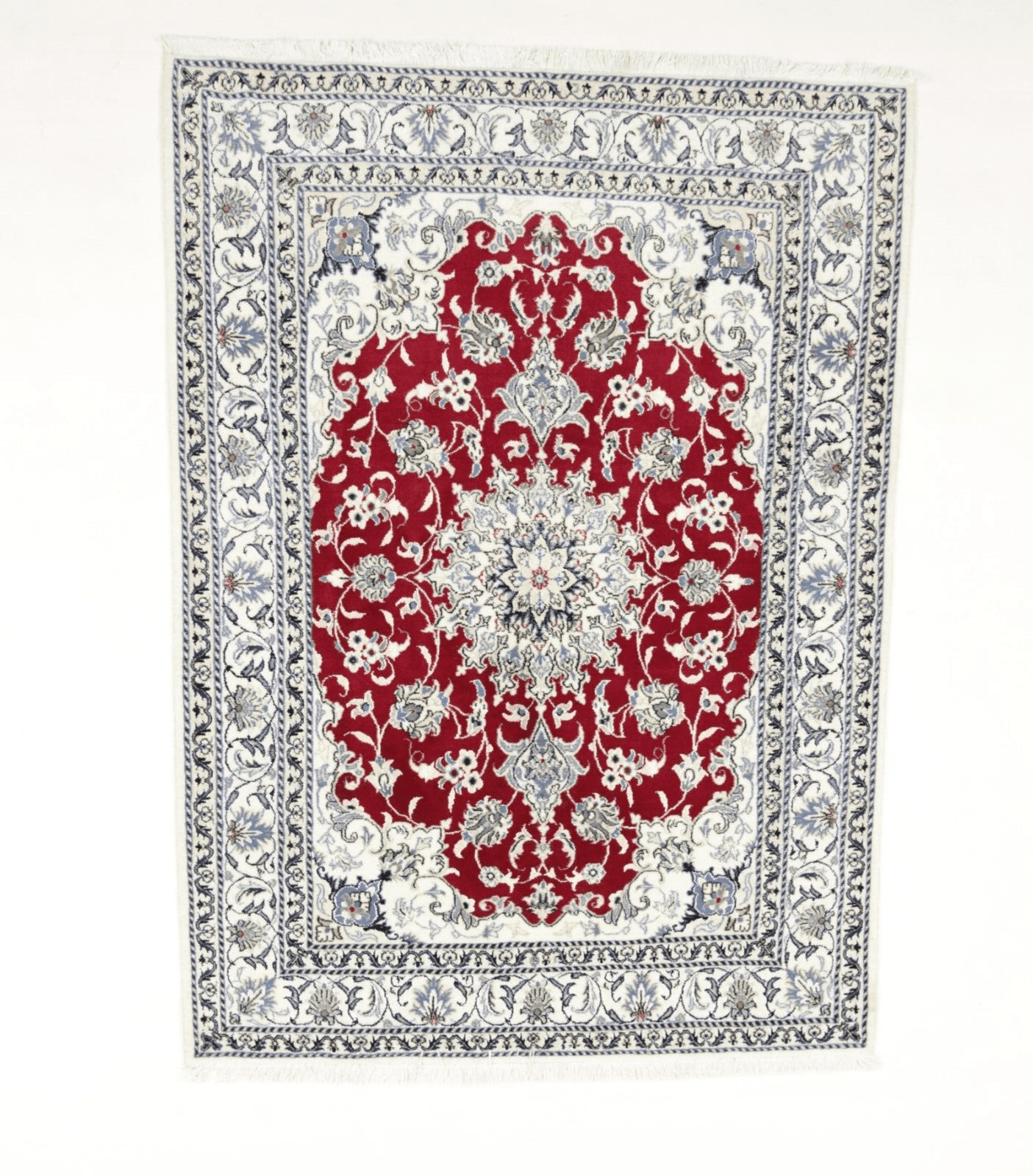
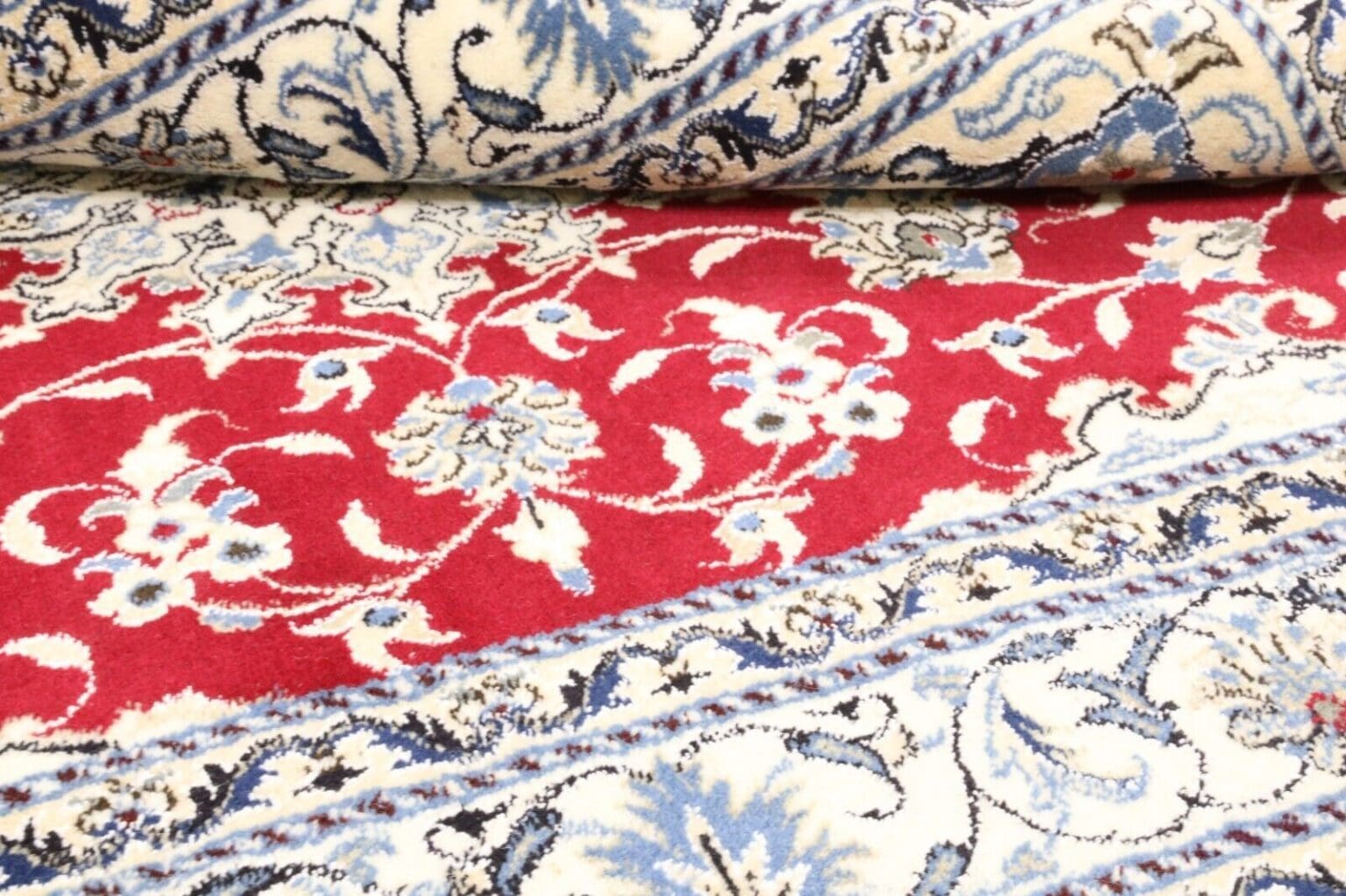
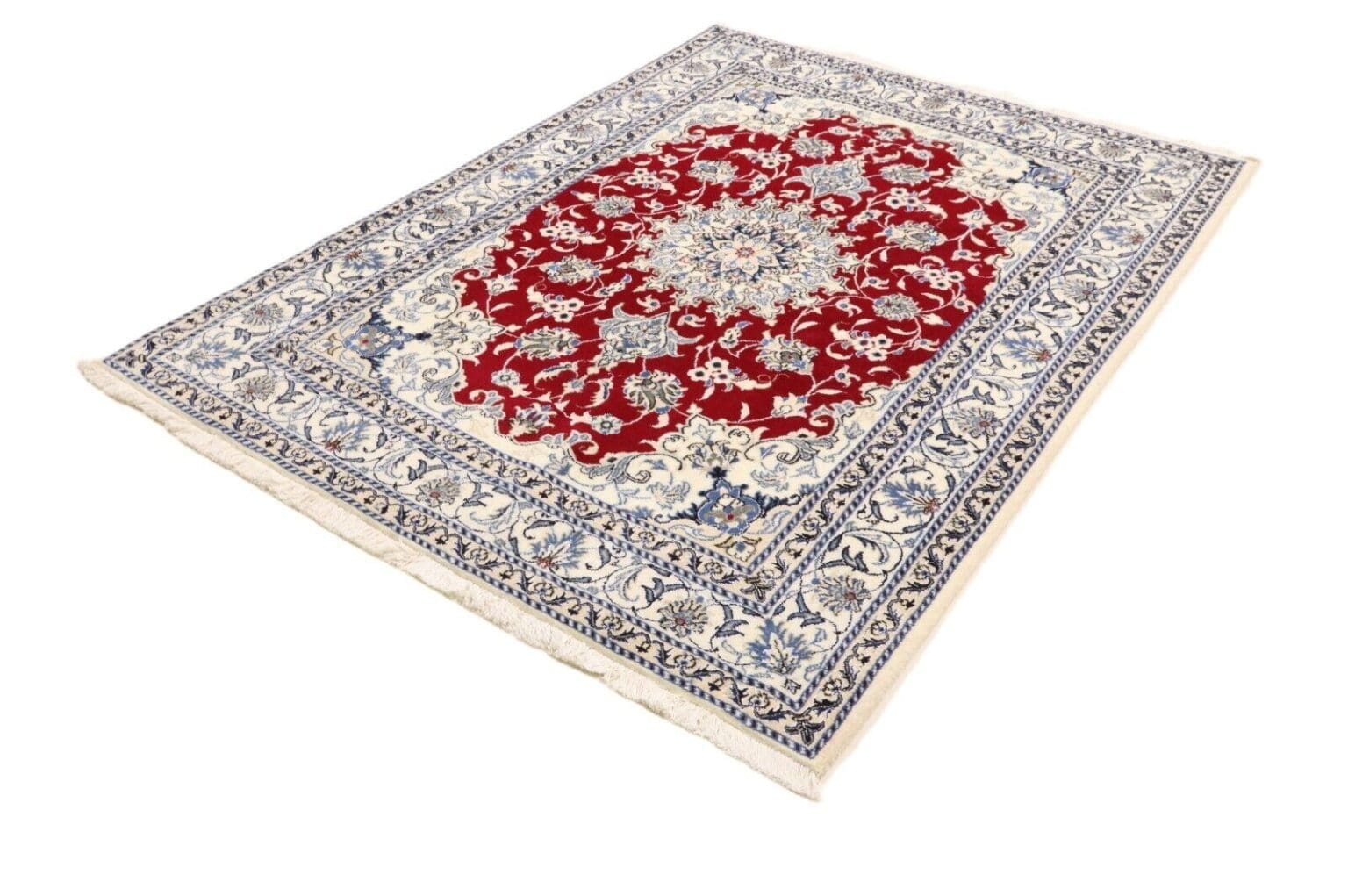
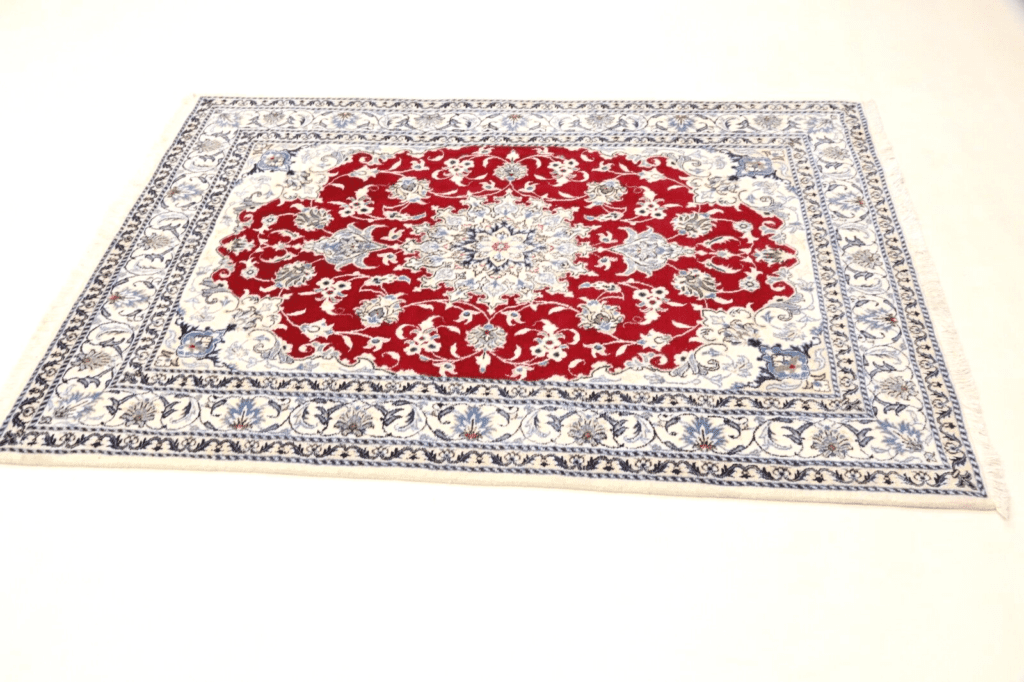
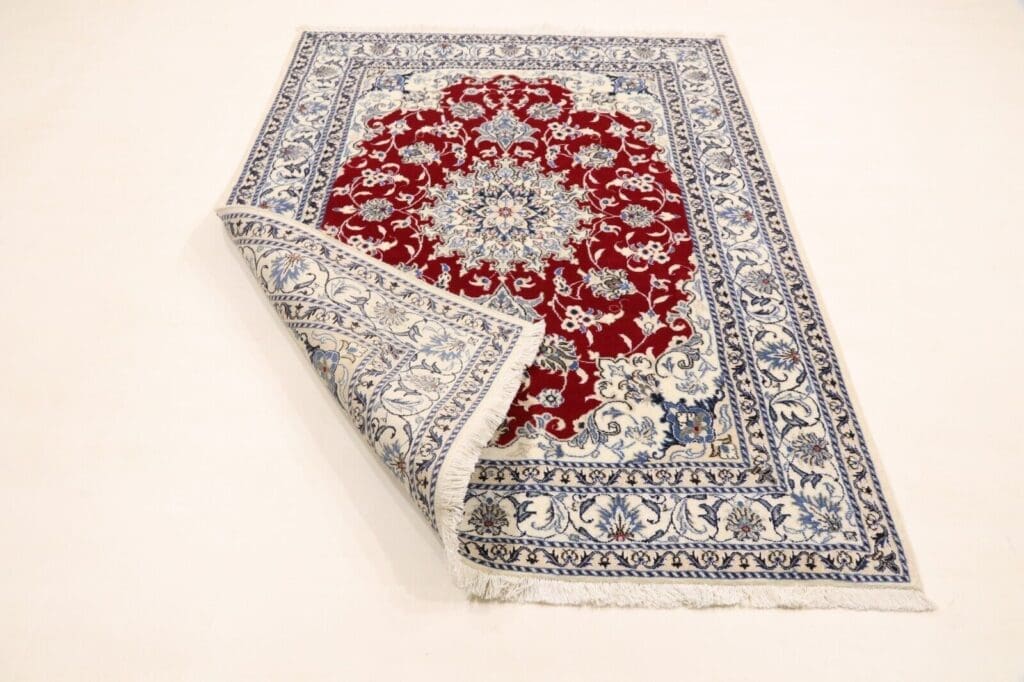
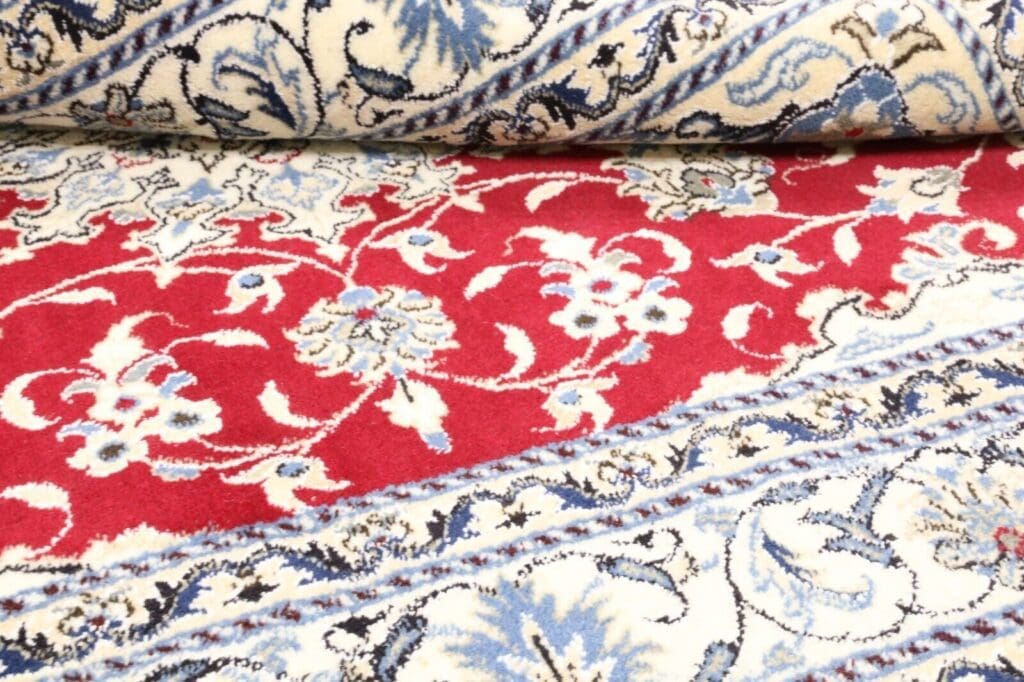
This Nain Persian rug is hand-knotted. Its pile is made from virgin wool and silk, while the warp is cotton. This combination brings together materials with different traditional roles in rug making. Wool provides a resilient and pleasantly warm pile, silk contributes a smooth surface and subtle sheen, and the cotton warp forms the foundation to which the rows of knots are attached. The result is a textile structure created through a sequence of manual production steps.
Virgin wool is widely used in hand-knotted rugs because of its natural strength and comfortable handle. It can give the pile a durable structure and a warm feel underfoot. Silk is traditionally introduced where a finer appearance and a more reflective surface are desired. In this rug, wool and silk are combined with a cotton warp rather than being treated as separate decorative elements. The source describes the pile as 90 percent virgin wool and 10 percent silk, with a warp made entirely from cotton.
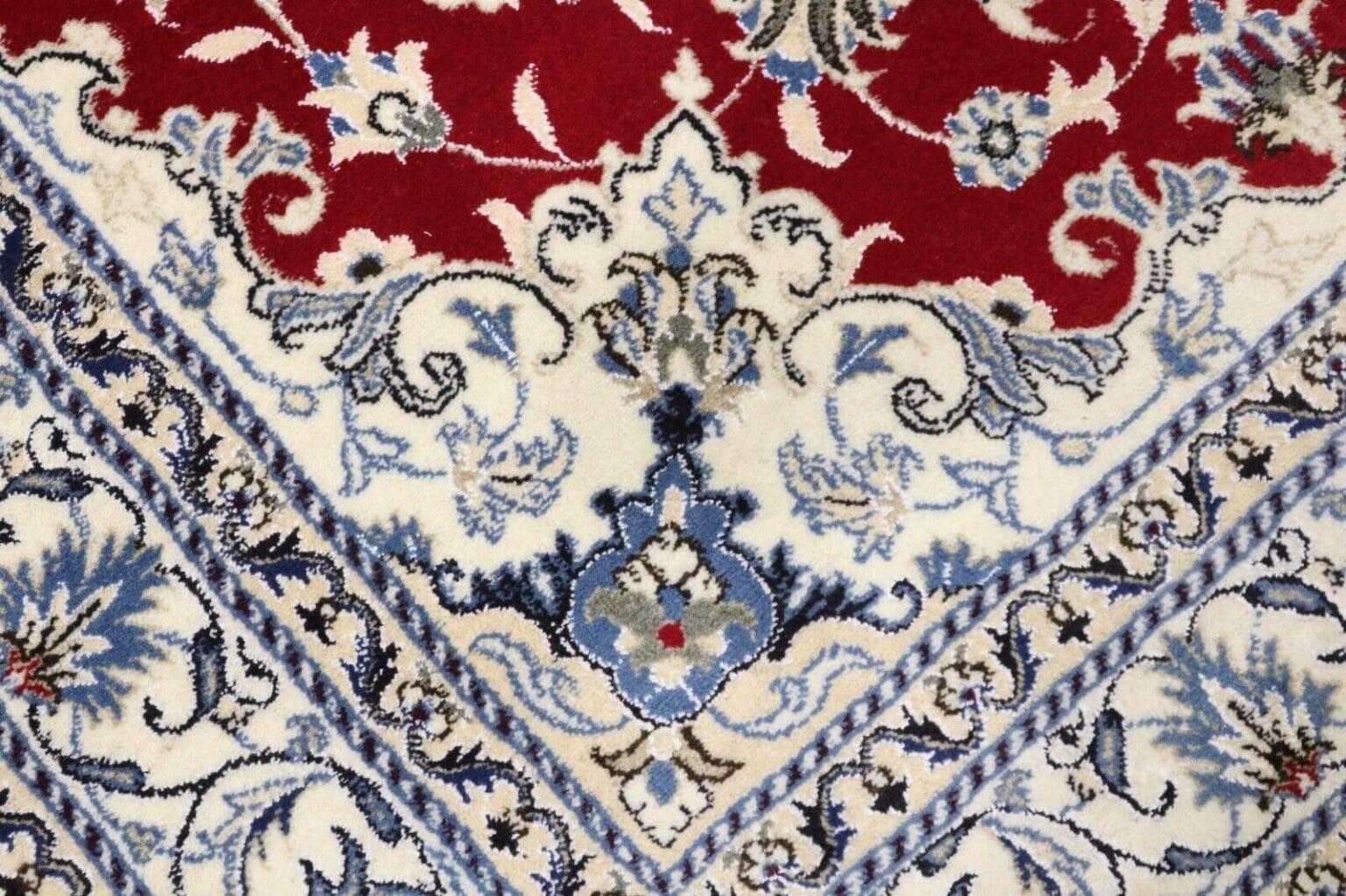
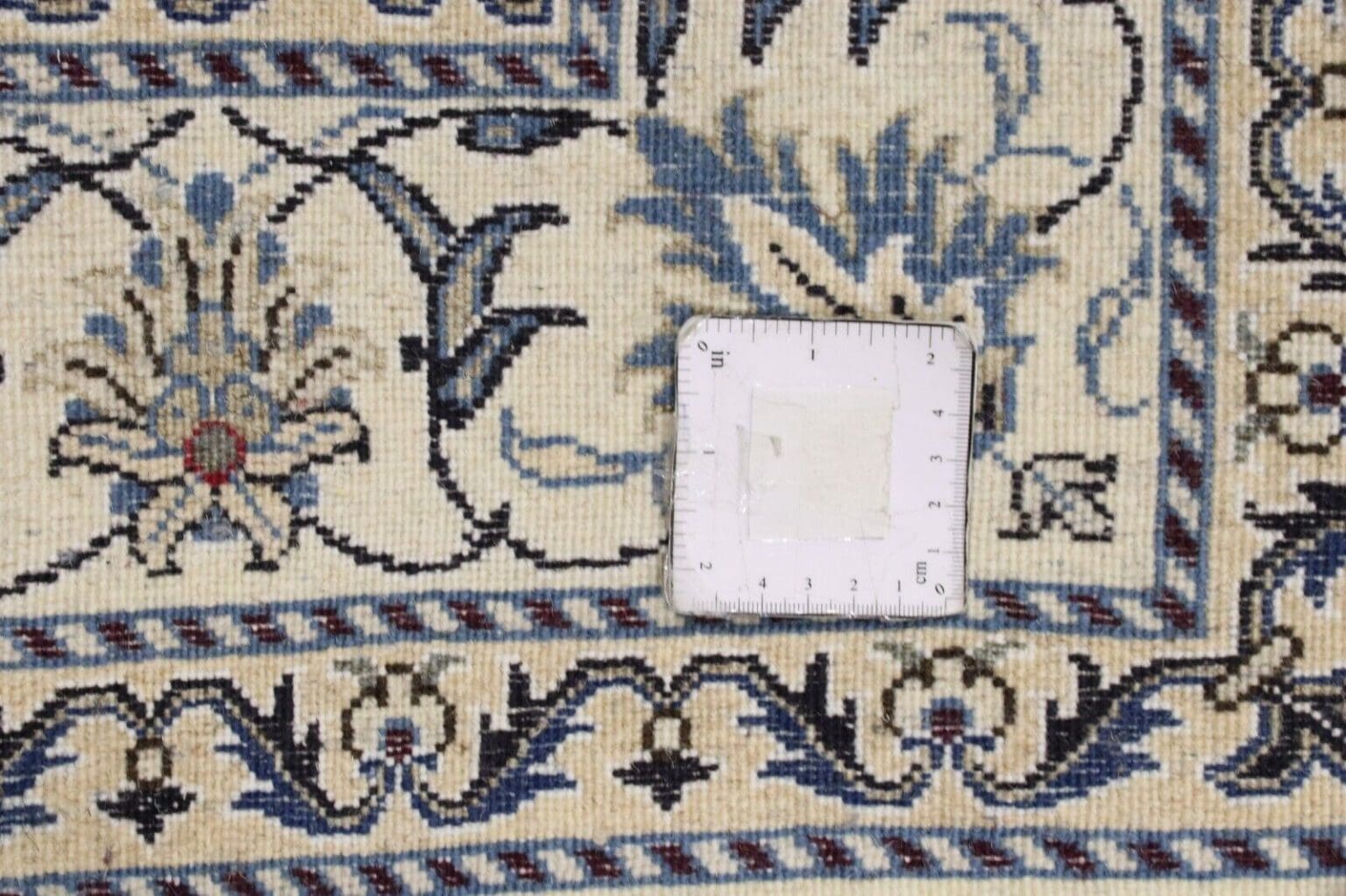
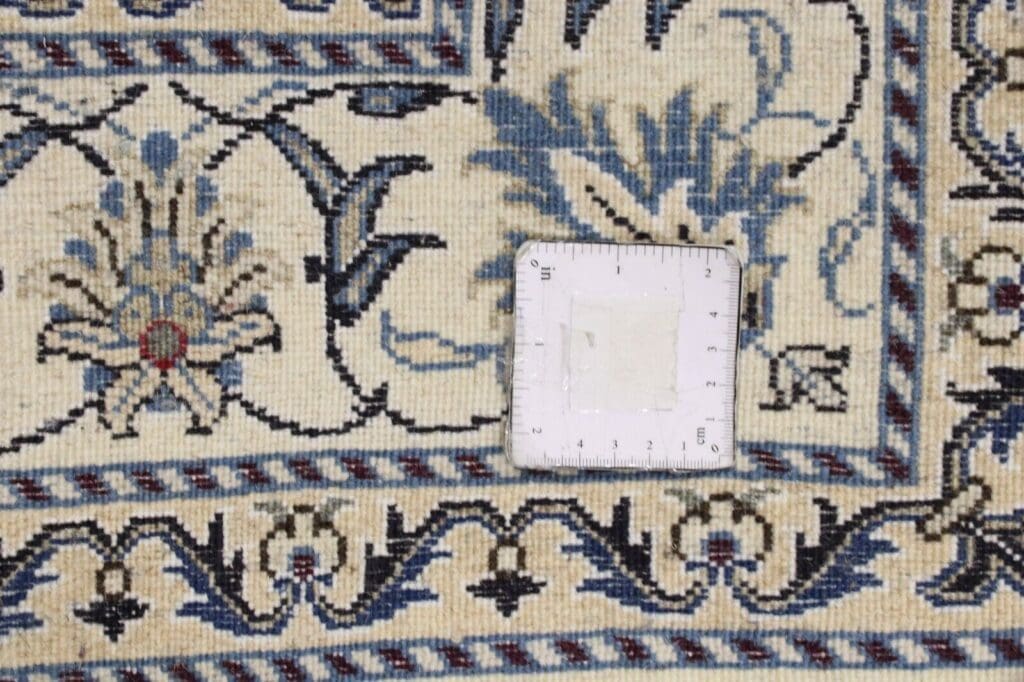
Hand-knotting means that the knots are placed by hand rather than produced by a machine. The weaver works through many individual stages, securing knots, building rows, trimming the pile and finishing the surface. The listed density is approximately 300,000 knots per square metre. Knot density indicates the fineness of the construction and supports a detailed textile surface. This rug is new and is suitable for use in rooms with underfloor heating.
Origin and Tradition
Nain is a city in Iran and has developed a distinct place within the Persian rug tradition. It lies in central Iran, in a dry landscape shaped by historic routes and long-established craft cultures. The local rug tradition became recognised for carefully controlled drawing and fine workmanship. Nain rugs are commonly associated with precise knotting, balanced compositions and a restrained relationship between ground, border and ornament.
Persian rug making combines practical household use with a visual language passed down through generations. Knowledge of stretching the warp, placing the knots, securing the rows, trimming the pile and finishing the edges has traditionally been taught within families and workshops. Every stage affects the evenness of the final surface. In fine Nain work, the regularity of the construction and the clarity of the pattern are therefore closely connected.
The history of Persian rugs reaches back many centuries. Rugs served as floor coverings and protection from cold, but they also became important elements of interior arrangement and cultural expression. Regional traditions developed their own preferences in colour, border structure and ornament. Nain belongs to this wider Persian heritage while retaining a recognisable regional identity. Its name refers to the city and to the weaving tradition associated with it, not simply to one isolated decorative motif.
In the broader history of Iranian textiles, a rug can record the knowledge of a place through its construction as well as through its design. The foundation, knotting method, pile treatment and composition all reflect decisions made in the workshop. A regional label does not mean that every rug follows one fixed template. Different workshops may vary the proportions, colours and sequence of motifs while remaining within the Nain tradition. Each hand-knotted rug is consequently an individual result of a shared regional vocabulary.
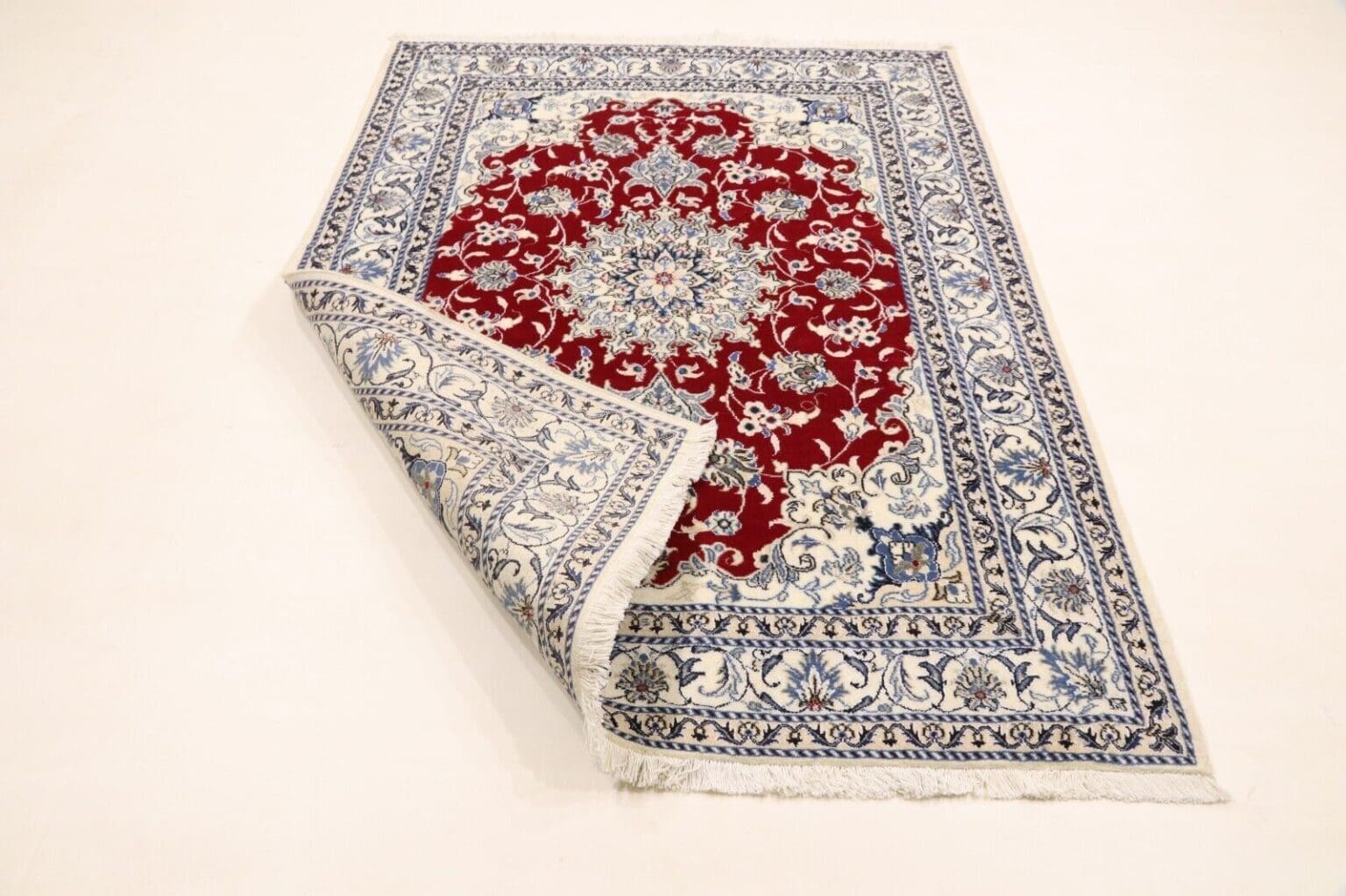
Nain rugs are often connected with fine knotting and a carefully organised appearance. Their designs may use a central field framed by one or more borders, with ornament distributed in a measured way across the surface. This organisation helps the eye read the relationship between the central area and its surrounding frame. The tradition also shows how Persian weavers adapt established forms instead of merely repeating them. A familiar motif can change through scale, spacing, colour or line quality.
The present rug is described as a Nain Persian rug from Persia, meaning Iran, and is hand-knotted. That origin distinguishes it from rugs made in other countries that may borrow Persian design names. Nain is therefore both a place of origin and a reference to a particular regional craft tradition. The rug belongs to the Persian category because the source identifies its origin as Persia and Iran.
Design and Pattern
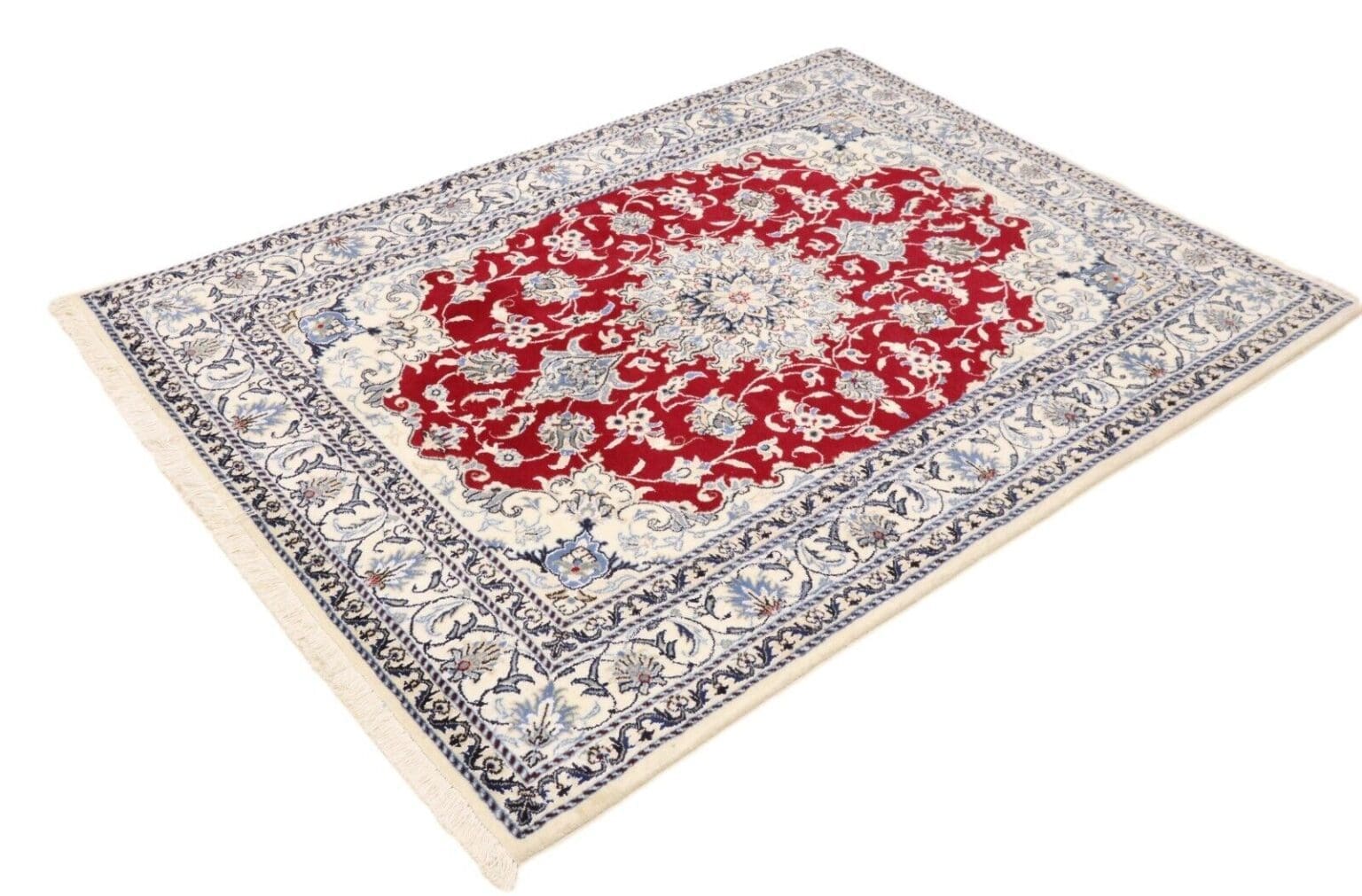
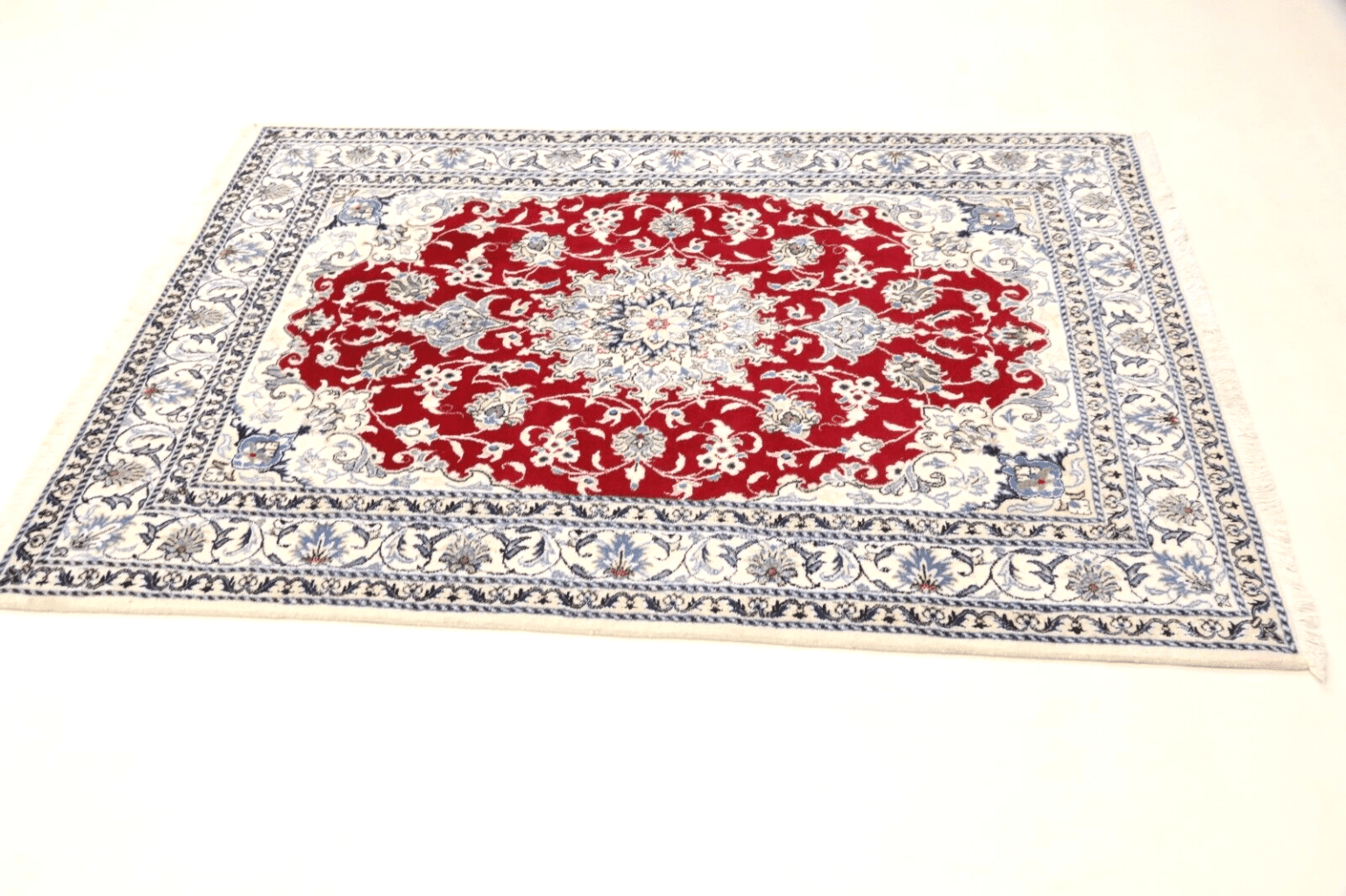
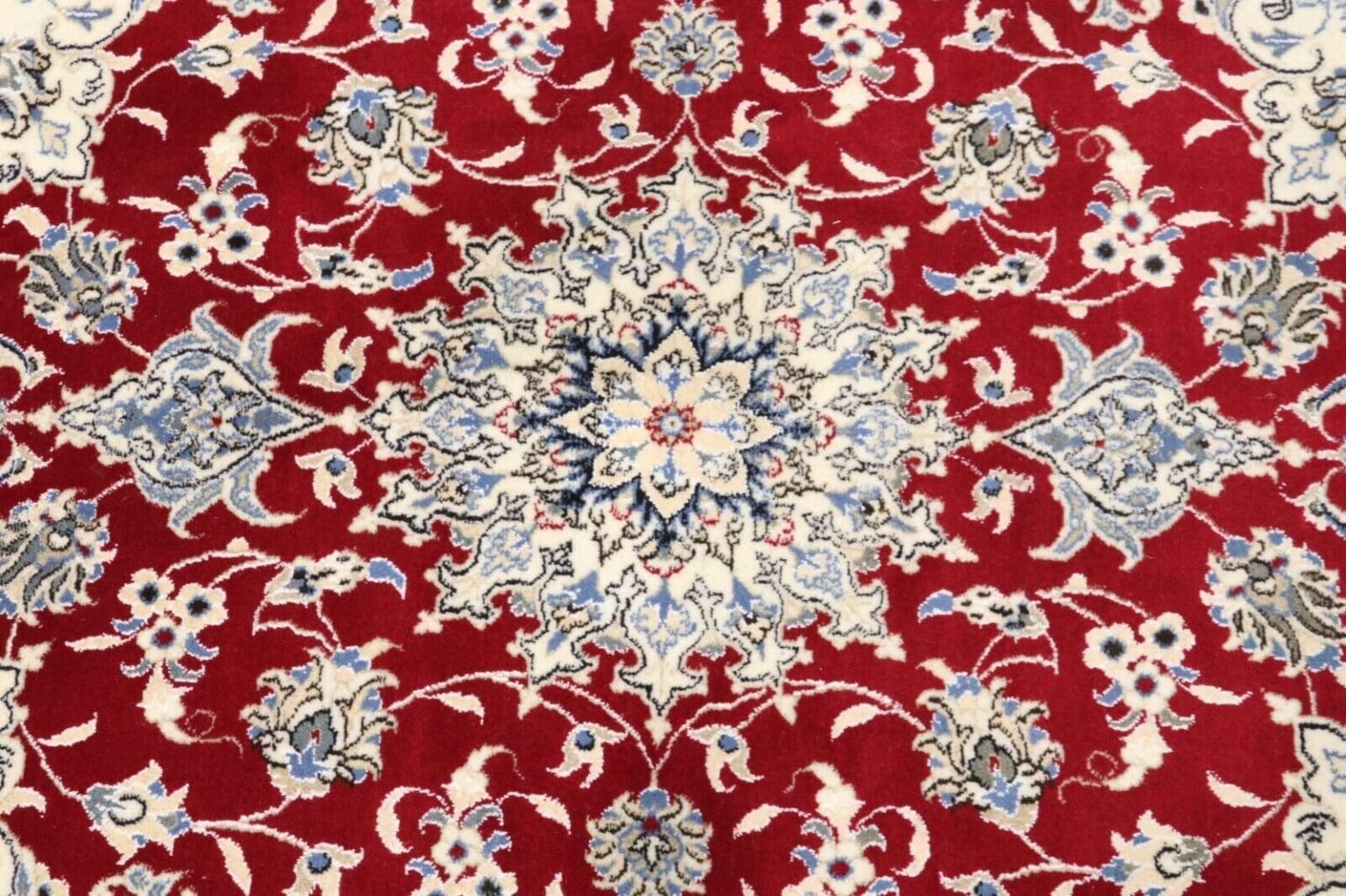
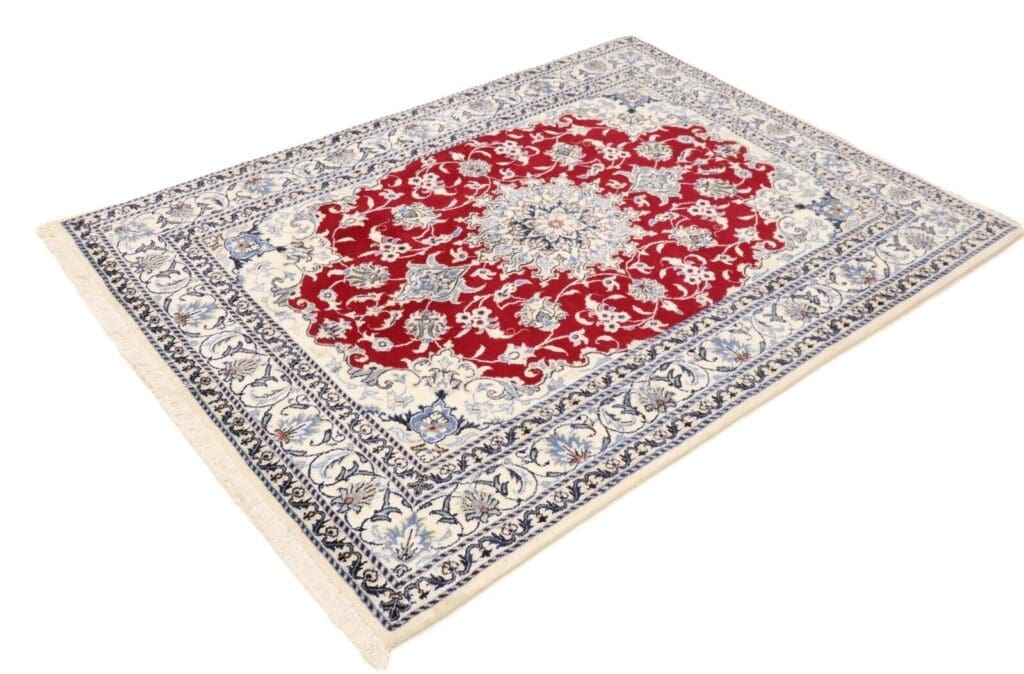
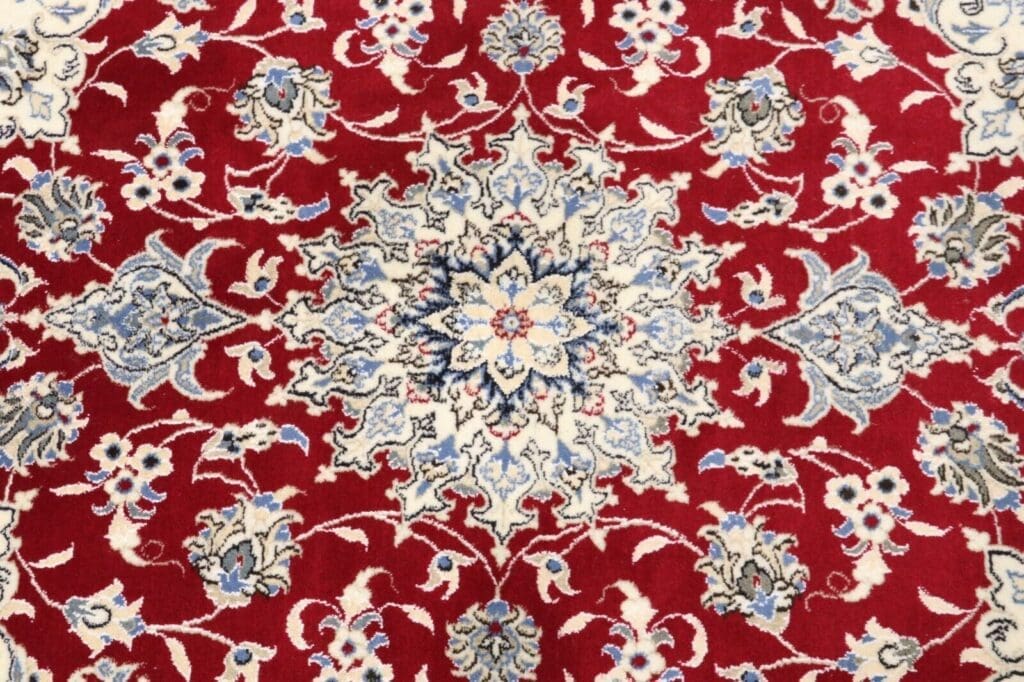
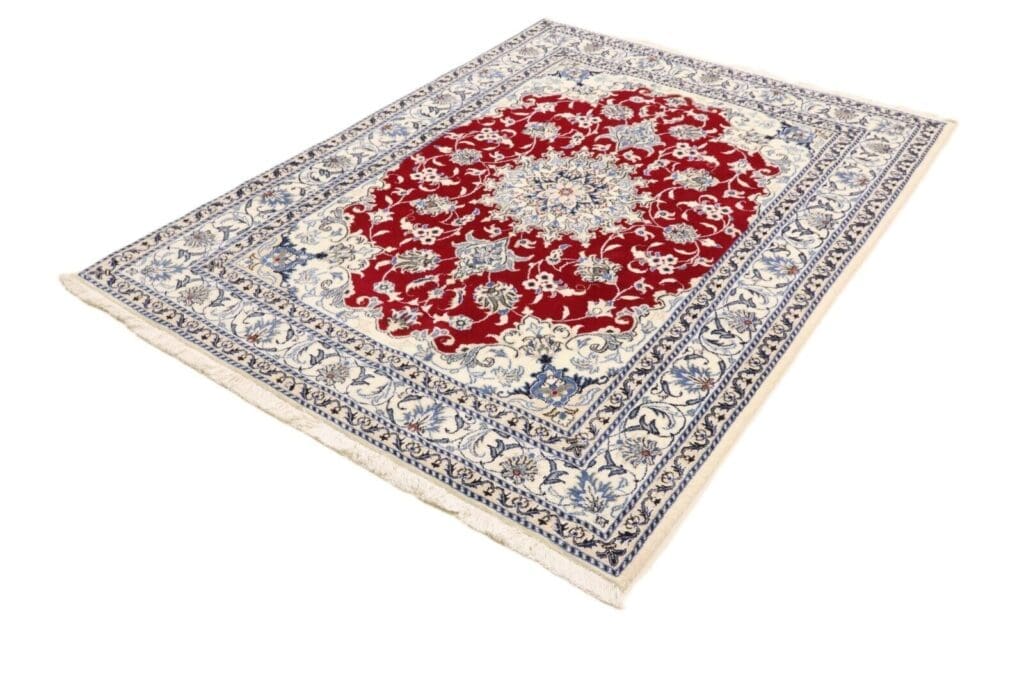
The rug is classified in the traditional Oriental and Persian style. This places it within a decorative design tradition built around ordered fields, borders and repeated ornament. Nain rugs are often associated with harmonious colours and finely drawn patterns. Floral and geometric elements are both common possibilities within the regional vocabulary. These elements may be arranged around a central medallion, distributed as an all-over pattern or organised in clearly separated zones.
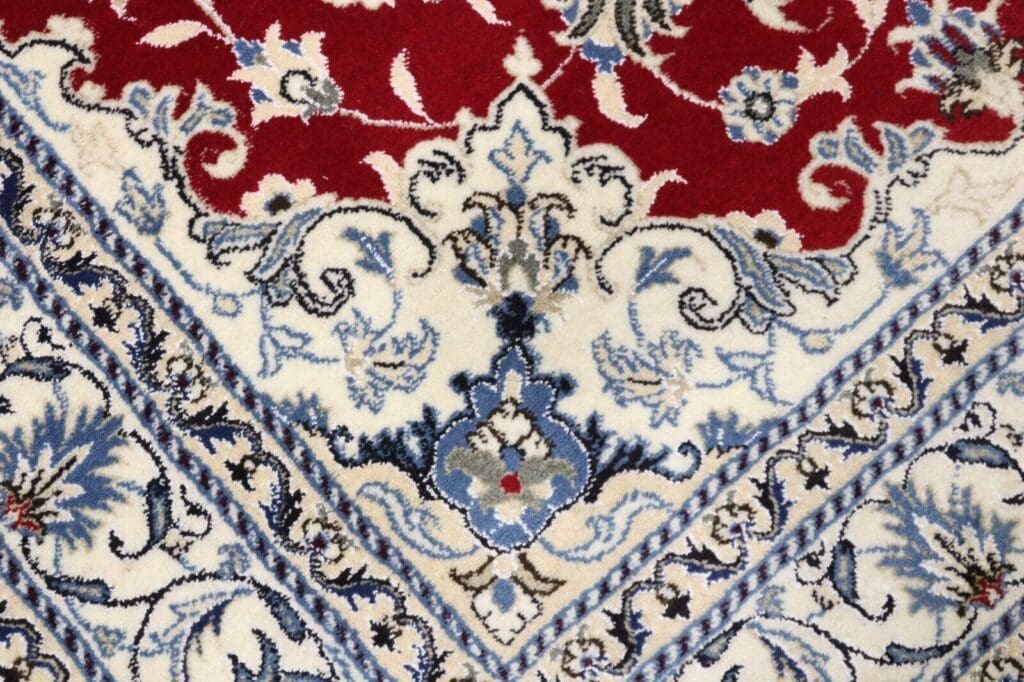
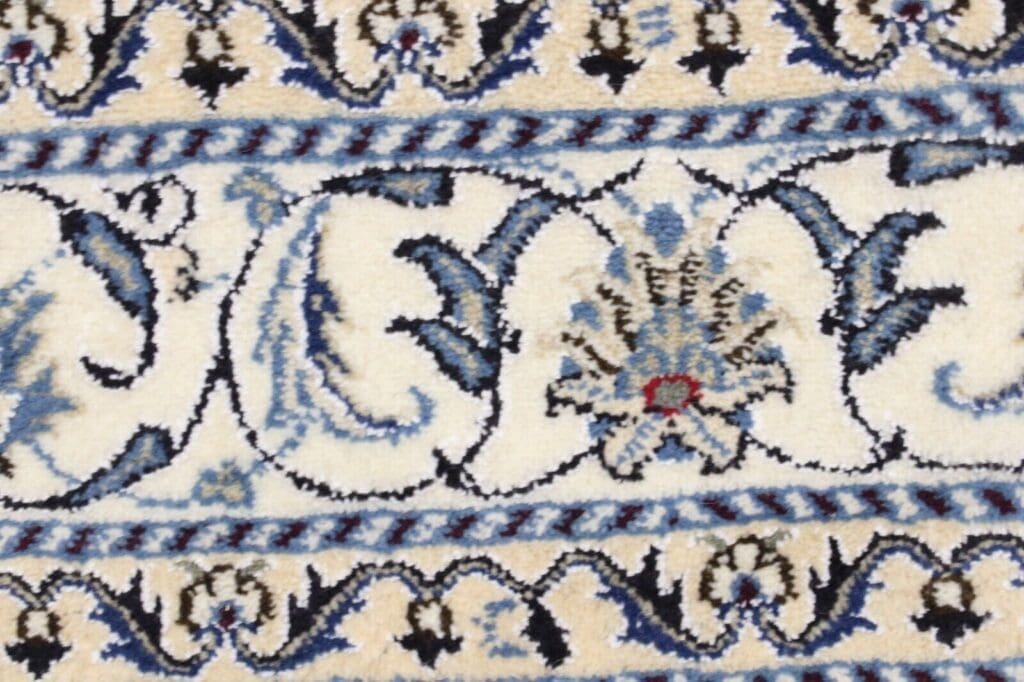
Floral Persian motifs frequently draw on stylised leaves, blossoms, vines and palmettes. They are not necessarily botanical illustrations; instead, they are adapted to the geometry of a woven or knotted surface. Repetition creates rhythm, while variations in scale keep the field from appearing mechanically uniform. Geometric details can provide a framework for the softer curves of foliage and flowers. This balance between flowing lines and measured structure is an important feature of Persian pattern design.
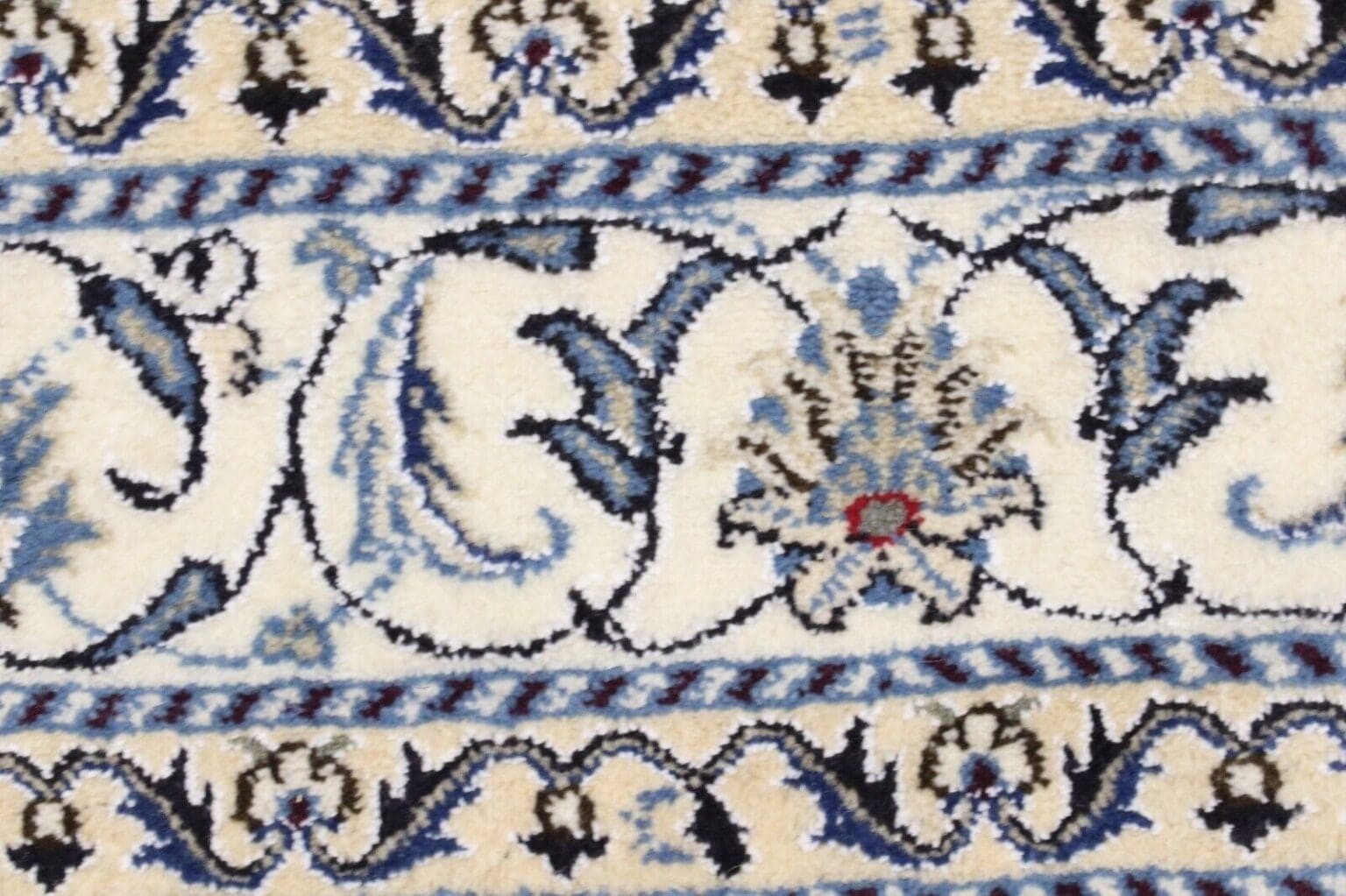
A border gives the central field a visual edge and creates a transition between the rug and the surrounding room. A principal border may be accompanied by narrower guard borders, allowing the composition to move gradually from the centre towards the outer edge. The border also helps contain the pattern and establishes a sense of proportion. Within the field, the design may be centred, repeated or spread through interconnected ornament. The precise arrangement belongs to the individual execution of the rug.
Traditional Persian colour systems usually depend on relationships between the ground colour, the main ornaments and the border areas. Carefully balanced tones allow the drawing to remain legible while keeping the composition coherent. Nain designs are often described in connection with a calm and coordinated colour effect. The product description places this rug in the traditional Oriental and Persian style, so its design is understood within that established regional approach rather than as a modern abstract composition.
Persian ornaments can also carry cultural associations. Garden imagery, plant forms and repeating patterns may suggest ideas of growth, order and continuity. These associations should not be read as a single fixed story for every rug. Motifs are part of a visual tradition that has been adapted by many workshops over time. Their meaning may depend on context, while their practical function is to organise the surface and create a coherent relationship between line, colour and space.
The traditional classification makes the rug compatible with a range of interior settings, from classically furnished rooms to restrained contemporary spaces. This is a statement about its design language, not a claim about a particular room. The ordered Persian ornament can provide a defined textile element in living rooms, bedrooms or offices. The regional pattern tradition remains visible while the hand-knotted construction gives the surface the character of a crafted one-off piece.
Special Features
The stated knot density of approximately 300,000 knots per square metre is one of the rug’s defining technical features. A high knot count allows patterns to be drawn with greater precision and indicates a finely constructed surface. It also reflects the time and skill involved in hand-knotting. Since every knot is part of a manual process, the finished rug is an individual piece rather than a mechanically repeated product.
The rug uses a pile of virgin wool and silk with a cotton warp. It is new and suitable for rooms with underfloor heating. Wool contributes a warm and resilient character, while silk adds a finer sheen to the material combination. As a hand-knotted textile, the rug can also soften footfall and absorb some room sound. These qualities describe the construction and materials stated for this piece.
FAQ
How should I care for the Nain Persian rug?
Regular vacuuming helps remove dust and loose dirt from the pile. Spills should be treated promptly with a damp cloth and a mild cleaning product. Rubbing aggressively can place unnecessary stress on the surface, so careful dabbing is preferable. Professional cleaning every few years is recommended to help preserve the quality of the rug. The required interval depends on use and soiling. Because the pile contains virgin wool and silk, professional cleaning should be selected for this material combination and carried out by a specialist familiar with hand-knotted rugs.
Can the rug be used over underfloor heating?
Yes. The Nain Persian rug is suitable for rooms with underfloor heating, as stated in the product information. It can therefore be placed in a room where heat is delivered through the floor. The heating system should still be operated according to its own instructions, and the floor should be able to release heat appropriately. This suitability is an additional feature of the rug and does not alter the care requirements for its wool and silk pile.
Is the rug suitable for allergy sufferers?
Yes. The rug is described as allergy-friendly. Virgin wool has natural properties that can help repel dust and mites, which makes it a suitable option for allergy sufferers and people with sensitive airways. Regular vacuuming remains useful because dust can settle on any textile surface regardless of its fibre. Anyone with a specific allergy or medical sensitivity should also consider their individual reaction to wool, silk and the other materials used in the rug.
To provide the best experiences, we use technologies like cookies to store and/or access device information. Consenting to these technologies will allow us to process data such as browsing behavior or unique IDs on this site. Not consenting or withdrawing consent, may adversely affect certain features and functions.
Functional Always active
The technical storage or access is strictly necessary for the legitimate purpose of enabling the use of a specific service explicitly requested by the subscriber or user, or for the sole purpose of carrying out the transmission of a communication over an electronic communications network.
Preferences
The technical storage or access is necessary for the legitimate purpose of storing preferences that are not requested by the subscriber or user.
Statistics
The technical storage or access that is used exclusively for statistical purposes.The technical storage or access that is used exclusively for anonymous statistical purposes. Without a subpoena, voluntary compliance on the part of your Internet Service Provider, or additional records from a third party, information stored or retrieved for this purpose alone cannot usually be used to identify you.
Marketing
The technical storage or access is required to create user profiles to send advertising, or to track the user on a website or across several websites for similar marketing purposes.
 SECURE PAYMENT
 SHIPPING PARTNERS


