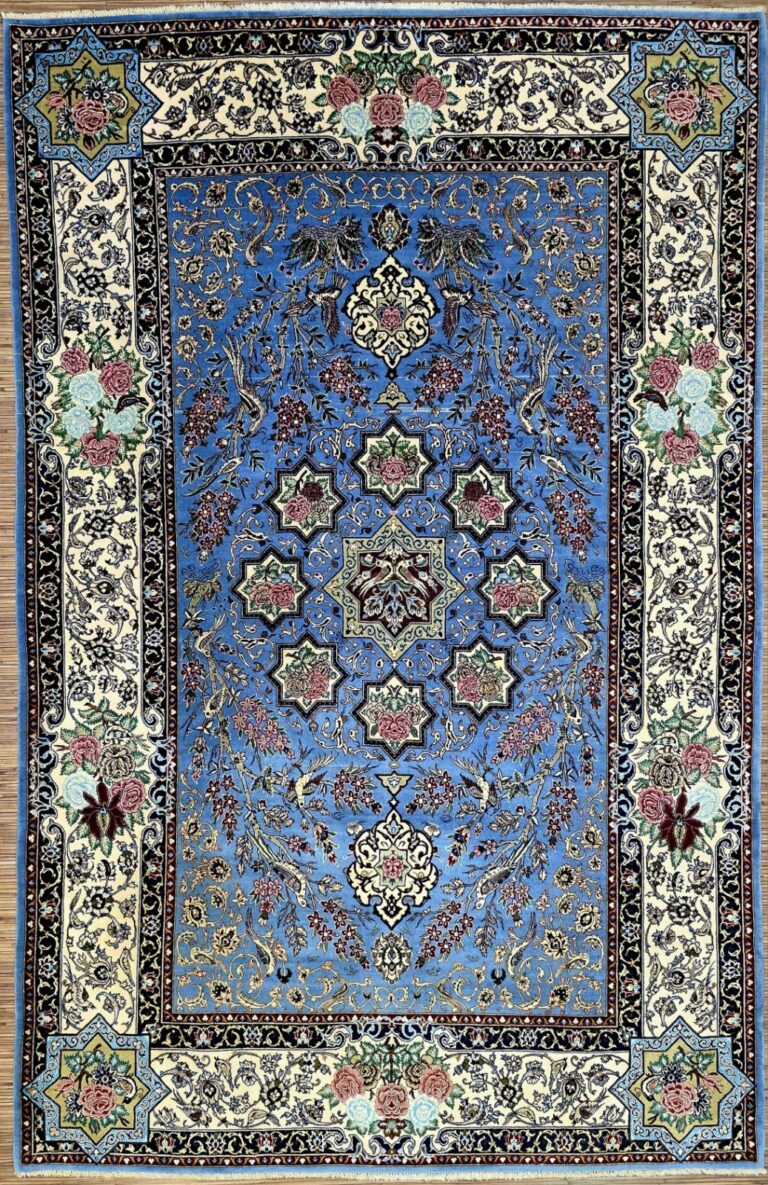
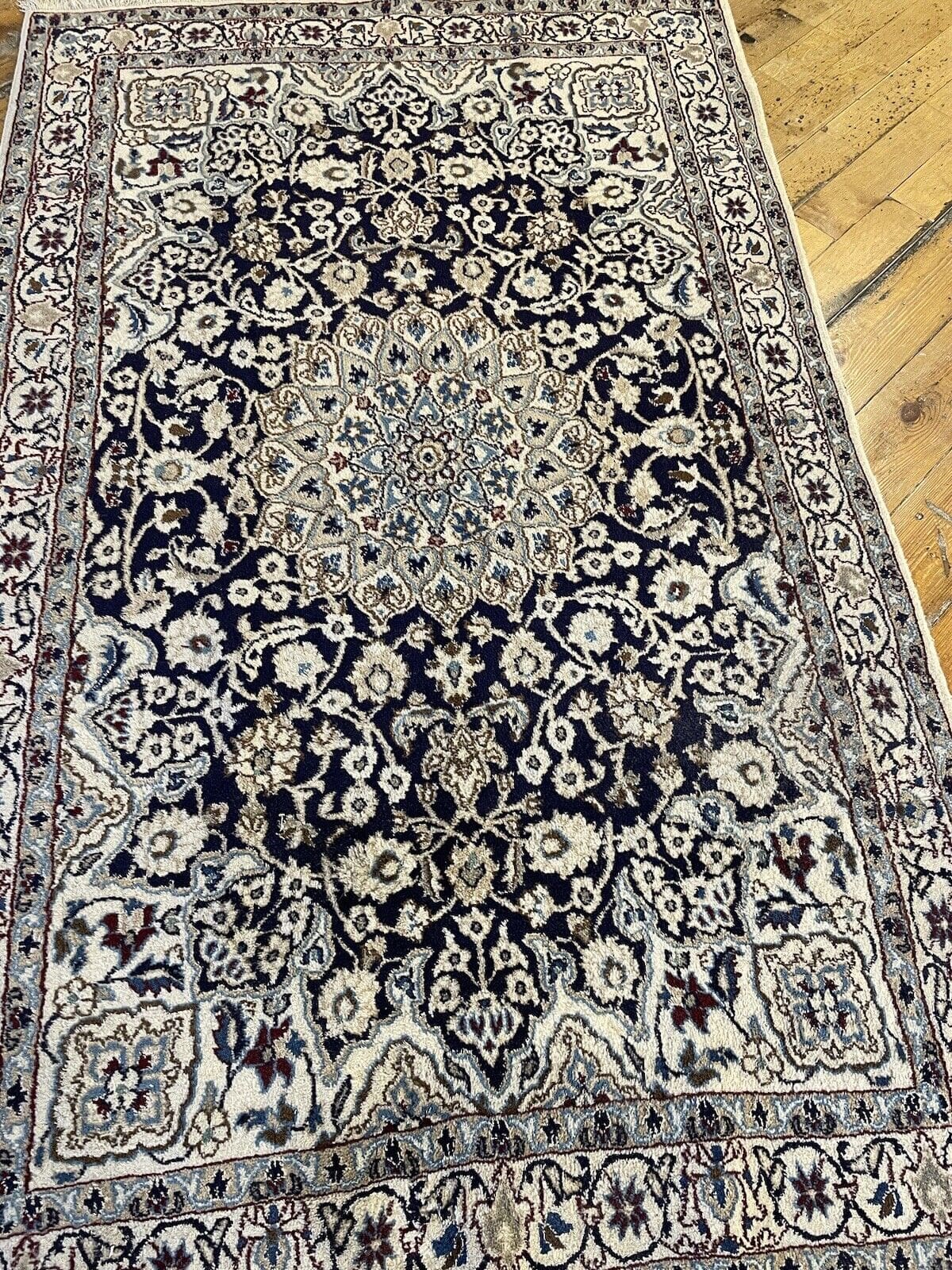
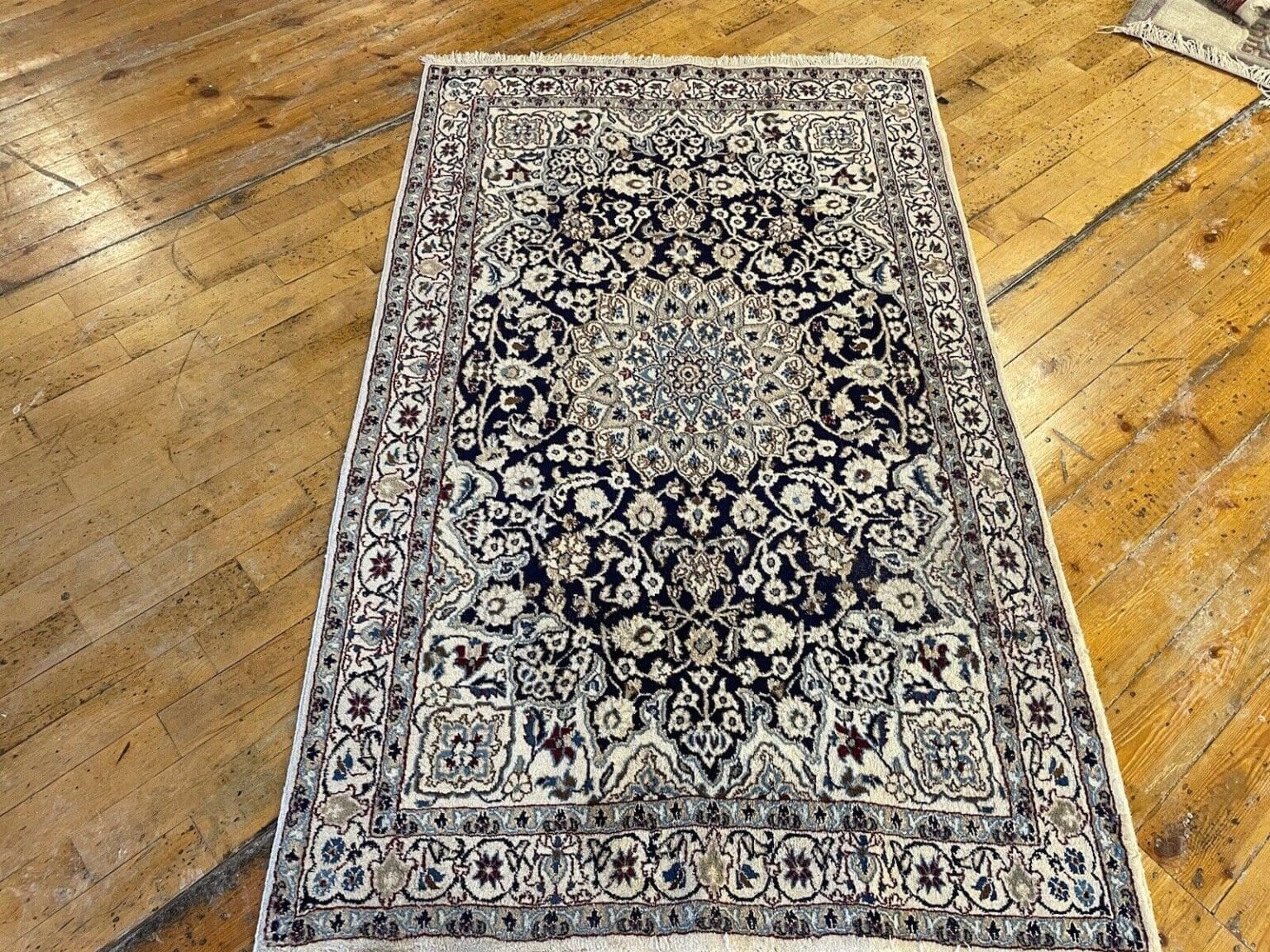
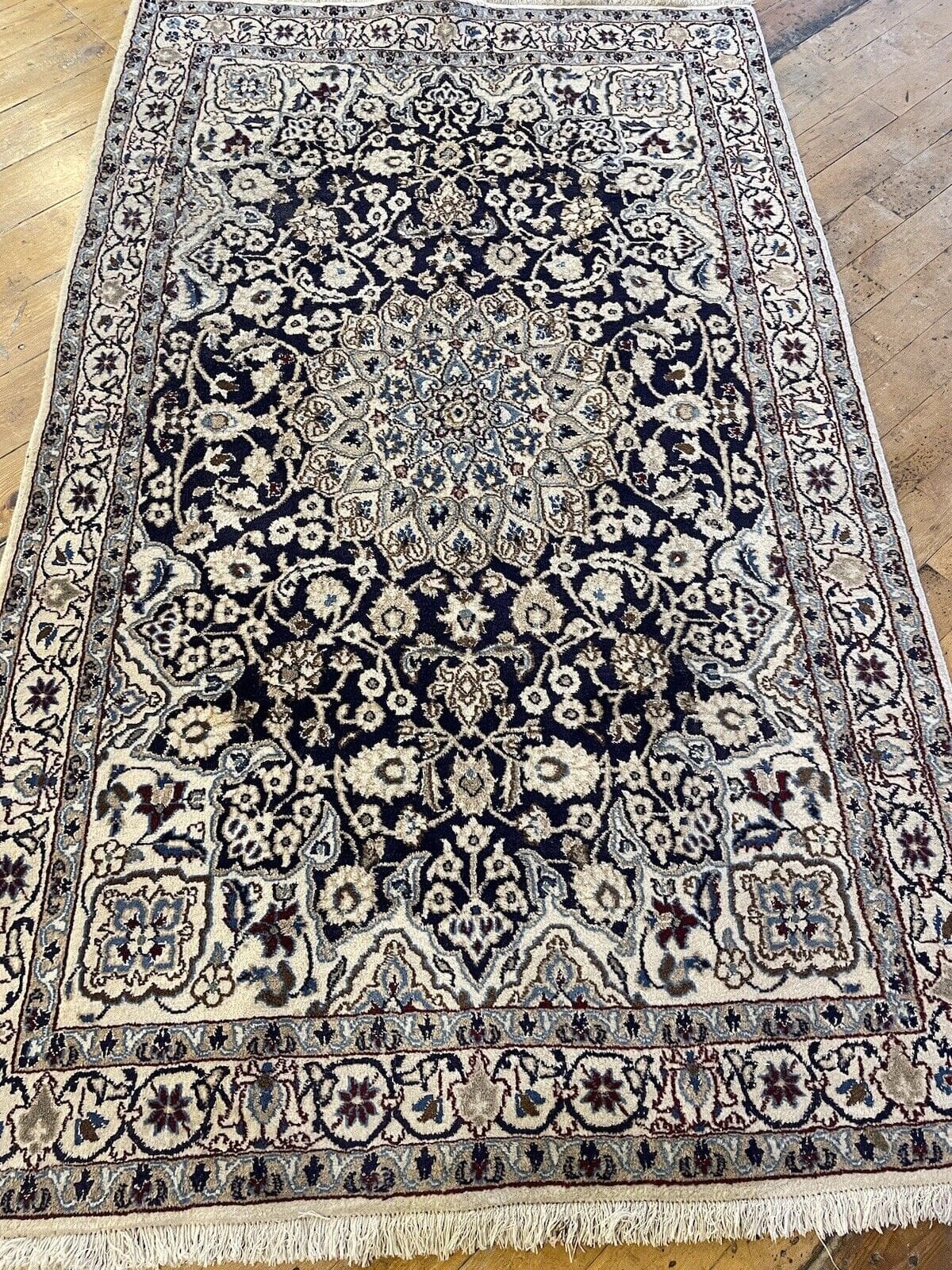
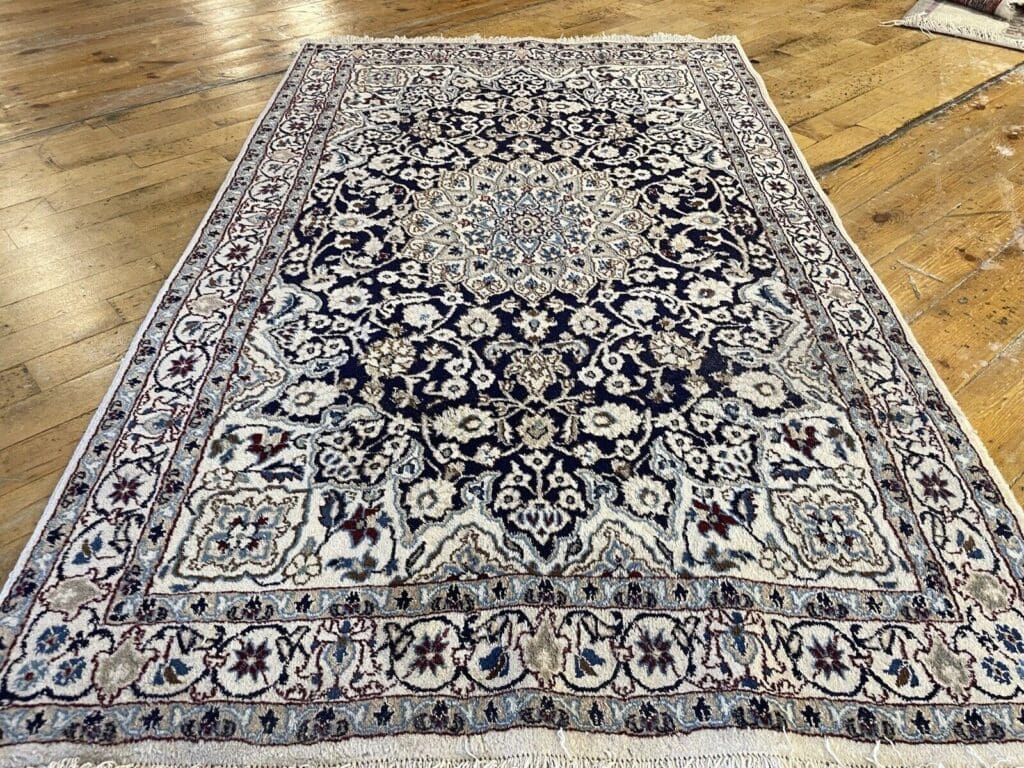
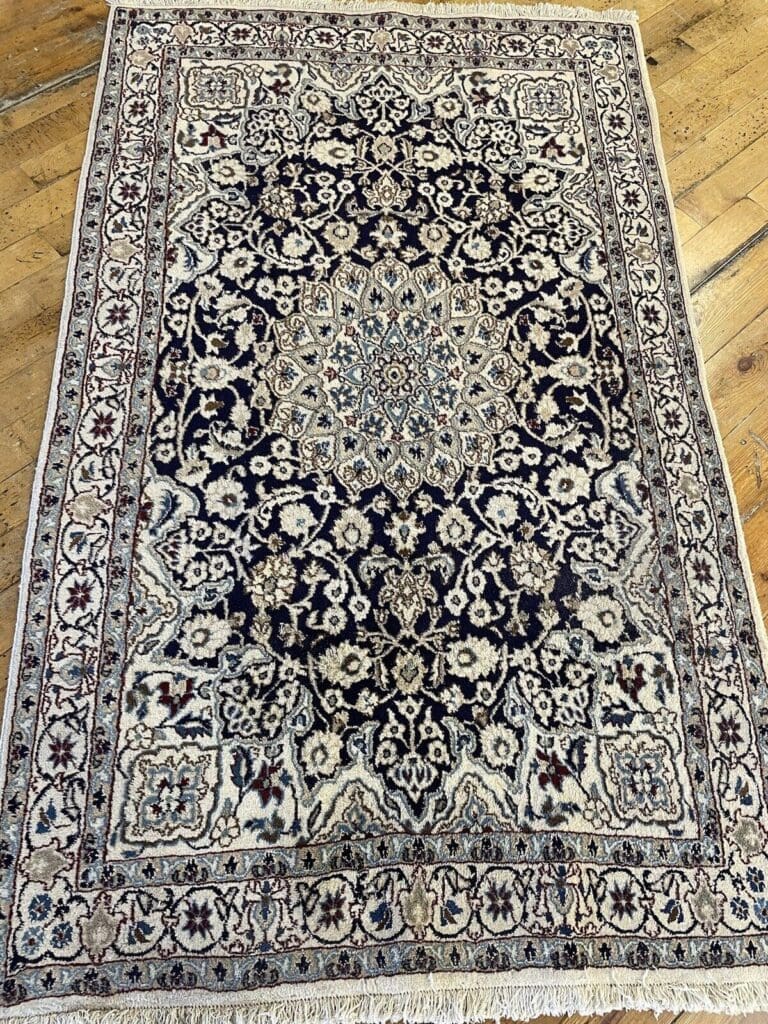
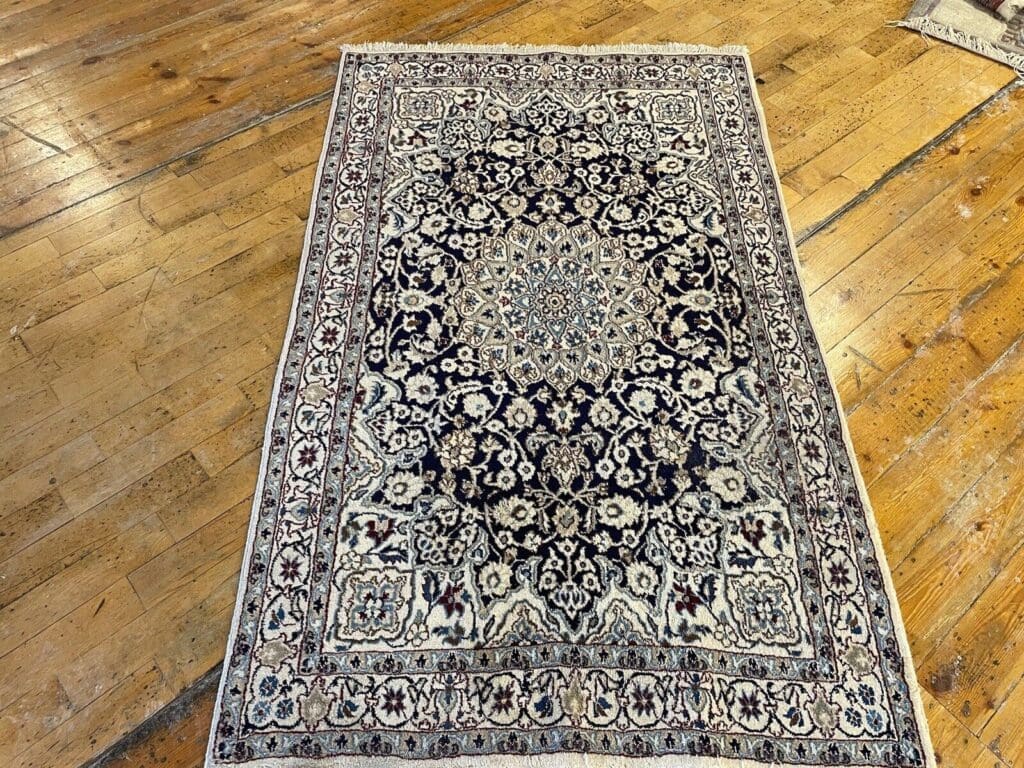
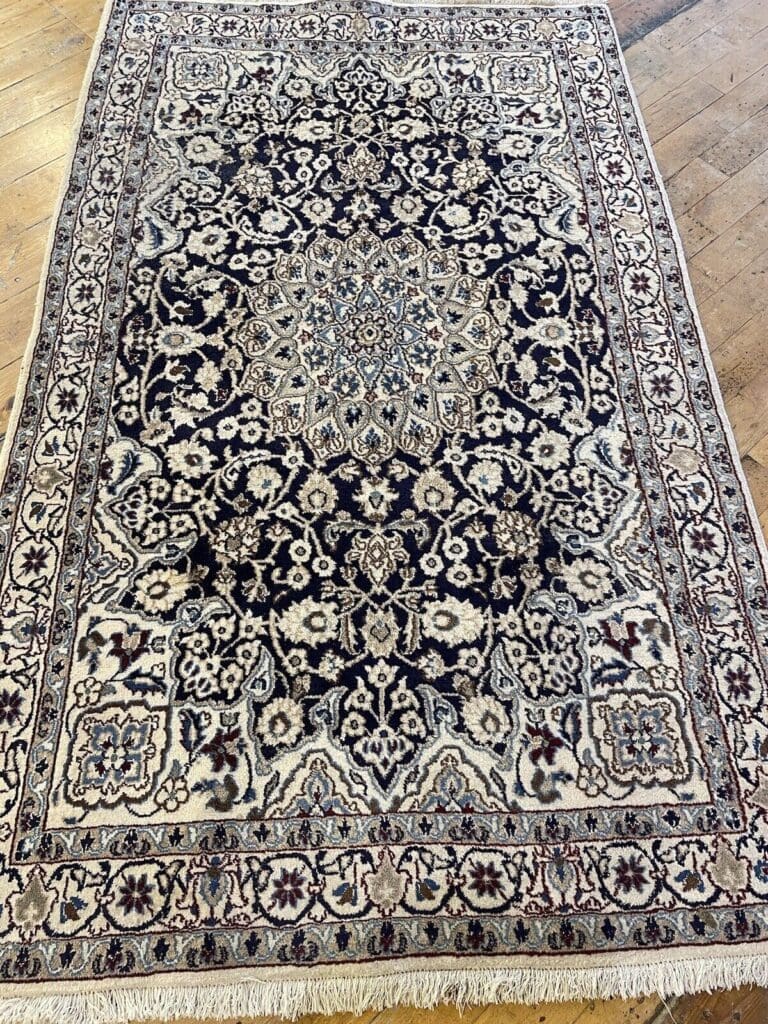
Hand-knotted Nain Persian rug | Knot density: exceptionally high | Material: pile wool with silk, warp cotton | Size: 200×120 cm | Pattern: floral design with medallion, beige border | Condition: new without label
This Nain Persian rug is hand-knotted, with a pile made from wool with silk. Cotton is used for the warp. The combination of wool and silk is part of the traditional material language of Nain rugs: wool provides a substantial and durable pile, while silk contributes a finer surface and a restrained sheen. The cotton warp forms the textile foundation into which the knots are worked. The material description therefore distinguishes clearly between the visible pile and the supporting warp.
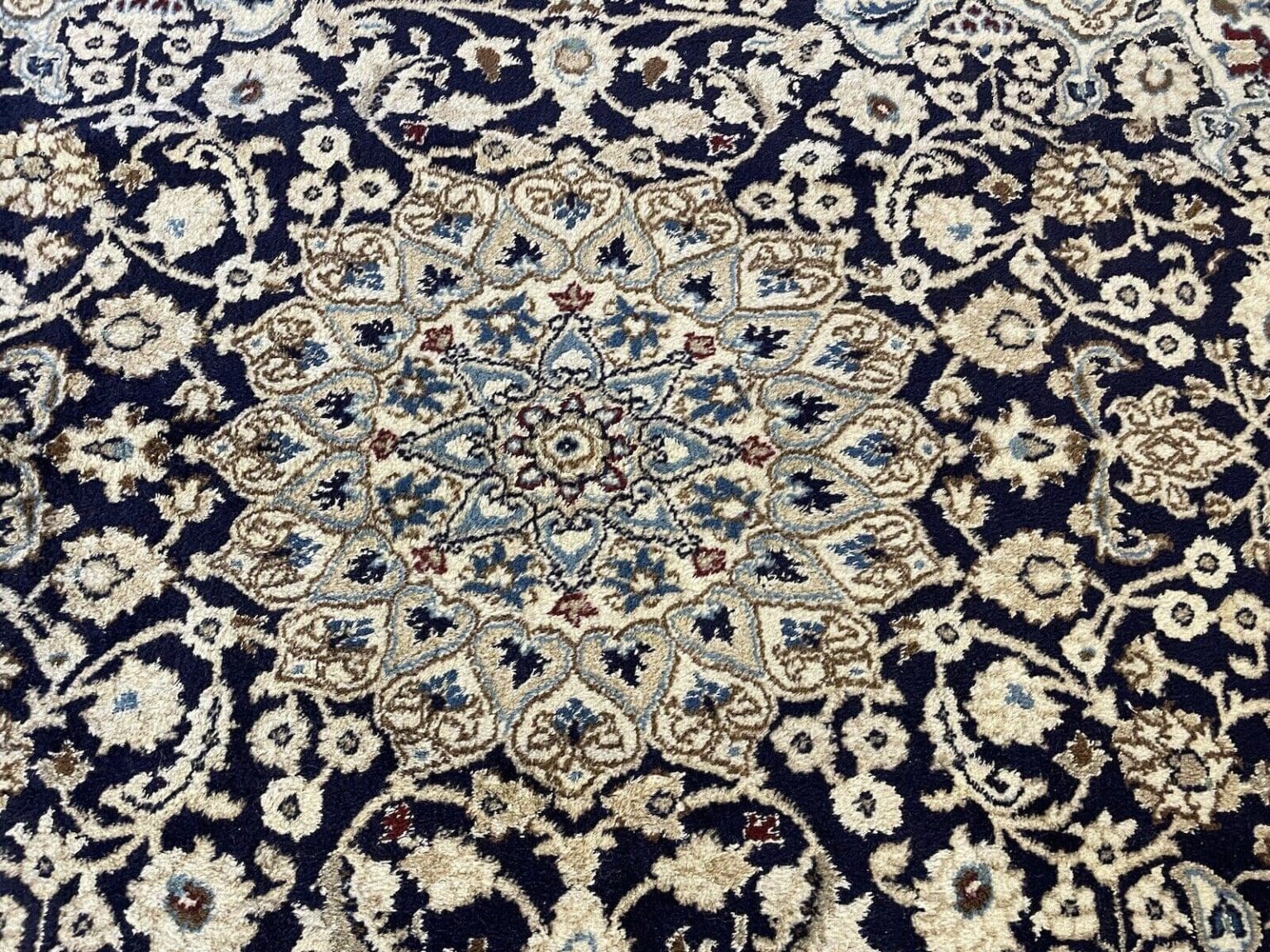
The rug has an exceptionally high knot density. Closely placed knots allow floral outlines, leaves and other small details to be rendered with precision. In a hand-knotted rug, each knot is placed individually. This process requires time, practice and consistent control. The handwork is therefore directly connected to the appearance of the design: a dense knot structure makes it possible to reproduce fine contours and carefully articulated ornamental forms.
Wool and silk contribute different qualities to the pile. Wool gives the surface body and resilience, while silk adds a smoother, more light-catching element. Together they create the material character associated with many Nain rugs. The addition of a cotton warp does not replace the pile materials; it provides the foundation on which the hand-knotting is built. The result is a textile made through individual manual work rather than industrial production.
The condition is recorded as new without a label. This identifies the rug as a new piece for which no label is present. Its construction is defined by hand-knotting, an exceptionally high knot density and the stated combination of wool with silk in the pile and cotton in the warp. The source also describes the rug as suitable for living rooms, offices and entrance areas. It is suitable for use in rooms with underfloor heating.
Origin and Tradition
Nain is a city in Iran near Isfahan and is known for a well-established rug-making tradition. This Nain Persian rug therefore belongs to a clearly identified Iranian tradition of carpet production. The city has a long history of weaving that reaches back to the sixteenth century. Over time, this tradition developed a particular focus on finely articulated designs, carefully selected materials and controlled hand craftsmanship.
Nain rugs are especially associated with fine knotting. The exceptionally high knot density of this rug relates to that regional tradition of building delicate floral forms through a close and precise structure. Individual knots create both the surface and the drawing of the rug. They allow lines, leaves and blossoms to be divided into fine passages and arranged as part of a coherent composition rather than as isolated marks.
The making of a Nain rug depends on knowledge passed from one generation of craftspeople to the next. That knowledge includes the selection and combination of materials, the ordering of the pattern and the maintenance of an even knotting rhythm. Wool and silk are traditionally used in Nain rugs. Natural pigments also belong to the established craft tradition. They support the soft, organic color character associated with these rugs and form part of the broader history of regional Persian weaving.
The material tradition of the area also includes wool from sheep raised in the surrounding region and high-quality silk. For this rug, wool with silk is specified for the pile and cotton for the warp. These details place the rug within a practice in which pile and foundation have distinct functions. The central feature remains the manual process: a Nain rug is built knot by knot and acquires an individual structure through that work.
Nain’s proximity to Isfahan places it within a part of Iran where Persian art and textile design have long been closely connected. Within this setting, Nain developed its own identifiable weaving tradition. Fine knotting, floral compositions and the use of wool and silk are central points of that tradition. In this rug, Nain is therefore not merely a decorative reference. It identifies a city of Iranian carpet production with its own history and established methods.
Design and Pattern
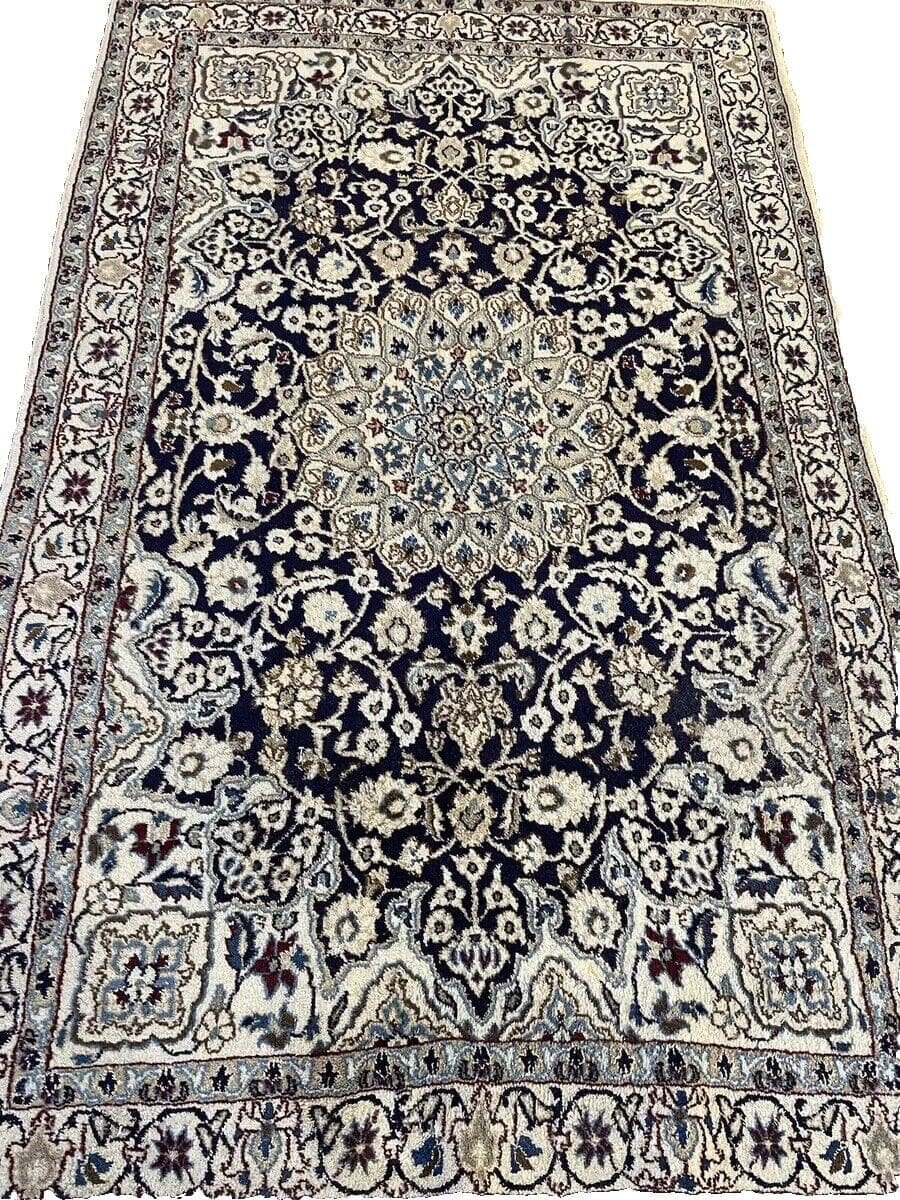
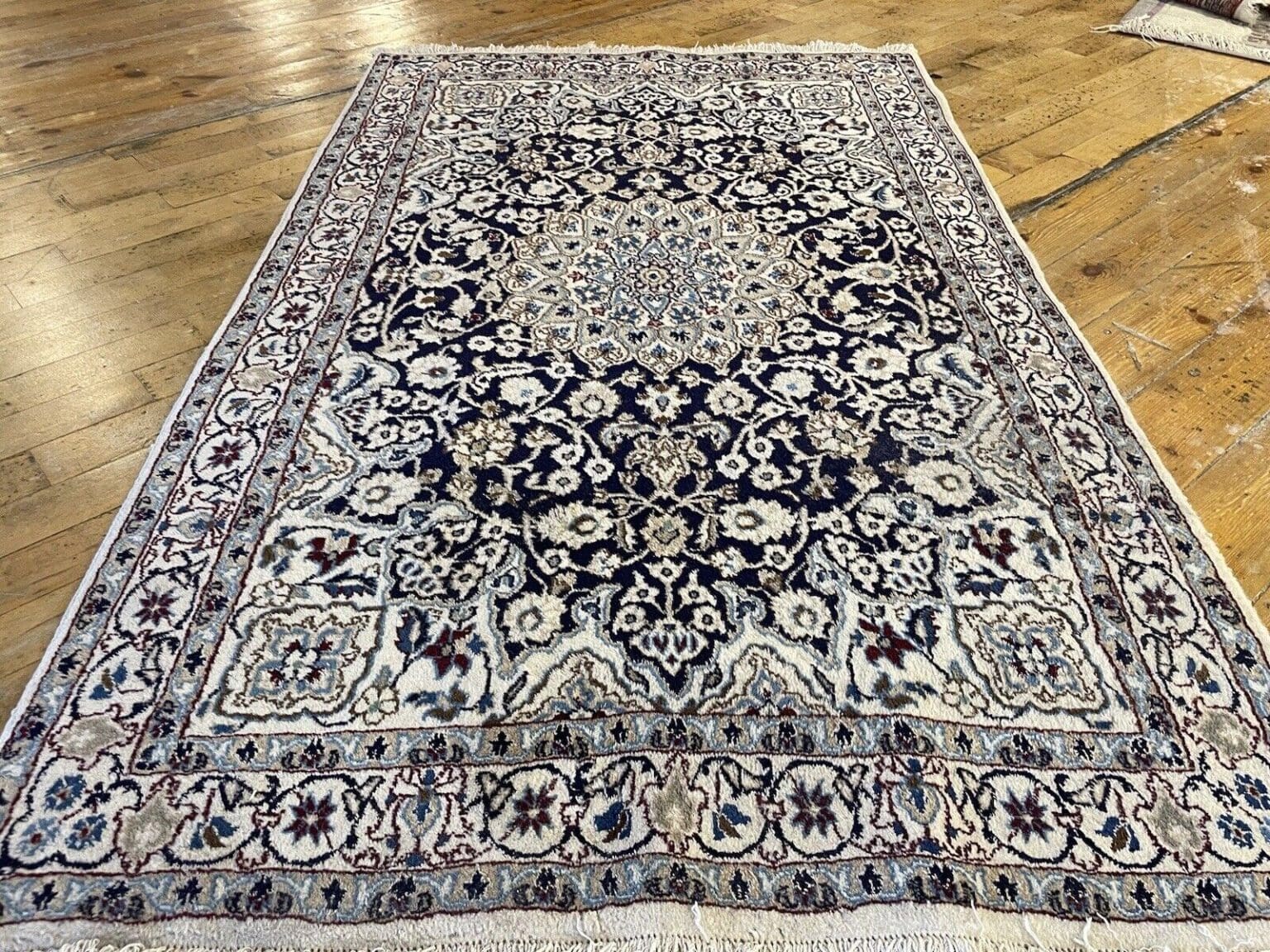
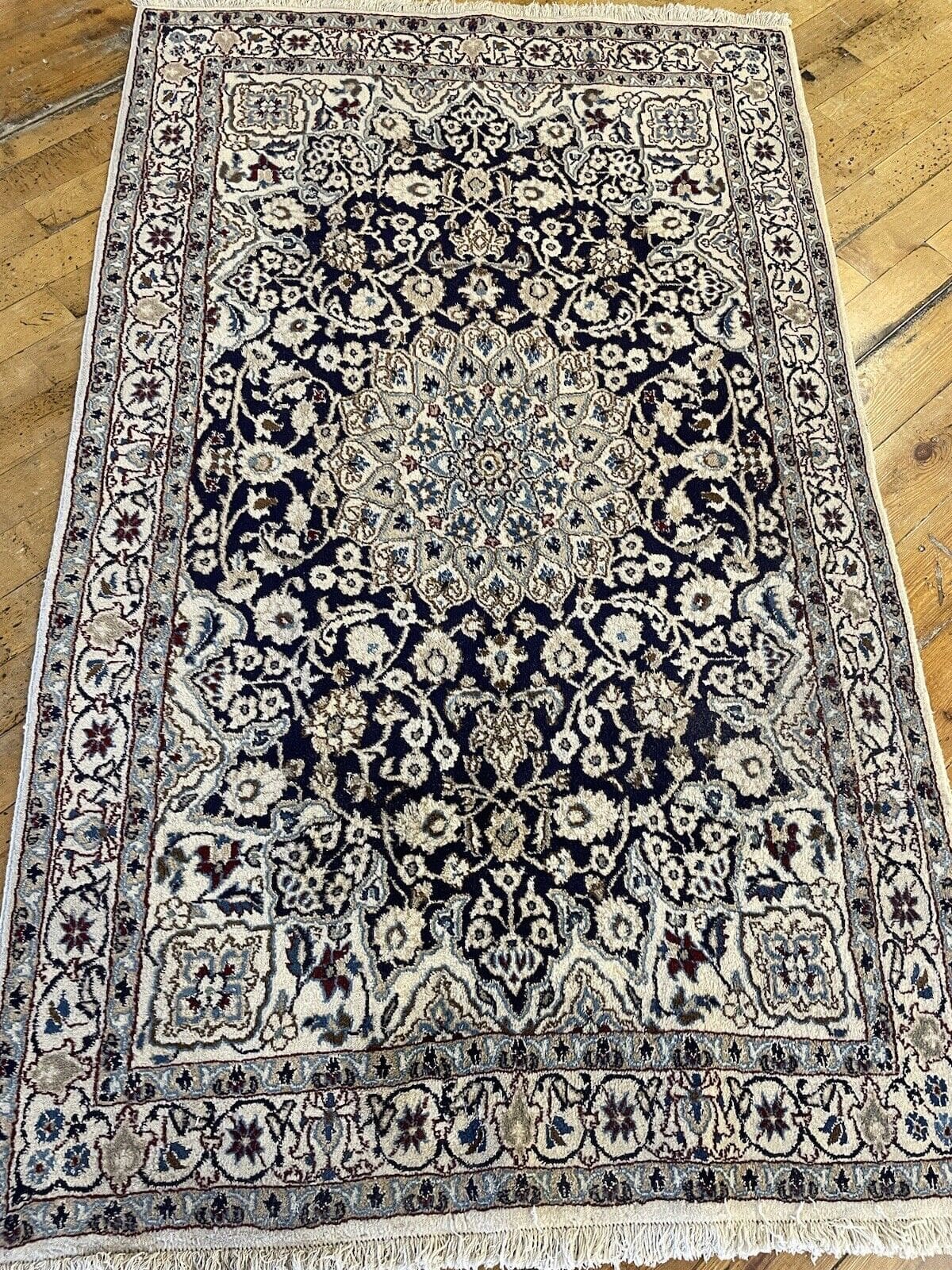
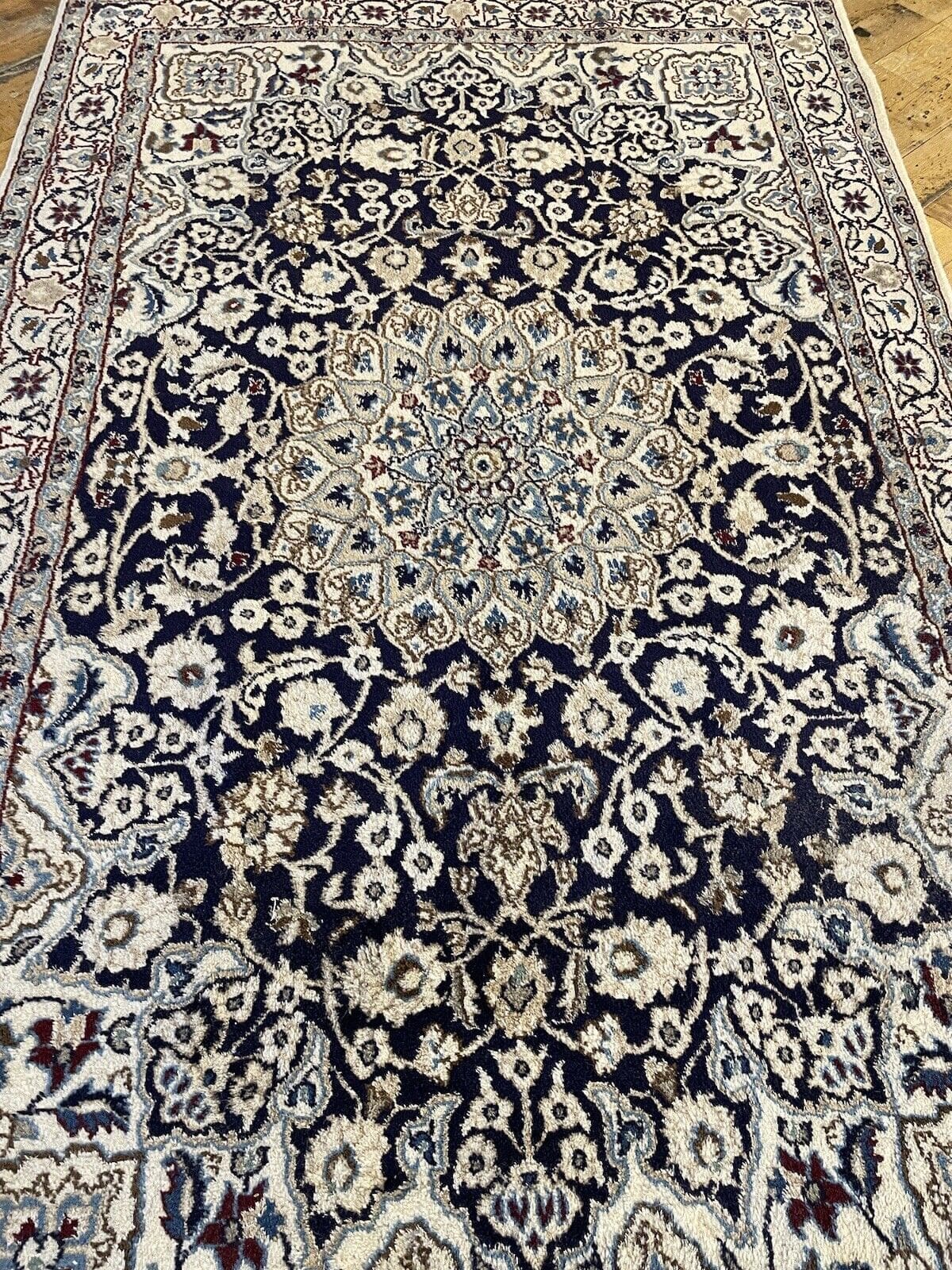
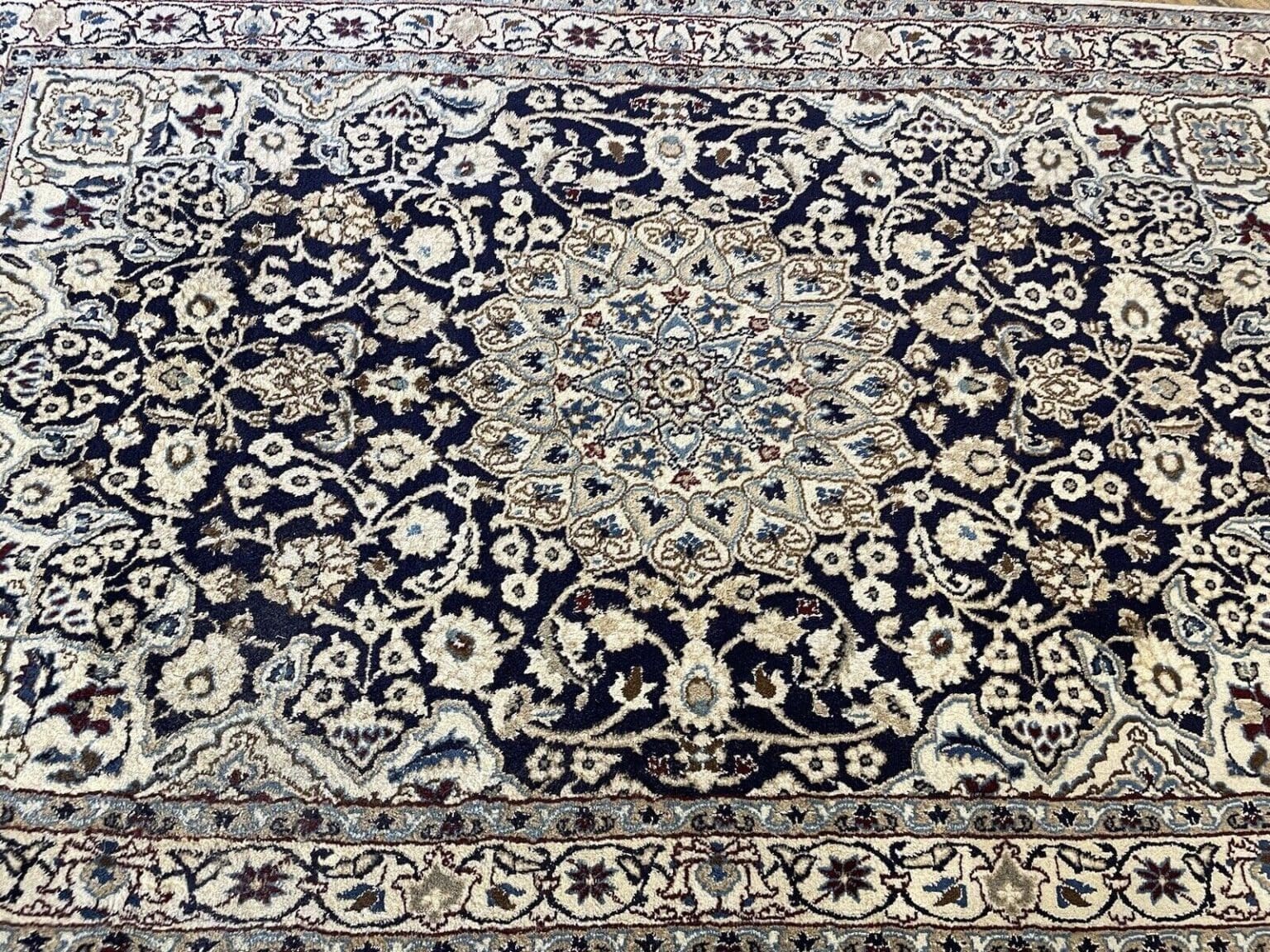
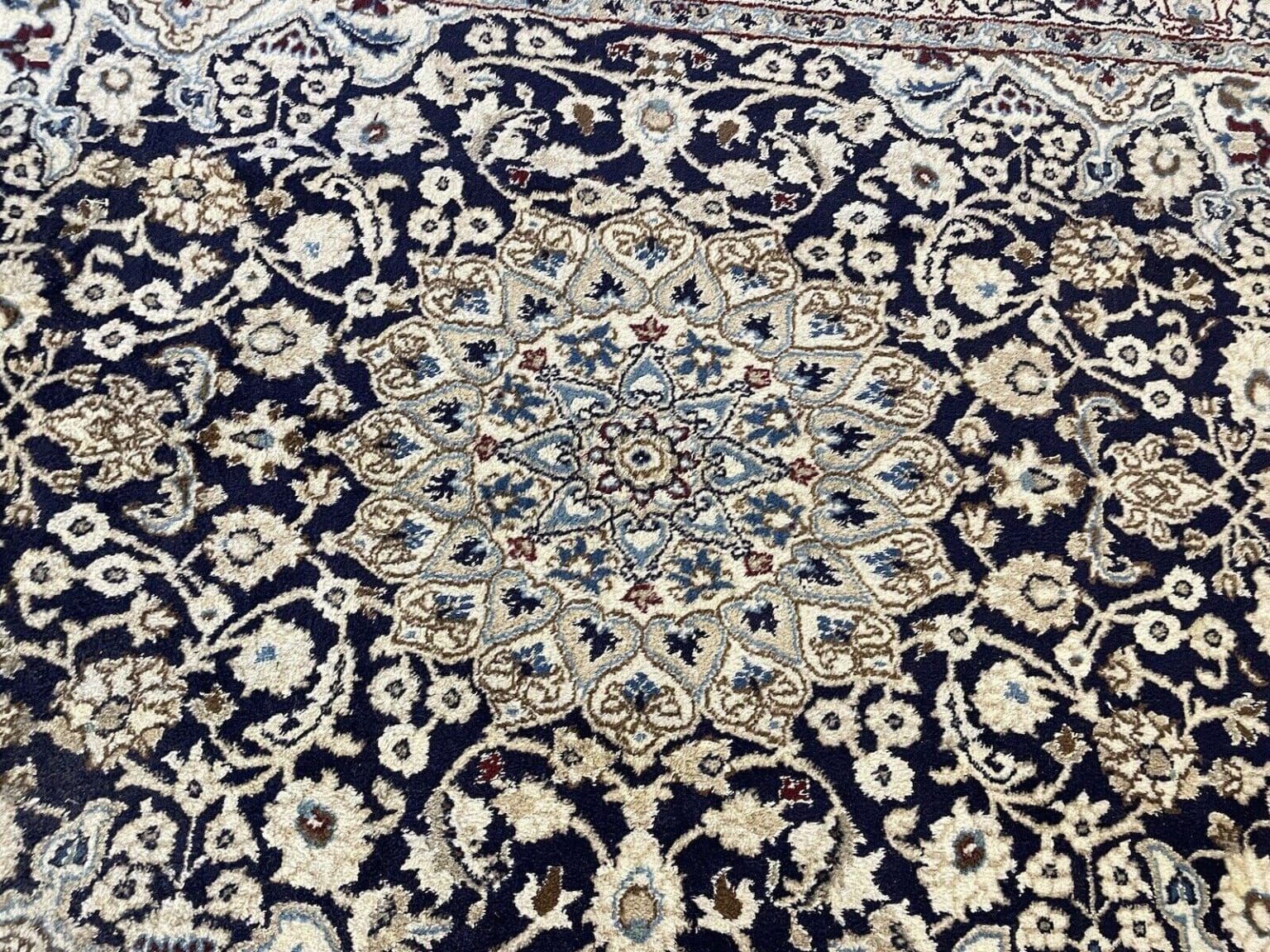
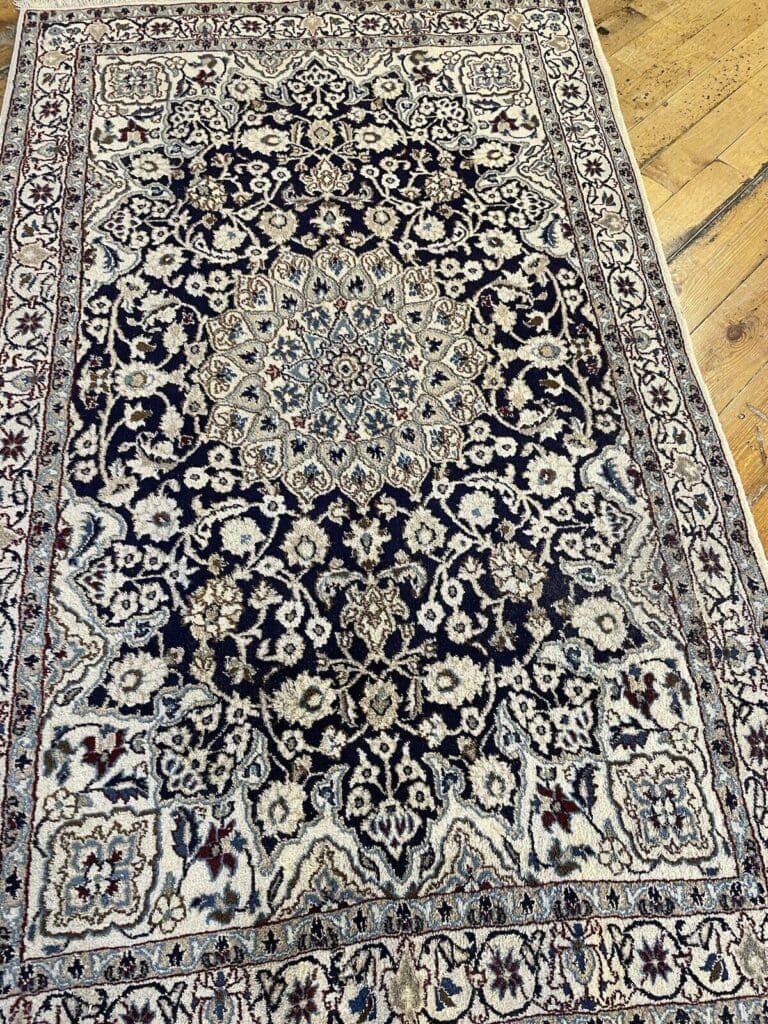
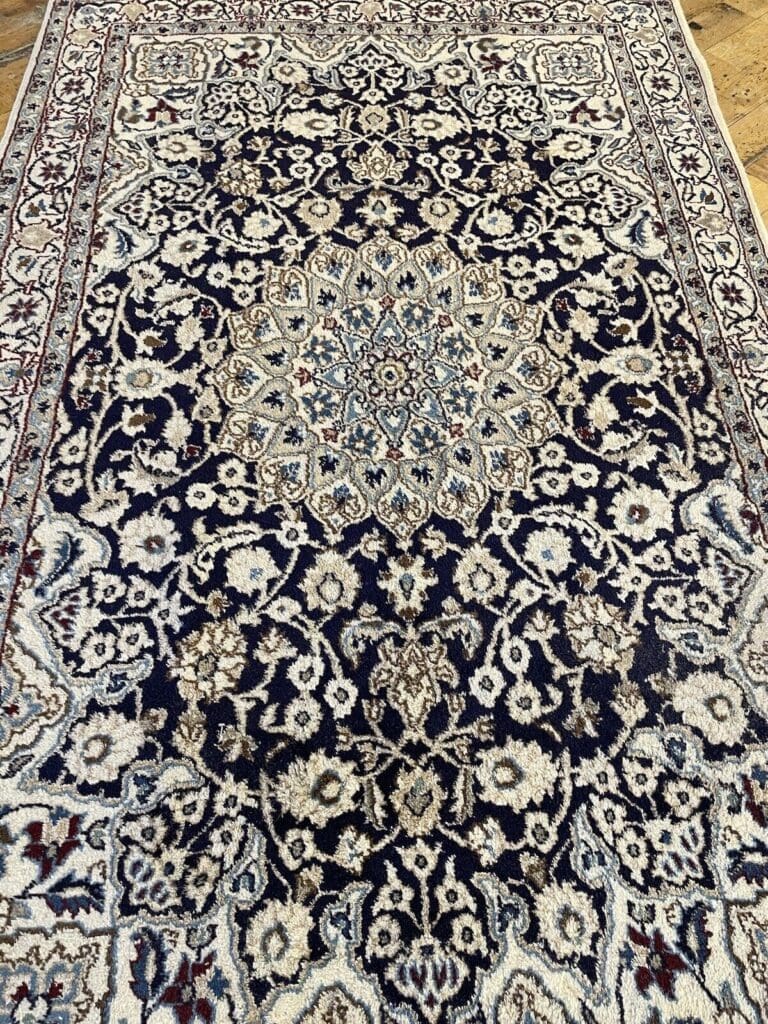
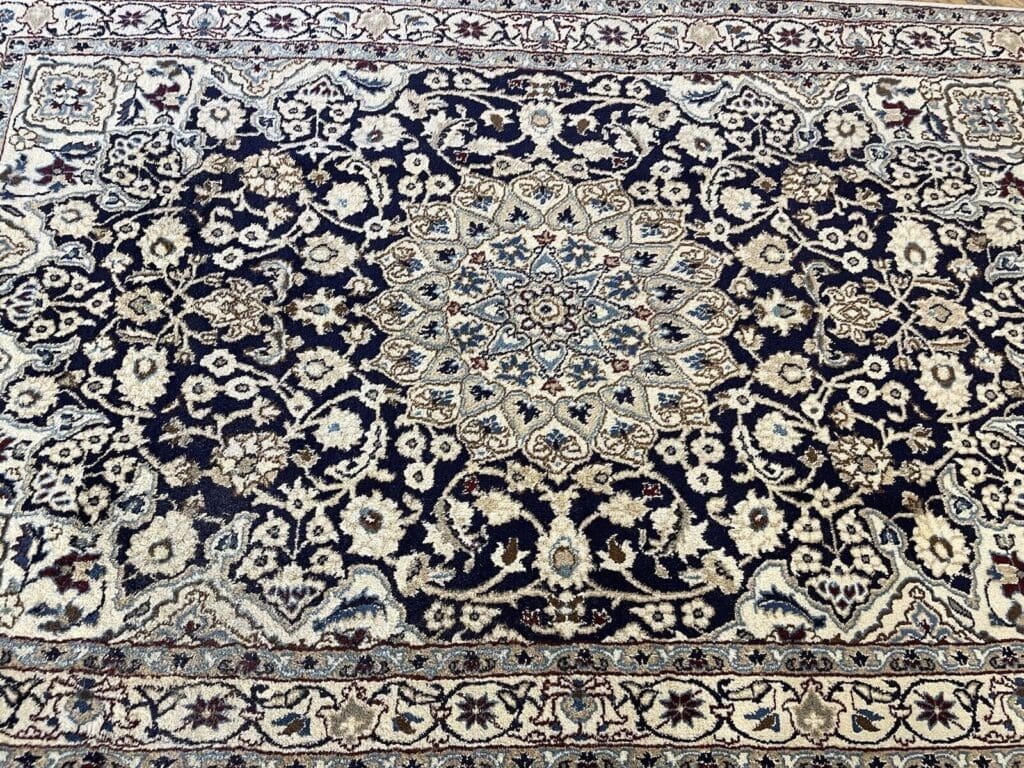
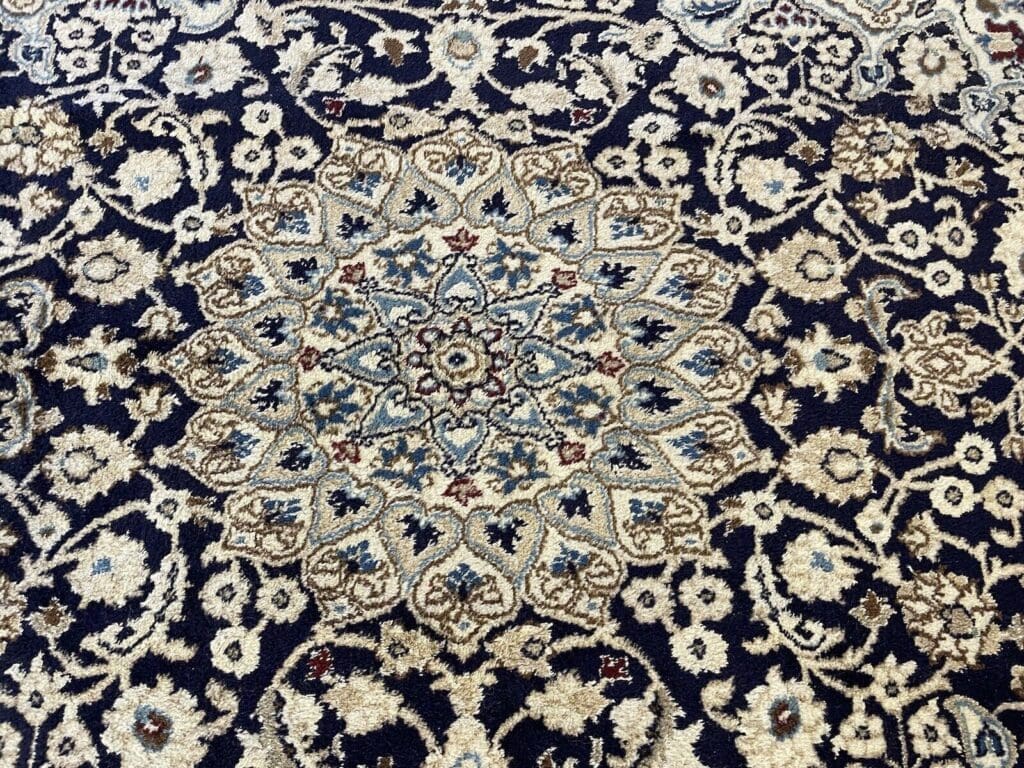
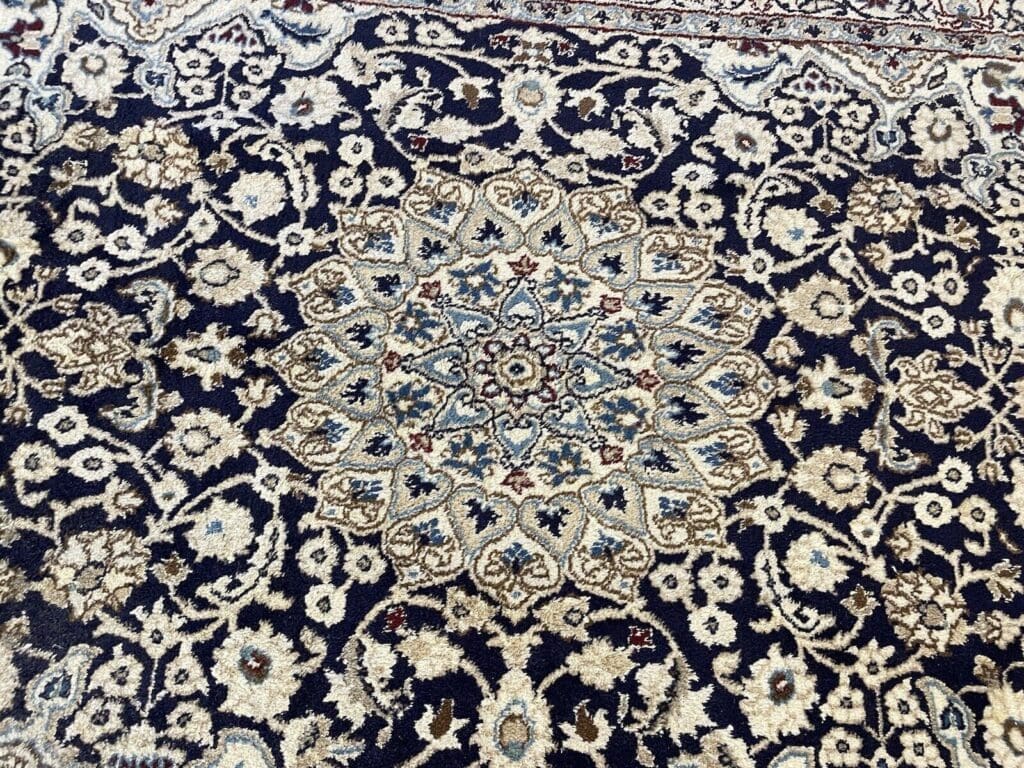
The pattern is described as a floral design with a medallion. The medallion occupies the center and gathers the viewer’s attention as the principal visual focus. Floral forms are arranged around it, while the beige border frames the composition at the outer edge. The border creates a defined transition between the central field and the rug’s surrounding finish.
Floral motifs are familiar elements in Persian carpet design. Blossoms, leaves and curving stems may be linked in repeating rhythms and balanced arrangements. In Nain rugs, such forms are often drawn with fine precision. The high knot density supports this detailed treatment, allowing small contours and subtle changes in direction to be represented within the hand-knotted surface.
The medallion gives the pattern a central point of orientation. It establishes a visual middle and helps organize the floral elements around that focus. In Persian carpet design, a central medallion is often associated with ideas of harmony and an ordered world. Floral motifs are likewise more than simple decoration in many traditional interpretations; they can refer symbolically to paradise and to harmony in nature.
The stated color scheme combines blue with a beige border. Blue shapes the principal color impression, while beige defines the outer framing area. Light and gentle colors are frequently used in the Nain tradition to keep floral details legible and to create a balanced overall composition. Here, the beige border has both a chromatic and an organizational role: it separates the pattern from the edge and gives the design a clear conclusion.
The floral details can be understood as cultural signs within Iranian carpet art. Leaves and blossoms bring nature into the design, while the medallion holds the composition together. The resulting arrangement has both a central focus and a surrounding ornamental order. Its appearance depends on the interaction of color, border, floral drawing and the precision of the hand-knotted construction.
The traditional Persian and Oriental style is expressed through the combination of a medallion, floral motifs and a defined border. The pattern is not simply an unrelated collection of ornaments. It follows a composition with a center, an outer frame and recurring natural forms. This structure makes the design readable in different interior settings while retaining the visual language of Persian carpet tradition.
Special Features
A defining feature is the hand-knotting technique. Each knot is placed by hand, creating an individual one-off piece. This distinguishes the rug from an industrially made carpet and explains why its production requires both time and precision. The exceptionally high knot density supports the fine rendering of the floral design and is an important part of the rug’s stated character.
The listed material combination is another specific feature: wool with silk in the pile and cotton in the warp. The rug is described as blue with a beige border, with a central medallion and a floral design. Its condition is new without a label. It is also suitable for underfloor heating. The source describes it as easy to care for and robust, and names living rooms, offices and entrance areas as suitable settings.
FAQ
How should I care for my Nain Persian rug?
For regular care, vacuum the rug without using a brush attachment. Any spills or marks should be dabbed promptly with a damp cloth rather than rubbed. Avoiding friction helps protect the pile and the fine floral details. For a thorough cleaning, a professional service experienced in Persian rugs is recommended. Specialist cleaning can take the hand-knotted construction and the combination of wool with silk in the pile into account.
Can I use the rug over underfloor heating?
Yes. This rug is suitable for rooms with underfloor heating. Nain rugs are described as having good heat conductivity, which supports their use in such rooms. The temperature should not be set too high, however, so that the integrity of the materials is maintained. Moderate, even warmth helps prevent unnecessary strain on the wool-and-silk pile and the cotton warp.
What do the patterns on the rug mean?
The floral motifs and the centrally placed medallion are often associated with paradise and harmony in nature. Blossoms and leaves bring nature into the composition as both a decorative and cultural theme. The medallion serves as the visual center and organizes the surrounding design. Together, these elements reflect the craft tradition of Iranian carpet weaving and the symbolic visual language found in Persian rugs.
To provide the best experiences, we use technologies like cookies to store and/or access device information. Consenting to these technologies will allow us to process data such as browsing behavior or unique IDs on this site. Not consenting or withdrawing consent, may adversely affect certain features and functions.
Functional Always active
The technical storage or access is strictly necessary for the legitimate purpose of enabling the use of a specific service explicitly requested by the subscriber or user, or for the sole purpose of carrying out the transmission of a communication over an electronic communications network.
Preferences
The technical storage or access is necessary for the legitimate purpose of storing preferences that are not requested by the subscriber or user.
Statistics
The technical storage or access that is used exclusively for statistical purposes.The technical storage or access that is used exclusively for anonymous statistical purposes. Without a subpoena, voluntary compliance on the part of your Internet Service Provider, or additional records from a third party, information stored or retrieved for this purpose alone cannot usually be used to identify you.
Marketing
The technical storage or access is required to create user profiles to send advertising, or to track the user on a website or across several websites for similar marketing purposes.
 SECURE PAYMENT
 SHIPPING PARTNERS