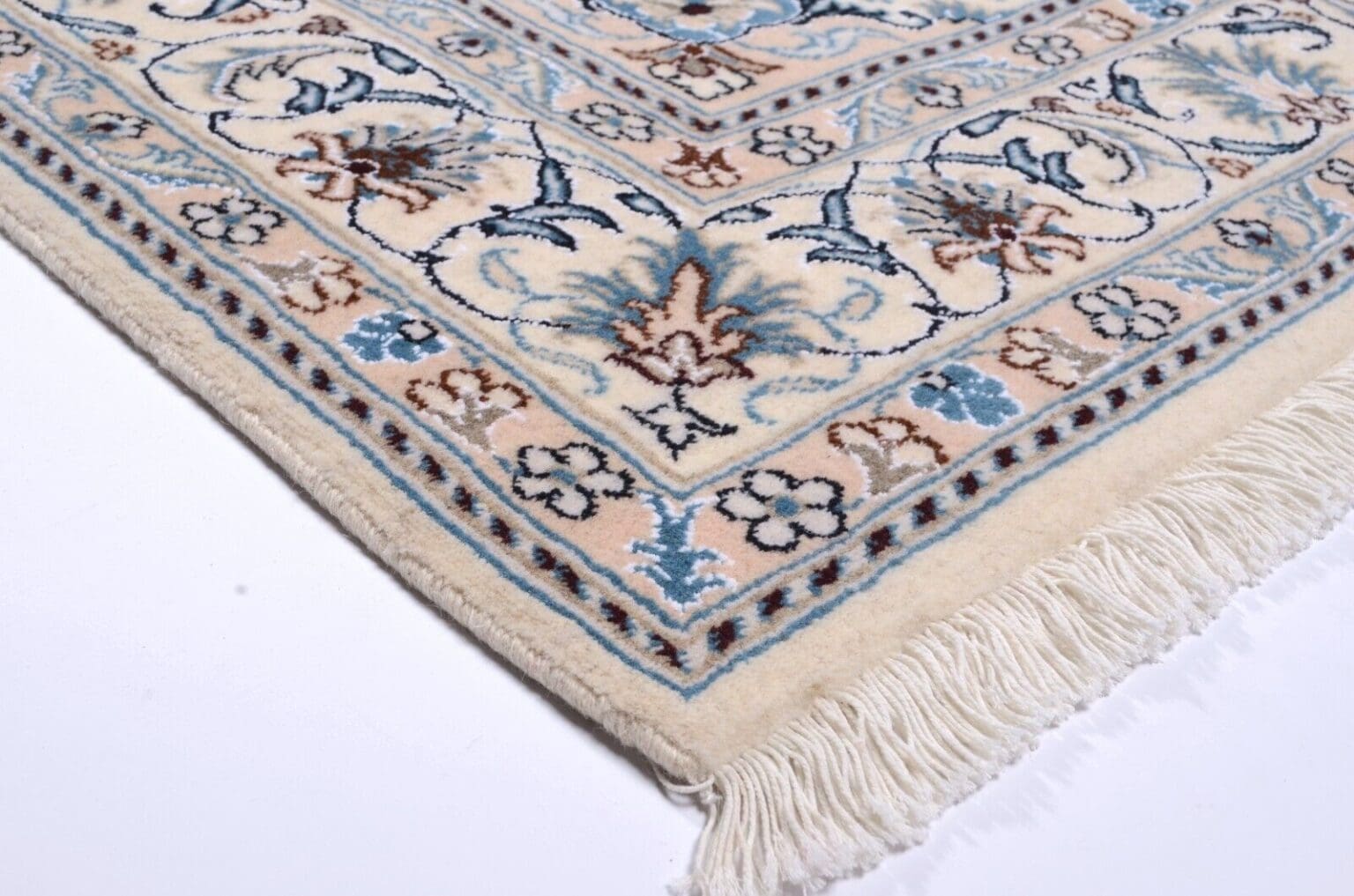
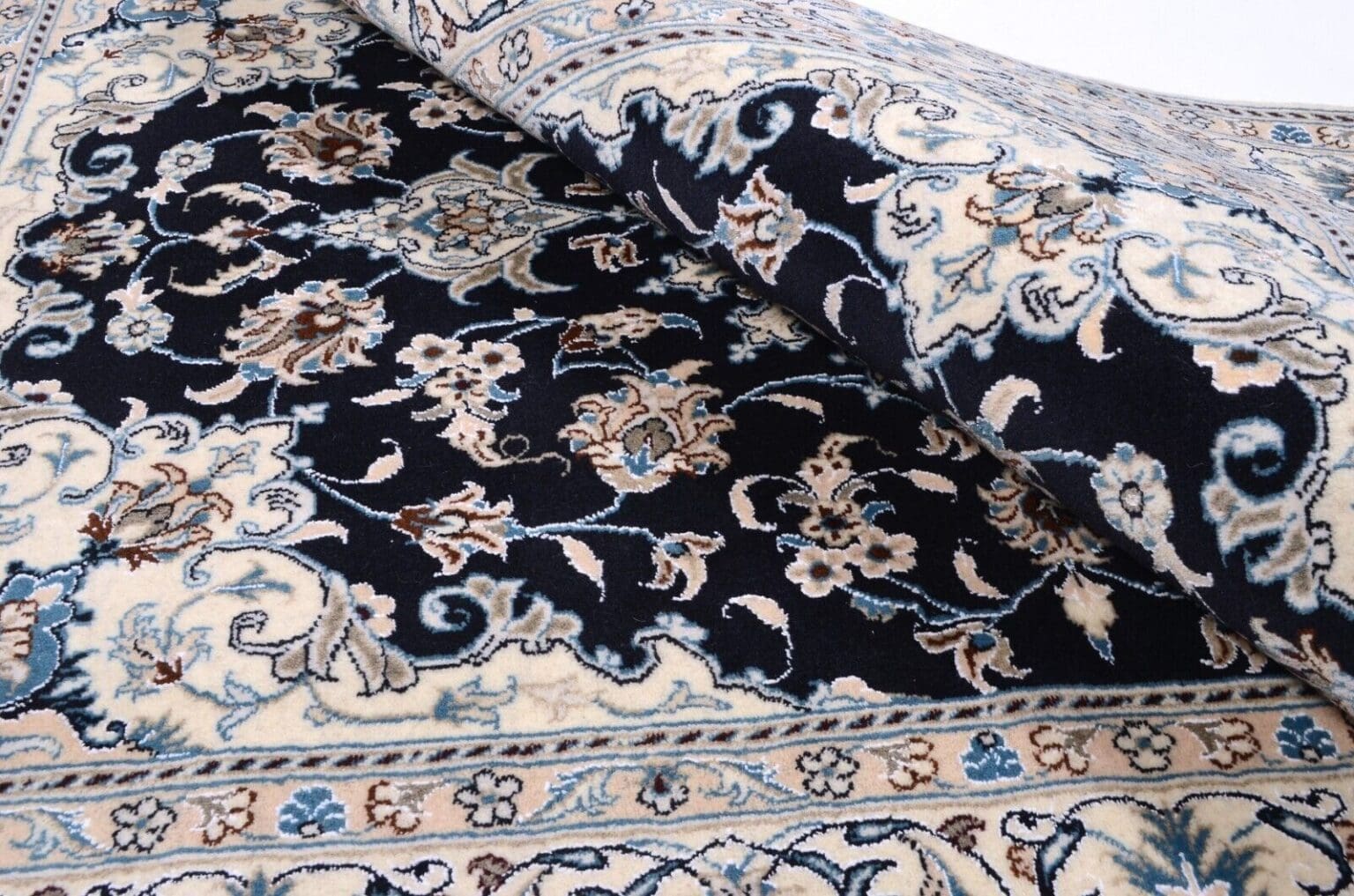
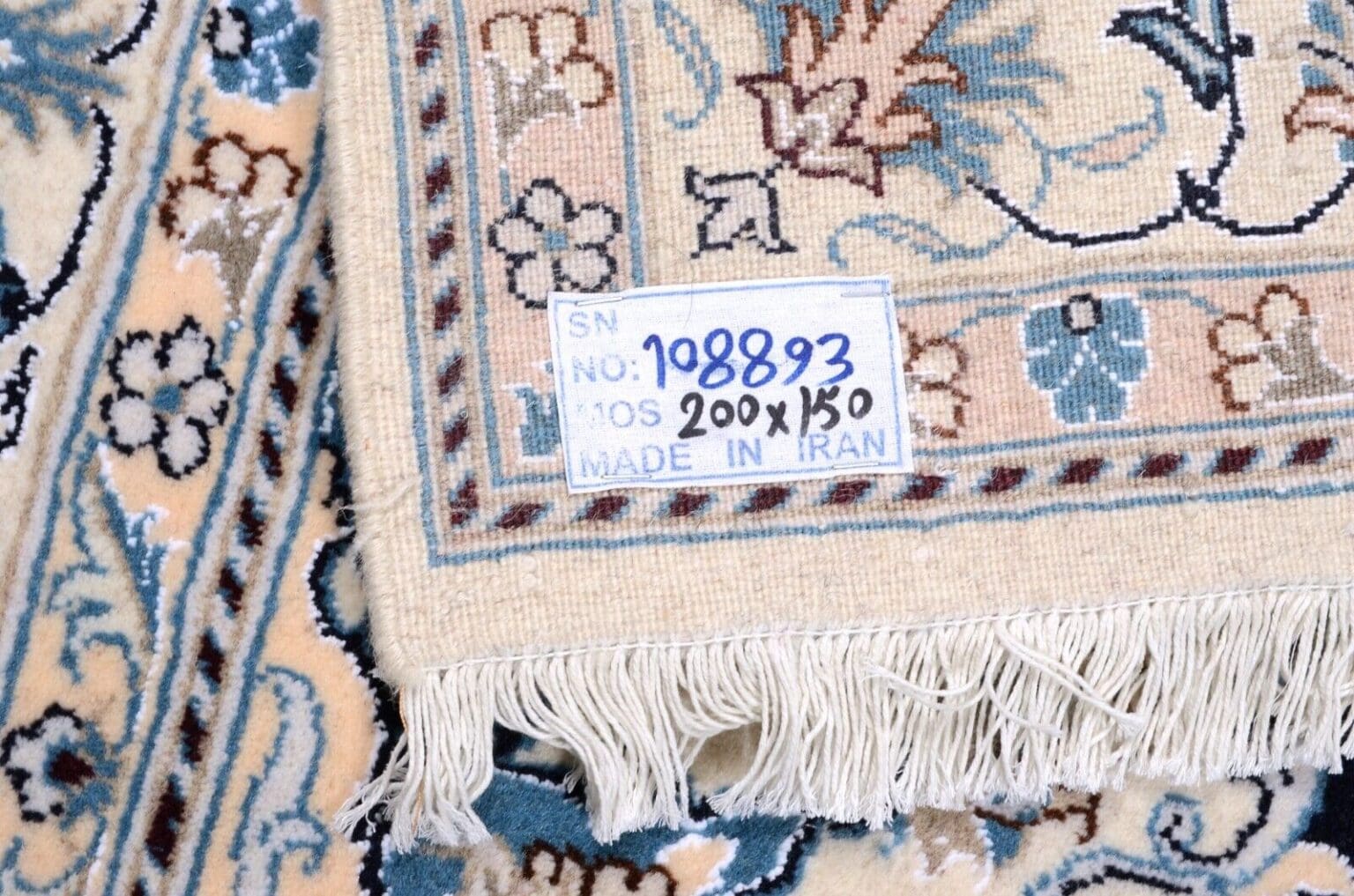
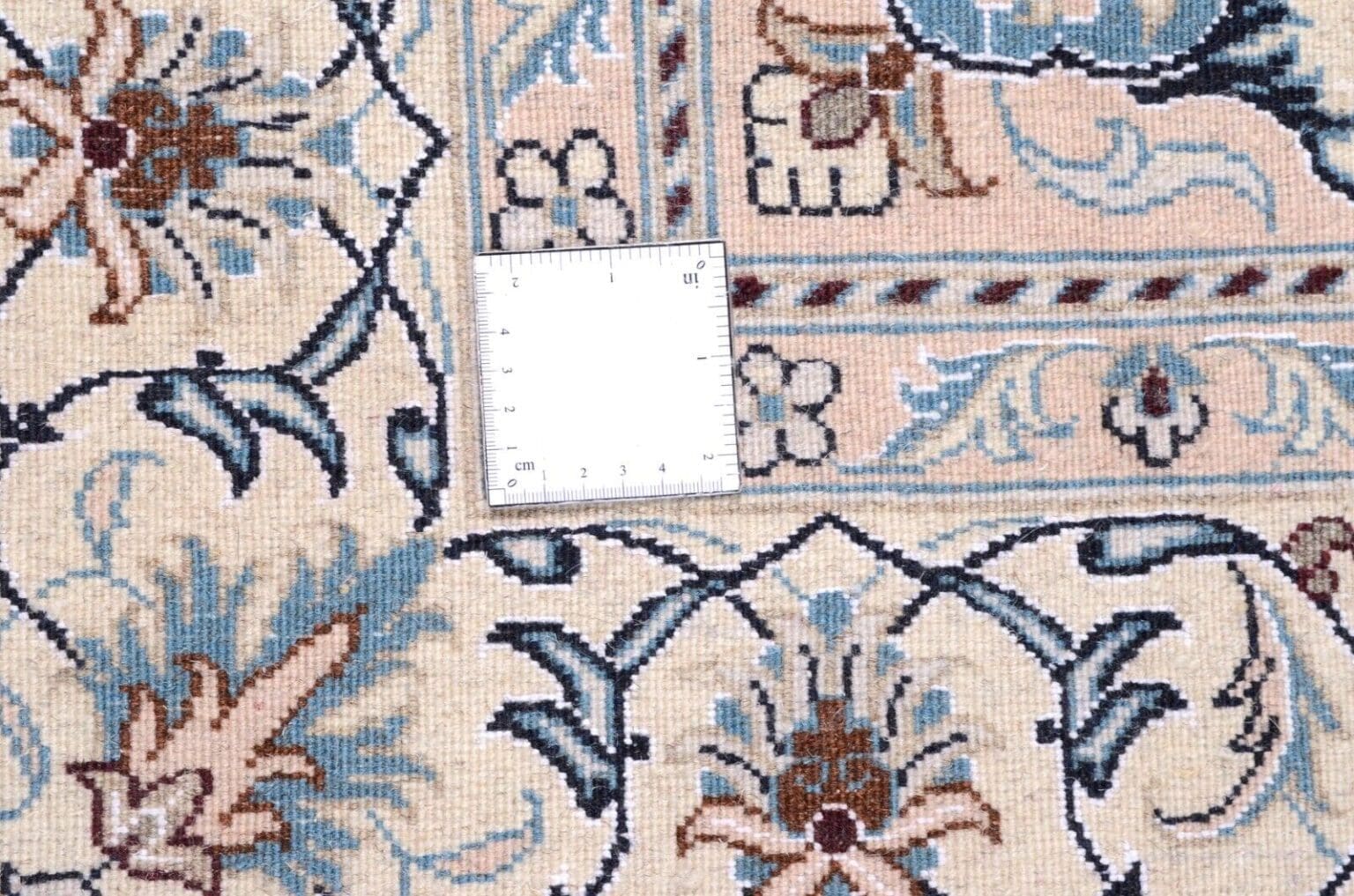
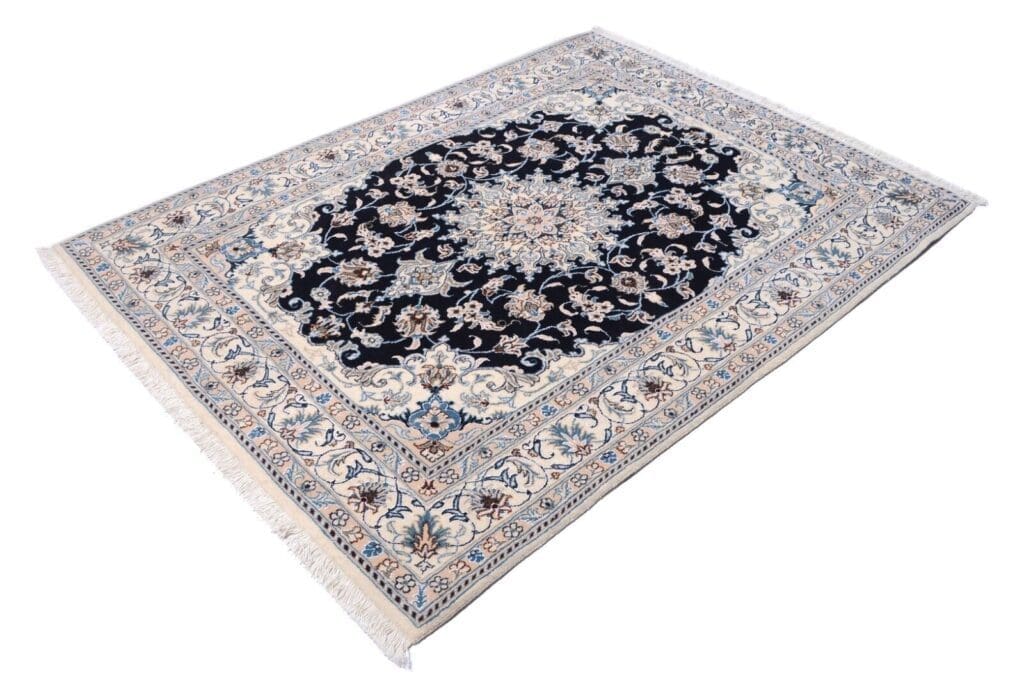
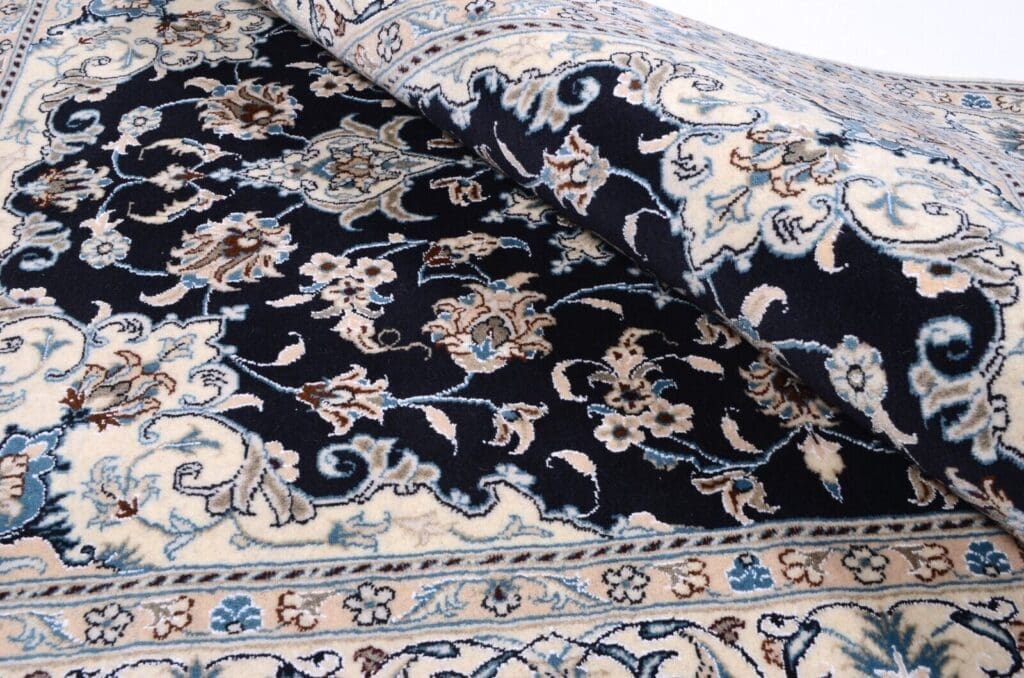
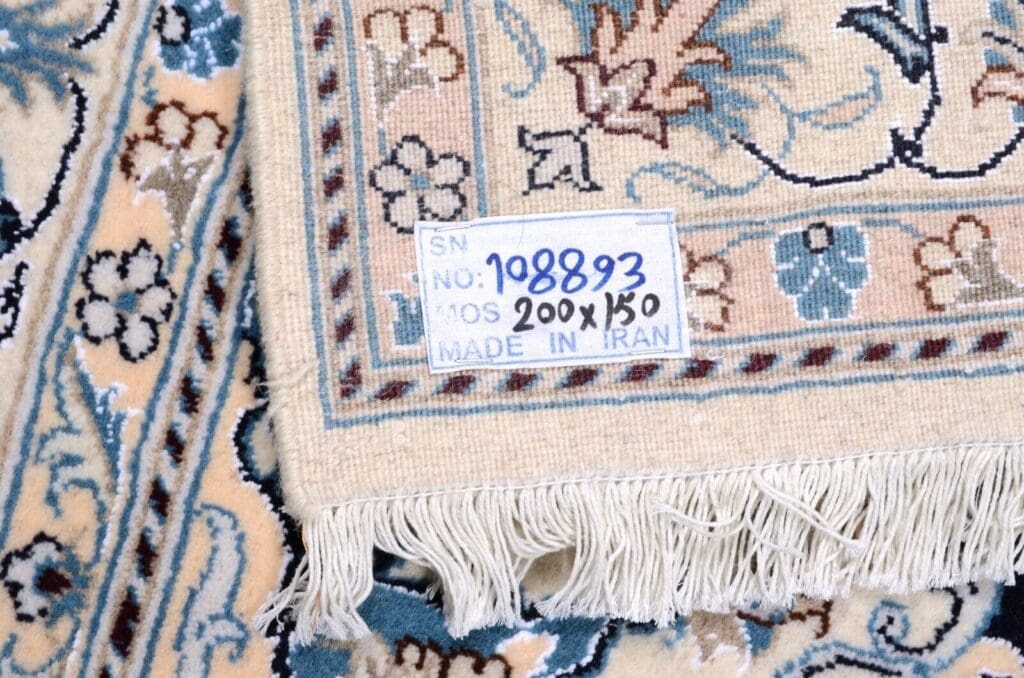
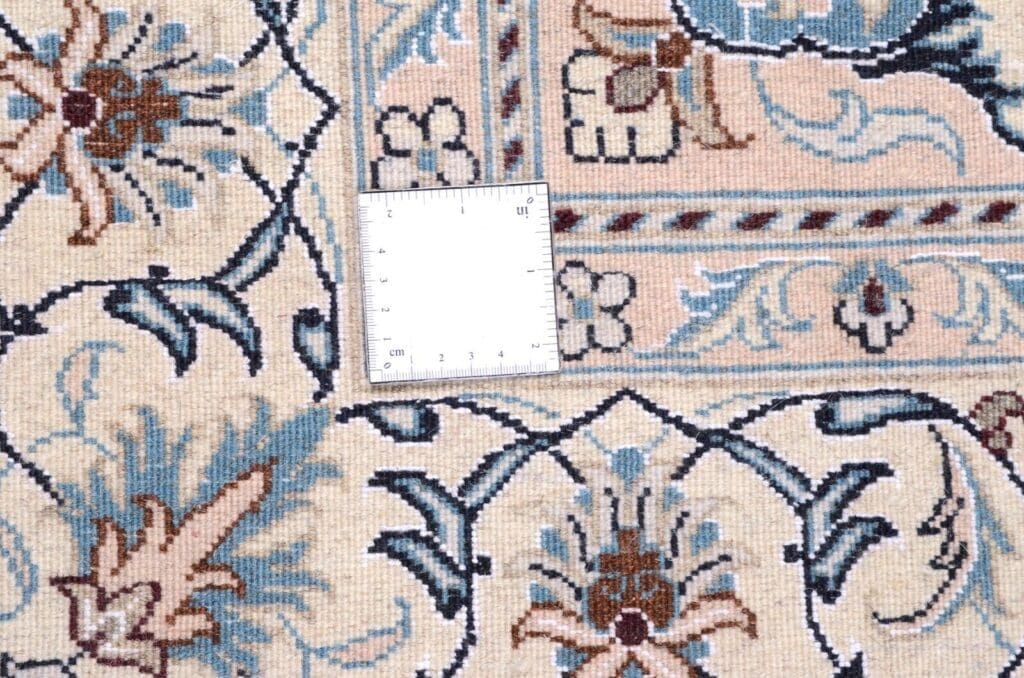
This Nain Persian rug is hand-knotted with a pile made from 100% virgin wool. Its construction combines a natural textile material with a traditional method in which the design is formed knot by knot. The pattern is therefore worked into the structure of the rug rather than simply applied to its surface. Hand-knotting is one of the defining features of Persian rugs and supports the detailed appearance of the floral medallion.
Virgin wool is used in rug making for its comfortable feel, its resilience and its ability to hold colour well. In this rug it forms the pile. The surface has a thickness of approximately 10 mm and provides a soft feel underfoot. High colour fastness is also specified. The rug is new and suitable for use over underfloor heating. Its construction has a knot density of 300,000 knots per square metre. These details describe the material, production and stated features of this particular rug.
Origin and Tradition
Nain is a city in the centre of Iran and belongs to Isfahan Province. It has a long tradition of producing Persian rugs. Rugs from Nain are known for fine workmanship and elegant compositions. The name therefore identifies more than a location: it also refers to an established regional craft tradition in which inherited methods are combined with carefully ordered ornament.
Nain has a history reaching back to the sixteenth century. Over time, rug production in the city developed while retaining its connection to traditional forms. Across Persia, rug making was adapted to local materials, working methods and visual languages. Nain represents its own direction within that wider culture, associated with finely drawn rugs, balanced ornament and controlled pattern structure.
In Nain, rug making is understood as both a craft and an artistic discipline. A composition has to be planned before the knots are tied so that the medallion, flowers, vines and surrounding fields remain proportionate. Weavers transfer that order into the knotted structure. Regional tradition therefore depends not only on the material, but also on experience in organising a design, balancing colours and maintaining an even execution.
The rug industry of Nain has changed over the centuries, incorporating both established techniques and responses to changing interiors. Alongside traditional compositions, contemporary variations have been developed for classic and modern rooms. The underlying principle remains the same: a hand-knotted rug joins a useful textile object with an intentionally organised ornamental surface. In this piece, the designation Nain places the rug within its Persian origin and cultural tradition.
Persian rugs are part of a broad visual language in which plant forms, central ornaments and repeating vine patterns are important. These motifs can suggest nature, order and harmony. Their meaning is not limited to a single interpretation; it is shaped by the individual composition and its regional context. In Nain designs, a clearly defined centre is often set in relation to a finely divided surrounding field.
Design and Pattern
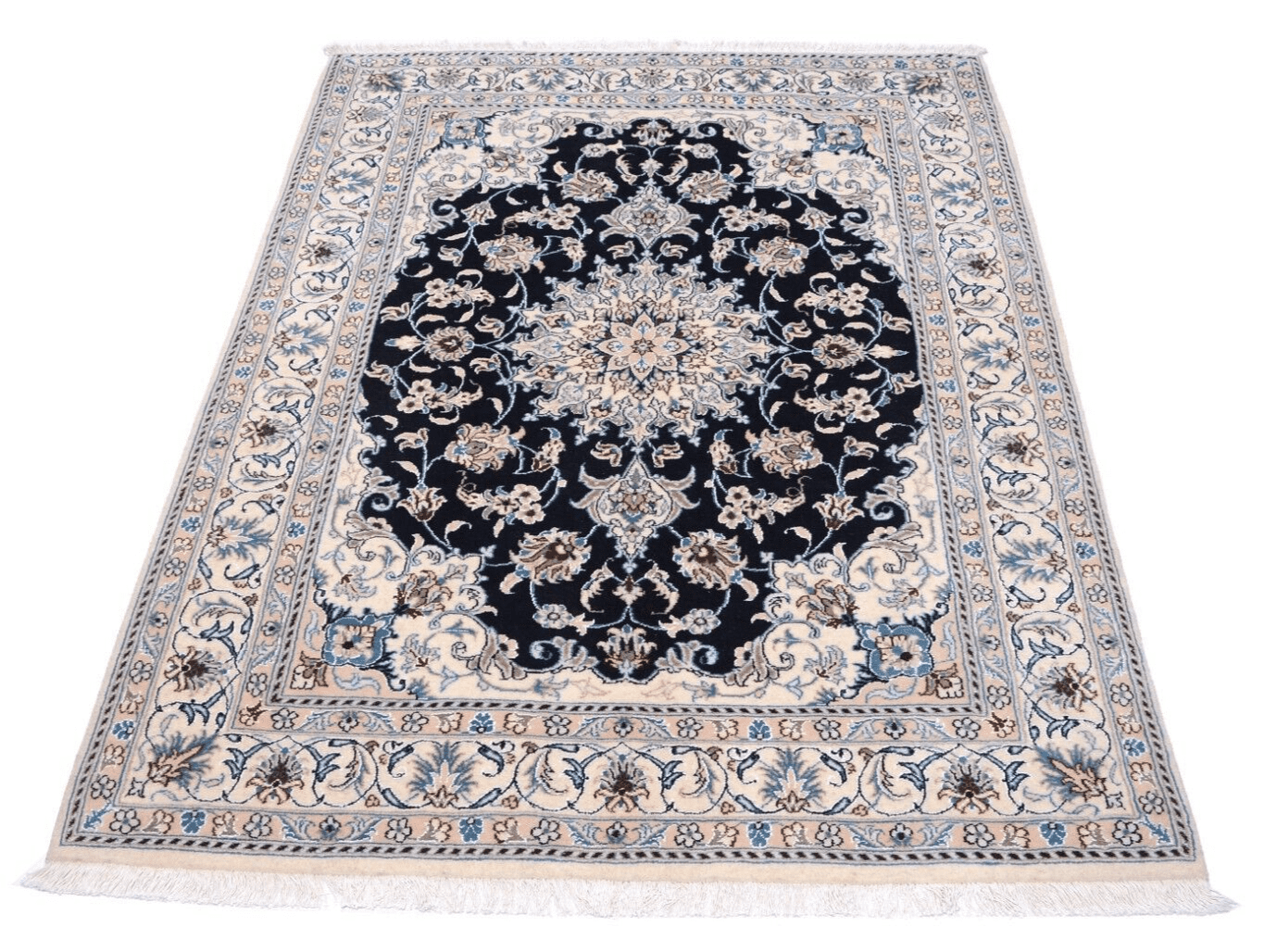
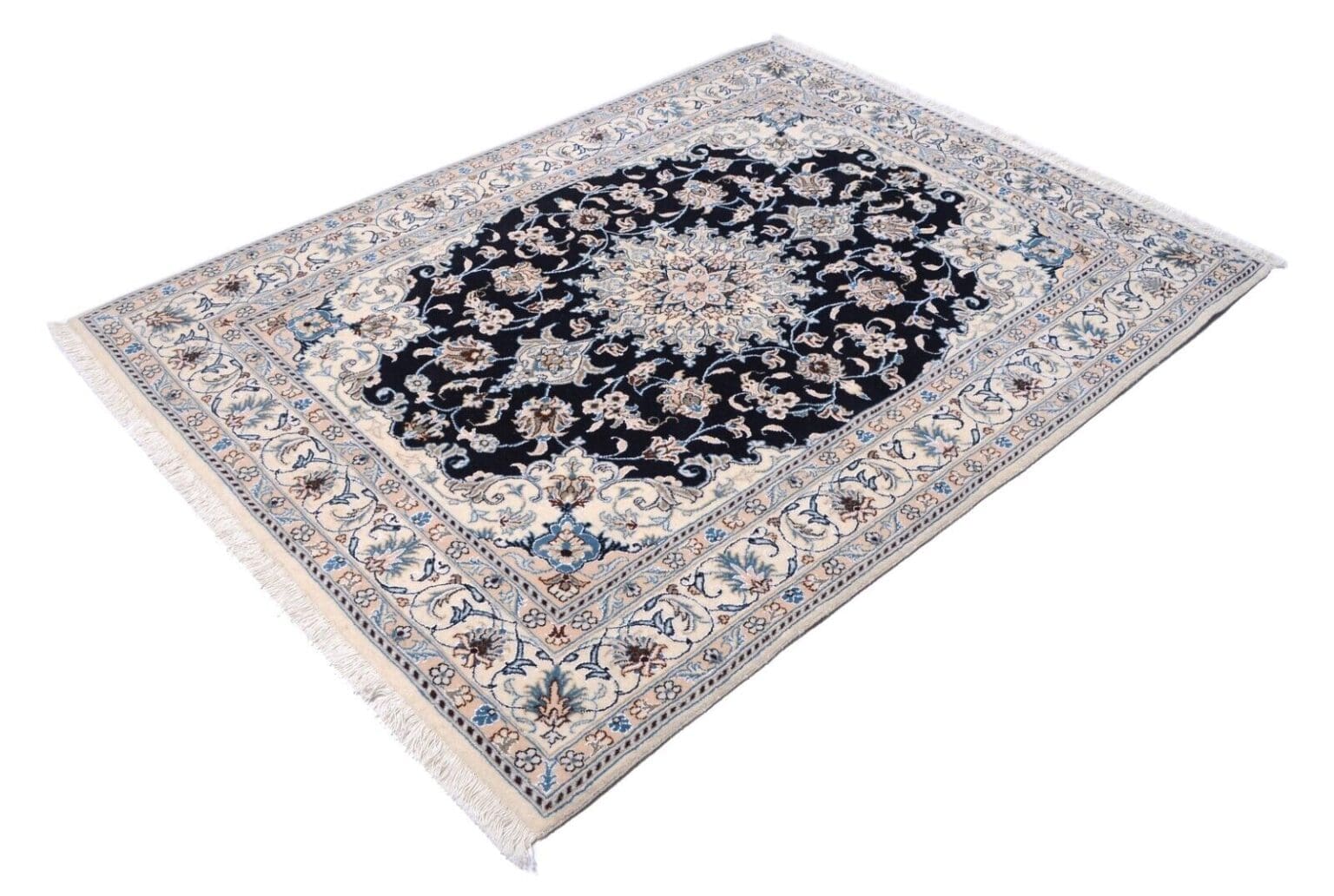
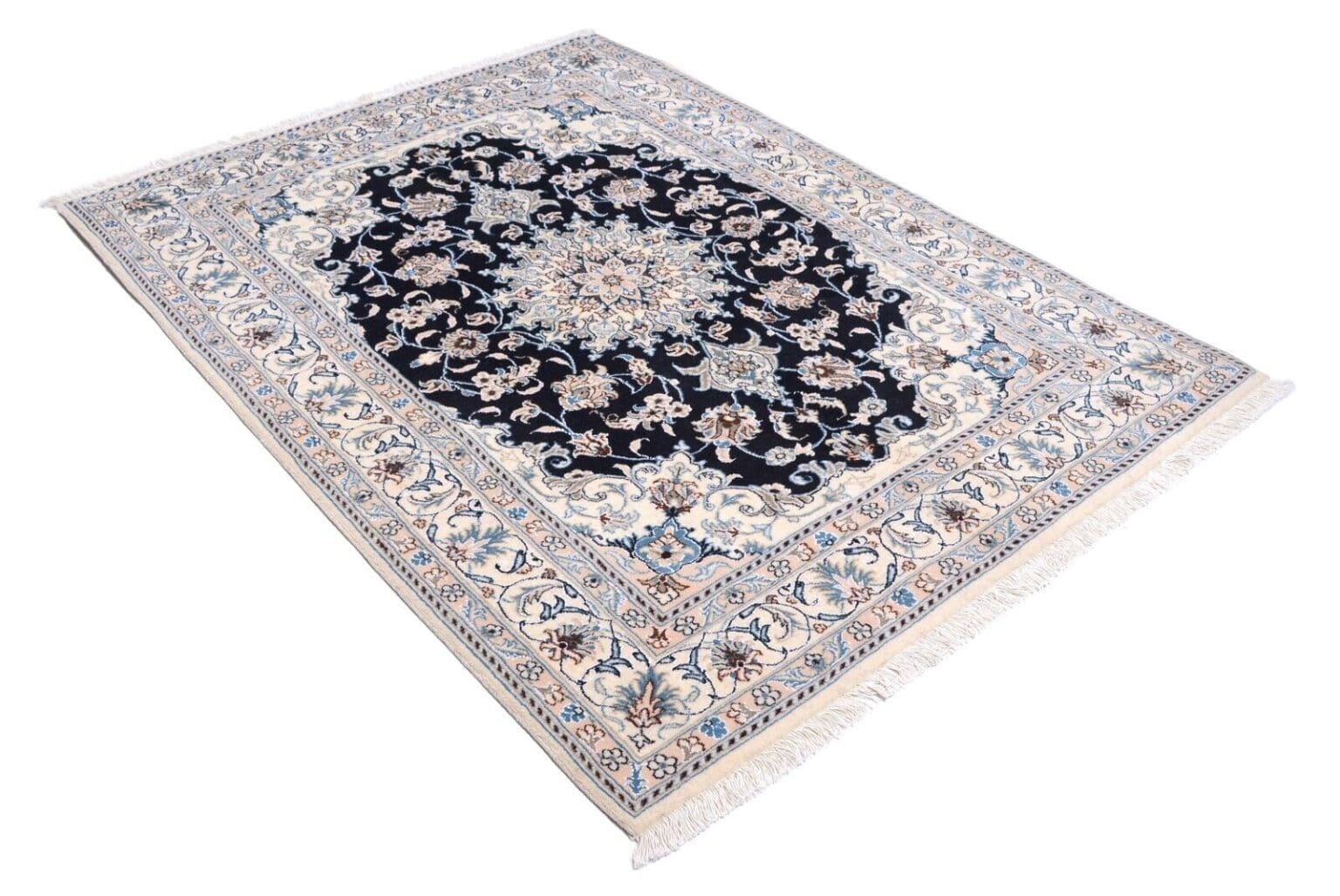
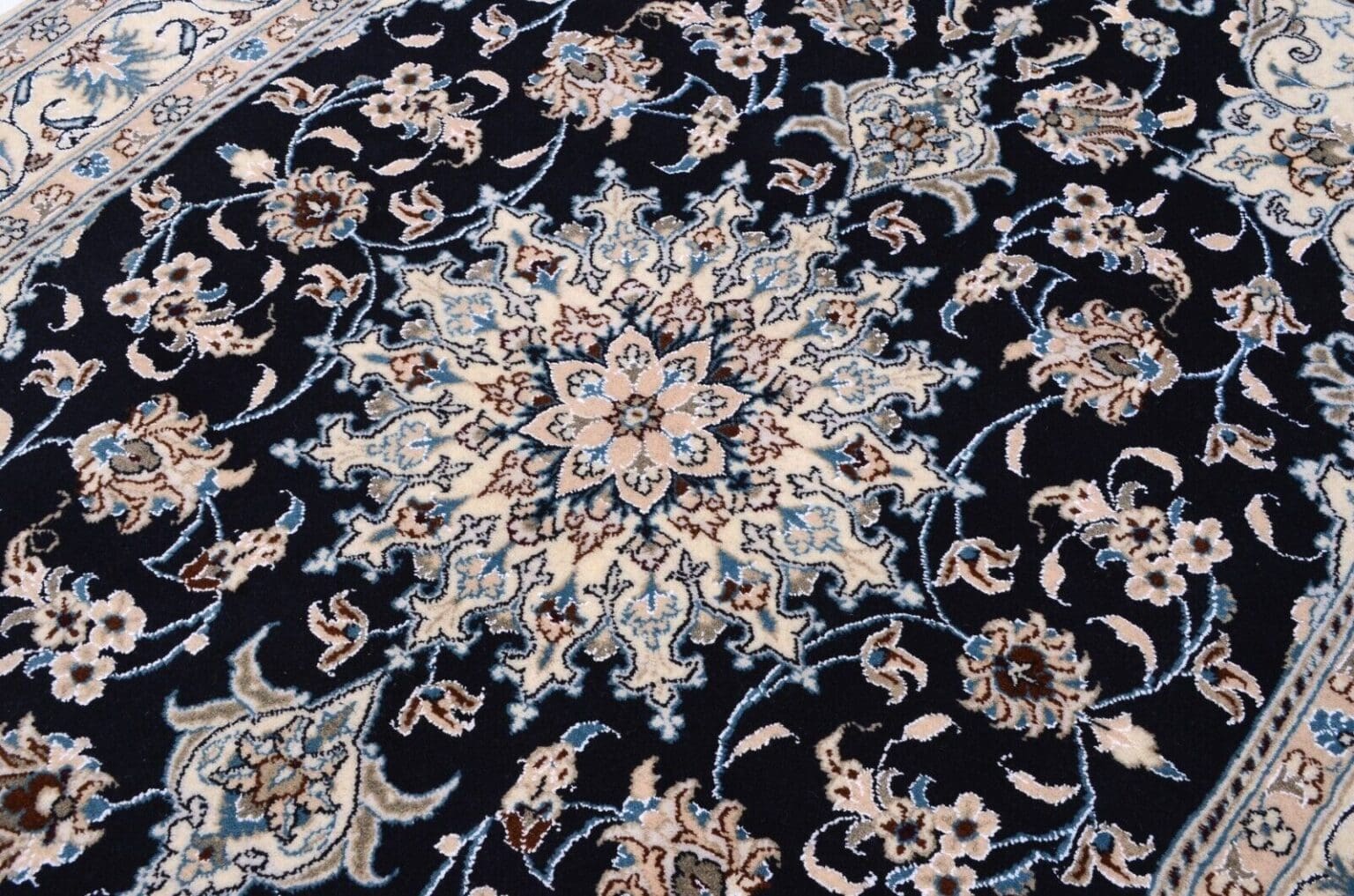
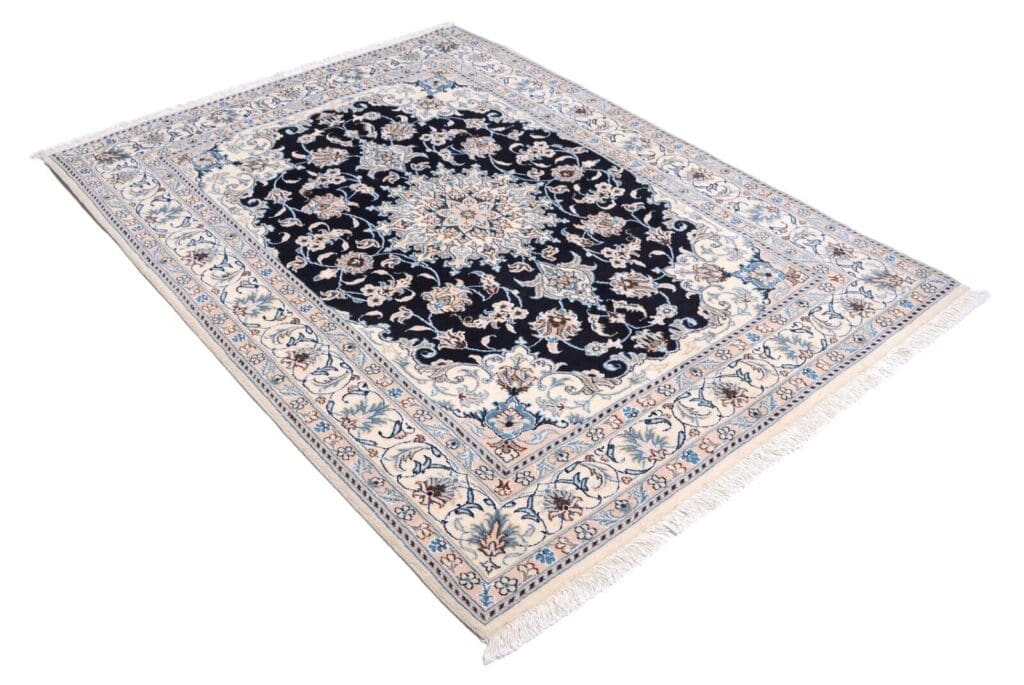
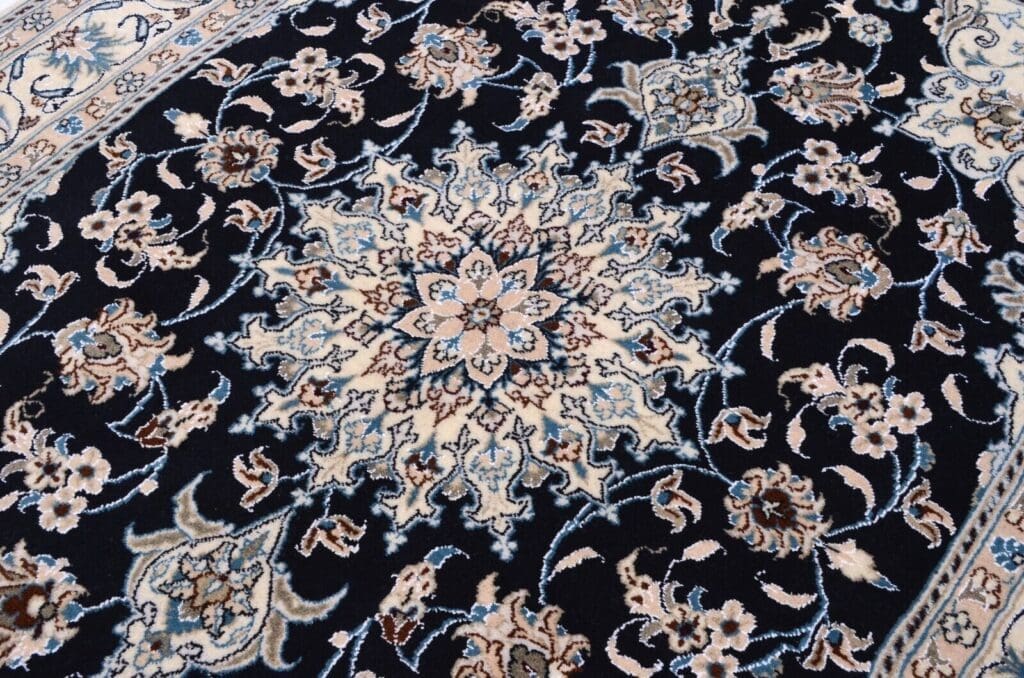
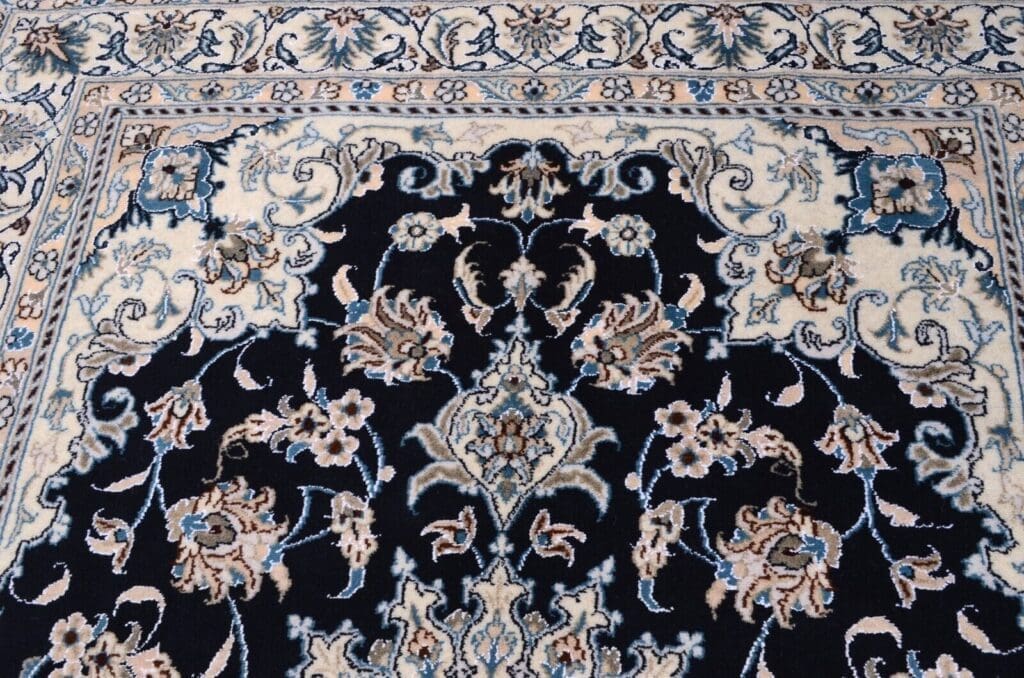
The design of this rug consists of a floral motif with a medallion. A medallion provides the visual centre of a composition and gives the overall design a recognisable structure. The floral treatment complements that centre with blossoms and botanical forms. The pattern consequently gains its character from the relationship between a central element and a finely worked ornamental setting.
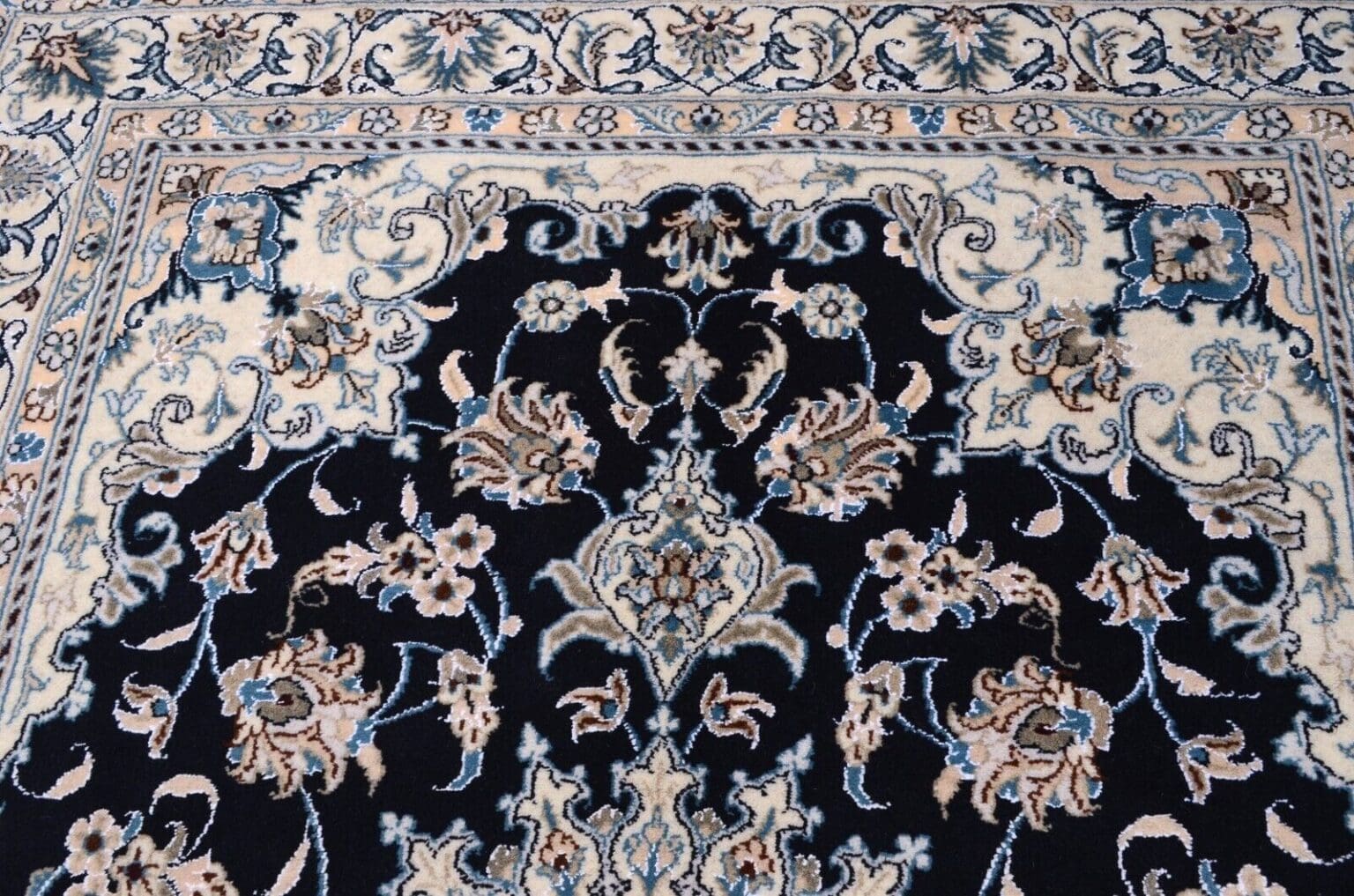
The medallion is embedded in a delicate pattern. In Persian designs of this kind, vines, flowers and additional ornaments often accompany the central form. These elements lead the eye from the centre into the surrounding areas and create a continuous arrangement. The drawing follows a planned order rather than a random distribution. The floral theme presents nature in a stylised textile form.
Flowers, leaves and vines are familiar subjects in Persian rug art. They may represent growth, good fortune and harmony, while also serving a decorative purpose. A floral design introduces organic shapes into the ordered structure of a rug, and the medallion holds the composition together. This creates a balance between a clearly defined centre and the movement of botanical details. Here, the floral medallion is the central design feature.
Nain compositions are traditionally arranged so that individual motifs relate to one another. The lines of a vine may continue from the edge of the medallion into the surrounding fields. Flowers and smaller ornaments occupy the spaces between larger forms without obscuring the centre. Fine drawing reinforces the detailed effect associated with hand-knotting. The design is therefore read as a connected system rather than as a collection of isolated decorations.
Floral medallion patterns can work with different interior styles because they combine order with natural forms. In a classic setting, they can echo the established language of Persian ornament. In a contemporary room, the pattern can provide a cultural and decorative accent. It can also complement a bohemian interior through its combination of botanical motifs and central structure. The setting influences the overall impression, while the pattern itself remains rooted in the Nain tradition.
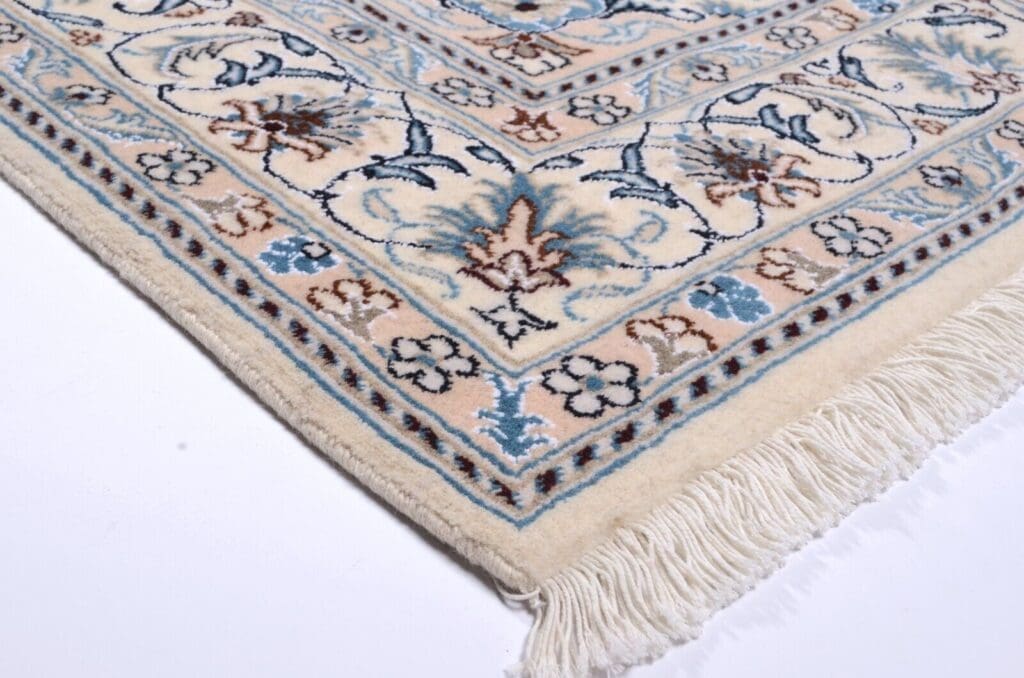
The colour treatment is described as gentle and colourfast. A restrained palette can support the fine outlines of the medallion and the floral details. At the same time, the balanced arrangement prevents the surface from being dominated by one ornament alone. Centre, surrounding field and botanical elements are designed to belong together, giving the rug a coherent decorative appearance.
Special Features
Notable features of this rug include its hand-knotted construction, its pile of 100% virgin wool and its specified high colour fastness. Hand-knotting makes each rug a one-off, since the textile execution is not reproduced as an identical industrial surface. This new rug combines that traditional workmanship with a floral medallion and finely drawn ornament.
The rug is suitable for use over underfloor heating. Its surface is described as easy to care for and it can be used in a range of living areas, including a living room, bedroom, hallway or office. Its practical character as a floor covering is combined with wool, hand-knotted construction and a design intended to remain relevant across different interiors.
FAQ
How should I clean my Nain Persian rug?
The rug should be vacuumed regularly. Professional cleaning once a year is recommended for more thorough care. Spills and stains should be treated promptly with a mild cleaning agent in order to reduce the risk of marking or damaging the surface. Cleaning should be carried out carefully, taking the properties of the wool pile into account.
Can the rug be used over underfloor heating?
Yes. This Nain Persian rug is suitable for use over underfloor heating. The properties of the virgin wool make this application possible. The heating temperature should not be set too high, however, so that the material is treated gently. Even, moderate warmth supports the long-term care of the rug surface.
How can I identify an authentic Nain Persian rug?
High knot density, fine wool and precise pattern detail are regarded as important characteristics when identifying Nain rugs. The careful execution of the floral medallion and the hand-knotted structure can also assist with classification. A certificate or proof of origin may provide additional documentation. For a reliable assessment, an examination by a qualified specialist is recommended.
To provide the best experiences, we use technologies like cookies to store and/or access device information. Consenting to these technologies will allow us to process data such as browsing behavior or unique IDs on this site. Not consenting or withdrawing consent, may adversely affect certain features and functions.
Functional Always active
The technical storage or access is strictly necessary for the legitimate purpose of enabling the use of a specific service explicitly requested by the subscriber or user, or for the sole purpose of carrying out the transmission of a communication over an electronic communications network.
Preferences
The technical storage or access is necessary for the legitimate purpose of storing preferences that are not requested by the subscriber or user.
Statistics
The technical storage or access that is used exclusively for statistical purposes.The technical storage or access that is used exclusively for anonymous statistical purposes. Without a subpoena, voluntary compliance on the part of your Internet Service Provider, or additional records from a third party, information stored or retrieved for this purpose alone cannot usually be used to identify you.
Marketing
The technical storage or access is required to create user profiles to send advertising, or to track the user on a website or across several websites for similar marketing purposes.
 SECURE PAYMENT
 SHIPPING PARTNERS


