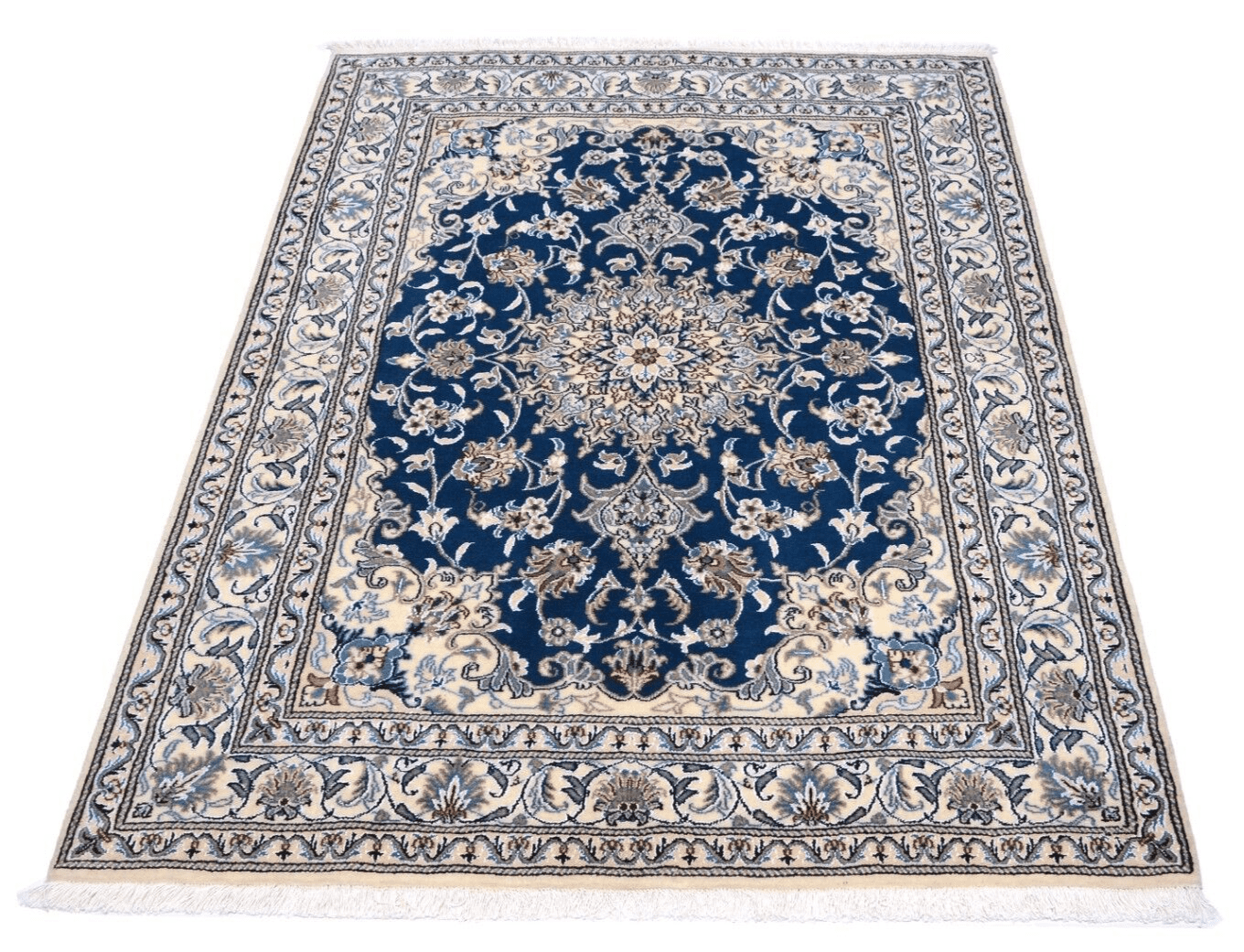
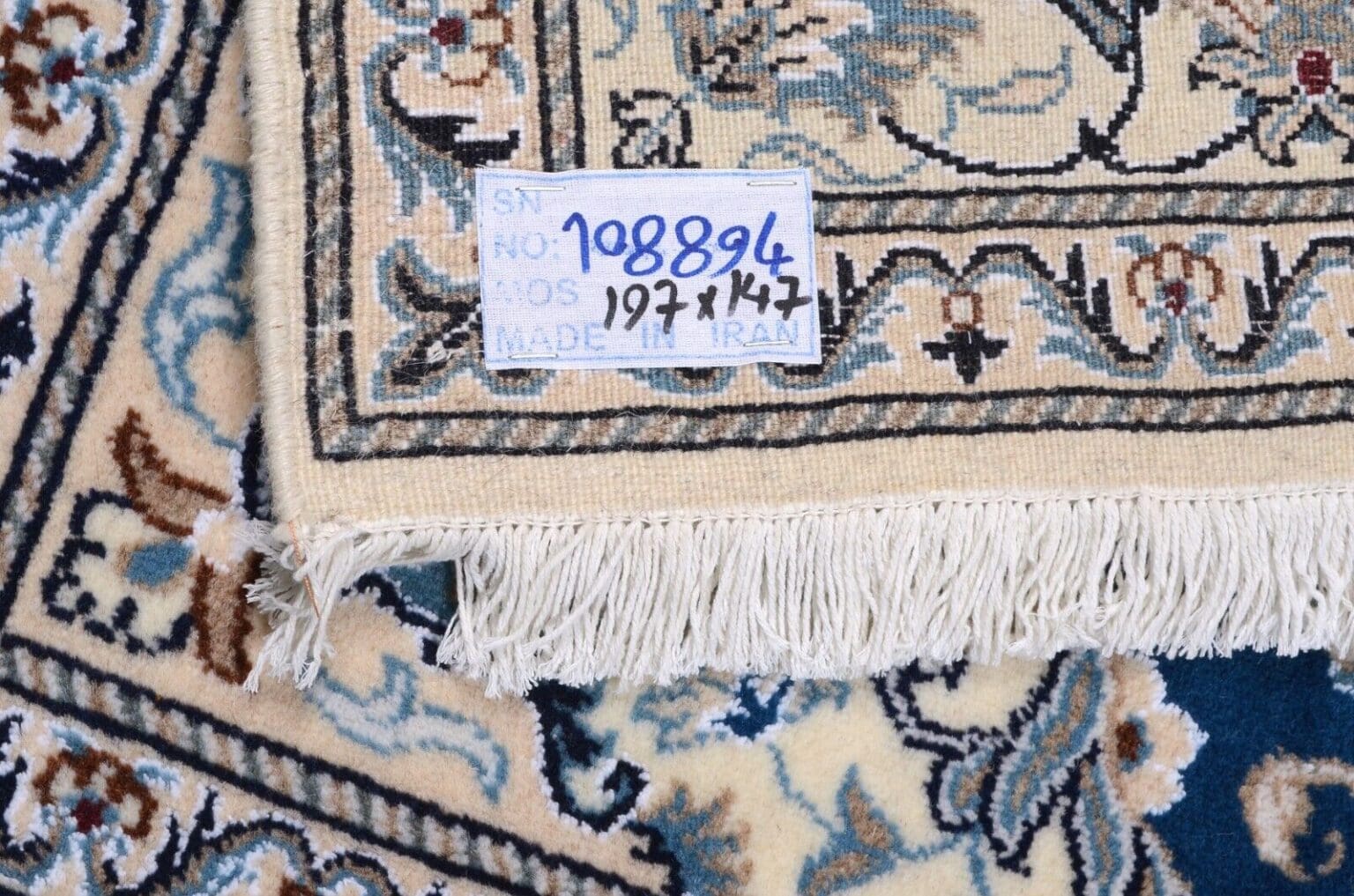
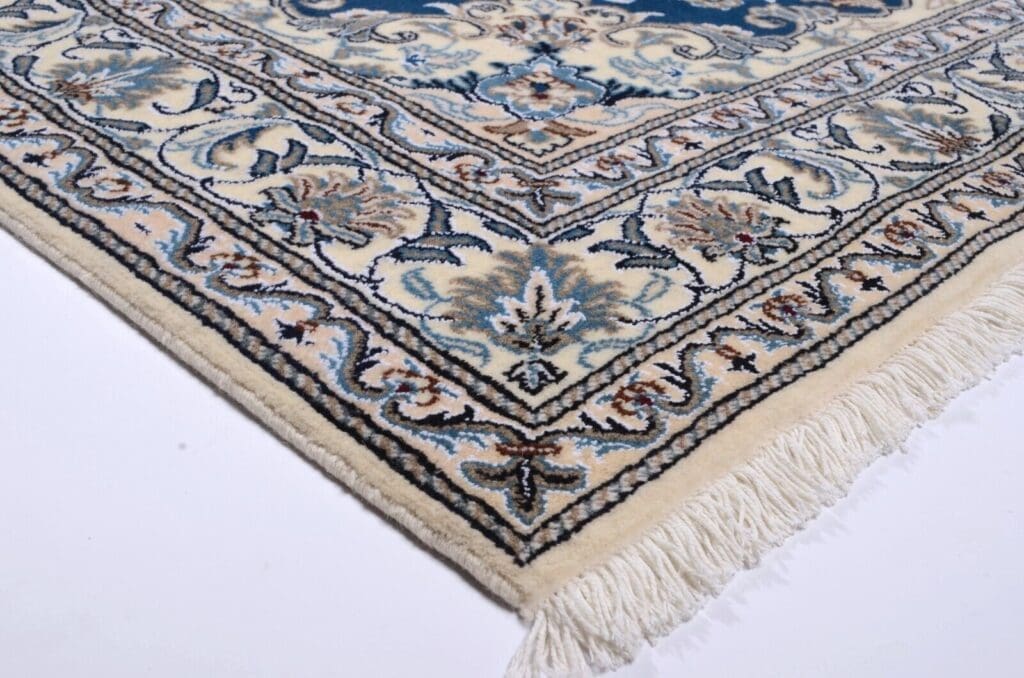
This Nain Persian rug is hand-knotted and has a pile made from 100% virgin wool. Pure virgin wool gives the surface a natural textile character and provides the material basis associated with durable oriental rugs. In a hand-knotted rug, the design is built into the structure rather than applied to a finished surface. Each knot contributes to the pile, while the relationship between warp, weft and pile creates the finished textile.
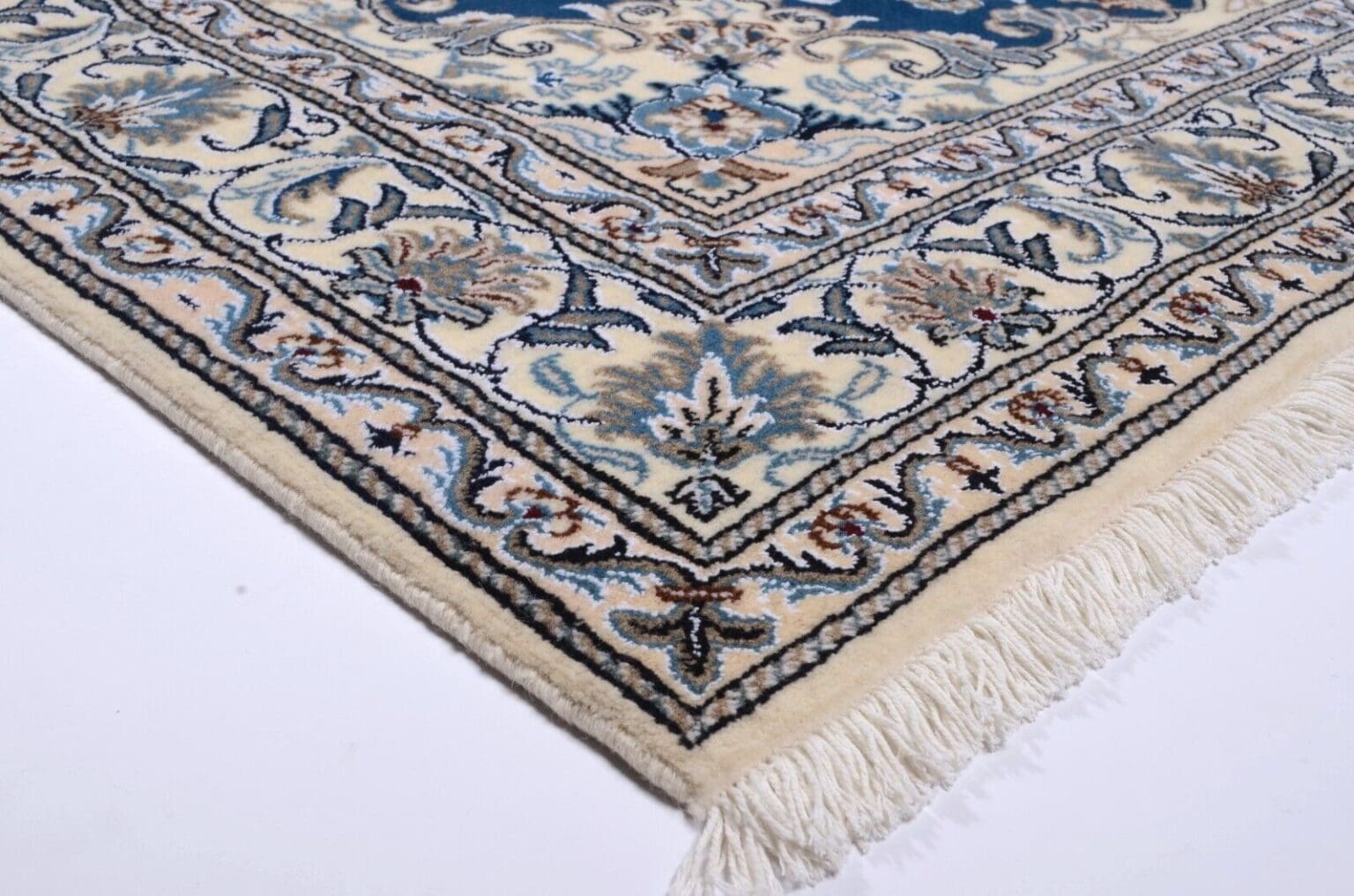
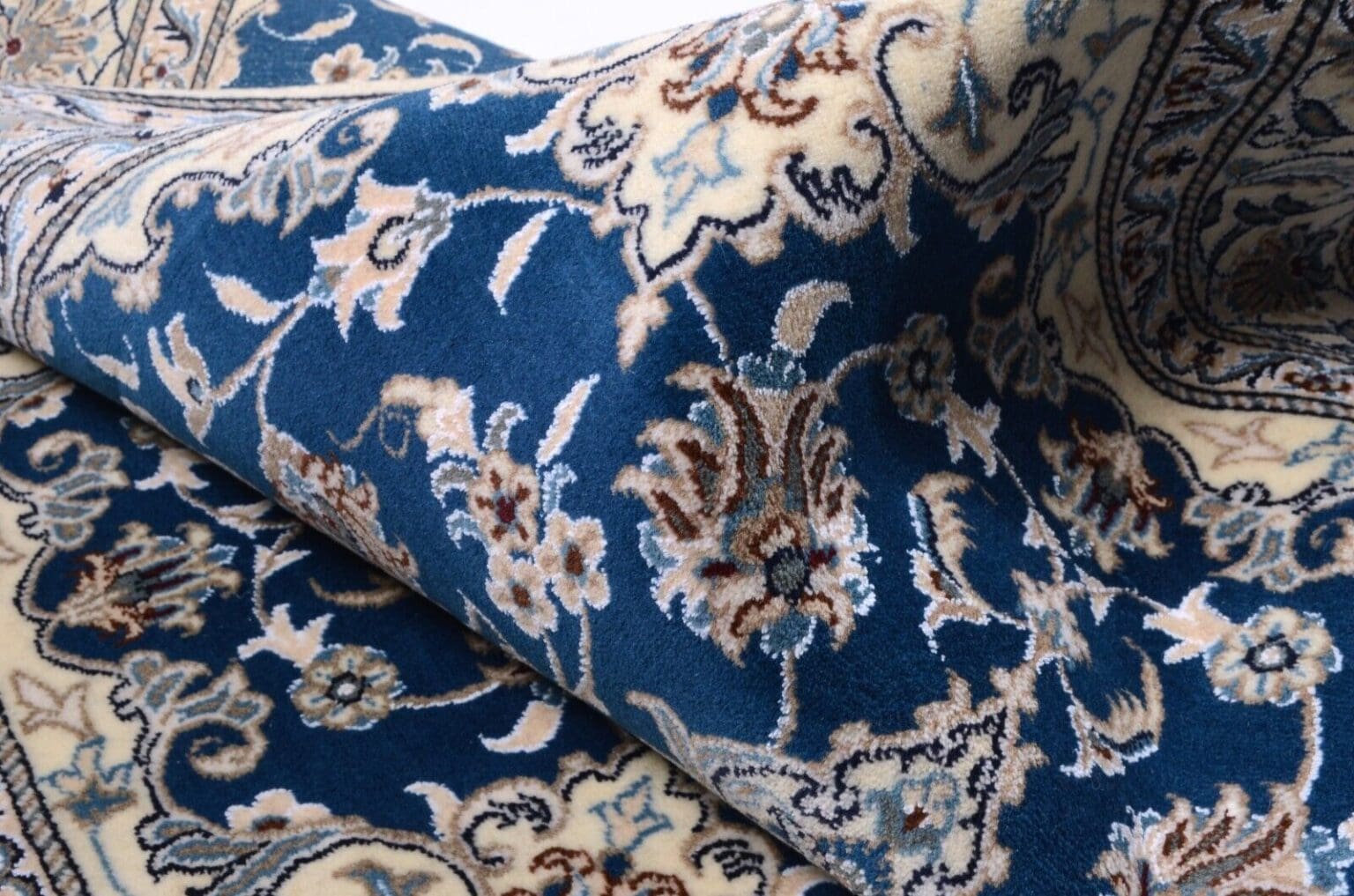
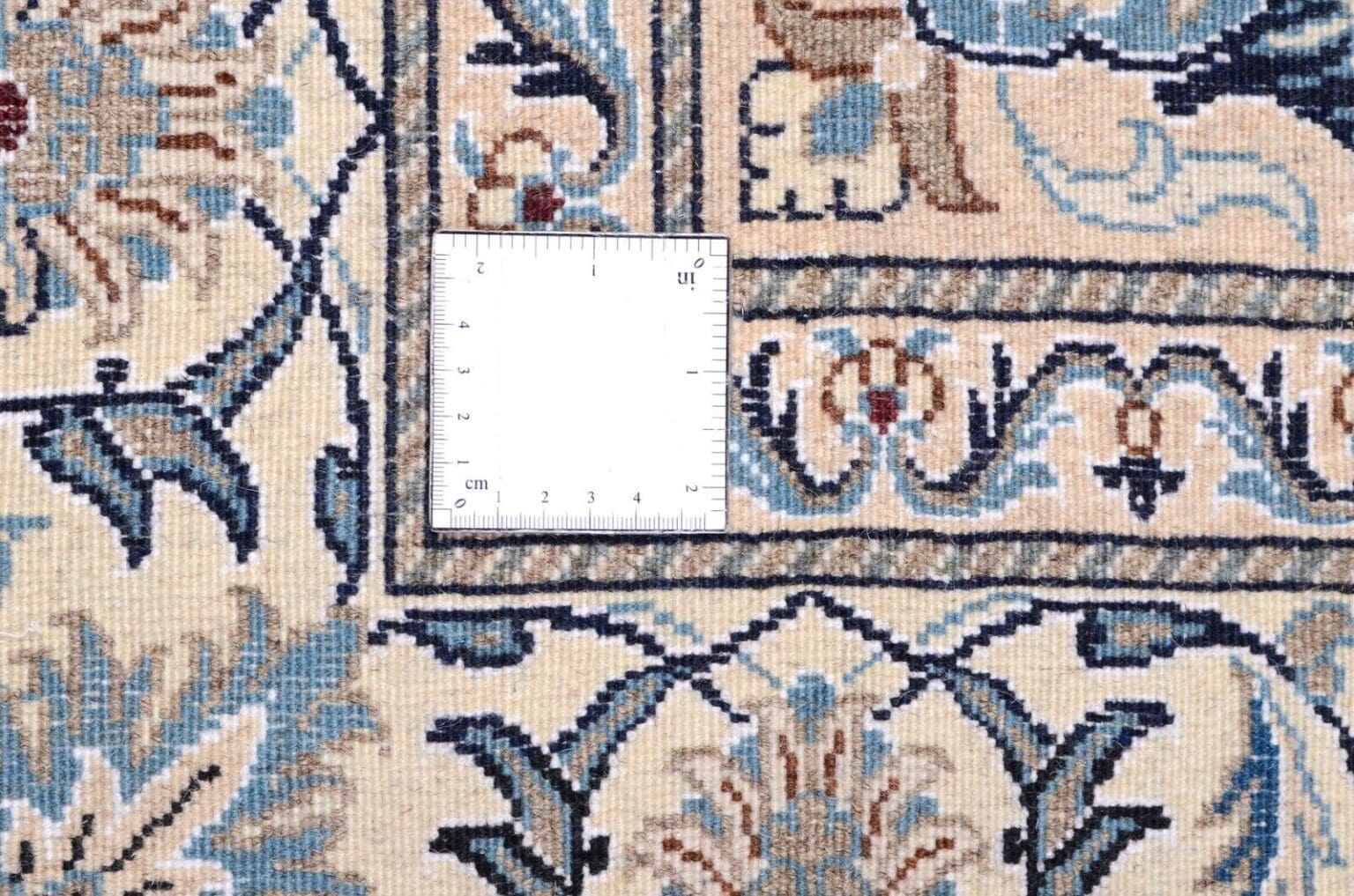
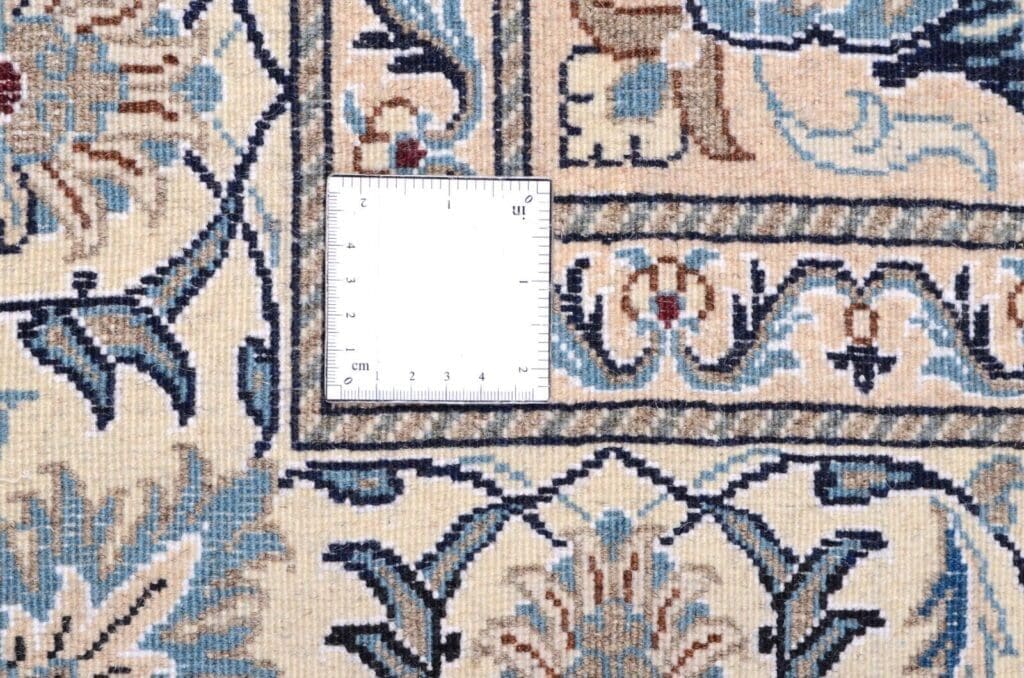
The density of 300,000 knots per square metre indicates a finely worked construction. A dense knotting allows outlines to be drawn with care and gives floral details a clearly structured appearance. It also reflects the precision involved in making a Nain rug. The virgin-wool pile combines this detailed workmanship with a resilient natural fibre. The rug is listed as new and is described as having high colourfastness. It is also suitable for use with underfloor heating.
Origin and Tradition
Nain is one of the established carpet centres of Persia. The town lies in central Iran and is known for finely knotted rugs with controlled compositions and carefully rendered ornament. Its historical setting was shaped by arid landscapes, long-distance trade routes and local craft traditions. These conditions supported the exchange of materials, techniques and decorative ideas, while Nain developed a recognisable place within Iranian carpet culture. Persian rugs are understood through more than colour alone: drawing, proportion, knotting and the relationship between motifs are equally important.
The Persian carpet tradition has been carried through many generations. Different areas of Persia formed their own approaches to knotting, colour and pattern, and workshops adapted shared ideas according to local practice. Nain is particularly associated with precise execution and balanced ornament. Isfahan also occupies an important position in the broader history of Iranian textile arts, having served for centuries as a major cultural and artistic centre. Design ideas connected with Isfahan influenced neighbouring and more distant weaving areas, where they were interpreted through regional working methods.
Hand knotting involves a sequence of deliberate manual operations. The warp is first arranged on the loom. Knots are then inserted row by row and secured with weft, gradually building the pile and the design. After the knotting is complete, the surface, edges and finishing are worked and checked. This method explains why hand-knotted rugs have a direct, crafted character and why every individual piece is distinct. The pattern is not printed onto the rug; it emerges through the placement of coloured knots within the woven structure.
Persian rugs have traditionally served both practical and decorative purposes. They provide a textile covering for the floor, add insulation and form part of the visual arrangement of an interior. At the same time, they preserve local approaches to ornament and colour. A Nain rug belongs to a tradition in which fine execution, orderly design and careful surface work are considered together. Its regional identity therefore relates not only to a place name, but also to a way of organising pattern and making the textile by hand.
Design and Pattern
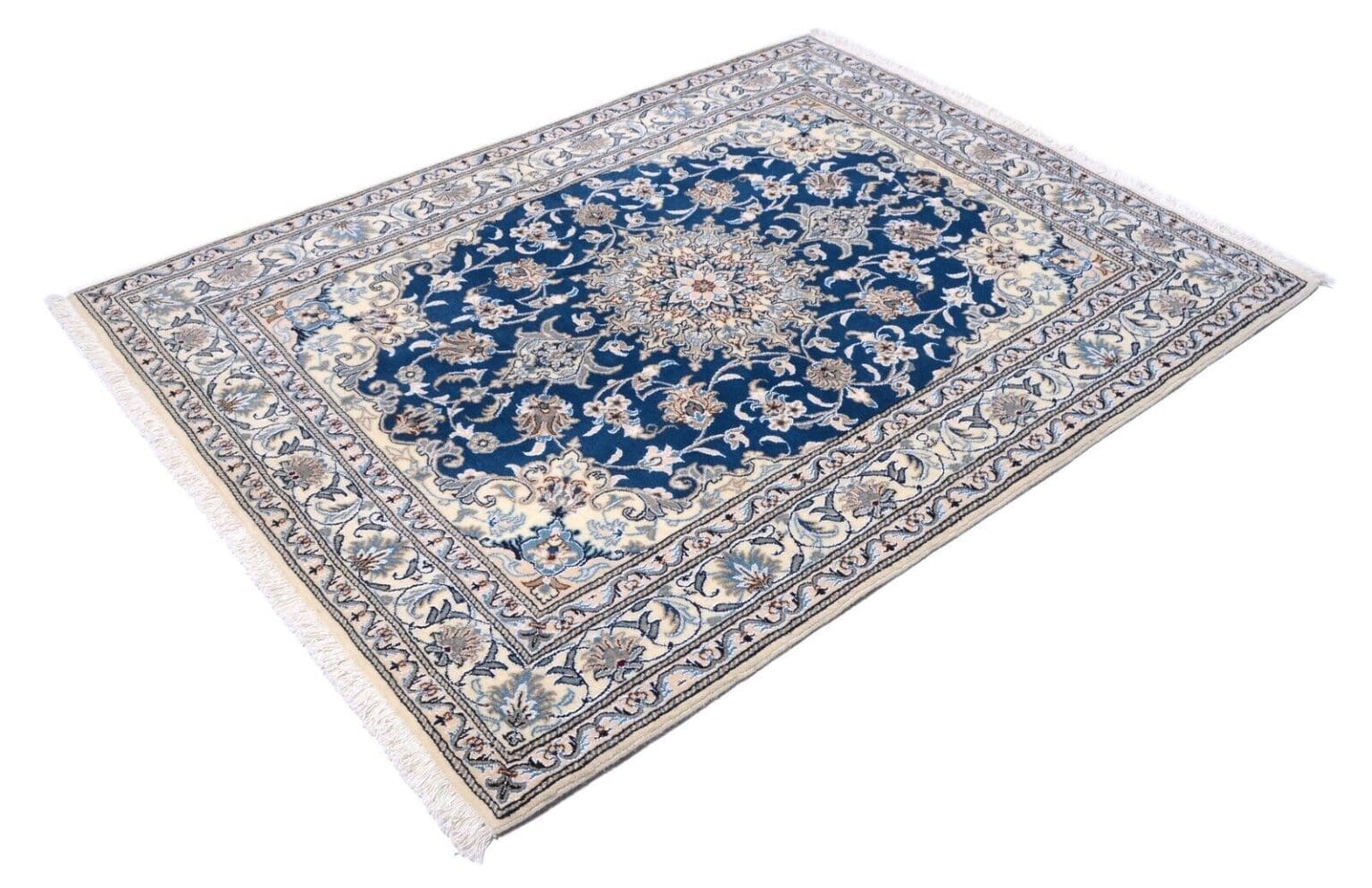
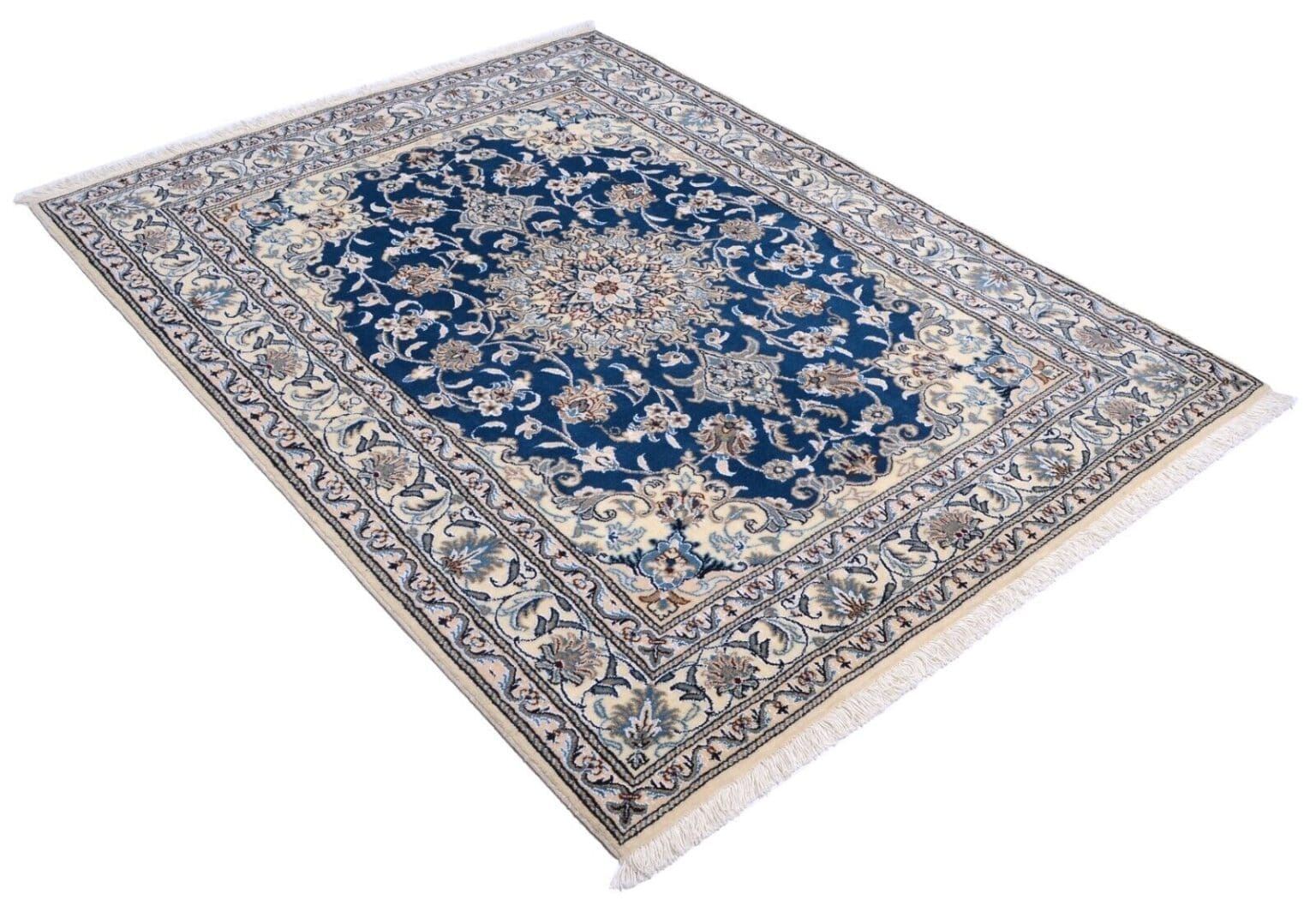
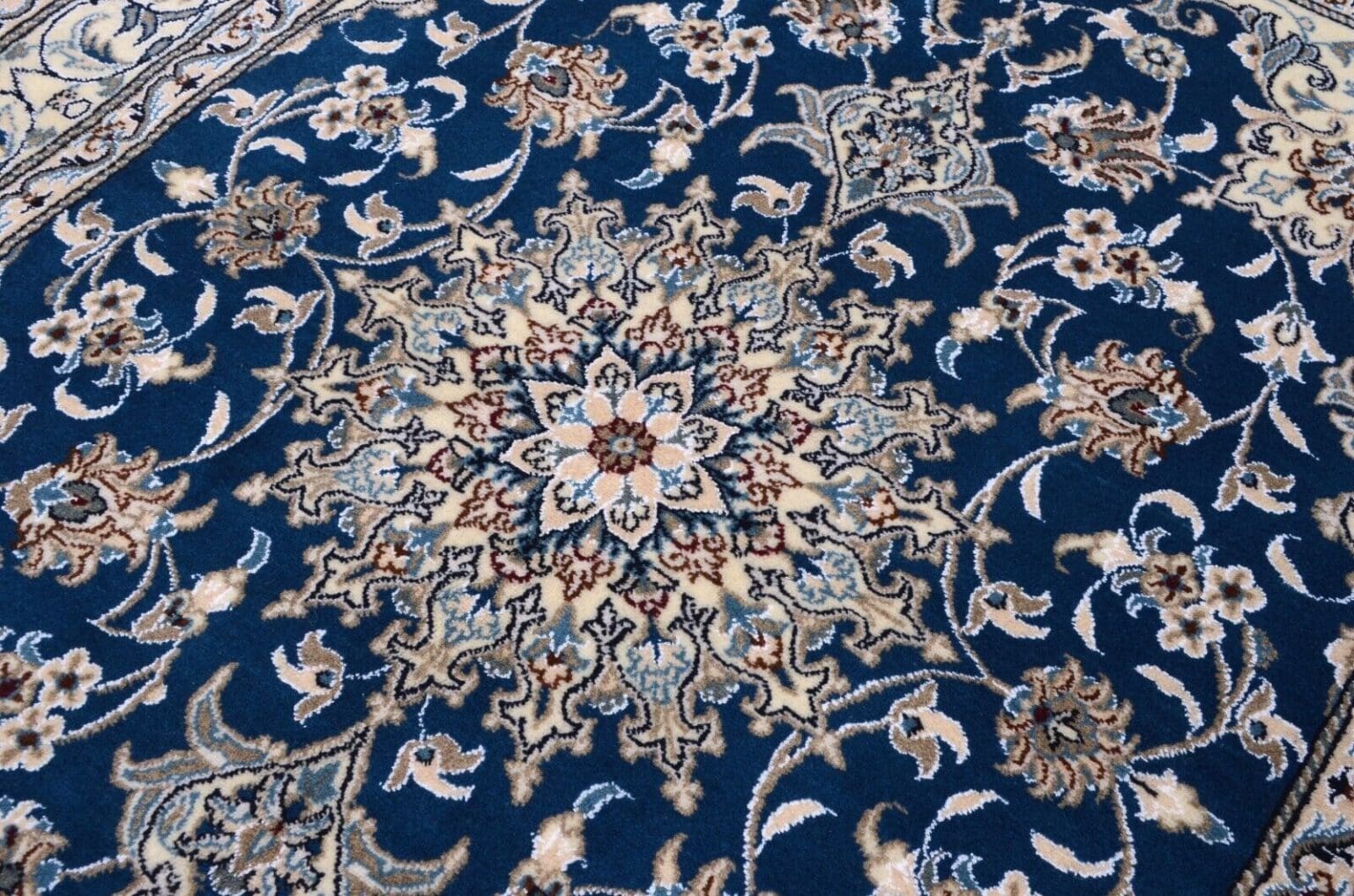
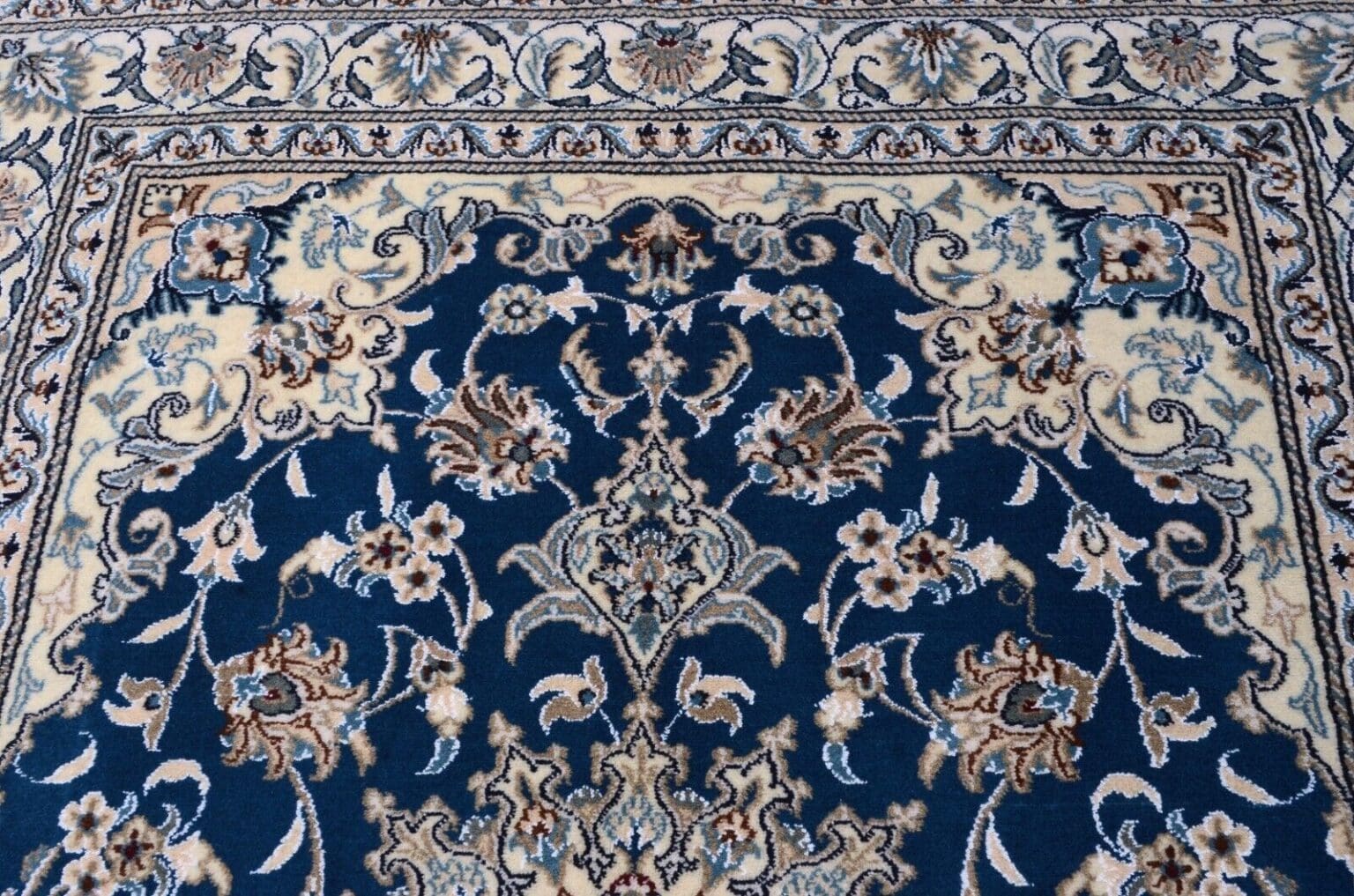
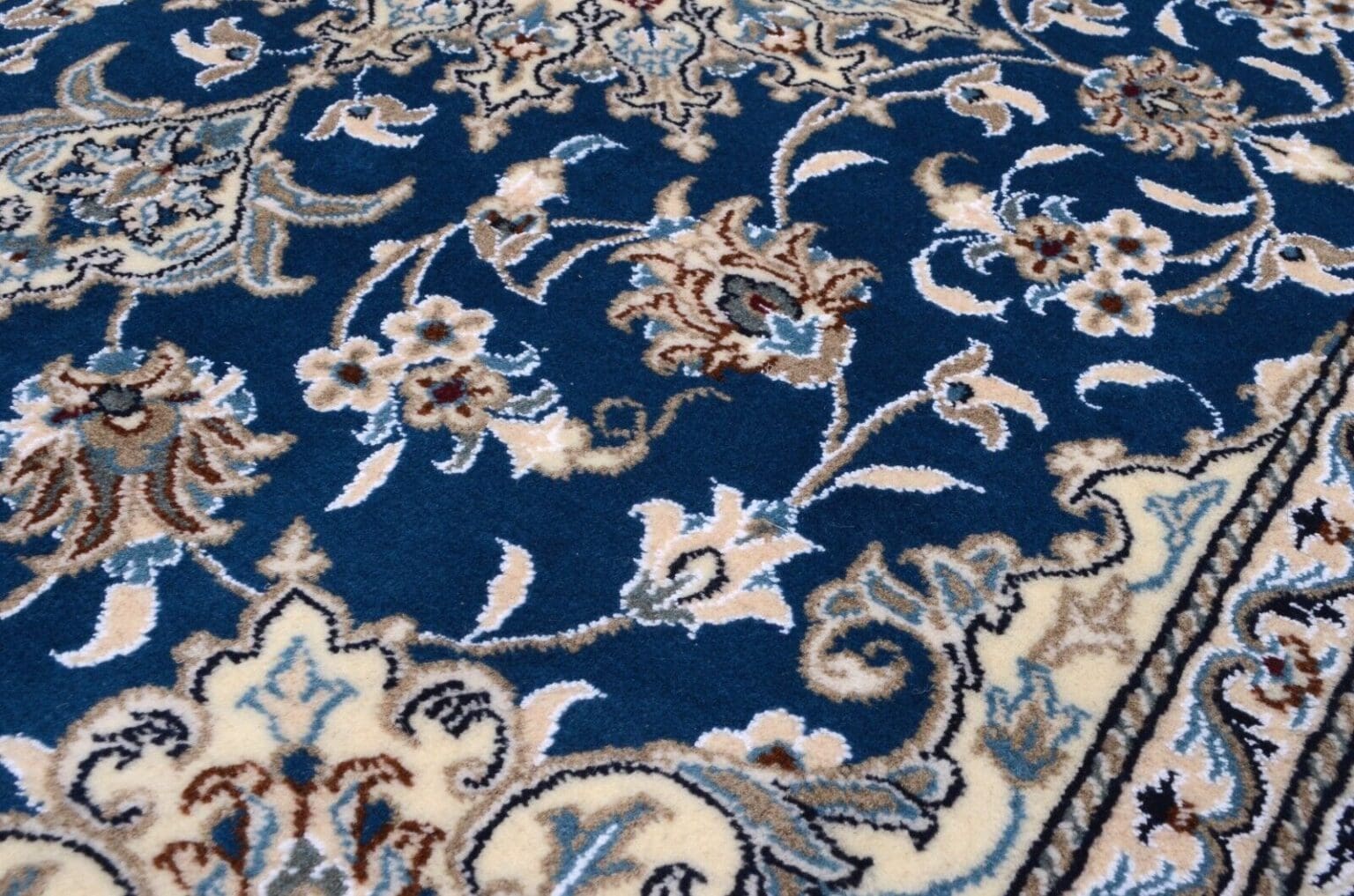
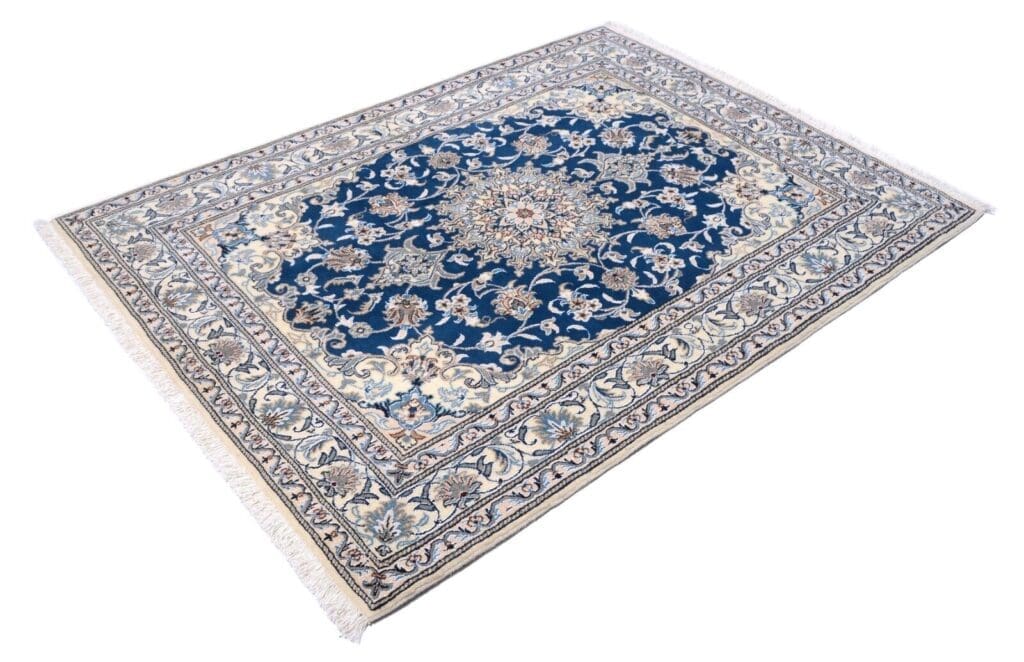
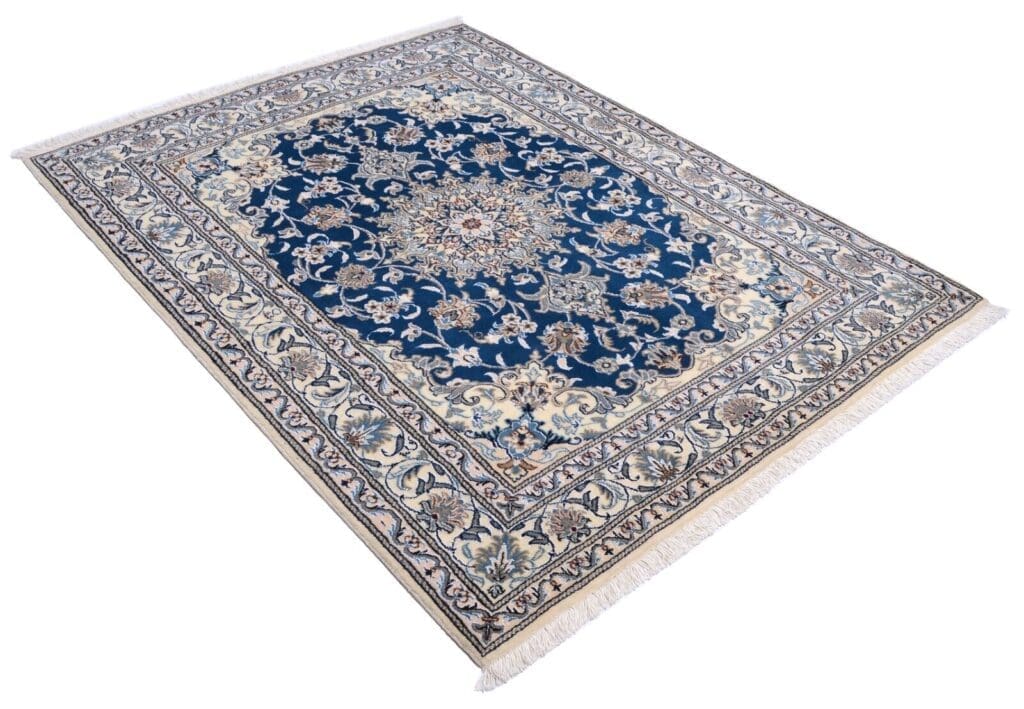
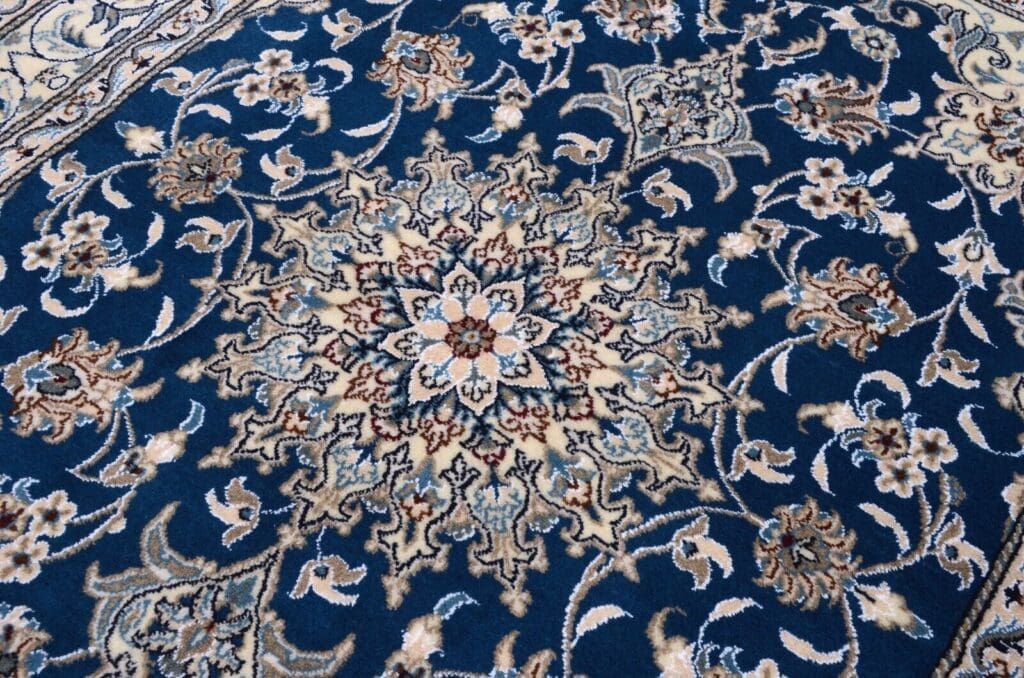
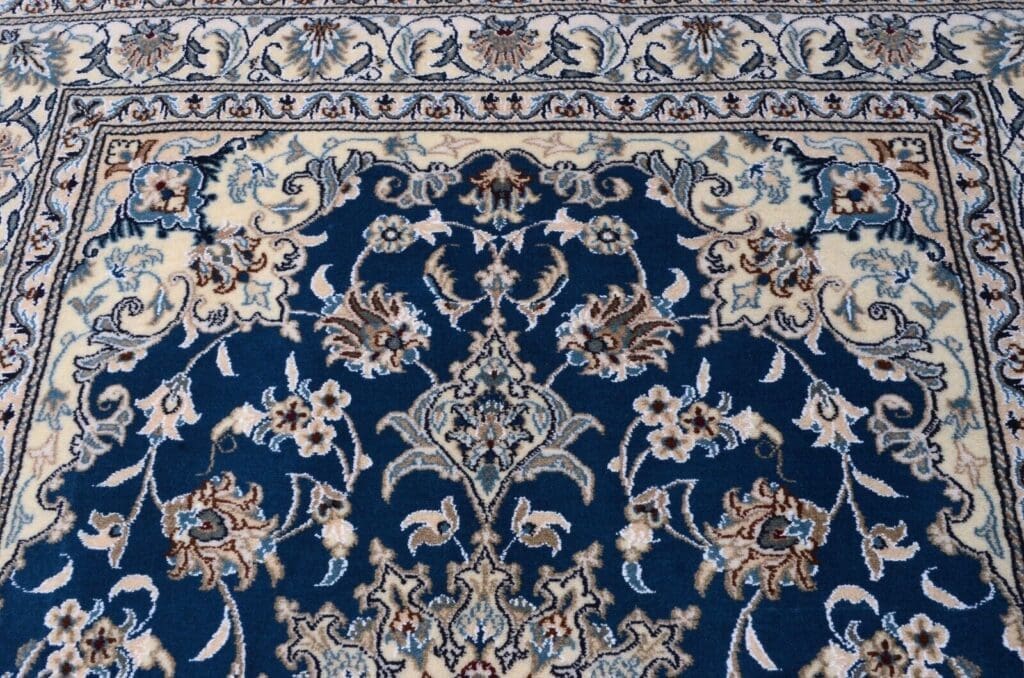
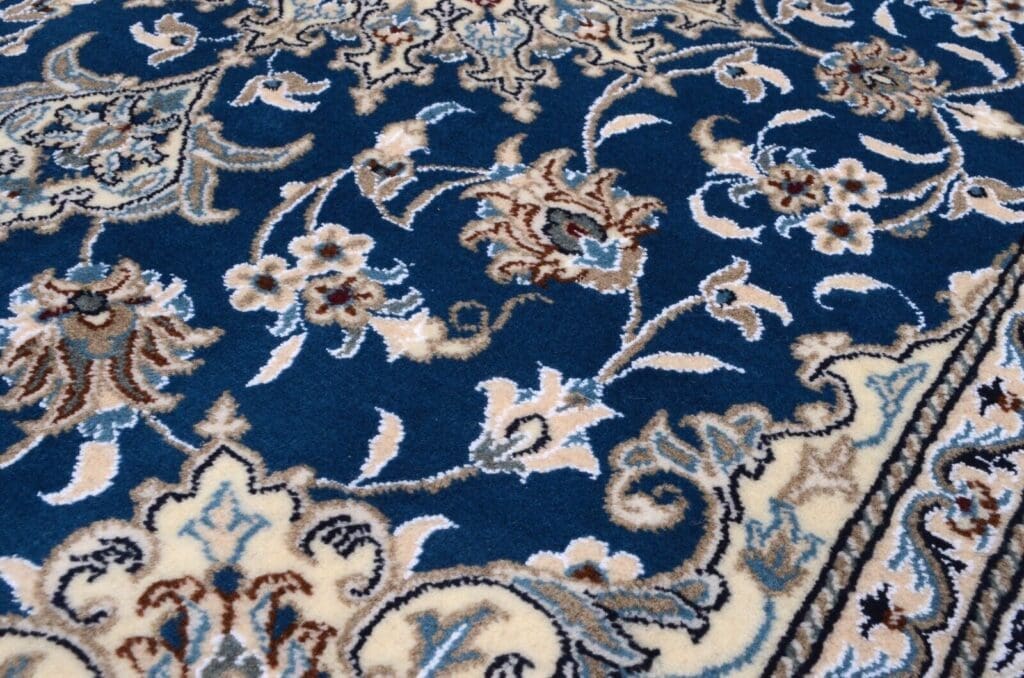
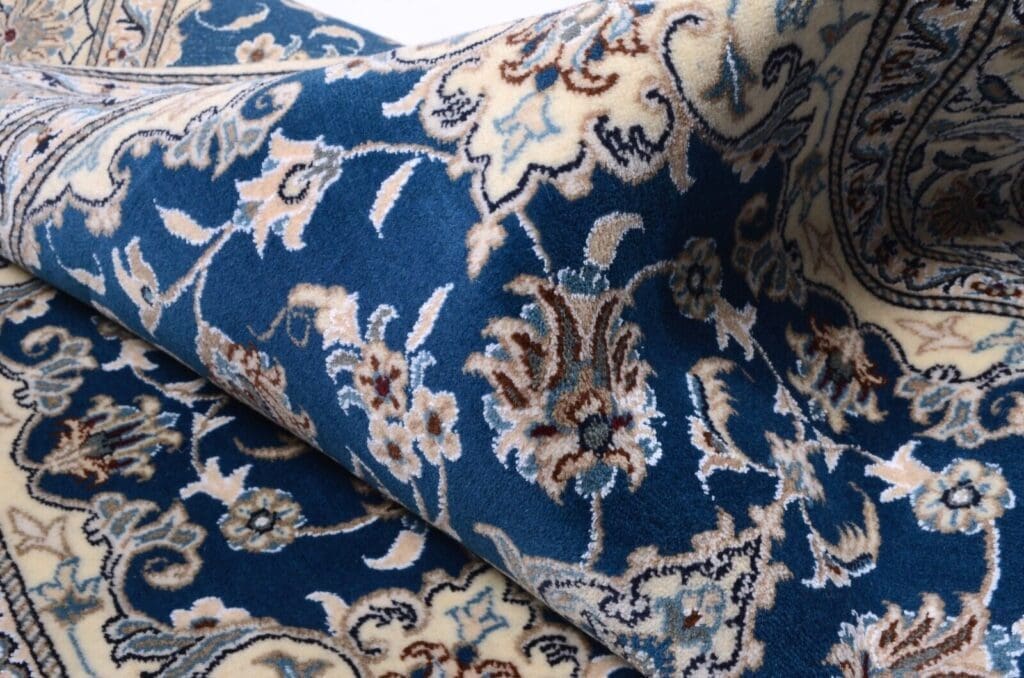
The pattern of this rug is described as a floral motif with a medallion. In Persian carpet design, a medallion often serves as the visual centre of the composition. It may be surrounded by vines, blossoms, leaves or other ornaments that guide the eye from the centre into the surrounding field. Floral patterns give the surface a rhythmical structure while retaining the ordered character typical of formal carpet design. In a hand-knotted piece, these shapes are built from many individual colour points.
Royal blue defines the colour impression of the rug. Blue has a long history in Persian ornament and can appear in deep saturated shades as well as lighter variations. Within a floral composition, blue may establish the main field, define contours or bring smaller motifs into focus. The described rug combines its royal-blue presence with blue and red tones. Red adds contrast and accents, while the blue range maintains a coherent visual connection between the medallion and the surrounding floral drawing.
Floral motifs in Persian rugs are not botanical illustrations in a strict sense. Flowers, leaves and scrolling vines are stylised into forms that can repeat, connect and fill a field with measured rhythm. This transformation of natural forms into ornament is a central feature of many Persian design traditions. A medallion gives the composition a point of focus, while the surrounding plant forms create transitions and distribute the pattern across the surface.
Persian compositions may be strongly symmetrical or may allow greater freedom in the placement of individual ornaments. The effect of a medallion rug depends on the relationship between its centre, surrounding field, border areas and repeated details. The eye first recognises the central form, then follows the floral lines outward. The knotting process makes it possible to build curves, small leaves and flower heads progressively into the pile. The design is therefore both visual and structural.
The combination of royal blue, floral drawing and a central medallion places this rug within a design language that joins established Persian elements with a clearly defined decorative effect. The colour description refers to this particular piece, while floral and medallion compositions belong to a wider vocabulary of Persian carpet art. Their continued use reflects the flexibility of traditional ornament: the same basic principles can be adapted through different palettes, proportions and levels of detail.
Special Features
The rug is listed as new and was made by hand knotting. Its pile consists of 100% virgin wool. The source describes high colourfastness and suitability for underfloor heating. These features place a traditional production method alongside properties relevant to contemporary interiors. The fine knotting supports the detailed rendering of the floral medallion, while the virgin-wool pile retains the natural textile qualities of the fibre.
The combination of the Nain designation, royal-blue palette, floral pattern and central medallion defines this Persian rug. It is not a machine-made reproduction of a pattern, but a one-off hand-knotted textile. Its craftsmanship, pure virgin-wool pile and stated colourfastness stand alongside the particular choice of colour and ornament. Together they explain the rug’s character without separating its practical material qualities from its traditional design language.
FAQ
How should a hand-knotted Persian rug be cared for?
Regular, careful vacuuming removes loose dust and dirt from the pile. The edges should not be pulled or repeatedly exposed to direct strain from the vacuum cleaner. If something is spilled, blot it promptly with a clean, slightly damp cloth rather than rubbing the area forcefully. For deeper treatment, professional cleaning is advisable. A specialist cleaner can take the wool pile, knotting and colours into account and help preserve the surface over time.
Where can the Nain Persian rug be placed?
A hand-knotted Persian rug with a floral medallion can be used in a living room, bedroom, sitting room or hallway. Its royal-blue palette and combination of blue and red tones create a distinct textile accent. Direct, intense sunlight should be avoided where possible so that the colours remain evenly preserved. The stated suitability for underfloor heating also makes the rug appropriate for contemporary living areas in which this type of heating is installed.
How can the quality of a Persian rug be assessed?
Knot density, material and method of manufacture are important points of reference. A higher knot density can support finer and more detailed drawing when it is accompanied by careful workmanship. Hand knotting distinguishes the rug from a machine-made product and reflects the individual construction of the textile. In this piece, the specified knot density, the pile of 100% virgin wool and the hand-knotted technique are considered together. The regularity of the design, the treatment of the edges and the condition of the pile are also relevant when examining a rug closely.
To provide the best experiences, we use technologies like cookies to store and/or access device information. Consenting to these technologies will allow us to process data such as browsing behavior or unique IDs on this site. Not consenting or withdrawing consent, may adversely affect certain features and functions.
Functional Always active
The technical storage or access is strictly necessary for the legitimate purpose of enabling the use of a specific service explicitly requested by the subscriber or user, or for the sole purpose of carrying out the transmission of a communication over an electronic communications network.
Preferences
The technical storage or access is necessary for the legitimate purpose of storing preferences that are not requested by the subscriber or user.
Statistics
The technical storage or access that is used exclusively for statistical purposes.The technical storage or access that is used exclusively for anonymous statistical purposes. Without a subpoena, voluntary compliance on the part of your Internet Service Provider, or additional records from a third party, information stored or retrieved for this purpose alone cannot usually be used to identify you.
Marketing
The technical storage or access is required to create user profiles to send advertising, or to track the user on a website or across several websites for similar marketing purposes.
 SECURE PAYMENT
 SHIPPING PARTNERS


