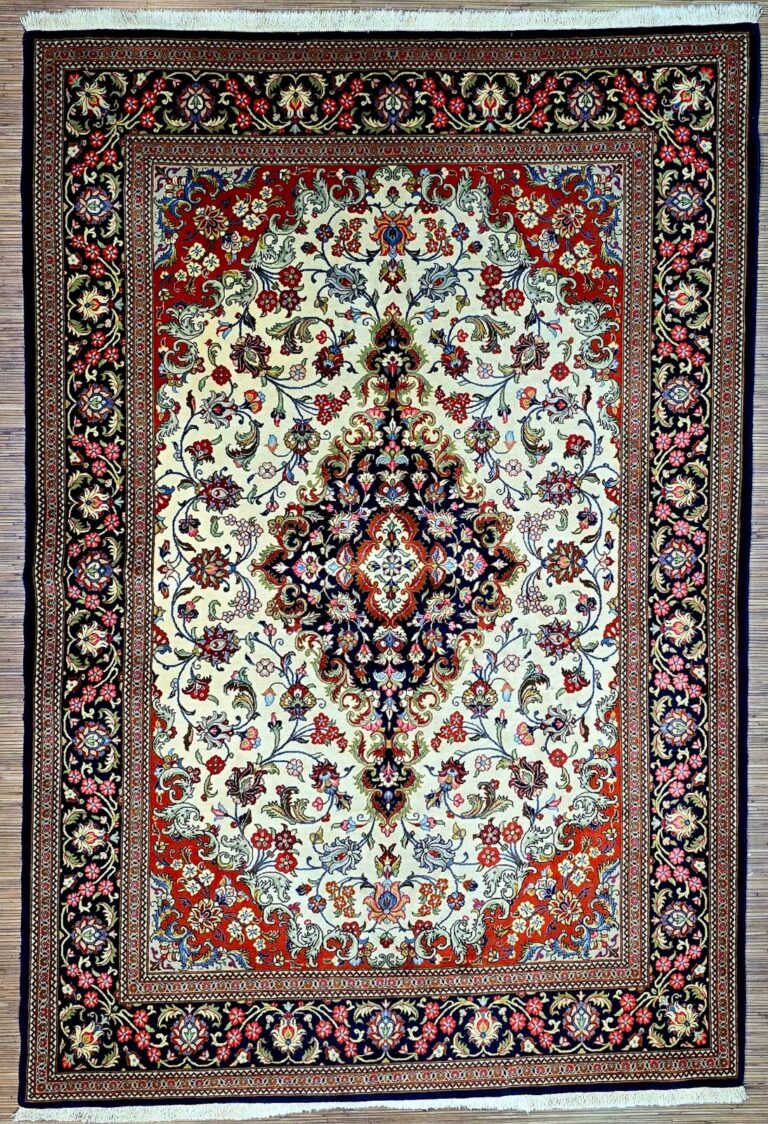
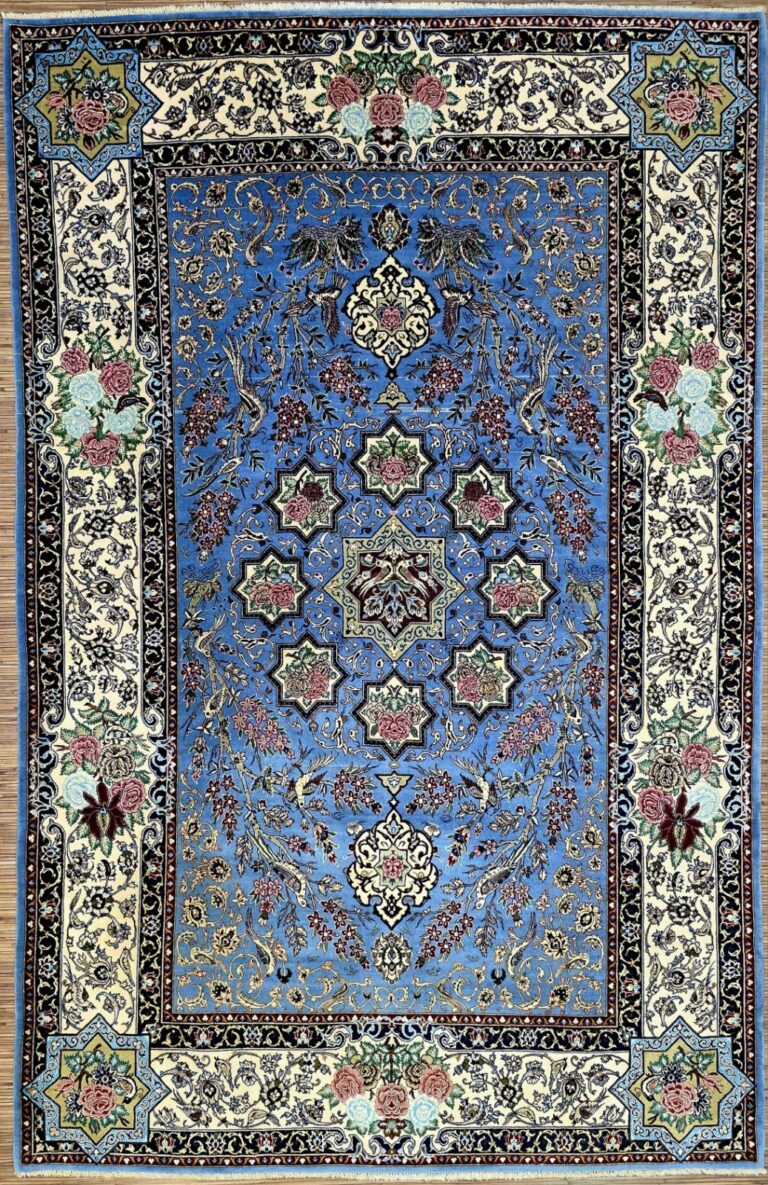
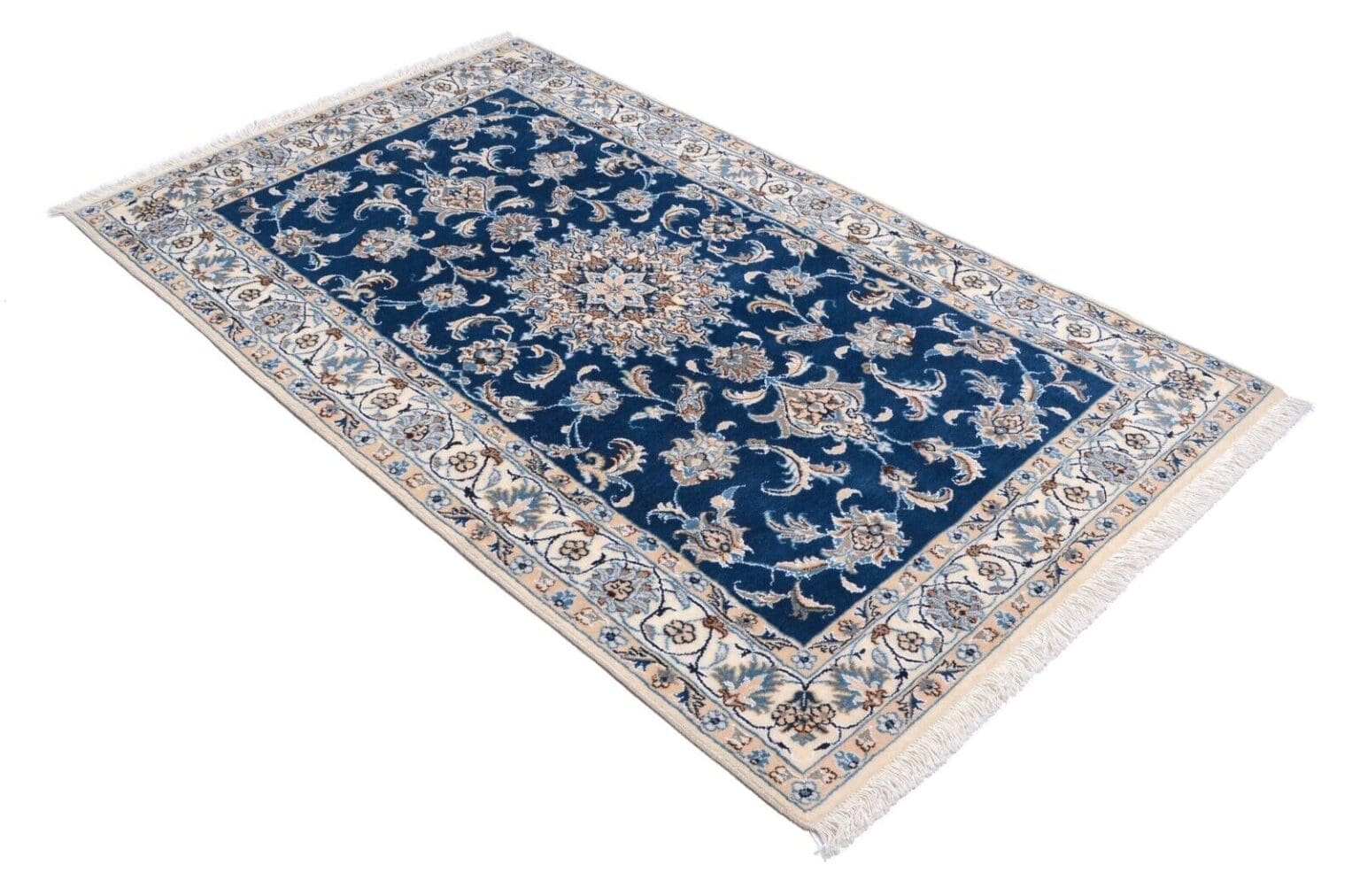
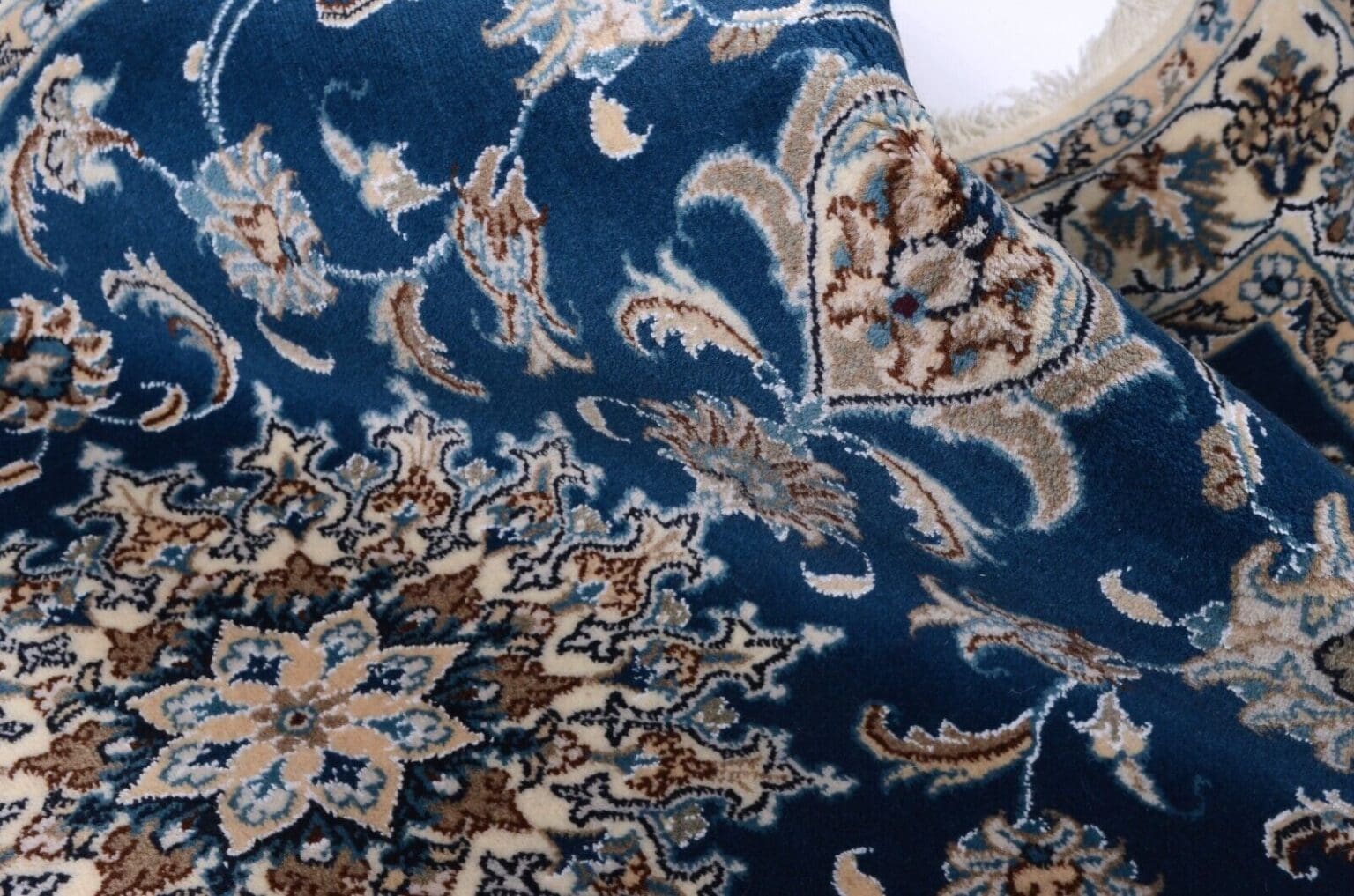
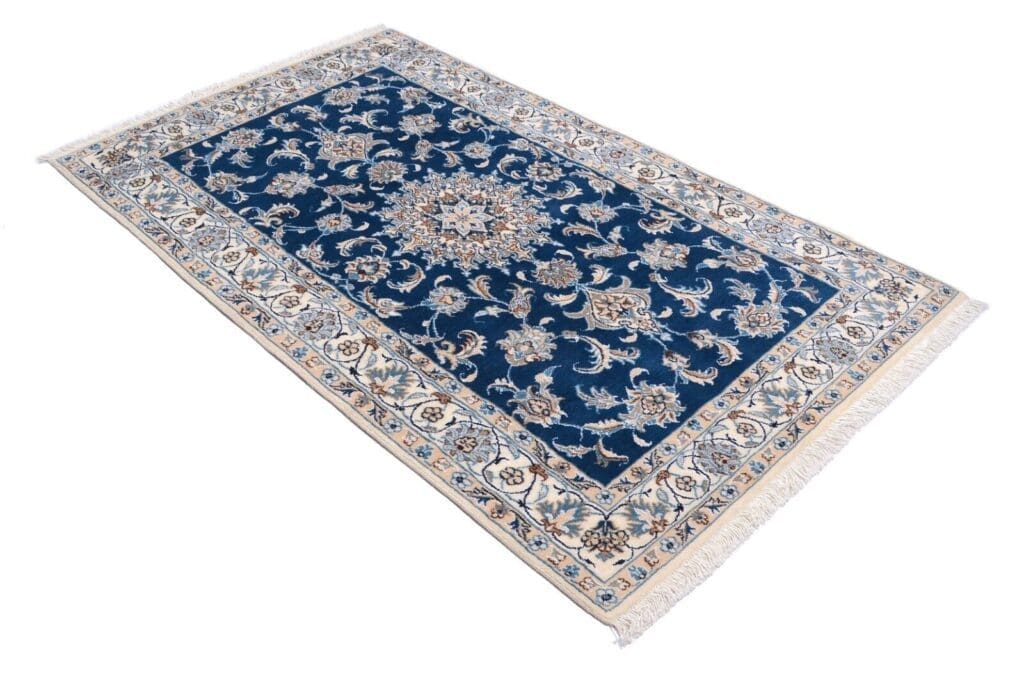
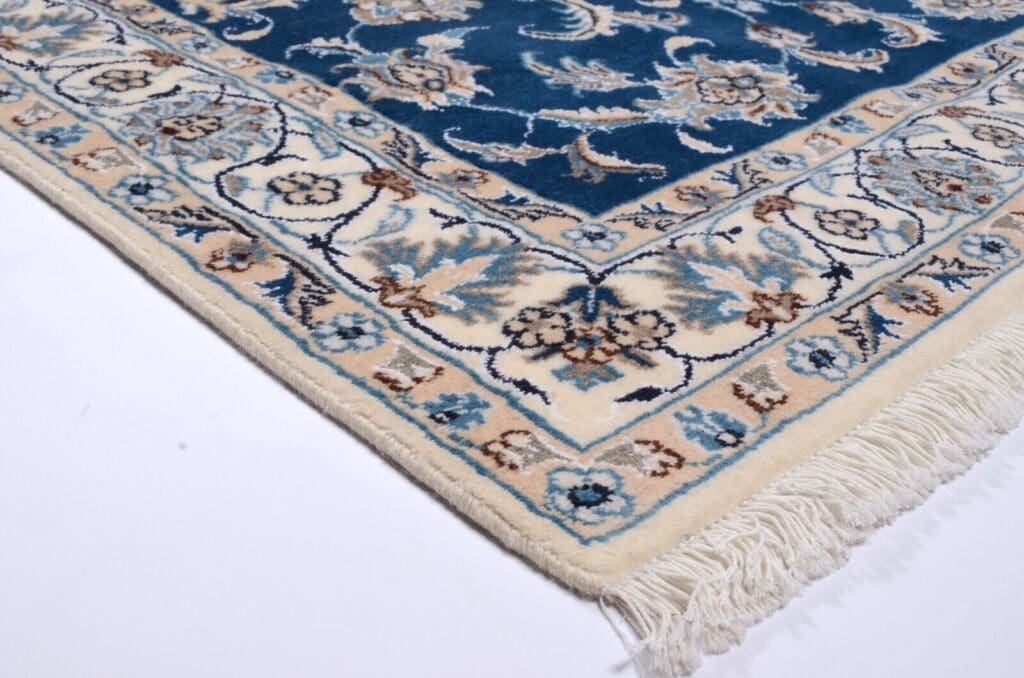
This Nain Persian rug is hand-knotted with a pile made of 100% virgin wool. Hand production brings the fibre together with a detailed knotting process in which each knot is placed individually into the prepared foundation. The resulting surface has a dense textile structure, allowing the floral forms to be defined across the design. Because the work is carried out by hand, this rug is a one-off within the tradition of oriental carpet making.
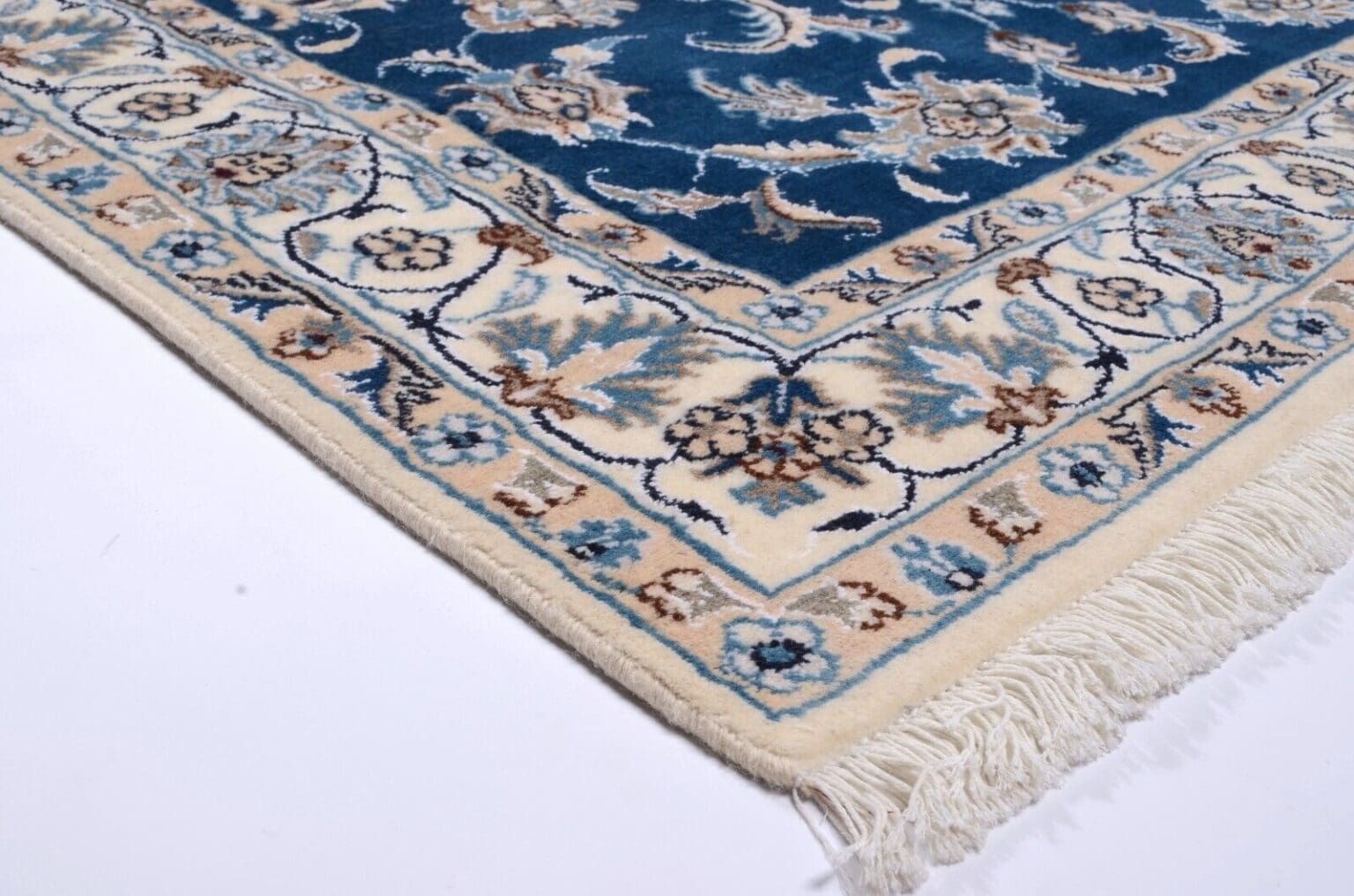
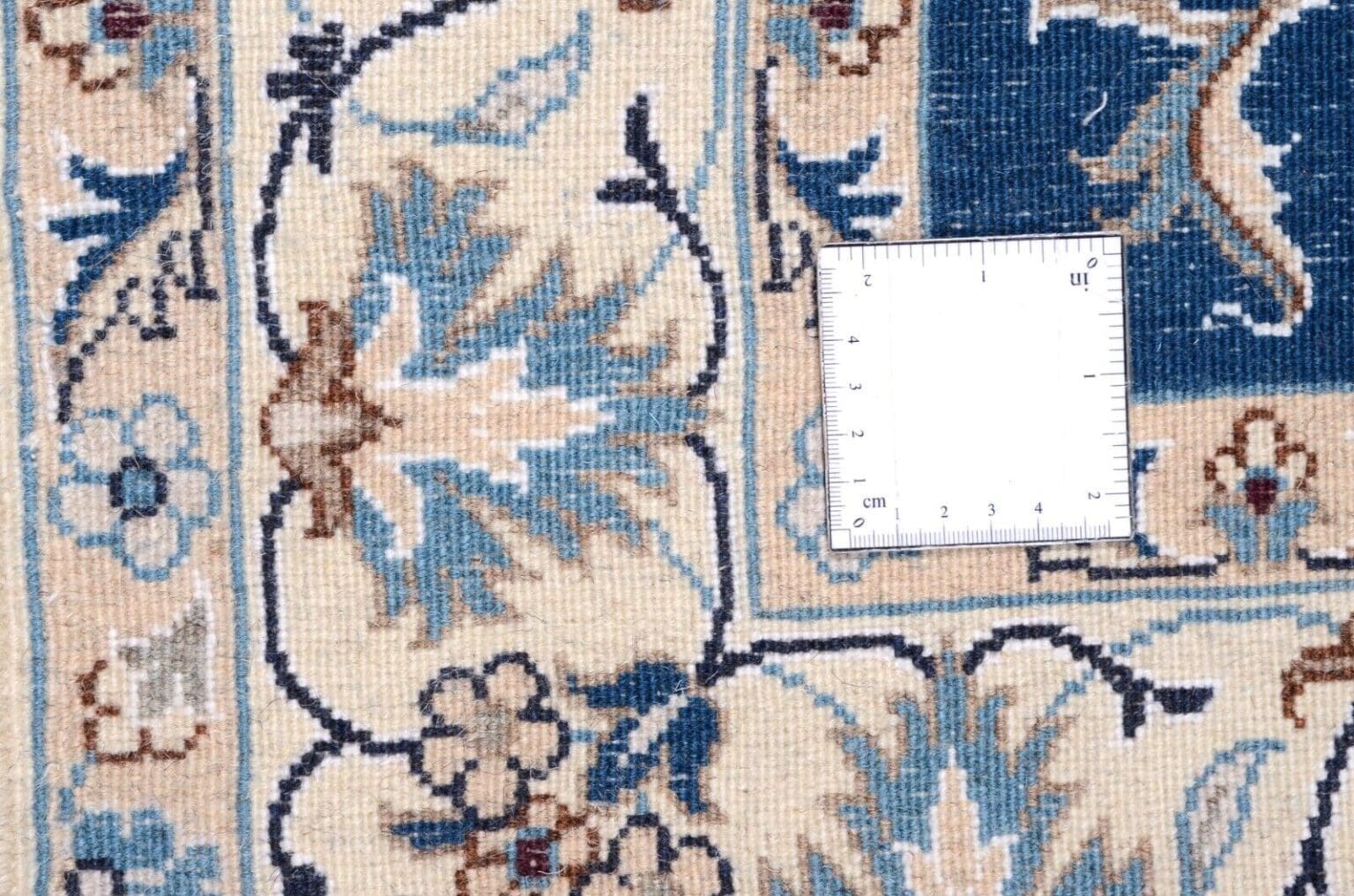
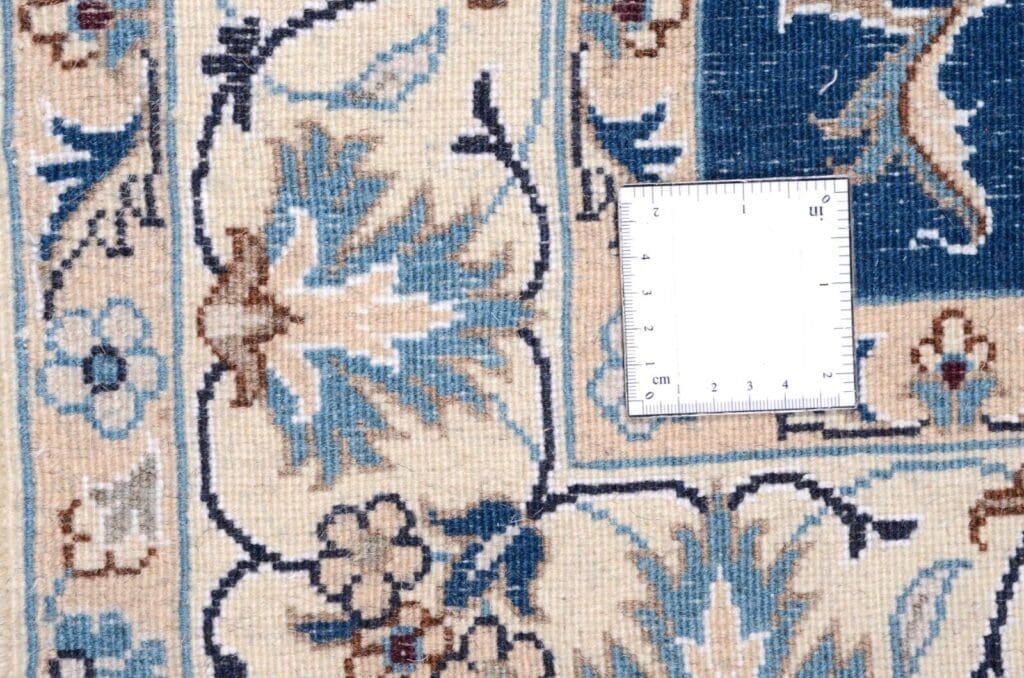
The rug has a knot density of 300,000 knots per square metre. A dense knot structure supports the rendering of fine outlines and numerous small ornaments. This is particularly relevant to a floral design, where petals, leaves, vines and connecting lines need to remain visually distinct. The wool forms the pile and gives the surface the characteristic textile handle associated with a hand-knotted wool rug.
Wool has been used as a pile fibre in Persian carpet making for centuries. It can be spun into yarn, dyed in many shades and worked through different knotting methods. The appearance of a hand-knotted rug depends not only on the fibre but also on yarn tension, the regularity of the rows and the careful continuation of every contour. These practical steps shape the visible texture and definition of a Nain rug.
This rug is suitable for use over underfloor heating. It also has high colour fastness. Royal blue is the defining colour of the piece, so the colour itself forms an essential part of the design and works together with the floral arrangement rather than standing apart from it.
Origin and Tradition
Nain is located in Central Persia and is known as a town and carpet-producing region with its own established knotting tradition. The town lies in the Iranian highlands, north-east of Isfahan. Within Persian carpet culture, Nain rugs are commonly associated with carefully organised ornament, fine knotting and balanced compositions. The regional craft developed through the practical use of yarn, dye, knot structure and repeated decorative forms.
Carpet making in Nain reaches back to the early modern period. Knowledge of preparing fibres, handling colour, tying knots and arranging patterns was passed on through generations of makers. As in other Iranian weaving centres, the loom is more than a tool of production: it is the setting in which inherited systems of proportion and ornament are applied by hand. The process requires concentration throughout, since small changes can affect the alignment of lines and the appearance of a design.
Nain rugs are traditionally connected with fine knotting and carefully differentiated ornament. Floral elements, vines, leaves, rosettes and medallions may be combined into an ordered field. These forms belong to the visual vocabulary of Persian rugs, where a composition can be structured through a central field, a border and repeated secondary details. Individual Nain rugs do not all use the same layout, yet many share an emphasis on controlled decoration and precise line work.
The craft is transmitted through practical experience. This includes working with wool, reading a design plan, placing the knots and maintaining the sequence of rows. When the knot density is high, progress is necessarily gradual because many separate actions are needed for a small visible area. The hand-knotted character therefore remains central to the Nain tradition, alongside the choice of material and the arrangement of colour.
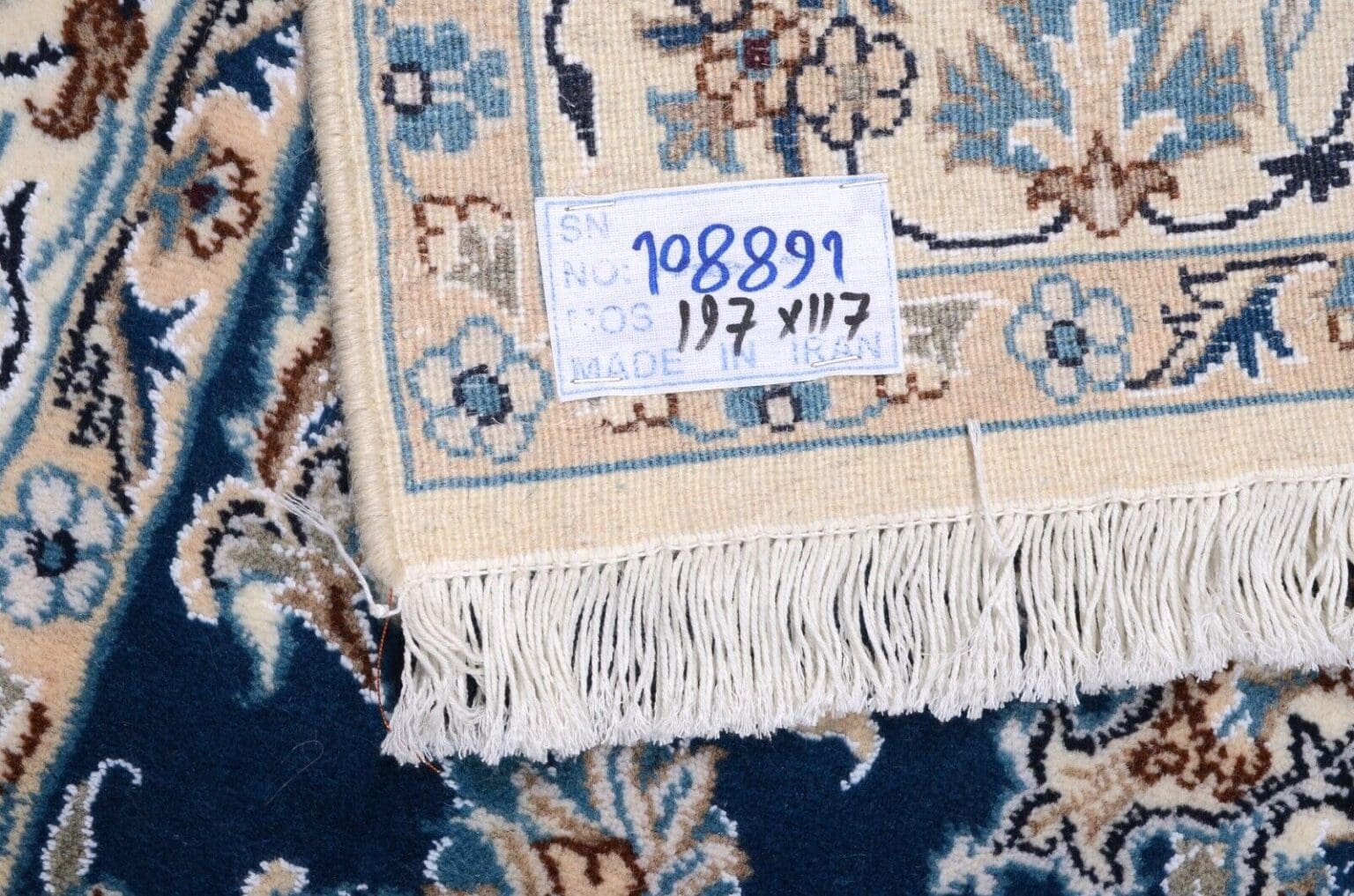
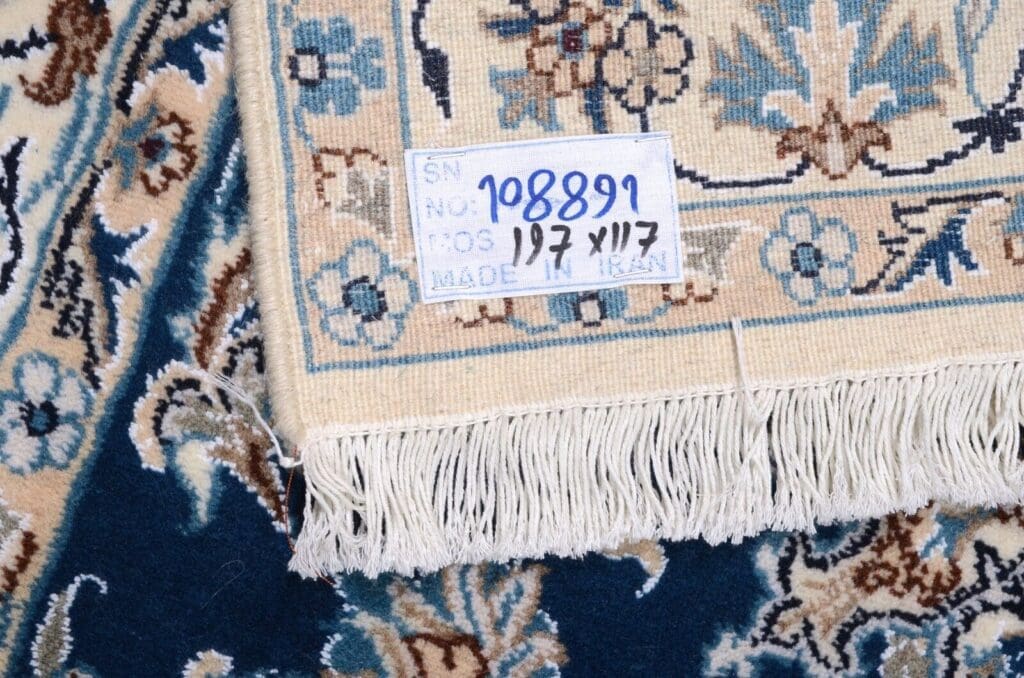
Iranian origin is what places this piece within the category of a Persian rug. Persian rugs are not defined by one single pattern; they reflect regional techniques, inherited forms and the relationship between material and handwork. Nain is one of the recognised regional names associated with finely ordered floral compositions and medallion-based designs. This rug is identified as a Nain Persian rug from Central Persia.
Design and Pattern
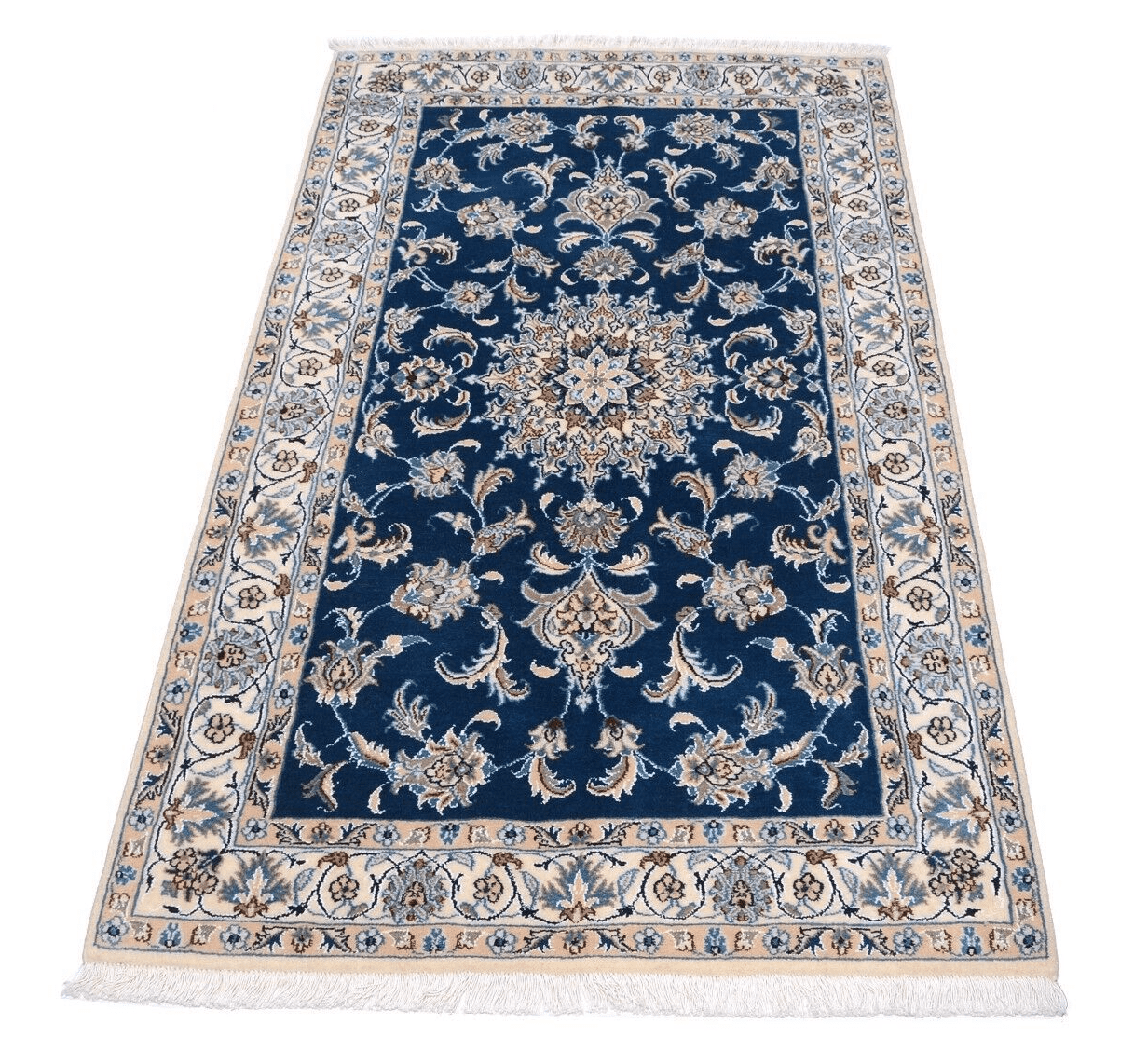
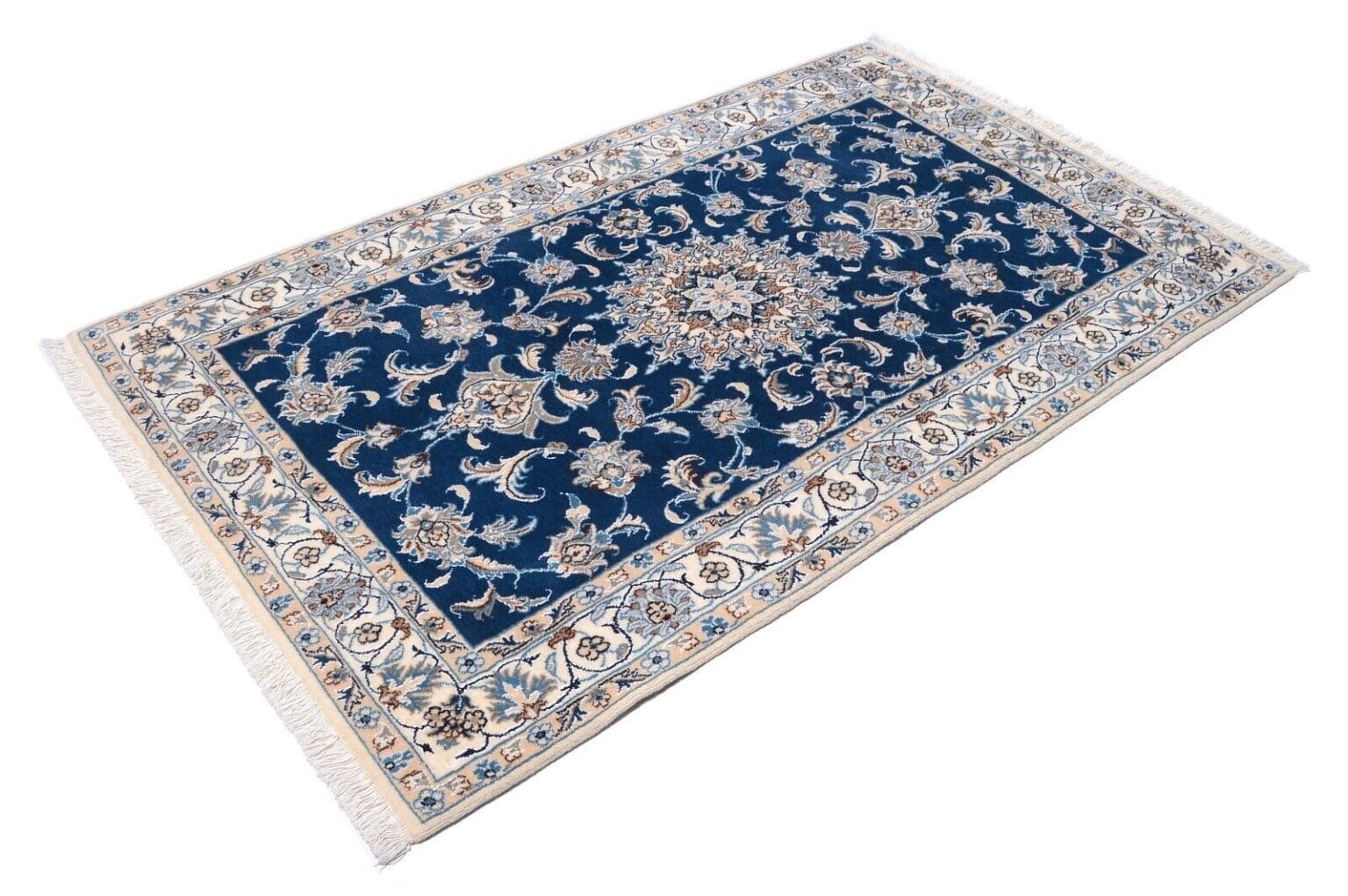
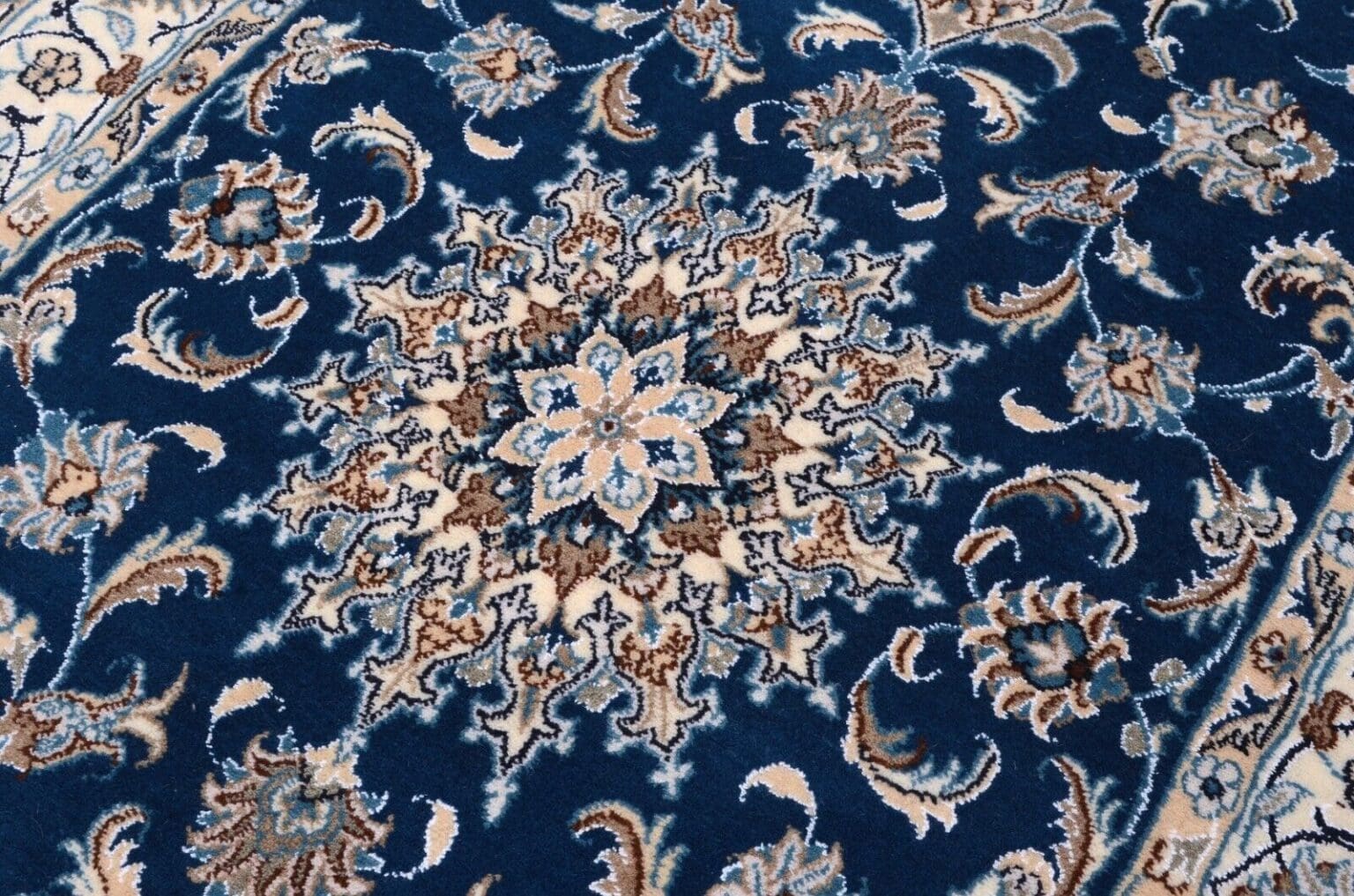
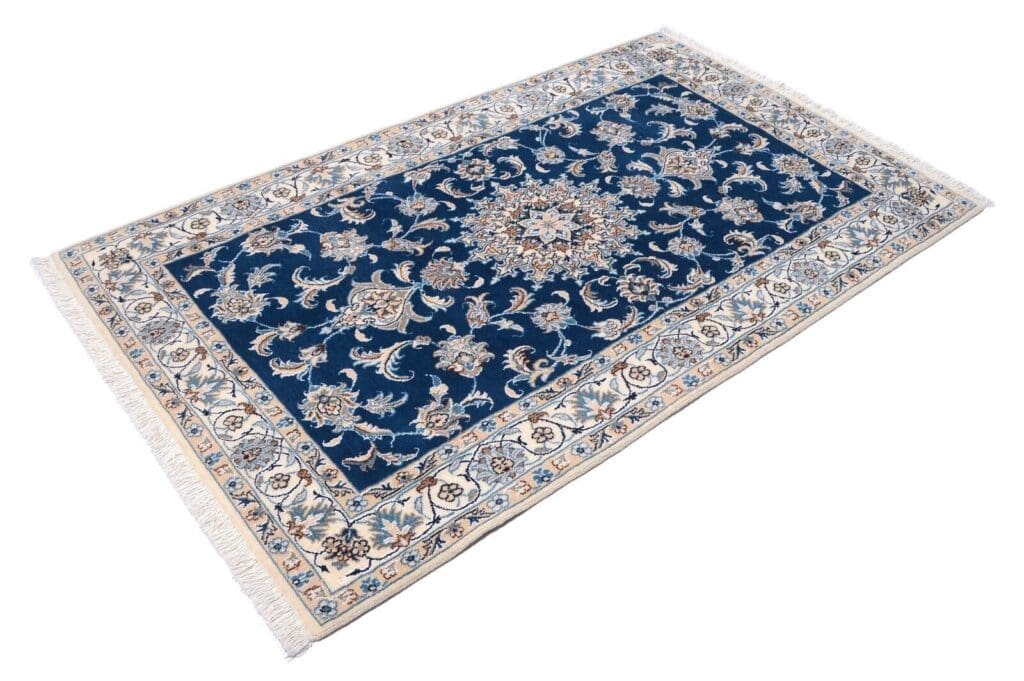
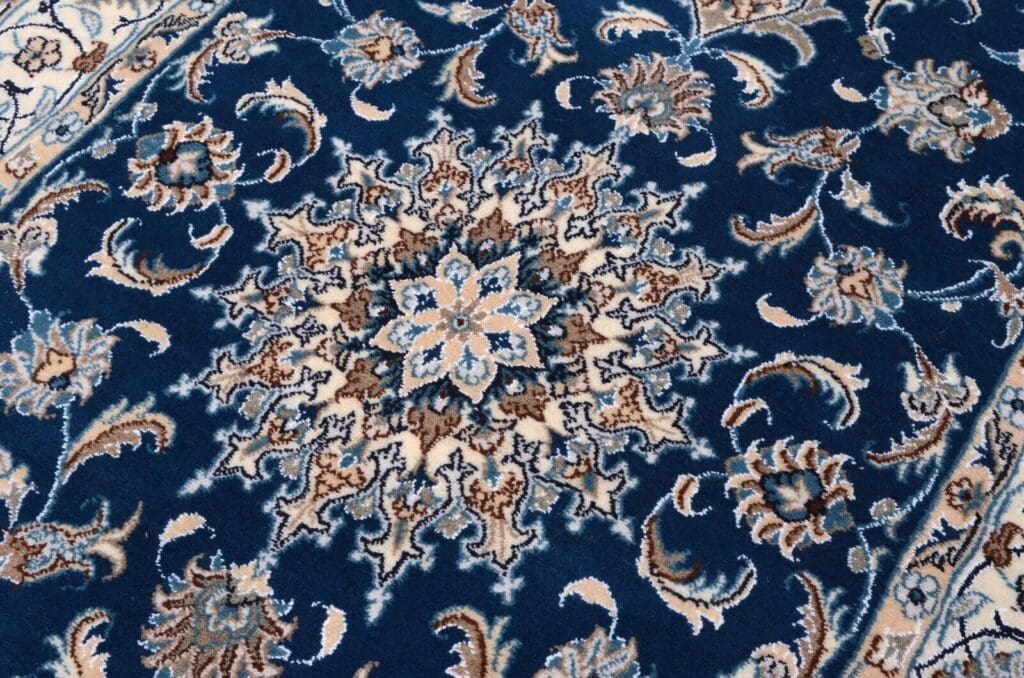
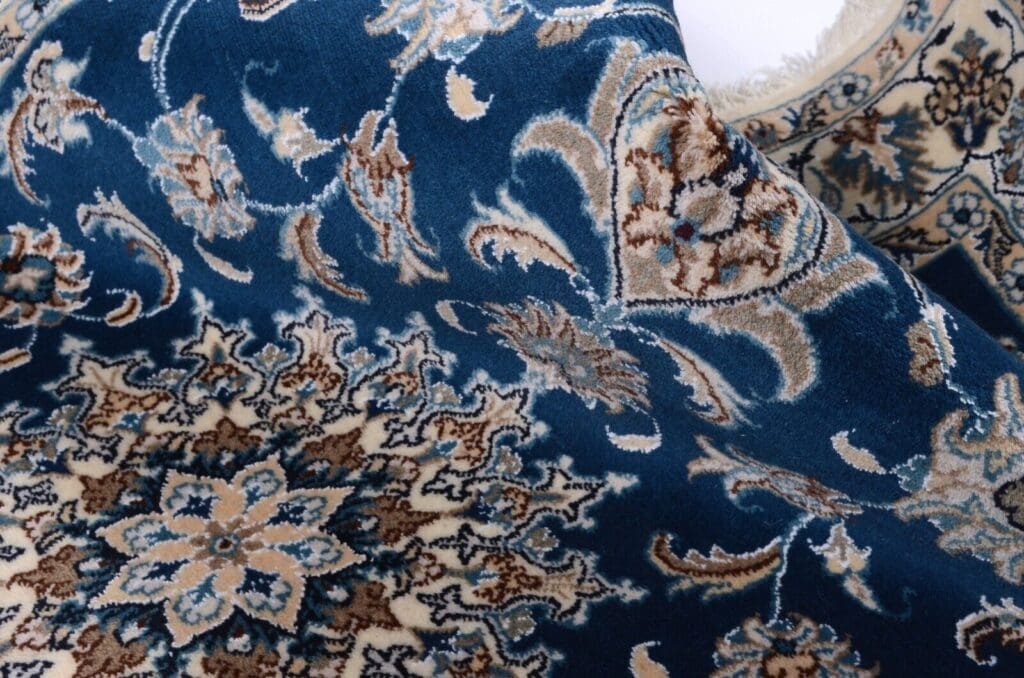
The design of this rug combines a floral motif with a medallion. Two established principles of Persian carpet design come together here: botanical ornament and a clearly marked centre. A medallion can provide a visual focus, while vines, leaves and flowers guide the eye from the centre towards the surrounding field. The overall effect depends on the relationship between the main motif, the smaller ornaments and the distribution of colour.
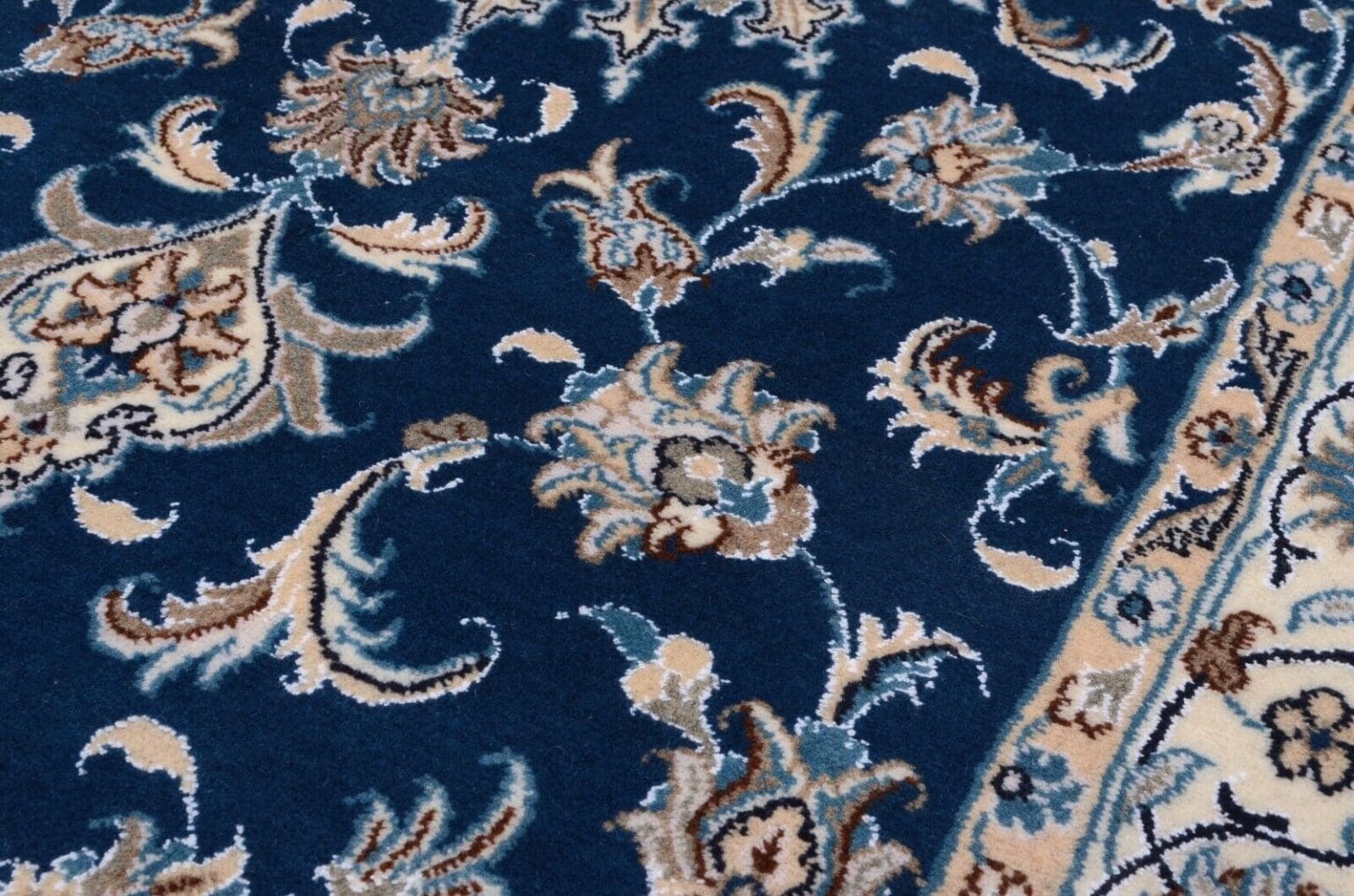
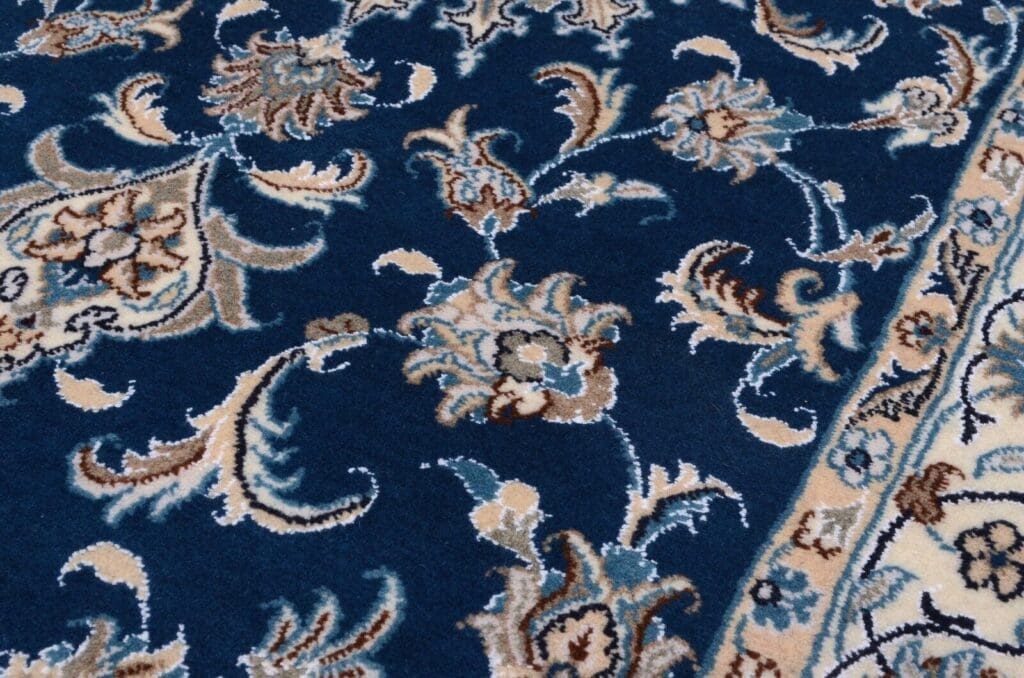
Floral patterns are widespread in Persian art. They do not usually reproduce a landscape literally; instead, forms from nature are transformed into an ordered ornamental language. Flowers may be stylised, leaves arranged rhythmically and vines used as linking lines. Repetition and symmetry create continuity across the field, while variations in scale and placement prevent the design from becoming mechanically uniform. Nature serves as a source of forms, but the finished composition follows the principles of ornament.
Royal blue is the dominant ground colour of this rug. In Persian carpet design, a deep blue ground can provide a calm background against which lighter or contrasting ornaments become legible. It adds visual depth and helps the outlines of floral elements stand out. The way blue is perceived may change with the surrounding light, but it remains the principal colour reference for the composition.
The combination of royal blue, a medallion and floral ornament places the rug within a recognisably Persian decorative tradition while giving it a clearly defined colour presence. A centred composition can complement the symmetry of a traditional interior. At the same time, a strong blue ground can serve as a single colour accent in a more contemporary setting. This describes the general design potential of these elements, not a claim about any particular room.
In a finely knotted floral rug, the treatment of line is important. Narrow contours separate petals, vines and areas around the medallion. Repeated shapes establish rhythm, while changes in size and direction keep the field active. The result is a cohesive ornamental surface in which the individual forms remain connected to the overall composition.
Special Features
The knot density of 300,000 knots per square metre is one of the stated features of this rug. It relates to the detailed execution of its hand-knotted floral design. The pile is made from virgin wool, and the high colour fastness supports the lasting perception of the royal blue ground. These points describe the specific construction and finish of this individual piece.
The rug is new and in perfect condition. It is suitable for rooms with underfloor heating, making that installation possible without excluding the use of this rug. As with hand-knotted wool rugs, regular gentle care remains appropriate. Dust and loose particles should be removed without placing unnecessary strain on the pile. Strong, direct sunlight should be avoided so that the colours remain as even as possible over time.
FAQ
How should I care for my Nain Persian rug?
Regular vacuuming on a low setting helps remove dust and loose particles from the pile. Vacuuming should be carried out without excessive pressure so that the hand-knotted surface is treated gently. Direct sunlight should be avoided because prolonged exposure can cause colours to fade. If a fresh stain occurs, it should be treated promptly with a damp cloth and a suitable carpet cleaner. Vigorous rubbing is not advisable, since it can work the dirt further into the fibres or put unnecessary stress on the surface. For heavier soiling, professional rug cleaning is the safer method and preserves the material and structure more reliably.
Where does the knotting technique used for Nain rugs come from?
The knotting technique of Nain rugs belongs to the long Iranian tradition of carpet making and has been practised in Nain for centuries. It is based on placing individual knots into a prepared warp and building the rug row by row. The pattern is formed by the sequence of coloured knots, so the maker must follow the design carefully while maintaining consistent tension. A high knot density requires patience and precise work. It allows floral outlines and medallion details to be rendered with greater definition. Knowledge of the wool, the knot sequence, the tension and the pattern is transmitted through practical craft experience from one generation to the next.
Can this rug be used in a modern interior?
Yes. The royal blue colour, floral motif and medallion give the rug a distinct Persian identity without limiting it to one style of room. In a traditional interior, the centred composition can echo existing symmetry and ornamental furnishings. In a modern setting, the strong ground colour can act as a single, clearly defined accent, while the floral pattern introduces a traditional counterpoint to uncomplicated furniture. The surrounding palette and the existing shapes in the room will determine the final balance. For that reason, a Nain Persian rug can be integrated into both classic and contemporary interiors.
To provide the best experiences, we use technologies like cookies to store and/or access device information. Consenting to these technologies will allow us to process data such as browsing behavior or unique IDs on this site. Not consenting or withdrawing consent, may adversely affect certain features and functions.
Functional Always active
The technical storage or access is strictly necessary for the legitimate purpose of enabling the use of a specific service explicitly requested by the subscriber or user, or for the sole purpose of carrying out the transmission of a communication over an electronic communications network.
Preferences
The technical storage or access is necessary for the legitimate purpose of storing preferences that are not requested by the subscriber or user.
Statistics
The technical storage or access that is used exclusively for statistical purposes.The technical storage or access that is used exclusively for anonymous statistical purposes. Without a subpoena, voluntary compliance on the part of your Internet Service Provider, or additional records from a third party, information stored or retrieved for this purpose alone cannot usually be used to identify you.
Marketing
The technical storage or access is required to create user profiles to send advertising, or to track the user on a website or across several websites for similar marketing purposes.
 SECURE PAYMENT
 SHIPPING PARTNERS