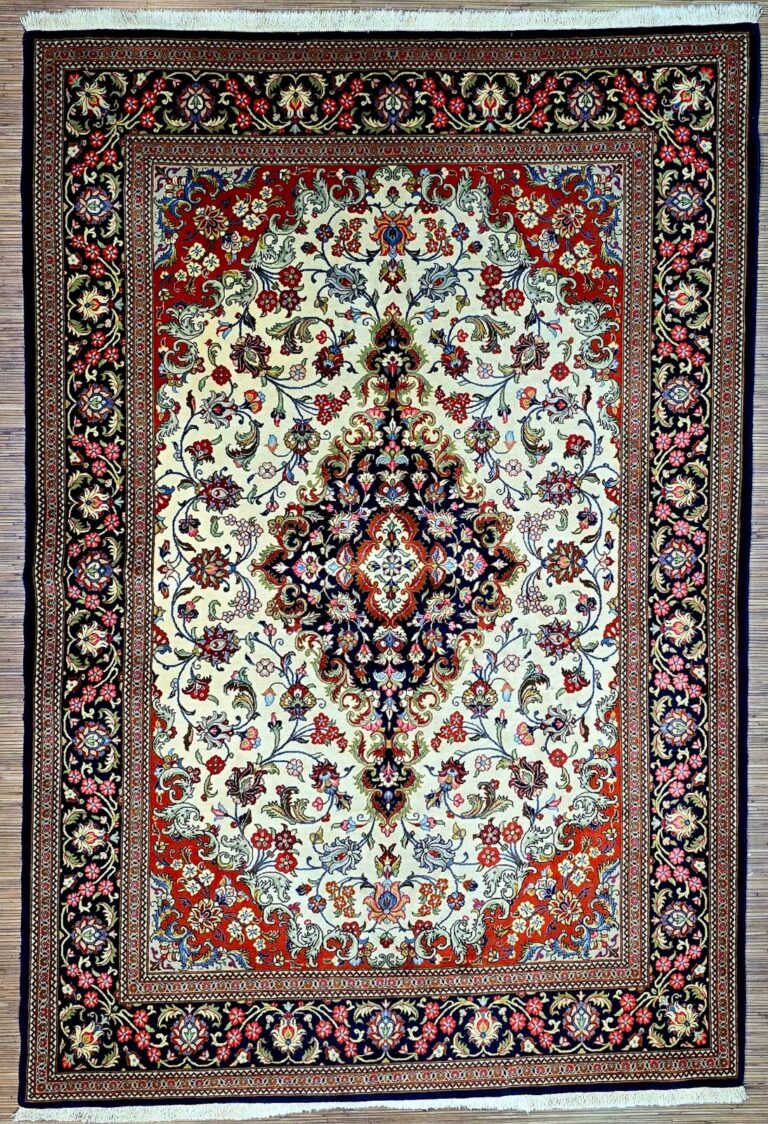
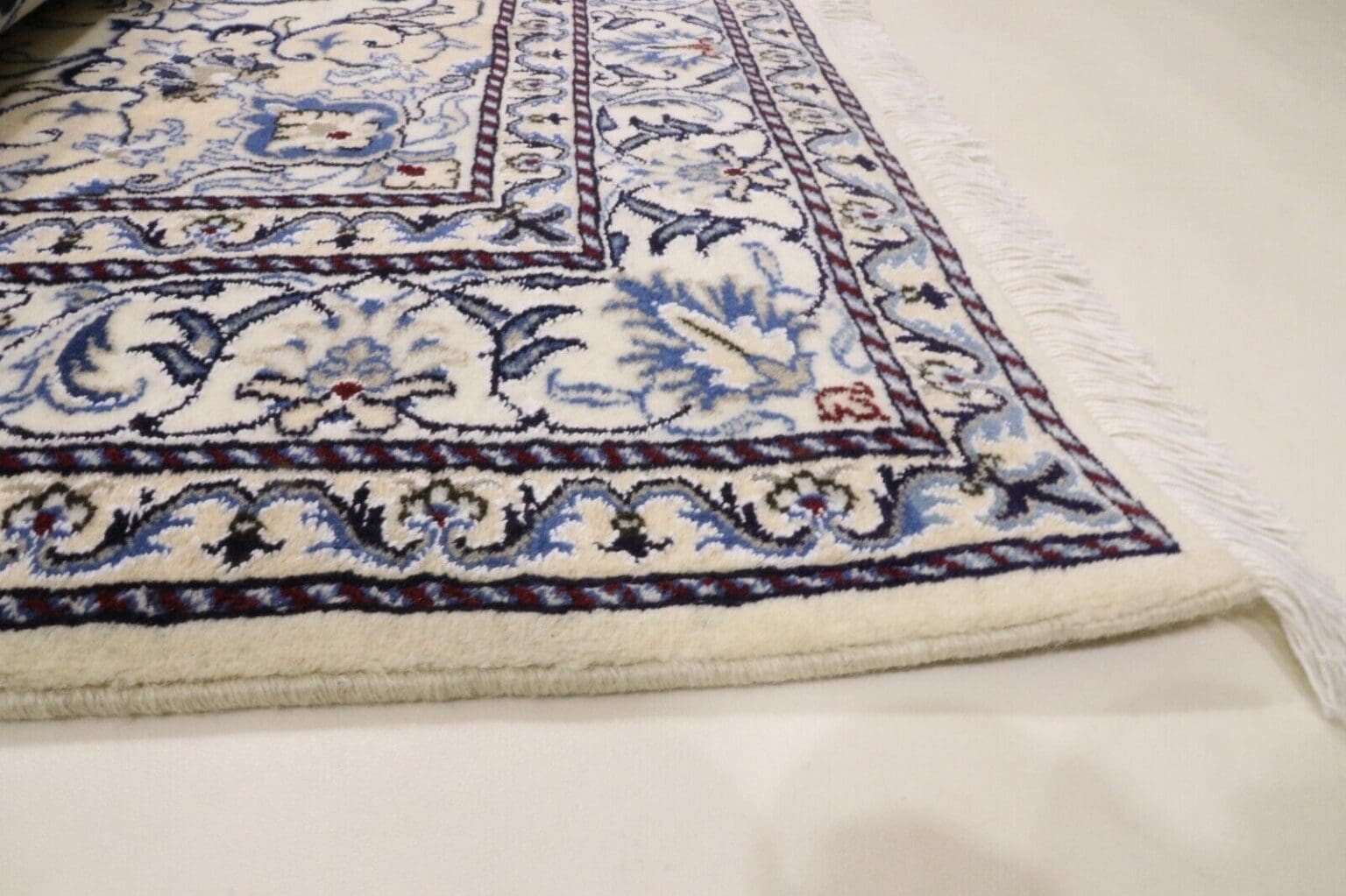
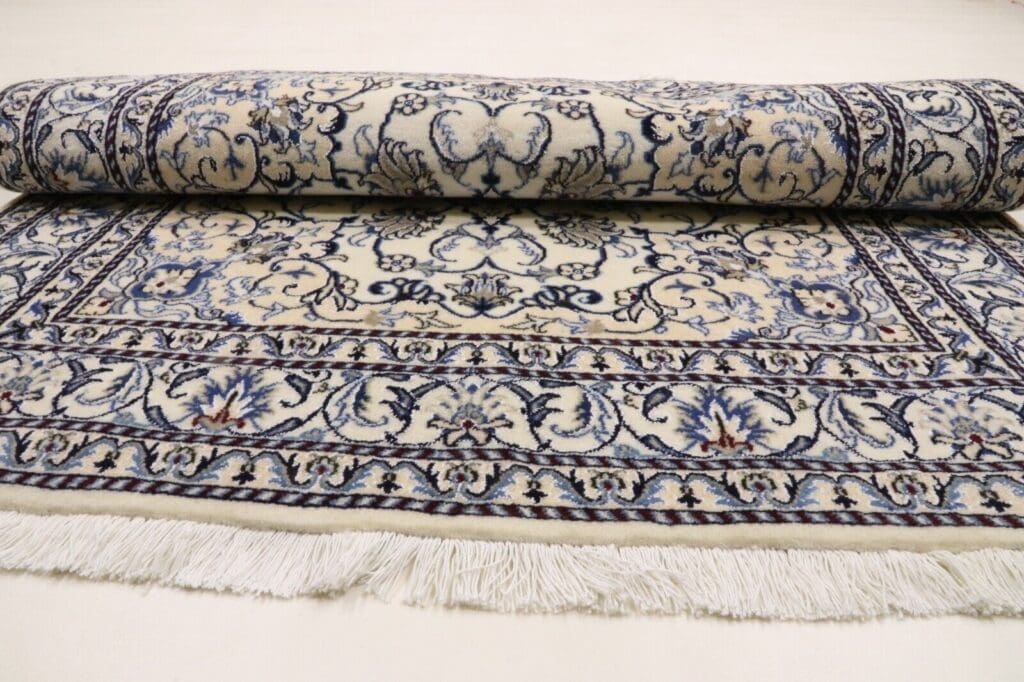
This round Super Nain rug is hand-knotted from 90% virgin wool and 10% silk. Virgin wool forms the larger part of the pile and is valued in rug making for its resilience, natural structure and ability to retain a pleasing surface over time. It is also a practical fibre for a floor covering because wool has a firm feel and can withstand regular use when the rug is properly maintained. The wool component gives the pile substance, while the silk content introduces a finer element to the material composition.
Silk is traditionally used in Oriental rug making when a more delicate surface effect and greater visual refinement are desired. Its smooth fibres can reflect light differently from wool, producing a discreet sheen as the surface is viewed from changing angles. In this rug, the combination of virgin wool and silk brings together two established textile materials with different characteristics. The result is a pile that combines the substantial nature associated with wool with the fine appearance associated with silk.
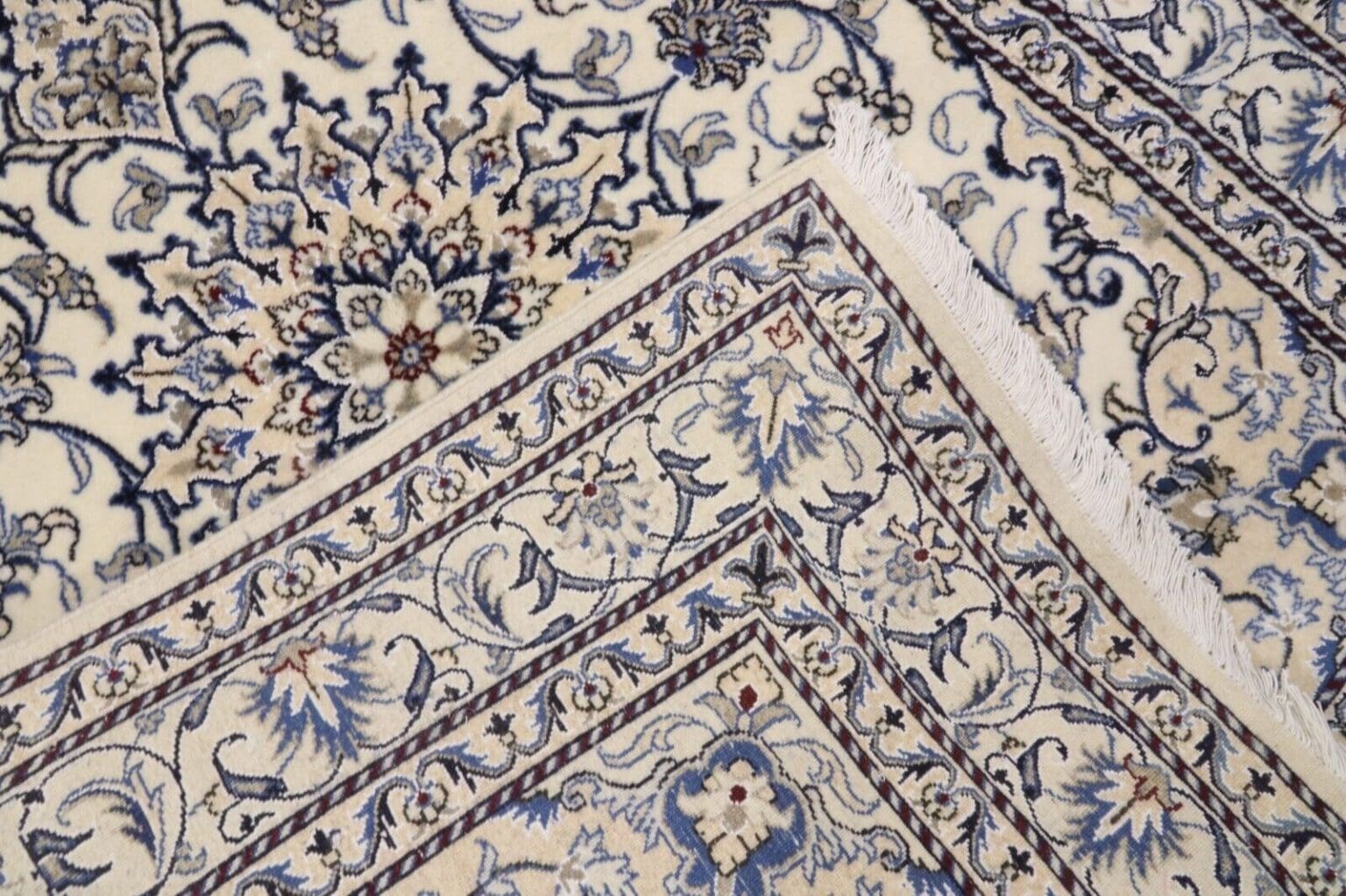
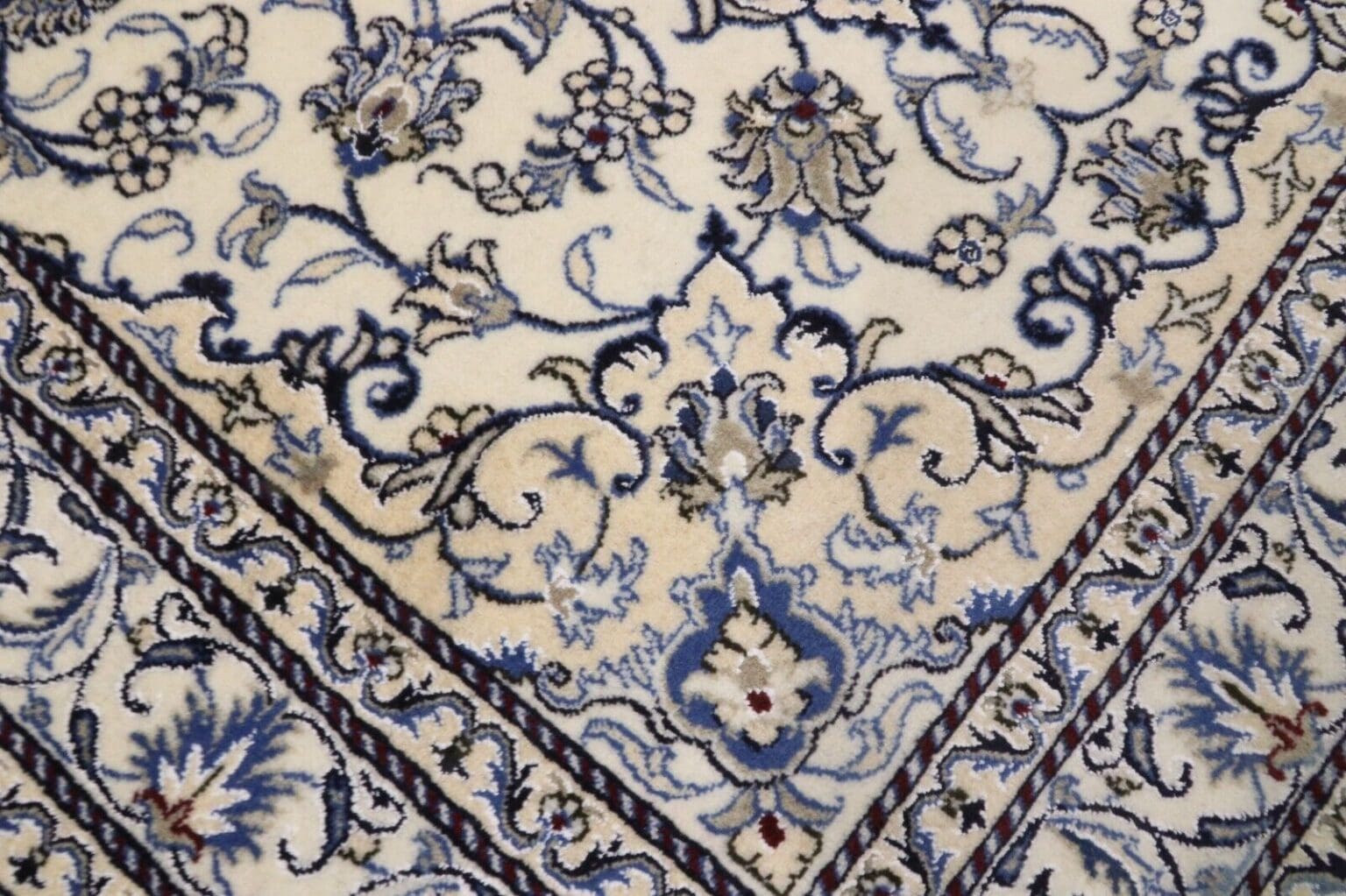
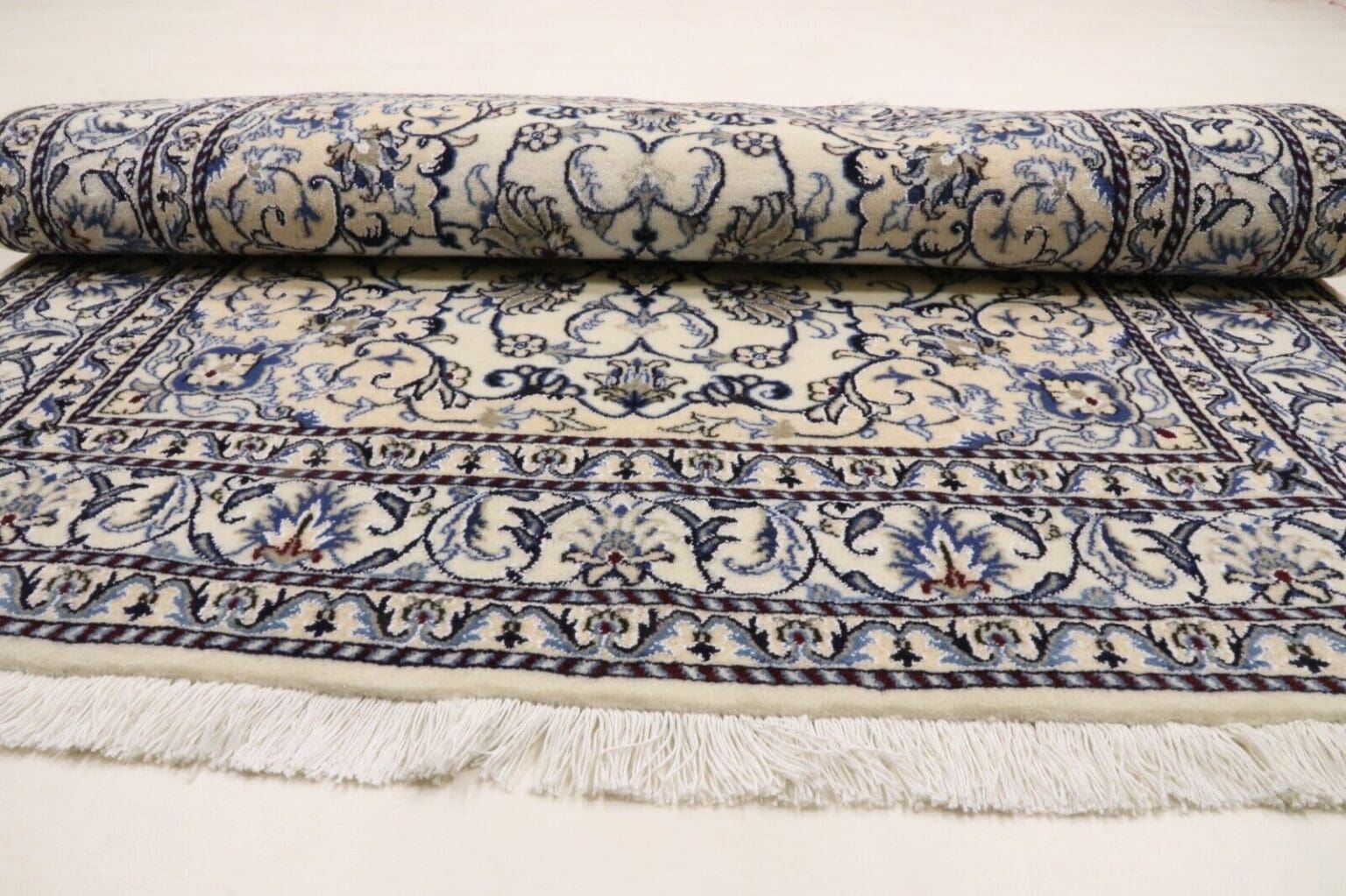
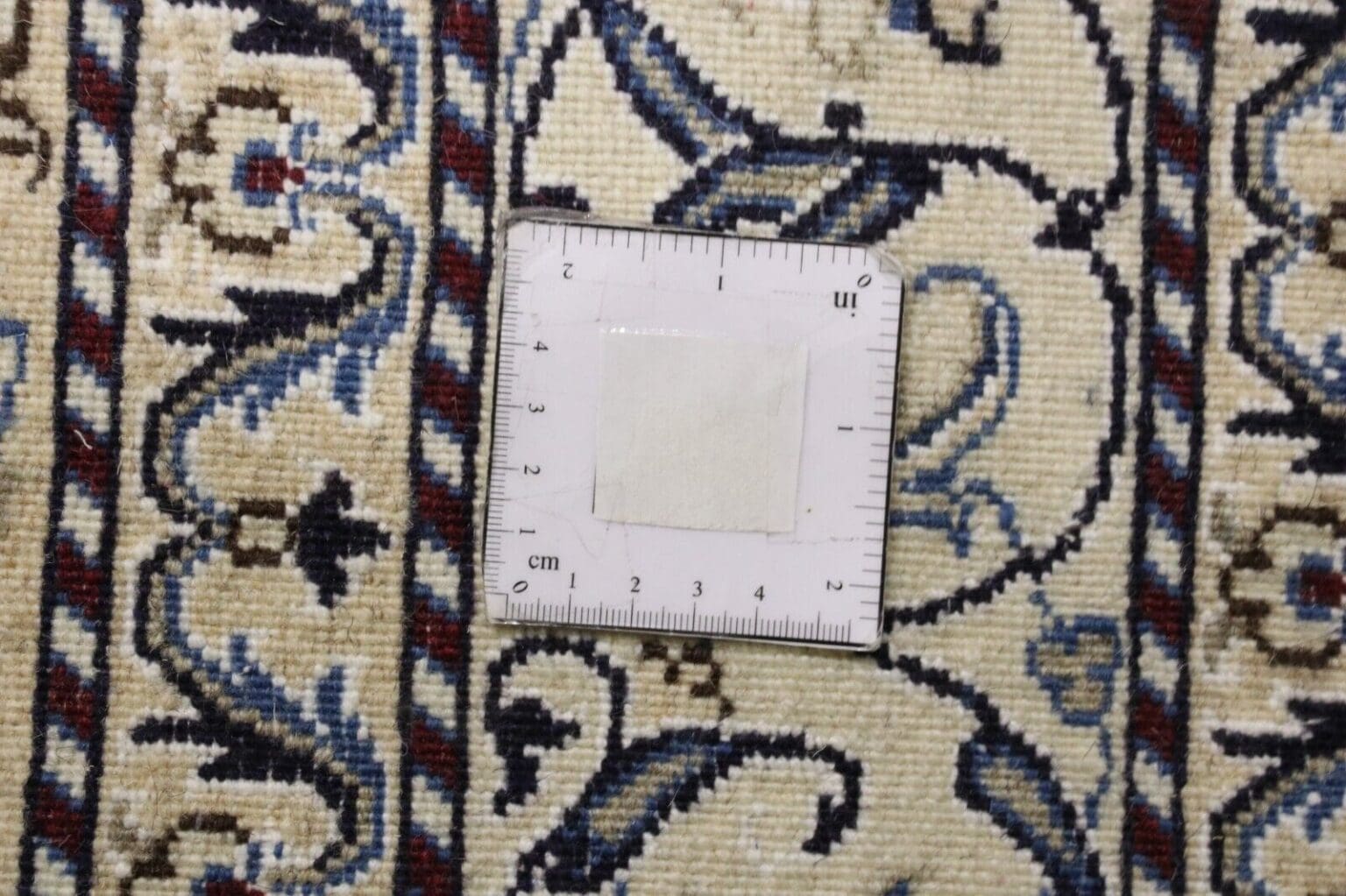
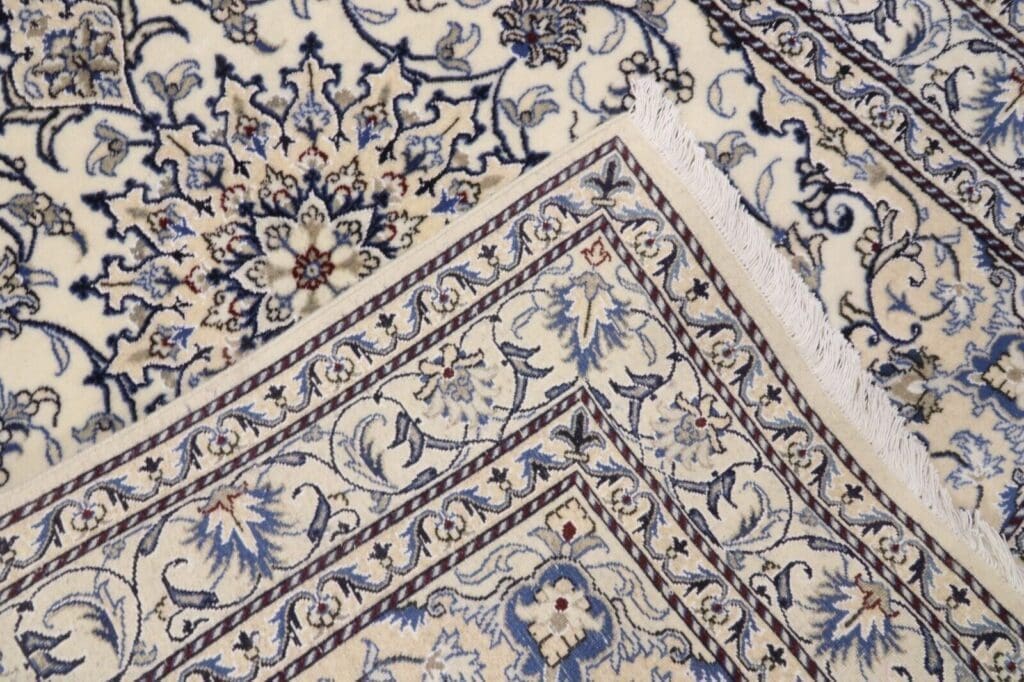
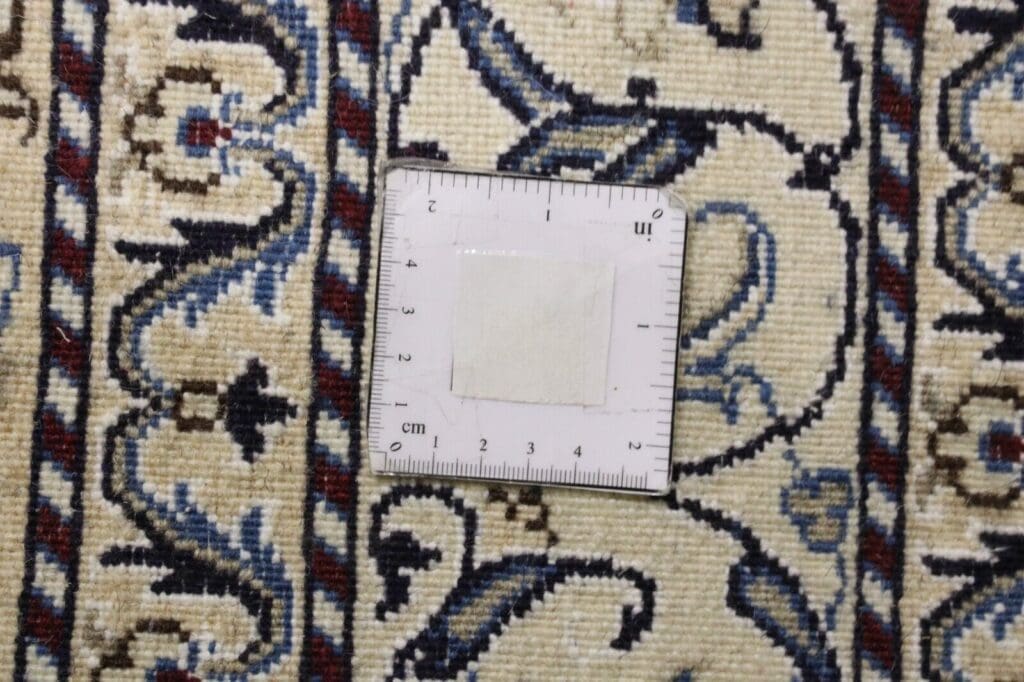
The rug is hand-knotted rather than machine-made. In this technique, individual knots are tied by hand around the warp, and rows of knots are built up gradually to form the pile. The process requires coordinated work with the design, the structure and the tension of the foundation. A knot density of approximately 300,000 knots per square metre indicates a finely worked construction. Hand-knotting also allows detailed motifs and carefully arranged transitions to be created across the surface.
Hand-knotting is a traditional form of textile craftsmanship in which the pile, foundation and pattern develop together during the making process. The stated materials and construction describe this piece as a Persian rug with a wool-and-silk pile and a finely knotted surface. Its round format is part of its design and distinguishes it from the more usual rectangular rug format. As with hand-knotted textiles generally, the work is based on repeated manual operations rather than industrially uniform production.
Origin and Tradition
Nain is a renowned rug-making region in Iran and is associated with Persian rugs of carefully organised design and refined execution. The name Nain refers to a place and a weaving tradition, not simply to a decorative pattern. Rugs from the region are known for compositions in which floral details, balanced geometry and controlled ornament are brought together in a coherent overall arrangement. The Nain tradition forms part of the wider history of Iranian weaving, in which rugs serve both practical and artistic purposes.
The development of rug weaving in Nain reaches back to the nineteenth century. Local artisans established a tradition of producing rugs intended to combine durability with a high degree of visual order. Over time, Nain weaving connected inherited Persian methods with changing workshop practices and contemporary requirements. This combination of continuity and adaptation is one reason the regional style remains recognisable while allowing individual rugs to differ in format, detail and colour organisation.
Persian rug production is shaped by a close relationship between design and structure. A drawn or memorised pattern guides the placement of motifs, while the weaver builds the surface knot by knot. The scale of the motifs depends partly on the fineness of the construction, and a higher knot density can support more closely arranged detail. Regional traditions provide established principles for borders, central organisation and floral ornament, but the final appearance depends on the particular design used by the workshop.
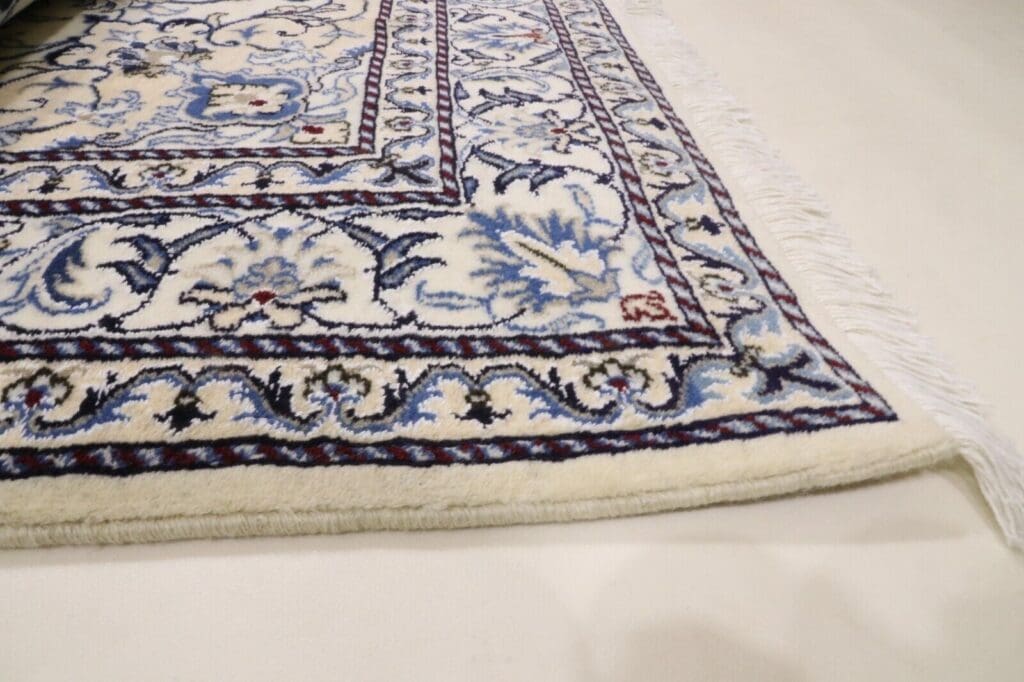
Nain rugs are commonly associated with restrained compositions and a precise handling of line. Their designs often reflect the broader Persian vocabulary of vines, flowers, leaves and geometric ordering. These elements may be arranged around a central field or distributed through a balanced all-over structure. Borders help frame the central area and give the composition a defined edge. The regional tradition therefore combines decorative richness with an emphasis on proportion and visual clarity.
The history of Nain weaving is also part of the wider cultural history of Iran. Persian rugs have long carried regional knowledge through their materials, knotting methods and ornamental language. Workshops pass on technical skills from one generation to the next, while designs preserve references to older floral and geometric traditions. At the same time, artisans can adjust the handling of colour, the scale of motifs and the arrangement of the field. Nain represents this continuing relationship between established craft and evolving interpretation.
This rug is identified as a Nain Persian rug and as a Super Nain. The regional designation places it within the Iranian Persian rug tradition described above. The term Super Nain is used in rug trade language for a particularly refined Nain style, especially in connection with fine knotting and the use of a wool-and-silk pile. It does not replace the origin: Nain remains the named Iranian weaving region. The hand-knotted construction and the stated material composition correspond to the traditional qualities associated with this type.
Design and Pattern
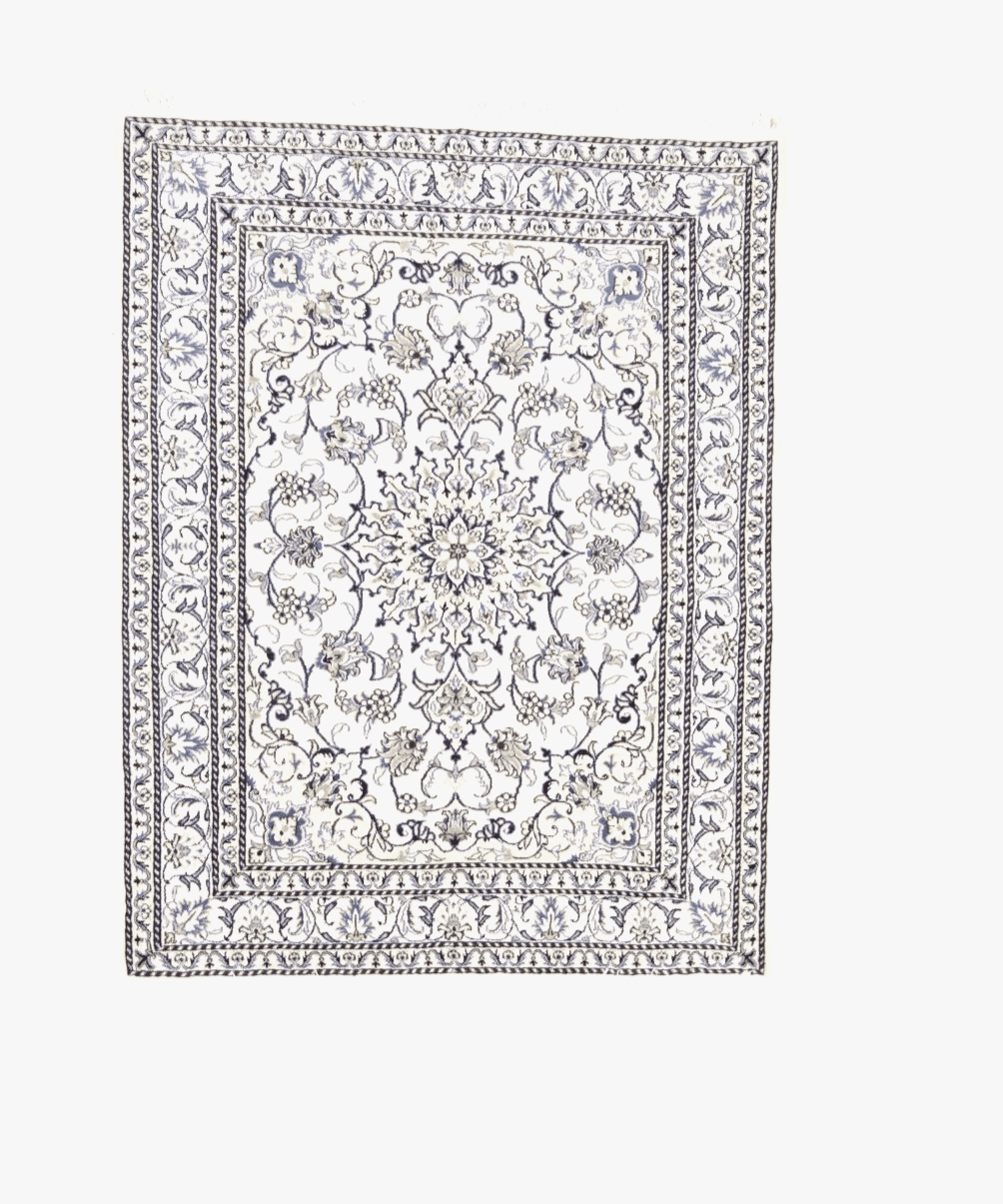
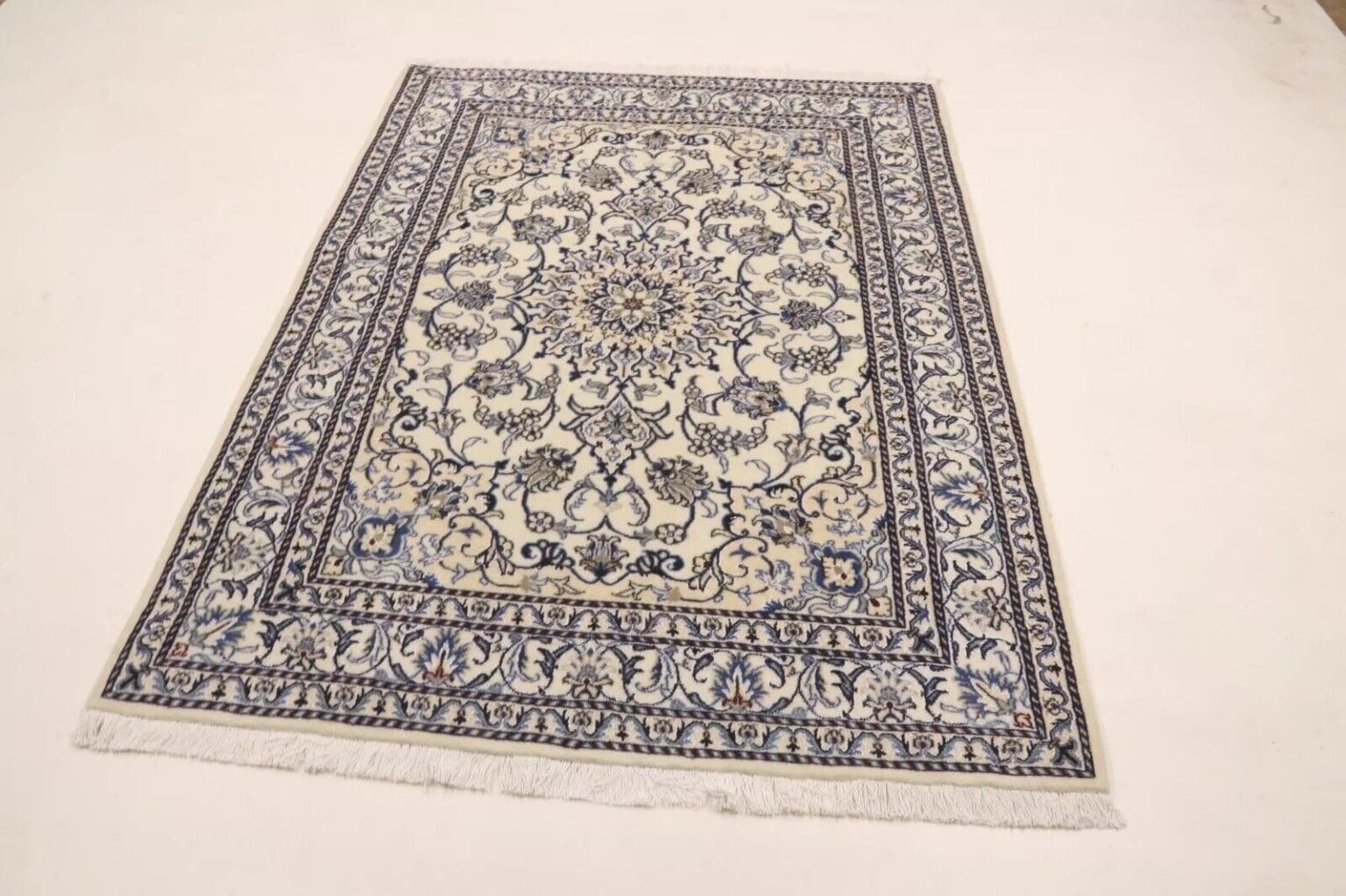
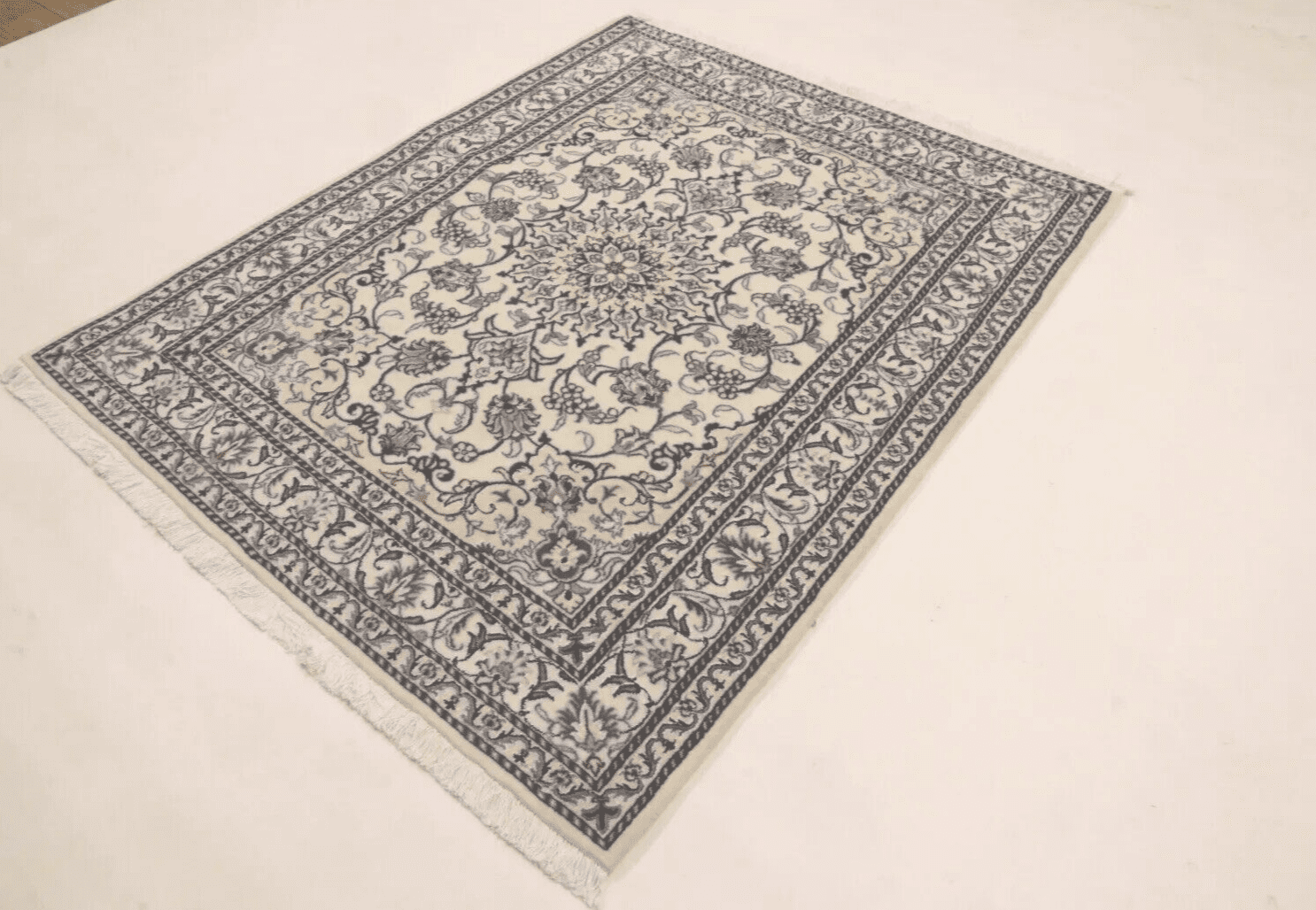
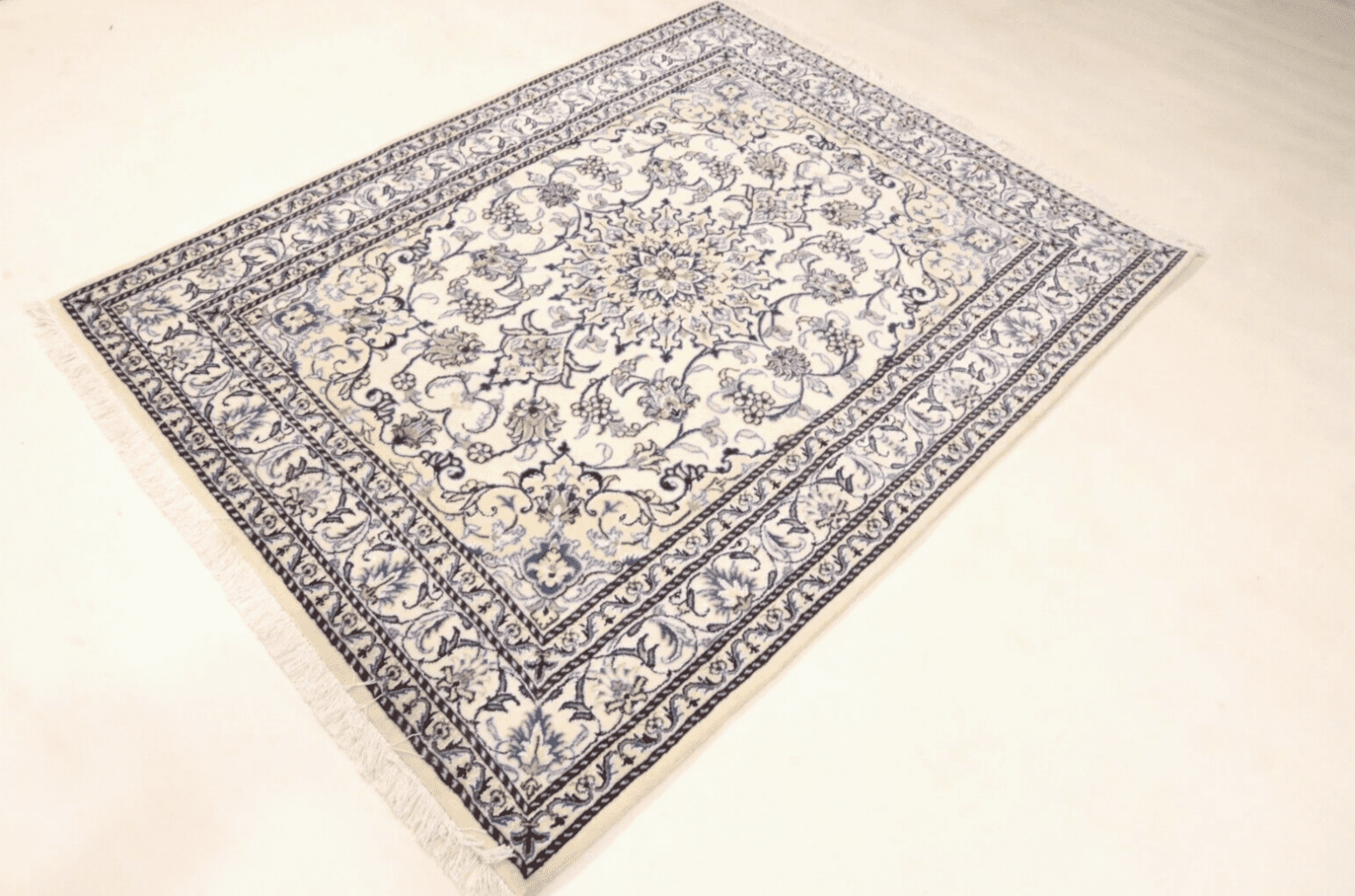
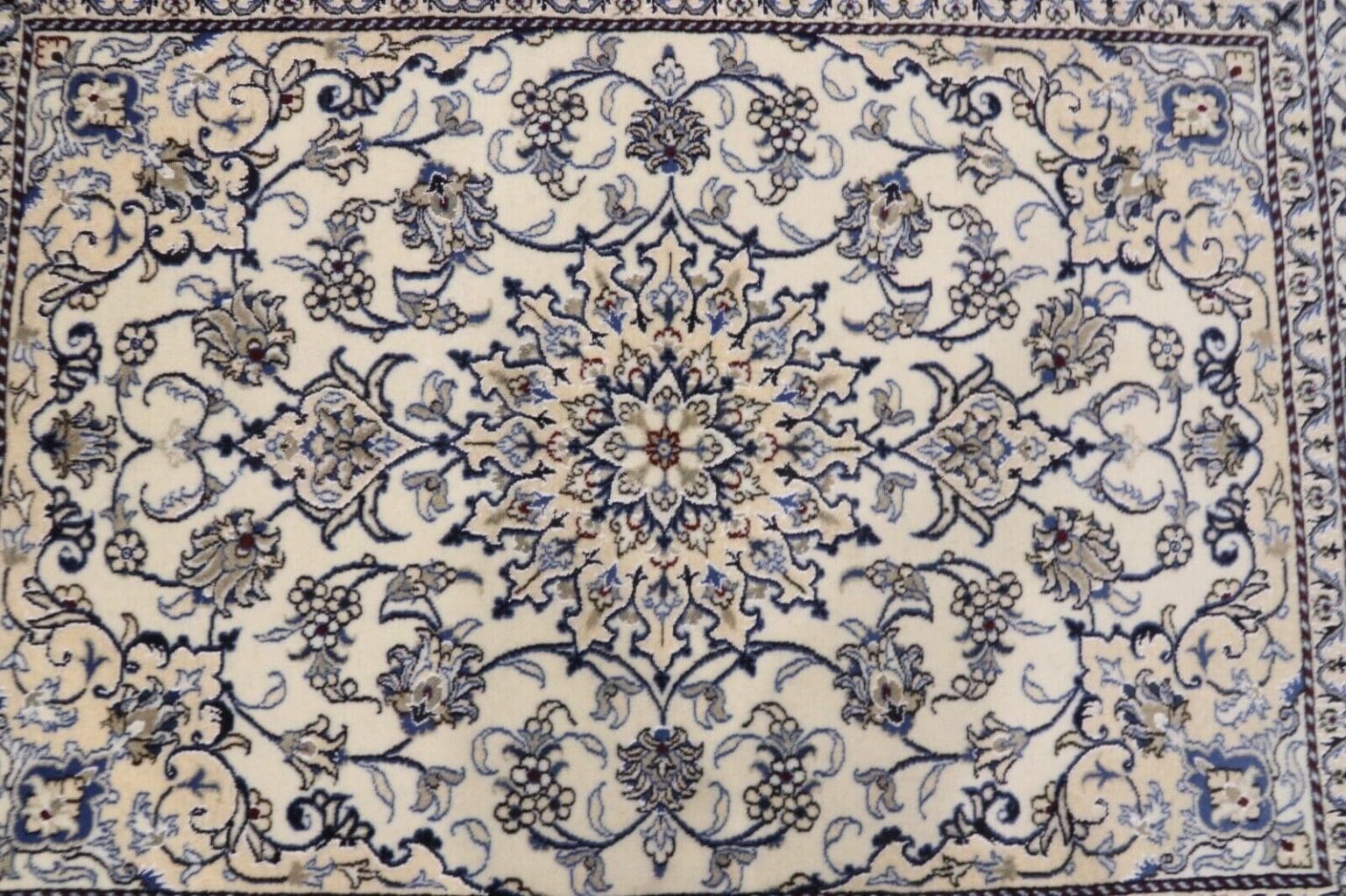
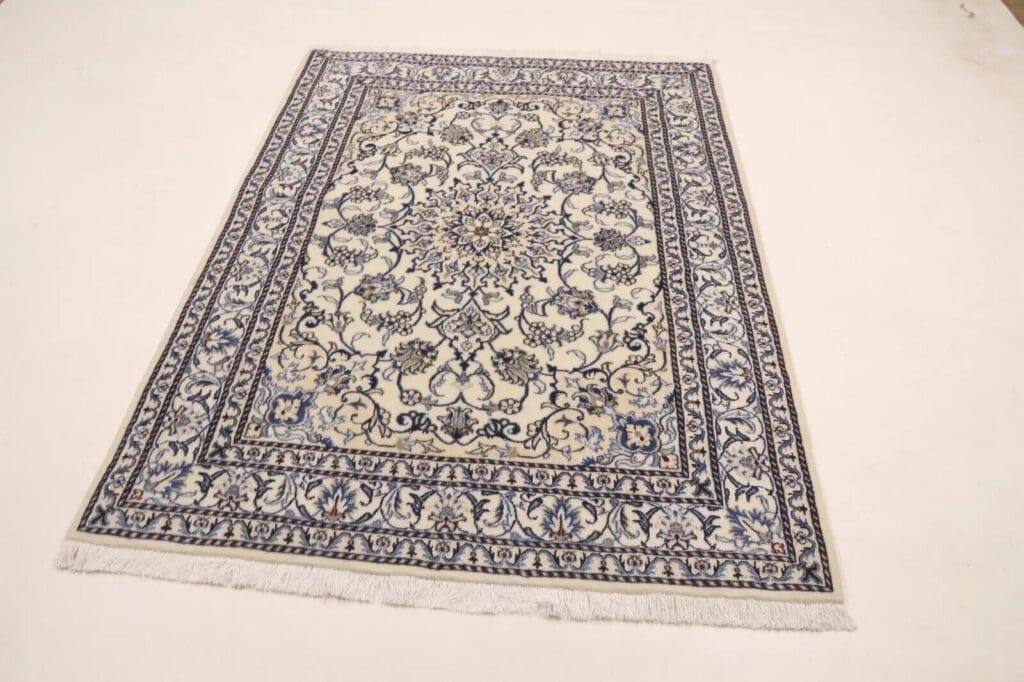
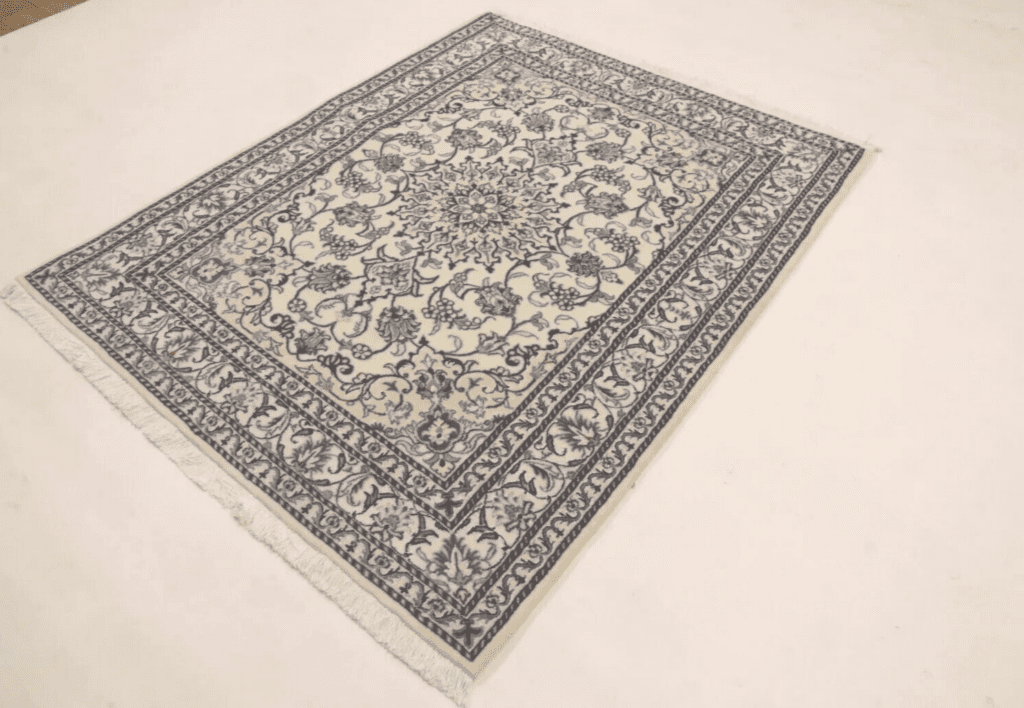
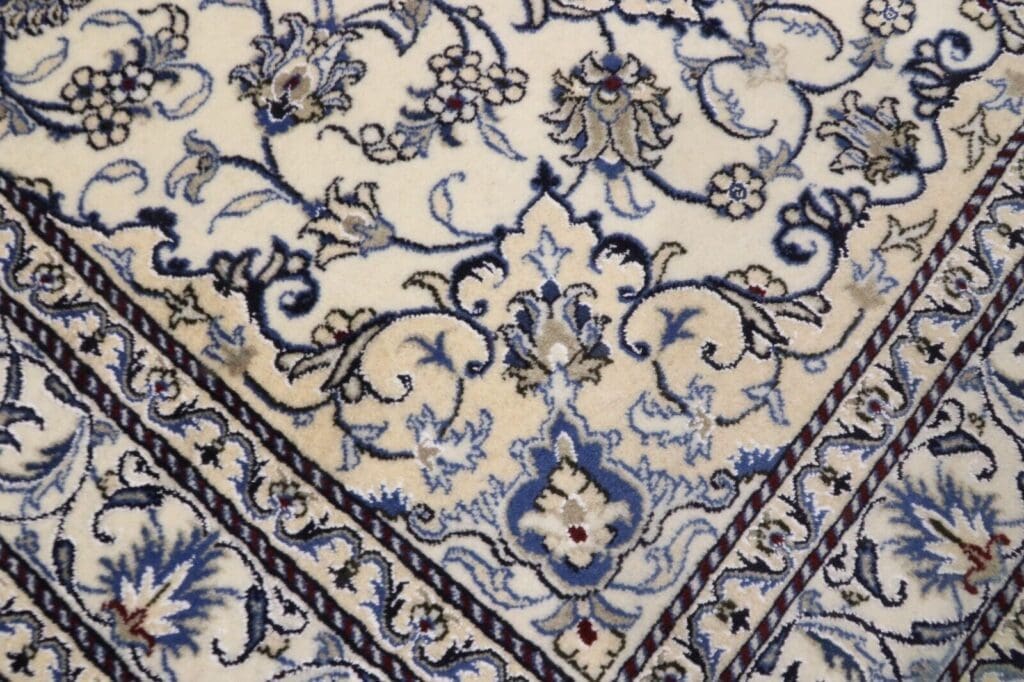
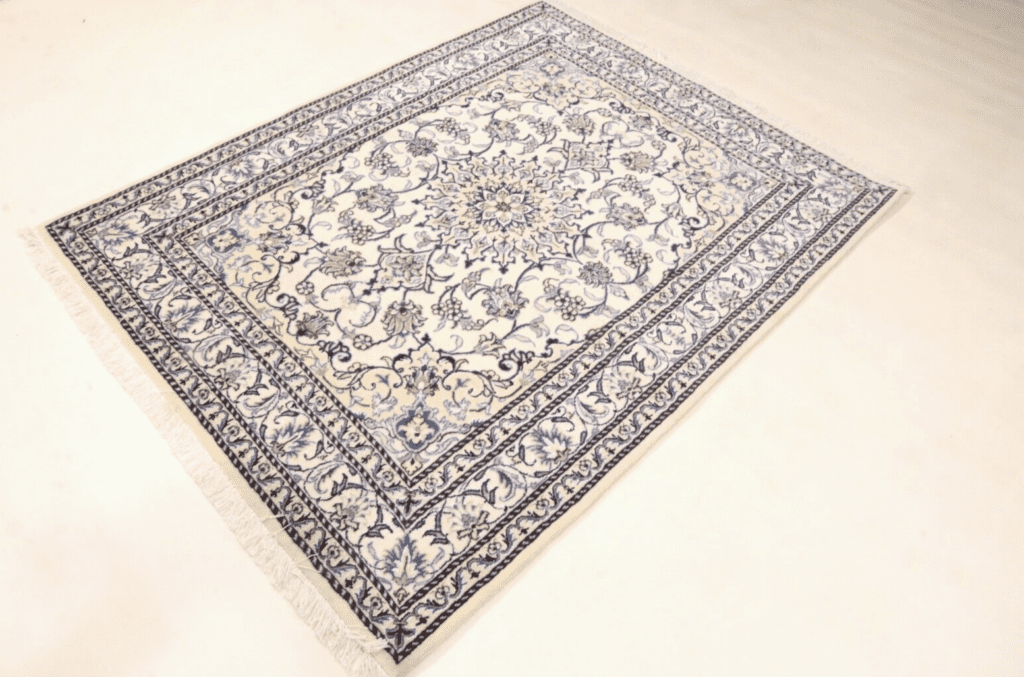
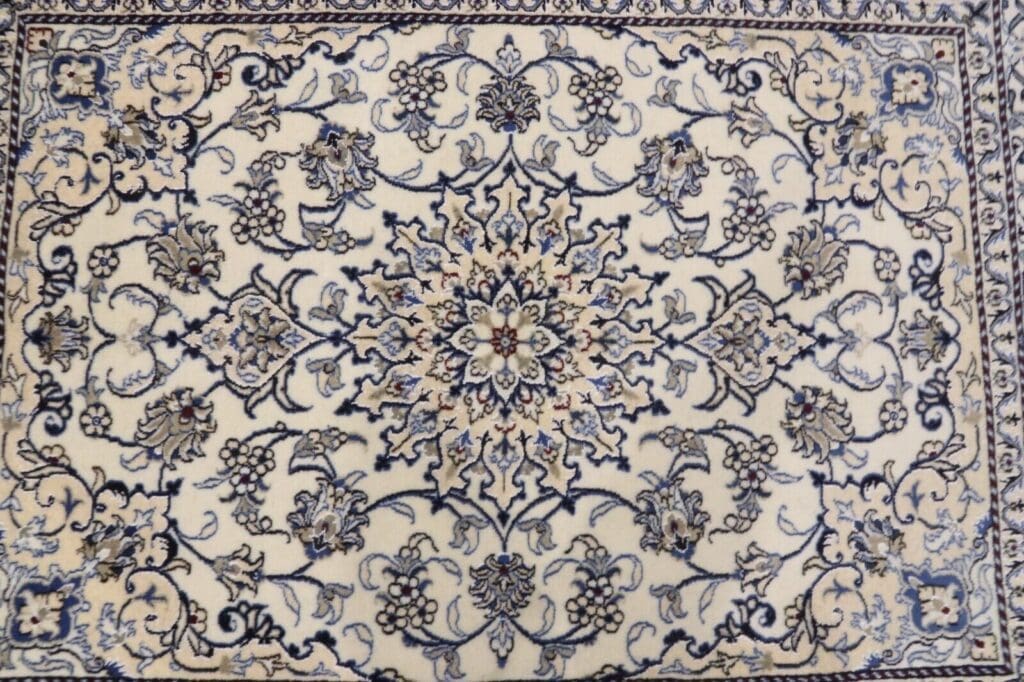
The design of this Super Nain rug follows the decorative language associated with Nain rugs. Floral elements and geometric forms are incorporated into the composition, allowing organic ornament and ordered structure to work together. Flowers, leaves and scrolling forms are part of the long Persian tradition of translating natural imagery into stylised surface decoration. Geometric lines provide structure, helping to organise the motifs and maintain a sense of balance.
In Persian rug design, floral ornament is rarely treated as a direct botanical illustration. Instead, flowers and foliage are arranged as repeated, stylised elements that can be adapted to the proportions of the field and borders. Curving stems may connect separate motifs, while leaves can fill spaces between larger forms. This method creates continuity across the surface. Geometric details then provide points of order, define transitions and support the rhythm of the overall composition.
The pattern language of Nain is often distinguished by fine detail and a carefully controlled arrangement. Small motifs can be placed close together without losing the overall structure when the design is planned precisely. The approximately 300,000 knots per square metre of this rug is consistent with a construction suited to detailed pattern work, although the knot density itself does not determine the exact design. The visual result depends on the drawing, the colours, the knotting and the way the individual elements are distributed.
The colour palette described for the rug extends from soft pastel tones to stronger accents. Pastel shades can give floral and geometric motifs a quiet, finely graduated appearance, while more pronounced accents create contrast and help selected elements stand out. A carefully coordinated palette connects the different areas of the design rather than treating each motif as an isolated mark. This balance between gentle tones and stronger notes is characteristic of the intended visual harmony of the piece.
A round rug creates a different design challenge from a rectangular one. The composition must remain balanced as it moves around the curved perimeter, and borders or repeated motifs need to follow that circular movement convincingly. Floral forms can be distributed radially or arranged within a central structure, while geometric elements help maintain orientation. The round format can therefore emphasise the relationship between symmetry, repetition and the central field without changing the Persian vocabulary of the ornament.
The pattern is decorative rather than tied to a single literal scene. Floral and geometric forms carry the visual heritage of Persian weaving through repetition, rhythm and proportion. In this context, motifs are part of a shared regional design language that has been refined by generations of artisans. The composition can be read as an arrangement of connected elements: a field, surrounding ornament and accents that guide the eye across the surface. Its timeless character comes from the continued use of this established design vocabulary in a contemporary interior setting.
Special Features
The rug is round, hand-knotted and identified as a Super Nain from Iran. Its material composition combines 90% virgin wool with 10% silk, and its surface is described as very good in condition. The fine knot density, the use of silk alongside wool and the Nain design tradition are the principal characteristics stated for this individual piece. These details distinguish the rug within the broad category of Oriental rugs without requiring additional claims about its history or provenance.
The round format allows the rug to function as a defined accent in living or dining areas. It can be used where a circular shape helps organise furniture or mark out a particular zone. The design combines floral and geometric elements, and the colour range includes soft pastel tones with stronger accents. This makes the piece suitable for both classic and modern furnishing concepts, where it can provide a link between traditional Persian ornament and a more current room arrangement.
The wool-and-silk construction also explains the different surface effects visible in the material. Wool contributes body and durability, while silk adds a smoother appearance and a gentle lustre. Regular care is appropriate for preserving the surface. The rug should be vacuumed regularly, and professional cleaning is recommended when heavier soiling occurs. Direct sunlight should be avoided because prolonged exposure can cause colours to fade.
FAQ
How should I clean and care for this Persian rug?
Regular vacuuming is the basic care measure for this hand-knotted Nain rug. It removes loose dust and everyday particles before they become embedded in the pile. Vacuuming should be carried out with suitable care for a wool-and-silk surface, avoiding unnecessarily aggressive treatment. If the rug becomes heavily soiled, professional rug cleaning is recommended. Specialist cleaning takes the mixed material composition into account and is preferable to improvised wet treatment. Direct, prolonged sunlight should also be avoided, as it can fade the colours. A consistent care routine helps preserve the pile, the silk sheen and the visual definition of the floral and geometric design.
How can the quality of a Persian rug be assessed?
Several factors are relevant when assessing the quality of a Persian rug. Knot density provides information about the fineness of the construction and the amount of detailed handwork involved. The materials are also important: this rug uses virgin wool together with silk, two natural fibres with different but complementary properties. Finally, the workmanship must be considered, including the regularity of the knotting and the handling of the design. High knot density alone does not describe every aspect of quality, but it is an important element when considered together with the materials and the hand-knotted construction. In this case, the approximately 300,000 knots per square metre, the wool-and-silk pile and the Nain tradition form the central quality characteristics.
Can this round Nain rug be used in a modern interior?
Yes. The round Super Nain rug can be used in both classic and modern furnishing schemes. Its circular shape can define a seating or dining area and introduce a clear accent without relying on a rectangular layout. The pattern combines traditional floral ornament with geometric structure, while the palette moves from soft pastel shades to stronger accents. This allows the rug to relate to restrained contemporary interiors as well as to rooms with more traditional furnishings. Its Persian design language remains recognisable, but the balanced arrangement and round format can be integrated into a current room concept. The rug therefore connects an established Iranian weaving tradition with different interior styles.
To provide the best experiences, we use technologies like cookies to store and/or access device information. Consenting to these technologies will allow us to process data such as browsing behavior or unique IDs on this site. Not consenting or withdrawing consent, may adversely affect certain features and functions.
Functional Always active
The technical storage or access is strictly necessary for the legitimate purpose of enabling the use of a specific service explicitly requested by the subscriber or user, or for the sole purpose of carrying out the transmission of a communication over an electronic communications network.
Preferences
The technical storage or access is necessary for the legitimate purpose of storing preferences that are not requested by the subscriber or user.
Statistics
The technical storage or access that is used exclusively for statistical purposes.The technical storage or access that is used exclusively for anonymous statistical purposes. Without a subpoena, voluntary compliance on the part of your Internet Service Provider, or additional records from a third party, information stored or retrieved for this purpose alone cannot usually be used to identify you.
Marketing
The technical storage or access is required to create user profiles to send advertising, or to track the user on a website or across several websites for similar marketing purposes.
 SECURE PAYMENT
 SHIPPING PARTNERS