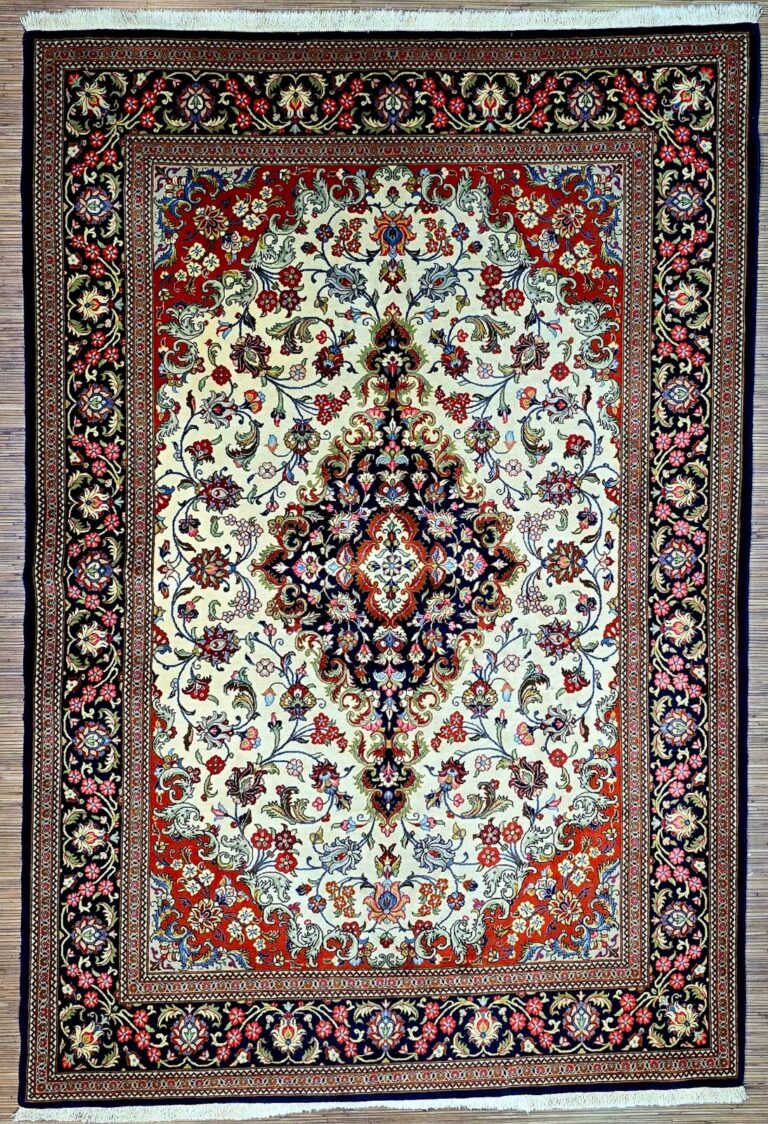
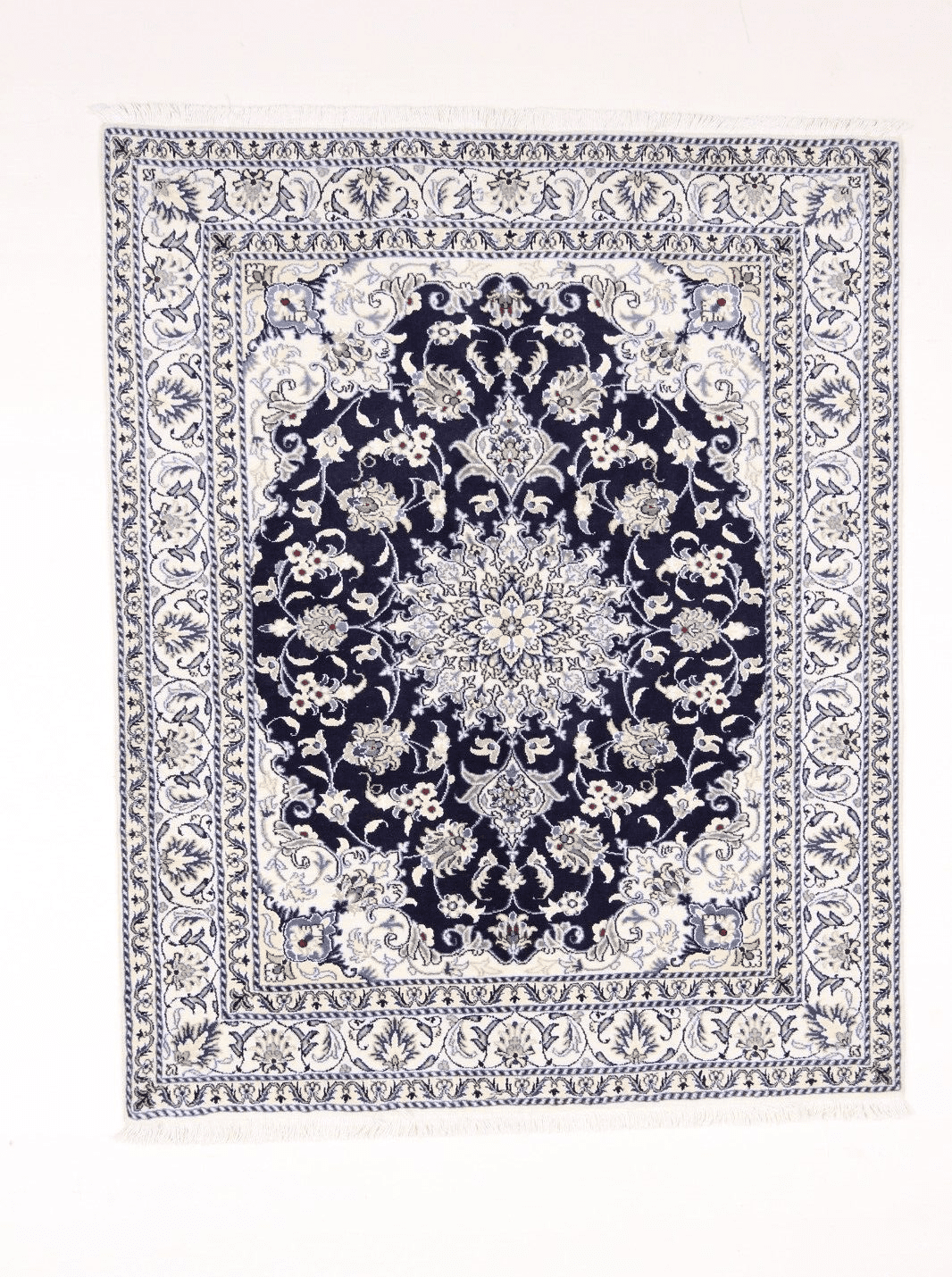
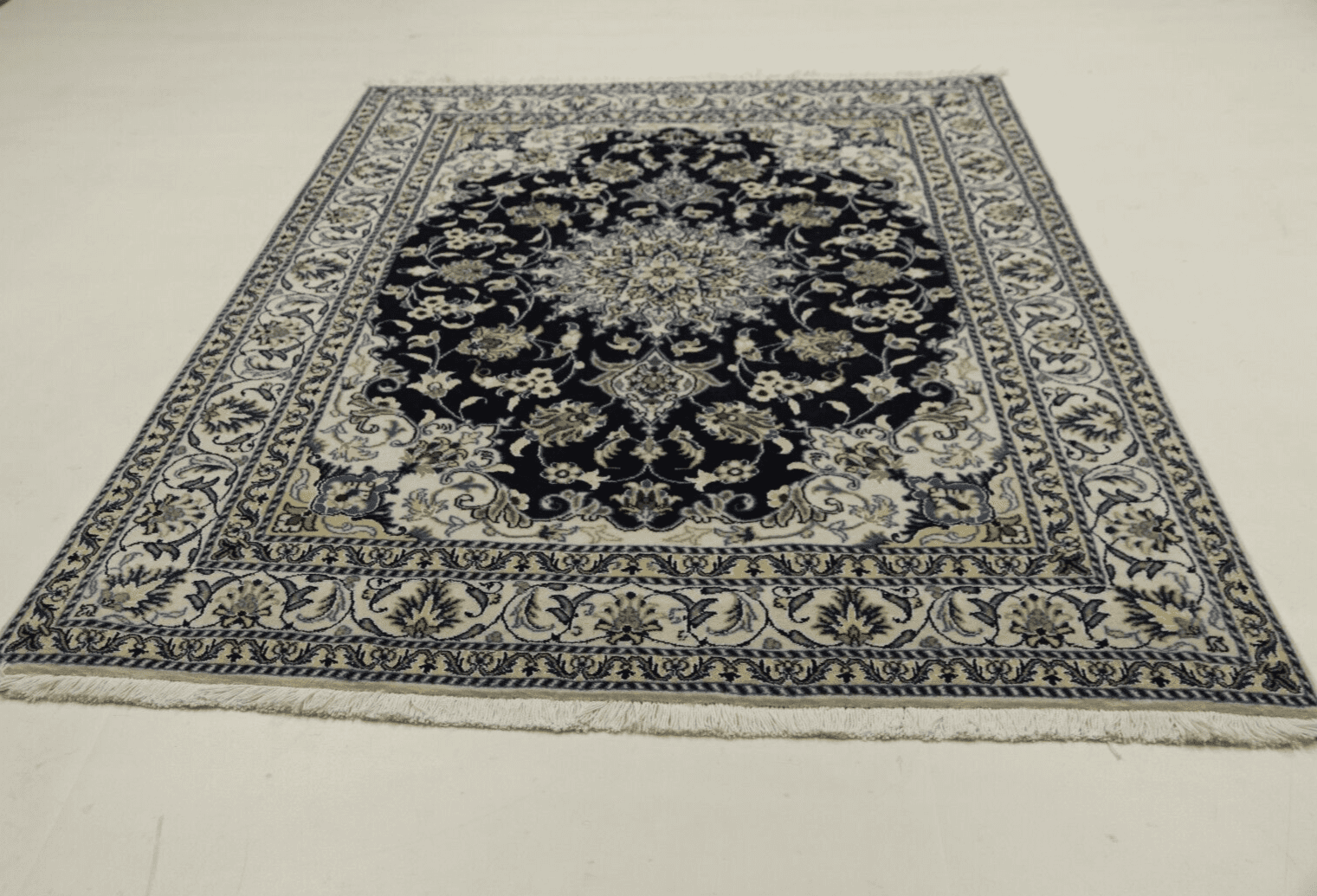
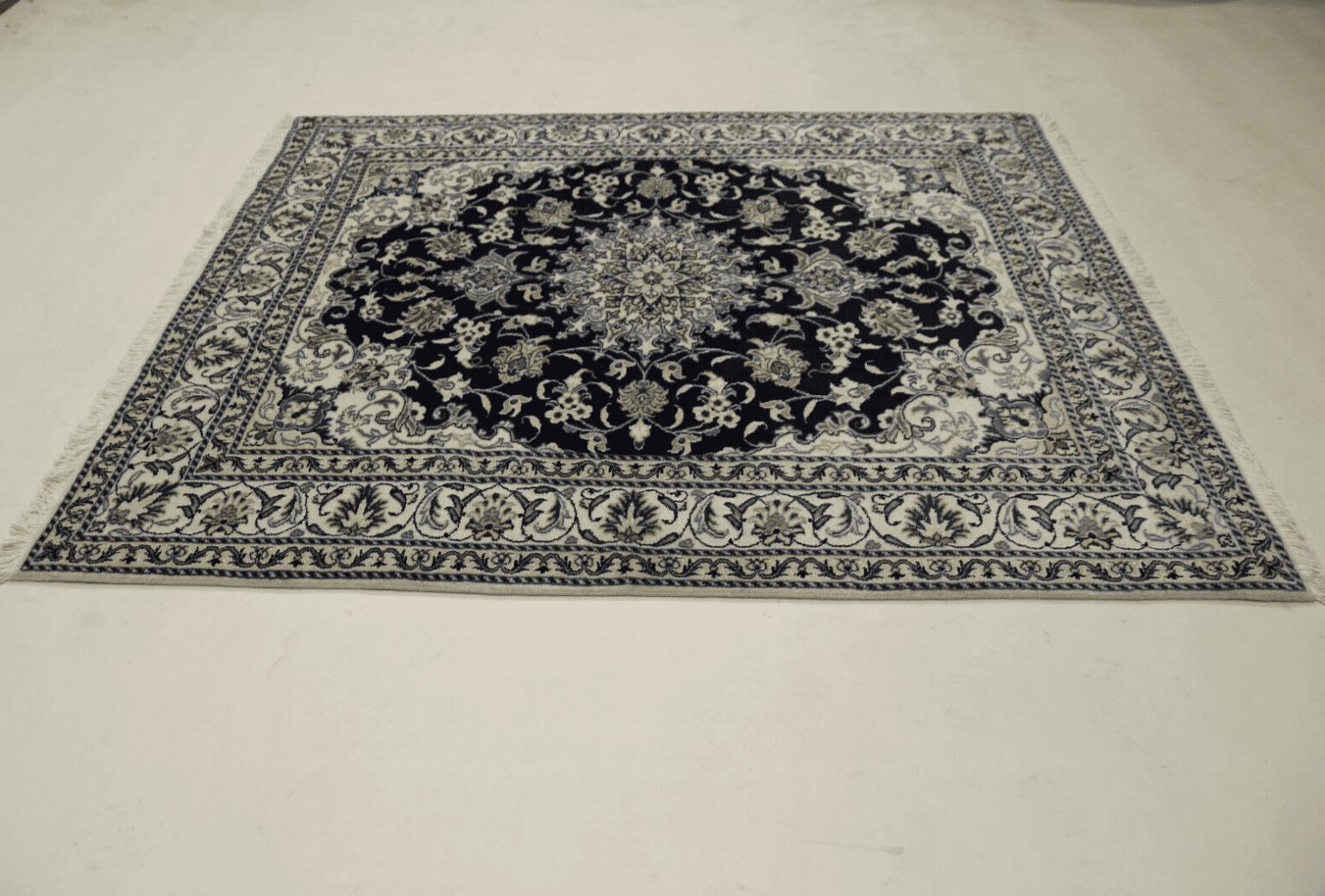
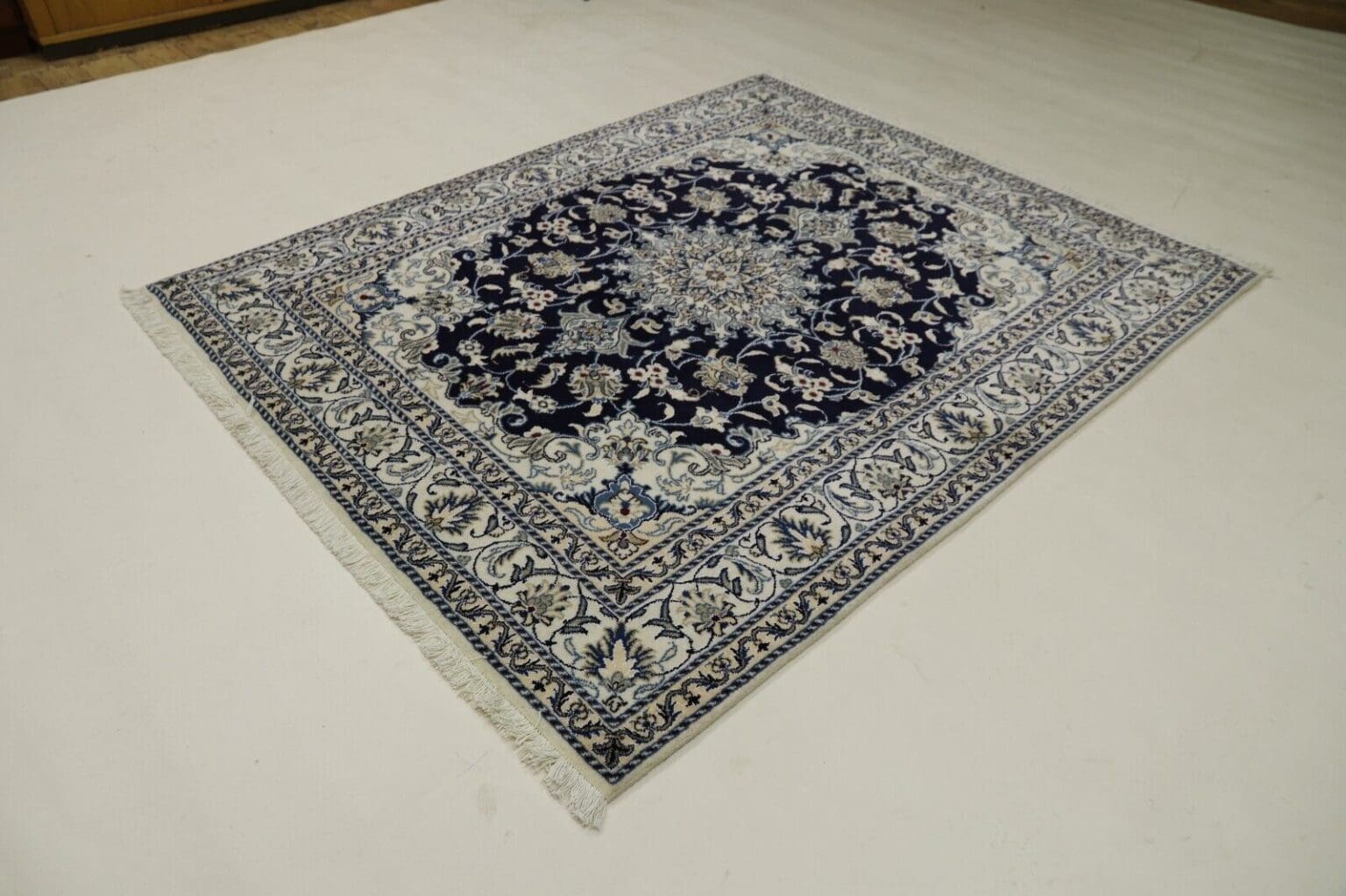
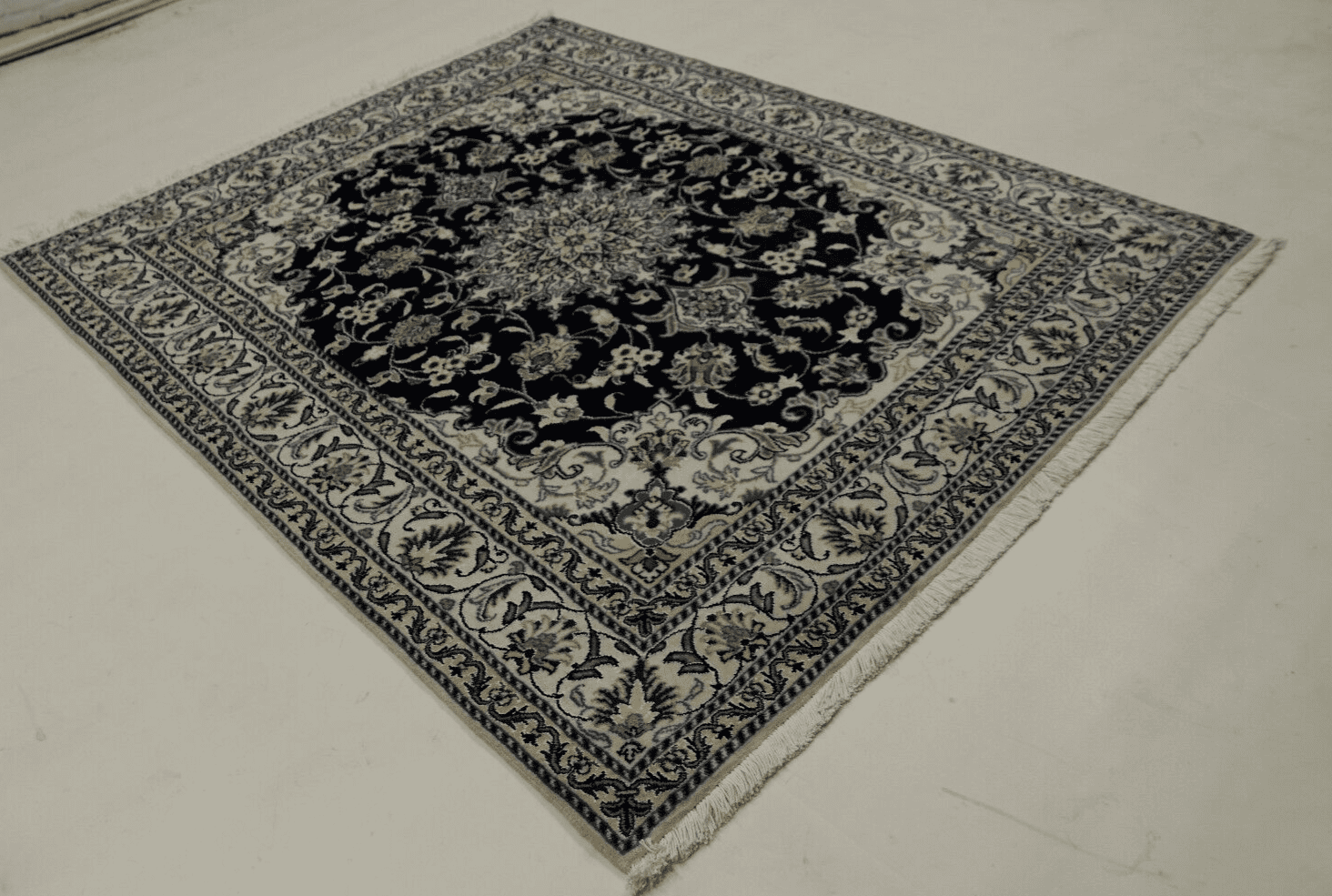
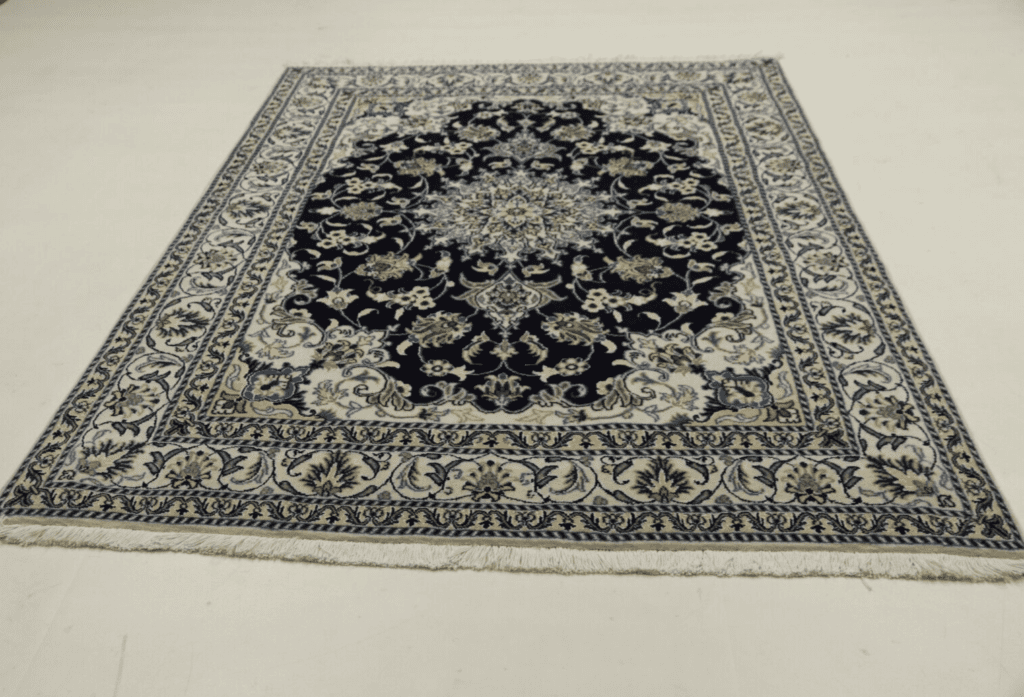
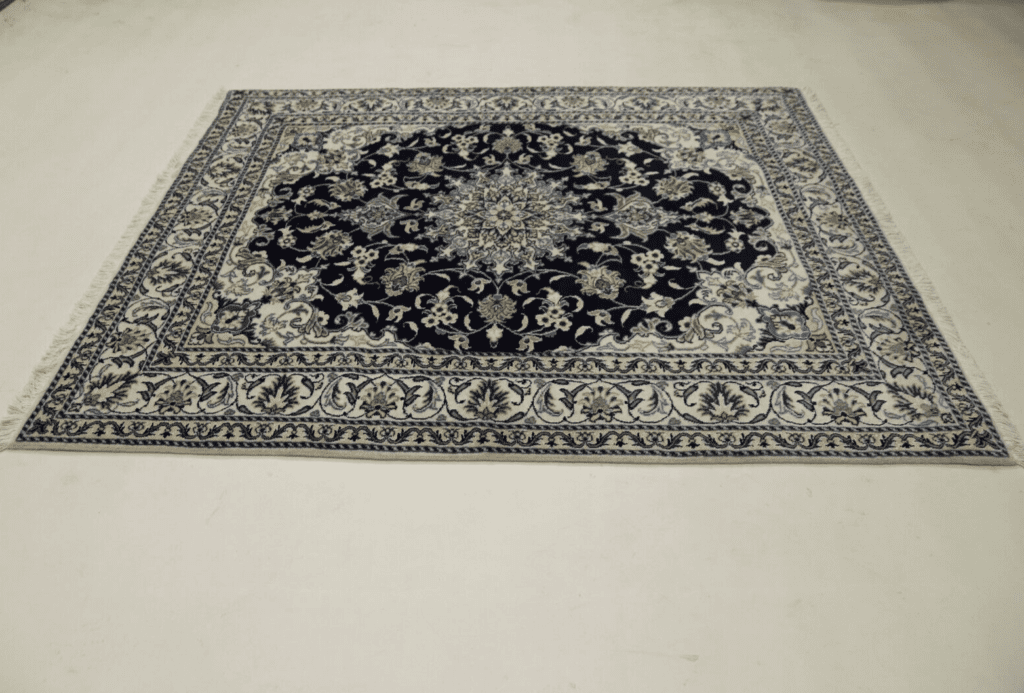
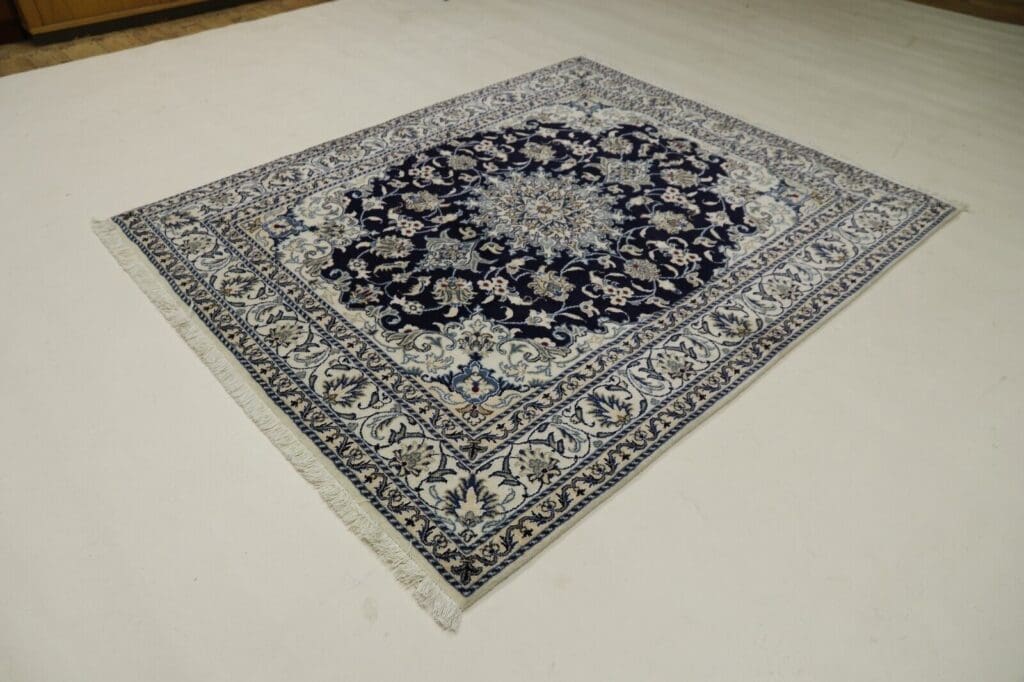
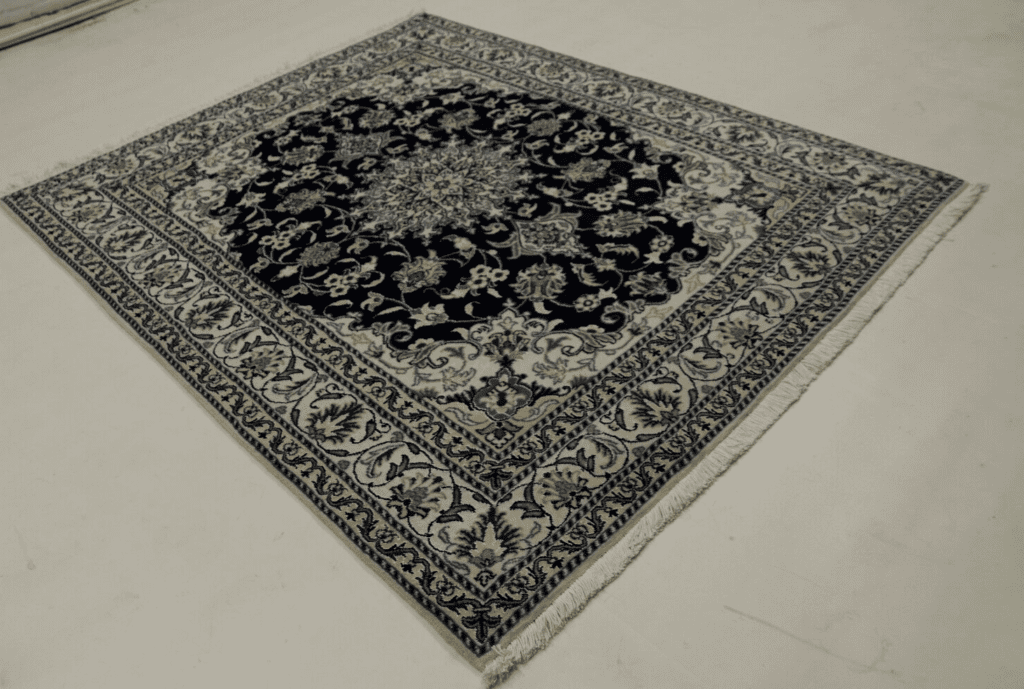
Hand-knotted Nain Persian rug | Knot density: approx. 300,000 knots/m² | Material: 90% virgin wool, 10% silk | Size: 190 x 154 cm | Pattern: traditional Oriental and Persian, dark blue | Condition: new, perfect
This Nain Persian rug is hand-knotted and made from virgin wool and silk. The two materials give the piece a distinct textile character. Virgin wool provides a warm and resilient pile, while silk contributes a smoother surface and a restrained sheen. The appearance can change subtly as light moves across the surface. Combining wool with silk is a familiar approach in finely made Persian rugs because it brings together the practical qualities of wool and the refined visual effect of silk.
Virgin wool is used in rug making for its natural resilience and comfortable feel. Its fibres have a degree of elasticity and can recover from ordinary pressure more readily than a completely rigid material. Wool also has a textured surface that can make light, loose dust less immediately visible. Regular, gentle removal of such particles is therefore part of sensible care. The fibre remains warm to the touch and gives the pile a substantial, natural feel.
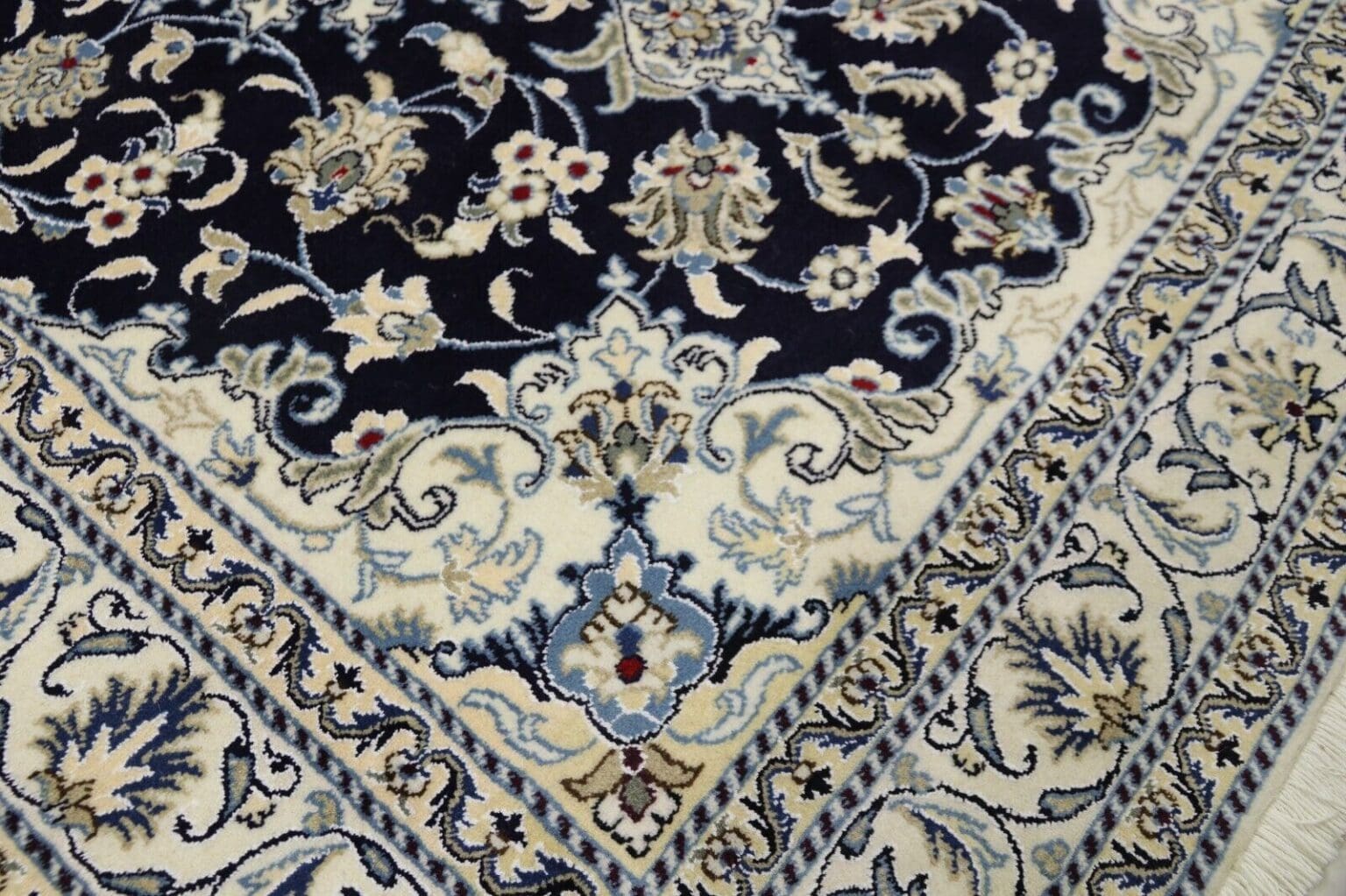
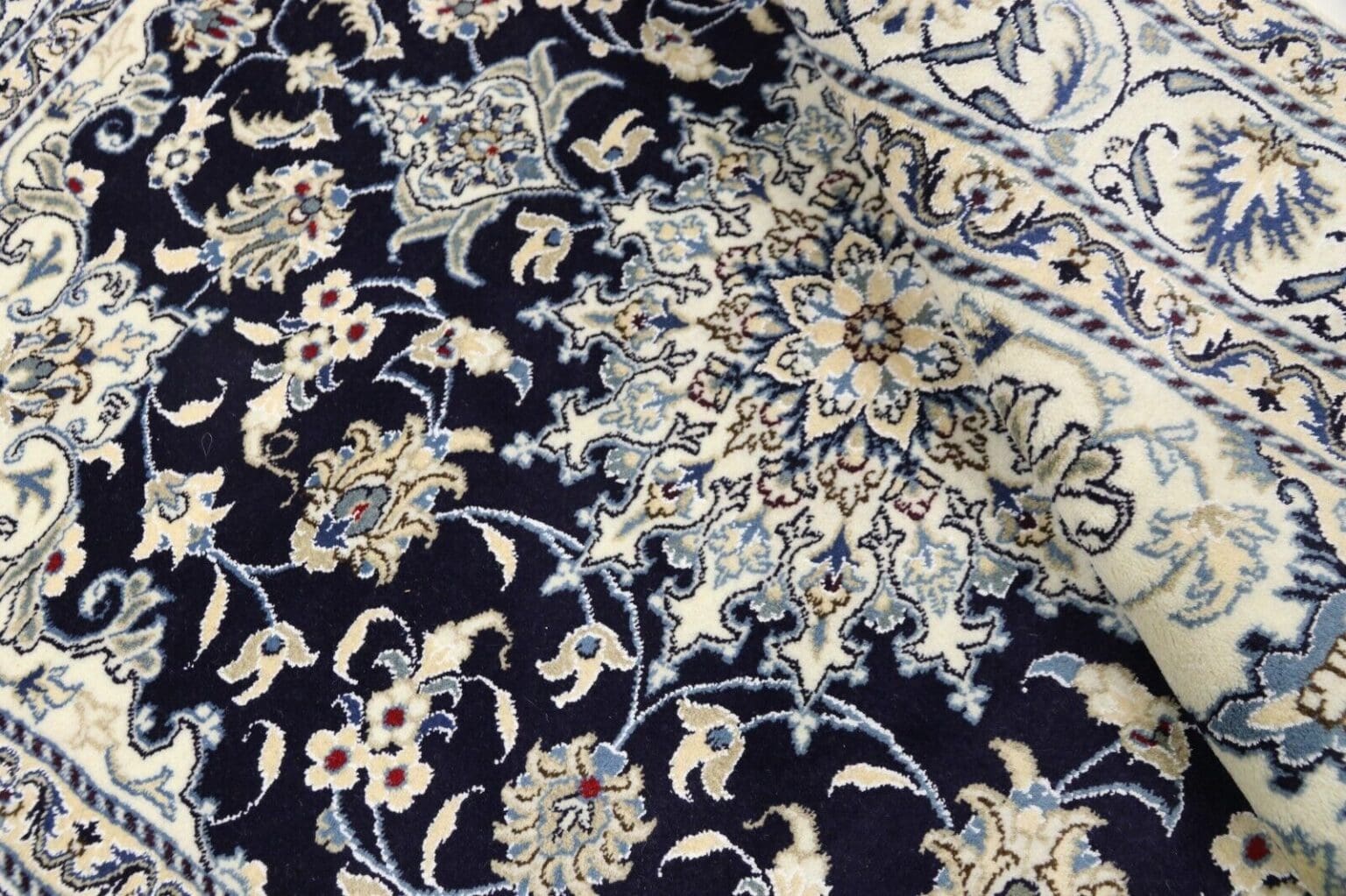
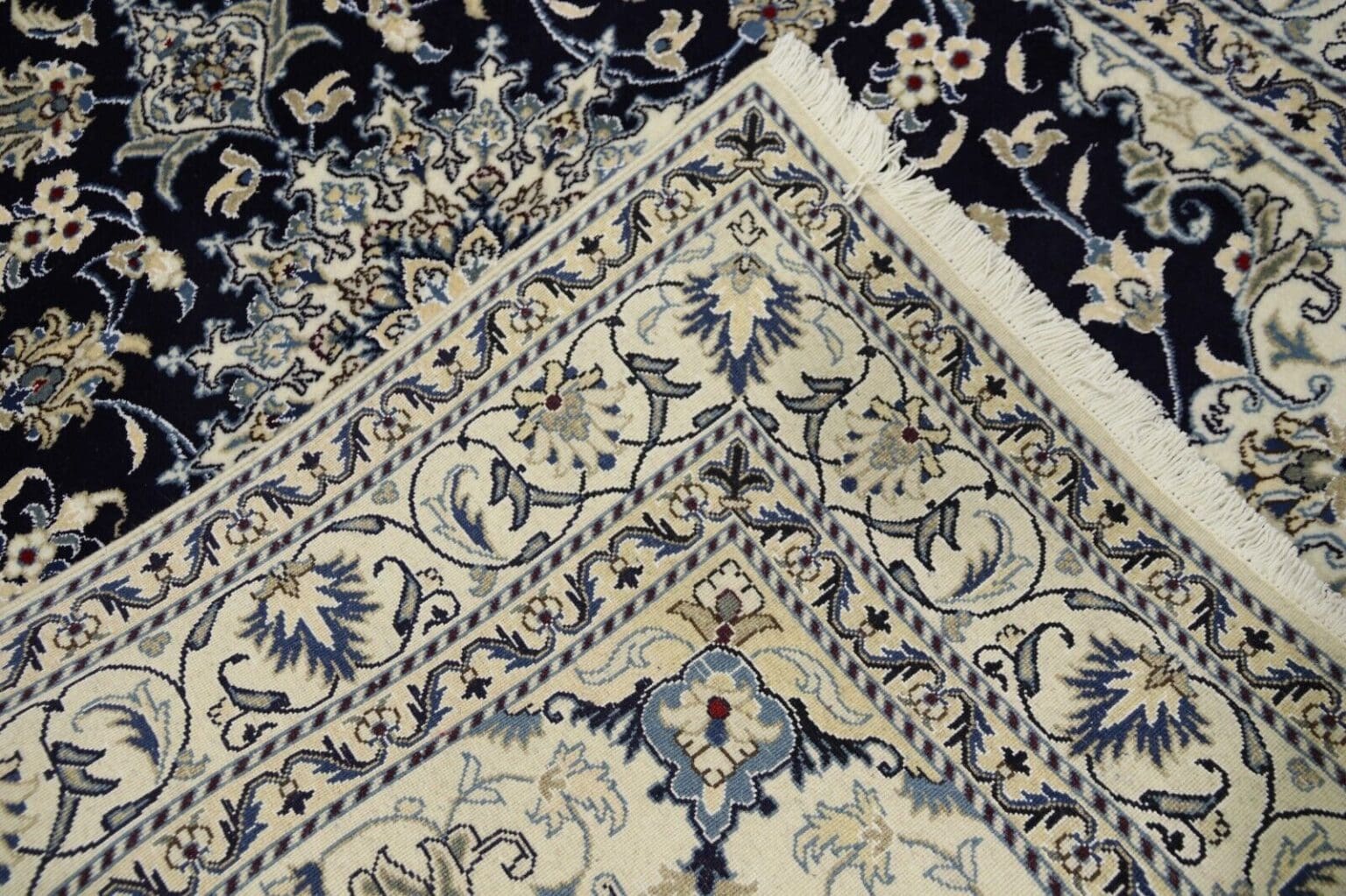
Silk is chosen in rug weaving when fine outlines, a smooth hand and changes in light reflection are important. Used together with wool, it can help selected lines and small design elements appear more clearly. Hand-knotting is not an industrial process in which a repeated surface is simply printed or woven in one pass. Individual knots are tied onto the foundation, row by row, and the planned design is built up through sustained manual work.
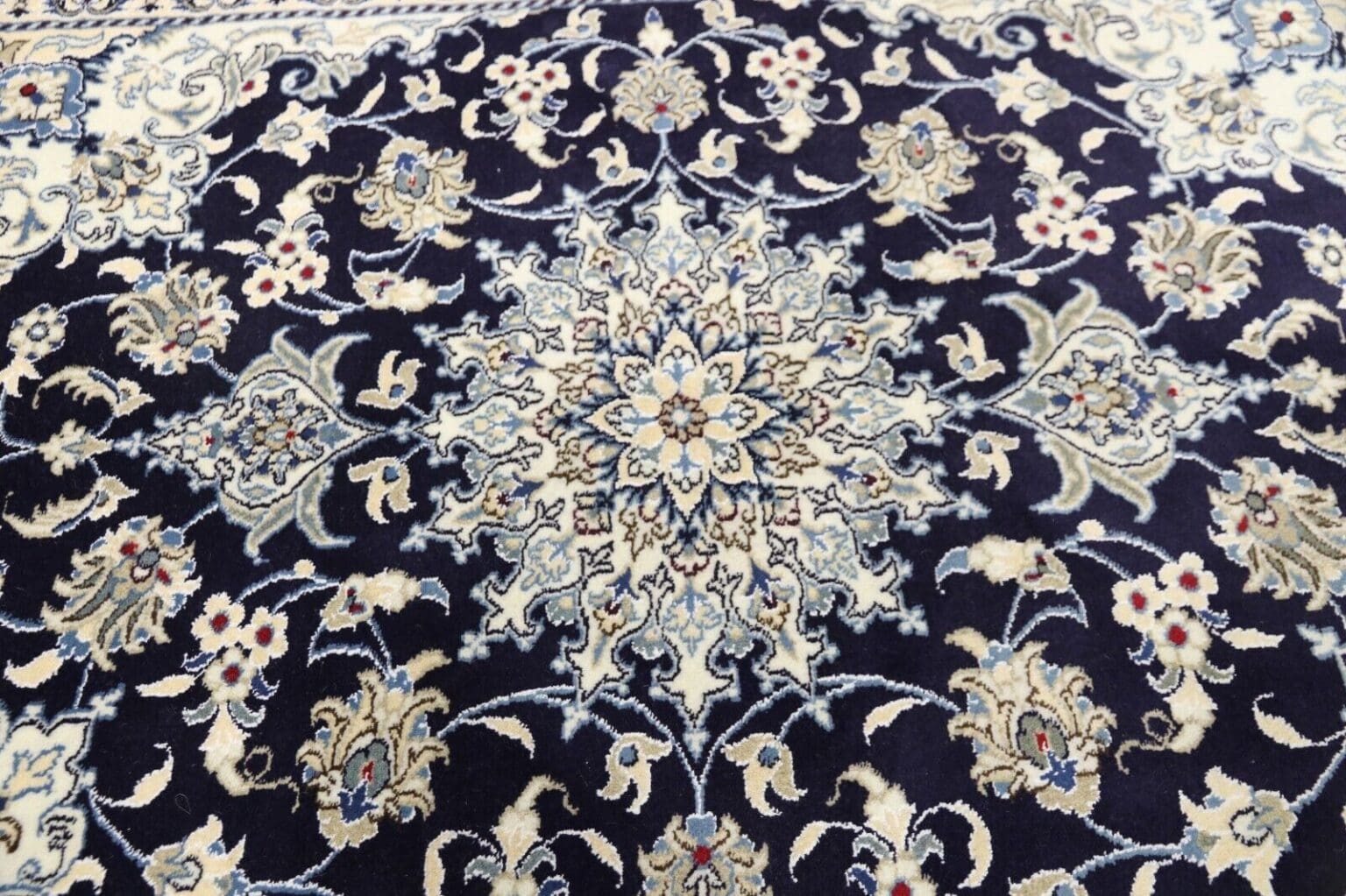
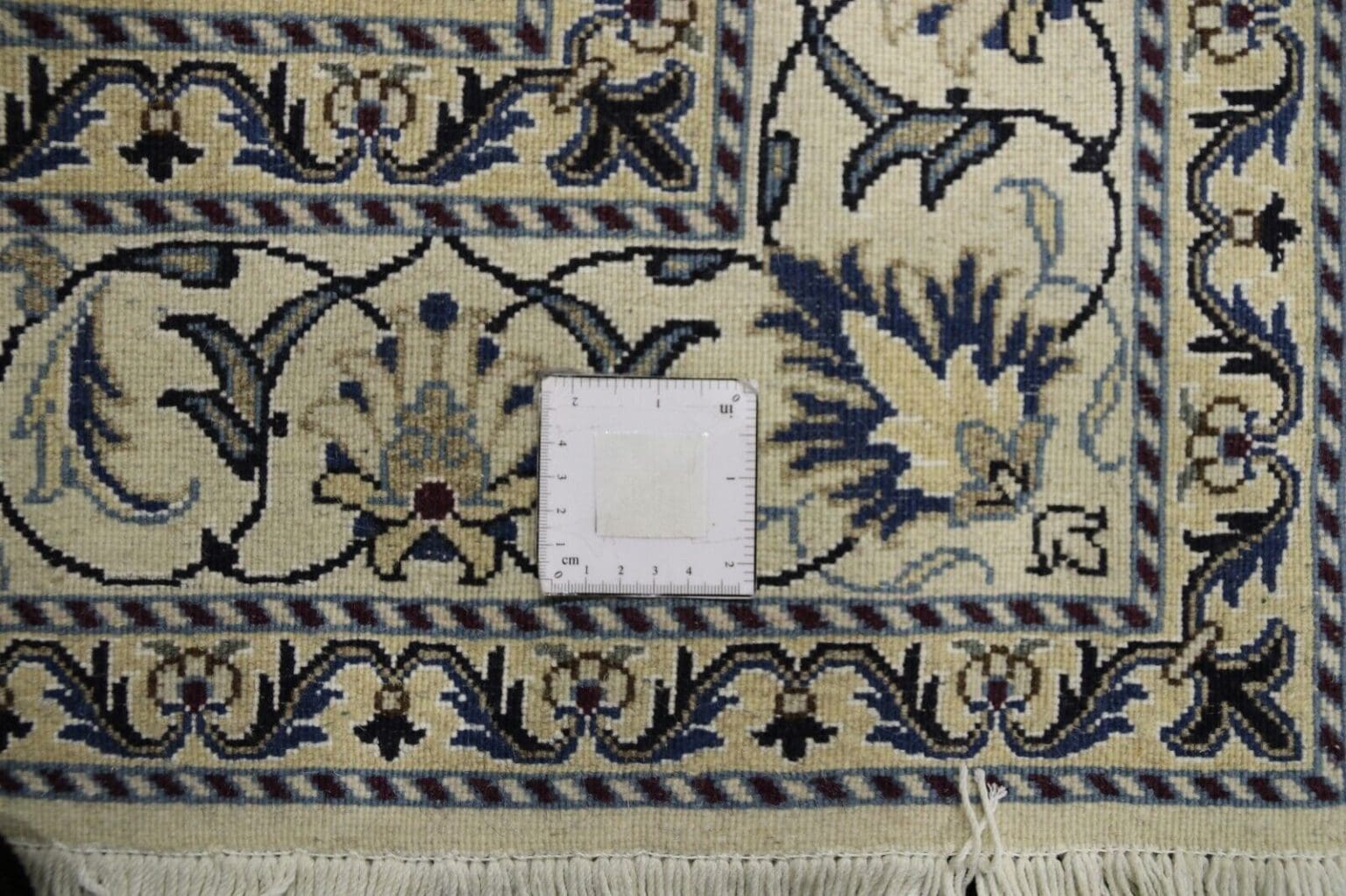
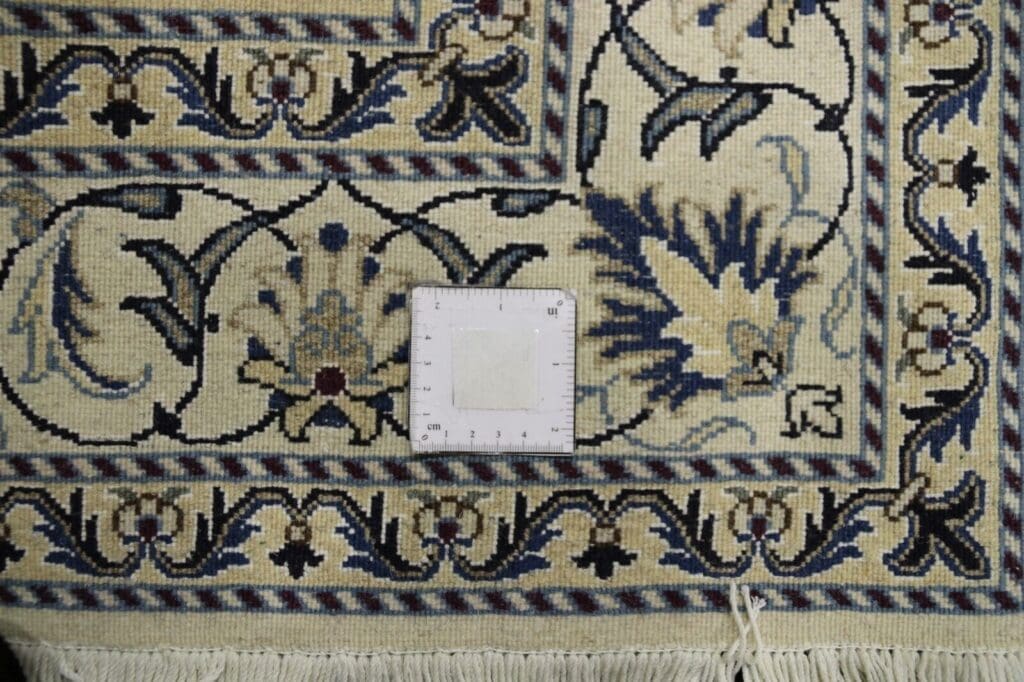
The stated density of approximately 300,000 knots per square metre indicates a finely structured knotting. A dense knot field can support small ornaments, controlled contours and carefully resolved transitions. Knot density is one characteristic among several, however. Fibre quality, consistency of the knotting, the drawing of the pattern and the condition of the finished rug also belong to a proper assessment.
Origin and Tradition
This rug comes from Nain in Iran. Nain is a Persian carpet centre with a distinct weaving tradition. The city lies in central Iran and is known for textile and carpet production. Nain rugs are associated with controlled drawing, fine pattern work and careful use of materials. Their designs often draw on established Persian compositions, while individual rugs can still differ in their arrangement, colour balance and detail.
Carpet production in Nain has a long history reaching back to the sixteenth century. As in other Persian weaving centres, knowledge about yarns, dyes, knotting methods and ornament was passed from one generation to the next. The craft involves more than tying the knots themselves. Preparing the foundation, selecting and handling the fibres, introducing colour according to the design and finishing the surface all influence the final result. The character of a hand-knotted rug is formed by this sequence of connected tasks.
Persian carpet regions developed their own preferences for borders, field arrangements, repeated motifs and colour relationships. Nain is linked with a tradition in which fine lines and ordered surfaces play an important role. Traditional motifs form a visual vocabulary handed down through the craft rather than a random collection of decoration. Flowers, leaves, scrolling vines and symmetrical arrangements may be combined to create a coherent field. The precise arrangement remains a feature of each individual rug.
The origin name Nain describes the place identified for this rug: the city of Nain in Iran. It also points to the local tradition in which the piece is situated. Nain is not simply a colour name or a reference to one isolated ornament. It is one of the recognised Persian carpet centres whose work has become known beyond Iran for fine patterning and the use of wool with silk in carefully executed designs.
The history of Persian rugs shows how closely everyday use and visual language have been connected. Rugs were made for domestic interiors, reception spaces and representative settings, where they provided both a practical surface and a cultural statement. Their designs preserve influences from different periods and regions. In a Nain rug, this heritage is expressed through a disciplined layout and through the manual execution of a design that has been planned before it is transferred knot by knot.
Hand-knotting also gives the weaving process a particular rhythm. A weaver follows the structure of the foundation and the planned colour sequence, checks the developing lines and works across the field in stages. This is different from a machine-made product in which an identical surface can be reproduced mechanically. The Nain tradition therefore encompasses a place, a body of knowledge and a method of making, not only a decorative appearance.
Design and Pattern
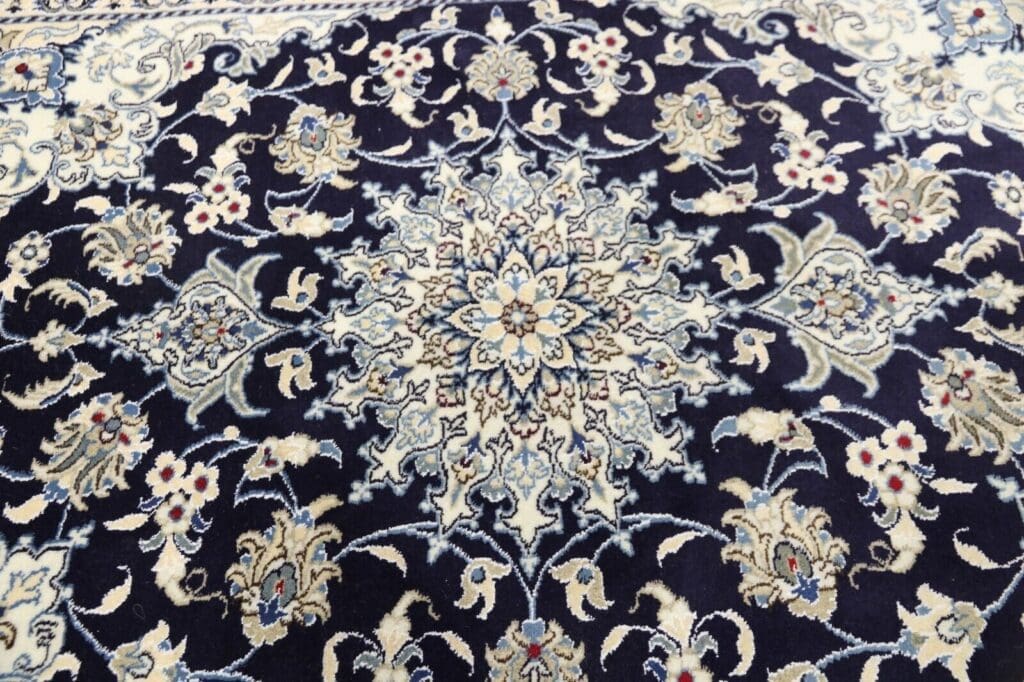
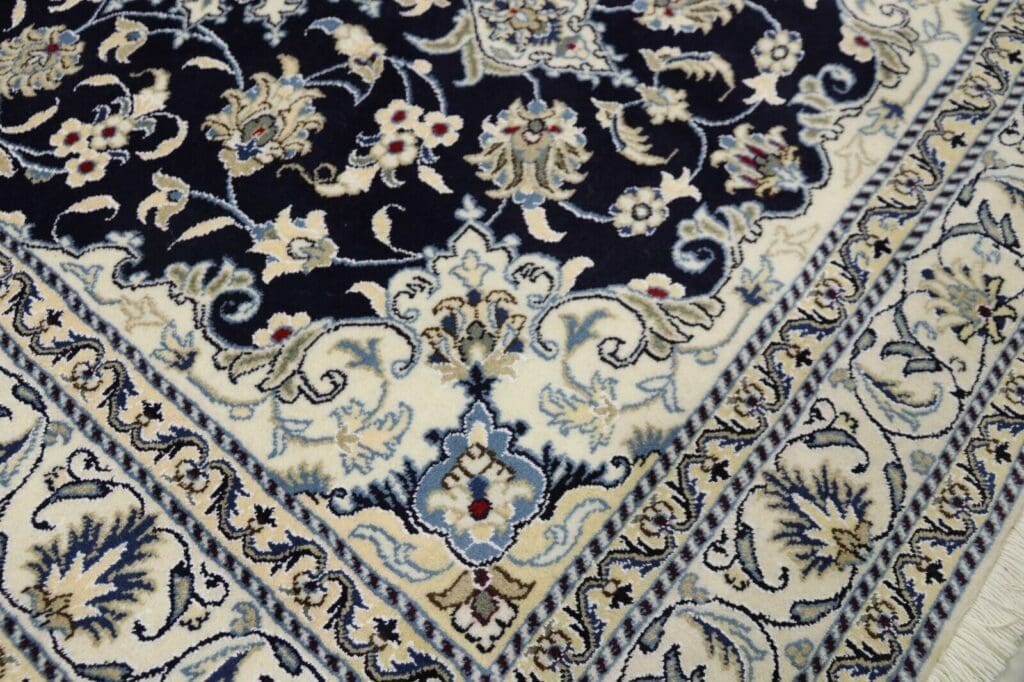
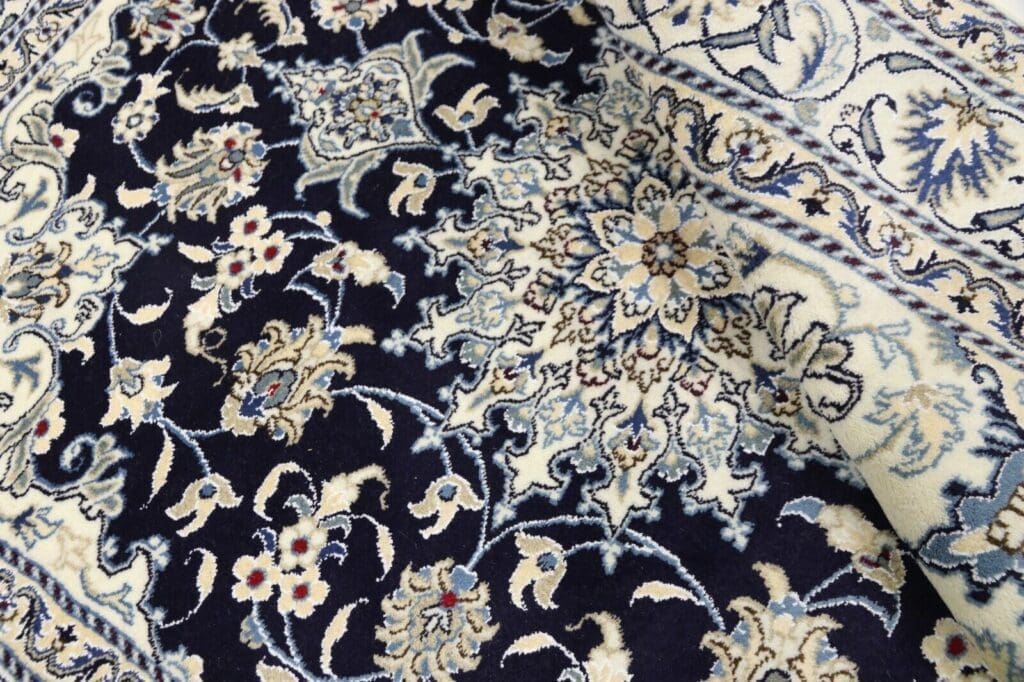
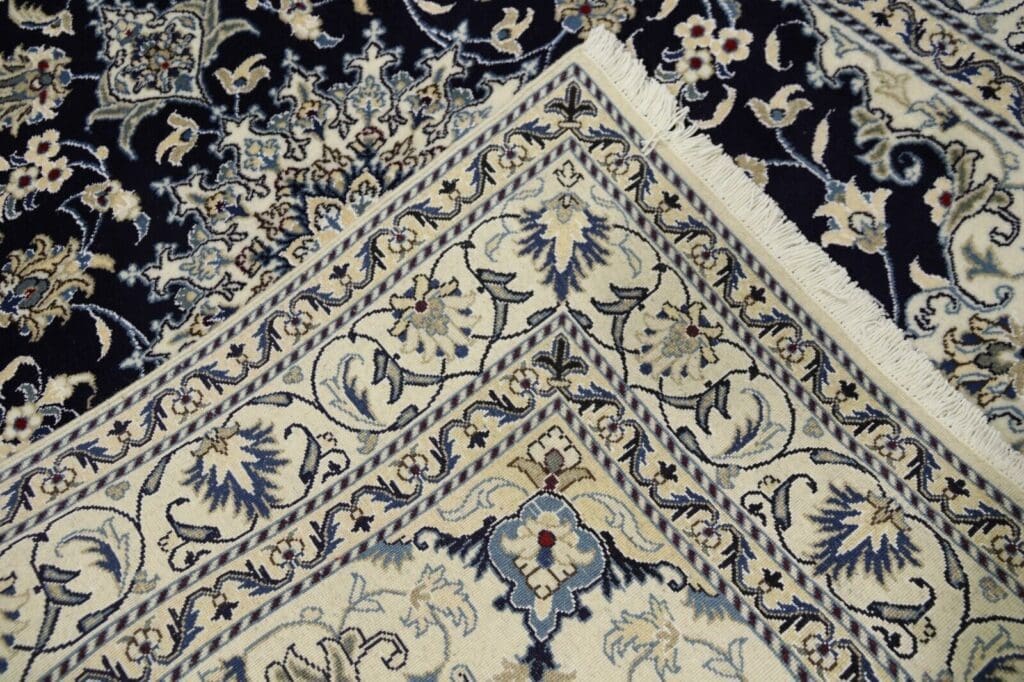
The pattern is described as traditional Oriental and Persian. Dark blue is given as the colour of the rug. This colour creates a deep, composed ground for the finer elements of the design and gives the overall surface a calm visual structure. Dark blue belongs to the established palette of Persian carpets and can be set against lighter accents, muted natural shades or other restrained colours.
Nain designs often include floral details, geometric order and medallion-like compositions. Floral elements may take the form of blossoms, leaves and scrolling branches. Geometric order is created through symmetry, repeated spacing and the relationship between the central field and the surrounding border. A medallion arrangement concentrates attention toward the centre, while the border frames the field and gives the composition a defined edge. These are features of the Nain design tradition, not a claim that every listed element appears in this particular rug.
Persian ornament frequently carries a cultural layer beyond its decorative function. Flowers and vines can be associated with growth, harmony and the ordered forms of nature. A central medallion may be read as the focus of a composition, while repeated motifs can suggest balance and continuity. Such interpretations belong to the history of Persian pattern language. For this rug, the specific design facts are its traditional Oriental and Persian style and its stated dark-blue colour.
The fine structure associated with Nain weaving is well suited to controlled pattern work. A close sequence of knots can help define small internal details, narrow outlines and transitions between adjoining motifs. The visual effect comes from the interaction of structure, fibre and colour. Silk can catch and return light differently from wool, while wool gives the surface a deeper and more tactile quality. These material effects can be seen as part of the broader tradition behind the design.
A traditional Persian pattern is not limited to one type of room. It can sit within a classic interior that continues the historical language of the rug, or it can provide a defined textile element in a more reduced setting. Dark blue works with pale furniture, wood, neutral upholstery and other subdued tones. The result depends on the surrounding interior, while the rug itself retains its traditional Oriental and Persian identity.
The title describes the rug as Super Nain, placing it within the Nain category. This label should be considered alongside the other stated attributes rather than used as a substitute for them. Nain identifies the named Iranian origin, hand-knotted identifies the technique, wool and silk identify the materials, and dark blue identifies the stated colour. Keeping these aspects separate provides a clear and accurate description of the piece.
Special Features
A notable feature is the stated density of approximately 300,000 knots per square metre. This is a concrete characteristic of the rug and indicates a finely structured knot field. Such density can support detailed pattern drawing, although it should not be treated as the only measure of quality. The fibres, the regularity of the work, the clarity of the design and the condition all contribute to how a hand-knotted rug is assessed.
The rug is described as a one-off and as being made to a high standard. As a hand-knotted individual piece, it is not part of an industrial run of mechanically identical surfaces. It is also described as pet-friendly and suitable for use over underfloor heating. The stated pile height is approximately 8 mm. Its condition is described as new, perfect and very good.
The combination of Nain origin, traditional Persian and Oriental design, dark-blue colouring, and wool and silk brings together the main characteristics supplied for this rug. It can be used in modern, traditional or Oriental interiors. Its classification remains precise: this is a hand-knotted Persian rug from Nain in Iran, rather than a machine-made floor covering.
FAQ
How should I care for the Nain Persian rug?
Regular vacuuming without a brush attachment is recommended for everyday care. This removes loose particles while avoiding unnecessary mechanical stress on the pile. Spills should be addressed as soon as possible with a damp cloth and a mild cleaning product. Vigorous rubbing is best avoided because it can put pressure on the fibres and the colours. Professional cleaning once a year is also advisable. A specialist can take the wool and silk composition into account and use a suitable process to help preserve the rug’s condition.
Where is the best place to position the rug?
The Nain Persian rug is suitable for living rooms and dining rooms. It can also be used in an entrance area or office. Its dark-blue colour and traditional Persian and Oriental pattern can work with several interior styles. In a classic room it can continue an established decorative language; in a modern setting it can act as a clearly defined textile feature. It should be laid on a level, clean surface with secure support so that the hand-knotted rug remains stable during everyday use.
Is the rug suitable for underfloor heating?
Yes, this hand-knotted Oriental rug is suitable for underfloor heating. The materials used can allow heat to pass through while providing a comfortable warmth underfoot. As with any rug placed over a heated floor, a moderate temperature setting is sensible. The rug should also be laid correctly so that heat can be distributed evenly. Suitability for underfloor heating is one of the explicitly stated usage properties of this Nain Persian rug.
To provide the best experiences, we use technologies like cookies to store and/or access device information. Consenting to these technologies will allow us to process data such as browsing behavior or unique IDs on this site. Not consenting or withdrawing consent, may adversely affect certain features and functions.
Functional Always active
The technical storage or access is strictly necessary for the legitimate purpose of enabling the use of a specific service explicitly requested by the subscriber or user, or for the sole purpose of carrying out the transmission of a communication over an electronic communications network.
Preferences
The technical storage or access is necessary for the legitimate purpose of storing preferences that are not requested by the subscriber or user.
Statistics
The technical storage or access that is used exclusively for statistical purposes.The technical storage or access that is used exclusively for anonymous statistical purposes. Without a subpoena, voluntary compliance on the part of your Internet Service Provider, or additional records from a third party, information stored or retrieved for this purpose alone cannot usually be used to identify you.
Marketing
The technical storage or access is required to create user profiles to send advertising, or to track the user on a website or across several websites for similar marketing purposes.
 SECURE PAYMENT
 SHIPPING PARTNERS