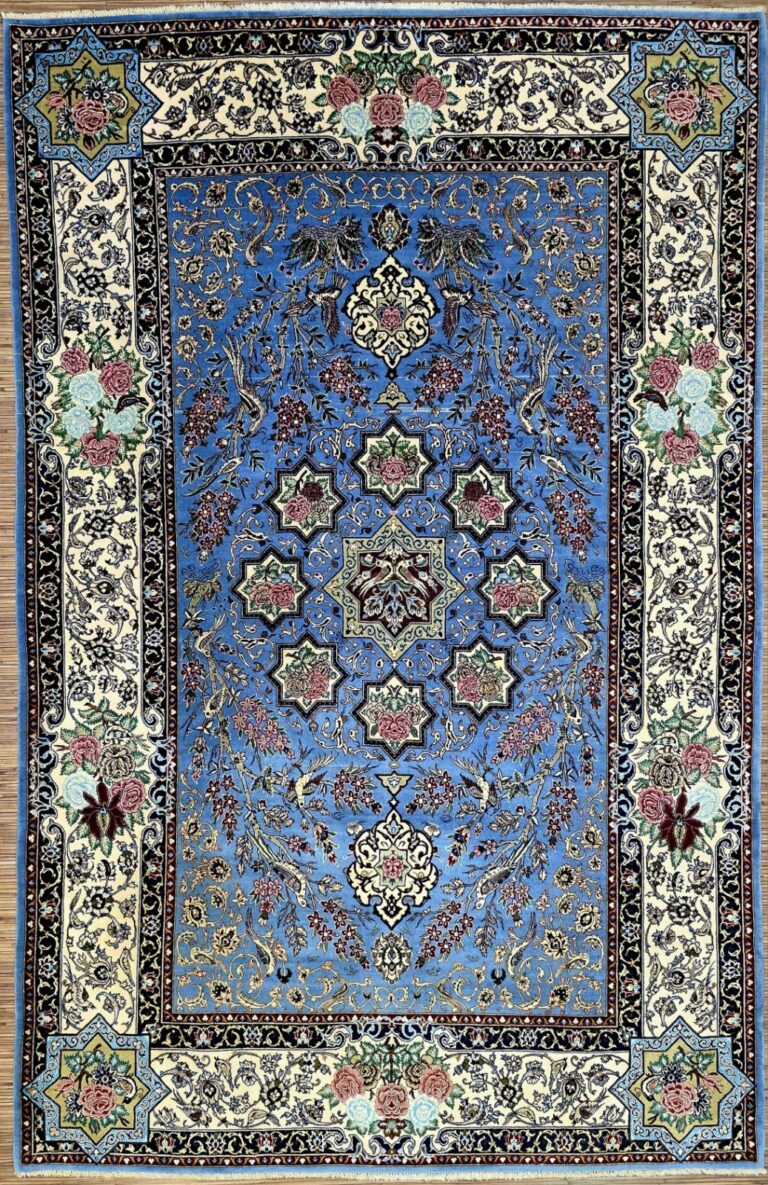
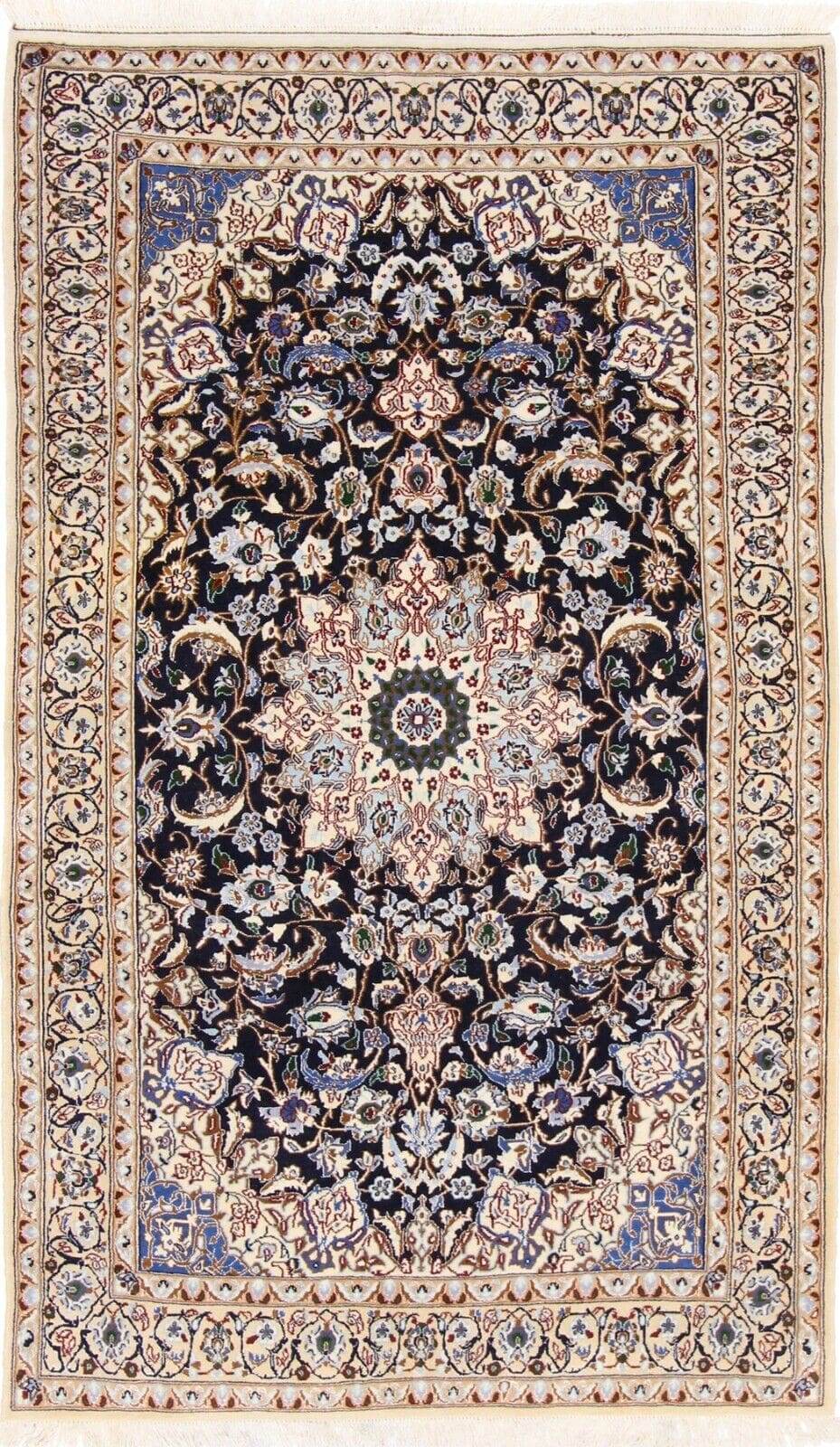
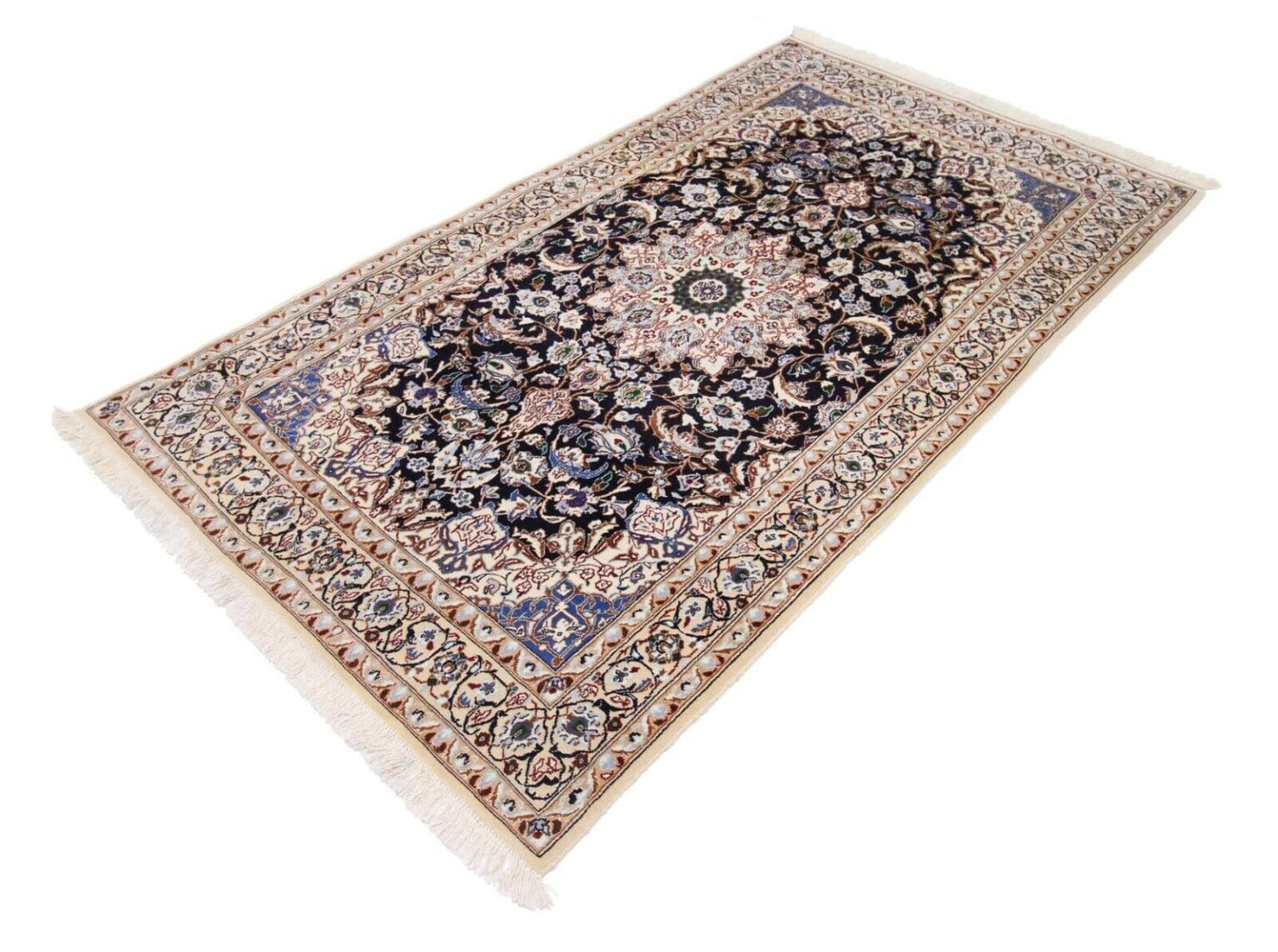
This Nain Persian rug is hand-knotted, with a pile made from 100% wool and a warp made from 100% cotton. These two materials form a traditional basis of oriental rug production. The wool creates the visible and tactile surface, while the cotton warp provides the longitudinal foundation into which the knots are tied. No other material is specified for this piece.
Hand-knotting means that individual knots are inserted by hand into the prepared warp. After a row has been completed, weft threads are placed and compacted before the next row is worked. The process creates a textile structure unlike that of a machine-made floor covering. The product description records a high knot density. In general, a high knot density means that knots are placed more closely together, allowing lines and areas to be drawn with greater differentiation. It does not, by itself, identify a particular design.
Handmade production in Nain rugs combines the preparation of the loom, the arrangement of the warp, the tying of the knots and the finishing of the surface. Wool has long been used in rug making because it forms a durable pile and accepts colour well. Cotton is used as a warp material because it creates a regular base for the pile. For this rug, the pile and warp materials are specifically identified as wool and cotton.
The making of a hand-knotted rug is a sequential process. A weaver works across the width of the loom, follows the intended arrangement and checks the tension as the structure grows. Finishing may include trimming and washing, depending on the individual piece. The fact that this rug is described as washed is part of its product information. No details about a particular workshop, dye recipe or production date are provided.
Origin and Tradition
This rug is described as originating in Persia and as a Nain rug. Nain is an Iranian city with a distinct rug-making tradition. It lies in central Iran, in a region historically shaped by dry landscapes and long-distance trade routes. Rug production became an established craft there, and Nain is now recognised internationally as a name within Persian carpet culture.
Persian rugs encompass many regional schools. Nain is mentioned alongside Isfahan, Tabriz and Kashan as a known place of production. Each region has its own workshop customs, preferred compositions and approaches to colour and ornament. A place name therefore does more than identify geography: it places a rug within a historical craft tradition. It does not mean that every rug from the region uses one unchanging design.
Nain workshops became particularly associated with carefully organised compositions and precise drawing. The process begins with the planning of the ground structure, the warp and the intended distribution of colour. The design is then built knot by knot. Unlike a printed floor covering, the visible pattern is created within the textile itself as coloured yarn is inserted into the foundation.
Persian rugs are often identified by their region because regional practice offers context for their construction and visual language. Nain names a city and its weaving tradition. It is not a complete description of the individual pattern on this rug. Workshops within one region may use different drawings, proportions and colour schemes. The Nain designation therefore provides a regional classification while leaving the specific design of this one-off piece open.
The making of a hand-knotted rug requires time, practiced technique and repeated attention to alignment, tension and contour. Designs may be transferred through a drawn guide, memorised workshop knowledge or an established weaving practice. The high knot density recorded for this rug indicates a closely worked construction, but it does not establish a maker, a workshop or an age. No date of manufacture and no signature are stated.
Persian rug traditions also developed in relation to domestic use, trade and the preservation of craft knowledge. Motifs were adapted over generations, while individual weavers and workshops interpreted them in their own way. This mixture of continuity and variation explains why a regional label can be useful without replacing a full description of the rug itself. Here, the documented regional identity is Nain and the broader origin is Persia.
Design and Pattern
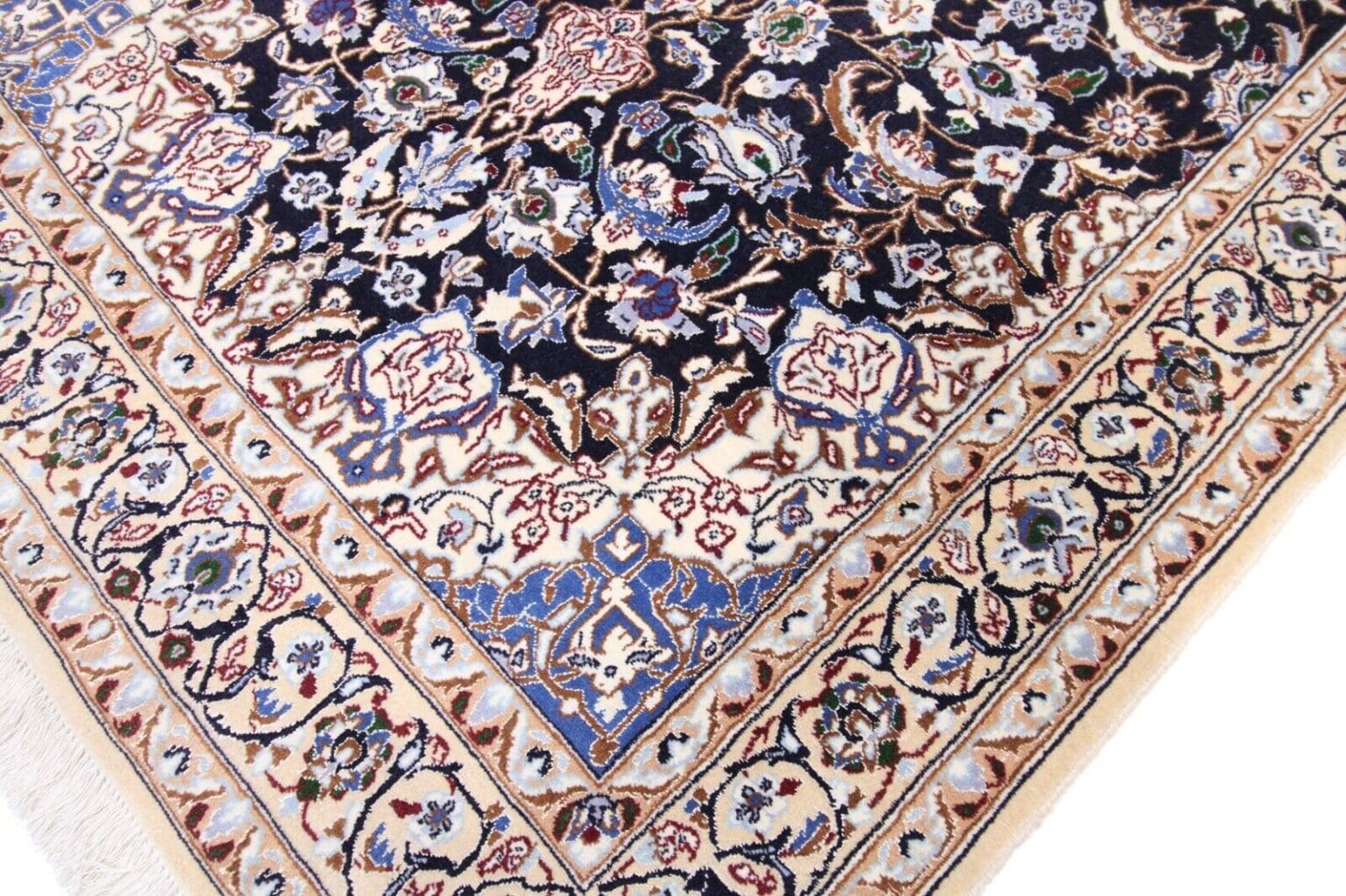
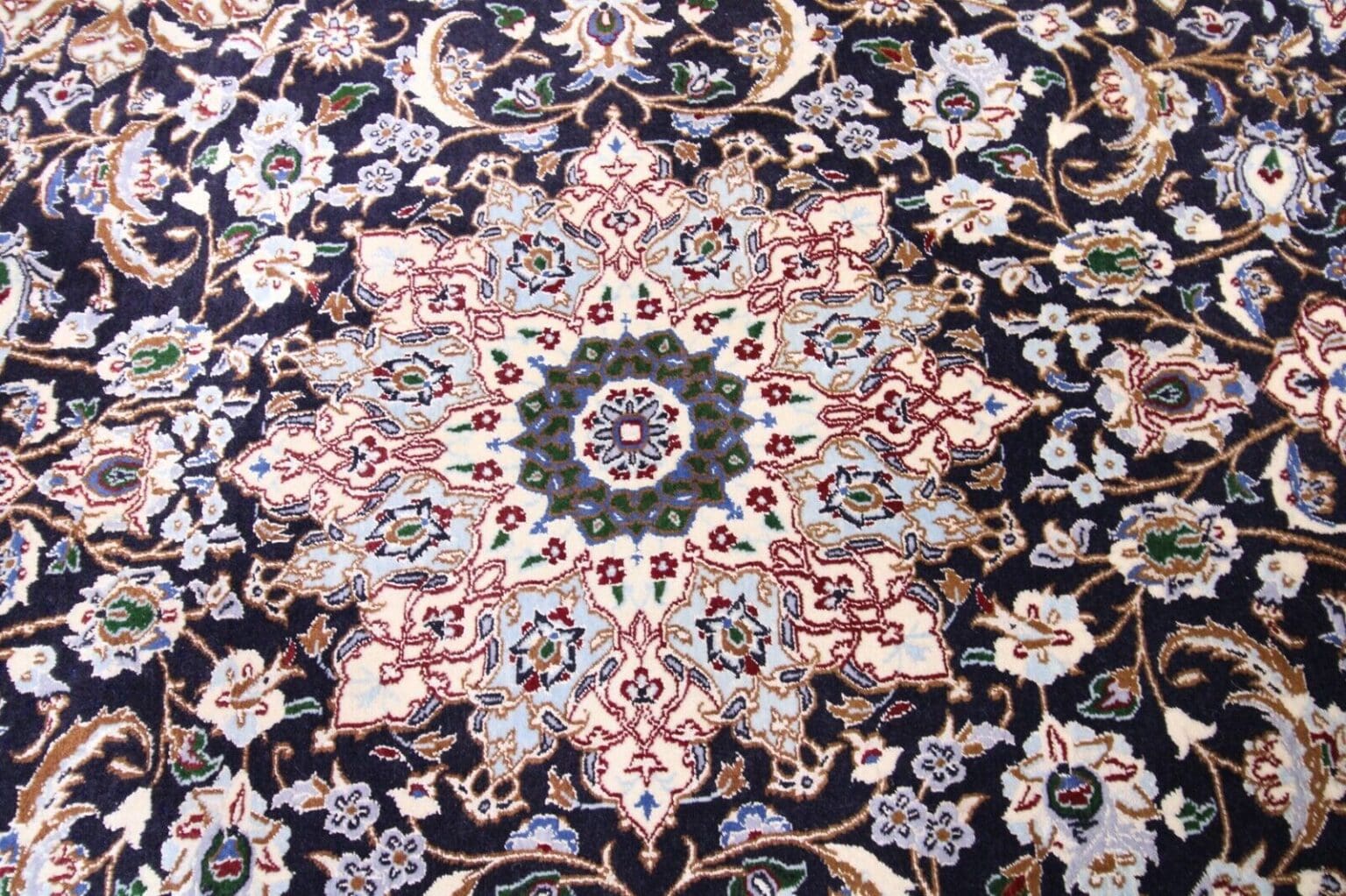
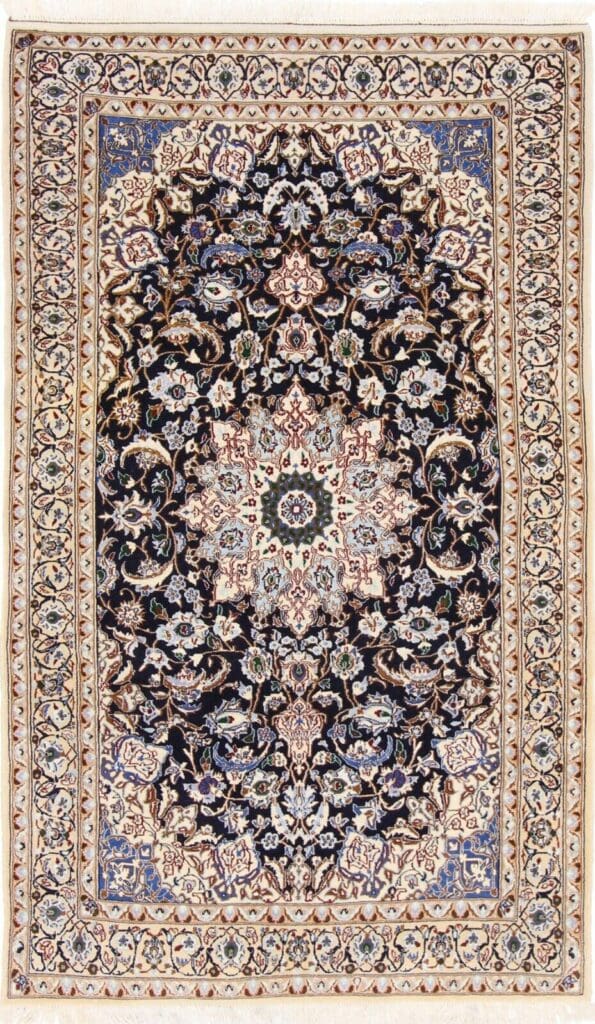
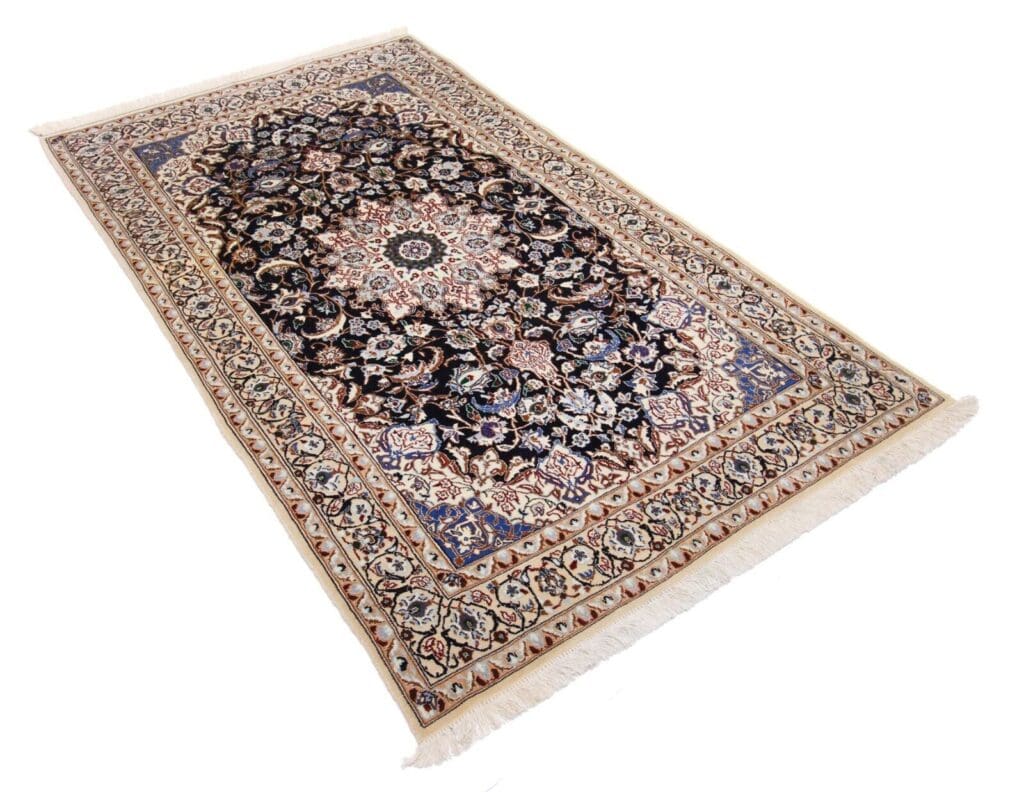
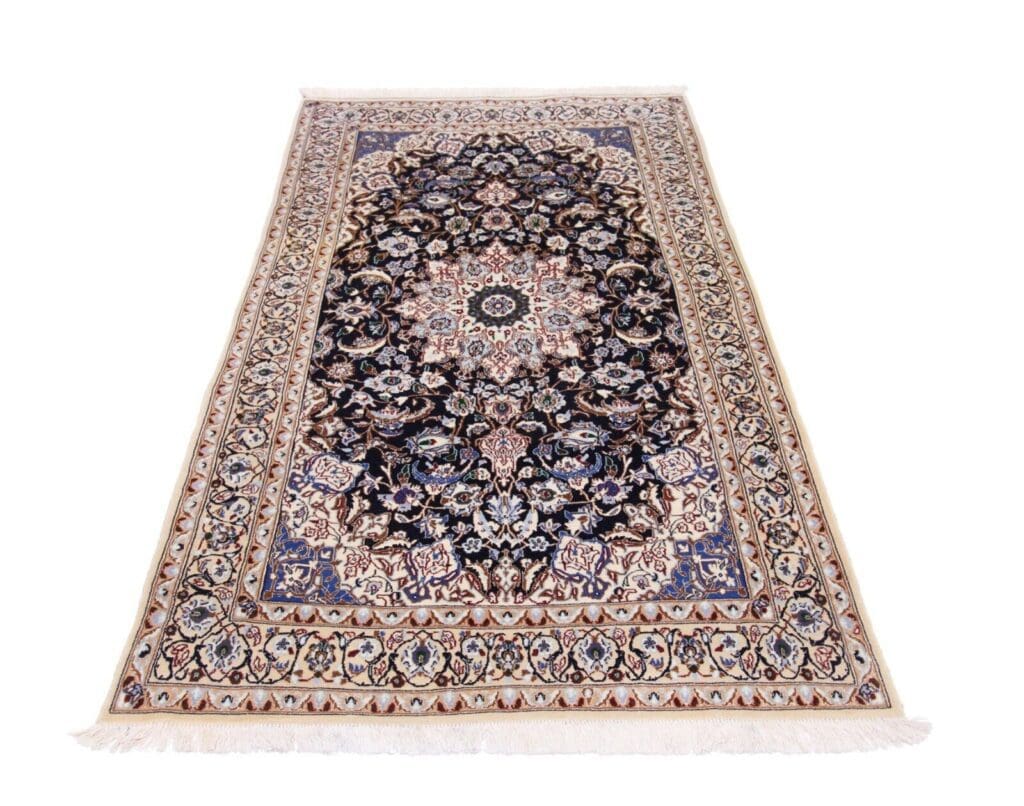
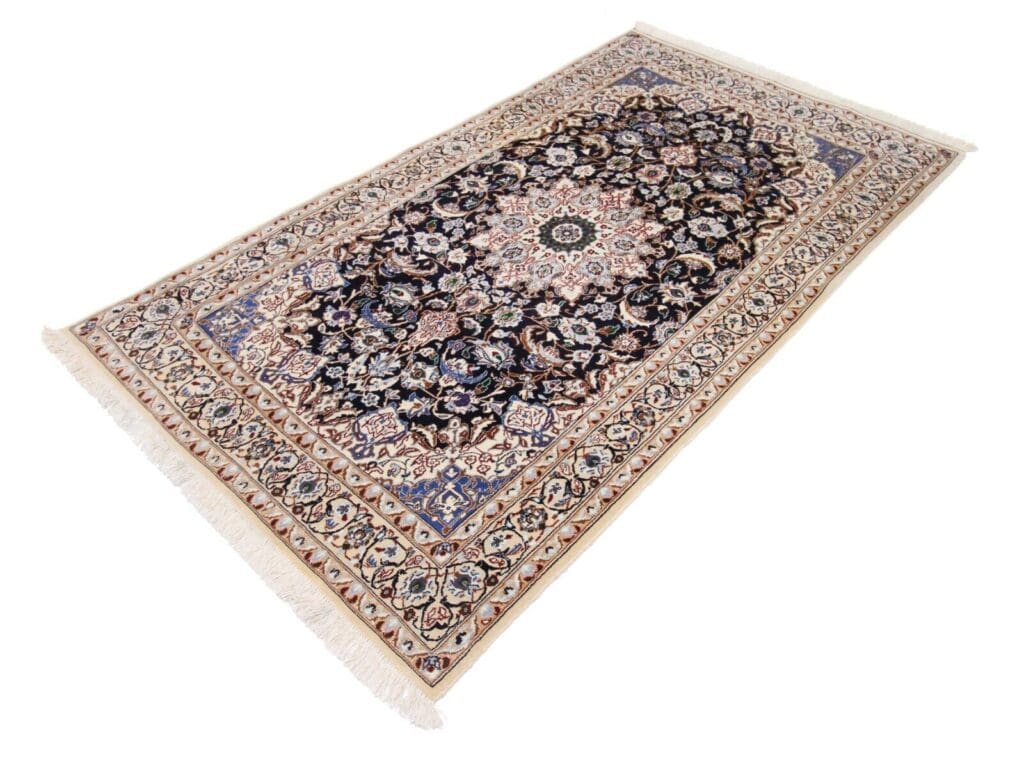
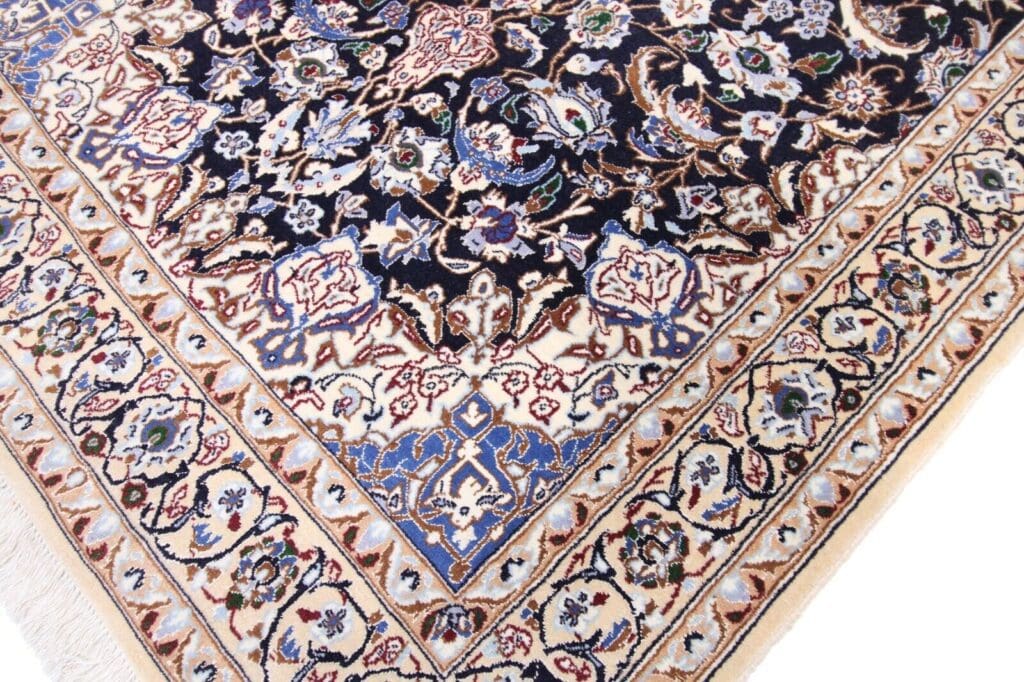
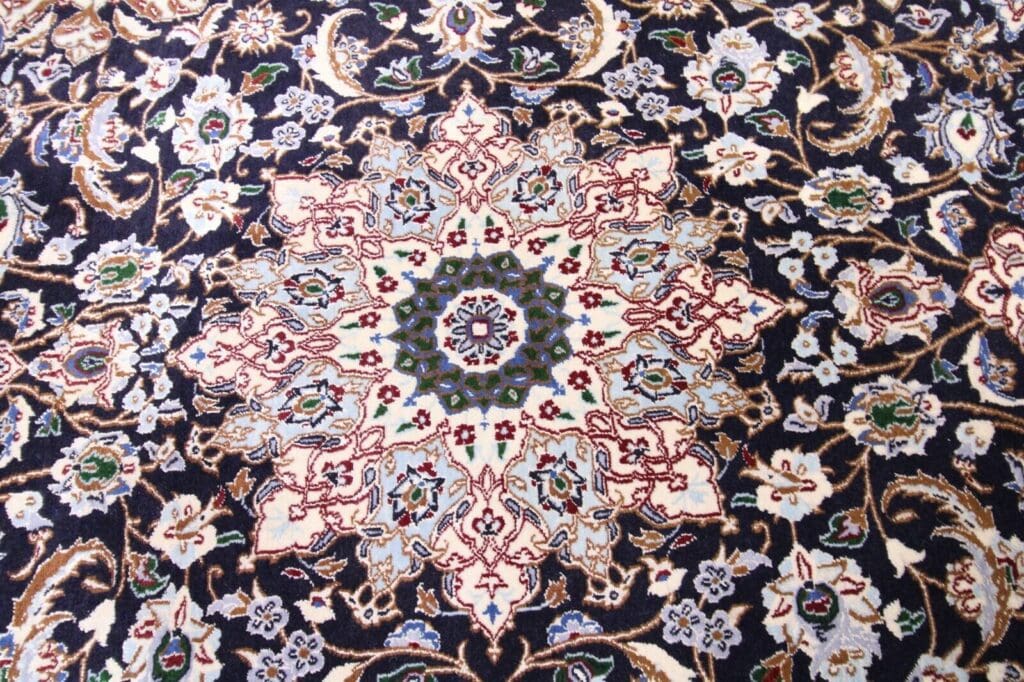
No specific pattern is recorded for this rug. Its drawing is therefore not assigned to a named ornament, colour arrangement or compositional type. In Persian rug design generally, floral and geometric forms are frequent tools. They may be used separately or combined within a balanced overall structure. These are elements of the wider tradition, not claims about a motif present on this particular piece.
Persian compositions are often discussed through distinctions such as central medallion, repeated field design and all-over arrangement. A medallion concentrates the visual structure in the centre. A repeated design uses a motif or group of motifs across the field, while an all-over arrangement distributes the ornament more evenly. Borders frame the field and can contain related or contrasting forms. These terms explain the vocabulary of Persian design, but the product information does not identify one of them for this rug.
Floral designs may include leaves, vines, blossoms and stylised branches. Geometric designs rely more strongly on lines, angles, compartments and repeated proportions. Persian weavers have often transformed natural forms into ordered symbols, allowing organic shapes and measured structure to coexist. The exact interpretation depends on the regional school, the workshop and the individual design. No detailed pattern description is available for this Nain rug.
Colour in Persian rugs has both a decorative and an organising function. Common colour families in the tradition include red, blue, cream, gold, green and natural tones. Nain rugs are often discussed in connection with controlled compositions and clearly separated fields, but this general association does not establish the colours used here. The source does not provide a colour list for the individual rug, so no particular palette is attributed to it.
A high knot density can generally support the rendering of fine contours, small changes in motifs and carefully graded areas. Knot density alone, however, does not define a rug’s visual character. Colour, proportion, border treatment and the handling of the field all contribute to the finished design. In a hand-knotted one-off, these elements come together through the work of the weaver. Since the specific pattern is not named, the appropriate description remains its documented Nain classification and its place within Persian design tradition.
Pattern terminology should not be confused with origin. A motif can appear in several weaving regions, while a place name identifies a production tradition. For this rug, Nain is the regional name supplied in the product information. The absence of a named design leaves room for the individual composition to be considered on its own terms rather than forcing it into an unsupported pattern category.
Special Features
The recorded features of this rug are its hand-knotted construction, high knot density, 100% wool pile and 100% cotton warp. It is described as original and handmade. Its condition is given as top, and the rug has been washed. These statements concern the offered one-off piece.
Regular vacuuming is recommended for ongoing care so that loose dust does not remain in the pile. Professional cleaning is suggested when further cleaning is needed. Direct sunlight should be avoided because prolonged exposure can cause colours to fade. The rug has already been washed, but no restoration history, date of manufacture or signature is provided. An authenticity certificate is not stated as part of this specific rug.
FAQ
What characterises a Nain Persian rug?
A Nain Persian rug belongs to the Persian rug tradition and takes its regional name from the Iranian city of Nain. The designation refers to a place and its associated craft history, not to one mandatory pattern. This piece is hand-knotted, has a high knot density and combines a 100% wool pile with a 100% cotton warp. Its individual pattern is not specified. In general, Nain rugs are associated with carefully organised drawing and the use of floral or geometric forms within a structured composition. The regional name provides context for the workmanship while the individual rug remains distinct.
How should I care for this Persian rug?
The rug should be vacuumed regularly and gently so that dust does not settle permanently in the pile. Professional cleaning is appropriate when more extensive care is required. This piece is already described as washed and is listed in top condition. Direct sunlight should be avoided because it can fade colours over time. Any cleaning treatment should take account of the wool pile and cotton warp. The product information does not recommend aggressive cleaning agents or independent wet cleaning, so specialist care is the suitable approach for additional cleaning.
Where can I use a Nain Persian rug?
A Persian rug of this type can be used in a living room, dining room or hallway. These areas are named as suitable applications in the product description. Its traditional origin can be combined with both classic and modern interiors. In a living room it may define the area beneath a seating arrangement; in a dining room it may be placed beneath a table when the furniture stands securely. In a hallway it can help structure the floor area. The final placement should take account of the room, circulation routes, furniture and the condition of the floor beneath it.
To provide the best experiences, we use technologies like cookies to store and/or access device information. Consenting to these technologies will allow us to process data such as browsing behavior or unique IDs on this site. Not consenting or withdrawing consent, may adversely affect certain features and functions.
Functional Always active
The technical storage or access is strictly necessary for the legitimate purpose of enabling the use of a specific service explicitly requested by the subscriber or user, or for the sole purpose of carrying out the transmission of a communication over an electronic communications network.
Preferences
The technical storage or access is necessary for the legitimate purpose of storing preferences that are not requested by the subscriber or user.
Statistics
The technical storage or access that is used exclusively for statistical purposes.The technical storage or access that is used exclusively for anonymous statistical purposes. Without a subpoena, voluntary compliance on the part of your Internet Service Provider, or additional records from a third party, information stored or retrieved for this purpose alone cannot usually be used to identify you.
Marketing
The technical storage or access is required to create user profiles to send advertising, or to track the user on a website or across several websites for similar marketing purposes.
 SECURE PAYMENT
 SHIPPING PARTNERS