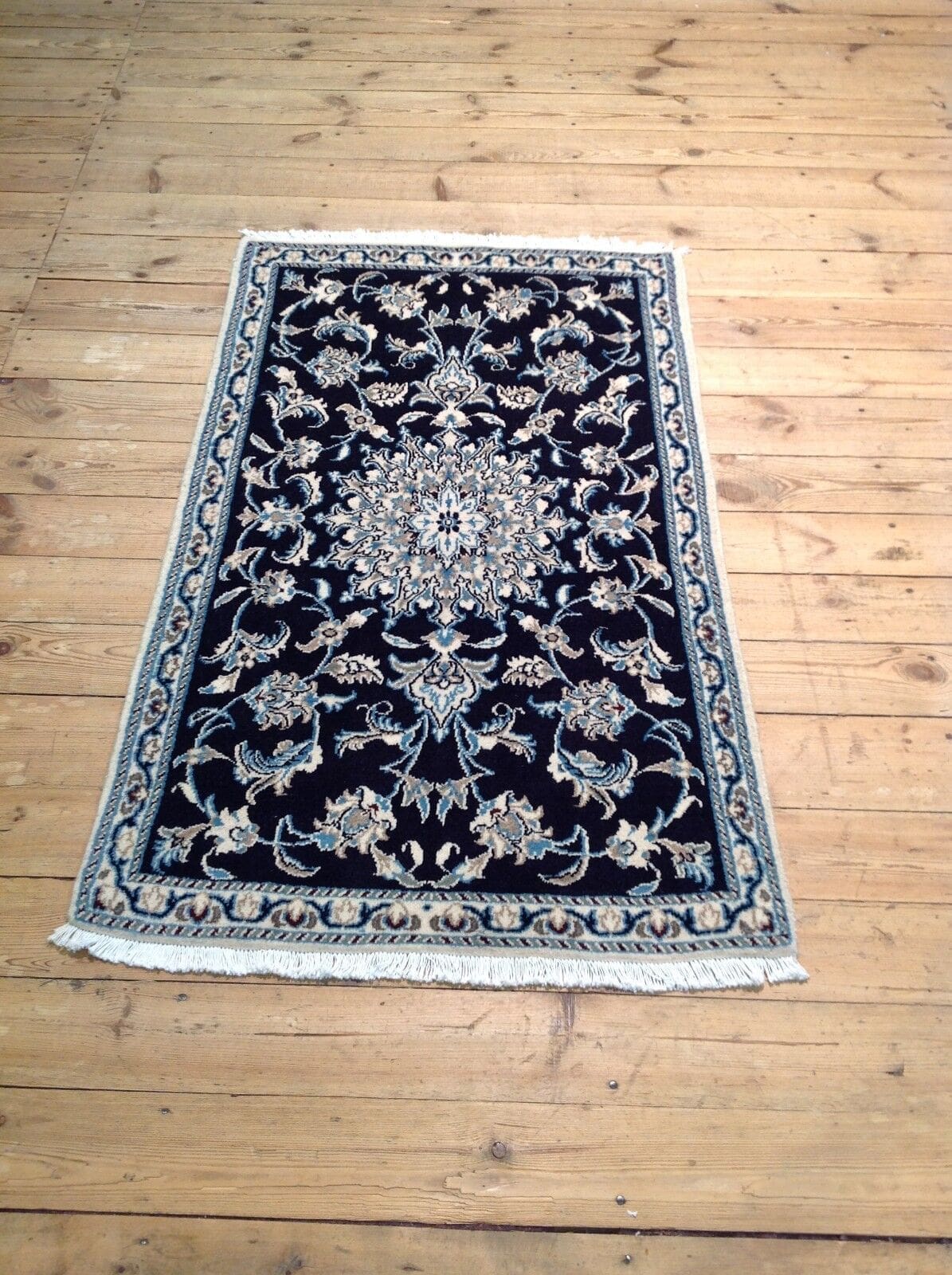
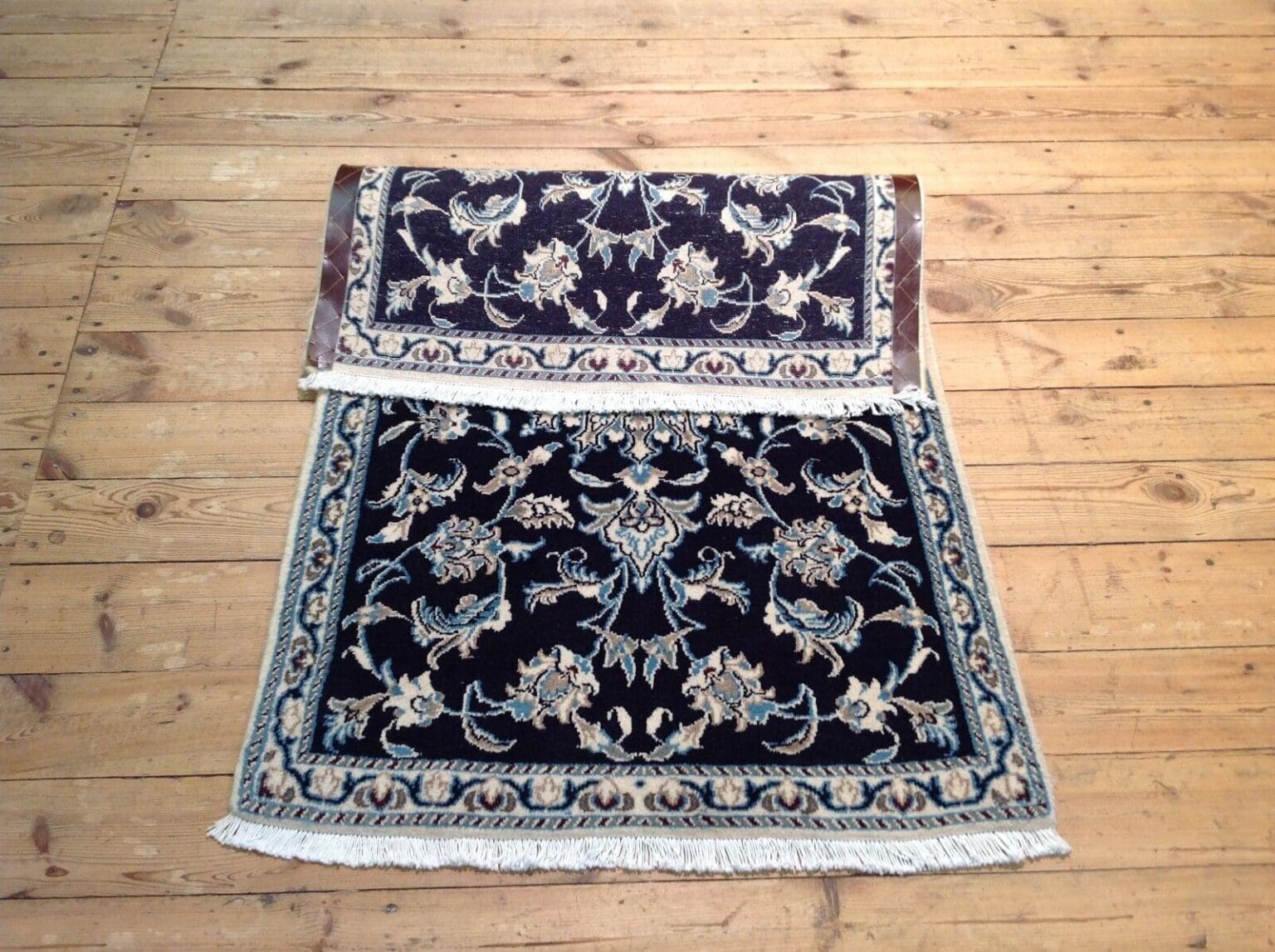
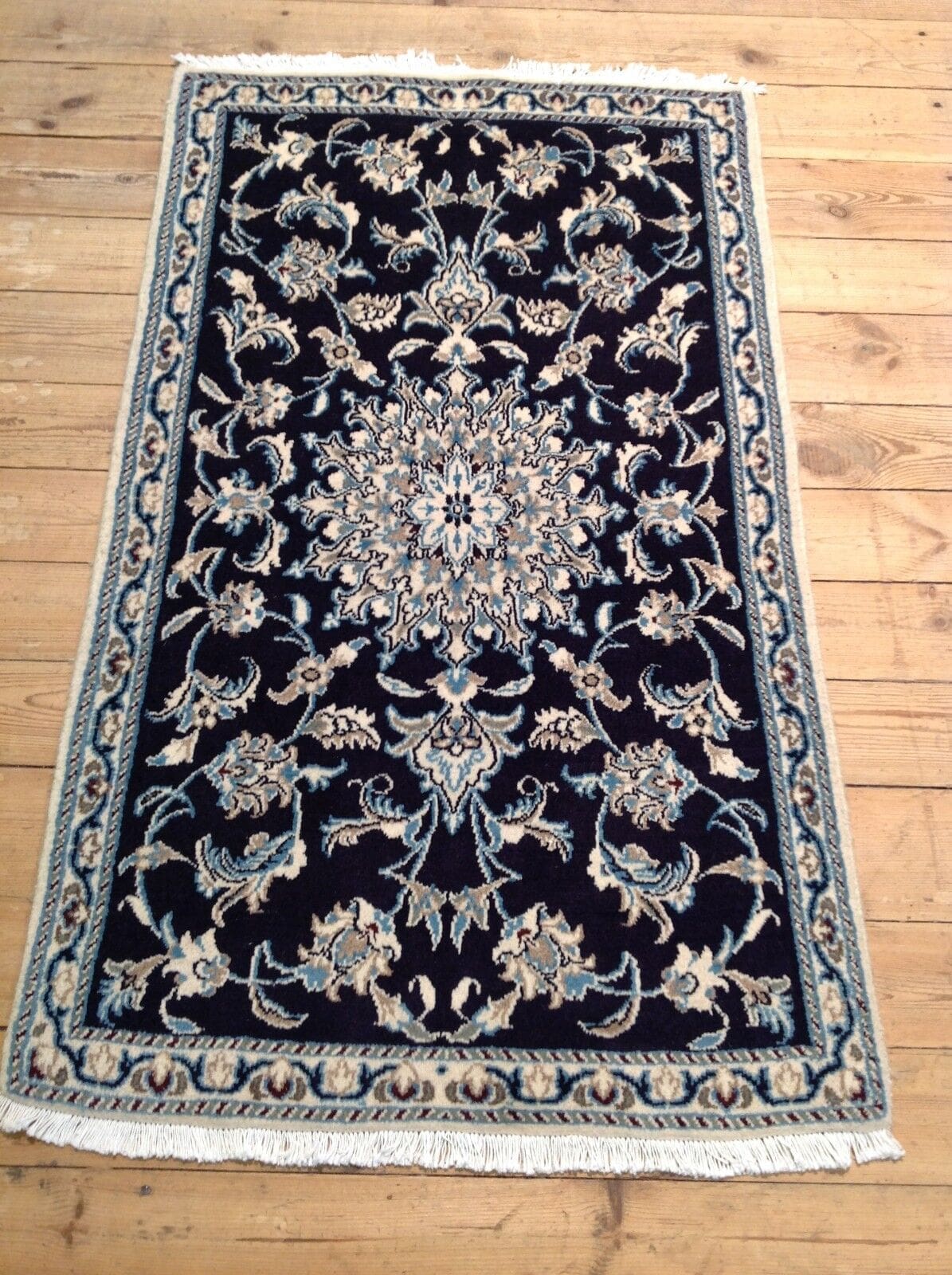
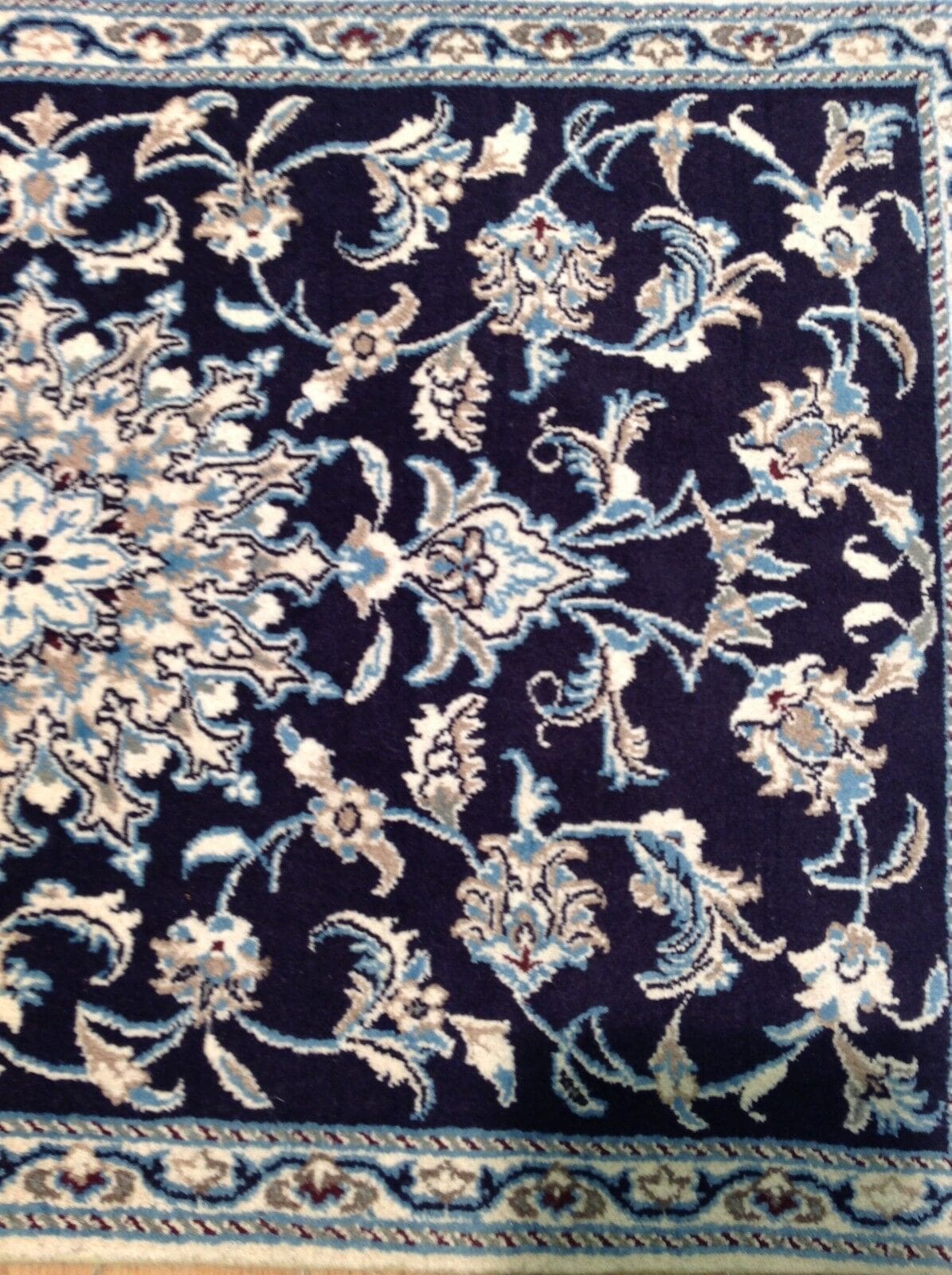
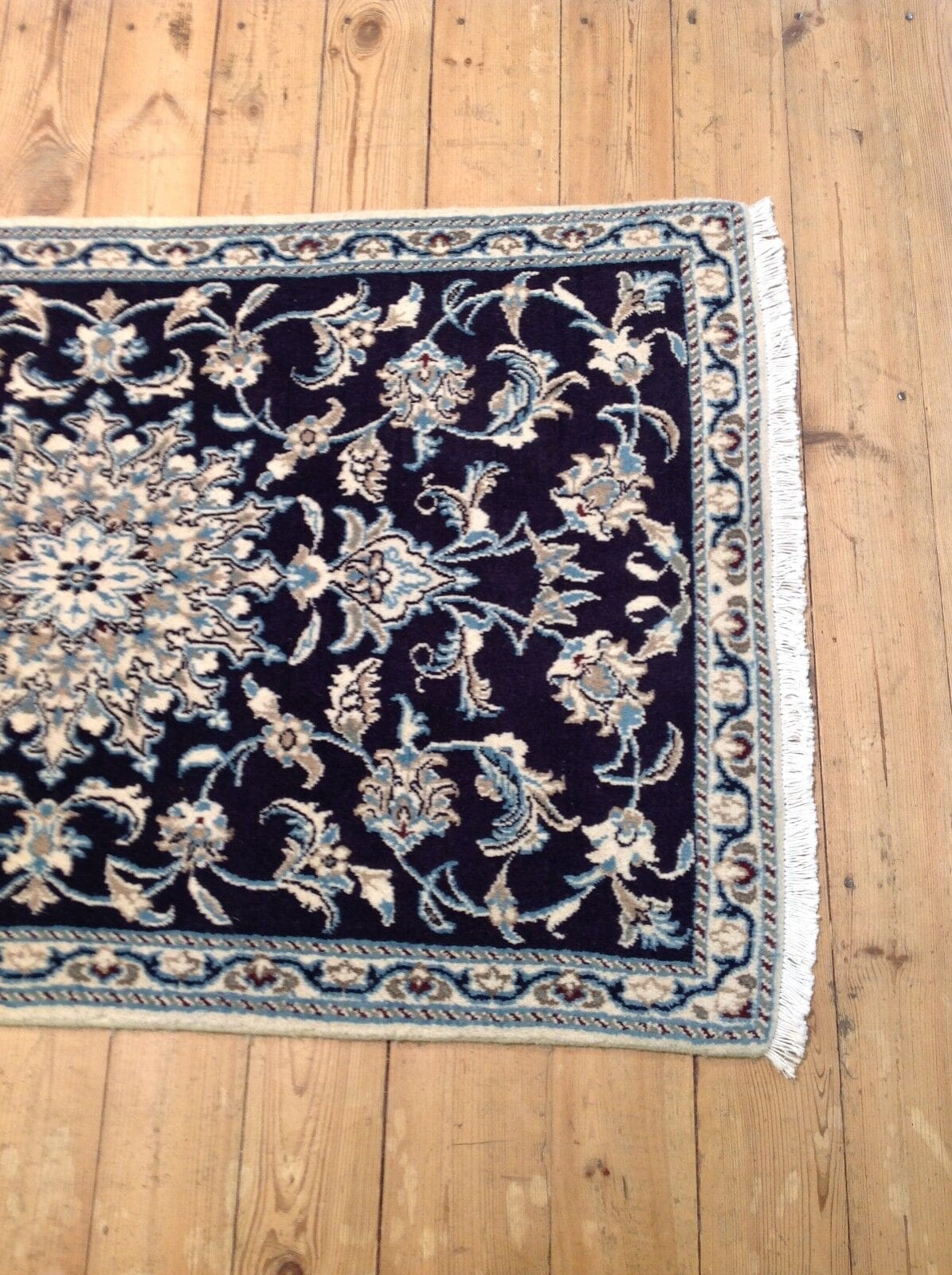
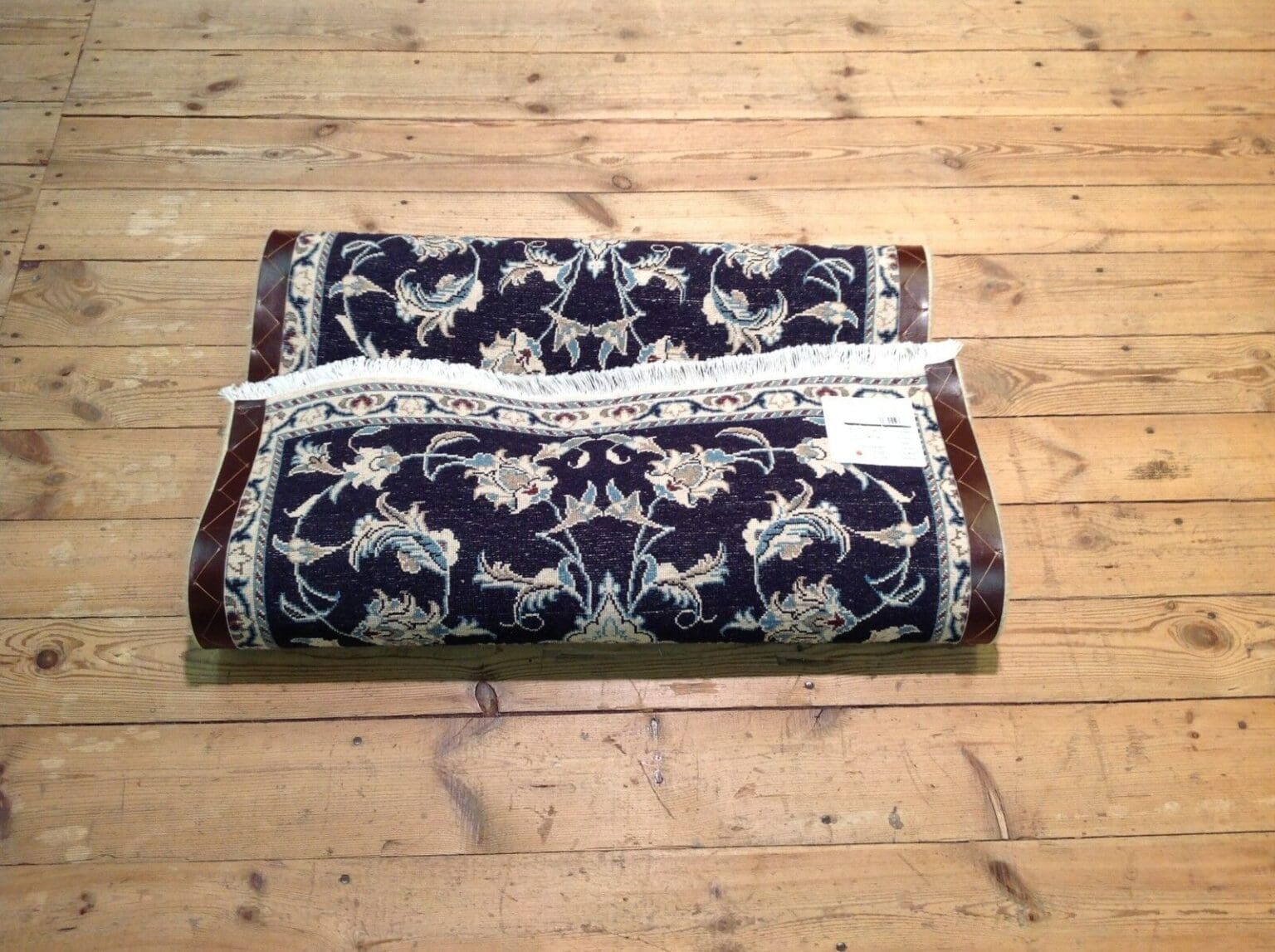
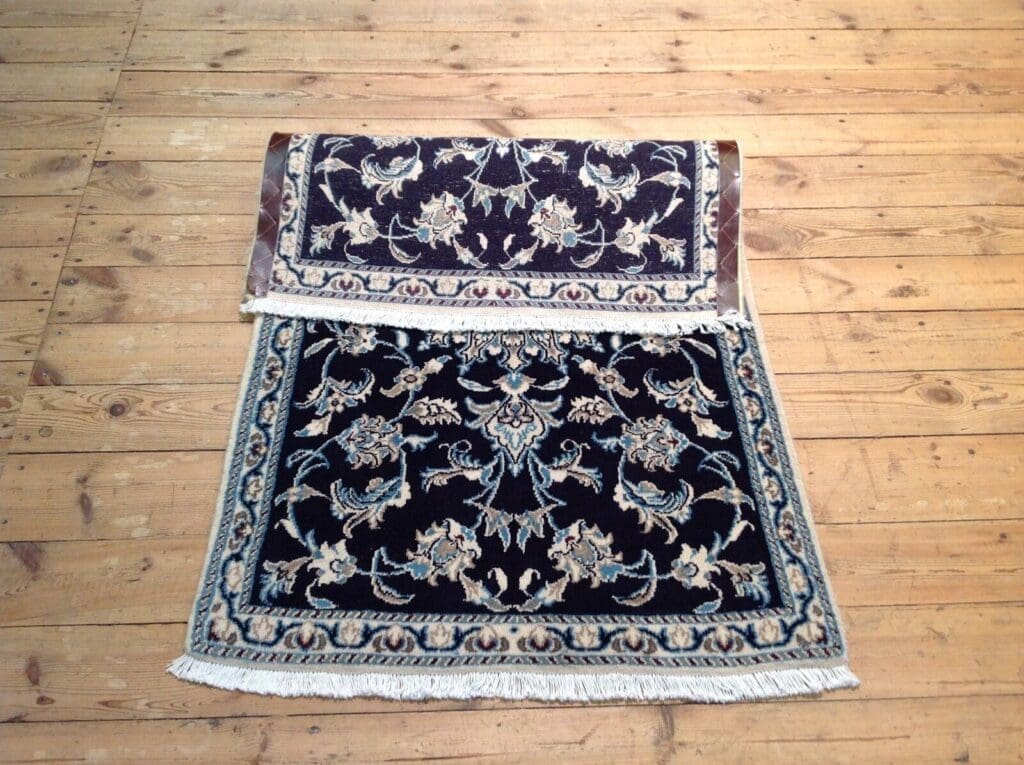
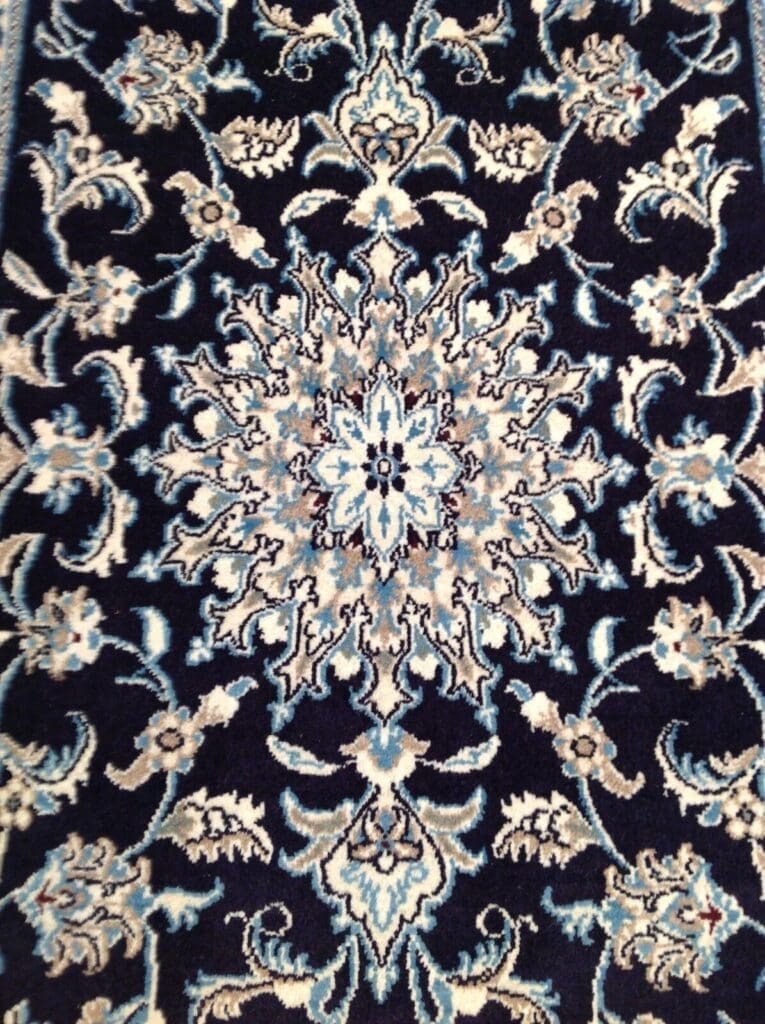
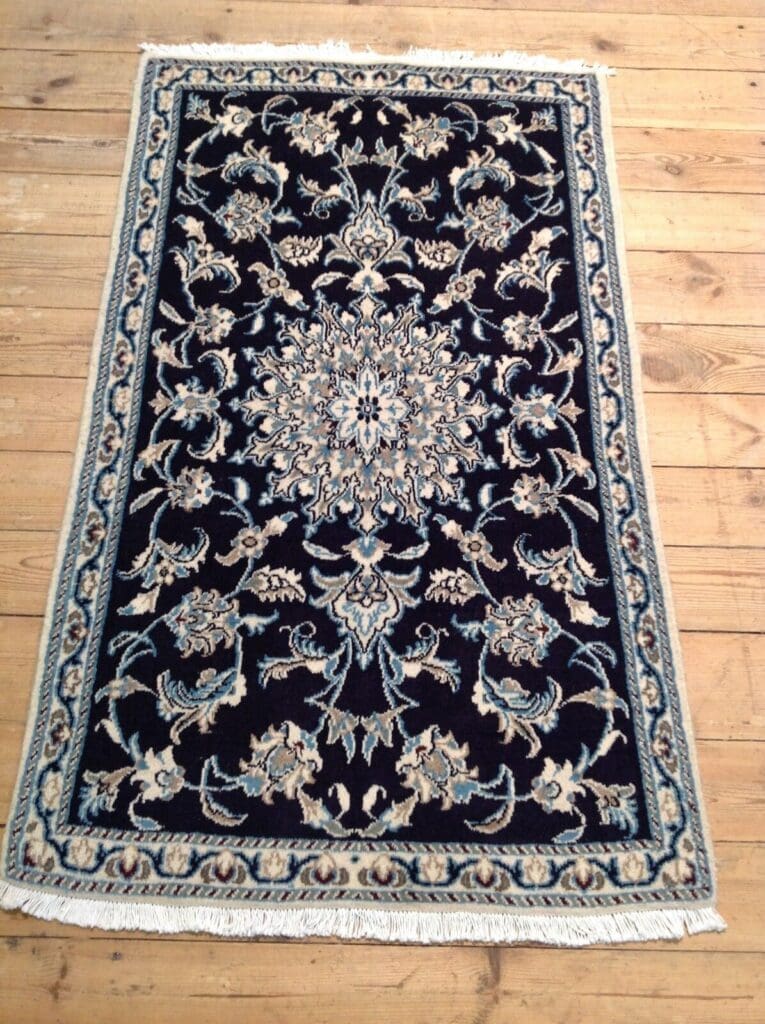
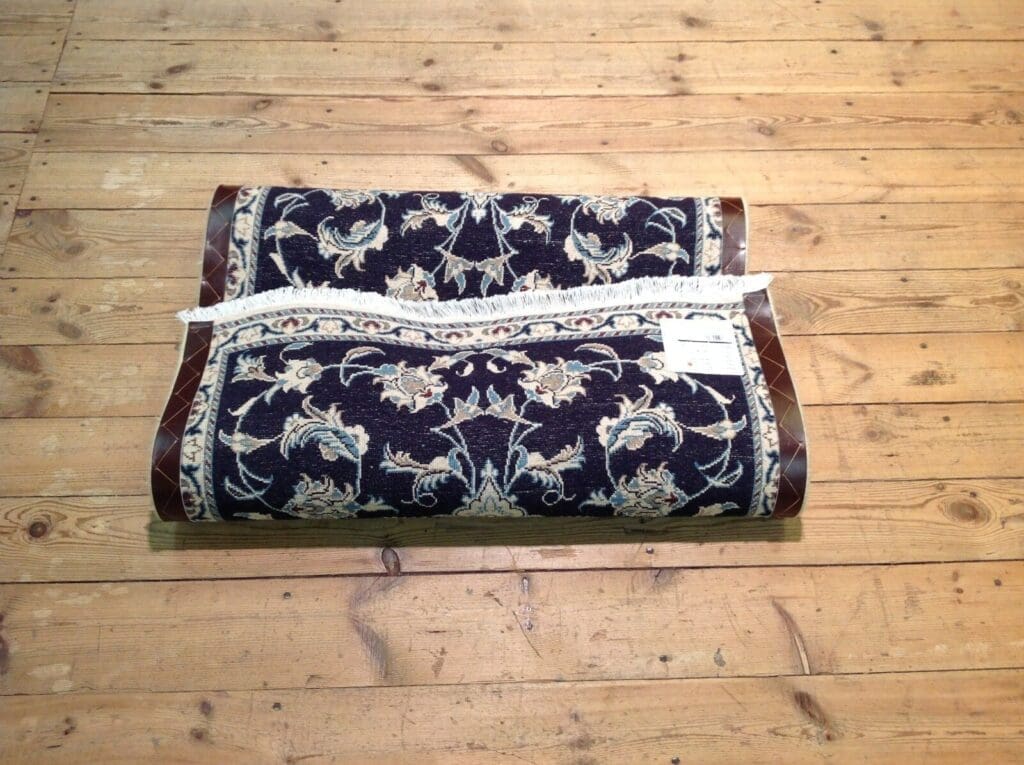
Hand-knotted Nain Persian rug | Knot density: approx. 300,000 knots/m² | Material: pile 100% virgin wool, warp 100% cotton | Size: 148 x 90 cm | Pattern: traditional Oriental and Persian | Condition: new, very good
This Nain is a hand-knotted Persian rug made with a pile of 100% virgin wool. The warp is specified as 100% cotton. These two materials perform different roles within the construction: the pile creates the visible and tactile surface, while the warp forms part of the underlying structure that supports the knots. Together they describe a clearly defined textile build based on natural fibres and traditional rug-making practice.
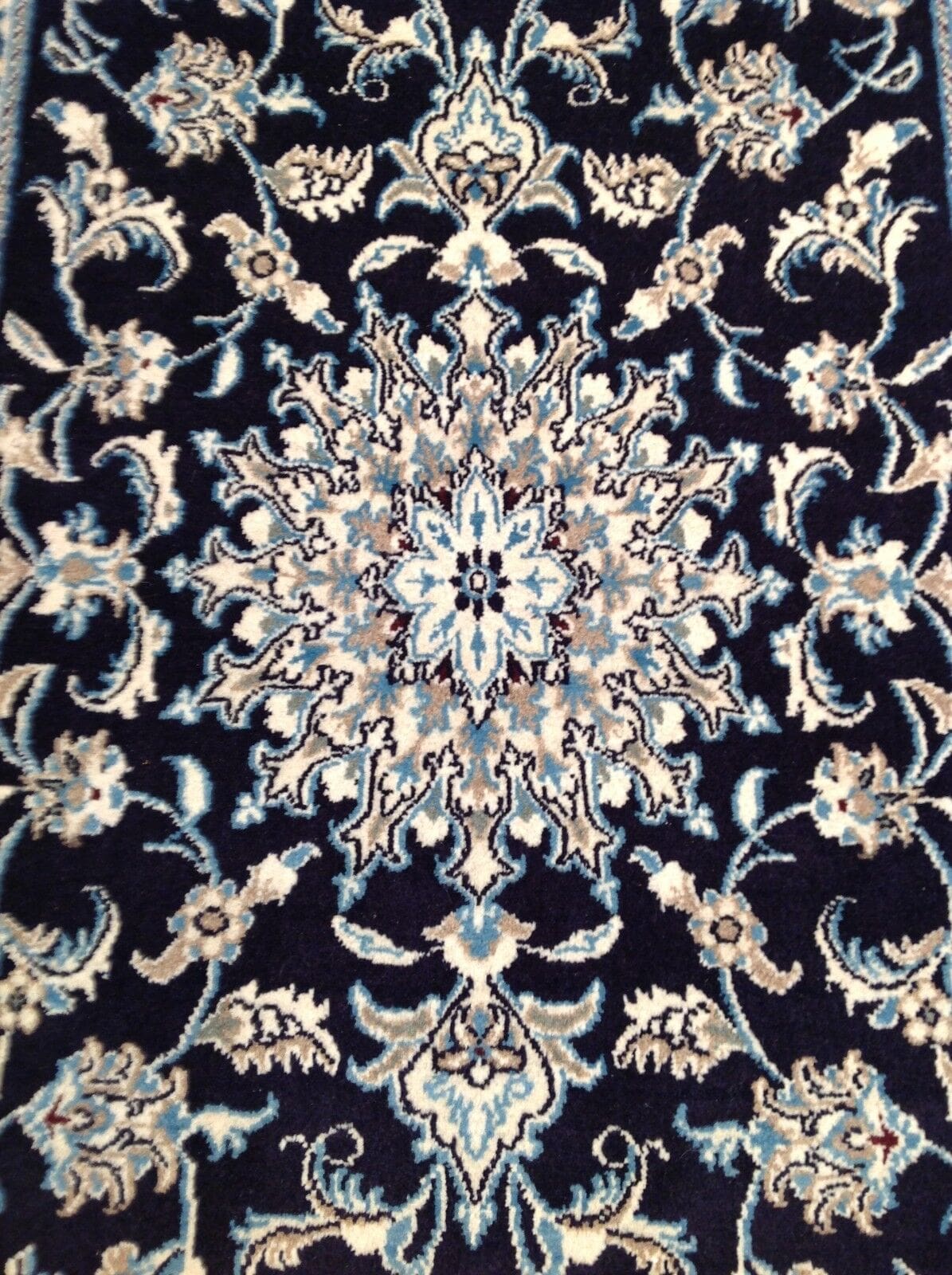
Virgin wool is used in hand-knotted rugs for its hard-wearing character and pleasant feel. It provides a comfortable surface underfoot and contributes natural warmth. In this rug, the pile is entirely virgin wool. The listed density of approximately 300,000 knots per square metre indicates a finely executed knotting structure. A dense knot arrangement gives a weaver the basis for rendering small floral details, measured outlines and geometric elements with greater definition.
Hand-knotting is an individual process rather than a continuous machine-produced operation. Knots are placed one by one into the prepared foundation, then secured through the ongoing sequence of weaving and finishing work. The final surface comes from the relationship between warp, weft, knots and trimmed pile. For a Nain, this technical foundation is combined with a Persian design vocabulary. Craftsmanship therefore affects both the way the rug is made and the way its pattern is read across the surface.
The wool pile gives the rug a comfortable hand and natural insulation. This piece is described as new and in very good condition. That condition, together with the hand-knotted construction and the specified materials, forms part of its individual description. The use of wool and cotton makes the structure easy to understand while retaining the character associated with traditional Persian knotting.
Origin and Tradition
Nain is a city in Iran and also the name of a recognised Persian rug tradition. Nain rugs are associated with fine knotting, carefully drawn ornament and a controlled division of the field. The city developed its own weaving identity within the broader history of Iranian carpet production. In that setting, rug making is more than surface decoration: it is a textile craft shaped by inherited methods, regional knowledge and a long familiarity with planned ornamental composition.
Persian carpet design brings together technical skill, repeated motifs and deliberate organisation of the available space. In the Nain tradition, floral details and geometric order are often brought into close balance. The rug begins with its structural plan: warp and weft establish the foundation, knots form the pile, and finishing work clarifies the surface. The result is a textile image that can be examined in detail while still maintaining a coherent overall arrangement.
The history of Persian rugs is made up of many regional schools, each with preferences concerning proportion, ornament, colour relationships and fineness. Nain represents a refined regional interpretation within that larger Iranian tradition. Its design language is commonly connected with precise drawing and the careful combination of botanical forms with ordered geometry. Individual rugs can differ considerably, yet the regional identity remains visible through the approach to composition and the discipline of the knotting.
Knowledge in Persian rug production has traditionally been passed through generations. It includes preparing the loom, tensioning the warp, selecting and handling yarns, placing the knots, and trimming and arranging the pile. Experience becomes especially important when a design contains narrow contours, small ornaments and carefully balanced transitions. A higher knot density requires steady work and close attention to the intended drawing. These general features explain why Nain is associated with detailed, finely structured carpets.
Nain rugs are commonly classified as traditional Oriental and Persian rugs. This classification describes their cultural and design context, not a factory-made format. The Persian designation places the rug within the Iranian tradition, while Nain identifies the city and the associated weaving school. This particular piece is described as a Persian rug from Persia and as a Nain, so its origin and regional identity belong to that Iranian context.
Persian rugs have traditionally served both private and representative interiors. Their role is not limited to covering a floor. A carefully organised textile field can define an area, add a layer of material texture and establish a visual relationship between furniture and architecture. The Nain tradition can therefore be placed in more classical rooms as well as in quieter contemporary interiors, while its connection to Persian carpet culture remains clear.
Design and Pattern
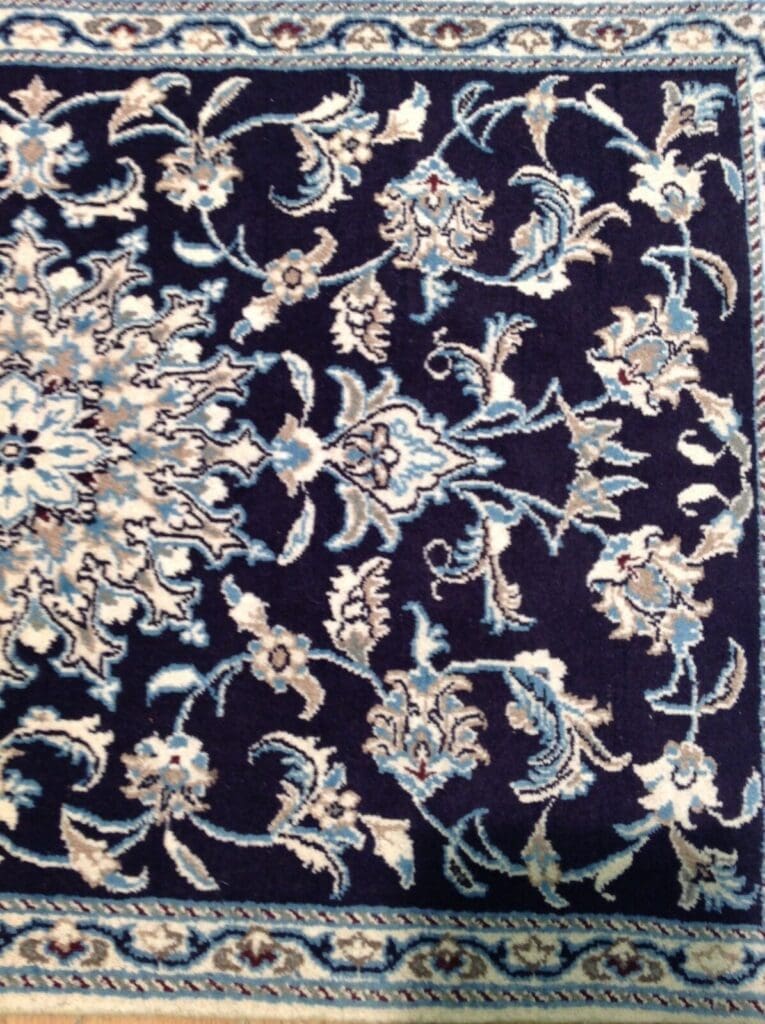
The rug is described as traditional Oriental and Persian in style. Nain designs are typically associated with fine floral elements and intricate geometric forms. Floral ornament may include leaves, vines, blossoms or stylised botanical shapes. Geometry introduces axes, intervals and recurring rhythms. In Persian design, these two qualities are often arranged so that the field feels ordered without losing the richness created by numerous small details.
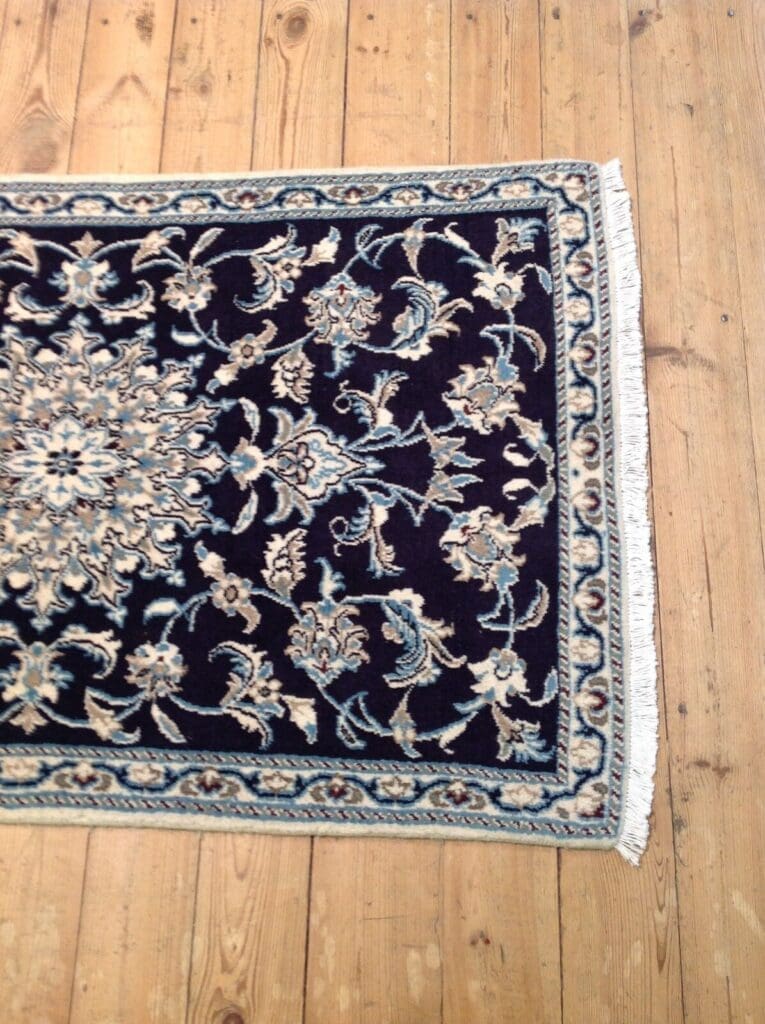
A key principle of traditional rug design is the hierarchy of the composition. A central field may be framed by one or more borders, while the inner area may be organised around a medallion, an all-over arrangement or a balanced sequence of plant forms. Nain compositions are generally connected with clear drawing and careful coordination of many small shapes. This description concerns the design tradition of the rug type and does not add a specific motif description that is not provided for this individual piece.
Floral ornament in Persian carpets is not necessarily a literal depiction of nature. Flowers and vines may be stylised, mirrored, repeated or placed within a regulated pattern repeat. In this way, natural references become part of an ornamental language governed by proportion and rhythm. Small variations in line, spacing and placement give a hand-knotted rug its individual visual character, even when the underlying design belongs to an established regional tradition.
Geometric forms can strengthen contours, separate areas and guide the eye through the field. Repetition creates a measured rhythm and helps a complex pattern remain legible. In a fine knotting, such lines are built from many individual knots rather than drawn in a single continuous gesture. A dense structure supports the representation of small elements and allows the composition to retain detail instead of relying only on broad, simplified shapes.
Persian patterns often carry visual ideas that have been transmitted through ornamental history. Botanical forms may suggest growth and ordered nature, while a balanced field can convey compositional stability. Such interpretations belong to the wider history of Persian ornament and should not be treated as a specific statement about every individual motif. The character of a design emerges from the relationship between field, border, repetition, symmetry and detail.
Nain rugs may use palettes ranging from restrained earth and natural tones to more pronounced accents. The source describes this rug as traditional Oriental and Persian, but it does not specify its actual colours or name individual motifs. The relevant regional context is therefore the design approach: fine floral drawing, geometric organisation and a harmonious division of the field are established features commonly associated with Nain rugs.
As a hand-knotted one-off, this piece has its own execution. A one-off is not an industrially identical series product. Even when a traditional design draws on established examples, manual knotting produces an individual arrangement of knots and details. The terms unique piece and one-off identify the singular nature of this rug without requiring an additional claim about a motif that has not been described.
Special Features
The specifically stated features are the hand-knotted construction, a pile of 100% virgin wool, a warp of 100% cotton, the fine knot density, the new and very good condition, and the designation as a unique one-off piece. Taken together, these details describe both the construction and the individual status of the rug. It is identified as a Nain and as a Persian rug from Persia.
Routine care for a wool rug can include regular vacuuming to remove loose dirt and dust from the pile. The description also recommends occasional beating as part of maintenance. Professional cleaning at longer intervals can help refresh the appearance while treating the fibres carefully. With a hand-knotted rug, appropriate handling matters because the pile, knots and textile foundation work together to create the surface.
The one-off can be used in living rooms, bedrooms, hallways, offices or reception areas. These possibilities follow from its traditional Oriental and Persian design classification. It may serve as a textile floor covering or as a decorative element. Its hand-knotted construction identifies it as an individual work within the Persian rug tradition rather than as a repeated machine-made product.
FAQ
How should a Persian rug be cared for?
Regular vacuuming removes loose dirt and dust from the pile and supports everyday care. The cleaning should be carried out gently so that the surface is not subjected to unnecessary stress. Occasional beating can supplement routine maintenance. Professional cleaning at intervals of several years may help refresh the colours and protect the fibres. A hand-knotted rug should be entrusted to a cleaner familiar with natural wool fibres and traditional rug construction. Strong or unsuitable cleaning agents should not be used without checking their suitability first, since pile, knots and foundation need to be treated as one textile structure.
Are hand-knotted rugs better than machine-made rugs?
Hand-knotted and machine-made rugs are produced by different methods, so the distinction is primarily one of construction and individual character. In a hand-knotted rug, knots are placed one at a time into the prepared foundation. This allows detailed drawing to develop through many manual stages and gives each piece its own maker’s mark. Machine-made rugs follow a standardised technical process and can be reproduced in identical form. This Nain is described as a hand-knotted one-off. Its approximately 300,000 knots per square metre are also listed as a feature of its fine execution.
Where can this Nain be used?
This Nain can be placed in living rooms, bedrooms, hallways, offices and reception areas. Its traditional Oriental and Persian design can also be used as a decorative textile element. In a living room or bedroom it can define a textile area; in a hallway or reception space it can create a clearly framed accent. Suitability also depends on the room’s traffic and the care available to the rug. The surface should be even and clean, and the hand-knotted pile should not be exposed to unsuitable or excessive stress.
To provide the best experiences, we use technologies like cookies to store and/or access device information. Consenting to these technologies will allow us to process data such as browsing behavior or unique IDs on this site. Not consenting or withdrawing consent, may adversely affect certain features and functions.
Functional Always active
The technical storage or access is strictly necessary for the legitimate purpose of enabling the use of a specific service explicitly requested by the subscriber or user, or for the sole purpose of carrying out the transmission of a communication over an electronic communications network.
Preferences
The technical storage or access is necessary for the legitimate purpose of storing preferences that are not requested by the subscriber or user.
Statistics
The technical storage or access that is used exclusively for statistical purposes.The technical storage or access that is used exclusively for anonymous statistical purposes. Without a subpoena, voluntary compliance on the part of your Internet Service Provider, or additional records from a third party, information stored or retrieved for this purpose alone cannot usually be used to identify you.
Marketing
The technical storage or access is required to create user profiles to send advertising, or to track the user on a website or across several websites for similar marketing purposes.
 SECURE PAYMENT
 SHIPPING PARTNERS


