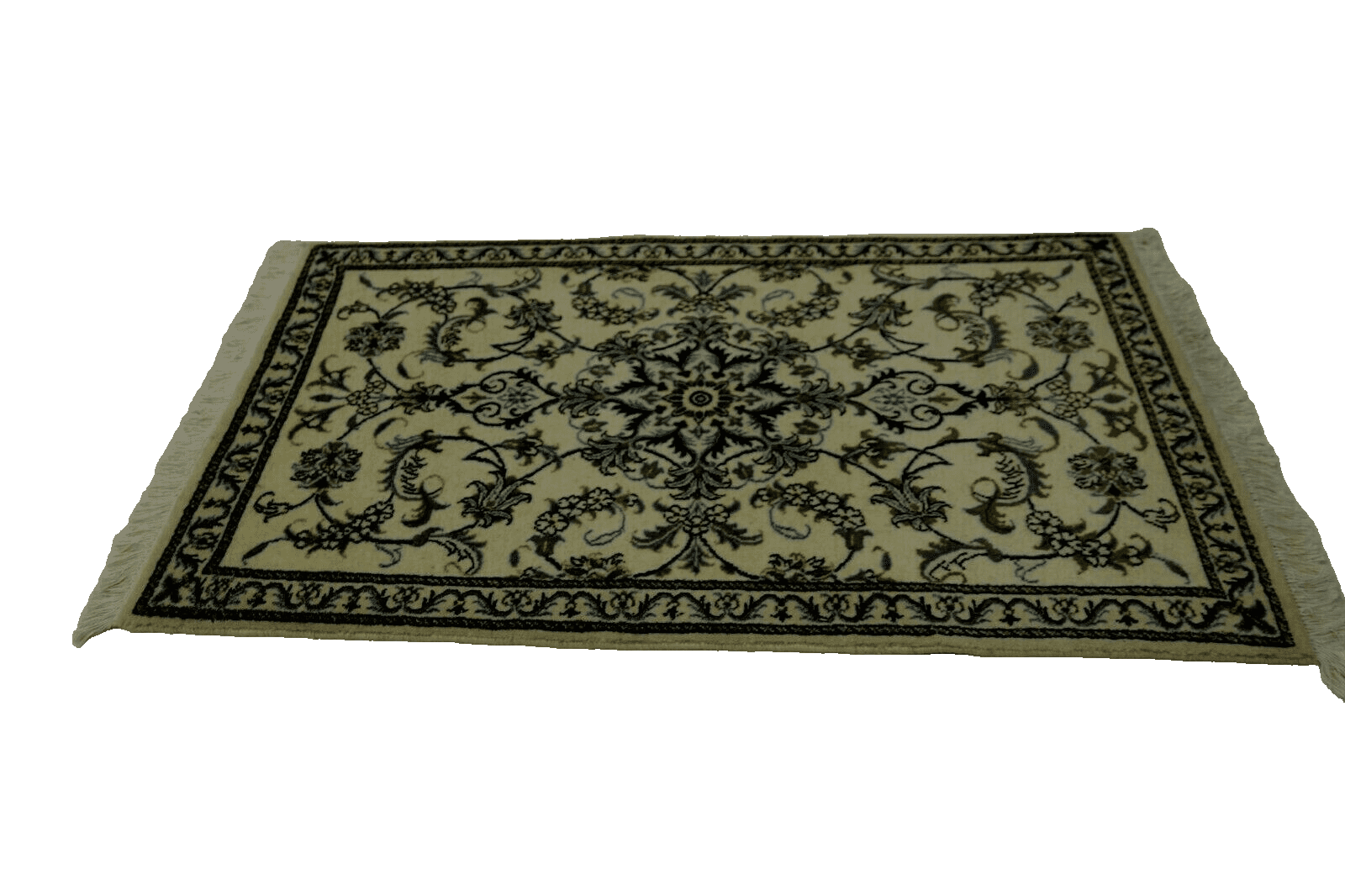
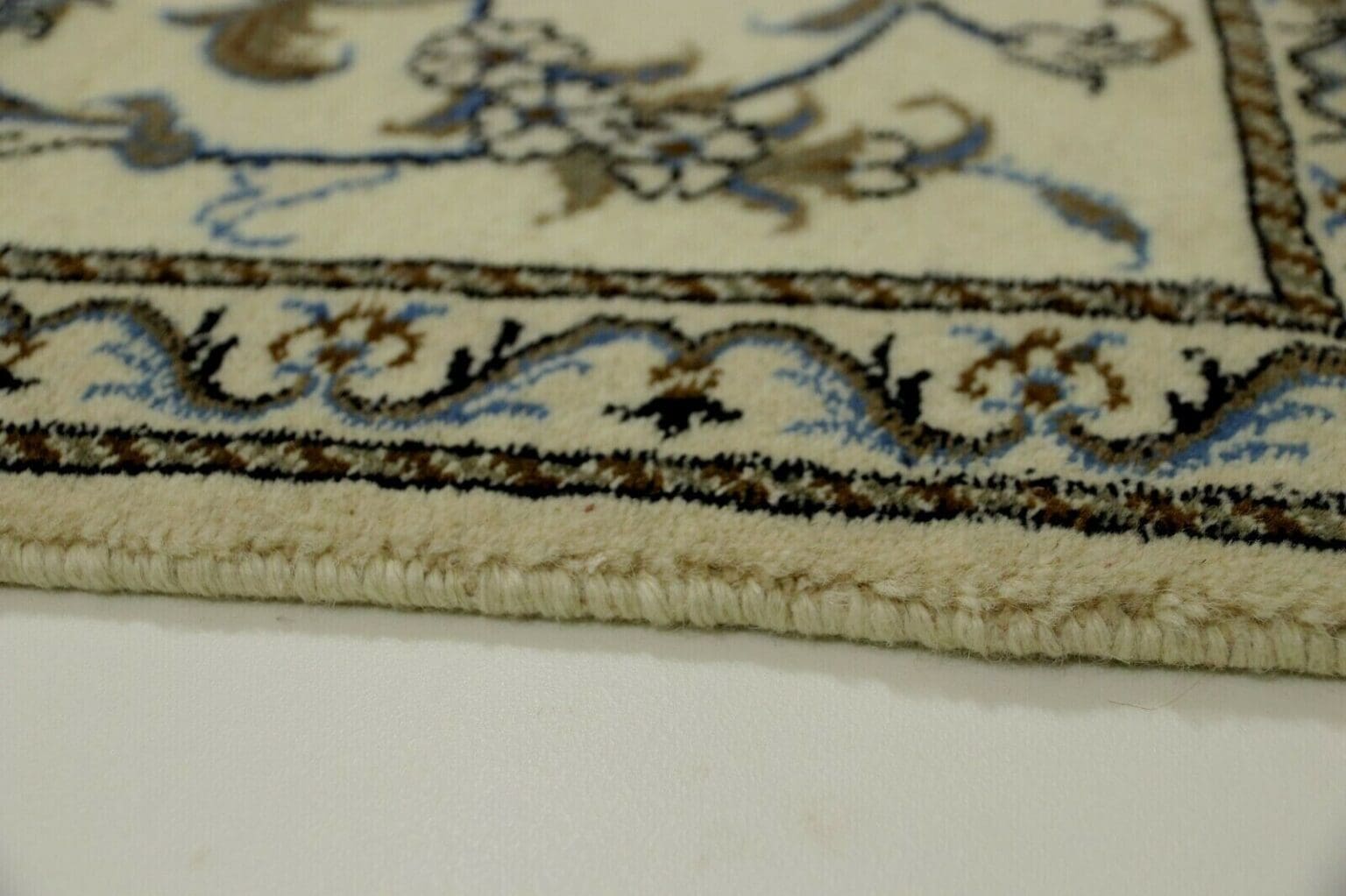
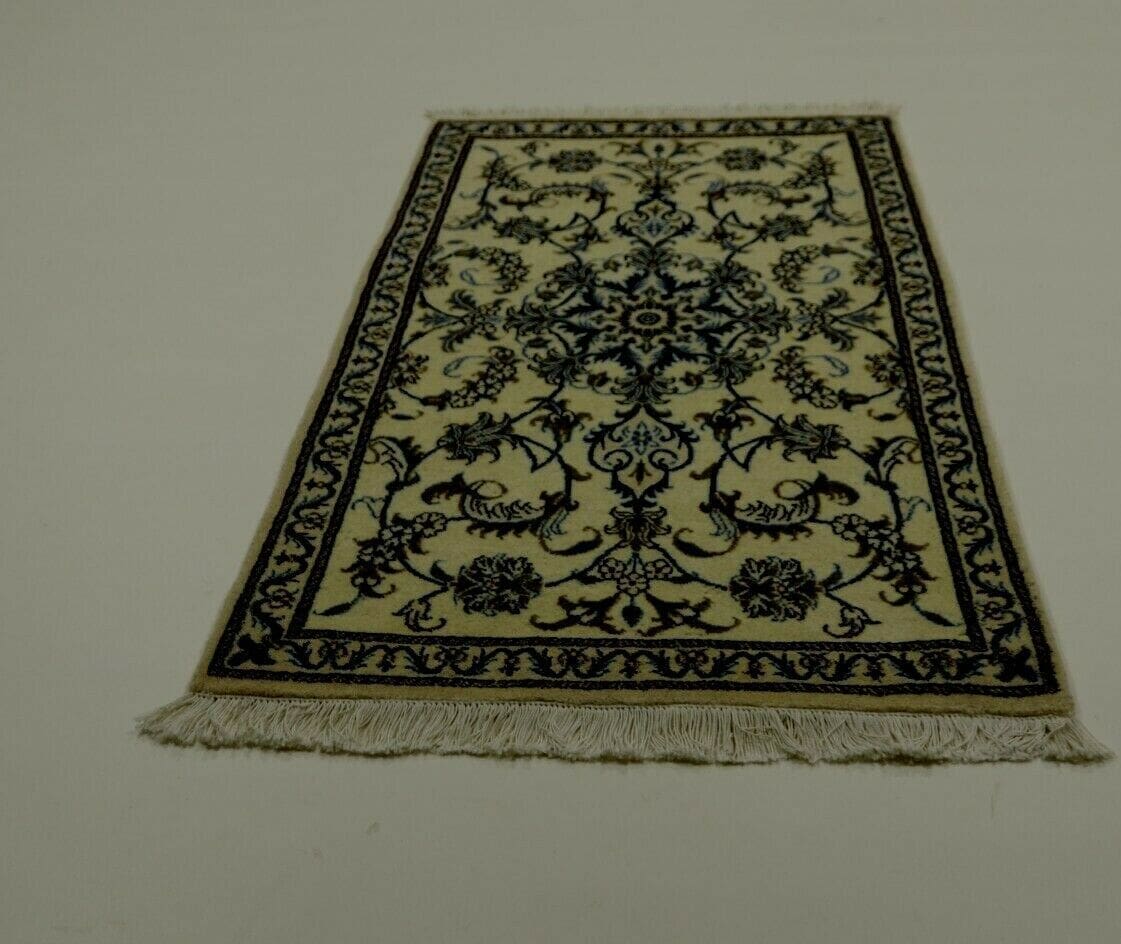
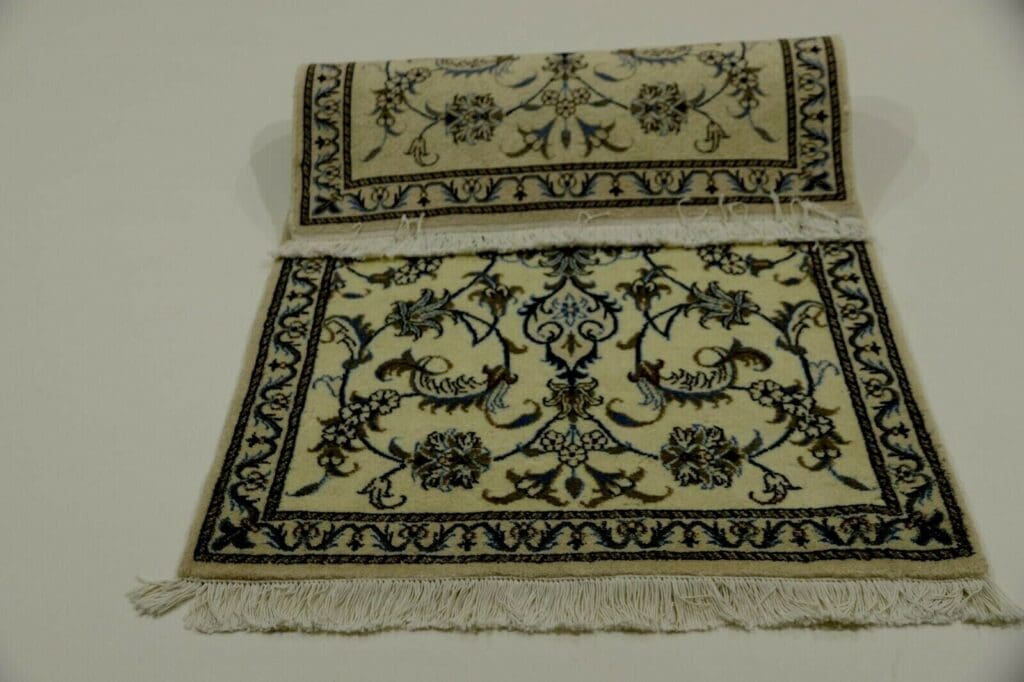
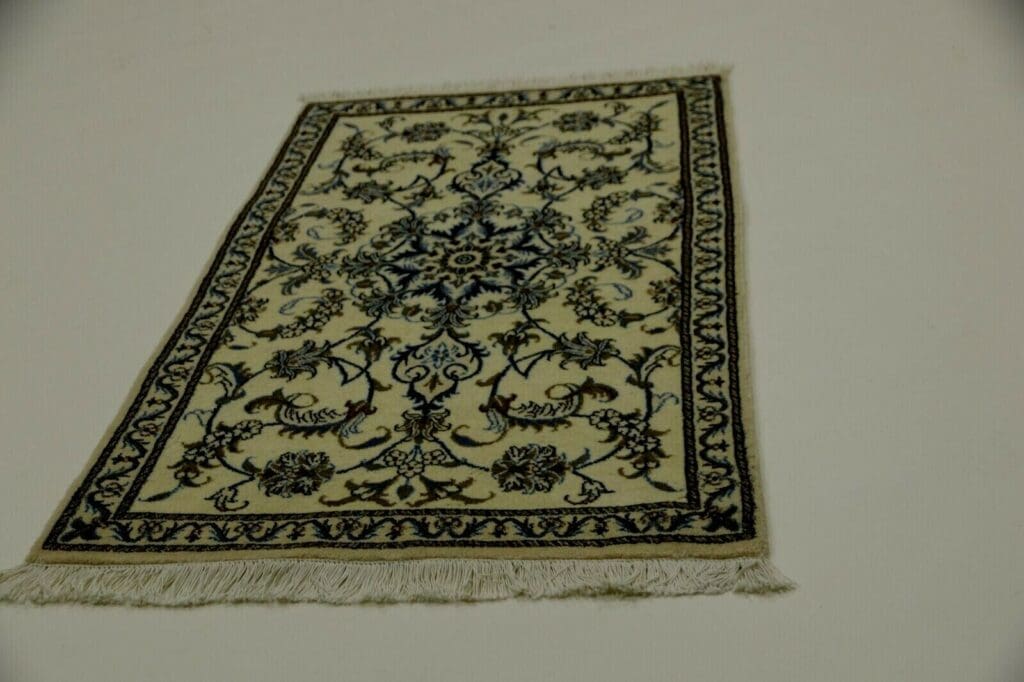
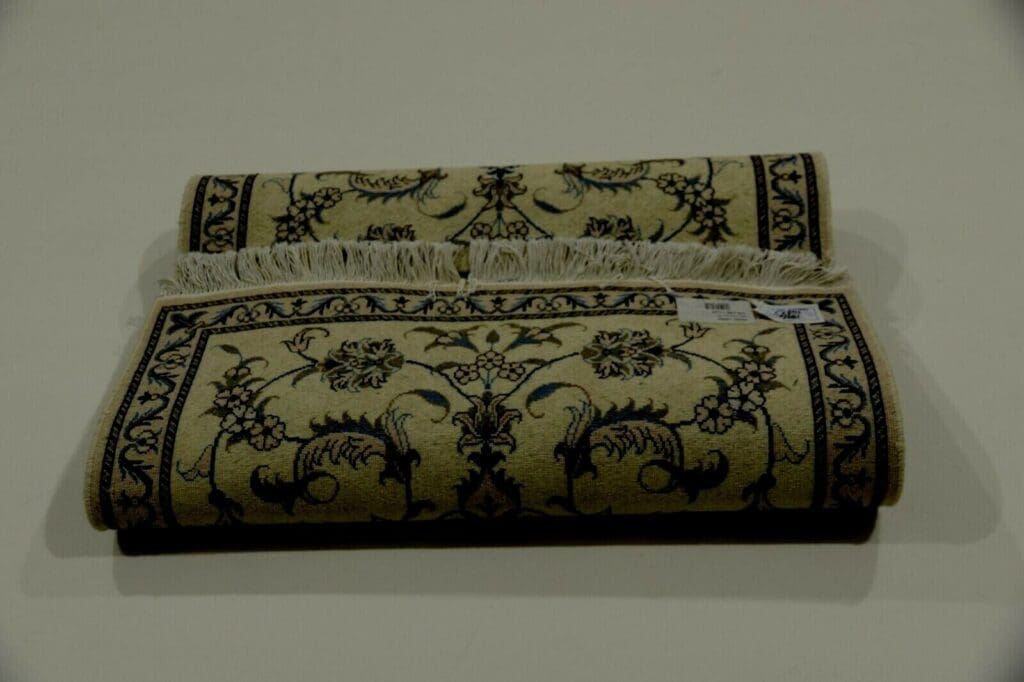
This Nain Persian rug is hand-knotted and made from 90% virgin wool and 10% silk. The combination brings together wool’s firm, resilient character with the smooth qualities of silk. Virgin wool is traditionally used in rug making for its pleasant hand, durability, and insulating properties. It gives a woven surface a substantial textile feel and can contribute to a comfortable atmosphere in a room.
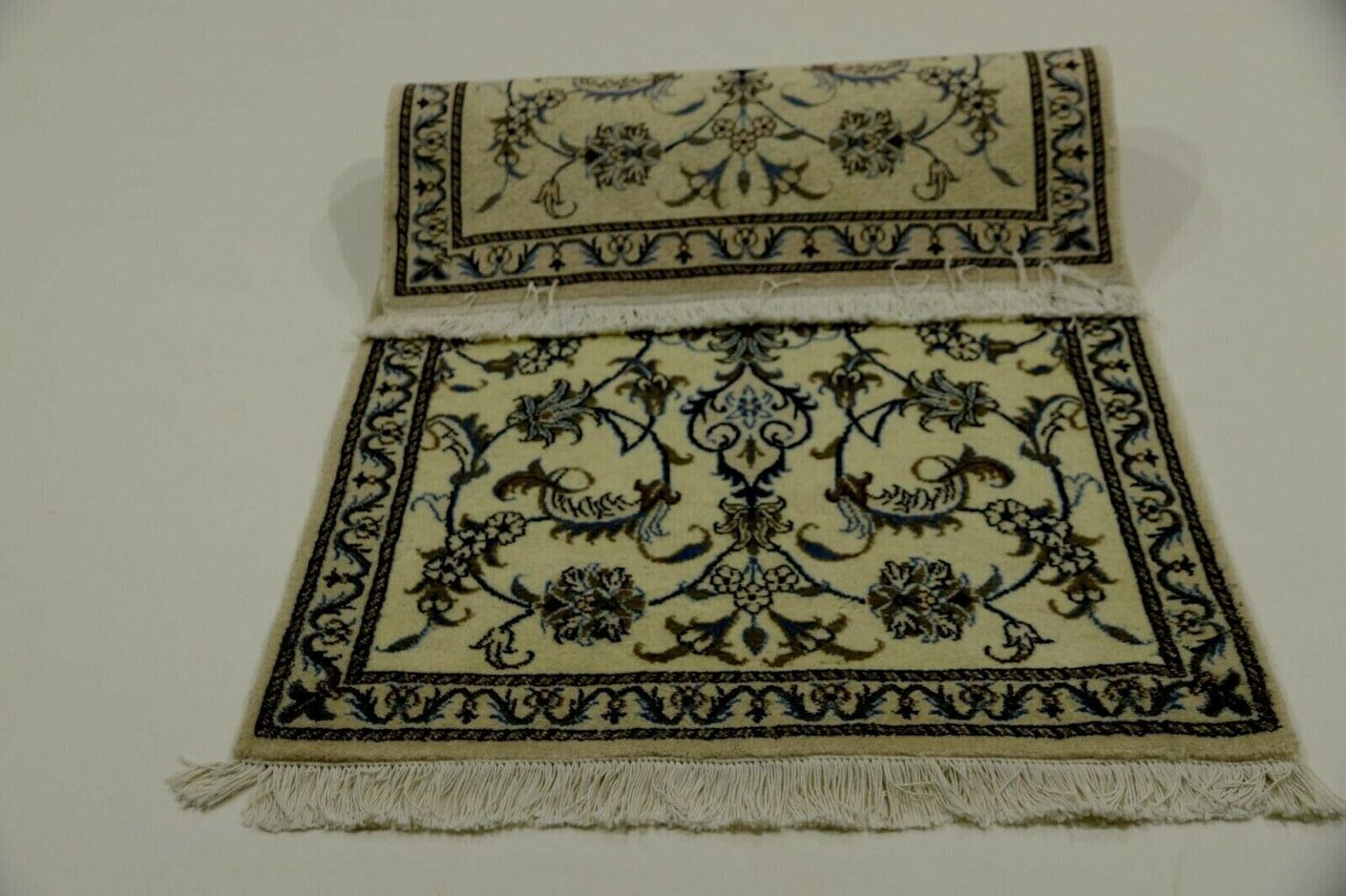
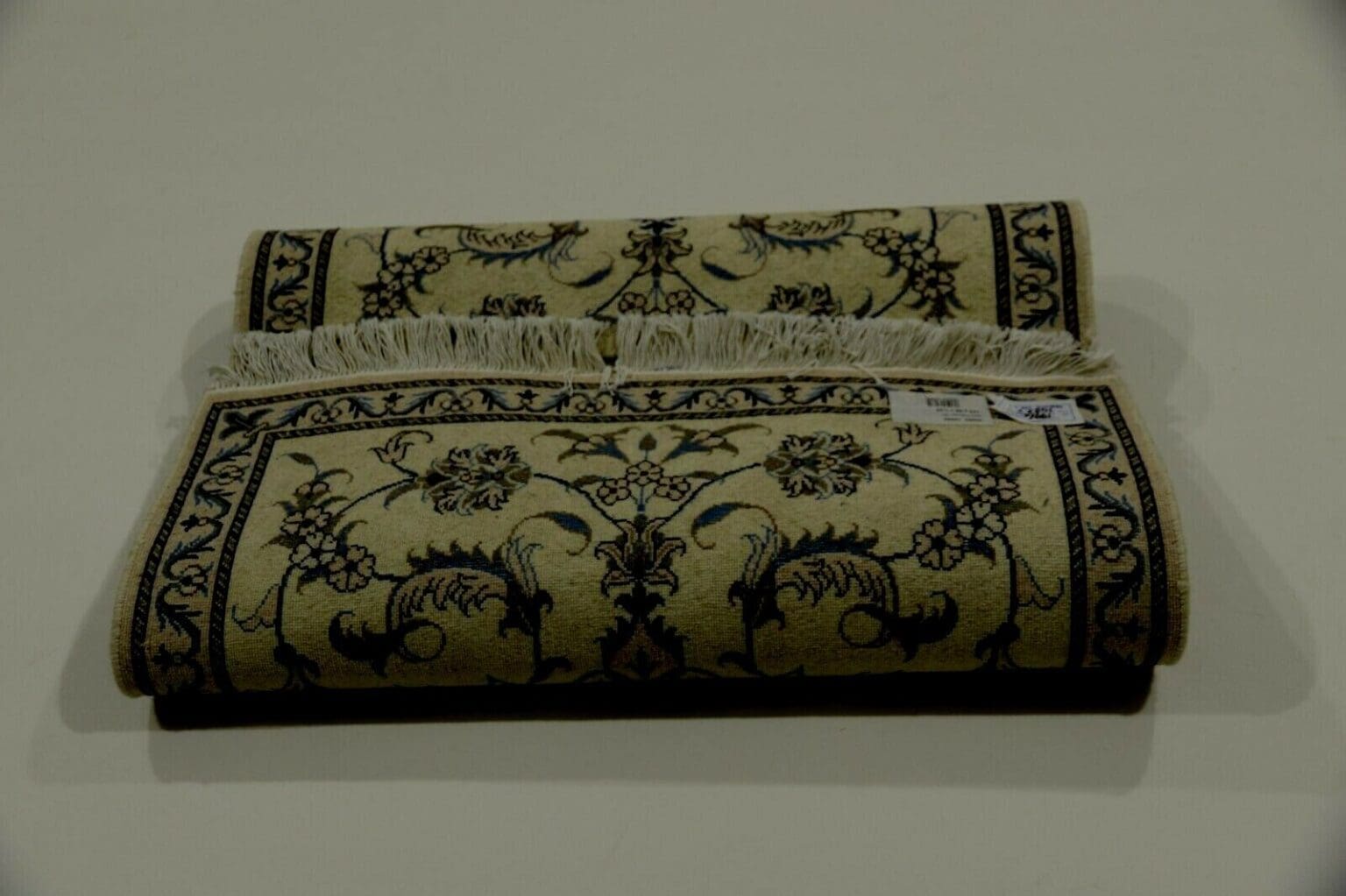
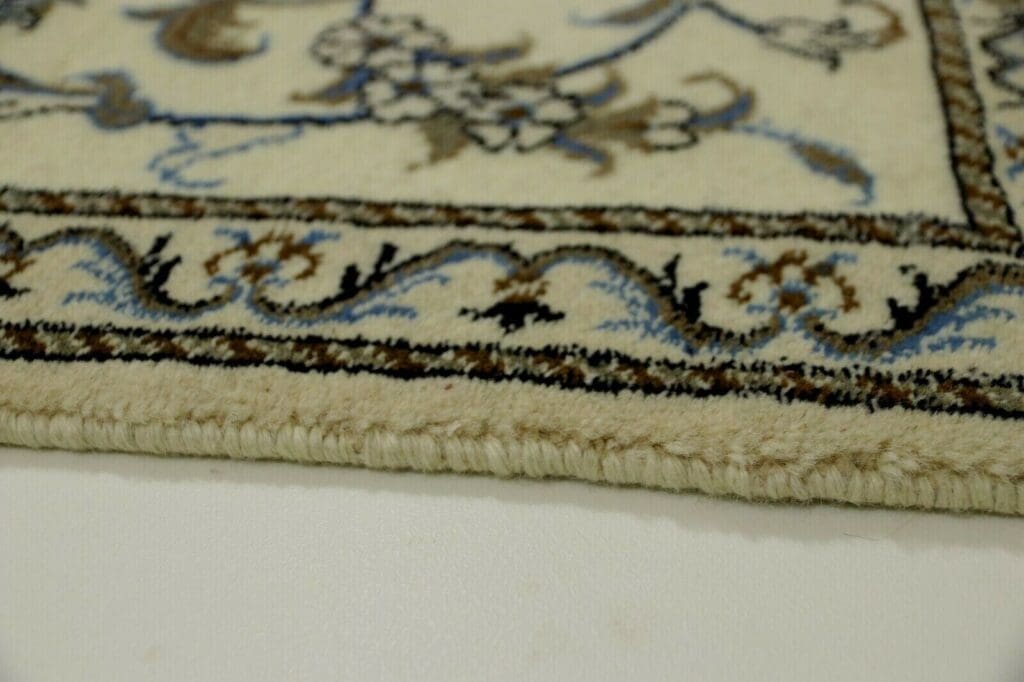
Silk adds a finer, smoother fibre to the material composition. In a hand-knotted rug, the design is built knot by knot rather than printed or mechanically applied. The pile is then finished so that the drawing becomes clearly defined. This manual process makes each piece unique. The rug’s workmanship is described by a knot density of approximately 300,000 knots per square metre. An authenticity certificate is included with the piece.
The rug is described as new and perfect in condition. Its thickness is approximately 9 mm. It is suitable for use over underfloor heating and is described as pet-friendly. These practical details belong to this particular rug and complement its hand-knotted construction and wool-and-silk material.
Origin and Tradition
This rug comes from Persia, or Iran, and is identified as a Super Nain. Nain is one of Iran’s established rug-producing regions. The town and its surroundings lie in an arid landscape where a distinctive textile tradition developed over many generations. Nain rugs are associated with careful, fine knotting. Their character depends not only on the pile itself, but also on the precise planning of the complete composition.
The Nain tradition is linked with refinement, order, and balanced proportions. Regional designs are commonly planned so that the central field, border areas, and transitions work together. The weaver translates the design into a textile structure in which every knot contributes to both the surface and the image. Finer work allows small lines, contours, and repeated ornaments to be represented with greater clarity.
Persian rugs developed in many regions through a combination of local craft knowledge, inherited designs, and practical understanding of fibres and dyes. Nain represents a distinct direction within this broad tradition. Rugs from the region are often associated with elegant nuances of colour, clearly organised compositions, and traditional ornament. Classic forms can be arranged in a way that remains legible in both traditional interiors and more contemporary settings.
Natural dyes belong to the historical background of Nain weaving. Their use reflects the long development of Persian dyeing, in which colours were obtained from plant-based and other natural sources and adapted to wool or silk. The appearance of a colour also depends on the fibre, the light, and the finishing of the surface. Nain’s identity therefore rests not only on its motifs, but on the relationship between knotting, materials, and colour preparation.
Hand-knotted Iranian rugs are not produced in a single industrial sequence. A design is translated through a series of manual steps: fibres are prepared, knots are tied, rows are compacted, and the finished surface is trimmed and refined. This process explains why regional rugs are regarded as records of a living craft tradition. The rug offered here combines that Iranian background with the designation Super Nain and a fine hand-knotted construction.
The history of Nain rugs also illustrates how regional traditions can respond to changing interiors without abandoning their formal language. Traditional layouts, floral details, and geometric order remain recognisable even when the overall presentation is restrained. The result is a type of Persian rug in which technical precision and decorative structure are considered together. That relationship is central to understanding the Nain tradition and does not depend on a single decorative motif.
Design and Pattern
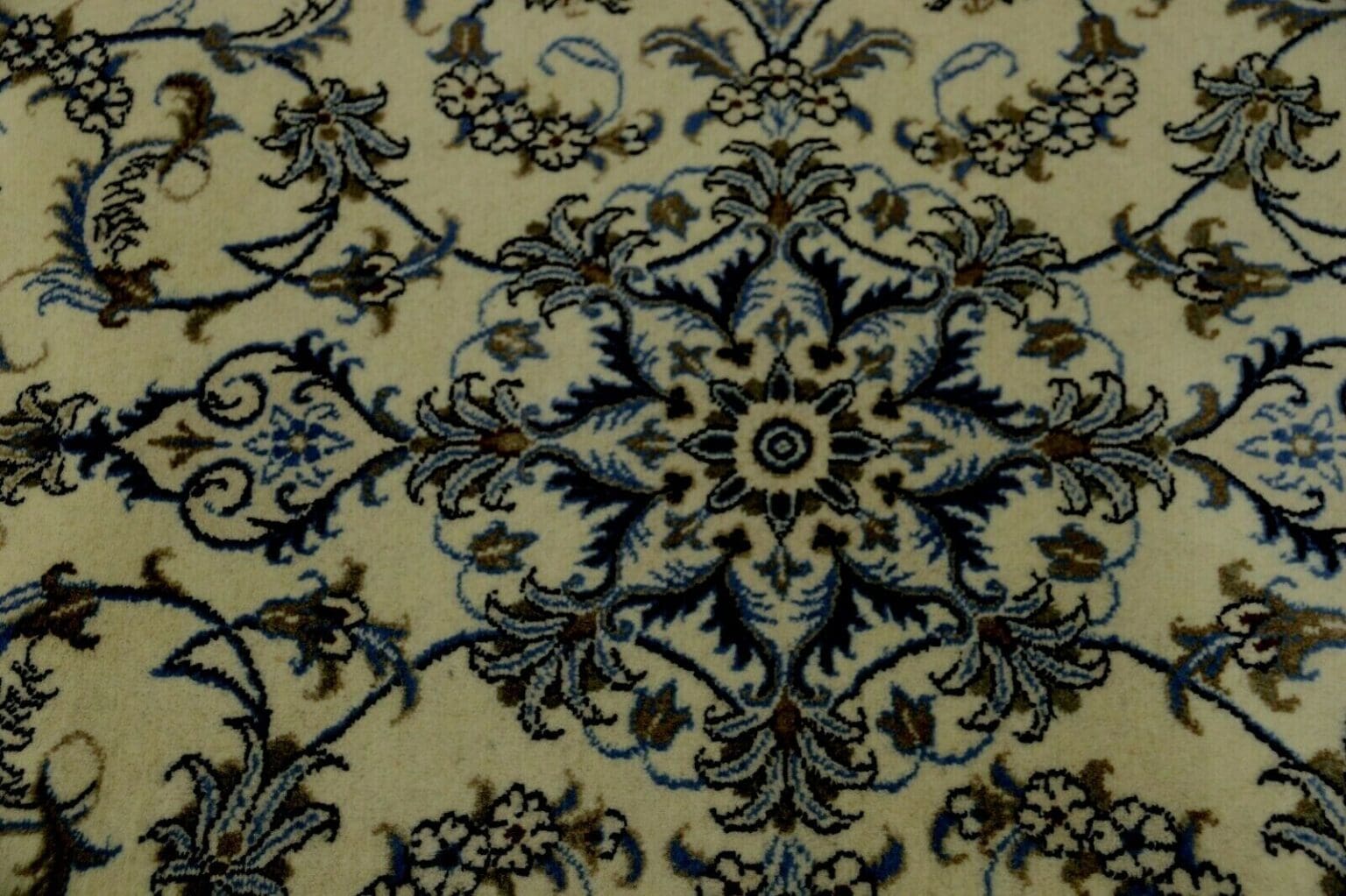
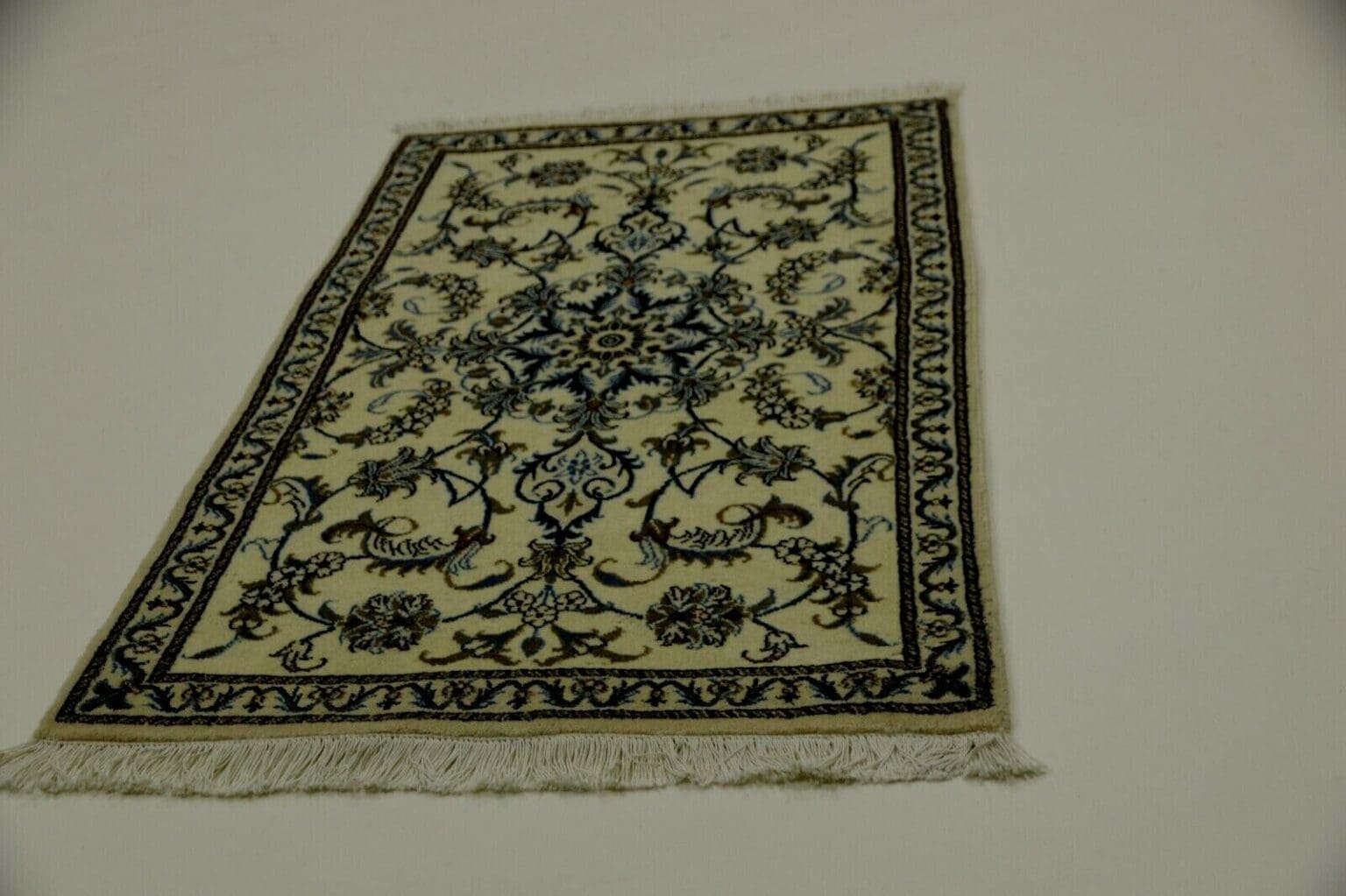
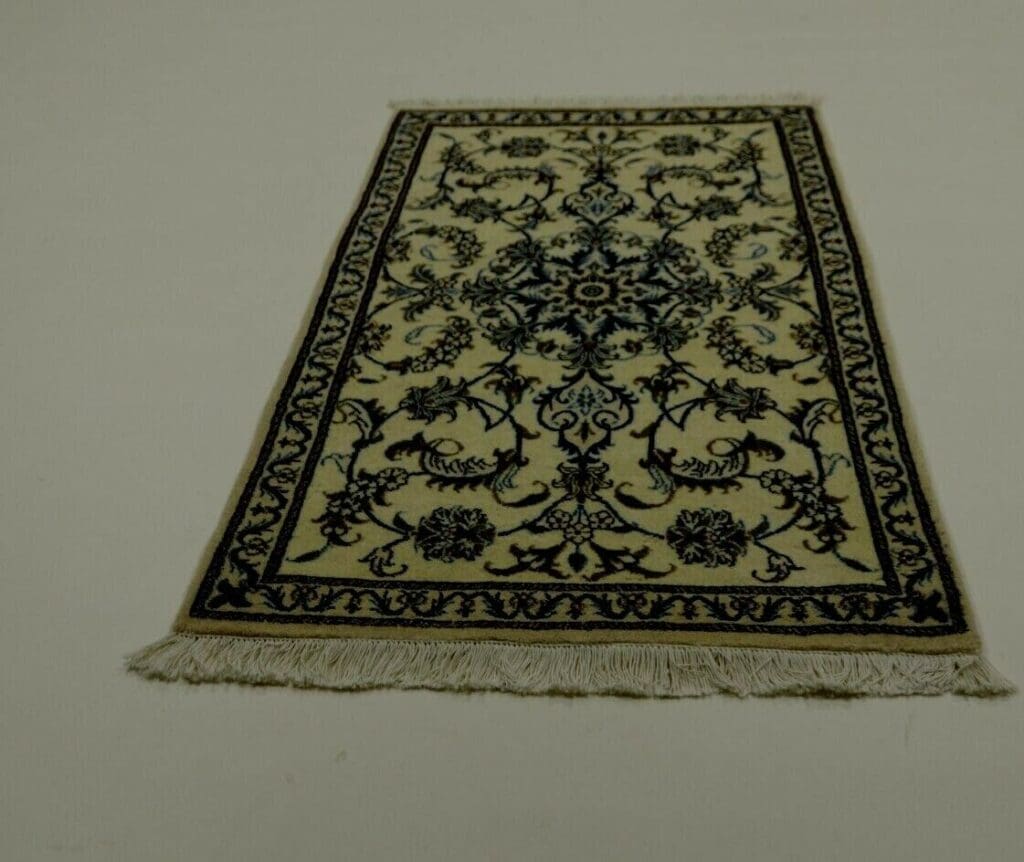
The pattern of this rug is described as Oriental. Its design includes fine detailing and a rectilinear character. Nain rugs are associated with controlled ornamentation, in which forms are repeated, related to one another, and arranged within a balanced overall field. The drawing is intended to be readable through the relationship between lines, areas, and recurring motifs rather than through random decoration.
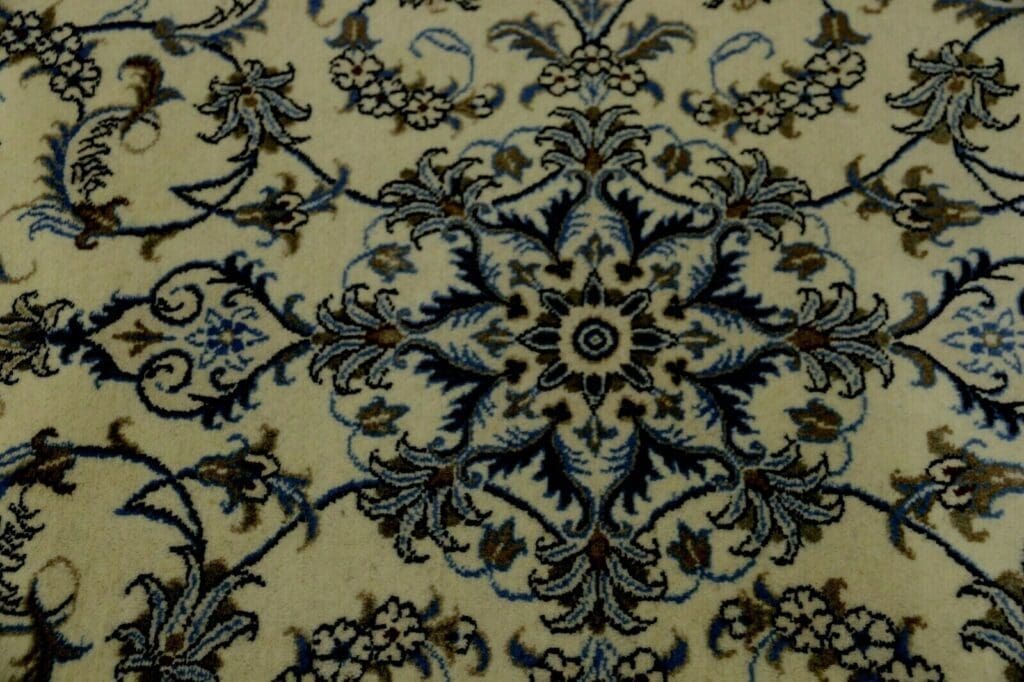
The described appearance includes floral patterns and geometric forms. Floral ornaments may draw on leaves, blossoms, tendrils, or stylised plant shapes. In Persian rug design, such elements are generally not intended as literal botanical pictures. They are simplified, rhythmically arranged, and connected into a continuing pattern. Geometric forms give the organic elements structure and help create orientation across the composition.
A Nain design may use a central arrangement in which a principal motif organises the field and is supported by secondary ornaments. It may also distribute repeated forms across the surface. The visual effect depends on the scale of the elements, their spacing, and the lines that connect them. The fine drawing and straight-lined design are expressly part of this rug’s description. In general, a high knot density helps represent small details, while the overall design retains the ordered quality associated with the region.
Harmony in an Oriental rug pattern is created through repetition and variation. An ornament can recur several times while changing slightly in direction or in the way it joins neighbouring forms. Tendrils can link separate areas, geometric shapes can define boundaries, and floral details can soften transitions. These devices belong to the wider vocabulary of Persian rug design and help explain why Nain patterns can appear both traditional and clearly structured.
The design is also connected with Iran’s artistic and cultural history. Rug motifs have been passed down, rearranged, and adapted to regional preferences over generations. They are not merely surface decoration, but part of a visual language in which symmetry, rhythm, and references to nature play important roles. This particular rug is described as Oriental in pattern, finely drawn, and rectilinear. Its floral and geometric elements show the connection between regional tradition and disciplined composition.
Hand-knotting gives the drawing a textile depth that belongs to the making process. Each knot contributes to a contour or to the density of a surface. The combination of virgin wool and silk can create different surface effects within one design. More generally, silk is used in rug making to provide finer accents and a smoother structure, while wool gives the field body and resilience. The appearance of the pattern therefore remains closely tied to the materials and the craft technique.
Special Features
A defining feature of this rug is its high knot density of approximately 300,000 knots per square metre. Such density permits detailed rendering of the pattern and represents a considerable amount of manual work. The rug is a one-off piece and is offered with an authenticity certificate. These details emphasise its individual execution and the documented authenticity stated for the item.
The condition is given as new and perfect. The rug is also suitable for underfloor heating and is described as pet-friendly. Its thickness is approximately 9 mm. These properties make it intended for use in a living space while retaining its identity as a hand-knotted Nain Persian rug. The combination of Iranian origin, wool-and-silk material, fine knotting, and certification defines the profile of this individual piece.
FAQ
What distinguishes a Nain rug?
Nain rugs come from the Iranian region of Nain and are known for fine knotting, elegant designs, and clearly organised ornament. Floral elements are often combined with geometric forms and balanced colour nuances. The regional tradition also involves careful workmanship and quality materials. The rug described here is identified as a Super Nain, is hand-knotted, and has a high knot density.
How should I care for my Persian rug?
For regular care, vacuum the rug without using a brush attachment. This removes dust while avoiding unnecessary mechanical stress on the surface. Treat spills as soon as possible with a soft cloth and lukewarm water. Professional cleaning is recommended every few years. With a hand-knotted rug, cleaning products should not be applied indiscriminately; heavier soiling is best handled by a professional rug cleaner familiar with such materials.
Can Nain rugs be considered an investment?
High-quality Nain rugs are often considered potential investments. Their hand workmanship, materials, and long regional tradition are among the reasons for this view. Every rug must nevertheless be assessed as an individual object. Quality, condition, execution, origin, and demand influence its position. This rug is described as new and perfect, hand-knotted, unique, and supplied with an authenticity certificate. Those facts do not guarantee a particular future change in value.
To provide the best experiences, we use technologies like cookies to store and/or access device information. Consenting to these technologies will allow us to process data such as browsing behavior or unique IDs on this site. Not consenting or withdrawing consent, may adversely affect certain features and functions.
Functional Always active
The technical storage or access is strictly necessary for the legitimate purpose of enabling the use of a specific service explicitly requested by the subscriber or user, or for the sole purpose of carrying out the transmission of a communication over an electronic communications network.
Preferences
The technical storage or access is necessary for the legitimate purpose of storing preferences that are not requested by the subscriber or user.
Statistics
The technical storage or access that is used exclusively for statistical purposes.The technical storage or access that is used exclusively for anonymous statistical purposes. Without a subpoena, voluntary compliance on the part of your Internet Service Provider, or additional records from a third party, information stored or retrieved for this purpose alone cannot usually be used to identify you.
Marketing
The technical storage or access is required to create user profiles to send advertising, or to track the user on a website or across several websites for similar marketing purposes.
 SECURE PAYMENT
 SHIPPING PARTNERS


