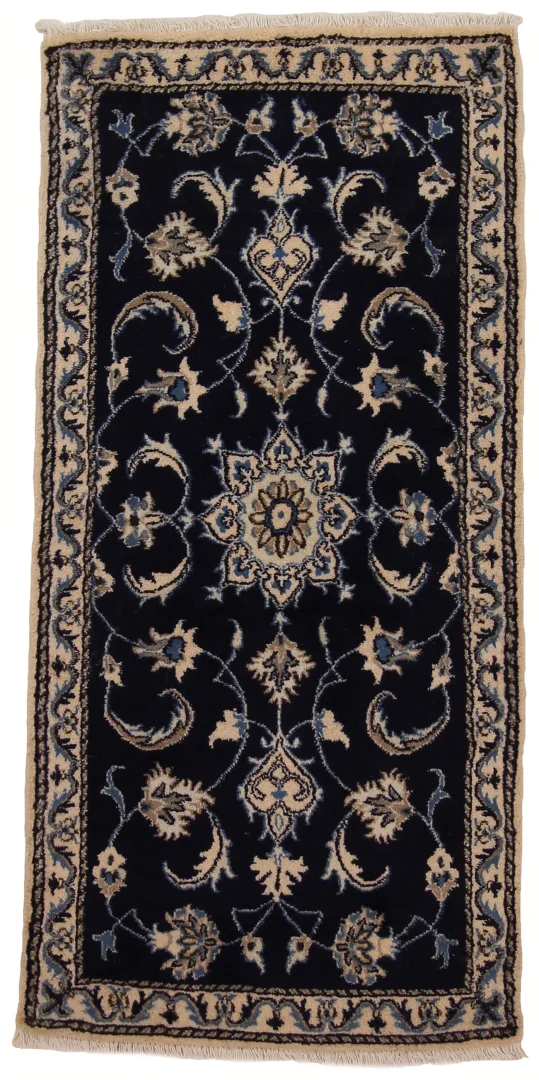
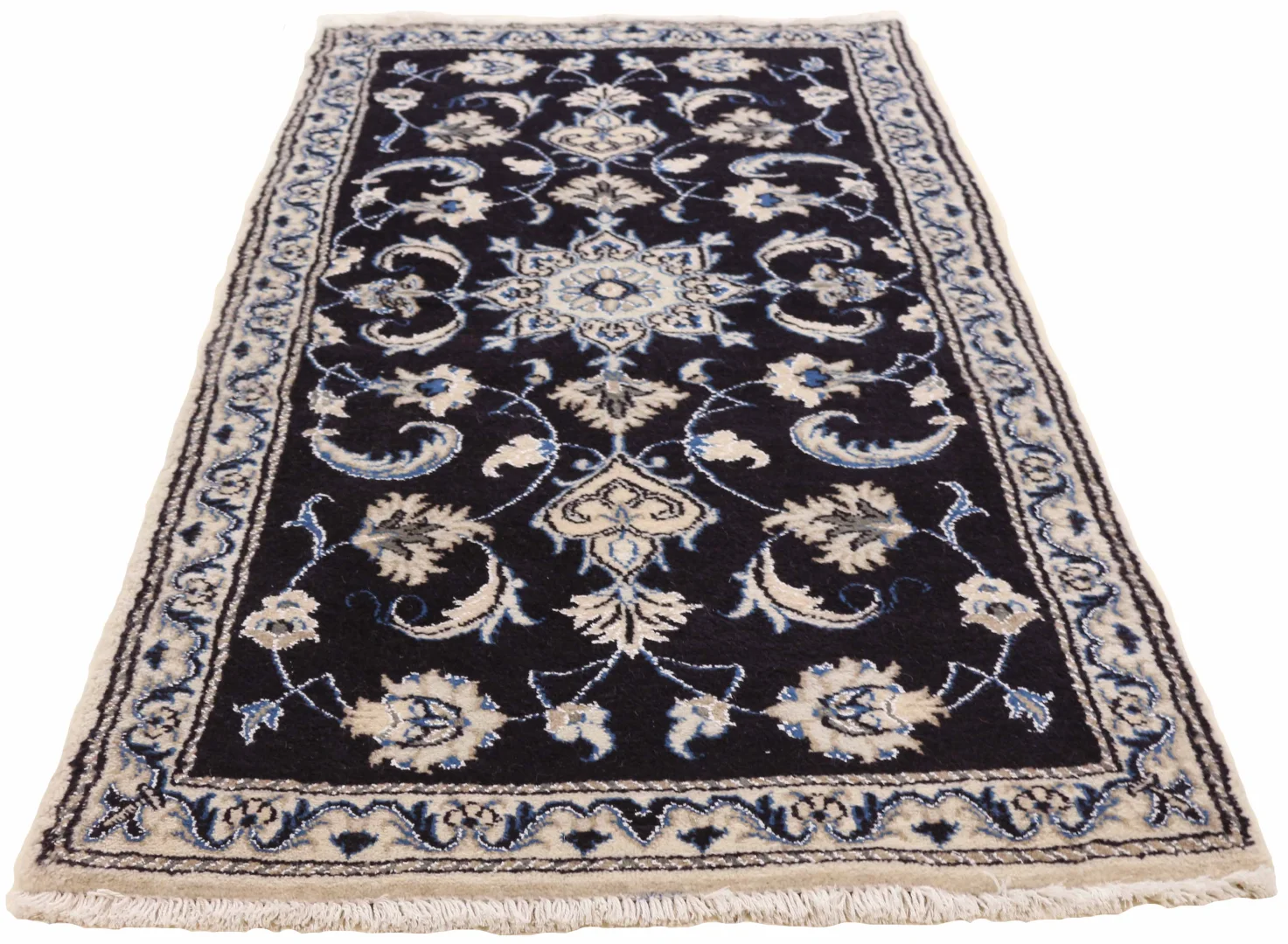
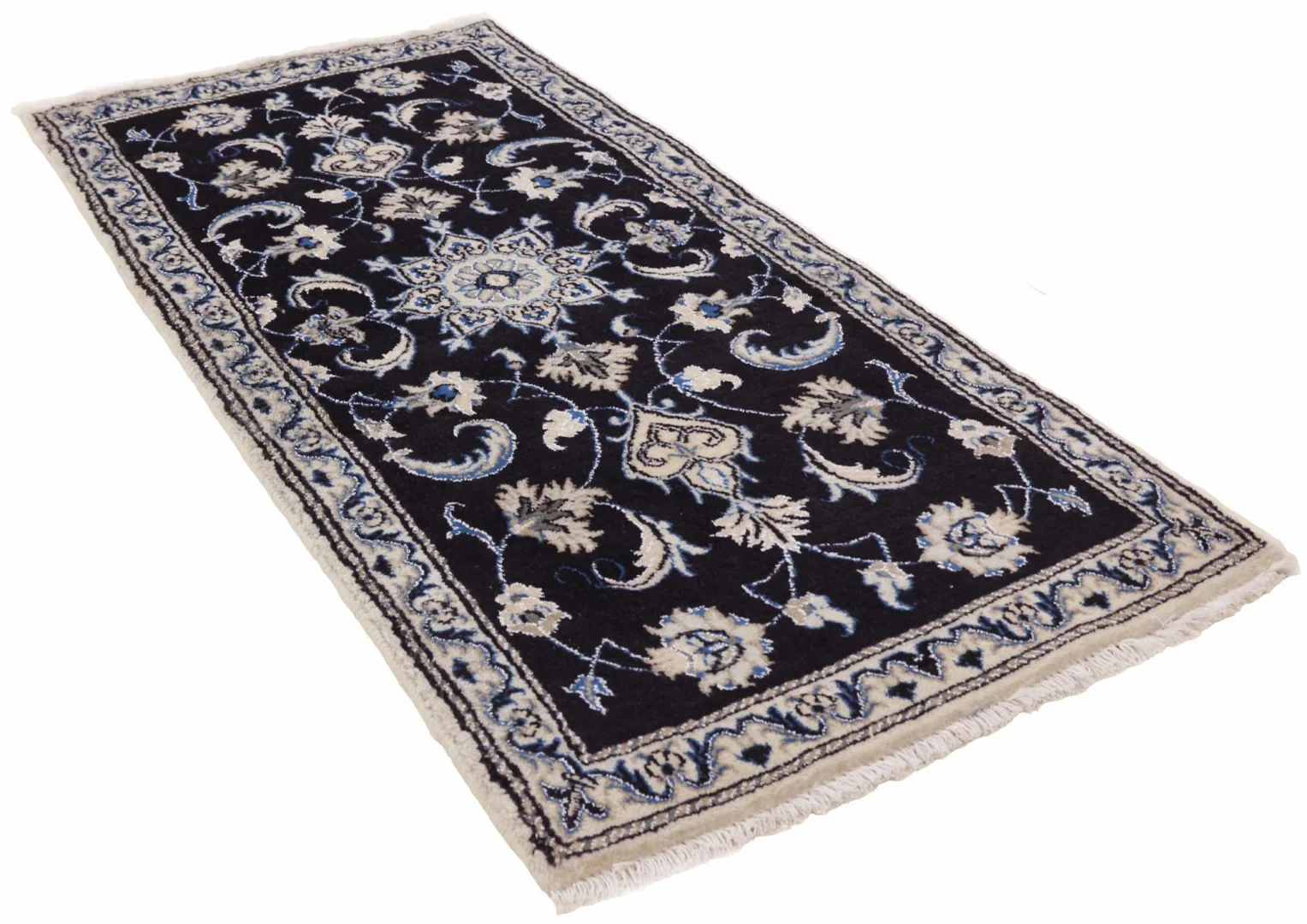
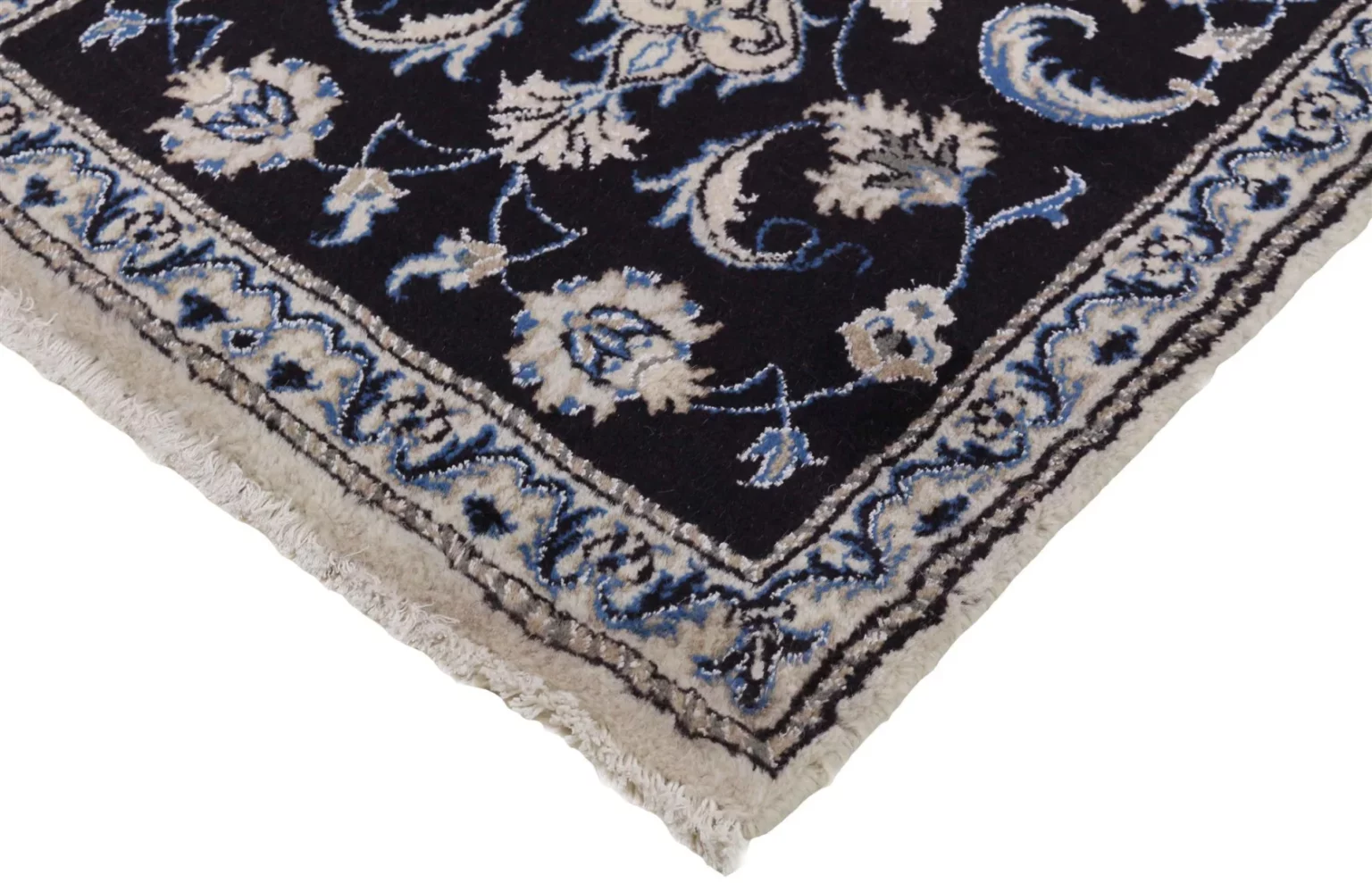
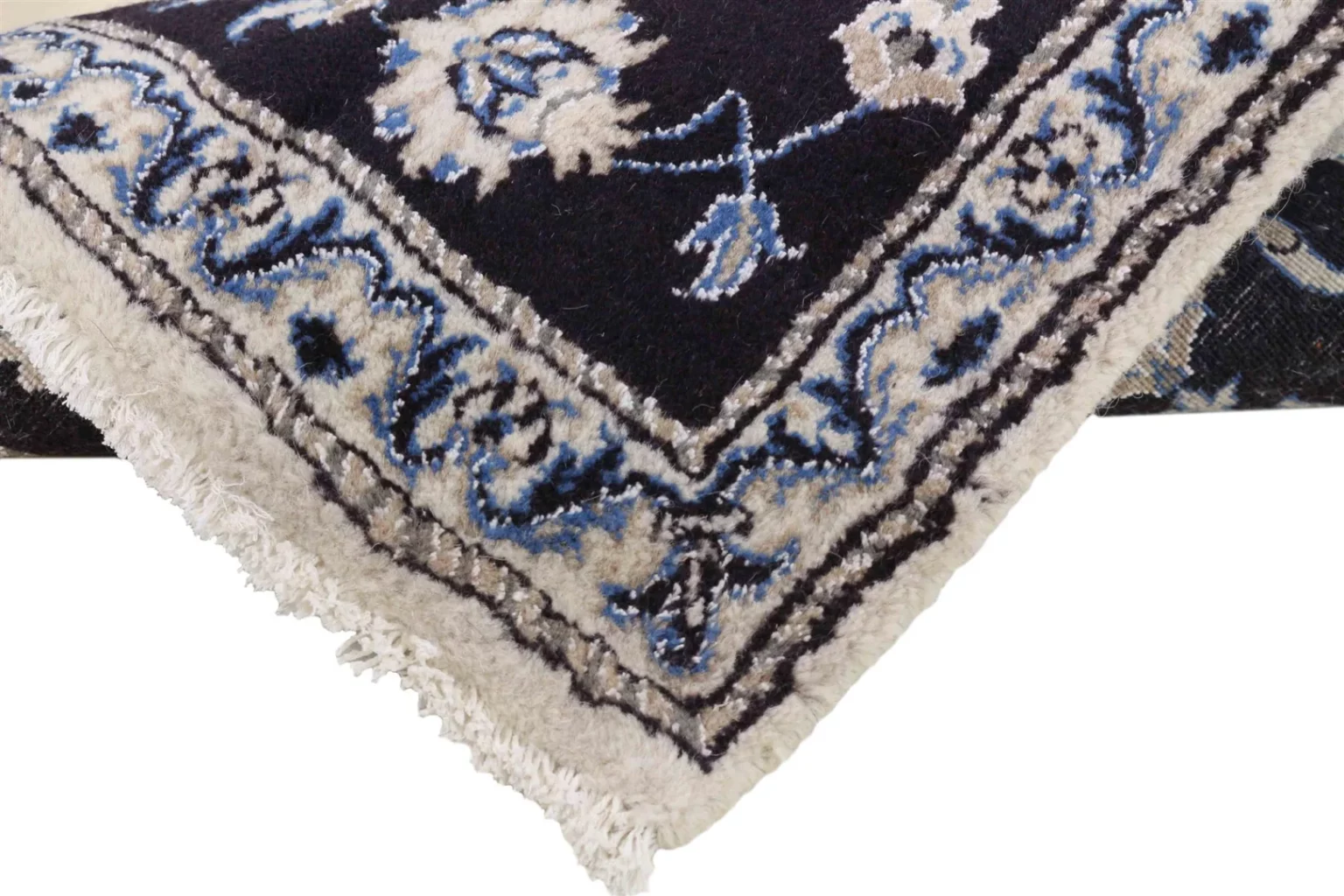
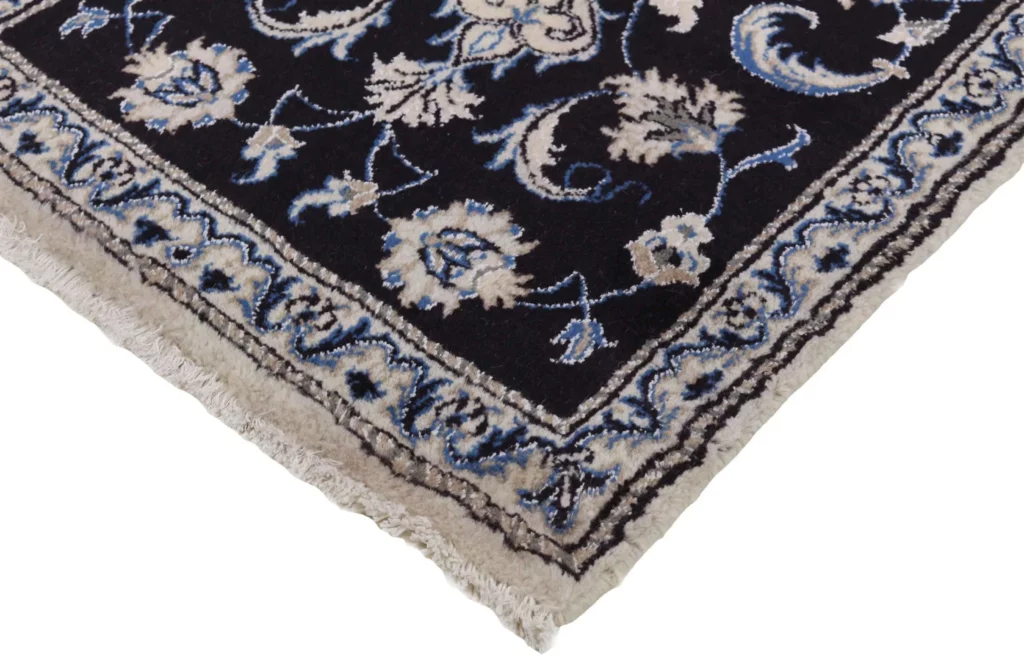
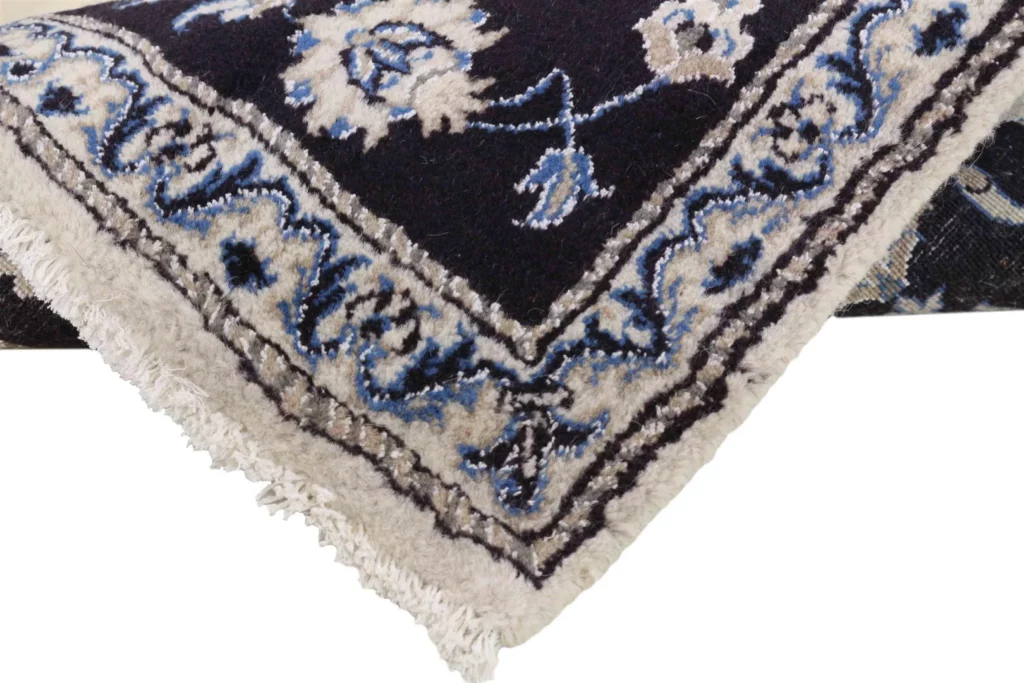
This Persian rug from Nain is hand-knotted. Its pile is made of wool and is complemented by silk accents. This combination is associated with the established craft of fine Nain rugs: wool provides a durable textile foundation, while silk can give selected areas a smoother surface and a more differentiated response to light. The material description for this particular piece is wool with silk accents.
The rug is classified as 9-Lah. Lah is a customary Nain term used to distinguish different levels of knot density and quality. The classification is connected with the way a pattern can be developed, since a denser construction generally allows small flowers, curved lines and narrow contours to be rendered with greater definition. The 9-Lah designation places this Nain rug within the recognized range of Nain qualities.
A hand-knotted rug is built knot by knot on a prepared foundation. The weaver follows the planned structure of the design, adds rows of pile, and gradually forms the complete surface through repeated manual work. Unlike a printed or machine-made decoration, the pattern is created by the textile construction itself. In Nain weaving, this process is associated with controlled outlines, balanced ornament and a finely organized field.
The condition of this rug is described as very good. That condition statement is part of the specific product information and complements the details about its material, construction and quality classification. Wool, silk accents and hand-knotting together define the surface and help shape the way the floral ornament is presented.
Origin and Tradition
Nain is a city in central Iran known for its carpet production. It lies near Isfahan and has developed a recognizable place within the wider history of Persian weaving. A Nain rug therefore represents both a geographic origin and a regional design tradition. The name is associated with carefully organized compositions, fine drawing and a measured use of ornament.
The history of Nain reaches back to the Sassanian period. This long cultural background forms part of the setting in which textile production and Persian decorative arts developed. Persian carpets bring together practical weaving, inherited motifs, symmetry and the deliberate coordination of materials and colour. Within that broader tradition, Nain is commonly identified with designs that are finely articulated, orderly and often restrained in their overall composition.
Lah is used in Nain carpet terminology to separate different quality levels. Common classifications include 4-Lah, 6-Lah, 9-Lah and 12-Lah. The system refers to knot density per square metre. In the traditional comparison, 4-Lah rugs are associated with more than one million knots per square metre, while 12-Lah rugs are associated with approximately 250,000 knots per square metre. The figures are therefore not read like an ordinary school grade; they identify a particular construction and degree of fineness within the Nain system. This rug is classified as 9-Lah.
Knot density affects the degree of detail that can be expressed in a design. A more closely structured surface can separate small petals, leaves and outlines more clearly, while also giving the field a more compact appearance. Lah is consequently part of the specialist vocabulary used to describe Nain rugs and to place them within their regional craft tradition.
Nain belongs to a larger group of Iranian carpet centres. Isfahan and Kashan are also known for their rugs, but each has its own visual and technical emphasis. Isfahan rugs are often associated with lively colours and complex designs. Kashan rugs are frequently linked with traditional patterns and a higher pile. These distinctions show why a city name in a rug description refers to more than a decorative label: it points to a particular regional history, workshop culture and approach to design.
Qom and Tabriz are also established names in Persian carpet production. Families and workshops connected with these centres produce rugs with distinctive designs and high-quality materials. A Nain rug remains identifiable through its own combination of origin, fine knotting, floral ornament and balanced composition. This piece is described as a Nain rug from Iran, not as a rug from one of the other named centres.
Design and Pattern
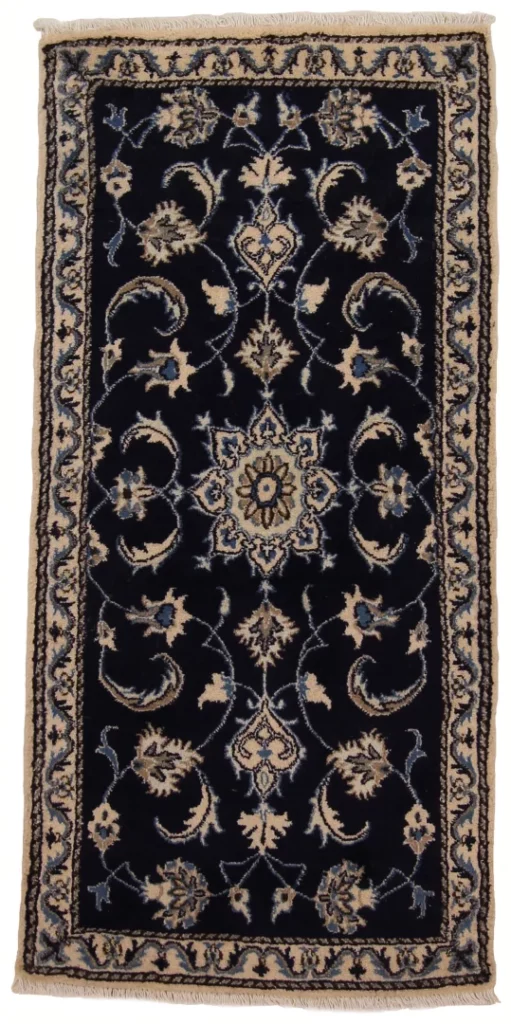
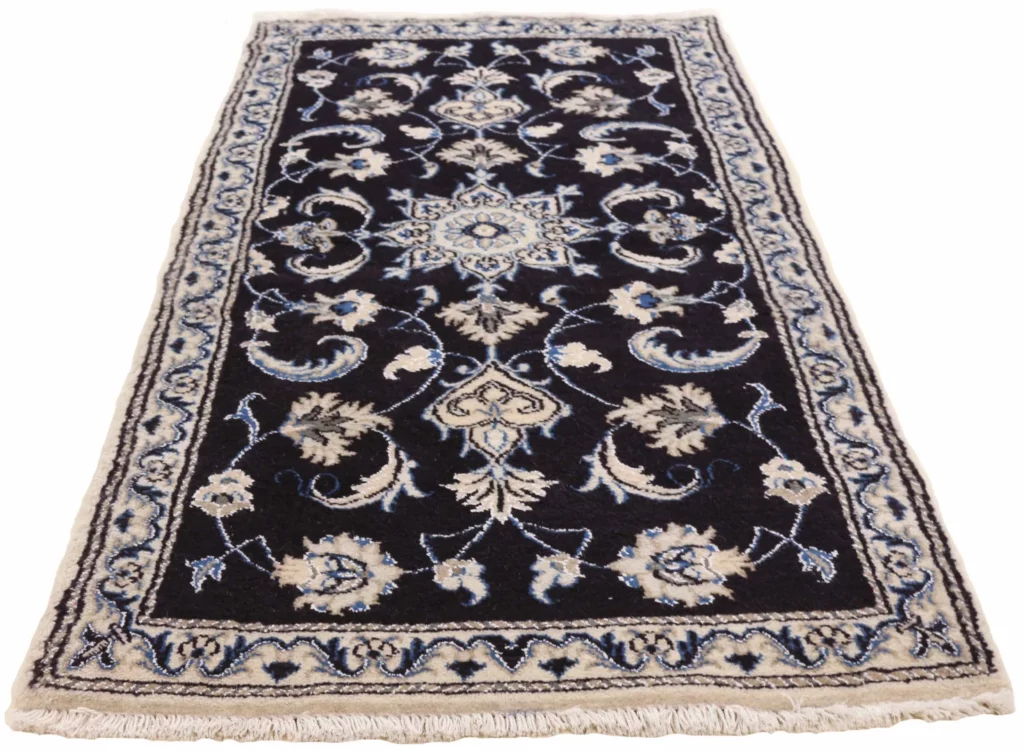
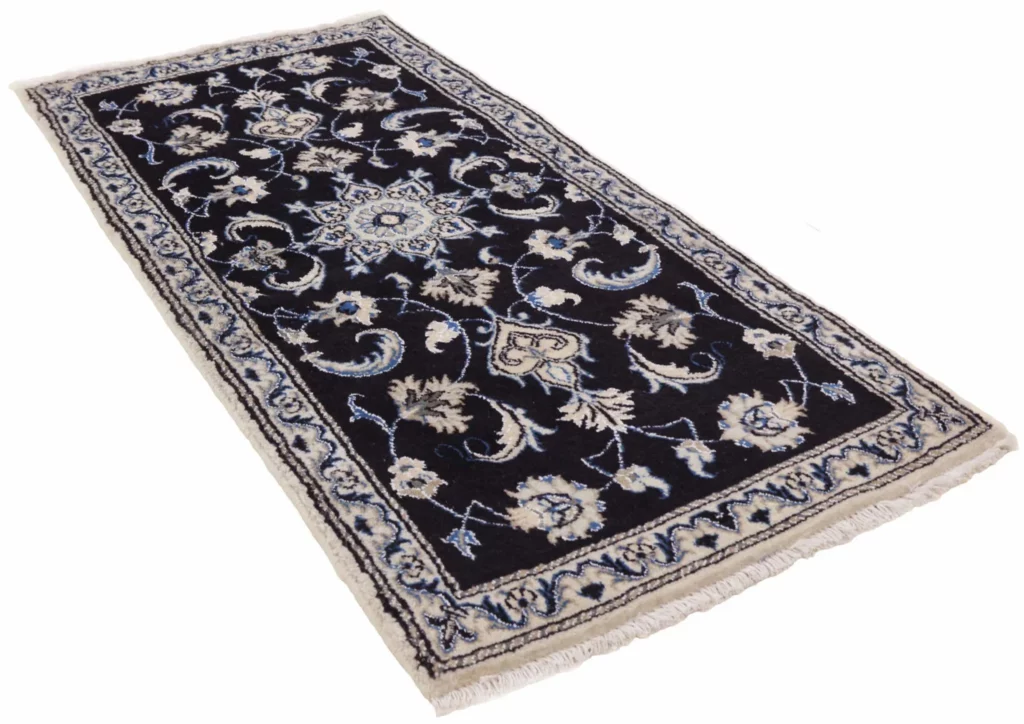
The pattern of this rug is floral. Floral Nain designs traditionally use flowers, leaves, vines and linked plant forms as the principal elements of the composition. These motifs are arranged ornamentally rather than copied as a botanical illustration. Repetition, symmetry and flowing lines allow many separate details to function as one coherent carpet design.
Many Nain rugs use a central medallion. A medallion concentrates the composition in the middle and may be accompanied by a structured field and border. Other floral arrangements rely more strongly on continuous vines or an all-over distribution of motifs. The specific pattern information for this rug identifies a floral design; it does not expressly state that a central medallion is present.
Nain pattern language belongs to the wider Persian tradition of ornament. Flowers and vines may suggest growth, order and the relationship between natural forms, although individual motifs do not have to tell a fixed story. In carpet design they primarily serve as components of a balanced surface. Their character comes from the relationship between line, repetition, spacing and the precise separation of colour areas.
The general Nain palette can range from soft cream and beige shades to vivid blue and red. Light grounds can make delicate floral outlines easier to read, while contrasting tones may emphasize flowers, vines or borders. The product information for this rug specifies a floral pattern but does not provide a complete list of its colours. The regional colour tradition can therefore be explained without assigning unlisted shades to this particular piece.
Fine pattern drawing is closely related to the knotting technique. The design is not applied to the completed surface afterward; it is formed through the arrangement of coloured knots and textile areas. Silk accents can, in general, add a smoother visual note to selected parts of a finely drawn composition. Silk accents are listed as part of this rug’s material, but their exact position within the floral design is not specified.
Floral Nain rugs can sit comfortably within both traditional and more contemporary interiors because their visual language is based on ordered ornament and a disciplined composition. The pattern remains legible through the relationship between field, border and open areas, rather than depending on a single isolated motif. This makes the regional design tradition understandable even when individual layouts vary from one rug to another.
Other Persian carpet traditions use different priorities. Tabriz is often associated with complex drawing and elaborate compositions. Gabbeh rugs are more commonly connected with simpler, frequently geometric motifs and a rustic character. These comparisons help define the present rug accurately: it is identified by its Nain origin and its stated floral design, not by a pattern name belonging to another region.
Special Features
The specific characteristics of this rug are its origin in Nain, Iran, its hand-knotted construction, its 9-Lah classification, and its material of wool with silk accents. Its pattern is floral. These details describe the identity of the individual rug without adding an unstated signature, age, provenance or construction feature.
The condition is listed as very good. For a hand-knotted rug, condition is considered alongside material and craftsmanship because it completes the description of the preserved textile surface. The combination of wool, silk accents and floral ornament makes both the tactile structure and the decorative character of this rug clear.
The Nain tradition brings together regional origin, a differentiated knot-density system and Persian floral ornament. This piece belongs to the 9-Lah category and combines a wool pile with silk accents. Its description remains focused on the documented features of this one-of-a-kind rug.
FAQ
How should a Nain rug be cared for?
Regular vacuuming helps remove dust and loose dirt from the pile. If a stain occurs, it should be blotted promptly with a damp cloth rather than rubbed. A professional carpet cleaning is also recommended for a more thorough treatment. Care should be gentle and should take the combination of wool and silk accents into account. Specialist cleaning is particularly appropriate when a stain cannot be removed with careful blotting.
Where can I buy a Nain rug?
Nain rugs are available from specialist oriental-rug dealers and through online retailers. When choosing one, it is useful to compare the stated origin, knot-density classification, materials and method of construction. A precise description helps distinguish a rug made in Nain from a rug that merely uses a similar floral pattern. The listed condition should also be included in the purchase decision.
How can I assess the quality of a Nain rug?
The quality of a Nain rug can be assessed through its knot density, the materials used and the level of detail in its pattern. The Lah classification provides an important indication of the quality category within the Nain tradition. Fine Nain rugs are associated with pure wool or silk threads and carefully executed ornament. This rug is identified as 9-Lah, made with wool and silk accents, and in very good condition.
To provide the best experiences, we use technologies like cookies to store and/or access device information. Consenting to these technologies will allow us to process data such as browsing behavior or unique IDs on this site. Not consenting or withdrawing consent, may adversely affect certain features and functions.
Functional Always active
The technical storage or access is strictly necessary for the legitimate purpose of enabling the use of a specific service explicitly requested by the subscriber or user, or for the sole purpose of carrying out the transmission of a communication over an electronic communications network.
Preferences
The technical storage or access is necessary for the legitimate purpose of storing preferences that are not requested by the subscriber or user.
Statistics
The technical storage or access that is used exclusively for statistical purposes.The technical storage or access that is used exclusively for anonymous statistical purposes. Without a subpoena, voluntary compliance on the part of your Internet Service Provider, or additional records from a third party, information stored or retrieved for this purpose alone cannot usually be used to identify you.
Marketing
The technical storage or access is required to create user profiles to send advertising, or to track the user on a website or across several websites for similar marketing purposes.
 SECURE PAYMENT
 SHIPPING PARTNERS


