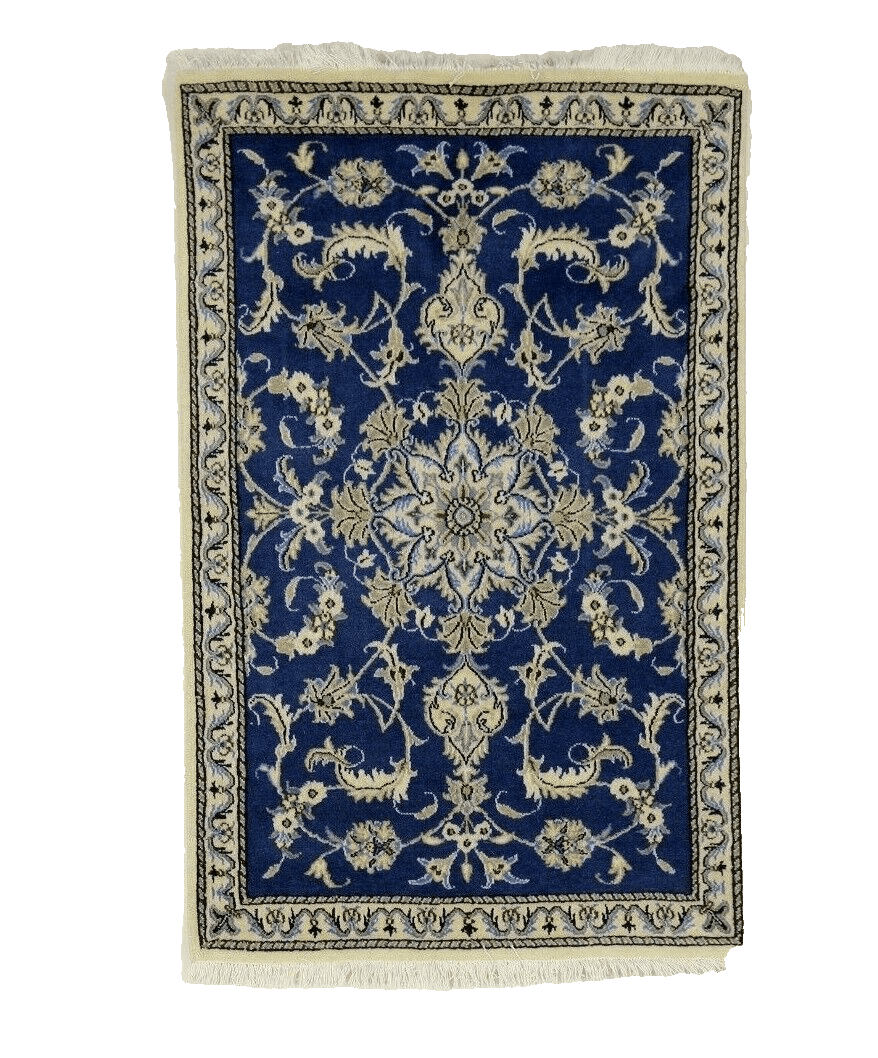
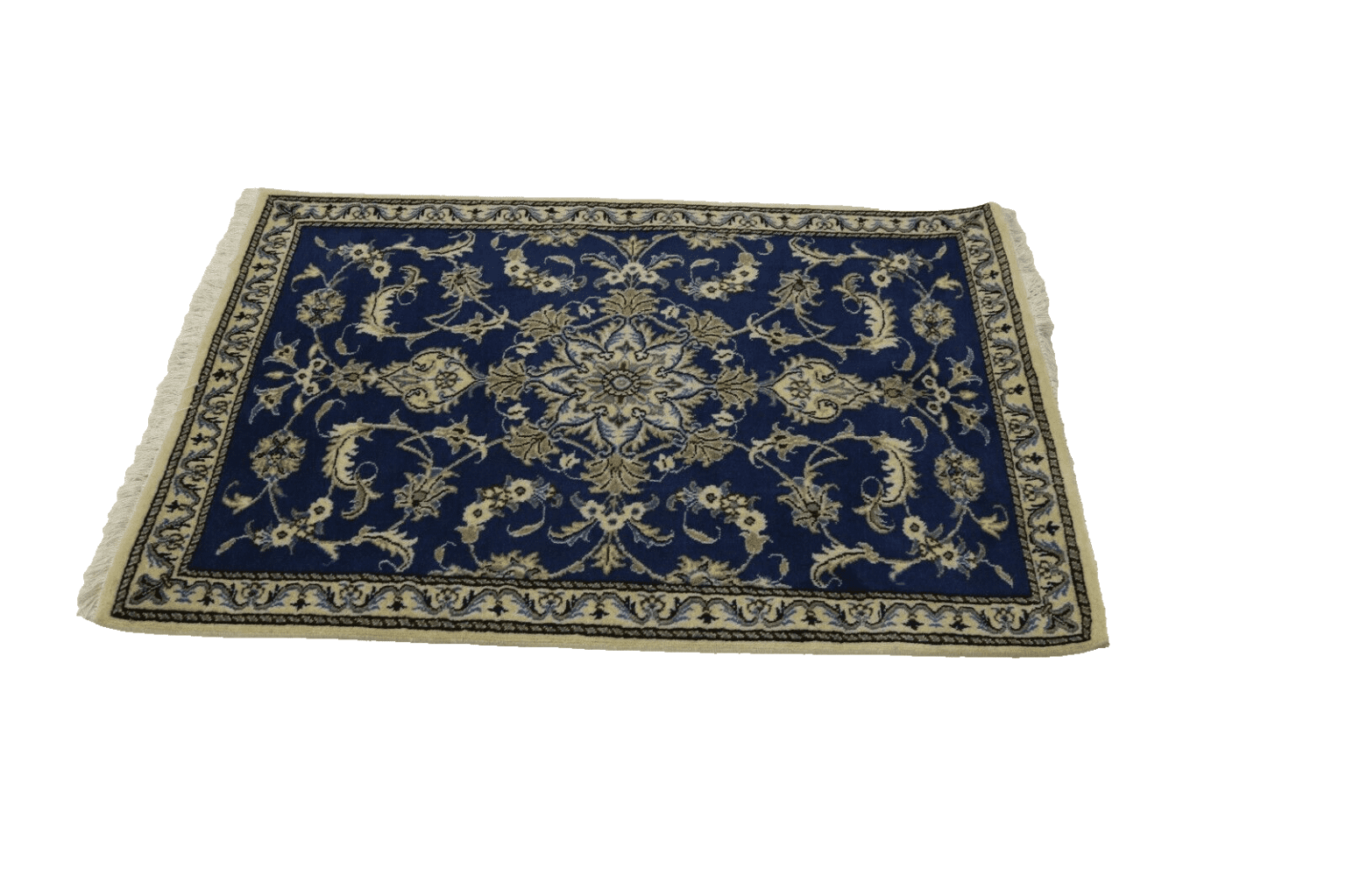
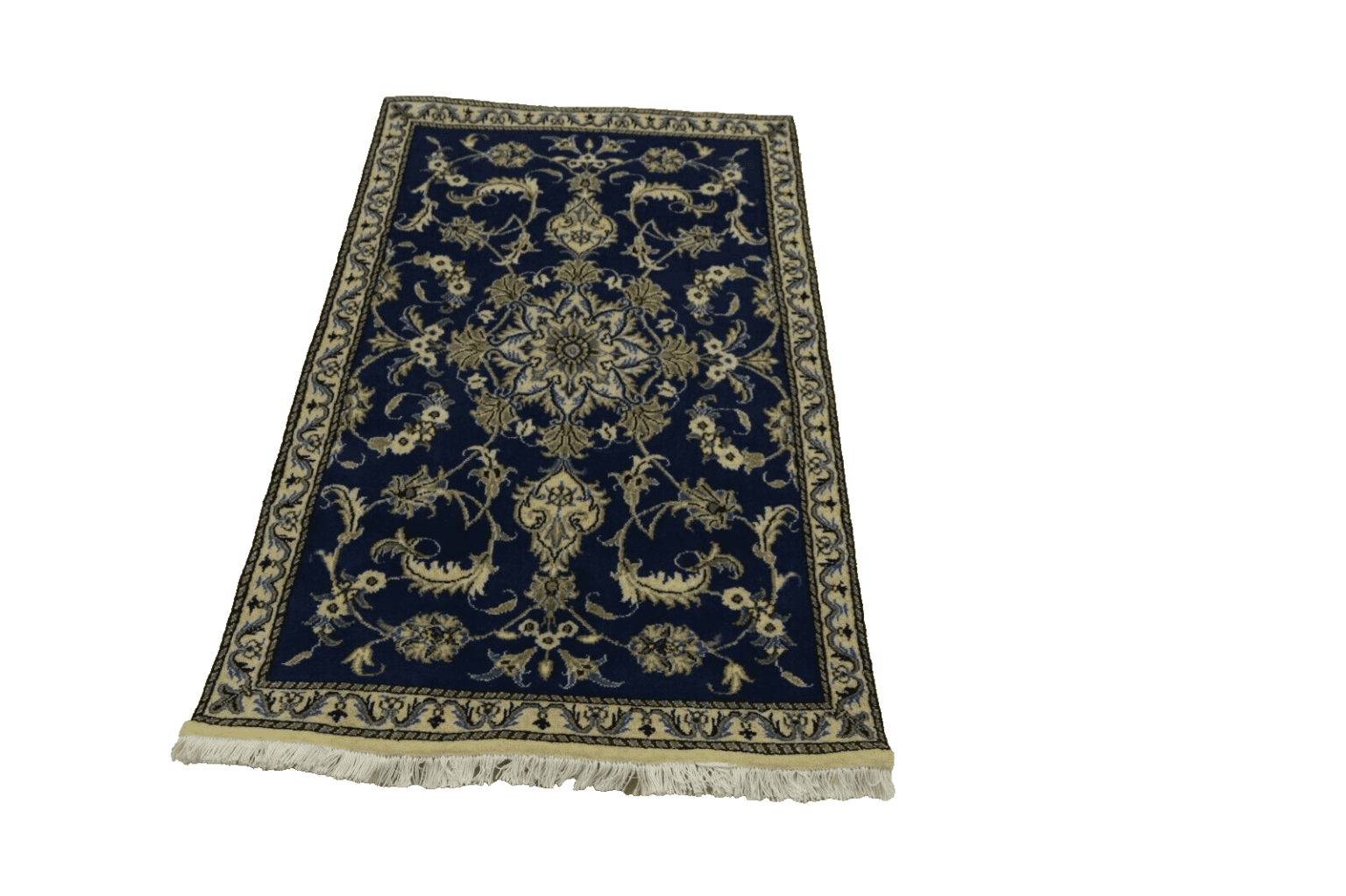
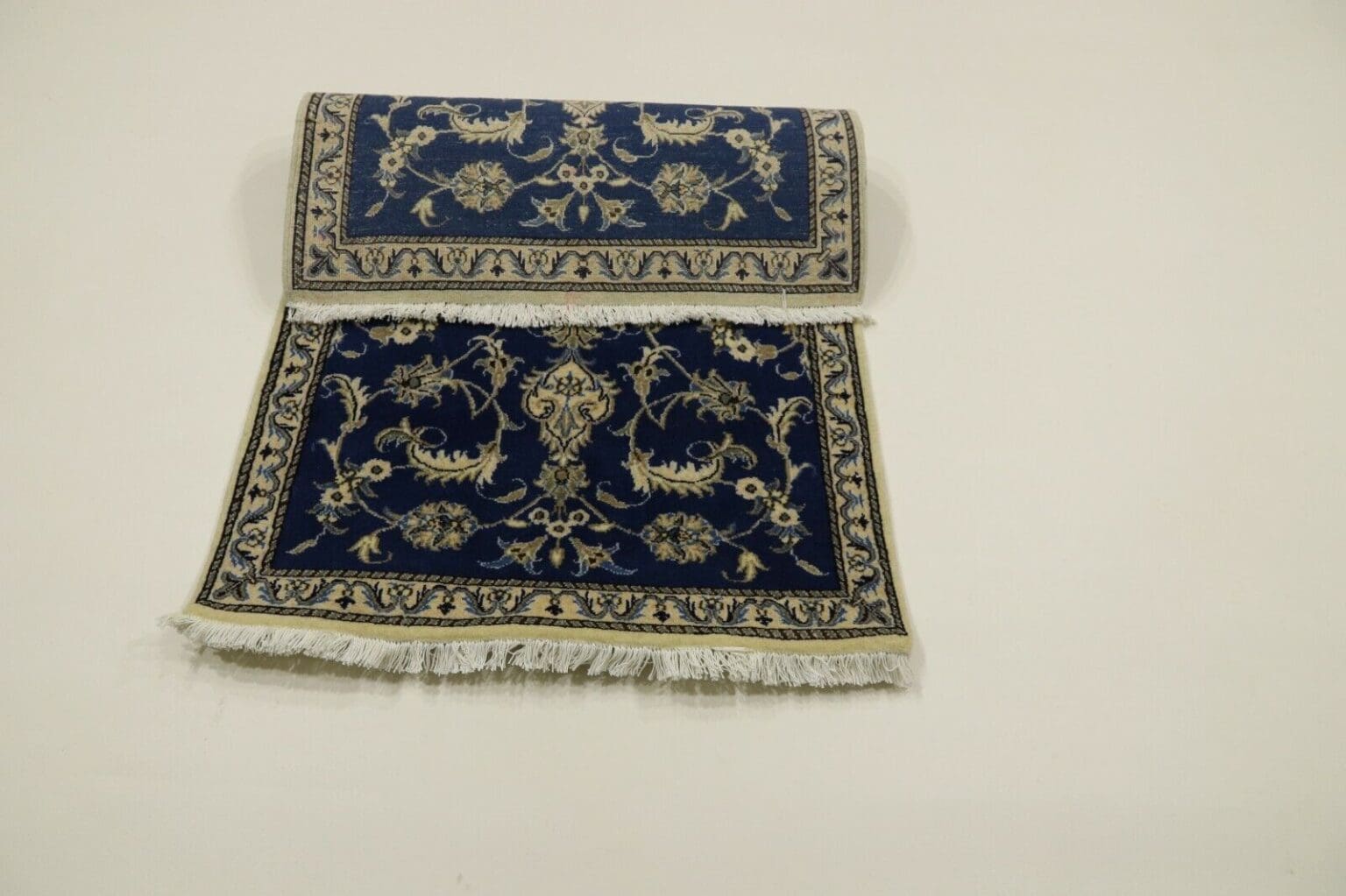
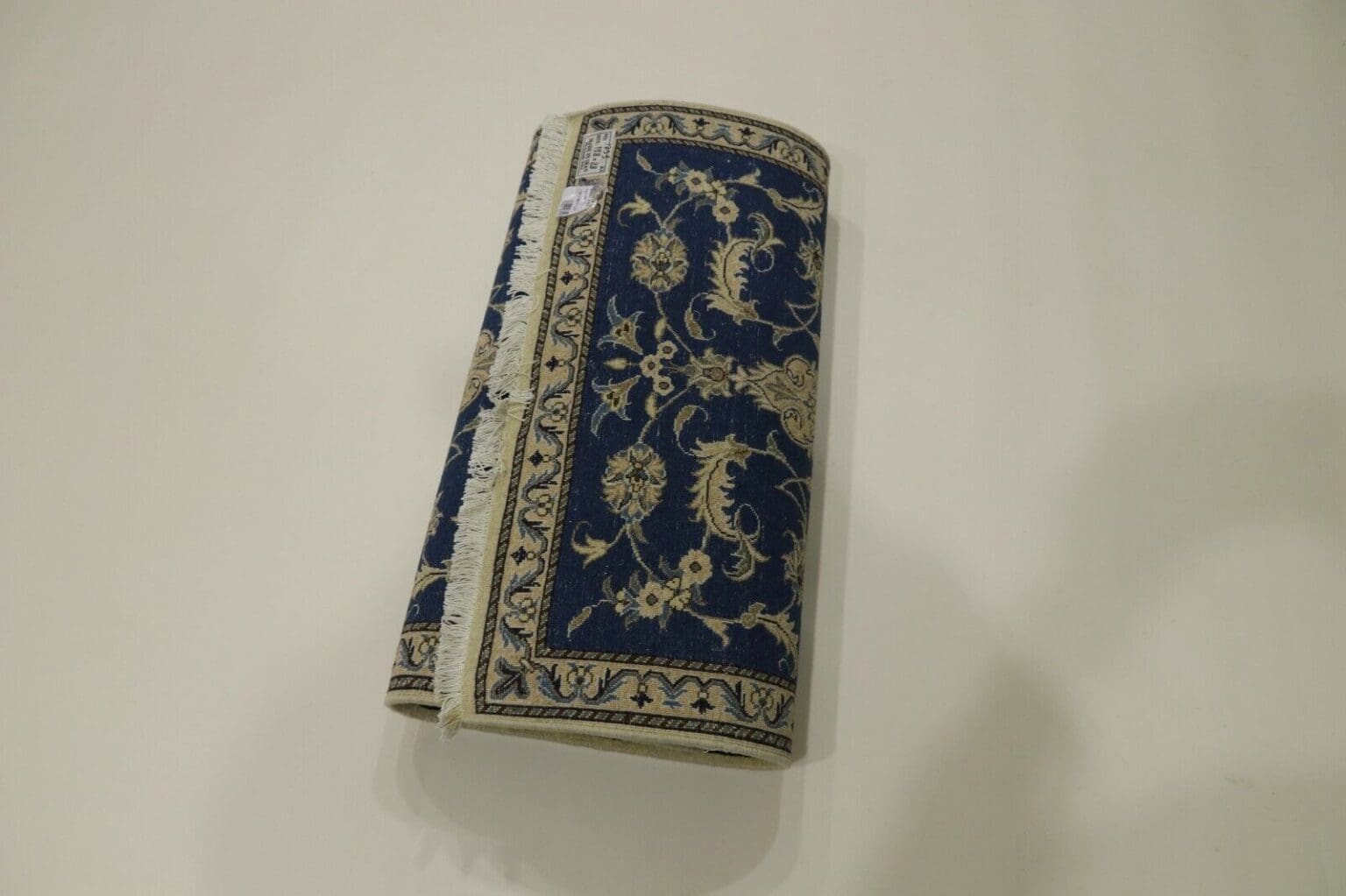
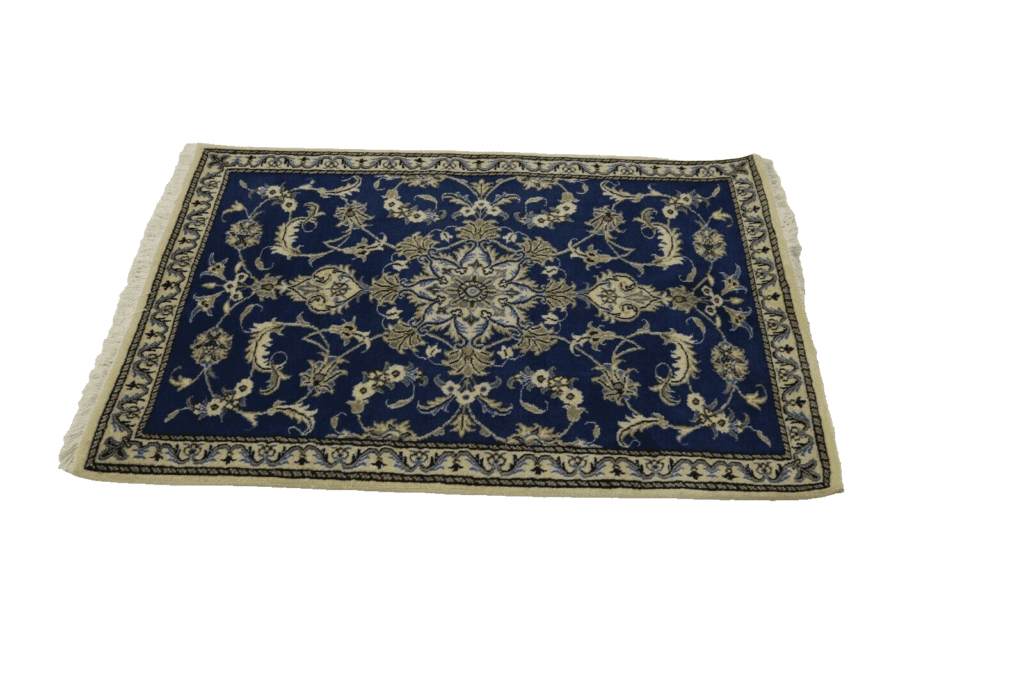
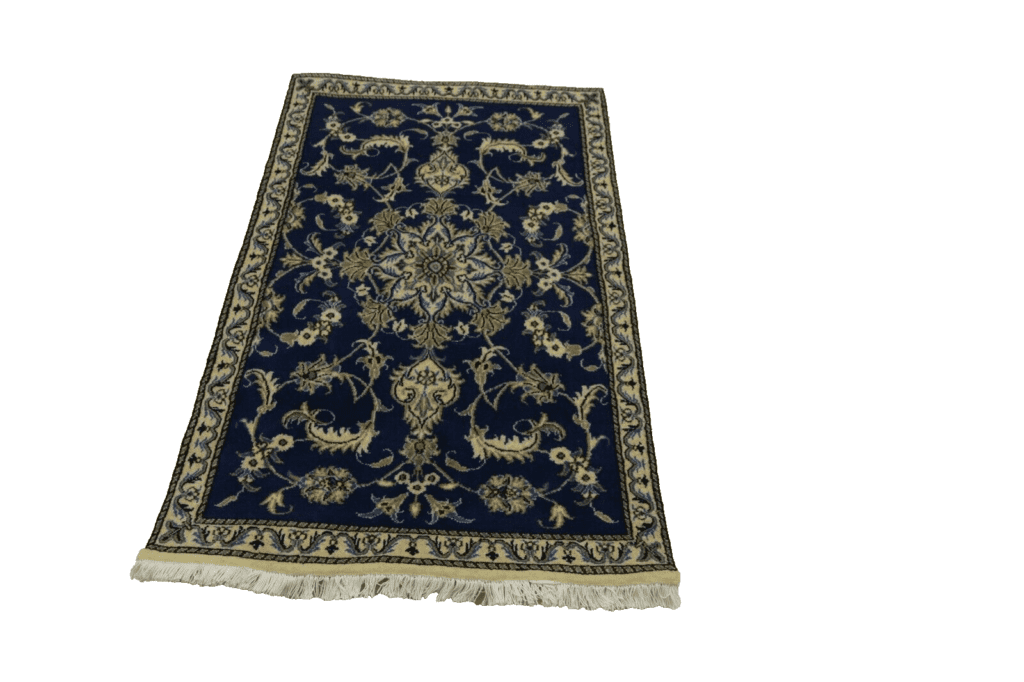
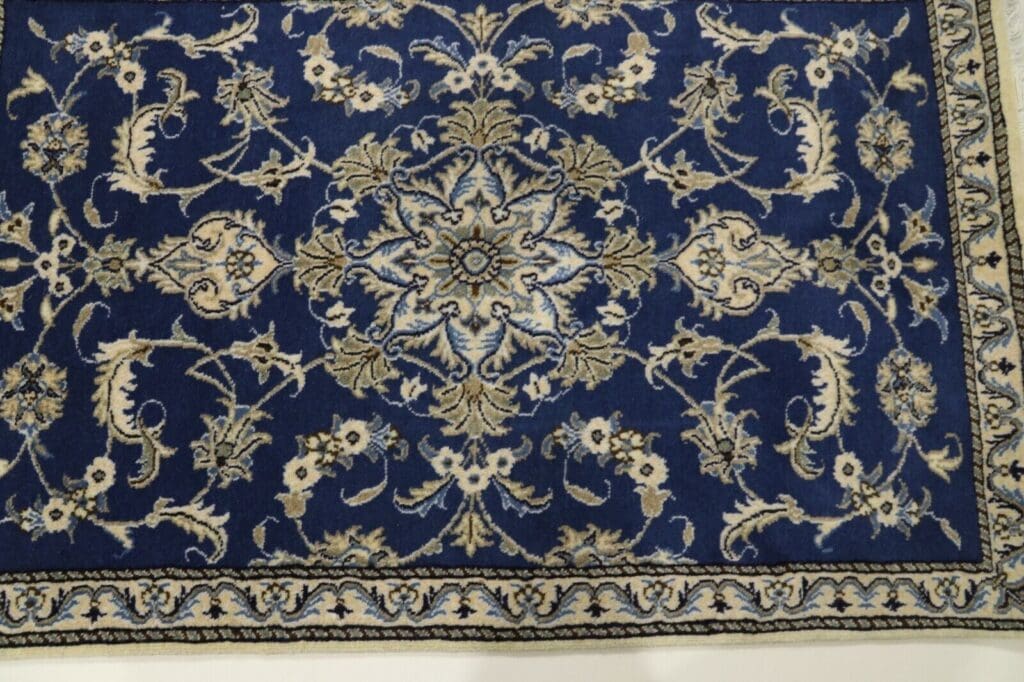
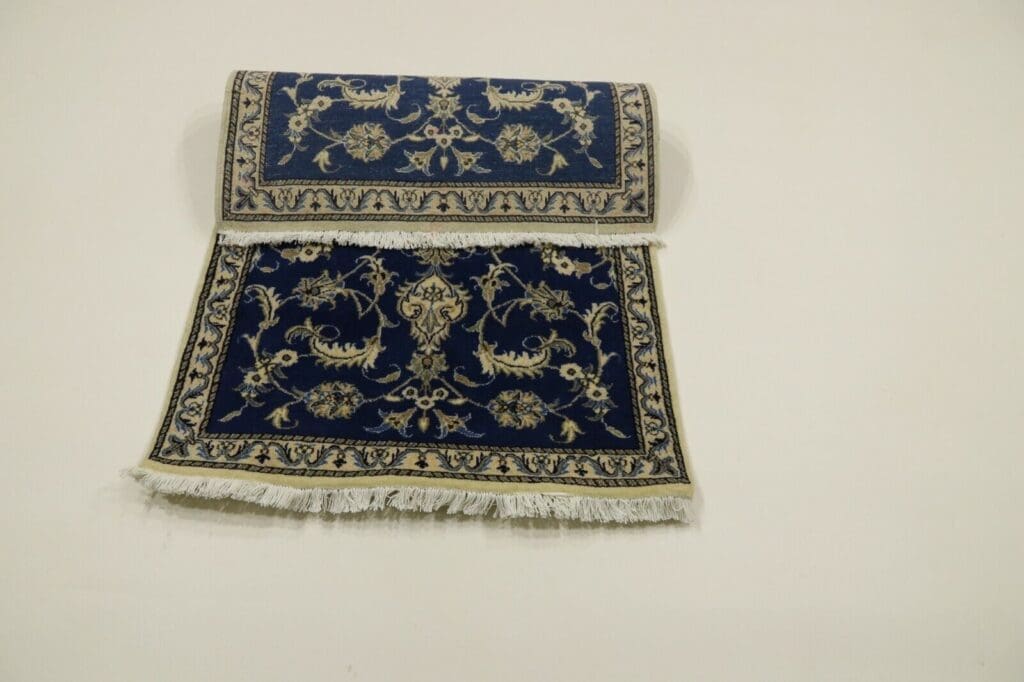
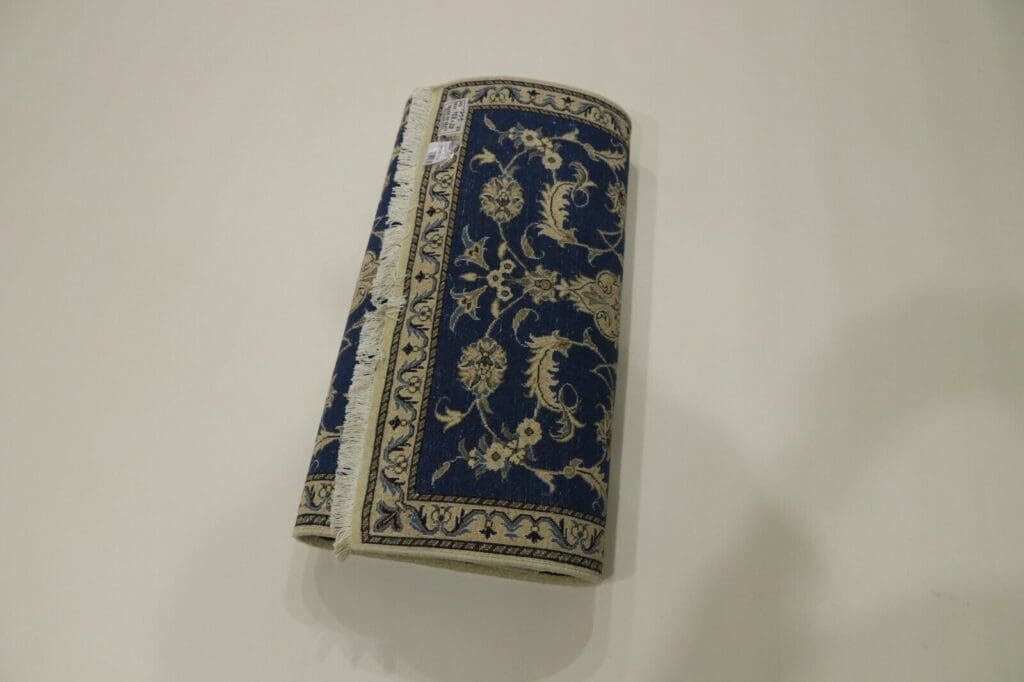
Hand-knotted Nain Persian rug | Knot density: approx. 300,000 knots/m² | Material: pile 100% virgin wool, warp cotton | Size: 138 x 88 cm | Pattern: Traditional Oriental-Persian, blue | Condition: New, very good
This Nain Persian rug is hand-knotted, with a pile made from 100% virgin wool. Cotton is used for the warp. This combination reflects a long-established foundation of Persian rug making: wool forms the visible and tactile surface, while the warp provides the underlying framework around which the knots are tied. Virgin wool is valued in rug weaving for its resilient fibres, pleasant feel and ability to take colour evenly. Cotton provides a firm, regular basis for the construction of the rug.
In hand-knotting, each knot is tied individually around the warp threads and then secured with weft threads. The rug therefore takes shape row by row as the design is built directly into its structure. This process differs fundamentally from machine production, where the pattern and construction are created through an industrial mechanism. Hand-knotting requires continuous attention to tension, alignment, knot placement and the intended drawing. The knot density of this rug is approximately 300,000 knots per square metre, allowing a finely articulated pattern structure.
The virgin-wool pile gives the surface a natural textile character. Wool has a fibre structure that helps it handle warmth and moisture in a way that has made it useful for household textiles for centuries. Cotton in the warp supports the regular arrangement of the foundation threads. Together, the two materials create a construction in which the soft visible pile is attached to a stable woven base. The rug is described as new and in very good condition.
Hand production also means that the finished surface is not the result of an entirely uniform industrial repetition. Subtle variations in tension, knot appearance and colour impression can occur as part of the making process. They reflect the fact that the weaver transfers the design directly into the textile rather than applying it to a completed surface. This particular rug is identified as a unique one-off piece, not as one item from a group of identical machine-made products.
Origin and Tradition
Persian rugs belong to the historic rug-making culture of Persia, now Iran. Nain is one of Iran’s recognised rug centres and is associated with carefully executed rugs, precise drawing and refined workshop production. The city is located in central Iran, in an arid region shaped by long-standing links between settlements, trade routes and craft communities. Its rug tradition developed from older Persian weaving and knotting practices and was maintained through specialised workshops.
Nain rugs are often associated with a balanced overall composition and clearly articulated ornament. Regional designs may include a central medallion, scrolling floral forms, repeated leaves and a coordinated border. These are not the requirements of one single fixed pattern; they describe a family of design principles that can be interpreted in many ways. Careful symmetry, controlled outlines and an orderly relationship between the field and the border are recurring features of the broader Nain tradition.
Persian rug making depends on knowledge passed through families, workshops and local communities. The craft includes preparing the foundation, keeping the warp under suitable tension, placing the knots, inserting and beating down the weft, trimming the pile and finishing the edges. Preparing wool and selecting colours are also part of the wider process. A design is not printed onto a finished textile. It is created through the interaction of knots, warp, weft and colour as the rug is woven.
The history of Persian rugs includes both practical household textiles and pieces made for formal or representative settings. Rugs have been used in homes, reception areas and religious or public spaces. Their designs may draw on plants, gardens, geometry and inherited visual symbols. Over time, regional forms were refined, combined and adapted by different workshops. Nain represents a city-based tradition in which a calm sense of order can be combined with detailed workmanship and carefully balanced ornament.
The name Nain places this rug within that regional Persian context. It identifies a tradition of origin and design rather than a modern industrial production category. Even where workshops work with familiar pattern families, each hand-knotted rug remains a separate textile. Proportions, colour distribution, line quality and the handling of small details depend on the work carried out on the individual piece.
Persian knotting traditions were shaped over centuries by trade, movement of craftsmen, workshop relationships and the exchange of patterns. Motifs could travel beyond their original region while being adapted to local materials and methods. Nain rugs form part of this wider Iranian history of regional interpretation. Their tradition rests on the combination of established visual language, disciplined handwork and the ability to render a design clearly through a dense knot structure.
The cultural background of Persian rugs also explains why their patterns are more than arbitrary surface decoration. Repeated plants, garden references, geometric divisions and border systems can express ideas of order, continuity and balance. At the same time, a rug is a practical textile intended to be used in a living environment. The Nain tradition brings these two aspects together: a functional woven surface and a carefully organised decorative composition created by hand.
Design and Pattern
The design of this rug is described as traditional Oriental-Persian, and blue is specified as its colour. In Persian rug design, blue may create a continuous visual field, separate motifs, define outlines or provide emphasis within a border. Its effect depends on the way it is distributed and on the colours placed beside it. A blue rug can therefore appear quiet and unified in one arrangement or more strongly contrasted in another. The documented colour is blue; the precise shade and complete palette are not defined further.
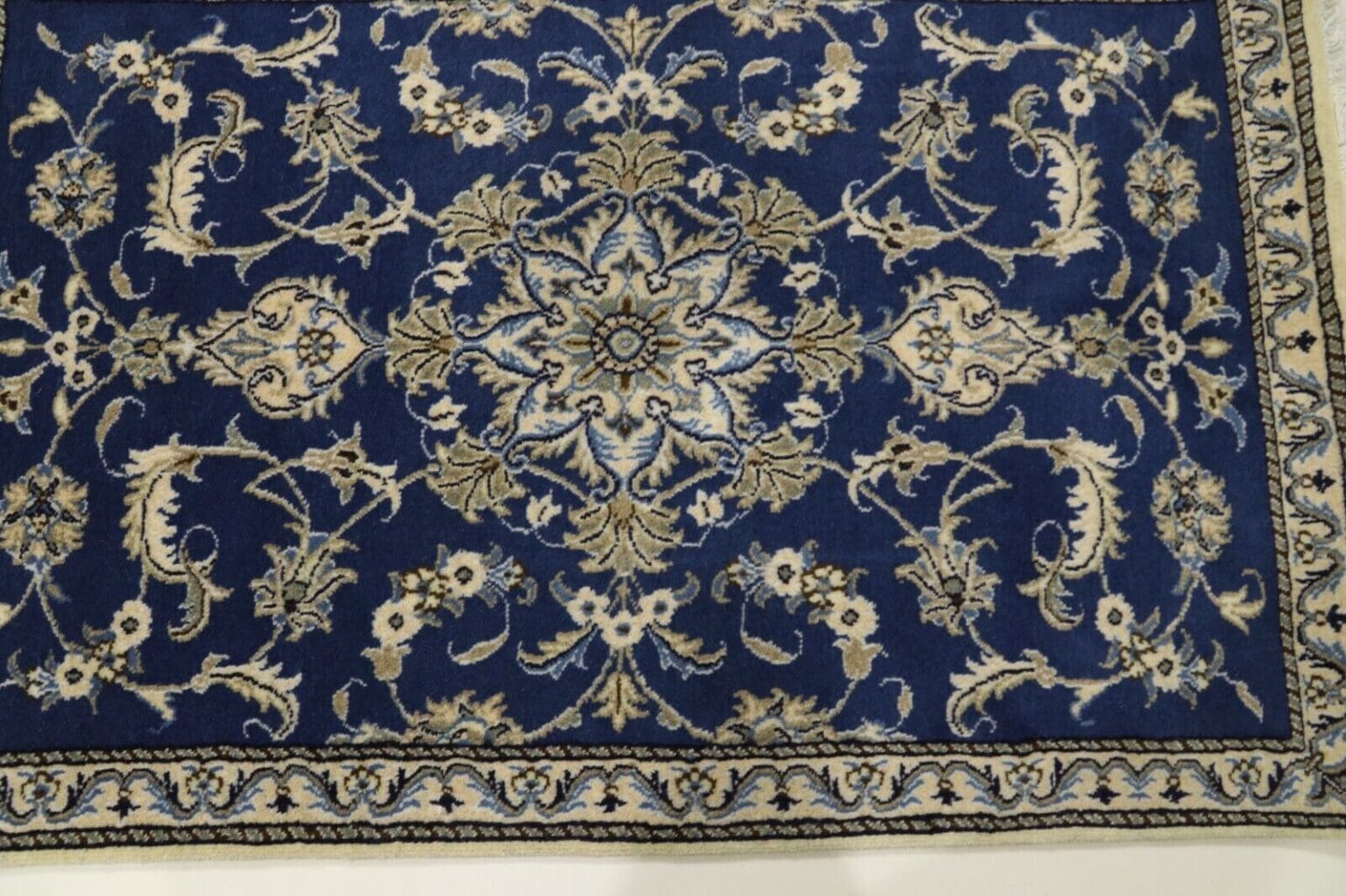
Traditional Persian compositions often rely on a clear hierarchy of forms. A central motif may be surrounded by scrolling vines and floral details, while an outer border gives the design a visual frame. Other designs distribute repeated elements across the field rather than concentrating them in a single medallion. In both approaches, readability is created through rhythm, symmetry and a measured relationship between large and small forms. The description “traditional Oriental-Persian” places this rug within that established design language without assigning an undocumented individual motif.
Floral ornament is common in Persian rug art. Flowers and vines may be represented in recognisable form or reduced to stylised lines, leaves and repeated units. Their purpose is not only to imitate nature. They can organise the surface, lead the eye through the composition and connect the centre with the border. Geometric elements can add proportion, repetition and directional structure. Persian designs often combine organic and geometric features, allowing the pattern to appear both flowing and carefully controlled.
The level of detail in a rug is closely linked to its knotting technique. A dense knot structure can support finely graded outlines, narrow passages and small ornamental units. It allows a weaver to distinguish adjacent shapes and to keep delicate lines legible within the overall composition. Knot density does not itself determine which pattern is used; it is a technical means of translating a chosen drawing into textile form. The traditional appearance of a Persian rug comes from the relationship between the drawing, the colour arrangement and the construction.
Blue has a long history in Persian and Oriental textiles and can be used in many visual roles. Depending on dye, wool, light and neighbouring colours, it may read as deep, cool, muted or luminous. A blue area can support a border, frame a central arrangement or tie repeated motifs together. Colour in a rug is therefore experienced through the complete composition rather than through an isolated colour name. The effect remains specific to the individual hand-knotted piece and its actual distribution of colour.
The product description names children’s rooms, living rooms and bedrooms among the possible settings for this rug, as well as other rooms. In a living space, a traditional pattern can define an area, connect furnishings and introduce a textile layer without relying on a modern printed design. The blue colouring can be coordinated with neutral materials or used as a deliberate accent. Its suitability for different rooms follows from the stated range of possible uses, while the final placement depends on the interior in which it is used.
Persian motifs can carry cultural associations through references to gardens, vegetation, symmetry and geometric order. This broader tradition explains why rug ornament may have meaning as well as decorative function. It should not, however, be confused with attributing a particular symbol that is not identified for this piece. The documented characteristics here are its Nain Persian classification, traditional Oriental-Persian style and blue colouring. Those features provide the proper basis for describing its design.
Special Features
A central feature of this rug is its hand-knotted construction. Each knot is placed by hand in a process that builds the pattern into the textile itself. Combined with a knot density of approximately 300,000 knots per square metre, this construction supports a finely worked visual surface. The pile is 100% virgin wool, while cotton forms the warp, giving the rug the material combination stated for this piece.
The rug is described as new and in very good condition. It is also identified as a unique one-off item, so it is not presented as one interchangeable example from an identical series. Its Nain classification connects the individual textile with a Persian regional tradition. The traditional Oriental-Persian style and the blue colour provide the specifically stated design characteristics.
Hand-knotted rugs are valued as durable textile objects because their construction is made from individual knots supported by warp and weft. The appropriate care depends on the material and the type of soiling. For this rug, the stated combination of virgin wool, cotton, hand knotting and new condition defines the principal features. These characteristics distinguish it from a printed floor covering and explain why its pattern is part of the textile structure.
FAQ
How should a hand-knotted Nain Persian rug be cleaned?
For routine care, use a vacuum cleaner without a brush attachment. This removes loose dust while avoiding unnecessary agitation of the pile by a rotating brush. If the rug is more heavily soiled, use a specialist rug cleaner or arrange professional cleaning. A suitable professional process helps protect both the colours and the structure of the wool pile. Cleaning products should not be applied casually to a visible area, since natural fibres can react differently to moisture and chemical agents. For thorough cleaning, consultation with an experienced rug specialist is the sensible approach.
How can the rug’s service life be extended?
Keep the rug away from direct sunlight, as prolonged exposure can cause the colours to fade. Rotate it regularly so that everyday use is distributed more evenly across the surface. Avoid placing heavy weights on it for extended periods, as this can put unnecessary strain on the material. Spills and dirt should be addressed promptly and gently rather than treated with aggressive products. When the rug has significant soiling or a difficult stain, professional advice can establish the safest cleaning method for the wool pile and cotton foundation.
What are the advantages of hand-knotted rugs?
Hand-knotted rugs combine a labour-intensive making process with natural materials and an individually executed design. Since each knot is placed separately, the construction can support a dense structure and detailed pattern work. Compared with machine-made rugs, hand-knotted pieces often have a distinct textile character and a more individual execution. Virgin wool is used for its pleasant feel and resilience, while the knotting method makes the design part of the fabric rather than a surface print. This rug is additionally described as a unique one-off piece, so its particular arrangement is not presented as an identical serial repetition.
To provide the best experiences, we use technologies like cookies to store and/or access device information. Consenting to these technologies will allow us to process data such as browsing behavior or unique IDs on this site. Not consenting or withdrawing consent, may adversely affect certain features and functions.
Functional Always active
The technical storage or access is strictly necessary for the legitimate purpose of enabling the use of a specific service explicitly requested by the subscriber or user, or for the sole purpose of carrying out the transmission of a communication over an electronic communications network.
Preferences
The technical storage or access is necessary for the legitimate purpose of storing preferences that are not requested by the subscriber or user.
Statistics
The technical storage or access that is used exclusively for statistical purposes.The technical storage or access that is used exclusively for anonymous statistical purposes. Without a subpoena, voluntary compliance on the part of your Internet Service Provider, or additional records from a third party, information stored or retrieved for this purpose alone cannot usually be used to identify you.
Marketing
The technical storage or access is required to create user profiles to send advertising, or to track the user on a website or across several websites for similar marketing purposes.
 SECURE PAYMENT
 SHIPPING PARTNERS


